Flotsam and Jetsam No. 26: Handmade Heaven

You can find many wonderful things handmade by artisans on etsy.com, and that’s where I went to get this matched pair of saddle-leather cases for my iPhone and iPad mini. It took some time and it wasn’t cheap (but then I’ve spent sillier money on pens), but these cases will outlast the gadgets in them, and maybe even the user:

You can find more from the maker here.

Penman No. 60: Enter the Listicle

Listverse

Penman for Monday, Aug. 19, 2013


I WAS online last week looking up the rumors about the impending release of the iPhone 6 on September 10 when I glanced at the sidebar of the page I was reading and spotted a new word out of the corner of my eye. The word was “listicle”, and immediately I wondered if it was something cold, sweet, and edible, or some sinister medical malady, some unnerving imbalance afflicting grown men.

I clicked the link, and learned something new, thanks to Anna Lawlor of The Guardian: “The journalistic lexicon has a new entry; the ‘listicle’, describing a list-based article. From The Sunday Times’ ‘100 Best Companies’ to Buzzfeed’s ’31 Things You Can Make Out of Cereal Boxes’, listicles are equally beloved for their condensed information format and online virility and decried as lazy journalism for the perennial lunchtime ‘news snacker’.”

News snacker? What the heck was a news snacker? Farther down the piece was the definition: someone who engages in “checking news content far more frequently, for short, sharp bursts of attention.” In other words, that’s someone who checks out the headlines on his or her mobile phone or tablet five to six times a day.

I suppose that’s me—I’m online all the time, and can’t help peeking into the news, my eBay bids, and the chatter on my favorite fountain-pen and Apple websites every few hours—but I’m also old enough to still be reading the newspaper from the front page to the back page with my morning coffee, and to watch one or two TV newscasts before bedtime. So rather than a news snacker, call me a news glutton, which I almost had to be to pick up a new word and concept like “listicle.”

Come to think of it, we are in the full-blown age of the listicle, and you don’t have to look much farther than the STAR to realize that. Toward the end of every July, the STAR celebrates its anniversary by coming out with lists of anything and everything its inspired Lifestyle writers can put together (in my case, this year, I offered “27 bits of advice I give to young writers”).

If lists float your boat, then you have to be a regular on listverse.com, which serves up lists of such engrossing subjects as “10 strange non-sexual ways people have orgasms,” “10 creepy historical vampires you’ve never heard of,” and “10 unconfirmed victims of famous murderers.” (Talk about learning something new: from a list of “10 earliest versions of everyday technologies,” we learn that the first smartphone—with email, predictive typing, and some basic “apps”—was an IBM phone named Simon, which weighed a pound, was the size of a brick, and sold for nearly $1,000 back in 1994.)

But there were lists, of course, long before the Internet. In 1977, David Wallechinsky, Irving Wallace, and Amy Wallace compiled the first Book of Lists. Featuring such irresistible morsels as “famous people who died during sexual intercourse,” the book became a hit, and was periodically updated and reissued.

As you can see, some lists are more serious and some more ridiculous than others, although we should probably admit that silly lists are usually more fun to read. No one really talks much about lists like “10 things we need to do as a nation to move forward,” although we should. By their very nature, lists draw attention and achieve popularity because they seem to create patterns we’ve never seen before in the raw, undigested mess of our daily lives; patterns are intriguing if not mesmerizing, a kind of eye candy of the mind, but also reassuring at the same time, in that they bear the promise of an underlying logic to everything. Lists create mass, and mass creates credibility if not consequence.

To get on the serious side of lists, the first “listicle”—certainly the best known to lit geeks like me—has to be the “catalog of ships” in Book II of Homer’s Iliad, where every Greek and Trojan chieftain who took part in the Trojan War is listed along with a description of his home city and the ships he brought with him. There’s a lot of debate among scholars about the historical veracity of this catalog, there being a 500-year gap between the war and Homer’s own time, but some scholars have come to the all-too-human conclusion that, well, lists change and grow with time. As a website devoted to Greek studies puts it:

“An intermediate theory is that the catalogue developed through a process of accretion during the poem’s oral transmission and reflects gradual inclusion of the homelands of local sponsors by individual singers… In the most recent extended study of the Catalogue, Edzard Visser, of the University of Basel, concludes that the Catalogue is compatible with the rest of the Iliad in its techniques of verse improvisation, that the order of the names is meaningful and that the geographical epithets evince concrete geographical knowledge. Visser argues that this knowledge was transmitted by the heroic myth, elements of which introduce each geographical section… W. W. Minton places the catalogue within similar ‘enumerations’ in Homer and Hesiod, and suggests that part of their purpose was to impress the audience with a display of the performer’s memory.”

(Note to self: add “Edzard Visser” and “W. W. Minton” to a list of “names that sound like heavyweight professors’ names.”)

The sidestep to Homer and the literary catalog reminded me of another famous employer of the catalog, the American poet Walt Whitman (known to many of us as the author of that perennial declamation favorite, “O Captain, My Captain!”), whose epic Leaves of Grass surveyed the broad American landscape and used poetry to do what Instagram might have achieved in another time, taking snapshots of the passing scene, creating quick portraits of “newly-come immigrants,” “the squaw,” “the connoisseur,” “the one-year-wife,” “the paving man,” “the canal boy,” and so on.

At its best—and Whitman shows how—the listicle, or at least its literary form, can achieve a transcendent significance, a more-than-the-sum-of-the-parts meaningfulness that ordinary lists such as “the 10 best-selling burgers in America” can’t convey. Whitman scholar Betsy Eikkila explains it thus:

“Whitman’s catalog technique serves as a democratizing device, inscribing the pattern of many and one. By basing his verse in the single, end-stopped line at the same time that he fuses this line—through various linking devices—with the larger structure of the whole, Whitman weaves an overall pattern of unity in diversity. This pattern of many and one—the e pluribus unum that was the revolutionary seal of the American republic—is the overarching figure of Leaves of Grass.”

If that was a bit much for you, no problem. There’s always listverse.com and its promise of a yummy news snack to get you through another day of tedium at the office, and you don’t even have to choose between “10 of the slowest plants to ever bloom” and “11 cool facts about polar bears”—you can have them both, and more. They may be low on fiber, but hey, they’re high on sugar.

Penman No. 58: Hello STOP Goodbye STOP

Penman for Monday, August 5, 2013

FROM INDIA, last week, came the news that the company that handles that subcontinent’s telegram service had sent out its last telegram, ending a facility that had been available to Indians since 1850. It was also from India that, two years ago, we received word of the demise of the last operating manufacturer of typewriters in the world, a company called Godrej and Boyce, which was still making up to 12,000 typewriters a year until 2009.

It might seem then that the horizon of obsolete technologies lies somewhere between Srinagar and Chennai, but of course we Pinoys know differently. For even in this age of Twitter, Instagram, SMS, and FaceTime, many Filipinos—the oldest and the poorest of us, that is—still have one foot firmly planted in the 20th century, and it will be a while before we’ll learn to let go, at least in our minds, of the things that made our life easier back in 1963.

A surprisingly comprehensive history of the Philippine telecommunications industry, written and published online by Federico and Rafael Oquindo, says that the Spanish began laying out a telegraphic service in the Philippines in 1867.

I’m not sure if we can actually still send paper telegrams to one another, since the old telegraphic companies have either died out or been taken over by telecoms giants more interested in moving money than messages. Your relatives would surely be more interested in receiving a MoneyGram from you, anyway, than your telegraphic best wishes. If you’re feeling wacky, you could also send them a singing telegram, which—for around P2,000—will include a box of chocolates to go with the guitarist and singer, and your favorite song.

But where has the old-fashioned, STOP-punctuated slip of paper gone? Gone the way of the horse-drawn carriage and the steam engine and the carrier pigeon, it would seem, replaced by faster, sexier, and maybe even cheaper ways of getting a message from A to B. In the US, Western Union sent its last telegram in 2006.

To be perfectly dry-eyed about it, few 21st-century citizens will miss and mourn the telegram. To send one, you had to go to an office and scrawl your message on a pad of paper—a message that, depending on your agent’s sharpness of eye and adequacy of mind, could come out garbled on the other end. The cost of the telegram was computed by the word, and how fast it traveled depended on how much of a premium you were willing to pay; I remember that “NLT”, or night letter, was the cheapest option, because you had to wait for some night clerk to attend to your message after everything else went out for the day. And then your telegram, encased in a flimsy plastic envelope, had to ride along with a bagful of others in the back of a motorcycle or even a bicycle to cross rivers and mountains to get to its recipient, two or three days after pushed your message across the counter.

It all seems too cumbersome and too quaint now, but there was a reason for the telegram’s popularity in its day. Very often, it went out to people and places without telephones (yes, there was such a country and such a time), and it was much faster than a regular letter, albeit more tight-lipped. Arguably, the telegram was unique in the power it conveyed and the significance it implied, for only the most important—both the saddest and the happiest—of messages merited a telegram.

Unlike SMS, or even the pager (remember EasyCall?) that preceded the cellular phone, the telegram was too slow for casual banter, too terse for courtship or argument. It worked best at bringing you the good news and the bad news: prizes won, loved ones lost, congratulations, condolences, reminders, pleadings.

I have a soft spot for the telegram, because it figured prominently in my literary career, starting with one I received in May 1969, informing me that I—then a high school senior—had won a national essay competition. Over the next two decades, at around this time of year, I would scan the horizon for the RCPI messenger, the bearer of the only telegram that mattered to me and hundreds of other aspiring Filipino writers: one sent by the Carlos Palanca Memorial Awards Foundation, telling us that we had won and inviting us to the September 1st awarding ceremony. (Our exuberant imagination supplied the rest of the unspoken message, which understandably would have cost the Palancas too much to tack on to their congratulations: “You’re a wizard of words, a literary lion, a paladin of prose whose works will sell a million copies, attract hordes of screaming fans, foment revolutions, and uplift human life and civilization!”) I did receive a number of those telegrams, a few of which I still keep as souvenirs, reminders of the Jobsian admonition to “stay hungry.”

There was one telegram I remember sending, sometime in the mid-1970s, from my small hometown in Romblon where I had gone on a short visit with my father and had quickly run out of cash, not having had much to bring in the first place. In desperation, I cabled my new bride Beng, whom I had to leave behind in Manila: “MISSUS I MISS US HONEY SEND MONEY.” And so she did.

And that’s all the old telegram companies do these days—send money to presumably happy recipients. Let text and Twitter take care of the bad stuff. If it’s the physical telegram itself you really want to send or to get, just so you can relive the good old days when people got inky fingers from writing long letters with fountain pens and licked postage stamps and waited for weeks to get something back in the mail, there’s hope for you. A company will still deliver a telegram to a Philippine address (and to over 200 other countries), for $24.95 plus 88 cents per word (no NLT option here); you’ll just need to go online at www.itelegram.com to avail yourself of this charming if pricey service.

SPEAKING OF other countries, it’s always good to read positive things about the Philippines when you’re abroad, even if they happen to be advertisements. In Hong Kong a couple of weeks ago, I beamed when I turned to the travel pages of a local newspaper and saw how many ads featured our national tourism tagline: “It’s more fun in the Philippines!” The ads offered special packages for Manila (read: the new Solaire casino) and other parts of the country (read: Boracay) via Philippine Airlines and Cebu Pacific.

Now, I’m one of those guys who—no matter how strongly I might criticize our foibles and follies back home—like to wave the Philippine flag when they’re on the road. Any chance I get, I invite my foreign friends to come and visit, allaying their usual fears by pointing out that they could get mugged in New York or robbed in Prague, anyway—they might as well enjoy our sunshine! Lord knows we need all the plugging we can get, with neighbors like Thailand roping in some 22 million tourists a year versus our 4 million.

I’m wondering now if it was schadenfreude—that wicked burst of pleasure you get when something nasty happens to your neighbor but not to you—that coursed through my veins when I came across an article in The Standard noted that traveling to Thailand was fraught with danger “from jet-ski scams to robbery, assault and even police extortion.” Hah! I thought—that’s what I’d been trying to tell my Hong Kong friends—it’s more fun in the Philippines!

Then I read on, turning the page: “Britain said Thailand is the country where its citizens are second most likely to require consular assistance, behind the Philippines.” Ooops! Sounds like we need to do a little more work in the Philippines.

(Image from philippinephilatest.net)

Penman No. 52: A Man of Many Hats

Me

Penman for Monday, June 24, 2013

I’VE BEEN writing about writing for the past eight weeks, so I hope my readers will indulge me this personal break, this little foray into male plumage.

You’ll probably notice that, this week, I’m sporting a new picture for this column—the first time I’ve changed it in years. I liked that old picture (taken by Raymund Isaac) and had been using it whenever I was asked for one, but I think the time has come to be honest with myself and my readers and to admit that, well, I just don’t look like that anymore. I’ve grown—and I look—considerably older, though happily also a bit leaner, thanks to my diabetes-induced diet-and-exercise regimen.

The most visible change in my new avatar, however, is the hat—one of a few I’ve been regularly wearing over the past year. People have been wondering why I’ve adopted what seems to be a foppish affectation—a practice I share with other writer-friends like Rio Almario and Teo Antonio; notably, National Artists Bien Lumbera, Frankie Jose, Bencab, Billy Abueva, and the late NVM Gonzalez have been known to wear hats or caps of one kind or other. I don’t mean to suggest, by citing such exalted company, that wearing a hat will boost my literary stock in any way, although I do hope, in secret, to be taken a little more seriously by dumping all that straw on my balding pate.

The fact of the matter is that I’ve been wearing hats for more than 20 years now. I picked up my first fedora from the Milwaukee Hat Store back in 1989 or so, when I was a graduate student there—and if you know how bitter Midwestern winters can get, you’ll understand that it was more for practical protection than about making a fashion statement. The fashion side came in choosing a felt fedora over a baseball cap, going for a ‘40s or ‘50s look over a ‘90s one (I do keep a small hoard of baseball caps for my morning walks around the campus). I still keep a felt fedora for when I have to travel to the West during the cold months, but here in the steaming tropics, felt (“felt” simply means mashed wool pulp) isn’t too practical, so that a straw panama hat makes more sense. It was one such panama I brought home with me in 1991 when I finished my studies, and I wore that hat to UP graduations for years, until it got lost somewhere.

Here’s a bit of Panama Hat 101: the best panama hats aren’t made in Panama at all, but in Ecuador—in a town called Montecristi, and another called Cuenca (the best hats come from Montecristi, but the most come from Cuenca). It’s said that the black-banded straw hat we now call a panama got its name when President Theodore Roosevelt was pictured wearing one during a visit to the Panama Canal. There’s no set system of grading panama hats, but the best Montecristis are woven so finely that you can roll them for storage and travel, and they’ll spring back into shape. Depending on fineness and quality of weave, color of straw, and other imponderables, a “panama” (there are many mass-produced ones being passed off for the real thing) can be had for anywhere from $25 to $25,000, the latter made by master weaver Simon Espinal. (Thanks to Brent Black of brentblack.com for all this information.)

The hat I’m wearing in my picture is a Montecristi, but a bargain item I got lucky enough to find on eBay for a lot less than $100. (Yes, I wore it all the way home from Virginia to Manila.) EBay is a great source for hats, watches, and pens—my old-guy passions—but buying a hat is like buying shoes: you need to know your exact size, or even the smartest-looking specimen will bring you nothing but grief. (My hat size can be expressed either as 7-1/2 inches, 61 mm, or Large; of course, even with the numbers on hand, you can expect some issues with fit and finish, so it’s best to buy a hat at a store.)

What do I look for in a hat? A sensible profile—nothing that will make me look like a cowboy, a gangster, or a pop star—and good workmanship. Of course, utility is also important. I have a very light, foldable “vineyard hat” for long days in the hot sun—this was the hat I brought to Batanes—because your sweat just wicks off the fabric; another hat, a thicker canvas one called a Tilley Endurable, is beloved of archaeologists, and boasts of being the best hat in the world, made with “British hardware and Canadian persnicketiness.” Another favorite that’s been with me for about 15 years now is an Australian rancher’s rigid felt hat, an Akubra, whose wide brim provides great protection against sun and rain (and against an opponent’s prying eyes at the poker table).

But let’s face it: like many of life’s imponderables, in buying hats, attraction trumps function most of the time. Last November, on a trip to Melbourne, I had to kill some time while they cleaned my hotel room prior to check-in, and I found myself wandering off to a nearby shopping center and coming face-to-face with a gorgeous hat in the men’s section—it was made not from the traditional, fine toquilla straw, but the somewhat rougher raffia, and it was woven not in Ecuador but Bangladesh, but it was handsomely blocked, and sat perfectly on my head when I tried it, like Napoleon’s crown. A peek at the price tag made me shudder and I put it back on the shelf immediately, and walked out to a balmy Melbourne morning; but the balmier the morning became, the more I convinced myself that a hat was the best and most practical Australian souvenir I could bring home, even if my trip had barely begun, and within the hour I was back in the store, forking over a plastic card for a straw bauble.

I still wear that hat most days, alternating it with the whiter toquilla, which is softer and lighter but also much more fragile. (You can’t wear a toquilla panama in the rain.) I realized what a good choice I had made with the raffia hat when I woke up in a hotel room one morning to find the hat completely drenched by an overnight drip from the airconditioner above; a few hours’ drying, and it was good as new.

I often wonder when and why we Pinoys stopped wearing hats, in this eminently hat-friendly weather; if you take a look at any street scene from the 1930s, you’ll see Filipino men, rich and poor alike, wearing hats. Here and there—in places like Baliuag and Lucban—you can still buy a good locally made hat, but we have a long way to go to catch up with the weavers of Montecristi and Cuenca. With cheap Chinese-made baseball caps in abundance, I’m sure not too many people care. That’s all right—I’ll just keep wearing my silly hat to my senior’s sickbed, then tip it to my nurse when the time comes.

Hats

Penman No. 44: Pen Boys’ Weekend

Chito and JPPenman for Monday, April 29, 2013

AS IF two trips up to Baguio in early April weren’t enough, I went up a third time later this month. But while my previous sorties had to do with literature—high-minded work, you might say—this third one was purely for fun… and, well, okay, some education of the esoteric kind. That education, I hope, properly qualifies this piece for the Arts & Culture section, particularly as it has to do with my favorite subject of discussion, fountain pens—that’s right, those inky instruments of insistent individuality.

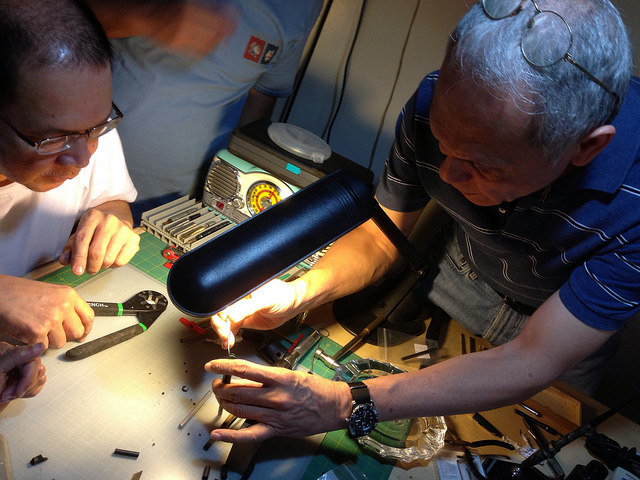
The members of our five-year-old pen club, the Fountain Pen Network-Philippines or FPN-P, had long planned to hold a vintage-pen-repair workshop in Baguio, and this month it finally happened. Why Baguio? Because that’s where our host—the Bali-based Fil-Am pest exterminator (seriously, that’s what he does for a living) Butch Palma—keeps house when he’s in the Philippines, with a veritable pen repair shop and laboratory in the basement. After some hemming and hawing, seven diehards signed up for the workshop: the onetime mechanic, nurse, and now banker JP Reinoso, our local “nibmeister” or master of nib repair and modification; the retired pharmaceuticals executive Chito Limson; the lawyer and DepEd Undersecretary Albert Muyot; the UP engineering major Jonathan Isip, our resident geek and IT specialist; the UP Special Ed grad student Cesar Salazar, who’s had as rich and varied a business background as any; and the two Butches, Dalisay and Palma.

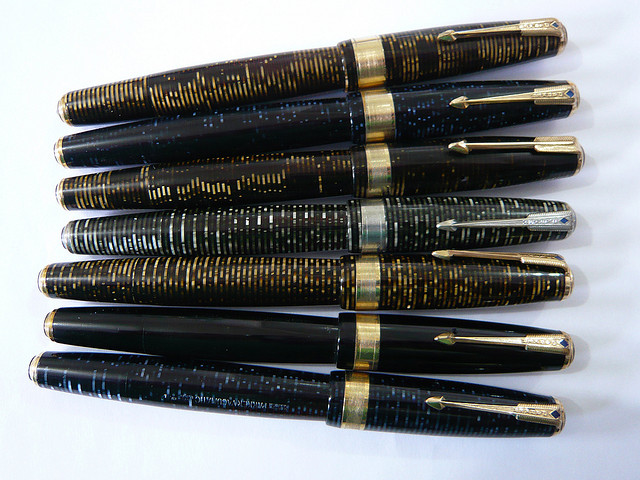
In FPN-P, my tocayo and I are known as the vintage-pen guys, since our collections (about 200 pens for me, and double that for The Other Butch, or TOB as he’s affectionately called in the group) lean heavily toward prewar pens. I have about 60 Parker Vacumatics—fabulous pens and eye candy, with colorful shimmering stripes—and have learned to repair them myself; TOB also likes Vacs, Sheaffers, and gold pens, and is far more advanced and experienced at repair than the rest of us. But what’s even more impressive about TOB is his armory of pen-repair tools, including a mean-looking heat gun and Dremel drill, maintained and arranged as carefully as a conscientious dentist might treat his picks and forceps. (The comparison isn’t as fanciful as it may seem; the dental pick is one of a pen repairman’s most constant friends.)

Fountain-pen repair is a lot like vintage-car restoration. You want the final product to come out all spiffy and shiny, but there’s a lot of work to do—often insanely complicated work—under the hood. You don’t need just the skills, which no one really teaches; you also need the parts, supplies, and tools, which can be as arcane as they come, such as an inner-cap puller for Parker pens, sac protectors for Sheaffer Touchdowns, lever boxes for hard-rubber Watermans, and rubber sacs and diaphragms of many sizes. These aren’t things you can pick up at True Value; they have to be sourced online, and then painstakingly practiced with, inevitably at the cost of a priceless pen or two.

And when a repair newbie’s eagerness outstrips his skills or his patience, disaster happens. Thirty years ago, as I was just getting hooked on pens, I found a rare, mustard-colored Parker 51 Vacumatic in a thrift shop in Michigan for 25 cents—not bad for a pen worth at least 1,000 times more—and promptly cracked the barrel with a twist of the pliers. (Memo to self: heat the barrel with a hair dryer before attempting disassembly, to let the plastic expand.)

Vacumatics

You would’ve thought that—dozens of fixed Vacumatics later—I would be a master at this, and maybe I thought so, too. But at TOB’s workshop, I made another dumb newbie mistake: using a tool I didn’t know without reading or following instructions. The tool in point was TOB’s heat gun, which sends out a blast of hot air like some kind of light saber. I was kidding my tocayo about his having a heat gun instead of a hair dryer because—well, if you see his shiny, saintly pate, you’ll understand why—and then I turned the heat gun on a 1940 Vacumatic that I was going to use to demonstrate my graduate-level skills to the nervous newbies. But, alas, before I could say “This is how…”, the heat gun vaporized a chunk of the pen’s barrel, and there in a smoky wisp went another of George S. Parker’s creations, having survived for over 70 years before some dumb monkey with a PhD zapped it to pen heaven.

Happily the rest of our weekend’s forays into the art of reviving dead writing instruments went much less dramatically, with positive results. Taking a break from headaches in primary education, Usec Albert (one of three Usecs in FPN-P, big fountain pens being a lawyer’s weapons of choice) learned how to replace a “jewel” or an ornament in the butt of a ca. 1960s Parker 61, Chito repaired the 1940s Vac of San Beda Prof. Pidoy Velez (threatening to bill him P8,000 per hour for the three-hour service), JP showed me how to breathe life back into a 1930s Touchdown, and TOB put together a pretty 1938-ish blue Esterbrook using a cap and barrel rummaged from my parts bin (and I found a black Vac barrel from his, to replace the one I ruined), so in the end, everything worked out just fine for the pen boys. (And just to get this straight, at least a third of FPN-P’s more than 300 registered members are female, some of them—the amazingly talented Ms. Leigh Reyes instantly comes to mind—blessed not only with formidable pen collections but with divine calligraphic skills as well.)

We didn’t do too badly as amateur pen repairmen go, but we were glad to be reminded that for truly difficult jobs and truly valuable pens, there are pros we can always tap around the world for their unique expertise. For the longest time, the bible of pen repairmen was the late Frank Dubiel’s “Da Book,” but a new generation of more scientifically savvy restorers has taken over. The legendary Richard Binder (who lent his name to the word “binderized,” to mean exquisitely finetuned and smoothened nibs) has himself retired, but nibmeisters John Mottishaw and Greg Minuskin can still refashion a perfect nib from a sorry scrap of gold, and out in Nebraska, Danny Fudge still services my Vacs and Duofolds when I can’t bear to break them myself. Ron Zorn in upstate New York has a backlog of at least six months, but he’s almost the only one who can properly put back a broken pen together—not with superglue or epoxy, but with a solvent weld that takes months to cure. (Can anyone here in Manila do these things? Beyond the simple repairs we did, the short and plain answer is no; Montblanc does do basic repairs in its service center in Rustan’s Makati, and sends on the tougher jobs to Hong Kong and Gemany.)

Is it worth it? That depends on how much you value your pens. If it’s a P500 Schneider or Inoxcrom, replacing it might be cheaper than attempting a fix; if it’s your grandfather’s Wahl Doric or Waterman Patrician, a $30 solution from Danny Fudge (plus postage, of course) will be a bargain. As far as I’m concerned, and as far as I can help it, every old pen deserves a second chance, if only because they’ll never be made again the way they were back in the 1920s. (That’s not entirely true: companies like Conway Stewart have come out with splendid revisions of the old classics, but these pens could cost you more than an iPhone.)

Boys being boys, and with our precious cargo back in their leather cases, we gathered around the table over scotch and coffee, and babbled into the wee hours about a host of manly subjects: cars and carburetors, terabytes and audio formats, Paul Simon and the Beatles, swords and light sabers, Malcolm Gladwell and Jared Diamond. Now and then some new words and brilliant ideas slipped into the conversation: hadoken, innumeracy, dyscalculia; now and then wives and women were mentioned, but not too often. And every five minutes or so, the talk drifted back to pens, about how gorgeous but oh how expensive the prewar Omas Extra Lucens was, about how Sheaffer Vac-Fills use a bewildering range of rod sizes, and, yes, how quickly vintage celluloid can melt in the wrong hands.

Such was our pen boys’ weekend, and—as I’m sure our wives appreciated—there are worse things men can spend their weekends on and weekends with than leaky Vacumatics.

Penman No. 39: A Weekend of Bargains

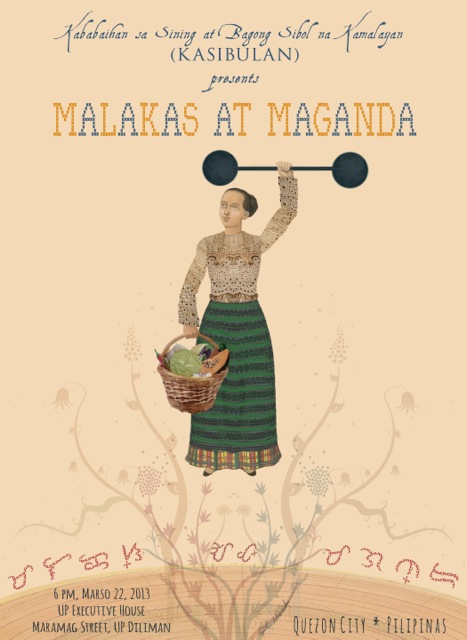
Malakas at Maganda baybayinHIGH RESOLUTION (3)Penman for Monday, March 25, 2013

BEFORE ANYTHING else, let me put in a plug for a show that my wife Beng is curating on behalf of Kasibulan (Kababaihan sa Sining at Bagong Sibol na Kamalayan). Founded in 1989 by such stalwarts as Imelda Cajipe-Endaya, Brenda Fajardo, Ana Fer, Julie Lluch, and Ida Bugayong, Kasibulan has since gone on to engage a new generation of leading Filipino women artists. Those women—older and younger—have come together in a major exhibit titled “Malakas at Maganda,” a celebration of the power of female artistry. The show opened last Friday at the Executive House at the University of the Philippines, and will run for a month. I’ve seen it, and I can guarantee—especially to my fellow men—that it’s a marvelous eye-opener.


AS THE minders of an empty nest, Beng and I can be excused for being foolishly footloose—running off to unlikely destinations like Melaka and Ho Chi Minh City on budget tours, leaving our daughter Demi with little more than a clutch of leaky old fountain pens for an inheritance. But we’ve never forgotten the fun of finding even cheaper thrills right here at home. Indeed, for all the traveling we’ve done, Beng and I inevitably come to the same old conclusion: it’s more fun in the Philippines.

A couple of weekends ago—after both of us had slogged through a particularly tough week of work—we decided to blow the weekend off on our favorite pastime: shopping for ukay-ukay bargains. For many years now, the two of us have been shameless and ardent ukay-ukay and thrift-shop habitués, partly out of necessity but more, I’d say, for the sheer adrenaline rush of getting something for next to nothing. Now and then I need to put on a blazer for business, and two of my favorites—a Zegna and a Ferragamo, brands whose posh boutiques I’d never think of stepping into—were both Cubao ukay-ukay finds, for about P150 each. (And, of course, being the inveterate tourists that we are, we’ve carried the habit overseas, scoping out and revisiting our favorite resale shops in New York, Virginia, and San Diego. The highlight of my shopping year is our October jaunt to the flea markets of Manhattan—a treat I’m going to have to forgo this year, my semestral break already consumed as of this moment by other commitments.)

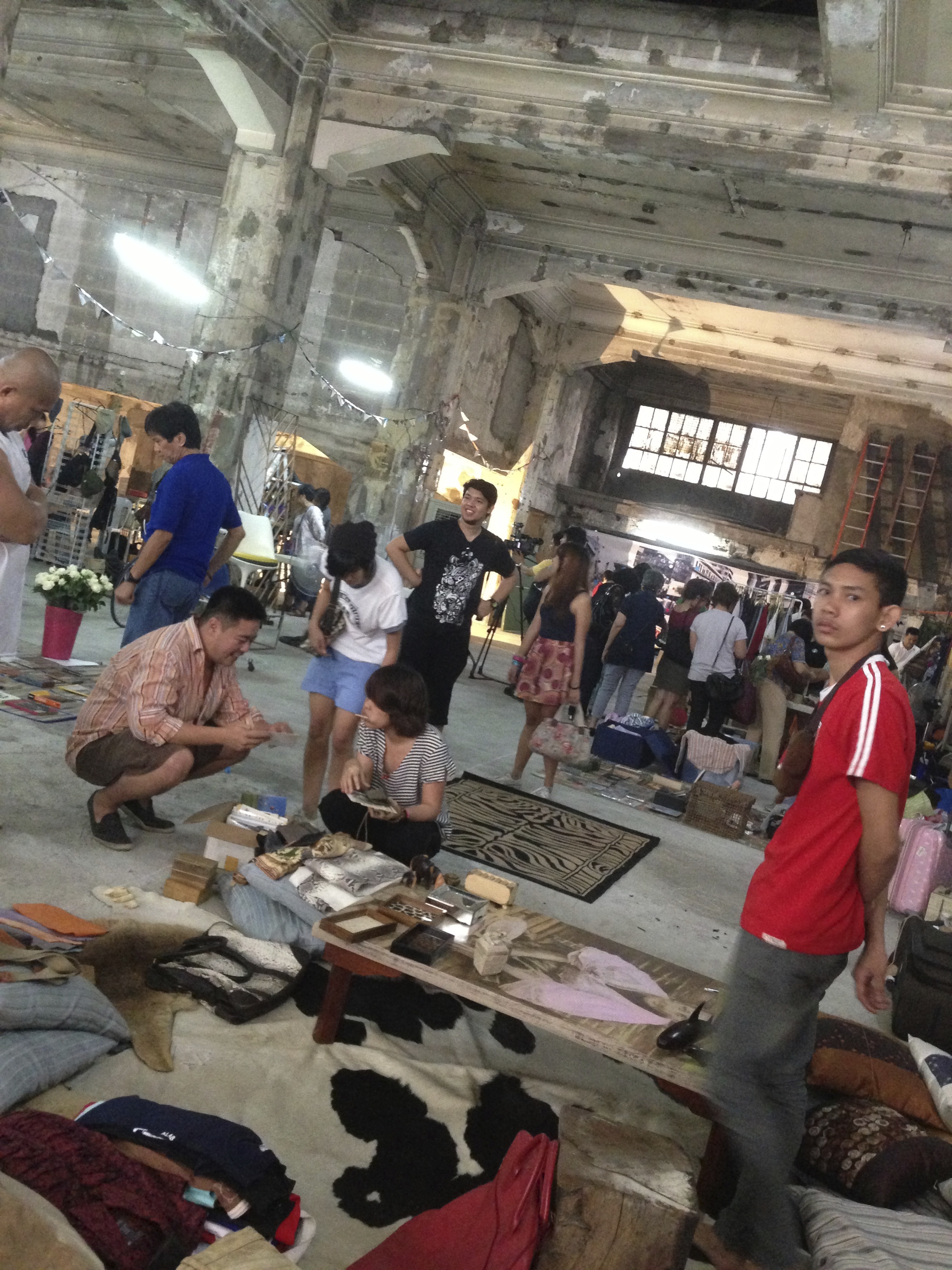
This time we had a special address on our weekend itinerary: the old Berg department store on the Escolta, where a group of young artists had organized a Saturday market. Beng spotted the notice on Facebook (she’s on it, I’m not) and it took little to convince me to go. I still remembered the Escolta of my youth, and how swanky it was back then. And they didn’t get much swankier than Berg, which was there before Rustan’s, before the malls, before eBay. (I have this recurrent dream of time-traveling to the past and walking into a store like Berg to the pens section, and, seeing row upon row of pristine Parker Vacumatics, picking out a blue and red Senior Maxima or maybe even a gold Imperial—the grandest of the ‘40s Parkers—and paying no more than P40 for each, a princely sum at the time.)

When we got there—from our parking spot in front of the iconic Savory Restaurant on Plaza Goiti—we saw that a crowd had begun to gather in the concrete cavern that was all that remained of the old store. Vendors—about 26 of them, I would later learn—had claimed their 2 x 2-meter squares on the bare floor and had laid out a cornucopia of books, clothes, shoes, trinkets, records, old bottles, cameras, bags, and other staples of the flea market trade.

IMG_0833

The people behind the event were the members of 98B, a “collaboratory” of young progressive artists led by Mark Salvatus, one of the brightest new names in the contemporary art scene. We had a happy reunion with Mark, whom we had come to know purely by chance almost ten years ago when we strayed into the Salvatus home and folk-art shop in Lucban during one Pahiyas. He was just starting out then, and we were glad to see him again—in old Escolta, of all places. His collective thought of the Saturday market as a way of revitalizing Escolta, a shabby relic of its old stylish self. “We’d like to encourage local businesses to grow,” said Marika Constantino, another 98B member, “which is why we didn’t bring in any food concessionaires, so locals could set up food stalls outside.” Another familiar face we ran into at Berg was that of Jason Moss—for many years now, Beng’s personal favorite and mine, another brilliant artist whose rise we’d predicted and followed. “He’s one of our guiding spirits,” said Mark. We gathered that 98B would look into regularizing the Saturday market—a great idea, going by the inaugural turnout.

Since we were in the neighborhood, Beng and I then availed ourselves of the opportunity to enjoy a hearty lunch of machang and pancit at Polland in Binondo. We walked off all that starch in our stomachs by following Ongpin all the way to Avenida Rizal (passing by another culinary landmark, the Ramon Lee fried chicken place in Sta. Cruz). Benighted as it may have been by the LRT overhead, this avenue—another childhood paradise—still contains many treasures for the bargain hunter. (I remember when, back in the early 1990s, I picked up a trove of gorgeous vintage pens—sold as new old stock—from the shops on Avenida for 1960s prices.)

This time, we plunged into a succession of ukay-ukay stores—one turned up a smart herringbone Ralph Lauren blazer (P380)—culminating in the three-story Japan surplus shop that we had visited years earlier and were glad to see was still there. The usual racks of clothes occupied the first floor, but on the top floor—the houseware section—were all manner of china and cutlery. Beng pounced on the bowls and teacups, but I took away a lovely lacquered bento box (P180) that I would use for my ink bottles. The floor also yielded possibly the day’s best score: two good-as-new Japan-made titanium eyeglass frames (P200 each) that Beng and I are now wearing with prescription lenses.

As if Escolta wasn’t enough, we took to the road the next day for more good food and cheap fashion—in Tagaytay, which has some of the best roadside restaurants and ukay-ukay palaces in the country. I suppose we use one as an excuse for the other—the eating and the shopping—but no one really needs an excuse to spend a lazy Sunday in Tagaytay, a treat we shared with Beng’s mom Juliet and her caregiver Meann, and our driver Vic. Food took priority, and our great discovery of the day was an unassuming restaurant along the ridge (turn right at the junction) called Tootsie’s. We had never been before, and were taking a chance since the usual suspects (bulalo at Leslie’s for me) were full to the brim, but we got lucky. Much to my mom-in-law’s delight, Tootsie’s proved to be something of a Visayan oasis in the Tagalog heartland, offering such delights as kansi bulalo (P485, soured with Bacolod batwan) and sus kadyos (P335). The crispy daing na biya (P137) was a terrific appetizer, and the roast chicken kawi (P305)—described by Chef Ed Quimson as an “unexpected, unintended chicken concoction on the way to a busy day” was a big hit, with its subtly smoky flavor.

Then we were off for a quick run to the ukay-ukay shops near the junction—I came away with a linen Giordano blazer for P200, and Beng picked up a straw hat for herself, rubber sneakers for Meann, and a cap for Vic—before dessert of halo-halo, turon, and mais con hielo at Ming’s on the way home. I tried not to eat too much, mindful of the inevitable connection between food and fashion. (The most visible beneficiary of my recent weight-loss program has been my waist, which dropped from a salbabida-size 40 to a more manageable 34. I had to send all of my pants to the tailor for alteration, but that’s easier to do with pants than shirts and jackets, so it’s also given me a great excuse to refurbish my wardrobe—all, of course, in the ukay-ukay. For the first time in years, I’ve been able to wear shirts marked L—without the X or XX—or even M. And thank God I didn’t throw or give away my linen Ferragamo, whose buttons I could barely close; today there’s room to spare.)

And so a fun weekend was had by all for not too much; we would morph back into working stiffs come Monday, but as we patted our stomachs and surveyed our haul from our forays that Sunday evening, Beng and I could only look forward to that long and endless weekend upon retirement, to be spent in the city’s and the world’s finest junk shops and food stalls.


Flotsam & Jetsam No. 19: There’s a Snake in My Pocket

Agatha1SHE’S HERE—that obscure object of my ardent and longstanding desire, the Agatha Christie fountain pen from Montblanc. If you see me walking minus an arm and a leg, that’s what it cost me—but I’m deliriously happy. Here’s that red-eyed beast up close (yes, those eyes are real rubies):

AC

Penman No. 32: Ten Tips for the eBay Newbie

ebayPenman for Monday, February 4, 2013

BEEN LOOKING for a DVD copy of the 1973 Hollywood musical Lost Horizon, a 1954 Omega Seamaster, a pair of Johnny Depp’s Moscot Lemtosh shades, an 11200-mAh power bank for your iPhone, or a 1988 Stipula Baracca limited-edition fountain pen? Well, I have—and I found them all, not in my neighborhood mall or ukay-ukay, but in that largest of global marketplaces, eBay.

I’ve been buying and occasionally selling on eBay almost from the very beginning, since December 1997, and now have a feedback of 520+ (thankfully 100 percent positive). In all those hundreds of transactions, I’ve had maybe three or four bum cases of sellers not delivering, or sending me bad stuff. All of those cases were sorted out and I was refunded, so I do believe eBay to be a generally safe place to shop, with lots of wonderful bargains to be had, but as with any marketplace physical or digital, it can be tricky for the unwary.

I thought of writing up this brief guide to shopping on eBay because, thanks to my recent articles featuring fountain pens, papers, and inks, I’ve been deluged with inquiries about where to find these items and for how much. In particular, vintage and premium pens seem to be in great demand—pens like the Montblanc 149 and 146, the Parker Duofold, Parker Vacumatic, and Parker 75, and 1920s Waterman pens with flexible nibs.

I’ve sold quite a few of these pens myself, having made a pledge (a pitifully weak one) to trim down my collection of about 200 pens by half. My recent acquisitions have tended to be more expensive, so to help assuage my wallet and my conscience, I’ve had to dispose some of my loot, if only to make room for more. That means that I have to find a steady and reliable source for pens both to resell and to keep, and that can only be eBay—where, at any given moment, there will be about 40,000 pens of all kinds to compete for my attention and my credit card.

So I’ve been telling my pen-seeking friends that they could save themselves a chunk of change by bypassing me and going straight to the source—where a slightly used Montblanc 149 (which sells new on Amazon for $810) might go for around $400. But I’ve also warned them that it’s going to be a slippery slope, fraught with dangers and risks—not to mention the biggest risk of all, which is to get infected with eBay shopaholia.

Even if you care nothing about pens, there are literally a million more things to be found on eBay.com and on its local site, eBay.ph—everything from a mummified monkey’s paw (which you can buy without bidding for $13.00) and an 1864 autograph of Abraham Lincoln (bidding starts at $4,995.00) to a 2012 Lamborghini Aventador (yours for $469,991.00). Very likely, they’ll be things you don’t need but will soon want—and want badly, so mind the following tips if you plan on shopping on eBay without risking your children’s inheritance or your marriage. I’m going to use pens to illustrate my points, but these tips can apply as well to cameras, shoes, bags, bikes, or whatever floats your boat.

1. Know what you’re looking for—know the product and its current market value. Do some research beforehand and establish what possible issues there might be with the item. For example, if you’re looking for a Montblanc, understand that vintage celluloid ones in good shape could command more than new ones in “precious resin”—but also that the 149 and 146 are the most faked pens in the world (along with the Parker Sonnet); eBay actually has a guide to determining fake MBs (which means, know your way around eBay as well). EBay’s “completed listings” is a great way to determine market value—look for the median price (discard lowest and highest prices) for a better sense of what you can expect to pay. Check other websites (Amazon, BestBuy, etc.) as well, because their special deals and offers could undercut eBay. I do most of my gadget shopping, for example, on dealmac.com.

2. Condition, condition, condition. In your enthusiasm for an item, you might forget to probe its condition. Read the description very well and look out for any flaws. Especially scrutinize all the pictures. (This also allows me to spot special features that others might miss—a broad stub on a nib, for example). I think I know pens well enough that I can tell make, model, year, and approximate value for most major brands on sight, but every pen is still unique once it’s up for sale. Keep an eye out for cracks, glue, broken tines, mismatched caps and barrels, discoloration, etc.

3. Set up a PayPal account. It will make your life a whole lot easier on the Internet, since PayPal has become a global standard for electronic payments. I’ve tied my PayPal to a specific bank account I use only for eBay transactions. Is it safe? Of course you’ll hear a horror story here and there, but in my own experience, eBay and PayPal have served me very well, settling questions and disputes and sending refunds very quickly in the rare cases of non-delivery I’ve encountered.

4. Keep looking. Since I now buy and sell pens, I check out eBay many times a day—I have it on my phone—and have set up search terms for my favorite items, like Parker Vacumatics. This enables me to find what I like quickly, in a marketplace where millions of items are up for sale at any given moment. Some of my best bargains have come when buyers in the US—my chief competitors—are literally asleep. I also check out ebay.uk and ebay.ca (the UK and Canada) and have found some of my best bargains there. The first thing I check is “newly listed”, further narrowed down to “buy it now”—this way I can catch the real bargains before anyone else does. Then I check “ending soonest.” You can also refine your searches, for example by looking just for “149” under “Montblanc” under “fountain pens.”

5. Check the seller’s feedback. I’d be wary of a seller with less than 95% positive feedback. He or she may not be a cheat, but has a poor service record (delayed mailings, no response, etc.)

6. Establish your bidding threshold early on. Don’t get caught in a bidding war with another bidder. These days, since I could be bidding on 20 items at any given moment (expecting to win maybe two or three), I just bid my maximum and forget about it until the last two minutes, which are really all that matters on eBay. Some people use sniping programs that let the computer make a last-second automated bid for them; I should, but have been too lazy to set one up, and I rather like the excitement of making the last-minute bid myself.

7. Figure out and factor in your shipping options. Since most of my purchases are made in the US, I use a US shipping address (my sister’s in Virginia) and aggregate my purchases there. When I’ve gathered a boxful, I ask my sister to ship them to Johnny Air Cargo in NYC, which forwards them to me in Manila a week later. I’m sure many of you have US relatives who can do this for you (just make sure that they’re willing—be very nice to them at Christmas). I’ve educated my sister on pens so she’ll know how to check out a pen when it arrives and how to handle and package them properly; and yes, I’ve given her a nice pen or two.

8. Pay promptly, and leave feedback. You’ll see how your own feedback will improve once you become a good eBay netizen.

9. If and when you encounter a problem, report it to eBay. They have mechanisms for dealing with problems like getting a defective item (unless it was so described) or not receiving an item you paid for at all. Take note that there’s a time window (45 days, I believe) within which complaints can be filed.

10. Don’t lose hope. I’ve lost out on bids for items that I’d coveted for years, but then found another one a week later, for cheaper. If you can’t find it on eBay, it probably doesn’t exist, or is illegal to own. For me, it’s fountain pen paradise, and another reason to wake up in the morning for.