Penman No. 12: A Spectacle of Orientalia

AK

Penman for Monday, Sept. 17, 2012 

I BELONG to a generation that grew up on Broadway musicals—before Broadway got all dark and grungy, and even if we’d never been to Broadway at that point. Thanks to the movies and to vinyl, it was perfectly possible to be transported from Boni Avenue in Mandaluyong to Salzburg and Manhattan, or from Barrio Malinao in Pasig to the South Pacific and Siam. It’s hardly surprising that today, as a grown man approaching 60, I can still sing songs from South Pacific, Carousel, The King and I, West Side Story, The Sound of Music, My Fair Lady, and Camelot with the verve, albeit without the voice, that I had at 17.

I’ve since had the opportunity to catch some musicals on Broadway and the West End, and while I’ve marveled at the visual and vocal pyrotechnics of such modern classics as Phantom of the Opera and Les Miserables, I miss the brave optimism of the old musicals—where, even in death, there was always a glimmer of hope in the end (“You’ll Never Walk Alone” in Carousel, “Somewhere” in West Side Story). I didn’t know then that this defiant cheerfulness was part of a commercial formula; I didn’t care. All I knew was that it felt good to whistle a happy tune, and that, approaching my crush du jour’s abode, I wanted to burst into a heartfelt rendition of “On the Street Where You Live” outside her window.

And so when I recently received an invitation from a long-time Penman reader and correspondent—the accomplished musical theater director Freddie Santos—to a preview performance of The King and I, there was no way that I was going to resist or refuse. The show took place at the Newport Performing Arts Theater at Resorts World a couple of Sundays ago, and my wife and I (or, as I rechristened the two of us, “The Beng and I”) arrived three hours early to see what the Resorts World buzz was all about, being staunch denizens of the North.

“I feel like I’m in Macau” was Beng’s first impression, and soon it was my jaw’s turn to drop when we entered the plush and capacious Newport Theater. It seemed like a daunting cavity to fill, but nothing fills space like music, and as soon as the overture began and the curtains rose, we were all elsewhere.

I had seen the Yul Brynner-Deborah Kerr film version of the musical many times, and so I wondered how Freddie Santos was going to convey all that convincingly in a practically all-Filipino production, but I needn’t have worried. Freddie earns this shameless plug: this is a wondrously good show, so good that The Beng and I will gladly return as paying patrons with friends to see it all again.

In a sense, The King and I is almost pre-programmed to succeed—which only raises the bar for any director assigned to it. Most musicals can be lucky to have more than one or two showstoppers that people will be singing afterwards (say, “I Know Him So Well” from Chess and “What I Did for Love” from A Chorus Line)—often without any idea of where the song came from. The King and I has at least seven of them: “I Whistle a Happy Tune”; “Getting to Know You”; “Hello, Young Lovers”; “We Kiss in a Shadow”; “Something Wonderful”; “I Have Dreamed”; and “Shall We Dance”. (The most difficult piece of all of these to essay—“Something Wonderful”—brought Beng to tears, although, without meaning to diminish Gina Respall’s achievement, I should add that Beng cries every time she sees The King and I, particularly when Yul Brynner dies in the title role.) Incidentally, Gina—as the sympathetic Lady Thiang—is a Filipino performer now based in London, where she has also played the role.

As was to be expected, the veteran Leo Valdez played King Mongkut with comic aplomb and authority. Monique Wilson (on leave from the London Performance School where she is a department head) inhabited her character thoroughly.

No Broadway musical can be complete without a pair of star-crossed lovers—think of Joe Cable and Liat in South Pacific, and of Tony and Maria in West Side Story—and the Tuptim-Lun Tha subplot in The King and I lends the narrative a romantic urgency that counterpoints the Anna-King relationship, which never goes beyond mild flirtation. Tanya Manalang as Tuptim and Lawrence Martinez as Lun Tha carried their duets with powerful poignancy.

The sets and costumes—the latter sourced directly from Thailand—were sumptuous. The allegorical “Uncle Tom’s Cabin” playlet was a masterful demonstration of ingenious stagecraft.

Of course it isn’t just Orientalia on display; after all, there’s no more quintessential East-meets-West piece of theater than The King and I. The 1951 Rogers and Hammerstein musical—based on Margaret Landon’s 1944 bestseller Anna and the King of Siam—purports to chronicle the contact between the British Anna Leonowens and Mongkut (great-grandfather of the present King Bhumibol) and thereby the incipient modernization of Thailand, but the academic in me has to add, at the risk of being a spoilsport, that the truth was far more prosaic than the play, which one critic called “a confection built on a novel built on a fabrication.” Some online sleuthing will quickly reveal that there was a real Anna (1831-1915) and she did go to the Siamese court to teach Mongkut’s wives and children for almost six years, and Mongkut did find her “a difficult woman,” but no, they didn’t waltz around the room “on a bright cloud of music.” Indeed, the movie musical was banned in Thailand when it first came out.

That said, people go to musical theater not for history and scholarship but for spectacle and romance. This unabashed and otherwise silly translation of human emotion and experience into song and dance is after all, from the very outset, a conscious departure from fact and reality, striving for truths of the heart rather than of the mind. Trust the historians and the journalists to lay out the facts, which can and should be appreciated in their own good time; but these momentary fictions and our need for them are also, inalienably, part of what make us human.

In other words, The Beng and I had an enormously good time, and we spent the long ride home singing along to the soundtrack I played off my iTunes in the car. The next morning, I took my usual walk around the UP Oval, with the Peabo Bryson-Leah Salonga version of “I Have Dreamed” streaming through my ears.

The show opened to the public just last Saturday and will run until December, with ticket prices ranging from P1,000 to P2,400—certainly not loose change for cash-strapped Pinoys, but think again of how much you’d be saving by not having to fly to London or New York for the chance of enjoying a world-class musical experience.

(Photo by Geoffrey Yusooncho)

Flotsam & Jetsam No. 10: Sundays Are for Pens

IT BEING a rainy Sunday here in Manila, I thought I’d take out some of my fountain pens—vintage and modern—for some routine maintenance (read: boy plays with toys). I took this shot of the pens with my iPhone, and I rather like its antique-y look.

And while we’re at it, here are the pens in my current rotation. Can you identify them?

Flotsam & Jetsam No. 9: Confessions of a Fish

For Esquire Magazine / July 2012

THERE’S A saying among poker players that if you can’t figure out who the fish is at your table within the first half-hour, then the fish is you. The fish is, of course, the prey in the ocean, regular lunch fare for the sharks, the poker player who’ll go all-in on a pair of Queens because they’re the best hand he’s had all evening despite an Ace and a King showing on the table.

But let’s make this easy without having to wait for 29 more minutes: I’ll admit it, I’m a fish, 90 percent of the time. I go into a poker game not really to win—though I’ll be happy if I do, and thank you very much—but to play cards, which can be very different from playing to win. How so?

First of all, let’s define what winning in poker is. Logically speaking, winning is a positive outcome—literally, a result at the end of the day that yields you a bigger bankroll than you started out with. If you’re a poker pro, which I’m certainly not, this can be your only definition of winning: going home with even just a couple of thousand pesos more in your pocket, whether from a tournament or a cash game, after having risked, say, anywhere between P5,000 and P10,000 in play.

For fish like me, winning is less an outcome than a moment—a surge of adrenalin, a flood of endorphins—that can pass very quickly, but is a high well worth buying. It’s the high you get when you hit your flush or your inside straight on the river, busting your cocky opponent’s three Aces or two pair. Never mind that that rush is followed by a long, slow slide back into the doldrums, and that you’ll be driving home in the wee hours many thousands of pesos poorer. All a fish has to do is to remember that instant—that look of utter horror and disgust on the other guy’s face—and all the pain of losing fades away, like dirty water down a drain.

A “grinder” or a “rounder”—someone who’ll play hundreds of hands in a day, on the felt table or online, just to come out with a little more than what he would’ve made driving a cab or flipping burgers or calming down irate Texans from a call-center cubicle—can’t afford that kind of drama. That’s one way of spotting the pros: they’ll fold pocket Kings when they have to with the faintest cluck of the tongue, almost as easily as if they’d been holding a Seven-Deuce.

Like you might have noticed, I observe my fellow players a lot. That’s my official excuse for spending 16-hour binges at the tables—typically checking in after lunch and playing in the 2:30 tournament, busting out by 6 pm, signing up for the 7 pm tournament, and again busting out by midnight, just a few places short of finishing in the money, and staying on at the cash tables until 5 am, when UP’s gates open and I can drive home with a little back massage from the rosy fingers of dawn. I’m writing a novel with a poker player in it—a call center fellow whose wife has been sleeping with her boss and whose only consolation, if you can call it that, is the draw of the cards and the gambler’s unflinching conviction that, one inevitable day, he’s going to strike it rich. Throw in a messy love story—a cute dealer with a thuggish boyfriend—and you have a novel.

So I’ve been taking notes about the game and its practitioners, in between throwaway hands. Seriously: I get a lot of writing done over those stretches, and it used to be easier when I was using a BlackBerry instead of an iPhone. I sit at the tables for so long that I have to bring an extended battery for use from about 2 am onwards, and I wouldn’t have traded the BlackBerry for the iPhone’s crappy battery life if I didn’t need to surf and look up my eBay bids while playing (more fish tells: impatience, distraction).

And so I dutifully observe the comings and goings of the cross-dressing diva whose girlish giggles disguise a strong, solid game; the starlet whose privates I’d met in a sex video before I met the rest of her; the loudmouthed balikbayan cursing the last card, or the “river”; the dealer bouncing back from pregnancy to another kind of succulence; the masseuse in hospital scrubs kneading a bare, shiny back as large and as dark as Africa. They used to play “Pokerface” to death on the PA but that’s been replaced by B.O.B.: “Beautiful girls all over the world I could be chasing but my time would be wasted….” How could I be wasting my time when I’m meeting people and learning songs like these? Never mind that any dude my age is addressed as “Daddy” or “Tatang” at the tables; put on shades, a hoodie, and Sennheisers, and you’ll feel 30 years younger.

I’ve written down lines like “The ceaseless murmur of chips sounds like a forest of crickets” and “There’s nothing more cruel than the indifference of cards” and “The dealer’s fingers darted like a skittish crab across the felt, picking up chips at every stop” (let’s add this for the wannabe Hemingways out there: copyright, Butch Dalisay, 2012). I’d like to think that, one of these days, those lines will turn like Moses’ snake—whapak!—into a novel that will win a prize that will recoup all my losses from all those donkey calls.

Ah, the donkey. Anatomically and taxonomically, donkeys have very little to do with fish, but in poker, they might as well be the same animal. The donkey will make a bad call holding an insufferably bad hand—something like a Three and a Seven off-suit—in the deathless hope that the flop, the first three community cards, will be Four, Five, and Six. And you know what? Sometimes it happens. And that’s what the donkey-fish lives for, to the dismay of the pros, who also have an attitude problem of their own, to the effect that “Unless you’re holding at least an Ace-King, you have no right to call my pocket Queens.”

As for the cards themselves, I’ve seen and had them all: a royal flush (three times), an Ace-high flush beaten by a one-outer straight flush (my best hand ever), a four-of-a-kind beaten by a straight flush (my worst hand ever). In the middle of a boring meeting at the English department, I run these games through my head like YouTube videos, savoring every flip of the cards, almost forgetting that, in many cases, I was on the losing end.

That’s why I’m a fish. I’m here for the endorphins, and they don’t come cheap.

(Photo courtesy of pilipinaspoker.com)

Penman No. 8: A Hotel with a View

Penman for Monday, August 13, 2012

A MONTH ago, I was invited out to lunch by Bobby Laurel and his sister Sallie Laurel-Lopez, who both help manage the Lyceum of the Philippines University which was established by their grandfather, the late President Jose P. Laurel, Sr., in Intramuros 60 years ago. I’m writing a biography of Bobby’s and Sallie’s father, the late Sen. Sotero “Teroy” Laurel, and we’d set up the lunch to interview some old Laurel family friends.

The interviews went well, as I’d expected. What came as a pleasant surprise was the venue for our lunch—the Bayleaf Hotel, specifically its 9 Spoons restaurant on the 9th floor. Bayleaf is just a few steps away from the main LPU campus. Externally, the nine-story building blends in with the Spanish colonial architecture of the district; it was an old building acquired from the Licaros family, and subsequently and brilliantly renovated by TI Vasquez Architects & Planners. Its interiors and amenities couldn’t be more modern, with five function rooms that can accommodate up to 500 people, and large LCD TVs and wi-fi access all over the place.

I saw these rooms and the Bayleaf’s suites myself, having asked for a guided tour of the place after a sumptuous lunch at the 9 Spoons (so named after the nine children of Teroy and Lorna Laurel; and before I forget, the crowd favorite at the 9 Spoons lunch buffet—the crunchy bagnet—is to die for). The 57 rooms—which start at around P4,000 a night, including breakfast—are very smartly appointed.

On top—literally—of all these is the Bayleaf’s killer feature, which isn’t even in the building itself: the view. The Bayleaf’s roof deck offers a 360-degree view of Manila Bay, Intramuros, and has quickly become the hotel’s choicest spot. The weather permitting, you could do worse than sit here at sunset with friends, sharing a cold beer.

The Bayleaf’s facilities tie in neatly with the Lyceum’s offerings in Culinary Arts and Hospitality Management, among its strongest programs today (historically, the school had been known for its Law, Foreign Service, and Journalism programs). LPU President Bobby Laurel, however, clarified that “We’re running Bayleaf as a business first, and as a training ground second. I’d describe it as a 3-4-5 star hotel: 3-star price, 4-star amenities, 5-star service. We got the best people we could find to run it. This is going to be an investment, a learning experience that we can duplicate in the other campuses if we do it right.” An avid and talented amateur photographer, Bobby also did some of the pictures in the hotel and the Cioccolata coffee shop on the ground floor.

The next time you’re in Intramuros and feel like having a hearty lunch or a cool drink at day’s end, give Bayleaf a try. Better yet, stay overnight and enjoy the view. I never thought I could say this about a city whose infernal traffic and grime I’ve resigned myself to embracing, but from the Bayleaf’s roof deck, Manila never looked so good.

* * * * *

SPEAKING OF Manila, I don’t get my fellow Manileños who’ve been griping about how badly Manila was portrayed in The Bourne Legacy, with its visual emphasis on the city’s poorer districts. I wonder what they were expecting when the Bourne people came over and said they were going to shoot here. Greenery? Bonifacio High Street? They can get that more cheaply—miles and miles of it—in Southern California.

Of course Manila isn’t all poverty (don’t we know that, every time we ride or drive into one of its gated communities, leaving our pedestrian IDs at the guardhouse), and of course it isn’t fair to portray just one side of things. But movies aren’t about fairness, especially action thrillers with the singleminded purpose of pumping more adrenaline into your bloodstream. They’re about achieving a certain effect, a mood or a backdrop against which the plot can move forward without too many distractions.

If there’s anything to complain about in the movie, it’s how the plot—so rich and complex at the beginning—seems to peter out in the end, after the long and well-executed chase scene. I don’t mean this to be a spoiler, but this movie is begging for a sequel (as if it wasn’t already a sequel to a sequel). Since Jeremy Renner and Rachel Weisz—who turned in very creditable performances—have already sailed off into the sunset (and more literally than you think), I don’t imagine we’re going to see more of Manila in this franchise’s future. Time to hit the slums of Mumbai?

* * * * *

THE RECENT flood—all the more infuriating to many because it didn’t even have a name—reminded me of my own baptism as a reporter for the Philippines Herald back in 1972. I was 18, a freshman dropout who’d wangled his way into a reportorial job at a broadsheet, realizing the dream of my albeit brief lifetime.

I’d been with the Herald for just a few months writing mainly news features when what would be called the July-August floods of 1972 broke over our heads and turned Manila and much of Central Luzon into a giant bowl of mud soup, like Ondoy a month long. That truly was a downpour of biblical proportions.

I did some research at Public Works and realized that the flood plans for Central Luzon hadn’t been reviewed or revised since 1935. I wrote that story up, and got it into the front page—the first time anything I wrote was ever worth the front page, so I’ve kept the clipping to this day.

But more interesting things were in store for me. I reported for work one morning, only to be told to return that evening and to pack a change of clothes. I was going to be sent out on a Navy ship to cover relief operations in Pangasinan, which was still heavily flooded. The ship turned out to be an LST, a Landing Ship Tank, which seemed to me to be a large metal box floating on the ocean—that’s certainly what it felt like when we sailed in rough waters along the coast that night.

The next morning my photographer and I disembarked in Lingayen Gulf, wading into the water like an invading army, and plunged into the wettest excursion of my life. The US bases were still around, and the folks at Clark had sent a big rubber raft along, and I clambered aboard, half-reporter and half-flood victim, to get stories from the flood. We spent a cold night at the governor’s house amidst bags of relief goods, after I’d phoned in my story to a deskman who took it all down on a typewriter with the phone clenched between his cheek and shoulder (ever wonder how newsrooms worked before cellphones and email?).

The following day an American helicopter arrived, a Jolly Green Giant they might have been using in Vietnam, and we hopped aboard—not knowing that its next stop was Clark Air Force Base. Stepping out of the chopper—smoother than any plane I’d ever flown, although I hadn’t flown too many then—I saw and gawked at all those warbirds on the Clark tarmac and imagined for a minute what it would be like to be transported out of this infernal wetness into some place like California; but I settled for the chocolate cake at the commissary (another word added to my vocabulary).

Sunny California would come into my life eight years later. Back in the office the next day, the desk then sent me out to interview Mrs. Imelda Marcos in Malacañang about the Palace’s relief work. She met me in front of a mountain of Nutribuns. I don’t remember much of what she said—charmed witless, I suppose. What can I say? I was eighteen, with hardly a notion that, just a few weeks down the road, an even darker and longer storm was about to fall all over the islands.

Flotsam & Jetsam No. 5: What a Fish!

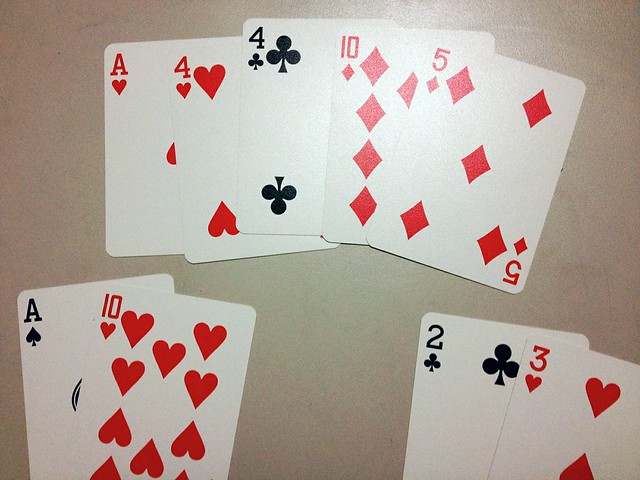
We played this hand at the 10-20 table at the Metrocard Club last night (or make that early this morning), and it shows exactly why I’m such a fish who can’t resist making awful donkey calls, despite my illusions to the contrary.

The flop was A-4-4.

The “villain” (not a derogatory term in poker–just the guy or gal you’re betting against) bet 100. I said, what the heck, and called.

The turn was a 10. The villain thought a bit and bet 160. I tanked, figured that I had lost more than a thousand already and had to go home soon, and called.

The river was a 5.

I sighed and went all in with my remaining chips, bringing the pot to around 3,000. The villain tanked for about three minutes, trying to figure out what I had. “Please make him call,” I prayed to the poker gods. “Please, say call!” Finally, wanting to fold but too curious to let go, the villain called, and showed an A-10, good for top two pair. I turned over a 2-3 offsuit for a baby straight. I thanked him, slugged the chips into a rack, and went home. What a fish!

Flashback No. 5: Miracle at Big Ace

Flotsam & Jetsam for Oct. 11, 2009

AS SOME of my friends know, I’ve become an intensely addicted poker player. I’ve won a couple of tournaments, but as pokeristas go, I’m not a very good one (a “donkey,” in poker parlance, who can’t help making bad calls out of sheer hubris or dumb curiosity and enriching the rest of the table in the process), but one besotted enough about the game to be reading books by the likes of Daniel Negreanu instead of Thomas Pynchon, and watching video replays of classic poker games on YouTube instead of the new Pinoy indie movies that have “important” written all over them. My excuse is that I’m gathering material for my next novel (I am!) but it’s really to get away from everything else I have to do, especially anything having to do with words more elaborate than the only four words you need to know in poker: “call,” “check,” “raise,”

or “fold.”

Yesterday, a Saturday, I joined a group of poker enthusiasts from pokermanila.com to play in the first PokerManila Inter-Collegiate Tournament at the new Big Ace Liberty Club along Shaw Boulevard. I was part of the UP Maroons “seniors” team—meaning, I guess, anyone with a UP student number earlier than 80-xxxxx. My pair of aces got painfully cracked by a straight and I busted out of the tournament early. So I moved over to the cash game, at the 25-25 table (the so-called “blinds” or mandatory first bets are 25 pesos), and promptly began losing again. Story of my poker life!

But I hung on, because aside from the pot or the money on the table, we were all going for the “High Hands” promo of Big Ace, which gives special prizes to the day’s best hands as of 12 midnight (a neat marketing ploy, of course, to keep you glued to your seat way past bedtime). That deadline passed and I had hit nothing better than a full house of jacks (JJJ77), and others were hitting quads and even a straight flush, so I said I’d cut my losses and pack up after another “orbit” (a complete turn around the table; for a glossary of poker terms, see here).

Now here’s what happened in one of those last few deals, where I had just about P1,500 worth of chips left.

My hole cards (the two cards every player is dealt) are 7h-8h. I often make donkey calls (way too often!) and I can’t resist suited connectors (the 7 and 8, same suit), so I say, okay, here’s where we make a gallant last stand, and I call the blind (the minimum bet), as do several others.

Now comes the flop (the first three “community” cards on the table): 5h-Kh-3s.

Aha, I say—a four-flush! I need just one more heart to complete a flush, which is probably enough to win, so I make a bet of about 200, forcing two or three players out, but one player goes all in for 850, and the next guy calls! Of course I call, and I think someone else after me also calls. So now we have a monster pot all of a sudden, and we all get up on our feet and people around us start following the action.

The turn (the fourth card, second to the last) is 6h. I hit my flush! But the guy beside me goes all in with his remaining chips, so I happily call, and we have a side pot of about 1,200.

Now everyone shows his cards before the last or “river” card is drawn. Player A, the original raiser, has Ad-Kd (ace and king of diamonds). So as far as I’m concerned, he’s drawing dead to my flush (no way he can win). But Player B turns up his cards—Ah-Qh! Suffering Jesus! He has the nuts (the highest possible flush, with an ace-high, short of a straight flush, or five cards of the same suit, in sequence)!

So now I’m showing K-5-6-7-8, all hearts, against B’s A-K-Q-5-6. I have a very faint hope of making a straight flush—either 4-5-6-7-8 or 5-6-7-8-9 of hearts—but another player has already folded the 4h, so my one and only out is the 9. That’s one card in a deck of 52!

The dealer draws the river card, and… drumroll… it’s the 9 of hearts! The crowd goes wild, I go nuts with the nuts, Player B is stunned speechless (as I certainly would be), and I get my name on the leader board for the next day’s High Hands, since it’s already 12:30 am.

Two deals later, I get up and cash out, to make doubly sure that my day has a happy ending. Hallelujah!

(You’d wish poker was like this every God-given day, but sadly, it ain’t necessarily so.)