Penman No. 72: Martial Law in Three Filipino Novels

KillingPenman for Monday, November 11, 2013 

LATE LAST month, I flew down to Davao for a group organized by the chair of the National Historical Commission of the Philippines, Dr. Maris Diokno, for a roundtable discussion on narratives of martial law. The Martial Law Historical Advisory Committee, created by Administrative Order No. 30, had been tasked to collect, evaluate, and preserve documentary and other materials pertaining to the Philippine martial law experience, and this roundtable was an early but vital stage of that process, a thinking-through of basic assumptions and expectations from participants in and scholars of that period.

I was invited not only because of my activist background and imprisonment under martial law, but because I’ve written a novel and some stories about it, and will write yet more—a nonfiction oral history of the First Quarter Storm, for which I’ve been given a grant by the NHCP. I’ll say more about this project in a forthcoming column, but in the meanwhile, let me share excerpts from a brief think piece that I contributed to the Davao roundtable (which, incidentally, was both insightful and moving, attended by the likes of martial law veterans Joy Jopson Kintanar and Judge Meinrado Paredes, as well as younger scholars and writers Leloy Claudio and Roby Alampay). Here’s what I wrote:

In his review in Philippine Studies of Azucena Grajo Uranza’s Bamboo in the Wind—one of the first and few novels to have dealt with our martial-law experience—Fr. Joseph Galdon quoted another writer, Linda Ty-Casper, who wrote that:

Literature is one way [by which] history, which too often reduces life to dates and events, can animate life so that man is returned to the center of human existence. It is man, after all, not nations, who feels the hunger caused by economic recessions and market fluctuations, who suffers separations and dislocations from social upheavals, who catches the bullets and bombs of war. It is in man’s flesh and bones that the events of history are etched. Individuals die, while their country goes on. It is in literature that generations of images representing man are preserved. It is in literature that we can recover again and again the promise of our resurrection. It is the house of our flesh in which we can refresh, restore and reincarnate ourselves.

I’m beginning with this quotation because I’d like to suggest that, in some ways, the best way to remind Filipinos and to make sense of what happened to them under martial law is through fiction rather than factual narrative, because fiction requires and creates a wholeness of human experience. Young Filipinos, especially, need to see martial law as a story—a continuing story with consequences reaching into their generation and even the next.

Considering that the Marcos era lasted more than 20 years—from his first election in 1965 to his forced departure in 1986—it’s a bit surprising that not too many Filipino novels have been written about Marcos and martial law. (I should immediately qualify this statement by saying that, actually, not too many Filipino novels have been written, period. As a literary form, the novel—whether in English or Filipino—has never been our strong suit, unlike the Indians and the Chinese.) You would expect that martial law, in particular, would have left a thick scar or welt on our literary consciousness and imagination, in the same way that many survivors of martial-law prison were plagued by intense, recurring nightmares long after their incarceration. In fact, however, we have barely dealt with it in our literature, and if our children today know little if anything at all about martial law, it is because we have not written enough about it, and have left the little that we have written out of the curriculum.

Online can be found two very interesting and fairly comprehensive listings and discussions of the literature we have produced on our martial law and martial law-related experience. The first is a lecture delivered by the writer Edgardo Maranan in London’s School of Oriental and African Studies in 1999 and published by the site Our Own Voice in 2007, titled “Against the Dying of the Light: The Filipino Writer and Martial Law.” The second is a reading list compiled by a blogger and bibliophile who calls himself “rise.” Both lists contain and discuss works of fiction, poetry and nonfiction produced during and after martial law, material that now generally falls under the rubric of “protest literature.”

Understandably perhaps, it takes time, will, and bit of distance to process—with the benefit of hindsight and a freer imagination—a traumatic experience like martial law. In my case, it took nearly 20 years after my imprisonment to try and make sense of it in a novel. I’m not even sure, at the end of things, if I succeeded. But it’s important in any case to make the effort—for our creative writers to inscribe their own history of our political and social experience—because the writerly imagination is a powerfully intuitive tool for sense-making. Creative writing is integrative, rather than analytical; it puts things together, rather than taking them apart, as scholarship and criticism tend to do.

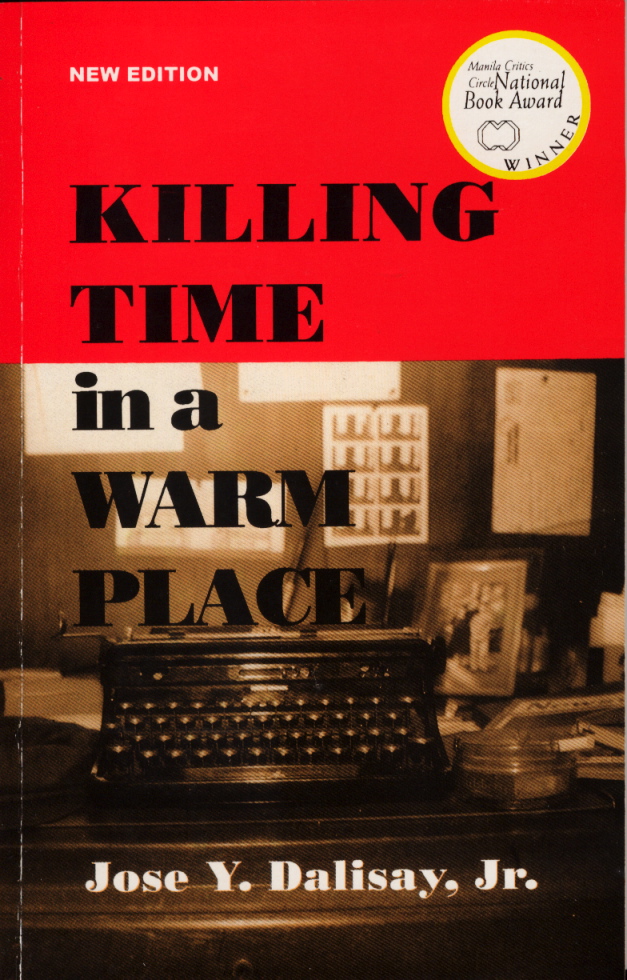
Today, I’ll focus on how three novels—I’m immodestly including mine—have represented our martial law experience in its various aspects. At least one of these three novels—two in English and one in Filipino—would be how our students today encounter, if at all, martial law and its causes and effects. The novels I am referring to are Dekada ’70 by Lualhati Bautista, first published in 1988; Bamboo in the Wind by Azucena Grajo Uranza (1990); and Killing Time in a Warm Place by myself (1992).

What the three novels share most strongly is a narrative of how martial law came about and what its immediate effects were. Of the three, Dekada ’70 offers the broadest sweep of things, covering the whole decade as it follows the individual paths that the members of the Bartolome family take. It is also the most unabashedly didactic, presenting long and detailed expositions of the political situation obtaining at that time, an approach that literary aesthetes might find too direct but which, when you think of it, is probably the only explanation young readers will have of an episode that to them might as well be ancient history.

All three novels are basically grounded in the specific experience of the middle class, taking note of its bright-eyed idealism and yet also its vulnerability to vacillation and co-optation. In this respect, Bamboo in the Wind attempts to cover the broadest ground, reaching across the social spectrum to present the plight of peasants under feudal tenancy as well as to display the clannishness of the elite. It ends just after the declaration of martial law, on the portentous note that “It was going to be a long night,” as indeed martial law would be, for the next decade.

My semi-autobiographical first novel Killing Time in a Warm Place is focused on the person and the growth of its narrator, Noel Bulaong, who has provincial roots but grows up in Manila, studies in UP, becomes an activist, is imprisoned under martial law, and then, upon his release, joins the government service as a propagandist no less; faithless, loveless, and friendless, he leaves for the United States to study and live there, coming home only for the death of his father, where the novel begins. Of the three novels, it is the most personal, although Dekada ’70 can also be read as Amanda’s story, the making of a feminist in the crucible of political and personal turmoil.

To my mind, the most important contribution these three novels make to the discourse on martial law is not even and not only their depiction of the horrors and excesses of martial law—the obligatory scenes, you might say, the arrests, the tortures, the rapes, the thievery, the brute exercise of State power over the people. It is their exploration of the element of collusion and complicity—of how we, in a sense, allowed ourselves to be ruled by a regime that promised peace and progress for the price of a little national discipline.

In Dekada ’70, Julian Bartolome Sr. gives the regime every benefit of the doubt, convincing himself of the government’s good intentions, despite Julian Jr.’s deepening involvement in the Left. In Killing Time, Noel Bulaong does a 180-degree turn and joins the dark side—an acrobatic maneuver that many former activists, including me myself, performed, caught in a bipolar world. Having left the Left, it seemed that one had little choice but to cast one’s lot with the Right, and it’s no surprise that many ex-activists became the sharpest thinkers and most active doers of Marcos, Cory Aquino, Ramos, Estrada, and Arroyo. Bamboo in the Wind delves into how martial law benefited the elite, especially those factions that sided with the regime, and how it sought to corrupt intellectuals with progressive inclinations. In other ways, these novels speak of guilt and redemption, of how we are defined by family and class, of abject betrayal and astounding heroism.

These novels are far from perfect, and we can argue all day about what they failed to say and how they may have misrepresented this and that. But writing and promoting works of fiction like them may yet be the best way we can remind our people, especially this “selfie” generation, of the fact of martial law in the Philippines, and of its continuing legacy.

Penman No. 68: Towards a Regional Literary Community

Penman for Monday, Oct. 14, 2013

WE WERE back in Bangkok very recently, about the same time as last year, for another gathering of the newish Asia-Pacific Writers and Translators Association (APWriters). Around 200 participants from all around the region and from as far as Europe and the US got together from October 3 to 6 in Chulalongkorn University—also the site and host of last year’s conference—to meet on a wide range of literary concerns, most of them bearing on this year’s focus on “The Teaching of Creative Writing.”

Titled “Reaching the World 2013,” the conference was sponsored by the Bangkok Metropolitan Authority, Asia Books, and the Faculty of Arts of Chulalongkorn University. Bangkok had good reason to host us two years in a row; it had been named World Book Capital for 2013 by Unesco, and was celebrating the honor in the most appropriate way it could. It’s also at Bangkok’s historic Oriental Hotel that the annual SEAWrite Awards for the region’s best writers are given out, and we were welcomed there at dinner by the urbane and popular Governor of Bangkok, Sukhumbhand Paripatra. The son of a prince and educated at Oxford and Georgetown, the governor put everyone at ease by joking that he couldn’t greet us with rhymed couplets, as he was “only a politician” (he had, in fact, taught political science at Chula, Georgetown, and Columbia).

I was one of the organizers of the conference, and was proud to see that a total of 27 Filipino participants (not counting four who had to withdraw at the last minute for various reasons) attended “Reaching the World.” Among others, the delegation included stalwarts of the Philippine literary community such as STAR columnist and former DepEd Usec Isagani Cruz; UST and UP creative writing guru Cristina Pantoja-Hidalgo; MSU-IIT professor and poet Christine Godinez-Ortega; DLSU creative writing center head Shirley Lua; UP Press director and poet J. Neil Garcia; University of San Carlos professor Hope Sabanpan-Yu; the Bellagio-bound fictionist Menchu Sarmiento; and Davao Writers Guild president Jhoanna Lynn Cruz.

But more than seeing familiar names on the program, I was especially glad to see that many of our youngest writers on the UP faculty were able to attend as well, including Francis Quina (my deputy at the Institute of Creative Writing), Gabby Lee, Sandra Nicole Roldan, and Vyxz Vasquez. Conferences like APWriters expose writers like them to ideas and influences outside of their own local schools and networks, and sustain the continuity of our commitment to literature from one generation to the next.

APWriters grew out of the old Asia-Pacific Writing Partnership, which we expanded to include translators, in recognition of their crucial role not only in promoting the works and careers of individual authors but also of fostering international understanding through literature. On top of the transition has been the indefatigable Australian writer Jane Camens, who now serves as APWriters’ executive director (read: conference busybody) and who put the conference program together from dozens of proposals we received.

What distinguishes APWriters and its conference format is the informality of the discussions. Proposals for presentations were solicited and accepted, but no lengthy papers were actually read; instead, panelists spoke from notes or off the cuff, achieving our goal of witnessing “writers in conversation” as participants from places as diverse as Norwich and Ho Chi Minh City shed their academic robes, rolled up their sleeves, and spoke from the heart and from memory about the subjects that matter most to writers, translators, and teachers of creative writing.

We don’t mean to be unfriendly towards critics, scholars, and their important work, which after all endeavors to make sense of what we creative writers do. It’s just that there are already enough venues out there for the reading of formal papers (the annual and massively-attended conferences of the Modern Language Association and of the Associated Writing Programs come to mind) on the most obscure and abstruse of literary concerns. I took part in two panels at Chula, as a discussant in the first (which confronted the question of “cloning” in writing workshops and programs) and a moderator in the second (which dealt with how writers budget their time, and with what else they do besides writing).

Aside from Jane, I was glad to see old friends and acquaintances from around the region (or whose work and personal lives bring them regularly to Asia) such as the American writer and workshop specialist Tim Tomlinson, whose book The Portable MFA I’ve recommended to those in need of a crash course in creative writing; the Indonesian translator Eliza Vitri Handayani, who’d sponsored the translation workshop in Jakarta that I’d been a part of just the week before; Kate Griffin of the British Centre for Literary Translation; the Japanese-American fictionist Kyoko Mori, a fellow alumnus of the University of Wisconsin-Milwaukee’s PhD program; the Indonesian-Chinese-American Xu Xi, who directs the low-residency MFA program at the City University of Hong Kong; the Australian nonfiction and theater expert David Carlin; and, of course, the APWriters chairman himself, the Hong Kong-based Sri Lankan journalist and humorist Nury Vittachi, who’s been behind some of the region’s most significant literary projects, such as the Man Asian Literary Prize and the forthcoming World Readers’ Award.

There were many more, but you get the idea: this is a functioning network of writers and literary specialists from around the Asia-Pacific who’ve come to know each other as friends. And before anyone starts screaming “Another literary cabal!”, let me say, yes, why not, because right now, that’s what we need; there will be a time and an occasion for principled disagreement, but for now our emphasis is on finding and strengthening commonalities of thought, practice, and experience, thereby creating a working community of writers and translators in the region.

The commitment of these people to our emerging network was evidenced by the fact that many participants, including myself, were entirely self-funded. (It also helped, of course, that Bangkok is one of the most accessible, affordable, and tourist-friendly places on the planet.)

The large turnout from the Philippines also reflects the size and the maturity of our literary community and culture. Why shouldn’t we be able to send almost 30 writers to Bangkok? I respectfully disagree with those of us (including my friend Cirilo Bautista, whom I praised and quoted a few weeks ago) who see the Philippines as “a small country.” We’re certainly not—neither in size (at 300,000 sq. km., the same size as Italy), population (in 2005, we were 13th in the world), nor GDP (around 40th to 43rd  out of nearly 200 countries, depending on the year and who’s counting). Our grossly inequitable incomes and power relations are a real problem, but even these haven’t curbed, and may even have encouraged, our expressiveness in art and culture.

Indeed, as we look around the Asia-Pacific, we’ll find that the Philippines has one of the most robust of literary infrastructures, with formal creative writing programs in half a dozen major universities, a workshop tradition going back half a century, and the kind of democratic irrepressibility and irreverence that you can’t find anywhere else in Southeast Asia.

We’re banking on these strengths to put the Philippines more firmly on the global literary map, and we’ve taken a step in that direction by offering to host (after Singapore next year) the 2015 edition of the Asia-Pacific Writers and Translators conference. I hope to see many of our Bangkok fellows there, and more.

Penman No. 63: A Poet Speaks

CBautistaPenman for Monday, Sept. 9, 2013

NOW 72, Cirilo F. Bautista towers over the writers of his generation. Though primarily known as a poet in English, Cirilo—“Toti” to his friends—also writes formidable fiction in both English and Filipino. His books of poetry alone number a dozen, and have won the country’s most prestigious prizes, including the Centennial Prize in 1998. Until his retirement, he was a full professor and writing guru at De La Salle University, and had, at some time or other, taught at other major universities here and abroad. His poetry is deep and complex, conscious of the need to separate the emotional from the intellectual—difficult to many—but not without wit and humor.

Bautista has been nominated for the hallowed title of National Artist, and it’s an honor he would richly deserve and invest with the necessary achievement and gravitas. I can only hope that the bestowers of this award will take this view—shared by many in our literary community—when they sit down next to consider our National Artist awardees. I can be fairly sure that there will be great rejoicing and little dissension when that happens, unlike the controversy that met the last batch of dagdag-bawas “laureates.”

Last Sunday evening, I was privileged to hear Cirilo speak at the 63rd Palanca Memorial Awards for Literature at the Manila Peninsula. He had been asked by the contest sponsors to be evening’s guest of honor. Although forced to use a wheelchair by muscular dystrophy, Cirilo showed no sign of slowing down where his mind was concerned. That night, in a mixture of polemic and poetry reading, Cirilo lamented the diminished role of the poet (by extension, the artist) in Filipino society, diminished since the days of Jose Rizal, when poets were heroes and heroes were poets.

With his permission, I’m excerpting portions of his speech, in the hope that more Filipinos will take notice of their poets in general, and of one named Cirilo F. Bautista in particular. What follows are his remarks:

Small as the Philippines is, smaller still is its literary community—poets and fictionists caught in the bright dream of making a difference in its aesthetic and cultural development. Some are good, many are terribly bad. I speak of the good ones only since charity has no place in the critical evaluation of artistic excellence. To those who live with words, who are engaged in the art of counting syllables and harmonizing metaphors, whose constant fear is not finishing their work, to be poets in the Philippines is to live in a surreal world whose stress and strains shape their concept of existence. People regard you as a specimen of some strange thing to encounter, to examine, even to touch. But not of something to take seriously. You live on the border, on the periphery, on the edge of society, considered unique, but nothing more. The institution that you represent—the world of fine writing—has not made the priority list of any government in the history of the country, whatever our political fathers may say about the importance of cultural advancement. Poetry receives no significant financial allocation, no institutional support, no artistic infrastructure. Not that the poets should depend on the government, but that since the government is tasked with the overall progress of the people, certain measures must be taken to insure that poets do not wallow in the quagmire of neglect.

… Now we see manifestations of the absence of support for the poets. Poets are generally unknown in their own country. Few read them but in the lingering and strengthening vestiges of colonialism prefer the work of Western writers. We are led by the nose by American capitalist interest in the arts. We read what they give us, and have not been sincere and brave enough to assert our own taste and preferences.  Our culture is a borrowed culture, disguised as modernistic simply because it arrived on the Internet. But of the values that assert our roots, they seem to have been devoured by TV novelas and rock concerts. Our taste is largely a mixture of truncated native idealism and borrowed Western adventurism. That we adapt to them may be our virtue, given difficult times; that we are controlled by them may be our downfall. But like them we do. They appeal to that inexplicable part of us that needs to resolve the ironies and contradictions of our existence. And it is in this that, quite strangely enough, the poets seem naturally equipped to provide explanations.

… I am a veteran poet; as I have said, I have published some 12 books of poetry. None of them made a print run of one thousand copies. By American standards I should be rich from the sale of these books, but I am not. It seems they are read only by the inquisitive and misdirected. On a few occasions when, feeling generous, I give my books to relatives and acquaintances, they ask me why I am punishing them. Those who don’t like reading poetry considering reading it a punishment; that’s the only way of interpreting the situation. And poetry becomes a burden to society which has reached a certain stage of insensitivity to the stark harmonies of the soul. This baffles me. I can’t understand why in an affluent society like ours (we are called Third World only by the political elite who handle the greater portion of our national budget for self-improvement and establishing political dynasties), a true literary resurgence cannot take place, or why we cannot remedy the effects of a fractured culture and mismanaged patrimony. The elite in society do not buy Filipino books but patronize foreign ones. It is their pride to be amongst the first to have the work of this or that European poet or novelist, but they will ignore the works of their countrymen. Is this colonial mentality or crab mentality? They still find it difficult to believe in Filipino excellent artistry, or they will down to lower ground Filipinos who exhibit excellent artistry. I find this prevalent among the young who regard foreign shores as sources of cultural inspiration. Always the Filipino is never first in their appraisal.

… It is of course an error to belittle our poets. They have proven that they can compete with the best in the world, given certain assistance and patronage. Their works appear in international publications, they have won important prizes, they are invited to global conferences and festivals of art, they exchange ideas with prominent figures of contemporary literature. Why then are they not patronized in their own country? As I said, I’m baffled by this, short of saying what I don’t want to say—that like crabs we pull down those we perceive to be making names for themselves, and consign to neglect the products of those names. Some are even proud not to be readers of Filipiniana.

… We are proud to point to a poet as our national hero. A poet laureate reflects a country’s coming to terms with the importance of poetry in the overall conduct of its affairs, but mostly with the progress of its artistic sensibility. Poetry is a civilizing factor that drives away the rudeness and coarseness of practical existence. It confers on the individual a high sense of being-ness and a true perspective of life. The poet laureate serves as a bridge to connect the people’s aesthetic education and spiritual well-being. It is seeing their world in another way, and making connections with realities that seem hazy at the start. A moon is not a moon, flying is not leaving the ground—but something else. What? That’s the exquisite area of poetic discovery that only the knowledgeable may enter.

(Photo courtesy of the Cultural Center of the Philippines)

Penman No. 62: A Letter to the Philippines

Penman for Monday, Sept. 2, 2013

I RECEIVED a very interesting message in my mailbox last week from a good friend now based in Singapore, the American writer Robin Hemley, who serves as Director and Writer-in-Residence of the Yale-NUS Writing Program at the National University of Singapore. Robin and I have been to many conferences and workshops together, breaking bread and chugging beer not too long ago in Hong Kong, Michigan and Melbourne.

Just retired from Iowa, Hemley’s one of the world’s foremost experts on creative nonfiction, and a mean writer of fiction himself; I teach one of his stories, a very funny piece titled “Reply All,” in my class. He’s a frequent visitor to Manila—not surprisingly, since his wife Margie is Filipino. But Robin has been more intimately engaged with Philippine culture and society than his family ties would suggest. Fairly recently, he found himself stranded on a remote island in one of the Babuyan Islands while doing research for a novel. That’s my kind of writer—someone who immerses himself in his material to the point of self-endangerment.

Thus being no stranger to risk, Robin didn’t surprise me when he sent me a copy of a letter he had written in the wake of the pork barrel scandal, by which he had been deeply disturbed. It was addressed to no one in particular—he had titled it “A letter to the Philippines”—and Robin asked me what I thought of it, and if it would be worth sharing with others. I read the letter, and immediately wrote Robin to say that I thought it was worth publishing, and that I would be happy to do the honors in this column, with his approval—which came shortly after, with his thanks.

That creative writers and other artists respond to the day’s political issues is something we’ve learned to expect, if not encourage, although our responses more often take the form of our art itself, with its necessary mediations and interpretations. When we respond directly—like Beng and I did in joining the Million People March last Monday—it’s more as citizens than as artists. And that’s actually a relief and a reminder of sorts, that we can act as ordinary people, with ordinary people, away from the pressures of performance.

I decided to publish Robin’s letter to acknowledge his participation, if not his citizenship, in our society. Surely there are many others like him, though few perhaps as articulate, who feel deeply invested in our affairs but who, out of caution or a sense of propriety, have decided to keep quiet. Robin’s letter will also surely upset some Filipino readers who may feel that the pork barrel scam—or whatever wrongdoing takes place here—is none of a foreigner’s business. And that, I think, would be a sad thing, because if evil is universal and cuts across countries and cultures, so should the outrage that it deserves to be met with. Here’s Robin’s letter to us:

I want to preface my remarks by stating that although I am a foreigner, I have nothing but love and respect for the peoples of the Philippines. I’m married into the culture, have written extensively about it, and consider it my second home. If I could, I would become a citizen of the Philippines, but becoming a citizen of the RP is much more difficult than becoming a citizen of the U.S., which my wife did a few years back, not because she loves her country any less, but for logistical reasons, i.e. visa-free travel, as much as anything.

The most recent scandal in the Philippines, involving Janet Napoles and a number of prominent politicians, has prodded me to think more deeply about the privilege of citizenship. Unfortunately, politicians in almost all countries seem to think the number one qualification for any public position is the fearless ability to betray the public trust. Political scandals in the Philippines are nothing new. In fact, they seem to occur with such frequency that the Philippines’ famously free press ironically seems to exacerbate the ability of these officials to sink to ever lower depths of betrayal by giving the public a safety valve to impotently express their outrage. The hard-working public, the people who pay taxes, have become so inured to the corruption of their public officials or so resigned to it, that the frequent scandals in the papers become so much public theater, producing little in the way of results.The latest scandal seems so egregious that it has rightfully sparked enough outrage to bring people into the streets. If I were in the Philippines right now, I would join them, but I’m living in Singapore at the moment, a country that doesn’t have the same free press as the Philippines, but that has also a low tolerance for corruption of public officials.

I wonder if I would be welcome to join the protests in the Philippines. I know my friends would welcome my presence, but Filipinos by and large are sensitive to foreigners criticizing them, and for many good reasons which I respect. But I’ve also been to Cuba several times in the last few years, and I was impressed by the willingness of the Cuban people, almost from the beginnings of their fight against the Spanish, to enlist the support of sympathetic foreigners. Che Guevara, probably the most revered figure of the Cuban revolution, was Argentinian. And there have been many others, though I hasten to add that I’m not making any comparisons here other than this observation. I’m not communist and I don’t look good in a beret or a moustache.

Still, I think of the young Dutchman, himself apparently a communist sympathizer who famously made a policeman cry and then was deported from the Philippines for being obnoxious. This seems to me a serious blunder of the Philippine government, displaying a lack of maturity at best. While the Dutchman was undoubtedly immature himself, I’m not sure that his act warranted deportation. In principle, I should say I’m not opposed to making policemen cry. Not that I’m against the police of the Philippines. My late father-in-law was an honest policeman in Mindanao, and lived relatively modestly his entire life, but led a life of dignity because he refused to take a bribe, a temptation many of his fellow police couldn’t resist. He taught his children to be honest, too, a couple of them who have become lawyers and who refuse to enter politics because they don’t want to be corrupted. One, who works for the government, also refuses to take bribes, though they are routinely offered. And this of course makes me proud of the family into which I’ve married.

These are the people who should be in politics, but they’re too wise to do so. To me, they are the real patriots, the people who will never grab headlines, but who choose to live a life of quiet dignity serving the people and their homeland in the small ways available to them.

Instead of deporting critics of the Philippines, no matter how annoying they might be, no matter whom they make shed tears, perhaps the real villains of the Philippines should finally be called to account for their multiple betrayals. To set up fake NGOs, and contribute millions to their coffers in the name of the public good while cynically using this money for their own gain, seems to me to be a new nadir of betrayal. If found guilty, perhaps these politicians should lose what they should have valued most from the start: their citizenship.

Penman No. 58: Hello STOP Goodbye STOP

Penman for Monday, August 5, 2013

FROM INDIA, last week, came the news that the company that handles that subcontinent’s telegram service had sent out its last telegram, ending a facility that had been available to Indians since 1850. It was also from India that, two years ago, we received word of the demise of the last operating manufacturer of typewriters in the world, a company called Godrej and Boyce, which was still making up to 12,000 typewriters a year until 2009.

It might seem then that the horizon of obsolete technologies lies somewhere between Srinagar and Chennai, but of course we Pinoys know differently. For even in this age of Twitter, Instagram, SMS, and FaceTime, many Filipinos—the oldest and the poorest of us, that is—still have one foot firmly planted in the 20th century, and it will be a while before we’ll learn to let go, at least in our minds, of the things that made our life easier back in 1963.

A surprisingly comprehensive history of the Philippine telecommunications industry, written and published online by Federico and Rafael Oquindo, says that the Spanish began laying out a telegraphic service in the Philippines in 1867.

I’m not sure if we can actually still send paper telegrams to one another, since the old telegraphic companies have either died out or been taken over by telecoms giants more interested in moving money than messages. Your relatives would surely be more interested in receiving a MoneyGram from you, anyway, than your telegraphic best wishes. If you’re feeling wacky, you could also send them a singing telegram, which—for around P2,000—will include a box of chocolates to go with the guitarist and singer, and your favorite song.

But where has the old-fashioned, STOP-punctuated slip of paper gone? Gone the way of the horse-drawn carriage and the steam engine and the carrier pigeon, it would seem, replaced by faster, sexier, and maybe even cheaper ways of getting a message from A to B. In the US, Western Union sent its last telegram in 2006.

To be perfectly dry-eyed about it, few 21st-century citizens will miss and mourn the telegram. To send one, you had to go to an office and scrawl your message on a pad of paper—a message that, depending on your agent’s sharpness of eye and adequacy of mind, could come out garbled on the other end. The cost of the telegram was computed by the word, and how fast it traveled depended on how much of a premium you were willing to pay; I remember that “NLT”, or night letter, was the cheapest option, because you had to wait for some night clerk to attend to your message after everything else went out for the day. And then your telegram, encased in a flimsy plastic envelope, had to ride along with a bagful of others in the back of a motorcycle or even a bicycle to cross rivers and mountains to get to its recipient, two or three days after pushed your message across the counter.

It all seems too cumbersome and too quaint now, but there was a reason for the telegram’s popularity in its day. Very often, it went out to people and places without telephones (yes, there was such a country and such a time), and it was much faster than a regular letter, albeit more tight-lipped. Arguably, the telegram was unique in the power it conveyed and the significance it implied, for only the most important—both the saddest and the happiest—of messages merited a telegram.

Unlike SMS, or even the pager (remember EasyCall?) that preceded the cellular phone, the telegram was too slow for casual banter, too terse for courtship or argument. It worked best at bringing you the good news and the bad news: prizes won, loved ones lost, congratulations, condolences, reminders, pleadings.

I have a soft spot for the telegram, because it figured prominently in my literary career, starting with one I received in May 1969, informing me that I—then a high school senior—had won a national essay competition. Over the next two decades, at around this time of year, I would scan the horizon for the RCPI messenger, the bearer of the only telegram that mattered to me and hundreds of other aspiring Filipino writers: one sent by the Carlos Palanca Memorial Awards Foundation, telling us that we had won and inviting us to the September 1st awarding ceremony. (Our exuberant imagination supplied the rest of the unspoken message, which understandably would have cost the Palancas too much to tack on to their congratulations: “You’re a wizard of words, a literary lion, a paladin of prose whose works will sell a million copies, attract hordes of screaming fans, foment revolutions, and uplift human life and civilization!”) I did receive a number of those telegrams, a few of which I still keep as souvenirs, reminders of the Jobsian admonition to “stay hungry.”

There was one telegram I remember sending, sometime in the mid-1970s, from my small hometown in Romblon where I had gone on a short visit with my father and had quickly run out of cash, not having had much to bring in the first place. In desperation, I cabled my new bride Beng, whom I had to leave behind in Manila: “MISSUS I MISS US HONEY SEND MONEY.” And so she did.

And that’s all the old telegram companies do these days—send money to presumably happy recipients. Let text and Twitter take care of the bad stuff. If it’s the physical telegram itself you really want to send or to get, just so you can relive the good old days when people got inky fingers from writing long letters with fountain pens and licked postage stamps and waited for weeks to get something back in the mail, there’s hope for you. A company will still deliver a telegram to a Philippine address (and to over 200 other countries), for $24.95 plus 88 cents per word (no NLT option here); you’ll just need to go online at www.itelegram.com to avail yourself of this charming if pricey service.

SPEAKING OF other countries, it’s always good to read positive things about the Philippines when you’re abroad, even if they happen to be advertisements. In Hong Kong a couple of weeks ago, I beamed when I turned to the travel pages of a local newspaper and saw how many ads featured our national tourism tagline: “It’s more fun in the Philippines!” The ads offered special packages for Manila (read: the new Solaire casino) and other parts of the country (read: Boracay) via Philippine Airlines and Cebu Pacific.

Now, I’m one of those guys who—no matter how strongly I might criticize our foibles and follies back home—like to wave the Philippine flag when they’re on the road. Any chance I get, I invite my foreign friends to come and visit, allaying their usual fears by pointing out that they could get mugged in New York or robbed in Prague, anyway—they might as well enjoy our sunshine! Lord knows we need all the plugging we can get, with neighbors like Thailand roping in some 22 million tourists a year versus our 4 million.

I’m wondering now if it was schadenfreude—that wicked burst of pleasure you get when something nasty happens to your neighbor but not to you—that coursed through my veins when I came across an article in The Standard noted that traveling to Thailand was fraught with danger “from jet-ski scams to robbery, assault and even police extortion.” Hah! I thought—that’s what I’d been trying to tell my Hong Kong friends—it’s more fun in the Philippines!

Then I read on, turning the page: “Britain said Thailand is the country where its citizens are second most likely to require consular assistance, behind the Philippines.” Ooops! Sounds like we need to do a little more work in the Philippines.

(Image from philippinephilatest.net)

Penman No. 56: Cheers for The Mango Bride

mango bride final cover copyPenman for Monday, July 22, 2013

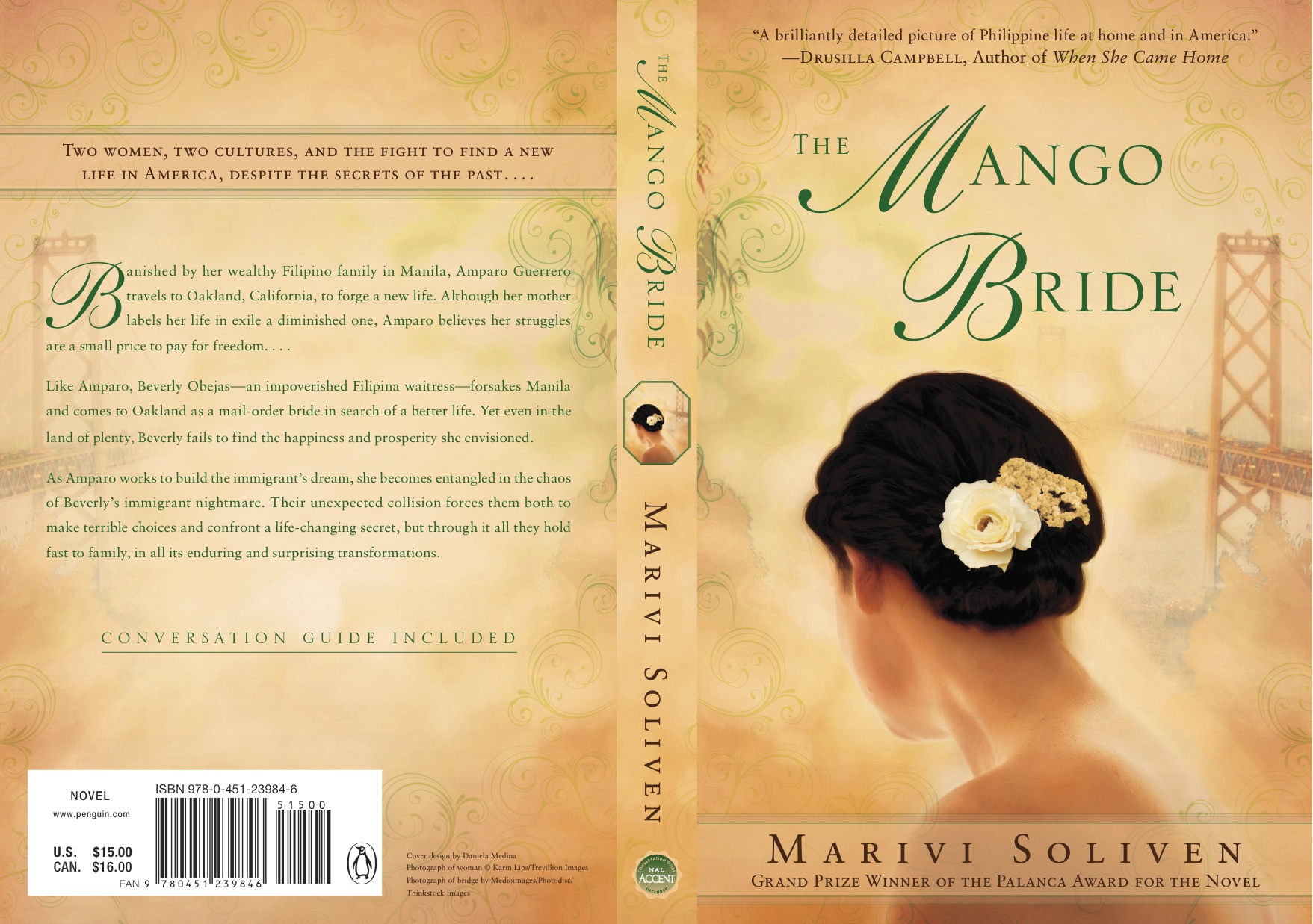
IT ISN’T every day or even every year that a Filipino author gets published by Penguin Books—I can think of only Jose Rizal, Jose Garcia Villa, Jessica Hagedorn, and Miguel Syjuco, off the top of my head—so when Marivi Soliven told me a couple of years ago that her new novel The Mango Bride (New York: NAL Accent, 2013) had been picked up by a division of Penguin, I immediately sent her a congratulatory note. But I didn’t realize the extent of Marivi’s achievement until I received a copy of the published book and read the novel in a mad dash to the ending.

Again, that doesn’t happen to me very often; given my crushing workload, it usually takes me weeks and even months to finish a new book, which is why I habitually decline invitations to do book reviews, not wanting to keep the authors and publishers waiting interminably. But Marivi’s case was different, because I was reading the book not as a beetle-browed critic, but as a mentor and a friend; as it happened, Marivi—whose husband John Blanco teaches literature at the University of California in San Diego, where they’ve been living for many years now—was also my daughter Demi’s English teacher in UP, and since Demi herself moved to San Diego, we’ve all kept in pretty close touch.

All this chumminess and this moving around has a point, and it’s directly related to The Mango Bride, which deals with the powerful tides, both social and personal, that continue to deliver many thousands of our countrymen to America. It tracks two Filipino women—the to-the-manor-born Amparo Guerrero, who gets banished to Oakland following an unwanted pregnancy that threatens to bring shame and scandal on her family, and Beverly Obejas, a plucky girl who also ends up in Oakland following the well-traveled path of the mail-order bride.

There is, of course, more in common between these two women than meets the eye, and it will hardly be a spoiler to say that their trajectories will cross. The task of the novel’s plot is to bring these two seemingly very different characters together—Amparo is a carefree college coed, while the orphaned Beverly works as a waitress—and when they do, toward the novel’s explosive climax, the author completes a narrative coup, with both dramatic inevitability and irony.

But more than a story of individuals, The Mango Bride is also a story of Filipino families rich and poor, which is to say that it presents Philippine society as an unfolding telenovela—bitchy matrons, philandering patriarchs, wayward sons, gay go-betweens, suffering servants, and all. This is, unabashedly, the source of the novel’s power, its appreciation of life in its broad, harsh strokes.

But unlike a telenovela, Soliven’s masterful prose lends the novel a fineness of detail that extends the pleasure of reading beyond mere plot and character into language. Here’s how she presents Amparo’s first experience of sex (as novelists know, a sex scene is always one of the hardest things to do well, and do freshly): “If there was something Amparo learned that first night, it was that the rhythm of passion was deeply satisfying for its simple circularity. Mouths making pillows of opposing lips, the call and response of interlocking sighs, a passel of caresses, cascading one into the other as waves folding into sea foam. Afterward, they gathered the thin sheets about them and curled into each other, chin to chin, chest to breast, dozing twins in a cotton womb.”

There’s a brilliant scene where Amparo tries to tell her boyfriend Mateo that he’s gotten her pregnant, but an elephant—literally—strides into the picture, having escaped from a circus and running red lights all the way down EDSA. It’s unexpected pay-offs like this that keep lifting the novel above the pedestrian, that remind us of an important literary talent at work, one with an unfailing feel for her material, whether we’re in Forbes Park or North Cemetery or a grocery in Oakland.

There will, I expect, be some complaining over the coincidences that mark the plot, but even here the improbable seems fated, precisely because of the novel’s implicit message: that we are closer to each other than we think, and might do well to acknowledge and accept that closeness while we can.

Marivi says that she began the novel in 2008 in the frenzy of NaNoWriMo (National Novel Writing Month—November, to most people) and completed it two years later. It won the Grand Prize for the Novel in the 2011 Palancas, but was extensively revised by Marivi for international publication.

If you want to buy the book and see if you can share my enthusiasm, it’s available at National Bookstore. But here’s the best part: if you want to meet Marivi herself and get her to sign your copy for you, she’ll be in town very soon for a series of readings and talks, thanks to NBS, which is sponsoring her visit.

She’ll be spending an afternoon with us in UP Diliman on Wednesday, August 7, from 2:30 to 4 pm at CM Recto Hall. The UP Institute of Creative Writing and the Department of English and Comparative Literature will co-sponsor the event, which is open to all. See you there!

SPEAKING OF new books, I was happy to have attended the recent launch of a rather unusual book—unusual because it’s a bilingual Spanish-English edition—titled La Oveja de Nathan (Nathan’s Sheep), by the late novelist Antonio M. Abad. Translated into English by Lourdes Castrillo Brillantes (a professor of Spanish at UP, and the lovely wife of our friend and literary kuya Greg Brillantes), the novel won the Premio Zobel in 1928, and was being published for the first time.

The Premio Zobel was initiated by the pioneering businessman Enrique Zobel de Ayala in 1920 to preserve the linguistic and cultural heritage of Spanish in the Philippines in the face of what Nick Joaquin would have called unbridled sajonismo. The Philippines and Filipinos had imbibed English like it was God’s own drink, and bold measures had to be taken to ensure the survival of Spanish in the new American age. Over the next many decades, the Premio Zobel did just that, and more, granting recognition to the best literary works written by Filipinos in Spanish, as well as the most valuable cultural contributions made by Filipinos to the cause of hispanidad.

Abad’s novel was one of the earliest winners of the prize (which Prof. Brillantes herself would later win), and its present publication by the Premio Zobel Collection, the Filipinas Heritage Library, and Georgina Padilla y Zobel (Enrique’s granddaughter) could not be more timely, as it deals with Filipinos caught between powerful political forces.

I’d have to admit that Sra. Georgina’s thoughtfulness in sending over an invitation to my house, with my name and address hand-lettered with a fountain pen, was what convinced me to drive across town in rush-hour traffic to catch the launch. Of course, the late author’s son, the poet Jimmy Abad, is also a dear friend, and Jimmy’s moving poetic tribute to his father’s legacy (delivered, in customary Jimmy Abad fashion, straight from memory) was well worth the excursion.

Penman No. 53: Manila, femme fatale

Manila-NoirPenman for Monday, July 1, 2013

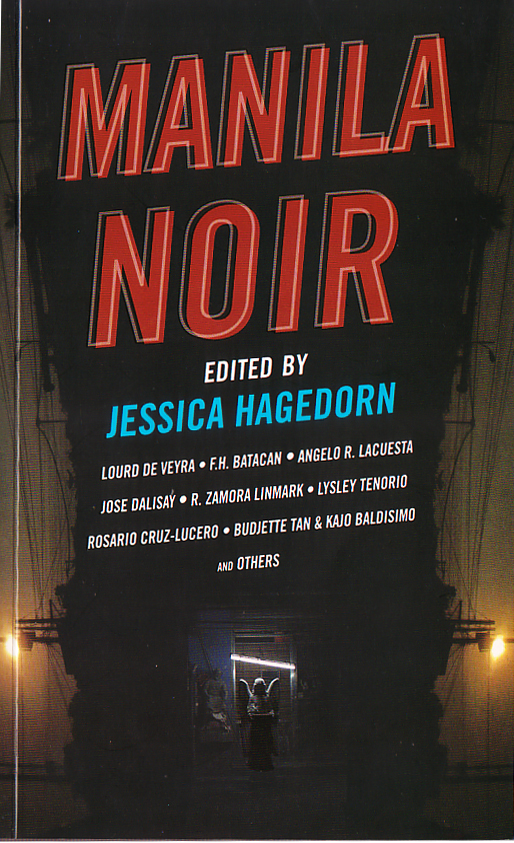
FIRST OF all, I’d like to invite my readers to the launch this coming Saturday of a unique and exciting new book, a collection of stories to which I made a modest contribution. The book’s title is Manila Noir, and it contains 14 stories written mainly by Manila-based authors, with each story focused on a specific district of the metropolis (mine, not surprisingly, was Diliman).

Edited by the accomplished Jessica Hagedorn, whose own Dogeaters made waves in international publishing in 1990, Manila Noir is the latest book in a long series published by Akashic Press—a series that includes books set in places as diverse as Chicago, Copenhagen, and Delhi. This local version (reprinted by Anvil Publishing) features pieces from Gina Apostol, Budjette Tan & Kajo Baldisimo, F.H. Batacan, Jose Dalisay Jr., Lourd de Veyra, Eric Gamalinda, Jessica Hagedorn, Angelo Lacuesta, R. Zamora Linmark, Rosario Cruz-Lucero, Sabina Murray, Jonas Vitman, Marianne Villanueva, and Lysley Tenorio.

Here’s what Publishers Weekly says about the book: “While certain cities in past Akashic volumes might appear to lack an obvious noir element, Manila (like Mexico City, which shares many of the same problems) practically defines it, as shown by the 14 selections in this excellent anthology. As Hagedorn points out in her insightful introduction, Manila is a city burdened with a violent and painful past, with a long heritage of foreign occupation. The specters of WWII (during which the city suffered from U.S. saturation bombing), and the oppressive 20-year reign of dictator Ferdinand Marcos live on in recent memory. The Filipino take on noir includes a liberal dose of the gothic and supernatural, with disappearance and loss being constants.”

As the French word for “black” suggests, noir is a mode of storytelling that dwells on the dark side of human nature, with crime as a central element or a specter hovering above the story.

In her introduction, Hagedorn herself notes that “I think of Manila as the ultimate femme fatale. Complicated and mysterious, with a tainted, painful past. She’s been invaded, plundered, raped, and pillaged, colonized for four hundred years by Spain and fifty years by the US, bombed and pretty much decimated by Japanese and American forces during an epic, month-long battle in 1945. Yet somehow, and with no thanks to the corrupt politicians, the crime syndicates, and the indifferent rich who rule the roost, Manila bounces back. The people’s ability to endure, adapt, and forgive never ceases to amaze.”

And this book, I guarantee you, will not fail to amaze. Join us—Jessica and my co-authors—for a round of brief readings, a Q&A, and a book signing session from 4 to 6 pm, July 6, at National Book Store Glorietta 1 in Makati. See you there!


IT WAS with deep sadness that I received, by text message, the news of the sudden passing of one of my dearest friends, Luverne Gueco. Luverne was also a brother in the profession, having served as foreign news editor at the Inquirer for many years. But more important to me than that, he was my kumpare, my confidante, and my partner in crime 30 years ago, when we were all in our mid-20s and romping through life like young men do. Luverne and I were part of a rather remarkable stable of writers and artists in the Economic Information Staff of the National Economic and Development Authority, a group recruited and supported by our visionary boss, Dr. Gerry Sicat.

It was a group that included former newsmen Jun Medina, Wilson Bailon, and Efren Cabrera; the now-Canada-based poet Patty Rivera; writers Fidel Rillo, Lilia Santiago, Jess Santiago, Reuel Aguila, Eric Caruncho, Joey Papa, and Minnie Quemuel; the future lawyer and now Undersecretary Rey Cruz; and let’s not forget a pretty artist named Beng, who worked with fellow artists Anna Nolasco and Herick Ventura. Not surprisingly, our immediate supervisor was himself an artist, the tenor Frankie Aseniero.

Although we were working under martial law, the NEDA then felt like a kind of Camelot, and we were all grateful for the little haven that Dr. Sicat created for long-haired, irreverent types like us (another officemate, albeit in another division, was the renowned playwright and another dear friend, the late Bienvenido “Boy” Noriega). As an ex-detainee, I failed my security clearance check, but Dr. Sicat took it upon himself to cover for me and sent me to the Development Economics program in UP to cool off for a year.

Luverne was in the thick of all this, one of the most dependable writers in the group. He had also been with the Left, and the stories he shared about what he had gone through seared themselves into my memory, so much so that I used the most painful one—about a rebel who took it upon himself to execute his wife after discovering she was an enemy spy—in my first novel, Killing Time in a Warm Place (1992).

After hours, our friendship developed in countless pool halls, beerhouses, and girlie bars (we were certainly no saints). We played pusoy, darts, and billiards with wild abandon. Luverne was a gifted pool player—this was the dawning of the age of the Pinoy pool champion, when Amang Parica was still king and young bucks like Bata Reyes and Django Bustamante were still hungry for glory. (I, on the other hand, was what the pros derisively called a “tama-bola,” a guy who could barely hit the target with the cue ball, let alone pocket it.) When Luverne married his wife Judith and became a dad, I became godfather to his son Elias. Luverne was always a motorcycle kind of guy, and had his share of bad spills, but when he went out looking for his first car, I convinced him to get the same car I already had—a VW Beetle.

Perhaps fittingly, Luverne collapsed while doing what he loved doing most—playing pool. I’m not sure if it was a stroke or a heart attack, but the end came swiftly. He was only 62.

I’m devoting all this space to the passing of someone who lived the quiet, uneventful life of a desk editor not just to mourn the loss of a friend, but also of the kind of friendship forged in the real world. Ironically, I didn’t see much of Luverne after NEDA—these past 30 years—and our last meeting was about a year ago, but there was never a moment during those decades when I wouldn’t have listed him among my six closest friends, people whom I could count on to help me in a bind, no questions asked, and to whom I would throw the same lifeline. How many people have earned your trust and affection like that?

I’m not on Facebook—one of the country’s last holdouts—for one stubborn reason: I can’t accept the Facebook definition of “friend.” To be my friend, we should have broken bread and maybe a few precious other things together; we should have rejoiced and despaired together; we should have found each other’s weakest spots, but let them be; we should have disagreed on many things, but agreed on more. On Facebook, “friendship” is a convenience, just as easily disposed of with a mouse click to “unfriend.” I’d much rather wait five years to talk to someone like Luverne and pick up where we left off as if those five years had been just yesterday.

Penman No. 50: More Than Islands

IMG_1517

Penman for Monday, June 10, 2013

LAST WEEK, I realized another lifelong dream. Nearing 60, I’ve had the privilege of traipsing all over the planet, but I’d never been to Batanes, the northern spearpoint of our vast archipelago. The occasion was a seminar held by the National Commission for Culture and the Arts, specifically its Literary Arts committee, for the province’s teachers and writers on the development of local and regional literature. Truth to tell, we went there less to teach than to learn, so remote and strange was Batanes to me and my fellow committee members, who had come from as far down south as Zamboanga.

I can’t pretend to have discovered everything good and bad about Batanes in the few days we spent there, but we saw and heard enough to make us want to both rejoice and, occasionally, shake our heads in anger and sadness.

Happily there’s much, much more to celebrate about Batanes than to mourn. “Breathtaking” is almost an understatement for this cluster of islands. If there was such a thing as “panoramania,” or landscape overload, Batanes would be the cause of it, with seemingly endless and unfailingly spectacular views coming one after the other, just around the bend. The greenery covering the undulating hills is marked by a latticework of hedgerows, which act both as property boundary markers and as windbreakers. Despite the many first-class concrete roads beribboning the islands, Batanes is still clearly 4X4 country, better suited for cattle and goats than people, and no Batanes landscape would be complete without a cow or two in the picture, grazing placidly away even on the steepest of hillsides. Nearly everything on the main island of Batan happens in the shadow of the cloud-capped, 1,009-meter Mt. Iraya, although it should be fairly easy to find an undisturbed corner in one of the many coves around the island.

With a near-nonexistent crime rate, Batanes is one of those places where residents still keep their doors unlocked, where you can walk the highway at night without fear of being waylaid, and where—on my early morning strolls in the capital of Basco—I was greeted more than once with a beaming “Good morning!”

The “Basco Hymn”, with words and music penned by the mayor himself, Demy Marag, captures this lightheartedness well: “Hampas ng alon mo ay musika sa pandinig ko / Luntiang bundok mo, ginhawa’y dulot nito / Ihip ng hangin mo, haplos sa katawang hapo / Ngiting nasasalubong, ligayang totoo.”

You can find those words on one of the most useful and inexpensive PR giveaways I’ve come across, handed to us by Mayor Demy’s staff: a cardboard fan shaped like a kavaya, the leaf of the breadfruit tree, which the local people use as plates and food wrappers. Practical to begin with because of the withering heat, the fan was also very informative, in that it contained interesting facts about Basco—among them, that the population of the entire province is just somewhere above 16,000, half of whom live in Basco. The fan also highlighted Basco’s and Batan Island’s major tourist attractions.

Only in his mid-thirties, the poetically gifted Demy Marag is a Broadcast Communication graduate from UP; after graduation in 1998, he worked in the industry and with an NGO for a few years before eventually answering the calling that lodged his grandfather in the governor’s office decades earlier. A big sign just outside the municipal hall posts the mayor’s cell phone number and those of other key municipal offices; you can call them anytime. Now on his last term, Demy says that his biggest headache in Basco is zoning, with new buildings cropping up all over town, likely in response to the surge in tourism and commerce.

There are, of course, many other problems a remote province like Batanes has to contend with. Over a light merienda at the impossibly picturesque (had enough of these superlatives yet?) Fundacion Pacita, Basco’s energetic vice mayor, Ann Viola, explained how the typical Batanes resident, though not wealthy, was basically self-sufficient, producing enough for oneself and one’s family through fishing and farming. (You can appreciate this wiry self-containment in the fact that you’d be hard put to find an obese or even chubby Ivatan, and they don’t look emaciated, either.) Since transport costs are prohibitively high, producing goods for export poses a huge problem.

DSC_6610

Indeed, there’s literally a price to pay for all that glorious isolation: a liter of gas costs P70—which was cheap, said our guide, considering that it had shot up to P150 at some point a year ago. Bewilderingly, there are hardly any fresh fruits to be found in Basco—no bananas, pineapples, star apples, or jackfruit—and the only fruit that kept turning up on the dessert tray was the obviously imported apple, very likely from nearby Taiwan, which is closer to Batanes than much of the rest of the Philippines.

Tourism should be the province’s logical economic booster, and good, affordable bed-and-breakfast places like the Amboy Hometel, where we stayed, can be found. (For those with more elastic budgets, the Fundacion Pacita is a matchless choice.) Tours by van are readily available, taking you to the best spots—the Vayang rolling hills, the boulder-strewn Valugan beach, and the lighthouse on Naidi Hill, among many others. A day trip to nearby Sabtang Island, just half-an-hour away by ferry, is also well worth it, particularly for the stone houses of Savidug.

DSC_6695

It’s getting there that’s the big hurdle for most people. PAL Express and SkyJet fly three times a week from Manila to Basco, and a local airline called NorthSky makes a hop to Cagayan, but flights are sometimes canceled for lack of passengers. Only cargo vessels now dock in the harbor. As a regular one-way plane ticket to Manila costs about P9,000, a Basco native could spend his or her whole life without ever stepping on Luzon. “If you have a medical emergency and can’t be treated here, or airlifted to Manila, you’ll die,” said the vice mayor.

Another problem is the pernicious presence of poachers from Taiwan, who come down to the islands to steal the pretty arius tree, which they use for bonsai, and also fish the waters using state-of-the-art detectors—intrusions against which the local fishermen and Coast Guard are no match. It’s too bad that these criminal acts should spoil the relationship between Batanes and Taiwan, whose people—linguistically, for one—have much in common.

That remoteness and expensiveness, however, has its pluses for the locals. “It keeps the riff-raff away,” said a resident. “If it were that cheap to come to Batanes, we’d have drug dealers coming here before you know it.”

My message for the teachers and writers of Batanes was the same one I gave at the closing ceremonies of the recent Iligan National Writers Workshop. I was, I told them, an island boy, and proudly so—I was delivered by a midwife a short walk from the water’s edge in an island in Romblon, in a house with a straw roof and a bamboo-slat floor—and we Filipinos, come to think of it, all live on islands, some of them just bigger than others. But the challenge to our writers and teachers is to help us become more than a collection of islands. Our writers have to find and emphasize what we share in common as a people, even as we celebrate the things that make us unique. By building a bridge of words, Batanes can come much closer to the rest of the country.

I’d like to thank our guides—Chriz Annmarie Bayaras and Juliet Gulaga of the Batanes Heritage Foundation, Inc.—for a most productive week.


SPEAKING OF Iligan, MSU-Iligan Institute of Technology is capably led by Chancellor Sukarno Tanggol, a public-administration expert and another UP graduate who chose to return to his roots in Mindanao after serving as Ambassador to Kuwait to help raise the quality of education there. Dr. Tanggol recalled, jokingly, how he had lost all his poems and therefore his literary ambitions when his laptop got stolen years ago, but he’s making up for that by pledging his strong support for cultural programs in MSU-IIT, most notably the writers’ workshop and the institute’s resident performing company, IPAG.

The wonderful thing about attending a region-based workshop like Iligan’s is being able to listen to commentary and criticism in a flurry of languages—Filipino, English, Cebuano, Hiligaynon, and even more obscure ones like Higaunon (spoken in parts of Bukidnon)—and somehow, with some effort and patience—to make sense of it all. This is the nation in progress, the nation at work, rightly de-centered from Manila, celebrating the vibrancy and vitality of literary talent beyond the metropolitan mainstream.

A fantastic discovery in Iligan was the talent of a young Higaunon poet named Shem Linohon from Central Mindanao University. Though perfectly fluent in English, Shem has chosen to write in Higaunon, to help preserve his people’s language and experience. At one point, Shem broke down in tears as he recalled the depredations his people have had to go through at the hands of oppressors and landgrabbers; but more than anger, Shem has the skill with which to fight back, and we can only wish him and his people well. Another happy find was Carmie Flor Ortego of Leyte Normal University, who can write about a Homeric character like Penelope in Catbalogan. Bright and earnest, young writers like Shem and Carmie make me proud and happy to be a teacher of writing.

Penman No. 48: To the Writer at 25 (Part 1)

INWWPenman for Monday, May 27, 2013

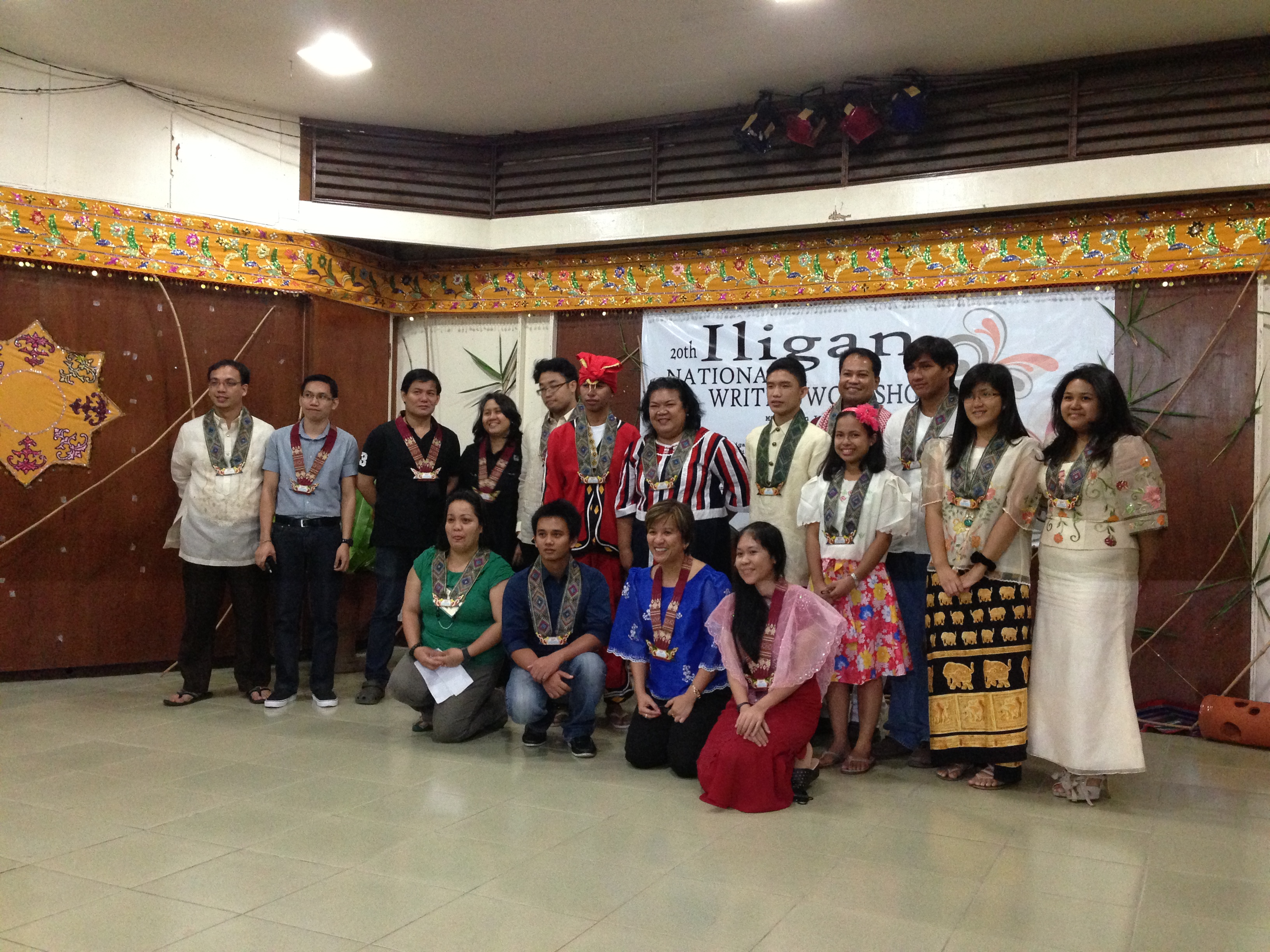
LAST WEEK, it was Iligan’s turn to host me, among other writers, for the 20th National Writers Workshop under the auspices of the MSU-Iligan Institute of Technology and the National Commission for Culture and the Arts, and I was honored to deliver the keynote, which I’m excerpting this week and next. Here’s what I said:

It’s always a pleasure to be in the company of friends and comrades in the profession, including many luminaries of our national literature who happen to be based in the Visayas and Mindanao. I’m especially glad to be addressing our young fellows, for whom I wrote this talk, for special reasons that will be shortly clear. In fact, I’ve decided to title this talk “To The Writer at 25,” aimed at writers of that age, give or take a couple of years.

Why 25? Let me cite a statistic that, depending on how you take it, could either be empowering or overpowering. It’s a figure that’s been there all along but which no one seems to have thought about too much, probably because no one really knew what to make of it or recognized its potential significance.

And here’s that fact: Jose Rizal finished writing Noli Me Tangere in December 1886 and published it by March 1887. At that point, he was still no more than 25 years old.

Rizal had less than ten years to live after that. But by the time he was executed by the Spaniards in 1896, he had written two novels and parts or fragments of five more, as well as dozens of important essays and poems.

Think of that for a minute—the Noli by age 25, the Fili by age 30, and a lifetime’s work by 35. If only for these, then—at least in my book—Jose Rizal does deserve to be a national hero, and not incidentally a National Artist.

Those of us who are now far north of 25 might recall what we were doing at that age. We may have been already writing by then—I know I was—but I doubt that we were laboring at or even thinking about a Noli, or even a novel, at that time.

At 25 I was married and a father, and I’d won a few literary prizes, certainly not enough to convince me or anyone else that I would go on to any kind of greatness, but enough to suggest to me that the rest of my life would be inscribed by literature, that I would do well to take it seriously, for better or for worse. I was out of school, and I had not even gone to my first writers’ workshop, but I knew, in my blood and bones, that I would go on to write more and more things, as inchoate as those things were to me then.

Indeed, for most of us not named “Jose Rizal,” 25 seems to be a good landing on the steps, a firm pre-departure point for a future in writing. Interestingly enough, in his famous essay “Tradition and the Individual Talent,” published when he was 31, T. S. Eliot specified 25 as the age by which one should have made some crucial commitments—among them, an embrace of tradition or “the historical sense, which we may call nearly indispensable to anyone who would continue to be a poet beyond his twenty-fifth year.”

It wasn’t even at 25 but a few months after turning 24 that Fyodor Dostoyevsky published his first novel titled Poor Folk, now nearly forgotten in the wake of his greater and more mature work but a critical and commercial success in its time. In fact, so intent was Dostoyevsky on pursuing a literary career that he published his second novel, The Double, a month after Poor Folk.

Edgar Allan Poe was even more precocious, publishing his first book of poetry at 18; he had three collections of poetry by his 22nd year, and turned to prose at 24, winning a prize for his story “MS. Found in a Bottle.”

Eighteen was also the age when Sylvia Plath published her first story in Seventeen magazine, in 1950; that year, she wrote in her journal: “I can never read all the books I want; I can never be all the people I want and live all the lives I want.”

I could go on and on, about this and that writer having written this and that work at this and that young age, but you catch my drift. While there may be no real prodigies in writing, there have been, on the other hand, many precocious people who began producing significant work around their 25th year.

I bring this up because, as I prepare to embrace seniorhood in a few months, I find myself often asking if I have written enough, if I were to keel over tomorrow. But enough for what? Perhaps the more accurate question would be, did I write enough of what I could, when I could? What does age have to do with output and insight?

This is what I’d like to talk about a bit this morning, this relationship between age and productivity in creative writing. I would have liked to say not only in creative writing but in the other arts as well, but this is where writing perhaps differs the most from music, painting, and so on. As I’ve often pointed out before, true prodigies don’t exist in literature, unlike in music or mathematics—no Mozarts who can write full symphonies or Ramanujams who can solve complex equations at a preciously tender age.

We don’t find full-blown adult novels written by eight-year-olds, which was Mozart’s age when he composed his Symphony No. 1 in E Flat Major. Prodigies also abound in painting—The Huffington Post lists at least ten of them, one of whom, nine-year-old Kieron Williamson, recently sold 24 paintings worth almost $400,000 in one month and was reported to be preparing for a retrospective—yes, a retrospective.

Why don’t we have a Brothers Karamazov or even a Gone With the Wind written by a third-grader? The reason is obvious: writing involves more than vocabulary; it requires social experience, which can only come with growing up.

Even so, Rizal did an awful lot of growing up very quickly to be able to dish out the Noli and Fili by his 30th year.

It was in my 30th year, in 1984, that I came out with my first book, Oldtimer and Other Stories. Throughout the mid-to-late 1970s, my officemate and I, the late playwright Bienvenido “Boy” Noriega Jr., then both in our early 20s, had carried on a fierce but friendly competition in the arena of playwriting. I drew first blood, with a first-prize win over Boy’s second place in the 1976 CCP Playwriting Competition—our mutual teacher in playwriting, Prof. Amelia Lapeña Bonifacio, came in third—but that was the first and last time I won over Boy, over many CCP and Palanca competitions that followed. As a result, I shifted from playwriting in Filipino to the short story in English, where I felt I was safe from Boy. But in the meanwhile, we made another friendly dare—to come out with our first books by our 30th year. As it happened, we both made it—barely: he published Bayanan-Bayanan at Iba Pang Mga Dula in 1982, after turning 30; I published Oldtimer in 1984, a month before turning 31.

I recall these things because I also recall the intense awareness of age and time that accompanied our writing then. We felt under the constant pressure of a deadline—and I don’t mean just the Palanca deadline, although that was mightily important to us then, at a time when there was very little publishing going on, and competitions were literally the only game in town. Ours, after all, was the generation of the First Quarter Storm, of a brave but bloody activism that saw many of its acolytes fall at the steps of the altar in their teens and early 20s. If there was anything important we wanted to do—like write a book, or get married, or father a child—we had to do it sooner than later, because life was very likely going to be short, if not nasty and brutish.

Of course we will never really know how long we will live or when we will die—that remains life’s greatest mystery, and it’s still with some astonishment that I realize I’ll be turning 60 in January—so we really can’t tell when our most productive years will be, or when we’ll write the piece that we will hope to be remembered by. (Conclusion next week.)