Penman No. 13: Random Reflections on Martial Law

HBD

Penman for Monday, Sept. 24, 2012

LAST FRIDAY marked the 40th anniversary of the imposition of martial law in the Philippines by Ferdinand Marcos, and the occasion gave rise to much reminiscing among those of us who went through that dark period. I myself was interviewed by a TV station and asked to speak at a forum at the University of the Philippines about my experience with martial law, which I fictionalized in my first novel, Killing Time in a Warm Place (Anvil, 1992).

Of course I’ve never really stopped thinking about martial law all these years, but not until this anniversary did I force myself to sit down and write what martial law really meant to me and what it taught me—the “me” being no longer the 18-year-old boy who was arrested for “subversion” and detained for seven months in Fort Bonifacio, but the 58-year-old man who managed to live far longer and to see more things than he expected.

What I will write down here are entirely my own impressions and conclusions as a private citizen. I am not a political scientist or an ideologue, although I did work as a journalist, and, ironically, as a government PR man in the late 1970s, when there were few other jobs to be had, after my release from detention. I’m sure that some readers and even my friends will find something to quarrel with in these observations, which will be good, because I don’t think we ever really sat down and summed up what that period meant to us, beyond saying—as we should—“Never again!” So, herewith, my random reflections on martial law:

1. It wasn’t as bad as what the Argentines and Chileans went through in their darkest days of state terror. But that comparison’s pointless and even cruel when it’s your body or that of someone you love being laid out in the interrogation room, when it’s your family desperately seeking an abductee, running from prison to prison. The government called it “smiling martial law,” but don’t be fooled—horrific things happened to ordinary citizens in those camps and prisons. It may have been good for business—at least at first—but it was an unmitigated nightmare for designated enemies of the state.

2. An armed forces cannot be at war with its own people. Martial law irreversibly politicized if not corrupted the military, so that it has had to be re-indoctrinated to support the people rather than the ruling elite. I don’t know how far it’s come along in this respect.

3. America can be a great friend, but it will always look out for its own interests first, and those interests don’t always coincide with ours. American politics is coldly opportunistic; the rhetoric of freedom and democracy can easily be used as window dressing for American commercial policy. Ferdinand Marcos and martial law wouldn’t have lasted that long without America’s imprimatur; even though some insist that it was the Americans themselves who took him out—that EDSA was a CIA plot—it was American support that entrenched him in the first place.

4. It takes a people to build a nation—not one leader, certainly not one despot and his cohort. Martial law turned us into blind followers, trusting the leader to make crucial decisions for the rest of us. Except for those who resisted the dictatorship, the rest of us were complicit in it; we wanted it to work and gave it our tacit approval, because it seemed to offer a simple and efficient solution to age-old problems. It also takes a thorough process—not quick fixes like martial law, street revolts, or coups—to secure deep and enduring change.

5. The Church can be a potent and progressive political force when it wants to. Much as I may be dismayed by the intransigence of the Church on social issues such as the RH bill—and indeed I no longer consider myself a practicing Catholic because of this—I acknowledge the contributions and sacrifices of many religious workers to the fight for freedom.

6. We all have our weaknesses and our limits. I saw how people who spoke big words could fall silent at the merest hint of torture, and how even the toughest ones could break at the edge of the unendurable. I have since learned not to demand of others what I could not demand of myself. At the same time, I saw that ordinary people can also be capable of extraordinary courage. Their heroism has made me wonder if I who survived was worthy of it.

7. On a purely personal level, one of post-martial law life’s most awful discoveries was that, incredibly, there were worse things than martial law, worse pains that one could receive, or inflict on oneself and on other people. A government can do only so much evil; the rest you can do yourself. But redemption is always possible for the self-aware, and I suppose that’s what many of us have been striving for these past 40 years.

* * * * *

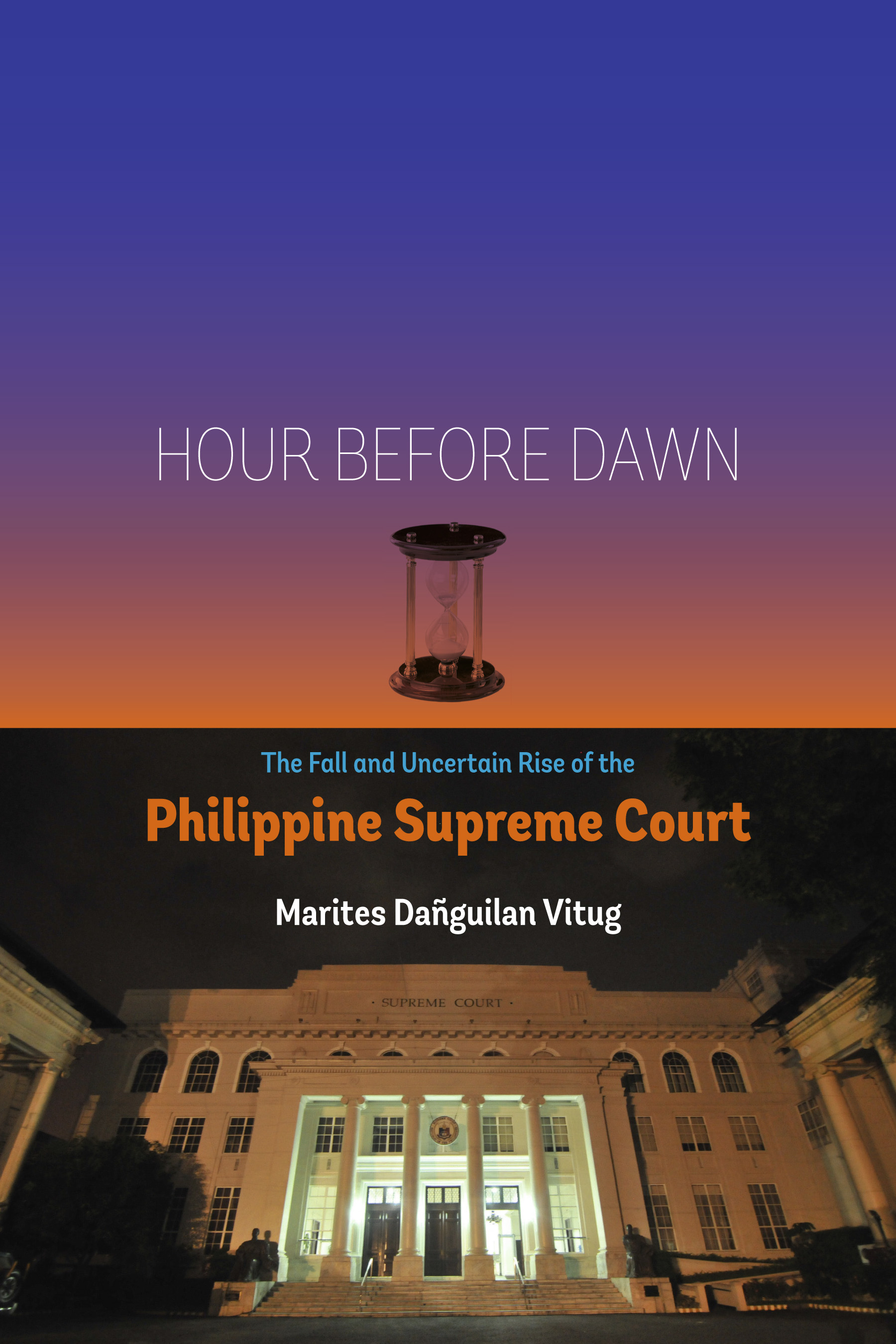
SPEAKING OF September 21, that was also the day last week when I failed to attend an important book launching in Makati because I was teaching my graduate class in Diliman at that same time. The book was Marites Danguilan Vitug’s Hour Before Dawn: The Fall and Uncertain Rise of the Philippine Supreme Court (Clever Heads Publishing, 2012), which I copyedited, along with its predecessor, the acclaimed and bestselling Shadow of Doubt: Probing the Supreme Court (Newsbreak, 2010).

It’s a copyeditor’s great privilege to read a book—and even reshape it to some extent—before anyone else does, aside from the author and the book designer. With Marites—with whom I worked for many years on Newsbreak—I always know that I’m in for a political junkie’s treat, as she will patiently go behind the scenes to reveal the inner workings of our most important yet also most inscrutable institutions, like the Supreme Court.

Without spoiling the suspense, here’s what I can say about Hour Before Dawn and why you should grab it before they run out of copies: if you’ve ever really wondered why Chief Justice Renato Corona had to be impeached and what the Supreme Court was like under his watch, read this book. If you’ve also wondered what Lourdes Sereno is really like and what kind of Chief Justice she’s going to be, read this book.

As its full title suggests, Hour Before Dawn offers both darkness and light, ample cause for both dismay and hope. It demystifies the Supreme Court and the Justices who preside over our fates, showing them to be as fallibly human as the rest of us, and yet also mindful of the higher judgment of history.

I don’t know if this book is going to earn its author another slew of death threats and libel suits, but I think it should be required reading for every law student, lawyer, and judge in this country—make that every citizen-at-large who hasn’t given up hoping for impartial justice.
Penman No. 5: Encounters with History

Library

Penman for Monday, July 23, 2012

I HAD an unusual encounter with history last week, by way of two sorties to two different exhibits that turned out to have a bit more to do with each other than I might’ve initially thought.

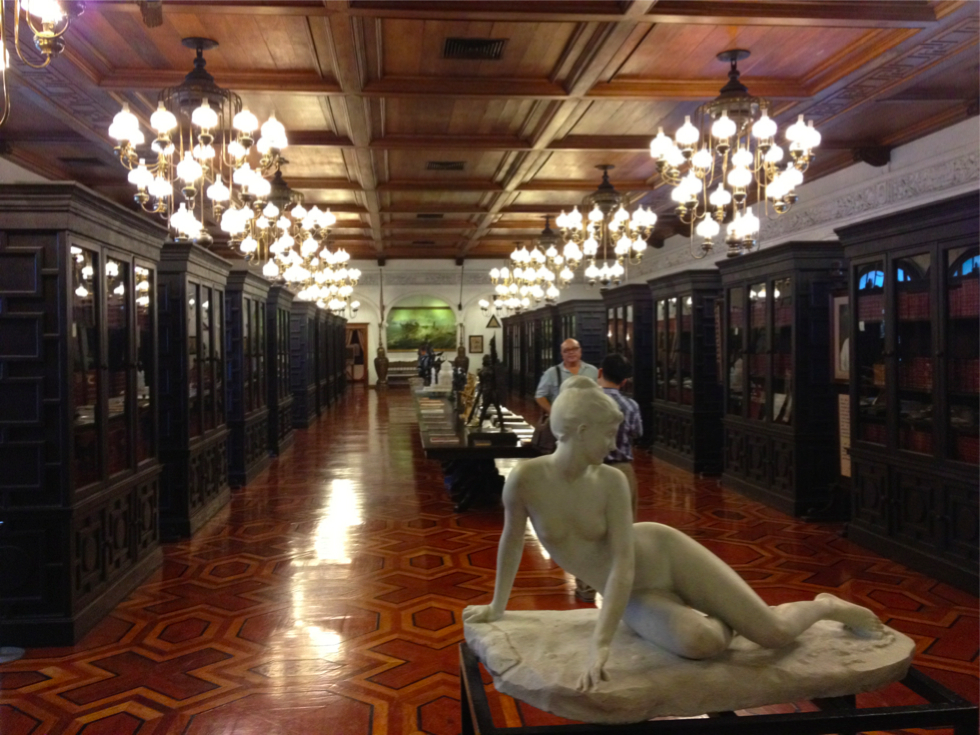
The first trip was something I’d been meaning to do for years but just never came around to doing—a visit to the Presidential Museum and Library at Malacañan Palace. (Our tour guide took pains to point out that “Malacañan” referred specifically to the presidential seat of power and the more popular “Malacañang” to the entire place itself; I think we’ll go with Malacañang for the rest of this piece.)

It’s one of those sad ironies that we footloose Filipinos can make elaborate and expensive plans to visit the White House and Buckingham Palace without ever setting foot on our own presidential abode. It could be that for far too long—particularly all those years of martial law—Malacañang didn’t lend itself to friendly visitations by ordinary citizens. That, plus the fact that we Pinoys have never had much of a sense of history, beyond routine celebrations of Independence Day and tired if not tiresome commemorations of Edsa 1. We’ve been schooled to think of history as high drama, as a calendar of big events, forgetting that those events were forged in offices, classrooms, factories, and the shade of mango trees.

Malacañang is, of course, the perfect theater for high drama—one of the balconies in the museum was the setting for that famous picture of Ferdinand Marcos and his family vowing defiantly to stay and to fight on, shortly before decamping to America in February 1986—but it was also, and remains, home and office to a long succession of men and women who led the country, people doing nothing more earth-shattering on most days than signing letters of condolences and felicitations and proclamations declaring this or that period to be National Fire Prevention Week.

As a museum rat, I’ve always been fascinated by presidential and royal regalia, and by the mementoes left behind by the high and mighty—not to be awed by them, but to appreciate their humanity behind the pomp and the poses. George Washington’s signature blue coat is on display at the Smithsonian, but so are his dentures, which must have hurt far worse than mine, and I don’t even have to worry about putting a country together; the mock pockets on Jose Rizal’s jacket in Dapitan betray a sharp fashion sense even in exile (and the smallness of his body size—a surprise to many Filipinos expecting a titan of a hero—merely accentuates his real stature).

Last week, thanks to the invitation of Ronnie Geron—an undersecretary in the palace and an avid member of Fountain Pen Network-Philippines—our group of over 30 fountain-pen enthusiasts got to visit and tour the Presidential Museum and Library. Since fountain pens themselves are something of an anachronism, stepping back into presidential history was a treat for all of us, and we can’t be blamed for feeling that the highlight of the tour was staring at Emilio Aguinaldo’s pen, or what remained of it—a piece we quickly identified as being very likely a Waterman 52 in mottled red hard rubber (a sorry shell of a pen, in exchange for which I offered to provide a near-mint example from my collection—but no one seemed to be too interested).

There were no other pens to be found that day in the museum and library, but there were roomfuls of other memorabilia, from the time of the Spanish and American governors-general to the prewar, postwar, and recent presidents: photographs, paintings, clothes, books, furniture, documents, and campaign materials. Every president had either a room or a corner devoted to materials from his or her presidency, and our very knowledgeable guide—a young man named Louie—walked us through the history of every room, mindful that the building itself was historic, quite apart from its residents.

The museum and library are located in what is now known as Kalayaan Hall, a 1921 structure used by the Americans as their Executive Building; the Marcoses called it Maharlika Hall, but Cory Aquino gave it its present name. Aside from the Main Hall and Library (or the Gallery of Presidents), the building also contains the Old Waiting Room Gallery, with materials from the Spanish era; the Old Executive Secretary’s Office, with rare Rizaliana; the Old Governor-General’s Office, the Osmeña Cabinet Room, the West and East Staircases, the Quezon Executive Office, the Quirino Council of State Room, the Roxas Cabinet Room, and the Northeast and Southeast Galleries. Plan on spending at least an hour to see and imbibe everything.

What most Filipinos (including many of us) don’t know is that tours of the Presidential Museum and Library are available for a minimal fee to individuals or groups who make the necessary arrangements beforehand. (Call 784-4286 local 4945 or email pml@malacanang.gov.ph for details.) The entrance is through Gate 6, and parking can be had at the Freedom Park just outside the gates.

Another exhibit that I made a point of looking into was one at the Cultural Center of the Philippines Main Gallery, titled “ReCollection 1081: Clear and Present Danger (Visual Dissent on Martial Rule),” co-curated by Marika Constantino and Ruel Caasi, and staged by the CCP in cooperation with the Liongoren Gallery. ReCollection 1081 brings together a selection of artworks produced by Filipino artists during and after martial law, as well as publications produced by both the underground and alternative press.

Those who lived through martial law can’t possibly miss the irony of the exhibition venue—much hated and derided in Imelda Marcos’ time as the domain of the elite, but long since reclaimed by more ordinary folk.

This show was already written about by Constantino herself a few days ago here in the Star, so I’ll just have a few points to add—chiefly, that the artist’s protest against oppression, injustice, and exploitation both preceded and continued after martial law (see Jaime de Guzman’s Sabbath of the Witches, 1970, and Nunelucio Alvarado’s Tunok sa Dahon, 1986).

It was martial law, of course, that provoked both the most explicit and subtlest forms of protest, demanding both courage and wit of the artist, and this range of responses is on full display in the exhibit. Assembling these works was already a feat in itself, considering how many more such works (and their creators) have been lost in the crossfire. Their survival into another century and their installation in the cultural bastion of the dictatorship is sweet poetic justice.

ReCollection 1081 runs until September 30.

Flashback No. 4: What Fil-Ams Can Do

This being the Fourth of July, and my daughter Demi having taken her oath as an American citizen a couple of weeks ago, I thought I’d repost this piece I wrote for the now-defunct San Francisco-based magazine Filipinas a few years ago.

Manileño for January 2007

I HAD a very pleasant and engaging semester as a visiting professor at St. Norbert College in De Pere, Wisconsin, last fall, a welcome break from my teaching duties at the University of the Philippines, where I should be back in harness by the time you read this. Not only did my stint at SNC allow me to introduce the Philippines to about 50 of my own students, only three of whom were Filipino-Americans; I was also able to speak before several groups of students and compatriots in other schools—the University of Michigan, the University of California at San Diego, and Marian College in Fond du Lac, Wisconsin.

With UCSD having one of the biggest Asian-American student populations among US universities, my encounter with the students there after my formal talk proved the longest and most challenging. Here, a student raised a question that I would hear in other places: what was the best thing Filipino-Americans could do for Filipinos and the Philippines?

I’m sure that it’s a question that occupies Filipino-Americans all the time, and for which there are any number of answers, some easier and more obvious than others.

When a supertyphoon hits the Philippines and ravages the land, then relief goods are always welcome; when poor Filipino boys and girls can’t go to school despite their talents, their lives can be changed by scholarships from Fil-Ams who also worked their way up the educational and economic ladder. Many US-based doctors make regular pilgrimages home on medical missions to poor communities. Some Philippine schools receive loads of used books and computers from their alumni in America.

All of these efforts are noble and much appreciated, for sure. A few of them may have been undertaken more to burnish the image of the donor than to uplift the lot of the receiver, but in the end, it doesn’t matter: some public or private good has been done.

At the same time, such humanitarian projects are basically defined by a relationship of dependency, with America as the perennial giver and the Philippines as perpetual receiver. It’s a relationship that, like I told the students in San Diego, can sometimes grate on both sides, with Fil-Ams feeling like the only thing they’re useful for is another donation to another needy cause, and Filipinos feeling like they’re seen as little more than mendicants.

It gets worse when—dependency or not, and whether out of frustration, bossiness, or a genuine concern—some Filipino-Americans dispense quick and easy prescriptions for the cure of Philippine maladies as though nobody back home had the brains or the guts to come up with such ideas on their own.

One such bromide Pinoys often hear is, “Why don’t you just unite behind the President and stop bickering with one another?” Sounds good, but it makes me wonder why more than two million Filipino-Americans can’t get together under, say, just one dozen regional associations and one alumni association for each major university or college, and elect a congressman or US senator among themselves.

The fact is that the best and worst of our culture manifest themselves on both sides of the ocean. Our generosity, our sense of self-sacrifice for the good of the family, our commitment to education, and our industry and resourcefulness have helped us back home as much as they have gained our compatriots a firm footing in American society. On the other hand, the same sorry habits of inggitan, intrigahan, and siraan have fragmented Filipinos in Manila and Manhattan, in Cebu and Chicago, in Davao and Detroit (I’m using these cities metaphorically, but I’m sure you can supply the damning details). One of the worst examples I heard of recently had to do with the visit some years ago of a Philippine president to a Midwestern city—only to find two competing Fil-Am organizations holding two separate programs in two hotels facing each other across the street.

So what did I tell the bright and idealistic Fil-Am students who asked me what I thought they could best do for the Philippines?

Be good Americans, I said—whatever that may mean to each of them. Get engaged in America’s political processes, and make a difference in your own sphere of action. Vote not just for fellow Filipino-Americans—although a few more such voices in high places could help the community as a whole—but for political leaders who will make responsible decisions that will benefit peoples everywhere, including Filipinos.

As the world’s only remaining superpower, America needs all the critical intelligence (and I don’t mean military intelligence) it can muster, and Filipino-Americans can make themselves heard on both domestic and foreign-policy issues, instead of simply going with the flow and making themselves as inconspicuous as possible.

And what’s our claim to being in a unique position to tell Americans and American leaders something they don’t know? Well, we lived with America for half a century. As I often tell my American friends, we were their first Vietnam; and yet we also view America with much greater affection—some would say unreasonably so—than they can ever expect from Afghanistan or Iraq.

Overseas charity is good for the soul and is always welcome; but as they say, it begins at home, as does good global citizenship.