Flotsam & Jetsam No. 33: My Trusty Merrells

SINCE MY daughter Demi bought them for me a year ago, these trusty Merrells have now taken me everywhere, from Michigan to Manila to Melbourne. They started out feeling tight and stiff but have softened nicely without being too cushy. They’ve also taken me on hundreds of kilometers of walks that have lost me a few dozen pounds (no kidding). Here they are in a brook in Palawan (I got them wet in the ocean not too long after).

Penman No. 70: Digital Detox and Ambrosia in Puerto Princesa

Penman for Monday, October 28, 2013
AFTER MORE than 20 years of being a digital junkie—usually traveling with nothing less than a Macbook Air, an iPhone, an iPad mini, a standby dual-SIM Nokia, sometimes a Nikon DSLR, two digital voice recorders, and a boatload of spare chargers and batteries—I never thought the day (much less the week) would come when I could pretty much do away with the cellular phone and the Internet.

But very recently, it happened—thanks to a writers’ retreat organized by a tirelessly dedicated Fil-Am writer and hosted by two of the most wonderful and interesting people I’ve ever met. (If this normally reserved writer runs out of superlatives this week, it will be for good reason.)

Almira Astudillo-Gilles has two master’s degrees and a PhD in Sociology, and could have been set for life working in business or academia, but she’s chosen the prickly path of creative writing to find another form of fulfillment. Having published a prizewinning book for children and a novel set in the Philippines, among other works, Almi—whom I met last year at the Philippine Studies conference in Michigan—put her mind to establishing a restful retreat for writers in need of a little solitude to recharge and to get some new work done. Marshaling her organizational resources and with the help of some private and institutional sponsors, Almi led our group to the first Adverbum Retreat for Writers at a hillside villa in Palawan.

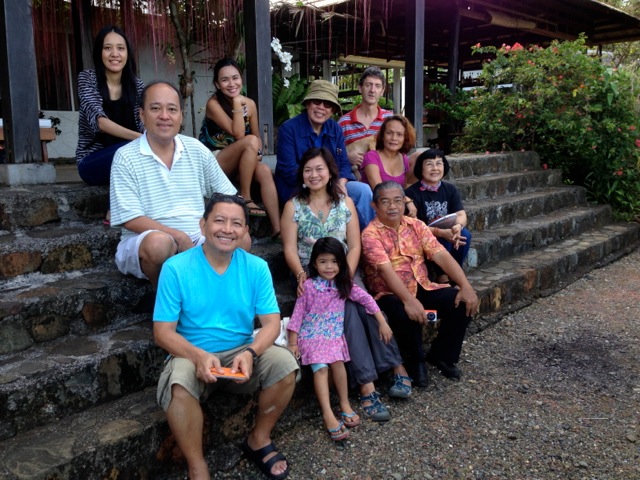
IMG_4458

In the group, aside from Almi and myself, were writers Edgardo Maranan, Ricardo de Ungria, and Jhoanna Lynn Cruz, and guests Joel Tan-Torres and his daughter Marjette, who had writing projects of their own; my wife Beng, of course, was with us, bringing her drawing and painting kits along.

The hillside villa is about 1 ½ hours by van from downtown Puerto Princesa, way past Iwahig and a little beyond Napsan, on a road that alternates between patches of smooth concrete and gravel the size of pomelos. (Technically speaking, the villa is just out of Puerto, in Sitio Bubusawin, Barangay Apurawan, municipality of Aborlan. You’d have to remember that Puerto Princesa is the country’s largest city in terms of land area, at almost 254,000 hectares, a bit larger than Davao.) If you’re looking for city comforts, go no farther than the new Robinson’s mall downtown.

I’d have to say that, as a certified metrophile and mall rat, I was daunted and distressed by the villa’s promise of a complete “digital detox—guaranteed NO Internet and NO cellular connection”; I hadn’t gone offline for more than a day in years. I’m not on Facebook, but I check out eBay, PhilMUG, and the news a dozen times a day, and with four book projects in the works, I felt like I was about to vanish into the dark side of the moon. I was placated only by the promise that, should the isolation prove intolerable, we could get a cellphone signal by venturing out farther into the boonies or on the water. And probably worse than the digital detox, I’m a self-described culinary philistine who hates cheese and anything vaguely Frenchy and who thrives on canned sardines and instant noodles; the prospect of being fed fresh vegetables spiced up by offerings from the backyard herb garden sent me into a panic, so I stocked up on ramen and chocolates at the grocery before boarding the van to the villa.

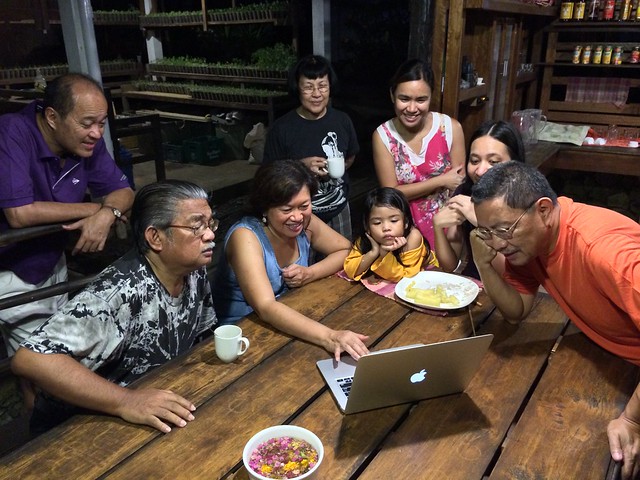
As it turned out, and to my own great surprise, my fears and anxieties proved largely groundless. The detox was made easier by the loveliness of the villa itself—a symphony in wood and stone, perched on a hillside overlooking a long trackless curve of beach and ocean (the silken beach alone would make you wonder why you’d need to go to crowded Boracay), under the shadow of cloud-enshrouded mountains. More than the place, we were relaxed by its owners—a Filipino-Belgian couple whose love for one another and for life itself is manifest in the way they keep their villa and feed and treat their guests.

Gielens

Theresa Juguan is a livewire, a brilliantly imaginative chef who may not have been born with a silver spoon in her mouth but who more than made up for the lack of privilege and opportunity with pluck, inspiration, and a single-minded determination to show the world just how good she could be. Theresa trained as a midwife, but discovered that she had a gift for baking, and was soon delivering fresh loaves and cupcakes instead of babies. The baking led to cooking, which she does with a liberal dash of the herbs she grows in her garden and, she says, “with emotion.”

Unlike most chefs we watch on TV, she doesn’t feel the need to taste what she’s cooking every five minutes or so; she knows in her bones, she says, how the dish will turn out. One guest remarked on the exquisiteness of her pork, which she had served him untasted; she doesn’t eat pork herself and can barely touch it. During our stay, we were served such seemingly simple but delectable creations made with crayfish, octopus, spring rolls, chapatti, and free-range chicken, most of it prepared with as little salt as possible, if any, to let the natural flavors of the ingredients pop.

Theresa also happens to be a talented and impeccably tasteful architect and interior designer, having designed and laid out the villa pretty much by herself. The very first thing that greets visitors to the villa is a striking trellis from which hair-like roots hang like a diaphanous pink curtain.

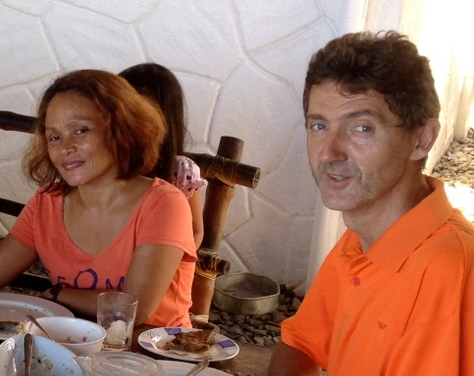
Her Belgian husband Herwig Gielen—you can call him “Gilles” (pronounced JIL)—was a businessman in the Philippines who one day found himself facing a very irate and demanding client—Theresa—and who was immediately captivated by her gutsiness, very much unlike the sweet, docile, marriageable types that expats like him tended to meet. If Theresa is an earth-goddess type, Gilles is a lanky, amiable god, indeed more shepherd than deity, in the attention he devotes not only to his wife and to the villa but to every small detail that will enhance the guest’s experience, from the virgin coconut oil and citronella concoction he prepares against insects and their bites to the ice for their cocktails and the generator that lights the place up after sundown.

As if the place needed yet another secret charm, you might get to meet Theresa’s five-year-old granddaughter Zanique (Theresa had been widowed before meeting Gilles), whom Beng and I instantly fell for like tipsy dominoes. She doesn’t talk much, preferring the company of her lola and her pet puppy Nitro, but she loves to draw and, not surprisingly, to cook, imbibing Theresa’s mastery of the kitchen.

Surprisingly, after being in operation for a couple of years, the Gielens had never really come around to finding a real name for their place—a visitor called it an “amazing villa” and the name (entirely true) stuck—but they took advantage of the presence of so many writers to cast about for another name, and my suggestion (ahem) was deemed acceptable: henceforth, this corner of Eden will be called Ambrosia, The Amazing Villa, after ambrosia, the food of the gods.

And let me thank Cebu Pacific for sponsoring the flights of the writers on this retreat (some members of the group, including Beng, paid their way through for the presumptive privilege of our company, and we think this can be a model for future workshop-retreats where aspiring or non-professional writers can spend some time and discuss their work with the pros). Since Beng and I are hopelessly footloose but can afford little more than budget fares, we’ve been traipsing all around Asia on one Cebu Pacific promo or other and I’ve been writing regularly about these trips and flights, but the Palawan trip was the first time I actually got a free ticket from CP. When our flight back to Manila was delayed for four hours by maintenance work on NAIA’s radar and runway congestion, Cebu Pac handed out packed lunches to the waiting passengers—nothing on the level of Theresa’s gourmet creations, but welcome nonetheless.

I’ll talk more about the retreat itself and about another place in Puerto well worth visiting—the new Hotel Centro downtown—in a forthcoming column. In the meanwhile, you can check out the Gielens’ place here and here (and you can write Gilles at herwiggielen@yahoo.com for more information—they have a home in downtown Puerto and attend to their email there; do give them some time to respond, as they may be away at the villa).

All I can add is, when my iPhone began chirping back to life on the road back in Iwahig, I felt a deep pang of regret; my message-less and therefore trouble-free week was over. Bon appetit!

Penman No. 68: Towards a Regional Literary Community

Penman for Monday, Oct. 14, 2013

WE WERE back in Bangkok very recently, about the same time as last year, for another gathering of the newish Asia-Pacific Writers and Translators Association (APWriters). Around 200 participants from all around the region and from as far as Europe and the US got together from October 3 to 6 in Chulalongkorn University—also the site and host of last year’s conference—to meet on a wide range of literary concerns, most of them bearing on this year’s focus on “The Teaching of Creative Writing.”

Titled “Reaching the World 2013,” the conference was sponsored by the Bangkok Metropolitan Authority, Asia Books, and the Faculty of Arts of Chulalongkorn University. Bangkok had good reason to host us two years in a row; it had been named World Book Capital for 2013 by Unesco, and was celebrating the honor in the most appropriate way it could. It’s also at Bangkok’s historic Oriental Hotel that the annual SEAWrite Awards for the region’s best writers are given out, and we were welcomed there at dinner by the urbane and popular Governor of Bangkok, Sukhumbhand Paripatra. The son of a prince and educated at Oxford and Georgetown, the governor put everyone at ease by joking that he couldn’t greet us with rhymed couplets, as he was “only a politician” (he had, in fact, taught political science at Chula, Georgetown, and Columbia).

I was one of the organizers of the conference, and was proud to see that a total of 27 Filipino participants (not counting four who had to withdraw at the last minute for various reasons) attended “Reaching the World.” Among others, the delegation included stalwarts of the Philippine literary community such as STAR columnist and former DepEd Usec Isagani Cruz; UST and UP creative writing guru Cristina Pantoja-Hidalgo; MSU-IIT professor and poet Christine Godinez-Ortega; DLSU creative writing center head Shirley Lua; UP Press director and poet J. Neil Garcia; University of San Carlos professor Hope Sabanpan-Yu; the Bellagio-bound fictionist Menchu Sarmiento; and Davao Writers Guild president Jhoanna Lynn Cruz.

But more than seeing familiar names on the program, I was especially glad to see that many of our youngest writers on the UP faculty were able to attend as well, including Francis Quina (my deputy at the Institute of Creative Writing), Gabby Lee, Sandra Nicole Roldan, and Vyxz Vasquez. Conferences like APWriters expose writers like them to ideas and influences outside of their own local schools and networks, and sustain the continuity of our commitment to literature from one generation to the next.

APWriters grew out of the old Asia-Pacific Writing Partnership, which we expanded to include translators, in recognition of their crucial role not only in promoting the works and careers of individual authors but also of fostering international understanding through literature. On top of the transition has been the indefatigable Australian writer Jane Camens, who now serves as APWriters’ executive director (read: conference busybody) and who put the conference program together from dozens of proposals we received.

What distinguishes APWriters and its conference format is the informality of the discussions. Proposals for presentations were solicited and accepted, but no lengthy papers were actually read; instead, panelists spoke from notes or off the cuff, achieving our goal of witnessing “writers in conversation” as participants from places as diverse as Norwich and Ho Chi Minh City shed their academic robes, rolled up their sleeves, and spoke from the heart and from memory about the subjects that matter most to writers, translators, and teachers of creative writing.

We don’t mean to be unfriendly towards critics, scholars, and their important work, which after all endeavors to make sense of what we creative writers do. It’s just that there are already enough venues out there for the reading of formal papers (the annual and massively-attended conferences of the Modern Language Association and of the Associated Writing Programs come to mind) on the most obscure and abstruse of literary concerns. I took part in two panels at Chula, as a discussant in the first (which confronted the question of “cloning” in writing workshops and programs) and a moderator in the second (which dealt with how writers budget their time, and with what else they do besides writing).

Aside from Jane, I was glad to see old friends and acquaintances from around the region (or whose work and personal lives bring them regularly to Asia) such as the American writer and workshop specialist Tim Tomlinson, whose book The Portable MFA I’ve recommended to those in need of a crash course in creative writing; the Indonesian translator Eliza Vitri Handayani, who’d sponsored the translation workshop in Jakarta that I’d been a part of just the week before; Kate Griffin of the British Centre for Literary Translation; the Japanese-American fictionist Kyoko Mori, a fellow alumnus of the University of Wisconsin-Milwaukee’s PhD program; the Indonesian-Chinese-American Xu Xi, who directs the low-residency MFA program at the City University of Hong Kong; the Australian nonfiction and theater expert David Carlin; and, of course, the APWriters chairman himself, the Hong Kong-based Sri Lankan journalist and humorist Nury Vittachi, who’s been behind some of the region’s most significant literary projects, such as the Man Asian Literary Prize and the forthcoming World Readers’ Award.

There were many more, but you get the idea: this is a functioning network of writers and literary specialists from around the Asia-Pacific who’ve come to know each other as friends. And before anyone starts screaming “Another literary cabal!”, let me say, yes, why not, because right now, that’s what we need; there will be a time and an occasion for principled disagreement, but for now our emphasis is on finding and strengthening commonalities of thought, practice, and experience, thereby creating a working community of writers and translators in the region.

The commitment of these people to our emerging network was evidenced by the fact that many participants, including myself, were entirely self-funded. (It also helped, of course, that Bangkok is one of the most accessible, affordable, and tourist-friendly places on the planet.)

The large turnout from the Philippines also reflects the size and the maturity of our literary community and culture. Why shouldn’t we be able to send almost 30 writers to Bangkok? I respectfully disagree with those of us (including my friend Cirilo Bautista, whom I praised and quoted a few weeks ago) who see the Philippines as “a small country.” We’re certainly not—neither in size (at 300,000 sq. km., the same size as Italy), population (in 2005, we were 13th in the world), nor GDP (around 40th to 43rd  out of nearly 200 countries, depending on the year and who’s counting). Our grossly inequitable incomes and power relations are a real problem, but even these haven’t curbed, and may even have encouraged, our expressiveness in art and culture.

Indeed, as we look around the Asia-Pacific, we’ll find that the Philippines has one of the most robust of literary infrastructures, with formal creative writing programs in half a dozen major universities, a workshop tradition going back half a century, and the kind of democratic irrepressibility and irreverence that you can’t find anywhere else in Southeast Asia.

We’re banking on these strengths to put the Philippines more firmly on the global literary map, and we’ve taken a step in that direction by offering to host (after Singapore next year) the 2015 edition of the Asia-Pacific Writers and Translators conference. I hope to see many of our Bangkok fellows there, and more.

Penman No. 67: Found in Translation (2)

IMG_2078Penman for Monday, Oct. 7, 2013

AS YOU read this, I should just be returning from Bangkok from another conference of writers and translators, and I’ll be reporting on that encounter next week.

But before anything else—and given this context of world literature in which I’ve been immersed for the past two weeks—let me voice my concern over a development I’d heard about in my absence pertaining to some contemplated changes in our high school curriculum. With our educational system shifting to the K-12 scheme—which I’m in favor of, just to be clear about that—our teachers and school administrators have had to review the curriculum to adjust it to the opportunities presented by the extra class time.

The plan being prepared by the Department of Education and the Commission on Higher Education was for high school seniors to have two semesters of literature—regional and world literature, meaning, literature by Filipinos outside of Manila and literature written by everybody else. Those of us who teach literature in college were elated to hear about this, because we see how valuable literature is to exposing young Filipino minds to the dynamic realities and challenges of the world around them—beginning with us as still a nation-in-progress, which regional literature helps to build, and with our growing engagement with Southeast Asia and the rest of the planet, which world literature makes sense of and amplifies.

Comes now the news that the DepEd has decided to compress these two semesters into one and to treat both regional and world literature as one subject, which doesn’t make sense for the teachers of these subjects and disperses the intended focus of our concerns in these areas. Makes me wonder what we added those extra semesters for, and, worse, if literature is going to continue to be treated as a disposable frill without any real bearing on national development. Have any of our government officials figured out by now that part of the reason we have a “Zamboanga hostage crisis” or a “Mindanao problem” is that we’ve never really introduced and explained ourselves to ourselves—which is what art and literature do for a people? Let’s hope that the DepEd rethinks its position on this matter, before it’s too late and before we fall farther behind our Asean neighbors in using culture as a foundation for nationbuilding.


AND NOW back to Jakarta, where I spent a few days with a large group of very enthusiastic and talented translators-in-training and with experienced translators and language specialists from as far away as the UK and Norway. As Kate Griffin of the British Centre for Literary Translation put it, the Jakarta workshops were something of a “translation boot camp,” a quick and memorable immersion for the participants into the unique challenges and wonders of translation as a bridge between cultures. (The BCLT promotes the translation of foreign authors into English, in support of what it calls “bibliodiversity,” the opening of minds and hearts through a richer and more accessible fare of reading material.)

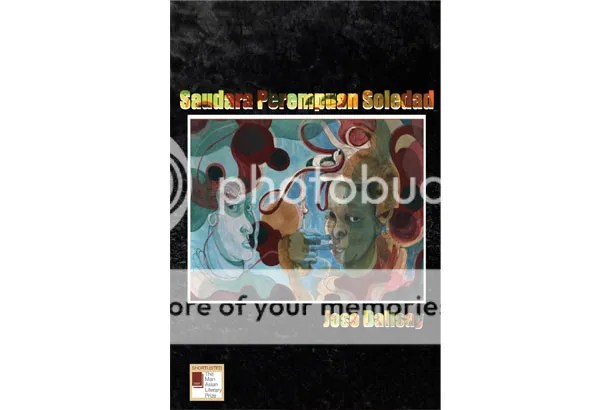
As I reported last week, the experience of having parts of my second novel Soledad’s Sister translated into Bahasa Indonesia (where it reads as “Saudara Perambuan Soledad”) reminded me of other fruitful encounters I’d had with my previous translators: Clara Nubile, who translated Soledad into Italian for Isbn Edizioni, Marta Alcaraz, who translated Killing Time in a Warm Place into Spanish for Libros del Asteroide, and Jean-Pierre Aoustin, who translated Soledad into French for Mercure de France. I’d had lively discussions with all of them, especially Jean-Pierre who turned out to be an old Manila hand and who met with me on a recent vacation here.

I think it was Salman Rushdie who once said that “the most interesting parts of a language are the untranslatable ones.” Be that as it may, translators have to do their best to come closest to an author’s original intentions, knowing that it is an impossible and fruitless task to strive for 100% fidelity and accuracy, but creating a space for negotiation and understanding between cultures in the middle of the two languages, the source and the target.

Clara, I recall, asked me to describe what kind of a criminal operation a bukas-kotse gang was. Marta had a load of questions about juego de prenda, the tuta in “Marcos Hitler diktador tuta!”, and why I had chosen to call the ruling party under martial law the “PNR, or the Party of the Newly Risen”; I explained to her that the actual martial-law government party was called the Kilusang Bagong Lipunan, or Movement for a New Society. I used PNR as something of a private joke, as the initials also stand for Philippine National Railways (a reference to how everything was railroaded under martial law) and for the Filipino phrase “puwede na rin,” or “it will do” (a reference to mediocrity). Jean-Pierre wondered about my use of “laundry on the clothesline” and if it had any cultural resonances; I told him that we Pinoys still hang our clothes out to dry, and that you can half-expect to find your favorite jeans and shirts gone from where you left them if you don’t watch out.

In other words—literally, I guess—translation involves much more than figuring out equivalents for individual words and phrases; the translator keeps looking for similar, familiar experiences in the target culture to convey a working sense of the author’s meaning.

In Jakarta, my group and I—with the Bali-based translator and art critic Arif Prasetyo facilitating—went over words and phrases that the Indonesians had flagged. Why did I use “cloud-curtained” to describe a rainy evening instead of just “rainy”? (Because it was the novel’s opening scene and I wanted a touch of the theatrical.) Why did I say “a million gas stoves roared to life”? (Because I wanted both the sound and the image of the gas fires coming awake, mirroring the headlights of motorists and even the flowers in the plane’s cargo hold.) When I wrote that the sudden downpour “blurred glasses and windows,” did I mean “eyeglasses”? (Yes, to set up a motif having to do with seeing and perception.) We had fun with the word duhat, which I’d kept in the Filipino original, not knowing its English equivalent; some Googling with images established that, in Bahasa, it was the local jamblang, also known as the duwet or the black plum (but if I’d used “black plum” in my novel, not a single Pinoy would have known what I meant).

Just as interestingly, my translators found a couple of mistakes in my novel, which I acknowledged with equal amounts of embarrassment and gratitude. One was a small typo, the other a major boo-boo: I’d said that the flight from Jeddah to Bangkok had “stretched the daylight with it,” but an alert member of the team who had actually been to Jeddah (I never had) noted that it worked the other way around, that one flew more quickly into the darkness. I promised to correct this in the next edition.

And so my adventure with the translators went, full of surprises and revelations. I learned much from listening to Kate Griffin talk about how, in the UK, interest in translation has been drummed up through popular word games, and how the BCLT (which is based at the University of East Anglia in Norwich, where I began Soledad’s Sister as a David TK Wong Fellow in 1999) combines teaching, research and expertise with an ambitious outreach program. Eric Abrahamsen, an American who has been based in Beijing for the past 12 years, spoke about how he helped form Paper Republic to band translators of Chinese together to professionalize their trade.

John McGlynn, an American translator who works with the Lontar Foundation which translates and publishes Indonesian writing into English, brought up the painfully obvious point: translators don’t get paid enough for their work. Ideally, he suggested, translators should get at least $20 (or, to us, P1,000) per page, given that the US State Department paid professional translators like him $30 per page for contracted work. In reality, however, Indonesian translators got a tiny fraction of that suggested amount. “Factor in the cost of printing and distribution, plus royalties for the author, and you really have very little left for the translator,” said John.

Indeed, translators around the world have a long way to go to attain the same respect and consideration given to the authors whom they lend their voices to, but like the writers themselves, they have no choice but to persevere, the unacceptable alternative being silence and ignorance.

Penman No. 66: Found in Translation (1)

Penman for Monday, Sept. 30, 2013

I HADN’T been back to Indonesia in 30 years—the last time being in 1983, when Manong Frankie Sionil Jose brought five fellow Filipino writers to an idyllic lakeshore in Bali to meet with other Asian writers—but last week, I flew in to Jakarta again, thanks to the Inisiatif Penerjamahan Sastra, the Initiative for the Improvement and Promotion of Literary Translation in Indonesia.

The event was the 2013 Literary Translation Workshops, sponsored by the IPS with the support of the program Creative Encounters: Cultural Partnerships between Asia and Europe, promoted by the Asia-Europe Foundation (ASEF) and Arts Network Asia (ANA), in collaboration with Trans Europe Halles (TEH). Further support was provided by the Royal Norwegian Embassy, TransCon, the Lontar Foundation, Komunitas Salihara, Pusat Dokumentasi Sastra, Yayasan Reproduksi Cipta Indonesia, and our own Department of English and Comparative Literature at the University of the Philippines.

I had been brought in by IPS’ Eliza Vitri Handayani in my capacity as a novelist—the author of Soledad’s Sister—whose work had been selected as a subject for the workshops’ translation exercises. Going beyond the usual practice of laboring in the dark on a foreign manuscript with just the help of one’s own knowledge of two languages, a dictionary, and the translator’s best understanding of the text, the IPS had brought in the authors of the chosen texts for a conversation with their translators, to clarify the authors’ intentions behind writing specific passages and to establish the best translations for them based on those intentions.

The translations went several ways: from Bahasa Indonesia to English (author Triyanto Trikwitromo, in a group led by literary translator Pamela Allen); from English to Bahasa Indonesia (me, led by Arif Bagus Prasetyo); Norwegian-English-Bahasa Indonesia (Kari Fredrikke Braenne, led by Kari Dickson and Miagina Amal); and Chinese-Bahasa Indonesia and Chinese-English-Bahasa Indonesia (Su Cici, led by Eric Abrahamsen and Yusi Avianto Pareanom).

In choosing my novel for their English text—for which I, of course, felt deeply honored—the workshop organizers underscored the need for us Southeast Asians to restore and strengthen our cultural connections to one another, instead of always turning to the West for inspiration and affirmation. Indeed, as I told the dozen or so young Indonesian translators at my table, it was colonialism that broke us apart and led us down different historical paths; but now, ironically, it was a colonial language—English—that was bringing us back together as a bridge.

Also ironic for me was the fact that my novel was now being translated into Bahasa Indonesia (even if only for an exercise), after it had been translated into Italian and French, and released in a US edition. This, I heard, was a point made in last year’s workshop—how we Asians often have to be validated first in the West before being recognized in our own regions, let alone in our home countries. Sitting down with the Indonesians and listening to their concerns, I was reminded of the many exchanges of emails I’d had with my Italian, French, and Spanish (for Killing Time in a Warm Place) translators, and of what a difficult, precious, and yet little-appreciated skill literary translation is.

The emphasis now being put by the Indonesians on the development of good literary translators also called to mind our own budding efforts in this respect, and of how far behind we are in using translation to promote the best of our literature abroad and within our own shores. I suspect that, for one, we haven’t pushed for translation as hard as we should because many of us naturally assume that we don’t need translation, since we write in English and therefore have direct access to global publishing. But what about our treasure trove of literature in Filipino and other non-English languages? How many capable and willing translators do we have who will devote years of their time and talent to the resurrection and promotion of what could be classics of our literary heritage?

I’m thinking, for example, of the work put by Cecilia Locsin-Nava into her well-received translation of Ramon L. Muzones’ epic 1946 novel Margosatubig (Ateneo Press, 2012), hailed by National Artist Bien Lumbera as “a wonder-work of an English translation, literate and literary, a rare, readable English version of a regional literary treasure. It is a lucid, unornamented rendition of the original Yuhum novel that manages quite effectively to suggest the delicious sensation of following the development, chapter by chapter, of the serialized popular novel.” This was a novel so popular that it reportedly caused Yuhum’s weekly circulation to soar from 2,500 to 37,000 copies. Surely it deserves to be read beyond its original Hiligaynon audience? Thanks to Cecile Nava, this will now be possible.

As the Jakarta organizers reminded everyone, literary translators today have assumed an expanded role. Not only do they render works into another language; they also help promote these works and draw the attention of global publishers to the emergence of vibrant new writing from around the world. Indeed, how could we have read Gabriel Garcia Marquez without the intervention of Gregory Rabassa, or Pablo Neruda without W. S. Merwin, or Italo Calvino without William Weaver?

What kind of relationship do translators have with authors? Here’s part of what Weaver told the Paris Review about working with Calvino: “I had problems with Calvino because he thought he knew English. He would fall in love with English words. Every now and then he would fiddle with a sentence in his English. At one point he fell madly in love with the word feedback, and he didn’t realize that in America feedback is like closure or spinning out of control, something you hear constantly on television. It’s jargon and cliché, and you can’t use it anymore. The word is dead to literature, but to him it was new and fascinating. He thought it was fun and so he kept putting it into this story where it really didn’t belong, and I kept taking it out. Finally the last proofs came, and I took it out definitively. And I’m sorry to say he died before he had the book in his hands, so he never knew that I’d done this to him.”

Authors can be a handful enough, but translators face an even bigger problem beyond the text: getting due recognition and remuneration for their work. I’ll dwell on this—and on the questions I fielded from my Indonesian translators—next week.

(Illustration courtesy of the STAR’s Igan D’Bayan)

Flotsam & Jetsam No. 28: Traveling Companions

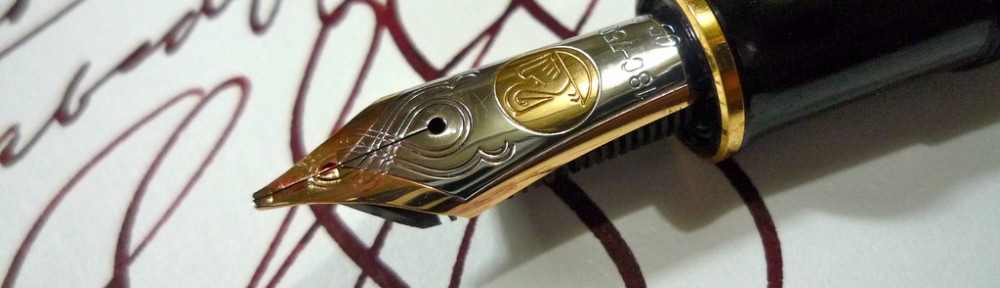
AM DOWN in Jakarta for a conference this week and brought two workhorse pens with me for signing books: my ever-reliable 1993 MB Agatha Christie and a 1928 Parker Duofold Senior, the classic “Big Red.”

I originally bought the Big Red for resale, but decided to keep it when I saw how clean it was. Look how sharp the milling is on the black hard rubber part of the cap:

Penman No. 54: Calling All Filipino Writers

APWTPenman for Monday, July 8, 2013

I’LL BEGIN with a sheepish apology (and a word of thanks) this week, for a stupid mistake I made in my piece about hats a couple of weeks ago. I was in the car on my way to a meeting in Makati last Wednesday when I realized to my great horror that I’d written something very wrong, and resolved to fix the problem in the blog version of my column at www.penmanila.ph, but of course, before I could do that, an alert reader named “Nestie U” caught the error and pointed it out to me. I’d written that “felt” meant “mashed leather pulp,” but it’s certainly not—it’s wool, not leather. It probably won’t mean much to most people, but if we self-proclaimed wordmeisters don’t get finicky about words and what they mean exactly, then who else is going to care? Many thanks again, Nestie, for reminding me of what a confused and forgetful fellow I could be, sometimes.


THIS IS going to be a week of announcements, not because I’m too lazy to write a properly thought-out column—you know how I can go on and on about my pet causes and peeves—but because my involvement in certain literary organizations and concerns gives me access to news and information that (given the usual space limitations) might not even make it to the literary or culture section of most newspapers. (Here in the STAR, of course, we do our best to keep you abreast of the most important and interesting goings-on in the cultural front.) So let’s get on with the literary news—these just in!

For writers, the first and most vital announcement I have to make is a call for all alumni of writers’ workshops sponsored by the National Commission for Culture and the Arts (NCCA) to take part in a tracer study being conducted by the National Committee on Literary Arts, on which I sit as a member.

Most people don’t know this, but the NCCA—the government’s funding agency for cultural programs—has been supporting most if not all of the country’s major writing workshops for almost 20 years now. Without the NCCA’s substantial support, these workshops would have been forced to shut down a long time ago, or would never have become as highly developed as they are now. The workshops enable young writers to meet both their peers and their seniors, examine and affirm the writers’ talent, and initiate them into a community that can help sustain their productivity for life.

The UP workshop, for example, has been held every year for almost half a century, and while we now take only 12 fellows a year, we used to have more, so if you average everything at about 20 fellows per batch, we would have produced almost 1,000 alumni fellows since the beginning. Add to these the fellows who’ve gone to the Silliman, Iligan, Iyas (La Salle Bacolod), and other NCCA-supported workshops in the regions.

Like any other government agency, the NCCA has to be publicly accountable for how it spends the people’s money, so we at the NCLA thought of initiating a tracer study to see exactly how these workshops have helped our writers in their careers—say, in terms of books written and published and awards won for their work, among other criteria.

We’ve asked Dr. Christine Godinez-Ortega of MSU-IIT to be the project leader for the first phase of this project, and Christine and her team have formulated a set of questions that we’d like all workshop alumni from 1994 to 2010 to respond to. If you’ve attended and benefited from one of these workshops, please click on the link following and fill out the form.  http://www.msuiit.edu.ph/ research-extension/ncca/ tracer.php. Your response will go a long way to help sustain government support for the development of Philippine literature, as well as create a very helpful database and virtual network of all workshop alumni.

The second item on this week’s literary agenda is another call, this time for papers to submit to the “Reaching the World 2013” conference, scheduled for October 3-6, 2013 in Bangkok, Thailand. Spearheaded by the Asia-Pacific Writers and Translators Association, the conference is co-sponsored by Chulalongkorn University, the SEAWrite Award, and the Bangkok Metropolitan Administration.

Among many other Filipino writers, I’m one of the founding members of APWriters (www.apwriters.org), which has become one of the most active and viable organizations of writers and academics in the region. Last year, a formidable contingent of Filipino writers attended this conference, also in Bangkok, and our participation there left a very positive impression on the organizers and our fellow delegates, so much so that this year, I’ve been asked to head the Academic Committee that will receive proposals for papers and presentations.

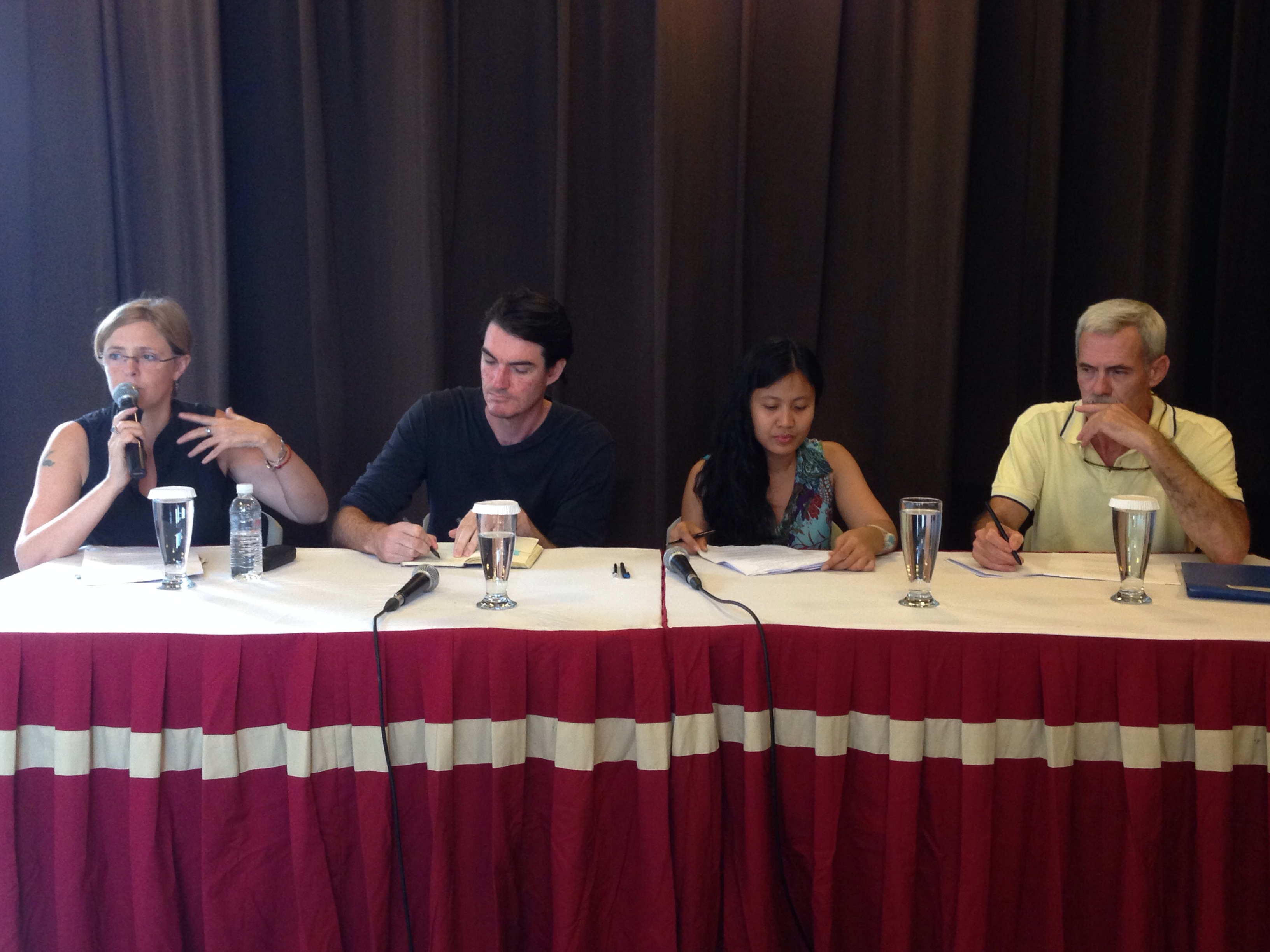
Bangkok has been named by UNESCO as the World Book Capital for 2013, which is why we’re returning there (aside from the fact that Bangkok and Thailand are worthy of visiting for food, fabulous sights, fantastic shopping, foot massages, and other pleasures anytime, given any reason or excuse). Its famed Oriental Hotel has also hosted the annual SEAWrite Award, honoring the region’s best writers. (That’s a session from last year’s conference in the pic above.)

“Reaching the World 2013” will bring together authors, literary translators, scholars, teachers of Creative Writing, publishing professionals, and others from Asia and beyond. This three-day international conference with workshops and a free public day will enable writers, readers, scholars, students, publishing industry professionals and interested members of the public to network and share their work.

APWriters is a fairly open and friendly organization, and you just have to be a writer, a translator, a teacher, or have an interest in either writing or translation to sign up. Even in the academic area of the organization and the conference, we try to remain accessible, preferring discussions on topics of broad application to obscure and highly specialized ones that only a very few can understand and appreciate.

This year, for the conference, we are inviting papers and presentations on the following subthemes: Teaching Creative Writing; Literary Translations; Cultural Identity; Food in Literature; Music/Art in Literature; Online Writing; Young Writers; Literary Fiction; Creative Nonfiction (including biography and memoir); Poetry; Genre Fiction; and other related topics. Our main focus, however, will be the teaching of writing.

To offer a presentation or longer paper with a focus on teaching and practice of creative writing, email me, Jose (“Butch”) Dalisay, Chair of AP Writers’ Academic Committee, at jdalisay@mac.com. Deadline: August 10.

To offer a presentation or longer paper on literary translation, email Eliza Vitri Handayani, Chair of AP Writers’ Translation Committee, evhandayani@gmail.com. Deadline: August 10.

If you’re teaching Creative Writing at a university which offers this discipline and would like to offer a half-day or full-day workshop, send a paragraph describing the workshop you’d like to offer along with a brief bio to AP Writers’ Board Member Xu Xi at xu.xi@cityu.edu.hk.

If you would like to read your poetry or discuss your creative writing on the panels at the public forum on Sunday, October 6, in the Bangkok Arts & Culture Centre, or if you want to launch a new book at “Reaching the World 2013,” email Jane Camens at admin@apwriters.com.

I’ve reminded the early birds who’ve already emailed me to express their interest in presenting a paper that they will have to produce a ten-minute-maximum version of their paper (and that time will include setting up PowerPoint, should they need it). I’ve noticed that here in Asia, we tend to be too respectful of each other in terms of extending time limits, which many paper presenters routinely ignore, droning on and on without compunction. Well, I’m going to pull the plug on any such miscreant (I think it’s a gross discourtesy to the next speaker and to the audience itself to speak beyond one’s allotted time), so please practice your presentation with an alarm clock before leaving home.

There’ll be a small conference fee (last year it was only USD$50 per participant) and we have no travel funding whatsoever to offer anyone, including ourselves, so save up and book a budget fare early, and see you in Bangkok in October!