Flotsam & Jetsam No. 37: The 2014 APWT Conference Tentative Program

ASIA-PACIFIC WRITERS AND TRANSLATORS

Bridging Cultures: Creative Writing and Literary Translation in Asia Today

17-20 July 2014 

The Art House, 1 Old Parliament Lane, Singapore

Program (Draft@24 April)* 

*Sessions or times are likely to change, so check back before the event.

Our ‘roundtables’ are so-called to encourage audience participation in conversations started by the featured authors.

Speaker biographies can be found here: http://apwriters.org/singapore-2014-conference/biographies-whos-speaking-and-youll-meet-at-bridging-cultures/

Thursday 17 July

08:30     Blue Room           Sign in, collect conference badge and handout.

Tea/coffee, courtesy of the Arts House and NBDC

09:00     CHAMBER           Welcome and Introduction.

09:15    CHAMBER            Opening Keynote (TITLE TBA) by Suchen Christine Lim.

09:50    CHAMBER            ROUNDTABLE. ‘What is Literature For? featuring the conference keynotes: Suchen Christine Lim with Linda Jaivin and Merlinda Bobis. Moderator TBC.

11.00     Blue Room           Refreshments, courtesy of the Arts House and NBDC

11:30     LIVING ROOM   ROUNDTABLE. Poetry: Art and Soul of It – This is a free-wheeling conversation about what poetry is and isn’t, led by Alfian bin Sa’at, Martin Alexander, Mani Rao, Menka Shivdasani, and Joshua Ip. Moderated by Jennifer Crawford.

11:30     CHAMBER           ROUNDTABLE. Twisting the Truth: Truth in Fiction, Lies in Non-Fiction. An exploration of story-telling as art and why we tell stories, with David Carlin, Lisa Walker (TBC), Michael Vatikiotis and Philip McLaren (TBC) – Moderated by Jose Dalisay.

12:45    Blue Room           Lunch, courtesy of the Arts House and NBDC.

2:00      WORKSHOPS (4 hours) with Martin Alexander (COUNCIL ROOM) and Tim Tomlinson (Green Room). SEE DETAILS. http://apwriters.org/singapore-2014-conference/creative-writing-and-editing-workshops/

2:00        LIVING ROOM   ROUNDTABLE. The Art of Remembering. This broad conversation about writing memoir will be kicked off by Sally Breen, Tony Birch), Jessie Cole (TBC), and Victor Marsh in conversation with Francesca Rendle-Short.

2:00       CHAMBER            ROUNDTABLE. The Art of Forgetting. Fiction can take us away from our ‘real’ lives into different ways of seeing the world. Novelists talk about their work, featuring Kathryn Koromilas, Dipika Mukherjee (TBC) and Angelo Loukakis, in conversation with Maria Carmen Sarmiento. 

2:45        LIVING ROOM   Conversation on Writing Today from Pakistan with Iram Shafique and Farheen Chaudhry and Qaisra Shahraz.

2:45        CHAMBER           Changes to the Literary Landscape in Indonesia. A panel discussion led by John H. McGlynn with others (TBC) includingIwan Sulistiawan who will talk about changes ‘From Discrimination to Multiculturalism: Indonesian Chinese in Indonesian Novels’. Moderated by Michael Vatikiotis.

3:30     Blue Room       Refreshment, courtesy of the Arts House and NBDC

3:45    LITERARY WALK (TBC), organized by the Arts House. Meander through the fiction, non-fiction and fantasy of Singapore with award-winning writer Rosemary Lim (TBC). You will follow in the footsteps of Joseph Conrad and Somerset Maugham, explore locations that inspired Rex Shelley and Edwin Thumboo. Discover Singapore as muse to novelists, playwrights and poets as you travel in time from colonial days to the present day through words and imagination.

4:00       Earshot Café     NEW WORK- Book Launches.

Help celebrate the launch of five new books. Menka Shivdasani launches an anthology of women’s writing from India; Eu Yoke Lin will launch her first book of poetry; John McGlynn launches a translation of a classical Malay tale “Krakatau: The Tale of Lampung Submerged”; Victor Marsh launches his memoir that draws on his experiences as a disoriented Australian who is initiated by a young guru; and Mani Rao will launch a Singapore edition of echolocation (Math Paper Press). Details will be available on a separate link.

6:30      Blue Room        Welcome Cocktails (TBC) – courtesy of the Arts House and NBDC

EARSHOT CAFÉ (?)     Singapore Outloud (TBC). Poetry and short fiction readings with participating moderators Martin Alexander and Alfian Sa’at.

Friday 18 July

09:00     WORKSHOPS (4 hours) with Tony Birch (COUNCIL ROOM) and Nury Vittachi (Green Room). http://apwriters.org/singapore-2014-conference/creative-writing-and-editing-workshops/

09:00    CHAMBER            KEYNOTE: ‘Border Lover in Uncertain Times: Story-Making Across Cultures, Languages, and Literary Forms’ by Merlinda Bobis

09:45     CHAMBER           RoundtableWhat Women in Asia Write About Now, with Merlinda Bobis, Menka Shivdasani (TBC),Mridula Chakraborty, Farheen Chaudhry, and Qaisra Shahraz. Moderated by Judith Buchrich

09:45     LIVING ROOM Roundtable – TBA

10.15     Blue Room           Refreshments, courtesy of the Arts House and NBDC

10:45    LIVING ROOM   Gender Politics: Forcing the Issue– Victor Marsh, Jhoanna Cruz and Alfian Sa’at speak about issues that brought them out as writers. Moderator TBC.

10:45     CHAMBER           Changes to the Literary Landscape and New Publishing Opportunities (#1). This session discusses new magazines and other platforms with Zafar Anjum, Simon Clews, Martin Alexander, Kulpreet Yadav and others TBC, with participating moderator Kelly Falconer (Asia Literary Agency).

12:30    Blue Room           Lunch, courtesy of the Arts House and NBDC

1:00        LIVING ROOM   Book launches. Help celebrate the launch of books by Lydia Kwa, Bhavna Khemlani, Bob D’Costa and Farheen Chaudhry. Details will be available on a separate link.

2:00    Workshops (4 hours) with Sally Breen (COUNCIL ROOM) and Merlinda Bobis (Green Room). See http://apwriters.org/singapore-2014-conference/creative-writing-and-editing-workshops/

2:00     CHAMBER      Writing Under Political Pressure. ‘Prison Makes Poets of Us All,’ wrote Filipino political prisoner Alan Jazmines. Maria Carmen Sarmiento discusses the literary work of some political prisoners in the Philippines. At the age of 18 Jose Dalisay was himself a political prisoner for seven months under Filipino martial law (1973) and wrote his first novel about that experience (1992). He now writes nonfiction history of that period. Others on this panel include Alfred Birnbaum who translated the censored work of Burmese novelist Nu Nu Yi. Moderated by Michael Vatikiotis.

2:00        LIVING ROOM   How Translation Transforms both Text and Translator with Alfred Birnbaum, Andrea Berrini, Sun Xuefen (TBC) and Linda Jaivin, moderated by Mani Rao.

2:45        CHAMBER           Links and Fragments into Narrative Wholes

What can be done when a novel gets stuck – when the writer just cannot imagine what the next action is?  Tim Tomlinson has suggestions, while prolific author Nury Vittachi adds advice of his own. Cristina Hidalgo who has authored more than 30 books will also offer a few tips. Moderator TBC. 

2:45        LIVING ROOM     IN CONVERSATION. Shirley Lee, translator of North Korean poet Jang Jin Sung’s recently published disturbing memoir Dear Leader, in conversation about the book, its success and the issues associated with its translation, in conversation with her with her agent Marysia Juszxakiewicz of Peony Literary Agency. TBC

3:30        Blue Room           Refreshments, courtesy of the Arts House and NBDC

4: 00       CHAMBER           Roundtable. On Teaching Creative Writing in English and the Influence of the Mother Tongue. Join this discussion withDai Fan who teaches one of the few English language creative writing courses in China, Jayanthi Manoj who teaches in Trichy, India, Filipino teacehers Hope Sabanpan-Yu and Christine Godinez-Ortega (TBC), and Indigenous Australian author and professor Tony Birch. Moderated by Francesca Rendle-Short.

4:00     LIVING ROOM

5:30        EARSHOT CAFÉ                 Singapore Outloud #2 – Poetry and short fiction readings with participating moderators Joseph Ip and Mani Rao.

Saturday 19 July

09:00     Workshop (4 hours) with Francesca Rendle-Short (COUNCIL ROOM). See details. http://apwriters.org/singapore-2014-conference/creative-writing-and-editing-workshops/

09:00        CHAMBER        KEYNOTE: Found in Translation – In Praise of a Plural Worldby Linda Jaivin.

09:45     CHAMBER           RoundtableTranslation Thrills and Spills. Translators speak about their translation process and challenges, and share hilarious moments from their experience translating authors and poets who are too close, too far, and even omnipresent. Linda JaivinKyoko Yoshida, Andrea Lingenfelter and Menka Shivdasani with participating moderator Mani Rao.

09:45   LIVING ROOM   CONVERSATION “ASIAN SAVVY”. Changes to the Literary Landscape and New Publishing Opportunities (#2). Join in this lively conversation led by Nury Vittachi who contends that ‘Asia’ is poised to lead the literary world.

10.15     Blue Room           Refreshments, courtesy of the Arts House and NBDC

10:45     CHAMBER           How Translation Transforms both Text and Translator with Alfred Birnbaum, Andrea Berrini, Sun Xuefen (TBC) and Linda Jaivin, moderated by Mani Rao.

10:45     LIVING ROOM   Language and Politics: New Dynamics. Has the role of English shifted significantly in a postcolonial scenario? A dominant group can seize, assimilate, domesticate … is it any different when translating from English to vernacular languages? When so-called local, native or indigenous texts present culturally specific contexts, how can they be translated into more ‘universal’ contexts without misrepresentation? What goes into making non-English texts, “world literature”? If translation has now been exposed as colonial discourse, has it changed in a postcolonial context? Mridula Chakraborty, Antonette Talaue, Shafique Iram, Dipika Mukherjee(TBC) and/or Shirley Young-Eun Lee (TBC), moderated by Shelly Bryant.

12:30    Blue Room           Lunch, courtesy of the Arts House and NBDC

SPECIAL LUNCHTIME ANNOUNCEMENTS

1)      Re: Joint issue of Griffith REVIEW/ASIA LITERARY REVIEW publishers Susan Hornbeck (GR) and Martin Alexander (ALR), introduced by Jane Camens.

2)      Re: World Readers Award by Nury Vittachi.

3)      Overview of 2015 Meeting in the Philippines with Jose Dalisay (and the Filipino organizers).

1:00        CHAMBER           ANNUAL GENERAL MEETING of AP Writers. All members of AP Writers welcome. Appointment of a new Director and a new Translation Chair, account by the Executive Director of finances, and other matters aimed at improving and expanding AP Writers.

3:00        Blue Room           Refreshments, courtesy of the Arts House and NBDC

3:30 pm Literary Walk #2 TBC organized by the Arts House.

5:00        EARSHOT CAFÉ     Singapore Outloud #3 Readings, with participating moderators Bernice Chauly (TBC) and Sally Breen.

Sunday 20 July FREE PUBLIC DAY

 Full Public Program to come.

10:00   WORKSHOP Bring Out Your Best at POETRY SLAM with Marc Nair, organized by Word Forward. For poets intending to participate in our closing poetry slam. (Registered conference participants can perform in the Slam without attending this workshop.) Details to be provided soon.

From 10 AM, all day

  • Author conversations with Singapore and visiting authors before a public audience.
  • Readings with a Singapore audience.
  • Children’s session (2 pm) with Nury Vittachi. Other possible authors for this children’s session Bhavna Khemlani? Cris Barbra Pe? Angelo Loukakis? Others?
  • CLOSING EVENT

POETRY SLAM, organized by Word Forward.

Penman No. 95: Return to Hanoi

Penman for Monday, May 5, 2014

I HADN’T been back to Hanoi in 20 years, so last January, when Beng and I thought of a place to visit for the summer on one of Cebu Pacific’s promotional fares, Hanoi was at the top of my list. I’d taken Beng to Ho Chi Minh City a few years ago and we’d had a blast with the food, the history, and the shopping, so a northern sojourn seemed in order. Joining us on the trip last week were my niece Susie and her husband Toto, taking a break from their business chores and eager to be initiated into the cheap thrills of regional travel.

When we arrived past midnight, rain was lashing the city, and the unseasonable weather persisted to the next day. For the rest of our four-day stay the sky was overcast, not altogether a bad thing, as we hardly sweated on our marathon walking tours. Few people realize how far north Hanoi is, as used as we are to thinking of Vietnam in terms of Saigon, nearly as low on the map as Davao. But Vietnam is a very long, thin country, and to fly the three hours from Manila to Hanoi is to actually fly northwest, practically toward China.

While HCMC—the old Saigon—might swelter in the heat, Hanoi is happily cooler. It’s also older, smaller, and quieter than its southern counterpart, which makes for more pleasant touring. At its core, the city is lived in by just around 2 million people, so it’s a city that can still boast of a lot of greenery and free space, with sidewalks wide enough to host the ubiquitous, low-slung food stalls that the Vietnamese would probably starve to death without.

Few cities around the world can claim to be more than 1,000 years old, and that’s a milestone that Hanoi passed in 2010, to much fanfare. The event is still commemorated by a four-kilometer-long wall of mosaic art that runs along the city’s main avenue. Ranging in inspiration from Van Gogh’s “Starry Night” to comic-book art, the vibrant mural is free of any graffiti whatsoever. Paint, of course, would have a hard time sticking to the tiles, but perhaps more significantly, it’s a reminder of how strongly social order has been maintained by Vietnam’s political managers, despite its exuberant capitalism, manifest on every street and streetcorner, in the thousands of small shops that make up Hanoi’s Old Quarter.

The charm of old Hanoi was in the fact that its traditional center—the “36 Streets District”—used to be devoted to guilds of craftsmen, with each guild occupying a street, the silk merchants here and the shoemakers there, and so on. Some of that remains—the silk shops and therefore Beng and Susie themselves were mostly to be found on Hang Gai street—but modernization, plastic, and mass production have inevitably worked their way into the Old Quarter, rendering swaths of it indistinguishable from other streets in Shanghai, Bangkok, and Kuala Lumpur. All these are signs of the energetic entrepreneurship that has swept up the Vietnamese; I read that almost 98 percent of businesses in Vietnam are small ones, and it did seem that nearly every Vietnamese person we met was a shopkeeper or a tradesman. “We work from 9 in the morning to 11 in the evening,” said one girl in a souvenir shop, in the same tone she would have used to talk about the weather.

Paper

Speaking of shopping, any visitor to Vietnam quickly realizes that you become an instant millionaire the minute you exchange as little as US$50, which is equivalent to just over a million dong, or VND. (Toto devised an easy way to figure out how much things cost in pesos—drop the last three zeroes, then multiply the remaining number by two, so 400,000 dong is 800 pesos.) Costs have gone up a bit, but Tripadvisor recently still listed Hanoi as the world’s cheapest city for tourists: a one-night stay in a four-star hotel, and cocktails and dinner for two with wine plus taxi for two miles averaged just $141, compared to London’s $518.

When I first visited Hanoi in 1994 with a small group of Filipino journalists and artists, we stayed in a hostel in an old French-colonial building; our room had a ceiling fan and a mosquito net, and it cost us all of $5 per day. This time (thanks to our daughter Demi’s employee discount) we were booked at the swanky Sheraton overlooking the West Lake, with free wifi and the kind of sumptuous breakfast buffet that you could just as well find in Hong Kong’s or Singapore’s best hotels. A leisurely walk along the nearby lakefront revealed that a robust industry had sprung up in the construction of modern “executive villas”, presumably for expats and managers. Every now and then a coffee shop broke the succession of leased apartments; Vietnam is one of the world’s largest producers and consumers of coffee, and Hanoi is dotted with virtual temples to the godly brew.

Aside from coffee, the most popular drinks seemed to be fresh coconut water and the local Bia Noi beer—all of which, of course, we joyfully imbibed. Just as naturally, food is one of the best reasons for visiting Vietnam, and Hanoi did not fail to satisfy in this department, with rice noodles, spring rolls, roast pork, and fresh fruit topping the menu.

But for all that they had to eat and drink, the Vietnamese we met remained slim and fit, ready for another long day’s work. Surely there must be poor and even very poor people in Vietnam—you just can’t find them on the streets of Hanoi; not once were we approached by a beggar or a street person; neither were the sellers as pushy with their wares as they might be elsewhere in many an Asian market. Come to think of it, we didn’t meet too many uniformed policemen, and no blue guards stood watch over stores and businesses.

In the museums—such as the military memorial that impressed me the first time I saw it, with its display of scraps from fallen B-52s—grim reminders exist of the horrors of that terrible war by which alone many outsiders know Vietnam. Ho Chi Minh’s mausoleum—built in his honor against his express wishes—was closed the day we visited, but even among the milling crowds outside at Independence Park, the affection for the man was palpable; unlike Mao and Stalin, Ho was more a teacher and an uncle than a ruler or despot, and books of his poetry were still sold in the bookstores.

Hanoi is a city of parks and lakes, the most famous of them being Hoan Kiem in the Old Quarter, its centerpiece a temple to which pilgrims cross over a red bridge; I daresay that no one visits Hanoi without having his or her picture taken on that bridge. Nor will tourists miss the famous Water Puppet Theater in one corner of that lakeshore, a cultural institution that draws on the traditional affinity of the Vietnamese to the water, defined as the north and south are by the Red and Mekong Rivers. Playing for at least four one-hour shows every day, the theater was packed with tourists, each one paying just around 200 pesos for truly unique, ingenious, and wholesome entertainment.

The smiles on our faces as we stepped out of that theater pretty much summed up our long Hanoi weekend, and over coffee in a park beside Hoan Kiem, the inevitable question came up: if the Vietnamese can do this for themselves, why can’t we?

Penman No. 94: Poverty in Fiction

Penman for Monday, April 28, 2014

ONE OF the liveliest discussions we had at the recent UP National Writers Workshop in Baguio had to do with one of the oldest and yet still most current issues in writing—the depiction of poverty in fiction. A pocket debate arose over a workshop fellow’s short story, the protagonist of which was a 13-year-old boy, poor but streetsmart, who runs into some bad luck but, by the end of the story, is hit by a brain wave and dreams of opening a sawsawan, a kind of food stall, near the tricycle stand he works from.

It was an upbeat ending, an uptick to an otherwise beleaguered existence, but it provoked an unexpected reaction from some members of the workshop—fellows and panelists alike—who felt that the story offered false hopes, given that it was highly unlikely that a sawsawan would provide a real solution to the systemic problem of poverty in this country.

Of course, it’s typical of a UP workshop to get a response like that, and while I didn’t agree with that reading, I was rather glad about the fact that we had people on board who could look at writing and literature for more than felicity of language and agreeability of character and dramatic situation. Sharp-eyed and well-schooled critics these days can take a very long step backward and see things in stories that you or even the author never thought were there—buried or even unintended messages, hidden desires, the author’s own confused and febrile imaginings, latent ideologies. Authors in workshops—especially new ones—will sometimes cry foul at these readings or misreadings, protesting that they never intended their work to be taken that way.

The bad news for authors is that, in today’s critical environment—especially in academia—it’s all fair game; whatever you write can be interpreted in any which way by anyone, and the author’s intentions are often lost by the wayside, seemingly the least important factor to consider in appreciating the story. (In this sense, a writers’ workshop may be the only place where these intentions are given primacy—we try to find out what you really want to do or say with your piece, and then try to help you achieve that purpose.) But it’s not all necessarily bad, as even hostile criticism can be insightful and helpful in the long run to the writer intent on improving his or her craft and vision.

So we should understand when a keenly political critic looks at a story and says that it may be nicely written, but it’s essentially peddling a romantic confection by suggesting that something short of a revolution can banish mass poverty. (Here I may be overstating the specific comments made about that workshop story, but I’m pushing the argument to the extreme for greater clarity’s sake.)

We all agreed that no one does the poor a favor by romanticizing their plight and putting a halo above their heads (instead of saying “their” I should probably say “our,” because most of us are poor compared to the few same people we keep reading about in the glossies). The poor can be as vicious as they can be virtuous; desperation and desire can drive people to outrageously evil acts, and the very poor and the very rich—and the seemingly normal middle class between them—can be perfectly capable of it.

To be honest, my fiction actually deals more with the predicaments of the Filipino middle class, which for me remains the most fascinating source of characters because it’s also the most vulnerable. In a sense, the poor have nothing to lose, and the rich will always find a way to survive; but we, the middle class, entertain the most fervid and the most elaborate ambitions—we know exactly which brands and models to buy, all their technical specifications, sometimes even more so than the wealthy; we just don’t have the wherewithal. Hovering between plenitude and penury, we are one windfall away from a new house in the suburbs, and also one catastrophic illness away from utter destitution.

But I’ve written about the poor and the oppressed in my own fiction often enough (that cranky fellow who keeps implying that I’m some snooty señorito who never stepped on carabao pie and who writes workshop-processed fluff obviously hasn’t read my work). I’d call myself middle-class, but growing up and well into adulthood, we hit rock bottom many times; you all know the sob story, so I don’t need to go there again to vet my poor-boy cred.

What I always say and think about the poor is this: the poor are about more than their poverty. Poverty is awful and dehumanizing, but it’s what people do and how they act at a given disadvantage that I find interesting and even inspiring as a person and as an author, not the overwhelming odds themselves. I’ll leave the objective analysis of poverty to the social scientists and its alleviation to the activists; my job as a fictionist is to see and employ it as another means to understand why we do the things we do. Even poverty needs to be defamiliarized, and especially so, because we think we already know it, when we might not; one exercise I’ve given my writing students is to write a scene or a story about poverty without employing the usual clichés of the sampaguita flower-seller or the shanty in Payatas.

Getting back to the Baguio workshop, I took up the cudgels for the story, reasoning that I didn’t think the author intended for us to believe that the protagonist’s dream of becoming an entrepreneur would necessarily materialize and change his and his family’s life. Indeed the odds seemed stacked against him, and the objective if sad likelihood was that he would falter and fail. What grabbed me about the story was not the dark futility of hope, but the poignancy and the audacity (as Obama would have put it) of even hoping. At that particular moment, this boy thought he saw something better he could do and become—a “bossing,” as he described himself.

As I’ve said, the chances can’t look too good that this boy (nicknamed “Kadyot”) would become the next Manny Pangilinan. But this is where fiction and literature diverge from the social sciences. Fiction isn’t about certainties and probabilities—if anything, the best fiction doesn’t just tell you what you already know, but challenges what you think you know, and even makes the improbable reasonable if not inevitable.

I’ll even up the ante here, and ask why we should take it as an article of faith that this dreaming boy will fail, and that society can’t be changed one person, one family, and one community at a time. We don’t stop hoping or dreaming as individuals because systemic problems demand systemic solutions. The records of banks, cooperatives, and NGOs are full of these stories of lives transformed because one poor guy, maybe being a little silly, dared to dream of starting a business or learning a trade.

I suspect that part of our problem as university-based readers is that we have a traditional humanist bias, gained from decades of immersion in revolutionary politics, against the notion of capitalist enterprise. Mining, for example, will always be a villain in Philippine fiction, no matter what social and economic good the industry or particular companies may produce. Call me an unfashionable neoliberal, but I can’t buy into that kind of summary judgment. Anytime we authors employ simplistic social formulas to explain and to move our characters, the fiction loses, leaving us all the poorer.


Penman No. 93: Resurrecting Another Lost Master

143Penman for Monday, April 21, 2014

ON THIS Easter Monday, a kind of resurrection story seems to be in order. A few months ago, I wrote a piece about the late painter Constancio Bernardo, a lost master and pioneer of Philippine modernism whose life’s work was then about to be celebrated with a centennial retrospective at the Ayala Museum. Little did I know that—a few weeks later, and thanks to a chance encounter at a literary festival—I would learn of yet another and largely forgotten hero of early 20th century Philippine art.

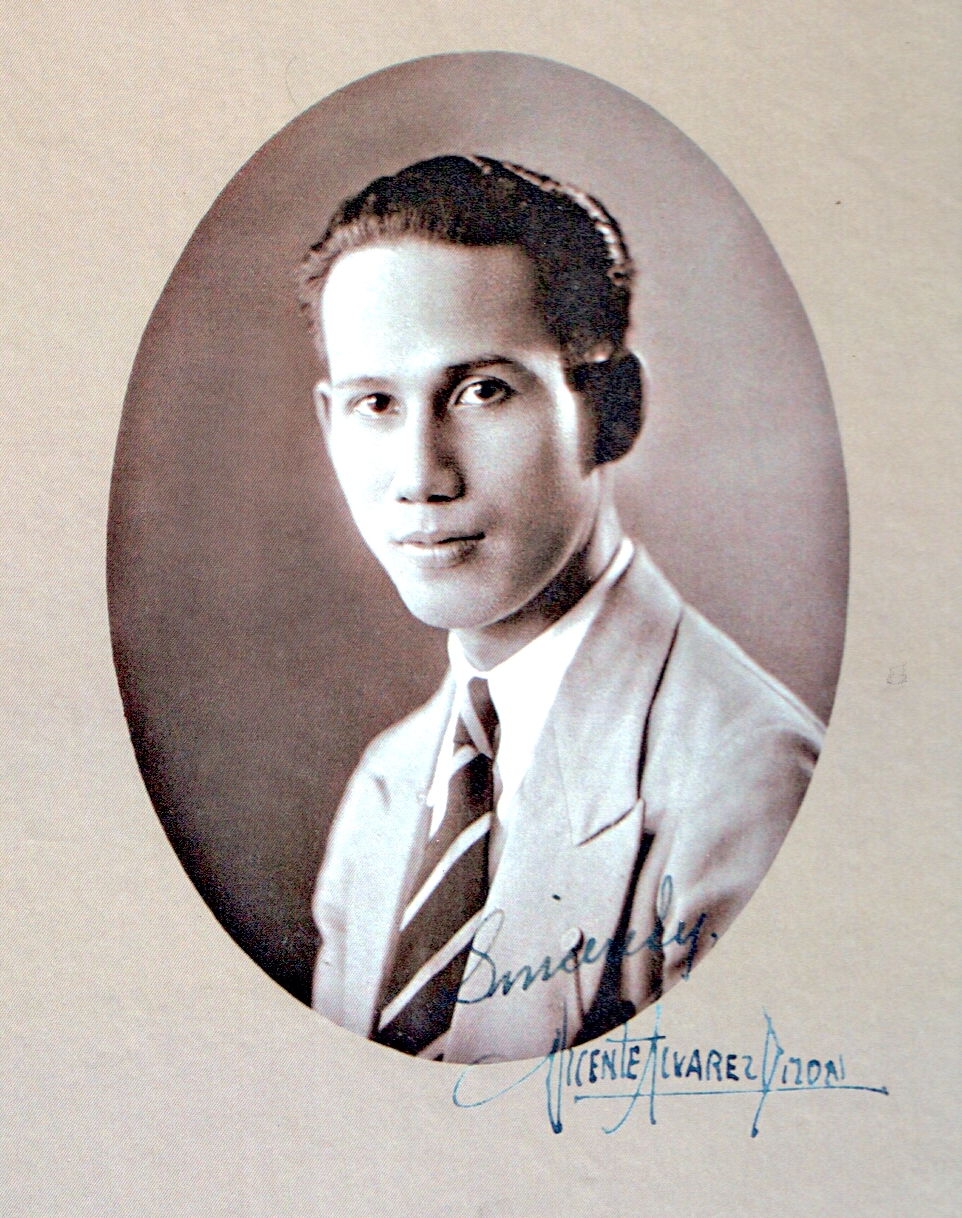
The venue was the Taboan Writers Festival, which we held this year in Subic, with closing ceremonies in Clark Field. It was at Clark that I met Josie Dizon Henson—a painter, writer, and community leader who gifted me with a pair of books she had written. One was a study on Kapampangan orthography, of more scholarly interest; the other book, which caught my fancy, was a slim but substantial, privately published volume titled After the Day’s Toil: A Golden Moment in Philippine Art, a biography of her late father, Vicente Alvarez Dizon and an account of his long-lost masterpiece.

Even at first mention, the name rang a bell in my mind. Two years ago, while doing research for a biography of the late nationalist thinker Emmanuel Q. Yap, I had met (at least by email) a painter named Daniel Dizon, one of Manoling Yap’s boyhood friends. Reminiscing on his friendship with the Yaps, Dan Dizon happened to mention the fact that his father had himself been an accomplished artist—so accomplished that he had won over Salvador Dali in an international competition in the US before the war. That amazing feat—and its doer, Vicente Alvarez Dizon—stuck in my memory. More on that Dali story later.

I had never heard of Vicente Alvarez Dizon before, and as it happened, I would not hear of him again until I met his daughter (and Dan’s younger sister) Josie in Clark. Hearing her name, I made the connection to Dan and to her father, and she seemed delighted to learn that I knew something about her father, and brought me a copy of her book. I set the book aside for a more leisurely read, and when that opportunity arose recently, I found myself engrossed by its account of another extraordinary Filipino life.

Born in Malate, Manila in 1905, Vicente graduated with a diploma from the School of Fine Arts with high honors in 1928. His talent got him a scholarship to Yale in 1934, a sojourn from which he emerged not only with his BFA but also with diplomas in Advanced Painting, Museum Administration and Art Appreciation. Back in Manila, he taught at UP, Mapua, and the National Teachers College; for the rest of his brief life, Dizon would become a staunch advocate of art education and art scholarship, tirelessly lecturing on art subjects around the country.

But his finest hour—the “golden moment” Josie’s book refers to in its title—was likely the Golden Gate International Exposition in San Francisco in 1939, an ambitious, visually opulent panorama that rivaled the New York World’s Fair that opened the same year on the opposite coast of America.

Within the exposition, International Business Machines, already an industry giant under its founder Thomas Watson, decided to sponsor an international art exhibition and competition featuring artists from 79 countries where IBM did business, including the Philippines. The Philippine pavilion in San Francisco actually displayed two other works by young Filipino masters, murals by Victorio Edades (assisted by Botong Francisco) and Galo Ocampo. But as fate would have it, it was Dizon’s painting that IBM chose to represent the Philippines.

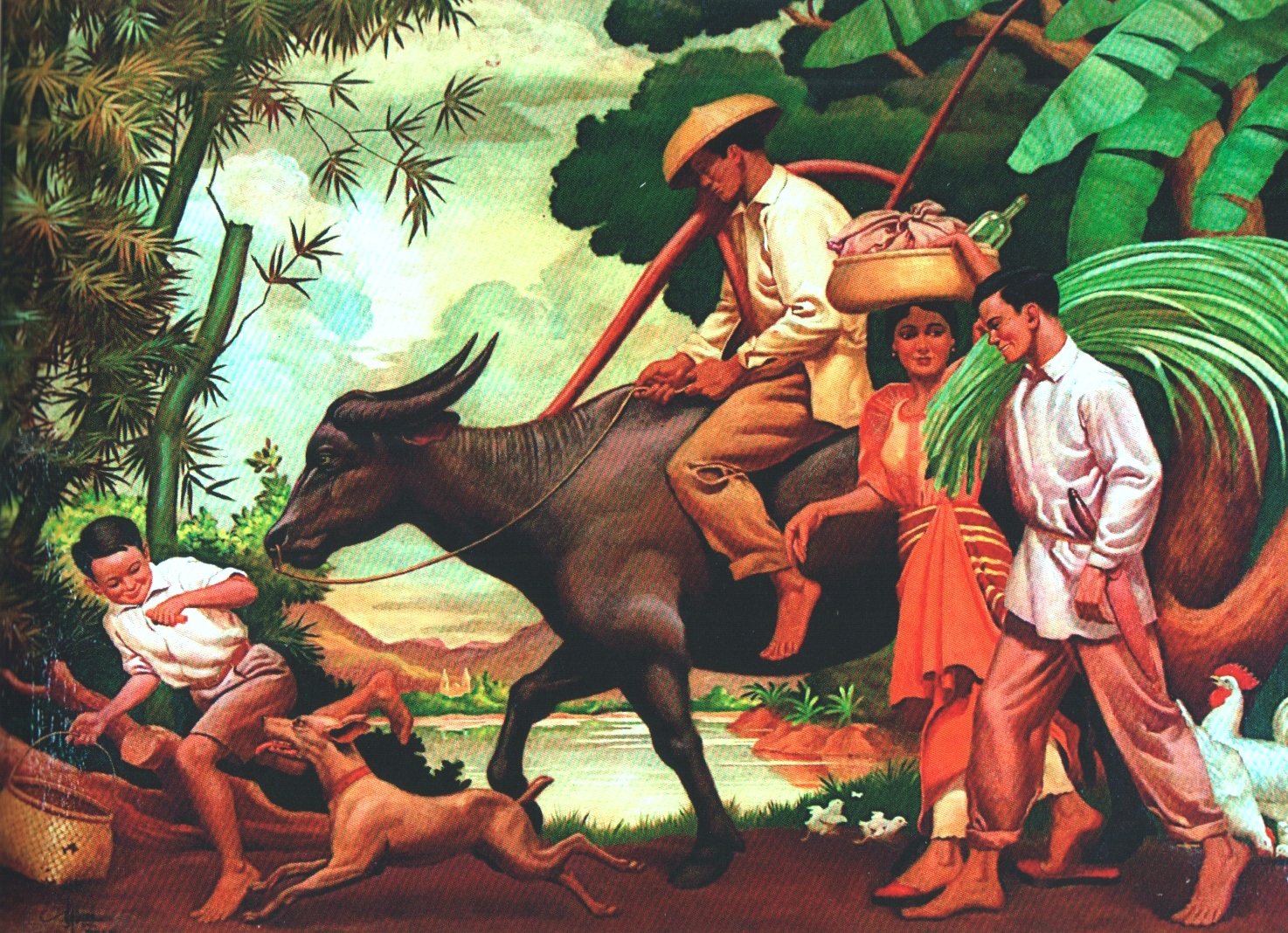
142The painting had been Vicente’s thesis project at Yale. Typical of its time in its evocation of a rustic, romantic countryside, the painting depicted a Filipino family—father, mother, son, carabao, and other farm animals—heading for home at the end of another working day. Because he worked on it at Yale, he had to use Caucasian models for his studies, but replaced the faces with their native counterparts in the final work. He apparently took it home upon graduation, because it was in Manila where IBM’s Philippine representative, Kevin Mallen, saw and bought the painting for IBM, which shipped it to America for the competition. When the results were announced, Dizon had won first prize, followed by Spain’s Salvador Dali and by the American Robert Philipps. (Coincidentally, at the other global fair in New York that same year, another Filipino, Fernando Amorsolo, also won first prize for his painting “Afternoon Meal of the Workers.”)

But that’s not where the remarkable story of this remarkable painting and its creator ends. Vicente himself, sadly, would die young and penniless in 1947 at just 42, afflicted with tuberculosis, a condition that, according to Dan, also ravaged the family’s finances. His masterpiece and legacy lived on—although it was almost lost.

In October 1980, the Batangas-born Filipino-American physician, Roger Pine, received a letter at his home in Princeton, New Jersey from a New York art dealer informing him of the availability of a painting with a Filipino theme titled “After the Day’s Toil,” 40 x 53 inches, signed “V. A. Dizon, 1936.” Would he be interested in looking at and possibly acquiring it? The dealer sent a transparency of the painting along.

The painting had last been seen by the Dizons in 1952, when it had been shipped from the US to Manila on loan from IBM for a local exhibition. And then it vanished. Further inquiries produced no leads other than the name of a New York gallery, which had no records of it.

When Roger Pine received the invitation from his dealer, he felt an instant connection to the painting, having grown up in a family of farmers. He knew nothing about the painting, the artist, nor its provenance, but he did know, especially after seeing the painting itself in New York, that he just had to have it. The dealer—who said that he had earlier tried to interest the National Museum in Manila to no avail—let the Pines have it on installment. It was also only in New York that Roger Pine realized that he had found and bought a long-lost prizewinner.

Next came the trans-continental search for the painter’s family—not an easy task in those pre-email, pre-Google days. It eventually took 25 years and a bit of luck—a dinner conversation during one of the Pines’ visits back in Manila—to connect the Pines with the Dizons. In 2006, the two families met, and the following year, two generations of Dizons trooped to Princeton, New Jersey to visit the Pines and to see, once again, Vicente’s painting. It was a tearful but joyful reunion, the kind of happy ending that deserves to be written about in a book. That’s what Josie Dizon Henson has done.

Poster 12x38

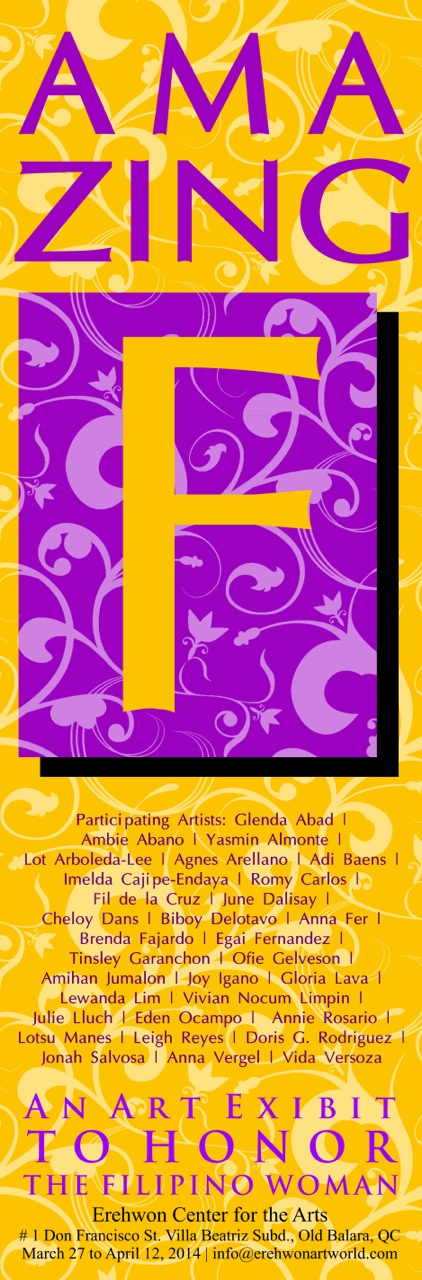
AND WHILE we’re on the subject of documenting Philippine art, let me note that, in celebration of the Filipino woman and of Women’s History Month, the Erehwon Center for the Arts in Quezon City recently hosted “Amazing F,” featuring some of the country’s leading artists, both women and men.

The participating artists included Glenda Abad, Ambie Abano, Yasmin Almonte, Lot Arboleda-Lee, Agnes Arellano, Adi Baens, Imelda Cajipe-Endaya, Romy Carlos, Fil de la Cruz, June Dalisay, Cheloy Dans, Biboy Delotavo, Anna Fer, Brenda Fajardo, Egai Fernandez, Tinsley Garanchon, Ofie Gelvezon, Amihan Jumalon, Joy Igano, Gloria Lava, Lewanda Lim, Vivian Nocum Limpin, Julie Lluch, Eden Ocampo, Annie Rosario, Lotsu Manes, Leigh Reyes, Doris G. Rodriguez, Jonah Salvosa, Anna Vergel, and Vida Verzosa.

Erehwon—located at #1 Don Francisco St, Villa Beatriz Subdivision, Old Balara, Quezon City—is fast becoming one of Metro Manila’s most vibrant art centers, hosting not just painters but also musicians like the Metro Manila Concert Orchestra. The Amazing F show, which ran until last week, was another of its projects to benefit the Erehwon Arts Foundation, which aims to run a residency program for talented but financially challenged young Filipino artists.

It was curated by Erehwon Arts Foundation Vice President June Poticar Dalisay, who said that “AMAZING F is an art exhibit that explores the different facets of the Filipino woman, a complex and enigmatic individual whose roles are varied and endless, affecting every sphere of our personal and public lives. She is warm, sweet, and compassionate, but she can also be can be cunning, feisty, and combative.” Don’t I know that—and yes, June, I stand amazed!

Penman No. 92: Nurturing Our Sense of Nationhood

IMG_3176Penman for Monday, April 14, 2014

AT THE University of the Philippines Institute of Creative Writing, we were happy to recently welcome into our ranks several new “associates”—UP colleagues who were also accomplished writers whom we felt could make significant contributions to the Institute’s programs. They were Chari Lucero, Luna Sicat-Cleto, Eugene Evasco, and Heidy Eusebio-Abad. Chari is a bilingual—indeed, a multilingual—fictionist and essayist, a very sharp reader of texts; Luna is a playwright and novelist in Filipino; Eugene, a Palanca Hall of Famer, is a writer of stories and poems for children in Filipino; and Heidi writes stories for children in English.

The entry of Eugene and Heidi into the UPICW was particularly timely, since we were severely short-handed as far as our expertise in writing for children and young adults was concerned. Puppetry advocate Amelia Lapeña-Bonifacio remains on our board of advisers, but we had lost Rene Villanueva to an early death and Carla Pacis to La Salle. By bringing Eugene and Heidi into our workshops, we wanted to remind ourselves—and the reading public, of course—of the primal importance of children’s literature as a means of nurturing our sense of nationhood in the imagination of our youngest citizens.

This renewed emphasis was evident at the 53rd UP National Writers Workshop, which we held last week in Baguio. At least three of our 12 workshop fellows were writers for children and young adults. Cyan Abad-Jugo, who already has a PhD in Creative Writing, is working on a book of 13 stories in the fantastic mode. Renato “Nats” Vibiesca, a Palanca award winner, teaches at the Polytechnic University of the Philippines; Marcy Dans-Lee is primarily an illustrator and artist, but also writes her own texts, often drawn from the wealth of indigenous lore that surrounds her in Davao, where she teaches at the University of the Philippines-Mindanao.

Cyan submitted what can most easily be described as modern horror stories; Nats contributed a comic piece about a poor kid who dreams of becoming a bossing, an entrepreneur; Marcy presented retellings of native creation myths. The fact that their material and their approaches vary so widely can only bode well for the future of children’s literature in the Philippines. Herewith, some excerpts from their “poetics”—their explorations into why and how they write what they write (I’ve translated Renato’s excerpt from Filipino):

Cyan Abad-Jugo: I wanted to see if I could achieve “a wider lens on ultimate reality” by making a slight detour “from direct representation of the surface of reality;” I wanted to skew it a little or reshape it a lot, and see if I could not arrive at better relevance and social commentary (which is what I thought Scholes meant by returning “towards actual life by way of ethically controlled fantasy”). This does not mean that I wanted to identify an aspect of social reality and then work it into my fiction. I never start out with such clarity of mind, and cannot give myself clear directions; my default mode is “lost mode,” and so must find my way out of the labyrinth I inevitably find myself in.

The project had more to do with finding out whether the fantastic mode inherently contained within it a metaphor for what it was like to live in our own world. I wanted to write first, as always, and see what came of each story in the end (hello, story, do you have a metaphor in you after all?); but I also wanted to limit what I wrote, I wanted to try my hand at writing particular kinds of tales, given their definitions or what I thought to be their definitions. As I clarified in my proposal:

Though stories never adhere to strict definitions of modes or genres, the definitions and characteristics of each kind of tale or story could serve a heuristic purpose; they could serve as guides to the writer who wants to explore the capabilities, flexibilities, and possibilities of the fantastic story, and how it expresses what we are and could become.

Renato Vibiesca: The short story “Sawsawan sa Padyak” deals with the experience of a boy (with the nickname Kadyot) who grows up in Gagalangin, Tondo—specifically, his transition from childhood to adolescence while confronting his family’s poverty. The story raises questions about the self, physical change, initiation, experimentation, confusion, observations about the adult world, vice, and other instances that address this period of transition. The story also illustrates the culture, the exploits, and the strategies employed by the poor to survive and stay in the city. Even as these problems aren’t solved in their entirety within the story, it does offer hope for the protagonist who keeps on dreaming as he moves along this new path in his life.

The story was written from the point of view of the protagonist, using a voice unique to a 12- or 13-year-old; often facing personal problems, tossing questions around in his mind, nudging forward and backward in his decisions…. Though often full of fear, experience and his station in life become drive him to become more creative and resourceful.

The story’s main aim is to give value to how such young persons face life’s challenges. It isn’t very often that the experiences of adolescents are taken up in fiction. This stage is an eventful one, which makes it more important for readers of this age to be given guidance. The author hopes that more works—both short stories and novels—will be written along this line.

Marcy Dans-Lee:Monsters are my personal inspiration
for writing for children, as children can relate
more to monsters than grown-ups. Children
believe that monsters are real; adults believe that monsters are real only in other adults. And because children believe in monsters, they have the ability to embrace “magic” in stories. As a writer for children, I depict magic with gentle care, never underestimating my little reader’s intelligence for they have been known to persistently demand “Why?” And the writer must be prepared to give them valid and reasonable magic, one that has practical logic, delicately balanced by its own breathtaking mystery.

In writing Luis and the Enchanted Creatures, my intention was to introduce children to six fearsome folkloric Filipino monsters. Under the shade of a balete tree, Luis reads about each monster in his grandmother’s old forbidden
book, from which the monsters soon emerge. In
a child’s mind, because the monsters are in the book, it is logical for them to come out of it. This is acceptable magic for children; it is completely reasonable.

Likewise, the adult’s choice of words in talking and writing is inarguably different from that of a child. Simplicity and straightforward narration are encouraged, while expanding a child’s vocabulary is the writer’s choice. Repeating a new word, a phrase or a sentence allows for remembering and internalizing meaningAs a writer, I particularly enjoy dialogues for these provide me the opportunity of acting
out character parts, drawing inspiration from every child’s unforgettable characters, like the pig’s chinny chin-chin and the wolf ’s huff and puff, as well as the nightly read-aloud sessions to become an incredibly angry Papa Bear, a delicately shocked Mama Bear and a whining spoiled Baby Bear when they see their bowls of half-eaten porridge, their chairs mussed up, and their bed sheets crumpled and undone.

The style of putting these words together however may lead a writer to unknowingly
“talk down” to children. Writers for children
are particularly vulnerable to this danger for as adults, we are sadly accustomed to innovating the strangest, most convoluted ways of controlling and negotiating with children in order to restrain their innate curiosity. We tend to be condescending, unaware that we are in fact the primary bullies
in their young lives. When I draft a story, I unconsciously converse with a child—with the same respect I converse with adults.

Simultaneously, my mind’s eye can see the illustrations that will go with the story. This anticipation allows me the luxury of fewer words since the illustrations will speak a thousand words. For after all, does a writer for children need to explain that a monster has a thin face, with big scary eyes, sharp yellow teeth and long unruly hair? Such descriptions are certainly better drawn than written.

In the end, “happily ever after” means that our stories and illustrations for children
must contribute to inspire a child’s imagination
to become real in adult life. For how else can technology, medicine, green urban planning, space and time travel be imagined and made real, if not for stories of monsters and magic?

(That’s Marcy and Heidi in the pic.)

Penman No. 91: The Pinoy McManus (Part 2)

ButchMetroMSEPenman for Monday, April 7, 2014

IN CASE you’re wondering where “The Pinoy McManus, Part 1” is, it came out in this corner almost two years ago, on May 28, 2012; and in case you’re wondering who or what a “McManus” is, let me reprise what that first piece was all about.

Jim McManus is a prizewinning journalist, novelist, and director of the Master of Fine Arts Program at the Art Institute of Chicago, whose fiction won him the Carl Sandburg Prize for the novel in 1996, and whose journalistic pieces—on everything from stem cell research to poker—have been published by the New York Times, Esquire, and Card Player Magazine, among many other periodicals. He’s been a Guggenheim and Rockefeller fellow as well.

In other words, in the writing game, Jim’s no slouch, and you’ll pardon me if I’ve felt a certain affinity to him, having shared the same interests and experiences—not the least a passion for poker. The fact that Jim and I are both writers and creative writing teachers is my official excuse for posting this column-piece in Arts & Culture rather than in the sports page. Now let’s get to the fun part.

Jim McManus was assigned by Harper’s to cover the 2000 World Series of Poker in Las Vegas as the backdrop for a murder investigation, but rather than watch the game from the sidelines, he decided to use his advance to buy a satellite seat (a kind of pre-tournament tournament, with a much smaller entry fee). That started an incredible run to the main event itself and, against all the odds, to the final table, where he finished in fifth place, beating out many established pros to win almost $250,000. He later chronicled that miraculous ascent to poker stardom in the book Positively Fifth Street: Murderers, Cheetahs, and Binion’s World Series of Poker, a copy of which I picked up in a second-hand bookshop some years ago.

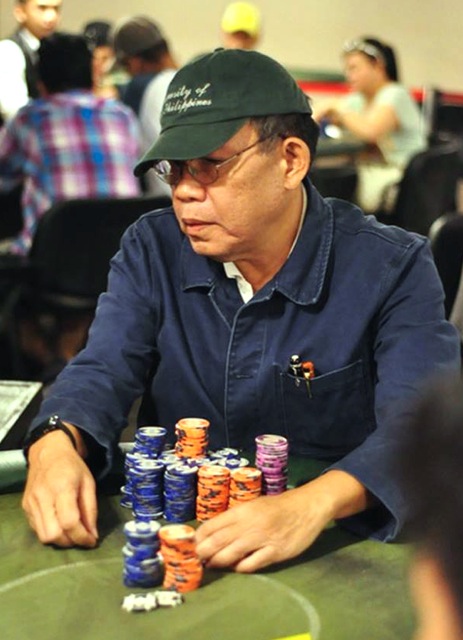
Some years ago—about eight years now, to be more precise—was when I began playing no-limit Texas Hold ‘Em poker semi-seriously, starting with beer-soaked Friday-night home games among friends and progressing to the Pagcor-vetted Metrocard Club in Pasig’s Metrowalk, where Manila’s pokerati regularly converge. Since then, I’ve spent many a night at Metro, usually on 16-hour binges, playing low-stakes poker while pecking away on a biography or an essay on my laptop and subsisting on dry saltine crackers and hot tea and black coffee.

My excuse to indulgent Beng for these excursions is that I’m gathering material for my third novel, on which I’ve been at work for three years now, and which features a call-center agent who moonlights as a poker grinder. But heck, I’ll admit it, the game’s addicting, and while other old guys might prefer golf, my turf’s the green felt table, and the swish of the cards is music to my ears. I’ve learned a few things about the game and have even won a few small tournaments, but I’m still basically what the pros would call a fish, an amateur whose rank enthusiasm for playing will often get the better of him.

As I wrote for a magazine a couple of years ago in a piece titled “Confessions of a Fish,” I’m in it more for the rush than the money: “For fish like me, winning is less an outcome than a moment—a surge of adrenalin, a flood of endorphins—that can pass very quickly, but is a high well worth buying. It’s the high you get when you hit your flush or your inside straight on the river, busting your cocky opponent’s three aces or two-pair. Never mind that that rush is followed by a long, slow slide back into the doldrums, and that you’ll be driving home in the wee hours many thousands of pesos poorer. All a fish has to do is to remember that instant—that look of utter horror and disgust on the other guy’s face—and all the pain of losing fades away, like dirty water down a drain.”

Part 1 of my McManus article came out because I’d just then placed 20th in a big million-peso tournament at Metro, my best-ever finish at that point. Jim McManus actually read my Star column online and congratulated me for it; we exchanged messages and pleasantries, and I promised to take him up on his invitation to have coffee or a beer with him in Kenilworth, Illinois one of these days and have my copies of his books signed (I also have his definitive history of poker, Cowboys Full).

Now, Jim, if you’re still out there, here’s an update from the fanboy and wannabe: last week, I did myself one better, and made the final table of another major tournament, the P1-million Metro Summer Event. A million pesos is small beans by Las Vegas standards, but the first prize could have wiped out my credit-card bills and bought me a Montblanc or two, so I was all worked up for the four-day marathon.

Like Jim, I entered the MSE through a pre-tourney satellite, winning a ticket to the big game. We started out with 15,000 in chips, and at one point on Day 1—among over 400 other players in the pool—my stack went down to 7K. On Day 2 and with the pool down to a hundred, I hit a lucky streak and nursed my 40K stack to almost 380K; on Day 3, that ballooned to over 1.2 million (these are just chips, folks, not real money, so don’t get too excited). On Day 4, down to the final table of ten players, I went in as second chip-leader, but also as the oldest guy and the biggest fish in the pool of sharks.

The technical details that follow will fascinate only the poker cognoscenti: I got that far in the tournament because of some of the most incredible, heart-stopping suckouts or last-card, last-second turnarounds you ever saw. At one point, my opponent drew a flush on the flop against my Q-10, but I hit trips on the turn and a full house on the river. The wildest hand of the tournament had me going all-in against the chip leader with a pair of 9s; he called, and tabled a pair of 10s: I was, 90 percent, a dead duck right at the start. The first three cards or the “flop” rolled out, none of them a 9 or a 10, but with two clubs; the fourth or turn card was the 6 of clubs. My opponent held the 10 of clubs, so he wasn’t just leading from the get-go but also had a backdoor flush draw.

Only one card in the whole deck remained that could beat him, the 9 of diamonds; if any other card showed up, I’d be homebound (even if the fifth and last or “river” card was the 9 of clubs, he would still hit his flush). At this point, I got up and shouldered my man-bag (loaded with crackers, a cellphone power bank, and Splenda sweetener); I needed the Splenda, as I could smell and taste the bitterness of certain defeat. Then the dealer drew and turned over the river card—hallelujah, the 9 of diamonds, the absolute, 2-percent one-outer. My opponent collapsed against the wall as I heard choirs of angels singing “Ode to Joy.”

On the final day, after a good night’s sleep, I got up at 6, and did a 10-kilometer walk around the UP campus, running the “Chariots of Fire” theme in my head. This was my day of days; I showered, did my students’ grades and turned in my grade sheets, worked on one of the biographies in the pipeline, got a foot massage, then put on my “University of the Philippines” baseball cap and blue jacket—my battle gear—and went to the final table.

I held on that night, scribbling messages to myself over the breaks on a notepad with my faithful Agatha Christie, reminders like “Keep your head!” and “Patience, endurance, opportunity!” (It was probably the doodling more than the messaging that relaxed me.) With uncharacteristic smartness, I played it safe, tossing away nine out of every ten hands, preserving my stack while I let the others duke it out. Eventually I finished in second place, bowing to a friend and previous champion, a genial and exemplarily cautious player, TV and film director Tofie Runas.

The next day I brought Beng with me to Metro to claim my prize, to ensure that the money would go to good causes (I might treat myself to a pen or two, as a souvenir of the experience). “Heck, this beats the Palancas,” I told myself, remembering my first Palanca short-story win nearly 30 years ago, also a second-place finish. I could see Jim McManus grinning in Kenilworth, Illinois. He’d addressed me in his messages as “brother,” so here’s to you, brother Jim, and to all of us 60-somethings chasing thrills and spills on the green felt table.

Penman No. 90: The Monkey Wrench

Penman for Monday, March 24, 2014

ANOTHER INTERESTING work came into my Creative Nonfiction class last week (yes, folks, there is such a large and lumbering creature as CNF for me, and if there are people who think otherwise, then that’s their problem, not mine nor my students’): a piece of reportage on the natural beauty of Los Baños and Mt. Makiling. It opened with an introduction to the jade vine, a beautiful plant that’s apparently not that easy to find.

My student, the author, came across one on the mountain after several hours’ hiking. He noted that “The showiest parts of the plant, which it is especially prized for throughout the world by horticulturists and exotic plants collectors alike, are its inflorescences which comprise translucent jade or blue-green flowers. Collectively, these rare colored flowers would hang like a bunch of jade pendants or a chandelier, effortlessly decorating the forest canopy during flowering season which comes around April.”

The work then moves on to a discussion of and an argument for biodiversity, citing an expert’s opinion that “although there have been successes as in the case of the Tubbataha Reef in Palawan and the Mt. Iglit-Baco National Park in Mindoro Occidental which has been the home of the endangered tamaraw, there is enormous room for improvement in the conservation and protection of other key places such as the Peñablanca protected area in Cagayan, the Agusan Marsh in Agusan del Sur, and even Mt. Makiling, which is one of the few places in the country where the jade vine naturally flourishes.” The piece concludes with a look into new propagation techniques being explored for the jade vine, and into its market potential.

All told, the piece was very capably done, save for the usual edits and the suggestion of a better choice of words here and there. In this and in a previous submission, its young author showed skill and sensitivity, as well as an abiding love of nature, having studied in UP Los Baños and having lived there for many years.

Now here’s the thing: in my class, “good” can’t ever be good enough. My students have my mantras coming out of their ears: “Raise the stakes!” and “Push the envelope!” Critics of writing programs who keep carping that all these programs and workshops ever do is promote safe, boring, homogenized pieces should take a seat in my class. I’m far from the world’s best writing teacher, but I certainly don’t give my students an easy time, any more than I give myself an easy time. I try to give every piece, no matter how poorly conceived or executed, the attention it deserves, assuming that it’s all the student could do up to that point; if I could help him or her turn into something that at least makes sense and hangs together, something he or she could share proudly and happily with others, then I would have done my job.

But I tend to be hardest on my best students—some of whom will come to class wth an attitude, and some of whom don’t even realize just how good they are—because the hardest and yet also the most worthwhile transition to make is that between being merely good and being possibly great.

This is why I keep urging them to raise the stakes and to push the envelope, because great writing—by which I mean something substantial and memorable, in both substance and form—is far more than a matter of perfect grammar or witty language. I’d much rather have a rough-hewn but editable story heavy with human drama than a clean but tepid script with every detail correctly rendered but showing me little more than what I’ve already seen before or what I could have predicted myself. I want a kink in the character, a twist in the plot that the author’s understanding of human action will not only make plausible but even dramatically inevitable.

In the case of our “jade vine” piece, we took one big step backward and tried to assess its possibilities. What was its real or best potential subject? What was the author capable of? Sure, it was interesting to know all those details about the jade vine, and of course we all agreed that protecting our biodiversity was a good and necessary thing—but these were all safe points to make, a plea for the preservation of natural beauty that no one in his or her right mind could contest.

This was where I trotted out another of my writing mantras: “Let’s throw a monkey wrench into the works!” By “monkey wrench,” I meant an incongruous element, something that might even go against the grain of the piece, but also something that would give it more complexity and traction. I’ve sometimes found myself doing this with my own stories, usually as a check against sentimentality and predictability. In a story titled “Some Families, Very Large,” a Christmas story about a boy and his errant father, I took the story to a funeral parlor toward the end, just because it was the most un-Christmasy thing I could think of.

You don’t really plan these things from the beginning (which would make them, in a way, predictable); instead, just when everything seems to be going right, you pause and ask yourself—almost with narrative mischief in mind—“Now, what if….” What if an ambulance takes a wrong turn on its way to a pick up a patient? What if, on a trip celebrating their reconciliation, an estranged couple is waylaid by bandits and forced to reveal secrets better left untouched? What if, in a nonfiction piece making an eloquent case for biodiversity and beauty, we throw in an element of violence?

That’s right, violence—which, to be totally unromantic and untouristy about Los Baños and Mt. Makiling—has sadly scarred that otherwise edenic landscape. I reminded the author—who probably knew the circumstances better than I did—of the recent spate of horrifying crimes and incidents that had shaken up that area and UP’s campus there: the rape and killing of a coed, the drowning of two UPLB students in a stream, the fatal stabbing of a woman by her husband, a security officer who then committed suicide. These were morbid facts that, in my former life as the UP System’s top PR man, I might have de-emphasized or treated in another way; but the nonfictionist’s eye has to be bare, wide open, and utterly dry, and I asked my student to maintain that stance as well.

What did murder and mayhem have to do with jade vines and biodiversity? There’s the real challenge to the creative nonfictionist—not just the good, competent one, but the potentally great one. I suspect that writers the likes of Nick Joaquin, Greg Brillantes, Kerima Polotan, and Pete Lacaba would instinctively have known how to mesh these disparate elements together into a gripping, compelling narrative that would have seamlessly paralleled violence of one kind with another. Rather than being perfectly smooth, their pieces would have, here and there, retained a rough edge—and showed off the glint that comes with rough edges.

And that, not incidentally, is the advantage of creative nonfiction over everyday journalistic reportage or the conventional essay: it can marshall different and even discordant notes and voices together, and, unlike essays which demand clarity of thought and meaning, employ and even thrive on ambiguity. One of the CNF models I use in class is a New Yorker piece titled “The Fourth State of Matter” by Jo Ann Beard, which begins with an image of the Milky Way in the night sky, a sick dog, squirrels, and an absent husband—before veering off into the 1991 shooting of four people by a Chinese graduate student at the University of Iowa, ending with “Shards of fly wings, suspended in amber.” Messy and marvelous.

The next time you’re feeling safe, smug, or soft about your work in progress, toss that monkey wrench into the middle of the piece, and see what happens. If you didn’t see it coming, then it isn’t likely that others would have, either, and in the very least, you’d have a fresher and more provocative work in hand.

(Picture of the jade vine from lifestylebygoldie.com)

Penman No. 89: Camels and Scribes

d4966305xPenman for Monday, March 17, 2014

A FEW months ago, I wrote about the fountain pens that famous people like T. S. Eliot, Winston Churchill, and Neil Gaiman used, and especially about how Eliot’s pen had been donated by his widow Valerie to the Royal Society of Literature for members to sign themselves with into the society’s logbook. The more practical-minded will and should, of course, dismiss any such discussions of celebrity memorabilia as mere fetishism, an adoration of idle and otherwise meaningless objects.

Happily, that’s a charge I can live with, as an incorrigible collector of lovable old junk, particularly pens to which I’m drawn by some deep Freudian current I won’t even try to palpate. I never even excuse the fact that I collect pens not so much to write as to doodle with—I enjoy laying wet bright lines on a crisp sheet of paper and watching the ink spread and shade. Whatever words I may be forming really mean little; it’s the sheer pleasure of forming the words that matters for the moment, the joy of the first pictographer tracing the outline of a bull on a cave wall, of the medieval scribe illuminating the Book of Genesis.

Eliot and Co. weren’t collecting Watermans and Conway Stewarts, of course; they were putting them to work. In their time, everyone wielded a pen, from insurance executives like Wallace Stevens to ambulance drivers like Ernest Hemingway and Walt Disney. Soldiers carried pens with them to the trenches, using ink pellets they could dilute in water; today these wartime pens and their embedded pellets are highly prized.

I was thinking of just this scene last week when I came across a thread in a pen forum talking about the pen or pens that T. E. Lawrence—Lawrence of Arabia, immortalized by Peter O’Toole in the 1962 film epic—used in his desert campaigns. Lawrence was an indefatigable writer, and his Seven Pillars of Wisdom remains as interesting today as when he published it in 1922.

The forum discussion wasn’t really even about Lawrence’s pen but the ink he used; apparently, he preferred a special French-made ink, one that his pen could safely ingest and expel. India or carbon ink is fine for drawing but is usually too thick for use with conventional fountain pens, whose feeds or ink channels it will clog. A forum member (many thanks to “carlos.q” from Puerto Rico) had dug up a typewritten letter from Lawrence, who was back in Southampton, dated May 3, 1934 and addressed to a friend initialed “FV”. In it, he complains (note his curious abuse of the colon) that “I apologize for the ink. The only carbon ink that will run in a fountain pen is Bourgeois: and that is sold only by Reeve in the bottom of Charing Cross Road. I have emptied my bottle of all but the too-thick dregs: I cannot demand more by post: but as soon as the R.A.F. will pay my expenses to London for a working day I shall go to the shop and buy some, and again charge the excellent pen. Only carbon ink is ink—that I wholly agree. I badly want to reach London again, but cannot afford a private visit.” (It’s sad enough to see this proud man in such dire straits, but sadder still to know that he would be dead in a year, from a motorcycle spill.)

Lawrence’s pen—two of them, actually, a Swan and a Conway Stewart—would turn up in a Christie’s auction in 2007, realizing over $5,000. The pens were accompanied by a 1969 letter from a Lawrence associate establishing their provenance, which noted that they had both been “trodden on by a camel & broken,” although this likely applied only to the Swan, as the Conway Stewart pictured had been made much later than Lawrence’s camel-riding days. The letter does end, presciently: “They may be worth something one day.”

That’s something we all wish we could say for our possessions, hopefully without requiring the chunky foot of a roving dromedary to enhance their narrative value. Having just stepped into the gray zone of seniorhood, I often wonder what will become of my trove of mostly vintage Parkers, Sheaffers, Montblancs, Pelikans and what-not once I sign my last signature. They’ll be worth something, for sure, but all of them put together might not even be enough to trade up for a Rolex, so it isn’t their bankable value I’m thinking about, but the stories they carry, especially the dozen or so in my daily rotation: “This one I got from the Thistle Pen Shop in Edinburgh, and it led to a story that became a book; this one I found in the Greenhills tiangge, selling for a tiny fraction of its actual worth; this one was being sold by a shop in Auckland, but it was missing a tiny part, a tassie which I later found online at the Berliner shop in New York; this one I found in an antique shop on Morato, inscribed to a ‘Consuelo,’ who would have worn it as a pendant on a chain….” And so on.

Last year I told myself that I would try to unload about a third of the collection, thinking to keep just the best dozen or so by the time I turn 70, but turning 60 gave me an excuse to acquire even more ink-spitting baubles. How to say no to a half-priced Montblanc Oscar Wilde, the flamboyant companion to my black-and-formal Agatha Christie? Or the Onoto Magna Classic in mottled tortoiseshell, its golden tongue spinning tales in a summery green-gold (known to ink connoisseurs as Rohrer & Klingner Alt-Goldgrun)? Let me declare this here and now: camels are strictly forbidden from entering my barangay in UP Diliman; any large humpbacked mammal coming within a hundred meters of my house will be shot on sight (with liberal squirts of india ink).

Scribe

Now, if all this talk of bygone pen-mongering strikes a responsive chord in you—evoking the inner Lawrence or the inner Agatha (Christie tracked Lawrence’s footsteps in Syria, intrigued by his spying)—you might want to pay a visit to the newest pen palace in town, a veritable emporium of pens, papers, inks, and even wax seals.

The members of our local (and still growing on its sixth year!) pen club, the Fountain Pen Network-Philippines, were a captive crowd at the recent launch of Scribe’s new flagship store at the East Wing of Shangri-La Plaza Mall. Scribe’s owner, the lovely and gracious Marian Yu-Ong, recalled how the business began in 2002 as an importer of writing and reading products, before opening its first store in Eastwood Mall in 2009. Also featured at the launch were the works of three master calligraphers whom Scribe has designated its ambassadors: hand-lettering maven Fozzy Dayrit, advertising executive Leigh Reyes, and architect-conservator Mico Manalo.

Today, if you want to feast your eyes on the largest and most sumptuous range of quality pens, papers, and inks in Metro Manila, there’s really no other place to go but Scribe Writing Essentials—make that “places,” because aside from Shang and Eastwood, Scribe can also be found at Glorietta 5, SM Aura Premier, and SM Megamall Fashion Hall.

I paid a visit to Scribe’s new flagship store after the launch, and was impressed to find an assortment of quality pens that we used to have to order online or fly to Hong Kong, KL, or Singapore for, and at very competitive prices, brands like Pelikan, Sailor, Platinum, Kaweco, and TWSBI, as well as the more familiar Cross and Lamy.

Here’s my standing advice to fountain-pen newbies, faced with these choices: if you want one good, classic pen you can expect to use for the next ten years, invest in a Pelikan; if you want a good, well-designed pen with a great nib for a price that won’t break the bank, try the Taiwan-made TWSBI (twis-bee), a huge hit among pen aficionados. Then treat yourself to a bottle of J. Herbin ink and a Midori notebook, and before long you’ll be scanning the horizon for wayward camels.

(Upper photo from christies.com)

Penman No. 88: Whatever Happened to the New NAs?

Penman for Monday, March 3, 2014

I GOT a series of messages from a fellow member of the Philippine Macintosh Users Group a few weeks ago, but it had nothing to do with Macs or computers; of all things, it had to do with the actress Nora Aunor and the National Artist Award. I thought it was interesting and compelling enough to take up in this corner, since I’d been wondering about some of the same things myself.

Before I go one line further, let me say that I was a member of a fairly large lower-level committee that was part of the recent selection process for the National Artist Awards. I signed a non-disclosure agreement when I joined that committee, so nothing I say here will be emanating from our discussions in that committee, which will remain confidential.

What’s no longer a secret, since it’s emerged from other sources online, is that a number of people, including Nora Villamayor (aka Nora Aunor), have been recommended for recognition as National Artists. The recommendations of our committee went up to yet another committee or council for final evaluation, before being forwarded to the Office of the President for proclamation, prior to the conferment of the awards themselves.

So far, so good. The prescribed process was rigorously respected and followed by the National Commission for Culture and the Arts, which oversees it (the board of the Cultural Center of the Philippines weighs in, I believe, at the last stage prior to sending the final list off to Malacañang). This was of keen interest to many Filipino artists and the cultural community—not just the names of the prospective NAs, but even more importantly, the process itself—given how the Palace, in the past and most recently in 2009, had cavalierly disregarded the rules and common decency to hand out the award to its favorites.

It’s been half a year, however, since that final list reached the OP—and so far, that’s where it’s been, gathering dust and gathering rumor. The loudest of these rumors has it that Nora’s run-ins with the law—presumably a question of morals—have held up her proclamation, as well as that of the others in her batch, and those before them. (Let’s not forget that, as a result of the infamous dagdag-bawas that happened under GMA, the proclamation of legitimately nominated National Artists such as the late Federico Aguilar Alcuaz and Lazaro Francisco—not to mention that of the eminent musician Ramon Santos, who was unceremoniously dropped to make way for others far less qualified—was indefinitely postponed.) Another bit of speculation has it that the Palace was betting on the late Dolphy, rather than Nora, to make it through the selection process, and that if Dolphy’s not getting it, then neither will Nora.

That will be a very sad and silly thing to do, if there’s any truth to the scuttlebutt. I respect and admire the work of both Nora Aunor and Dolphy, and myself would like to see them both recognized as NAs. I’ve even had the pleasure and the privilege of writing a couple of filmscripts for Nora (among them, “Ina Ka ng Anak Mo”) and of writing a back-cover blurb for Dolphy’s searingly excellent autobiography, released shortly before his death.

But if Dolphy—the comic genius, but also easily the popular and sentimental choice—was indeed excluded for whatever reason from the final list of recommendees this time, penalizing Nora with a similar rejection isn’t going to make things right. Instead, I’d be the first to sign on to a new campaign to endorse Dolphy in the next round of selections. Employing a moral argument is just going to make things worse, by introducing a spurious element into the issue. The religious conservatives won’t like it, but the plain fact is that artistic excellence and personal morality have never made a necessary if a happy marriage; let’s not ask of our finest artists what we don’t and can’t demand of our national heroes.

Early last month, my PhilMUG friend Don Rapadas wrote NCCA Chairman Felipe de Leon, Jr. a letter to inquire about the case, and he gave me his permission to quote from that letter:

“I am Zandro G. Rapadas of the Nora Aunor for National Artist Movement, and it is my privilege to write to you and thank you for the honor you bestowed on Ms. Nora C. Villamayor at the 6th Ani ng Dangal Awards held last Sunday, February 2. It was a well-appreciated and regarded state recognition for the international honors that Ms. Villamayor brought to the country in 2013, particularly for her Best Actress wins at the 7th Asian Film Awards in Hong Kong, and at the 3rd Sakhalin International Film Festival in Russia.

“With all her achievements to date locally and abroad, there is no doubt that Nora C. Villamayor’s time has come to be officially recognized and honored as a National Artist, hence our official nomination of her to the Order of National Artists in November 2012….

“The media and the public have known of the six artists endorsed for confirmation, proclamation, and conferment by Malacañang since early October last year, and we welcomed it with much rejoicing, because a new set of National Artists means the restoration of trust and respect for this state honor, which was unfortunately tarnished with the 2009 controversy involving artists added by Malacañang for proclamation and conferment.

“We believe it was fair enough to make this information known to the public because the decision by the Joint Boards of the CCP and NCCA has already been made and submitted to Malacañang, and what follows should be transparency in the final stage of the process and, on the part of the public, vigilance to help ensure that the transgressions of 2009 will remain a thing of the past. After all, this is a state honor, and the institutions involved operate on public funds, hence the public interest. Moreover, the deciding officials are public officials, and a ‘public office is a public trust.’ Certainly, no one can take us to task for being watchful this time.

“And watchful we have been. We know that after the Honors Committee convened to discuss the endorsement, they went back to your office and requested you to comment on issues raised about morality and past legal cases against Ms. Villamayor, your candidate for National Artist for Film and Broadcast Arts. And we understand that the NCCA has informed Malacañang that it does not take issue with the points raised, and that the Office of the Executive Secretary, who chairs the Honors Committee, has acknowledged receiving this reply early in January this year, and was passed on to the Malacañang Protocol Office for the information of other members of the Honors Committee. Since then and up until last Tuesday, February 4, the latest tracking of its status notes that it’s still with the Protocol Office.

“Why it’s taken this long, we do not know and we do not understand. But what we do know is that out there in the print and social media recently, many are already wondering what’s keeping the Palace from officially proclaiming the new set of National Artists. And included in this anxious waiting are some questions on why the NCCA and CCP have kept mum on the matter. I have attached in this email correspondence a few of these expressions of concern against the long wait.

“On a final note, I wish to underscore that this is not just about our anxious waiting for Nora C. Villamayor’s own cause, but more importantly our desire to see that the original dignity of the National Artist honor is restored with full respect and regard for its original intent and purpose, despite it being subject to political prerogative.”

Don Rapadas’ last point is an important one to note—this is as much about the process as the person. February, our National Arts Month, would have been the perfect time to honor our new National Artists—including the rightful ones from the previous batch; let’s not wait another year to make these long-overdue amends to Philippine culture’s overlooked heroes, and let’s hope Don gets his answer soon. 

(Photo from philstar.com)