Penman No. 84: Pens & Inks

Penman for Monday, February 3, 2014

A YEAR ago, I wrote a piece for this column titled “The (ink and) paper chase,” where I talked about how obsessed some people get with finding just the right paper to write on, fussing over paper color, texture, thickness, and (important to us fountain pen users) feathering and bleed-through.

The last two factors have to do with how tightly the paper’s fibers are packed; the looser they are, the easier it is for ink to spread and scatter through the paper—not a good thing if you’re trying to write a legible letter. This is why ballpoints and cheap paper make better partners—and a good thing, too, that they do, because most people have neither the time, the inclination, nor the loose change to play around with fancy pens and papers, let alone exotic inks.

But what if you did?

In that column last year, I promised I would write a bit more about inks—the essential, indispensable companions of pens—but I never got around to doing it, at least until now.

Inks are the last thing people think about these days in connection with writing, except perhaps in respect of color, which invariably comes down to a choice among black (business formal), blue (a little more personal), and red (for marking something as “wrong!”). In my late father’s time—he worked as a clerk for a government office, so he used fountain pens regularly—you had the option of using blue-black, very likely as Parker Quink or Sheaffer Skrip, and it’s a color I came to associate with my dad, which is why I keep blue-black as a staple for one of my pens.

The fact is—before fountain pens underwent a kind of renaissance in the 1990s more as a fashion statement than as a clunky writing instrument, followed by a plethora of designer inks—there was a wealth of inks available to the discerning public. You could get them in green, purple, brown, pink, orange, and so on, in brands long vanished such as Carter’s, Sanford, and Stephens’, aside from the in-house inks of the major pen makers such as Parker, Sheaffer, Waterman, Montblanc, and Pelikan. There was also a lively competition among these makers in terms of packaging, specifically in labels and bottles (Carter made exceptionally pretty labels), and the bottles have now become highly collectible on their own, some with their vintage contents intact and still usable after 40 to 50 years.

But we’re getting ahead of ourselves. How did ink get its start, anyway? At the advent of writing, ink was made from soot or lamp black mixed with gum (says my trusty guide, The Fountain Pen: A Collector’s Companion by Alexander Crum Ewing); red ink was made from vermillion. In medieval times, the quill pen called for a more fluid ink, and this came from tannins culled from vegetables, converted to gallic acid, then mixed with ferrous sulfate (get that?), resulting in a blue-black iron-gall ink, which you can still procure these days. With the steel-nibbed pen (which acid corroded) came inks made with chemical dyes, which also led to an explosion of color.

“The range of ink available by the 1920s would bewilder many people today,” noted Ewing. “It is estimated that the German firm Pelikan alone produced 172 different types, colors, or bottles of ink. There were inks for writing, for drawing, for accountants (which could not be erased), for hoteliers (which could be erased) and so on.”

Which leads me to my first admonition about inks, lest I forget: never put India ink (like Higgins) into a fountain pen; it’s meant for calligraphic and technical pens, and will surely clog your fountain pen’s feed (the part of the pen beneath the nib that conveys the ink), possibly requiring repair. Use only ink clearly meant and often marked “For fountain pens.”

I used to say that I was a pen, not an ink person, in that for the longest time, I limited myself to four basic colors: black, blue, blue-black, and brown. I’m nowhere near becoming an ink fiend—some people collect basically just the inks and couldn’t care less about the pens—but over the past year, I’ve found my desk getting more crowded and cluttered by an invasion of ink bottles, in such sacrilegious colors as Diamine Oxblood and Rohrer & Klingner Alt-Goldgrun (more on these esoteric varieties later). In the ink department, I’m a novice compared to many of my confreres at the Fountain Pen Network-Philippines (at least one of whom, Los Baños-based Clem Dionglay, runs a globally recognized blog on inks, papers, and pens). Ask a newbie question like “What’s a nice bright blue ink?” and you’ll get a dozen responses within minutes (on fpn-p.org), answers such as “Pelikan Edelstein Topaz!” or “J. Herbin Bleu Pervenche!” or “Noodler’s Baystate Blue!”

Ah, Baystate Blue…. Many pen folk swear by it, but I’ve never used it myself, for a couple of reasons: I hate bright blue, and BSB (as it’s called, like LSD or MSG) has been notoriously known for staining if not eating into some pens, like vile acid. Some people love flirting with danger, anyway, in the quest of the perfect color.

That quest, of course, is what keeps the ink companies alive—companies that might as well be manufacturing precious wines and perfumes: Noodler’s, J. Herbin, Iroshizuku, Diamine, Private Reserve, Rohrer & Klingner, De Atramentis, and so on. These are no longer your basic Quink and Sheaffer inks that you can buy (and why not?) at National Bookstore. They’re specialty inks, selling on the average for something like P15 per milliliter, or P450 for a 30ml bottle. (To see a mindboggling assortment of these inks, check out a site like www.gouletpens.com, from where we order our supplies if we can’t get them from NBS or the pioneering Scribe Writing Essentials at Eastwood and Shangri-La malls.)

You won’t believe how exotic and even strange some of these inks are. Mahatma Gandhi would squirm if he learned that a 60ml bottle of his namesake ink—produced by Montblanc, in vivid saffron, of course—sells for $100 on eBay. There are inks with extravagant names such as Noodler’s Black Swan in Australian Roses (a lovely deep pink); Noodler’s even has an ink called Whiteness of the Whale, touted to be “invisible during the day, glows under black light.” Some inks are embedded with gold or silver flakes. De Atramentis makes inks that carry scents like apple blossom, or are actually made from wines like chianti and merlot.

And like fine wines and rare vintages, vintage and rare inks now command an audience and a premium. A few weeks ago, educated by online reading, I felt ecstatic to have located and landed two bottles of the now-rare, 1950s Sheaffer Skrip in Persian Rose on eBay for about $10; it’s a flaming pink ink, which makes it highly doubtful that I’ll ever write with it, but just ask the owner of that $300,000 bottle of Chateau Cheval Blanc 1947 when he’s going to take a sip.

Fountain pens come with all different nibs, nib qualities, and filling systems, making ink choice both a pleasure and a pain for the penman (and penwoman). Snooty collectors prefer piston fillers like most Montblancs and Pelikans, but these pistons require patient flushing to get all the old ink and its color out before switching to something new. This is why I generally prefer everyday converters, which make flushing and ink replacement a breeze. To make things even easier, I’ve matched my favorite pens with my favorite inks, going mainly by color—a black pen gets black ink—so I don’t have to guess, when I pick up a pen or two to bring along for the day, what’s in it. And just for the heck of it, I took a shot of these happy combinations, which I’m illustrating this column-piece with.

And I can’t blame you if, after reading this frothy talk about pretty pricey pigments, all you want to say is “Hand me that cheap blue Bic!” 

(The inks and pens in the topmost pic are, downwards: Pelikan Blue-Black in the Montblanc Agatha Christie; Diamine Oxblood in the Parker Vacumatic Oversize; Rohrer & Klingner Sepia in the MB Oscar Wilde; Montblanc Carlo Collodi in the Conway Stewart Marlborough; R & K Alt-Goldgrun in the Onoto Magna; Pelikan Brilliant Brown in the Faber-Castell Pernambuco; and Aurora Black in the MB 100th Anniversary.)
Penman No. 83: A Bag of Bread

IMG_20140110_155634Penman for Monday, January 27, 2014

ONE OF the most delightful gifts that Beng and I got a couple of weeks ago for my 60th birthday and our 40th wedding anniversary was a bag of oven-fresh bread, accompanied by a handwritten letter. I found the bread so literally warm, and the letter and its contents so unique, that I secured the permission of the sender to reproduce it for this column. It’s a testament to the persistence of good things and good intentions—and, of course, of good people in a world too often and too crassly ruled by the bottom line.

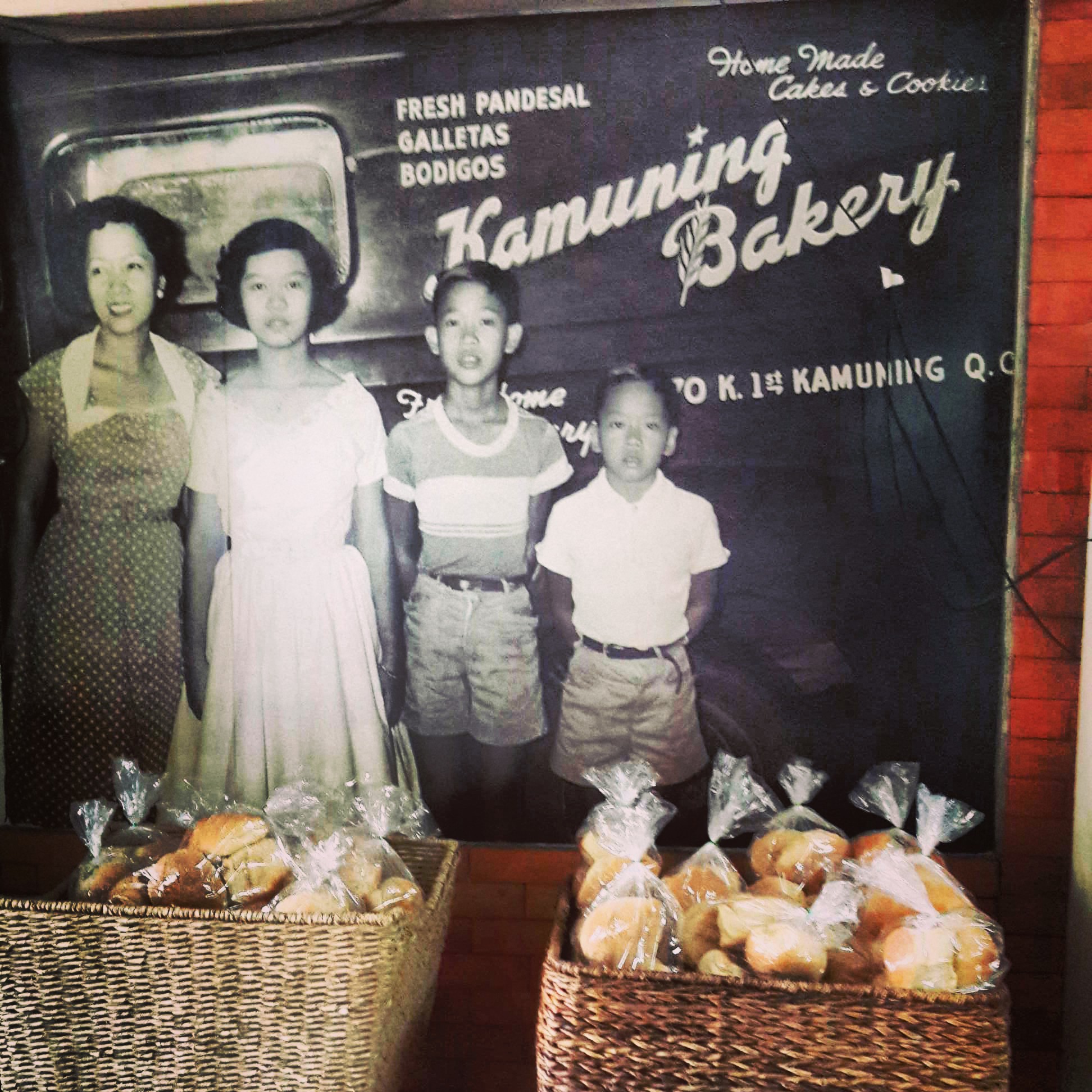
In part, the letter said: “I’m sending traditional pan de suelo breads which are pugon-baked on the suelo or floor of the 75-year-old wood-fired oven of Kamuning Bakery. The crust is crunchier and it should be reheated with a toaster and not with a microwave oven. Nick Joaquin, NVM Gonzalez, and others of past generations have written about this pan de suelo bread of the Philippines.

“I bought Kamuning Bakery just before Christmas, and have kept the old owners as minority shareholders so they can continue the traditions and tastes of this bakery. I also bought the land and old building. I invested here because I believe in the old owners, the pugon bakers who are artists and the staff with their unique commitment to their craft and vocation. I want to support this independent pugon bakery with their traditional no-preservative and no-additive Filipino breads, despite the huge challenges of this era of big multinationals, bakery chains and supermarkets and their mass-produced factory or industrial breads.”

2014-01-16 22.41.53

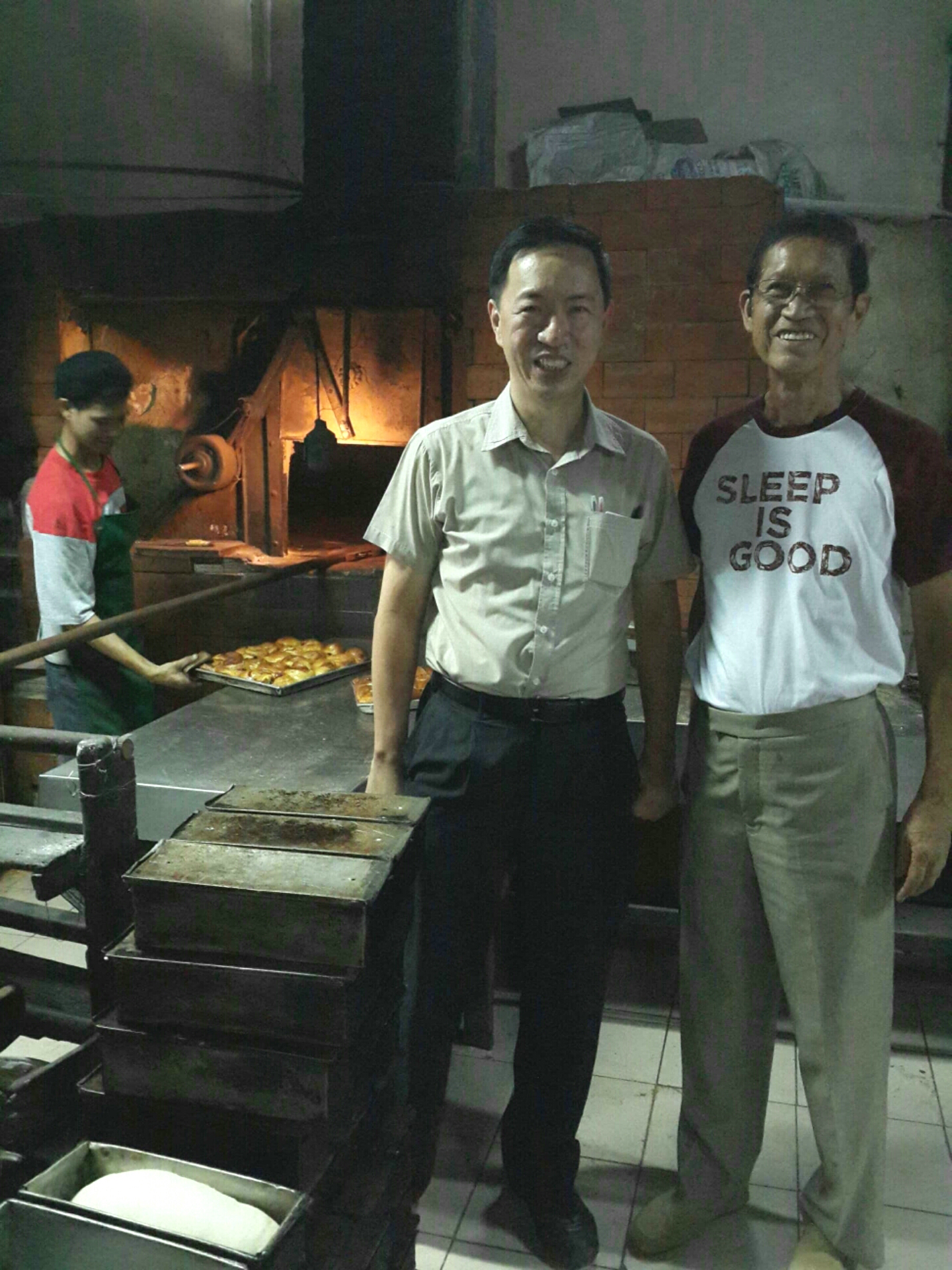
The sender of the bread and the letter was none other than my fellow STAR columnist Wilson Lee Flores, business chronicler extraordinaire and confidant of Filipino taipans. Wilson may move in those lofty circles, but his feet remain solidly on the ground—in this case, Kamuning and the oven floor on which pan de suelo is baked, unlike the more familiar pan de sal, which comes to life on metal trays. (Incidentally, many young Filipinos probably don’t know that kamuning—like the kamias that lends its name to the same street across EDSA—is a plant, Murraya paniculata, with tiny and fragrant white flowers.)

The Kamuning district is one of Quezon City’s oldest—in fact, the bakery was put up in its present location in 1939, when the city itself was established—and while modernization has inexorably overtaken many other parts of the city, Kamuning has managed to retain some of its 1940s charm and character, an effect assisted by the proliferation of antique and resale shops and even a vintage-car restoration outfit in the neighborhood.

You can’t get more original than Kamuning Bakery, which has stayed pretty much as it was when it opened. It’s been kept alive by the seventy-ish Ted Javier and his sister Beth Javier Africa, the son and daughter of the late Atty. Leticia “Letty” Bonifacio Javier, who co-founded the bakery with her husband Lt. Marcelo Javier.  Wilson tells the rest of the story: “It was President Quezon’s close ally Alejandro Roces, Sr. who suggested to the Bonifacio family of Los Baños Bakery that they open the new city’s first bakery. So they sent their newly-married daughter Atty. Leticia Bonifacio Javier and her husband Marcelo, who founded Kamuning Bakery.” Sadly, however, Marcelo, his father-in-law Major Miguel Bonifacio, and another of Ted’s uncles were killed by the Japanese during the Second World War.

So it fell to Letty to keep the bakery going with the help, in time, of her three young children, producing pan de suelo, described by Wilson as the “fist-sized version of pan de sal with a hard and crisp crust,” and of which Nick Joaquin wrote “colegialas got their gums toughened on their segundo almuerzo in the morning and, with hot chocolate, their meriendas in the afternoon.”

Indeed it was all the crunchy goodness that Wilson and Mang Nick promised, but don’t take it just from me. Just last month, a blogger named Tummy Traveler reported, after receiving her own gift bag of the bread, that “The pan de suelo was toasted just right. Just the right amount of crunch on the outside yet the bread still had that delicious moistness and softness on the inside. It had a faint hint of sweetness that went well with the salty corned beef together with my freshly brewed coffee and sausage.”

If all this sounds like a shameless plug, it is. Let’s help Wilson Lee Flores help keep a family and Pinoy tradition alive. I’m already planning a sortie there this weekend with Beng to stock up on the good stuff, and to visit an antique shop or two while we’re in the area. Kamuning Bakery can be found on 43 Judge Jimenez corner K-1st Street, one street inward on the left somewhere between EDSA and Tomas Morato, telephone 929-2216. They also have a Facebook page at https://www.facebook.com/kamuningbakery1939.

IMG_6589

WHILE I’M writing about bread and giving thanks to friends, let me thank another fantastic baker, Theresa Juguan, who with her family and husband Herwig hosted me and Beng in their home in Puerto Princesa over the post-Christmas break. A few months earlier, we had been first-time guests at their seaside villa just outside Puerto, and we struck up such a rapport that Theresa and Beng now call each other “sister.” I’ve also urged Theresa to write her cookbook-cum-autobiography, with her life-story being as remarkable as her cooking and baking.

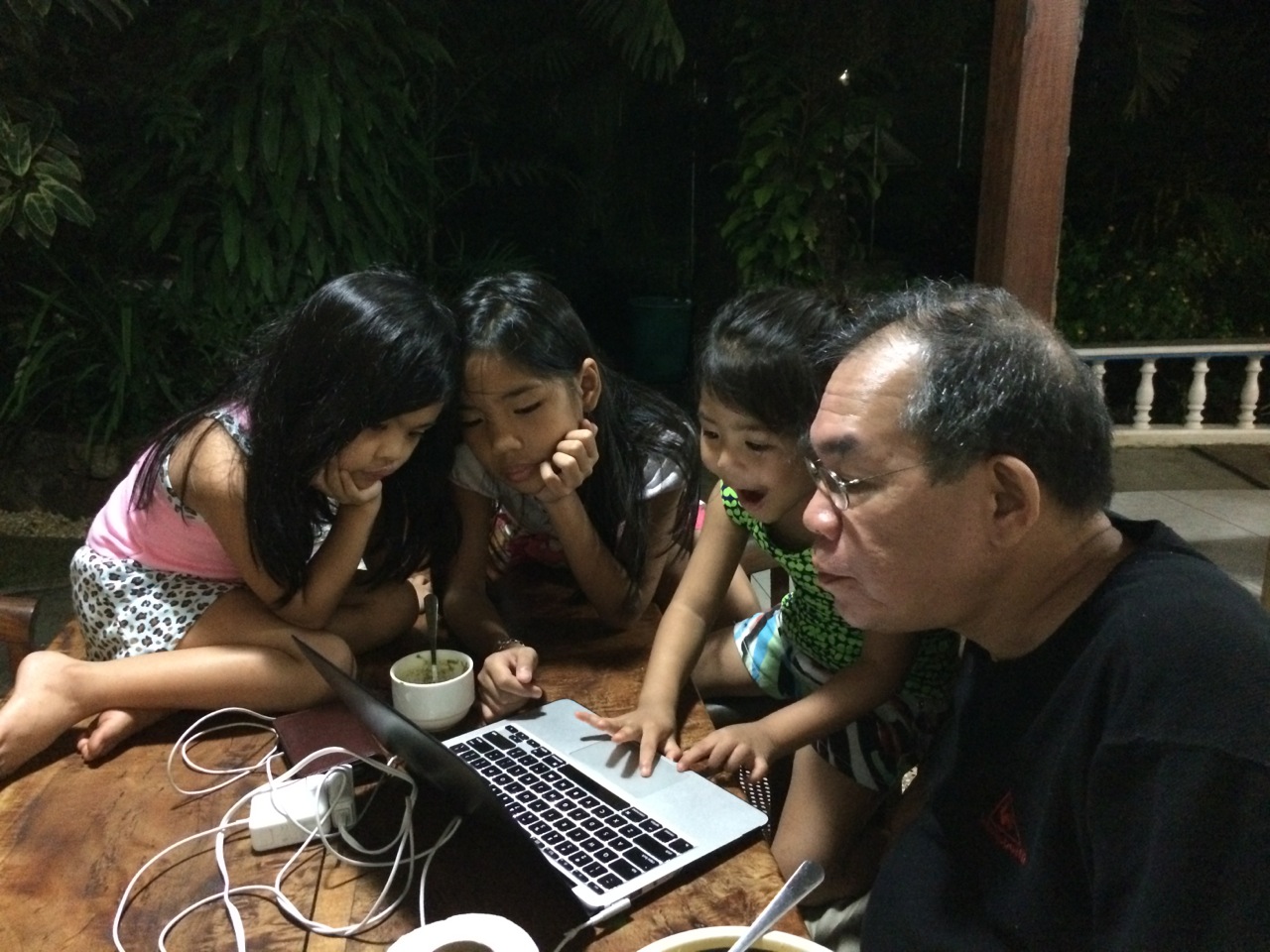
What I most enjoyed about this second visit, though, was playing “Tito Butch” to Theresa’s granddaughters, particularly five-year-old Zanique and her elder sister Zitroenne and cousin Zantelle, who amazed me with their precociousness. Since the in-house wifi was down, my MacBook Air—hooked up to cellular Internet—became the center of the girls’ attention. “Tito Butch,” they cried, “we want to play! Can we use your computer?” “Sure,” I said, “where do you want to go?” And here’s what floored me: these girls knew what a URL was and could recite it by heart: “W-W-W-dot-Y-8-dot-com!”

So I keyed in the address and sure enough, a website for online games popped up. “Go to Games for Girls!” shrieked the kids, and so we did, and they quickly zoomed in on “Cooking Games,” which featured the step-by-step cooking and baking of everything from spicy corn and shrimp salad to tiramisu. “You cook this,” said Zanique, “and I’ll cook this!” And so they did, in all earnestness, arguing over the sequencing and the measuring of the ingredients. (Beng and I had watched Zanique stick by her grandma in the kitchen, helping with the making of fresh lumpia and admonishing a tita who was going about it the wrong way.)

Thus are great cooks and bakers and great traditions made.


Flotsam & Jetsam No. 35: New Pens for the New Year

THE HOLIDAYS and turning 60 this month gave me all kinds of excuses to acquire new pens, and here are two of the best ones: a Montblanc Oscar Wilde, issued in 1994, and an Onoto Magna Classic in tortoiseshell, handmade in the UK just last month. I’m broke but happy 😉

They do look good beside my old mainstay, the Agatha Christie. It’s like having three gorgeous girlfriends to take out on a date (shhhh, don’t tell Beng!).

Penman No. 82: A Man Called Nik

IMG_2939Penman for Monday, January 20, 2013

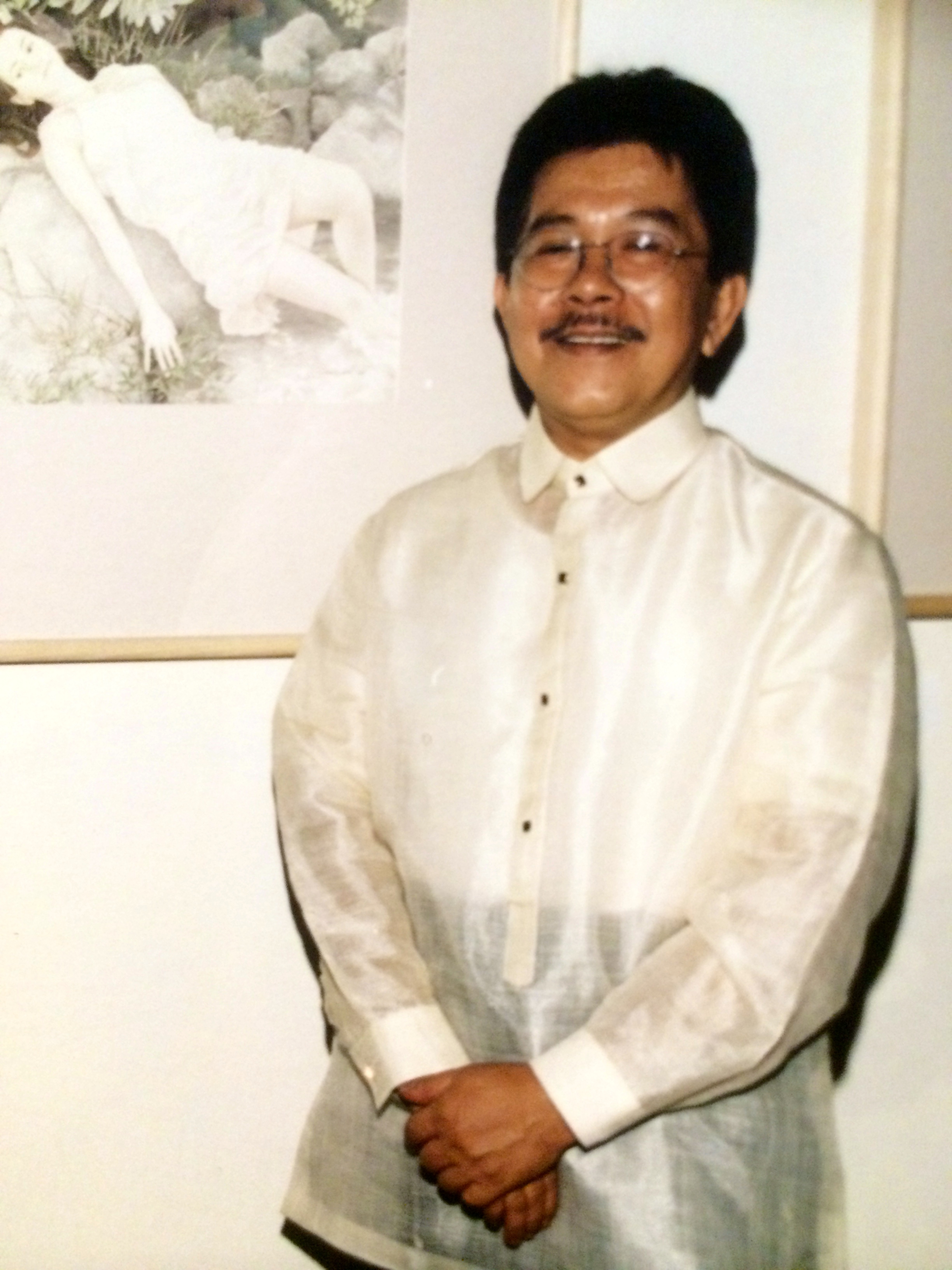
IT WAS with great sadness that I received the news a little over a week ago that my friend Nik Ricio had passed away. We knew that he had been ill for some time, but as these things go, you hope for the best, and never really think people could leave so soon.

He was, to me, indisputably the best Filipino book designer of his time, and one of the finest Filipino artists to have wielded a brush or a technical pen. More than that, he was a friend to me and to many other artists and writers, the kind of friend whose company you didn’t only enjoy but whose talent you felt enriched by and actually learned from.

I got the message about Nik’s death from another old friend, Tere Custodio, with whom Nik and I had worked on the massive, 10-volume Kasaysayan project back in 1997-98. The three of us would collaborate on other book projects after that, but nothing before or since matched Kasaysayan in its scope and intensity. We had been commissioned by Reader’s Digest Asia and by A-Z Direct Marketing to come up with this anthology in time for the celebration of the Philippine Centennial in June 1998; we had our first meeting in January 1997, and in exactly 18 months, on schedule, the anthology was launched—a compendium of 3,000 pages, a million words, thousands of photographs, and the labor of around 200 writers (not just historians, but economists, poets, scientists, priests, and artists, among others) whom we tapped for various essays. Tere oversaw the logistics and execution of the gargantuan project; I edited the text, advised and assisted by the late Doreen Fernandez; but it was Nik who almost literally shaped these ten books and gave them their final look, working with what even then was already an aging pair of Macs and PageMaker.

I recall that effort because of what I learned from Nik, with whom I sat side-by-side, going over those many thousands of pages on his computer screen. I was a rookie editor, something like an infantry captain suddenly ordered to command the Battle of the Bulge; Nik already had many coffeetable books to his credit, chiefly with Gilda Cordero Fernando’s GCF Books, sumptuous productions which Beng and I coveted but could then scarcely afford. I decided early on—sagely, as it turned out—to let the design lead the text.

Happily Nik and I shared a traditionalist aesthetic—a sense of pleasing balance, squared corners, fine detail, and subtle suggestion (this was before book design got all postmodern funky, splashy, and edgy). I could see that Nik was going for a certain look; he’d tell me, “It would be nice if all the last lines on the page ended here…. Let’s get rid of all widows and orphans (lines that hung out all by their lonesome)…. I need a subhead here, to balance the subhead there…. Could you make sure that all the subheads are at least X number of characters and Y at the most?… You see this white line running down the page? That’s a ‘river’ and it doesn’t look good. Help me remove these rivers by adding a few words here and deleting some there….”

As meticulous and painstaking as he was, I never once heard Nik raise his voice, even as the rest of us were at our wits’ end doing our darnedest to make sure we hit our deadlines. Our tie-up with Reader’s Digest afforded us a substantial budget, and as art director Nik could have had his pick of hotshot photographers to help him illustrate our books (Nik insisted that there be a picture in every spread, over ten volumes). But when he had to, no-nonsense Nik—a talented photographer himself—went out with his camera to shoot, say, a rash of rust on a GI sheet or a patch of moss on a rock to use as pictorial motifs.

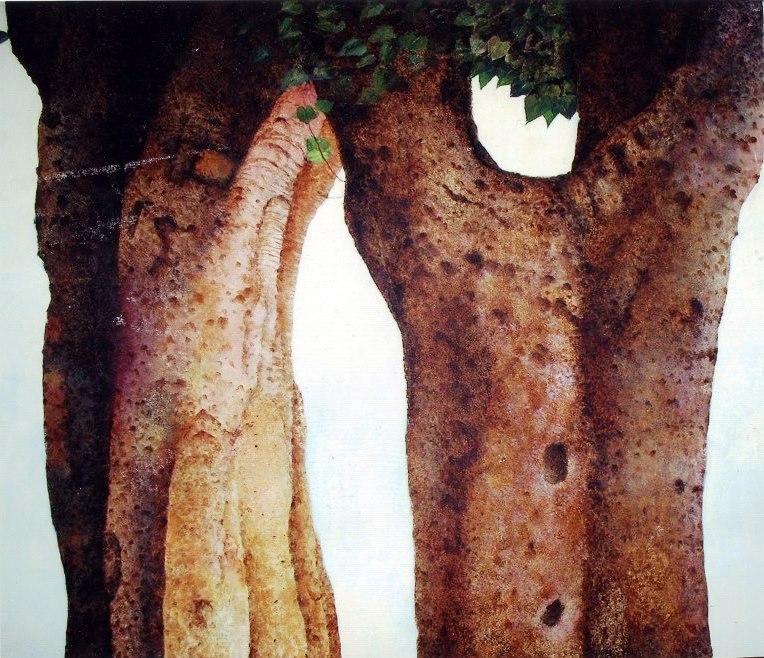
There’s an ongoing retrospective until the 27th of Nik’s work as a designer, illustrator, photographer, and painter at the Liongoren Gallery on 111 New York Avenue, Cubao, and aside from his book designs and paintings, there’s a wall of his photographs, taken on Manila’s streets in the 1960s and ‘70s: an armless man playing a guitar with his toes, a dog standing his ground in front of a Mercedes-Benz, an old woman staring out a concrete window. He had the eye of Lino Brocka, but unlike Brocka, he went past the real to the romantic, insistently seeking beauty in a decidedly un-beautiful world. He never gave up; even toward the end, no longer able to hold a brush, he used sponges to create large tree paintings.

Nik sponge painting

Flashback to another New York, the real one. In October 1999, Nik had one of his finest and happiest spells when an exhibition of his paintings opened at the Philippine Center in New York. I was happy to write the text of the brochure that introduced Nik and his works to viewers, and this is what I said then:

“After more than three decades of working as one of Manila’s leading graphic designers, photographers, and illustrators, Nik Ricio returns to an old love—painting.

“This exhibition—surprisingly enough, only the first one-man show of his long career—shows Nik returning to his artistic and spiritual roots. Those roots lie deep in romantic myth in a sense of beauty and order to the natural world, in faith and hope in the regenerative power of Art. Ricio’s works are a veritable garden of the Muses. The lushly detailed foliage that has become a virtual trademark of Ricio’s graphic design is more than pretty in these paintings; every leaf and flower is an affirmation of life, which all Art aspires to achieve and to sustain.

“Ricio made his mark early by winning first prize for two successive years, 1966 and 1967, in the prestigious Shell National Student Art Competition, before graduating in 1968 from the University of the Philippines with a BFA, majoring in commercial and editorial design.

“In Manila and around Asia, he is best known and much sought after as a book and graphic designer. His book projects include the celebrated Turn of the Century, The Streets of Manila, Being Filipino, Dances of the Emerald Isles, Rizal the Saga, Tide of Time, and, most recently, Kasaysayan: The Story of the Filipino People. He counts among his clients some of the Philippines’ largest corporations, as well as Readers’ Digest Asia, the World Bank, the Ambassador Hotel in Hong Kong, and the Manila Hotel.

“As an art director, he has been described by a critic as ‘a submarine commander, a visionary of the deep who gives out consummate orders with the minimum of tantrums.’

“Both the mastery and the modesty should come through in these paintings. They are as close as we can get to what Nik Ricio—so much of whose work has been to realize the dreams of others—really dreams of, all by himself.”

It was no great secret to those who knew him that for many of his last years, Nik was estranged from his family; there was great pain on both sides, and ironically it took his terminal illness to reunite him with his wife Tes and their children, also accomplished artists.

Beng and I went to Loyola Guadalupe for Nik’s very brief wake, to condole with Tes and the family, and with Nik’s many other friends. He lay in an open casket, like Beng’s brother had many years before, preparatory to cremation. I remarked to someone how I would probably end up the same way in the same place, having bought a funeral policy for Beng and myself there. Many tears were shed and regretful words spoken. Walking back to the car, it felt as if you had closed a well-written book full of engaging events and lavish illustrations, leaving you wishing only that it had gone on for a bit longer and had a happier ending.

Godspeed, Nik, and may you meet with all the beauty you tried to give us an early glimpse of. 

Penman No. 81: Hello, Seniorhood

ButchBeng1974

Penman for Monday, January 13, 2014

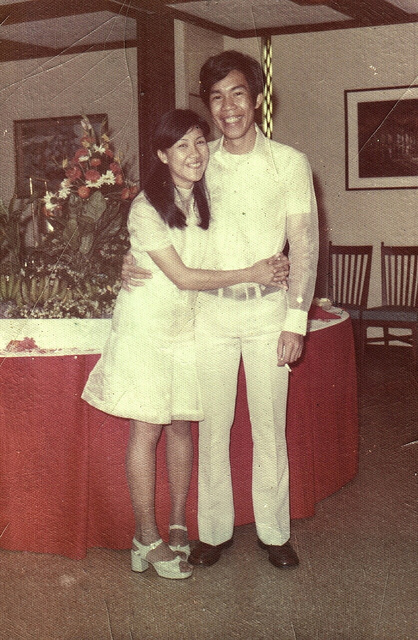
THIS WEDNESDAY the 15th, Providence permitting, I’ll be marking two milestones I frankly never thought I’d reach: I turn 60, and Beng and I will celebrate our 40th wedding anniversary. (That’s right, we got married in Manila’s City Hall on my 20th birthday. It seemed a cool idea at the time, but I’ve regretted it ever since—the timing, not the marriage—because it deprived us of an excuse to party twice.)

I’ll admit this only now, but I’ve been looking forward to seniorhood with growing anticipation over this past year. At 57 or 58 you might still be in denial, walking with a pronounced spring in your step to convince yourself and everyone else that all you need is a new pair of Merrells to unleash the inner tiger in you, but the fact is, within six months of 60, you can’t wait to get there and have the inevitable done with.

The last time I knew I had to be a senior soon was just last month, when I stood in a long line in the unseasonably sweltering heat at the DFA to submit my expiring passport for renewal. Taking pity on me, a guard came up to me and asked, “Sir, how old are you?”, obviously thinking to bump me up to the express lane where a few imperturbable seniors sat smiling. “I’ll be 60 in three weeks!” I said. Not good enough. I waited three hours.

I know something about seniors—I live with four of them in the house; I know their moods, their ailments and medications, their favorite TV dramas, their exquisite skill at swallowing fish heads and spitting out the eyeballs.

And there’s no diplomatic way of putting this, but for the past three years, I’ve been married to one (Beng’s folks didn’t know she was marrying a young innocent until we were in the car on the way to City Hall; I had to get parental dispensation). But to her enduring credit, elfin Beng often has to be “carded” in the restaurants, as they’d put it in the States, while all the salespeople and cashiers have simply albeit solicitously assumed that I have a senior card to show for a discount.

So I’ve been mooching off Beng’s seniority, tagging along with her when she goes to the head of the line come boarding time at the airport, or when we queue up for movie tickets. That’s when you realize that the next best thing to being a senior is marrying a card-carrying one. But Beng doesn’t find it funny when I tell her what a shock I get to wake up in the morning beside a lola. Well, I guess we’re even now.

Of course, in a sense, you can never get old enough, maybe not until you hit 80. At 60, there will always be writers in their 80s or 70s who can’t wait to remind you what a bumbling tyro you are compared to their accomplished selves. That’s all right, because having older people on your shoulders could be the only thing that will keep you young, or at least younger, not counting strange potions meant to stiffen, uhm, one’s resolve.

It’s a pleasant surprise to get this far, because ours was a generation that was supposed to die before we even hit 25. After stepping out of martial law prison at age 19, I’ve taken every breathing moment since as a kind of grace note.

As it turned out, the grace note was my marriage, running four decades long, another unexpected, shamelessly undeserved blessing. When Beng and I stood before a CFI judge—my mom’s boss—that nippy January in 1974, it was after just three months of being together. We were in love, surely—truly, madly, deeply—but we were also gasping for breath, seizing happiness when and while we could, thinking that the State’s long and murderous hand could break the spell at an instant. As it turned out, too, the predictable State was hardly the enemy, but the inconstant self. Some of those forty years proved hard and lonesome, thankfully not too many nor too long.

As we start the count toward our golden 50th, Beng and I have come to realize that there are a few things we need and want to do in the years ahead.

With some regret, we will seek and keep fewer friends—the real, not the Facebook, kind. We’d like to focus on family, work, good health, our private charities, and, of course, more time together. This will mean socializing less and staying home more, which will be all right, because we both have so much work to do and always less time to do it.

On the other hand, lest our world become too small, and with whatever we can spare from our perennially meager savings, we will travel up a storm—march up headless hilltops, wind through strange alleyways, and wander down foreign boulevards while our knees can. This May, I hope to realize a longstanding dream, which is to bring Beng to Venice, where I had a magical moment three years ago but where she’s never been (of course, she’ll have to stay with me at that dinky hostel in Mestre, across the water and next to the Asian food store that was my culinary lifeline in heathen Italy).

We might not even need to go that far. One of the most enjoyable dates Beng and I had over the recent holidays was in front of the TV, watching a late-night screening of “Funny Face” with Astaire and Hepburn in Paris and singing along to the Gershwin score. And then another day we took our quarterly stroll around the Quiapo area, imbibing the Oliver-Twistian energy of the hardware and music stalls on Raon and Evangelista, cherrypicking the dustiest of Avenida’s ukay-ukays, and consoling ourselves with cheap mami and siopao at the Pinsec place on Recto, because Ramon Lee’s chicken house was still closed for the New Year break. We’ve been to dreamier places like the Grand Canyon and Bellagio (the Italian and Vegas versions) but it’s these slumdog sorties that we’ll remember for the fun.

With our only child Demi well set in her own career in Southern California and well loved and cared for by her own man, we can and will help others achieve fullness in life by putting them through school and giving them the same kind of guidance we gave our daughter (“Don’t worry too much about grades, enjoy your education! Make your own mistakes! Learn to think on your feet! And never forget where you came from.”)

Where she came from, I think, was us. As I turn 60 and Beng and I turn 40 (which Demi, too, will be, come October), I’d like to think that beyond all the books and paintings we ever created, Beng and I did nothing better than produce Demi, whom I named—while Beng was still in a post-partum haze—Dalisay Emilia Poticar Dalisay, “Emilia” being my mother’s name. Demi loves her lola, but wasn’t too thrilled to grow up having to explain her redundant name to her classmates, with the anciently Shakespearean “Emilia” wedged in between. “Don’t worry,” I told her, “don’t you know that Demi Moore is really Dalisay Emilia Moore?” It didn’t fly. But hey, her name seemed like another cool idea at the time.

A couple of years ago, I wrote her this poem titled “To Our Unica Hija Demi, Born Dalisay Emilia Poticar Dalisay”:

It matters not if our names end with you

If no more Dalisays walk the earth

You were all we wanted in this world

Our most joyful blessing was your birth.

When at times we seem too far apart

Remember that we are your blood and breath

And that your name to us is like a distant bell

That you bore twice, and bore it well.

Here’s to the three of us, anak. We’re all growing older, but we’re doing it together. 

Butch Beng2013

Penman No. 80: Men of Letters (2)

FCPenman for Monday, January 6, 2014

I CAN’T remember now how the poet Fidelito Cortes fell into our circle of beer-guzzling, Yeats-quoting friends in Diliman back in the early 1980s, but I do know that he was there, on December 10, 1984, when my very first book (Oldtimer and Other Stories) was launched without much fanfare in UP. I know that, because after the event, we went for more drinks in a restaurant on Katipunan (where serving beer was still illegal then, because of some silly ordinance), and Fidelito was with us.

Also there was the late Ernesto “Cochise” Bernabe II, a popular figure on campus and an English major who had been fortunate enough to visit Stanford, and who had come back with some application forms for that university’s famed Wallace Stegner fellowship. We all feigned indifference to Cochise’s offering (who needed Stanford?), but weeks later, we would discover that at least four of us had applied for the Stegner-me, Krip Yuson, Fidelito, and I think Mon Bautista (not the currently telegenic one, but a gifted fictionist from Mindoro).

Imagine our surprise and envy when, come April, we heard that it was Fidelito whom Stanford had accepted for the one-year, well-funded fellowship, with nothing much to do but write and attend workshops on Stanford’s plush campus in Palo Alto, California. But then we shouldn’t have been surprised, as Lito was an extraordinarily good poet, whose work resonated with a deep and quiet melancholy.

Lito flew off to Stanford in August 1985; I would follow to Ann Arbor, Michigan, in 1986, having snagged a Fulbright. Mon Bautista got a fellowship to Kansas, I think it was. (In an even more remarkable turn, our friend and beermate Gina Apostol wrote a fellow named John Barth directly at the University of Maryland, showing him a short story that she had written, titled “Earthquake in Mexico”; Barth wrote her back, offering her a scholarship, and thus began the Leyteña Gina’s long and continuing sojourn in the US). It was, in other words, a time when another generation of young Filipino writers began looking abroad, and specifically to the US, for opportunities to broaden their horizons (before we would discover Australia, Singapore, Japan, China, and other places closer to home).

Lito, in a way, had always been prepared to go Stateside; he’d never been there prior to the Stegner, but he had imbibed its pop culture so well that he routinely beat the crap out of us in Trivial Pursuit, particularly in the sports category, where he seemed to know all the NFL teams and their key players by heart; not to be outdone in colonial education, I commanded the geography portion, having memorized the US states and their capitals since my grade school days.

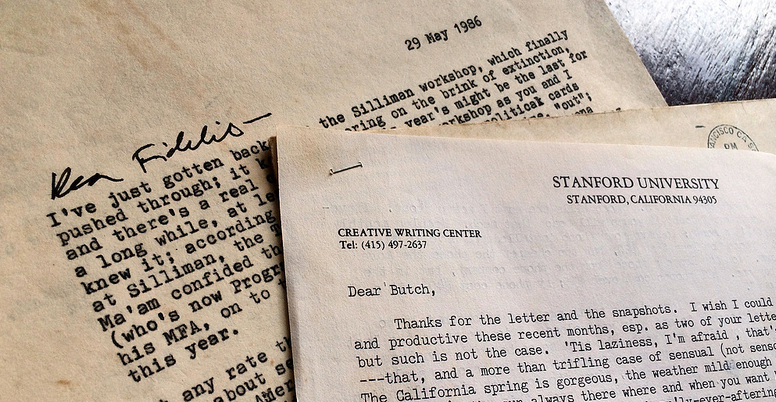
On January 18, 1986, I wrote Fidelito:

Dear Fidelito, 

Thanks a lot for your Christmas card and the Stanford forms. Unfortunately, I only got the forms yesterday (you mailed them Dec 16-a month ago!), so their users will have to wait till next year…. The “US or bust” fever continues, probably because it’s application time; we’re getting deluged by inquiries about getting into a US university, any university; the GRE and TOEFL people are raking it in…. Still no news about my acceptance; I’m hoping for either Michigan or Colorado…. We’re running out of rumors, unless you count election-fever rumors, one of the most persistent (I hear it every night, in my dreams) of which is that as a token of the American government’s displeasure with the travesty of democracy in this country, all educational assistance grants are to be terminated forthwith…. Seriously, there’s a tremendous outpouring of effort and initiative here these days, even among the most unlikely people, in support of the Cory-Doy duo; it looks like everybody’s going to be voting; the boycott boys are unusually quiet; still nearly everyone agrees that while Cory has a real chance if the votes are counted straight, there’s just no way the old man’s going to yield his seat with a smile; the US is taking a beating in the crony press; there’s even talk of declaring Bosworth p. non grata…. I hope they declare me and Beng & Demi personae non grata, and ship me out on the next plane. So don’t be in too much of a hurry to get home. By the way, Isabel plans to do her MA paper for Abad’s class on your poetry. Keep it up-statistically speaking, there’s got to be one beach blonde out there somewhere who’s into football, Yeats, and Filipino poets.

A few months and a couple of letters later, Lito wrote, on April 13, 1986:

Dear Butch,

Thanks for the letter and the snapshots. I wish I could say I’ve been busy and productive these recent months… but such is not the case. ‘Tis laziness, I’m afraid, that’s responsible for my silence-that, and a more than trifling case of sensual (not sensory) disorder called hedonism. The California spring is gorgeous, the weather mild enough for tees and shorts (cherchez les femmes), the sun is always there where you want him. “In short there’s simply not a more congenial spot for happ’ly-ever-aftering than here in Palo Alt(o).”

…. As far as I’m concerned, I’m going to be happy when the Stegner-ship is over. I’ll hate leaving Stanford, of course, which has such breathtakingly beautiful women, and San Francisco, and ditto, and ditto scenery, but to balance these, I’ll be glad to get away from the pressure of the workshop. I was kidding when I said that I had been doing nothing lately; on the contrary. I’ve always felt the pressure to produce, to bring something to class, and I’ve been prolific like I’ve never been before. Of course, I’m not being ungrateful-after all, I’m writing poems and they’re all before me, but I’d like to relax. Hence I’m applying for a seven-month fellowship in Provincetown, Mass. Where the only thing I have to do is write at my own pace. I hope I get in.

Denise Levertov has left. I say this not without a sigh of relief, for she has been hard on our poetry and hard on us as poets. She insists on precision, and with great justification, but boy! It’s difficult to sit still while she’s working on your poem. We became friends, mainly because as a leftist intellectual-and with a wonderful revolution going on in the Philippines-she was glad to have an actual Filipino in her class. But she still fills me with awe, and of course she’s scarred us, one way or another, with sharp criticism. I think that the inevitable consequence of studying under such a famous and demanding teacher is not that your work necessarily gets better, but that you become demanding yourself, and unfortunately more so upon those other than yourself, and you tend to take as your own your teacher’s biases and peculiar orientation. I’m afraid, Butch, that when you see me again, I will have become more opinionated and dogmatic-hence obnoxious-about craft and art. Denise has supplied me with ammunition (30 rounds on line breaks alone; 40 on the poem’s sonic structure; etc), and you will find that I can’t wait to pull the trigger.

Being here has allowed me to experience a lot of the literary life, I’ve heard Joyce Carol Oates, Adrienne Rich, Thom Gunn, Wendell Berry, Michael McClure, Robert Duncan, Alex Haley read and lecture. I had lunch with Berry. Muriel Spark and John Irving are coming in the spring to lecture and read. If it’s possible to OD on the stuff, I would’ve done so, but I keep attending readings and classes. I’m reading Leon Edel’s Henry James, and I’m beginning to understand what commitment to literature is…. Two girls have offered to marry me, to keep me here, can you beat that? But I’m too proud, I guess, although pride is for swallowing. Write soon, Butch, and keep on writing. Yours,

Fidelito

Lito and I exchanged hello’s over Christmas-me from Manila and he from New York, where his lovely wife Nerissa teaches at Stony Brook. It was great to be in touch again after all these years-I had to warn him that these incriminating letters were coming out-but as fast and convenient as email is, nothing beats a scribbled signature and a postage stamp.

Penman No. 79: Men of Letters (1)

ImagePenman for Monday, December 30, 2013

I’M AN incorrigible pack rat; I keep restaurant receipts and bus tickets from the 1970s, business cards from associates long forgotten or even departed, and notes and memos from various points of my engagement with one bureaucracy or other. These odds and ends molder in a large wooden baul that sits in a corner of my office, a chest Beng and I bought for our daughter’s wedding but which somehow stayed with me (our unica hija Demi will still get that baul, contents and all, on one of her visits home from California). Other old letters I keep in a leather briefcase, itself now an artifact, a souvenir from my first trip to the US in 1980.

I was rummaging through the papers in that chest and that briefcase a few weeks ago, looking for something I could contribute to the benefit auction we were holding for Writers’ Night, when I stumbled on some letters I’d received (and some I sent—I dutifully Xeroxed my outbound mail then) from writer-friends. The most interesting ones were those that opened a window on my friends’ minds as writers and as persons—as young men, really, on the road to emotional, intellectual, and artistic maturity.

One of those friends I exchanged long letters with was the late Bienvenido “Boy” Noriega Jr., very probably our finest playwright, and something of a prodigy who headed the Policy Coordination Staff at the National Economic and Development Authority in his early 20s; Boy went to Harvard in 1978, when he was 26, for his master’s in Public Administration, but cross-enrolled in theater courses at the same time. Another was poet Fidelito Cortes, who beat me out to a Wallace Stegner fellowship at Stanford in the mid-1980s (and who made up for it by greeting me in San Francisco with the gift of a Stanford sweatshirt when it was my turn to come in 1986). I also wrote letters to film director Lino Brocka, who preferred to use the telephone to respond (quite often forgetting, when I was in Milwaukee, that it was 2 am when he was calling from Quezon City).

Boy always hand-wrote his letters in small, fine script; Lito, like myself, used a typewriter; our letters went on for pages and pages, reporting on what we were writing, seeing, and thinking at that time, aware that we were standing on the doorstep of our lives’ great labors.

This week and next, let me share some excerpts from our exchanges, leaving aside more personal references. I’m translating Boy’s from the Filipino original.

Harvard U, 3 Nov 78

Dear Butch,

My drama course is the most exciting of all my subjects. We’re studying all the major dramatists. We’re done with Ibsen, Strindberg, Chekhov, Wilde, Shaw… Wagner, Dumas fils and Buchner, and soon to follow will be Brecht, Pirandello, Beckett, Miller, Williams, O’Neill, etc. The best for me are still Ibsen and Chekhov—Ibsen for characterization and Chekhov for his mastery of dramatic devices such as economy in dialogue, choice of moments, verbal counterpoint, and so on. You know, it’s only now that I’ve discovered how Chekhovian my [three-act play] Bayan-Bayanan is. When I get back home, I can return to it and give it a final revision because I know now how I can still tighten and improve it. One more thing I admire about Chekhov is his lifestyle—shy, pensive, self-assured.

I don’t know if I can still write for the CCP [Literary Contest]—I’m too pressed for time. What about you, are you all set for this, or are you working on your Filmfest entry first? My dilemma in joining contests always seems to be that I worry about how to write my play in a way that the judge who’s in a hurry will grasp. If it isn’t well-made (meaning, it has a very clear plot), it could be hard to appreciate or to draw attention. I guess that if Chekhov joined our contests, he’d lose…. His style is so refined compared to mine. Once, for example, he was asked what the “character” of one of his characters was, and he answered, “He wears a yellow tie,” and everything was in that answer.

19 Jan 79

What are the entries to the Manila Film Festival—are they any good? Have they started the songfest? These would be good to get into—I have a lot of ideas for songs, about country and love and life—but I need to look for a good composer and a good singer….

There must be many more good playwrights such as Sophocles, Shakespeare, Racine and Moliere, but I still don’t know them well enough. I’d like to understand them all—because I’d like to teach drama someday (as a sort of sideline in case I become a full-time writer). It looks like I keep looking to [Rolando] Tinio as a model—whatever is in my field, I’d like to know.

…. The more I learn here, the more I’m aware that there’s so much I don’t know. The truth is, I need philosophy, psychology, and more to put everything together in my head. What I’m doing now is crash education. My letter’s getting awfully long. I’m just trying out the ideas I’ve been picking up. That’s because I don’t have any students yet. I remember when PETA asked us to give a lecture about our plays. I feel like I wasn’t able to say anything. The audience’s orientation was also so different. That will never happen to me again. I will also organize my ideas.

…. This will be all for now, because I’m getting sleepy. It looks like both of us keep writing such long letters. I hope we’re not just repeating ourselves. But it seems to me that we’re progressing.

2 March 79

About some of the points you raised in your letter—you’re right about speechwriting there. The Philippines or the world won’t change because of one speech. I’ve tired of this myself. The problem there is, every presidential speech has to be a speech to impress. It would be easier if it were just a speech to inform. Another problem is that we still lack in achievement and vision, so it’s really hard to impress. If there’s truly a lot to show, there wouldn’t be much need for talk, right?

…. The finitude of everything probably remains debatable. Or maybe I’m just being optimistic—I suspect that man will always discover something to overcome natural forces…. In general, I think I’m still optimistic. Maybe this is because I believe there’s a God who guides our actions. The “meaning” of life probably just doesn’t manifest itself in its consequences (in its practical results) but in the way life is used. Could be in some small things (small acts of charity, love, etc.) that we sometimes fail to notice.

…. There was a point in my brief life (before I turned 21) when I asked myself these things—what was the purpose of life? Why are people the way they are? And so on. Every now and then, I still raise the same questions, but I’m no longer dismayed, like I used to be. I’m no longer surprised, either…. When I come home, I’ll write some essays (I’m preparing my topics)—I’d like to be able to contribute to the field of thought. I have so many plans.

Boy Noriega died of cancer in 1994 at 42; I was away on a writing fellowship in Scotland, working on what would become Penmanship and Other Stories, when I heard about it. I later put his letters to me together and gave copies of them to his family. Next week, some fun with Fidelito.

Penman No. 78: My FQS Project

CEGP Penman for Monday, December 23, 2013

FOR SEVERAL weeks now, some friends from way back—more than 40 years back—have been getting private messages from me, inviting them to take part in what could be an important historical project—important not only to our generation, but more especially to those who have come after us, who know so little about their past.

I’ve just begun what I consider to be my lifelong dream project: The First Quarter Storm: An Oral History. It’s not as if I don’t have enough books to write; at the moment, I’m working on five books in various stages (two nearly done, two halfway through, and this one just started), not to my mention my third novel, which has had to sit on the back burner. I’m no Superman, but I write books for a living, and take on every engagement as a privilege and a responsibility. Still, this one’s a special self-assignment.

After writing biographies and histories for such varied personalities as the Lava brothers, the business icon Washington SyCip, and the former Marcos associate Rudy Cuenca, I felt the time had come for me to do something for my own generation, whose political awakening came about in the late 1960s and early 1970s.

That was one of the most politically charged periods in recent Philippine history, a time many Filipinos my age call the “First Quarter Storm” or FQS, referring to the tumultuous years just before and after the declaration of martial law by President Ferdinand Marcos on September 21, 1972.

Those few months around martial law were both frightening and exhilarating, murderous and ennobling, challenging a generation of young Filipinos to offer themselves up to the altar of revolutionary resistance. The martial law regime would last for 14 years and claim thousands of lives, and cause deep damage to Philippine democratic institutions. By the time a peaceful street revolt restored democracy in 1986, the course of Philippine history and the complexion of that FQS generation had been irreversibly changed.

And yet today, 40 years later, many principals from the martial law regime remain entrenched in power along with pretty much the same ruling elite that prospered under martial law. Despite more democratic space, the same deep-seated problems of poverty and injustice remain. It is as if nothing has been learned—most Filipinos born after 1986 have no inkling of what happened before them—which is not surprising, because a definitive history of martial law and the FQS has yet to be written.

I’d like to help in redressing that amnesia by writing an oral history of the First Quarter Storm, a project that will involve conducting in-depth interviews with many of the surviving principals from that period—from the resistance, the government, the military, the religious, and ordinary citizens—while they are still alive and accessible. My interest in the subject is both personal and professional. As many readers know, I myself was imprisoned for seven months as an 18-year-old student activist in 1973, an experience that became the basis for my first novel, Killing Time in a Warm Place (Anvil Publishing, 1992).

I’ll focus less on the broad sweep of policy than on personal narratives, contextualizing these against particular flash points of the FQS. These personal accounts, I think, will reach deeper into the consciousness of Filipinos today and allow them to grasp the realities and implications of martial law more effectively than an academic paper could.

I’ll be looking for personal stories—including but not limited to or focused on the most harrowing cases of torture and imprisonment (although we’ll certainly have those, unavoidably and necessarily). I’ll be looking for stories of everyday life both aboveground and in the underground; of people preparing for demonstrations and for war, of dealing with separation from family and loved ones, of watching from the sidelines (or even the other side of the barricades), of trying to live an ordinary life amid the chaos, of achieving some kind of balance between the personal and the political. I want stories of courage, of doubt, of heroism, of betrayal, of commitment, of guilt, of loss, of survival. I’ll also be looking for funny, poignant, ironic stories. And then I’ll have an update on everyone interviewed—what they did and what they became after the FQS—for a brief epilogue.

I have no overarching agenda for this book, just an honest recording of people’s memories (as flawed or as self-serving as they may turn out to be), before those participants in and witnesses to history vanish. I don’t mean for this book to be a manifesto or an indictment or any kind of political treatise; I will maintain strict journalistic and scholarly neutrality, endeavoring to gather a multitude and a variety of voices. I will be contextualizing what people say with some factual background, but I will not editorialize or romanticize or make judgmental commentary. Rather than take an obvious stance, I will let the book’s stories speak for themselves, and will leave it to the professional historians and political scientists to use the book as material for their critical evaluations. (In the interest of full disclosure, let me acknowledge a grant from the National Historical Commission of the Philippines, which kindly offered their assistance after hearing about my project, as part of their own project for the documentation of the martial-law period.)

I’ve begun with a small group of people I know, which I expect to enlarge over the next year that I will devote to this project. (So far, they’ve included former SDK and later GMA spokesman Gary Olivar; former UP Vanguard and UPSCAn Ed Maranan; UP activist stalwart Rey Vea; former Makibaka member Sylvia Mesina; Cebu firebrand and now Judge Meinrado Paredes; colegiala-turned-activist Joy Jopson Kintanar; former UP Student Council Chairman and Upsilonian Manny Ortega; and Jesus Christ Superstar and Afterbirth mainstay Boy Camara, among others.) Of course, I’ll remain open to suggestions about whom else to reach out to. I’m particularly interested in stories from the military and the police, as well as from government officials, businessmen and ordinary citizens who may have vivid memories of that period. I’m interviewing people who were active in the Visayas and Mindanao. Sometime next year, on a visit to the US, I will also be interviewing US-based former activists and other principals.

If you think you have an interesting first-person story from that period that you can share with others—whatever your political position was then, or may be now—send me a message at my email at jdalisay@mac.com. (I’m not surprised—I do feel doubly responsible—when some interviewees tell me that “I’m telling you my story so my children will know what really happened and what I did.”) I can’t promise to include everyone’s story in the final manuscript, which will be subject to space and other editorial limitations (I’ll be sending everyone whose story will be included a copy of the text, for their final revisions and approval); but I can promise to be fair, and to render what people tell me as faithfully as possible.

By so doing, I hope that this book can contribute to a deeper understanding of how democracy has been challenged and has survived in the Philippines, and to continuing efforts at national reconciliation, by bringing out the human and more personal aspects of a nation in crisis and a society under stress. This way, it might also provide guideposts for the thinking and behavior of young 21st century Filipinos facing their own choices and challenges as individuals and as citizens. Wish me luck!

Penman No. 77: Writers at Their Best

wn13_1Penman for Monday, December 16, 2013


WRITERS’ NIGHT 2013 went off last Dec. 6 in UP Diliman with nary a hitch, thanks to tremendous support from the Philippine writing community (and, of course, from my staff at the Institute of Creative Writing). It was a night of celebration that began early, with the Filipinas Copyright Licensing Society (FILCOLS) holding its general meeting and handing out historic (and substantial!) first checks to Filipino authors whose works had been used with permission in textbooks.

This was followed by the presentation of the 13th Madrigal-Gonzalez First Book Award, an annual recognition of the best first book by a Filipino author writing in English or Filipino (the award alternates between these two languages, so the award covers publications for the past two years in each language; it was English’s turn this year). This P50,000 prize—established and generously endowed by the Madrigal-Gonzalez family through Atty. Gizela Gonzalez-Montinola—has become another important rite of passage for Filipino writers, and over the years it has gone to such talents as Angelo Lacuesta, Luna Sicat Cleto, F.H. Batacan, Ellen Sicat, Vicente Groyon, Kristian Cordero, Rica Bolipata Santos, Zosimo Quibilan, Adam David, Lualhati Abreu, Lawrence Ypil, and Will P. Ortiz.

The actual awarding is preceded by a lively forum featuring the finalists, who remain unaware of the winner until the end of the ceremony. This year’s board of judges was chaired by prizewinning fictionist Charlson Ong, with poet Mookie Katigbak-Lacuesta and Prof. Shirley O. Lua of De La Salle University as members. It was a banner year for the University of Sto. Tomas Publishing House, whose books accounted for five of the six finalists.

The citations that the judges prepared for the finalists were little gems in themselves, so to give you an idea of what our best new writers have been producing, let me quote from those citations:

Daryll Delgado, After the Body Displaces Water (UST Publishing House, 2012): “In After the Body Displaces Water, Daryll Delgado draws upon both romantic and realistic traditions in fiction, the personal as well as the political, to deliver an outstanding debut collection. Here are tales of the post-EDSA uprising generation who navigate through the murky mire of lost certainties, failed expectations, of promise and compromise. Here, water, cleansing, life-giving yet dangerous, is prime element. Water is memory: malleable, mesmeric. It suggests the comfort of the womb and of early death, but must finally give way to the body, to present and authentic self. These stories offer up no easy answers only uneasy angles, uncanny ways of seeing as ‘through a glass darkly.’”

Marc Gaba, Have (Tupelo Press, 2011): “’Stories are about the dropped stitch,’ writes an American fictionist. The dropped stitch interrupts the pattern and disturbs an existing order. To stretch a metaphor: when this happens, a stitch falls off your needle and unravels for several rows beneath the row you are working on. At some point in your writing career, you are going to drop a stitch.
You will forsake what you know for what you don’t know.
Writers less fearless would try to reach that dropped stitch, slide a crochet hook into its loop, and mend a rent in the pattern.
But Gaba’s poems are about the dropped stitch—the one that makes the reader imagine a pattern because it has gone completely missing. His is the stitch that unravels the whole.”

Anna Maria L. Harper, Agueda:
A Ballad of Stone and Wind (UST Publishing House, 2012): “Rare is the Philippine historical novel, rarer still one with a woman main character. Agueda may be an attempt at national allegory, but its richness of detail make it a quite engaging read. Though treading familiar ground, the book visits nooks and crannies of our past usually ignored by historical texts. We catch glimpses of our forebears—rich and poor—heretofore unseen and gain further insight into who and why we are. Who knows, in time, its heroine may become as familiar to readers as the likes of Maria Clara and Salome?”

Neal Imperial, Silver Fish, Hook of Moon (UST Publishing House, 2012): This collection affirms the power of language in all its majestic simplicity and frugality, as if self-denial is a form of art. The seeming effortlessness of the poems’ cadence complements the stream of images and metaphoric turns which seek to stir the mind of the listener, such verses as ‘We hear the silence / of dead birds / combing the wind / for wings / stuffed / in the belly of a gun,’ ‘To love an older woman / is to bleed / on a bed of salt,’ or ‘You are too-much-food / too late…” This engaging work claws at our heart, like ‘the hook of moon.’”

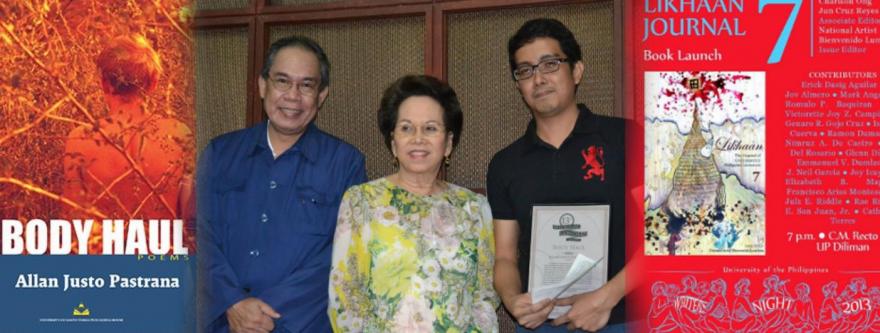
Allan Pastrana, Body Haul (UST Publishing House, 2011): “Called at turns difficult and lyrical, Pastrana’s poetry is deeply personal (and to the casual reader, hard to inhabit). His poems pose a difficult conundrum, for despite their apparent inaccessibility, an internal music moves them. Pastrana must be credited with such precise notation. Each of his themes seem set to an appropriate time signature—nostalgia, desire, childhood, domesticity—each one is given a clipped and particular music. It is music first that draws the reader into the writer’s milieu, uncertain of what he might find there, or if he will find anything at all…. First and last is his music. First and last is music of such virtuosity that Pastrana must be one of our finest poets.”

John Jack Wigley, Falling Into the Manhole: A Memoir (UST Publishing House, 2012): “This selection of essays shows the author’s deep-reflective investigation of his identity, whether as a boy growing up in the City of Angels, as a novice traversing through the muddled metropolis of our sad republic, or as a determined man embarking on a delicate quest in the land of his white forefather, a land deemed an earthly paradise by Spanish conquistadores. The personal narratives are unabashedly candid and sensitive, infused with humor and irony, and peppered with thrilling bits of pop culture. This book is both a delightful and heart-ripping read.”

The winner was Allan Pastrana, of whose work the judges had this further to say: “Like Orpheus’ lyre, Body Haul lures us with its refreshing variations of songs, stories, and tall tales. Like a prophet’s rod, it bestows spirit to birds, forces the word ‘trap’ to speak in three different languages, and illumines a path out of Eden to a re-worlding of stars and love. Pastrana’s kingdom is nonetheless that of a sophisticated intellectual, whose appreciation for music, literature, and the visual arts obtrusively yet gracefully seeps through the many fine verses in the collection.”

The evening’s highlight was an auction of writers’ memorabilia that we held for disaster relief, particularly for writers hard-hit by supertyphoon Yolanda. Beyond their craft, here were writers at their best, donating choice items and dipping liberally into their pockets to help out their fellows.

The money we raised came chiefly from a 1940s Parker Vacumatic fountain pen donated by yours truly (won by Jimmy Abad for P18,000 in spirited bidding over film director Auraeus Solito); a Smith Corona Portable Classic 12 donated by Paolo Manalo (won by a member of the Inkantada Band for P5,500); two manuscripts of works by Gregorio Brillantes and myself (won by Andrea Pasion-Flores for P4,200); and assorted manuscripts, author’s proofs (including that of Soledad’s Sister), and other memorabilia donated by Jimmy Abad and myself (won by rocker-news anchor-novelist-etc. Lourd de Veyra for P6,000). Poet Alan Popa went home with a drawing by fictionist Merlinda Bobis, donated by Chari Lucero, for P2,200. We’d also like to thank our other donors, buyers, and supporters—among them, National Artists Bien Lumbera and Rio Alma, poet Cirilo Bautista, and other writer-friends like Efren Abueg, Amelia Lapeña Bonifacio, Alma Miclat, Richard Gappi, Carlo Clemente, Dolores Mose, Francis Quina, Khavn de la Cruz, the NBDB, and the Chancellor’s Office of UP Diliman—for their generosity. We were all winners! See you all again in Writers Night 2014.


Penman No. 76: A Lesson in Description

Penman for Monday, December 9, 2013


NOW AND then I walk my students in Creative Writing through a lesson in description, which—as I’ve often noted in this corner—is at best always more than a rendition of the physical setting and the people and things in it. In the hands of a skilled or a gifted writer, a plain object can acquire a strange and memorable luminosity. Sometimes all it takes is the uncommon but logical and precise choice of a word, such as when William Faulkner describes a campfire as being “shrewd,” struggling and managing to keep alive despite the wind. At other times good description requires the writer to step back and to set things in a larger context, balancing fine detail with the broader sweep of memory and understanding.

I don’t even need to draw on the likes of Faulkner or Greg Brillantes or Kerima Polotan to demonstrate what I mean. Take this passage from a story submitted to my fiction class a couple of semesters ago by a young student named Katrina del Rosario, part of a story titled “Paying Respects.” Rather quiet in class, she more than made up for her reticence with this outpouring of brilliant prose:

The first Dayaos had been very successful farmers, and the land burst with green and trees and stalks and vines heavy with bright fruit; now only one or two Dayaos farmed the land, with the most magnificent of trees cut down to build houses. The elders remembered entire lives lived underneath the shadows of trees and grown roofs of vine, childhoods spent working the fields. They did not remember it as work. They remembered instead the bits of sugarcane that could no longer fit into carts and the sap sticky on their chins as they tore off strips of the bark with their teeth; getting lost in entire walls of tall grass that needed to be cut down; the cool of the mud and manure against their knees in the middle of a field exposed to all the ghastly splendor of a high sun; as small children, play was pretending to chop wood for the hearth and desiring to be old enough to pound the rice, watching in awe as their mothers tossed the grains into the air like a high wave and catching it again, cooking kangkong in hot water in their small toy pots made of clay. Everything they needed could be found on trees, in the fields. They had been perfectly comfortable. They were never hungry. Home was where the land began, and ended; living was the certainty of land and its fruit.

What’s even more interesting about this example is how little use it makes of adjectives and adverbs—the crutches that beginning writers often employ to carry the burden of description (“he snarled angrily,” “the bright, sunny morning,” etc.). “Write with nouns and verbs!” I keep reminding my students.

There are many ways of describing the same scene, but one approach I offer student writers is the option of gauging one’s emotional and psychological distance from the subject, and rendering the scene accordingly.

Depending on your purpose, you can choose to describe a person, thing, or place in one of several alternative modes. Your purpose, of course, will depend in turn on the kind of fiction or scene you are working on. I made up the following examples (so you’ll forgive me if they sound cheesy) to illustrate these alternatives.

What I call the technical/objective mode is strictly that, a seemingly factual, no-frills rendition of the scene, as a police report might put it:

The apparition was reported by a male witness, 45 years old, a farmer and a native of the town of Libmanan, Camarines Sur where previous sightings were said to have occurred. The man, Angelo Camagay, described what he saw as a woman in her early thirties, about 5 ft. 4 in. tall, and with distinctly Caucasian features: light brown hair, blue eyes, and fair complexion. She was clothed in a full body-length white robe of soft material; Camagay could not remember seeing footgear of any kind. She appeared before him at about 5:45 am on the opposite bank of a stream where he had paused to draw water in his bamboo container, prior to working in the fields.

Somewhat warmer and more detailed is the neutral/realistic mode. It’s still a fairly straightforward description without much emotional coloring, but we see things more vividly:

Augusto dipped the thick, three-foot length of bamboo trunk into the water; it had been severed at the nodes, with a hole cut into the top and a wooden handle attached to one side. Now the cool, clear water gurgled into the hole as Augusto held the container down, feeling the stream swirl around his wrists and the bamboo struggle to keep afloat. Later, in the heat of noon, the same water would slake his thirst and wash the paddy mud off his hands. Augusto looked up; it might have been a bird bursting out of the trees that caught his eye; but it was a woman on the opposite bank, blinding in her pure white robe. She, too, was white of skin; her hair was a light brown, and she stood closely enough for him to see that her eyes were blue. He could not see her feet, which were lost in the lush grass. She seemed younger but somewhat taller than his wife. Augusto knew that in all of his forty-five years in Libmanan, he had never seen anyone like her; but some of his townmates had, and now he believed them.

And finally—though perhaps with the greatest degree of difficulty—one can go into the lyrical/romantic mode, which involves a certain degree of abstraction and sublimation, and certainly a more pronounced attitude, not to mention some linguistic dexterity:

Rough the palms that trapped the water, brown the arms that fought its surge. Come into my bamboo cup of cups and fill me in my driest need, my limpid blood of morning. Come. And Augusto looked up for an instant, thinking that a great white bird had exploded in the trees, flushed out by his presence. But no bird there, no stark familiar creature of his town’s well-traveled woods. Maria, Ave Maria, oh fair oh pure oh thou footless light disconsolate. Eye of sky, hair of corn, I come to you. And bathed in her sudden radiance, Augusto thirsted as he had never had, but as others had, and now he saw, and now he knew.

Whichever mode the writer employs, he or she should remember that the best description always does more than physically describe: it prepares and conditions us for what is about to follow, and, working with the narrative, provides a context against which we can understand characters and their situations better.


LAST WEEK’S piece on the forgotten master Constancio Bernardo—whose 100-year retrospective dazzled us when we attended its opening last Wednesday—prompted the following recollection from the Davao-based poet Ricky de Ungria, who also paints and draws occasionally:

“My first teacher in the arts was Ms. Katy Bengzon of DLSU. I took a summer class there in Taft when I was still in high school and copped a prize for a watercolor of mine. My second teacher was Constancio Bernardo. My father enrolled me in a summer class of his at the old CMLI gardens somewhere in Quezon City. He taught me how to do landscapes in watercolor. In fact in one of my old sketchpads he showed me how to do shadows of leaves on trees. Very calm, soft-spoken and gentle man, as I remember now. All this to tell you how much I appreciate your piece on him today because I knew so little of him.”