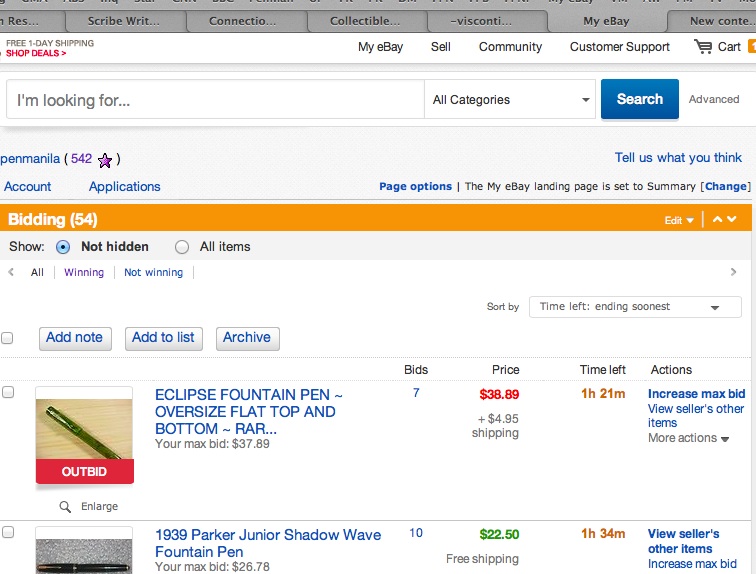
Penman No. 32: Ten Tips for the eBay Newbie

ebayPenman for Monday, February 4, 2013

BEEN LOOKING for a DVD copy of the 1973 Hollywood musical Lost Horizon, a 1954 Omega Seamaster, a pair of Johnny Depp’s Moscot Lemtosh shades, an 11200-mAh power bank for your iPhone, or a 1988 Stipula Baracca limited-edition fountain pen? Well, I have—and I found them all, not in my neighborhood mall or ukay-ukay, but in that largest of global marketplaces, eBay.

I’ve been buying and occasionally selling on eBay almost from the very beginning, since December 1997, and now have a feedback of 520+ (thankfully 100 percent positive). In all those hundreds of transactions, I’ve had maybe three or four bum cases of sellers not delivering, or sending me bad stuff. All of those cases were sorted out and I was refunded, so I do believe eBay to be a generally safe place to shop, with lots of wonderful bargains to be had, but as with any marketplace physical or digital, it can be tricky for the unwary.

I thought of writing up this brief guide to shopping on eBay because, thanks to my recent articles featuring fountain pens, papers, and inks, I’ve been deluged with inquiries about where to find these items and for how much. In particular, vintage and premium pens seem to be in great demand—pens like the Montblanc 149 and 146, the Parker Duofold, Parker Vacumatic, and Parker 75, and 1920s Waterman pens with flexible nibs.

I’ve sold quite a few of these pens myself, having made a pledge (a pitifully weak one) to trim down my collection of about 200 pens by half. My recent acquisitions have tended to be more expensive, so to help assuage my wallet and my conscience, I’ve had to dispose some of my loot, if only to make room for more. That means that I have to find a steady and reliable source for pens both to resell and to keep, and that can only be eBay—where, at any given moment, there will be about 40,000 pens of all kinds to compete for my attention and my credit card.

So I’ve been telling my pen-seeking friends that they could save themselves a chunk of change by bypassing me and going straight to the source—where a slightly used Montblanc 149 (which sells new on Amazon for $810) might go for around $400. But I’ve also warned them that it’s going to be a slippery slope, fraught with dangers and risks—not to mention the biggest risk of all, which is to get infected with eBay shopaholia.

Even if you care nothing about pens, there are literally a million more things to be found on eBay.com and on its local site, eBay.ph—everything from a mummified monkey’s paw (which you can buy without bidding for $13.00) and an 1864 autograph of Abraham Lincoln (bidding starts at $4,995.00) to a 2012 Lamborghini Aventador (yours for $469,991.00). Very likely, they’ll be things you don’t need but will soon want—and want badly, so mind the following tips if you plan on shopping on eBay without risking your children’s inheritance or your marriage. I’m going to use pens to illustrate my points, but these tips can apply as well to cameras, shoes, bags, bikes, or whatever floats your boat.

1. Know what you’re looking for—know the product and its current market value. Do some research beforehand and establish what possible issues there might be with the item. For example, if you’re looking for a Montblanc, understand that vintage celluloid ones in good shape could command more than new ones in “precious resin”—but also that the 149 and 146 are the most faked pens in the world (along with the Parker Sonnet); eBay actually has a guide to determining fake MBs (which means, know your way around eBay as well). EBay’s “completed listings” is a great way to determine market value—look for the median price (discard lowest and highest prices) for a better sense of what you can expect to pay. Check other websites (Amazon, BestBuy, etc.) as well, because their special deals and offers could undercut eBay. I do most of my gadget shopping, for example, on dealmac.com.

2. Condition, condition, condition. In your enthusiasm for an item, you might forget to probe its condition. Read the description very well and look out for any flaws. Especially scrutinize all the pictures. (This also allows me to spot special features that others might miss—a broad stub on a nib, for example). I think I know pens well enough that I can tell make, model, year, and approximate value for most major brands on sight, but every pen is still unique once it’s up for sale. Keep an eye out for cracks, glue, broken tines, mismatched caps and barrels, discoloration, etc.

3. Set up a PayPal account. It will make your life a whole lot easier on the Internet, since PayPal has become a global standard for electronic payments. I’ve tied my PayPal to a specific bank account I use only for eBay transactions. Is it safe? Of course you’ll hear a horror story here and there, but in my own experience, eBay and PayPal have served me very well, settling questions and disputes and sending refunds very quickly in the rare cases of non-delivery I’ve encountered.

4. Keep looking. Since I now buy and sell pens, I check out eBay many times a day—I have it on my phone—and have set up search terms for my favorite items, like Parker Vacumatics. This enables me to find what I like quickly, in a marketplace where millions of items are up for sale at any given moment. Some of my best bargains have come when buyers in the US—my chief competitors—are literally asleep. I also check out ebay.uk and ebay.ca (the UK and Canada) and have found some of my best bargains there. The first thing I check is “newly listed”, further narrowed down to “buy it now”—this way I can catch the real bargains before anyone else does. Then I check “ending soonest.” You can also refine your searches, for example by looking just for “149” under “Montblanc” under “fountain pens.”

5. Check the seller’s feedback. I’d be wary of a seller with less than 95% positive feedback. He or she may not be a cheat, but has a poor service record (delayed mailings, no response, etc.)

6. Establish your bidding threshold early on. Don’t get caught in a bidding war with another bidder. These days, since I could be bidding on 20 items at any given moment (expecting to win maybe two or three), I just bid my maximum and forget about it until the last two minutes, which are really all that matters on eBay. Some people use sniping programs that let the computer make a last-second automated bid for them; I should, but have been too lazy to set one up, and I rather like the excitement of making the last-minute bid myself.

7. Figure out and factor in your shipping options. Since most of my purchases are made in the US, I use a US shipping address (my sister’s in Virginia) and aggregate my purchases there. When I’ve gathered a boxful, I ask my sister to ship them to Johnny Air Cargo in NYC, which forwards them to me in Manila a week later. I’m sure many of you have US relatives who can do this for you (just make sure that they’re willing—be very nice to them at Christmas). I’ve educated my sister on pens so she’ll know how to check out a pen when it arrives and how to handle and package them properly; and yes, I’ve given her a nice pen or two.

8. Pay promptly, and leave feedback. You’ll see how your own feedback will improve once you become a good eBay netizen.

9. If and when you encounter a problem, report it to eBay. They have mechanisms for dealing with problems like getting a defective item (unless it was so described) or not receiving an item you paid for at all. Take note that there’s a time window (45 days, I believe) within which complaints can be filed.

10. Don’t lose hope. I’ve lost out on bids for items that I’d coveted for years, but then found another one a week later, for cheaper. If you can’t find it on eBay, it probably doesn’t exist, or is illegal to own. For me, it’s fountain pen paradise, and another reason to wake up in the morning for.

Penman No. 31: The (Ink and) Paper Chase

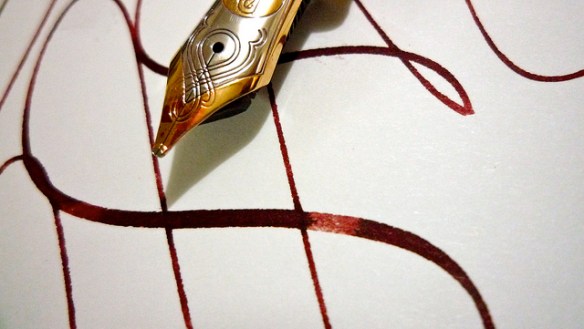
Oxblood

Penman for Monday, January 28, 2013

ONE THING that fountain pen fanciers rather quickly realize is that their obsession (read: expenses) won’t end at buying another Parker, another Sheaffer, or another Pelikan. You can have bread without butter, or even without coffee on the side; but you can’t write without ink and paper, so that anyone who habitually buys and collects pens soon metamorphoses—even without meaning to—into an ink and paper hoarder as well.

Indeed, inks and papers have become collectibles on their own, and not necessarily together. I have friends who couldn’t care less about pens, but for whom the sheer texture and even the faint aroma of paper can trigger paroxysms of pleasure. These are the people who seek and haunt stationery and art-supply shops, pawing through exotic papers from Thailand, Japan, and Italy, paper that might not even end up being lettered on but pressed into some other service. (And while we’re on this subject, please, please never say “stationary” to refer to writing paper; it’s “stationery” with an E, referring to “stationers”—the people who, in medieval times, sold books in fixed places, as opposed to peddlers who went around with their wares.)

My wife Beng, a watercolor painter and professional art restorer, has one such mecca on 3rd Avenue in New York City, on the second floor of which, up a steep flight of stairs, can be found an astounding array of the world’s finest art papers. But when she visits, Beng’s not looking for paper to paint on; instead, she wants a delicate, silk-like paper made in Thailand that she can use to lay over and stabilize patches of paintings where the paint has begun to flake off.

Forty years ago, when I worked briefly as a printmaker (another of the many hats I’ve worn—and I still wear them now, the real ones!), I too rhapsodized over art paper—the thicker and creamier the better—and on good days or for special jobs, I’d splurge on Strathmore paper, whose texture somehow made any print I designed, however poorly, look rich.

Indeed, it seemed rich of me to get so picky about my papers when, just a few years earlier in my mid-teens, the only paper I knew and cared about was bond paper (the kopong bond we bought at the corner store for 5 centavos a sheet), ruled pad paper for school, and yellow legal pad paper. For special purposes, there was oslo paper and onion skin, and maybe when we got moony we bought some fancy stationery at the bookstore (mine had a picture of the Beatles on every sheet) to write the crush of the moment on (yes, all I’ve ever had in my meager arsenal all my life has been words, words, words).

I still look for good paper these days, but it’s no longer to woo the wenches with (better not, says Beng) nor to pen my next novel on, but simply to test my nibs and inks, like a driver might look for a pristine stretch of track on which to lay some nasty rubber.

And what’s to like and not like about paper? While many kinds of paper—especially the smooth ones—may all look the same from the top, on the microscopic level, they could vary a lot, in terms of the makeup of the fibers and how closely they’re packed together. That means that when the ink flows out of the pen’s nib and gets onto the paper, it will either hold together and more or less stay in one place, or spread out like mad through spaces in the fibers and saturate the paper in such a way that the ink will bleed through, or be visible from, the back side of the sheet.

This latter process is called “feathering” and “bleeding.” You’ll know that your paper feathers when the line you write quickly becomes thicker and fuzzier, sometimes to the point that the letters become hard to read; bleeding or bleed-through, on the other hand, is obvious when you turn the page over and can see the ink. Feathering, I think, is worse than bleed-through; at least you can write on just one side of the paper and still have something crisp and clear, but paper that feathers horribly will leave you with one big blur.

As a general rule, cheap paper—thin, with loose wood-pulp fibers—will feather and bleed. More expensive papers, such as those that use linen, will tend to be thicker and more compact, and therefore offer a more pleasant writing experience. A simple pad or notebook could cost many hundreds of pesos, especially if they sport leather covers and other accoutrements.

In our pen club, the Fountain Pen Network-Philippines, members are forever on the hunt for good but affordable writing paper, even as we may indulge ourselves in the occasional pad of proven performers like Clairefontaine and Rhodia, available in some local bookstores. One sad and surprising discovery that fountain-pen users make early enough is that the iconic Moleskine notebook—whose design I love and have offered whole essays to—isn’t fountain-pen-friendly at all, showing awful feathering and bleeding.

Thankfully, many alternatives to (and copies of) Moleskine now exist, some dearer and others cheaper. A recent experience of mine seems to prove a point. Feeling more expansive than usual on my birthday, I went to the bookstore and spotted a very handsome-looking, leather-bound Jadeco notebook with what appeared to be excellent paper; the tag price of nearly a thousand pesos made me gulp, but what the heck (as I often rationalize these days), at 59 I can excuse anything. I picked it up, paid for it out of my birthday budget, and soon confirmed my expectation that the paper would hold up well to runny fountain-pen ink. The following day, on another sortie to National Book Store, I saw a small spiral notebook (that’s all it says on the kraft-paper cover: “Notebook”) that cost all of P28; on a whim, I bought that, too, and discovered to my chagrin that it performed almost just as well as the Jadeco. I would later learn from friends that some good compromises can be found in the middle of these extremes; I found another one myself a week later, at Fully Booked, under the brand-name Schützen—a regular-sized spiral notebook for P285 that didn’t feather and bled just minimally.

This brings us to inks, which really deserve another column-piece on their own (which I’ll do some other time). Let’s just say for now that inks can even be more bewildering and exhilarating than paper, given the seemingly infinite range of colors and hues you can produce from a mixture of water and pigment. Some inks are also thicker and more saturated than others; some are permanent, and others washable. Some specialty inks, like De Atramentis, can even carry the scents of fruits, flowers, and wines.

I’m not a very adventurous person ink-wise, and for the longest time wrote only with black, blue-black and brown inks; green, bright blue, purple, and red (not to mention yellow and orange) were simply out of character for me. They still are, but I’ve since nudged my range a bit to include Diamine Oxblood (a robust maroon) and Rohrer & Klingner Sepia (a greenish gray reminiscent of old manuscripts) in my small stable. I’m still on the hunt for the perfect blue-black, alternating between the Parker, Pelikan, Montblanc, and Lamy versions. Most days, I just liberally mix things up, turning my desktop into Inkspot City. (Better than alchemy, drop in at Scribe Writing Essentials in Eastwood Mall for a plethora of inks such as J. Herbin, not to mention many fine pens.)

Do take note that the final appearance of your ink will depend not just on chemistry, but on the paper quality, and also on the pen and the nib you use—a wider nib like a stub will deliver a thicker line that shades beautifully as it moves along; that’s what sends pen pushers into seventh heaven.

And what do I write with these exquisite implements? Aside from the occasional signature, absolutely nothing meaningful. I’ve come to realize and to accept that this is how I relax and make myself feel good: by taking hold of a pen worth what someone else more practical might have paid for a fridge or a flat-screen TV, and doing nothing more with it than doodling for hours on premium paper. I liken it to driving around on a lazy weekend to nowhere in particular, just enjoying the scenery and the sweet hum of a perfectly tuned engine. Such are one’s pleasures on the doorstep of one’s dotage.

Penman No. 30: Music to Lose Weight by

Penman for Monday, Jan. 21, 2013

AS I’VE been reporting lately, I’ve lost quite a bit of weight since my doctor ordered me six months ago to take brisk walks and go on a sensible diet to fight the onset of Type-2 diabetes. I seem to have hit the wall at a weight loss of 45 pounds, but I guess I should be happy where I am, in the low 170s. With my blood sugar in the 100 range and my blood pressure steady at around 110/80, I’m a whole lot better off than where I was a year ago—and, I suspect, than many men my age.

But this isn’t about cholesterol, triglycerides, and all that; rather, it’s about another unexpected side benefit to all this huffing and puffing. Because I take 30-minute to one-hour walks around the UP Academic Oval several times a week, I’ve rediscovered all the music I’d stored away in my iTunes. I have about 2,000 songs all in all—apparently not much by the standards of today’s kids, some of whom I’ve seen to profess having 10,000 songs in their playlists (of which, I’m pretty sure, 9,900 will sound all the same to me).

As you can imagine, most of my music is made up of what seniors know as “standards”—vintage pieces from the likes of Doris Day and Bing Crosby that can put a 20-something to sleep in 30 seconds, the kind of music you’ll hear on FM radio at 2 pm. Of course I have the complete Beatles collection (and could probably sing 80 percent of it from memory), a boatload of Broadway, Sinatra from here to eternity, Michel Legrand in both English and French, opera like I knew Italian, enough bossa nova to make me wish I knew Portuguese, and instrumentals from the likes of Jackie Gleason (yes, he was also a bandleader). Henry “Pink Panther” Mancini, and Toots Thielemans, who can make a harmonica sound like a love letter with your address on the envelope.

I do have quite a few new songs—but “new” to me usually means something 20 or 30 years old. Instead of Linkin Park, I have Led Zeppelin; instead of the Eraserheads, I have Heber Bartolome and Banyuhay. OK, I have a couple of songs by Journey (what else but “Open Arms” and “Faithfully”) and one by INXS (“Afterglow”) but no Nirvana, no hip-hop, nothing to disturb my hard-won equanimity or my illusion that the world is anything but an ordered whole.

It’s that old-guy sense of order and purpose that drives my left foot in front of the right and the right in front of the left, for 2.2 kilometers around the oval until I reach the Oblation and then do it all over again. I have to believe that all of this exertion will actually mean or bring something good, and for that I need emphatically optimistic music.

Broadway, I find, best puts me in this mood. If anything—from Carousel to Les Miserables—Broadway’s been built on selling the power of love and the indomitability of the human spirit, so you could whistle a happy tune and never walk alone and look to the rainbow and be sure that the sun will come out tomorrow. I might start with something light like “Dites Moi” from South Pacific or “Question Me an Answer” from Lost Horizon, progress to something more dramatic like “We Kiss in A Shadow” from The King and I or “If Ever I Would Leave You” from Camelot, and then push myself for another turn around the oval with something truly rousing like “On the Street Where You Live” from My Fair Lady or “There Is Nothing Like a Dame” from South Pacific. I’m singing all of these in my head, but being deaf to the world with my noise-canceling earphones on (not the smartest idea on the open road), I’m sure—from the strange looks I get from people I pass by—that I’m making noises I’m not hearing.

Next to Broadway, my two favorite genres are Latin music and OPM. I don’t really speak anything more than schoolboy Spanish (thank God for the old Spanish Law, which of course all of us detested in our time), but whenever I listen to someone like Luis Miguel, I find myself feeling foolishly sorry that we kicked those Spaniards out. I have eight versions of “Sabor a Mi” in my iTunes, and savor both Andrea Bocelli’s and Ennio Morricone’s versions of “Amapola” (which Morricone used for the soundtrack of Once Upon a Time in America). Speaking of Morricone, how could anyone resist “Gabriel’s Oboe” from The Mission, especially when it’s Yo Yo Ma doing the honors? And speaking of Yo Yo Ma, how much sweeter can a cello get than on “Doce de Coco” from his Brazilian album?

Ah, Brasil, where hearts were entertaining June, and we stood beneath an amber moon…. I’ve told my wife June (also known as Beng) that when I croak, the kind of music I’ll want at my wake will be that of Antonio Carlos Jobim, especially “Desafinado.” There’s something in the gentle insistence of the bossa nova that speaks to my own temperament. And here I have to bring up one of my favorite divas (aside from the inimitable Barbra and our own Sharon—yes, I’m an unabashed Sharonian)—the Japanese-Brazilian chanteuse Lisa Ono, whose “Pretty World” never fails to add some lift to my shoes.

For something more soulful I’d turn to Laura Fygi’s “Abrazame”—and it may be an odd way of looking at these ladies, but if Laura Fygi and Lisa Ono’s voices were like ink, Laura’s would shade to purple and Lisa’s to green. To top off my Latin section, no single album gets more airplay in the car or in my earphones than the soundtrack of Woman on Top, which has an upbeat vibe you can listen to all the way to Baguio. (I was playing it in the car once while driving around Pampanga, and everyone with me wanted a copy.)

And did I say OPM? Much as I may appreciate exotic melodies like “Dein ist mein ganzes herz” or “Les moulins de mon coeur,” they can’t get me going like Sharon’s “I-Swing Mo Ako” or “Bituing Walang Ningning.” When I’m rounding that long bend around the Sunken Garden and am tempted to linger under the acacias for a lick of sweet sorbetes, I strengthen my resolve by drawing on “Sana’y Wala Nang Wakas”: “Kahit na ilang tinik ay kaya kong tapakan, kung iyan ang paraan upang landas mo’y masundan… Kahit ilang dagat ang dapat tawirin, higit pa riyan ang aking gagawin!

And that—plus a lot of kangkong and hasa-hasa in sour broth—was how I lost 45 pounds in six months.

Penman No. 29: Some Things Meant to Be

Penman for Monday, January 14, 2013 

MY LATE father Jose Sr.—Joe to his friends—would have turned 90 this coming Saturday. An incorrigible chain smoker, he died of an aneurysm in 1996, and there’s hardly been a day since when I haven’t thought about him. Whenever I travel, which is fairly often, I find myself talking to my dad to tell him, “Tatay, I wish you’d seen this, and this, and that.” He was a simple man whose feet never left his country nor, pretty much, his home; his joys were in the kitchen and in the garden, and his favorite pastime was doing crossword puzzles.

Indeed, in his own way, he was a man of words, a gifted writer who—like I would do, myself—ghost-wrote speeches for far more powerful but much less articulate men. As modest as our circumstances were, there were always books and magazines at home, and even before I could read or write, my father fired up my imagination by reading stories to me at bedtime. In brief, I would not have become a writer had it not been for him.

Nor, speaking of my quaint obsessions, a fountain pen collector. In his last days my father wrote with a cheap plastic Bic ballpen—the kind you can now buy by the box and forget or throw away after a few uses—but in his prime he had some Sheaffers and Parkers that he would load up with blue-black ink, whose ability to bloom into a dark-hearted rainbow on a wet napkin brought me endless fascination. Regretfully none of his fountain pens have survived—which is probably why, as with most enterprises driven by some deep longing, I keep amassing pens, as if they would somehow bring my father back.

Now, begging your indulgence, here’s where this memory detours into the story of a pen and of a box.

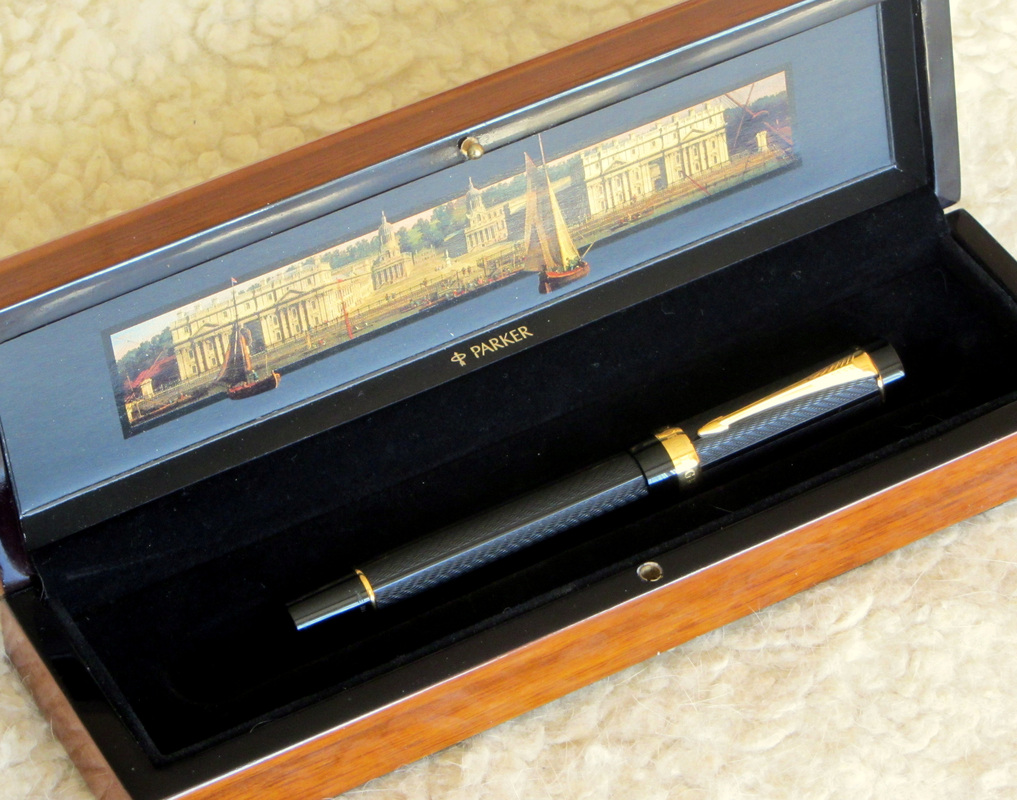
A few weeks ago, after months of eager questing, I acquired what collectors call a “grail” pen—an object of acute desire, usually for reasons of great beauty, scarcity, or some sentimental connection. In this case, it was purely a matter of esthetics and collectability: the Parker Duofold Greenwich Centennial would simply be a big, black, overpriced pen to most sensible people, but to me it was the noblest of the modern Duofolds, a reincarnation of a classic 1920s line that established the Parker name for the rest of the century. Made specifically to commemorate the Royal Observatory in Greenwich, England—which Beng and I visited around the time the pen was made in 1999—the pen was a special edition with a limited run, and had become rather hard to find.

When I found one on eBay at a price I could afford, I was ecstatic, filling my posts about the find with smileys and dancing bunnies. It was near-mint, the chevrons incised into its black cap and barrel deep and lustrous, its gold fittings rich and warm. Its regal nib was a joy to write with. I couldn’t have asked for more—or perhaps I could, as it came to me without its presentation box. Pens of this caliber always came in pretty wooden boxes in themselves worthy of collection, and indeed, in one discussion of the Greenwich in a forum I frequented, another collector had reported seeing “a small but fancy box with what appeared to be a European cityscape picture on the inside of the box cover.” I wasn’t sure why, but that description sounded oddly familiar to me then.

When the pen arrived from the US I put it to happy use, doodling away, writing loopy notes to no one. The Greenwich was truly an impressive pen and it sat haughtily in my pocket, but now and then I would be besieged by the collector’s constant fear of losing or dropping a valuable pen, and I would begin wishing that I had its box to put it to bed in, before I scored the exquisite chasing on the pen or, worse, let it slide out of my attention in one of my poker binges. But then of course, I didn’t have its box, and I couldn’t bear to stick it in anything beneath its stature.

And then, a few nights ago, something strange happened. As I was idly surfing away to more pleasant distractions (meaning, more pen-related Websites) in the middle of finishing the draft of another commissioned piece, I stumbled on a picture of the Greenwich in its original wooden box. And at that instant, the familiarity of the box and of its pictured scene overcame me, as I realized that, of course, I’d had that box somewhere in the house, somewhere in the very room I was in. Years ago, I had found the varnished receptacle in a thrift store in America, and had been taken by its plaintive beauty—plaintive because it was clearly a box for some majestic Parker pen (the Parker name was proudly emblazoned on it), but it was empty, and I had no idea then what model its proper occupant might have been.

I bought the box for a couple of dollars, and brought it home with me to the Philippines, where I decided that it would house the most precious pen in my collection—my dad’s battered Bic ballpen, the last thing he wrote with before he died. So I was certain I had it somewhere, and I began ransacking my den, pawing through shelves of empty pen and ink boxes (you can imagine what a collector’s nest looks like). Sure enough, there it lay behind a stack of ink bottles, the box that opened to a “European scene”—a cluster of neoclassical buildings foregrounded by a sailboat on the water. (I would later discover that it was a depiction of the Royal Naval College at Greenwich, seen from the north bank of the Thames.)

It was the box that had been designed for—and only for—the rarefied Parker Duofold Greenwich Centennial, and by some stroke of what the poets called serendipity, I had found the box years before I found the pen. I took my father’s crystal Bic in my hand and smiled, thinking, “Tatay, what strings did you pull to make this happen?”

So I put the Parker where it was meant to rest, and now I had to find new and no less suitable quarters for the Bic. Fortunately, on the same shelf was an old Japanese box, gleaming in black lacquer, that I had found in another discount store on Avenida Rizal, and which would originally have carried chopsticks. I didn’t think Tatay would have minded the switch, being an excellent cook.

And finally, I resolved that, in honor of Jose Quinton Dalisay, Sr., the Greenwich pen would henceforth use nothing but blue-black ink, a choice its golden nib seems perfectly content with. My other pens can gorge on Diamine Oxblood and other fancier concoctions, but I had been soundly persuaded that some things are just meant to be. (And here’s to a happy 90th, Tatay!)

Penman No. 28: Traveling with Pens

Vacumatic

Penman for Monday, January 7, 2012 

IT’S THE day before New Year, and I’m on my way to Kuala Lumpur with Beng for the last jaunt of the old year and the first of the new one. In my shirt pocket is a 1999 Parker Duofold Greenwich Centennial, a big black pen I’ve had for just a few days and which I’m putting through its paces; in my bag is a leather two-cigar case that’s transporting not Cohibas but two more Parkers—another Duofold, an orange International from around 2008, and a Vacumatic Oversize that goes all the way back to 1938.

I don’t even know why I travel with fountain pens. Lord knows how many valuable ones I’ve lost on the bus or in some stranger’s car, where it’s probably moldering under the back seat alongside an ossified wad of gum. (Probably the most valuable pen I lost, I didn’t even see. Twenty years ago, my grad-school friend Joe mailed me a pen in a box along with a book—I grabbed the book and threw away the box. “How was the pen?” asked Joe when I thanked him for the book. “What pen?” I asked. “The silver-filigree vintage Waterman that I tucked away in a corner of the box. It was meant to be a surprise,” Joe said. This was a couple of days after the box had gone to the dumpster in Milwaukee.)

It’s not like I write novels on the road, or write anything substantial, period, with my fountain pens. I have a thick pad of gorgeously creamy Clairefontaine paper at home, and all I ever write on it is “This is a Parker Duofold from 1931” or “This is a Bexley with a broad nib that I stubbed” or “This Waterman 52 flexes oh so nicely” and pages and pages of figure 8s. If I ever become truly famous, I suppose that pad of doodles and scribbles will be worth something to someone, but they’ll be disappointed if they’re expecting to find the first line of a new novel or some deep dark secret in it.

I keep that pad on my desk for whenever I get a new pen—maybe two or three times a month—for its ritual initiation: I’d write “This is a Pelikan M600 in tortoise” and see how the nib performs. I like my nibs broad, wet, and stubby, and if they aren’t any of these three (I do keep a few fines and mediums unmodified), I work on them with very fine 2500-grit sandpaper, finishing off the job with an 85-peso nail buffer from a Korean cosmetics shop (it always raises eyebrows when I walk into one of these mall shops and get three nail buffers all at once).

It takes care and patience, but there’s a lot you can do to improve the flow of ink in new pens, whose nibs will sometimes be “hard” writers requiring just a bit of tweaking to perform optimally. Beyond the flow, modifying the nibs themselves requires special knowledge and more than a dash of daring; I can stub or flatten nibs and make them write more smoothly, but it takes the skills and workbench of someone like my friend JP Reinoso to turn them into crisp cursive italics. For even more difficult jobs like straightening bent tines or adding iridium or tipping material to old nibs, we go to the best of the world’s so-called “nibmeisters”—people like John Mottishaw, Greg Minuskin, Mike Masuyama, and the now-retired Richard Binder.

But where was I? Oh, traveling with fountain pens. As I was saying, it’s something no one really needs to do these days. In fact, I also bring along a ballpoint or a rollerball pen for the inevitable task of filling out immigration and customs forms, especially those that require duplicate copies. (It was the necessity of the carbon copy, back in the ‘40s, that would eventually spell the death of the age of soft-nibbed fountain pens and the start of the world’s love affair with the ballpen or the “biro” as it was first called, after its inventor Laszlo Biro.)

A vintage fountain pen in your pocket might even spell fashion disaster inflight. Today’s air cabins are properly pressurized, and I should say that I’ve yet to have a pen burp on me airside and cause an inky bloom on my shirtfront, but there’s enough anecdotal evidence out there to suggest that not all pens or filling systems may be so well behaved. Conventional pen wisdom says that you fly with your pen either completely empty or completely filled.

Being a gambler, I travel with fully loaded pens. I might write a line or two with them on the road in my Moleskine notebook, but again it’s not the writing I carry them with me for—for that menial task, I have the trusty MacBook Air that I’m typing this piece on, in seat 7-D of our AirAsia flight. So what is it that I need to bring three pens for to an exotic destination like KL—where, ironically, I’m going to be picking up five more pens for friends from PenGallery (www.pengallery.com), one of Asia’s and the world’s best pen shops?

I suppose my pens are like the kids or pets I never had—and I know, I know, sometimes kids are better left at home, but you still want to know that they’re safe and that they’re where they’re supposed to be, and what better place can they be but right with you? I can’t possibly bring all of my dozens of pens along—I keep about nine or ten of them in the daily rotation—so I choose favorites for the week, and perhaps go for a mix of old and new, of ink colors (my staples being blue-black, which reminds me of my father’s writing, and oxblood, which lives up to its sanguinary promise), and of nib sizes (a fine or a medium for note-taking, a broad stub for signatures). A pen’s pleasures are both visual and tactile—the smooth curl of a line or a letter on the page, the feel of a precisely tuned instrument at your fingertips. Knowing that these pleasures are literally within reach, wherever I may be, gives comfort.

I like my modern Duofolds (a reprise of a classic design from the 1920s) because of their heft and balance, but I’ve taken the burgundy 1938 Vacumatic out of its 18-year storage and put it in my cup of daily writers after convincing myself that if I had a pen this precious but never used it, then I would have foregone one of life’s rarest privileges. (Yes, this is the very pen I found in Edinburgh in 1994 and which provoked the writing of the short story “Penmanship,” a desperate attempt to justify the impulse buy of the pen and to recover its cost.)

As you can see, I’m something of a Parker partisan, although I like and collect all kinds of pens, including the relatively inexpensive but ever-reliable TWSBI and Lamy. I have nothing against Montblancs—I have quite a few of them and treasure one of my 149s for its ability to write a sharp wet line even after weeks of being left unattended—but I remind my corporate and lawyer friends that there are other fine pens out there without a white star on the cap, such as Pelikans and Sheaffers, and they don’t all come with five-figure price tags. (Try Scribe Writing Essentials at Eastwood Mall and the pen counters at National Book Store for more options, or join our pen club at http://groups.yahoo.com/group/fpn-p/ for more information and great company.)

Speaking of vintage pens, I found a couple of noteworthy ones just before Christmas in an antiques shop in Quezon City. I had taken Beng out to lunch at a Japanese restaurant and right beside it was Siglo, which we hadn’t visited in ages. There under glass were two pens that had been waiting all that time for me: a 1920s Waterman safety pen inscribed “Conchita”, and a 1947 Parker 51 once owned by a “Julian T. Navarro.” Some pen collectors don’t like these personalizations, but I’ve never minded them, taking them as provenance and proof that these once were more than objects for someone’s collection.

Vintage pens

Like I told another collector-friend, I see myself much less as an owner than a caretaker of things that will pass on and give delight to someone else, and hopefully revive some tender memory of me. I have no way of knowing who “Conchita” was, but thanks to the wonders of Google, I was able to locate the obituary of Julian T. Navarro, who was born in the Philippines in 1907 and who died in California in 2003. He had been a war veteran, and then a contractor, and would have been 40 when he got the Parker in 1947—a man just approaching his peak at the end of a devastating war. I can just imagine him writing with that Parker, its now heavily tarnished gold cap gleaming in his hand. What hope and optimism would have flowed out of that pen.

I suppose that’s why I bring these babies home, and carry them around with me wherever I go.

KRIP YUSON already wrote the literary tributes I would’ve offered for the late Emy Arcellana and Jerry Araos, so let me just add my fervent sympathies to the families of these dear departed friends. Their lives enriched and brightened ours, and they will be much missed. Beng had visited Jerry just a week or two before the end, and he had told her, “I want to go home.” And so he did.

Penman No. 27: One for the 5

Penman for Monday, Dec. 31, 2012

WITH ALL the literary reportage I’ve been doing lately, I haven’t found the time and opportunity to indulge in my favorite pastimes (aside from poker, which I really can’t promote too much in this family-friendly corner), so let me use these holidays as an excuse to talk about my preferred stocking-stuffers.

Yes, you guessed right—they have to do with gadgets both digital and analog, namely phones and pens. If these things don’t excite you even half as much as they do me, you can turn the page now—or you can forget who you are and forget who I am and just join me these next few minutes as I transform into a 58-year-old boy taking out his tractors for a spin on the living-room floor. I’ll save the pens for another time, and focus on that object of desire that my undergrad students swore they couldn’t live without (as their professor quietly agreed), the cellular phone.

The phone on my mind and in my hand is, of course, the iPhone 5, and I’m writing this piece partly to answer the question that many friends who know me as an Apple fanboy have been asking lately: “How’s the iPhone 5 and do I need to upgrade it to it now?”

Let’s answer the easy part of that question first, which is the second part, and the quick answer is “No.” To be brutally honest—something that won’t come easy to those terminally ill with gadget lust—nobody really needs to upgrade to anything now or almost anytime. Seriously. That phone or that laptop or that camera that served you so well this past year or even longer should be able to do the same thing for you for a few more years, with reasonable care.

What we might call “upgraditis” is a terrible affliction that makes old useful objects—once sparkling with charm and oozing with sex appeal—suddenly look dumpy and inutile, leaving you with little option but to dig into your meager savings or even go into credit-card debt for something newer and shinier. Solid-state hard drives? More gigabytes. Digital cameras? More megapixels. Batteries? More mAh (milliampere-hours to the uninitiated). Upgraditis also leads to a state of mind that equates “want” with “need,” and makes a P35,000 phone or P70,000 laptop look not only a reasonable but an irresistible buy.

So, knowing all these nuggets of wisdom so well and dispensing them so liberally, why did I upgrade my iPhone 4S, barely a year old, to the IP5? To be honest (I make that sound easy), because I’m 58—59 in a couple of weeks—and I don’t need an excuse to get anything new, with my profound awareness that I don’t have too many more sentient years ahead of me to enjoy all the wonderful gadgets that they’ll design in Cupertino and manufacture in Shenzen; I’d be lucky to be around when the iPhone 12 rolls out of the factory, so I’ll take the 5 right now, thank you.

That was actually easier said than done, given the traditional lag time between a product rollout in the US and its appearance on Philippine shelves. The IP5 was released in the US, with the usual fanfare, last September 21, and it didn’t have an official Philippine launch until two weeks ago, on December 14, when Globe and Smart released their stocks (Smart slightly ahead of Globe, at a midnight bash). I couldn’t wait that long, and like a few hardcore Pinoy techies, I got mine in the US when I was there last October for a conference. Other members of our Apple users group (www.philmug.ph) got theirs in Singapore, Hong Kong, the UK, Australia, and even France. Why these countries? Because iPhones are sold factory-unlocked (often by law) in these places, so you can use them with any GSM network worldwide, unlike in the Philippines, where most network-supplied cellphones will require a touch of Greenhills magic to set free.

The US iPhones come in several varieties (Verizon, AT&T, and Sprint), and to spare you a long discussion about 4G or Long Term Evolution (LTE) networks and what will work here, let me tell you that the most compatible, factory-unlocked iPhone 5 version to get in the US for Philippine use is the Verizon one (yes, it’s a CDMA phone, but has a GSM capability as well) that you can now get contract-free from places like Best Buy. That’s what I got off eBay last October, and at the December 14 Philippine launch I got Beng a white IP5 for not too much under a retention plan, so now her iPhone 4 goes to my mom, who’d been using an iPod Touch. Why are we all on iPhones—us here, and my mom, daughter, sister, brother-in-law, and sister-in-law in the US? Because of what I think is the iPhone’s true killer feature, for binational Pinoy families: FaceTime, the free, limitless videoconferencing app that’s even easier to use than Skype and virtually pays for the cost of the phone over time.

So what’s so great about the IP5? Frankly, for me, nothing too earth-shaking; it’s just nice to have if you can cough up the cash. If I wanted to rationalize the hit on my Amex card (minimized by the quick sale of my 4S to my happy sister), I’d say that the IP5 is narrower, thinner, and lighter in the hand; the screen is bigger because of the phone’s extended length, the already-good camera is even sharper, the processor is faster, and the phone is LTE/4G capable, meaning that it’s good to go for the faster networks our telcos have promised to build. (I tested LTE on Verizon in New York, and it was blazingly fast.)

On the downside, the iPhone’s uninspiring battery life hasn’t really improved, at least in my own field tests, so that I’ve taken to carrying a power bank—a rechargeable battery—in my bag or glove compartment just to get through the day and my all-night poker binges. (I use my phone as a business machine rather than a toy—I check my email, surf, and even do school work and write articles like this on it—so I can’t afford to employ battery-saving tricks like turning 3G or Wi-Fi off.) Also, unlike the hard glass and tough plastic of the 4/4S, the anodized aluminum back and sides of the IP5 have been reportedly prone to scuffing in both the black and white models. (Another problem may be network-related; what’s the use of a 4G capability if your network is so slow, even on 3G?)

So what’s my bottomline on the IP5? Five million people apparently felt that they just had to have it within three days of its first release, but if you’re happy with your iPhone 4/4S or even your Samsung (and if you’re not 58 and bothered by your mortality), stick with what you have; it should serve you well for another year or so.

Otherwise, bite the bullet, sell the farm, and queue up for the iPhone 5 at your nearest Globe or Smart branch. Remember all the tedious routines and forms you’re going to have to fill out (there was much tearing of hair and gnashing of teeth at the December 14 launch over the four-hour queues, messed-up reservations, and unactivated nano-SIMs). Why? Because I’ll bet you my black 32-gig iPhone 5 that—for all the moaning and groaning and the buyer’s remorse that you’ll be going through now—you’ll be doing it all over again for the iPhone 5S, 6, 7, and 8.

Penman No. 26: New Novelist in Town

OFW AwardPenman for Monday, Dec. 23, 2012

IT’S ALWAYS a pleasure to welcome a new novelist into our ranks, and today will be one of those happy days when we acknowledge the arrival—literally and figuratively—of a new talent in our midst, Dr. Almira Astudillo Gilles, or just Almi to her friends.

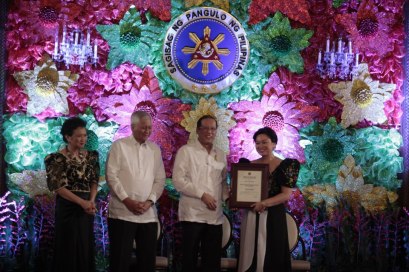
Almi flew in from Chicago as one of 29 recipients of the 2012 Presidential Awards for Filipino Individuals and Organizations Overseas, which were given out last December 5 by President Aquino at Malacañang. I had met her at the ICOPHIL conference in Michigan last September, although she had introduced herself to me by email earlier, as a fellow Filipino eager to make contact with other writers in the US and the Philippines.

Last December 9, Almi also launched her first novel, The Fires Beneath: Tales of Gold (San Francisco: Philippine American Writers and Artists, Inc., 2012), at the Ayala Museum. The novel deals with how a poor man’s discovery of ancient gold in the Philippine South changes him, his family, and his community. I haven’t finished reading the book, but I’ve been much impressed by her sharpness of eye and precision of language.

Writing about Quiapo and Binondo, for example, Gilles observes that “In Quiapo, the Golden Mosque is flanked by the Church of the Black Nazarene while the Binondo Chinese worship at Our Lady of China. On the sidewalks surrounding both places, vendors set up storefronts assembled from canvas, corrugated metal, or pieces of plywood, displaying items promising an easier spiritual journey. ‘Bypass purgatory,’ the vendors hawk. ‘Take one step closer to paradise… at a fraction of retail.’ Most believe, all pray. Both acts of nature and man cause great suffering. Metropolitan Manila lies beneath sea level and all it takes is one bad rainy season to show the inadequacy of the government’s flood control system. But the people take this all in stride. They buy both prayer beads and rubber boots.”

Since she was busy enjoying a well-deserved Christmas break with her family in the Philippines, I asked Almi to respond to a few questions I sent her by email, to map out the unlikely course she took to becoming a novelist from a professional background in the social sciences.

BD: Tell me something about yourself and your background.

AAG: I spent a few childhood years in Frankfurt, Germany where my father was assigned by the World Bank. Hence, English was the first language I learned formally. I was in premed psychology at UP Diliman and switched to AB psychology in my third year because I never intended to be a doctor and the subjects were getting harder. I graduated cum laude, and went to work for Sycip, Gorres, and Velayo (management consulting). After two years, I left for graduate school in the US, where I eventually finished a doctorate in social science, a master’s in political science, and a master’s in labor and industrial relations, all from Michigan State U. I also met my husband there, a doctoral student in economics, and got married there, on campus. My husband works in the telecommunications industry. I have a 22-year-old-son who works for Facebook and a 17-year-old daughter who’s starting college next year. I have a brother in Vancouver, Canada, and a brother and sister in the Philippines. My parents live in Manila.

BD: What started you writing?

AAG: I started writing poetry when I was about seven years old, and as I grew older I also started writing essays which were often published in the school newspaper. After graduate school, I joined the management faculty at De Paul University as adjunct professor, and taught at other area universities as well. At the same time, I had young children and my husband was traveling frequently. None of my childcare arrangements were satisfactory. After I grew dizzy and almost fainted in one of my classes (a night class for graduate MBAs), I went to see a doctor the next day and was diagnosed with hypertension, which apparently had been going on for quite a while. I then decided to quit teaching (I was teaching at campuses all over the Chicago area and would often get home around 11 at night) and try my hand at writing. My children’s book, Willie Wins, was published soon after, and I was hooked on writing. I started out writing for children since I had young ones of my own, and have published poetry, essays, short stories (one of which won a national award in the US), and plays for community theater. Now that my children are older, I thought I’d try something more adult, hence this novel.

BD: Where did the idea for this novel come from?

AAG: My friend’s sister was curator of the gold exhibit at the Ayala Museum, and she suggested I write a novel based on the discovery of the Surigao treasures. It took me about three years to finish, but I was working on other projects as well. I was fortunate that a video series of this story already existed, and I used that as reference.

I wanted the novel to reflect the tug between secularism and religiosity, and tried to delineate this struggle through my main characters (the gold discoverer and his family). Since I consider myself as a writer of the diaspora, I was careful to maintain a high level of authenticity about the Filipino experience (especially since the setting is the Philippines), while trying to appeal to American readers as well. Several chapters were workshopped at a master novel writing class led by a Northwestern University professor, and they were all white (no writer of color). While they liked the voice and style, they defined it as magical realism—a sad commentary on their knowledge of other cultures since the characters, setting, scenes were typical of a Filipino lifestyle. Some were also uncomfortable with my sentence construction (I tried to mimic the rhythms of Tagalog) but generally they liked the novel very much. In a writing workshop organization to which I belong, I’m the only Filipino writer (of English), and the only Filipino writer I know of actively publishing in the Midwest, so I feel I have to work extra hard to publicize my work and get the American readership to be more open to Filipino writing in English.

BD: What did your presidential award mean to you, and where do you go from here?

AAG: I write full time, but I guess you can say that days are filled with a lot of community organizing in addition to my writing projects. I’m very active in the Filipino American community in Chicago, and have a good working relationship with the Field Museum of Natural History. I try to promote Filipino culture whenever I can and am also invited by many schools to talk to students about multicultural writing. I’ve spoken at institutions and conferences all throughout the US, most notably at the Smithsonian Institution in Washington DC.

I’m humbled by the achievements of all the awardees—they are really exceptional people who have given so much back to the Philippines. I’m grateful that my writing has been recognized (Willie Wins is the most widely circulated Filipino American children’s book in the US, available in many schools and libraries, and is on the reading list of most multicultural publications), but I feel that a presidential awardee is obligated to continue to serve. My other passion is conservation and the environment (as president of the UP alumni group in Chicago, we raised funds for a marine study in UP Visayas), and I’m always trying to push both literacy and conservation. I’m encouraged by the feedback I get about my efforts because many have told me that I have motivated them to either write or start doing something to save the environment. I try to use the award to open doors so that I might do more, and the awards have been very effective in helping me to connect to others whom I might recruit for my cause.

AND SPEAKING of new novels, I’m awaiting an early copy of Marivi Soliven Blanco’s The Mango Bride, a comic romp through contemporary Filipino relationships, which will be released by Penguin in the US this coming April. Like Almi, the San Diego-based Marivi started out writing stories for children. Their examples should encourage more Filipinos, especially women, to make their mark in global publishing.

Penman No. 25: EQ Yap, a Filipino Patriot

EQYPenman for Monday, Dec. 17, 2012

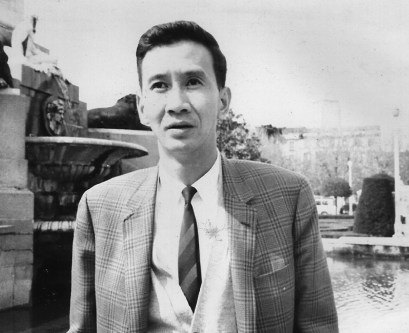
LAST DECEMBER 9 would have been the 81st birthday of a man named Emmanuel Quiason Yap—a name unfamiliar to most Filipinos, but who deserved more of his countrymen’s attention than they were able or willing to give him when he was around. Yap was one of the last in a distinguished line of nationalist Filipino intellectuals who emerged in the second half of the 20th century, a roster that included the likes of Renato Constantino, Alejandro Lichauco, and Hernando J. Abaya.

More than a year ago, I was asked by Yap’s family to write his biography, and I agreed—first, because he was the father of a former student of mine, and second, because I had met him earlier in the company of the Lavas, a family of committed revolutionaries whom I had also written about. (He was also a Yap, which is my mother’s maiden name, so we might have had a mutual ancestor somewhere back in Fujian.) I had heard of “Manoling” Yap’s own nationalist convictions, but had never really sat down with him to learn how he had acquired them.

I had several meetings with him and had begun on the book—which I’m now a week or two short of finishing—when he suddenly died in September 2011. Thus I begin the book this way:

“When Emmanuel Quiason Yap died all of a sudden on September 26, 2011, very few Filipinos knew what they had lost. It was almost as if a stranger had walked into a sleeping household, had left a precious gift in their midst, and had walked away; waking up in the morning, the family members see the object and wonder what it is and who brought it there, but they cannot recognize its value, and put it aside.

“His peers and colleagues would recognize and refer to him, even within his lifetime, as a visionary, an astute student and critic of his nation’s political and economic fortunes, a shaper of minds whose firm nationalist beliefs might have led the Philippines on to another track of growth and progress. He was an adviser to Presidents, senators, and congressmen; for a time, he headed an economic planning office for the House of Representatives; he helped to foster stronger diplomatic ties between the Philippines and socialist countries; and he founded a popular movement to promote patriotism among Filipinos. In various venues over many decades, including a newspaper column, he campaigned strenuously for a more independent foreign policy, a more self-reliant economy, and for greater justice in a society riven by exploitation and oppression.

“Manoling Yap, in other words, was a reformer, a man who never tired of thinking how life might yet be bettered. And he was no armchair dreamer, but someone who took his battles to the political arena, risking his life and freedom in pursuit of his principles. But as many if not most reformers soon discover, Manoling Yap would often find his idealism opposed, rejected, or even taken advantage of by others resigned to a more pragmatic view of things.”

Few may remember it now, but Yap—born in Angeles, Pampanga to a family of lawyers and entrepreneurs—was instrumental, along with Mayor Rafael del Rosario, in achieving cityhood for Angeles in the early 1960s and for planning its modernization. However, their plans ran afoul of the rackets being run by the notorious Kumander Sumulong, who issued death threats against the mayor and Manoling.

Trained as an economist, Manoling later went to Georgetown for graduate school with the encouragement of former President Jose P. Laurel, who urged him to go to America “to learn how the Americans are fooling us.” Yap took the admonition to heart—this was the time of parity rights—and came home an even more ardent nationalist. He taught at the Lyceum, then a bastion of radical thinking.

He set up the Congressional Economic Planning Office—a forerunner of what today is the National Economic and Development Authority—and worked with the old man Laurel’s son, Speaker Jose B. Laurel, in crafting the Magna Carta for Economic Freedom and Social Justice, which argued strongly for a more independent economic policy and for vigorous industrial and agricultural development. The Magna Carta was signed into law by Marcos in 1969, but languished in implementation, and Speaker Laurel himself fell from power soon afterwards—the victim, Yap was convinced, of imperialist machinations (as was, Yap would later believe, Marcos at Edsa).

Yap was also instrumental in opening diplomatic and trade ties with the socialist bloc in 1967—surprisingly, even as anti-Red rhetoric was escalating along with the Vietnam War, and well before Richard Nixon undertook his own diplomatic initiative toward China. He accompanied Rep. Manuel Enverga, chairman of the House Foreign Relations Committee, on a grueling three-month journey behind the Bamboo and Iron Curtains. Years later, he would also advise Sen. Leticia Ramos Shahani, when she chaired the Senate Foreign Relations Committee, and help her draft a more independent foreign policy moving away from the traditional Philippine-US alliance to stronger ties with our neighbors in the Asia-Pacific, and with countries in the Middle East, the Indian Ocean, and Central Asia.

In the last decade of his life, Manoling Yap devoted much of his time and energy into setting up and promoting the People’s Patriotic Movement, an effort to unite Filipinos from all backgrounds and persuasions behind the fundamental need for a sense of nationhood. “Together,” he wrote, “we will rediscover our common historical truth, rectify the errors of our colonial past, muster the national will to reconstruct the Filipino nation into a strong nation-state which can adequately feed, educate and protect its own people by the sweat of its brow and not from mendicancy and subservience to other nations, and ultimately assure a better future to all our children.”

As with many intellectuals, he was a man of ironic contradictions—an Atenean who sang Latin hymns as a boy with touching fervor, but one who grew into a brooding skeptic; a civil libertarian, but one who imposed strict family discipline; a seeker and defender of freedom and a friend of known Communists, but one who appreciated Ferdinand Marcos as a progressive nationalist; and an astute analyst who predicted the end of the Cold War but who blithely ignored the signs of his own failing health.

Emmanuel Quiason Yap was a complex man; his burning idealism often met with disappointment and disenchantment, and in the end he had very few friends left to talk to—among them his cousin the historian Serafin Quiason Jr., the painter Dan Dizon, and my fellow STAR columnist Billy Esposo. But he had his country at heart and died a patriot, joining the privileged company of his heroes—Rizal, Mabini, and the old man Laurel.

Penman No. 24: The Necessity for Nonfiction

NonfictionowPenman for Monday, Dec. 10, 2012

A FEW weeks ago, in Melbourne, I had the pleasure and privilege of speaking before a global audience of experts in and practitioners of nonfiction—that broad branch of writing that straddles everything from journalistic reportage, history, and philosophical essays to personal memoirs, travelogues, and cookbooks. I gave one of the four keynote addresses in that three-day-long Bedell Nonfictionow Conference; the other speakers were David Shields, on collage and appropriation; Helen Garner, on the central place of the interview in nonfiction; and Margo Jefferson, on the boundary between criticism and nonfiction. I chose to take a less technical and more social tack, and talked about why, more than ever, there’s a need for nonfiction in this age of the Internet, particularly in places off the global literary centers like the Philippines.

I wasn’t alone in representing the Philippines and its literature. Lawrence Ypil, one of our brightest young poets who’s doing a second MFA at the University of Iowa, this time for nonfiction, spoke about using family photographs to solve a mystery, and also introduced the work of Resil Mojares and Simeon Dumdum Jr. from his native Cebu. Longtime activists Bonifacio Ilagan and Marili Fernandez-Ilagan discussed the political possibilities of nonfiction in print, film, and theater; Boni also gave a comprehensive overview of recent political nonfiction from the Philippines. Their talks provoked much interest, and reminded me of just how far ahead of the curve our writing is in many ways, despite the obvious obstacles to writing in a society that doesn’t seem to value books much.

So I used my keynote as an opportunity to reintroduce contemporary Philippine literature to others, highlighting our work in nonfiction, particularly that of the late, great Nick Joaquin. Below is the full text of that 40-minute talk (because of space limitations, I was able to provide only an excerpt for the newspaper column version of this piece):

Thank you all for this great honor of having me as one of the keynote speakers for this conference, and for this opportunity to introduce another literature and another literary experience to a global audience, from which we Filipinos have been largely removed. And who, exactly, are we Filipinos? Just two days ago, a Gallup poll revealed that Filipinos were the most emotional people on the planet. We laugh and we cry with equal facility—so don’t be too surprised if this talk descends from the sublime to the ridiculous within a paragraph of each other.

This being a keynote, let me assure you that this talk will be about more than our domestic literature, and that it will connect to the greater issues of nonfiction in the world. But I have chosen to begin on a point of disconnection, from the periphery, because our vagrant experience presents some interesting possibilities for looking at how nonfiction—if not literature itself—has served self and society outside of the West.

Indeed, these past few years, I’ve traveled around various literary conferences around the world with a stock speech titled “Why You’ve Never Heard of Me,” by way of addressing the relative obscurity in which the Filipino writer has labored—even and especially in the company of our fellow Asians such as the Chinese, the Japanese, and the Indians who have understandably gained much greater international attention and prominence.

In sum, my thesis is that we Filipinos don’t write enough novels, and the novel has been the ticket to literary fame and consequence in 20th century publishing. It also hasn’t helped that, as a former colony of Spain and the United States, we are out of the Commonwealth loop. We no longer write in Spanish, and as for our writing in English—a thriving, century-old literature—the Americans (with the notable exception of Robin Hemley) don’t quite know how to receive it, despite its troubling familiarity, like the bastard child who suddenly appears at the door with an expectant smile. We also have a robust literature in our other national and regional languages, but again they hardly connect to the other native literatures of Southeast Asia, in gatherings of which the non-Bahasa-speaking Filipino has often been the odd person out.

That’s all the more strange when we consider the Filipino diaspora which—like that of the Indians, the Nigerians, and many other ambulatory nationalities—has taken our workers all over the planet. We are you maids, your nurses, your sailors, your entertainers. One-tenth of our population of over 90 million people now live and work overseas, in places as remote to us as Iceland, Angola, and Syria, providing not just the foreign remittances that keep our economy afloat but also a wealth of material for our literary imagination. Indeed it often takes the literary imagination, more than journalistic reportage, to sort out these experiences of dislocation.

But why even go abroad for alienation? If there’s anything colonialism does to the colonized, it’s to leave behind two states of mind, often manifested in two or more predominant languages, one of which represents the colonial elite. That’s American English in our case, and while it’s given us a global edge in the BPO or call-center industry—in which we now rank second, next only to India—it has produced no comparable literary dividends, with our literature in English trailing far behind India’s, and even behind translations to English from the Chinese and Japanese, in the attention of the world.

Thus we represent an insular experience. But like exotic species which—after a geological point of separation—have survived and mutated on their own in some tropical plateau or some literary Galapagos, literatures like ours can be interesting and useful objects of study, because they manifest both fundamental similarities to and striking departures from the biological mainstream. They speak back to the mainstream, as I am speaking today, and offer up a mirror—perhaps a somewhat distorted or distorting mirror—in which others can see versions of themselves.

Our insularity has resulted in some interesting courses of evolution. Given the absence of a market for novels, we have developed our strengths in poetry and the short story. Given further that there is no money to be made either in poetry or the short story—but also that these genres require little material investment—our writers have focused on producing the best art they can, rather than on satisfying a market (and there was, arguably, a market for these in our newspapers and magazines of the early 20th century, when they were part of the entertainment mainstream).

In the case of Philippine nonfiction, curiously enough, more titles have been emerging over the past 20 years—memoirs, biographies, histories, essays, travelogues, cookbooks, and motivational materials for business and religion. Most it not all of this production has been in English rather than in the national language, Filipino—not surprisingly, since books are expensive and considered non-essential items in a country still largely poor, and the people who can buy books at and for their leisure speak and write in English. (Parenthetically, this introduces another interesting element for further thought: if translating language means inevitably translating experience, what goes on in nonfiction in a foreign or borrowed, and especially a colonial, tongue? Whose stories tend to get told, and how, from what perspective?)

There has also been a perceptible rise in enrollments in courses and workshops for nonfiction, seen by many—correctly or otherwise—to be a less formidable and more accessible entry point to writing than fiction or poetry.

The rising global popularity of nonfiction is manifest in the region. A quick glance at the recent titles taken up by the Hong Kong-based Asian Review of Books will reveal a clear preponderance of nonfiction, covering such diverse topics as the undercities of Mumbai, Christianity in Communist China, the Thai monarchy, the Amritsar Massacre, the Jewish community in Shanghai, and Japanese ninjas. Not surprisingly, much of this nonfiction deals with China and India, being both the largest sources of and markets for such work. There is great interest in the West in these two countries, as well as in Japan and Korea, because their economies are umbilically tied to those of the West.

But let me go beyond money and markets, and talk about the necessity for nonfiction in less familiar and less mediagenic countries such as ours.

To state the obvious, nonfiction provides an alternative to fiction and of course to itself. In the first instance, I don’t simply mean the choice the reader faces at the bookshop at any given moment between buying a novel or a book of essays, but as a means to appreciating the truth, in which everyone is presumably interested and invested.

That truth can be particularly elusive in a country and society where there has been a longstanding tradition of suppressing it—in our case, the nearly two decades of the rule of Ferdinand Marcos, carrying over to his successors, one or two of whom turned out to be even more adept than Marcos in kleptocracy and in hiding the truth.

In this experience we Filipinos can hardly be alone, given the emergence and in many cases the continuing rule of autocrats, despots, and demagogues around the world, from Asia and the Middle East to Africa and Latin America. Personal accounts and testimonies are important in such places where an “official version” of events is often promoted, if not enforced.

While fiction might best capture the grotesqueness of life and the absurdity of the truth in many of these places—and I’ll get back to this later—it is nonfiction that bears the burden of presenting the facts on the ground, often at great risk to the author and even to the reader.

It was just a little over a week ago when PEN International marked the Day of the Imprisoned Writer—an issue I could personally relate to, having been imprisoned for seven months in 1973 at age 18 not for writing any earth-shaking novel but rather political flyers and such ephemera. Among those on PEN’s list of “focus cases” was Ericson Acosta, a young poet and activist who had been writing and filing reports on human rights abuses in the Philippine countryside. He has been held without trial since February last year—ironically, under the regime of President Benigno Aquino III, whose family has been canonized for its espousal of civil liberties.

The authoritarian State not only seeks to stifle the truth: it is an active and imaginative producer of fiction. In the Philippines, this was never more palpable than during the long years of martial law, from 1972 until the expulsion of the Marcoses—at least for the time being—in 1986. Let me share a few stories in this regard.

In 1964, just before he first ran for President, Marcos commissioned Hartzell Spence—an American author and editor of Yank magazine, who contributed the word “pinup” to the vocabulary—to write his biography, titled For Every Tear a Victory (later reissued as Marcos of the Philippines), of which a film version was later made. These biographies touted Marcos’ wartime heroism, for which he supposedly received 27 medals, thus becoming the most highly decorated soldier of the war on the American side. Most of these decorations were subsequently proven to be fake. Spence reported that Marcos sustained wounds from singlehandedly engaging 50 Japanese soldiers in a gun battle, a claim Newsweek later disproved. Marcos also claimed to have led a guerrilla force of more than 8,000 men, which the US Army dismissed upon investigation as “fraudulent” and “absurd.”

There was no doubt that Marcos was a brilliant fellow—he topped the bar examinations in 1939, having reviewed for the exams while in prison for allegedly shooting his father’s political enemy at night between the eyes; the young Marcos had been a sharpshooter with the ROTC, and was the natural suspect. He defended himself before the Supreme Court and was acquitted, and the legend was born. Indeed, it was easier to create and to promote the myth because the known facts in themselves seemed incredible enough.

Sometimes the myth was not about himself, but about the nation and its prehistory. In 1971, one of the biggest stories to rock the anthropological world was the discovery of the Tasaday, supposedly a Stone Age tribe that had somehow survived in the Philippine South in benign innocence, well into the 20th century. They made the cover of the National Geographic and were hailed as if Adam and Eve themselves had stepped wild-eyed out of Eden, until skeptical parties spoiled the fun by decrying the Tasaday as an elaborate hoax. As chronicled by Robin Hemley, more responsible investigation has since established that the truth very likely lay somewhere in between—that the Tasaday were neither quite that ancient nor that synthetic, but had lived largely by themselves for a long time. The Marcos government, however, felt deeply invested in validating the notion of a lost tribe, as it seemed to extend the arc of development even farther back, as if to say, “Look how far we’ve come.”

To make sure that the future got things right, in 1977, Marcos published a multivolume history of the Filipino people under his own byline, titled Tadhana, or “destiny,” for which he had actually commissioned some of the country’s most eminent historians.

To reach beyond the range of books, the Marcoses ventured into film. One of the most memorable projects I’ve ever worked on—if only because of its intentions—was an abortive film epic conceived and commissioned by Imelda Marcos, circa 1978, involving the production of a four-hour extravaganza on Philippine history from Ferdinand Magellan to Ferdinand Marcos. This was to be the Marcoses’ version of Hitler’s Triumph of the Will. But instead of having just one Leni Riefenstahl, Imelda wanted eight of the country’s top film directors and their scriptwriters to stitch the opus together, dividing four hundred years of Philippine history among themselves into a half-hour segment each.

As it was the height of martial law, there was no saying no to the Madame, and film director Lino Brocka took me along, as a 24-year-old rookie scriptwriter, to a meeting with Mrs. Marcos in a State guesthouse near the presidential palace where, over bottomless cups of coffee and increasingly crumbly cupcakes, she lectured us for at least six hours on how to make a good movie. The meeting lasted so long that we had to be issued special passes, because a 10 pm curfew was in effect, and we staggered home around 2 am. The movie was done, but for some reason was—and I should probably add thankfully—never shown and never seen in its entirety, not even by its makers. It remains one of the great mysteries of mythmaking under martial law—all those reels of footage devoted to the historical inevitability and apotheosis of Marcos, which must now lie in a warehouse somewhere in Manila and have themselves become historical relics.

But this kind of mythologizing did not begin nor end with Marcos, and it would be naïve to think that other Filipino leaders did not avail themselves of the power of fiction—or, otherwise, the power of silence.

Let me point out here quickly that while repression remains a very real threat in our society, Philippine literature and journalism are wonderfully wanton—we have no sacred cows, no taboos. We feel free to write as we please, if only because we suspect, with some justification, that the government is functionally illiterate, and doesn’t give a rat’s ass about what you say in your obscure novel or inscrutable poem. But this doesn’t mean that there’s no political backlash, when someone upstairs does read or misread your report in the newspaper, the magazine, or online.

Those genres tell us something, by the way—that, at least in the Philippines, nonfiction is a far riskier enterprise than fiction. Statistics kept by the international Committee to Protect Journalists show that 73 Filipino journalists have been killed since 1992. So far, no novelists or poets have figured on the death list.

Some of our journalists eat death threats and libel suits for breakfast. One of them has been Marites Vitug, a groundbreaking magazine editor and investigative reporter whose two books on the Philippine Supreme Court—and the shenanigans within, which culminated in the recent impeachment of the Chief Justice—have become two of the hottest nonfiction titles in town. I copyedited both books—doing the first one anonymously, asking my name to be left out of the acknowledgments—not necessarily because I feared for my life or freedom, but because I knew that the book would result in a libel suit which would be more an annoyance than anything; I had many foreign engagements lined up and a libel suit (two of which I’d already faced myself, one from the former President’s husband) would mean that I would have to secure permission from the court even to spend, say, a weekend in Hong Kong. Sure enough, Vitug got slapped with a libel suit and a death threat, which thankfully went nowhere.

But speaking of journalists, let me introduce a name that will be unfamiliar to most of you, by way of celebrating the indigenous explosion of creative nonfiction around the world.

Born in 1917, Nicomedes Marquez Joaquin, better known as Nick Joaquin, was, by popular acclamation, the greatest Filipino writer of his generation, a man who effortlessly straddled the worlds of street-level journalism and highbrow fiction. He practiced New Journalism well before the term was coined, and wrote true-crime fiction well before Truman Capote put it on the publishing map. To Nick—and to use his own words—journalism was “literature in a hurry,” and Nick Joaquin seemed to be in an awful hurry, producing an average of 50 feature articles a year, according to his biographer. He wrote these under a pseudonym that was also an anagram of his surname, Quijano de Manila. He would also write some of the most memorable Filipino short stories and plays of his time, in an English inflected with the exuberance of the Spanish he also knew and loved, but it was his unique reportage that made him accessible to a broad public. He took on all subjects—politics, crime, showbiz, and sports.

According to critic Resil Mojares, “He raised journalistic reportage to an art form. In his crime stories—for example, ‘The House on Zapote Street’ (1961) and ‘The Boy Who Wanted to Become Society’ (1961)—he deployed his narrative skills in producing gripping psychological thrillers rich in scene, incident, and character. More important, he turned what would otherwise be ordinary crime reports (e.g., a crime of passion in an unremarkable Makati suburban home or the poor boy who gets caught up in a teenage gang war) into priceless vignettes of Philippine social history.”

I’m going to read you a few short paragraphs of his prose, just to suggest his treatment of his material, and also his language:

In “Flesh and the Devil,” published in January 1962 in the Philippines Free Press, Joaquin introduced a story of white slavery by harking back to ancient mythology:

Proserpine, in classic myth the daughter of the earth mother, was kidnaped by the lord of the underworld and carried to hell. Rescued and brought back to earth, she found herself alien to its light and flowers; half of her heart had turned dark; she had eaten of hell’s pomegranates and must ever partly dwell in shadow.

The pomegranates of hell were news last week in the story of four girls who said they had escaped from hell after several months of an evil bondage; their flesh had been made merchandise. Three of the girls are 19 years old, but the fourth is a child of 15, and her name is Proserpina.

But he could be as hard-boiled as they came. In “The Mystery of the Murdered Bigamist,” published in May 1961, he reported on the discovery of a corpse:

He had been stabbed eight times in the left breast, his throat had been slashed, and he had been hit so hard in the face his left eyeball had sunk. He had been trussed up with a rope, his hands and feet bound together behind him, and he had been stripped of his wallet, watch, ring, and shoes…. In the ditch where he was found, the police found the bloodstained fragments of a letter in Pampango. The writing was almost illegible, but the signature was clear: Felino.

And always, Joaquin sets the piece in its larger context, as the enactment of an ageless drama. Reporting in 1963 on the bloody assault of a government office by private security guards gone rogue who had axed the skulls of their victims—also security guards—he would write that:

In the August 26 robbing of the Rice and Corn Administration’s main office in Manila, the security-guard culture, long a-ripening, has burst into saga and epic. The eyer is now the eyed, and the figure that has so long lurked at the edges of our consciousness has moved into the center of our attention. We stare at the symbol of our unsafeness.

Security guards were the victims, security guards were the villains… The tragedy happened within a special sphere, among an esoteric society or knighthood of men bound by their own codes, their own private rituals, a shared lore…. A couple of the invaders had been false to the code of the brotherhood and had been ousted, and returned in stealth and were let in, because they knew the secret words and rites.

Joaquin goes on to chronicle sundry acts of mayhem and mésalliance: the murder of a movie star’s delinquent son; the affair between a Filipino ambassador and a German baroness; an abortive shooting of an actor who later became President of the Philippines. Despite his many awards for his fiction and drama, he never considered journalism beneath him. In 1996, he said that “Journalism trained me never, never to feel superior to whatever I was reporting, and always, always to respect an assignment, whether it was a basketball game, or a political campaign, or a fashion show, or a murder case, or a movie-star interview.”

In 1977, his best journalistic pieces were compiled in several anthologies, under the titles Reportage on Crime, Reportage on Lovers, and Reportage on Politics, and eventually these selections grew to more than ten books; in addition, he wrote histories, almanacs, and a dozen biographies.

I brought up Nick Joaquin (who died in 2004) not just to introduce a name, but also to show that the New Journalism and creative nonfiction were laying down native roots in other parts of the world outside of the West—certainly not only in the Philippines—before we knew them by these terms. Joaquin’s Free Press pieces, which began in 1957, antedated Truman Capote’s In Cold Blood, which was published in 1966. Of course Capote never claimed to have invented the true-crime genre, and neither did Joaquin, and more thorough investigation will easily turn up far earlier examples from all around the world.

Indeed, we are often referred back to the Scotsman William Roughead, who began attending trials at age 19 and, in 1913, published the first of many collections, Twelve Scots Trials, which he called “adventures in criminal biography.” It’s instructive that Roughead lamented his publisher’s choice of that title, which he thought was too dry. He said that “Trials suggested to the lay mind either the bloomless technicalities of law reports or the raw and ribald obscenities of the baser press.”) You’ll note that in this desire to eschew “bloomless technicalities” and “raw and ribald obscenities” lies the fundamental impulse for creative nonfiction.

The highest crimes, of course, are often perpetrated by the State, and this again is where the greatest value of nonfiction lies, in unraveling the truth where the outcome could affect the lives and fortunes of millions. Sometimes the most significant outcomes are no more immediate and practical than an understanding of the past, especially when alternative histories face off against each other.

This is where nonfiction competes against itself, one version versus another. We often speak of nonfiction in the same breath that we say “the truth,” as if nonfiction and the truth were interchangeable, but this is something that everyone in this conference should know cannot always be so. Nonfiction is, in a sense, a process rather than a product, a way to establishing certain verities most of us can accept or agree with or recognize, albeit with some resistance.

Most notably, nonfiction is an arena for competing histories or interpretations of history. This again is particularly important where the formation of a people’s self-image is involved, especially in a colonial or postcolonial context.

Traditional historians, for example, have viewed and represented the uprisings of poor peasants in the Philippines as the epileptic seizures of cultist fanatics, rather than legitimate and inevitable revolts of the feudal oppressed. The communist guerrillas who fought the Japanese in the Second World War and struggled on against the American-supported postwar regime—much like the Vietnamese resistance—were presented as power-hungry troublemakers and stooges of the Soviet Union and Red China, disregarding their deep nationalist and anti-imperialist orientation.

These histories and their alternatives continue to be written in my country and, I’m sure, in yours. In my own nonfictional work, I’d like to think that I’ve contributed to this conversation through the biographies and institutional histories that I’ve been writing, about which I’ll say more in this afternoon’s panel discussion on nonfiction from the Philippines. Nonfiction is even more essential in this age of Facebook and Twitter, when every event is deemed newsworthy within five seconds of its occurrence, for even the worst—or some would say the best—of gonzo journalism bears some of the composure and the composition of art.

Nevertheless, the argument can always be made that sometimes the best response to fact is fiction—not the fiction of the State, but the fiction that emanates from deep within the individual’s heart and conscience, bodied forth by the free imagination. Fiction—especially the kind of realist, pre-postmodern fiction that still predominates in Asia—is relentless in its effort to make sense of events and of the characters who impel them. Our narratives tend to be straightforward, transparent or at least translucent rather than opaque, trading cleverness of presentation and virtuosity of language for what is seen—or hoped to be seen—as honest, heartfelt storytelling, the object of which is the understanding of character and the improvement of community.

Our national hero Jose Rizal was an excellent polemicist who scored the abuses and effects of Spanish colonial rule in one essay after another—but it was his two novels from the 1880s, Noli Me Tangere and El Filibusterismo, that captured both the obviousness of the need for some kind of revolutionary action and yet also the complexity and difficulty of making this choice. His farewell poem, supposedly written in his prison cell on the eve of his execution by firing squad, is impressed in the national consciousness.

Under martial law, when our presses were shut down and all the newspapers and magazines were producing hosannas, it was poetry, fiction, and drama that took up the fight—slyly, stealthily, employing such disguises and devices as we knew would escape the regime’s eyes and yet catch the public’s. In 1983, when Sen. Ninoy Aquino returned from exile in the US, only to be gunned down by an assassin at the airport—thereby precipitating a chain of events that would ultimately lead to Marcos’ downfall and departure—my reaction was to write not an essay, but a novella set in 1883, with a revolutionary agent returning from Hong Kong being assassinated on his homebound voyage.

I’ve also written a novel about those years, about growing up under Marcos and about our complicity in the whole project; but one of these days I’d like to embark on my dream project, which is an oral history of our martial-law experience through the eyes of various protagonists from all the sectors involved—the resistance, the government, the military, the businessmen, the citizens.

And then perhaps we will understand why, 40 years after they virtually proclaimed themselves rulers for life over one of the happiest and yet also the most dolorous people on the earth, and even long after the downfall and the death of their patriarch in 1989, the Marcos family remains staunchly embedded in our political firmament, with Imelda Marcos in Congress, her daughter Imee in the governor’s mansion, and her son Ferdinand Marcos Jr., now a senator, being groomed for the presidency. It was as if martial law never happened—and to many Filipinos, especially the young, it never did.

Simply put, the full story of this most traumatic episode in our modern history has yet to be told. Most of us never knew what happened behind the barbed wire; most of us never understood that the prison began well before the barbed wire, and extended into our homes and our subconscious. We cannot remember what we never knew, and we can never learn from what we cannot remember.

And this, ultimately, is the necessity for nonfiction—whether it comes in the form of personal memoir or national history, of comic musing or tragic reflection, of travelogue or cookbook, of political polemic or erotic encounter: it constrains us to confront the tangible world, reminds us of our vulnerable, mutable, insurgent physicality, and connects us to a shared past, present, and future. Today it connects me to you and our literature to yours, for which opportunity I once again am deeply grateful.