Penman No. 45: Distance and Intimacy in Prose

RRSCMC

Penman for Monday, May 6, 2013

VERY RECENTLY, over a long weekend, I was at the City University of Hong Kong where I had been invited to hold what they call a “generative workshop” for the university’s Master of Fine Arts program in Creative Writing. City U’s low-residency MFA program has been a pioneer of its kind in our part of the world; what “low-residency” means is that you can take and complete most of the program from afar, online, having only to physically attend two or three sessions a year with one’s mentors at City U’s sprawling campus near the Kowloon Tong MTR station.

I’ve been privileged to be one of these long-distance mentors (in my spare time, of course, as I teach full-time at UP), and to meet and interact with the kind of international crowd that Hong Kong and City U’s unique MFA setup attract. (Of note, two Filipinos—Karla Delgado and Sheree Chua—have graduated from this relatively new program.)

The low-residency formula allows for both students and instructors to come from all over—Asia, the US, the UK, and Europe. This time, my “mini-residency” group included a French woman doing risk analysis at a bank; a Chinese teacher of American literature; a Chinese-American woman who returned to Beijing from Chicago; an American working for a high-tech firm in Shenzen; and a Chinese-Canadian musician. None were full-time creative writers, but all shared a passion for the written word, and all had interesting stories to tell, whether in fiction or nonfiction.

The mini-residency is an intensive morning-to-evening three-day workshop designed to generate ideas for new work, and my fellow instructors (this year, it was the eminent American nonfictionist Robin Hemley—who’ll soon be heading the Yale-NUS liberal arts program in Singapore—and the Indian novelist Sharmistha Mohanty) and I were asked by the program director, the Chinese-Indonesian-American novelist Xu Xi, to focus on the subject of intimacy: not how intimately characters feel about each other, but how intimacy (and its correlative, distance) might be achieved in a creative work.

I designed my workshop to explore how writers employ different approaches and techniques to suggest distance or intimacy in their work, primarily through description and narration. We took “distance” here to mean both the physical and psychological distance between reader and subject—factors that mediate the reader’s response to the text and, of course, the presentation of the narrative itself.

In both fiction and creative nonfiction, writers assume a certain standpoint or perspective vis-à-vis their subject. This has a lot to do with—but is not necessarily the same as—point of view. A writer might be detached and clinical in his or her approach, describing things and narrating events from a distance or from behind a glass wall, with seemingly little or no involvement in the unfolding narrative. And then again, he or she might be and might sound totally immersed in the scene, surrendering all objectivity to subjective impression, led on less by logic than by emotion.

The best writers know how to provide both accurate descriptive detail and an evocation of a mood or an attitude by which we can perceive the subject. In his story “Breasts,” for example, Stuart Dybek writes: “When Joe looks up, Marisol stands as if she’s emerged from the morning glories. She has a white flower in her auburn hair. Her flower scent obliterates the mix of pigeons, garbage, and motor oil he’s come to associate with Johnny Sovereign. She’s dressed in white cotton x-rayed by sunlight: shirt opened a button beyond modest, tied in a knot above her exposed navel, and tight white toreador pants. The laces of the wedged shoes he used to call her goddess sandals snake around her ankles. Her oversized shades seem necessary to shield her from her own brightness.” Note the use of “white” and brightness as a motif, the incongruity of “pigeons, garbage, and motor oil,” the “sandals (snaking) around her ankles.”

Sometimes authors will nudge our attitudes along with some fine and subtle commentary. Look at how Dino Buzzati opens his now-classic postmodern short story “The Falling Girl”:

“Marta was nineteen. She looked out over the roof of the skyscraper, and seeing the city below shining in the dusk, she was overcome with dizziness. The skyscraper was silver, supreme and fortunate in that most beautiful and pure evening, as here and there the wind stirred a few fine filaments of cloud against an absolutely incredible blue background. It was in fact the hour when the city is seized by inspiration and whoever is not blind is swept away by it. From that airy height the girl saw the streets and the masses of buildings writhing in the long spasm of sunset; and at the point where the white of the houses ended, the blue of the sea began. Seen from above, the sea looked as if it were rising. And since the veils of the night were advancing from the east, the city became a sweet abyss burning with pulsating lights. Within it were powerful men, and women who were even more powerful, furs and violins, cars glossy as onyx, the neon signs of nightclubs, the entrance halls of darkened mansions, fountains, diamonds, old silent gardens, parties, desires, affairs, and above all, that consuming sorcery of the evening which provokes dreams of greatness and glory.”

Note how the city is “seized by inspiration” and becomes “a sweet abyss”, and how “the long spasm of sunset” descends into “that consuming sorcery of the evening.”

And it isn’t just in fiction where the writer can manipulate the reader’s reception of a subject by calibrating distance. One of my favorite nonfiction writers, the surgeon Richard Selzer, describes an operation he undertakes with in-your-face immediacy:

“I follow his gaze upward, and see in the great operating lamp suspended above his belly the reflection of his viscera. There is the liver, dark and turgid above, there the loops of his bowel winding slow, there his blood runs extravagantly. It is that which he sees and studies with so much horror and fascination. Something primordial in him has been aroused—a fright, a longing. I feel it, too, and quickly bend above his open body to shield it from his view. How dare he look within the Ark! Cover his eyes! But it is too late; he has already seen; that which no man should; he has trespassed. And I am no longer a surgeon, but a hierophant who must do magic to ward off the punishment of the angry gods.”

This comes from an essay titled “The Surgeon as Priest,” so the religious imagery is intentional and necessary, but Selzer demonstrates how the physical can rise to the philosophical, as when he talks about opening up a patient’s body on the operating table:

“It is the stillest place that ever was. As though suddenly you are struck deaf. Why, when the blood sluices fierce as Niagara, when the brain teems with electricity, and the numberless cells exchange their goods in ceaseless commerce—why is it so quiet? Has some priest in charge of these rites uttered the command ‘Silence’? This is no silence of the vacant stratosphere, but the awful quiet of ruins, of rainbows, full of expectation and holy dread. Soon you shall know surgery as a Mass served with Body and Blood, wherein disease is assailed as though it were sin.”

We’re all a long way from being Buzattis and Selzers, but in my workshop, we took a look at how both fiction and nonfiction writers deal with distance and intimacy, and why certain approaches work best in certain situations. This led to the student-writer’s own exploration of his or her options when contemplating a work in prose: how far or how near are you going to be to your subject? How do you negotiate and calibrate physical and psychological distance?

Over the weekend, I gave my students a series of increasingly more complex exercises: first, to provide an objective description of a setting, any familiar spot in Hong Kong; second, to introduce a character into that setting; third, to give that character a problem; and fourth, to write a dramatic monologue, from within that character’s point of view, dealing with the problem and reflecting in some way the setting around the character.

City U’s impressive new Run Run Shaw Creative Media Center (pictured above), where our workshops were held, stands on top of a hill from where the lights of distant buildings glow and twinkle through the afternoon mist. It’s a great vantage point from which to appreciate the new, culturally resurgent Hong Kong—and to reflect on one’s own location in the great GPS of an increasingly globalizing literature.

Penman No. 44: Pen Boys’ Weekend

Chito and JPPenman for Monday, April 29, 2013

AS IF two trips up to Baguio in early April weren’t enough, I went up a third time later this month. But while my previous sorties had to do with literature—high-minded work, you might say—this third one was purely for fun… and, well, okay, some education of the esoteric kind. That education, I hope, properly qualifies this piece for the Arts & Culture section, particularly as it has to do with my favorite subject of discussion, fountain pens—that’s right, those inky instruments of insistent individuality.

The members of our five-year-old pen club, the Fountain Pen Network-Philippines or FPN-P, had long planned to hold a vintage-pen-repair workshop in Baguio, and this month it finally happened. Why Baguio? Because that’s where our host—the Bali-based Fil-Am pest exterminator (seriously, that’s what he does for a living) Butch Palma—keeps house when he’s in the Philippines, with a veritable pen repair shop and laboratory in the basement. After some hemming and hawing, seven diehards signed up for the workshop: the onetime mechanic, nurse, and now banker JP Reinoso, our local “nibmeister” or master of nib repair and modification; the retired pharmaceuticals executive Chito Limson; the lawyer and DepEd Undersecretary Albert Muyot; the UP engineering major Jonathan Isip, our resident geek and IT specialist; the UP Special Ed grad student Cesar Salazar, who’s had as rich and varied a business background as any; and the two Butches, Dalisay and Palma.

In FPN-P, my tocayo and I are known as the vintage-pen guys, since our collections (about 200 pens for me, and double that for The Other Butch, or TOB as he’s affectionately called in the group) lean heavily toward prewar pens. I have about 60 Parker Vacumatics—fabulous pens and eye candy, with colorful shimmering stripes—and have learned to repair them myself; TOB also likes Vacs, Sheaffers, and gold pens, and is far more advanced and experienced at repair than the rest of us. But what’s even more impressive about TOB is his armory of pen-repair tools, including a mean-looking heat gun and Dremel drill, maintained and arranged as carefully as a conscientious dentist might treat his picks and forceps. (The comparison isn’t as fanciful as it may seem; the dental pick is one of a pen repairman’s most constant friends.)

Fountain-pen repair is a lot like vintage-car restoration. You want the final product to come out all spiffy and shiny, but there’s a lot of work to do—often insanely complicated work—under the hood. You don’t need just the skills, which no one really teaches; you also need the parts, supplies, and tools, which can be as arcane as they come, such as an inner-cap puller for Parker pens, sac protectors for Sheaffer Touchdowns, lever boxes for hard-rubber Watermans, and rubber sacs and diaphragms of many sizes. These aren’t things you can pick up at True Value; they have to be sourced online, and then painstakingly practiced with, inevitably at the cost of a priceless pen or two.

And when a repair newbie’s eagerness outstrips his skills or his patience, disaster happens. Thirty years ago, as I was just getting hooked on pens, I found a rare, mustard-colored Parker 51 Vacumatic in a thrift shop in Michigan for 25 cents—not bad for a pen worth at least 1,000 times more—and promptly cracked the barrel with a twist of the pliers. (Memo to self: heat the barrel with a hair dryer before attempting disassembly, to let the plastic expand.)

Vacumatics

You would’ve thought that—dozens of fixed Vacumatics later—I would be a master at this, and maybe I thought so, too. But at TOB’s workshop, I made another dumb newbie mistake: using a tool I didn’t know without reading or following instructions. The tool in point was TOB’s heat gun, which sends out a blast of hot air like some kind of light saber. I was kidding my tocayo about his having a heat gun instead of a hair dryer because—well, if you see his shiny, saintly pate, you’ll understand why—and then I turned the heat gun on a 1940 Vacumatic that I was going to use to demonstrate my graduate-level skills to the nervous newbies. But, alas, before I could say “This is how…”, the heat gun vaporized a chunk of the pen’s barrel, and there in a smoky wisp went another of George S. Parker’s creations, having survived for over 70 years before some dumb monkey with a PhD zapped it to pen heaven.

Happily the rest of our weekend’s forays into the art of reviving dead writing instruments went much less dramatically, with positive results. Taking a break from headaches in primary education, Usec Albert (one of three Usecs in FPN-P, big fountain pens being a lawyer’s weapons of choice) learned how to replace a “jewel” or an ornament in the butt of a ca. 1960s Parker 61, Chito repaired the 1940s Vac of San Beda Prof. Pidoy Velez (threatening to bill him P8,000 per hour for the three-hour service), JP showed me how to breathe life back into a 1930s Touchdown, and TOB put together a pretty 1938-ish blue Esterbrook using a cap and barrel rummaged from my parts bin (and I found a black Vac barrel from his, to replace the one I ruined), so in the end, everything worked out just fine for the pen boys. (And just to get this straight, at least a third of FPN-P’s more than 300 registered members are female, some of them—the amazingly talented Ms. Leigh Reyes instantly comes to mind—blessed not only with formidable pen collections but with divine calligraphic skills as well.)

We didn’t do too badly as amateur pen repairmen go, but we were glad to be reminded that for truly difficult jobs and truly valuable pens, there are pros we can always tap around the world for their unique expertise. For the longest time, the bible of pen repairmen was the late Frank Dubiel’s “Da Book,” but a new generation of more scientifically savvy restorers has taken over. The legendary Richard Binder (who lent his name to the word “binderized,” to mean exquisitely finetuned and smoothened nibs) has himself retired, but nibmeisters John Mottishaw and Greg Minuskin can still refashion a perfect nib from a sorry scrap of gold, and out in Nebraska, Danny Fudge still services my Vacs and Duofolds when I can’t bear to break them myself. Ron Zorn in upstate New York has a backlog of at least six months, but he’s almost the only one who can properly put back a broken pen together—not with superglue or epoxy, but with a solvent weld that takes months to cure. (Can anyone here in Manila do these things? Beyond the simple repairs we did, the short and plain answer is no; Montblanc does do basic repairs in its service center in Rustan’s Makati, and sends on the tougher jobs to Hong Kong and Gemany.)

Is it worth it? That depends on how much you value your pens. If it’s a P500 Schneider or Inoxcrom, replacing it might be cheaper than attempting a fix; if it’s your grandfather’s Wahl Doric or Waterman Patrician, a $30 solution from Danny Fudge (plus postage, of course) will be a bargain. As far as I’m concerned, and as far as I can help it, every old pen deserves a second chance, if only because they’ll never be made again the way they were back in the 1920s. (That’s not entirely true: companies like Conway Stewart have come out with splendid revisions of the old classics, but these pens could cost you more than an iPhone.)

Boys being boys, and with our precious cargo back in their leather cases, we gathered around the table over scotch and coffee, and babbled into the wee hours about a host of manly subjects: cars and carburetors, terabytes and audio formats, Paul Simon and the Beatles, swords and light sabers, Malcolm Gladwell and Jared Diamond. Now and then some new words and brilliant ideas slipped into the conversation: hadoken, innumeracy, dyscalculia; now and then wives and women were mentioned, but not too often. And every five minutes or so, the talk drifted back to pens, about how gorgeous but oh how expensive the prewar Omas Extra Lucens was, about how Sheaffer Vac-Fills use a bewildering range of rod sizes, and, yes, how quickly vintage celluloid can melt in the wrong hands.

Such was our pen boys’ weekend, and—as I’m sure our wives appreciated—there are worse things men can spend their weekends on and weekends with than leaky Vacumatics.

Penman No. 43: Bencab and Biboy

Bencab and Jim LibiranPenman for Monday, April 22, 2013

EVERY SUMMER, when the UP National Writers Workshop caravan heads up to Baguio for a week-long literary retreat, our first stop right after we drop off our bags at the hotel is an art and ethnographic museum on Asin Road off Naguilian, built and run by National Artist Benedicto Cabrera, better known to all as Bencab. This Easter-Sunday visit with Bencab has become one of the staunchest of workshop traditions, as eagerly anticipated as the Friday evening poetry slam at the Mt Cloud bookshop.

Most years, there’ll be three National Artists in attendance at these meriendas—aside from Bencab himself, we’ll have workshop panelists Virgilio “Rio” Almario and Bienvenido “Bien” Lumbera with us (and if our prayers gets answered and poet Gemino “Jimmy” Abad gets named to this grandest of honors one of these days, there’ll be one more). It’s a treat for the workshop fellows, this leisurely afternoon with cultural heroes, and as mid-career writers with at least one major book or work behind them, they’re not expected to genuflect before the luminaries but to chat with them as peers—although, of course, it can’t be helped if some get star-struck and tongue-tied.

Bencab makes it easier for everyone by personally welcoming the workshop fellows (that’s him with filmmaker Jim Libiran, above) and leading them to the generous merienda, which also serves as his birthday celebration (he was born on April 10, 1942). Then he’ll lead a smaller group of fit and intrepid volunteers on a walking tour of the grounds, showing off new additions and developments.

It has to be said that the Bencab Museum has become a reason unto its own to go up to Baguio. Built on one side of a gorge (Bencab had the foresight and thankfully the wherewithal to acquire both sides, to ensure the integrity of the view), the modernistic multilevel museum and its adjoining buildings dominate the landscape, a white counterpoint to green. It’s been 13 years since Bencab decided to move his studio from the old artists’ village in Tam-awan to Asin, and we’ve had the privilege of watching the museum grow from year to year, a few bricks and exhibits at a time. These days, the museum features not only paintings—Bencab’s own and those of some of the best young Filipino artists today—but a world –class collection of traditional Northern highlands art, including the iconic bulol. The sculpted grounds covering five hectares all in all feature plots of homegrown strawberry, coffee, and lettuce, and this time we got to meet the museum’s newest denizens, the delight of squealing children—15 Peking ducks in the pond.

Despite the entrance fee of P100 per person (discounted to P60 for seniors and students), the place attracts many hundreds of visitors on weekends, and if you’d rather have Benguet coffee than acrylic abstractions, the museum has Café Sabel (named after Bencab’s signature character) with a fabulous view.

I’ve admired Bencab’s work since the early 1970s, when I first met him at the old Printmakers Association of the Philippines shop on Jorge Bocobo in Malate. Fresh out of martial law prison—where I’d studied art with a fellow detainee, the printmaker Orly Castillo—I was apprenticing with the masters at PAP, and Bencab himself would drop by. Knowing my limitations, I soon shifted from prints to prose—but not before I met my wife-to-be, the artist June Poticar, at PAP; the other bonus of that brief foray into printmaking was a lifelong friendship with people like Bencab.

When we visited him last Easter Sunday, Bencab was just about to leave for New York to participate in an international exhibition and symposium with 17 other artists from the Spanish-speaking world. He spoke eagerly of the new commissions he had been working on, including an eight-foot sculpture for the recently inaugurated Solaire casino. Not too long ago, he had been a resident artist at the Ken Tyler Print Institute in Singapore; his pieces have been realizing premium prices at international auctions.

Here, I thought, was an artist who, at 71, was still at his productive prime, generously sharing his experience and his influence with younger artists and the public through the museum. But while he’s assumed a public persona, he’s never forgotten—like all good artists—to return to his studio beside the museum and to work in creative solitude. You can’t share what you don’t have, and Bencab’s been great at doing both. Thanks again, Ben, and we look forward to more visits and chats with you.

IMG_1016

I WAS also fortunate to have been invited last month to the opening of Antipas “Biboy” Delotavo’s 13th one-man show, titled “Mallcontents”, at the ArtInformal gallery on Connecticut Street in Greenhills. Biboy and I also go back a long way to 1978 when he illustrated the poster of the first movie I ever scripted, “Tahan Na, Empoy,” for director Lino Brocka. It turns out that Biboy was born a couple of months after me in 1954 (as were Jacky Chan and Kazuo Ishiguro, so I suppose I’m in good company, ha ha.)

Biboy has been called a social realist, an artist whose work carries an explicitly political agenda. Indeed his paintings have demonstrated a keenly political sensibility, an awareness of how ordinary Filipino lives are shaped if not mangled by forces much larger and more powerful. You can see this in one of his most familiar works, “Itak sa Puso ni Mang Juan,” which depicts a man on the street walking against the backdrop of a giant Coca-Cola sign—suggesting, perhaps, a form of cultural imperialism, of how we’ve allowed brands and loyalties like Coke to define our tastes and therefor define us.

But whatever you may think of the politics of art, no one captures the contemporary, everyday Pinoy as sharply as Biboy Delotavo. His portraits of pedestrians in “Mallcontents” are painstakingly honest—neither pessimistic nor jubilant, neither warped nor romanticized. These are people just getting through another day, mulling over the usual problems (rent, supper, tuition, cellphone load, birth certificate, happiness, relief, rheumatoid arthritis); they don’t look particularly hopeful but they’re not despondent, either—they’re thinking about possible ways of coping. You look at a Delotavo portrait and see yourself and people you know, and you feel that one way or another you’ll survive, and the affirmation of that shared experience—of community and society—makes it well worth the visit to the gallery.

Penman No. 42: The Memoir as Mediated Memory

LarsonPenman for Monday, April 15, 2013

AMONG THE most interesting topics that came up in the recent UP National Writers Workshop in Baguio was that of writing the memoir. More and more people—and not necessarily celebrities or historical figures—have been writing their memoirs lately, and it could even be argued that many blog entries are, effectively, memoirs, although the quality of the prose and of the sensibility behind it might vary widely. No matter, for now: what’s important is that we’ve put a considerable value on what people say they remember, so it’s as good a time as any to look at memoir-writing with a critical eye, as we did in Baguio.

Having been assigned to lead that discussion, I drew on a book that I’ve had my students in creative nonfiction read before they mine their own lives for material with which to complete the course. Written by Thomas Larson, the book is titled The Memoir and the Memoirist: Reading and Writing Personal Narrative, and it was published in 2007 in the US by the Swallow Press of the University of Ohio. It was my wife Beng who found the book for me during one of our visits to San Diego, and I’m very happy that she did. I rarely read books from cover to cover in a few sittings, but this was one of those exceptions. I found myself nodding and putting check marks on the margins here and there, so cogently did Larson raise his points.

So rather than dilute Larson’s wisdom with too much of my own commentary, and since this isn’t a full-scale lecture on the memoir, I’m going to quote extensively from his book by way of raising issues that the potential memoirists among my readers can consider.

Let me just take off from what I said last week about the writing of historical fiction—about how the past speaks to the present, and how, beyond nostalgia, history is of value to the writer as material with which to explore why we are who and what we are today. Memoir writing, when you come right down to it, poses the same challenges and opportunities as historical fiction, except that it really happened, and it happened to you.

But in the memoir, Larson suggests, the past in a vital sense did not just happen; it continues to happen. In other words, the past is never over, and it is the memoirist’s job to be aware of and to remark on the happening.

Quote: “You need to emphasize that which captivates you in the present…. The past drama is not the only drama. The present drama of recollection is equally alive, equally in and of the story. [The memoirist finds] that as she remembers she is being emotionally altered by what she remembers.”

Memoir is different from autobiography, Larson says, in that it deals with small, intimate, ambiguous portions of a life rather than a coherent whole. The memoirist’s stance is one of self-doubt rather than the biographer’s certitude.

Quote: “The Encyclopedia Britannica describes the old plural form, ‘memoirs’, as that which emphasizes ‘what is remembered rather than who is remembering.’ If we invert this, we can call a book that emphasizes the who over the what—the shown over the summed, the found over the known, the recent over the historical, the emotional over the reasoned—a memoir…. It cannot be the record of the past as autobiography tries to be. Memoir is a record, a chamber-sized scoring of one part of the past.”

Larson says that indeed, the true subject of memoir is not the past but the mutable self.

Quote: “[In] the construction of a relative self in the memoir… the person who is writing the memoir now is inseparable from the person the writer who is remembering them. The goal is to disclose what the writer is discovering about these persons…. What the memoirist does is connect the past self to—and within—the present writer as the means of getting at the truth of his identity.”

In revisiting the past, Larson refers to what Virginia Woolf calls “moments of being,” those events, instances, and decisions that define the self. The memoirist actively seeks out these moments, and explores and amplifies them until they acquire a kind of resonance.

Quote: “The exceptional moments are ‘moments of being.’ They are physically overwhelming and, over time, represent a legendary quality about the self.”

Context is vital to the definition of this self.

Quote: “The memoir’s prime stylistic distinction is a give-and-take between narration and analysis, one that directs the memoirist to both show and tell…. In memoir, how we have lived with ourselves teeter-totters with how we have lived with others—not only people, but cultures, ideas, politics, religions, history and more.”

The memoir is therefore more than raw memory, but is rather memory mediated and processed by a host of factors, including one’s position and interests in the present.

There will, of course, be times when the memoirist seems unsure of exactly what happened—and that uncertainty is part of the game. The best memoirists, Larson says, don’t deliberately invent events (as in that infamous case of James Frey); they don’t have to.

Quote: “In the memoir, the truth and the figuring out the truth abide. The best way to deal with the tension between fact and memory, as one uncovers the tension in the course of one’s writing, is to admit to the tension—not to cover it up…. What we learn in memoir writing is that memory has far more of its own agency than we thought, that the very act of remembering may alter what did occur…. This layered simultaneity… is the prime relational dynamic between the memoir and the memoirist: the remembering self and the remembered self.”

And finally, there’s no escape from chronology, says Larson. The whole point of memoir is that one thing will lead to another, and that what we’re trying to palpate from these flows of memory is the underlying plot of our lives—even if, or perhaps because, we don’t know what will happen next. The memoir is itself a story, but is also part of a longer story yet to be fully grasped and told.

Quote: “Be it abuse, death, grief, a fall off a horse or the rise to the presidency, a memoir is, as tale and discovery, always consequential, even if one tries narratively to evade or delay the consequence…. Memoir is reminding us that its largely essayistic direction allows readers and writers not to know ahead of time what will be said. And to preserve that not-knowing, that tentativeness, is vital to the memoir’s story.”

Penman No. 41: Writing Historical Fiction

Deed of SalePenman for Monday, April 8, 2013

AS I write this, we’re up in Baguio with this year’s crop of 12 fellows attending the 52nd UP National Writers Workshop, and we’re discussing the works-in-progress presented by the fellows, who are all practicing and accomplished creative writers with at least one published book to their name. We’re calling them mid-career writers, but their ages range widely from the mid-20s to seniorhood.

In our youth-oriented culture, we often forget how maturity can have its advantages, and how the literary imagination can improve with age. I was reminded of this when we took up the works of two of this year’s older fellows, Thomas David Chavez and Anna Marie Harper, both of whom happened to be working on historical novels.

Writing the novel is difficult enough, but the writing of historical fiction poses some special challenges, which probably explains why not too many writers essay the medium.

History deals with the past, but whenever we present it today—whether as fact or fiction—it inevitably also deals with the present, and by projection, with the future. In other words, the past is truly important to us—beyond its curiosity value—insofar as it informs the present, and provides clues as to what the future might be.

The “historical” part of the term “historical fiction” apparently requires close attention to factual detail, which means exhaustive research of an almost academic nature, to make certain that one is taking off from solid ground. Just how solid that ground is will of course be debatable and may even be the subject of the fiction itself—“What really happened?”—but no matter what departures from fact are taken, a certain familiarity with the past (perhaps a fictive or imagined familiarity) is assumed.

Indeed the basic proposition of historical fiction can be summed up thus: “We think we know the past, but we don’t.” A more severe formulation might be: “We don’t know the past at all.”

The fictionist’s conceit lies in his or her suggestion that fiction, rather than even more thorough or more scholarly research, can remedy this lack of understanding. It’s the same conceit we carry over to contemporary fiction, which is our response, our proposed alternative, to CNN, to the White House or the Malacañang Press Secretary, to the Departments of History and Political Science. The fictionist’s reason for being draws from one of my favorite quotations, this one from Mark Twain, a man who knew how to spin a fanciful yarn while being engaged in the most significant political debates of his time. In so many words, Twain said: “Of course fact is stranger than fiction; fiction, after all, has to make sense.”

The sense-making of fiction relies, in turn, on dramatic plausibility—or, to put it in Aristotelian terms, on probability and necessity, in the logic of the human heart and mind. (To Aristotle, tragedy—which you can take to be literature itself—was superior to history, because history merely dealt with what happened, while tragedy concerned itself with what could happen). What makes fiction interesting is that this logic of the human heart and mind can often be bewilderingly illogical, although it will, at some point, acquire a frightening inevitability.  I’ve often told my students that characters become truly interesting if and when they go out of character, and these turning points are what we wait for, both in history and fiction.

It is, therefore, the burden of the historical fictionist to offer more than both ordinary historians and ordinary fictionists can offer. The past has to be more than setting or décor, the pitfall of bad historical fiction; and the fiction will require more than an embellishment of known fact. Historical fiction is not fictionalized history; it is not creative nonfiction. It is a fictionist’s creative use of the past as material with which to make sense of the present, of how we came to be what we are, of how we will likely be tomorrow.

Dave Chavez’s novel is set in the American Occupation, told from the point of view of the Filipino butler and cook of an American officer who heads the health service in a time of war and cholera. It goes a bit farther back to 1874, when a boatload of Japanese lepers arrives in Manila Bay from Nagsaki under the command of a Captain Kurosawa:

“Only in the last minute was Kurosawa informed of the nature of his gruesome mission, although two weeks before setting sail, he was told to recruit an able-bodied crew of 14 ocean-tested men, then to stock up on supplies treble that number, and finally, to organize a guild of petty merchants who could assemble on such short notice a credible cargo for trade in Manila. Given the time constraint, the captain orchestrated a passable, if rough and ready nine tons of merchandise. Kurosawa inspected and oversaw for himself the weighing of the bales of Kyushu silk, wax-sealed jars of Shikoku soy sauce and crates of Western-style gleaming steel cutlery from the foundries of Fukuoka.

“Of course, there were special items that were not for sale or barter, but were primed spotless and sheening just the same under orders of the Overlord. In there were intricately- packaged gifts of dolls, fans of gilt brocade paper, ukiyo-e scrolls, pictures of the fleeting world depicting the pillow tales of cloistered Genroku noblewomen, some fancy paper from the presses of Nagoya, and finely-wrought cotton yukatas from the prefecture of Nara. These were presents for Manila’s notables, including Governor-General José Malacampo Monje, the Spanish and mestizo nobles of Intramuros and Ermita, the regidor of the port, and finally the Archbishop of Manila, Gregorio Melitón Martinez Santa Cruz.”

Bambi Harper’s second novel will be a prequel to her first one, Agueda, published last year. While Agueda charted a woman’s and her society’s progress from the late 19th to the early 20th century, The Shadow on the Sundials starts with the British Occupation of 1762, and introduces a colorful cast of characters that includes a visionary beata, a dashing Spanish rake, a native servant girl, and a dwarf. Harper draws the curtains on our bygone days thus:

“The entire upper floor of the house that overlooked the narrow provincial road formed a giant screen with its window panes of capiz shells, while below the sills were ventanillas where as a child Tita dangled her chubby legs through the spaces between the carved balusters. The house stood on the corner beside an old stone bridge and massive doors opened into a saguan where granite steps led to the caida, an anti-sala overlooking a garden of fruit trees. The lower classes waited here to be summoned into the august presence of the owner—even poor relations of Doña Titik unless they were in the kitchen eating with the help. The lucky visitor who was invited into the inner sanctum of the sala meant you were either a friar, a foreigner, rich, or all of the above. No expense had been spared in the décor of the living room that revealed ceilings painted with garlands held up by rose-cheeked cherubs. Trompe l’oeil of receding colonnades on the walls created an illusion of expanding space. No carpets hid the glory of the wide narra floor planks that were rubbed daily with a coconut husk and banana leaves to a mirror finish.”

I look forward to the completion of both projects—indeed, of more novels that draw on our tremendously rich history to examine the emergence of our nationhood.

I’D LIKE to acknowledge and express my appreciation for a message from reader Nikko Salvador, who wrote in to say—in response to my GenSan piece last week—that a museum can indeed be found at his school, the Notre Dame of Dadiangas University, and that a few steps away stands a thorny dadiangas plant. I’ll make sure to visit these spots the next time I fly down to GenSan.

Penman No. 40: Some Things Fishy in New GenSan

Microtel

Penman for Monday, April 1, 2013

THE FIRST thing I realized when I flew down to GenSan last weekend was how big the plane was—a wide-bodied Airbus A340 that seated eight people across—and how the plane was almost full for our early morning flight. This wasn’t going to be some spit of land under a clump of coconut trees.

Oddly enough, in my nearly 60 years, I’ve been to almost all corners of this country and about two dozen others, but had never visited General Santos City, not even back when it was still called Dadiangas. I simply had no reason to, which explained why I was there this time—to help tell the story of the city and of its entrepreneurial spirit through a biography of one of its business pioneers and of his family. I had told my client that his story had to be the story of the city as well, and that my sheer ignorance of it—beyond a few touristic slogans and clichés I’d heard about the place being the country’s tuna capital and the home of boxing champs both faded and fabled—was a good thing, because I was going to be interested in everything about the city, as I always am especially on a first visit.

So I read as much as I could, online, about GenSan before coming over. I came across the story of how, back in the days of President Quezon, a group of 62 Christian settlers led by Gen. Paulino Santos arrived on a steamship on the shores of Sarangani Bay. They were the spearhead of thousands more who followed them from Luzon and the Visayas, displacing the native B’laan, who called the place Dadiangas, after a tree. Dadiangas was then just part of the municipality of Buayan. In 1954, Buayan was renamed General Santos, which became a city in 1968, and was reclassified into a highly urbanized city in 1988.

“Highly urbanized” might suggest something like Cebu or Davao, with sprawling suburbs, heavy traffic, and crowded malls, but GenSan clearly—and perhaps thankfully—isn’t in that same category yet. As your plane prepares to land at the new international airport in Bgy. Tambler—built with significant and some say suspicious American support, its runway is big enough to take Boeing jumbo jets and even the new Airbus A380—the view at the window is that of rolling hills and even of mountains in the distance. That tall, cone-shaped mountain looming almost 2,300 meters over the plains is an active volcano called Mt. Matutum, South Cotabato’s highest point. (On the flight home at dusk, these mountains would turn velvet, laced by low-hanging clouds.)

GenSan’s city center is about a 20-minute drive from the airport, and the businesses along the tree-lined highway still suggest the old frontier: rough-hewn lumber, hardware, heavy machinery. A familiar face pops out of a billboard beside a shop selling bottled water—but this isn’t just any water, it’s “PacMan H2O, Ang Pambansang Tubig.” This is Manny Pacquiao country—or would have been, more convincingly, if he hadn’t lost in that congressional bid some years ago to Darlene Custodio, now GenSan’s incumbent mayor. Congressman Pacquiao of course now represents neighboring Sarangani just across the river, but he remains very much a presence in GenSan, maintaining two big houses there (“Mansion 1” and “Mansion 2,” as the locals called them), plus a gym.

I was billeted at the Floirendo-owned Microtel, GenSan’s newest landmark along the national highway, not too far from the East Asia Royale Hotel, the city’s grandest. The Microtel was neat and comfortable, as a business hotel should be, and was flanked by an equally new strip of restaurants, culminating in a big McDonald’s fronting the highway (across, inevitably, a Jollibee). This sense of newness in this city of more than 500,000 people and almost 500 square kilometers was pervasive—down Santiago Boulevard off the main highway was GenSan’s own SM (what’s a Pinoy city without an SM?), which opened just last August and was already drawing crowds from the older Robinson’s, Gaisano, and the homegrown KCC mall. Not surprisingly, the vehicle of choice hereabouts was the SUV or its pickup variant, especially in white, with rows of them lining the parking lots.

Gen. Santos

So what happened to the old GenSan? The former Buayan airport had been converted to an Air Force station, with goats and cows grazing beside the runway. I asked my guide to bring me to the older and poorer part of town, near the wharf and up Pioneer Avenue, towards City Hall. Now and then a house from the 1940s turned up, its paint long scoured and blistered by time and by the swirling dust that Gensan oldtimers remember. But even later structures looked forlorn or boarded up. “Everyone’s moved to SM,” said my guide. We got off a the park in front of City Hall to visit the statue of Gen. Santos, who headed Quezon’s land settlement program, and also to look for a living specimen of the dadiangas tree; surprisingly, we couldn’t find any, even when we went to a nearby plant nursery. “It has thorns and has yellow blossoms” was all the older people could tell us. There was no museum we could visit to look up the tree or a history of GenSan for that matter (and I’d be grateful for any leads from readers to a good history of Dadiangas or GenSan).

Most of my three-day visit went to work—interviews with my subjects and tours of plants and facilities—but it was very pleasurably punctuated by sorties to the local restaurants, and as a seafood addict, I found that I’d gone to heaven. I had to arm-wrestle the gargantuan crabs at Gusteau in the newish Sun City Suites complex (another popular local restaurant was Grab a Crab) and, of course, we were served schools of luscious tuna in all manner of preparation.

The sea being the source (excluding PacMan) of much of GenSan’s present wealth, I asked to see the city’s fish port in operation, and even as we arrived too late to observe the day’s tuna catch being unloaded for auction at 5:30 in the morning, the port was still abuzz with activity an hour later, with batches of tuna being graded, weighed and sorted out for resale to various end-buyers. I got a fascinating crash course in what we archipelagic Pinoys should know by heart but barely do—Tuna 101, or some things fishy in our economy and culture.

IMG_0925

I learned how tuna came in three basic varieties—bluefin (the premium kind that gets sold for record prices in Tokyo’s famous Tsukiji market—a 222-kg fish recently brought in US$1.78 million, or almost $8,000 per kilo); the more common yellowfin, which was what I saw that morning; and skipjack, the much smaller tuna that goes into canning and eventually onto your sliced bread. A Class A yellowfin could fetch P400 per kilo at the fish port, while its Class C brother could go for P180; the fish traders have to know which is which by sight and by an instinct honed through years of experience, although they could—only after buying their fish—take core samples from a natural slit under the dorsal fin to confirm their judgments.

I learned how the wooden boats that brought them in ventured out for weeks as far as the edge of the Indonesian border, the smaller ones returning with about 200 fish in their bellies, the larger with about 500. (The modern and large steel-hulled catchers of my hosts, the RD Corporation, remain at sea—with licenses to fish in Indonesia and Papua New Guinea—for as long as two years, employing helicopters to help track the migratory tuna; the “master fishermen” directing these operations on every vessel could earn as much as P200,000 a month—so get out of that call center, and learn to catch tuna!)

That afternoon, I visited a canning plant—the frustrated engineer in me would rather tour a factory than linger at a boutique—and saw how a skipjack gets thawed, pre-cooked, and stripped to its most useful parts by hand before it gets sterilized and canned for shipment in containers to the US, Europe, and Japan, among others. (The tuna that gets used in a Subway sandwich in New York and comes in a Subway-labeled can might have come from GenSan.)

Such was the energy fueling the new General Santos—but alas, it was more to be found in people than in the power lines, as the city remains plagued by chronic brownouts occurring twice a day in 3.5-hour stretches. Beyond another mall, GenSan needs more juice for its ice plants, its canneries, and its factories—in other words, for its future—and it can’t hurt to have even a small museum with a dadiangas tree in front to let weekend visitors like me know a little more about its past.

Penman No. 39: A Weekend of Bargains

Malakas at Maganda baybayinHIGH RESOLUTION (3)Penman for Monday, March 25, 2013

BEFORE ANYTHING else, let me put in a plug for a show that my wife Beng is curating on behalf of Kasibulan (Kababaihan sa Sining at Bagong Sibol na Kamalayan). Founded in 1989 by such stalwarts as Imelda Cajipe-Endaya, Brenda Fajardo, Ana Fer, Julie Lluch, and Ida Bugayong, Kasibulan has since gone on to engage a new generation of leading Filipino women artists. Those women—older and younger—have come together in a major exhibit titled “Malakas at Maganda,” a celebration of the power of female artistry. The show opened last Friday at the Executive House at the University of the Philippines, and will run for a month. I’ve seen it, and I can guarantee—especially to my fellow men—that it’s a marvelous eye-opener.


AS THE minders of an empty nest, Beng and I can be excused for being foolishly footloose—running off to unlikely destinations like Melaka and Ho Chi Minh City on budget tours, leaving our daughter Demi with little more than a clutch of leaky old fountain pens for an inheritance. But we’ve never forgotten the fun of finding even cheaper thrills right here at home. Indeed, for all the traveling we’ve done, Beng and I inevitably come to the same old conclusion: it’s more fun in the Philippines.

A couple of weekends ago—after both of us had slogged through a particularly tough week of work—we decided to blow the weekend off on our favorite pastime: shopping for ukay-ukay bargains. For many years now, the two of us have been shameless and ardent ukay-ukay and thrift-shop habitués, partly out of necessity but more, I’d say, for the sheer adrenaline rush of getting something for next to nothing. Now and then I need to put on a blazer for business, and two of my favorites—a Zegna and a Ferragamo, brands whose posh boutiques I’d never think of stepping into—were both Cubao ukay-ukay finds, for about P150 each. (And, of course, being the inveterate tourists that we are, we’ve carried the habit overseas, scoping out and revisiting our favorite resale shops in New York, Virginia, and San Diego. The highlight of my shopping year is our October jaunt to the flea markets of Manhattan—a treat I’m going to have to forgo this year, my semestral break already consumed as of this moment by other commitments.)

This time we had a special address on our weekend itinerary: the old Berg department store on the Escolta, where a group of young artists had organized a Saturday market. Beng spotted the notice on Facebook (she’s on it, I’m not) and it took little to convince me to go. I still remembered the Escolta of my youth, and how swanky it was back then. And they didn’t get much swankier than Berg, which was there before Rustan’s, before the malls, before eBay. (I have this recurrent dream of time-traveling to the past and walking into a store like Berg to the pens section, and, seeing row upon row of pristine Parker Vacumatics, picking out a blue and red Senior Maxima or maybe even a gold Imperial—the grandest of the ‘40s Parkers—and paying no more than P40 for each, a princely sum at the time.)

When we got there—from our parking spot in front of the iconic Savory Restaurant on Plaza Goiti—we saw that a crowd had begun to gather in the concrete cavern that was all that remained of the old store. Vendors—about 26 of them, I would later learn—had claimed their 2 x 2-meter squares on the bare floor and had laid out a cornucopia of books, clothes, shoes, trinkets, records, old bottles, cameras, bags, and other staples of the flea market trade.

IMG_0833

The people behind the event were the members of 98B, a “collaboratory” of young progressive artists led by Mark Salvatus, one of the brightest new names in the contemporary art scene. We had a happy reunion with Mark, whom we had come to know purely by chance almost ten years ago when we strayed into the Salvatus home and folk-art shop in Lucban during one Pahiyas. He was just starting out then, and we were glad to see him again—in old Escolta, of all places. His collective thought of the Saturday market as a way of revitalizing Escolta, a shabby relic of its old stylish self. “We’d like to encourage local businesses to grow,” said Marika Constantino, another 98B member, “which is why we didn’t bring in any food concessionaires, so locals could set up food stalls outside.” Another familiar face we ran into at Berg was that of Jason Moss—for many years now, Beng’s personal favorite and mine, another brilliant artist whose rise we’d predicted and followed. “He’s one of our guiding spirits,” said Mark. We gathered that 98B would look into regularizing the Saturday market—a great idea, going by the inaugural turnout.

Since we were in the neighborhood, Beng and I then availed ourselves of the opportunity to enjoy a hearty lunch of machang and pancit at Polland in Binondo. We walked off all that starch in our stomachs by following Ongpin all the way to Avenida Rizal (passing by another culinary landmark, the Ramon Lee fried chicken place in Sta. Cruz). Benighted as it may have been by the LRT overhead, this avenue—another childhood paradise—still contains many treasures for the bargain hunter. (I remember when, back in the early 1990s, I picked up a trove of gorgeous vintage pens—sold as new old stock—from the shops on Avenida for 1960s prices.)

This time, we plunged into a succession of ukay-ukay stores—one turned up a smart herringbone Ralph Lauren blazer (P380)—culminating in the three-story Japan surplus shop that we had visited years earlier and were glad to see was still there. The usual racks of clothes occupied the first floor, but on the top floor—the houseware section—were all manner of china and cutlery. Beng pounced on the bowls and teacups, but I took away a lovely lacquered bento box (P180) that I would use for my ink bottles. The floor also yielded possibly the day’s best score: two good-as-new Japan-made titanium eyeglass frames (P200 each) that Beng and I are now wearing with prescription lenses.

As if Escolta wasn’t enough, we took to the road the next day for more good food and cheap fashion—in Tagaytay, which has some of the best roadside restaurants and ukay-ukay palaces in the country. I suppose we use one as an excuse for the other—the eating and the shopping—but no one really needs an excuse to spend a lazy Sunday in Tagaytay, a treat we shared with Beng’s mom Juliet and her caregiver Meann, and our driver Vic. Food took priority, and our great discovery of the day was an unassuming restaurant along the ridge (turn right at the junction) called Tootsie’s. We had never been before, and were taking a chance since the usual suspects (bulalo at Leslie’s for me) were full to the brim, but we got lucky. Much to my mom-in-law’s delight, Tootsie’s proved to be something of a Visayan oasis in the Tagalog heartland, offering such delights as kansi bulalo (P485, soured with Bacolod batwan) and sus kadyos (P335). The crispy daing na biya (P137) was a terrific appetizer, and the roast chicken kawi (P305)—described by Chef Ed Quimson as an “unexpected, unintended chicken concoction on the way to a busy day” was a big hit, with its subtly smoky flavor.

Then we were off for a quick run to the ukay-ukay shops near the junction—I came away with a linen Giordano blazer for P200, and Beng picked up a straw hat for herself, rubber sneakers for Meann, and a cap for Vic—before dessert of halo-halo, turon, and mais con hielo at Ming’s on the way home. I tried not to eat too much, mindful of the inevitable connection between food and fashion. (The most visible beneficiary of my recent weight-loss program has been my waist, which dropped from a salbabida-size 40 to a more manageable 34. I had to send all of my pants to the tailor for alteration, but that’s easier to do with pants than shirts and jackets, so it’s also given me a great excuse to refurbish my wardrobe—all, of course, in the ukay-ukay. For the first time in years, I’ve been able to wear shirts marked L—without the X or XX—or even M. And thank God I didn’t throw or give away my linen Ferragamo, whose buttons I could barely close; today there’s room to spare.)

And so a fun weekend was had by all for not too much; we would morph back into working stiffs come Monday, but as we patted our stomachs and surveyed our haul from our forays that Sunday evening, Beng and I could only look forward to that long and endless weekend upon retirement, to be spent in the city’s and the world’s finest junk shops and food stalls.


Penman No. 38: Why I Teach Creative Writing

English Class

Penman for Monday, March 18, 2013

LAST THURSDAY, I delivered the keynote speech at a conference of creative writing teachers held at the University of the Philippines, and this was part of what I told them:

I’m going to propose an idea that will probably sound like heresy today: I teach creative writing not to promote the science or the politics of literature, but to help enlighten the mind and ennoble the spirit. These are big words, but creative writing is a big thing. It has been a big thing for a very long time, and one might even argue that it got a lot smaller when it became an academic discipline, subject to the vagaries and vicissitudes of departmental politics, and the constant and sometimes annoying need to justify its existence to those who ask, with ill-concealed derision, “Can creative writing be taught?”

Let me humor that point for a minute. No one ever asks if music can be taught, or if ballet can be taught, or if painting can be taught—and yet, in all of these artistic endeavors, a mentor-mentee relationship has been the practice if not the rule for ages. It may be that writing is a more solitary act, and indeed, until the 20th century, was something self-taught, and people like Shakespeare and Nick Joaquin wrote without the benefit of a BACW or an MFA.

But most people aren’t Shakespeare and aren’t Nick Joaquin, and we’re no longer in the 17th or even the 20th century. Genius can take care of itself; most people can’t, particularly in a time when what are seen to be the more practical necessities of life militate strongly against a young person’s decision to choose a life of art. This, I believe, is the social function of artistic education today—the preservation and promotion of art as a vital human enterprise, alongside the sciences and the professions, without which society would fail, in the absence of the self-critical mirror that the artistic imagination provides.

Those of us who teach creative writing—or music, or dance, or painting, and so on—should fight to claim our space in academia, not because we need the jobs (which of course we do), but because society needs us for its own well-being, as nurturers of our people’s imagination. Like life itself, each work of art emerges from a synthesis of method and mystery, and sometimes the happiest and most wondrous results arise from what may seem to be accident and serendipity. But as a social project, the production of art cannot be left to chance.

This is particularly significant in the context of a country and a society like ours, whose people remain in dire need of a sense of nationhood—a sense that can only be artificially defined if not distorted by politicians, but more authentically apprehended by artists. The stories, poems, essays, and plays that our students write are this generation’s understanding of who and what we are, and this has been one of the key principles of my own teaching of creative writing: to help the student find not only himself or herself, but to find himself or herself in the community of others, in the life of the nation.

Thus, this semester in my graduate fiction class, I have asked my students to write about characters decidedly unlike themselves, to explore a milieu larger than their immediate and familiar surroundings. “Write about what you know” is what we often tell them, and that’s fine for starters; but I like to push this further and to suggest, as the title of one of my books says, that the knowing is in the writing, that they will never really know their subject until they’ve written all they could about it, until they’ve stood at the edge of the unknown and made that headlong freefall into the abyss of the human condition.

In this respect, allow me to make some observations about the state of the art as I see it in our students’ work. As a writer and a teacher of creative writing, I’ve been privileged to come across the work of some of our best young writers today—in my classes, in workshops, and in literary competitions—and to note their strengths and weaknesses.

The strengths are rather obvious to me—most notably, sharp and felicitous language. It always surprises me how—at a time when it’s become customary to deplore the deterioration of the language skills of our young people—new writers keep emerging who can use English with a mastery and confidence I didn’t have at their age. I suppose that comes from an earlier and more natural affinity with English, which many Filipino writers of this post-martial law generation not only write but think and speak in—at home, at school, at work, at play.

Another hallmark of our younger writers—not only in English but in Filipino and other Philippine languages as well—is their awareness and deployment of more contemporary literary theories that have done away with the stodgy realism of old, and value freshness of approach and cleverness of idea. They write in and from the margins, employ unusual points of view, play around with their use of time, and assume a variety of voices. They cross genres, mix languages, and generally don’t seem to care or worry too much about what other people might think of their work (except for readers of their own generation), and about whom they get published by.

That’s all well and good, but let’s go to the downside of things.

The most persistent shortcoming I’ve noticed in my students’ work is their inability or unwillingness to go beyond the safe and the familiar, to push the story to the farthest limits of its dramatic possibilities. They can take risks with treatment and technique, but in terms of the human drama at the core of the piece, they fall short. In other words, they’re great at writing scenes, sketches, and setups—vignettes that define a character or a situation—but, with a few outstanding exceptions, they won’t go over the edge and take us somewhere we’ve never been. They may be technically polished and even perfect, but they are immemorable and add little to our understanding of ourselves as Filipinos. They don’t connect to a larger audience beyond the university, making what we do seem even more esoteric and irrelevant to many. We often talk in these corridors about the need to popularize science, but what about the popularization of art?

Now, I’m not making a pedestrian demand for our art to be simple and accessible, or to be held to a standard of social relevance as the measure of excellence. I firmly believe that art is intrinsically elitist, even if its aims may not be. Whether among the most common folk or the most privileged, only a few possess the sensibility and the skill to create art.

All I’m asking for is for us to encourage our students to see writing not only as a means of self-expression but as a form of engagement with the larger human community—a love letter, as it were, to the world at large, perhaps full of pain and disappointment and yet remaining open to appeal and negotiation, if not reconciliation. This, I suppose, is what I meant by “enlightenment and ennoblement”—a recognition and admission of oneself, through art, as a human being, with all of its attendant privileges and responsibilities.

That’s the challenge you and I have to pose and, ourselves, to meet: to help produce not only great art, but great art that somehow matters. By “matters”, I don’t mean that it will foment a revolution the next day or the next year, but that it will, one way or another affirm and enrich our sense of humanity and community.

The fact is that very few of our students—counting even the CW majors—will go on to become writers for life. That’s all the more reason why their brief encounters with us should be memorable ones. No matter how poorly conceived or executed, a work sincerely presented for workshop by a student still represents an act of the imagination, which deserves respectful consideration. The best students will benefit the most, taking our admonitions to heart in the same way that I can still remember what my writing teachers told me. From Mrs. Vea, my English teacher in high school: “Good writing doesn’t depend on your mood.” From Franz Arcellana: “This is good, but it needs rounding out.” From my American professor Nick Delbanco: “Don’t forget the narrative line!” What have we told our students that they will remember 40 years hence?

I have always believed that every student has at least one good story, poem, or essay in him or her—and if we draw that out of them before they move on to become lawyers, engineers, and politicians, then we shall have done our duty. If we can inspire the best of them to consider taking the same breathless gamble we took in devoting ourselves to the life of words, then we shall have gone beyond performing our teacherly duties to helping secure the future of the Filipino imagination.

Flotsam & Jetsam No. 19: There’s a Snake in My Pocket

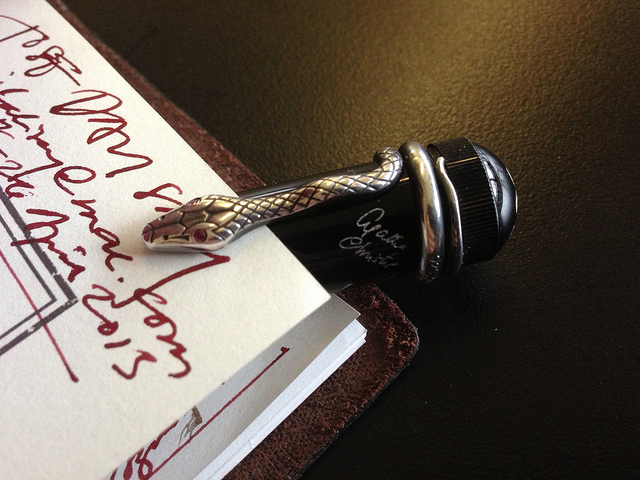
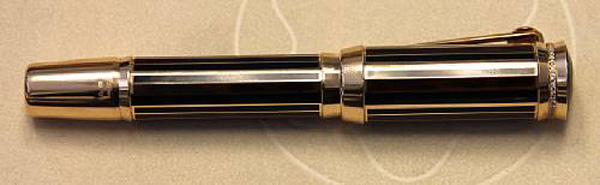
Agatha1SHE’S HERE—that obscure object of my ardent and longstanding desire, the Agatha Christie fountain pen from Montblanc. If you see me walking minus an arm and a leg, that’s what it cost me—but I’m deliriously happy. Here’s that red-eyed beast up close (yes, those eyes are real rubies):

AC