Penman No. 21: Literary Networking in Bangkok

Penman for Monday, November 19, 2012

BENG AND I had hardly stepped off the plane from weather-beaten New York when we were off again to sunny Bangkok, this time to attend a conference of writers and translators from all over Asia and the Pacific. I asked Beng to come along because we hadn’t visited Bangkok in a few years and had always enjoyed the place. Here, again, we were helped by the fact that our unica hija Demi works in the hotel industry, and she was able to find us a nice place in Sukhumvit—the Aloft, Bangkok’s iteration of a global chain of smart boutique hotels. More on the Aloft in a bit.

I was there to take part in “Reaching the World,” billed as Bangkok’s first international literary showcase, under the auspices of the Asia Pacific Writers and Translators Association (AP Writers for short) and the South East Asian Writers (SEAWrite) Award, hosted by the Faculty of Arts of Chulalongkorn University. I sat on the 2010-2012 board of AP Writers with fellow Filipino professor and STAR columnist Isagani Cruz, who served as its chairman.

A sizeable delegation represented the Philippine literary community in Bangkok, aside from Gani and myself: writer and scholar Cristina Pantoja-Hidalgo, who now divides her time between UP and UST; UP English department chair and Southeast Asian literature expert Lily Rose Tope; poet and UP professor Isabel Mooney; fictionist and UP Mindanao professor Jhoanna Cruz; poet and DLSU professor Dinah Roma; essayist and UP professor Jeena Rani Marquez; and UST literature professor Timothy Sanchez. Novelist Charlson Ong, this year’s SEAWrite awardee from the Philippines, joined the Bangkok conference in its last couple of days, coming from the Singapore Writers Festival which I had attended last year.

AP Writers emerged out of an earlier organization, the Asia-Pacific Writing Partnership founded by Jane Camens who had also helped establish the Hong Kong International Literary Festival. Jane, an Australian writer who has lived, studied and worked in the US, the UK, China, Macau, and Hong Kong, has been an indefatigable spirit bringing writers from all corners of the region together, and she will now serve as AP Writers’ general manager. The Sri Lankan-born but Hong Kong-based humorist and essayist Nury Vittachi will serve as AP Writers’ new chairman, backstopped by the Chinese-Indonesian-American fictionist Xu Xi, who runs the MFA low-residency program at the City University of Hong Kong, and by the translator Shirley Young-Eun Lee, who has roots in Korea but who read Classics and Persian at Oxford.

As you can see from just that small corner of the organization’s membership roster, AP Writers is both as regional and as global as you can get. This reflects an increasingly obvious fact in today’s literary world: international and inter-cultural exposure has become vital for writers, to expand both their perspectives and their networks. By “network” we mean here that web of connections that emanates from the writer and his or her work to the other people involved in the process of literary production and dissemination—agents, editors, translators, publishers, critics, booksellers, critics, reviewers, teachers, researchers, and, of course, students and general readers.

This year, in Bangkok, AP Writers paid special attention (and gave formal recognition, in its full name) to a vital but largely neglected member of that network, the translator. A literary work can’t be read beyond its original market unless it’s translated into another language, and that requires the skills of a very small group of specialists around the world. Literary translation isn’t just the kind of word-for-word interpretation you might get from a software program or even a live person—it involves the understanding and translation of one culture into another, the conveyance of nuances that, paradoxically, will never be perfect but will achieve interesting effects of its own. (I’m reminded of a quote attributed to Salman Rushdie, about the most interesting words of a language being the untranslatable ones.) In Bangkok, we were privileged to be in the company of some of the world’s best translators, including the Australian Henry Aveling, who has undertaken many translations from Indonesian and Malay.

We were also treated to a tour of the stately and historic Mandarin Oriental Hotel on the Chao Phraya River, probably the only hotel in the world where writers are revered. AP Writers held its business meeting there, after being regaled by Harold Stephens, an American expat and raconteur who’s written 30 books on travel and adventure and who also happens to be married to a Filipina, with stories of the old hotel from the days when the likes of Joseph Conrad (then still a ship captain), W. Somerset Maugham, Noel Coward, and Graham Greene stayed over. There’s a room and a lounge now maintained in their honor at the hotel—where, fittingly enough, Charlson would receive his SEAWrite Award later in the week from Thai royalty).

Readings and socials are an important part of any literary conference, and while some readings can be interminable (let’s face it: authors love to hear themselves), now and then you come across an entirely original voice. This time around that voice was that of Jang Jin-sung, one of Kim Jong-il’s favorite poets who defected when he could no longer take what was going in in North Korea.

The gut-wrenching hunger and desolation that Jang spoke of in his homeland contrasted, ironically, with the culinary and visual opulence of Thailand, which makes every visit there worthwhile. Beng was landing in the new Suvarnabhumi airport for the first time and was awed by the experience, even more so when the sleek commuter train took us from the airport to the city center for a mere 20 baht (about 30 pesos). We dropped our bags off at the Aloft—a jazzy, upbeat hotel with free wi-fi, a great buffet breakfast, and an iPod stereo player in every room—and dashed off in a cab to catch the weekend market at Chatuchak.

Thailand is a shopper’s and diner’s paradise but Beng and I contented ourselves with a bag for her and an iPhone case for me—and lots of fresh fruit, spicy chicken rice meals, and heavenly foot massages. It may not have seemed too auspicious when the printed menu in one streetside restaurant offered us “Steamed Crap,” but we survived the typo.

We came away much impressed by the Thais’ devotion to culture and literature, good reason for Bangkok to be named the World Book Capital for 2013 by Unesco (a distinction that, I bemoaned, Manila would probably earn by 2053). At the welcome dinner, Bangkok’s urbane and genial governor, M.R. Sukhumbhand Paribatra, ducked out of his busy schedule overseeing preparations for an upcoming world indoor football championship to break bread and share jokes with writers and translators. I’d like to believe we were well worth his and each other’s time.

Penman No. 20: Report from Lansing

Icophil

Penman for Monday, November 12, 2012


THANKS TO superstorm Sandy, which shut down nearly all public traffic on the US East Coast, my flight back to New York from Lansing, Mich. was canceled a couple of weeks ago, requiring me to stay for the last day of the International Conference on the Philippines (Icophil), where I had come to read a paper. I’d planned on leaving that Tuesday because our departure for Manila was set for Thursday, and I wanted the extra day to tie up loose ends and do some last-minute shopping with Beng, who was waiting at her sister’s in New York. But Sandy nixed all that, threatening even my flight home.

But Providence must have had other things in mind, because that last day at Icophil turned out to be a most productive one for me, in terms of making new contacts and friends and listening to provocative presentations.

Let me report, first of all, that Icophil 2012—the ninth of this once-in-four-year series—was a resounding success, with about 250 participants signing in, well over the 150 the organizers had been expecting. This means that there’s a lot of interest in the Philippines and in Philippine studies out there, not only from us Filipinos but also from foreign scholars specializing in Philippine concerns and affairs. (And if you’re wondering why, ask instead why not—given how we’re a fairly large country of more than 90 million people, living in one of Asia’s richest cultural crossroads and exporting our labor and talent to nearly every other country on the planet.) Indeed, about half or more than half of all the participants I met at Icophil weren’t based in the Philippines (from where, admittedly, going to international conferences can be quite expensive, especially without university or government support).

What were they interested in? As Icophil’s programme went, everything from archaeological digs, Pinoy boxing, and the Ati-atihan festival to the economy, indigenous peoples, peace building, and electoral reform. There’s never a dearth of subjects to be explored where the Philippines is concerned, and every door at Icophil was an invitation to a new dish at an intellectual smorgasbord. Everyone I spoke to agreed that they had a hard time choosing which session to attend, and I myself ended up walking into session rooms almost at random, imbibing whatever was on offer to get the full range of things.

I learned a lot by listening to Jay Gonzalez—who teaches political science while also serving as an assistant boxing coach at the University of San Francisco—talk about how he used boxing as an entry point to introducing his students to Filipino and Asian values and attitudes. Robert Balarbar of the National Museum explained the intricate process by which he and his team restored Botong Francisco’s “The Progress of Medicine in the Philippines,” a painting now hanging at the Philippine General Hospital. Robin Hemley of the University of Iowa undertook his own investigation of the controversy surrounding the alleged discovery of the Stone Age Tasaday tribe in Mindanao in 1971—a discovery soon denounced by critics as a hoax—and came to the tentative conclusion that the truth was probably somewhere in between the claims of both believers and naysayers. Sharon Delmendo, a professor at St. John Fisher College in New York who has written extensively about Philippine-American relations, shared the early fruits of her recent research on the “Manilaners”—Jewish refugees from Nazi persecution who found refuge in Manila under the auspices of President Manuel Quezon. Her findings were supported by film footage and interviews put together by independent Fil-Am filmmaker Sonny Izon. Speaking of film, award-winning director Nick Deocampo closed the conference with a screening of his brilliantly animated new documentary on American influences in Philippine cinema.

I’m becoming something of a recluse the older I get, but Icophil—and that extra day—reminded me of how valuable and important it was to keep in touch with fellow academics, particularly those engaged in significant and interesting research that very few other people can be expected to undertake. That’s the burden of scholars and scholarship: their concerns may seem obscure if not downright silly and useless to more practically oriented people, but their ultimate service is to help us better understand ourselves.

They don’t do our thinking for us so much as lay out possible ways of thinking about a problem or situation like migration, conservation, or resource management. I’m fairly sure that many scholars would make lousy executives (although this has been resoundingly disproved in some cases), but their insights into human and social behavior, not to mention their understanding of the physical and natural world, help politicians and businessmen make smarter decisions (unfortunately, not always more socially beneficial ones).

At Icophil, over the farewell dinner that I would have missed had I left on schedule the day before, I also had the pleasure of meeting Stephen Feldman and Mario Feir, who together run Asian Rare Books (www.asianrarebooks.net) from One McKinley Place in Global City. ARB had operated in New York City for over three decades before moving to the Philippines, where Stephen and Mario oversee an incredible, multi-thousand-volume collection of rare books. It’s accessible by appointment only, and I fully intend to avail myself of their kind invitation to visit them one of these days.

To digress a bit, I had one more reason to be rushing home to the Philippines, notwithstanding Sandy. As a shameless, diehard ‘60s liberal, I’m a big Obama fan, and wanted to see him re-elected. But I seem to have had a personal history with American presidential elections: I was in the United States on my first visit when Ronald Reagan won in 1980, and there again as a grad student when George Bush the Father won in 1988. In 2008, I was also in the US on a family visit, but left just a few days before the election, and Barack Obama won. Call it a voodoo jinx, but I knew I had to be out of there before November 6 if I wanted my guy to win. And that’s what happened—Beng and I managed to fly out of JFK on November 1, a day after the airport reopened. Barack, you owe me a big one.

Flotsam & Jetsam No. 15: One Night in Bangkok

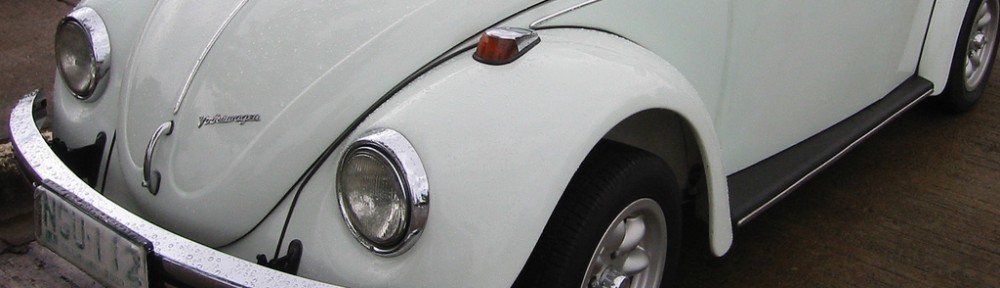
ALMOST AS soon as we got home from New York, Beng and I flew out to Bangkok where I  was speaking at a conference. We stayed in a boutique hotel in Sukhumvit, a lively district that becomes even livelier after dark. I ran into this outdoor “bar” complete with disco lights outside our hotel—a new life for an old VW Kombi. Cheers!

Penman No. 19: Autumn in New York

Penman for Monday, November 5, 2012

I FIRST visited New York 32 years ago, as a young man on his first trip abroad, and I can still remember the convulsive thrill that I felt as I peered out the window of my plane from Detroit and saw Manhattan’s spires rising toward me, to the accompaniment of a Gershwin tune.

At the same time, I looked at New York with not a little dread, both because of its sheer immensity and also its fearsome reputation for harboring mobsters and hucksters. While I marveled at the Christmas lights of Rockefeller Center, I also saw Times Square and Bryant Park at their worst, long before Rudy Guiliani came in with a broom, and 9/11 lent the city the kind of composure that comes with tragedy.

I’ve been back many times since—with my mother, daughter, and sister, and Beng’s sister living in the US, we try to visit every year—and over the years, I’ve slowly learned to trust if not to love this mother and mentor of modern cities, holding my wariness in check just long enough to let New York’s many and unexpected charms seep through and permeate my senses.

It’s a tired cliché by now, but while I go to my sister’s place outside of Washington, DC for rest and recuperation, I go to New York for the energy and the excitement, for the buskers in the subways playing everything from Vivaldi to That’s Amore, for Paul’s Burgers in St. Mark’s Place, for the two lions guarding the library (Patience downtown, Fortitude on the uptown side), for the $6/lb. Chinese takeouts, for the Art Deco flourishes nearly everywhere you look, for the Housing Works resale shops, for the discounted Broadway tickets, for the Sabrett’s hotdogs on the sidewalks, for the muscular subway, for the parks that sprout up amidst brownstone and cinderblock, for the warren of words that’s the Strand, and, of course, for the translucent glass stairway leading down to the reverse-heaven of the Apple Store.

New York can have the newest of the new—think of the iPhone 5 and the iPad mini—but oddly enough, what Beng and I enjoy most on our New York visits is seeking out old treasures (or what might be junk to most other people) in the thrift shops of 23rd Street and the flea markets of the Upper West Side and Hell’s Kitchen. Sometimes these treasures even come free, shamelessly dragged in off the street on my sister-in-law’s block in Forest Hills, like that miniature wooden Christmas sleigh that I salvaged last week off the top of a pile of detritus (the polite Roman word, I think, for garbage).

Inevitably, despite our absent intentions, every visit brings something new. Two years ago it was the magic of dusk in Coney Island, at the very end of the F subway line and, it seemed, of New York itself, so serene was that velvet hour with the amusement park’s fun machines in off-season repose. This year it was a day trip we took by train to a small village called Cold Spring, up the Hudson River, after learning that it hosted a cluster of antique shops and was a good place to catch the fall colors, besides.

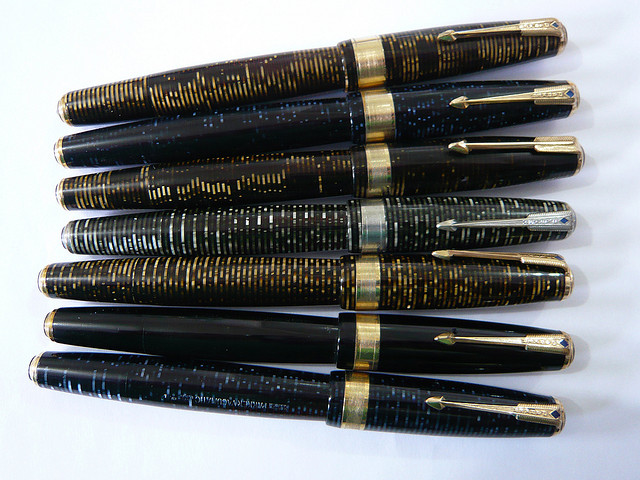
It did not disappoint on either count; autumn declared itself resplendently for most of the 90-minute ride along the ribbon of the Hudson, and exploded in brilliant yellows and reds on our arrival in Cold Spring. As Beng and Mimi scoured the shops for old buttons, bottles, and trinkets, I strayed into a shop with a small door that turned out to be a huge warehouse of vintage knickknacks—among them, a lovely black hard-rubber-and gold Conklin ladies’ pen from around 1920 and a marbled Parker Vacumatic desk pen from 1935. Having earlier picked up a Waterman silver-overlay pen and a contemporaneous brass inkwell from 1915 at the Greenflea Market on the Upper West Side, I pronounced this trip sufficiently penworthy, and contented myself for the rest of the day with photographing the Hudson’s color-washed banks.

Another novelty on this trip was my first walk into and across the heart of Central Park, which I had somehow never done in three decades of visiting New York. All that time I had contented myself with reconnoitering the fringes of the park, forewarned by a score of movies and CSI New York episodes about the demons and dangers lurking within. On the Saturday that we crossed the park on our way to Greenflea, we met nothing more dangerous than sprightly squirrels and latter-day hippies channeling John Lennon in Strawberry Fields, the corner of the park across the Dakota Apartments, where Lennon lived and was shot dead (a few days after I left New York on my first visit there in 1980). And how can you walk across Central Park without (again) George Gershwin, Simon and Garfunkel, Barbra Streisand, and Liza Minnelli performing in concert in your dreaming head?

We had earlier visited the 9/11 Memorial downtown, where the Twin Towers used to stand; last year it had been under construction—and still was, to some degree, as the museum within has yet to open. But the two large reflecting pools were already in operation, acting like four-sided waterfalls whose constant flow—broken only, when we looked, by an almost unbearably theatrical rainbow—seemed to represent a perpetual dousing of the fires that burned the towers down, a cleansing of the evil and the ill will that came before and after the event. I had also been there in 2001, a few months before 9/11, and had seen the towers—had even gone up to the top of one of them on an earlier visit—but had no personal connection to the place. Still, I paused when I caught a name—one of almost 3,000 names etched deeply into the bronze railings around the pools—that was unmistakably Filipino: “Ronald Gamboa,” who turned out to be a 33-year-old Fil-Am, a manager at The Gap who died as a passenger on UA 175, one of the hijacked planes.

In yet another unintended irony, I’m writing this paean to New York from Lansing, Michigan, where I’m attending a conference and from where I’m supposed to fly back to JFK tomorrow and then back home to Manila on Thursday—but can’t, because New York and much of the American East Coast has been shut down by super storm Sandy, and I’m effectively stranded. If I can’t get back to JFK by Wednesday, I’ll have to rebook my Manila-bound flight, and stay in New York a little longer. That’ll be mildly annoying—but I can’t wait to spend a bonus weekend in Manhattan, poring over heaps of junk at the flea market, in quest of that golden glint that could be the clip of a 1936 Parker Vacumatic Oversize, one that George Gershwin himself might have scripted a tune or two with.

Flotsam & Jetsam No. 14: iPhone 5 Adapter + iPad 1 Dock = :)

A BRAINWAVE hit me a few minutes ago as I was going all the Mac junk in my man-cave and I saw an iPad dock for the original iPad—remember these expensive and practically useless thingies that couldn’t hold up an iPad in its case? I’ve had this dock since i bought my iPad 1 and never even opened the box—I swear, it was that useless!

Well… I came home last night from the US with an iPhone 5 and a Lightning-to-30-pin adapter…. So what would happen if I plugged the adapter on to the iPad dock? Voila—a standing charger for the iPhone 5! There’s just enough stability and clearance to lift up the IP5 (it’ll work even with a thin case or skin—I tried it). So, suddenly, my useless iPad dock becomes a neat bedside accessory! (I should’ve kept more of these to sell right now, ha ha.)

It charges—and, yes, it syncs.


Penman No. 18: My Own QC Memorial

Penman for Monday, October 29, 2012

BECAUSE OF the timing of this current trip to the US, I failed to attend the awarding ceremonies two weeks ago for Quezon City’s Gawad Parangal, which I was honored to receive this year among other sons and daughters of the city. So by way of publicly thanking the people who gave me that distinction, let me offer up my own memorial to that city which I now call home.

“Now,” I just realized, goes back almost 45 years, except for a couple of stretches we spent in Pasig and San Mateo. The Dalisays—my parents and their five kids—might as well have been gypsies in our childhood, moving around Manila at least a dozen times while we were growing up, everywhere from Pasay and Singalong to Boni Avenue and Pasig (not just one but three barrios in Pasig—Malinao, Bambang, and San Nicolas). Childhood and adolescence were to me a series of moving trucks carting increasingly smaller loads of furniture, appliances, and sundry effects from one apartment or rented space to another.

But it’s Quezon City that’s accounted for most of my life, since the early ‘60s when we found ourselves on Liberty Avenue—peppered by grainy-sweet aratiles—before our Pasig interlude. When I qualified for the Philippine Science High School in 1966, we moved back to Quezon City, to another apartment on Mahiyain Street in Teachers Village, where we ran a small and luckless poultry business in the backyard; I learned to smoke here, and I remember looking up at the tracered sky one New Year’s Eve and sighing, “It’s 1970!”

We were paying P160 a month for that apartment, but even that proved too much, and we had to move again, to what amounted to a lean-to that my father built on the side of a house on Tandang Sora; here we kept a pig in the bathroom and performed our ablutions under his watchful eye. I walked from this happy hovel to my classes in UP; the happiness ended, at least for me, when I was arrested in this same place under martial law in January 1973.

Within a year I was out of prison and married; my young bride Beng and I moved briefly to an apartment on Bignay Street in Kamuning, and then to Project 6, before settling in with Beng’s folks in Barangay Marilag in Project 4. In 1978, my parents decided to amortize a small house and lot in Modesta Village in San Mateo, so, being the good son, I took the house next to theirs, and paid that off over 15 years, even when we lived elsewhere. In those carless days, commuting to work meant leaving very early and coming home past dinnertime, so we eventually moved back to Project 4, and then to Sorsogon Street in West Triangle, Masikap Street in Barangay Central, and finally (for now) to Juan Luna in Barangay UP Campus.

It’s been a hectic but exciting journey, in the course of which I grew up, and more; I first met my wife-to-be in Quezon City; I lost my innocence (and more) in Quezon City; I received my college degree in Quezon City; my daughter went to school, had her debut, and got her first job in Quezon City; my father died in Quezon City; I’ve written most of my books in Quezon City.

I’ve often asked myself why—given how wide Metro Manila has grown and how many choices of places to live we middle-class working stiffs have—I’ve kept coming back to QC the couple of times I’ve strayed from it. It’s hardly the prettiest place on earth—although it has green fringes, like Diliman, especially where it overlooks Marikina Valley, that make you forget or want to forget its drearier swaths.

But the wonder of Quezon City is precisely its variety and mutability. A pious president lived on sedate Times Street, not too far from Timog Avenue in its raucous heyday. (And the younger me remembers, with an unrepentant grin, that Manila, Makati, and Pasay had nothing on QC in the nightlife department, back in the day.) Some neighborhoods might verge on the hoity-toity, but few approach the opulence and pretentiousness of the new upper class in Manila’s newer suburbs.

Indeed, if anything, Quezon City is staunchly middle class, my comfort zone, one that stretches from Farmer’s and Ali Mall in Cubao to SM North and Trinoma and the restaurants of Matalino Street and its pedestrian-friendly environs. A perfect Sunday for Beng and me might begin with a morning walk around the UP Academic Oval, a light lunch at Via Mare, then a P250 foot massage at Ton-Ton on V. Luna in mid-afternoon, a half-hour’s browsing through the “new” arrivals at the ukay-ukay next door, an early dinner of chicken mami and siopao in our favorite noodle place in Trinoma, capped by a movie around 7 pm.

The older we get, the less inclined Beng and I are to roam too far from our nest on the UP campus (unless it’s to some exotic destination reachable by budget fare), knowing that, in our corner of QC, everything we need is a 15-to 30-minute drive away: groceries at Rustan’s or Shoppersville, medical check-ups at your choice (or maybe not) of the Lung, Heart, or Kidney Center, certificates of all sorts at the NSO and licenses of all manner at City Hall. And, of course, there’s my workplace-cum-backyard, the University of the Philippines, where I’ll likely stay until they kick me out when I reach mandatory retirement not too long from now.

How I got there is another serendipitous QC story in itself. I’d been working, albeit as a college dropout, at the Manila and then the Makati offices of the National Economic and Development Authority in the late ‘70s when our boss, Gerry Sicat, decided to move our unit to the NEDA office on EDSA, near GMA-7. Being that close to UP, I thought I’d re-enroll and take some units when I could, and I did—and left NEDA to teach in UP.

It was probably just fitting that the person who informed me of my Gawad Parangal was another friend from NEDA days, former Budget Minister Manny Alba, who’s worked for Quezon City for many years now as City Administrator and Senior Adviser to the Mayor. After telling me the happy news, Dr. Alba shared his own reminiscences of UP:

“I note you live on Juan Luna St., UP Campus. So, did I, from 1961 (when the area was still cogonal), until 1983. I was Minister of the Budget for two years then but I left (though I did not want to), because I was feeling guilty paying just about P300 a month and displacing other deserving faculty members.

“I was on leave. In fact, I was on leave for most of the time I was working with the government and it was easy for me to go back to UP after martial law. I was on a status called ‘faculty on government service’ or FOGS (I was one of several original ‘foggies,’ which included Gerry Sicat, Cesar Virata, Jimmy Laya, Tony Aguenza, and OD Corpuz. OD himself concocted the idea of the FOGS, when he was UP President.”

And in my own odd way, that’s what and where I am now—an aging fogey killing time on the fruit farm most people call the University of the Philippines, Diliman, Quezon City.

Penman No. 17: Another October, Another Michigan

Penman for Monday, October 22, 2012

LIKE I mentioned last week, I’m in the US to visit family and to participate at the International Conference on the Philippines (Icophil), which is taking place Oct. 28-30 at Michigan State University in East Lansing, Michigan.

Dealing with all aspects of Philippine Studies, Icophil happens every four years, and it’s been held around the world—mainly in the US and the Philippines, but also in Australia and the Netherlands; the upcoming conference in Michigan will be the ninth. Icophil’s international reach reflects not only the global Filipino diaspora, but also the growing interest and engagement of non-Filipino scholars in Philippine affairs. While most participants still come from the Philippines, a significant number of speakers and panelists come from foreign universities.

Icophil also provides scholars an opportunity to assess the state of Philippine Studies around the world, in a roundtable organized by Prof. Belinda Aquino of the University of Hawaii at Manoa, who is Icophil’s founding chair. Convenors for this year’s conference are the eminent scholars Dr. Roger Bresnahan of MSU and Dr. Bernardita Churchill of UP.

Aside from us Filipinos, this meeting will bring together Filipinists from the US, Japan, Singapore, Thailand, Australia, France, Russia, Spain, and the Netherlands. By institutional affiliation, the confirmed Filipino participants will include Jose Buenconsejo, Marilyn Canta, and myself (UP Diliman)); Filomeno Aguilar, Jr., Czarina Saloma-Akpedonu, and Lisandro Claudio (Ateneo de Manila); Paul Dumol and Clement Camposano (University of Asia and the Pacific); Raymundo Rovillos (UP Baguio); Teresita Ang See (KAISA); Nick Deocampo (Center for New Cinema);  Genevieve L. Asenjo (DLSU); Hope Sabanpan-Yu (University of San Carlos), Kristian Cordero (Ateneo de Naga); and Prisciliano Bauzon (University of Southern Mindanao).

Icophil 2012’s keynote speaker will be an international expert on climate change, Dr. Rodel Lasco, Senior Scientist and Philippine Program Coordinator of the World Agro-Forestry Centre (ICRAF) and Affiliate Professor, UPLB School of Environmental Science and Management. A recipient of the Outstanding Young Scientist Award in 1997, Dr. Lasco has been a member of the Intergovernmental Panel on Climate Change since 1999. In 2009, he was elected to the National Academy of Science and Technology of the Philippines.

Trailers for two new and interesting documentaries will be shown: one by MSU Prof. Geri Alumit-Zeldes on the two Filipino nurses who were wrongly convicted for murdering their patients in Ann Arbor, Mich. in the mid-1970s, and another, by filmmaker Sonny Izon, about the “Manilaners”—Jewish refugees from the Nazi Holocaust who found refuge in Manila through the intercession of President Manuel Quezon. Filmmaker Nick Deocampo will also be showing a documentary on American influences on Philippine cinema.

The panel discussions cover a predictably broad range of topics, from indigenous peoples, the Pinoy diaspora, and peace-building to economic relations, modernization, and popular culture (one of my early favorites on the program: “Automats, Supper Clubs, Drive-ins, and Quarantined Carinderias: The Contradictions of Restaurant Culture in Post-War Manila” by Peter Keppy of the Netherlands Institute for War Documentation).

I expect to be ruffling a few academic feathers with my chosen topic, which just happens to be one of my recent areas of expertise: “The Commissioned Biography: Confessions of a Hired Gun.” I’ll be speaking less as an academic than a professional writer, and I’ll try to keep it light, but I’ll be dealing with some serious ethical and academic questions raised by the practice of biographical writing from a sympathetic point of view, as opposed to the independent and critical stance expected of the unpaid scholar. Aside from payment for the writer and PR for the subject, can there be anything to be gained from the commissioned biographies that have appeared in recent years on Philippine shelves? Can they be of any service to the academic historian, political scientist, and litterateur? My provisional answer is yes, but I’m going to have to prove my case.

I tacked on the official part of this trip to my annual vacation so it’s not costing UP anything, but I have another personal reason for going to Icophil. I’m a proud graduate of Michigan State’s archrival, the University of Michigan (MFA ’88), but it was MSU (the “other” Michigan) and East Lansing that hosted me for more than two months on my first visit to the US (and my first trip abroad) in 1980. I’d never been away from my home and family for so long, and it was here that my 30-year-plus relationship with America took off. I would even write about that first autumn—about a foray into the yellow forest in my backyard called Sanford Woods—in my first novel, Killing Time in a Warm Place (1992):

“Sandbar, Sandfar, Sanford. Sanford Woods. In the shock of autumn, the first of my life, I took a walk in Sanford Woods with Estoy. Estoy himself had arrived in the United States just the previous year to take a Ph.D. in Development Economics on a fellowship, and I took the train up to Michigan the first chance I got to leave the conference in New York. I had never stepped into a forest of red and gold before, and for the first few minutes I trod carefully on the layered ground, as though disturbing it would hurtle me back in a swirl of pretty leaves to prison camp. We let ourselves be taken in and covered by that new season: we watched the squirrels shimmy up the trunks, and, coming into a patch of pure, delirious yellow, I persuaded Estoy to pose for a snapshot he could send home to his wife Marie. He stood stiffly against the color, hands in his jacket pockets, and he muttered an oath about the cold, but his grin was true. On the way back we observed how fat the squirrels were. In Manila, Estoy said, they’d be roasting on a spit, if they ever got that big. I said that there probably was a law preventing people from doing that in this country.”

That fellow “Estoy” was based on a real character, a friend who passed away a few years ago, whose life was marked by both blinding brilliance and consuming darkness. I barely told his story in the novel, and it will be a moving experience for me to retrace our steps into those woods, in another October more than three decades after.

More comic is the memory of my first kitchen disasters in that new country: of how I walked miles to the nearest Asian food store, craving food from home, and then eagerly frying a panful of dilis in my dorm room, only to have people hammering on my door, asking where that awful smell was coming from; and of stashing bottles of Coke in the freezer and forgetting about them, to be greeted by a ragged waterfall of black ice upon opening the fridge.

I’ll have a thing or two to say in East Lansing, but I’m really looking forward to more private conversations with the squirrels and sugar maples of Sanford Woods.


Flotsam & Jetsam No. 11: Pen & Inkwell

ALMOST AS soon as we landed in New York, Beng and I ran off to one of our old haunts, the Sunday flea market on the Upper West Side. These were my two neat finds: a Waterman 412 1/2 PSF fountain pen in silver filigree from 1915 (still a bargain at $150), and a brass inkwell, in dire need of restoration but a pretty piece (at a pretty price–$10!).