Penman No. 473: New Light on (and from) the Philippine Short Story

Penman for Sunday, April 6, 2025
FEW MAY have noticed, but this year, 2025, marks the centenary of what has been widely acknowledged to be our first classic short story in English, Paz Marquez Benitez’s deathless “Dead Stars.”

As I’ve often observed as both a writer and teacher of Philippine literature, there’s probably no literary form more popular among Filipinos than the short story and its predecessors—myths, legends, folktales, and such stories that draw on the power of narrative to tell and teach us something about human life. 

A lot of this has to do with the fact that people and cultures everywhere have made use of stories to make sense of things—to establish causality in human actions—often as a way of prescribing and also proscribing certain behaviors. Stories were there to learn from, like the biblical parables, Aesop’s fables, and the creation myths. The more exciting and entertaining the stories were, the easier the learning happened. Even the mere recognition of oneself in a story that could have taken place a thousand years ago in a place across the planet makes our lives seem more meaningful.

In the Philippines—as it did in the West, where the modern short story took form—the short story was a staple of prewar weekly magazines like the Sunday Tribune, where a story written by an American author would be matched by a local story during what our early literary scholars like Leopoldo Yabes would call our period of apprenticeship. This was in English, but the short story in Filipino (then Tagalog) and other Philippine languages had developed even earlier, and continued (as it continues) to explore new forms and material.

Why the short story and not the novel? That’s another long discussion to be had, and I’ve addressed it in a lecture titled “Novelists in Progress,” but the short of it is that, well, we Pinoys like things in small doses (think Nick Joaquin’s “heritage of smallness”), and the short story satisfies our craving for a touch of fiction and fantasy in our ordinary lives. We’re not marathoners, but great sprinters; we’re not summiteers or navel-gazers, but masters of the street and alley. 

And so, over the past century, important anthologies of the Philippine short story have been published, tracking the development of the genre and its practitioners, from Yabes’ landmark Philippine Short Stories 1925-1940 (a project continued by Gemino Abad for 1956-2008) to Isagani Cruz’s Best Philippine Short Stories of the Twentieth Century (2000). Outside of English, Mga Agos sa Disyerto edited by Efren Abueg came out in 1964, proclaiming new directions for Tagalog short fiction, and the much-needed Ulirat: Best Contemporary Stories in Translation from the Philippines was published in 2021, edited by Kristine Ong Muslim.

But the 21st century is now a quarter of the way through, and just in these past two decades or so, a fresh bumper crop of brilliant new stories has built up, awaiting harvest.

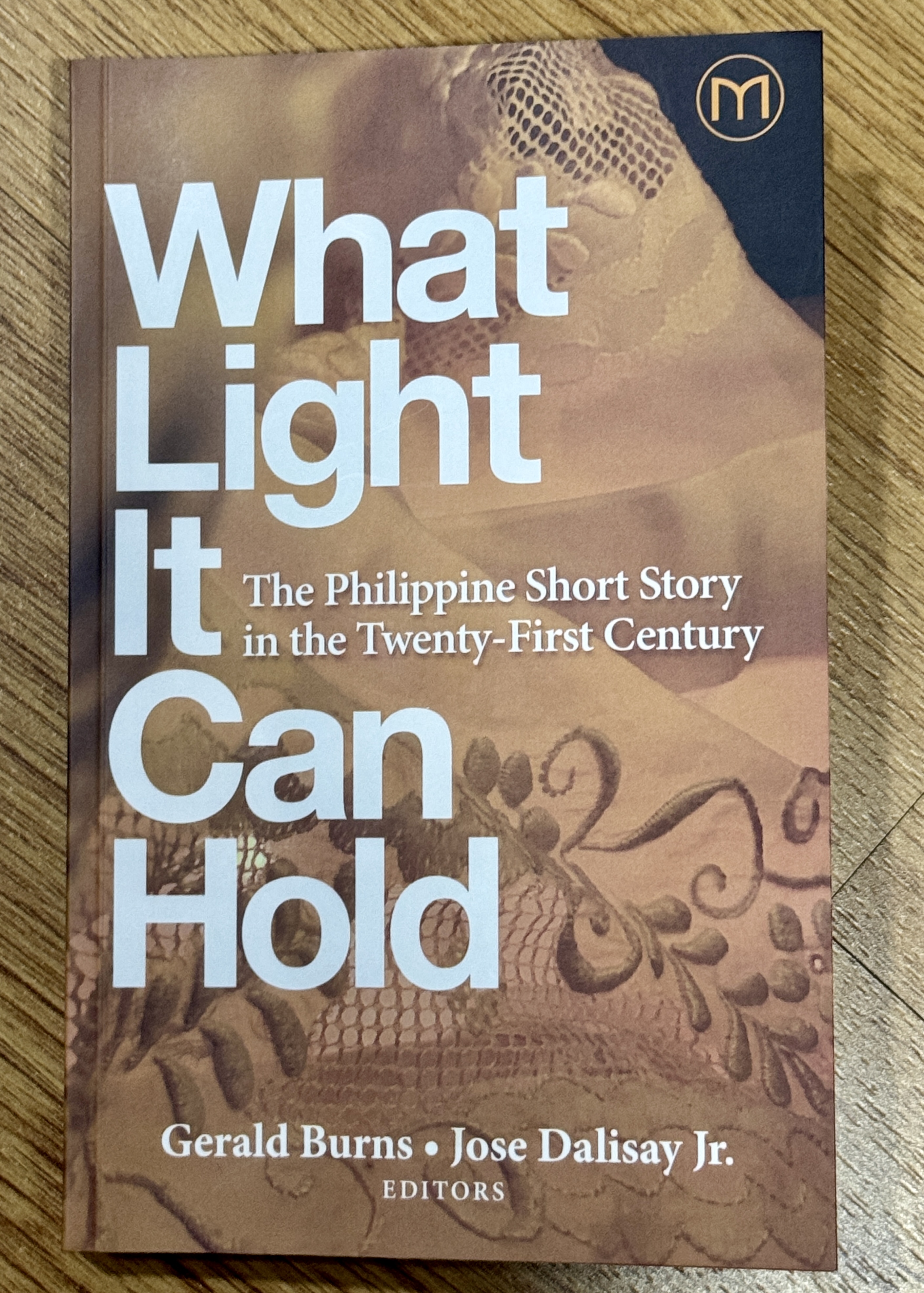
Five years ago, an American friend named Gerald “Jerry” Burns—a fellow academic and a scholar of Philippine literature in English, now Emeritus Professor at Franklin Pierce University in New Hampshire—decided to do just that: review the best of the newest Philippine short stories and produce a selection with which to introduce them to the world. He needed a collaborator, and having worked with Jerry earlier when he was a Fulbright professor at our English department in UP, I agreed to co-edit the volume with him. Because of our backgrounds, our stories would be mainly those written in English (and the excellent Ulirat had already covered much more ground in the other Philippine languages than we ever could) but Jerry wisely insisted that we should have at least some representation of non-English stories in translation in the book, if only to lead the reader to explore more in Ulirat.

The selection process was predictably long and bruising, with all the political, aesthetic, and practical considerations that go into anthologizing, but in the end we came up with 18 stories written by both familiar and fresh names, from within and beyond the Philippines, including the diaspora: Dennis Andrew Aguinaldo, Dean Francis Alfar, Mia Alvar, John Bengan, Ian Rosales Casocot, Richard Giye, Vicente Groyon, Ino Habana, Carljoe Javier, Monica Macansantos, Perry Mangilaya, Doms Pagliawan, Ma. Elena Paulma, John Pucay, Anna Sanchez, Larissa Mae R. Suarez, Lysley A. Tenorio, and Socorro Villanueva. We also found an agreeable and supportive publisher, Milflores Publishing, fortuitously run by Andrea Pasion-Flores, herself a fine fictionist who understood the need for a new anthology like this, especially on the threshold of the Philippines’ participation as Guest of Honor in this year’s Frankfurt Buchmesse.

The book’s title, What Light It Can Hold: The Philippine Short Story in the Twenty-First Century, was suggested to Jerry by an encounter with the piña weavers of Kalibo, Aklan, and a caption he saw that said: “How fragile a single thread of piña is, how delicate, but look how much light it can hold.” He explains that “What Light… is intended to recognize the limited capacity of the Philippine short story in this period to offer any widespread or definitive illumination of the nation’s life and culture. At the same time, a more expansive understanding of that title is possible. For the short story, as will be suggested in the next pages, is a signature Philippine product, too. And these slender narratives, fashioned by their makers with a skill, patience, and devotion comparable to the piña weavers’, bring what light they can hold to vital areas of contemporary Philippine and larger human experience.”

No anthology project will be without its perceived failures and omissions, and Dr. Burns and I remain fully open to criticism in that respect. But we believe the sympathetic reader still stands to profit from both the selections and the introduction, penned largely by Jerry, that makes salient observations on the changes that have taken place in this most favored literary form of ours over the past century. Happy reading! (What Light It Can Hold is available on Lazada and Shopee.)
Penman No. 460: The Fil-Canadians Speak

Penman for Sunday, March 10, 2024

WE’VE BECOME quite familiar by now with the writings of our Filipino-American brethren across the Pacific, thanks to the success of such breakthrough works as Jessica Hagedorn’s Dogeaters, Ninotchka Rosca’s State of War, R. Zamora Linmark’s Rolling the R’s, Marivi Soliven’s Mango Bride, and Gina Apostol’s Insurrecto, and to the bridging efforts of such literary stalwarts as Luis Francia, Alfred Yuson, and Cecilia Manguerra Brainard. Of course, they had many antecedents, going back to at least Carlos Bulosan, followed by Jose Garcia Villa, Bienvenido Santos, NVM Gonzalez, and Alberto Florentino, among many other expatriates. 

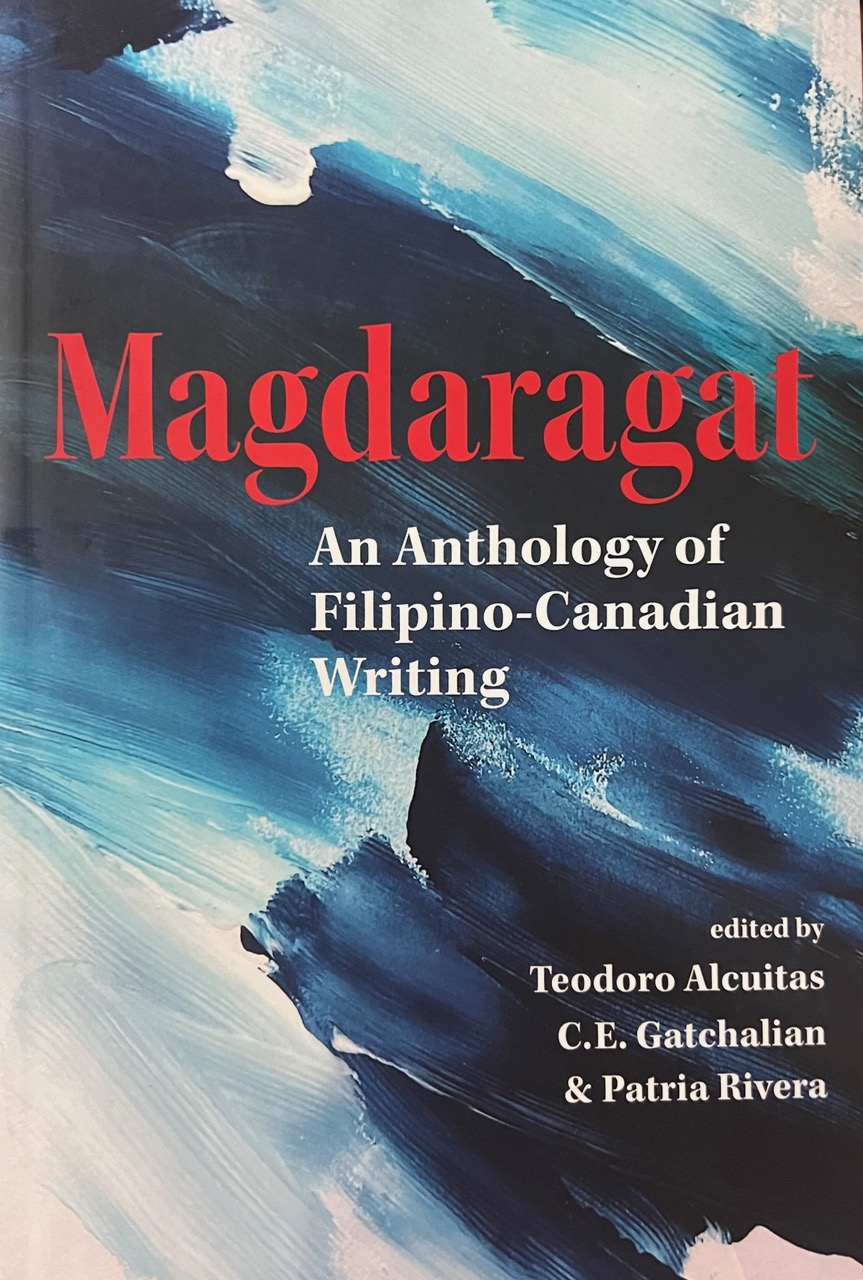
But hardly a whisper has been heard from our Filipino-Canadian cousins, as if their experience—whatever it’s been—were simply an extension or an echo of their southern compatriots, with no distinguishing qualities. There’s a reason for that, which we’ll get into shortly, but first let me announce, with both joy and relief, that the long silence is over. Filipino-Canadian literature is introducing itself to the world—and to us in particular—with the publication of the landmark Magdaragat: An Anthology of Filipino-Canadian Writing (Toronto: Cormorant, 2023), edited by Teodoro Alcuitas, C. E. Gatchalian, and Patria Rivera.

I was first alerted to this hefty 390-page volume by one of the editors, Patty Rivera, an old friend from way back who developed into a fine, prizewinning poet when she, her husband Joe, and their family migrated to Canada decades ago. Arriving in Canada in late July 1987, Patty recalls that moment pregnant with both hope and not a little dread that every FOB immigrant seems fated to step into: 

“The air steamed with purpose when summer meant another life to live. From every corner, a mirror to reflect on. Outside our window, the children’s park, though trees, appeared bruised from the dark slits on the windowpanes. Thorny Vineway. Did our new street name augur of tomorrows yet to come? Would our life in this new country lead to a path laid with thorns? We were young at the time, and everything looked promising. We were alive in this new country and were no longer afraid, the years in the future distant and to be savored. We were ready to be every person we chose or wanted to be.”

Today there are nearly one million Filipinos in Canada, which itself is inching close to 40 million. Some years ago, Filipinos edged out the Chinese as the largest group of immigrants in Canada. Many are highly educated, and many work in health care, leading perhaps to a kind of stereotyping of the Fil-Can as caregiver. To be fair, that’s probably how we home-based Pinoys ourselves imagine our Canuck brethren to be, followed inevitably by “Now why did they go to Canada and not America?”

Magdaragat’s editors try to answer that: “It’s the American Dream, after all, that Filipinos chase; Canada is the consolation prize if America, for whatever reason, doesn’t pan out. While, according to historical records, the first Filipinos arrived in what would eventually become the United States in 1587, Filipinos didn’t arrive on Canadian shores (Bowen Island, BC, to be exact) until close to three centuries later, in 1861. In addition, Canada’s population is a tenth of the United States’. Filipino-Canadian history is, thus, of a smaller scope than Filipino-American history. But within that scope are issues unique to Filipinos in Canada that makes Fil-Can history a distinct subject in its own right, not merely an ancillary of Fil-Am history.”

There are, we discover, subtle but important nuances to the Filipino-Canadian experience:

“Another, more insidious, survival issue Filipinos in Canada have to navigate: the passive-aggressive racism of white Canadians. The brazenness of white American racism is well documented (and spotlighted and hyper scrutinized because of the United States’ status as an imperial power); in contrast, white Canadian racism often slips under the radar because it is more typically characterized by microaggressions. The favorite Canadian refrain vis-à-vis racism—‘We’re not as bad as Americans’—constitutes what might be called “maple-washing”: the relentless washing over of all instances of Canadian racism with the claim that it’s still not as horrible as what has transpired in the United States. Accordingly, the racism Filipinos in Canada experience—and which makes its way into some of the pieces in this anthology—is more insidious than its American counterpart and is characterized by shocking ruptures in a strenuously maintained politesse.”

But what about the literature of that experience? Magdaragat provides ample and eloquent proof of the Filipino-Canadian’s desire to reconnect with the homeland while charting their own course in the new country, as this passage from Deann Louise Nardo’s “Where Do You Come From” illustrates:

“I come from dirt and sand, the scribbled writing of an ancestor in a trance, the sound of droplets on skylights, unopened buds on trees, and the sleep dust in my mama’s eyes. I come from cacao beans and the callouses on fishermen’s hands, the arthritic crackle of my grandmother’s hands as she tends to the garden and mends nets. I come from the silver iridescence of stretch marks, the swirl pattern inside tree barks, the razor-thin whiskers of cats, and eerie creaking of Maplewood floors. I come from lengthwise half-cut bamboo wall sheathing, river mud and buried shards of broken glass, of broken tsinelas and confused roosters singing tik-ti-la-ok at three in the morning.”

There’s a long story by Nathalie de los Santos that alone may be worth the price of the book for its sweeping, multigenerational narrative of the immigrant experience from Bohol to New Brunswick, and from Filipino to Filipinx. The young Kay laments that “Even my relatives can be like this, they remind me how I’m not Filipino enough when I don’t know something about our culture. But then some people here believe I’m not Canadian just by looking at me. When I’m asked, ‘Where you from?’ it implies that. Who am I then?… But, maybe all of this is coming from the same place of hurt?” 

The Fil-Cans have spoken, and theirs are voices worth listening to.