Qwertyman No. 153: Our Literary Fathers

Qwertyman for Monday, July 7, 2025
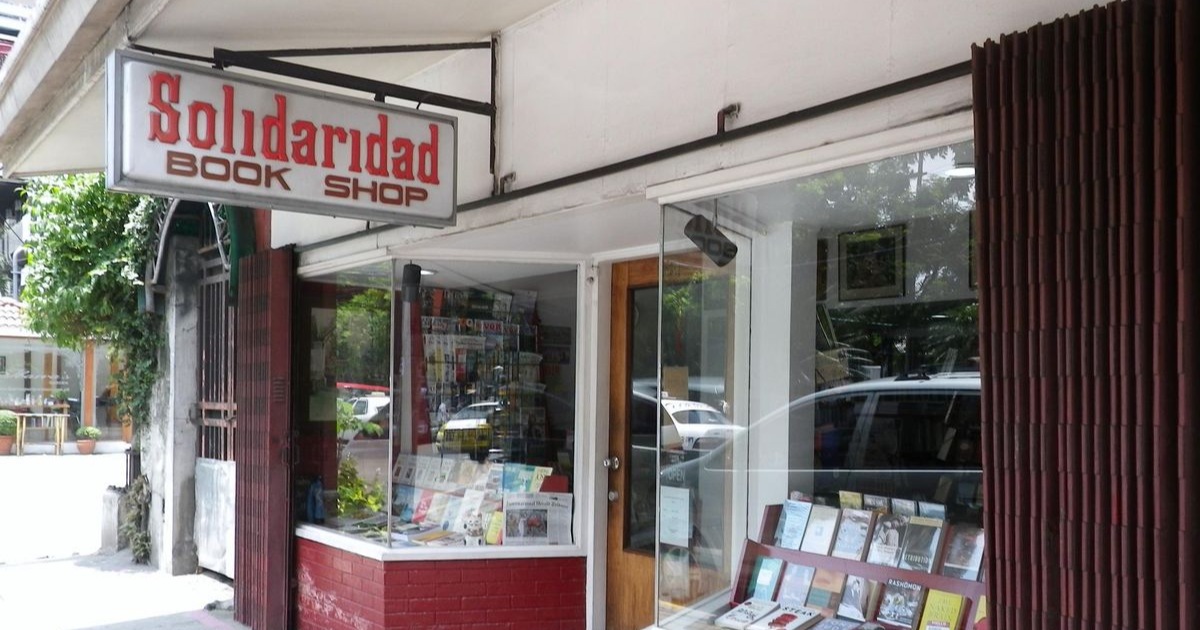
THE RECENT announcement of the impending sale of the Solidaridad bookshop in Ermita owned and run by the family of the late National Artist F. Sionil Jose understandably triggered a wave of nostalgia for the place, the old man, his dear wife Tessie, and for a bygone era when people strolled into book stores over their lunch break or after work to browse and pick up an Updike, a Le Guin, or a Garcia Marquez—and, of course, a Sionil Jose, and get it signed by the man himself if he was luckily around. Five decades ago, as a writer for the National Economic and Development Authority just a couple of blocks away on the same street, that browser would have been me, for whom Solidaridad and the equally legendary Erehwon nearby were a godsend, an unlisted perk. 

Indeed Solidaridad and FSJ (or Manong Frankie, as we his juniors called him) were inseparably conjoined in the public’s imagination of a man who was not only our most productive and best-known novelist but also an indefatigable purveyor of great literature and critical if occasionally controversial thinking, through his journal Solidarity and his long-running column “Hindsight,” this very space I was honored to have inherited.

Like many others—even those with whom he had quarreled fiercely—I was deeply saddened when Manong Frankie passed away three years ago. It was particularly bittersweet for me because we had become quite close in his last years, after having been somewhat estranged for the longest time. 

He had taken me under his wing on a writers’ conference in Bali in 1983, in a group of young, aspiring writers finding their way in a broadening literary world. But shortly after, in an interview with National Public Radio in America where I had gone to study, I offered my rather injudicious opinion of his prose—not mine alone—which he must have gotten wind of and found disparaging, because he gave me the cold shoulder afterwards. Like other younger writers, I would bristle at his hectoring moods—which I would better understand as I myself got older—during which he lamented the seeming alienation of the Filipino writer from his or her own social and political reality. 

It was a concern we happened to share, and he began to know and appreciate me as someone who eschewed academic snobbery as much as he did, having transitioned to fiction from a background in journalism rather than the writers’ workshop system that he was deeply dubious of. In other words, we had more in common than each of us thought, and our work in the Akademyang Filipino brought us closer together. At one time I gifted him with the very first issue of Solidarity—Vol. I, No. 1—which I had found, and which he had not seen for ages; he was happy. After my speech at the Palancas in 2017, he came up to shake my hand.

Ironically, this happened at a time when FSJ, ever strongly opinionated, turned off many of his readers with his pro-Duterte sentiments, his putdowns of Nobel prizewinner Maria Ressa and others he thought undeserving of their fame, and his acerbic loathing of certain families he considered oligarchs despite their long having been supplanted by new and far more ravenous overlords. I did not share these views, and he knew that, but I think we had quietly decided that our friendship was more important than our politics. Shortly before he died, he sent me a brief letter that will be a cherished secret to keep until I myself pass on.
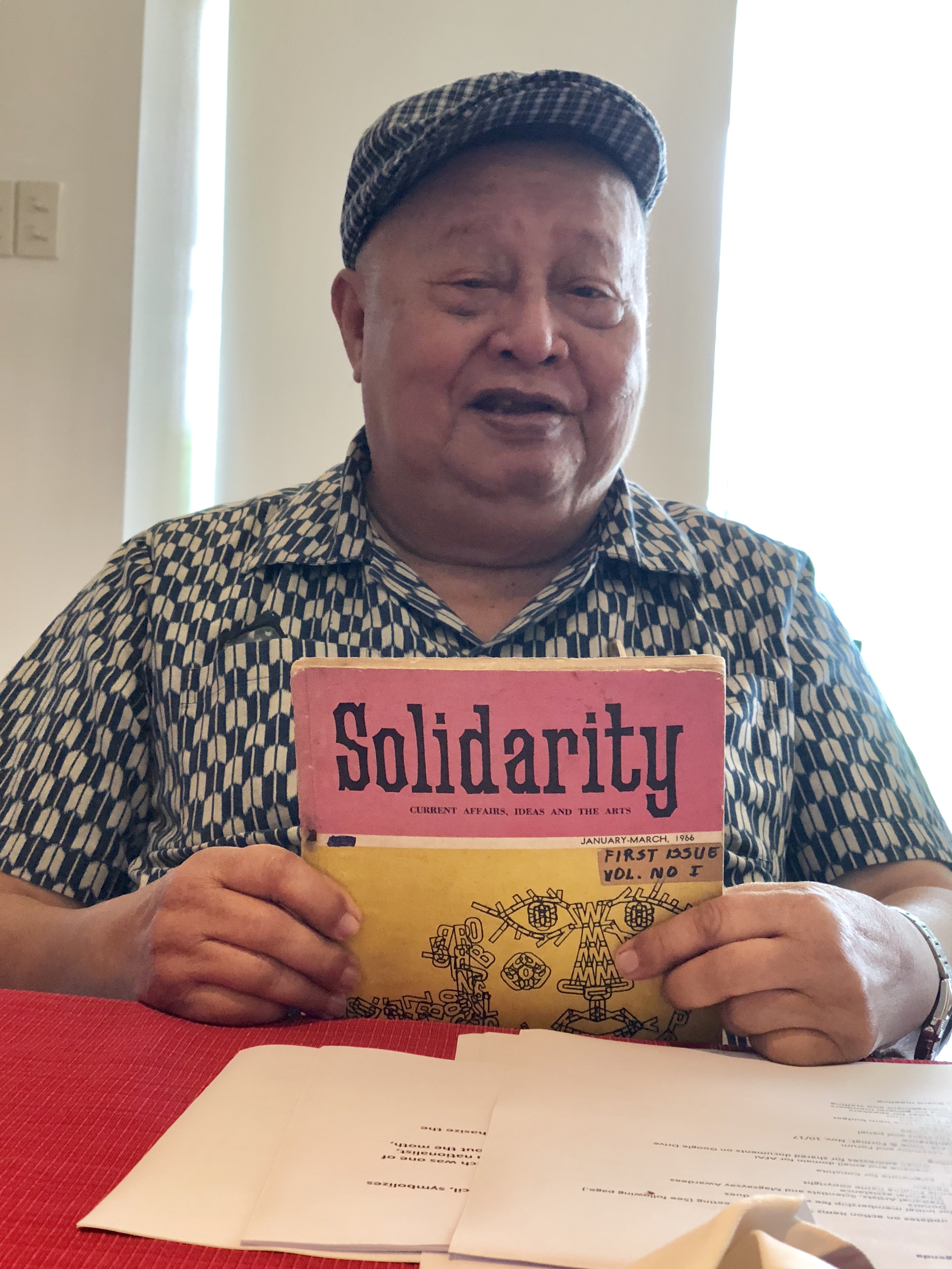
I didn’t learn writing from Manong Frankie; rather, I observed and admired his persistence and perseverance, literally writing to the last on what turned out to be his deathbed. I enjoyed his stories more than his novels, but in the end my own preferences don’t matter. He left a sprawling, robust, and indelible body of work that for many readers here and overseas will define Philippine literature in English for the latter 20th century. He led what our mutual friend the novelist Charlson Ong called “a well-managed life,” building a legacy partly through Solidaridad, Solidarity, and Philippine PEN which he led for a long time, apart of course from his work, and making sure he was heard when he spoke. 

His passing reminded me of the other members of his generation—his seniors and juniors by a decade or so—whom my generation in turn looked up to and at the same time, in that perpetual cycle of revolt and renewal, sought to depose. Nick Joaquin we adored as much for his prose as for his prodigious drinking (and seriously, for putting as much of his heart and craft into his journalism as into his fiction). NVM Gonzalez, who happened to have been born in Romblon (and not in Mindoro as many think) several kilometers away and forty years ahead of me, had that common touch many citified writers lost. Edilberto Tiempo I owe for urging me to return to school and devote my life to studying and writing rather than to bureaucratic servitude. 

Bienvenido Santos, twinkly-eyed and gently smiling, was my favorite of them all in terms of the quietude but also the emotional resonance of his stories, so graceful and yet so powerful. If I were to think of a literary father, it would have been Franz Arcellana, whose work may have been so vastly different from mine and yet, as my mentor in school, was the one I sought to please, slipping my story drafts under his office door and praying for his approval. Gregorio Brillantes, the youngest of them and perhaps more properly belonging to the next generation along with Gemino Abad, has been my writing hero for his superlative technique and unfailing sense of character. All these men (and women as well, for whom a separate story should be told) have taught me and my peers much, not just about the craft of writing but just as importantly the writing life, this vocation of books and words we have ddevote ourselves to for the bliss and yet also often the anguish of finding meaning in life through language.

Manong Frankie has passed on and soon so will his fabled bookshop, but his words, as well as ours, now have a life of their own.
Penman No. 419: Pages from the Past

Penman for Monday, July 19, 2021

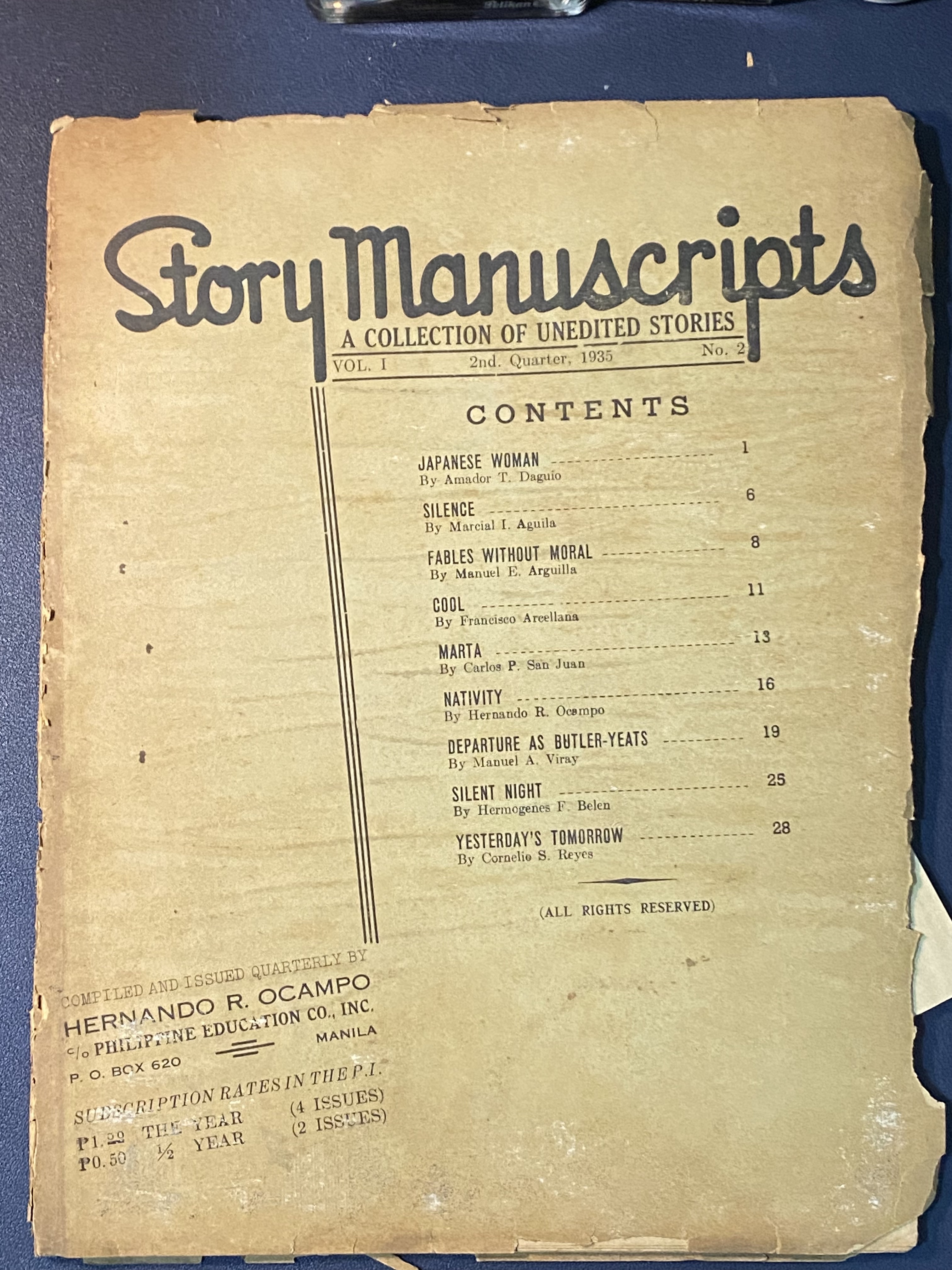
LAST MONTH, two precious documents came my way. The first was a magazine with a unique idea behind it. It was a copy of Story Manuscripts, “a collection of unedited stories,” Vol. 1, No. 2, from February 1935. No more than mimeographed copies of the authors’ typewritten manuscripts between two hard covers, this issue brought together stories from Amador Daguio, Manuel Arguilla, Francisco Arcellana, Manuel Viray, and H. R. Ocampo, among others. 

Ocampo’s presence was especially interesting. I knew that National Artist Hernando Ruiz Ocampo (1911-1978) was a short story writer before he turned to painting, but he was this magazine’s publisher as well. What was exciting for me (as a writer and literary editor, especially of Arguilla) is that I’d never come across these stories before under these titles, so they’re very likely undiscovered stories or early drafts of later ones, being “unedited,” as the Story Manuscripts tagline claims. 

Arguilla’s three “Fables Without Moral”—I have to check if they appeared in the book of fables that his wife Lyd published after his death and credited him for as co-author—are a surprise. They all have to do with, uhm, procreation, rendered in a mock-mythic tone. I would have to revise my introduction to the Arguilla anthology I edited three years ago to account for these risqué diversions. Here’s a sample:

“But soon he awoke for an earthquake shook his newly-found home and a storm tossed the forest of hair and a groaning and moaning filled the air. Then a downpour such as he had never before known drenched him, buried him in its thick flood.” (Hint: “he” is a vagabond ant.)

The Arcellana story, “Cool,” is quintessentially Franz—the young and ardent admirer (the author himself was just 18 then) watching his beloved from a distance, chanting over and over again, “I see her but I do not want to see her looking at me.”

H. R. Ocampo’s “Nativity” is, unsurprisingly, visual: “The big round eye floated gently upward and upward. Then it ceased floating upward. It ceased floating and winging upward and was suspended in space. Then it was dark. Darkness all around. Darkness for a brief one millionth second.

“After the brief one millionth second the big round eye came back seeing everything and nothing in a whirling sphere of soft jelly-like mass of white and black and red and green and orange and blue and violet.”

There’s an interesting biographical footnote to the Ocampo story: “Hernando R. Ocampo was born on April 28, 1911 in Sta. Cruz, Manila. Began writing two years ago on a dare and thought that writing was ‘just like that’ when his first effort was immediately accepted by Mr. A.V.H. Hartendorp of the PHILIPPINE MAGAZINE, but a series of rejection slips from the same and other local editors later toned down his ultra-optimistic viewpoint—so much so that he actually considered giving up writing ‘for good.’ Fortunately he met Manuel E. Arguilla who through patient coaching gave him courage to try anew.”

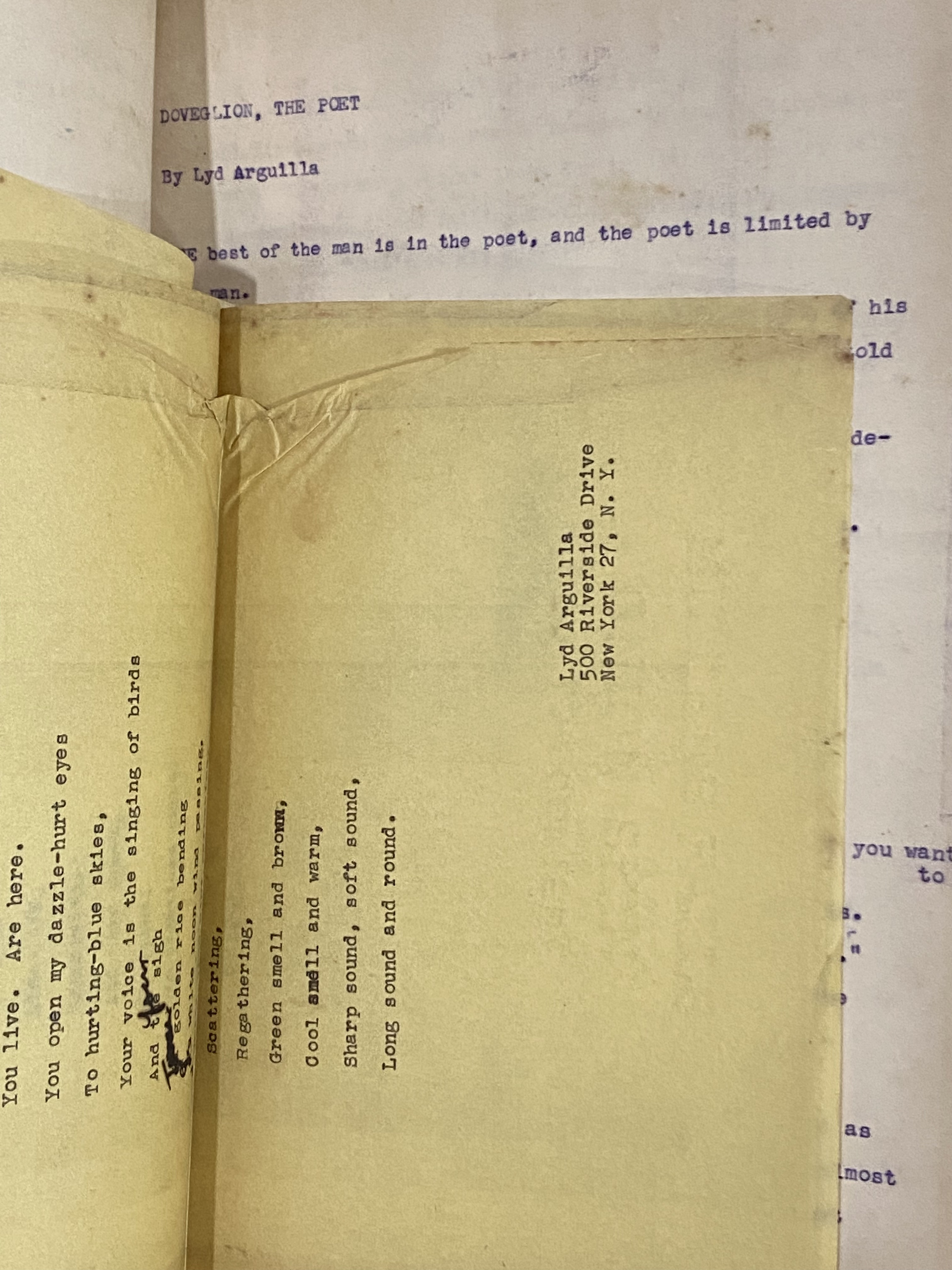
The other document I felt extremely lucky to acquire was a plain black folder, rather worn, with about 60 to 70 pages in it of what was obviously a carbon paper copy. It was also clear, however, that the author of these pages had used this copy to make handwritten revisions on. 

It was a collection of essays written by Lyd Arguilla—and I’m not sure if they were ever published—during a sojourn to the United States in the early 1950s, when she received a grant for further studies in New York. This was just a few years after the war; in 1944, she had lost her husband Manuel, who was executed by the Japanese for his guerrilla activities. Lyd had been active in the resistance herself, and was away when Manuel was arrested. We can only imagine the pain she went through on discovering his loss. By the time she writes about the experience, she has composed herself, but she leaves it to Manuel’s fellow prisoner, a Major Moran, to relate what happened:

“On a tip from Pete Mabanta, Manuel E. Arguilla had already escaped with us out of the city. Friends and fellow members of our guerrilla unit had helped: the Lansang brothers, Ramon Estela, S.P. and Mary Lopez, Koko and Lina Trinidad. But Manuel sneaked back into the city to destroy or put in a safer place some records. He was able to protect the lives of his associates, but did not escape with his own.

“‘Arguilla was accused of being a major in Marking’s guerrillas, of heading an espionage and propaganda unit against the Japanese. Liling (Rafael R.) Roces was charged with publishing Free Philippines and various other acts against the Japanese military.’

“‘Arguilla had enough material, according to him, for two books. All he asked was to be able to live through to write them.

“‘It was on August 29th, early in the morning, about seven o’clock, maybe earlier, that the prisoners in Bilibid were given old clothes to put on (we all wore our underwear), put in handcuffs, and blindfolded. The blindfold was either green or white. The 28 men wore white bands. I thought, being most of them influential men that they would be given better treatment than those of us who were given green bands. I was wrong of course. For I and others were taken to Muntinlupa where we were finally liberated, and the 28, as we learned later, were beheaded at the Chinese cemetery.’

I could imagine Lyd typing those words on a chilly morning in New York and running that awful moment through her imagination. Elsewhere in the folder, she tucked away a love poem she had written for Manuel. Holding those pages, I felt myself in the presence of something close to sacred.

Penman No. 282: Never Enough Patriots

IMG_4055

Penman for Monday, December 18, 2017


(THIS IS the last of three parts of my recent talk on “Celebrating Arguilla” at the Taboan Literary Festival in Bauang, La Union.)

Leonard Casper and Joseph Galdon aver that Manuel Arguilla’s best stories are those in the pastoral tradition, and I would agree that “Midsummer” is in a class all its own, but who knows what else he would have written, given ten or twenty more years? Stories like “Elias” convey less surface beauty than his pastorals, but in some ways are more resonant; his last story, “Rendezvous at Banzai Bridge,” is something of a psychological thriller.

This brings to me my main point, which is to propose that to celebrate Arguilla is to recognize and embrace his complexity and even his seeming contradictions. In a sense, he prefigured the situation of many Filipino writers today who find themselves caught between burning local issues and the seductions of the global. The Third World is the new Nagrebcan, and what lies beyond it the new metropolis.

One thing we have to note of Arguilla’s work is that he wrote in English—indeed, a very refined and educated English—which tells us that while he wrote tirelessly and affectionately about the farmers of Nagrebcan, he wasn’t writing to be read by them. That’s not an accusation—only an observation of the fact that Arguilla was very much a member of his literary milieu, a milieu inflamed by proletarian ideals but one that still conducted its passionate debates in English.

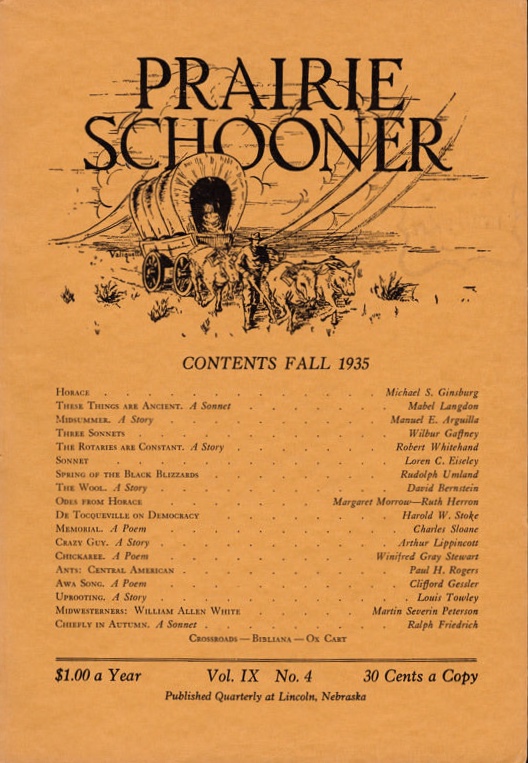
Many years ago, as a graduate student in Milwaukee, I found a copy in an old bookshop of the March 1936 issue of Story Magazine, America’s pre-eminent fiction publication then, featuring Sinai Hamada’s classic love story, “Tanabata’s Wife.” (I later gave that copy to the Hamadas in Baguio.) The author’s notes mentioned that Hamada had been preceded just the month before by another Filipino writer named Manuel Arguilla and a story titled “How My Brother Leon Brought Home a Wife.” Since then I tried to locate that issue, and more than 25 years later, I received it, as a gift from a friend who knew I had been looking for it. The note on the author doesn’t say much, only that “His biography has yet to reach us.” I also just recently acquired, on eBay, a copy of The Prairie Schooner from the Fall of 1935, where can be found a story titled “Midsummer” by Manuel Arguilla. This same journal would also later publish his story “Heat.”

All of these stories—including that of Hamada, who was younger than Arguilla by a year—had already been published in the Philippines. But they still sent them for publication in the US, because it was apparently important for them to do so in their time, just like we seek to be internationally published today not just to find more readers, but to be validated in the global society of letters.

They were young men in their early 20s, brimming with talent and ambition. All they wanted was to write, to be published, and to be read, just like all of you here today. And like many of you, they were outspoken about their beliefs, eccentric and maybe even offensive in certain ways, but totally dedicated to their craft. We lionize them today for good reason, but in truth, as persons and as writers, they were far from perfect, which also means that we can be like them.

Even after his martyr’s death, critical views of Arguilla’s work and legacy have varied widely. Indeed, among his peers, there seems to be a qualified dissatisfaction with his fiction that some of us today would find strange, if not unkind.

As I was preparing for this talk, I was elated to find, in my stash of old literary journals, a copy of the 1952 Literary Apprentice, where five writers—Lyd Arguilla, Ligaya Victorio Fruto, Francisco Arcellana, Edilberto Tiempo, and Alejandrino Hufana—shared their reminiscences of Manuel Arguilla in short personal essays. Lyd sweetly remembers the man and the husband—his bellowing laughter, his flair for fashion, his love of swimming, dancing, jazz, and poker (at least we share something), of Shakespeare, and above all of writing. Ligaya savors the “champaca-laden atmosphere” of the porch at the Arguillas’ house on M.H. del Pilar and the carefree banter of Manila’s prewar literary set, the names and initials of the notables—AEL, AVH, Estrella, Daisy and Bert, SP and Mary, and someone simply referred to by his surname Villa—dropping like cookies along some magical pathway. It all vanishes, of course, in the devastating war that sweeps in from just around the corner—the house, the company, the laughter, the floral fragrance.

Five years Manuel’s junior, Franz recalls Arguilla writing him a letter, urging him to “be true to your real self,” and gifting him with a book with that now famous inscription, “To Francisco Arcellana, May he put more life into his art and less art into his life.” Remarkably, Franz’s memoir ends with a candid admission that “the only thing that pleased me about him was his writing—when he wrote short stories. I didn’t like being lectured to, not even by him…. I shall never be able to forgive him his patriotism. He was no patriot…. He was a writer of short stories. He should have left patriotism alone…. We have many patriots. We don’t have too many writers.”

Ed Tiempo recognizes that “the outstanding gift of Arguilla is his sense of people, his characters,” but adds quickly that “people alone do not make successful fiction.” Ever the traditionalist, Tiempo looks for clearer meaning and coherence in Arguilla’s fiction, but grants that “because we accept the authenticity of the small details, there is something coercive even in (his) unconvincing characters.” Alex Hufana, another son of La Union, does a close reading of “How My Brother Leon Brought Home a Wife” and pronounces it authentic, praising the author for keeping “his hand cool even as they hold hot soil—decorum required of him as an artist.”

Whatever your own estimation of Arguilla may be, you will probably agree with me that at his best, he delivered what I tell my students should be the hallmark of a great story: it should not only be well written, but it should be moving, and it should be memorable.

What Arguilla teaches the young writer is that technical excellence alone is not enough. Too many writers exhibit little more than cleverness and linguistic virtuosity, with hardly any emotional impact or lasting effect. He also reminds us what a vast country we have, much larger, richer, and more complex than Starbucks, Facebook, and the Marvel and DC universe, and that a “real” writer, to use one of his favorite words, is one immersed enough in his or her society to recognize both beauty and brutality in the same place.

Franz Arcellana bemoans Arguilla’s loss to patriotism, but that too tells us something we often forget: that there are things more important than writing or literature, and country is one of them. In a war that tore through and across classes and across beliefs, Arguilla died for his country—not for literature, not for socialism, not for his class; well, maybe for Lydia, which makes him even more of a hero to me. With all due respect to my old teacher Franz, we have writers aplenty; of patriots, especially these days, we can never have enough.

IMG_3828

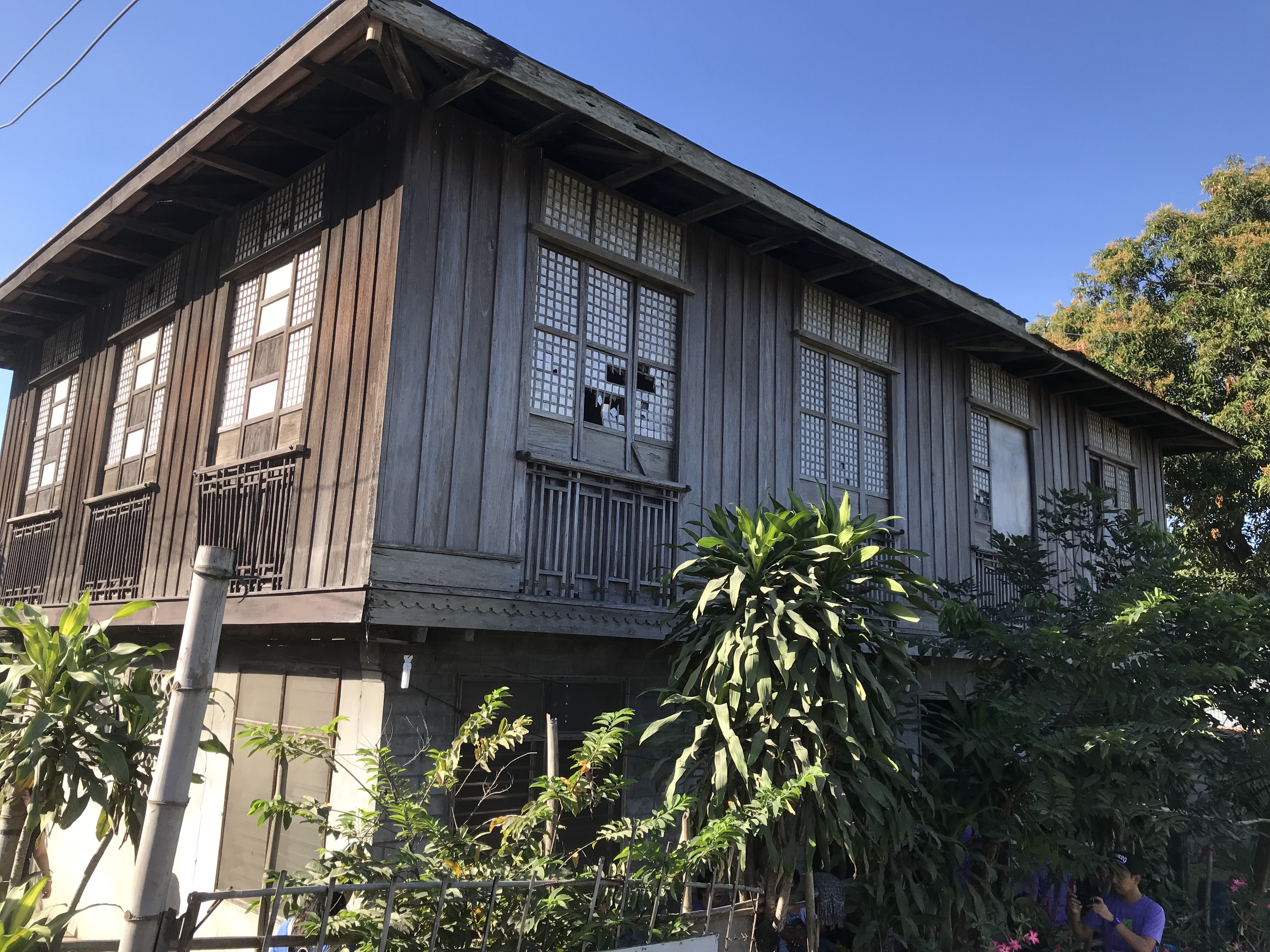
(Photo of Manuel Arguilla’s ancestral home along the National Highway in Bauang, La Union.)