Qwertyman No. 143: I or AI?

Qwertyman for Monday, April 27, 2025

I’VE RECENTLY been asked to talk about literature in the time of artificial intelligence (AI) in a couple of conferences in Dumaguete and Manila. What that tells me is that, with AI’s emergence and growing popularity, there’s been much uncertainty, anxiety, and fear—even outright hostility—generated by the seemingly unstoppable intrusion of artificial intelligence not just into literature but into almost every aspect of human life and society. As I’ve said before, depending on how you see and use it, AI is either God’s gift to humanity or the destroyer of civilizations. 

While it has been hailed for its contributions to such fields as medicine and criminology—shortening diagnostic procedures and sharpening digital forensics—AI’s application to less mechanical endeavors is more fraught with both ethical and technical questions. Studio Ghibli’s Hayao Miyazawa, for one, has forsworn the use of AI in his work, calling it “an insult to life itself.” 

For writers and other creatives, the big questions are: Will and can AI replace the author? Is AI capable of artistic imagination? Should writers, publishers, and readers feel threatened by its future development? Might there be a positive role for AI in literary creation? 

Now, we can be very brave and declare that the worst piece of writing or art done by a human is still better than the best of what AI can produce. I’ve heard many authors proudly insist that “AI can never replace me!” But do you honestly think that’s true, and will the readers of the future—say, the consumers of popular fiction—care? The sobering fact is that there is so much bad art and bad writing done by real humans that it shouldn’t be too hard to artificially produce something better, for which people will gladly pay. 

I know that this will strike some of us as being crassly commercial, but it would be naïve to deny that much of what know to be culture today has been commodified—produced and sold as entertainment, whether it be a book, a movie, a concert, a computer program, or the hardware with which to access them. These are all media in which AI is already playing an increasingly important role—initially, perhaps, merely as a facilitator, a simplifier of complex or difficult tasks, or as an aid to the imagination, but also as a co-creator or collaborator, such as in the generation and animation of images. 

Given the fact that most of us produce art to sell—and why shouldn’t we, especially when we promote the idea of “creative industries”—the entry of AI into our thought processes and methods of work could be a matter of survival for many. The question is, will it improve the mediocre, or degrade the excellent? Can we excel without it, or because of it?

Early AI’s clumsy mistakes or “hallucinations” are worth a laugh, but I’m not sure how long we’ll be laughing; AI’s present ineptitude simply means it has a lot to learn—and it will, with the kind of training it’s being fed off our books, our texts, our manner of writing. It will only be a matter of time—I’d say less than a decade—before AI can mimic the best of global writing especially as literary texts get digitized and tossed into the meatgrinder, until it can produce a decent if not impressive approximation of certain styles and approaches. 

(For AI professionals, the next phases of the AI revolution will move into Artificial General Intelligence or AGI, at which point AI can match human intelligence, and ASI or Artificial Super Intelligence, when AI becomes self-aware enough to improve and replicate itself without human intervention and possibly beyond human control. These scary scenarios will not take, they say, a century to happen—some experts predict that AGI could be realized as early as 2027.)

What’s going for us is that while literary styles can be copied, the human imagination is far richer and stranger than we think. AI tends to homogenize; the human artist strives to be unique. Even so, researchers are already talking about algorithmic imagination and experimental humanities as “true collaborations with culture machines.”

Given that it’s inescapable, I propose that instead of fearing it, ignoring it, or maligning it as I’m sure many of us are inclined to do, we study AI and use for what it might be able to offer in aid of the imagination—as unsettling or unappetizing as that proposition sounds.

We’re already tapping AI every time we use Google, and no one seems to mind. I don’t mind admitting that I have used AI—not in fiction but in creative nonfiction or CNF, specifically in writing the biography, where I ask AI to summarize and organize biographical material that I would have eventually found on my own, anyway—in days rather than seconds. 

I suspect that the use of AI in CNF is much less troubling for writers and theorists than its employment in, say, writing the novel or the poem, which we have been trained to think of as more personal, more “us,” than nonfiction. We will yield CNF to AI, but draw the line at fiction and poetry, where we feel we should resist the intrusion of the beast or the machine into the recesses of our imagination. 

I wonder, however, how long this fortress will hold, or what the first crack in the wall will be, if it isn’t there already. I’m pretty sure that somewhere out there, a plodding novelist is already using AI to chart a tree of plot possibilities—What will happen if Maria marries Oscar? What if they decide to live in Davao instead of Baguio? And so on. I wouldn’t do this myself, because the fun of writing for me is in working out the future of my characters in my head. 

And then again I write fiction for the love of it—unlike almost all other kinds of writing that I do for a living. But if I were a novelist under contract to produce a novel a year, I’m not so sure that I wouldn’t seek AI’s help to lighten my load and get the job done. So is AI OK for money but not for love? Is that what it all comes down to?

So right now we have many more questions than answers, and at the pace the world is changing, most answers we come up with will soon be obsolete anyway. But the basic questions will remain, the most vital of which could be, when we say “I am,” is that “I” me, or is it AI speaking?

Qwertyman No. 66: Beyond Reportage

Qwertyman for Monday, November 6, 2023

IT WAS probably fitting that I finished reading Patricia Evangelista’s highly acclaimed account of “murder in my country,” Some People Need Killing (Random House, 2023), over a holiday devoted to remembering the souls of the departed. I had received a pre-publication review copy from the publisher months ago under a strict embargo not to talk about it until its formal launch. As it happened, it lay under a pile of other books to be read until a flurry of posts and reviews reminded me that it was out in the open, and that the secret—not just the book, but also what it contained—could now be shared.

I can still recall the day—May 15, 2004—while we were celebrating Pahiyas in Lucban when I got the news on my phone that our representative to the English Speaking Union’s annual public speaking competition in London—a bright and pretty wisp of a teenager named Patricia Evangelista—had won the top prize. We were new to the ESU—subsequently we would produce two more global champions—and it was a grand way to announce to the world that we Filipinos could produce more than boxing heroes and beauty queens. Here was 18-year-old Patricia who could think on her feet and speak to issues of international importance, the poster child of Filipino intelligence and audacity, whose command of the English language led her to meeting no less than Prince Philip, the Duke of Edinburgh, in what amounted to a mini-coronation in recognition of her talent.

As magical as that moment was, I can only imagine how, in the months and years following, it must have begun to grate on the young Patricia to be asked to deliver her prizewinning speech in public forums over and over again, like a wind-up doll, and suffer the fate of prodigies who peak too soon. Surely that was just a beginning; surely there was more she could do—had to do—to outlive her Cinderella-like debut in London. 

I would see some of that when she enrolled in my undergraduate Fiction Writing class in UP. I knew who she was and made sure to give her no special treatment—indeed to lean even a little harder on her, knowing she had what it took—but she got a “1.0” all the same, one of the few I ever gave. I can’t claim to have taught her much how to write imaginatively—her own reading had likely primed her for that—but I can’t pretend not to be proud of what she turned out to be, my pride tempered only by fatherly concern.

Today, almost 20 years later, the sometime ingénue returns to the global stage as a hard-bitten, chain-smoking investigative reporter—a “trauma journalist,” in her own words, very possibly one of the world’s best yet again. But there is no real prize, no princely reward, for this kind of distinction, only pain and sorrow which—subdued too many times as a matter of professional discipline—exact their toll on the body and spirit. Patricia has had to suffer that to be able to tell her story as clearly as she could, unimpeded by the hand-wringing and the preachiness that often accompany such exposés of grave misconduct. 

This is not a review of the book’s explosive investigation into the thousands of extrajudicial killings that happened under the Duterte regime—that’s been done very capably by others, and is already the subject of international inquiry. The book will deserve all the journalistic accolades coming its way as an exemplar of excellent reportage. 

I will not even quote from the book, as there are simply too many quotable paragraphs to choose from. Rather, I want to note, from my privileged perspective and for the benefit of younger writers, how Patricia works with language to best serve the truth. Quite apart from its journalistic merits, Some People Need Killing is one of the best textbooks out there for what we now call “creative nonfiction,” a compound of reportage, memoir, history, and fictional technique. Indeed, beyond reportage, the book is a long personal essay in which the author is inextricably part of the story, a significant step away from the impersonal and largely mythic “objectivity” that we associate with traditional journalism.

Probing murder after ghastly murder—sometimes even coming on-scene to prevent one—Patricia is both chronicler and agent, witness perhaps not to the killing itself but to the larger crime of its planning and the exoneration of its perpetrators. Handling the most sensitive and dangerous of material, she draws on more than skill to tell her story; she demonstrates raw courage, an increasingly rare quality among journalists easily seduced and silenced by pragmatism. She names names, which surely will bear consequences both ways. 

I’ve often remarked in my lectures that the most endangered writers in this country are neither the poets nor the novelists, but the journalists who cannot hide behind metaphor and simile to tell the truth. We fictionists make artful lies which governments rarely have the intelligence or the patience to grapple with. Journalists live in the literal world inhabited as well by cops and crooks; what’s interesting is how the flimsy but oft-repeated fictions of “killed while resisting arrest,” so pervasive in this book, emerge from that reality.

Evangelista’s overarching technique is one of narrative restraint, informed by an English major’s awareness of how language and reality shape each other. She constantly parses the perversions of language—how words like disappearsalvageencounterverification, and even her own name assume different uses and meanings over time, in specific contexts. She knows—as I remind my students—that for dramatic effect, less is often more, that short sentences and blunt, single-syllable Anglo-Saxon words rather than the long, Latinate ones favored by lawyers hit closer to the gut and heart.

She is keenly aware of the power of irony—of professed liberals supporting EJK, of a morally ascendant Noynoy Aquino showing little empathy for ordinary folk, of her own journalist-grandfather affixing his signature to a petition supporting the older Marcos, and of communal complicity in the reign of terror. She uses people’s own words against them, quoting from the record. She avoids direct editorializing, or speaking in lofty generalizations like “justice” and “civil liberties,” and instead, in the best noir tradition, sees “sagging two-story tenement buildings (that) opened into dirt roads layered with garbage and last week’s rotten Happy Meal.”

After I had finished the book, I woke up at 4 am from a nightmare about running shirtless down a wet, earthen road. I was lucky. Patricia Evangelista lived through it, and I don’t even know if she’s woken up yet. Have we?

(Image from Rappler.com)

Penman No. 152: Writing the Stories of Your Life

Studio5

Penman for Monday, June 8, 2015

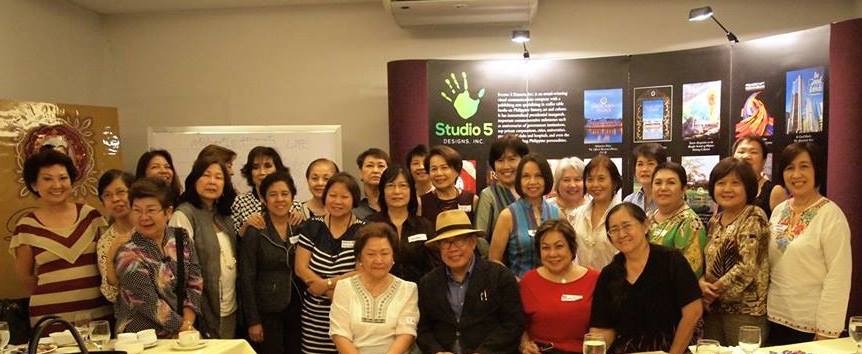
TWICE OVER the past three months, I’ve been giving workshops to medium-sized groups of people in my general age range (let’s put that at 50 to 70), people who came together because they had stories to tell, but needed some guidance on how to tell them. These workshops were arranged by the publisher and writer Marily Orosa, who had come up with very engaging book ideas to which these potential writers could contribute, and who thought that it would be a good idea to have a practicing writer give them a bit of coaching before they plunged into the actual task of writing.

I was glad that Marily put these workshops together, first because I’ve always believed that every person has at least one good story in him or her, and that it’s my job as a writing teacher to get that story out of the person. Second, being a senior myself, I’m happy when older people get an opportunity to express themselves in this obsessively youth-centered world.

Many if not most members of my audience were retirees or approaching retirement after many decades of productive work in their professions. One was a former Cabinet secretary and another a university president, among other luminaries, but in the end, it wasn’t one’s position that mattered as much as one’s experiences, which seniors have in spades.

I couldn’t cram a semester’s worth of lessons into a Saturday afternoon, but I did what I could to give them a framework, an approach, and some tools with which to get their stories out of their memories and onto the digital page. First, we talked about the basic difference between life (their life experience, the raw material) and art (the finished product they were expected to come up with).

What do artists—writers, painters, musicians, and so on—do to and with their materials to make works of art? What do artists see in the things around them that most other people don’t? In this way, we try to get people to see their own lives and experiences as matter to be structured and shaped—not to distort the truth (the object, I think, of all honest art) but precisely to get at it and to bring it out, even if it may not always be pleasant—and indeed much art out there is meant to disturb.

We talk about selection, and how the writer or artist chooses material to use directly in the artwork (the text) and leaves other things out (the context), given that you can’t possibly use everything out there. We talk about how artists work with concrete images and objects to suggest ideas, rather than the grand abstractions that, say, editorial writers and philosophers use.

When we consider life experiences, we then talk about distances in space and time, and about physical and emotional distance. Many participants at these workshops, for example, want to talk about travels they undertook to interesting places, and what I try to do is to get them to write something beyond the verbal equivalent of a posed snapshot in front of the Eiffel Tower or the Golden Gate. A trip to Paris isn’t just ever about Paris, but also, implicitly, about Tagbilaran or Bayombong, wherever it was the narrator or protagonist came from, and it’s that perspective that makes this particular experience of Paris unique.

Writing about the past really involves two protagonists (taking a page from Thomas Larson): the remembered self and the remembering self. Writing about a journey involves not just traversing physical territory, but also that internal space within which the character grows—so the physical journey is always paralleled by an internal, often spiritual, one.

After clarifying these fundamental concepts, I then introduce them to some basic tools of the trade—the elements of fiction which, when carried over to nonfiction, liven up the narrative and make both writing and reading a more engaging experience. We talk about plot, character, theme, point of view, dialogue, description, and setting—how to employ time, how to bring scenes to life, what to say and what to leave out.

I remind them what a lonely and (for most people) unremunerative occupation writing is, but going beyond the money or the lack of it, how important it is to write one’s stories down before the memory deserts or defeats us. It’s especially important for the young to know about how their elders lived and thought. It might take them another 20 years to become receptive readers, but the record will be there, and they’ll be surprised to find, as we ourselves did, how the past anticipated the future in so many ways.

I feel drained at the end of these three-hour workshops, faced with a flood of eager questions, but I also feel elated by all the creative energy I seem to have unleashed among my fellow seniors, and I can only begin to imagine what a touch of art can do to that rich lode of memories lying deep in their many-chambered brains.

Treasures

AND NOW’s as good a time as any to draw attention to the good work done by Marily Orosa’s Studio 5 Designs, which has been in the business of producing not just books but prizewinning ones, lauded both for their design and their substance. I’ve had the pleasure of working with Marily on a couple of coffeetable book projects, most notably De La Salle University’s centennial volume, The Future Begins Here, which I edited and wrote for, and which won a Quill and an Anvil Award (the Quill, Anvil, and National Book Awards are the local publishing and PR industry’s measures of excellence).

Studio 5 has also won NBAs for In Excelsis (The Martyrdom of Jose Rizal) by Felice P. Sta. Maria and The Tragedy of the Revolution (The Life of Andres Bonifacio) by Adrian Cristobal. Malacañan Palace (The Official Illustrated History) by Manuel Quezon III and Jeremy Barns also won a host of local and international awards, as did the magnificent Treasures of the Philippine Wild. Freundschaft/Pagkakaibigan (celebrating 60 years of friendship between Germany and the Philippines) will be included in the prestigious international design annual, Graphis.

Beyond being visual treats, these are all significant books, and their creators and publisher deserve high praise and encouragement.