Qwertyman No. 151: For Don, a Meditation

Qwertyman for Monday, June 23, 2025

(Photo of Los Cabos by Kurt Nichols)

I WAS looking for a topic for this column last week when it occurred to me that I had been staring it in the face, in the news and in the Facebook feed that, like for many, my days begin and end with. It was the omnipresence of death, in its many forms and guises, swift and slow, painless and agonizing, arriving on whispery feet and crashing through one’s roof or window. 

“A screaming comes across the sky,” the line with which Thomas Pynchon famously begins his novel Gravity’s Rainbow, was how death and destruction came last week to hundreds in Kiev, Tehran, and Tel Aviv, in missiles and drones designed and manufactured for but one purpose: to deliver death by inexact algorithm to place-names plotted on digital maps. 

In India we marveled at the horror and the mystery of one survivor escaping a catastrophic plane crash barely a minute after take-off: a moment when most of us would have just begun to fidget with the entertainment controls, wondering whether to take in a comedy or a thriller for the next two hours and what the meal choices will be. 

In Minnesota, a MAGA gunman stalked Democratic lawmakers and their families, shooting four and killing two on a long list of intended targets—murders that a Republican senator reflexively attributed to “Marxists not getting what they want.”

Most appalling was the report of Israeli tanks firing into a crowd of Palestinians lining up for food in Gaza, an incident that led to about 60 deaths and more than 200 wounded, for which the Israelis apologized with this statement: “The IDF regrets any harm to uninvolved individuals and operates to minimize harm as much as possible to them while maintaining the safety of our troops.”

As if the news isn’t enough, every time we scroll through our social media accounts, more deaths emerge, in the now-familiar solitary-candle meme and in the garlanded portraits of the recently departed. Facebook has become our new obituary page, our book of condolences, our virtual wake. The friend or the kinsman in us takes the loss with the requisite pain and grief; the enemy with muttered thankfulness, or more rarely forgiveness; the human with relief, that we are reading and not being read about.

Death in the news is meant to outrage us, and it still does, at least for a while, especially senseless and preventable death, willful murder, and patent genocide. But sadly we can only take so much, even with the keenest of consciences; there is something in our brains, a control or shut-off valve, that says “Enough” and leads us back into the immediate and comprehensible present, back to chocolate cupcakes, Torx screwdrivers, tomorrow’s court hearing, and Lola’s birthday. This, we remind ourselves, is life, the only one we have, our chief responsibility above all others to live and to give meaning to. 

We try to make sense of death as much as we do of life, and for those of us of a certain age, that means the acceptance of its inevitability. I suspect that those of my generation who came of age under martial law and fought it, who saw dozens of our comrades die, can do that with more equanimity than most, never having expected to live beyond twenty-five; every year and decade since has been a grace note, a blessing we have been careful not to waste. We are lucky to have come this far, and can leave without regret.

The Buddhists have what they call maranasati, the practice (says Google, meat-eating me being decidedly non-tantric) of contemplating one’s own mortality to cultivate mindfulness, reduce fear of death, and appreciate the present moment. The practical Swedes have döstädning, celebrated in The Gentle Art of Swedish Death Cleaning: How to Free Yourself and Your Family from a Lifetime of Clutter by Margareta Magnusson, a Nordic Marie Kondo who advises us to downsize and clean up our mess before we croak to save some grumpy nephew the trouble of sorting out which things go to the trash and which go to the resale shop. 

Speaking of which, my devotion to Japan-surplus stores and their wonderful bargains is tempered by the knowledge that most of these items were likely made available by the peculiarly Japanese practices of hikikomori, or withdrawing from society and living alone, and the even sadder kodokushi or “lonely death,” where the bodies and belongings of the forgotten might be found days after their passing. But then, as a collector of vintage fountain pens and antiquarian books, I am well aware that these precious objects have passed through many lives and survived their owners, and will certainly survive me, which is strangely reassuring. They offer proof of an afterlife—maybe not paradise, but the life of the people and things you leave behind.

In a way, death’s predictability (or the illusion thereof) is comforting, because we think we can therefore prepare for it, as for the coming of a friend who will lead us away by the hand, down to the smallest detail. Despite her surprisingly good health, my 97-year-old mother has written out her DNR instructions, and a year ago we made a light-hearted trip to the mall to pick out her funeral dress, in a deep, pacific blue. Well before my father died of an aneurysm almost thirty years ago—he was a chain-smoker and a candidate for early passage—I had written out a scene in my first novel where the protagonist comes home to his father’s wake, which was my way, the privilege of imaginative writers, of cushioning the real pain when it struck; when it did, I still wept like my father’s child.

I’m writing this because I’m actually not very good at dealing with death and processing grief, as detached or as flippant as I may sound about it. I avoid or don’t stay long at the wakes of friends because I tend to say the lamest things. 

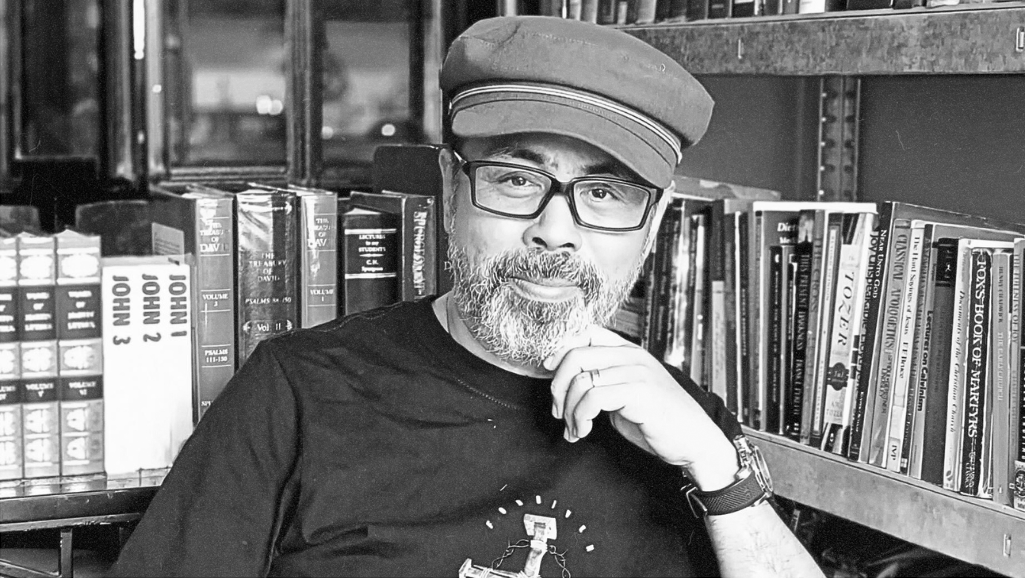
Last week I lost good friend—a high-school classmate named Don Rodis, brother to lawyer Rodel and producer Girlie, whom more people know—our Philippine Science High School batch’s livewire and indefatigably perfect host, to those visiting him in San Francisco. On vacation with his family in Los Cabos in Mexico, Don was strolling on the beach when a rogue wave known by the locals as the mar de fondo caught and swept him out to sea. Despite a massive search, his body has yet to be found. We are all stunned and awash with grief, but what struck me was how pretty that beach was from all the pictures, how blue and inviting its waters. And now I’ll say a stupid thing, for Don: rather than dying from a rocket to your head, or rotting from within, or freezing alone in Yamagata, sometimes we die in beauty’s arms. 

(Don Rodis, 1954-2025, with his wife Jocelyn)

Qwertyman No. 92: The Return of the Old Normal

Qwertyman for Monday, May 6, 2024

FEW WILL remember it, but yesterday, May 5, marked the first anniversary of the official end of the Covid-19 pandemic as a global health emergency, as announced by the World Health Organization. Of course it didn’t mean that Covid was over and gone—it would continue to mutate into thankfully less lethal variants—but the worst was over. It had infected more than 765 million people around the world, and killed almost 7 million of them; in the Philippines, as of last month’s latest figures, over 4 million of us caught Covid, and we lost more than 66,000 friends, family members, and neighbors to the disease.

It’s amazing what a difference a year makes. The pandemic rules had been relaxed long before May 5 last year, and much of 2023 and 0f the present year had been spent by us trying to get back to life as we knew it pre-Covid at a frenetic pace—engaging in that new term, “revenge travel,” buying new cars, building new homes, and as of last week, complaining about the infernal heat wave like it was the worst thing to have plagued us in decades (maybe it was—since Covid). For the most part, we seem to have willed Covid out of our minds, eager to replace its bitter memories with fresh and happy ones—an entirely human thing to do, to cocoon ourselves against the pain of loss. Are we in the “new normal,” or have we returned to the old?

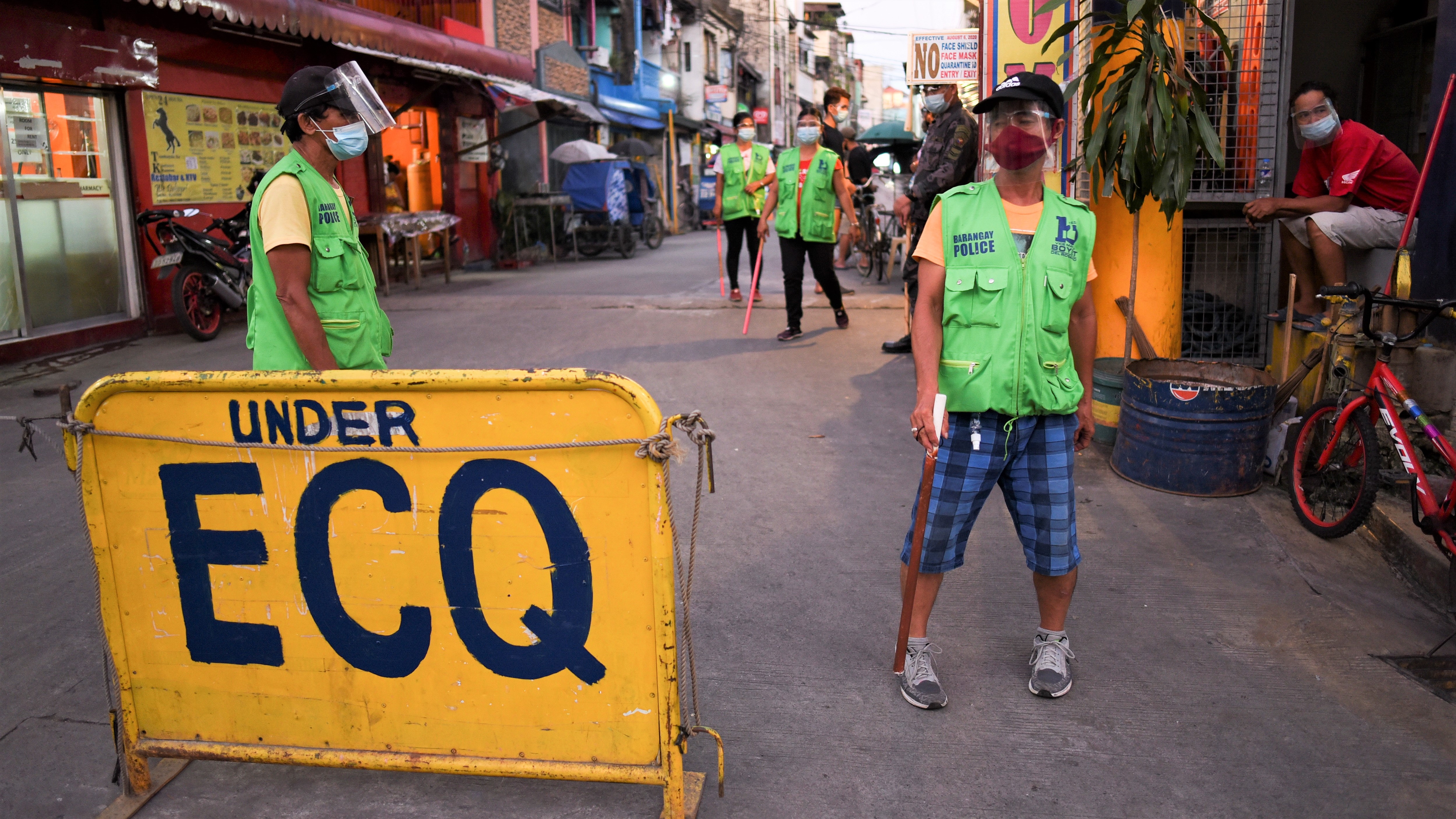
I remember most vividly the paranoia that gripped the country during the pandemic’s early days—the first reports of people we knew dying horrible deaths in isolation, the terror following a sudden and suspicious onset of coughing and fever, the constant fear of carrying the virus home to the innocent and the infirm in one’s shoes, one’s clothes, one’s merest touch, the rapid disappearance of disinfectants and bread from the shelves, the inevitable closure of cinemas and restaurants, the anxious eyes peering above face masks and through face shields, the physical boundaries beyond which only a select few could cross—and, of course, the near-endless wailing of sirens announcing the imminence of death and dying. Unfamiliar words and phrases entered our vocabulary: co-morbidities, social distancing, quarantine, lockdown, ECQ, EECQ, RT-PCR, community pantry, antigen, remdesivir, hydroxychloroquine, Ivermectin, Sinovac (and anti-vaxx), etc.

Like many others, I lost friends to Covid, from very early on when no one knew what was really going on and what could be done to save patients who were turning up feverish and could hardly breathe. One of them was my own cardiologist, who reportedly assisted a patient whom he didn’t know carried the virus. Others were academics and senior officials returning from conferences overseas. Fortunately, no one in our families died of the disease, although many of us, myself included, later caught it at some point despite all precautions. When I did catch it, I have to admit that it was with a strange sense of relief, not only because I could now count myself a participant in a grand if horrible experience, and also because I imagined, perhaps foolishly, that I would be rewarded with some kind of immunity from further and worse infection.

Those of us who survived Covid hopefully did so with a more profound appreciation of the gift and value of life, and of the need to do good in the time we have left. But the 2022 elections only seemed to prove the power of political patronage, which became even more keenly felt during the pandemic, when local officials down to the barangays held sway over their constituents like never before. Covid sharpened the already stark contrast between rich and poor, from access to what were seen as the most effective vaccines to self-declared exemptions from certain restrictions like liquor-lubricated parties and literal hobnobbing. In the end, the virus didn’t discriminate, scything rich and poor alike, although the poor, living in cramped communities, were always more likely to fall ill and die.

What the public often failed to witness—and therefore can’t remember—were the stories of the frontliners who met Covid head-on and served as heroes behind the scenes. I’m now working with Dr. Olympia Malanyaon—a pediatric cardiologist who also served as Director of the Information, Publication, and Public Affairs Office of UP Manila—on a book she’s writing to document the efforts of UPM and of the Philippine General Hospital (which is part of UPM) to respond to the Covid crisis. The PGH, the country’s largest public hospital, was designated a Covid-referral hospital almost as soon as the pandemic broke, and its people found themselves in the vortex of an unprecedented medical and social crisis, and we want to tell their stories in this forthcoming book.

The word “hero” gets bandied around a bit too easily these days, but if there was a time for heroes to emerge, it was during the pandemic, when what used to be the most routine decisions (“Should I report for work today?”) could mean a matter of life and death. When the death toll mounted, many PGH staff resigned for fear of infecting their families, but many more stayed on, with nurses pulling 16-hour shifts and some doctors remaining on duty for as long as 30 hours.

Even utility workers recalled how pitiful the plight of the afflicted was. One said that “They had no one with them, not even when they died. They would be put into body bags, which could not be opened. Then they would be cremated the next day, without being seen by their families.” And then, the staff felt shunned by society when they went home as ordinary neighbors. “When we ordered at the fastfood, the guard shooed us away when he learned that we worked in the Covid unit,” recalled another. “I was very upset. It felt very degrading to work so hard, to line up for food when you got hungry, only to be turned away.”

Thankfully, the crisis also brought out the best in some other Filipinos, such as those who poured their time and money into community pantries that served the hardest hit. For a while back there, we saw and felt the glimmer of our inner heroes. It was a spirit that I hoped would be sustained into a broader and more enduring wave of change in 2022, but as the pandemic receded, we realized how much of the old normal yet remained.

Covid made us aware of the precariousness of our health as individuals. Looking forward to 2025, I wonder what it will take for our people to value their well-being as a society and as a nation.

(Image from Reuters/Lisa Marie David)

Qwertyman No. 70: Life (and Death) on Installment

Qwertyman for Monday, December 4, 2023

THE SUDDEN collapse of Loyola Plans—yet to be explained to longtime customers like me—reminded me of the fragility of our expectations. Like probably hundreds of thousands of other pre-need plan holders, I was just going about my daily business, secure in the thought that whatever happened, I could look forward (well, not exactly, but…) to a coffin, an air-conditioned room full of flowers, and a patch of grass or a marble urn at the end of the road.

That road apparently ended sooner for Loyola than for me and my wife, and we are now in the odd situation of having outlived our funeral plans and the company that was supposed to fulfill them. I understand that Loyola sold educational plans as well, which in a way is even sorrier for the supposed beneficiaries, whose lives are just beginning as opposed to ours. 

We bought those plans more than 30 years ago, when we were in the middle of our lives and careers and just beginning to think of a far future, of the sunset over the horizon and such other clichés meant to assure us that life follows a predictable if not comfortable trajectory. Beng and I were both student activists who, much to our surprise, had survived the First Quarter Storm and martial law, when our friends and comrades were being murdered right and left. We got married and became parents in the middle of all that, and became tentatively hopeful that we would live a little if not much longer.

In true middle-class fashion, we paid for that future on the installment plan. We bought a subdivision house and lot in the boonies of San Mateo on installment, faithfully amortized for P784.54 a month over fifteen years (you don’t forget a figure like that when you write a check that often). We bought a used Volkswagen Beetle on installment, spread out over 36 months. We bought a set of the Encyclopedia Britannica—the crowning glory of the middle-class library—on installment. We budgeted by the month, our wages largely committed to patient creditors whom I imagined sitting at their desks slitting hundreds of envelopes stuffed with checks and cash (back then, we still trusted the postal system enough to actually send money in the mail). 

Come to think of it, our parents also lived from month to month. Their big thing was appliances—TVs and refrigerators, especially—that they checked out on the display floor, ooh’ed and aah’ed over, and then deposited a down payment for, withdrawn from the bank that afternoon with a sigh at once hopeful and despondent. These appliances became virtual members of the family, occupying positions of prominence in our living rooms and kitchens—until, sometimes and shockingly, they were carted away by strangers to Mama’s tears and Papa’s embarrassed silence. We younger ones learned that installment plans bore obligations that also carried emotional costs.

A little Googling tells us that installment buying has been around since at least 1807, when a New York furniture store offered the option. In 1850, Singer began selling its sewing machines on installment. The practice took off in the 1920s, and became even more hugely popular in the 1950s with the growing use of credit cards.

At least, those kinds of plans began with you getting some product up front. Until the repo man knocked on your door or until the blacks of your eyes turned white from viewing, you used and enjoyed your 14” TV. That’s not the case with educational and funeral plans, which are a kind of a safe bet that tomorrow’s prices will be higher than today’s, so you might as well buy now what you’ll pay for tomorrow anyway. At the end of your long period of indenture, you even get a document in fancy script—like we did—as final proof of your faithfulness and as a guarantee, graven in legal stone, that you will get what you paid for.

Except that now, that’s not going to happen. As the thousands of Filipinos who bought into the College Assurance Plan (CAP) two decades ago discovered, sometimes the bottom falls through the piggybank, and suddenly your dreams go “Poof!” (The CAP case, I’m told, is a complicated one, compounded by the unexpected rise in tuition fees and a new government requirement to produce billions of pesos up front. Last year, after an 18-year battle through the system, a Supreme Court ruling finally allowed for CAP’s rehabilitation, theoretically enabling the payment of 50 centavos for every peso owed a plan holder.)

Not being an avid follower of the business news, I heard about Loyola’s troubles only after their liquidation and the procedure for claims (until April 18, 2024, for the equally ignorant) were announced. As these claims processes go, we could be strumming lyres in heaven (or dodging forks elsewhere) before we see the color of money—and even so, if they just give us back what we paid in, instead of the now-expensive service we paid for, then it’ll be laughably (make that cryingly) small. 

My 95-year-old mother’s response probably said it for most plan holders her age: “I can’t die now.” No, you can’t, Nanay, and not just because we need to find you—and us—a new plan, which hopefully will be worth more than the paper it’s printed on. 

Qwertyman No. 62: Remembering Ed Hagedorn

Qwertyman for Monday, October 9, 2023

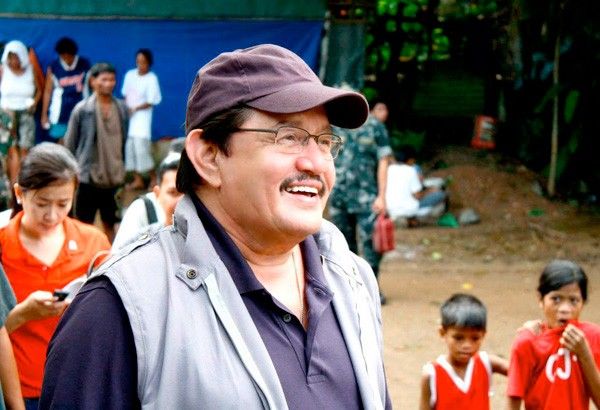
LIKE MANY Filipinos, I was surprised to hear last week that former Puerto Princesa mayor and Palawan congressman Edward “Ed” Hagedorn had passed away aged 76. It was a peaceful death, according to reports, which might have raised some eyebrows among those who knew him and his colorful past. Beyond surprised, I felt genuinely sad, because I had met the man and been much impressed by what he had been able to achieve, despite the brickbats thrown his way by his enemies and critics until the very end. (Only last July, the Sandiganbayan found him guilty of malversation of public property for failing to return some firearms issued to him when he was mayor.)

Hagedorn was one of those larger-than-life figures who stick in your memory like a barnacle. I came to know him two decades ago when he needed someone to write a book about Puerto Princesa’s regreening; I was available and happy to fly down to Puerto to see for myself what the buzz was all about, and looked forward to quiet beachside chats over beer and broiled squid. Instead I found myself rattling in the front seat of Hagedorn’s SUV on earthen roads at breakneck speeds, absorbing his stories, which never failed to make me wonder, “Is this guy for real?” But he was—a true politico, to be sure, who ate controversy for breakfast, but also a game-changer who left an indelible imprint on the community he served, just as Dick Gordon did for Subic and Bayani Fernando did for Marikina.

In memory of that man, let me share some unpublished notes I took for that project (which itself was overtaken by events, but that’s another story). Flash back to the early 2000s, and say hello to Ed Hagedorn:

With his well-combed pompadour, mestizo looks, and neat moustache, Hagedorn looks like a cross between actor-turned-President Joseph “Erap” Estrada and rebel-turned-Senator Gregorio “Gringo” Honasan. The resemblance goes beyond the physical, and the key lies in the movement of these men from the fringe to the center, in their mutation from outcast to power player.

For a man once feared as a teenage toughie, gambling lord, logger, and survivor of at least two assassination attempts, the two-term mayor of Puerto Princesa, Palawan, can be surprisingly gentle and charming. He speaks with an easy smile and a quiet, slightly raspy voice, the golden pin of a Christian dove bright on the collar of his gray bush jacket. He knows that the past hangs on his shoulders—something he has the honesty and the good PR sense not to deny—but he speaks much more enthusiastically about Puerto Princesa’s future, and its own transformation from sleepy island town to a global model for ecotourism, as acknowledged by no less than the United Nations.

Hagedorn appreciates the irony of his situation, and attributes his conversion to a religious faith that he now applies with a fanatic’s fervor to his job. Mayor since 1992, Hagedorn drove his former partners in crime out of the city, set down clear and strict environmentalist policies, especially those having to do with illegal logging, illegal fishing, and waste disposal. Today most of the land within Puerto has been reforested; a “Baywatch” program patrols the water; and a cigarette butt on the open street is about as common as hen’s teeth.

The story of Puerto Princesa’s regreening into a world-class showcase of Philippine environmentalism is an inspiring one, but the Hagedorn story is clearly the stuff of action movies. In fact, not one but two movies have already been made about the flamboyant mayor, who reconnoiters the city in his Chevy Suburban, wearing his trademark wraparound Cazal sunglasses and Rolex wristwatch (“It’s fake,” he says with a grin). 

He doesn’t drink, but until a few years ago couldn’t quit smoking, needing the nicotine to keep him going on typical killer workdays that begin at 6:00 a.m. and end at around 1:00 or 2:00 a.m. the next morning. (He kicked the habit in 2002.) “When I came into office in 1992,” he says, “I inherited the grand total of P26,000, plus one tractor and two dump trucks. In three years, we were able to pave 340 kilometers of roads—just 1,000 kilometers more to go!” Appalled by the city’s conditions when he assumed the mayorship, Hagedorn declared a state of calamity to gain access to P20 million in calamity funds; the government balked at his move, but the courts have since upheld the mayor. He talks about setting up International Environmental University on a large estate already blocked off in Puerto for environmental development.

People wait along the road for his SUV and flag him down. He stops to listen to an assortment of complaints; a secretary takes down notes and his instructions. Like a good politician, Hagedorn has a phenomenal memory: hosting several hundred guests at a banquet at a major hotel, he greets all the luminaries present by name, without notes. The next day he takes his guests to a bayside sari-sari store for a snack of cheap sweet biscuits and soft drinks; the tab comes out to P155; he hands the giggling storeowner a P500 bill and tells her to keep the change. “Don’t evict, develop,” he says of a squatter community that had sprung up on the bayshore. He has also set up 160 low-cost housing units on 100-square meter lots, payable at P500 a month for 25 years. Like an automatic wristwatch, the man’s mind is constantly working, kept alive by motion.

In quick succession, the mayor answers the typical interviewer’s questions:

“Is there anyone next to God whom Edward Hagedorn fears?” Answer: “My wife Ellen!”

“Whom did you grow up admiring the most?” Answer: “The Godfather!”

“Any political plans?” A job, he says, that would let him do more for the environment.

When Joseph Estrada was forced out of the Palace in early 2001, his staunch friend Ed Hagedorn stood by him to the end. That probably cost him the governorship in the election that May, when he challenged incumbent Gov. Joel Reyes for the job, running under the fallen Erap’s standard. We’ve heard that many trees have also fallen since in Palawan’s forests—one of them, reputedly the province’s largest, said to have been carted off to become a centerpiece for a politician’s house. 

I remember remarking then that to call Ed Hagedorn a saint would send St. Ignatius of Loyola—himself a colorful character in his time—into a spasm, but Edward Hagedorn is beginning to look like someone we’ll sorely miss when those trees start coming down for some bigshot’s dining table.

Qwertyman No. 50: Doro’s Times and Ours

Qwertyman for Monday, July 17, 2023

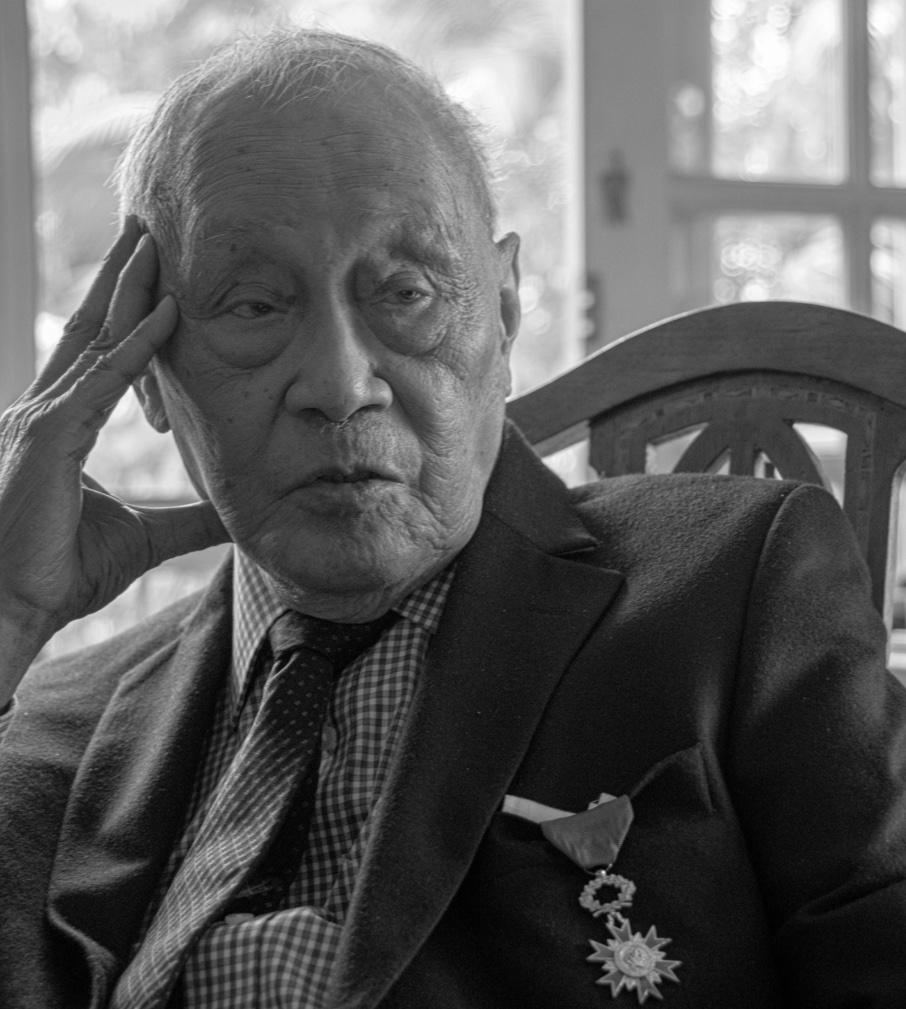
THE NEWS of Amando “Doro” Doronila’s recent passing in Canberra at age 95 marked the end of an era, as Doro was the last of his generation of journalists who made newspapers and their Op-Ed pages compelling reading. Whichever side of the political fence they were on, these journalists and columnists gave it all they had; many reveled in their prominence and some shamelessly parlayed their influence into all manner of profitable enterprise, back when it seemed the sensible thing to do, before the darker complicities of martial law set in.

Doro seemed to me to be above all this. His personality was, shall we say, poorly suited for TV or even radio, which was just as well, because it drew a clear line between journalists who did nothing better than think and write deeply, and those who confused their calling with show business.

I didn’t really know Doro personally. My one memorable encounter with him was when I was 18, a freshman dropout from UP who was dying to get into the newspapers, by hook or by crook. (Like some precocious teenagers, I was convinced I had the writing talent to skip journalism school. I would later pay for that hubris in tearful rewrites in the newsroom.) 

One of the doors I knocked on was that of the Manila Chronicle, which Doro was the editor of in 1972. I remember striding into its office and walking up to Doro’s desk, sucking in my stomach. He seemed puzzled to see my pimply face, which probably belonged to a messenger boy’s, except that I came empty-handed. “Yes?” What did I want? “Sir, I want to apply for a job—as a reporter,” I must have croaked, mumbling something about my writing for the Collegian and my high school paper. “How old are you?” I said that I was “going to be nineteen soon”—“soon” being about nine months away. 

I can’t recall if he looked back at me with pity or sympathy, or if he was laughing inside. I do remember him saying something like “Why don’t we talk again in a few years?” I was disappointed but not dejected; at least he didn’t throw me out of the place, or ridicule me before a roomful of the kind of people I wanted to be—hunched over typewriters, smoking up a storm, shaping tomorrow’s news, their bylines embedded crisply and imperishably on fresh paper.

Eventually, sometime that summer, and through sheer persistence, I did land a newspaper job, as a features writer and then a general-assignments reporter with the Philippines Herald, very likely the youngest fellow working full-time for the papers then. With the Herald and later Taliba  just before martial law, I met all kinds of journalists on the job, and saw how human we all were, the creatures of our noblest ambitions and pettiest grievances. One reporter I was on the police beat with loved playing cop, interrogating suspects each one of whom he was convinced was nursing a confession. Many had an enormous capacity for alcohol and the unapologetically macho bluster that came with it. Despite their gruffness, some had marshmallow hearts; two or three even took me under their wing to spare me from the usual gauntlet that rookies had to undergo. We were the peons of the profession, entry-level Hemingways and Woodwards chasing stories down the city’s tenebrous alleyways, and we loved every minute of it.

That was our world, but when I reported to the newsroom in the afternoon to file my story, I was ever aware that even above the copyeditors’ desk was another tier of men (as they mostly were) who perorated boisterously in a corner office on the day’s politics over scotch and cigars, the people whose opinions mattered and who made opinion matter. Never having worked with or for Doronila, I could only imagine him in that company, sitting sagely with his fingers crossed while allowing the thunder to roll above his head.

Today, half a century later, and finding myself just as old or even older than those titans of Philippine journalism then, I can savor the irony of having the privilege to write an Op-Ed column in times that mirror, in many ways, the early 1970s—with a Marcos in Malacañang, an opposition at bay, a scandal a week, and yet a people hard at work, striving for economic and moral deliverance. 

The great difference is that newspapers no longer have a monopoly of opinion-forming; that ground has been taken over by the Internet and social media (and elsewhere, by early-morning and late-afternoon AM radio, perhaps the hardiest of public platforms). Certainly, some Op-Ed stars remain—again on either side of the political divide—with faithful followers in need of sharper articulation and affirmation of their own sentiments. But even those readers tend to be aged or aging, people with the time and patience to read prose in paragraphs instead of bullets and memes, and who might even look for and appreciate that elusive quality called “style.” (Doronila’s no-frills prose, to be honest, was straight and guileless to the point of being starchy.) These 1,000-word pieces we produce now belong to what they call “long-form” writing, as if to write and read them were a test of endurance. 

But against the cheeky punchiness of Twitter and the ugly street brawls on Facebook, and above all stylistic considerations, I have to applaud this new generation of journalists (not all of them for sure) for their adherence to the truth and to fact-based reporting, and for holding themselves up to a higher standard of ethical behavior than their predecessors. Battling the bots and trolls of disinformation, they put their lives and well-being on the line, story by story, column by column; most are young, many are women, some even gay—the old gray men of the newsroom no longer dictate the headlines or the editorial slant. I think Doro himself would have been happy to see this, having mentored many of his successors.

And so as we grieve Amando Doronila’s demise at an age few of us can hope to approach, we can celebrate the continuity of upholding courage, virtue, and incorruptibility in Philippine journalism, with deepest thanks for the example the man set for us to follow.

(Photo by Pablo Tariman on FB)

Qwertyman No. 39: My Mother Emy

Qwertyman for Monday, May 1, 2023

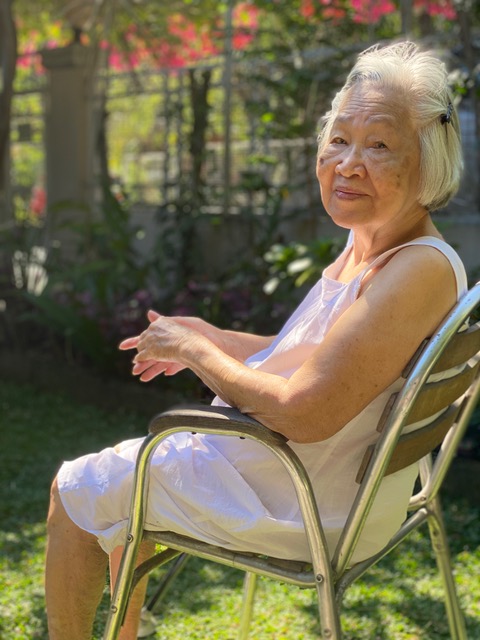
Pardon me if my column this week is a bit personal, because its subject is my mother Emilia, who will turn 95 next week, against all odds and through the grace of the One she prays to every night and every morning, and in the loving embrace of her five children and many grandchildren and great-grandchildren.

In this age of murderous Covid, rampant cancers, devastating disasters, and political turmoil, to reach 95 is extraordinary. To be 95 and be reasonably healthy, free of dementia (but for a few memory lapses that even I at 69 am prone to), able to walk a few hundred meters for her daily exercise, read without glasses, and comment tartly on the day’s political and entertainment news is almost superhuman. 

Like today’s children, my mom Emy can’t be removed from her iPhone and her iPad; she loves to play word games, beats my wife Beng at Scrabble, devours Netflix by the series, and has her telenovela programming graven in stone. She has daily Facetime audiences with our daughter Demi in California and my sister Elaine in Toronto. She even gave up her US green card to spend, she says, the rest of her time at home. In her “Tuesday Circle” of elderly friends, she is now the most senior, but hardly the most infirm. Best of all, she looks forward to reading my books and columns, and although I suspect that they sometimes bewilder her as much as they do my other readers, she invariably likes them because they were written by her first-born, who cannot possibly write anything badly. (This week’s surprise column, I think, will be a hit with her.)

A quarter-century ago, shortly after my father Jose Sr. died, we thought we were going to lose her as well. That’s what they say often happens—one dies, and then the other follows, in the utmost expression of devotion and sympathy. Emy was diagnosed with tuberculosis, so serious and advanced that we felt we were gathering at her deathbed, her sheets spotted with the blood she was coughing up. I had never seen her so frail and so helpless. She was missing my father terribly, and I’m sure she wouldn’t have minded leaving us to join him at that moment. 

Theirs had been a storybook, whirlwind romance. She was the youngest daughter of a landowner in Romblon, the only one in their brood of twelve whom her father had trusted to study and go to college in UP in Manila. She was her father Cosme’s pet, a girl who rode horses on his farm and who accompanied him when he took a boat to the big city to off-load his copra harvest and to buy necessities and a few baubles for his large family. It must have pained him when she decided to finish her high school in Manila (“I was walking on Padre Faura and saw UP High, and so I went in to see how I could study there,” she says) and to stay there so she could study to become a teacher.

My father Joe was the brightest boy in his school and, so the local legend goes, in the whole province. He was an eloquent writer and speaker and cut a dashing figure. The only problem was, his family was poor—his grandfather had been a sharecropper, his father a farmer. His parents had separated shortly after he was conceived—another story that deserves a telling of its own—and lived about a kilometer apart for the rest of their lives. Raised by my grandmother Crispina, Joe seemed destined for great things far beyond Romblon. He already had a girlfriend, among the town’s prettiest bachelorettes (I met her once when I was a boy, unaware of why she was looking at me a certain way.)

One day Emy and Joe met at the pier in Manila waiting for other people and other things. Some sparks must have flown, because not long after, they were together and engaged to be married. I was the first outcome of that improbable union, born in a nipa house in Alcantara, Romblon, pulled out of my mother by a midwife (whom I would meet about twenty years later, walking barefoot on the asphalt road, and whom I would rather awkwardly gift with a pack of Marlboros in token thanks for my delivery).

The decades following would be a mixture of toil and triumph, of struggle and hope. Both my parents had enrolled in law school, but the need to sustain us foiled that dream. Joe had even gone to the police academy, in the class of James Barbers. He clerked for Public Works, became a Motor Vehicles Office agent with a shiny badge, and took on all kinds of jobs to support us. My mother Emy, despite her pride as a UP Education graduate, soldiered on beside him and sold stamps as a postal clerk. We went through some very rough times, constantly moving around the city with all our worldly possessions on the back of a truck in search of more affordable lodgings. Sometimes my father would be gone for long periods, working as far away as Mindanao to be able to send us some money. 

But one thing they always held up for us was the value of education. My parents slaved and my siblings sacrificed so I could go to a private school, thinking like most Filipinos of their generation that a facility in English would be my ticket to success. It was a huge relief for all (and a good excuse to buy our first TV) when I got a full scholarship to the PSHS. So it must have felt like a stab in my mother’s heart when I announced, shortly after entering UP on the swell of activism, that not only was I not going to be a scientist (my Math grades were miserable) but that I was also dropping out of college to find work (which I did at 18, to write for the Philippines Herald). Despite everything, I wanted to follow in my father’s footsteps and gamble on my talent.

But I did come to my senses and many years later returned to school, where I remain to this day, with a lofty title my wife Beng prefers to downplay to “Chauffeur Emeritus.” Instead of following Joe to his grave, my mom Emy fought back, miraculously recovered, traveled the world, and cradled her great-grandchildren. So good things do happen to those who persevere and survive, for as long as we’re willing to give life another chance.

I honestly don’t think I’ll reach 95 myself, but I have the privilege—and the challenge—of living with someone to inspire me every day. Happy 95th, with all our love, Nanay!

Penman No. 421: Giving Spirit: A Requiem for Riel

Penman for Monday, August 16, 2021

WHEN I woke up to the sound of my wife Beng crying as she clutched her phone, I knew instantly what had happened in the night: “Riel is gone,” she said. “Riel” was Ronald Jaramillo Hilario, a sculptor and fellow alumnus of the UP College of Fine Arts. 

No institution in this country has been spared by Covid—every school, office, factory, and hospital will have more than one sad story to tell of unexpected loss and bereavement, of someone who was there with them one minute, laughing and shooting off on the issues of the hour, and then gone seemingly in the blink of an eye.

For the UP College of Fine Arts, it has been an exceptionally terrible year. One after the other, it lost artists and faculty members such as Jak Pilar, Leo Abaya, Joey Tañedo, and Neil Doloricon, and alumni Virgie Garcia and Riel Hilario. The arts community was still reeling from the passing of Neil—one of the stalwarts of social realism in Philippine art—when news of Riel’s death came through, and as she had done much too often since the pandemic began, Beng wept again.

Oddly, neither Beng nor I had actually met Riel—he lived in Lucban with his muse Joyce Campomanes—but he had quite a large digital footprint, from which I gleaned enough, and Beng became a kind of tita figure to him, always ready to lend an ear, albeit online. He was one of those rare artists (Neil Doloricon was another one) who was extraordinarily articulate, and who didn’t hesitate to let the world know what he thought. 

“Art is my religion, and I am a priest of that faith,” he asserted, and his life offered ample proof of that sacerdotal devotion to art—to its creation, its study, and its promotion in a society threatened by destructive and diabolical forces. 

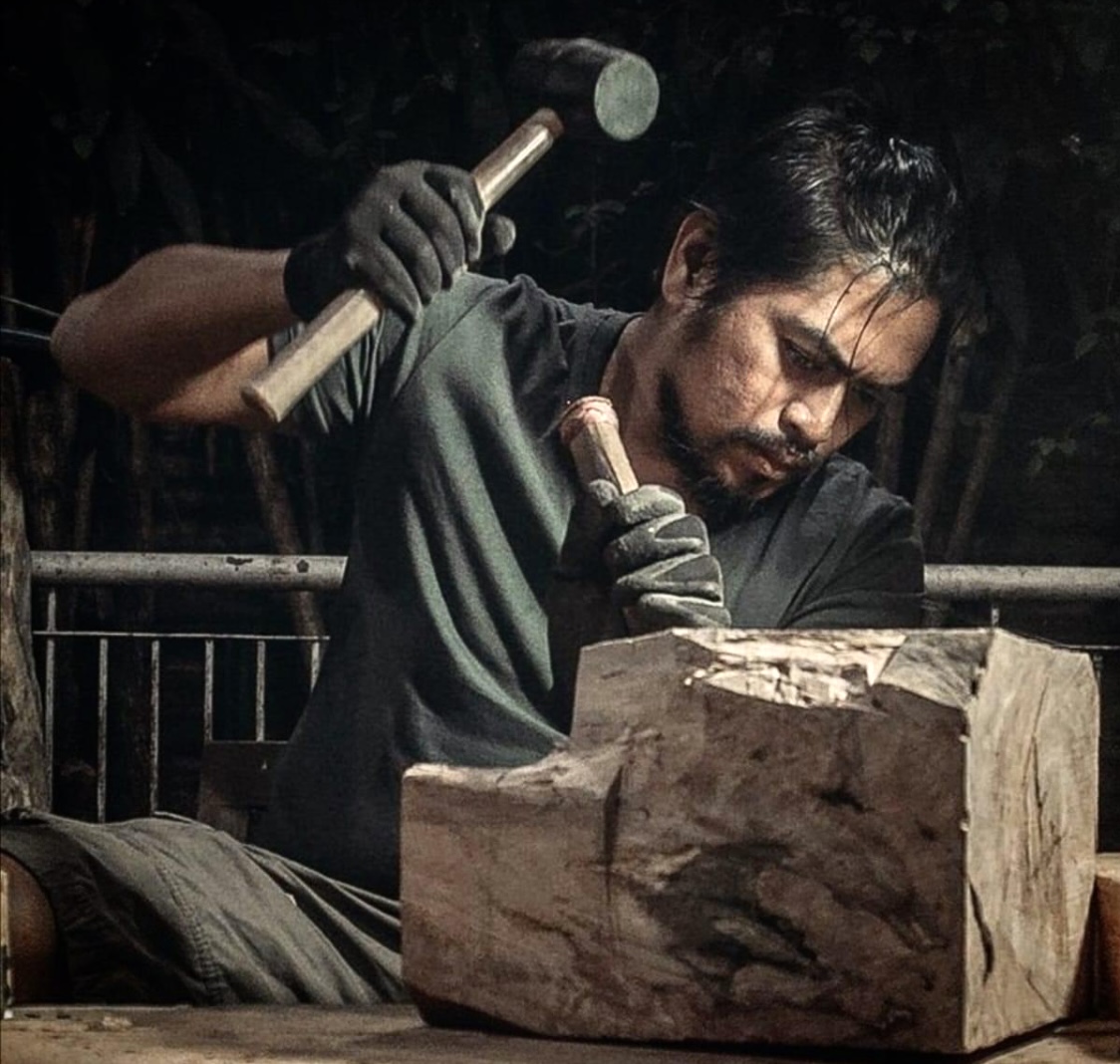
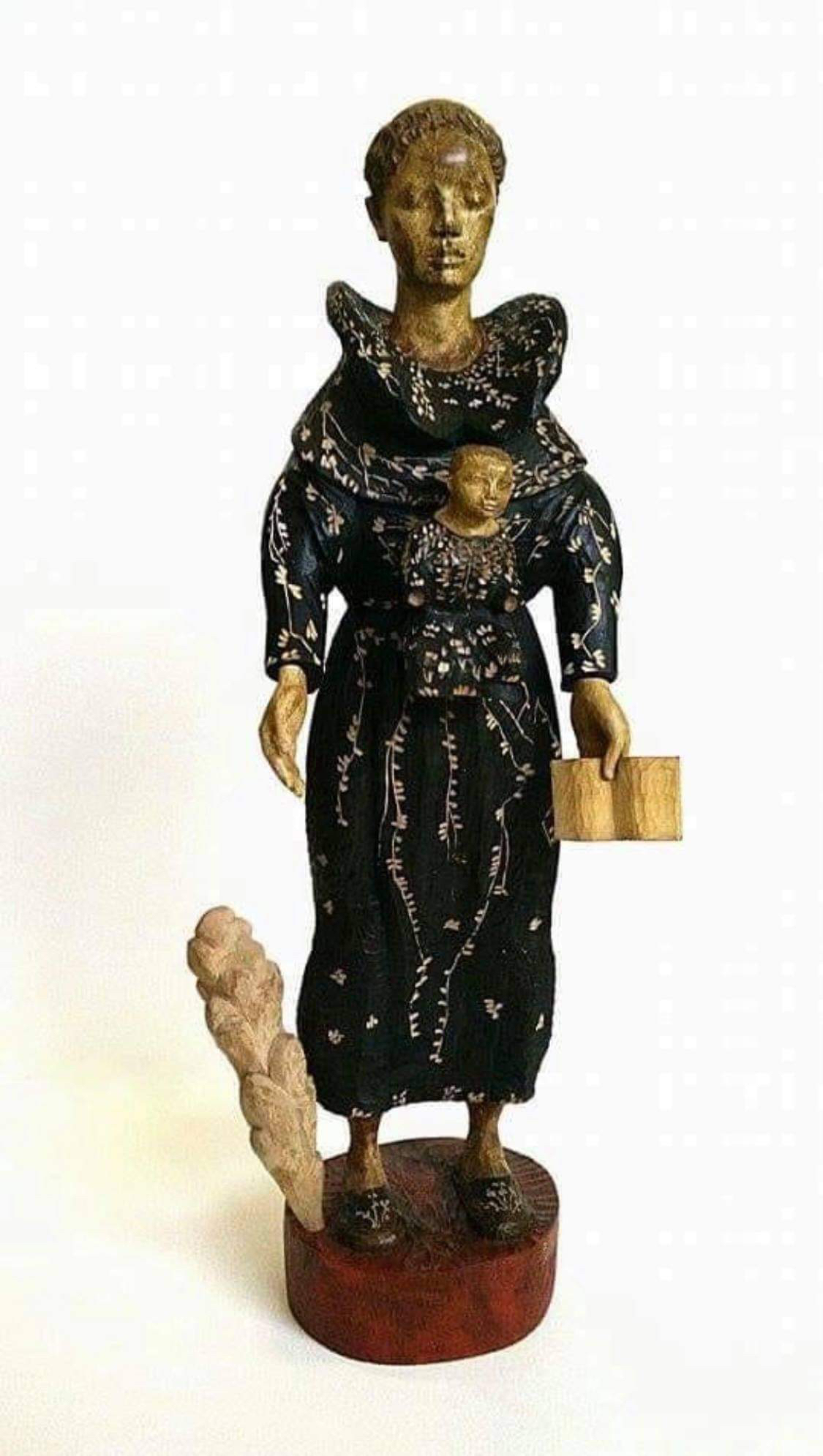
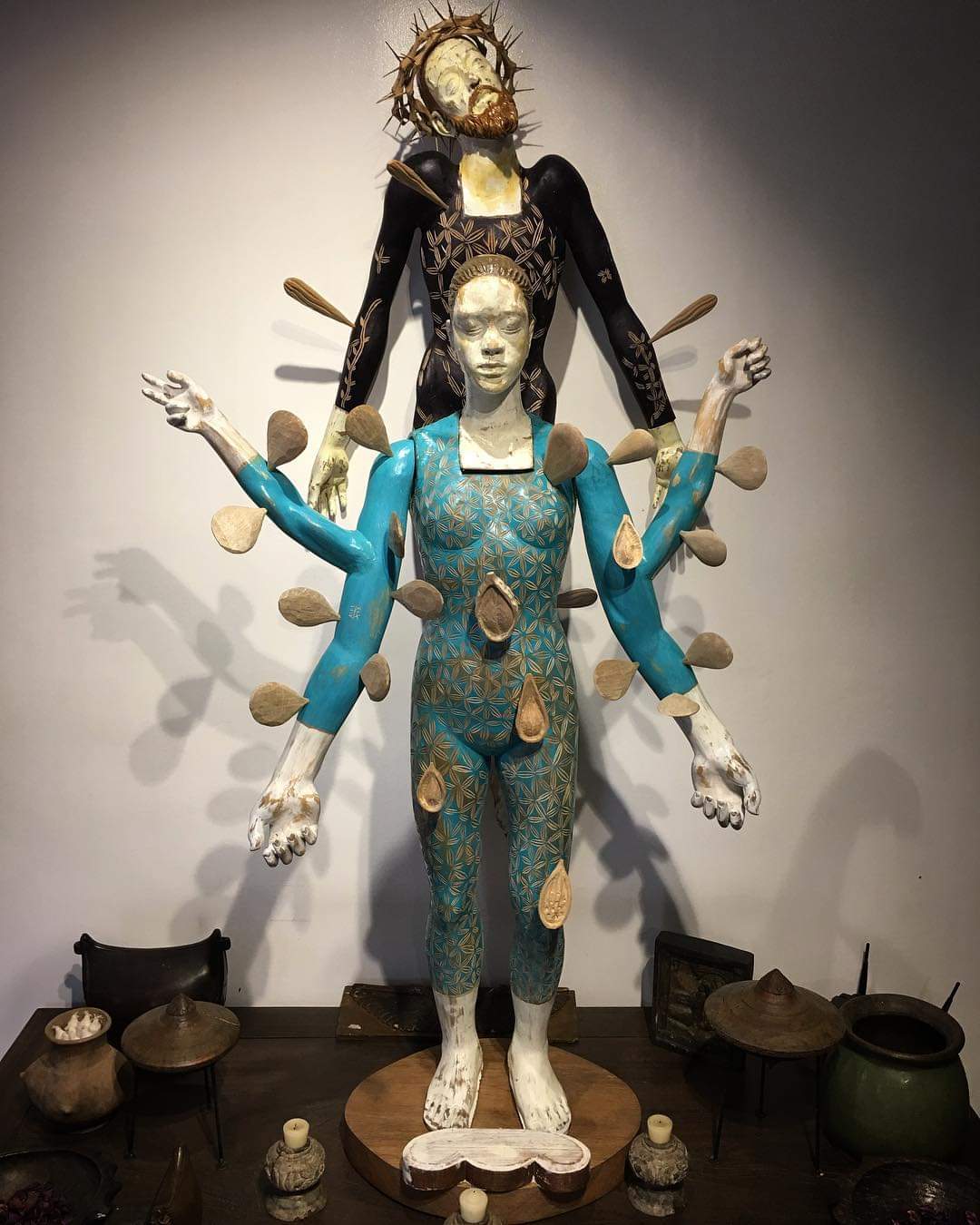
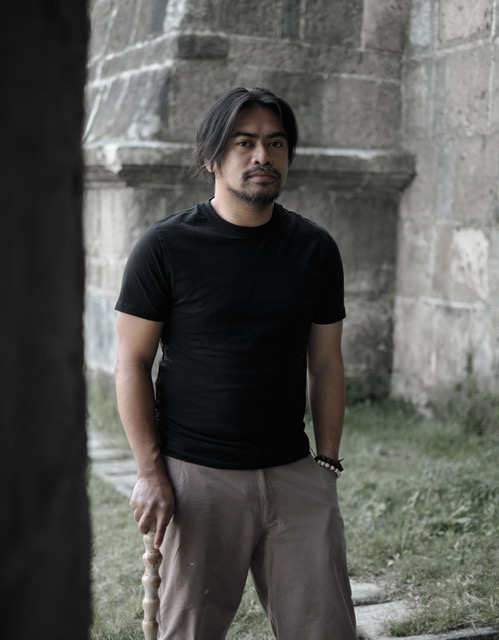
Indeed he looked every inch the part of an avenging angel (and his name summons those winged, sword-bearing creatures), bearded and muscular, with piercing eyes that seemed like they could see right through falsehood and deception. (Lorenzo Gabutina described him as “warrior, sultan, larger-than-life… a Pinoy Thor.”) His sense of mission, his critical intelligence, and his expressiveness may not have made him the easiest person in the room to sit with, but his seriousness was a reminder that art involves far more than decorating the homes of the rich, even as he created playful objects and rebultos that drew on native folklore and religion.

His formal résumé was more than sufficiently impressive. Coming out of the woodcarving tradition of Ilocos Sur, Riel went on to the Philippine High School for the Arts and UP, transitioning from painting to full-time sculpture in 2008. He undertook residencies and explorations in the US and Europe and served as curator for the Boston and Pinto art galleries. He also co-founded Artinformal, an art-education collective. In 2012, he was the winner of the Ateneo Art Awards-Fernando Zóbel Prizes for Visual Art, and in the same year was named one of the Cultural Center of the Philippines’ Thirteen Artists. 

Wood sculpture, he told Glenn Martinez, “served as my self-directed therapy following a debilitating episode of manic-depression in 2007. I had schizoid visions and dreams that were terrifying and disturbing. I felt the need to find an outlet that was more tactile than painting or writing. The following year I started carving wood sculptures based on the tradition of the rebulto, but following the urgings and suggestions of my visions. The practice had a cathartic effect and also helped me refocus my cultural work to do research on the craft.”

But as brilliant and productive as his own art was, Riel was also appreciated by his fellow artists for his advocacy of artists’ rights and his generosity toward others. A Facebook page dedicated to his memory and maintained by his relative and close friend Paul, “The Feathered Angel: A Tribute to Riel Hilario (1969-2021),” is full of testimonials to that giving spirit. Riel was on a mission to make sure his fellow artists were never taken advantage of by galleries and dealers, and for them to get their due recognition and respect. (In one recent episode, he recounted how he and Joyce had been turned down by a prominent bank’s branch in Antipolo when they tried to open an account, allegedly because artists can’t show proof of regular income; outraged, he recalled how solicitous the teller was in New York when he presented a $50,000 check for deposit.)

He was still brimming with ideas and plans for the future—having taught at PHSA, he was thinking of teaching at UP—when both he and Joyce were stricken by the virus. From Lucban came desperate calls for help—especially for oxygen—to friends like Glenn Martinez, Jason Moss, and Ricky Francisco. Glenn did what he could from Metro Manila to coordinate assistance, and Riel and Joyce were brought to a hospital in Lucena. But it was too full to accommodate them, and they were sent home. 

Joyce survived; Riel did not. But as one of Riel’s favorite sayings (and mine, from Hippocrates) goes, “Ars longa, vita brevis”—art is long, art endures, as short as our lives may be.

(Images courtesy of Joyce Campomanes)

Penman No. 273: A Privileged Friendship

IMG_7575

Penman for Monday, October 16, 2017


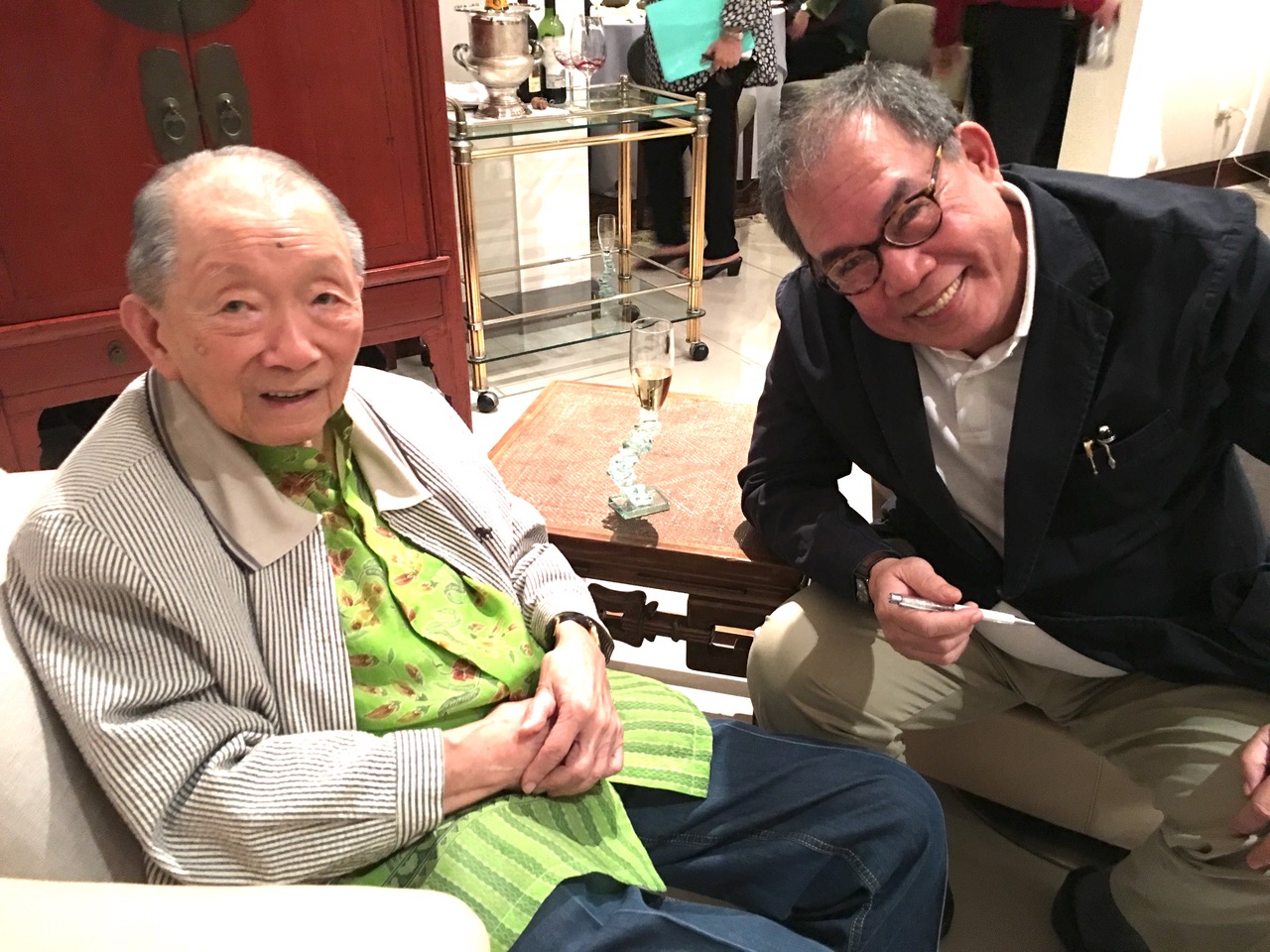
THE LAST time I saw Wash SyCip was from a far distance. It was his 95th birthday on June 30, 2016, and a long line of well-wishers—businessmen, politicians, and other celebrities—had queued up at the ballroom of the Shangri-La Makati to greet him and have their pictures taken with the icon. I thought for a second about falling in line, just to say hello, but then decided against it, already having spent more time with Wash than most people except his closest associates. He looked more frail than I had ever seen him, even as he kept up a cordial countenance seated in his chair on a raised dais, and I felt content to remember the sprightlier octogenarian I had first met a decade earlier.

Of course I knew who Washington SyCip was well before then; my wife Beng worked as an artist in the communications department of SGV in the 1980s, but I had never met the man himself—not until an opportunity arose to bid for and to write his biography in early 2006, when he was turning 85. I felt very fortunate to have been chosen for the job—and that’s what it was to me then, a job, albeit one involving an illustrious subject. I had no inkling that I was about to enter into a privileged friendship, something that would extend well beyond the writing of a book.

I had already done books for and about other personages in politics and business, and would do many more after Wash. But none of them—meaning no disrespect to or disregard for my other clients—would come close to the biography I would write for Wash, and it had everything to do with the uniqueness of the man, who lived not only an extraordinarily long life but also one far more colorful than you would credit an accountant for.

For months, we met Saturday mornings in his seventh-floor SGV office, and chatted for a couple of hours about phases of his life, proceeding chronologically from his childhood to the key decision to open his own accounting firm, a moment that I would later decide to open the book with. (Wash: Only a Bookkeeper was published in 2009 by the SGV Foundation and the Asian Institute of Management, and won the National Book Award for Nonfiction in 2010.) Immediately I felt at ease with his polite formality; no artificial chumminess there or dramatic flourish, just a quiet consistency of well-remembered detail, everything from trying to learn the foxtrot for a graduation dance and breaking Japanese codes in Calcutta to carrying a cold, dressed duck under his arm on the New York subway to bring to a lady friend.

Most readers, I’m sure, were looking for the grand contours, the big business decisions—and there’s all that in the book—but I tried to keep things homely, and was glad that Wash was game for it. He liked to play “Lara’s Theme” from Dr. Zhivago on his iPod—but not being a techie, often forgot to recharge it.

When he learned that I collected pens, he sent a bunch of them over to my house; I opened the box and saw that he had gifted me with some very nice ballpoints, which I thanked him for. When a perceptive associate gently reminded him that I collected not ball pens but fountain pens, he sent another box of the correct writing instruments—CEOs like him typically received scores of these as gifts and stored them away in drawers—with an apologetic note, even more graciously acknowledged by the ecstatic recipient. And every Christmas we would receive a box filled with some lovely piece of décor handcrafted by a microenterprise he supported in Cebu.

He had a soft spot for Filipino talent of all kinds. He once hosted a party at his home for President Cory Aquino, some ambassadors, and similarly lofty people. After dinner, he sprung a surprise on them. “Just get into your cars and follow me!” he announced with a twinkle in his eye. He led the convoy to a dimly downscale stretch of Boni Avenue, down into the happy maw of Club Mwah, the gay musical revue. Cory had a blast, and I had fun watching Wash garlanded by that feathery parade.

Sometimes I dropped by his office or chatted with him in the corner of a soirée to hear him share his views on current goings-on, both of us probably thinking that they would be useful inputs to the centennial update of his biography, but really just to catch up. It was these unscripted asides, his inviting trust, that I felt most privileged by. I suppose biographers come in through some special door, and with Wash, that door always seemed open.

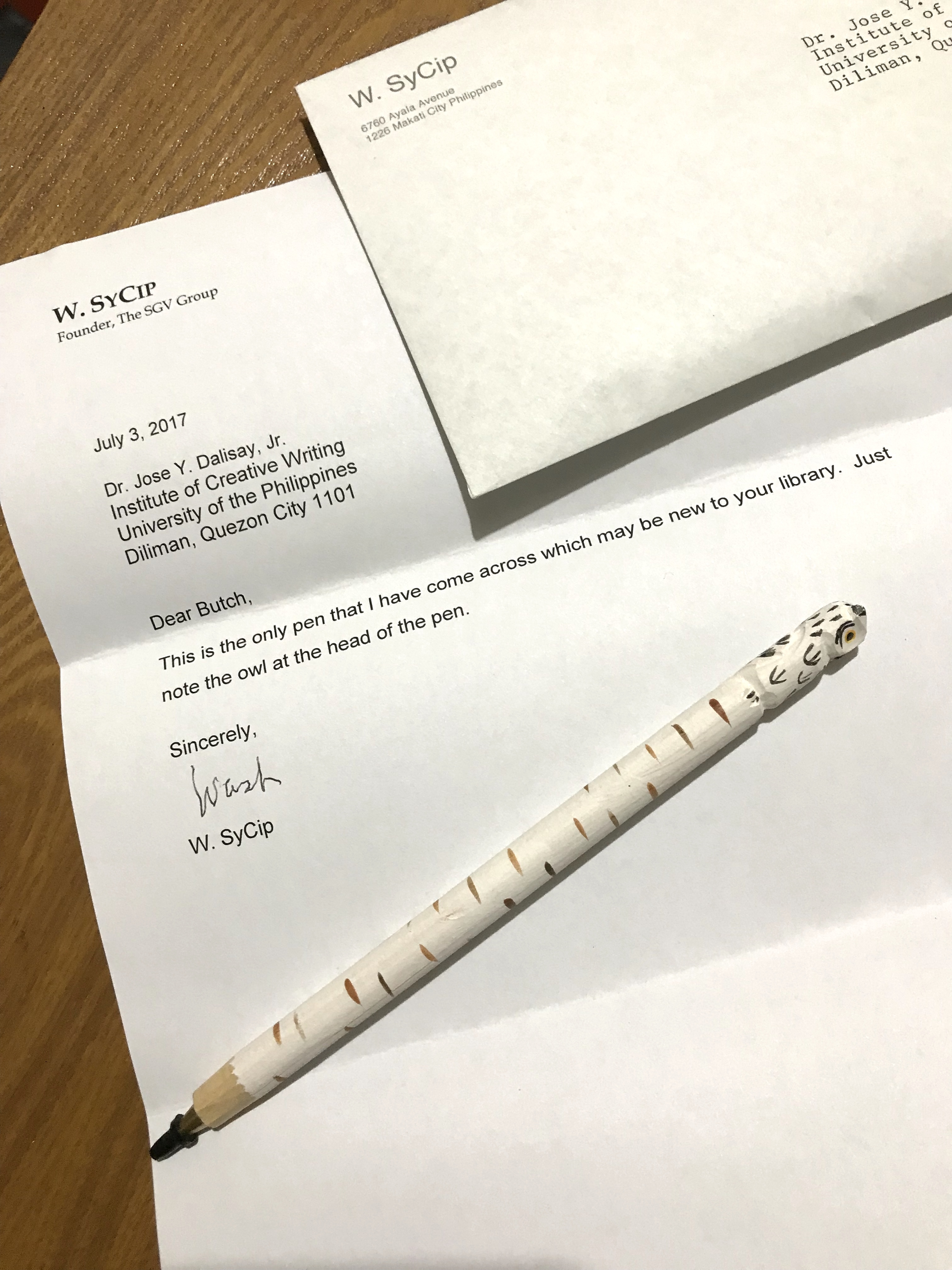
Last July I received an envelope from Wash, and even without opening it I could feel that it contained a pen inside. “Dear Butch,” said the accompanying note, “This is the only pen that I have come across which may be new to your library. Just note the owl at the head of the pen. Sincerely, Wash.” It was a ballpoint, but I didn’t mind—owls (and turtles) were his trademark avatars.

IMG_3207

His generosity was well known, but it was never the showy or sentimental kind. He believed above all in the capability of the poor to learn and to lift themselves up with a little help. Despite the American citizenship he had to accept in a time of war, he thought and acted as a true global Filipino.

When he passed away last week on a plane above the Pacific—bridging the two shores he knew best, and still on the job at 96—I was requested to draft an obituary, and I replied, choking, that it was going to be my honor. It was the first—and, almost certainly, the only—time I would shed a tear for someone I wrote about.

Penman No. 99: The Bromance of Fred and Wash

FredWashPenman for Monday, June 2, 2014


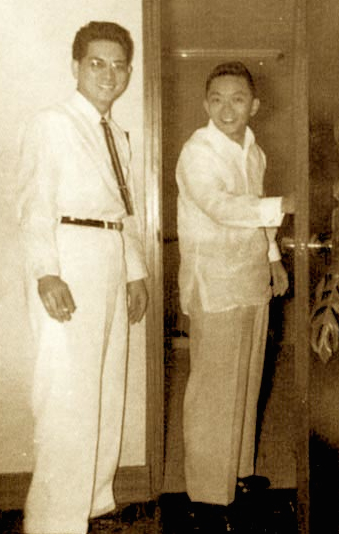
IT WAS with great sadness that I read last week about the passing, at age 92, of Alfredo M. Velayo—an outstanding accountant, teacher, citizen, and philanthropist. Fred Velayo was best known as the “V” in SGV or Sycip Gorres Velayo & Co., the pioneering accounting firm that he co-founded with Washington SyCip and Ramon Gorres after the Second World War.

I had the great privilege and opportunity of writing Wash SyCip’s biography some years ago, and among the delights of that assignment was meeting and interviewing Fred Velayo—who, like Wash, was already well advanced in years but still sprightly and brimming with boyish mischief. Tall, handsome, genial, and an irrepressible joker, Fred was the perfect foil for the more private and more formal Wash.

Fred and Wash had one of the most memorable friendships (today they call these unusually durable male bondings “bromances”) I’ve ever come across—certainly one of the longest ones, starting in the 1920s at the tender age of five, when both boys attended Padre Burgos Elementary School in Sampaloc, Manila. Their first meeting, on the first day of school, wasn’t too auspicious. The children started crying when their mothers and yayas had to leave—except Wash’s mother, who was a good friend of the principal’s, and was allowed to stay. So Wash sat there unperturbed, and Fred would remember with a chuckle that “Right that first day, of course, we all hated him. Naturally. He was looking at us, saying ‘Why the hell are you little kids crying?’”

With his brilliant mind and work ethic—qualities that Fred himself displayed—Wash would never again have to lean back on privilege to get ahead. But a little luck never hurt. Bright as they were, both boys got accelerated in grade school—not once, but twice. In Wash’s case, it didn’t occur just twice, but thrice. Fred always wondered how that happened when he was just as smart as Wash—and Wash didn’t tell him the real reason until they were in their mid-70s in 1996, when Wash let slip that there had been room in the upper class for just one more boy, and the teacher chose him—alphabetically.

Fred and Wash caught up with each other in V. Mapa High; they both lived in Sta. Mesa and walked to school together. The friendship—and the rivalry—continued over high school, then went on to college at the University of Sto. Tomas, from which both graduated summa cum laude. As I would note in my book, “To no one’s great surprise, Wash finished his four-year course in two-and-a-half years, graduating a full year ahead of Fred, and ending up being Fred’s teacher in one subject at the ripe old age of 17. Amazingly, Fred would close the gap a bit by also getting to teach in his junior year, also at 17.”

Wash went to Columbia in New York for his PhD and was caught by the War there, and joined the US Army as a codebreaker in India; Fred stayed behind and married the girl who would become his wife of over seven decades, Harriet. After the War, their paths crossed again—Wash came home, and Fred went to the States with Harriet and joined the Army.

But when Wash had to go back to the US to fulfill a residency requirement (he had to take US citizenship to be able to work as a codebreaker), he needed someone to mind the small accounting business he had started in Manila, and there was no other person who could fit that bill but his old pal Fred Velayo. He wrote Fred a letter that would become part of SGV lore. He told Fred, on December 16, 1946: “Dear Fred, Received your letter from Alaska the day after I mailed my last letter—but hasten to write you this note. You should try to return as soon as possible as the top opportunities here are excellent—the earlier you start the better. Master’s degree doesn’t mean much—ninety percent of the FEU accounting faculty do not have anything more than a bachelor’s degree—including some of the highest paid ones. But now is the time to get started as I believe that the more you put it off, the greater will be the competition when you get settled. There’s a lot of accounting work—and you can combine this with teaching and importing (with Miller-Gates)—the returns are much larger here than in the States and the competition for a capable person is much less. So cabron, get the hell on that boat and come out here. The various bills before Congress will undoubtedly increase the work of CPAs—but you have to get in on the ground floor… some come over fast. You can also try your hand at insurance—good and profitable line. Cost of living has been going down during the past month in spite of strikes in the States. Housing isn’t worse than in the States—so make up your mind—be your own boss—and come to virgin territory! See you soon. Wash.”

At first, Fred said no—he and Harriet had just begun to settle down in the US—but in January 1947, Fred changed his mind and took a plane home. The rest, as they say, is accounting history. Fred had a funny story about what supposedly happened next:

“One day, years later, Wash came back. He was still earning a little more than me. And so he came to my room. (WS) Fred, this has got to stop. (AMV) What are you talking about? (WS) The fact that I’m earning more from the firm than you. From now on everything will be equal. Our monthly drawings, even perks, club membership, everything, the same. It’s not fair to you that I’m getting a little more. (AMV) SOB, how come it took you so long? (WS) Never mind, from now on we’ll be equal partners. As he walked out of my room, he started laughing. (WS) Anyway, you’ll always be my junior partner. (AMV) After you said we’re equal from now on? (WS) I can’t help it. I’m 57 days older than you. He even counted!”

When we interviewed Fred for Wash’s book (Fred already had his own biography published before Wash), he told us a hoary joke, often recounted at SGV reunions, about dying ahead of Wash and getting to heaven sooner. I guess he knew something Wash didn’t. Bon voyage, Fred Velayo.