Qwertyman No. 131: A Relentless Questioner

Qwertyman for Monday, February 3, 2025
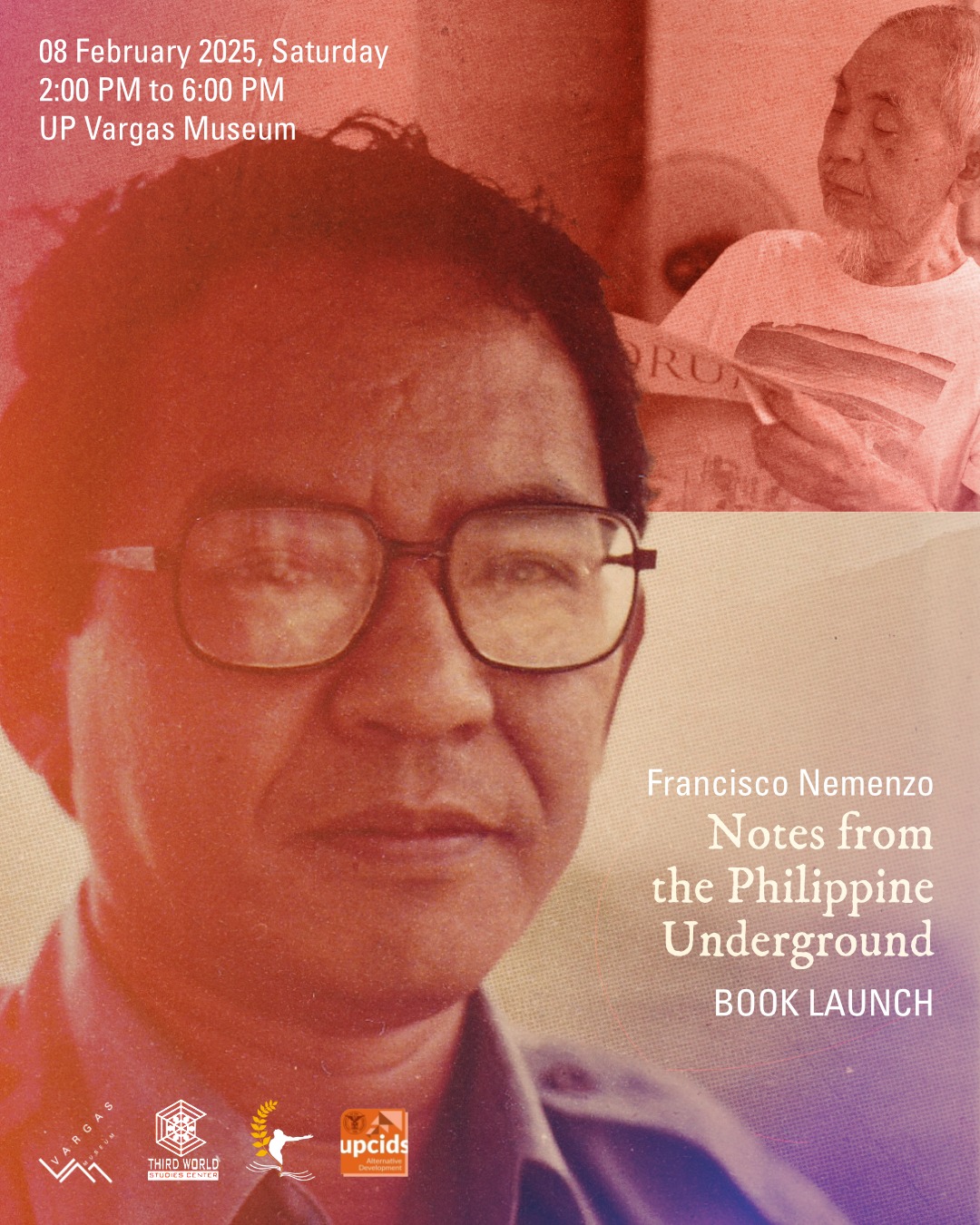
I DON’T know if there’s a Marxist heaven, but if there is, then Dr. Francisco “Dodong” Nemenzo, who passed away recently, must be smiling up there because of the forthcoming launch of his book Notes from the Philippine Underground (UP Press, 2025).

It’s too bad that Dodong won’t be around to see the book and sign copies for his legions of friends and comrades—many of them like my wife Beng, who remember him as a dashing and persuasively articulate professor of Western Thought, despite the Cebuano-accented English he was sometimes laughed at for by the ignorant. He never became my teacher in college, and oddly enough—because I was out of UP Diliman for most of the time he was teaching there—I never really got to know him closely as an activist and ideologue.

I did know him as a boss—he took me in as his Vice President for Public Affairs when he was UP President—and in that capacity I learned to respect and admire him as a man who held firm to his principles while finding practical and effective solutions to UP’s problems. This was especially true of our campaign to revise the outdated UP Charter, which eventually succeeded under President Emerlinda Roman, but which he tenaciously pursued despite the insults of spiteful politicians. 

Throughout his adult life and to the last, Nemenzo remained a professed and unapologetic Marxist—a word that would seem Jurassic in these post-Soviet and Trumpian times, but which he saw and lived in a different light. 

As the preface to his book by Prof. Patricio “Jojo Abinales” explains, “Dodong’s engagement with Marxist theory wasn’t an academic exercise. For him, Marxism was a living, breathing framework—a summons to connect theory to the existing conditions of everyday life. He wasn’t content to theorize from a distance; with a scientific mind, he dug into the realities of Philippine society, always interrogating its dominant ideas, structures, and contradictions. His writings speak to this dual commitment: the rigor of his analysis is matched by an acute sensitivity to the concrete lives of real people whose struggles he sought to illuminate. He distrusted all dogma, and sought to validate all received knowledge.

“Francisco ‘Dodong’ Nemenzo’s life and work resist easy categorization. He was a Marxist thinker, a revolutionary activist, an inspiring academic leader, and a mentor to generations of scholars and radicals. But more than any of these roles, he was a relentless questioner of the world as he found it—and a passionate believer in its potential to be different, if not better.”

Indeed the book shows how sharp, even scathing, Dodong could be in his opinions of how his idea of Marxism remains relevant and useful despite how it has been misused by many of its adherents and misunderstood by its opponents. 

He writes: “We must struggle against their misconception of Marxist theory and practice (e.g., equating Marxism with Stalinism and totalitarianism) and point out that humanism is inherent in the Marxist worldview. Going through the basic documents of Filipino social democratic groups, it is obvious that, even as they try to distance themselves from Marxism, their analysis of present conditions and their historical roots is almost entirely based on a Marxist framework.” 

He acknowledges the flaws and failures of Marxist parties caught up in internal conflicts (Dodong himself was once ordered to be executed by the party he belonged to, ostensibly for treason): “Can people be blamed for suspecting that communists are motivated by cynical calculations of what would bring them tactical advantages? Their loud and monotonous protestations ring hollow in the absence of inner-party democracy. The authoritarian and repressive character of the regimes their comrades established wherever they gained the upper hand reinforced this impression. This stigma they must shake off; otherwise they would remain at the periphery in the continuing struggle for democracy.”

He is not without wry humor. Reflecting on the ultimate folly of a revolution being led by a highly secretive, centralized, and “conspiratorial” party, he notes: “This is difficult to implement in the Philippine cultural milieu. A code of silence—what the Russians call konspiratsiya and the Mafiosi call omerta—is impossible among people who take rumor-mongering as a favorite sport. Our irrepressible transparency is a weakness from one point of view but a virtue from another. Our legendary incapacity to keep secrets is probably the best guarantee that no conspiratorial group can stay in power long enough to consolidate a dictatorship.”

Even for those disinclined or even hostile toward the Left, Notes from the Philippine Underground offers many valuable insights from one of that movement’s “OGs,” in today’s youth-speak. Nemenzo may be highly critical but he remains ultimately hopeful that positive and deep social change will happen, if the Left learns from its mistakes and finds new ways to engage society. Listen:

“There have been many pseudo-united fronts put up by the vanguard party. They consist of party-led mass organizations that simply echo the party line. None ever grew into a genuine united front, although they did attract a few prominent individuals who had no organizational base whatsoever. Other organized groups are often suspicious of the party and wary of being reduced into instruments for policies they do not accept.

“But I know of only three attempts at seriously establishing a real united front in this country: in the immediate postwar period, in the late 1960s, and very recently. They all collapsed because of sectarian methods of work. Sectarianism is the blight of all united front efforts everywhere….

“The Philippine movement has never been able to solve this dilemma. At the very moment when united front structures are set up, rivalries emerged. And intoxicated by short-term successes in expanding their mass organizations, the sectarians eventually prevailed.”

Pluralism, he suggests, is key: “Pluralism is a bourgeois liberal doctrine that ought to be preserved and enriched in the socialist revolution. It is not incompatible with socialism. The tension that arises through political competition would serve as a constant reminder that the party must earn the allegiance of the masses. Of course, no state would tolerate an opposition party that resorts to violent methods and solicits support from foreign powers. But this should never be an excuse for suppressing any opposition.”

Surely there will be blowback from those holding different views; expect the usual howl from UP bashers and red-taggers. But when that happens, even from the grave—or Marxist heaven—Dodong Nemenzo will have sparked the kind of discussion we direly need to find our way forward as a nation.
Qwertyman No. 126: The Young Dodong Nemenzo (2)

Qwertyman for Monday, December 30, 2024

THIS WEEK I continue with excerpts from my interview with the late Francisco “Dodong” Nemenzo, on his recollections of his genesis as a young intellectual and activist at the University of the Philippines in the 1950s.

“It was all a popularity contest. Everything just seemed to be socials. Homobono ‘Bon’ Adaza, who was then the editor of the Philippine Collegian, tried to organize a socialist club with me. Bon even put out an announcement for a meeting. Bon and I were contemporaries, but he was a year older than me. I think I was a senior by then. I was living with my father on campus, since he was a professor here. We had a cottage in Area 2, then we later moved to Area 14. Our whole family was here. 

“It was because of my readings. I had already read the history of the socialist movement, and I was fascinated by that so we formed a socialist club. I think just three of us turned up for the meeting—the third was Princess. After that we were always together. We weren’t going steady yet then. We continued being friends because she was the only one who listened to my sermons on socialism. You ask her, but I don’t think she had any association with socialism before. We had just that one meeting. 

“Bon was eventually expelled from UP, but I had a hand in his election as chairman of the Student Council and editor of the Collegian twice because we were friends. The editor was elected from among the topnotchers of the exam. 

“The UPSCAns didn’t have a candidate who passed the exam, who were all frat boys. Bon landed in the top three, but he had no supporters. I bargained with the UPSCAns because they held the majority. So I used my vote in the council to push for Bon. Eventually he became editor of the Collegian

“Together with the chairman of the council and also the leader of the UPSCA, we decided to hold the first student strike. This was because for one and a half years, UP had no president, with Enrique Virata serving as acting president. It came down to a stalemate between Vicente Sinco and Gonzalo Gonzalez. Squabbling behind them were Jose P. Laurel, who represented the Senate on the Board of Regents, and Carlos P. Garcia who was supporting Gonzalez. No one could get the majority. I was on that strike. I proposed a solution arguing for the Board to take decisive action but also endorsing Salvador Lopez, whose essays I loved, for president. The UPSCANs didn’t care who won, as long as we had a president. 

“Our strike paralyzed the campus for a couple of days. It didn’t last as long as the Diliman Commune, but it was the first—and it was my first mass action. I was the one who was planning the tactics. 

“I was really looking for allies when I met this labor leader who used to be the secretary-general of the Federation of Free Farmers. [We’ll call him Hernando for this account, pending verification of the name—JD.]He claimed to be a socialist and he seemed to have read books on socialism. He was a layman. He was the one who introduced me to labor leaders such as Ignacio Lacsina and Blas Ople. They had a group of young people who revolved around Lacsina, and they met at his office in Escolta. 

“But I continued my reading. Sometimes I felt alienated because they weren’t Marxists. They were just for nationalization, and I felt more advanced than they were. There were other students there, but they were not as involved as I was. When the Suez Crisis exploded in 1957, the Americans intervened in Lebanon. We decided to picket the US embassy. We were  already using the word ‘imperialism’ then. Prominent labor leaders were there, including Hernando. When we got there, the labor attaché invited us inside to have breakfast with the US ambassador. I didn’t want to go in, but Ople and Lacsina thought they could change US policy by convincing the ambassador, so we did. I was utterly disgusted by that experience. 

“I was due then to go to US for my PhD, on a Rockefeller fellowship at Columbia University. Our demonstration took place just a few months before I was to leave. I was an instructor in UP and my college wanted me take up Public Ad, but I wanted to get out of that so I chose Political Sociology. I had become an admirer of C. Wright Mills who worked there and I wanted to work with him, only to find out that he didn’t want to handle graduate courses. 

“I already had a room at the International House in Columbia. Everything was prepared. I already had my visa. But on the day I was supposed to leave, the embassy told me that I could not leave. The consul general showed me the immigration law, which banned the entry of communists, anarchists, drug addicts, and prostitutes. 

“I think they had some earlier information about me because Lacsina later told me that Hernando was a CIA agent. He said that once, he and Blas Ople wanted to invite Hernando for a drink so they could get him drunk and then ply him with questions to extract the truth. What happened instead was that Blas got drunk first so nothing happened. Then he lashed out at Hernando and told him to his face that he was a CIA agent, and cursed him for blocking me from taking up my scholarship in the US. Looking back, I think Lacsina was right!”

Dodong Nemenzo eventually went to the University of Manchester in the UK for his PhD in Political History. He returned to serve as dean of the College of Arts and Sciences, chancellor of UP Visayas, faculty regent, and 18th president of the University of the Philippines. He married Ana Maria “Princess” Ronquillo and they had three children—one of whom, the mathematician Fidel, became chancellor of UP Diliman.

Qwertyman No. 125: The Young Dodong Nemenzo (1)

Qwertyman for Monday, December 23, 2024

IT WAS with deep sadness that we received the news last week of the passing of Francisco “Dodong” Nemenzo, the staunch Marxist, nationalist, and former president of the University of the Philippines. My wife Beng and I are spending Christmas with our daughter in the US and being an all-UP family, we all knew Dodong and were much affected by his loss. Beng had been a student of Dodong’s at UP, and I was privileged to serve under him as his Vice President for Public Affairs twenty years ago. But long before this, I had met him as a student at the Philippine Science High School where his wife Princess taught us History; he came to pick her up in the afternoon in his Volkswagen Beetle whose door was emblazoned with the Bertrand Russell “peace” sign.

We will be missing the many memorial events that will surely be held in his honor these coming days, so I thought of recalling Dodong in a different way from what most of his colleagues and comrades will be speaking about him. More than ten years ago, I interviewed Dodong for a book I sadly have yet to finish, and he spoke with me about his life before he became the fighting ideologue everyone now remembers him to be. Let’s hear him in this abbreviated excerpt:

“We went back to Cebu after the war. Everything was still in turmoil. I enrolled at the Miraculous Medal School, a Catholic school, and completed my third and fourth grade there. By the time I reached fifth grade, Cebu Normal School was opened so I graduated from there. After sixth grade, I spent a year in the seminary in Cebu. That was my parents’ plan ever since I could remember. I was the only boy among three children, and the eldest. My parents were devout Catholics, and they considered it an honor when a member of the family became a priest or a nun. Since I was an only boy they wanted me to become a priest. I stayed there for only a year, and then I quit. That was probably the beginning of my radicalization. The seminary back then was run by Spanish or Vincentian priests who were supporters of Franco. They looked down on Filipinos and despised Rizal. 

“I went to the University of San Carlos. It was a Catholic school but my father was unhappy with the Science instruction. Our science textbook used the question-and-answer method and my father didn’t like that. He examined my notebooks every day and corrected what my teacher said. He got mad when we were taught creationism, and he lectured me on Darwin and evolution. I answered my teacher back and the principal reported me to my father for my heretical tendencies. My father decided to free me from this nonsense and transferred me to the Malayan Academy, a private non-sectarian school that had very good teachers. I finished near the bottom of my class, failing in Conduct and Tagalog. 

“I entered UP Diliman in 1953. The rule then was that you were exempted from the entrance exam if you had an average of 82, but my average was around 77 so I had to enroll in a summer institute that was like a backdoor into UP if you passed 6 units there. I didn’t know what course to take. My father didn’t want me to take up Law and wanted me to become a scientist like him, but I reckoned that if I did that, I would always be compared to him and come up short. So I chose a course called AB General. 

“The advising line was a mile long. Jose ‘Pepe’ Abueva, a friend of my father’s, passed by and saw me in the queue. He asked after me and I told him that I couldn’t think of a course I really wanted. He tried to sell me on Public Administration, but I didn’t like to serve in a bureaucracy. He said there’d be a lot of opportunities abroad, scholarships, and if I did well I could join the faculty. He had a lot of arguments, but the one that persuaded me was ‘If you join Public Ad right now, I’ll sign your Form 5 right away, and you won’t have to join this crowd.’ 

“That’s how I ended up in Public Ad. When the dean of Business Administration tried to recruit me and my (Pan Xenia fraternity) brod Gerry Sicat who was then in Foreign Service to go into Economics for our master’s, Pepe Abueva again swooped in and told me to take up an MPA instead, and to join the PA faculty immediately. So I became a faculty member in my senior year, just before my graduation, as an assistant instructor. I probably had the longest title in UP: ‘research assistant with the rank of assistant instructor, with authority to teach but no additional compensation.’ I really wanted to teach, but had no actual assignment. I only took over the classes of professors who went on leave. 

“I never joined the UP Student Catholic Action or UPSCA. Well, maybe for one year, but I was never active and then I got out of it. I joined only until I met an UPSCAn named Princess. We always met in Delaney Hall. We were together in the student council. She was representing Liberal Arts, I was representing Public Ad. I joined in 1955, my third year, along with Gerry Sicat, Manny Alba, and Jimmy Laya. I became a liberal and distanced myself from UPSCA. 

“I idolized (Philosophy professor) Ricardo Pascual. I was looking for a cause, but these liberals were just fighting for academic freedom with no purpose. It seemed empty. I was under the influence of Pascual for some time, but we had no advocacy. I joined a short course in Social Order at Ateneo on the papal encyclicals on labor. My liberalism and my growing social consciousness merged and I started reading Marx and Huberman on my own, to find out what we were fighting for. There were a couple of professors like Elmer Ordoñez and SV Epistola who according to Bill Pomeroy had already reached that level of consciousness, but when he left they became liberals, they weren’t really organized.” (To be continued)

(Photograph by Rick Rocamora, used with permission)