Qwertyman No. 174: Doing the Doable

Qwertyman for Monday, December 1, 2025
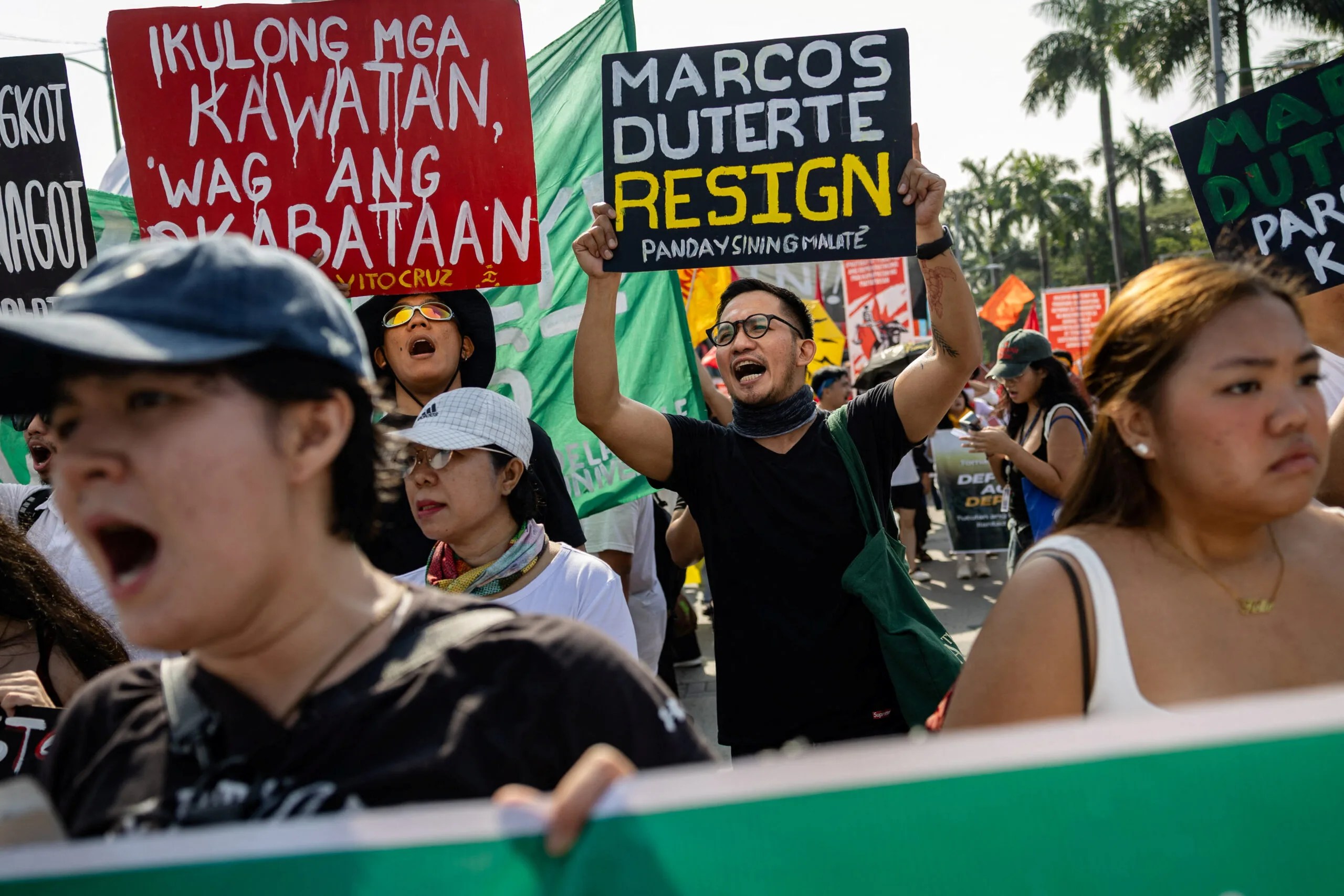
AS NOT a few placards in yesterday’s big anti-corruption march would have said, both President Bongbong Marcos and VP Sara Duterte should resign, along with everyone in public office implicated in the flood-control scandal and all the other shenanigans that have come to light over the past couple of months. 

That probably means half the government, but given the current public mood, the more the better, to give the nation a chance to rebuild itself on new foundations of moral rectitude and accountability. At least that’s the long view, supported by the Left among other parties who think that anything short of a national reset will simply paper over the problems and guarantee their comeback. 

It all sounds good, and it does make sense—except that, as we all know, it ain’t gonna happen. 

It’s about as realistic as the expectation that BBM will fall to his knees, own up to the Marcos billions, and ship all that money back to the Philippines on a FedEx plane for mass distribution, any more than VP Sara will admit to her father’s drug-fueled bloodlust, seek forgiveness of all the tokhang victims, and forsake her presidential ambitions. Let’s face it: the Marcos and Duterte dragons will be clawing at each other all the way to 2028. Meanwhile, what are we mere mortals supposed to do or to hope for? 

In the very least, we can ignore the DDS calls for BBM to step down and for Sara to take over, because there’s even less appetite for that than the Both-Resign demand. The Dutertes want to make hay of the moment, but the sun isn’t exactly shining on them. Despite their strong and well-funded social media efforts, the DDS camp seems pretty much in disarray, with Digong in jail, Sara in limbo until February (it tells me something that they approved the OVP’s 2026 budget in full—it’s for the office, not VP Sara, although she doesn’t seem to know the difference), Bato de la Rosa suddenly scarce, and their shot at a junta takeover badly misfiring. 

(The ICC’s predictable decision not to grant his interim release could in fact prove to be an ironic win. Digong at this point is useful only as emotional capital for Sara’s survival and triumph. His camp, I suspect, secretly wants him to stay in The Hague as a symbol of the Marcoses’ unforgivable perfidy. Bringing him back home will mean having to take care of a grumpy old man whose greatest ability—cursing—isn’t helping him much in his present situation; he was never a Leila de Lima, and certainly no Ninoy Aquino.)

All the players’ moves are interesting in this grand melodrama. I frankly can’t trust the Left, either, to show the way forward. Like a religion (did I hear someone say “Iglesia ni Cristo”?), the Left likes to flaunt its moral ascendancy—to “virtue-signal,” in today’s parlance—and its rock-solid grasp of the global and local situation from the Marxist standpoint. And yet it gets all tone-deaf and cross-eyed when it comes to picking its horses—ditching EDSA, but backing billionaire capitalist Manny Villar and then pseudo-nationalist and butcher Rodrigo Duterte for the presidency (should we even mention slaughtering comrades it deemed wayward in the Ahos campaign?). 

Interestingly, the INC also supported Duterte in 2016, and then BBM and Sara Duterte in 2022. While adopting some progressive liberals like Franklin Drilon, Risa Hontiveros, and more recently Bam Aquino and Kiko Pangilinan into its senatorial slate, it has also flexed its machinery behind Duterte surrogates Bong Go and Bato de la Rosa, as well as corruption-tainted Senators Joel Villanueva and Jinggoy Estrada. During its last mass rally last November 25 for “peace, transparency, and accountability,” however, it was careful to distance itself from recent calls for BBM’s resignation. In other words, the INC is the perfect straddler, the seguristathat makes sure it will survive and prosper under any administration, reportedly to secure key government appointments for its favored nominees.

That leaves us and our own wits, which—considering everyone’s else’s brain fog—might yet prove the most trustworthy.

In the realm of the doable, I want to see heads roll—as close to the top as the situation will allow. One way of looking at this, and strangely enough, is that the Filipino people aside, the party with the greatest stake in seeing this anti-corruption campaign through to the end (i.e., just short of the Palace) is PBBM himself. Having opened this Pandora’s box, he well knows that the only way he can keep his own head and hold sway over 2028 is to catch all those demons he released. I don’t know about you, but right now I’m desperate enough to let BBM finish his term in relative peace if he achieves nothing else than the herculean task of cleaning up the stables.

VP Sara’s impeachment trial should resume in February and will be a more efficient and definitive way to shut her out for good. But we have loads of senators, congressmen, department secretaries and undersecretaries, and lesser flunkies all caught up in this mess who should be held to account for their thievery. Hold the big bosses, the ultimate signatories, accountable, sure. But don’t let the second- and third-level enablers and functionaries off, because the message needs to be sent that complicity won’t pay—and that your sponsors will ditch you when things get too hot.

I want to see our courts work, overtime, to expedite the prosecution of these corruption cases. No pussyfooting, please, no Maguindanao massacre here. Let’s put a quick and decisive end to the kind of legalistic foolishness that lets a senator off the hook for a P30-million “private contribution,” with the judgment rendered by the Comelec commissioner who had previously served as that senator’s lawyer. How the heck can that be allowed to happen? What ethical universe are we in? The same goes for former Ombudsman Samuel Martires’ “forgetting” why he had kept secret his decision junking his predecessor’s carefully crafted case against Sen. Joel Villanueva. 

If the Comelec accepts Sen. Rodante Marcoleta’s ridiculous excuse that he kept millions of political donations off his report of campaign expenses because they were meant to be “secret,” then we should launch a million-people march not just against the likes of Marcoleta but also specifically against the Comelec to hound those charlatans out of office. That commissioner who couldn’t find the shame to recuse himself from his former client’s case should be impeached if he doesn’t resign.

I have no problem with people marching and screaming “Marcos, Duterte, resign!”, because we have billions of reasons to be upset with both. But I hope that doesn’t keep us from going after immediate and tangible if less-than-perfect results. Look at it this way—gut the body, and you’ve effectively chopped off the head.

(Photo from rappler.com)

Qwertyman No. 139: Filipinos for Nothing

Qwertyman for Monday, March 31, 2025

THERE’S A part of me that wants to stop beating up on the Dutertes, lest I be accused of being part of the Marcos propaganda machine (which stands to benefit from all this anyway, whatever I say), but like the gift that keeps on giving, the D’s and their people just won’t let me let them be. Being no lawyer, I’ll have nothing to say on the legality or otherwise of the former President’s arrest and forced departure for the Netherlands—except to opine, as others have, that justice sometimes works in mysterious ways.

My beef for this week is how the Duterte Agitprop Department (let’s call it DAD, like Elon Musk’s DOGE) has spun the whole ICC affair in the public sphere. These days, you never expect people to stand on the truth and nothing but the truth in these political matters. But you do hope for s0me degree of sophistication, for the kind of professional finesse that will justify the multimillions that any PR crew tasked with saving Rodrigo Duterte’s skin—or barring that, at least his reputation—will have been budgeted.

There are three propositions by the Duterte camp that I want to focus on, among many others that have arisen since the arrest.

First, his supposed global allies and endorsers. 

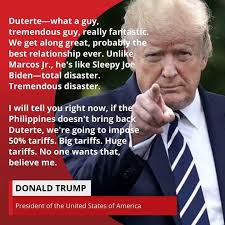
Donald Trump, for example, reportedly took precious time out from dismantling American democracy to declare that “We will protect Rodrigo and the Filipino people from the oppression you are facing…. I and the United States will not allow any of our allies and friends to suffer, and we will impose sanctions against the Marcos Administration for the unlawful act they did.” Why, he had even called Xi Jinping—not about tariffs, not about Taiwan, not about American forces in the Philippines—but about the “serious matter concerning our good friend Rodrigo.” For his part, Xi Jinping—who on a state visit to Manila did say “Our relations have now seen a rainbow after the rain” in response to Duterte’s more prosaic “I simply love Xi Jinping!”—supposedly brought up the Duterte arrest and the ICC in his opening address to the Boao Forum for Asia. Not to be outdone, another Duterte hero, Vladimir Putin, was reported to have threatened (someone—not specified) with “grave consequences” for Duterte’s arrest, as it violated the Rome Statute (which Russia incidentally pulled out of in 2016).

It’s all good when a national leader of superlative virtue and achievement has been so badly wronged that the world takes notice and his peers rise up in alarm to protest the injustice. But really—Donald Trump, Xi Jinping, and Vladimir Putin, all of them prime candidates for the ICC’s hospitality (Putin already is, along with Benjamin Netanyahu)? Never mind that all these supposed endorsements turned out to be fake; they still elicited applause from the DDS faithful, which I suppose was the intended effect. Q: Would it have been too much to expect an endorsement from the likes of Pope Francis? A: Yes.

Second, that call for OFWs to stop remitting their earnings home in a “Zero-Remittance Week” protest.

Our overseas workers contributed nearly $40 billion to the Philippine economy last year, so someone at DAD must have figured it would be brilliant to prick that bubble in the name of remitting Duterte home. But yet again, really? 

Granted, PRRD created the Department of Migrant Workers and the OFW Bank, and brought home hundreds of thousands of OFWs during the pandemic. Former OWWA chief Hans Cacdac even called him “the father of OFWs.” I don’t doubt that the Duterte name has a lot of traction in our expatriate communities, and that flexing a bit of their economic power in a week-long protest will ring some alarm bells, but you might as well ask people to chop off a finger to prove their fealty. For how long do you imagine will Pinoys postpone housing amortizations, tuition payments, maintenance meds, and grocery expenses to protest even the crucifixion of Jesus Christ?

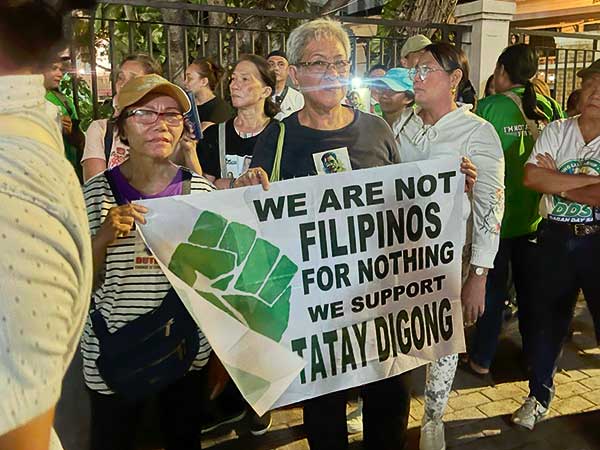
Lastly, and perhaps closest to my propagandist’s heart, there’s that inexplicably vague “I am not a Filipino for nothing” slogan.

Sure, it sounds brave and bold—like it actually says and means something. But does it, really? I’ve been turning the statement around and around in my head and maybe I’m extraordinarily dense and unreceptive but I just don’t get it. In rhetoric, double negatives are often used to suggest or even emphasize the opposite (the technical term is “litotes,” as in “That’s not a bad idea” or “She’s hardly destitute”). 

Rarely do double negatives make good copy for T-shirts and streamers, if you want to rally the masses. Well, there was Winston Churchill’s “We shall never surrender” (arguably a double negative) speech on the occasion of the Battle of Britain in June 1940, but that statement was preceded by a string of powerful positives: “We shall fight in France, we shall fight on the seas and oceans, we shall fight on the beaches, we shall fight on the landing grounds, we shall never surrender.”

Ninoy Aquino—who must be rolling in his grave at being compared to Digong Duterte—famously said “The Filipino is worth dying for,” a slogan ironically made all the more resonant by the fact that it turned out to be self-fulfilling. I doubt that Duterte will carry his emulation to that extreme, but he or his handlers can learn from its clarity and brevity, which contribute to its emotional appeal. “I am not a Filipino for nothing” means, well, nothing. It says nothing about freedom, justice, peace, love, patriotism, godliness, courage, or integrity—none of the grand ideals and ideas that our heroes exemplified. Might it be because these notions were never really associated with a president whom we best remember for his crude expletives and constant exhortations to kill? 

“Sampalin ang ICC!” sounds much more honestly him. It still sounds lame, especially given where he is right now, but it seems more purposeful, and should look good on a green T-shirt.

Qwertyman No. 138: Dutch Entertainment

Qwertyman for Monday, March 24, 2025

AS I’VE mentioned here before, I was a prisoner once—under martial law, for more than seven months, when I was eighteen. I had been arrested without a warrant for unspecified offenses against the State, on the strength of an Arrest, Search, and Seizure Order (ASSO) issued by Defense Secretary Juan Ponce Enrile. ASSOs were literally a catch-all piece of paper, meant to capture anyone whose face the regime didn’t like. I was sleeping at home when military agents barged in, and scooped me up in front of my terrified parents.

Our prison stood on a patch of land where the upscale BGC stands now; when we looked out at night we could see the neon lights of Guadalupe flashing. We had a small library in the back, TV in the mess hall, chess, calisthenics, and rumor-mongering for entertainment. It wasn’t too bad when there were just 40 of us occupying two Army barracks in the early months of martial law, but when we grew to over 200, the harsh realities of prison life set in, and people began escaping through the barbed wire.

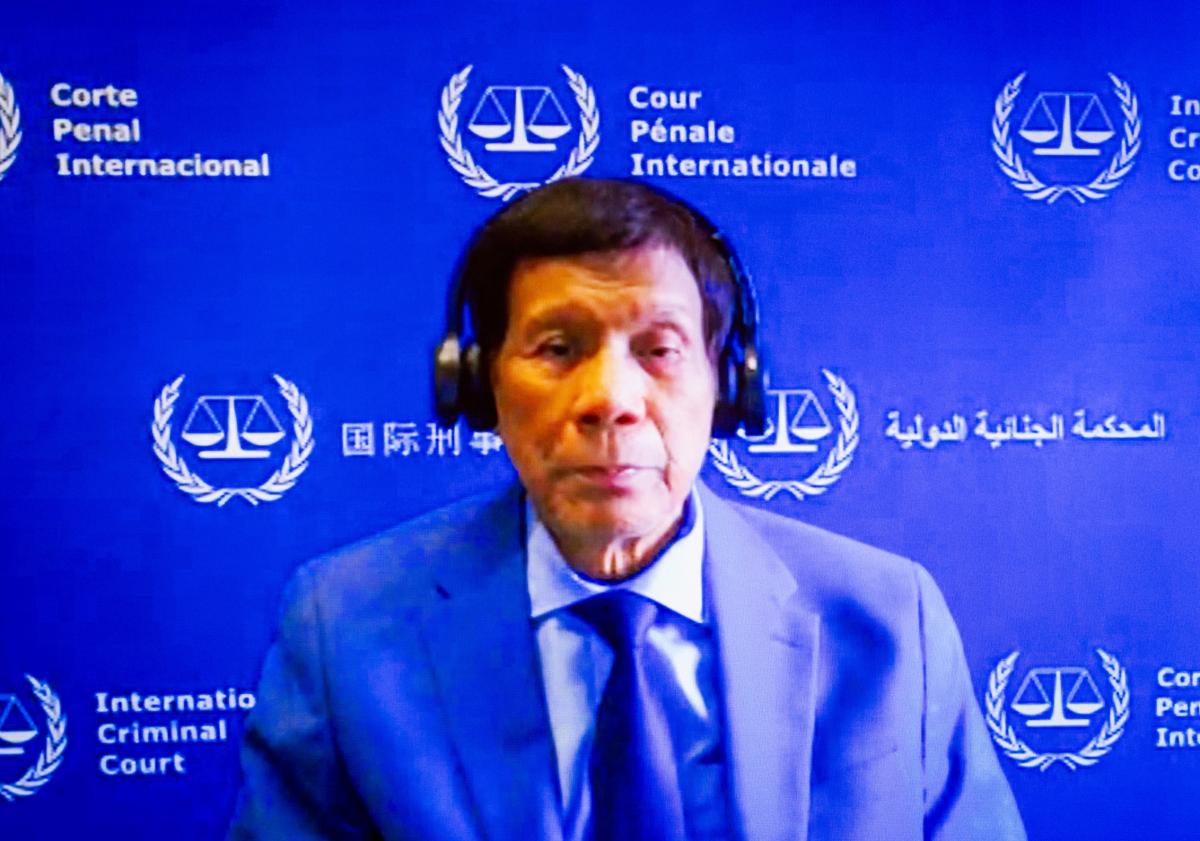
These recollections came back to me last week as I thought about the surprise arrest and deportation of former President Rodrigo Roa Duterte to a holding cell in the Netherlands while awaiting trial by the International Criminal Court.

By any legal reckoning, he’s going to be there for a while—he won’t be arraigned until September—so like it or not he’s going to have to adjust to his new abode over the next few months, like we had to in Bicutan.

His subalterns and supporters can make all the noise they want outside his prison, in the Philippines, and wherever in the world a DDS chapter exists, but RRD’s time ahead in Scheveningen will be largely spent in quiet and solitude.

From what we’ve seen online of his holding cell, Digong’s digs aren’t plush by any standard, but seem fairly adequate and comfortable—just spare enough to suggest to its occupant that he is in some kind of retreat, where he can ponder his worldly actions and contemplate the afterlife. Indeed the room—with its military cot and washbasin—evokes priestly economy, in stark contrast to the sybaritic excesses its previous tenants must have been accustomed to in their prime. In fairness to the incumbent, that lifestyle is something he has never been associated with; part of his popular appeal stems from his image as a man used to sleeping on hard beds and dining on the simplest fare.

There is a large flat-screen TV in the room, through which Digong can follow the news of the world and—given the way that world is going—feel upheld in his conviction that a hard fist and a knock on the head always makes things right. His heroes—Donald Trump, Vladimir Putin, and Xi Jinping (notably the same despots “quoted” by his trolls as expressing their support for him, like character references)—seem to be doing all right, keeping the world safe from the rule of law.

He might learn that the Dutch music industry is undergoing a boom on the strength of songs like “Anxiety” by Doechii and “Guilty” by Teddy Swims. Football, tennis, and golf are the favorite sports of the Dutch, although Digong might also be amused by a Frisian sport called klootschieten, which involves throwing a ball and sometimes drawing blood. Dutch cinema is a small industry, but The Punisher should still be thrilled by local crime classics like “Murder Story” (1989), “Gangsterboys” (2010), and “Accused” (2014).

Should RRD prefer interesting human conversation, I doubt he’s going to get it from the likes of Harry Roque, whose own tribulations must be coming out of Digong’s ears (“I want to go home, and you want to come here?”). If there are any CPP-NDF holdouts left in Utrecht, I’m sure they’ll have  a lot to talk about on a prison visit, going back to the Left’s early flirtation with their “nationalist” ally.

But truth to tell, if I were the former President, I would spend my time in Scheveningen writing my memoirs. I wrote a novel about my government-sponsored Airbnb experience, but given his bluntness, fiction probably won’t be RRD’s best suit.

I suspect Digong is a lot more articulate and maybe even more urbane than he lets on, because no Chief Executive could possibly be that vulgar and that ill-mannered without it being an act (you can imagine him rehearsing those PI’s before the SONA and turning up his collar to look even more roguish). All his life, he has presented himself to be a man of menace, projecting unforgiving brutality, steeping his hands into a cauldron of boiling blood to strike fear into his foes—but couldn’t all that have been just a show in the name of, uhm, good governance? 

The alternative narrative could go thus: In truth and deep at heart, all by his lonesome in his corner of the darkened Palace, he may have been a sensitive and tortured soul whose conscience reared and roared with every fresh report of another tokhang victim, who felt the anguish of every wife and mother like a stab to his own tender heart. He had done what he had to do for the noblest of purposes—the salvation of his suffering people from the stupor of narcotics (about which he knew something himself, but it was only to ease the pain from a motoring accident—all other uses were criminal).

RRD’s memoirs would not only be a spirited defense of his life—an apologia pro vita sua, as they used to be called—but a full, tell-all accounting of everything everyone ever did: henchmen, enemies, beneficiaries, and erstwhile allies alike. If he says he can’t get justice at the Hague, then at least he can dispense some of it from the safety of his albeit involuntary confinement.

Now that would not only be edifying but entertaining, wouldn’t it?

Qwertyman No. 137: ICC Ex Machina

Qwertyman for Monday, March 17, 2025

IN PLAYWRITING and fiction, we call it deus ex machina—literally, the “god out of the machine”—which has come to mean a miraculously happy or fortuitous ending to a long and agonizing drama. 

You’ll find it, for example, when a virginal heroine—beleaguered by dirty old men and rapacious creditors—seems on the brink of yielding her precious virtue, tearfully praying on her knees for deliverance, when a kindly lawyer comes knocking on her door to announce that a distant uncle has passed away, leaving her his fortune. We rejoice with her—despite feeling, at the same time, that divine intervention came a bit too conveniently. This is why I admonish my students to refrain from employing deus ex machina in their stories, because in today’s hard-bitten and cynical world, nobody really believes in it anymore, and readers simply feel deprived of a more rational ending.

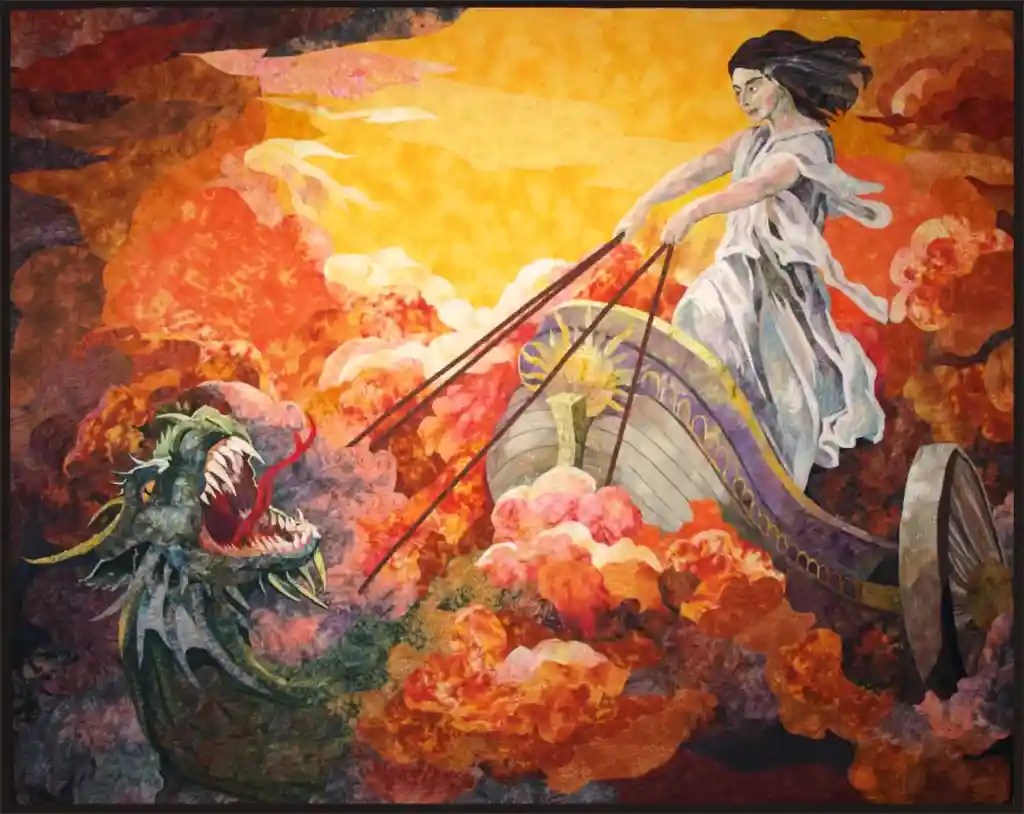
Like many things we know about drama, the idea goes back to the ancient Greeks, whose playwrights used it to great effect, Aeschylus and Euripides among them. Euripides most memorably turned to deus ex machina in Medea, where the title character—having been cheated on by her husband Jason—kills Jason’s mistress and their own two children. Guilty both of murder and infanticide, Medea seems hopeless and bound for damnation—until a machine, actually a crane shaped like a chariot drawn by dragons, emerges from behind the stage. It has been sent by Medea’s grandfather, the sun-god Helios, to pluck Medea away from her husband and from the coils of human justice and deliver her to the safety of Athens.

Was it fair of the gods to save Medea from the punishment awaiting her on earth? It’s arguable, but more than a device to resolve a messy plot, the “god out of the machine” was meant to remind the Athenian audience that a higher order of justice obtained, and that when humanity became too entangled in its own predicaments, then it was time for the gods to take over.

A lot of this swept through my mind last week as the drama of Rodrigo Duterte’s arrest and express delivery to the International Criminal Court at the Hague played out on TV and social media. Had the gods come out of the machine to impose divine justice? It had seemed nearly impossible a few years ago, when Digong was still flaunting his untouchability and taunting the ICC to come and get him. Well, we all know what happened since then—and they did. 

We understand just as well that the Marcos administration performed this operation not out of some abounding sense of justice or because it had suddenly acquired a conscience and realized the evil with which it had “uniteamed” to electoral victory in 2022. “We did what we had to do,” President Marcos Jr. explained on TV, with deadpan truthfulness—referring superficially to the Philippines’ obligation to honor its commitment to Interpol, but subtextually to the irresistible opportunity to cripple someone who had become a political arch-enemy, and providentially gain the support of masses of people harmed and disaffected by Duterte’s butchery.

The outswelling of that support—at least for Digong’s arrest and deportation—was spontaneous and sincere. Not since the Marcoses’ departure at EDSA had I felt such relief and exhilaration—and surely the irony would not have been lost on BBM, who knows what it was like to leave on a jetplane, kicking and dragging, for an uncertain future.

And what I say next may go against the grain of everything I have said and thought about the Marcoses, but no matter what ulterior motives may have come into play in this episode of the Duterte-ICC saga, I feel thankful for the resolve and the dispatch that BBM showed in this instance. Along with his administration’s resistance to Chinese aggression in the West Philippine Sea, this will be certain to count among his most positive achievements. 

The great difference between this drama and Medea, as an example of deus ex machina, is that the intervention of the ICC (with BBM helpfully providing the crane) isn’t going to save Duterte, but rather the people whom his presidency soaked in blood. But as with Medea, the “gods” step in when local justice proves impotent or inadequate (and did anyone really believe that Duterte would be hauled before and convicted in a Philippine court of law, when even the Maguindanao Massacre took a full decade to produce convictions for the principals?).

The question now is what next—not for The Great Punisher, for whom a prolonged trial at a cushy court will not be punishment enough, but for the Marcos administration, which suddenly finds itself with more political capital at its disposal, and yet also put itself at greater risk? Surely it must also realize that it not only has committed itself to tearing down the entire House of Duterte and confronting the many millions of voters they still represent, but that it has also set itself up for higher expectations, on pain of suffering the same ignominious fate?

In the hopeful bit of theater playing in my mind, I imagine BBM parlaying the bonus of goodwill he has earned from this maneuver into a broader if not genuine resolution to distance himself further from his predecessor and create a freer and more just society. There are clear and immediate steps he can take in this direction. The first gesture would be the release of all remaining political prisoners, followed by the abolition of the NTF-ELCAC, which no longer serves any useful purpose (not that it ever did). He can root out and punish the enablers and perpetrators of Oplan Tokhang and eliminate oppression and corruption from the mindset of Philippine law enforcement. And then he can begin reforming Philippine governance, starting with the quality of the people he seeks to bring to power—senators, congressmen, and the like.

But then that would be the ultimate deus ex machina, and we have been shaped by experience into a stubbornly disbelieving lot.

Qwertyman No. 79: Hymns of Repentance

Qwertyman for Monday, February 5, 2024

A CERTAIN senator was quoted some time ago as saying that Filipinos supporting the intentions of the International Criminal Court to probe the Duterte administration’s bloody tokhang campaign should be made to sing the national anthem 1,000 times to regain their sense of patriotism. The clear message was that, if you were in favor of an international body looking into local crimes and liabilities, you were being anti-Filipino. 

It wasn’t surprising, of course, given that the good senator was among those prominently mentioned as possible defendants in the case. In jest, he said that if he were found guilty, he would miss his grandchildren if he were incarcerated in the Hague. And just to be sure, he added that not all people in jail are guilty—he certainly wasn’t.

Without commenting on the merits or demerits of a hypothetical ICC case against officials of the previous administration—something we have enough lawyers on both sides to perorate upon—I’ll just observe that the quality of justice the senator and his likely dock mates can expect from the ICC will surely be far better than that received by the victims of summary and extrajudicial executions under the regime of tokhang. In the very least, guilty or not, they will be alive and reasonably comfortable, although they might temporarily miss the company of family and friends, as those bereaved by tokhang have come to experience for all eternity.

I was intrigued by the suggestion that repeated singing of “Lupang Hinirang” would make a better Filipino out of me, or at least make me think of the ICC as some kind of fire-breathing Godzilla threatening to incinerate the Filipino race off the face of the earth.

There are far more effective songs  for instilling love of country. Yoyoy Villame’s “Philippine Geography” will teach us more about the country we say we’re dying for than our anthem, which must have been sung hundreds of times in the halls of Congress without much palpable effect on the patriotism of some occupants. At least I’m assuming it’s regularly sung there; if not, then perhaps our senator can start a little closer to home.

(As for professing one’s innocence, oldtimers will remember Diomedes Maturan’s “Huwag Kang Manalig sa Bulong-Bulungan” (remade by Victor Wood). Even Billy Joel warbled that “Although this is a fight I can lose, the accused is an innocent man!”)

On a more serious tangent, let me swipe a page from a recent talk given by UP President Angelo A. Jimenez, himself a lawyer, at a seminar of police officials on the thorny topic of national security and human rights:

“Our police officers should be commended for the seizure of a total of P6.2 billion worth of illegal drugs in the first half of 2023. The PNP’s Intensified Cleanliness Program, aligned with the Philippine Anti-Illegal Drugs Strategy, has employed a coordinated approach among government agencies to create drug-free communities. This shows that a serious and successful war on drugs can be undertaken without any needless loss of life, for as long as we observe the law, fight corruption, and remember the need for compassion in a just society. Even drug suspects have rights—indeed, even convicted prisoners—and we maintain our moral superiority by respecting those rights, even as we dispense justice. Only then and only thus can we regain our people’s trust.

“Ours is a society that operates on leadership by example. If people see their public officials and law enforcers doing the right thing, they will follow suit. If they see the law being flouted by these very same people—such as unauthorized government SUVs using the bus lanes along EDSA—they feel entitled and emboldened to do wrong themselves. Exemplary behavior at the top will create and strengthen the moral foundation for a responsible and law-abiding citizenry. We cannot demand what we ourselves cannot supply or enforce.”

Frankly, I myself doubt that a full-blown ICC investigation will prosper under the present dispensation, which reportedly promised the senator that not a hair of his (but then, where’s the hair?) would be touched by the ICC, back when the two camps were—just to use an idiomatic expression, and meaning no malice—as thick as thieves.

Now that the knives are out between the erstwhile allies, the ICC card seems to be in play again, teasing us with the possibility of justice being done, but I’m not holding my breath. It’s just too big a risk for those in power to take, too wide a door to open—like Cha-cha for ostensibly just economic provisions. Who knows what other crimes the ICC will unearth, who else they will indict, and how far back they will go? Once you give people a taste of respect for human rights, why, they’d be at it like potato chips—they’ll keep wanting more. There’d be chaos in the streets and no, sir, we can’t have any of that, just when we need law and order.

For this reason alone, I don’t think our good-humored senator has anything to worry about, neither from the Palace nor from the Hague. He can finish his term, retire to his farm in peace, shoot the breeze (or something else) with his old boss, and have his memoirs ghost-written. Unless, of course, a certain lady succeeds in clawing her way to the top, in which case the senator—still fairly young as senior politicos go—can expect a new lease on his public life and serve afresh, perhaps in the Cabinet, where men and women of action belong, rather than in the Senate, where they’re reduced to preening and tweaking their moustaches.

Someone with far greater and indisputable jurisdiction will take over this case and pronounce ultimate judgment; he will need no rapporteur, no investigating party, no authorization, no earthly prison; his verdict will be unappealable. His brand of justice will make the ICC look like talent-show judges by comparison. Those found guilty will be killing lots of time in a very warm place. Some people better start learning and singing hymns of repentance.