Penman No. 181: A Designer on an Island

IMG_7775.jpg

Penman for Monday, January 4, 2016


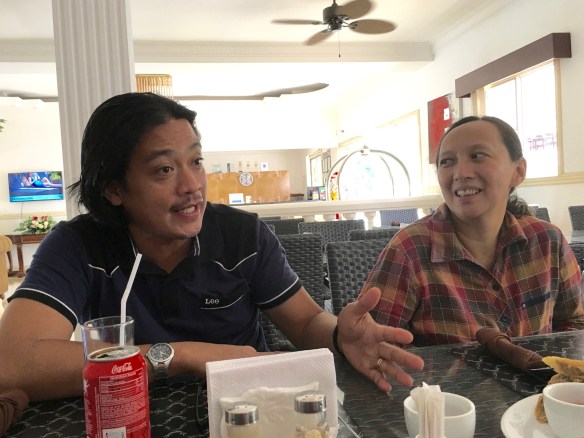
ONE OF the side benefits of our recent visit to Bohol was an opportunity to reconnect with an old friend and professional colleague, the prizewinning book designer Felix Mago Miguel, who has chosen to live and work in Bohol for the past ten years with his wife Amel and their five children.

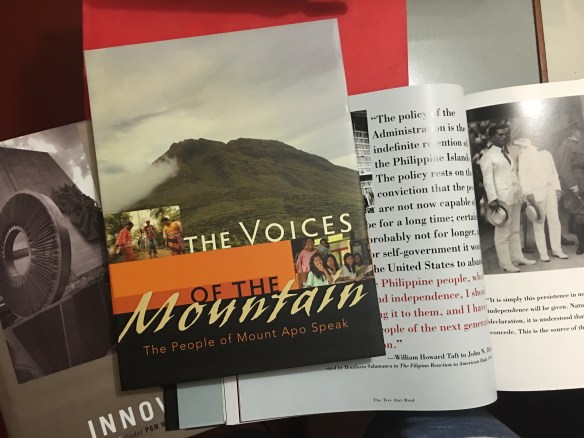
Beng and I had known Felix for a long time, since she saw and bought some of his paintings and gifted the then-newlyweds with her own painting and some plates by the potter Lanelle Abueva-Fernando. (“The plates are all gone now, because we used them and would break one every year,” said Amel apologetically, “but the painting’s still there!”) Felix and I had worked together, as writer and designer, on some coffee table book projects, notably those on Philippine-American relations, the Mt. Apo geothermal project, and the Government Service Insurance System. After my early collaborations with the late, lamented Nik Ricio, it was a relief and a pleasure to find the young and talented Felix, who has rightfully taken over Nik’s mantle as one of the country’s most sought-after book designers.

We invited the couple over to lunch at our hotel and we had a nice long chat about life, work, and what it’s like to keep on top of your profession from an island far from the country’s business and cultural center.

“Honestly, it hasn’t been all that difficult,” said the former Manileño. “In fact, I didn’t tell my clients for a whole year that I was working from Bohol because they might worry about my accessibility and meeting deadlines and so on. But with the help of the Internet and by scheduling my trips to Manila, I’ve been able to cope with the demands of the job. I use WeTransfer and Google Drive to move large files online, on my SmartBro account.”

Amelia Zubiri was born in Bohol, but also grew up and went to school in Manila, where she and Felix met in UP Diliman, where Felix was a Fine Arts major, graduating in 1992. They decided to move to Bohol to get away from Manila’s toxic atmosphere and to raise their children, now aged 16 to 7, in a healthier and more relaxed environment; all the children—the twins Ulan Kalipay and Ulap Namnama, Angin Kalinaw, Araw Naasi, and Langit Biyaya (the only one born on the island)—have been home-schooled. Deeply spiritual, the Miguels have learned to repose their trust in Providence, and their faith has been well placed.

When a huge earthquake devastated Bohol on October 15, 2013—just two weeks before supertyphoon Yolanda ravaged the Visayas—the Miguels and their one-storey home emerged shaken but unscathed, and they shared their good fortune by helping out with relief efforts. “The earthquake was a life-changer for many Boholanos,” Amel reflected. “It encouraged many Boholanos who had left for jobs overseas to come home and spend more time with their families. Seeing the new houses they had painstakingly built crushed in seconds seemed to remind them that nothing was more important than time together.”

Most of these OFWs work as seafarers, an occupation historically favored by Visayans. “It’s not uncommon for a Boholano family to have one or two seamen working on ocean-going vessels,” said Amel. “You can tell the houses that they build with their remittances by little design elements like anchors and portholes,” added Felix, smiling.

Felix Mago Miguel’s own journey to the crest of the book design business is a story of good breaks, sheer talent, and perseverance. Now 44, he started out in 1996 by designing Soledad Lacson-Locsin’s landmark translations of the Noli and Fili for Bookmark. “I’d done book covers before, but this was the first time that the publisher, Lori Tan, let me do everything from cover to cover,” said Felix. Later that same year, another book project, Water in the Ring of Fire: Folktales from the Asia-Pacific, edited by Carla M. Pacis, won for Felix his first design award from the National Book Awards. Since then, he has designed over a hundred books, some of them winning him recognition from the National Book Awards and the Gintong Aklat competition.

It isn’t the awards, however, that drives him to excel in his craft, but the satisfaction that he gets out of seeing a happy client. The project that has given him the most pleasure has been XYZ: The Creativity of Jaime Zobel, which drew on Zobel’s three decades of work in photography and art. “Don Jaime was so ecstatic about the book that he told me he needed to take a Valium to calm down,” recalled Felix. It’s that kind of reception that drives Felix to spend long nights staring at a computer screen, poring over one image after another.

The most technically challenging was Cuaresma, put together by Cora Alvina and edited by Gilda Cordero-Fernando and Fernando Zialcita, and winner of the National Book Award in 2000. “This was before digital photography, and I had to work with a huge box of color slides,” said Felix. But then again, “The technical aspects of book design are often easier to deal with than some people behind the books,” Felix confessed.

Like me, he’s had his share of good book projects that, for some reason or another, went nowhere. He did get paid for work done, as I was, but it’s such a waste of labor and good material when a project that seemed so promising never sees the light of day, because someone in the production process fails to deliver, or because the clients themselves lose interest or change their minds. Thankfully for Felix and me—as I wrote in this column a few weeks ago—coffee table books remain in high demand, and I expect to be working with him again on one or two forthcoming projects soon. One current project he’s excited about is a book on native Philippine trees that he’s doing for the Lopezes.

While he’s based in Tagbilaran, Felix flies out to Manila to personally check on his projects in the press. This used to be done abroad for high-quality printing jobs, but local printers have expanded and improved significantly enough to take on the challenge. “Our best local printers like House Printers can now compete head to head with their counterparts in Hong Kong and Singapore,” Felix said. (House Printers produced one of my most recent books, the biography of former Sen. Ed Angara.)

He misses painting, and spoke wistfully about the last big painting he did, a mural for the Church of Gesu on the Ateneo campus in Quezon City. But the children, the Miguels said, seem to be taking intuitively to art; Felix and Amel have monitored their time online to make sure that they can attend to more active and creative pursuits, and it may not be long before this couple’s decision to forsake Manila for a southern island bears fruit beyond more beautiful books.
IMG_7785.jpg


Penman No. 178: So You Want to Do a Coffee Table Book

IMG_7603.jpg

Penman for Monday, December 14, 2015


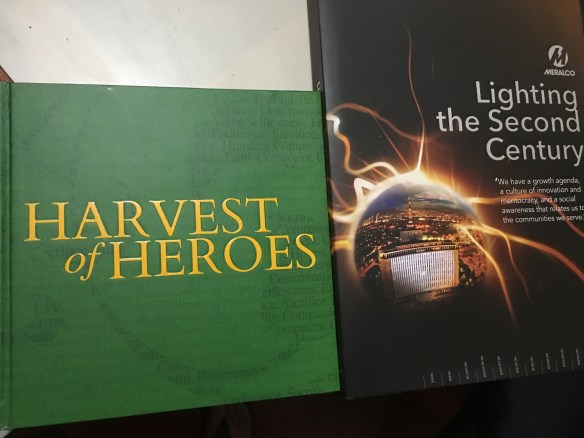
PEOPLE OFTEN ask me what it takes to produce a coffee table book. As a writer and editor, I’ve been involved with quite a few of them over the past twenty years. Just a couple of weeks ago, I was happy to attend the launch of one I co-wrote with Exie Abola and Felice Sta. Maria, Lighting the Second Century, produced for Meralco by the prizewinning Studio 5 group of publisher Marily Orosa.

While I suspect I know the answer, the first thing I tell anyone who asks me is, “What do you want a coffee table book for?”

Coffee table books are not cheap, running into the millions to produce—and, with few exceptions, they don’t make money for their publishers. So why even bother? Why does every year bring a plethora of new CTBs off the presses?

Many of those books don’t even come to market—they’re never meant to be sold or to make their investment back, and therein lies the reason for their existence: not to make money so much as to make an impression, not even to the general public but among a select group of readers, fellow connoisseurs, enthusiasts, and avatars of a certain thing or idea, to whom they can be given away as promotional material.

Because they’re generally not for-profit projects and because they require a sizable investment, CTBs are almost always conceived and funded by large institutions—corporations, foundations, universities, and the government—whose leaders have found some special reason to commission a CTB.

That reason is usually to commemorate and to celebrate an important milestone—the founding of an institution, the centenary of a founder, the completion of a major undertaking. CTBs can also be used to introduce or promote a new initiative—say, a province’s tourism program. Some CTBs may seem downright frivolous and extravagant, but many do serve a higher purpose beyond public relations, as visual records of our social and economic history,

But why a book, and why a coffee table book? Even and especially in this digital age—abounding with possibilities online and with new media—print still suggests permanence and prestige. The Web reaches far more people and is practically free, but many see it as an ephemeral medium, lacking the solidity and credibility of a book in the hand. For people and institutions seeking to perpetuate some shining moments and memories, the appeal and cachet of a CTB can be hard to resist.

CTBs are relatively new on the local publishing scene, and it wasn’t until the late 1970s when Gilda Cordero Fernando came out with such landmark tomes as Turn of the Century and A Question of Heroes that this new category of “desirable object” emerged. My own first exposure to CTBs was an epic challenge, when I edited the 10-volume Kasaysayan: The Story of the Filipino People for Readers’ Digest Asia in 1998, working with and learning from such legends as our editorial consultant, the late writer Doreen Fernandez, the late designer Nik Ricio, and our indefatigable project director, Tere Custodio.

Institutions usually go to PR or ad agencies for CTB projects, which are too complicated for in-house PR units to do all by themselves. They can also be put together and undertaken by people like me, Tere, or Marily who’ve had some experience in the work involved, but even I have to assemble a crew of first-rate professionals who can deliver good work on schedule.

CTBs are, first of all, conceptualized by the client in consultation with the writer or the PR specialists. While top management can and should give the marching orders early on—purpose, theme, scope, audience, treatment, budget—it’s best if a mid-level person with some understanding of media were designated to represent the client in dealings with the creatives, with full authority to streamline decisions and processes. (My worst nightmare would be to deal with a whole board of directors, each one of whom will be dipping into the editorial pie and making a general mess of things.)

Aside from the client, the CTB team will typically comprise the project director or manager; the head writer and his or her assistants; the executive editor; the book designer or art director; the photographer; and a production or editorial assistant in charge of logistics—handling money, setting up appointments, liaising with the client, following up the paperwork.

Many future problems can be solved right at the conceptualization stage. If the book’s purpose, scope, and audience are clear from the start, expensive adjustments can be avoided later on. Schedules, budgets, and deliverables have to be established and stipulated in a contract, leaving a little wiggle room for exigencies.

A CTB is picture-intensive, and will typically have a ratio of 60/40 or even 70/30 in terms of images to text. This means that there’s absolutely no excuse in a CTB for bad photography, bad design, and bad printing. If you can’t afford to come up with a good-looking product—never mind the text for the time being—then save your money and go for a regular, black-and-white book, not a CTB. Take note that a good designer could cost more than a good writer. (My pet peeves design-wise include designers who get too fancy with typography or insist on laying out text over an image, compromising readability.)

That said, showing off a well-designed book with awful text—poorly written and riddled with grammatical errors and misspellings—will be much like going to town with a date with the looks but also the brains of a lovebird (not that some people would mind). So invest in a good writer, one possessing a mastery not only of the language but also of the material, and with the patience and maturity to deal with both the client and his or her fellow creatives.

I’ve often found that the actual writing is the easiest and most pleasurable part of the job. Dealing with and interviewing clients can be quite stressful, and there’s a saturation point one reaches with almost any project, no matter how interesting it is.

Like any other book, CTBs also require sharp editors who can look over the writers’ shoulders. I never mind being edited myself, if the editor knows what he or she is doing. (If I don’t have the time to write the books myself, I’ll sometimes offer to do the editing.) CTBs, surprisingly enough, often reveal their lack of editorial oversight in their most visible and therefore vulnerable parts—in their titles, picture captions, and the front and back matter, which tend to be the last pieces of text to come in and are easily overlooked. I’ve seen expensive and glossy books with spelling errors on their title pages!

A good CTB should be a pleasure to read and to own. It should be a showcase of the art of good writing and good design. But above all, beyond being a plaything for creatives, it should do what it was meant to do—provide useful information in a visually engaging way. The best CTBs will retain their value over time and even become heirloom pieces on their own. That’s something worth keeping in mind next time somebody with more money than sense cries, “I want a coffee table book!”