Qwertyman No. 94: Artificial Intelligence

Qwertyman for Monday, May 20, 2024

DR. CHICHOY Carabuena had a problem. He wanted the school he owned and ran—the Generoso Carabuena Academy of Pedagogy in Santa Vicenta—to place higher in both national and international rankings, partly so he could raise tuition fees, and also so he could claim bragging rights among his university-president friends and drinking buddies. He had inherited the school from his grandfather; Generoso Carabuena was a banker who had collaborated with the Japanese and stolen the money they left behind to open a school for teachers, which was his wife’s dream, becoming a war hero in the process for outsmarting the enemy. 

The school had done well enough to the point that Chichoy’s dad Ramoncito could buy a Mercury Capri that he regularly drove to Manila to carouse in its nightclubs. Chichoy was the product of one of Ramoncito’s dalliances with the agreeable ladies, and it fell on him to rescue both the business and the family name from ruin and disrepute. He had been managing a carinderia for Pinoy workers in Dubai when the call came, and always wanting to become someone of substance, he returned to Sta. Vicenta to turn the daughters and sons of hog butchers and vegetable growers into teachers, like he imagined himself to be. Surely higher education wasn’t all that different from running a restaurant and coming up with the right menu at the right price for your customers. He had secretly dreamed of becoming a mayor, a congressman, or even governor, but first, he had to make a name for himself and make money.

Somewhere along the way he picked up a “Dr.” from a diploma mill and dressed the part, coming to his office even in the warmest of days in coat and tie. “More than anything else,” he would lecture his new recruits, “first impressions count, so before you even become a teacher, you have to look like a teacher, walk like a teacher, and sound like a teacher!” He had a faux marble statue made of his grandfather to greet visitors at the school entrance, and another one of Jose Rizal standing behind Generoso, as if looking on in approval. 

But lest people think he was beholden to the past, Chichoy Carabuena peppered his speeches with 21st-century mantras like “disruption,” “innovation,” “sustainability,” “customer-centric,” and, yes, “21st-century.” “The great challenge to higher education today,” he would often declaim, “is to produce graduates attuned to a global climate of disruption and innovation, mindful of evolving needs and opportunities in the marketplace of ideas while seeking sustainable and synergistic 21st-century solutions to problems rooted in our feudal and neocolonial history.”

Those speeches were written for him by his former executive assistant named Mildred, a UP graduate whom he had to fire when his wife discovered them smooching in his office—an act he vehemently insisted to be no more than a paternal gesture, much like  former President’s public bequeathal of a kiss on a married woman, a defense that gained no ground. His wife personally chose his next EA, a former SAF commando named Dogbert; making the best of the situation, Chichoy paraded Dogbert around as his bodyguard, spreading the rumor that his life was under threat from unspecified enemies determined to keep the quality of Philippine education down. “We can give them no quarter,” he declared at the last CHED event he attended. “We must resist, with all impunity, those who aim to keep our poor people shackled to the twin pillars of ignorance and idiocy!” He missed Mildred in those moments, but he felt quite pleased with his growing self-sufficiency in speechwriting, thanks to his new discovery, ChatGPT. Of course it never quite came up to his standards, so he tweaked the prose here and there, like that reference to Samson that he hoped would bring the house down.

But now, reading the reports of top Philippine universities slipping in their rankings in the usual Times Higher Education and Quacquarelli-Symonds surveys, Dr. Carabuena saw an opportunity for his modest HEI to rise. “As their mystique diminishes, so our aura will grow,” he informed an indifferent Dogbert. “We just need to come up with sustainable innovations that will disrupt the status quo.” Dogbert handed him a slim folder. “Sir, someone wants to see you, to apply for the position of Academic Vice President.” It was a position that Chichoy himself had held concurrently to save on salaries, but now he felt obliged to pass it on to a real expert. He flipped the folder open and saw the picture of a cute Chinese-looking woman going by the name of “Dr. Alice Kuan.” Chichoy was mesmerized. “Send her in—and get out!”

When Dr. Alice Kuan stepped into Chichoy’s office, he felt himself enveloped in a miasma of jasmine, peonies, and five spices—everything good he remembered from his only visit to China many years ago. Her lips were lotus-pink, her skin ivory-white, and here and there dumplings suggested themselves to his imagination. “Good morning, Dr. Kuan! Please, have a seat! You’re here to apply for the AVP job?”

“Yes, Mr. President,” she said with a quarter-moon smile, “and I come with many ideas for both improving your curriculum and raising revenues through academic innovations.”

“Innovations! I like that! Like what?”

“Why artificial intelligence, of course! We could use AI to teach many of our courses, reducing costs. Also, we could bring in more foreign students from—uhm—friendly neighboring countries, while creating part-time employment opportunities for them in—uhm—online entertainment, for which we could even lease out some of your campus property. It would create a huge economic boost for Sta. Vicenta!” 

Temple bells rang in Chichoy’s mind. Not only was she fetching; she was smart! Suddenly he could see his political future brightening. He wanted to know more about this adorable avatar, and only then did he notice how patchy her resume was. 

“Your birth certificate was filed when you were…. 17?”

“Was it? I don’t remember.”

“Which elementary school did you go to?”

“I don’t remember. Maybe homeschooling?” She threw him an exasperated sigh. “Look, Dr. Carabuena, does it matter? I can have AI do a perfect resume if that’s what you want. If not, I can take my ideas to the Fontebello Institute of Technology in San Bonito just an hour away, and maybe they’ll be more receptive to disruptive innovations—”

“No, no, no! Disruptive, I like disruptive! Please, Dr. Kuan, stay in your seat! I’ll have somebody prepare your contract. Dogbert!”

(Image generated by AI.)

Qwertyman No. 86: The Real Pasaways

Qwertyman for Monday, March 25, 2024

THE LOCAL Internet came down hard last week on an anonymous teacher who was caught on livestream giving her students a scorching tongue-lashing for what she claimed was their lack of respect and discipline. Almost hysterical, Teacher X called them good-for-nothings without a future. Predictably, netizens deplored her derogatory language, which they equated with child abuse, and called on the Department of Education to investigate the incident and impose some disciplinary measure on the teacher concerned.

I agree that Ma’am seems to have gone overboard in expressing her displeasure over her students’ misbehavior, and that she could have been more circumspect in her choice of words. I’m certain that DepEd—which happens to be headed by someone who doesn’t mince words herself when it comes to court sheriffs—will use her case to remind teachers of the need for exemplary behavior, if not some sweetness and light, in classroom management. 

At the same time, having been a teacher myself for forty years, I can imagine and understand the exasperation that must have gone into a titanic diatribe like that. I’ve never taught in elementary or high school, where these aggravations come in spades on both sides of the teacher’s table, but I’ve heard and read enough to know what a cauldron of high emotions a Filipino classroom can be in the worst of circumstances. 

Let’s pack a room meant for twenty students with twice that number or even more, with the heat from a tin roof bearing down on everyone (or, in another season, rain leaking down onto desks and textbooks). The teacher recites her lesson in a funereal monotone, expecting her students (who keep themselves awake by sneaking glances at TikTok on their phones) to regurgitate what she has just said: “Class, how do you pronounce a-DO-le-scent?” 

Not that she truly cares what they say, because her mind’s on the box of chocolates she has to buy for the supervisor whose signature she needs for her salary loan. She’ll spend half that loan on a fence around her garden to keep the roaming pigs and pissing drunks away, and the other half on a new cellphone because her arch-rival Mrs. Buenafe has one that can take selfies without the blemishes. Maybe, if she took better pictures of herself, she could win back her husband Temyong from that tramp in Trece Martires.

Just then a fight breaks out at the back of the room because Etoy has dropped a ballpen to sneak a look at Corito’s underwear, in full view of Corito’s alleged boyfriend Mikmik. “Stop that, quiet, gademet, you imbecile a-DO-lescents, I order you to behave or I’ll squeeze your little balls until they pop! You have no future, you worthless pasaways! You’re going to rot in this living hell they call a classroom!”

Now, when Teacher X says “You have no future,” I take it to mean that Ma’am has read the Edcom II report on the sad state of Philippine education, which puts our young learners practically at the cellar of global achievement. Unless some systemic reforms are put in place by the same DepEd that will now trumpet the virtues of better decorum in the classroom, we might as well have cursed those kids that caused Teacher X to blow her top—and by “curse” I don’t mean the use of foul language, but rather a hex such as a witch might put on some unfortunate soul. 

Philippine education is full of pasaways, many of them more than ten or even fifteen years old. Some have been in the system for so long that they have mastered its ways and means (e.g., how to make good money off bad textbooks) to a level of proficiency worthy of a doctorate. Secretaries of Education come and go—some more lamented than others—but these pasaways remain, as they do in certain bureaus dealing with government revenues, because they ensure continuity, which everyone but the occasional and hopelessly naive reformer appreciates. They may even be well-mannered, with the nicest smiles and mildest dispositions you ever saw, because of their contentment with the world as it is and their philosophical acceptance of human frailty.

This brings to mind another kind of pasaway, a certain man of God—no, make that Son of God—who has steadfastly refused to honor a summons by a Senate committee looking into sex trafficking, of which this pastor has been accused, among other crimes and misdemeanors. Let me judged by the proper court, he has argued through his lawyers, although—if he is who he claims to be—then no one but God the Father will qualify for that privilege.

God must have been a prolific babymaker, because this prosperous preacher is but one of many around the world proclaiming themselves to be Sons of God. Nearly all have landed in some kind of trouble with the law, usually in matters of sex and money, paltry and mundane emoluments that Sons of God seem to feel especially entitled to, in partial recompense for the heavy burdens of divinity.

Someone should have assured our good pastor that the Senate is a decorous institution, exceedingly kind to its guests, as a recent hearing involving police officials being questioned by a former police official showed. A senator who walked out of that hearing out of disgust over the “babying” shown the witnesses by their inquisitor now himself stands accused of discourtesy. Notwithstanding the presence of a chairperson known for her intolerance of untruths, our Son of God can surely count on the professed and unshakeable friendship of some of her honorable colleagues to shelter him from the slings and arrows of earthly justice. We are a much kinder people than that apoplectic teacher might suggest.

Penman No. 410: A Dimming of Lights

Penman for Monday, March 29, 2021

OUTSIDE OF immediate family, there comes to every life at least one figure whom we cannot owe and thank enough—a mentor, a cheerleader, a believer on whose every word of encouragement you wait, and whose rebukes or admonitions, albeit rare, strike you with chilling efficacy.

This past month I lost two such figures, a woman and a man who lived into their nineties and thus influenced not only me but generations of students and acolytes eager to learn.

The first was Mrs. Agnes Banzon Vea—better known to many as the understandably proud mother of Smart founder Doy and Mapua president Rey, among other accomplished children. She was our English teacher at the Philippine Science High School, where she taught for many decades and became an institution.

For many decades now, I’ve boasted about being Mrs. Vea’s acknowledged pet. One of the things I quickly realized upon her passing was that it wasn’t true—we were all her pets.

Maybe I just felt special, because that’s what she made each of us feel. We were the third batch of PSHS students, long before the school came to be known as “Pisay.” But she did far more than teach us grammar and even literature. She taught us to think on our feet, to see beyond the obvious, and to enjoy ourselves doing it. She liberated our minds, and made a science high school feel like a playground for the imagination.

There are two episodes that have remained very clearly with me that happened when I was editor of the Science Scholar, and she was our adviser. Once, deadlines were falling due, but I was feeling lazy, so I told her I wasn’t in the mood to write. That was the only time I saw her get angry. I can’t recall exactly what she told me, maybe because it left me in total shock, but she made it clear that talent was worth nothing without discipline. I went to work right away.

Another time, in more pleasant circumstances, she took me aside to tell me something important. “Butch,” she said, “there are two young writers I want you to read, because both of them are very good. One is Joey Arcellana, and he edits the Philippine Collegian at UP. The other is still in UP High, and his name is Gary Olivar.” I think she was telling me that there were far better writers than myself, and that it was good to never forget that, if I was to continue learning. I took her advice, and because of it, within my first semester of entering UP two years later, I joined the Philippine Collegian, and also the Alpha Sigma fraternity, to which Gary and incidentally Mrs. Vea’s son Doy belonged.

But more than a teacher, she was a second mother to us, and I was especially touched by the memory of one of my batchmates, Ophelia Gaspay, who recalled how she was sitting all by herself in one of our school dances, watching the world go by. Suddenly, much to her surprise, someone went up to her to ask her for a dance—none other than Rey Vea, the dreamboat and heartthrob of the whole school. As they were twirling across the floor, she saw, out of the corner of her eye, a beaming Mrs. Vea, her fairy godmother, who had apparently waved her magic wand.

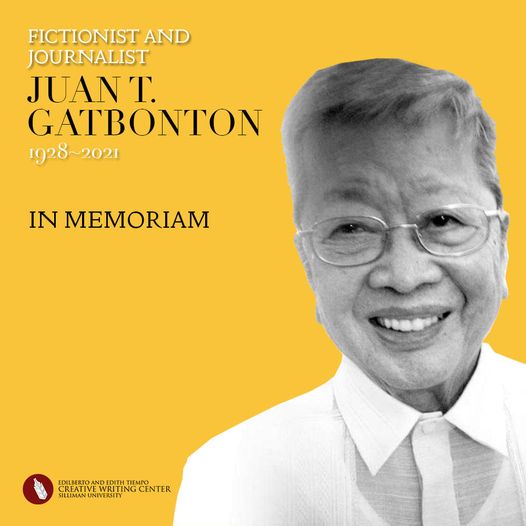
The second mentor I lost was the writer and editor Johnny Gatbonton, who had a long and distinguished career in journalism. Literature majors should remember him as the author of the classic postwar short story “Clay,” which won first prize in the Palanca Awards of 1951. When I met him in the early 1990s, he was about as old as I am now, and had set up a speechwriting operation for President Fidel V. Ramos. He needed another hand; I had just returned from my graduate studies in the US, and was close to penniless. 

I learned not only graceful and effective speechwriting from Johnny, but also imbibed his intellectual curiosity, his love for the arts, and his generosity toward younger writers. Johnny held office at the painter Malang’s building on West Avenue in Quezon City, and every now and then Johnny hosted lunch for a train of literary luminaries who included Nick Joaquin, NVM Gonzalez, Greg Brillantes, Rony Diaz, and Andy Cristobal Cruz; I was the proverbial fly on the wall, eavesdropping on another generation’s animated conversation.

In 1994, when I was a awarded a writing fellowship at Hawthornden Castle in Scotland (where I eventually wrote and completed Penmanship and Other Stories), instead of docking me a month’s pay for my absence, Johnny gave me the cash for pocket money and wished me well on my writing. Many years later, out of the blue and when he had also retired, Johnny asked me and the late Raul Rodrigo out to lunch just so we could chat about nonfiction and daydream about which National Artist’s biography we most wanted to write (I think I said Franz Arcellana, another mentor of mine, and Raul said Botong Francisco). 

The dimming of such lights, although inevitable, is deeply saddening, but we can only wish that we will be as sorely missed when our time comes.