Penman No. 65: Tried and Tested

Penman for Monday, Sept. 23, 2013

LAST WEEK’S piece on the kind of open-book exam I give my students reminded me of the toughest exams I myself had to take as a student. It’s been more than two decades since I last stepped into a classroom and sat opposite the professor’s table and chair, but the memory of those exams remains vivid—in some cases, distressingly so.

I have to declare, at the outset, that unlike most students, I liked exams, especially in subjects that I knew I would do well in. I got a thrill from being tried and literally tested; I saw the exam as a game of wits between me and my professor, and while my professor certainly knew much more than I did about the subject, I was always on the lookout for angles and insights that my professor might never have considered, and would therefore appreciate as something fresh. I disdained what professors call “spitback”—the rote regurgitation of points already discussed in class—knowing that many of my classmates were going to do just that.

I was, in other words, something of a smartass, and like all the annoying smartasses you remember and loved to hate from high school and college, I deserved and got my occasional comeuppance. Returning to college after a ten-year absence, I thought I could wing it in my Lit classes, but instead got the loudest wake-up calls I possibly could, from two professors known to be formidable “terrors” in the English department—Filonila Tupas and Damiana Eugenio—both of whom gave me a “5.0” in the objective quizzes that they began the semester with. Thankfully these were diagnostic quizzes, and the diagnosis was clear: I had to hit the books to do well, so I became a textual bloodhound, memorizing odd details and references (plants from Shakespeare: wild thyme, oxlips, woodbine, eglantine). I would not embarrass myself again—or so I thought.

Shakespeare and the Elizabethan age became a passion for me, a period fraught with dark political intrigue and steeped in grime yet also ennobled by some of the most sublime poetry ever written. It wasn’t even Shakespeare so much as the lesser poets and dramatists around him—Sidney, Wyatt, Webster, Middleton, Marlowe—who piqued my interest, thanks to a teacher who took kindly to an older student making up for lost time (I was 27 when I returned as a freshman to UP; my Paulinian colegiala classmate, Judy Ick—who would go on to become Dr. Ick, the real Shakespeare expert in the department—was just 17).

That teacher was the impeccably fashionable Prof. Sylvia Ventura, commended (as Shakespeare himself might have put it) by all the swains but feared by most of her students for the spot-passages exams she gave. (A spot-passage exam gives you nothing but an obscure passage drawn from the text of a play or a poem, for you to identify, contextualize, and discuss.) I thought I was doing pretty well in her class until the final exam, when I ran into a passage that might as well have been Greek. Knowing that I had absolutely no chance of identifying the passage correctly, I gathered my wits and used Shakespeare himself to explain my predicament, beginning my answer (whatever it was) with a quote from Act I, Scene 1 of A Midsummer Night’s Dream: “So quick bright things come to confusion!” Apparently it worked, because I escaped with a 1.25.

The toughest teacher I had in UP, however, was the legendary Wilhelmina Ramas, whose final exam on “The Idea of Tragedy” took us five hours and several bluebooks to finish—a herculean effort rewarded, in my case, with a niggardly (and probably accurate) 1.75. Soon after, I flew off the US for graduate school, and it was only then that I appreciated the rigor that my UP “terror” profs had put me through. Their American incarnations were tweed-suited dons rather than coiffed matrons, but they were no less demanding. I had come well prepared.

In my Shakespeare class at Michigan, taught by the pipe-smoking Russell Fraser, I felt like I had orchids coming out of my ears when Dr. Fraser commended me for being the only one in class to be able to answer his question about differentiating “hypotaxis” from “parataxis” (no, it has nothing to do with paid transportation). That still didn’t save me from the pain of Fraser’s final exam: a spot-passage exam, employing two totally unheard-of quotations from Shakespeare’s plays, with one question to answer: “Which is early and which is late Shakespeare, and why?” This was also an open-book exam that we had one day to complete; we were free to roam the library and to read Shakespeare from end to end.

Now, mind you, this was 1986, well before the Internet and Google; students were still using 5.25” floppy disks, if they were using computers at all (I wasn’t; I’d dragged my Olympia portable with me across the Pacific). Today my students would take seconds to find the answer to “early” and “late”, and maybe an hour to cough up a reasonable “why.” Back in ’86, it was all intelligent guesswork, knowing that no amount of speed-reading and cramming could possibly turn up those passages, let alone contextualize them. And Fraser knew that; whether we had the “early/late” part of the question right or wrong, he wanted to see us reasoning our way through our answers, given what we knew from class of the younger and the older Shakespeare. (Only later, in the age of Google, would I discover that Fraser was then at work on two books: Young Shakespeare, and Shakespeare: The Later Years.) I can’t recall how I scored on that exam—I passed the course with an A-minus—but it was the kind of exam that was both gut-wrenching and exhilarating at the same time; I loved it.

Still later, now doing my PhD at the University of Wisconsin-Milwaukee, I had a professor in Bibliography and Research named James Kuist. As mild-mannered as he was, Dr. Kuist had a fiendishly difficult task for us to complete. His exam question went like this: “The year is 1663 and I am a Fellow of the Royal Society. What books would be on my bookshelf?” So off we went to the library on a wild goose chase, and like an eager labrador retriever, I enjoyed the hunt, searching the stacks for the spoor of these antiquarian volumes.

Now that I’m the one giving the exams, I hope to come up with questions and problems that my students will remember 20 years from now, and still get a bit of a headache from—or let’s make that the pleasant buzz, the distant refrain, of an unusually agitated mind.

Penman No. 59: A Boon for UP Artists

IMG_2770Penman for Monday, August 12, 2013

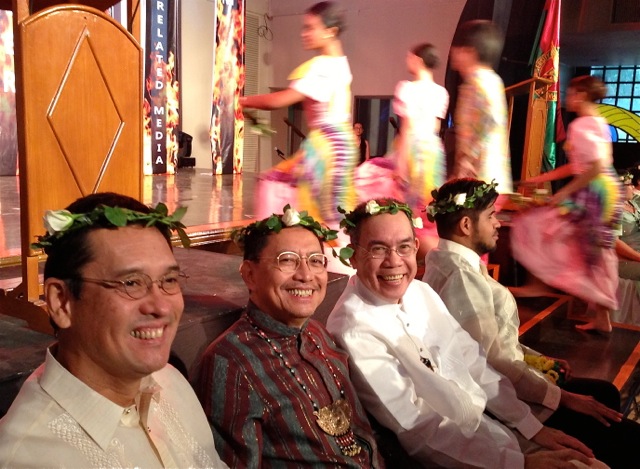
LAST WEDNESDAY, I had the privilege of being part of a special ceremony at the University of the Philippines in Diliman, this time for the UP Arts Productivity System or APS awards. Initiated under former UP President Emerlinda R. Roman in 2009, the APS provides substantial monetary incentives to artists within the UP System for work produced within a three-year period (or five, the first time you apply). Twenty-eight UP artists were honored, including 17 from the first batch in 2009. (A similar system had been earlier put in place for UP scientists.)

A committee of peers—themselves highly accomplished artists, including National Artists—receives and evaluates applications from Diliman and UP’s many other campuses. Points are assigned to specific works, such as books, productions, exhibitions, and major lectures; further points accrue from notable awards and distinctions, especially forms of international recognition. Within this committee, spirited discussions inevitably arise over the merits of an artist’s work. Since the award is given for new and continuing work, it isn’t a lifetime achievement award, and no matter how highly regarded an artist may be, only his or her sustained productivity will be recognized by the APS.

Not surprisingly, many questions and concerns come up in the APS. The proper and fair valuation of artistic work is one of the most difficult tasks anyone can assume, even and especially within an academic setting, which may not necessarily reflect what the market thinks say, of a painting or a commissioned biography. Academia is the bastion of theory, and an award-giving situation like this challenges and exercises every humanities professor’s notions of what is good and valuable.

The idea that art itself is of real value is, in the first place, something one can’t assume to be a general belief in our country, and even in our university. Painters have it easier in terms of establishing their worth, because people have gotten used to the spectacle of, say, a Van Gogh selling for many millions of dollars, even if they may not understand why. They can look at a painting or sculpture in their living room or in an office lobby and at least appreciate its decorative value (although modernist art will probably leave them deeply perplexed, especially when told that the piece was worth a lot of money).

The utility and practical value of a poem is far more ephemeral. Artistry in the form of a service—say, directing a play or curating an exhibit—is even harder to apprehend for many. This is why it takes another artist—or a scholar and academic—to seek out and to recognize these obscure but important triumphs of mind, spirit, and sensibility over matter.

There are awards enough in the Philippines for artistic endeavor, capped by the National Artist Award, which the Supreme Court found the good sense to rescue from pit of political patronage. Elsewhere there are the FAMAS, the Palancas, the Thirteen Artists, and any number of music-industry awards. What distinguishes the UPAPS is its recognition of artists who also teach, or teachers who also manage to produce good art despite the well-known rigors of teaching and that other great devourer of time and energy, administration.

This is particularly important in an institution like UP, which—not unlike many other Philippine universities today, for understandable reasons—seems to have reoriented itself toward more support for science, technology, and engineering. (One thing most people don’t realize is that, based on enrolment figures alone, UP Diliman is really basically an engineering school; those of us in a small minority in the humanities and the law just happen to be noisier than the typical engineer.)

I was told that the UP science complex—an impressive array of colleges and institutes geared toward establishing UP as a force to be reckoned with in regional S&T—has so far received some P3.5 billion in various forms of support and investments, chiefly from the government. Under President Alfredo E. Pascual, UP has asked Malacañang for a small fraction of that for what we might call cultural infrastructure—studios, laboratories, theaters, exhibition spaces, and equipment that our students and their teachers need to produce significant new work; so far I’ve yet to hear of a firm commitment for even this sliver of support given to S&T. (For the record, we shouldn’t be competing with S&T, but alongside S&T for our share of the national budget.)

Never mind, for now, our standing recommendation for the creation of a Cabinet-level Department of Culture to oversee national cultural policy and arts promotion. Never mind that we hardly ever hear about arts and culture in the SONA, very likely because our high officials still see culture as entertainment, as an intermission number without any material contributions to make to the national good.

Last week, where someone could do something about the lot of the Filipino artist, they did, and on behalf of the UPAPS awardees, I’d like to thank President Pascual and his administration for this initiative, and can only hope that it is picked up by other visionary academic leaders elsewhere.

Herewith, the list of UPAPS awardees—including, immodestly, yours truly (who had to publish five books in three years to make the grade!):

MUSIC and DANCE: Maria Christine M. Muyco, La Verne C. de la Peña, Jonas Baes, Josefino J. Toledo; ARCHITECTURE: Gerard Rey A. Lico, Danilo A. Silvestre; FILM: Grace J. Alfonso, Sari Raissa L. Dalena; FINE ARTS: Patrick D. Flores, Jason B. Banal, Leonilo O. Doloricon, Ruben Fortunato M. De Jesus, Ma. Eileen L. Ramirez, Reuben R. Cañete; LITERARY WORKS: Jose Y. Dalisay Jr., Ricardo M. de Ungria, Eugene Y. Evasco, Jose Neil Carmelo C. Garcia, Roland B. Tolentino, Rosario T. Yu, Layeta P. Bucoy, Victor Emmanuel Carmelo D. Nadera Jr.; RADIO, TELEVISION and RELATED MEDIA: Fernando A. Austria, Jr., Danilo A. Arao; SCHOLARLY WORK: Priscelina P. Legasto; and THEATRE: Josefina F. Estrella, Dexter M. Santos, Alexander C. Cortez.