Qwertyman No. 157: Rebalancing the UP-IRRI Partnership

Qwertyman for Monday, August 4, 2025
 

SINCE ITS establishment in 1960 by an agreement between the Ford and Rockefeller Foundations and the Philippine government, the International Rice Research Institute (IRRI) has been known around the world as a leader in agricultural research and a provider of much-needed and applicable solutions to global hunger. With so many people and economies dependent on rice, IRRI’s outputs—especially the famous “IR8” and similar high-yielding varieties—were hailed as gamechangers for billions, reportedly staving off famine in India in the 1960s and spurring “green revolutions” around Asia. The first President Marcos was a staunch supporter of IRRI, folding its “miracle rice” into his Masagana 99 program, which temporarily achieved self-sufficiency in rice but ultimately failed from bad credit and also proved environmentally destructive.

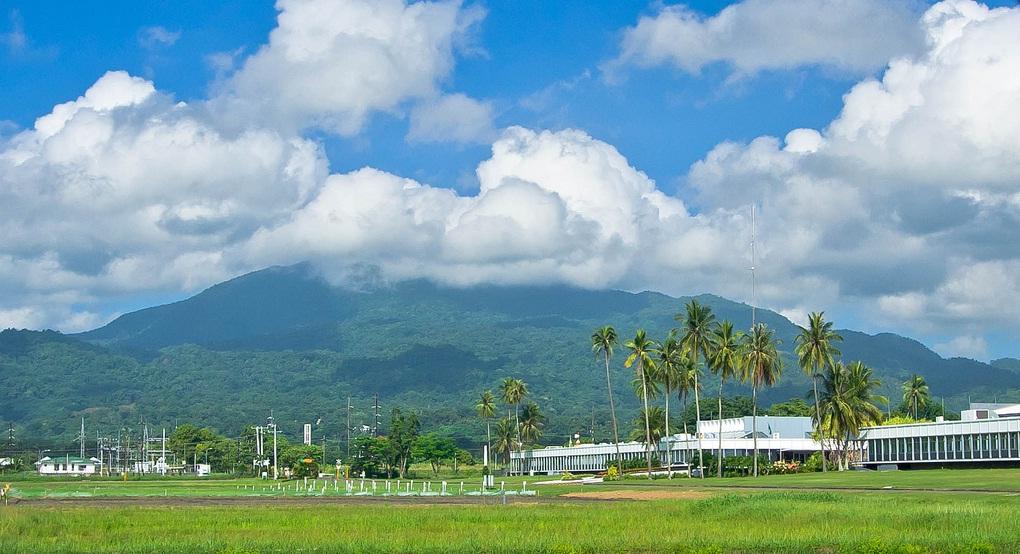
Headquartered in Laguna on the campus of the University of the Philippines Los Baños (UPLB), IRRI and its achievements became a source of pride for the Philippines, which not only hosted the institute but provided much of its manpower—the scientists in its labs and the farmers tilling its experimental plots, among other staff workers. (That sentiment, it should be noted, isn’t universally shared. A coalition of NGOs and individuals called MASIPAG, opposed to the kind of genetic engineering that IRRI and even UPLB does, sees IRRI as “a research arm of big agrochemical corporations in turning the food and environmental crisis into their businesses.”)

While that’s being debated, another issue has come up between IRRI and UP over the land that IRRI has been using, at the nominal rate of P1 a year for the past 65 years. IRRI’s lease on that land, totaling almost 280 hectares, expired last June 30. UP needs and wants some of that land back for its own use, especially with UPLB’s ambitious plans for the establishment of an Agro-Industrial and Information Technology Park in the area.

UP contends that IRRI has actually been using just around half of that property, so it would be good to put those idle hectares to more productive use, following UPLB’s comprehensive land use plan calling for more buildings for administration and research, housing, support services, engineering, and social sciences. It’s not simply getting land from IRRI (land that, let’s be clear, is really UP’s); according to UP’s Vice President for Legal Affairs Rey Acosta, in exchange for the land UPLB needs for its expansion, the UP System is offering IRRI new land to lease across its various campuses in Mindanao, Iloilo, Leyte, Cebu, Baguio, as well as its land grants in Quezon and Laguna, for both rice and non-rice crop research.

The land exchange was part of a new agreement that UP had proposed to IRRI to replace the expired lease. UP also wanted IRRI to pay more realistic rates for the land it was using. One key factor to consider was that since 1972, IRRI had fallen under the ambit of CGIAR (formerly the Consultative Group for International Agricultural Research), a global research network. CGIAR is apparently funded by contributions from many international agencies and countries including the Philippines, but exactly how it funds IRRI or what its legal status is in the Philippines is unclear to me. 

Under the IRRI charter, the Philippine Secretary of Agriculture and the UP President sit on its board of trustees as ex officio members, but the rest, including the Director General, are international experts nominated either by CGIAR or the outgoing board. It would have been at a board meeting that UP President Angelo Jimenez first brought up UP’s proposals over a year ago in anticipation of the end of IRRI’s lease—which, at the bottom line, UP is under no obligation to renew. Last June, IRRI submitted a counter-proposal ceding much less land than UPLB needed, asking for a much longer lease extension period (25 instead of 10) for much less money than UP deemed fair.

Negotiating in good faith, UP agreed to concessions such as giving IRRI almost 200 hectares for its use, and the possibility of a 25-year lease, subject to periodic reviews, if certain conditions were met. But instead of dealing with UP in the same spirit, IRRI went to court for a TRO, represented by one of the Philippines’ most influential (and must I add expensive) law firms. 

There are quarters in the Philippine academic and scientific community that will be happy to see IRRI go—MASIPAG might stand on the far extreme, but even more moderate voices have noted that much of the research that IRRI was known for can now be undertaken by the Philippine Rice Research Institute or PhilRice. Even so, UP’s leadership maintains that it continues to value its historic partnership with IRRI—based on a more balanced and lawful relationship. “We don’t want IRRI to leave,” said President Jimenez. “We would be happy for IRRI to stay but under fair and reasonable terms.” 

For the sake of not just the Philippines’ but the region’s and indeed the world’s food security, we should hope that this disagreement over how to best use that land in Los Baños doesn’t end up in a messy court case involving money, influence, and public relations. IRRI enjoys a generally positive reputation that, rightly or wrongly, most Filipinos still believe in. After 65 years, it’s time to renegotiate an agreement that will more directly and clearly benefit Philippine agriculture and education through its national university, ensure environmentally safe research, remunerate us fairly, and make IRRI the good global citizen an institution of its stature and intentions needs to be.
Penman No. 202: A Workshop on Mt. Makiling (2)

IMG_8512.jpg

Penman for Monday, June 6, 2016


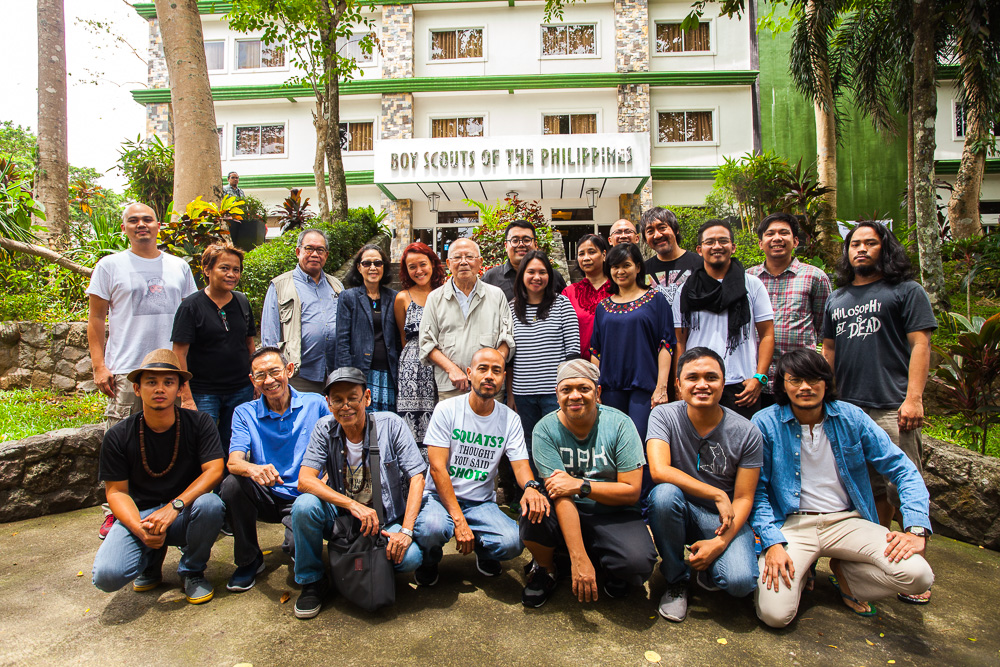
AS I noted last Monday, this year’s UP National Writers Workshop—which we held from May 22 to 29 on Mt. Makiling in Laguna—was one of our best in recent years, with a new batch of vibrant literary talents emerging to stake their claim on our attention.

Aside from the three women writers I mentioned last week—Elena Paulma, Mina Esguerra, and Celine Fabie—we had nine other fellows presenting fine, exciting work: new projects in various stages of completion, submitted for review and comment by their peers and seniors for possible improvements in both design and execution. These works were accompanied by a brief presentation of the writers’ “poetics”—their own appreciation of how and why they write what they write. While very few outside the workshop will ever get to read them, those poetics are often gems of creative insight, a rare look into the minds of writers trying to understand their own process of writing.

Poet Vijae Alquisola, for example, grounds his collection titled “Paglasa sa Pansamantala” (which I’ll loosely translate as “Savoring the Temporary”) on painful personal experience (and here again I’ll translate what he wrote, as I will other texts in Filipino): “Temporary was the answer my siblings and I held on to over the long stay overseas of our mother. Even if I didn’t know how many nights of sleep or days of waking temporary meant—and even if it was never clear what stretch of months or days it occupied on the calendar—we had no choice but to accept it. She had to go to Hong Kong to feed us. She had to leave so we could live, just for the time being.”

Novelist RM Topacio Aplaon (Topograpiya ng Lumbay, The Topography of Loneliness): “I feel liberated by the very act of writing because this is the only place where I can be true to myself, the only way I can freely say anything I want, can do anything I may have no right to do in real life, can chronicle moments I wish never to forget: place, feeling, image, sensibility.”

Poet Vincent A. Dioquino (“we never understood proximity”): “Language is that space where the imagined thrives, where the imagined is held closer to the body, saying what the body cannot speak of. It is that consciousness by which feeling and thought are evoked, a mediation from the abstract to the more concrete., or from a plurality of concrete and particular objects (that is to say: texts, or a set of inscriptions aspiring towards the textual). Language is being made immanent and tangible, threatened with decipherment. It is this specific occurrence of language that is rendered visible and visceral in poetry.”

Poet Francisco Arias Montesena (“Iluminado”): “I write poetry as a part of my being, as an attempt at things I cannot achieve in reality. Often I have to find time and space for poetry in the midst of my work as a teacher, but I have to do myself this favor, knowing that I have to share what I have, even if I have much to learn, despite my shortcomings. How can we begin to fill this need if we cannot mine words for love?”

Novelist Rolly Rude Ortega (Rajah Muda): “I write the stories that I want to read, and I want to read more stories about the Moros, specifically the Maguindanaos, and the lumads, specifically the Dulangan Manobos. The Ilonggos of Mindanao, the Maguindanaos, and the Dulangan Manobos are all significant to me because these people had been part of my life even before I decided to become a writer. Growing up in Kulaman Plateau, I saw firsthand that while the Ilonggos and other Christian tribes were poor, the Manobos were poorer still, which should not have been the case, for they had been living in the resource-rich land long before the migrants came.”

Writer for children Cheeno Marlo Sayuno (“Super Boyong Wears a Malong”): “I love writing for children and (writing about) culture. I would like to share with the children the beauty of our cultural heritage. While the advent of modernization is nothing but inevitable and even if cultures change and evolve, I want the children to still see the colorful costumes, dances, and songs from the past, hoping that it would help in developing a sense of nationalism and appreciation for Indigenous communities.”

Poet Melecio F. Turao (“The Antimodel”): “I have a soft spot for the outsider, for things on the periphery, the ignored, the unrecognized. In my silent heroic moments, I tell myself that I champion the cause of second fiddles. I remember that Cirilo Bautista gave up writing poetry in 2000, saying we live in a prosaic world. I tend to agree so far as our predictable lives go. But a poet should be able to see through appearances. So I pushed myself to try to understand what compels me to write. And it hit me that I would have been a good student of psychology or cognitive science because I amplify awkwardness, alienation, resentment, loathing, desire and failure. I trivialize the hypocritically serious and structured. Thus, The Antimodel.”

Playwright Visconde Carlo Vergara (“Hula Hoop”): “Since I work in comics and plays, writing description isn’t my strongest suit, but people have complimented me on how natural my dialogue sounds, or reads. This I credit to being used to listening and mirroring, ever since I was a kid, as well as having that stint as a theatre actor in the nineties. I would write my drafts purely in dialogue, and simply imagine what it would look like when played out. In acting out the play in my mind, I would also do the acting myself by reading the dialogue out loud in the personalities of every character, just to test if the words rolled off the tongue well enough, and if the sentences had good rhythm.”

Poet Enrique S. Villasis (“Manansala”): “A solution I saw (for the collection) was to bring the poems closer to the times when the paintings were executed. As historical artifacts, Manansala’s many-layered lights and colors could be seen as signifiers of the disturbances, dangers, sufferings, dreams, and desires of his age. This collection is my attempt as a poet to explore the relationship between an artwork and its period, as well as an attempt of the poet to assume the mask of a critic, historian, and curator.”

It was a pleasure and a challenge taking up these writers on their given premises and seeing how closely their grasp matched their reach. (And it was no huge problem if they didn’t: in a workshop, everything is negotiable, even one’s original design, although no one is under duress to accept alternative suggestions.)

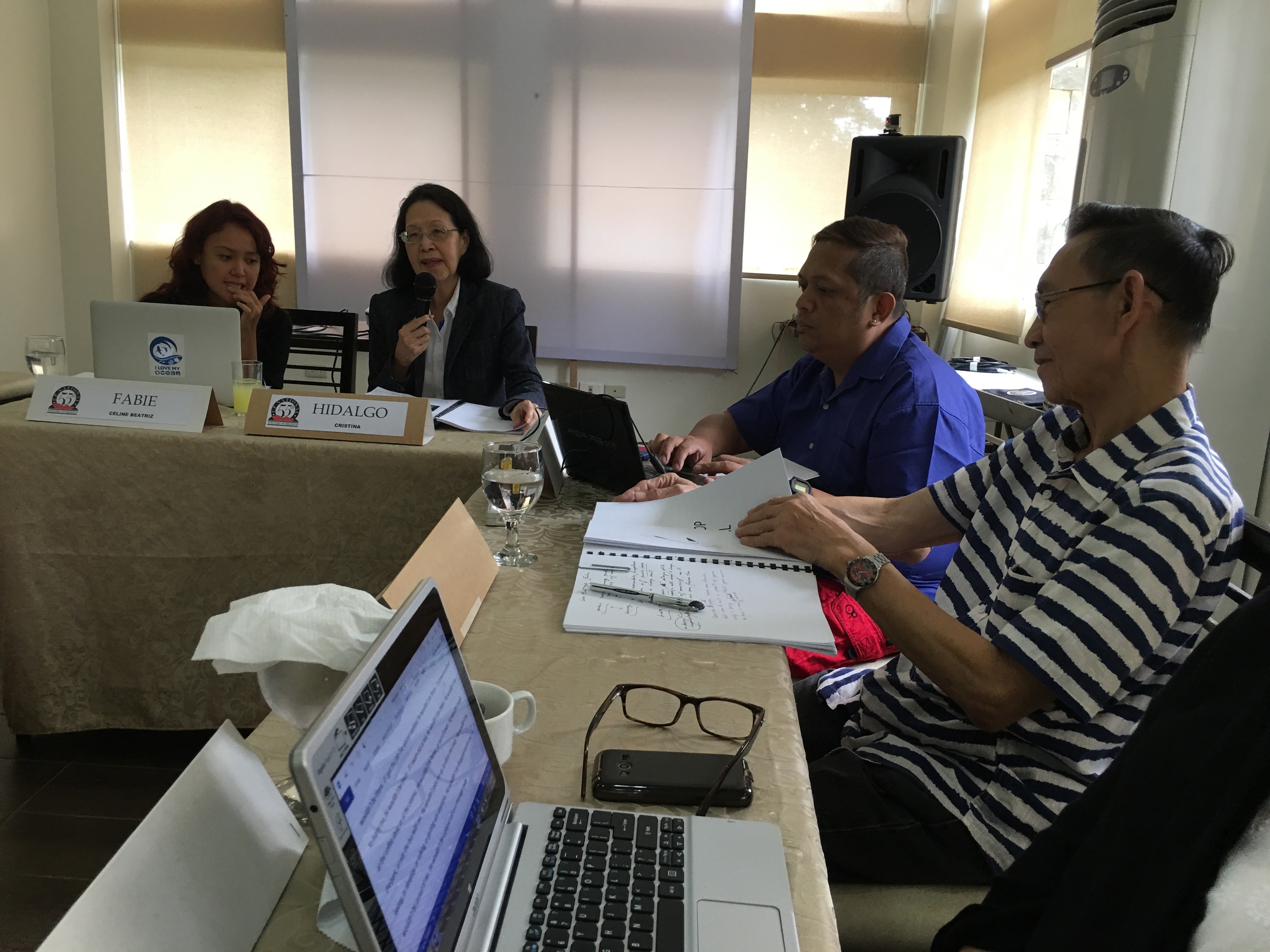
I’d like to thank my fellow panelists—National Artists Bien Lumbera and Virgilio Almario, and fellow UP professors and faculty members Jimmy Abad, Jing Hidalgo, Neil Garcia, Vim Nadera, Jun Cruz Reyes, Luna Sicat, Eugene Evasco, Issy Reyes, and Vlad Gonzales—our hosts at UP Los Baños, the National Arts Center, and the BP International Hotel, and of course the UP Diliman and UP System administration for another worthwhile effort at enriching the future of Philippine literature.

Penman No. 201: A Workshop on Mt. Makiling (1)

_MG_6720.jpg

Penman for Monday, May 30, 2016


FOR THE first time in ages, the UP National Writers Workshop—a project sustained without fail by the University of the Philippines since 1965—is being held away from its traditional venue in Baguio, this time on the foothills of Mt. Makiling in Los Baños, where UP has another major campus. The UPNWW has risen to become the premier workshop for mid-career writers in both English and Filipino, and by “mid-career” we mean writers who have published or are in the process of publishing their first book. Typically these are writers in their 30s and 40s who may be employed in jobs having little or nothing to do with creative writing, who may be teaching, or who may be simply stuck in a rut waiting for that push or kick to resume a stalled love affair with letters.

Toward December every year, we—meaning the UP Institute of Creative Writing, which runs the workshop and which I head as director—put out a call for applications for qualified writers to join the week-long workshop. No one gets a free pass—no matter how good you are or how many books you’ve published, you have to go through the application process and submit an excerpt from a work in progress and a short essay on your poetics (in other words, why you write what you write).

I could tell, even from the applications, that this year’s batch was one of the best we’ve put together in recent years. In it are Vijae Orquia Alquisola (poetry, Filipino), Celine Beatriz Fabie (CNF, English), Rolly Jude M. Ortega (novel, English), RM Topacio Aplaon (novel, Filipino), Vincent Abejuela Dioquino (poetry, English), Francisco Montesena (poetry, Filipino), Melecio Turao (poetry, English), Ma. Elena Paulma (CNF, English), Mina V. Esguerra (fiction, English), Cheeno Sayuno (children’s fiction, English), Enrique Villasis (poetry, Filipino), and Visconde Carlo Vergara (drama, Filipino).

We’re midway through the workshop as I write this, and already I’ve been impressed by what I’ve been reading and listening to. In particular, three women we brought into the workshop (sorry, guys, but ladies first) ably demonstrated the range and quality of the work at hand.

Celine Beatriz Fabie is an actress and singer by training, but her biography of her grandmother, the actress Mona Lisa, won for her the Madrigal Gonzalez Best First Book Award last year, and her continuing foray into creative nonfiction yielded a poignant recollection of her father’s passing:

“When dad went, a nurse came in and started cleaning his body, a body which hadn’t been moving anymore.  I asked her if I could do it.  I started wiping him and asked the nurse, my mom, and my uncle if he could be left there for a little while, if it’s okay that they didn’t take him away just yet, if I could just be given a moment to be with him a little more.  I crawled in bed with my dad, who clearly wasn’t there any longer.  I took his face in my hands, stayed there for an hour that seemed to me a fraction of second, and told him I loved him.  Just that I loved him.  There were no last promises, no saying goodbyes.  I knew for a fact that there was no time and place in this lifetime that I would find myself ready.  I was back to being his little girl in an instant, forever, and the little girl, I’m afraid, will never be ready to say goodbye.”

Elena Paulma spent a few years as a Cenacle nun before teaching Literature at Xavier University. I was especially proud when a short story she wrote for my class won First Prize at the Palancas in 2011. For the workshop, Elena submitted a meditation on the Sendong disaster that ravaged parts of Mindanao, which she and a friend also from Cagayan de Oro, Jeena Rani Marquez, are writing a book about. Elena recalls:

“And the raindrops just keep coming, now in torrents sweeping across the land, flowing down from mountains laid bare by chainsaws, waves of it now from the raging river washing onto the darkened houses in the subdivisions, in the main thoroughfares, along the highways, and falling riverbanks.

“Later, there will be hundreds of feet lined on the streets, dangling from trucks, hanging from roofs and treetops. Many of the houses will be no more, the whispered words and laughter silenced by the whirlpooling waters that the rains had become.

“Much later, even years later, there are those who will shiver when a single drop of rain hits the tin roof in the night. They will want to get up from their beds, gather the things   that survived the demon floods that devoured houses, cars, friends, dogs, and families, and run far away from the mere sound of rain.

“It will take a long time, a very long time, before the darkness that gathers in every household each time it rains will be cleansed away.”

Mina V. Esguerra comes from a background in Communications, which she has deftly employed to become a pioneer in digital publishing, selling thousands of copies of her romance novels online. She firmly believes that Filipino authors can break through to the global market, and that romance novels offer a viable way forward. Not surprisingly, her novels carry an upscale, millennial vibe. In her workshop piece, two characters find themselves trapped in an elevator:

“We both backed away from the speaker and… had nowhere else to go. It was hard to not look at each other, though, because all four walls of the elevator were reflective surfaces. If I looked one way, I would see his eyes, the nice shape of his lips. The sweep of his hair up and to the left, revealing a worried forehead. The other wall reflected an image of his broad back, straight and rigid because he was looking up, waiting for the display to change. A little lower down that wall and I could check out how his butt curved in his jeans, and…

“No no no, don’t go there, Iris.”

 Next week, I’ll share snippets of new work from some other workshoppers, to display the range of material and treatments that we’re dealing with. The important thing is to show and to see that Philippine literature is very much alive and advancing on many fronts, assuming a variety of voices, styles, and approaches.

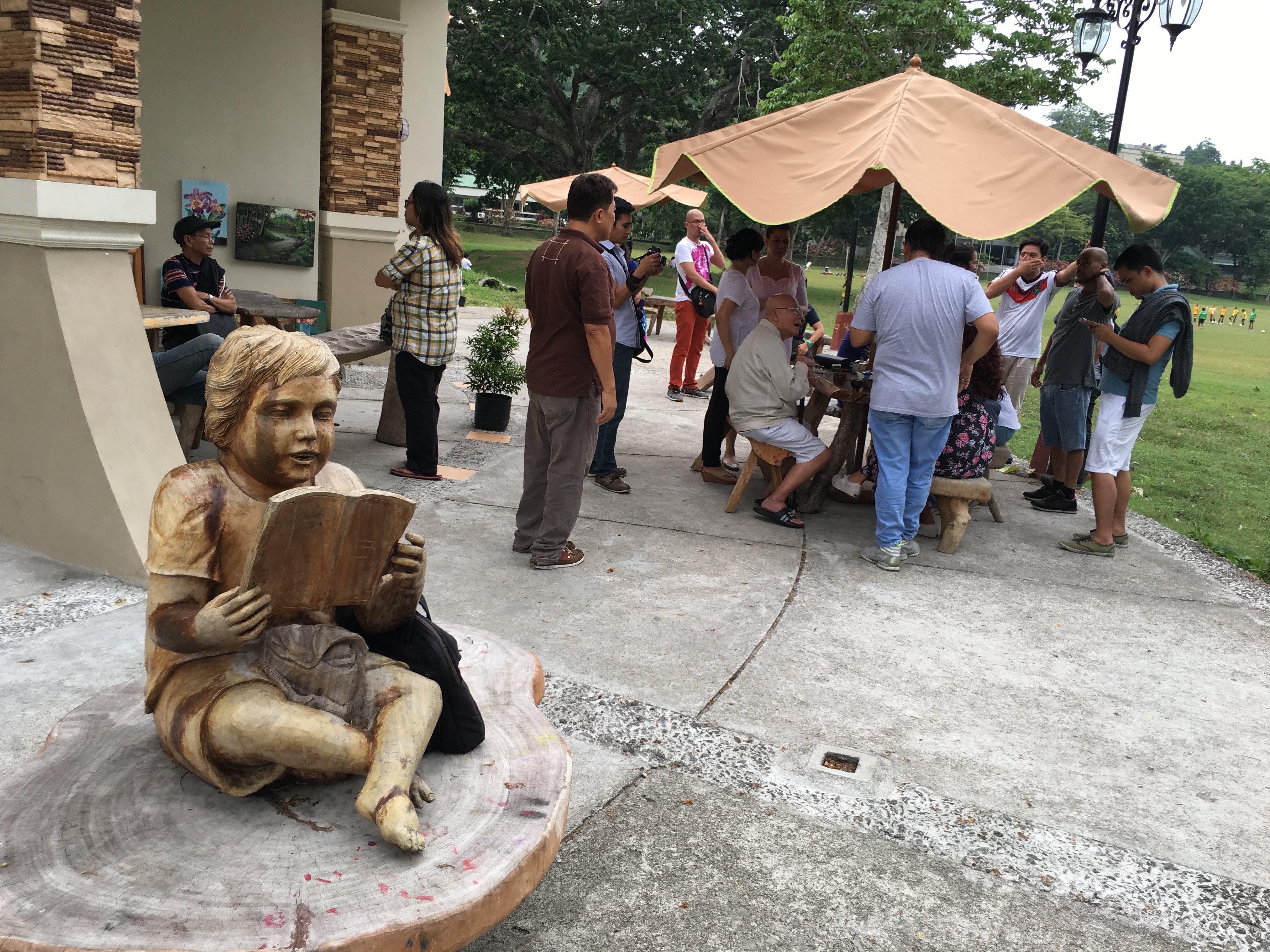
Another benefit of this reacquaintance with Los Baños is discovering how the campus has changed and grown since I first visited it as a freshman on the staff of the Philippine Collegian to attend the College Editors Guild of the Philippines conference in 1971. Among my most pleasant encounters this week has been that with a former student from way back, Yvette Co, who now runs the Ginhawa Craft Studio Café in a dome-shaped kiosk in one corner of the sprawling UPLB Alumni Plaza.

IMG_8519.jpg

As its name suggests, it’s a studio, gallery, performance space, and café all in one, a new and natural convergence point for lovers of the arts in Los Baños. Yvette—a Philosophy major who shifted to Interior Design and who now sculpts and paints—leased the space to breathe new life into a campus more known for agricultural studies, and her works and those of other guest artists blend in with that environment, utilizing scraps of wood and other natural objects as might be found in the area.

So thank you, Los Baños, for the warm welcome.