Penman No. 92: Nurturing Our Sense of Nationhood

IMG_3176Penman for Monday, April 14, 2014

AT THE University of the Philippines Institute of Creative Writing, we were happy to recently welcome into our ranks several new “associates”—UP colleagues who were also accomplished writers whom we felt could make significant contributions to the Institute’s programs. They were Chari Lucero, Luna Sicat-Cleto, Eugene Evasco, and Heidy Eusebio-Abad. Chari is a bilingual—indeed, a multilingual—fictionist and essayist, a very sharp reader of texts; Luna is a playwright and novelist in Filipino; Eugene, a Palanca Hall of Famer, is a writer of stories and poems for children in Filipino; and Heidi writes stories for children in English.

The entry of Eugene and Heidi into the UPICW was particularly timely, since we were severely short-handed as far as our expertise in writing for children and young adults was concerned. Puppetry advocate Amelia Lapeña-Bonifacio remains on our board of advisers, but we had lost Rene Villanueva to an early death and Carla Pacis to La Salle. By bringing Eugene and Heidi into our workshops, we wanted to remind ourselves—and the reading public, of course—of the primal importance of children’s literature as a means of nurturing our sense of nationhood in the imagination of our youngest citizens.

This renewed emphasis was evident at the 53rd UP National Writers Workshop, which we held last week in Baguio. At least three of our 12 workshop fellows were writers for children and young adults. Cyan Abad-Jugo, who already has a PhD in Creative Writing, is working on a book of 13 stories in the fantastic mode. Renato “Nats” Vibiesca, a Palanca award winner, teaches at the Polytechnic University of the Philippines; Marcy Dans-Lee is primarily an illustrator and artist, but also writes her own texts, often drawn from the wealth of indigenous lore that surrounds her in Davao, where she teaches at the University of the Philippines-Mindanao.

Cyan submitted what can most easily be described as modern horror stories; Nats contributed a comic piece about a poor kid who dreams of becoming a bossing, an entrepreneur; Marcy presented retellings of native creation myths. The fact that their material and their approaches vary so widely can only bode well for the future of children’s literature in the Philippines. Herewith, some excerpts from their “poetics”—their explorations into why and how they write what they write (I’ve translated Renato’s excerpt from Filipino):

Cyan Abad-Jugo: I wanted to see if I could achieve “a wider lens on ultimate reality” by making a slight detour “from direct representation of the surface of reality;” I wanted to skew it a little or reshape it a lot, and see if I could not arrive at better relevance and social commentary (which is what I thought Scholes meant by returning “towards actual life by way of ethically controlled fantasy”). This does not mean that I wanted to identify an aspect of social reality and then work it into my fiction. I never start out with such clarity of mind, and cannot give myself clear directions; my default mode is “lost mode,” and so must find my way out of the labyrinth I inevitably find myself in.

The project had more to do with finding out whether the fantastic mode inherently contained within it a metaphor for what it was like to live in our own world. I wanted to write first, as always, and see what came of each story in the end (hello, story, do you have a metaphor in you after all?); but I also wanted to limit what I wrote, I wanted to try my hand at writing particular kinds of tales, given their definitions or what I thought to be their definitions. As I clarified in my proposal:

Though stories never adhere to strict definitions of modes or genres, the definitions and characteristics of each kind of tale or story could serve a heuristic purpose; they could serve as guides to the writer who wants to explore the capabilities, flexibilities, and possibilities of the fantastic story, and how it expresses what we are and could become.

Renato Vibiesca: The short story “Sawsawan sa Padyak” deals with the experience of a boy (with the nickname Kadyot) who grows up in Gagalangin, Tondo—specifically, his transition from childhood to adolescence while confronting his family’s poverty. The story raises questions about the self, physical change, initiation, experimentation, confusion, observations about the adult world, vice, and other instances that address this period of transition. The story also illustrates the culture, the exploits, and the strategies employed by the poor to survive and stay in the city. Even as these problems aren’t solved in their entirety within the story, it does offer hope for the protagonist who keeps on dreaming as he moves along this new path in his life.

The story was written from the point of view of the protagonist, using a voice unique to a 12- or 13-year-old; often facing personal problems, tossing questions around in his mind, nudging forward and backward in his decisions…. Though often full of fear, experience and his station in life become drive him to become more creative and resourceful.

The story’s main aim is to give value to how such young persons face life’s challenges. It isn’t very often that the experiences of adolescents are taken up in fiction. This stage is an eventful one, which makes it more important for readers of this age to be given guidance. The author hopes that more works—both short stories and novels—will be written along this line.

Marcy Dans-Lee:Monsters are my personal inspiration
for writing for children, as children can relate
more to monsters than grown-ups. Children
believe that monsters are real; adults believe that monsters are real only in other adults. And because children believe in monsters, they have the ability to embrace “magic” in stories. As a writer for children, I depict magic with gentle care, never underestimating my little reader’s intelligence for they have been known to persistently demand “Why?” And the writer must be prepared to give them valid and reasonable magic, one that has practical logic, delicately balanced by its own breathtaking mystery.

In writing Luis and the Enchanted Creatures, my intention was to introduce children to six fearsome folkloric Filipino monsters. Under the shade of a balete tree, Luis reads about each monster in his grandmother’s old forbidden
book, from which the monsters soon emerge. In
a child’s mind, because the monsters are in the book, it is logical for them to come out of it. This is acceptable magic for children; it is completely reasonable.

Likewise, the adult’s choice of words in talking and writing is inarguably different from that of a child. Simplicity and straightforward narration are encouraged, while expanding a child’s vocabulary is the writer’s choice. Repeating a new word, a phrase or a sentence allows for remembering and internalizing meaningAs a writer, I particularly enjoy dialogues for these provide me the opportunity of acting
out character parts, drawing inspiration from every child’s unforgettable characters, like the pig’s chinny chin-chin and the wolf ’s huff and puff, as well as the nightly read-aloud sessions to become an incredibly angry Papa Bear, a delicately shocked Mama Bear and a whining spoiled Baby Bear when they see their bowls of half-eaten porridge, their chairs mussed up, and their bed sheets crumpled and undone.

The style of putting these words together however may lead a writer to unknowingly
“talk down” to children. Writers for children
are particularly vulnerable to this danger for as adults, we are sadly accustomed to innovating the strangest, most convoluted ways of controlling and negotiating with children in order to restrain their innate curiosity. We tend to be condescending, unaware that we are in fact the primary bullies
in their young lives. When I draft a story, I unconsciously converse with a child—with the same respect I converse with adults.

Simultaneously, my mind’s eye can see the illustrations that will go with the story. This anticipation allows me the luxury of fewer words since the illustrations will speak a thousand words. For after all, does a writer for children need to explain that a monster has a thin face, with big scary eyes, sharp yellow teeth and long unruly hair? Such descriptions are certainly better drawn than written.

In the end, “happily ever after” means that our stories and illustrations for children
must contribute to inspire a child’s imagination
to become real in adult life. For how else can technology, medicine, green urban planning, space and time travel be imagined and made real, if not for stories of monsters and magic?

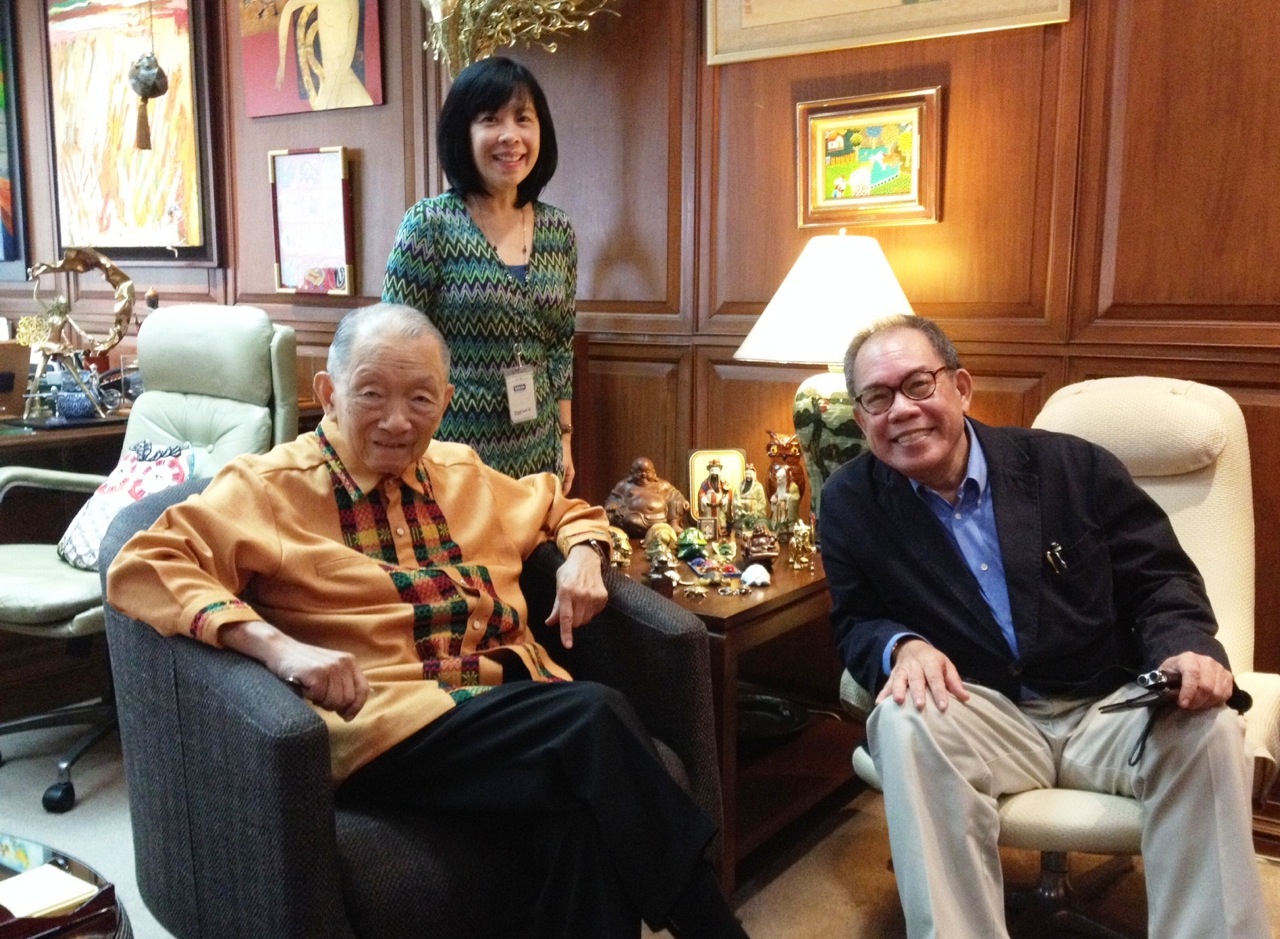
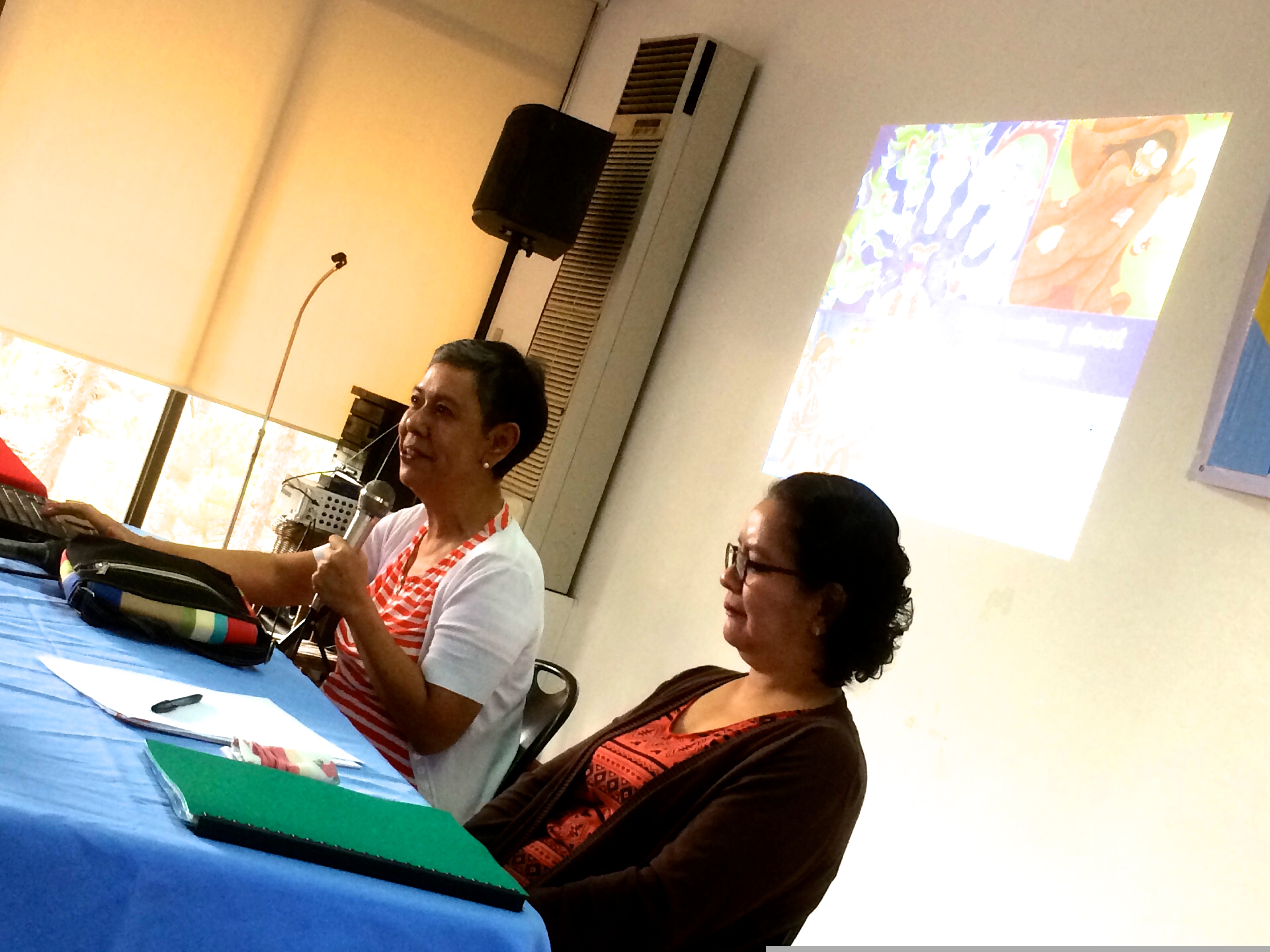
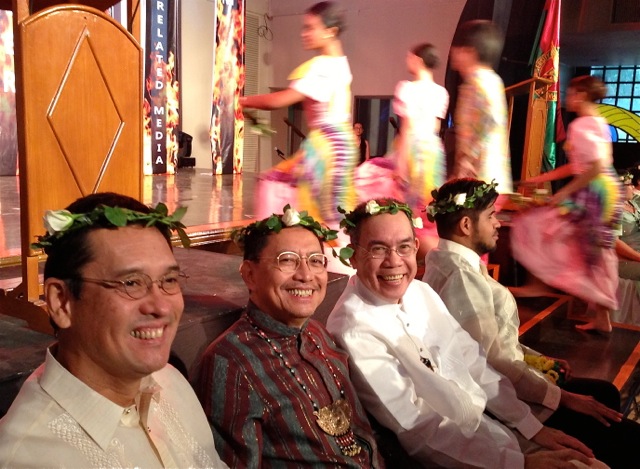
(That’s Marcy and Heidi in the pic.)

Penman No. 76: A Lesson in Description

Penman for Monday, December 9, 2013


NOW AND then I walk my students in Creative Writing through a lesson in description, which—as I’ve often noted in this corner—is at best always more than a rendition of the physical setting and the people and things in it. In the hands of a skilled or a gifted writer, a plain object can acquire a strange and memorable luminosity. Sometimes all it takes is the uncommon but logical and precise choice of a word, such as when William Faulkner describes a campfire as being “shrewd,” struggling and managing to keep alive despite the wind. At other times good description requires the writer to step back and to set things in a larger context, balancing fine detail with the broader sweep of memory and understanding.

I don’t even need to draw on the likes of Faulkner or Greg Brillantes or Kerima Polotan to demonstrate what I mean. Take this passage from a story submitted to my fiction class a couple of semesters ago by a young student named Katrina del Rosario, part of a story titled “Paying Respects.” Rather quiet in class, she more than made up for her reticence with this outpouring of brilliant prose:

The first Dayaos had been very successful farmers, and the land burst with green and trees and stalks and vines heavy with bright fruit; now only one or two Dayaos farmed the land, with the most magnificent of trees cut down to build houses. The elders remembered entire lives lived underneath the shadows of trees and grown roofs of vine, childhoods spent working the fields. They did not remember it as work. They remembered instead the bits of sugarcane that could no longer fit into carts and the sap sticky on their chins as they tore off strips of the bark with their teeth; getting lost in entire walls of tall grass that needed to be cut down; the cool of the mud and manure against their knees in the middle of a field exposed to all the ghastly splendor of a high sun; as small children, play was pretending to chop wood for the hearth and desiring to be old enough to pound the rice, watching in awe as their mothers tossed the grains into the air like a high wave and catching it again, cooking kangkong in hot water in their small toy pots made of clay. Everything they needed could be found on trees, in the fields. They had been perfectly comfortable. They were never hungry. Home was where the land began, and ended; living was the certainty of land and its fruit.

What’s even more interesting about this example is how little use it makes of adjectives and adverbs—the crutches that beginning writers often employ to carry the burden of description (“he snarled angrily,” “the bright, sunny morning,” etc.). “Write with nouns and verbs!” I keep reminding my students.

There are many ways of describing the same scene, but one approach I offer student writers is the option of gauging one’s emotional and psychological distance from the subject, and rendering the scene accordingly.

Depending on your purpose, you can choose to describe a person, thing, or place in one of several alternative modes. Your purpose, of course, will depend in turn on the kind of fiction or scene you are working on. I made up the following examples (so you’ll forgive me if they sound cheesy) to illustrate these alternatives.

What I call the technical/objective mode is strictly that, a seemingly factual, no-frills rendition of the scene, as a police report might put it:

The apparition was reported by a male witness, 45 years old, a farmer and a native of the town of Libmanan, Camarines Sur where previous sightings were said to have occurred. The man, Angelo Camagay, described what he saw as a woman in her early thirties, about 5 ft. 4 in. tall, and with distinctly Caucasian features: light brown hair, blue eyes, and fair complexion. She was clothed in a full body-length white robe of soft material; Camagay could not remember seeing footgear of any kind. She appeared before him at about 5:45 am on the opposite bank of a stream where he had paused to draw water in his bamboo container, prior to working in the fields.

Somewhat warmer and more detailed is the neutral/realistic mode. It’s still a fairly straightforward description without much emotional coloring, but we see things more vividly:

Augusto dipped the thick, three-foot length of bamboo trunk into the water; it had been severed at the nodes, with a hole cut into the top and a wooden handle attached to one side. Now the cool, clear water gurgled into the hole as Augusto held the container down, feeling the stream swirl around his wrists and the bamboo struggle to keep afloat. Later, in the heat of noon, the same water would slake his thirst and wash the paddy mud off his hands. Augusto looked up; it might have been a bird bursting out of the trees that caught his eye; but it was a woman on the opposite bank, blinding in her pure white robe. She, too, was white of skin; her hair was a light brown, and she stood closely enough for him to see that her eyes were blue. He could not see her feet, which were lost in the lush grass. She seemed younger but somewhat taller than his wife. Augusto knew that in all of his forty-five years in Libmanan, he had never seen anyone like her; but some of his townmates had, and now he believed them.

And finally—though perhaps with the greatest degree of difficulty—one can go into the lyrical/romantic mode, which involves a certain degree of abstraction and sublimation, and certainly a more pronounced attitude, not to mention some linguistic dexterity:

Rough the palms that trapped the water, brown the arms that fought its surge. Come into my bamboo cup of cups and fill me in my driest need, my limpid blood of morning. Come. And Augusto looked up for an instant, thinking that a great white bird had exploded in the trees, flushed out by his presence. But no bird there, no stark familiar creature of his town’s well-traveled woods. Maria, Ave Maria, oh fair oh pure oh thou footless light disconsolate. Eye of sky, hair of corn, I come to you. And bathed in her sudden radiance, Augusto thirsted as he had never had, but as others had, and now he saw, and now he knew.

Whichever mode the writer employs, he or she should remember that the best description always does more than physically describe: it prepares and conditions us for what is about to follow, and, working with the narrative, provides a context against which we can understand characters and their situations better.


LAST WEEK’S piece on the forgotten master Constancio Bernardo—whose 100-year retrospective dazzled us when we attended its opening last Wednesday—prompted the following recollection from the Davao-based poet Ricky de Ungria, who also paints and draws occasionally:

“My first teacher in the arts was Ms. Katy Bengzon of DLSU. I took a summer class there in Taft when I was still in high school and copped a prize for a watercolor of mine. My second teacher was Constancio Bernardo. My father enrolled me in a summer class of his at the old CMLI gardens somewhere in Quezon City. He taught me how to do landscapes in watercolor. In fact in one of my old sketchpads he showed me how to do shadows of leaves on trees. Very calm, soft-spoken and gentle man, as I remember now. All this to tell you how much I appreciate your piece on him today because I knew so little of him.”

Penman No. 68: Towards a Regional Literary Community

Penman for Monday, Oct. 14, 2013

WE WERE back in Bangkok very recently, about the same time as last year, for another gathering of the newish Asia-Pacific Writers and Translators Association (APWriters). Around 200 participants from all around the region and from as far as Europe and the US got together from October 3 to 6 in Chulalongkorn University—also the site and host of last year’s conference—to meet on a wide range of literary concerns, most of them bearing on this year’s focus on “The Teaching of Creative Writing.”

Titled “Reaching the World 2013,” the conference was sponsored by the Bangkok Metropolitan Authority, Asia Books, and the Faculty of Arts of Chulalongkorn University. Bangkok had good reason to host us two years in a row; it had been named World Book Capital for 2013 by Unesco, and was celebrating the honor in the most appropriate way it could. It’s also at Bangkok’s historic Oriental Hotel that the annual SEAWrite Awards for the region’s best writers are given out, and we were welcomed there at dinner by the urbane and popular Governor of Bangkok, Sukhumbhand Paripatra. The son of a prince and educated at Oxford and Georgetown, the governor put everyone at ease by joking that he couldn’t greet us with rhymed couplets, as he was “only a politician” (he had, in fact, taught political science at Chula, Georgetown, and Columbia).

I was one of the organizers of the conference, and was proud to see that a total of 27 Filipino participants (not counting four who had to withdraw at the last minute for various reasons) attended “Reaching the World.” Among others, the delegation included stalwarts of the Philippine literary community such as STAR columnist and former DepEd Usec Isagani Cruz; UST and UP creative writing guru Cristina Pantoja-Hidalgo; MSU-IIT professor and poet Christine Godinez-Ortega; DLSU creative writing center head Shirley Lua; UP Press director and poet J. Neil Garcia; University of San Carlos professor Hope Sabanpan-Yu; the Bellagio-bound fictionist Menchu Sarmiento; and Davao Writers Guild president Jhoanna Lynn Cruz.

But more than seeing familiar names on the program, I was especially glad to see that many of our youngest writers on the UP faculty were able to attend as well, including Francis Quina (my deputy at the Institute of Creative Writing), Gabby Lee, Sandra Nicole Roldan, and Vyxz Vasquez. Conferences like APWriters expose writers like them to ideas and influences outside of their own local schools and networks, and sustain the continuity of our commitment to literature from one generation to the next.

APWriters grew out of the old Asia-Pacific Writing Partnership, which we expanded to include translators, in recognition of their crucial role not only in promoting the works and careers of individual authors but also of fostering international understanding through literature. On top of the transition has been the indefatigable Australian writer Jane Camens, who now serves as APWriters’ executive director (read: conference busybody) and who put the conference program together from dozens of proposals we received.

What distinguishes APWriters and its conference format is the informality of the discussions. Proposals for presentations were solicited and accepted, but no lengthy papers were actually read; instead, panelists spoke from notes or off the cuff, achieving our goal of witnessing “writers in conversation” as participants from places as diverse as Norwich and Ho Chi Minh City shed their academic robes, rolled up their sleeves, and spoke from the heart and from memory about the subjects that matter most to writers, translators, and teachers of creative writing.

We don’t mean to be unfriendly towards critics, scholars, and their important work, which after all endeavors to make sense of what we creative writers do. It’s just that there are already enough venues out there for the reading of formal papers (the annual and massively-attended conferences of the Modern Language Association and of the Associated Writing Programs come to mind) on the most obscure and abstruse of literary concerns. I took part in two panels at Chula, as a discussant in the first (which confronted the question of “cloning” in writing workshops and programs) and a moderator in the second (which dealt with how writers budget their time, and with what else they do besides writing).

Aside from Jane, I was glad to see old friends and acquaintances from around the region (or whose work and personal lives bring them regularly to Asia) such as the American writer and workshop specialist Tim Tomlinson, whose book The Portable MFA I’ve recommended to those in need of a crash course in creative writing; the Indonesian translator Eliza Vitri Handayani, who’d sponsored the translation workshop in Jakarta that I’d been a part of just the week before; Kate Griffin of the British Centre for Literary Translation; the Japanese-American fictionist Kyoko Mori, a fellow alumnus of the University of Wisconsin-Milwaukee’s PhD program; the Indonesian-Chinese-American Xu Xi, who directs the low-residency MFA program at the City University of Hong Kong; the Australian nonfiction and theater expert David Carlin; and, of course, the APWriters chairman himself, the Hong Kong-based Sri Lankan journalist and humorist Nury Vittachi, who’s been behind some of the region’s most significant literary projects, such as the Man Asian Literary Prize and the forthcoming World Readers’ Award.

There were many more, but you get the idea: this is a functioning network of writers and literary specialists from around the Asia-Pacific who’ve come to know each other as friends. And before anyone starts screaming “Another literary cabal!”, let me say, yes, why not, because right now, that’s what we need; there will be a time and an occasion for principled disagreement, but for now our emphasis is on finding and strengthening commonalities of thought, practice, and experience, thereby creating a working community of writers and translators in the region.

The commitment of these people to our emerging network was evidenced by the fact that many participants, including myself, were entirely self-funded. (It also helped, of course, that Bangkok is one of the most accessible, affordable, and tourist-friendly places on the planet.)

The large turnout from the Philippines also reflects the size and the maturity of our literary community and culture. Why shouldn’t we be able to send almost 30 writers to Bangkok? I respectfully disagree with those of us (including my friend Cirilo Bautista, whom I praised and quoted a few weeks ago) who see the Philippines as “a small country.” We’re certainly not—neither in size (at 300,000 sq. km., the same size as Italy), population (in 2005, we were 13th in the world), nor GDP (around 40th to 43rd  out of nearly 200 countries, depending on the year and who’s counting). Our grossly inequitable incomes and power relations are a real problem, but even these haven’t curbed, and may even have encouraged, our expressiveness in art and culture.

Indeed, as we look around the Asia-Pacific, we’ll find that the Philippines has one of the most robust of literary infrastructures, with formal creative writing programs in half a dozen major universities, a workshop tradition going back half a century, and the kind of democratic irrepressibility and irreverence that you can’t find anywhere else in Southeast Asia.

We’re banking on these strengths to put the Philippines more firmly on the global literary map, and we’ve taken a step in that direction by offering to host (after Singapore next year) the 2015 edition of the Asia-Pacific Writers and Translators conference. I hope to see many of our Bangkok fellows there, and more.

Penman No. 67: Found in Translation (2)

IMG_2078Penman for Monday, Oct. 7, 2013

AS YOU read this, I should just be returning from Bangkok from another conference of writers and translators, and I’ll be reporting on that encounter next week.

But before anything else—and given this context of world literature in which I’ve been immersed for the past two weeks—let me voice my concern over a development I’d heard about in my absence pertaining to some contemplated changes in our high school curriculum. With our educational system shifting to the K-12 scheme—which I’m in favor of, just to be clear about that—our teachers and school administrators have had to review the curriculum to adjust it to the opportunities presented by the extra class time.

The plan being prepared by the Department of Education and the Commission on Higher Education was for high school seniors to have two semesters of literature—regional and world literature, meaning, literature by Filipinos outside of Manila and literature written by everybody else. Those of us who teach literature in college were elated to hear about this, because we see how valuable literature is to exposing young Filipino minds to the dynamic realities and challenges of the world around them—beginning with us as still a nation-in-progress, which regional literature helps to build, and with our growing engagement with Southeast Asia and the rest of the planet, which world literature makes sense of and amplifies.

Comes now the news that the DepEd has decided to compress these two semesters into one and to treat both regional and world literature as one subject, which doesn’t make sense for the teachers of these subjects and disperses the intended focus of our concerns in these areas. Makes me wonder what we added those extra semesters for, and, worse, if literature is going to continue to be treated as a disposable frill without any real bearing on national development. Have any of our government officials figured out by now that part of the reason we have a “Zamboanga hostage crisis” or a “Mindanao problem” is that we’ve never really introduced and explained ourselves to ourselves—which is what art and literature do for a people? Let’s hope that the DepEd rethinks its position on this matter, before it’s too late and before we fall farther behind our Asean neighbors in using culture as a foundation for nationbuilding.


AND NOW back to Jakarta, where I spent a few days with a large group of very enthusiastic and talented translators-in-training and with experienced translators and language specialists from as far away as the UK and Norway. As Kate Griffin of the British Centre for Literary Translation put it, the Jakarta workshops were something of a “translation boot camp,” a quick and memorable immersion for the participants into the unique challenges and wonders of translation as a bridge between cultures. (The BCLT promotes the translation of foreign authors into English, in support of what it calls “bibliodiversity,” the opening of minds and hearts through a richer and more accessible fare of reading material.)

As I reported last week, the experience of having parts of my second novel Soledad’s Sister translated into Bahasa Indonesia (where it reads as “Saudara Perambuan Soledad”) reminded me of other fruitful encounters I’d had with my previous translators: Clara Nubile, who translated Soledad into Italian for Isbn Edizioni, Marta Alcaraz, who translated Killing Time in a Warm Place into Spanish for Libros del Asteroide, and Jean-Pierre Aoustin, who translated Soledad into French for Mercure de France. I’d had lively discussions with all of them, especially Jean-Pierre who turned out to be an old Manila hand and who met with me on a recent vacation here.

I think it was Salman Rushdie who once said that “the most interesting parts of a language are the untranslatable ones.” Be that as it may, translators have to do their best to come closest to an author’s original intentions, knowing that it is an impossible and fruitless task to strive for 100% fidelity and accuracy, but creating a space for negotiation and understanding between cultures in the middle of the two languages, the source and the target.

Clara, I recall, asked me to describe what kind of a criminal operation a bukas-kotse gang was. Marta had a load of questions about juego de prenda, the tuta in “Marcos Hitler diktador tuta!”, and why I had chosen to call the ruling party under martial law the “PNR, or the Party of the Newly Risen”; I explained to her that the actual martial-law government party was called the Kilusang Bagong Lipunan, or Movement for a New Society. I used PNR as something of a private joke, as the initials also stand for Philippine National Railways (a reference to how everything was railroaded under martial law) and for the Filipino phrase “puwede na rin,” or “it will do” (a reference to mediocrity). Jean-Pierre wondered about my use of “laundry on the clothesline” and if it had any cultural resonances; I told him that we Pinoys still hang our clothes out to dry, and that you can half-expect to find your favorite jeans and shirts gone from where you left them if you don’t watch out.

In other words—literally, I guess—translation involves much more than figuring out equivalents for individual words and phrases; the translator keeps looking for similar, familiar experiences in the target culture to convey a working sense of the author’s meaning.

In Jakarta, my group and I—with the Bali-based translator and art critic Arif Prasetyo facilitating—went over words and phrases that the Indonesians had flagged. Why did I use “cloud-curtained” to describe a rainy evening instead of just “rainy”? (Because it was the novel’s opening scene and I wanted a touch of the theatrical.) Why did I say “a million gas stoves roared to life”? (Because I wanted both the sound and the image of the gas fires coming awake, mirroring the headlights of motorists and even the flowers in the plane’s cargo hold.) When I wrote that the sudden downpour “blurred glasses and windows,” did I mean “eyeglasses”? (Yes, to set up a motif having to do with seeing and perception.) We had fun with the word duhat, which I’d kept in the Filipino original, not knowing its English equivalent; some Googling with images established that, in Bahasa, it was the local jamblang, also known as the duwet or the black plum (but if I’d used “black plum” in my novel, not a single Pinoy would have known what I meant).

Just as interestingly, my translators found a couple of mistakes in my novel, which I acknowledged with equal amounts of embarrassment and gratitude. One was a small typo, the other a major boo-boo: I’d said that the flight from Jeddah to Bangkok had “stretched the daylight with it,” but an alert member of the team who had actually been to Jeddah (I never had) noted that it worked the other way around, that one flew more quickly into the darkness. I promised to correct this in the next edition.

And so my adventure with the translators went, full of surprises and revelations. I learned much from listening to Kate Griffin talk about how, in the UK, interest in translation has been drummed up through popular word games, and how the BCLT (which is based at the University of East Anglia in Norwich, where I began Soledad’s Sister as a David TK Wong Fellow in 1999) combines teaching, research and expertise with an ambitious outreach program. Eric Abrahamsen, an American who has been based in Beijing for the past 12 years, spoke about how he helped form Paper Republic to band translators of Chinese together to professionalize their trade.

John McGlynn, an American translator who works with the Lontar Foundation which translates and publishes Indonesian writing into English, brought up the painfully obvious point: translators don’t get paid enough for their work. Ideally, he suggested, translators should get at least $20 (or, to us, P1,000) per page, given that the US State Department paid professional translators like him $30 per page for contracted work. In reality, however, Indonesian translators got a tiny fraction of that suggested amount. “Factor in the cost of printing and distribution, plus royalties for the author, and you really have very little left for the translator,” said John.

Indeed, translators around the world have a long way to go to attain the same respect and consideration given to the authors whom they lend their voices to, but like the writers themselves, they have no choice but to persevere, the unacceptable alternative being silence and ignorance.

Penman No. 65: Tried and Tested

Penman for Monday, Sept. 23, 2013

LAST WEEK’S piece on the kind of open-book exam I give my students reminded me of the toughest exams I myself had to take as a student. It’s been more than two decades since I last stepped into a classroom and sat opposite the professor’s table and chair, but the memory of those exams remains vivid—in some cases, distressingly so.

I have to declare, at the outset, that unlike most students, I liked exams, especially in subjects that I knew I would do well in. I got a thrill from being tried and literally tested; I saw the exam as a game of wits between me and my professor, and while my professor certainly knew much more than I did about the subject, I was always on the lookout for angles and insights that my professor might never have considered, and would therefore appreciate as something fresh. I disdained what professors call “spitback”—the rote regurgitation of points already discussed in class—knowing that many of my classmates were going to do just that.

I was, in other words, something of a smartass, and like all the annoying smartasses you remember and loved to hate from high school and college, I deserved and got my occasional comeuppance. Returning to college after a ten-year absence, I thought I could wing it in my Lit classes, but instead got the loudest wake-up calls I possibly could, from two professors known to be formidable “terrors” in the English department—Filonila Tupas and Damiana Eugenio—both of whom gave me a “5.0” in the objective quizzes that they began the semester with. Thankfully these were diagnostic quizzes, and the diagnosis was clear: I had to hit the books to do well, so I became a textual bloodhound, memorizing odd details and references (plants from Shakespeare: wild thyme, oxlips, woodbine, eglantine). I would not embarrass myself again—or so I thought.

Shakespeare and the Elizabethan age became a passion for me, a period fraught with dark political intrigue and steeped in grime yet also ennobled by some of the most sublime poetry ever written. It wasn’t even Shakespeare so much as the lesser poets and dramatists around him—Sidney, Wyatt, Webster, Middleton, Marlowe—who piqued my interest, thanks to a teacher who took kindly to an older student making up for lost time (I was 27 when I returned as a freshman to UP; my Paulinian colegiala classmate, Judy Ick—who would go on to become Dr. Ick, the real Shakespeare expert in the department—was just 17).

That teacher was the impeccably fashionable Prof. Sylvia Ventura, commended (as Shakespeare himself might have put it) by all the swains but feared by most of her students for the spot-passages exams she gave. (A spot-passage exam gives you nothing but an obscure passage drawn from the text of a play or a poem, for you to identify, contextualize, and discuss.) I thought I was doing pretty well in her class until the final exam, when I ran into a passage that might as well have been Greek. Knowing that I had absolutely no chance of identifying the passage correctly, I gathered my wits and used Shakespeare himself to explain my predicament, beginning my answer (whatever it was) with a quote from Act I, Scene 1 of A Midsummer Night’s Dream: “So quick bright things come to confusion!” Apparently it worked, because I escaped with a 1.25.

The toughest teacher I had in UP, however, was the legendary Wilhelmina Ramas, whose final exam on “The Idea of Tragedy” took us five hours and several bluebooks to finish—a herculean effort rewarded, in my case, with a niggardly (and probably accurate) 1.75. Soon after, I flew off the US for graduate school, and it was only then that I appreciated the rigor that my UP “terror” profs had put me through. Their American incarnations were tweed-suited dons rather than coiffed matrons, but they were no less demanding. I had come well prepared.

In my Shakespeare class at Michigan, taught by the pipe-smoking Russell Fraser, I felt like I had orchids coming out of my ears when Dr. Fraser commended me for being the only one in class to be able to answer his question about differentiating “hypotaxis” from “parataxis” (no, it has nothing to do with paid transportation). That still didn’t save me from the pain of Fraser’s final exam: a spot-passage exam, employing two totally unheard-of quotations from Shakespeare’s plays, with one question to answer: “Which is early and which is late Shakespeare, and why?” This was also an open-book exam that we had one day to complete; we were free to roam the library and to read Shakespeare from end to end.

Now, mind you, this was 1986, well before the Internet and Google; students were still using 5.25” floppy disks, if they were using computers at all (I wasn’t; I’d dragged my Olympia portable with me across the Pacific). Today my students would take seconds to find the answer to “early” and “late”, and maybe an hour to cough up a reasonable “why.” Back in ’86, it was all intelligent guesswork, knowing that no amount of speed-reading and cramming could possibly turn up those passages, let alone contextualize them. And Fraser knew that; whether we had the “early/late” part of the question right or wrong, he wanted to see us reasoning our way through our answers, given what we knew from class of the younger and the older Shakespeare. (Only later, in the age of Google, would I discover that Fraser was then at work on two books: Young Shakespeare, and Shakespeare: The Later Years.) I can’t recall how I scored on that exam—I passed the course with an A-minus—but it was the kind of exam that was both gut-wrenching and exhilarating at the same time; I loved it.

Still later, now doing my PhD at the University of Wisconsin-Milwaukee, I had a professor in Bibliography and Research named James Kuist. As mild-mannered as he was, Dr. Kuist had a fiendishly difficult task for us to complete. His exam question went like this: “The year is 1663 and I am a Fellow of the Royal Society. What books would be on my bookshelf?” So off we went to the library on a wild goose chase, and like an eager labrador retriever, I enjoyed the hunt, searching the stacks for the spoor of these antiquarian volumes.

Now that I’m the one giving the exams, I hope to come up with questions and problems that my students will remember 20 years from now, and still get a bit of a headache from—or let’s make that the pleasant buzz, the distant refrain, of an unusually agitated mind.

Penman No. 64: The Outsider in the Story

Penman for Monday, Sept. 16, 2013

AS MY literature students know, there’s only one kind of exam they can expect me to give them—a 90-minute, essay-type, open-book exam. This means that, over a class period, they’ll be answering two or three questions with short essays that they can compose with the help of their notes, their readings, and their brains.

The first time they hear this, some students will cheer, thinking that an open-book exam will be a walk in the park, and that they can catch up on two month’s worth of reading and comprehension with 15 minutes of furtive cramming. (As they like to say on Pawn Stars, “That’s not going to happen.”) The smarter ones know that the best way to get my attention from this point on will be to say something fresh, beyond spitting back what we’d already said in class or quoting some ponderous French critic.

Just like answering them, writing exam questions is something of an art. Ideally, you want to frame questions that are hard to answer but easy to check—in other words, you should be able to sense, within a couple of paragraphs, if the student has a handle on the material or not. You also want questions for which there are no set or obvious answers. In this way, literature and the humanities are different from math and the sciences, in that there is no one correct answer that, with diligence and practice, everyone can theoretically arrive at. I grade responses based on the student’s appreciation of the problem and his or her reasoning; sometimes I might even give a high mark to an answer that doesn’t directly answer the question, but which sets up and pursues such an interesting tangent or dissent that I find myself provoked and educated by it.

Over the years, I’ve built up a battery of questions that I periodically revisit, tweak, and let loose on a new batch of students. Today, I’m taking one of those questions out of commission by putting it out here in the open, and answering it myself. It’s a question I used a few weeks ago for my midterm exam in my course on The Short Story, and while I may change the phrasing from time to time, it basically runs this way: “The Irish writer Frank O’Connor once described the short story as ‘the story of the outsider.’ Using at least three of the stories that we’ve taken up in our reader, discuss how and why O’Connor could have made this statement about the short story.”

What am I looking for when I ask that question? The bottom line, of course, is evidence that the student has read and understood the stories in the syllabus—this is where my passing grade begins—but beyond that, going from competence to brilliance, I look for insight and (this being, after all, a course in literature) articulation. In the case of the O’Connor statement about the short story and the outsider, two immediate possibilities present themselves: one, the outsider as the typical or ideal protagonist in the short story; and two, the short story as the ideal form for the depiction and development of the outsider-character. So we’re looking both at substance or subject and form, both of which the Lit major and budding creative writer should have a keen feel for. (And before anyone lectures me about ending my sentences with prepositions, that’s one of those mythical no-no’s, like the split infinitive, that have been elevated by sheer repetition into dictum.)

Taking the outsider as subject, it’s not too difficult to find and cite instances where the protagonist in the short story is an outsider in society—a nonconformist, a rebel, an outcast. Perhaps the best known example of such a character I can cite is that of Sammy in John Updike’s 1962 story “A&P,” a 19-year-old clerk in a convenience store who quits his job when the conservative store manager admonishes three girls who come into the store in bathing suits, the beach being not too far away. Sammy seems to come to the girls’ defense—ironically, the girls don’t even notice his chivalry—but the girls are really just an excuse, a catalyst for an explosion that had been long brewing within Sammy, who sees most of his customers as “sheep” and who feels oppressed by his environment. So he dramatically, heroically, quits his job, but realizes almost immediately that a nonconformist’s life is not going to be an easy one, as the story’s ending unequivocally states: “… my stomach kind of fell as I felt how hard the world was going to be to me hereafter.” (Having taught it for nearly 30 years now, I’ve been using “A&P” as a kind of litmus test to sense the drift of the current generation. My own First Quarter Storm cohort would have roundly applauded Sammy’s idealism; not surprisingly, most of my present students thought he was irresponsible if not stupid to have quit his job to make a point.)

Another example of such a character is Paul from Willa Cather’s “Paul’s Case.” Although published in 1905, the story could easily be transported to the “selfie” present, given 16-year-old Paul’s egotism and high ambition; he thinks himself well above his peers in intelligence and taste, and imbibes the world of the theater, even if his only role in it is that of an usher. When Paul suddenly finds himself with several thousand dollars entrusted to him by his father for depositing in the bank, Paul runs away with the money to New York, lives the life of a prince for a week, then—with the long arm of the law just about to reach him—he hurls himself in front of an oncoming train. Here, the outsider willfully chooses to be one, the exclusion achieved by arrogance and self-delusion (or, to be more generous, by indulging the high-romantic impulse that most of us will suppress).

The outsider might also become one not by choice but by social fiat; Katherine Mansfield’s “Miss Brill” is one such outcast, one who feels herself to be in the very center of things, observing people in a park with directorial authority, only to be spurned by that society. Society can also exert its pressures subtly but no less firmly, as in the case of Miss Mijares in Kerima Polotan’s “The Virgin,” where a thirtyish spinster’s longing for a man’s touch overrides her primly preserved composure.

The more difficult part of the answer involves form and technique: what in the short story qualifies it as ideal for the exploration of the outsider-character?

The short story’s relative brevity, for one, compels the action to be focused on a crucial moment, often a decision to be made by the protagonist, that will reveal the truth of his or her character. In this sense, short story characters live in a pressure cooker; at some point, we expect them to crack and break, and it’s these moments of rupture that yield the most valuable insights into the human condition, whether it’s the extent of human greed or of our capability for love and self-sacrifice. Arguably, these moments create departures from the norm and transform the protagonist into something other than he or she was, rendering the protagonist an outsider unto himself or herself.

But the best answer I got in the midterm exam was something I hadn’t even thought of: the short story brings out the outsider in us, the readers, by creating sympathy for characters in situations that our ordinary, rational selves would probably avoid. And that’s the magic and the power of literature—its ability to transform and transport us into other realms and possibilities, so that, for one brief moment, we stand on the outside looking in, and see things about ourselves that we never saw before.

Penman No. 59: A Boon for UP Artists

IMG_2770Penman for Monday, August 12, 2013

LAST WEDNESDAY, I had the privilege of being part of a special ceremony at the University of the Philippines in Diliman, this time for the UP Arts Productivity System or APS awards. Initiated under former UP President Emerlinda R. Roman in 2009, the APS provides substantial monetary incentives to artists within the UP System for work produced within a three-year period (or five, the first time you apply). Twenty-eight UP artists were honored, including 17 from the first batch in 2009. (A similar system had been earlier put in place for UP scientists.)

A committee of peers—themselves highly accomplished artists, including National Artists—receives and evaluates applications from Diliman and UP’s many other campuses. Points are assigned to specific works, such as books, productions, exhibitions, and major lectures; further points accrue from notable awards and distinctions, especially forms of international recognition. Within this committee, spirited discussions inevitably arise over the merits of an artist’s work. Since the award is given for new and continuing work, it isn’t a lifetime achievement award, and no matter how highly regarded an artist may be, only his or her sustained productivity will be recognized by the APS.

Not surprisingly, many questions and concerns come up in the APS. The proper and fair valuation of artistic work is one of the most difficult tasks anyone can assume, even and especially within an academic setting, which may not necessarily reflect what the market thinks say, of a painting or a commissioned biography. Academia is the bastion of theory, and an award-giving situation like this challenges and exercises every humanities professor’s notions of what is good and valuable.

The idea that art itself is of real value is, in the first place, something one can’t assume to be a general belief in our country, and even in our university. Painters have it easier in terms of establishing their worth, because people have gotten used to the spectacle of, say, a Van Gogh selling for many millions of dollars, even if they may not understand why. They can look at a painting or sculpture in their living room or in an office lobby and at least appreciate its decorative value (although modernist art will probably leave them deeply perplexed, especially when told that the piece was worth a lot of money).

The utility and practical value of a poem is far more ephemeral. Artistry in the form of a service—say, directing a play or curating an exhibit—is even harder to apprehend for many. This is why it takes another artist—or a scholar and academic—to seek out and to recognize these obscure but important triumphs of mind, spirit, and sensibility over matter.

There are awards enough in the Philippines for artistic endeavor, capped by the National Artist Award, which the Supreme Court found the good sense to rescue from pit of political patronage. Elsewhere there are the FAMAS, the Palancas, the Thirteen Artists, and any number of music-industry awards. What distinguishes the UPAPS is its recognition of artists who also teach, or teachers who also manage to produce good art despite the well-known rigors of teaching and that other great devourer of time and energy, administration.

This is particularly important in an institution like UP, which—not unlike many other Philippine universities today, for understandable reasons—seems to have reoriented itself toward more support for science, technology, and engineering. (One thing most people don’t realize is that, based on enrolment figures alone, UP Diliman is really basically an engineering school; those of us in a small minority in the humanities and the law just happen to be noisier than the typical engineer.)

I was told that the UP science complex—an impressive array of colleges and institutes geared toward establishing UP as a force to be reckoned with in regional S&T—has so far received some P3.5 billion in various forms of support and investments, chiefly from the government. Under President Alfredo E. Pascual, UP has asked Malacañang for a small fraction of that for what we might call cultural infrastructure—studios, laboratories, theaters, exhibition spaces, and equipment that our students and their teachers need to produce significant new work; so far I’ve yet to hear of a firm commitment for even this sliver of support given to S&T. (For the record, we shouldn’t be competing with S&T, but alongside S&T for our share of the national budget.)

Never mind, for now, our standing recommendation for the creation of a Cabinet-level Department of Culture to oversee national cultural policy and arts promotion. Never mind that we hardly ever hear about arts and culture in the SONA, very likely because our high officials still see culture as entertainment, as an intermission number without any material contributions to make to the national good.

Last week, where someone could do something about the lot of the Filipino artist, they did, and on behalf of the UPAPS awardees, I’d like to thank President Pascual and his administration for this initiative, and can only hope that it is picked up by other visionary academic leaders elsewhere.

Herewith, the list of UPAPS awardees—including, immodestly, yours truly (who had to publish five books in three years to make the grade!):

MUSIC and DANCE: Maria Christine M. Muyco, La Verne C. de la Peña, Jonas Baes, Josefino J. Toledo; ARCHITECTURE: Gerard Rey A. Lico, Danilo A. Silvestre; FILM: Grace J. Alfonso, Sari Raissa L. Dalena; FINE ARTS: Patrick D. Flores, Jason B. Banal, Leonilo O. Doloricon, Ruben Fortunato M. De Jesus, Ma. Eileen L. Ramirez, Reuben R. Cañete; LITERARY WORKS: Jose Y. Dalisay Jr., Ricardo M. de Ungria, Eugene Y. Evasco, Jose Neil Carmelo C. Garcia, Roland B. Tolentino, Rosario T. Yu, Layeta P. Bucoy, Victor Emmanuel Carmelo D. Nadera Jr.; RADIO, TELEVISION and RELATED MEDIA: Fernando A. Austria, Jr., Danilo A. Arao; SCHOLARLY WORK: Priscelina P. Legasto; and THEATRE: Josefina F. Estrella, Dexter M. Santos, Alexander C. Cortez.

Penman No. 49: To the Writer at 25 (Part 2)

John and ChristinePenman for Monday, June 3, 2013

TO CONTINUE from last week, here’s what I told my young audience at the 20th Iligan National Writers Workshop (that’s them in the picture above, with panelists John Iremil Teodoro and Christine Godinez-Ortega in the foreground) at the MSU-Iligan Institute of Technology:

Writing in The Atlantic a few years ago, Max Fisher addressed the question of age and artistic productivity. “When in life are we most creative?” he asked. “Do we peak when we are young and energetic, or old and experienced?” Fisher brought up three answers, each with its own champion.

First, he suggested, “We peak young.” He quoted Kazuo Ishiguro—who incidentally is my exact age, born 1954—who said: “There’s something very misleading about the literary culture that looks at writers in their 30s and calls them budding or promising, when in fact they’re peaking.” According to Ishiguro, he had been “haunted by the realization that most of the great novels had been written by authors under 40.”

Second, “We peak in middle age.” Fisher cites a psychologist from UC-Davis who established that while “poets and physicists tend to produce their finest work in their late 20s… geologists, biologists and novelists tend to peak much later, often not until they reach late middle age…. Unlike poets, who peak early and fade quick, fiction writers tend to ripen and mature with age.”

Finally, says Fisher, “We peak old (sometimes).” Here he falls back on Malcolm Gladwell of Tipping Point fame, who points out that “Some poets do their best work at the beginning of their careers. Others do their best work decades later. Forty-two per cent of Frost’s anthologized poems were written after the age of fifty. For Williams, it’s forty-four per cent. For Stevens, it’s forty-nine per cent.”

I myself suspect that, with enough research, we can come up with all kinds of numbers to support any one of these propositions. There will always be the prodigious Marlowes and Poes and Rizals and Plaths who will streak like a comet across the night sky in their 20s and 30s—and perhaps not incidentally die soon after. Some writers, even if they live long, will produce a burst of brilliant work in their early years, and then drop the pen, or be little heard from again.

Paz Marquez Benitez published the classic “Dead Stars” when she was 31, and Angela Manalang Gloria came out with her book of poems, which she would be known for, at 33—but they would forever be those 30-somethings and no older in our literary appreciation. Nick Joaquin published his first poem, “The Innocence of Solomon,” at 20, “May Day Eve” when he was 30, and “Portrait of the Artist as Filipino when he was 34, but The Woman with Two Navels wouldn’t come until he was 44, and of course he continued writing and publishing practically until his death at 86 in 2004. NVM Gonzalez was 26 when he published The Winds of April in 1941; he was 43 by the time he wrote “Bread of Salt” in 1958, and 46 when he published The Bamboo Dancers in 1960. And like Joaquin, Gonzalez demonstrated longevity, working well into his last years. Speaking of longevity and sustained production, we have Leo Deriada and Tony Enriquez, plugging away, I’m sure, at another prizewinning novel or story, as they’ve been doing all these decades.

We’ll see, however, that most of our best writers, especially those who lived past their 70s, produced their most memorable work between their 20s and 40s. Rarely have we found a Dostoyevsky, who published The Brothers Karamazov four months before he died at 59 (my present age). Jose Garcia Villa’s writing might as well have ended with the comma poems of Volume Two in 1949, although he lived for nearly half a century more. Franz Arcellana’s literary legacy really lies in Selected Stories, published in 1962 when he was 46; I know of no more stories that he wrote until his death 40 years later in 2002.

You can draw your own conclusions and prescriptions, but this is mine: write what you can when you can, the sooner the better. The best time to write that story or that poem in your head is today, not tomorrow, and never mind if it turns out to be bad, because that’s what tomorrow is for, for the insightful and merciless and inspired revision that separates the mediocre writer from the truly talented and committed.

Of course I should also say that to writers of my generation, with a slight difference: write what you can while you can, because tomorrow may not come around. Today we live in an intensely youth-oriented culture, and some days it may seem like only the young get all the attention—which they deserve—but we are not in competition with them. Rather we are competing with ourselves, with time itself, and with the ages.

Now, what would I do—or what would I advise a writer to do—if I were 25 today?

1. Focus on your first book. If you write only one book in your life, then this will be the most important thing you will leave behind, not counting your children—or maybe even counting them. Your first book will be even more important than an MFA or your MFA thesis, which, truth to tell, no one but your defense panel will read. Some students I know dithered for years in a vain attempt to perfect their MFA or PhD thesis projects. For me, much of that was wasted time. Do a thesis worthy of passing—and then spend time cleaning up the text and shaping it into a reader-worthy book, a book with your name on the spine. And of course there are good books and bad books, and some days you wish an awful author had desisted from publishing and spared a few trees. But you’ll have to take your chances and get that bad first book out of the way, or you’ll never get to your good second one.

2. Focus on your second book. Your first book will likely have expended everything you’d always wanted to say. So now, what? Once you’ve mined your own young and unavoidably angsty life for material, what’s left for you to write about? Why, the world of course, although that world may seem awfully small at 25, especially if you haven’t been looking too closely at anyone but yourself and your friends. The real challenge of writing for me isn’t writing about oneself—which is, admittedly, an inexhaustible subject, a continuing mystery—but about strangers, whom the writer then makes as familiar as oneself. That’s what the best writers have done—perform great acts of invention, of transport, of sheer imagination. You have to believe to believe that there is more than one book—indeed, more than one life to plumb—in you.

3. Attend a workshop or two, but learn to hunker down and to work on your own. Young writers today seem enamored of workshops, and that’s understandable to a point, as writing is among the loneliest of labors anyone can assume, and the young writer will need the affirmation and the comfort of the company that workshops provide. But workshops can’t be a crutch; life isn’t an eternal summer where you can keep tinkering with a draft in the hope that someone out there in some workshop will finally like it. Past your second or third workshop, keep the workshop in your head, and begin to write, in productive solitude, in the silent company of your presumptive fellows—Chekhov, Rilke, Salinger, Joaquin, Alfon, Gordimer, Lahiri, or whoever moves you to do as they did.

4. Stop arguing, and leave the polemics and the criticism to others. You don’t have time for that, and it can distract you from what you should be doing, which is writing more of your own work. While criticism can help clarify our own aims and means, these debates can sap too much of a writer’s psychic energy, energy one needs for his or her own poetry.

5. Lastly, listen to old fogeys like me, and listen closely—but make up your own minds, make your own mistakes, and don’t be afraid to make them, or you’ll never get anything right. Not everything you write will be a work of genius; indeed, much of it will very likely be immemorable. But if you endeavor to write well and to write enough, sooner or later, that masterpiece you might be remembered by will come. Desperate to earn a living from his writing, Chekhov wrote more than 200 stories in his lifetime; except for the most devoted fan, no more than a dozen of these stories will be familiar to us as classics. But he would not have come up with that glittering dozen if he hadn’t written 190 other less worthy pieces. So nothing is ever wasted in writing. Your misfires and your false starts are part of your investment in the enterprise of a lifetime.

Would Rizal be Rizal without the Noli and the Fili and Mi Ultimo Adios? Perhaps, but he would be a diminished Rizal, whose martyrdom would have lost much of its resonance. Will it be sacrilege to suggest that we admire Rizal less for his actions than for his writings? Were his writings not, in fact, largely his deeds? In any event, they are what live on—what he wrote at 25 and in the few years left to him after that.

As Hippocrates put it so well, “Ars longa, vita brevis,” often transposed into “Life is short, but art lives long.” May we all write something worthy of surviving us—the sooner the better.

Penman No. 46: Writers in Progress in Dumaguete, Iligan—and Umbertide

Silliman2013

Penman for Monday, May 13, 2013

IT’S BEEN a very busy traveling month for me, and it’ll get even busier these next few weeks, with paneling duties in two of our country’s premier writers’ workshops—in Dumaguete from May 12 to 17, and Iligan from May 20 to 24. The UP National Writers Workshop usually begins right after Holy Week, with Dumaguete and Iligan following in May. The University of St. La Salle in Bacolod, the Ateneo de Manila University, and the University of Sto. Tomas also hold their writers’ workshops sometime over the summer.

This means that Filipino writers both young and old don’t get much of a vacation from the writing life, which is probably as things should be, as those who profess to writing as a lifetime profession should consider themselves pledged to a kind of priesthood bound by certain vows—among them, to be able to think and to function as writers under any circumstance, and to see everything, including whatever tragedies may befall one’s life, as material for the imagination to convert and elevate to meaning. I remember having a good chat about this with my workshop students in Hong Kong last month—that, even when sitting idly at the airport waiting for a flight, a writer should be able to look around the pre-departure area and construct stories about that old man with a cough and that boy with a yellow Tonka truck and that flight attendant rubbing the back of one leg with the other, unshod foot.

But it isn’t as if a writers’ workshop means a week of drudgery and hard labor—there’ll be much mental labor, for sure, but it’ll be the labor of birthing, of seeing a project through to its best possible completion, with joy and delight attending the pain and anxiety. Of course there’ll be a few stillbirths as well, a logical and ultimately merciful form of natural selection; apprentice writers who just can’t make the cut should be told early on that they might make better lawyers or engineers, and perhaps they will. We discuss works in progress at the workshops, but the real subjects, in a sense, are the writers themselves—the writers in progress—and their talents, problems, and prospects. As I’ve noted before, a writers’ workshop is half boot camp and half support group, and it could feel one or the other on different days.

I’ll be on the panel this year in both Dumaguete and Iligan, with barely a day separating the two workshops for me, and it’ll be grueling, but I’m looking forward to engaging with our best young writers, especially those from outside of UP and outside of Metro Manila. This is the service that region-based (but no less national) workshops like Dumaguete (which is run by Silliman University) and Iligan (run by the Iligan Institute of Technology of Mindanao State University) perform for the larger literary community: they locate and develop the best entry-level writers, particularly from the outlying area or region, even as they both accept entries from as far away as Luzon. (The UP workshop targets generally older, mid-career writers with at least one published book.)

I’ve long been associated with Dumaguete since I myself became a fellow in 1981 (and thereafter pledged myself to a life of writing), but this will be the first time I’ll be sitting at the Iligan workshop—I’ll be delivering the keynote there as well—so let me talk a bit more about Iligan. This will be the Iligan National Writers Workshop’s 20th year, and it will be hosting five workshop alumni and 13 new fellows chosen from 65 applicants. The inclusion of the five alumni is a special feature for this anniversary, and is a sign of the workshop itself maturing through time under the guidance of MSU-IIT’s leading literary lights, Drs. Christine Godinez-Ortega and Steven Patrick Fernandez.

This year’s writing fellows will be the following:

LUZON: Fiction (English): Ma. Vida Cruz, Ateneo de Manila University/Quezon City; Laurence F. Roxas, UP Diliman/Pasig City; Poetry: Louise Vincent B. Amante (Filipino) UP Diliman/Quezon City. VISAYAS: Fiction: Nikos H. Primavera (English), UP Visayas/Iloilo City; Poetry: Ma. Carmie Flor I. Ortego (Waray), Leyte Normal University/Calbayog City. Ortego is the 3rd Boy Abunda Writing Fellow. MINDANAO: Play: Dominique Beatrice T. La Victoria (Sebuano), Ateneo de Manila University/Cagayan de Oro City;  Fiction: Edgar R. Eslit (Sebuano), St. Michael’s College/Iligan City; Rolly Jude M. Ortega (English), Notre Dame of Marbel University/Isulan, Sultan Kudarat; Poetry: Amelia Catarata Bojo (Sebuano), Central Mindanao University/Musuan, Bukidnon; Marc Josiah Pranza (English), UP Mindanao/Surigao City; Shem S. Linohon (Higaunon), Central Mindanao University/ Valencia City. He is likewise the 5th Manuel E. Buenafe Writing Fellow; and Vera Mae F. Cabatana (English), MSU-IIT/Iligan City. Cabatana is the 5th Ricardo Jorge S. Caluen Writing Fellow.

The INWW alumni will be:

LUZON: Fiction: Susan Claire Agbayani (Filipino), Maryknoll College/Manila. VSIAYAS: Fiction:  Hope Sabanpan Yu (Sebuano), University of San Carlos/Cebu City; Norman T. Darap (Kinaray-a), University of San Agustin/Iloilo City; Poetry: Cindy A. Velasquez (Sebuano), University of San Carlos/Cebu City. MINDANAO: Poetry: Ralph Semino Galan (English), MSU-IIT/Iligan City.

This year’s panelists include Leoncio P. Deriada, John Iremil Teodoro, Merlie M. Alunan, Victorio N. Sugbo, Macario D. Tiu, Steven Patrick C. Fernandez, German V. Gervacio, Antonio R. Enriquez, Christine Godinez-Ortega (INWW Director) and the keynote speaker, yours truly.

The Iligan workshop is unique among the five national writers’ workshops in that it publishes every year’s proceedings, so last year’s output, edited by Dr. Godinez-Ortega, will be launched this month. The workshop will also feature the Jimmy Y. Balacuit Memorial Literary Awards and a Seminar on Literature, Translation & Pedagogy on May 20 for tertiary language and literature teachers organized by the Department of English of the College of Arts & Social Sciences. Teachers interested in joining the seminar should call Honeylet Dumoran of the MSU-IIT Department of English at (063) 2233806.

Civitella

ON A related note, I’m very happy to report that two Filipino writers are among this year’s Civitella Ranieri Fellows: the Canada-based novelist Miguel “Chuck” Syjuco and the poet Mark Anthony Cayanan, who’s now working on his MFA in Creative Writing at the University of Wisconsin in Madison. Chuck zoomed to rightful prominence five years ago when his novel Ilustrado won the Man Asian Literary Prize, and he’s since been at work on another novel, which is very likely what he’ll be doing on this fellowship. Mark taught at AdMU and was one of the editors of the internationally-recognized Kritika Kultura as well as the author of a poetry collection titled Narcissus (AdMU Press, 2011).

The Civitella Ranieri Fellowship, which I was privileged to enjoy two years ago, is one of the writing world’s great luxuries, a prize in itself. Fellows spend a month in a medieval castle in Umbertide in central Italy, not too far from Perugia, to work on some significant personal project; I was able to put down 30,000 words of my third novel in that time, and while it’s still a long way from completion—a novel can take me five to ten years to finish—it wouldn’t have found that surge without some help from the Civitella Ranieri Foundation, which runs the Italian program from New York. Civitella attracts more than writers—musicians, painters, and performance artists make up the rest of each batch of 12 to 14 fellows from all over the world. You don’t apply for a Civitella fellowship, at least not directly; you get nominated anonymously by some authority in your field, and then you propose a project that a jury will review and approve.

Many of my fellow fellows at Umbertide were as old as or even older than I was, in their fifties and sixties, and it’s wonderful that Chuck and Mark are receiving this honor in the prime of their youth, with their best years and works still ahead of them. Chuck was a fellow in the 1998 Dumaguete Writers Workshop, and Mark was a fellow in the 2001 UP Writers Workshop in Baguio. Some days it may seem a very long way from Dumaguete or Baguio to Umbertide, but Chuck and Mark show that you can build that path and all the bridges you need to cross the water, word by patient word, word by luminous word.

Penman No. 45: Distance and Intimacy in Prose

RRSCMC

Penman for Monday, May 6, 2013

VERY RECENTLY, over a long weekend, I was at the City University of Hong Kong where I had been invited to hold what they call a “generative workshop” for the university’s Master of Fine Arts program in Creative Writing. City U’s low-residency MFA program has been a pioneer of its kind in our part of the world; what “low-residency” means is that you can take and complete most of the program from afar, online, having only to physically attend two or three sessions a year with one’s mentors at City U’s sprawling campus near the Kowloon Tong MTR station.

I’ve been privileged to be one of these long-distance mentors (in my spare time, of course, as I teach full-time at UP), and to meet and interact with the kind of international crowd that Hong Kong and City U’s unique MFA setup attract. (Of note, two Filipinos—Karla Delgado and Sheree Chua—have graduated from this relatively new program.)

The low-residency formula allows for both students and instructors to come from all over—Asia, the US, the UK, and Europe. This time, my “mini-residency” group included a French woman doing risk analysis at a bank; a Chinese teacher of American literature; a Chinese-American woman who returned to Beijing from Chicago; an American working for a high-tech firm in Shenzen; and a Chinese-Canadian musician. None were full-time creative writers, but all shared a passion for the written word, and all had interesting stories to tell, whether in fiction or nonfiction.

The mini-residency is an intensive morning-to-evening three-day workshop designed to generate ideas for new work, and my fellow instructors (this year, it was the eminent American nonfictionist Robin Hemley—who’ll soon be heading the Yale-NUS liberal arts program in Singapore—and the Indian novelist Sharmistha Mohanty) and I were asked by the program director, the Chinese-Indonesian-American novelist Xu Xi, to focus on the subject of intimacy: not how intimately characters feel about each other, but how intimacy (and its correlative, distance) might be achieved in a creative work.

I designed my workshop to explore how writers employ different approaches and techniques to suggest distance or intimacy in their work, primarily through description and narration. We took “distance” here to mean both the physical and psychological distance between reader and subject—factors that mediate the reader’s response to the text and, of course, the presentation of the narrative itself.

In both fiction and creative nonfiction, writers assume a certain standpoint or perspective vis-à-vis their subject. This has a lot to do with—but is not necessarily the same as—point of view. A writer might be detached and clinical in his or her approach, describing things and narrating events from a distance or from behind a glass wall, with seemingly little or no involvement in the unfolding narrative. And then again, he or she might be and might sound totally immersed in the scene, surrendering all objectivity to subjective impression, led on less by logic than by emotion.

The best writers know how to provide both accurate descriptive detail and an evocation of a mood or an attitude by which we can perceive the subject. In his story “Breasts,” for example, Stuart Dybek writes: “When Joe looks up, Marisol stands as if she’s emerged from the morning glories. She has a white flower in her auburn hair. Her flower scent obliterates the mix of pigeons, garbage, and motor oil he’s come to associate with Johnny Sovereign. She’s dressed in white cotton x-rayed by sunlight: shirt opened a button beyond modest, tied in a knot above her exposed navel, and tight white toreador pants. The laces of the wedged shoes he used to call her goddess sandals snake around her ankles. Her oversized shades seem necessary to shield her from her own brightness.” Note the use of “white” and brightness as a motif, the incongruity of “pigeons, garbage, and motor oil,” the “sandals (snaking) around her ankles.”

Sometimes authors will nudge our attitudes along with some fine and subtle commentary. Look at how Dino Buzzati opens his now-classic postmodern short story “The Falling Girl”:

“Marta was nineteen. She looked out over the roof of the skyscraper, and seeing the city below shining in the dusk, she was overcome with dizziness. The skyscraper was silver, supreme and fortunate in that most beautiful and pure evening, as here and there the wind stirred a few fine filaments of cloud against an absolutely incredible blue background. It was in fact the hour when the city is seized by inspiration and whoever is not blind is swept away by it. From that airy height the girl saw the streets and the masses of buildings writhing in the long spasm of sunset; and at the point where the white of the houses ended, the blue of the sea began. Seen from above, the sea looked as if it were rising. And since the veils of the night were advancing from the east, the city became a sweet abyss burning with pulsating lights. Within it were powerful men, and women who were even more powerful, furs and violins, cars glossy as onyx, the neon signs of nightclubs, the entrance halls of darkened mansions, fountains, diamonds, old silent gardens, parties, desires, affairs, and above all, that consuming sorcery of the evening which provokes dreams of greatness and glory.”

Note how the city is “seized by inspiration” and becomes “a sweet abyss”, and how “the long spasm of sunset” descends into “that consuming sorcery of the evening.”

And it isn’t just in fiction where the writer can manipulate the reader’s reception of a subject by calibrating distance. One of my favorite nonfiction writers, the surgeon Richard Selzer, describes an operation he undertakes with in-your-face immediacy:

“I follow his gaze upward, and see in the great operating lamp suspended above his belly the reflection of his viscera. There is the liver, dark and turgid above, there the loops of his bowel winding slow, there his blood runs extravagantly. It is that which he sees and studies with so much horror and fascination. Something primordial in him has been aroused—a fright, a longing. I feel it, too, and quickly bend above his open body to shield it from his view. How dare he look within the Ark! Cover his eyes! But it is too late; he has already seen; that which no man should; he has trespassed. And I am no longer a surgeon, but a hierophant who must do magic to ward off the punishment of the angry gods.”

This comes from an essay titled “The Surgeon as Priest,” so the religious imagery is intentional and necessary, but Selzer demonstrates how the physical can rise to the philosophical, as when he talks about opening up a patient’s body on the operating table:

“It is the stillest place that ever was. As though suddenly you are struck deaf. Why, when the blood sluices fierce as Niagara, when the brain teems with electricity, and the numberless cells exchange their goods in ceaseless commerce—why is it so quiet? Has some priest in charge of these rites uttered the command ‘Silence’? This is no silence of the vacant stratosphere, but the awful quiet of ruins, of rainbows, full of expectation and holy dread. Soon you shall know surgery as a Mass served with Body and Blood, wherein disease is assailed as though it were sin.”

We’re all a long way from being Buzattis and Selzers, but in my workshop, we took a look at how both fiction and nonfiction writers deal with distance and intimacy, and why certain approaches work best in certain situations. This led to the student-writer’s own exploration of his or her options when contemplating a work in prose: how far or how near are you going to be to your subject? How do you negotiate and calibrate physical and psychological distance?

Over the weekend, I gave my students a series of increasingly more complex exercises: first, to provide an objective description of a setting, any familiar spot in Hong Kong; second, to introduce a character into that setting; third, to give that character a problem; and fourth, to write a dramatic monologue, from within that character’s point of view, dealing with the problem and reflecting in some way the setting around the character.

City U’s impressive new Run Run Shaw Creative Media Center (pictured above), where our workshops were held, stands on top of a hill from where the lights of distant buildings glow and twinkle through the afternoon mist. It’s a great vantage point from which to appreciate the new, culturally resurgent Hong Kong—and to reflect on one’s own location in the great GPS of an increasingly globalizing literature.