Penman No. 182: In NVM’s Footsteps

IMG_7884.jpg

Penman for Monday, January 11, 2016


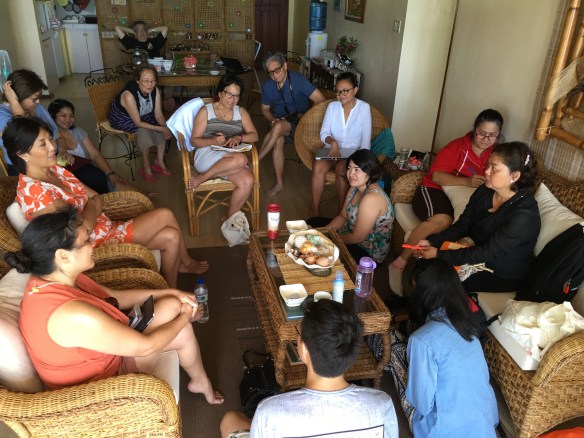
I’M WRITING this in Calapan, Oriental Mindoro, where I’ve come with a group of writers, most of them visiting Filipino-Americans, for the second and closing leg of the NVM Gonzalez Workshop, organized and led by NVM’s son Dr. Michael Gonzalez. Last year, 2015, marked the centenary of the late National Artist’s birth, and Myke thought that it would be fitting to hold the workshop, now on its sixth iteration, in the place most closely associated with his father, Mindoro.

NVM was actually born in my home province, Romblon (“about 60 kilometers and 40 years away,” I like to say), but he grew up in Mindoro, and wrote most of his works about its hardy people and their way of life, even when he moved to the United States. NVM died in 1999, but his memory remains fresh among his friends, colleagues, and former students on both sides of the Pacific. It was to honor that memory that Myke put this group together for both a workshop and a literary pilgrimage to the Philippines.

This year’s US-based contingent includes Mary Grace Bertulfo, who has written for television and children’s education and who runs a children’s creative writing workshop, Taleblazers, in Chicago; Anna Alves, a PhD student with the American Studies Program at Rutgers University in New Jersey; Chris “Kawika” Guillermo, a mixed-race Asian-American with Chinese, Filipino and Irish roots who has a PhD in English from the University of Washington, specializing in Asian and Asian-American fiction; Lisa Suguitan Melnick, a third-generation Filipina-American, an adjunct professor at the College of San Mateo and a contributing writer for PositivelyFilipino.com; Penelope Flores, a retired mathematician and educator from San Francisco State University; Myke Gonzalez, of course, who teaches Philippine Studies and Behavioral Science at the City College of San Francisco; and Evelina Galang, the workshop director, an accomplished fictionist who directs the Creative Writing program at the University of Miami.

Their local counterparts were Kat Cruz, a UP Business Administration graduate and company executive with a keen interest in writing; Meeko Camba, a young opera singer now studying Journalism in UP; Sarah Matias, a Creative Writing major who now runs Ant Savvy Creatives, a marketing and events company; Marily Orosa, a prizewinner publisher of coffee table books; Timmy Tuason, an expert in instructional design, materials development and project management; Jojo Hosaka, a surgeon and dog-show judge (and, like Timmy, a fellow fountain-pen enthusiast); Claire Agbayani, a graduate writing student at DLSU and PR practitioner; Judith Castillo, a teacher of English in Calapan; and Raul Manicad, an engineer, businessman, and guitarmaker. Myke and Evelyn were backstopped on the teaching staff by veteran fictionist Charlson Ong and myself.

We held the first part of the workshop from January 4 to 5 at the University of the Philippines in Diliman, where NVM had taught for many years in the 1950s, in the Gonzalo Gonzalez Reading Room of the College of Arts and Letters Library, which my office—the UP Institute of Creative Writing—administers as a repository of contemporary Philippine and Southeast Asian literature. From January 6 to 9, we moved to Calapan, where NVM used to go from their home in Mansalay to type out his manuscripts at the municipio, on paper that, Myke recalls, NVM apparently “borrowed” from the municipal government, whose stamp it bore.

The mixed composition of the group and the diversity of the participants’ backgrounds led to some very interesting discussions dealing with identity, race, language, and representation. While this was a writers’ workshop focused as much on technique as one’s philosophy of writing, inevitably the politics of writing took the foreground, given the Fil-Ams’ engagement with the issues that come with writing as a minority in America.

We talked about how the writer’s political positions define or feed into craft and technique, and how they shape the story itself. Understandably, given the environment they operate in, our US-based friends were keen on discussing the representation of race, of the Other, and the depiction of character in a racially or ethnically charged environment. We agreed that it was important to be accurate and to be fair in creating characters who will inevitably be seen to represent their race, whatever they may be; on the other hand, I interjected, it was just as important to remember that the character had first to succeed as an individual in the story, and that the character could even—and more interestingly—go against type; while we share many beliefs and practices as Filipinos, not all Filipinos think alike, and thankfully so.

The discussions also became a mutual revelation of what it was like to write as a Filipino and as a Filipino-American, and how we could be so similar yet also different in many ways. It wasn’t just the vocabulary, but the sensibility that came into play. In the end, we took the cue from NVM himself, who once famously explained his use of language thus: “I write in Filipino, using English.”

I learned a new word from Myke, who has a background in the social sciences—schismogenesis, promoted by the anthropologist Gregory Bateson in the 1930s, which roughly translates into how groups proliferate by breaking up. The context was the oft-made observation of how Fil-Ams and their organizations tend to fall apart because of personal and political differences (by one account I read, there are more than 3,500 Fil-Am organizations in Southern California alone)—a tendency we uniformly deplore. But Myke’s new word suggests a positive aspect, a way by which a race and its culture propagates itself.

We’d like to thank our hosts—the Madrigal-Gonzalez clan, for the use of the reading room in UP; Myke’s sister Selma, who spread out a very generous merienda for us; the Mother Butler Guild of Calapan, who conducted a charming putongan ceremony for the visitors; Florante Villarica, who has written a history of Oriental Mindoro and who had us over for dinner at his home; Anya Postma and the Mangyan Heritage Center, who made a wonderful presentation on Mangyan life and culture; and Chicago-based Almi Gilles, who lent us her their family’s beach house in Puerto Galera for our penultimate day in Mindoro.

And thanks, of course, to Myke and the Gonzalez family, for keeping their father’s flame alive.

Penman No. 172: Going Against the Grain

IMG_8272

Penman for Monday, October 26, 2015

I WAS asked to give the first keynote last week at the annual meeting of the Asia Pacific Writers & Translators at the University of the Philippines, on the conference theme of “against the grain,” and here’s part of what I said:

The Filipino writer is among the freest in the world as far as self-expression is concerned; but the Philippines is also one of the deadliest countries for journalists in the world—according to the New York-based Committee to Protect Journalists, it ranked second only to Iraq in 2013.

Creative writing won’t pay you much, but you can say whatever you want and reasonably expect to stay alive and ambulant. Nobody in this country ever got killed or imprisoned in recent times because of a novel or a story. Neither has a Filipino despot been deposed because of a play or a poem. Journalism, on the other hand, can be a dangerous enterprise, especially if you live and work far away from the glare of the metropolis.

…. We have one of the region’s richest concentrations of writers, and very likely the region’s most strongly developed systems for the development of new writers; but these writers have precious few readers.

We have never lacked for writers, and likely never will. The Filipino writing community is very much alive, producing new work not only in English but in Filipino and in many regional languages.

Within the region, we can claim to have the oldest, the longest-running, and possibly the most comprehensive writing programs—not just writers’ workshops which go back 50 years, but also degree programs from the BA to the PhD in several major universities. The Palanca Awards, which are handed out every year to the best work in many categories and several languages, have been running now for 65 straight years.

New young writers will find it easier to break out and get noticed by their peers and seniors here than in many other places, because, while Filipinos respect their elders, and everyone above 40 is a “Sir” or a “Ma’am,” we do not have the kind of master-apprentice, or senior-junior relationship that exists elsewhere. You do not need a senior’s validation or sponsorship to advance; indeed you might move forward much faster by slaying a literary father or two.

But for all the literary talent we think we have, it can be argued that creative writers really don’t matter much in Philippine politics today—certainly not as much they used to—because, to be hyperbolic about it, no one reads, no one buys books, and no one understands nor cares what we’re doing.

It’s a sad fact that in a country of 100 million people, with a literacy rate of about 97%, a first printing for a new novel or book of stories will likely run to no more 1,000 copies—which will take about a year to sell, and earn the author a maximum of about P50,000 (about US$1,000) for a few years’ work—good enough for a new iPhone. There’s no such thing as a professional novelist or playwright in the Philippines, which makes it easier for writers of any worth to be sidetracked or co-opted by the government or by industry.

It’s ironic that Philippine literature’s political edge should be blunted not by timidity nor by censorship but by sheer market forces. The simplest reason many Filipinos don’t buy books has to be poverty, with the price of an average paperback being higher than the minimum daily wage.

But perhaps we writers ourselves are also to blame, for distancing ourselves from the mainstream of popular discourse. Politics is nothing if not the domain of the popular, and the very fact that many of us write in English is already the most distancing of these mechanisms. The question of language has always been a heavily political issue in multilingual Philippines, where some regionalists still resent the choice of Tagalog as the basis of the new national language Filipino in 1935, and where English is reacquiring its prominence not only as the lingua franca and the language of the elite but as our economic ticket to the burgeoning global call-center industry.

Political change in the Philippines has historically been led by the middle and upper classes, from the Revolution against Spain of 1896 to the anti-Marcos struggle of the 1970s and the 1980s to the Edsa uprisings of 1986 and 2001. Therefore, one might argue that English is, in fact, the language of reform and revolt in the Philippines in modern times.

But it is this same English-literate middle class—our potential readership—that is the strongest bastion of neocolonialism in the Philippines, blindly infatuated with Hollywood, hip-hop, and Harry Potter, keen on trading the local for the global, opportunistic in its outlook and largely unmindful of the social volcano on the slopes of which it has built its bungalows. As I often remind my fellow Filipino writers, our rivals on the bookshelves are not each other, but J. K. Rowling, Stephenie Meyer, E. L. James, Paulo Coelho, and Tom Clancy.

When I return to the two main points I raised—that we are free to speak and to write, but only in politically inconsequential forms; and that we have writers aplenty, but very few readers—I have little choice but to conclude that the main culprit is our self-marginalization through English, and the academicized, Western-oriented mindset the language encourages.

The interesting upside of this unfortunate situation is that—largely untethered from the considerations of commerce and politics—our writers have been free to write their hearts and minds out, producing poetry and fiction of a high quality that, in a double irony, might yet break through to the global market.

The triple irony would be that it sometimes takes the international spotlight for local readers to take notice of native genius. It sounds like wishful thinking, but by being here today, and connecting our literature to yours, we might do enough together to push our literatures to the forefront of our peoples’ consciousness.

But let’s face it: the margins are familiar if not comfortable territory to many of us, not only here but wherever we live and write, as they give us a clearer view of the center. Going against the grain is very much in the grain of how and why we work. And if you didn’t think so, you wouldn’t be here today.

Penman No. 171: All Systems Go for APWT 2015

APWTlogo

Penman for Monday, October 19, 2015

IT’S “ALL systems go” for this year’s edition of the annual Asia Pacific Writers and Translators (APWT) conference, which will be held in Manila later this week, from Thursday on to the weekend. As a member of the APWT Board and one of APWT 2015’s convenors, I’m particularly thrilled for the Philippines to be hosting this event, which is the literary equivalent of the APEC, the SEA Games, and let’s throw in The Amazing Race, which it could be a bit of for our foreign guests.

It’s not a competition, of course, and we won’t be signing any treaties or squabbling over territory. In fact, the way we’ve set things up, it’ll be a politician-free zone, which isn’t to say that politics will be off the menu. With topics ranging from “Sex and Sensitivities” and “Criminal Intent” to “Love in the Time of Dissonance” and “Why Publishers Prefer Outsiders,” there’ll be fireworks aplenty in the panel discussions we’ve put together for the three-day conference, which will be held at the Institute of Physics in UP Diliman on Thursday and Friday, before moving to De La Salle University and the University of Sto. Tomas on Saturday.

I’ll be one of four keynote speakers for the conference, and will speak on the conference theme, “Against the Grain,” at UP on Thursday morning, to introduce the Philippines and our culture and literature to the audience, especially our visitors. I’ll be followed the next day by Romesh Gunesekera, the UK-based, Sri Lanka-born Booker Prize finalist who partly grew up in Manila, where his father had worked for the Asian Development Bank. At La Salle on Saturday, the indigenous Australian author Philip McLaren will keynote the meeting, and Jing Hidalgo will close the conference at UST with a talk on the “subversive memory” of women writers.

These 30-minute keynotes will be the exception, however. It’s an APWT hallmark to keep presentations short (no more than 10 minutes max) and informal (no footnoted academic papers on obscure topics, please—and no PowerPoint!). The key phrase here is “writers in conversation,” so we expect easy, freewheeling discussions around the topics given to each panel, with lots of time for audience interaction.

We’re expecting at least 50 foreign participants to join around 100 local authors in APWT 2015. Filipinos have always been well represented at APWT. Its annual meetings had been previously held in Hong Kong, Bangkok, New Delhi, Perth, and Singapore, and this will be the first time it will be coming to Manila. Next year, we’re planning to hold it in Guangzhou, China.

If you want to meet with fellow writers, translators, publishers, and agents beyond our shores, you can’t do better than to sign up with APWT, a ten-year-old organization that has become the most active and visible network for writers and translators in the region. The great thing about APWT is that it was designed by and for practicing writers above all; while we have many academics, critics, and scholars among our members, theory isn’t our big thing, but practice—engagement with reading publics, dealing with shifting markets, connecting across the globe, adapting to new media, rolling with the political punches. If you’ve written what you think is a terrific novel and want to catch an agent’s or a publisher’s attention, APWT is the place to go.

Speaking of which, this year’s conference will offer six workshops that writers—both budding and accomplished ones—can sign up for, to sharpen their skills or explore new possibilities. You don’t have to attend the full conference to attend these workshops, which will be run by a sterling crew of international authors. Robin Hemley—who used to teach nonfiction at Iowa and now heads the Yale-NUS program in Singapore—will be handling one on “The Art of Memoir Writing”; Xu Xi, who directs the MFA program at the City University of Hong Kong, will teach fiction writing “with Asian characteristics”; the New Yorker Tim Tomlinson, another frequent Manila visitor, will share “Pitching Tips from the New York Writers Workshop” to help you sell your manuscript, at the same time that poet and editor Ravi Shankar will be teaching his students how to create “timeless verse”; at La Salle, Sally Breen will hold a master class in editing, to address “What Editors Want”; and simultaneously, Francesca Rendle-Short and David Carlin will employ improvisational techniques to engage participants in “Essaying Manila.”

I strongly urge those inclined among my readers to go out for one or two of these three-hour-long workshops, because you may never get the chance again to study directly with these masters, some of whom have become good friends of mine over the years and whose teaching and writing excellence I can swear to. There’s a fee to pay, but it will be well worth it, and you’ll remember the lessons you’ve learned long after you’ve forgotten how much they cost. Slots are limited, so sign up early. If you can’t pay in US dollars online, you can pay for the conference and/or the workshops at the door, in pesos (at a slightly higher rate of 50-to-1, to cover conversion and remittance charges).

Filipino citizens can attend the full three-day conference at a reduced fee of $40 or P2,000 (for students with IDs of UP, DLSU, and UST, the fee will be just P1,000); the workshops will each cost $40 or P2,000. These fees will include some meals and snacks provided by our generous sponsors and hosts, who include—aside from the three aforementioned universities—the National Commission for Culture and the Arts, the British Council, Anvil Publishing, and the Japan Foundation.

For more information and for links to the registration page (again, you can also register and pay at the door), see here: http://apwriters.org/apwt-2015-manila.

See you at the panels!

Penman No. 167: The Real Value of Remembering

Penman for Monday, September 21, 2015

TODAY MARKS the 43rd anniversary of martial law, a time many Filipinos have forgotten or would rather forget. Those of us who went through it sound like a broken record when we say that—with the usual addendum that young people today have no idea what martial law means—and the phonograph gets creakier every year, the echoes fainter. It annoys us when no one else seems to make a big deal of the most centrally formative period of our sixty-something years, but it takes just a little math to realize, “Why should they?”

Forty-three years is longer than the interlude between the two World Wars, and longer even than the time between World War II and Vietnam. In the meanwhile, the world went through computers, VCRs, the collapse of the Soviet Union, cellphones, the Internet, and 9-11. Here at home, we went through EDSAs of various kinds, Pinatubo, Maguindanao, Yolanda, and Mamasapano. That’s an awfully long time, filled with mindboggling diversions and distractions, to keep your mind fixed on a scratchy black-and-white TV image of a man in a barong casting some strange voodoo hex on the the nation.

Thus I’m hardly surprised when my 19-year-old students admit to a blithe ignorance of Marcosian times. You can’t call it amnesia, because they had no memory to begin with; even the fervent clamors of today’s young activists draw on borrowed memory (but then again, isn’t that what history is, a sense-making narrative woven out of someone else’s recollections?).

I’m not a historian, but I try to do what I can to make the past come alive for my students in my Literature and Society class—not even to educate them on the nuances of specific events such as the declaration of martial law, but simply to make them aware of a life beyond the present, beyond themselves. An interest in the past can’t be forced; sometimes the best thing we can do is to open a small window on it, and then to enlarge that opening so they can see the bigger picture, and share in the excitement and the novelty of looking backward rather than forward.

Every now and then, when the urge grabs me and there’s an excuse to do so, I bring some odds and ends from my inestimably deep trove of vintage junk to class, as tinder for discussion. A 1923 Corona typewriter leads to a chat about the technology of writing, and how technology affects writing (Eliot and his typewriter, Hemingway and his pencil, computers and revision); a 1922 issue of the Philippine Collegian shows how little has changed (“Look, UP was asking for a permanent endowment even then!”); an 1830 grammar book, perhaps the oldest manmade thing these kids have ever held (yes, I pass the book around for them to get a feel of old paper), offers proof of the near-immutability of grammar (“It’s like glacial ice,” I say. “It moves, but you can’t see it.”)

A young person’s starting point very often is, “What does this have to do with me?” I try to answer that two ways: (1) “Why does it have to have anything to do with you?” Part of growing up is learning and accepting that the world isn’t your nursemaid, that it could and will often be totally indifferent to you and your little plaints. But also (2) in a gentler mood and whenever possible, we connect the dots between, say, the god Achilles and his choice of a short but glorious life and, yes, the martial-law activist who didn’t expect to live beyond 25.

Last week, I urged my class (note “urged”—I keep absolute requirements to a minimum) to watch the movie Heneral Luna—to my mind, easily one of the most significant Filipino movies of recent years. Beng and I had seen it the night before; the theater was three-quarters full, and when the movie ended, the audience applauded, the two of us included. The movie reminded me of how many gaps remained in my own appreciation of our past; if I, a full professor at UP and a self-styled history buff, didn’t know the full story of Antonio Luna, how could I expect my charges to know anything about martial law?

That leads me to think that it won’t be the textbooks or balding professors like me who will make our youth wonder about what else they missed, but the movies—or, more broadly, literature and its power to make dramatic sense of events, its humanization of history. More than four decades after the fact, not enough novels have been written and not enough movies have been made of the martial law period (Lualhati Bautista’s Dekada ‘70 being the standout in both print and film). Indeed, a definitive and comprehensive history of that time—and an independent one that kowtows neither to Marcos nor to Mao—has yet to be put together, although specific aspects of martial law (legal, economic, political, and personal) have been ventilated in various books and forums.

The real value of remembering martial law or some such national calamity, I’ll hazard, isn’t just in mouthing the oft-repeated “Never again!” I seriously doubt that even those who never experienced it will accept its repetition. Rather, it’s in looking back 43 years to take stock of what we’ve become since, as individuals and as a people—in memoir writing, we call this the difference between the remembered self and the remembering self. The very fact that they’re not the same thing should tell us something. It’s easy to say “No” to martial law ca. 1972, but what exactly will we be saying “Yes” to come 2016? The past keeps getting dimmer, but then again, some days, so does the future.

Penman No. 163: The Gentler Path

IMG_7998

Penman for Monday, August 24, 2015

FOR THE first time in something like 20 years, I’m teaching two undergraduate classes this semester. I usually teach one graduate and one undergrad class, but thanks to what I’m taking as a glitch in the registration process, my graduate fiction writing class—which is usually oversubscribed—had zero enrollees this term, forcing its cancellation and my reassignment to a course usually reserved for young instructors, English 11 or “Literature and Society.”

I should make it clear that I’ve always insisted on teaching at least one undergrad class every semester, and have done so unfailingly since I returned from my own graduate studies abroad in 1991. The benefits go both ways—young students get to learn from more experienced professors, and senior profs get to know how young people think. With four years of active teaching left before retirement (it’s hard to believe, but I’m getting there), these encounters with some of the country’s brightest young minds will only become more precious, and as with every class I take on, I can only hope that, many years from now, my former students will remember something useful that they picked up from me.

I haven’t taught English 11 in ages, so it was with some trepidation that I entered the classroom on our first day a couple of weeks ago, under UP’s new academic calendar. Students don’t realize this, but professors can be just as full of anxiety at the start of the semester as they are. As I scan the roomful of faces, I’m already wondering who will likely give me problems and who will make it worth the effort of preparing for every day’s lesson as if I myself were taking an exam. Thankfully, most of these mutual apprehensions soon retreat as I reassure my students that I know what I’m talking about—and that I won’t scream at them if they don’t—and as I begin to understand what exactly I’m working with, which is always a welcome challenge.

This semester, I was glad to discover that my English 11 class of about 30 students was composed of mainly science and engineering majors. You’d think that teaching the humanities to them would pose problems, but I see it as a unique opportunity to lead smart people on an adventure they might have missed out on otherwise. Of course, UP’s General Education program makes sure that our graduates acquire a balanced outlook on life, so my students didn’t really have any choice, but I see my job as making them see Literature as much less an imposed subject than a welcome relief from everything else—in other words, fun. When you disguise labor as discovery, and emphasize incentives over penalties, the students—and you yourself—can feel more relaxed.

English 11 is what used to be English 3 in my time—an introduction to literature—and while some teachers see this as a chance to pile on the heavy stuff like The Brothers Karamazov (and I can understand why), I prefer to take the gentler path to literary enlightenment, and begin with things the students know or can apprehend. That way you can lead them to stranger and more intriguing discoveries about the way language works to convey human experience.

Last week, for example, one of the first poems we took up in class was “Southbound on the Freeway,” a poem published in 1963 by the American poet May Swenson. We could’ve done something like T. S. Eliot’s “The Wasteland,” but unless you train lay people to look at poetry a certain way—to see it as a puzzle or a riddle to be solved, for example—it’s often very hard for them to get a handle on what some poets do on a high and abstracted level of language and idea, much like the way Picasso’s departure into Cubism (think of his women-figures with their eyes looking this way and their noses pointing that way) can be better appreciated if you first consider what goes into a traditional portrait like the Mona Lisa.

“Southbound on the Freeway” reads like a rather simple and even funny poem, in which alien visitors on a spaceship look down at the Earth, and see creatures “made of metal and glass…. They have four eyes. / The two in the back are red. / Sometimes you can see a 5-eyed / one, his red eye turning / on the top of his head.” It doesn’t take much for the student to see that the aliens, hovering above a freeway, have concluded that the cars themselves are Earthlings, and even that some cars—like the “5-eyed” police car—are more special than others.

In literature, this is a familiar device we call “defamiliarization,” by which poets and other artists take something we see everyday and present it to us in fresh and unexpected ways, revealing facets and insights we never really thought about before. The Swenson poem seems like all it does is show us how perspective can change our perception of things, but it goes beyond that eye-trick and asks a very intriguing question at the end: “Those soft shapes, / shadowy inside / the hard bodies—are they / their guts or their brains?”

At this point, I ask the class, what’s this poem really about? Is it just about aliens and humans, or about cars on the road? Inevitably, someone spits out the magic word: technology! So what is it about technology that’s so important, I press on, and what does it have to do with our lives? Why, everything, the class exclaims in a chorus—we’d die without our cell phones and iPads!

We go into a brief and engaging discussion about what exactly technology means, and whether it has benefited human society—or not. We talk about mechanization, automation, better and easier ways of doing things, products that were invented to improve human life, and inventions that did the opposite. We talk about armaments, and about Eli Whitney’s cotton gin and how it actually helped to encourage more slavery in the American South. I tell them that at some point, later in the semester, I’ll talk to them some more about the legend of Dr. Faust and how it led to the stereotype of the mad scientist, all the way to Dr. Strangelove, Lex Luthor, and Doc Ock. I can see that the class is listening, and I’m happy.

I ask them what the real question is that the Swenson poem is posing, and they get it. It’s been a good day in school for Literature and Society.

Penman No. 161: To Be a Journalist

Image-1

Penman for Monday, August 10, 2015

I WAS very sad to hear of the recent passing of an old colleague from my first foray into journalism—Nemesio Dacanay, who was then the City Editor of the Philippines Herald, one of the pre-martial law period’s smaller but pre-eminent newspapers. A relative of his texted me about his death and interment, but I was out of town and felt bad that I couldn’t even pay my respects in person, so I’ll do it here.

Five years ago, in this column, I had to issue an apology—and I was happy to do so—having inadvertently suggested in a previous piece that “Dac” had passed on to the hereafter. As it turned out, he was still very much alive, as his daughter Christine reminded me. This time, unfortunately, the news was real.

The story of my connection to Dac and of how I got into the newspapers is something I may have told before in bits and pieces, but here it is in full. The time was early 1972, and I had just turned 18. I was already a full-time activist, having dropped out of my classes in UP, a lanky, chain-smoking lad who was already a veteran of many a Plaza Miranda march and of the Diliman Commune.

In UP, I hung out with a group of older Journalism majors who were close to graduating and who would, very shortly after, begin to make a name for themselves as reporters—people like Wilson Bailon, Rolly Fernandez, Jun Engracia, Efren Cabrera, Rod Cabrera, and Val Abelgas, among others. I had great respect and admiration for these guys, but at the same time, it annoyed me to know that they were soon going to find and land jobs, while I—technically still a freshman, with but 21 completed units to my name (3 of them good for a “5.0” in Math, the consequence of absenteeism)—was going to be left behind.

I should explain that at 18, I had no greater ambition than to become a journalist. I’d written some stories, poems, and plays, but I had no plans of becoming a creative writer, and might even have thought journalism superior to poetry (and why not?). I had been editor in chief of the school paper at Philippine Science High (following in the gargantuan footsteps of Rey Vea, Mario Taguiwalo, and Rodel Rodis), and I found that I savored the romance of printers’ ink and hot lead (that’s “lead” with a short E for you young ones, the molten metal that magically turned into letters in reverse).

As soon as I stepped into UP, at 16, I did the three things I’d put on my agenda, after enrollment: join the Nationalist Corps (and later the Samahang Demokratiko ng Kabataan, or SDK), join the Alpha Sigma Fraternity (to which high school heroes like my Physics teacher Vic Manarang and firebrand Gary Olivar belonged), and join the staff of the Philippine Collegian.

It was in the nationalist movement and those long nights of proofreading at Liwayway Press that my desire to become a reporter flourished. Never mind poetry and fiction; I wanted to feel and to record the ground shaking beneath my feet from the steps of a thousand marchers, to trace the arc of tear gas canisters flying across the plaza, to bear witness to what we were all convinced was the forging of a bright new future, with all the sparks and all the smoke that came with the process. To be a reporter at that time was to be in the very womb of history, and I thought nothing was more thrilling and more important than to be there on the frontlines, notebook and ballpoint in hand and a barely stifled battle cry rising up my throat: “Pierce the enemy with your pens!” (That was the slogan silkscreened on my jacket.)

As you can see, as a teenage Maoist, I had no idea of and no patience for “objective” and “dispassionate” journalism. I hadn’t even taken one formal unit of Journalism in UP (I was an Industrial Engineering major, and still plowing through my GE subjects) and had embraced the notion that journalism was and had to be a partisan activity, convinced that Malacañang had bought 90% of the Philippine press, with the notable exception of progressives like Tony Zumel, Satur Ocampo, and Rolly Fadul, and young blood like Roz Galang and Millet Martinez. We were going to be the vanguard of what we called the Second Propaganda Movement.

But I didn’t want to be stuck on campus; it was a wide-open arena beyond Diliman, so when my friends began applying for jobs with the newspapers shortly before graduation in early 1972, I tagged along, hoping to land something, anything. (I’d already written and sold a teleplay to the TV drama anthology Balintataw in 1970, when I was 16, so I didn’t lack in self-esteem.) I remember walking up to the editor of the Manila Chronicle, Amando Doronila, and boldly announcing that I wanted to apply as a reporter. “How old are you?” the man asked in all reasonableness. “Eighteen,” I said. “Come back in a few years,” he suggested, not unkindly.

It was like that, one prospect after another, until my path led to the old Philippines Herald office in Intramuros, sometime in March or April. It was must have been around one in the afternoon, because the only person in the newsroom was Nemesio “Dac” Dacanay, whose name I didn’t even know at that point. He had a groovy look about him: dark shades, a colorful, open-necked shirt, and an impish grin. I told him what I was there for, and I can’t recall how long I begged to be given a chance, but finally, if only to get rid of the pesky walk-in, he said: “Where do you live?” I said, “Quezon City.” He said, “Okay. Go back to Quezon City, then come back in three days with a story. Understood?”

I stepped out of the Herald on a floating cloud—I was positive I would deliver as directed. Over the next three days, not knowing anything about real newswriting, I walked around the Quezon Memorial, waiting for some dreadful accident to happen that I could breathlessly report on. The world remained blissfully peaceful, and the only thing that came crashing down was my dream of becoming a journalist. On the third day, I was so tired and depressed that I took a jeepney to the Delta Theater, and decided to cool off in the moviehouse. I watched the screen. The movie was so awful I can’t even remember its title. When it was over, I went home, collected my thoughts, and pulled out my typewriter.

Then I took a bus to Intramuros, and handed Dac my story—a movie review. Damn—I could hear him mutter, and I could see him sizing me up through his shades—okay ka, kid. “I’ll pass this on to Nestor,” he said, referring to the venerable Nestor Mata, who handled the features page. “He’ll take care of you.”

And so I was hired at 18 as a general assignments reporter, the greenest of greenhorns in a roomful of veterans that included editor in chief Oscar Villadolid, news editor Joe Pavia, reporter Lito Catapusan (who took me under his wing), and a deskman who moonlighted as a songwriter named George Canseco. Over the next few months, I would make the rounds of the police, sports, and City Hall beats, cramming three more years of college into a semester. Thanks to a guy who humored me named Dac, I had achieved my ambition of becoming a journalist. (By July, in a flash of activist fervor, I would resign in solidarity with striking workers, and move over to Taliba as a correspondent right up to martial law, when we all lost our jobs and the press as we knew it vanished overnight. But that’s another story.)

Penman No. 154: Teaching English to Filipinos

NEU

Penman for Monday, June 22, 2015

I HAD a great time last week with the English faculty of New Era University in Quezon City, who had invited me to speak at their three-day workshop on “Enhancing English Teaching Practices.” For three days, I met with a very lively group of about 30 to 40 college and high school teachers of English, talking about writing, reading, and teaching the language in today’s Filipino classroom.

I was backstopped in these discussions by the young and very sharp Ms. Cyndriel “CY” Meimban, who had taken her high school at New Era before doing an English degree with us at the University of the Philippines and then a master’s in Education at Arizona State U. CY—who also just happens to be the daughter of an old friend and fellow Fulbrighter, Dr. Adriel Meimban—took a break from her teaching duties at Northern Arizona University to help out her fellow teachers at NEU.

It was my first visit to the NEU campus near Commonwealth Avenue, which was rather ironic because we’ve lived on the UP campus just across that avenue for the past ten years. The NEU is part of the Iglesia ni Cristo complex and is run by the church, although I was pleasantly surprised to find that it’s open to all faiths. There’s a substantial Muslim population in that very area, for example, and many students from that community attend New Era.

We held our workshop in the new Professional Schools building, which housed NEU’s colleges of Law and Medicine, among others; more prominently, along Commonwealth Avenue, the College of Evangelical Ministry which Dr. Meimban (a former president of NEU) now heads trains young INC ministers, including about a hundred students from overseas—Filipino-Americans and Filipino-Europeans, among many others; I was surprised to be addressed by a young black man from South Africa in perfect Filipino. I was, in other words, in a very rich cultural and linguistic environment, in which language is used not just to express oneself or get jobs but to propagate the faith.

Otherwise, the workshop attendees voiced the same problems I’ve heard elsewhere: a clear decline in English proficiency not just among students but teachers as well; the lack of new materials in the syllabi, particularly in literature classes, as well as teaching guides for these materials; and the persistence of outdated approaches to the reading and teaching of literature and of English itself.

I began my presentation with something I always emphasize when I teach English in UP, especially in my American Literature class: we study and teach English not because we want to be Americans, British, or some other Anglophone people, but to become better Filipinos. We learn English and study other literatures in English to gain insights into and understand how these other societies operate and how certain human values and truths transcend national and social boundaries. Thereby, we should lose our unfamiliarity with and our awe of the foreign, empowering ourselves as citizens of the world.

I did a module on creative writing—focusing on fiction and nonfiction—as a way of showing teachers how writers think and work, so they can themselves become writers or at least understand what writers do and how they do it. In reading and teaching literature, I went over several poems and stories, and asked my audience to draw up a list of questions that could or should be raised about the text beyond “What’s the moral lesson?”

I emphasized the importance of considering and discussing form and technique as much as content and meaning as a way of seeing how language works, on the level of the sentence or even the word. I argued for the enjoyment of language for its own sake—in effect, for the study of literature as an exercise in pleasure as much as in education.

The problem with too many literature classes is that they’re taught as anything but literature—as philosophy, as religion, as politics—rather than as the imaginative play on words that lies at the heart of literature. When teachers march into class and declare, “Class, this is what this poem means, and believe me because I’m the absolute authority on it,” students and even teachers miss out on the fun of discovery, of teasing out sense from seeming chaos.

Inevitably, the question of a “language policy” came up. Would students benefit from the imposition of an “English-only” policy? Was it all right (or was it criminal) for a teacher of English to resort to Filipino when teaching English, or literature in English?

I went out on a limb here—and I’m sure that what I’ll say here will turn many a reader livid with consternation and disgust—but I said that, even as a former chair of the UP English Department, I’ve always been opposed to an English-only policy, because it’s silly and it simply doesn’t work.

We study English—and try to master it—because it serves us well in communication and in business, especially in a global sense, but to deliberately throttle our use of other languages (of which we have an enormous wealth) in the notion that it will somehow make us better users and speakers of English is downright stupid. I’ve yet to meet someone who now speaks and writes perfect English by having paid 5 centavos for every Filipino word he or she used. Most writers of my generation are happily bilingual or even trilingual, and we don’t get our languages or linguistic registers mixed up; what’s key is appropriateness—which language and which register is best for which occasion?

I would even argue that code-switching from English to Filipino can work in the teaching of English, and especially of literature in English, if it relaxes the non-Anglophone student and allows him or her to speak—and even to make a mistake, which should also be encouraged (and gently corrected) without too heavy a penalty. Patience and understanding, rather than force and sheer authority, have always gotten me better results in the classroom. I hope my colleagues in New Era University got a taste of that treatment, and that they enjoyed the experience.

Penman No. 152: Writing the Stories of Your Life

Studio5

Penman for Monday, June 8, 2015

TWICE OVER the past three months, I’ve been giving workshops to medium-sized groups of people in my general age range (let’s put that at 50 to 70), people who came together because they had stories to tell, but needed some guidance on how to tell them. These workshops were arranged by the publisher and writer Marily Orosa, who had come up with very engaging book ideas to which these potential writers could contribute, and who thought that it would be a good idea to have a practicing writer give them a bit of coaching before they plunged into the actual task of writing.

I was glad that Marily put these workshops together, first because I’ve always believed that every person has at least one good story in him or her, and that it’s my job as a writing teacher to get that story out of the person. Second, being a senior myself, I’m happy when older people get an opportunity to express themselves in this obsessively youth-centered world.

Many if not most members of my audience were retirees or approaching retirement after many decades of productive work in their professions. One was a former Cabinet secretary and another a university president, among other luminaries, but in the end, it wasn’t one’s position that mattered as much as one’s experiences, which seniors have in spades.

I couldn’t cram a semester’s worth of lessons into a Saturday afternoon, but I did what I could to give them a framework, an approach, and some tools with which to get their stories out of their memories and onto the digital page. First, we talked about the basic difference between life (their life experience, the raw material) and art (the finished product they were expected to come up with).

What do artists—writers, painters, musicians, and so on—do to and with their materials to make works of art? What do artists see in the things around them that most other people don’t? In this way, we try to get people to see their own lives and experiences as matter to be structured and shaped—not to distort the truth (the object, I think, of all honest art) but precisely to get at it and to bring it out, even if it may not always be pleasant—and indeed much art out there is meant to disturb.

We talk about selection, and how the writer or artist chooses material to use directly in the artwork (the text) and leaves other things out (the context), given that you can’t possibly use everything out there. We talk about how artists work with concrete images and objects to suggest ideas, rather than the grand abstractions that, say, editorial writers and philosophers use.

When we consider life experiences, we then talk about distances in space and time, and about physical and emotional distance. Many participants at these workshops, for example, want to talk about travels they undertook to interesting places, and what I try to do is to get them to write something beyond the verbal equivalent of a posed snapshot in front of the Eiffel Tower or the Golden Gate. A trip to Paris isn’t just ever about Paris, but also, implicitly, about Tagbilaran or Bayombong, wherever it was the narrator or protagonist came from, and it’s that perspective that makes this particular experience of Paris unique.

Writing about the past really involves two protagonists (taking a page from Thomas Larson): the remembered self and the remembering self. Writing about a journey involves not just traversing physical territory, but also that internal space within which the character grows—so the physical journey is always paralleled by an internal, often spiritual, one.

After clarifying these fundamental concepts, I then introduce them to some basic tools of the trade—the elements of fiction which, when carried over to nonfiction, liven up the narrative and make both writing and reading a more engaging experience. We talk about plot, character, theme, point of view, dialogue, description, and setting—how to employ time, how to bring scenes to life, what to say and what to leave out.

I remind them what a lonely and (for most people) unremunerative occupation writing is, but going beyond the money or the lack of it, how important it is to write one’s stories down before the memory deserts or defeats us. It’s especially important for the young to know about how their elders lived and thought. It might take them another 20 years to become receptive readers, but the record will be there, and they’ll be surprised to find, as we ourselves did, how the past anticipated the future in so many ways.

I feel drained at the end of these three-hour workshops, faced with a flood of eager questions, but I also feel elated by all the creative energy I seem to have unleashed among my fellow seniors, and I can only begin to imagine what a touch of art can do to that rich lode of memories lying deep in their many-chambered brains.

Treasures

AND NOW’s as good a time as any to draw attention to the good work done by Marily Orosa’s Studio 5 Designs, which has been in the business of producing not just books but prizewinning ones, lauded both for their design and their substance. I’ve had the pleasure of working with Marily on a couple of coffeetable book projects, most notably De La Salle University’s centennial volume, The Future Begins Here, which I edited and wrote for, and which won a Quill and an Anvil Award (the Quill, Anvil, and National Book Awards are the local publishing and PR industry’s measures of excellence).

Studio 5 has also won NBAs for In Excelsis (The Martyrdom of Jose Rizal) by Felice P. Sta. Maria and The Tragedy of the Revolution (The Life of Andres Bonifacio) by Adrian Cristobal. Malacañan Palace (The Official Illustrated History) by Manuel Quezon III and Jeremy Barns also won a host of local and international awards, as did the magnificent Treasures of the Philippine Wild. Freundschaft/Pagkakaibigan (celebrating 60 years of friendship between Germany and the Philippines) will be included in the prestigious international design annual, Graphis.

Beyond being visual treats, these are all significant books, and their creators and publisher deserve high praise and encouragement.

Penman No. 151: A Workshop in Biography


IMG_7561

Penman for Monday, June 1, 2015

BECAUSE OF my trip to Canada, I was able to attend only one day of this year’s UP National Writers Workshop, which took place from May 10 to 17 in Baguio. I immediately went to work that morning leading a discussion of a biographical project submitted by one of the twelve fellows.

It was a topic I was keenly interested in, because of my own work in biographical writing. (Two of my biographies—A Man Called Tet: The Story of Enrique T. Garcia, Jr. and Edgardo J. Angara: In the Grand Manner—were published and launched recently by Anvil Publishing and the University of the Philippines Press, respectively.) I’m at work on a few more, and if it becomes my lot to be known primarily for my accounts of other people’s lives than for my own fiction, then I can’t complain, having assumed a rather unique responsibility and occupation, among a few others in our writing community.

As a grade-schooler, I devoured biographies in the library, finding that the lives of successful or significant people—whether here or in faraway lands—inspired me to try harder and do more in my own difficult existence. I especially enjoyed the life stories of scientists, explorers, soldiers, artists, and heroes. Of course, these elementary editions were highly simplified, and very likely glossed over the human imperfections—sometimes gross—that these characters possessed, which more mature biographies would reveal if not revel in. No matter; at that time, the overarching greatness of their deeds lent a luminous aura to these characters’ profiles, and I have to believe that I emerged all the richer for reading those books.

The idealization of a life was one issue we discussed at the workshop. There are many kinds of biographies, and I took the occasion to go over a simple classification of these kinds.

On one extreme would be hagiography—literally, writing about saints, and therefore the sunny sanctification of the subject as though everything that he or she did were beyond reproach. On the dark end would be the hostile or malicious biography, written for no other reason than to malign its subject as indelibly as possible, even at the expense of the truth. To its left would be the critical biography—a sober, perhaps scholarly, and more even-handed study of a life, sparing nothing and no one (least of all the subject) in pursuit of the presumptive truth, although these works could also carry their own agenda.

Farther on would come the kind of work that I and some others do on commission, for which I’ve coined the term “sympathetic biography,” a largely positive presentation of a subject’s life—without skirting, however, the major controversies and issues publicly known to involve the subject. Is it the whole truth and nothing but the truth? Realistically, I would expect not, and not because I think my subjects deliberately lie to me, but because it’s in human nature to present the best side of oneself. (I think Dolphy set the bar for searing candor and self-awareness in his autobiography, Hindi Ko Ito Narating Mag-Isa; I can’t imagine politicians or business figures being so open about their private lives.)

A sympathetic biography may be a half-filled glass to many, but it puts something on the table to be seen and seen through. I expect—I would hope—that whatever I write about my subject will be interrogated by more knowledgeable critics and scholars. This is why I urge my clients to be as forthright as possible and to deal with whatever issues they may have been embroiled in, because we live in a highly skeptical environment where questions never cease, especially online.

But to get back to the workshop, we were glad to succeed in our continuing quest for the discovery and encouragement of bright new writing talent across the archipelago. The UP Writers Workshop is different from most others in that it engages mid-career writers—people of proven ability with at least one published book, or major stage or film production to their name. We deal with them less as students than as younger brothers and sisters in the profession.

The critics of writing programs and workshops who think that all they produce are clones and sound-alikes of those teaching these courses should take a look at our roster of fellows and their work. These young writers sound nothing like us, and even after the workshop, they’ll continue working with their own material in their own styles, because we instructors do our best to recognize and preserve the originality of their voices.

The best help we can give them is to provide a response—whether it be a gut reaction or a learned reading that draws on a certain context—from our side of the generational divide, although they get responses as well from their peers, which might just be more useful and valuable to them, coming from people who share their vibe.

This year, we welcomed the following: Jack A. Alvarez (Creative Nonfiction); Armida Mabitad Azada (Poetry); Kristoffer Brugada (Nobela); Resty Cena (Nobela);

Gutierrez M. Mangansakan II (Creative Nonfiction); Isidro T. Marinay (Biography);

Segundo D. Matias Jr. (Kuwentong Pambata); Rhoderick V. Nuncio (Nobela); Will P. Ortiz (Nobela); Benedict Bautista Parfan (Poetry); Charlie Samuya Veric (Poetry); and Eliza Victoria (Fiction). Watch these names, because if you haven’t read or heard about them already, you will soon.

What many don’t realize is what a precious resource we have in these programs and workshops here in our part of the world. Our friends from the region have begun to notice what a liberal and nourishing environment we have for young writers. There’s still patronage and paternalism in the system to be sure—this is Asia, after all—but it’s much less pronounced and potentially stifling than elsewhere. Our tradition is for the younger ones to tell their elders “Up yours!”—until they start putting on the poundage and the gray hairs themselves.

Speaking of writing programs, it was with great alarm and dismay that I received news of the planned closure of one of Asia’s most unique and successful graduate writing programs—the low-residency Master of Fine Arts (MFA) program at the City University of Hong Kong.

The low-residency formula allows students from Hong Kong and around the region to enroll for an MFA and work online with mentors from all over the world, flying in to HK just once or twice a year for intensive workshops and face-to-face interaction. Some Filipinos have gone through the program, and I’ve had the privilege to lecture and to read at a couple of sessions over the years.

The City University administration says that the program costs too much to maintain, but ironically the program turned the corner this year financially, so it can’t be just the money. We wonder if someone up there sees creative writing as a threat to socialism with Chinese characteristics. City U ‘s mandarins should know that Hong Kong’s and China’s prestige and goodwill derive from programs like this—and not from building lighthouses and airstrips in the South China Sea.

Penman No. 150: Looking Eastward in Toronto

IMG_7573 (1)Penman for Monday, May 25, 2015

I FLEW out to Toronto in Canada a little over a week ago to take part in that city’s Festival of Literary Arts, possibly the first Filipino author to join that long-running festival, now on its 15th year. Previously, the festival had focused on South Asia (India, Pakistan, Bangladesh, Sri Lanka), but has recently opened itself up to more representation from East Asia, Africa, and the Caribbean, thus my inclusion in this year’s roster of invited writers and speakers.

Over a weekend, from Friday to Sunday (May 15-17), several dozen representatives from these regions and from Canada met in various venues on the scenic campus of the University of Toronto and its environs to tackle issues and problems besetting writers and publishers from outside the global centers. How does a writer from the periphery break through to the center? Or is that “periphery” its own legitimate center? Is yearning for publication and validation in the West a vestige of the colonial mindset, an experience shared by all the countries represented in Toronto?

Aside from these seminal discussions, of course, the meeting was first and foremost a festival, a sharing of the artists’ finest work, and I felt privileged to be introduced to authors and creations I would otherwise have totally missed or blithely ignored. With many of the authors coming from expatriate and postcolonial backgrounds, the offerings were rich and deeply nuanced, the talents outstanding.

Among others, I discovered a major international writer in the festival director, the novelist M. G. Vassanji, who had been born in Tanzania in East Africa, and whose account of his pilgrimage to his ancestral roots across the ocean (A Place Within: Rediscovering India) is a modern classic of creative nonfiction—a sympathetic but unsentimental and often searingly critical chronicle of his encounter with the sprawling reality of India today.

The visit also allowed me to reconnect with some old Filipino friends who had migrated to Toronto and had built new lives there. I was very graciously taken out to a scrumptious dimsum lunch in Toronto’s fabled Chinatown by Patty Rivera and her husband Joe. Patty and I worked together 40 years ago as writers and editors at the National Economic and Development Authority (an unlikely Camelot for young writers and artists under the patronage and protection of then-Sec. Gerry Sicat).

Though trained and still active as an editor and journalist, Patty has since developed into an accomplished and prizewinning poet, with three volumes to her name. Her first collection, Puti/White, was shortlisted for the 2006 Trillium Book Award for Poetry. Patty’s husband Joe, a former Ford executive who also wrote plays in the Philippines, became a lawyer in Canada and then, upon his recent retirement, turned to painting, an avocation in which he demonstrates a most unlawyerly exuberance. I also met and was happy to engage with some Alpha Sigma fraternity brothers led by Amiel “Bavie” de la Cruz, who now runs his own accounting firm in Toronto. IMG_7597 (1) Patty and Joe arranged a reading for me with a large and lively group of Toronto-based Pinoys (including Hermie and Mila Garcia, the moving spirits behind Canada’s longest-running Filipino newspaper, the Philippine Reporter, and expat poet Naya Valdellon); this was held in the very stylish apartment of writer-artist Socky Pitargue, and a great time was had by all as we threshed out the travails of Philippine literature and politics, two deathless topics that occupy me on every one of these overseas sorties. DALISAY_HMG_8056-300x168 Yet another meaningful encounter I had, thanks to the festival organizers, was with two classes of high school students at the Mother Teresa Catholic School in Scarborough, a Toronto suburb with a high concentration of Asian students, including Filipinos. These teenagers had very likely never met a living writer before, let alone a Filipino one, and I was glad to try and show them that we do exist, and that we have something to say. I, too, learned something from their teacher Kathy Katarzyna, who ended our session with a terrific quote from the Canadian poet Leonard Cohen: “There’s a crack in everything…. That’s how the light gets in.”

Many thanks to the Sri Lankan poet Aparna Halpe for taking me to the school. Of course, my thanks wouldn’t be complete without acknowledging the help and support of my sister Elaine Sudeikis and her husband Eddie, who flew in from Washington, DC to join me at the festival and to show me Toronto and a bit of Ontario (most notably Niagara Falls—we walked over to the US side as well for my shortest visit to the US, ever). Ed’s dad Al—all of 92 but still feisty—also gave me a little taste of Lithuania in Toronto.

And the visit would never have happened for me without the recommendation of Prof. Chelva Kanagayakam, an eminent scholar and festival founder whom I’d met in Manila, who tragically died of a heart attack a few months before the festival, on the very day he was inducted into the Royal Society of Canada. I found Toronto itself to be a highly livable and largely safe city (guns are under strict control in Canada), with a vibrant ethnic mix.

One out of every two Torontonians comes from somewhere else, and Vietnamese, Tibetan, and Puerto Rican restaurants stand cheek-by-jowl beside each other, not to mention a Chinatown noted to be among North America’s best culinary havens. (A Pinoy food store aptly named “Butchokoy” stood a block away from my lovely B&B—a three-storey house from 1853—on Dunn Street.) Victorian structures still in use by the university and the city government contrast sharply with ultramodern architecture in an eclectically energetic skyline. Seekers of the funky and the quirky can have their fill in the city’s counterculture-inspired Kensington Market. IMG_7691 (1) For someone schooled in Americana, this exposure to things Canadian was an interesting re-education—to think, for example, in terms of “Tim Hortons” instead of Starbucks or Seattle’s Best; of “Roots” instead of Gap; of “Hudson Bay” instead of Sears or JC Penney, etc.

But the most useful re-orientation took place for me at the festival itself, in reminding me that we have a lot to learn from South Asia as far as developing readerships in local languages is concerned, among other issues. We Filipinos think we’re well traveled and globally savvy, but we actually don’t get around enough in terms of mixing with our fellow Asians, let alone Africans. We seek out Western—specifically American—tutelage and patronage, often to our own deep disappointment.

It seems ironic that I had to learn this in Toronto—a true cosmopolis like New York—but sometimes you have to stand in the West for a better view eastward.

[Group photo from philippinereporter.com]