Penman No. 149: Advice to Freshmen

Penman for Monday, May 18, 2015

AFTER LAST week’s piece on “Why I’m not on Facebook,” I thought I should add or clarify that I’m not entirely off the grid, Web-wise. I do choose the websites or forums I frequent (and in case you’re wondering, I’ll explain the difference between forums and fora one of these days), to make sure that I deal only with things and people I’m truly interested in. For over a decade now, I’ve moderated the Philippine Macintosh Users Group (www.philmug.ph), and more recently the Fountain Pen Network-Philippines (www.fpn-p.org); now and then you’ll also find me at the Philippine Watch Club (www.philippinewatchclub.org). I keep a blog at www.penmanila.ph, and send out an occasional tweet, usually about my poker fortunes and misfortunes, from @penmanila.

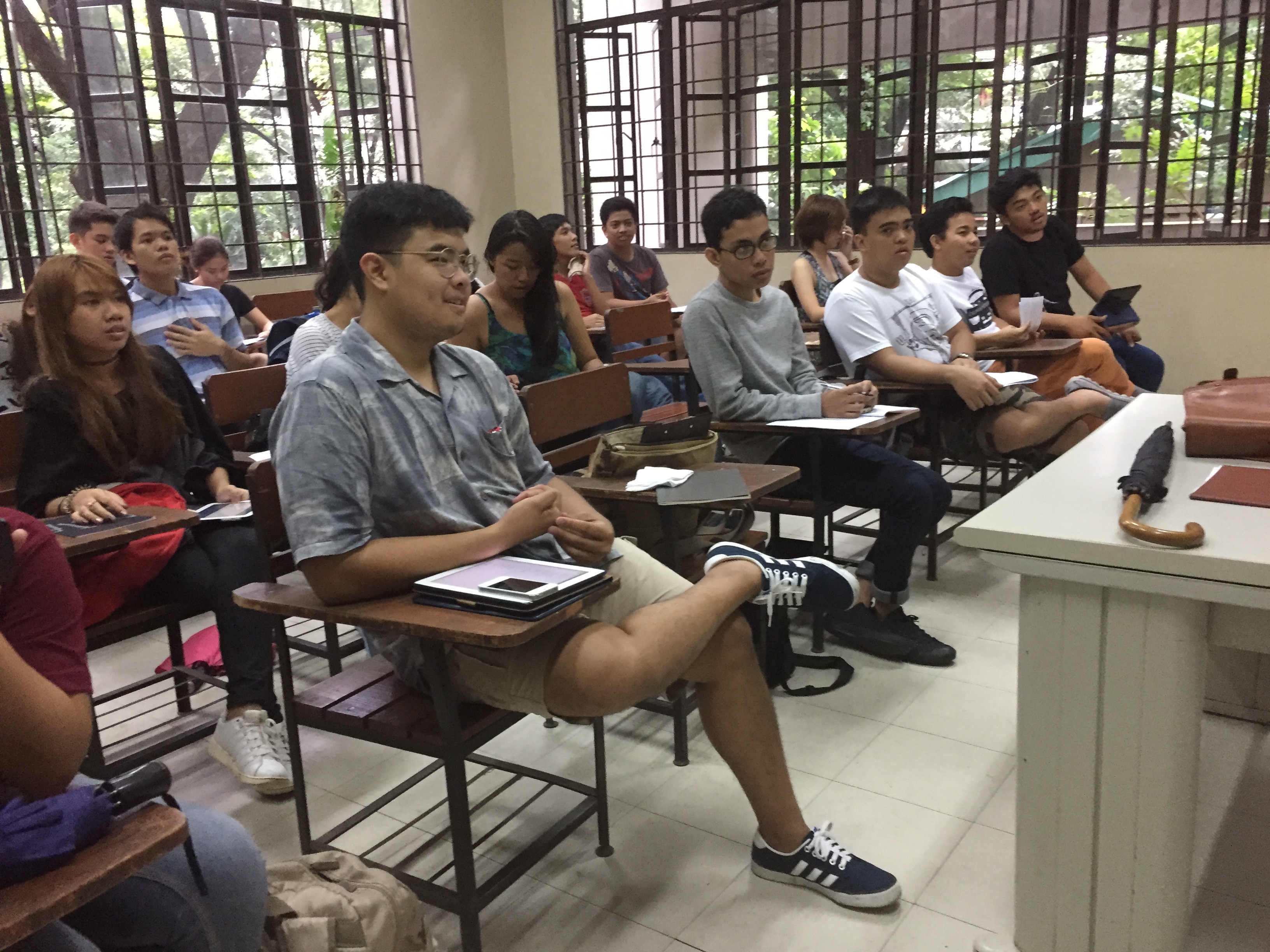
It was on one of these sites—Philmug, which has grown to become one of the world’s most active Apple user groups—that I came across a thread I’m tapping for my topic today. While Philmug is the place to talk about anything and everything Apple, it’s also a community that can spark very lively discussions about such motley topics as Manny Pacquiao, Manila traffic, where to stay in Hanoi, and what SIM cards to get in Europe. One such “offline” thread that perked my interest last week was one titled “College freshman tips,” started by a young member about to enter college. Was there anything, he asked, that his elders could tell him about college life?

It’s a thread that’s grown to ten pages long the last time I looked, and predictably, many Muggers (as Philmug members call themselves) recited that age-old mantra that all college freshmen know by heart (and sophomores even better): “Party hard, study harder!”

Other suggestions were more specific:

  1. Join student organizations and socialize, but choose which ones you’ll be joining wisely. These “orgs” could become networks for life, for both friendships and professional contacts.
  2. Avoid fraternities and such groups that employ physical initiation and advocate violence. You’re in college to study—not to maim or be maimed by other people.
  3. Get out of your comfort zone, and be a little more adventurous. Make friends with people who may be totally unlike you. That’s where a lot of learning happens—in knowing about how other people live and think.
  4. Manage your resources well—your budget and time, most especially. Learn how to take care of yourself, and consider taking a student job, both to earn and to learn some professional working habits.
  5. Master the freshman basics: the campus map, how to take notes, who the best (not necessarily the easiest) teachers are.
  6. Don’t confuse a college diploma with education. A lot of learning takes place outside the classroom.
  7. Don’t believe everything you hear, even from your professors. Learn how to argue, and argue well.
  8. Never plagiarize. It’ll never be worth it.
  9. Don’t be afraid to fail. Go ask a girl out if you really like her. Failure is part of learning.
  10. Don’t try to do everything in your freshman year. You’ll find yourself being pulled in so many directions that it’s easy to lose focus. Map out a clear and unimpeded path to your sophomore year.

Some other suggestions were a bit more unusual, although no less practical. “Always sit beside a female classmate and you will never regret college life, because they are lifesavers (and your immediate supply of pens, paper, books, assignments, and exams),” proposed one member (who now just happens to be one of our smartest cops in the PNP). “They smell better than boys,” another member, a retired pharmaceuticals executive, agreed.

And what did I say? Quite a bit, but among them was, “Don’t bother playing mind games with your professor (as in ‘I’m smarter than this guy, and I’m going to prove it’). You will lose; even if you are smarter than your prof, you will lose… Learn how to argue and come across as being smart without being snarky. I’m a very gentle prof myself, but nothing makes me happier some days than to give some smartypants a dose of his own medicine.”

Now, of course, like many 16- and 17-year-olds, I didn’t follow all this sound and sage advice I’m giving and hearing.

In my freshman year in UP in 1970-71, I (1) joined a frat and got beaten black and blue; (2) joined a militant student organization and went to dozens of rallies, many of them violent; (3) joined the staff of the Philippine Collegian, the student newspaper; (3) met (and lost) my first girlfriend, and did what boys and girls do; (4) got a 1.0 in English and a 5.0 in Math (for absenteeism—I was a Philippine Science high grad and arrogantly thought that Math 17 was beneath me); (5) shifted courses, from Industrial Engineering to Journalism, I think; and (6) went up to the mountains of Quezon and Bulacan to do “mass work.” It was, to say the least, an interesting year.

Within another year or so, I would drop out and divide my time between my activism and a job as a newspaper reporter (I may have been the youngest regularly-employed newspaper reporter of my time, at 18); also at 18, I was in martial law prison; by my 20th birthday, I was married, and became a father before I turned 21.

Not surprisingly, it took me forever to get back to school and finish. I resumed my undergrad studies at age 27, and graduated with my AB in English, cum laude (you could still get honors then even with a failing mark if it wasn’t in your major—I had shifted to English by then—and if your GWA could sustain it) at age 30. I made up for lost time by finishing my Master’s by 34, and my PhD by 37. Some of us like to hurry… and then to take our time… and then to hurry again.

I suppose my ultimate advice to freshmen is just to hang in there and don’t do anything stupid like get killed before turning 20, unless you’re doing it for God and country. But don’t stay too safe, either, because the best things you’ll be learning from will be your most grievous mistakes. One of the wisest things I ever heard came from a friend, now departed, spoken over beer and stale cigarettes at 2 in the morning: “Everyone should be entitled to one big mistake.” Or, as my professor in German once put it, “Ein Fehler ist kein Fehler”—one mistake is no mistake.

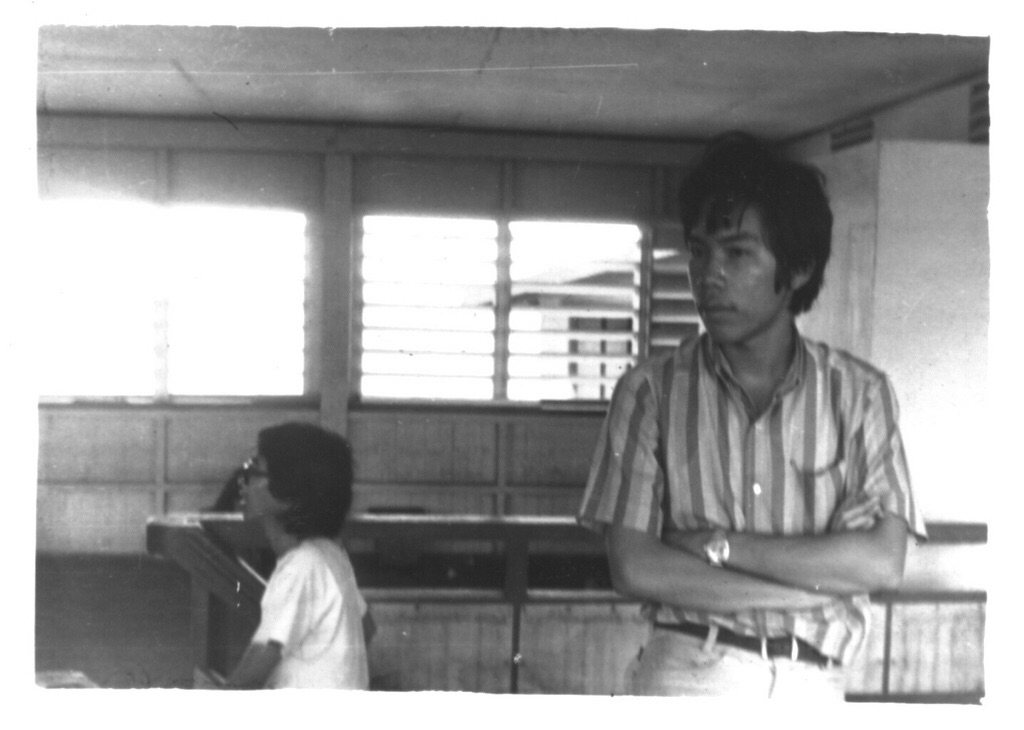
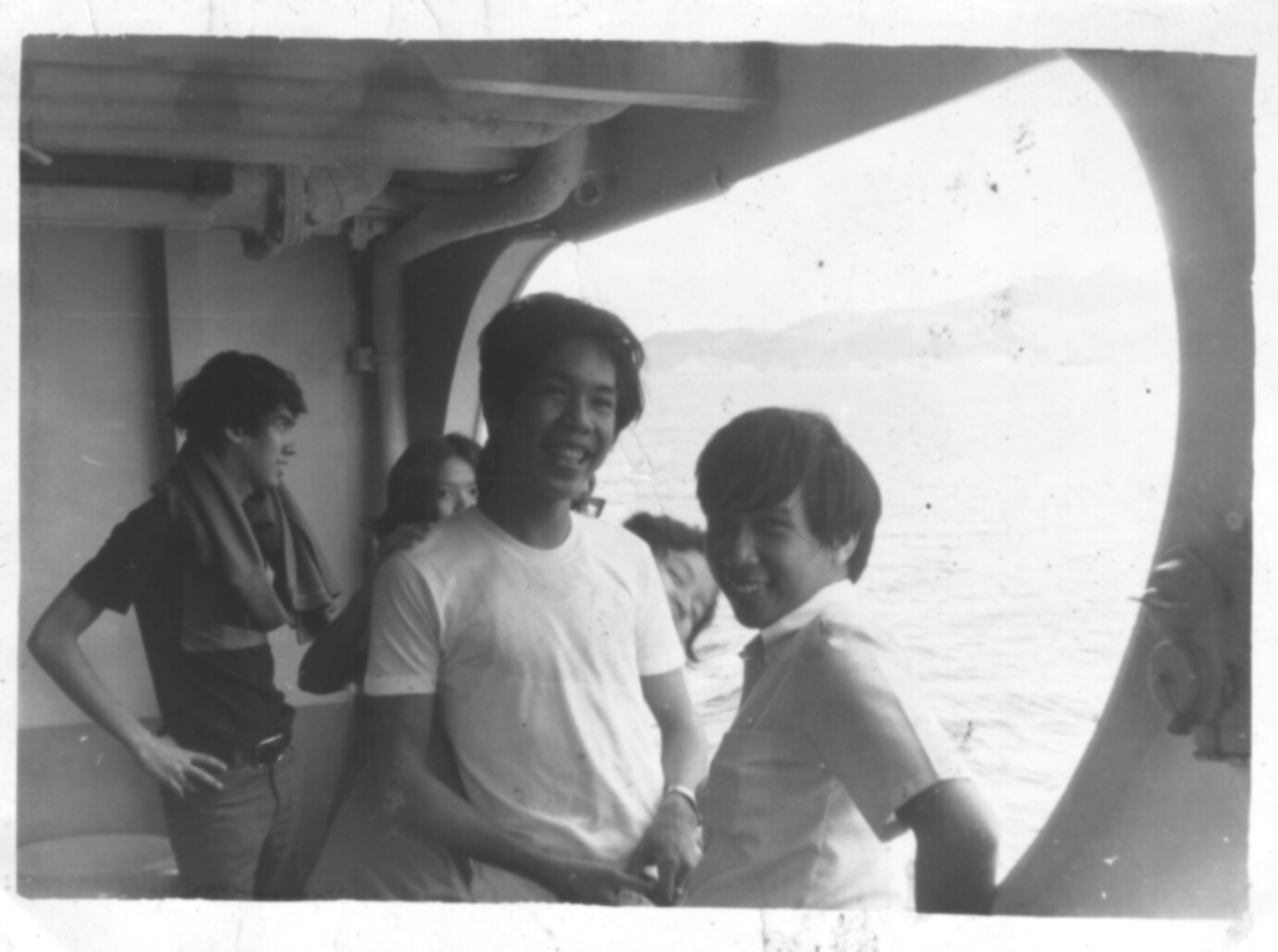
We made a few, and have survived and maybe even prospered despite and because of them. For a Thursday throwback, I posted a picture in that thread of myself as a lanky freshman, beside activist leader and fellow PSHSer Rey Vea (now president of Mapua University), on a boat to a CEGP convention in Dumaguete ca. 1970. My only question was, where did all that hair and leanness go?

1971

Penman No. 146: A Life in the Grand Manner

SEJA2013UPPenman for Monday, April 27, 2015

I’VE BEEN privileged to work with some of the most accomplished and interesting personalities in Philippine politics and business on their biographies—the accounting pioneer Washington SyCip, the brilliantly rebellious Lava brothers, the Marcos-era tycoon Rudy Cuenca, and the political maverick Tet Garcia, among others. This Wednesday, April 29, another biography I wrote—Edgardo J. Angara: In the Grand Manner, published by the University of the Philippines Press—will be launched at the Manila Polo Club, from 3 to 6 pm, and it’s focused on a man who will be remembered for many things in many ways, whose impact on our political, economic, and social life has been far greater than the headlines alone would suggest.

The man now known by many as SEJA (for Senator Edgardo J. Angara) courted consternation and even disdain from many people, including some old friends, when he stood by the embattled Erap Estrada into the last days of the latter’s doomed Presidency. He also confounded many of his own followers when, after leading the opposition, he signed up with Gloria Macapagal Arroyo’s senatorial ticket in 2007. The biography addresses those issues, and more—the Apeco issue in his home province of Aurora, for example, involving the conversion of land claimed to have been the ancestral domain of the Dumagats into an economic zone.

It also sheds light on some little-known but key moments in our political history, such as the peace agreement that Angara was able to negotiate, when he was Agriculture Secretary, with communist rebels in Negros. “That agreement continues to hold,” Ed told me. “It’s the longest-lasting agreement the Philippine government has achieved with insurgents.” The biography also narrates how Angara, still as Agriculture Secretary, was just about to conclude a rehabilitation plan for Camp Abubakar, in close consultation with the MILF leadership. “It would have been a historic breakthrough,” said Angara, “but it was opposed by the military, and ultimately dropped by President Estrada.”

My favorite portions of the biography have to do with his days as UP President, when he threw that famously independent and historically dissident institution into a tizzy by coming in from the cold and applying corporate governance to the academe.

Rumored to have been President Marcos’ choice for the UP job—something Angara strongly denies, attributing his selection to the support of the late Onofre D. Corpuz—Angara stepped into Quezon Hall from out of the blue, “the blue” being ACCRA, the law firm he had set up with some of the brightest young lawyers of his time. Angara would recall that “OD asked me to meet with him in the coffeeshop of the Mandarin. He brought up the UP presidency with me, and I told him that while it was certainly a great honor to be considered for such a lofty academic position, I simply wasn’t prepared for it. My only teaching experience was as a lecturer for two semesters, right after I had returned from Michigan. The School of Business Administration was looking for someone to teach corporation law, and I drove my Beetle from Makati to Diliman to teach my classes.”

His election by UP’s Board of Regents was no cakewalk: Angara faced a formidable and distinguished array of fellow candidates, including Secretary of Justice Vicente Abad Santos, Acting Budget Minister Manuel S. Alba, UPLB Chancellor Emil Q. Javier, Director of the United Nations Fund for Population Activities Rafael M. Salas, incumbent University President Emanuel Soriano, Economic Planning Minister Gerardo P. Sicat, Assemblyman Arturo M. Tolentino, and Assemblyman Ronaldo B. Zamora, among others. It was even rumored that First Lady Imelda Marcos herself was interested in the position.

In the end, the BOR elected the 46-year-old lawyer, and he lost no time wielding the broom—reorganizing and trimming down UP’s tangled and bloated bureaucracy, revamping its academic programs, and securing fiscal autonomy for the university. Some of these measures inevitably made him enemies, but also unlikely allies, such as the staunchly leftist professors Francisco Nemenzo and Roger Posadas.

Known to his colleagues as an irrepressible jokester, University Secretary Mart Gregorio probably wasn’t joking when he recalled a moment when he entered the campus with Angara, who observed a virtual menagerie of farm animals along University Avenue. “He asked me, ‘Why are there so many animals at the university entrance?’ I told him, ‘Ah, Mr. President, that’s the College of Veterinary Medicine. In other universities abroad, you might be welcomed by a beautiful arch or statue. Here we have cows, chickens, and goats.’ And then he asked, ‘What’s that other college there?’ I said, ‘That’s the College of Fisheries, sir.’ He said, ‘Fisheries—but we don’t even have an aquarium here!’ And right there, he said, ‘I think that should be transferred to UP Visayas.’ And it was. ‘Vet Med should be transferred to UP Los Baños.’ And it also was.”

I’m biased, of course, being a UP professor and former university administrator myself, but that’s the kind of anecdote that made this book a pleasure to write. It was also the realization that I was talking to the man responsible for many landmark bills that made a key difference in my own life, among many other millions of Filipinos—the Senior Citizens Act, PhilHealth, the Generics Act, and the creation of the Commission on Higher Education and the National Commission for Culture and the Arts, aside from laws on Agricultural and Fisheries Modernization, the Free High School Act, the creation of TESDA and of a host of financial and educational reforms.

He has been a strong supporter of culture and the arts, and lately has been an avid Hispanist, but Ed’s emergence as a cultural champion came as a surprise to many people—even to Ed himself, who acknowledges that “I don’t even sing or dance, much to the frustration of my wife. I don’t do any artistic work.”

From Con-Con delegate, corporate lawyer, and UP President to senator, Senate President, Agriculture and Executive Secretary, SEJA’s life has certainly been one of the most storied hereabouts. “I will be the first to say that it has been a far from perfect life, fraught with challenge and accident,” he says in his foreword, “but in my 80th year I can only still feel privileged to have lived it the way I did. The title of this book may sound rather immodest—it draws on Justice Holmes’ admonition for the law to be taught and therefore practiced in the grand manner—but I would like to believe that in the end, this is the only standard we can be measured by, as we seek to reshape society itself and our nation’s future.”

See you, I hope, at the book launch.

Penman No. 127: Some Inflight Education

IMG_0231Penman for Monday, December 16, 2014


ONE OF the things I like about flying is the onboard fun that I can look forward to—the movies and the music, to be more specific. At my age, and with all the mucking about that I’ve done, I should be sick of these things and ply myself insensible with the free beer or wine somewhere between Anchorage and Nagoya, but the honest truth is, I’m not. I’m eager for entertainment, which is the only way I can forget the fact that I’m going to be up in the air for the better part of a 24-hour day. I don’t have a fear of flying; it’s boredom I can’t abide.

Being up there means that I can catch up on all the movies I never saw and didn’t even know existed. Beng and I almost always take in a movie after our weekly foot massage (such is life in the 60s), but we’re slaves to what’s out there, and not being too much of a cinephile I’m positive I’m missing out on the good stuff by sticking to the mall fare.

That changed last week when I flew home from Dulles airport outside of Washington, DC to Terminal 3 on the fringes of Pasay—a distance of 8,548 miles, according to Google. That meant 11:30 hours of self-amusement to contemplate, but I think I hit the jackpot—a trifecta in sporting terms—by watching three great movies on one long trip (I actually saw four, but I don’t think Hercules: The Thracian Wars is going to win the Palme D’Or).

I can’t get enough of documentaries, and I actually watched this one twice—the first time on the inbound flight last September, and again coming home. It was an HBO special titled Six by Sondheim, about the life and work of the lyricist-composer perhaps best known for that song everyone loves to sing but nobody really seems to understand, “Send in the Clowns.” (Reader Ivi Avellana-Cosio finally made sense of it for me.)

I just enjoyed the presentation the first time I saw it, but this second time, I was furiously scribbling away on my notebook with a fountain pen in the half-light, as Stephen Sondheim spoke about the creative process behind six of his best songs. Anytime you see me taking notes, it has to be that good, so I’m going to save the best of Sondheim for another column, which the material richly deserves. But just for starters, this was the man who wrote the lyrics and libretto for West Side Story when he was 25—a task he chafed at, wanting to do the music instead—but it proved to be a great learning experience, and Sondheim would go on to become a master teacher himself, like his mentor Oscar Hammerstein II and West Side Story collaborator Leonard Bernstein.

It was Bernstein, come to think of it, who once said that “Music is the only art incapable of malice,” which makes a good segue to my second choice, a film suffused with malice but whose central character, played by the Briton Tom Hardy, exudes an odd naivete. I’ll spare you the spoiler, but The Drop is as quiet and as deliberate a murder mystery as they come. Set in a bar in Brooklyn, The Drop has no car chases, no photogenic panoramas, and co-star Noomi Rapace puts it best when she squirms and says “I don’t want to be here.” We don’t, either, but we can’t help staying and looking, because we fear for the safety and the happiness of our unlikely hero, a quietish bartender who seems intent only on saving damsels and dogs in distress—at least until he draws a severed arm out of a bag; but I’ve already said too much.

And Tom Hardy makes a good segue to the last item on my playlist, which I watched on the Tokyo-Manila leg. He doesn’t appear in it, but is quoted—or I should say more than quoted, because we hear his voice again, speaking like a head in a paper bag, coming out of the mouth of someone who looks nothing like Tom Hardy, the British comedian and mimic Rob Brydon.

The movie was the rather tepidly titled The Trip to Italy, and the only reason I bothered to click on it was because I mistook it for a travelogue that would take me back to some postcard-worthy renditions of Tuscany and Umbria. Of course—away from the neorealism of Fellini and his crew—nearly anything in Italy is worth a postcard and indeed a book. That’s the burden of Brydon and his fellow comedian and travel companion Steve Coogan, who get sent on assignment as their real selves to trace the footsteps of Byron and Shelley in Italy while feasting on veal and artichokes and an endless parade of smart brunettes.

It’s a road movie and a buddy movie all at once, but it’s not Easy Rider or Butch Cassidy and the Sundance Kid. Real men don’t tool around the countryside in a Mini Cooper, twirling pasta on their forks while quoting the Romantics (“romantic poetry” to most guys comes with a small “r” and is best represented by Kenny Rogers and Michael Bolton).

The Trip to Italy is the kind of talky romp that fans of that taciturn trio of Seagal, Stallone, and Schwarzenneger would absolutely hate. Ninety percent of the movie is conversation—make that intelligent, hilariously intelligent conversation, and 50 percent of that 90 percent is comic impersonation, with the two guys doing their irrepressible impressions of Michael Caine and Marlon Brando, making Coogan and Brydon the Dwayne Johnson and Vin Diesel of roadside repartee. But for all the silly banter, there’s a poignance that underscores this movie that seems to be going nowhere, except deeper and deeper into the male psyche.

I thought I was up there for a load of entertainment, but instead I got a dose of inflight education. I can think of far worse ways of killing time.

(Posters from imdb.com and wegotthiscovered.com)

Penman No. 118: To Teach Is to Persist

To-teach-is-to-persist-Penman-Butch-DalisayPenman for Monday, October 13, 2014


SOMEONE REMINDED me that World Teachers’ Day was celebrated earlier this month, on October 5. I forgot about it because I was—I am—overseas, on sabbatical leave until mid-2015. In our department at the University of the Philippines, we normally get just one sabbatical leave over the course of our teaching career, and typically, professors take it a few years before retirement. I’m five years away from that crossroads, so this is a good time to be away from the classroom and to recharge, which is what the sabbatical leave was originally designed for.

Wikipedia tells us that “Sabbatical (from Latin sabbaticus, from Greek sabbatikos, from Hebrew shabbat, i.e., Sabbath, literally a ‘ceasing’) is a rest from work, or a break, often lasting from two months to a year. The concept of sabbatical has a source in shmita, described several places in the Bible (Leviticus 25, for example, where there is a commandment to desist from working the fields in the seventh year). In the strict sense, therefore, a sabbatical lasts a year.”

This sabbatical, however, is shaping up to be anything but a vacation, or a rest break. I may be cool and dry in an America turning pretty with the onset of autumn, but my workload is as tropically toxic as ever, with several books to complete, columns and articles to write, faculty advising duties to perform, and sundry interests—totally and thankfully unscholarly—to pursue.

I do get a respite from the classroom, but, perhaps ironically, that’s the part of teaching I miss the most. As we celebrated World Teachers Day, I also realized that I was marking my 30th year of teaching this November, and I asked myself what three decades of teaching have taught me. After some reflection, it came down to this: to teach is to persist in the perfection of our humanity and our citizenship. That sounds awfully grand to the point of being pompous and pretentious—don’t we, after all, just grab a book, drag our feet to class, and preach bunkum for an hour to a roomful of people with the pulse rate of zombies to earn our lunch and gas money?

There are, of course, many days just like that in a teaching career, days that blur one into the other until the end of yet another semester. And at some point, it’ll get to you: your speech starts slurring and your eyes get glassy, and you can’t wait until the bell rings or the hour hand moves; you had a long rough night, the car needs new tires, the bills are piling up, your thoughts keep drifting back to Paris or Palawan, and the last thing you or your students want to talk about is disease and social order in William Carlos Williams’ “The Use of Force.”

Maybe ten years ago, I had such a day at the very start of the semester, and without realizing it, I must have been so bleary-eyed that I gave off the impression of not quite being there. To my great shock and dismay, one student later blogged about her disappointment with what she had seen; she had expected a stirring performance from her professor on Day One. It was a wake-up call, and I woke up; I promised that student that I would do my best to live up to her expectations, and I hope I did; we’re good, and she’s since gone on to a promising career in writing.

What I became acutely aware of then was that every teaching day is a performance, not unlike a show a professional actor studies and rehearses for, with the additional challenge that one simply doesn’t repeat the previous show, but keeps adding to it, improvising when possible to adapt to changes in the composition and the mood of every audience. I mutter my first lines to myself on the steps up to my classroom, ticking off the day’s main points and questions in my head; I take a deep breath, step into the door, flash a brief smile, and the day begins. And like the pro I have to be, I’ve learned to take care of myself, so I can teach well—to stay healthy, to sleep well (especially before a class day), and to think of something new to say or to bring to the next class.

So we all have our bad days, but it’s precisely on days like these when we need to remind ourselves of what a tremendous opportunity we have to make this Tuesday or Wednesday one of the most memorable in our young charges’ lives, through something we say, an idea or an experience we share, that will turn a key and open a door in their minds. Only in teaching can an ordinary, even a boring, day suddenly become indelibly special, with nothing more than thoughts and words—and the teacher’s persistence and faith in every student’s potential for transformation into someone more aware, more human, more Filipino. Perfectability? It’s more about the effort than the goal—and I’m sure that whatever we do for our students, we teachers do for ourselves as well.


SPEAKING OF teaching, my department has asked me to invite all teachers and students interested or involved in translation issues to attend the 6th Asian Translation Traditions Conference (ATT6) to be held October 23-25, 2014 at the University of the Philippines, Diliman, Quezon City.

The official flyer says that “The rationale for the ATT series is to challenge the Eurocentric emphasis of Translation Studies, which is largely due to the “unavailability of reliable data and systematic analysis of translation activities in non-European cultures” (Hung and Wakabayashi 2005). The ATT series was initiated by Professor Eva Hung of Hong Kong in 2002. A small but successful workshop was held in London that same year, followed by well-attended international conferences in India, Turkey, Hong Kong, and the United Arab Emirates. It is hoped that ATT6 will lead to theorizing on translation and developing methodologies on translation arising from the specific historical and contemporary contexts of Asia.”

Hmmm, I think that needs to be translated: this conference will explore the theory and practice of translation in an Asian context. For more details, please visit http://asiantranslation6.up.edu.ph/.

{Illustration by Igan D’Bayan of the Philippine Star.)

Penman No. 112: Exercises for the Editorially Minded

Penman for Monday, September 1, 2014


TO MY pleasant surprise, last week’s piece on what editors do drew a stream of positive responses—I never imagined that so many readers would find the thankless and dimly illuminated job of editing so fascinating—but my biggest surprise after the column came out was to realize that I’d already written not just one but two columns on editing, back in 2010. Thankfully, I didn’t repeat myself too much, and since I’ve already written dozens of pieces on, say, fiction and nonfiction, I don’t see why I can’t do a fourth one on editing, focusing this time on how an editor thinks or should think.

But before I go one step further into the trenches, let me just point out another important fact about the editor’s job. Particularly in a journalistic context, where some element of public interest is presumably involved (as opposed to literary publishing, which comes down to very personal tastes), “editing” involves much more than dotting I’s or finding better substitutes for problem words. Editing in journalism inevitably involves matters of policy—the publication’s policy in respect of the treatment of, say, political and social issues. What newspaper and magazine editors worry or should worry about are spelled out in a textbook titled Creative Editing by Bowles and Border (Wadsworth, 2000), which says, in a chapter on Situational Ethics:

“Copy editors are likely to be concerned with decisions involving the writing, editing and production processes: Is the use of profane language or obscene photographs ever justified? When? Are the implicit biases of the editor or the newspaper as a cultural institution evident in the selection of 
stories and photos? Should they be? Do certain people groups or institutions receive more play than others? Conversely, are some people groups or institutions ignored? Are headlines and captions fair and accurate? Are stories edited to eliminate bias and opinion? Are subjective words or words suggesting a viewpoint 
given thoughtful consideration?

“Managing editors and other senior editors are likely to be concerned with questions of policy: Should victims of crimes be identified? If so, when? In stories about rape? About incest? About battering? In stories involving juveniles? Should suspects in crimes be identified? If so, when? At their arrest? When they are charged? At the time
of trial? Should the cause of death be listed in obituaries involving victims of suicide or AIDS? Who in the newsroom should know the identity of confidential sources? Just the reporter? The supervising editor? The managing editor? The publisher? If a reporter pledges confidentiality to a source, are editors
bound by the same promise? How involved should newsroom employees be in writing and editing special sections that promote 
consumer products? How should corrections and clarifications be handled?”

Frankly, when I contemplate questions like these, I’m glad to be in the classroom rather than the newsroom, knowing how tricky these situations can get. It would seem that they should have clear and easy answers, but they rarely do, especially given the realities of Philippine publishing and politics—but that’s a story for another day.

Today, let’s do something more elementary—elementary enough to be among the very first exercises I give my students in CW198, Professional Writing. (I don’t care if my future students see this here, because they’ll still be hard put to cough up the answers. As all my students know, I always give open-book exams.) You might know if you have an editor lurking inside you if you can do these exercises reasonably well. Just for fun, I’ll respond to the first 10 responses emailed to me—if you don’t hear back from me, that means you were No. 11.

The first exercise has to do with the bane of Filipinos who love English too much, to the point of using 30 words where three will do, and of using a P1,000 word where a five-peso one will do. Cut. Simplify. Ruthlessly.

The second exercise is rather more advanced, and involves matters of judgment, nuance, and vocabulary—in other words, style. This is something that an editorial or opinion writer (which I was, way back when) would specialize in. I tell my students that they can express the same idea in three ways—nice, neutral, and nasty—depending on their specific purpose. I don’t mean for anyone to be nasty, of course, but just like learning karate or shooting, you never know when you might need it. Let’s have some fun!

I. Wordiness: Simplify and shorten the following sentences without changing their meaning.

  1. I managed to traverse the thoroughfare without jeopardizing my safety.
  2. The people of the Philippines have a great liking for festive occasions.
  3. Society as a whole, as well as the individual persons in it, should practice the virtue of honesty.
  4. In my personal opinion, it is my idea that a prohibition on pistols, revolvers and rifles should be implemented.
  5. His actuations produced a profound surprise in the very depths of me.
  6. We have insufficient information with regard to this state of events.
  7. Let us satisfy the requirements of our bodies for nourishment.
  8. The outbreak of hostilities was within the realm of possibility.
  9. I give you my permission to continue doing whatever it was you were doing.
  10. He was a uniformed enforcer of the law.

II. Modulation: Rewrite the following statements in the “nice-normal-nasty” modes, as required:

  1. (neutral) The Philippines is a country whose people are predominantly poor. (turn into nice and nasty)
  1. (nice) Heroic overseas workers contribute greatly to the health of the Philippine economy. (turn into neutral and nasty)
  1. (nasty) Your proposal is almost totally bereft of intelligence and originality, and is unacceptable in its present form. (turn into neutral and nice)

Penman No. 107: Small Loans for Big Dreams

WS-Butch-1Penman for Monday, July 28, 2014


IT HAD been a few years since I last sat down for a chat with the accounting and business guru Washington SyCip, whose biography (Wash: Only a Bookkeeper, published in 2009) I had been privileged to write, so I was only too happy to oblige when our mutual friend Marlu Balmaceda asked if I could spend some time last week to shoot the breeze with Wash.

Both Wash and I had aged a bit since we started working on his book back in 2006—I more so than he, who last month turned 93. Having just gotten my senior card in January, I’ve been feeling entitled to some relaxation, but Wash SyCip was right at his desk in his old 14th floor office where I last saw him, working away, surrounded by a growing menagerie of owls, turtles, and roosters, the gifts of friends. On the wall was a Chinese painting of a dignitary, perhaps the Emperor himself, seeking the counsel of a wizened turtle. Wash caught me looking at it and told me what the turtle’s sage advice was: “Take it easy.”

As cool and dapper as he is, Wash makes it look like he’s taken it easy all his life, but I know for a fact—having chronicled that life—that it just isn’t so. No slouch could’ve put up and sustained what became the regional accounting giant SGV.

But this time, Wash wasn’t talking about himself, but about a new program for education that he and a friend began three years ago, called the Zero Dropout Education Scheme, which seeks to put and keep poor Filipino kids in school. “The country’s biggest problem remains poverty and the wide gap between the rich and the poor,” Wash says. “For me, education is key to alleviating poverty, but ironically, the poorer you are, the more children you have, so half go to school and half don’t. Those who don’t will stay illiterate, and will be resigned to poverty all their lives.”

Seeing that illiteracy still afflicted millions of Filipinos, Wash resolved to do something about it and committed US$1 million of his own money to a fund aimed at the problem. Helping him along was his friend, the Armenian-American businessman and philanthropist Paul Kazarian, who pledged to match Wash’s contribution dollar for dollar. But even with that funding, Wash was modest and realistic enough to know that he couldn’t do the job by himself. “I don’t really know the poor, and how best to reach them,” he admits. “So I got in touch with CARD-MRI, which has been a leader in Philippine microfinance, to help us out.” Radiowealth Finance Corporation has also geared its CSR program toward the Zero Dropout scheme, and committed to provide P30 million.

The Center for Agriculture and Development-Mutually Reinforcing Institutions or CARD-MRI goes all the way back to 1986 when Dr. Jaime Aristotle Alip and 14 other rural development practitioners got together to set up CARD specifically to help empower women in poor communities. In 2008, it received the Ramon Magsaysay Award for Public Service. “With over 1,400 units all over the country, CARD had a network in place we could tap for our program,” Wash says.

Initially available to CARD members, the Zero Dropout scheme offers small renewable loans ranging from P1,500 to P3,000, at a monthly interest rate of 1 percent. “Basic education may be free,” Wash acknowledges. “But families still need money for school supplies, slippers, clothes, and other expenses. That’s where we come in. We’d like to provide not just the money, but an easy way of getting it, with as little red tape as possible.”

As of March this year, the program had supported over 46,000 students through loans totaling over P160 million, out of which P130 million in principal and P6.5 million in interest has already been paid back. They expect to hit 100,000 beneficiaries by year’s end.

While most beneficiaries come from Region IV-A (the Calabarzon area), the program has expanded to the ARMM in Mindanao, where the dropout rates are the highest. Typical beneficiaries include Lucena native Lilia Fernandez, a mother of nine who works as a manicurist alongside her husband, a construction worker; her son Erick dreams of becoming an engineer.

Unlike the government’s conditional cash transfer program, which gives cash direct to poor beneficiaries, Zero Dropout is a loan program. “They repay the loan through microfinance, by increasing their income with a loan for a store, a tricycle, and so on,” adds Wash.

If you think poor borrowers can’t or won’t repay their loans, think again. CARD has made a name for itself making sure its system works, basically because it’s led by people from the very grassroots it serves. Wash tells this story: “I had CARD’s management people over for dinner at my house once, and discovered that none of them were from Makati or Manila. They were all from the rural areas, and they were mostly women, very bright women. I was very impressed with their dedication. CARD knows its clientele. It works with groups of 20 women who guarantee each other. I’ve attended meetings with these groups and I can see that our poor communities are full of people with initiative and drive.”

I came away most impressed by an incident that Wash related: “When Yolanda hit, 8,000 students under the program were affected in Leyte and other places. My first reaction was to cancel their loans, as the least we could do to help. But Dr. Alip said, Wash, no—the poor are more honest than the rich. And as reconstruction took off, the loans also began to be repaid, even if the borrowers had lost their homes.” If that’s not inspiring—in the context of billions lost to crooks and scammers—I don’t know what is.

Penman No. 102: The Cream of the Crop

2014FulbrightPenman for Monday, June 23, 2014


A FEW weeks ago, I was happy to attend a pre-departure orientation seminar for this year’s US-bound batch of Fulbright and Hubert Humphrey scholars. I’ve been to quite a few of these PDOs over the past decade or so, and normally I’d be there up front, giving one of the orientation talks.

I’m usually the closer at these seminars, my task being to remind our scholars to enjoy their stay in America and to learn all they can—and then to come home and serve their people. “Love America all you please,” goes my spiel, “but never forget where your home is, which is here—not even here in 21st century Makati, but in those parts of our country which languish in the 20th and even the 19th century. We go to the great schools of America not just to improve our lives but theirs—those Filipinos who cannot even read, or are too hungry and tired from work to read.”

Last month, I sat in the audience on the listening end, having been privileged with a Fulbright grant—again, after my first one nearly 30 years ago, when I left for the US to do my master’s at Michigan and my PhD at Wisconsin before returning in 1991. This September, if all goes well, I’ll be leaving for Washington, DC to do advanced research in connection with my ongoing book project on the First Quarter Storm, specifically to seek out American perceptions of and experiences with martial law in the Philippines, and also to interview Filipino-American activists from that period.

The Philippine-American Educational Foundation, headed by the very capable and amiable Dr. Esmeralda “EC” Cunanan, actually administers or acts as a conduit for several distinct scholarship programs that fall loosely under the “Fulbright” rubric, named after the late Sen. William J. Fulbright, who saw educational exchanges as the best way to promote international cooperation and understanding between America and the rest of the world. (The Fulbright program also sends out American scholars for studies abroad.) Indeed, as I often tell my American friends, one Fulbright scholarship will probably cost a hundredth of and produce a thousand times more enduring goodwill than one bomb. For us Filipinos, this is the pensionado concept brought over into a new century, with the important difference that our learning is no longer meant to serve American ends, but ours.

A scan of this year’s batch of outgoing scholars offers great hope for the future. Chosen from many hundreds if not thousands of applicants after rigorous evaluations and interviews, they represent truly the cream of the crop, and I felt honored to be in their company.

The so-called “classic” Fulbright scholars—those going for their master’s and PhD degrees—include the likes of Lisa Decenteceo of UP Diliman, who’s going for her PhD in Musicology at the University of Michigan in Ann Arbor (yay, go Blue!); Neil Andrew Mijares of the University of San Carlos, who’s doing an MA in Urban and Regional Planning at the University of Iowa; and Ramjie Odin of Mindanao State University-Maguindanao, who’s entering the PhD program in Fisheries and Allied Aquaculture at Auburn University.

Among my three fellow “senior” postgraduate scholars, despite the fact that she looks young enough to pass for an undergrad, is Marites Sanguila of Father Saturnino Urios University in Butuan, who’ll be going to the University of Oklahoma to undertake advanced research in “Species Diversity and Survival in a Changing Environment: Developing a New Center for Biodiversity Conservation.”

For many years now, there’s also been a special Fulbright program focused on agriculture, the Philippine Agriculture Scholarship Program for Advanced Research, which was set up at the initiative of then Agriculture Secretary Edgardo J. Angara to improve our agricultural expertise. This year’s nine grantees include Ma-Ann Camarin of MSU-Marawi who’s going to another MSU, Mississippi State University, to do doctoral dissertation research on (hold your breath) “Disease Surveillance and Study on the Bacterial Flora of Freshwater Prawn (Machrobrachium rosenbergii) as Biological Control Against Pathogenic Bacteria.” Meanwhile, Shirley Villanueva of the University of Southeastern Philippines in Tagum is going to the University of California-Davis to conduct research on the “Genetic Diversity of Native Chicken Groups in the Davao Region.”

Among the two US-ASEAN Visiting Scholars will be Jay Batongbacal of UP, one of our foremost legal experts on maritime law, who’ll be studying issues related to current disputes in the South China Sea. The three Hubert Humphrey fellows—all accomplished professionals in mid-career—include a PNP major and former Pasay City precinct commander, Kimberly M. Gonzales, who’ll be looking into public policy and administration concerns at the University of Minnesota.

To help Americans—especially Fil-Ams—learn Filipino, the Fulbright program is sending out three Foreign Language Teaching Assistants, who include Edward Nubla from the University of St. La Salle in Bacolod; he’ll be on his way to Skyline College in San Bruno, California. Lastly, four Filipino undergraduates will soon be spending a year on a US campus, thanks to the Fulbright program. They include Michiko Bito-on of Silliman University in Dumaguete, who’s taking up Mass Communications.

It’s heartening to see the diversity not only in these scholars’ expertise and concerns but also in their representation of all corners of the archipelago, ensuring that the Fulbright experience is shared not only by the usual suspects like me from Manila’s academia, but by bright young minds from north, south, and center.


SPEAKING OF the Filipino presence overseas, a big cultural event will take place in Hong Kong over this weekend, thanks to the efforts of the poet and scholar Armida M. Azada, who’s been based there for many years now.

On Friday, June 27, 5:30-7:00 pm, Mida will sit in conversation with visiting Filipino writers Joel Toledo, Charms Tianzon, and Daryll Delgado in a symposium on new Philippine writing titled “Our Words, Other Worlds,” at the Amenities Building, Lingnan University. The next day, at noon, Mida’s new book of poems, Catalclysmal: Seventy Wasted Poems will be launched at the 7th Floor of Hong Kong City Hall in Central. Earlier that morning, from 10:30 to 12 noon in the same venue, a free writing workshop will be held for Pinoy helpers and HK-Pinoy youth. On Sunday the 29th, from 6 to 7:30 pm, a poetry reading by Filipino writers and their friends will be held on the first floor of DB Plaza Terrace near Dymocks in Discovery Bay.

This is a wonderful thing that Mida Azada—a gifted poet who was a colleague at the UP Department of English before she moved to Hong Kong and the UK—is doing not just for herself but for her fellow Filipinos in the diaspora. As prizewinning poet Joel Toledo puts it in his endorsement of Mida’s new collection, “Cataclysmal is a collection of haunts and visitations. The poems here flit in and out of the Philippine archipelago, travelling to London, Hong Kong, and New York without losing touch of a Filipino rootedness. The poet’s concerns stray and meander from the personal and cathartic to the phenomenal and ultimately global. But Azada’s voice is keen and focused, filtered on the page by a careful attention to language. One may argue that this is the poetics of the expatriate ruminating on both the post-modern and post-colonial. Yet at the heart of this collection is fierce integrity, a resonant ‘I’ persona that won’t flinch. Here are poems that both strain to capture the fleeting and restrain from exoticizing the past. The poet Fanny Howe once wrote, “Double the beautiful/because they are so little.” While phenomena can sometimes be indeed cataclysmal, the hurtful is never wasted—so long as poems remember and reconstruct and, in time, recollect the sorrows, parse them into bliss.”

Mida, Joel, Charms, Daryll, and the other fine, memorable voices of their generation—they too are the cream of the crop.

Penman No. 92: Nurturing Our Sense of Nationhood

IMG_3176Penman for Monday, April 14, 2014

AT THE University of the Philippines Institute of Creative Writing, we were happy to recently welcome into our ranks several new “associates”—UP colleagues who were also accomplished writers whom we felt could make significant contributions to the Institute’s programs. They were Chari Lucero, Luna Sicat-Cleto, Eugene Evasco, and Heidy Eusebio-Abad. Chari is a bilingual—indeed, a multilingual—fictionist and essayist, a very sharp reader of texts; Luna is a playwright and novelist in Filipino; Eugene, a Palanca Hall of Famer, is a writer of stories and poems for children in Filipino; and Heidi writes stories for children in English.

The entry of Eugene and Heidi into the UPICW was particularly timely, since we were severely short-handed as far as our expertise in writing for children and young adults was concerned. Puppetry advocate Amelia Lapeña-Bonifacio remains on our board of advisers, but we had lost Rene Villanueva to an early death and Carla Pacis to La Salle. By bringing Eugene and Heidi into our workshops, we wanted to remind ourselves—and the reading public, of course—of the primal importance of children’s literature as a means of nurturing our sense of nationhood in the imagination of our youngest citizens.

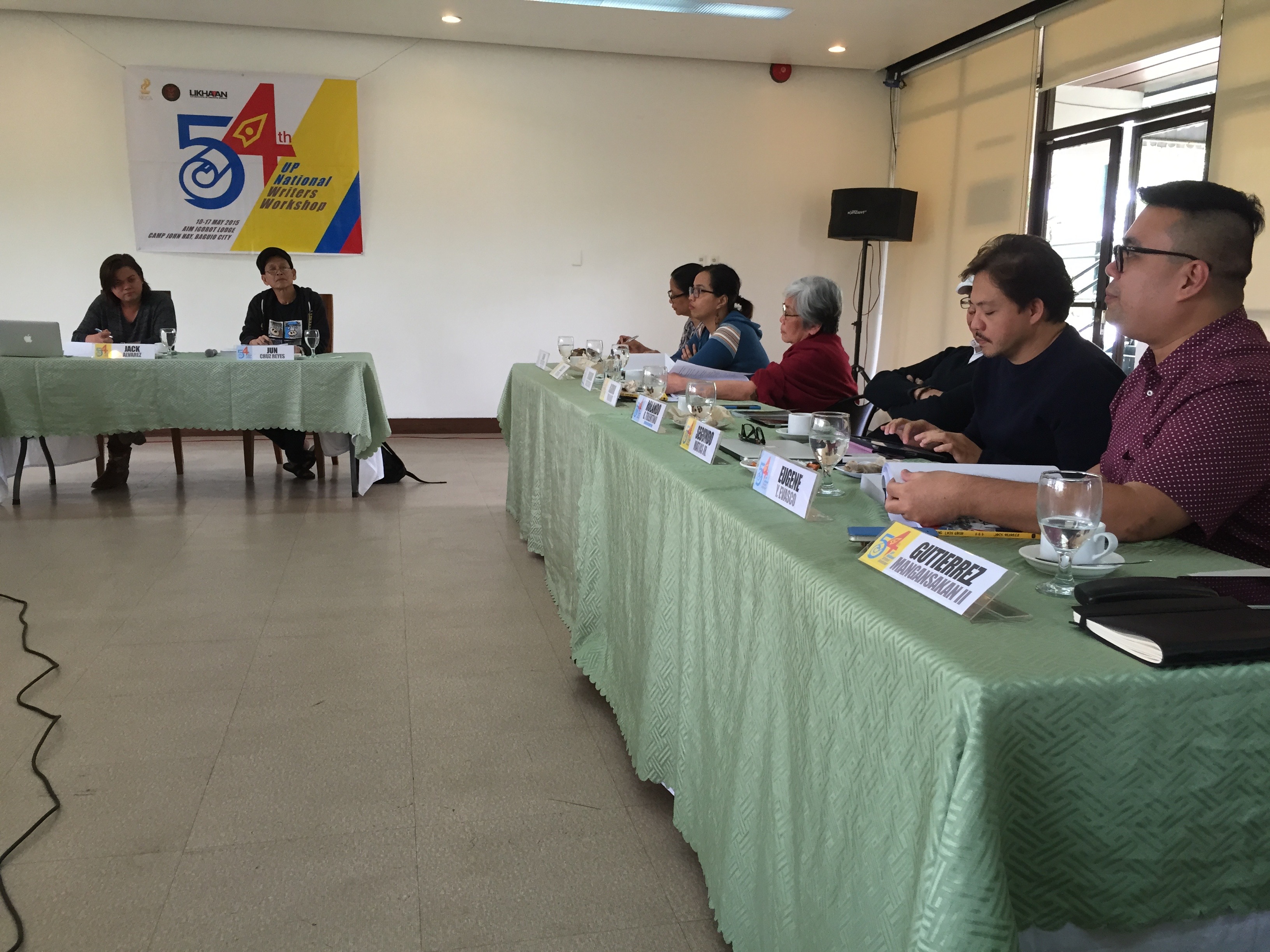
This renewed emphasis was evident at the 53rd UP National Writers Workshop, which we held last week in Baguio. At least three of our 12 workshop fellows were writers for children and young adults. Cyan Abad-Jugo, who already has a PhD in Creative Writing, is working on a book of 13 stories in the fantastic mode. Renato “Nats” Vibiesca, a Palanca award winner, teaches at the Polytechnic University of the Philippines; Marcy Dans-Lee is primarily an illustrator and artist, but also writes her own texts, often drawn from the wealth of indigenous lore that surrounds her in Davao, where she teaches at the University of the Philippines-Mindanao.

Cyan submitted what can most easily be described as modern horror stories; Nats contributed a comic piece about a poor kid who dreams of becoming a bossing, an entrepreneur; Marcy presented retellings of native creation myths. The fact that their material and their approaches vary so widely can only bode well for the future of children’s literature in the Philippines. Herewith, some excerpts from their “poetics”—their explorations into why and how they write what they write (I’ve translated Renato’s excerpt from Filipino):

Cyan Abad-Jugo: I wanted to see if I could achieve “a wider lens on ultimate reality” by making a slight detour “from direct representation of the surface of reality;” I wanted to skew it a little or reshape it a lot, and see if I could not arrive at better relevance and social commentary (which is what I thought Scholes meant by returning “towards actual life by way of ethically controlled fantasy”). This does not mean that I wanted to identify an aspect of social reality and then work it into my fiction. I never start out with such clarity of mind, and cannot give myself clear directions; my default mode is “lost mode,” and so must find my way out of the labyrinth I inevitably find myself in.

The project had more to do with finding out whether the fantastic mode inherently contained within it a metaphor for what it was like to live in our own world. I wanted to write first, as always, and see what came of each story in the end (hello, story, do you have a metaphor in you after all?); but I also wanted to limit what I wrote, I wanted to try my hand at writing particular kinds of tales, given their definitions or what I thought to be their definitions. As I clarified in my proposal:

Though stories never adhere to strict definitions of modes or genres, the definitions and characteristics of each kind of tale or story could serve a heuristic purpose; they could serve as guides to the writer who wants to explore the capabilities, flexibilities, and possibilities of the fantastic story, and how it expresses what we are and could become.

Renato Vibiesca: The short story “Sawsawan sa Padyak” deals with the experience of a boy (with the nickname Kadyot) who grows up in Gagalangin, Tondo—specifically, his transition from childhood to adolescence while confronting his family’s poverty. The story raises questions about the self, physical change, initiation, experimentation, confusion, observations about the adult world, vice, and other instances that address this period of transition. The story also illustrates the culture, the exploits, and the strategies employed by the poor to survive and stay in the city. Even as these problems aren’t solved in their entirety within the story, it does offer hope for the protagonist who keeps on dreaming as he moves along this new path in his life.

The story was written from the point of view of the protagonist, using a voice unique to a 12- or 13-year-old; often facing personal problems, tossing questions around in his mind, nudging forward and backward in his decisions…. Though often full of fear, experience and his station in life become drive him to become more creative and resourceful.

The story’s main aim is to give value to how such young persons face life’s challenges. It isn’t very often that the experiences of adolescents are taken up in fiction. This stage is an eventful one, which makes it more important for readers of this age to be given guidance. The author hopes that more works—both short stories and novels—will be written along this line.

Marcy Dans-Lee:Monsters are my personal inspiration
for writing for children, as children can relate
more to monsters than grown-ups. Children
believe that monsters are real; adults believe that monsters are real only in other adults. And because children believe in monsters, they have the ability to embrace “magic” in stories. As a writer for children, I depict magic with gentle care, never underestimating my little reader’s intelligence for they have been known to persistently demand “Why?” And the writer must be prepared to give them valid and reasonable magic, one that has practical logic, delicately balanced by its own breathtaking mystery.

In writing Luis and the Enchanted Creatures, my intention was to introduce children to six fearsome folkloric Filipino monsters. Under the shade of a balete tree, Luis reads about each monster in his grandmother’s old forbidden
book, from which the monsters soon emerge. In
a child’s mind, because the monsters are in the book, it is logical for them to come out of it. This is acceptable magic for children; it is completely reasonable.

Likewise, the adult’s choice of words in talking and writing is inarguably different from that of a child. Simplicity and straightforward narration are encouraged, while expanding a child’s vocabulary is the writer’s choice. Repeating a new word, a phrase or a sentence allows for remembering and internalizing meaningAs a writer, I particularly enjoy dialogues for these provide me the opportunity of acting
out character parts, drawing inspiration from every child’s unforgettable characters, like the pig’s chinny chin-chin and the wolf ’s huff and puff, as well as the nightly read-aloud sessions to become an incredibly angry Papa Bear, a delicately shocked Mama Bear and a whining spoiled Baby Bear when they see their bowls of half-eaten porridge, their chairs mussed up, and their bed sheets crumpled and undone.

The style of putting these words together however may lead a writer to unknowingly
“talk down” to children. Writers for children
are particularly vulnerable to this danger for as adults, we are sadly accustomed to innovating the strangest, most convoluted ways of controlling and negotiating with children in order to restrain their innate curiosity. We tend to be condescending, unaware that we are in fact the primary bullies
in their young lives. When I draft a story, I unconsciously converse with a child—with the same respect I converse with adults.

Simultaneously, my mind’s eye can see the illustrations that will go with the story. This anticipation allows me the luxury of fewer words since the illustrations will speak a thousand words. For after all, does a writer for children need to explain that a monster has a thin face, with big scary eyes, sharp yellow teeth and long unruly hair? Such descriptions are certainly better drawn than written.

In the end, “happily ever after” means that our stories and illustrations for children
must contribute to inspire a child’s imagination
to become real in adult life. For how else can technology, medicine, green urban planning, space and time travel be imagined and made real, if not for stories of monsters and magic?

(That’s Marcy and Heidi in the pic.)

Penman No. 76: A Lesson in Description

Penman for Monday, December 9, 2013


NOW AND then I walk my students in Creative Writing through a lesson in description, which—as I’ve often noted in this corner—is at best always more than a rendition of the physical setting and the people and things in it. In the hands of a skilled or a gifted writer, a plain object can acquire a strange and memorable luminosity. Sometimes all it takes is the uncommon but logical and precise choice of a word, such as when William Faulkner describes a campfire as being “shrewd,” struggling and managing to keep alive despite the wind. At other times good description requires the writer to step back and to set things in a larger context, balancing fine detail with the broader sweep of memory and understanding.

I don’t even need to draw on the likes of Faulkner or Greg Brillantes or Kerima Polotan to demonstrate what I mean. Take this passage from a story submitted to my fiction class a couple of semesters ago by a young student named Katrina del Rosario, part of a story titled “Paying Respects.” Rather quiet in class, she more than made up for her reticence with this outpouring of brilliant prose:

The first Dayaos had been very successful farmers, and the land burst with green and trees and stalks and vines heavy with bright fruit; now only one or two Dayaos farmed the land, with the most magnificent of trees cut down to build houses. The elders remembered entire lives lived underneath the shadows of trees and grown roofs of vine, childhoods spent working the fields. They did not remember it as work. They remembered instead the bits of sugarcane that could no longer fit into carts and the sap sticky on their chins as they tore off strips of the bark with their teeth; getting lost in entire walls of tall grass that needed to be cut down; the cool of the mud and manure against their knees in the middle of a field exposed to all the ghastly splendor of a high sun; as small children, play was pretending to chop wood for the hearth and desiring to be old enough to pound the rice, watching in awe as their mothers tossed the grains into the air like a high wave and catching it again, cooking kangkong in hot water in their small toy pots made of clay. Everything they needed could be found on trees, in the fields. They had been perfectly comfortable. They were never hungry. Home was where the land began, and ended; living was the certainty of land and its fruit.

What’s even more interesting about this example is how little use it makes of adjectives and adverbs—the crutches that beginning writers often employ to carry the burden of description (“he snarled angrily,” “the bright, sunny morning,” etc.). “Write with nouns and verbs!” I keep reminding my students.

There are many ways of describing the same scene, but one approach I offer student writers is the option of gauging one’s emotional and psychological distance from the subject, and rendering the scene accordingly.

Depending on your purpose, you can choose to describe a person, thing, or place in one of several alternative modes. Your purpose, of course, will depend in turn on the kind of fiction or scene you are working on. I made up the following examples (so you’ll forgive me if they sound cheesy) to illustrate these alternatives.

What I call the technical/objective mode is strictly that, a seemingly factual, no-frills rendition of the scene, as a police report might put it:

The apparition was reported by a male witness, 45 years old, a farmer and a native of the town of Libmanan, Camarines Sur where previous sightings were said to have occurred. The man, Angelo Camagay, described what he saw as a woman in her early thirties, about 5 ft. 4 in. tall, and with distinctly Caucasian features: light brown hair, blue eyes, and fair complexion. She was clothed in a full body-length white robe of soft material; Camagay could not remember seeing footgear of any kind. She appeared before him at about 5:45 am on the opposite bank of a stream where he had paused to draw water in his bamboo container, prior to working in the fields.

Somewhat warmer and more detailed is the neutral/realistic mode. It’s still a fairly straightforward description without much emotional coloring, but we see things more vividly:

Augusto dipped the thick, three-foot length of bamboo trunk into the water; it had been severed at the nodes, with a hole cut into the top and a wooden handle attached to one side. Now the cool, clear water gurgled into the hole as Augusto held the container down, feeling the stream swirl around his wrists and the bamboo struggle to keep afloat. Later, in the heat of noon, the same water would slake his thirst and wash the paddy mud off his hands. Augusto looked up; it might have been a bird bursting out of the trees that caught his eye; but it was a woman on the opposite bank, blinding in her pure white robe. She, too, was white of skin; her hair was a light brown, and she stood closely enough for him to see that her eyes were blue. He could not see her feet, which were lost in the lush grass. She seemed younger but somewhat taller than his wife. Augusto knew that in all of his forty-five years in Libmanan, he had never seen anyone like her; but some of his townmates had, and now he believed them.

And finally—though perhaps with the greatest degree of difficulty—one can go into the lyrical/romantic mode, which involves a certain degree of abstraction and sublimation, and certainly a more pronounced attitude, not to mention some linguistic dexterity:

Rough the palms that trapped the water, brown the arms that fought its surge. Come into my bamboo cup of cups and fill me in my driest need, my limpid blood of morning. Come. And Augusto looked up for an instant, thinking that a great white bird had exploded in the trees, flushed out by his presence. But no bird there, no stark familiar creature of his town’s well-traveled woods. Maria, Ave Maria, oh fair oh pure oh thou footless light disconsolate. Eye of sky, hair of corn, I come to you. And bathed in her sudden radiance, Augusto thirsted as he had never had, but as others had, and now he saw, and now he knew.

Whichever mode the writer employs, he or she should remember that the best description always does more than physically describe: it prepares and conditions us for what is about to follow, and, working with the narrative, provides a context against which we can understand characters and their situations better.


LAST WEEK’S piece on the forgotten master Constancio Bernardo—whose 100-year retrospective dazzled us when we attended its opening last Wednesday—prompted the following recollection from the Davao-based poet Ricky de Ungria, who also paints and draws occasionally:

“My first teacher in the arts was Ms. Katy Bengzon of DLSU. I took a summer class there in Taft when I was still in high school and copped a prize for a watercolor of mine. My second teacher was Constancio Bernardo. My father enrolled me in a summer class of his at the old CMLI gardens somewhere in Quezon City. He taught me how to do landscapes in watercolor. In fact in one of my old sketchpads he showed me how to do shadows of leaves on trees. Very calm, soft-spoken and gentle man, as I remember now. All this to tell you how much I appreciate your piece on him today because I knew so little of him.”

Penman No. 68: Towards a Regional Literary Community

Penman for Monday, Oct. 14, 2013

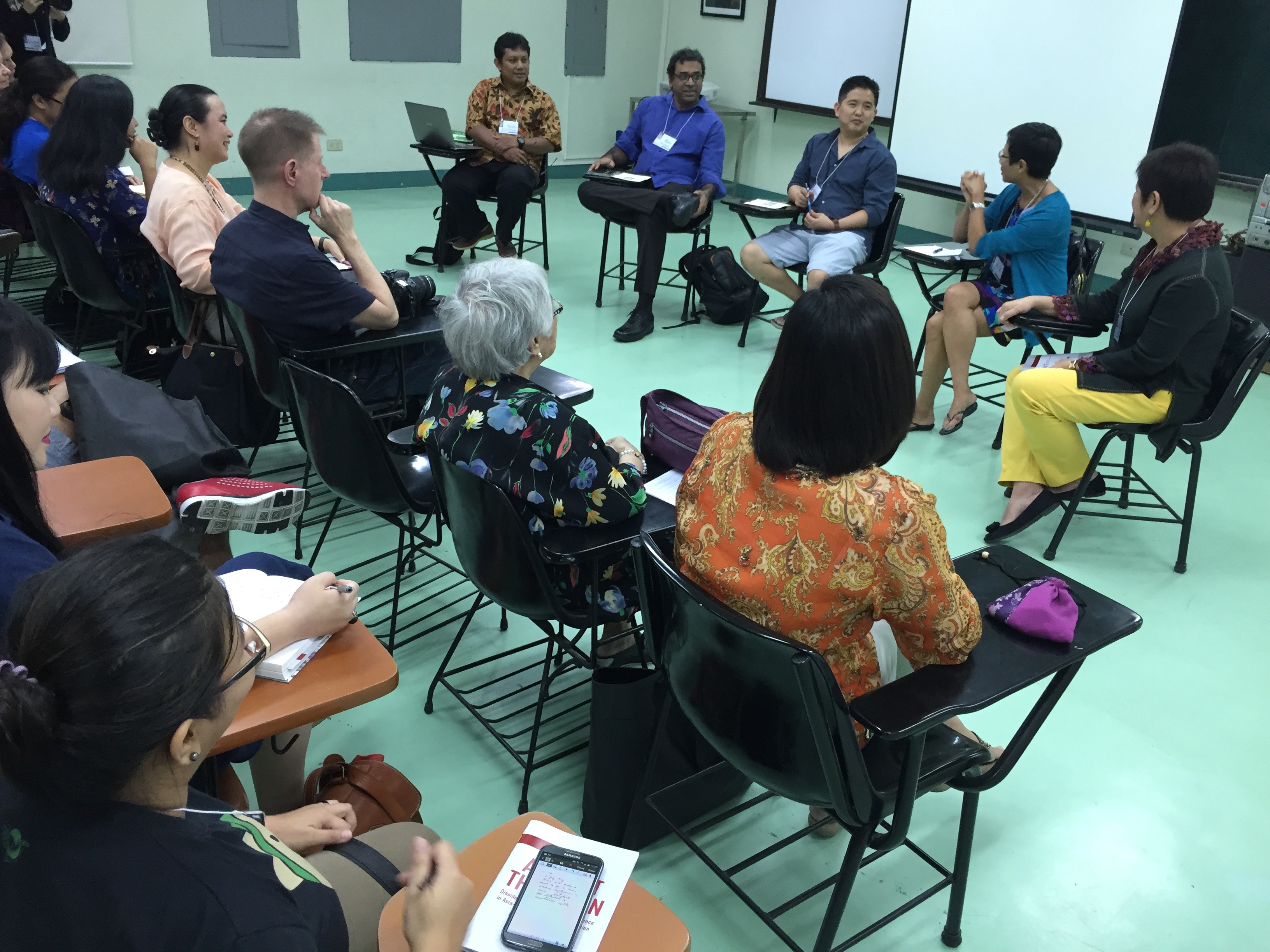
WE WERE back in Bangkok very recently, about the same time as last year, for another gathering of the newish Asia-Pacific Writers and Translators Association (APWriters). Around 200 participants from all around the region and from as far as Europe and the US got together from October 3 to 6 in Chulalongkorn University—also the site and host of last year’s conference—to meet on a wide range of literary concerns, most of them bearing on this year’s focus on “The Teaching of Creative Writing.”

Titled “Reaching the World 2013,” the conference was sponsored by the Bangkok Metropolitan Authority, Asia Books, and the Faculty of Arts of Chulalongkorn University. Bangkok had good reason to host us two years in a row; it had been named World Book Capital for 2013 by Unesco, and was celebrating the honor in the most appropriate way it could. It’s also at Bangkok’s historic Oriental Hotel that the annual SEAWrite Awards for the region’s best writers are given out, and we were welcomed there at dinner by the urbane and popular Governor of Bangkok, Sukhumbhand Paripatra. The son of a prince and educated at Oxford and Georgetown, the governor put everyone at ease by joking that he couldn’t greet us with rhymed couplets, as he was “only a politician” (he had, in fact, taught political science at Chula, Georgetown, and Columbia).

I was one of the organizers of the conference, and was proud to see that a total of 27 Filipino participants (not counting four who had to withdraw at the last minute for various reasons) attended “Reaching the World.” Among others, the delegation included stalwarts of the Philippine literary community such as STAR columnist and former DepEd Usec Isagani Cruz; UST and UP creative writing guru Cristina Pantoja-Hidalgo; MSU-IIT professor and poet Christine Godinez-Ortega; DLSU creative writing center head Shirley Lua; UP Press director and poet J. Neil Garcia; University of San Carlos professor Hope Sabanpan-Yu; the Bellagio-bound fictionist Menchu Sarmiento; and Davao Writers Guild president Jhoanna Lynn Cruz.

But more than seeing familiar names on the program, I was especially glad to see that many of our youngest writers on the UP faculty were able to attend as well, including Francis Quina (my deputy at the Institute of Creative Writing), Gabby Lee, Sandra Nicole Roldan, and Vyxz Vasquez. Conferences like APWriters expose writers like them to ideas and influences outside of their own local schools and networks, and sustain the continuity of our commitment to literature from one generation to the next.

APWriters grew out of the old Asia-Pacific Writing Partnership, which we expanded to include translators, in recognition of their crucial role not only in promoting the works and careers of individual authors but also of fostering international understanding through literature. On top of the transition has been the indefatigable Australian writer Jane Camens, who now serves as APWriters’ executive director (read: conference busybody) and who put the conference program together from dozens of proposals we received.

What distinguishes APWriters and its conference format is the informality of the discussions. Proposals for presentations were solicited and accepted, but no lengthy papers were actually read; instead, panelists spoke from notes or off the cuff, achieving our goal of witnessing “writers in conversation” as participants from places as diverse as Norwich and Ho Chi Minh City shed their academic robes, rolled up their sleeves, and spoke from the heart and from memory about the subjects that matter most to writers, translators, and teachers of creative writing.

We don’t mean to be unfriendly towards critics, scholars, and their important work, which after all endeavors to make sense of what we creative writers do. It’s just that there are already enough venues out there for the reading of formal papers (the annual and massively-attended conferences of the Modern Language Association and of the Associated Writing Programs come to mind) on the most obscure and abstruse of literary concerns. I took part in two panels at Chula, as a discussant in the first (which confronted the question of “cloning” in writing workshops and programs) and a moderator in the second (which dealt with how writers budget their time, and with what else they do besides writing).

Aside from Jane, I was glad to see old friends and acquaintances from around the region (or whose work and personal lives bring them regularly to Asia) such as the American writer and workshop specialist Tim Tomlinson, whose book The Portable MFA I’ve recommended to those in need of a crash course in creative writing; the Indonesian translator Eliza Vitri Handayani, who’d sponsored the translation workshop in Jakarta that I’d been a part of just the week before; Kate Griffin of the British Centre for Literary Translation; the Japanese-American fictionist Kyoko Mori, a fellow alumnus of the University of Wisconsin-Milwaukee’s PhD program; the Indonesian-Chinese-American Xu Xi, who directs the low-residency MFA program at the City University of Hong Kong; the Australian nonfiction and theater expert David Carlin; and, of course, the APWriters chairman himself, the Hong Kong-based Sri Lankan journalist and humorist Nury Vittachi, who’s been behind some of the region’s most significant literary projects, such as the Man Asian Literary Prize and the forthcoming World Readers’ Award.

There were many more, but you get the idea: this is a functioning network of writers and literary specialists from around the Asia-Pacific who’ve come to know each other as friends. And before anyone starts screaming “Another literary cabal!”, let me say, yes, why not, because right now, that’s what we need; there will be a time and an occasion for principled disagreement, but for now our emphasis is on finding and strengthening commonalities of thought, practice, and experience, thereby creating a working community of writers and translators in the region.

The commitment of these people to our emerging network was evidenced by the fact that many participants, including myself, were entirely self-funded. (It also helped, of course, that Bangkok is one of the most accessible, affordable, and tourist-friendly places on the planet.)

The large turnout from the Philippines also reflects the size and the maturity of our literary community and culture. Why shouldn’t we be able to send almost 30 writers to Bangkok? I respectfully disagree with those of us (including my friend Cirilo Bautista, whom I praised and quoted a few weeks ago) who see the Philippines as “a small country.” We’re certainly not—neither in size (at 300,000 sq. km., the same size as Italy), population (in 2005, we were 13th in the world), nor GDP (around 40th to 43rd  out of nearly 200 countries, depending on the year and who’s counting). Our grossly inequitable incomes and power relations are a real problem, but even these haven’t curbed, and may even have encouraged, our expressiveness in art and culture.

Indeed, as we look around the Asia-Pacific, we’ll find that the Philippines has one of the most robust of literary infrastructures, with formal creative writing programs in half a dozen major universities, a workshop tradition going back half a century, and the kind of democratic irrepressibility and irreverence that you can’t find anywhere else in Southeast Asia.

We’re banking on these strengths to put the Philippines more firmly on the global literary map, and we’ve taken a step in that direction by offering to host (after Singapore next year) the 2015 edition of the Asia-Pacific Writers and Translators conference. I hope to see many of our Bangkok fellows there, and more.