Penman No.205: Sojourn in Seoul (2)

IMG_8666.jpg

Penman for Monday, June 27, 2016


HAVING PLANNED our trip to Seoul months in advance, I made a point of touching base with some local contacts for possible meetings—something I usually don’t do, wary of disturbing people with my unseasonable presence. But with a week to kill in one city and with some longstanding connections in place, I thought it would be even more ill-mannered if I didn’t at least tell them that I was going to be in town.

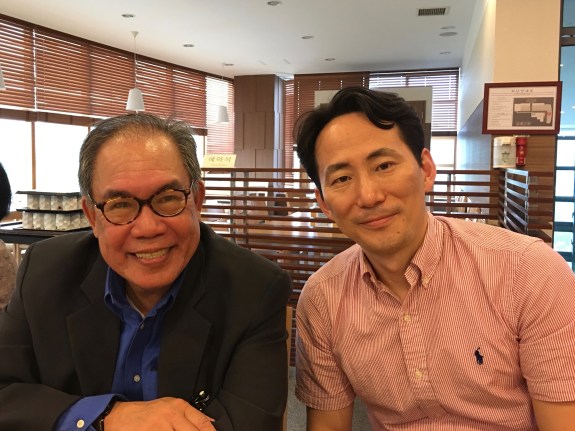
One of those connections was Dr. Sukjoo Sohn, who teaches English at Dong-a University in Busan, Korea’s big industrial center four hours by train from Seoul. Sukjoo—a specialist in world literature—happens to be married to Catherine Rose Torres, one of our bright new young fictionists who now serves as First Secretary and Consul at our embassy in Berlin. I’d first met Catherine in 2011 when I attended the Singapore Writers Festival and she was with our embassy there, and I was later very happy to write a blurb for her first book, Mariposa Gang and Other Stories (UST, 2015).

It’s really these personal connections that make for global literary networking, the value of which I can’t overemphasize. In 2014, Sukjoo translated one of my stories for publication in Global World Literature, which is put out by some of Korea’s foremost literary scholars and critics in that area. Through Sukjoo, I was also able to contribute an article to the Korea-based journal Asia, in which I wrote about some of our most gifted and exciting younger writers. As a result of that article, one of our best young non-fictionists, Sandra Nicole Roldan, will be visiting Seoul this week to attend the 2016 Asia Literature Creative Workshop.

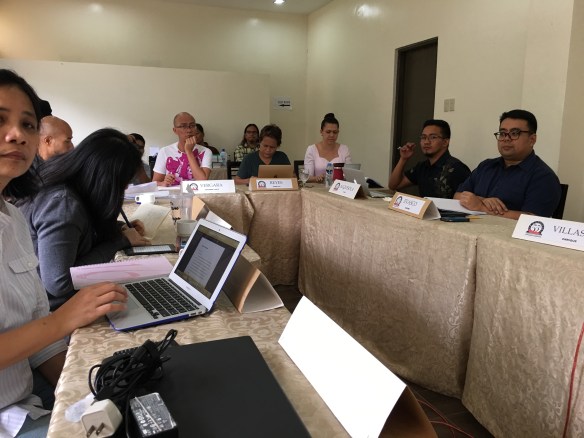
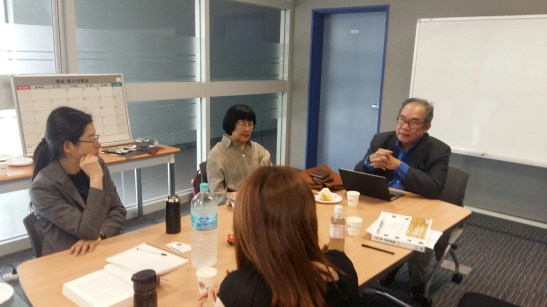
And so our connections continue and deepen. When they learned that I was visiting Korea, Sukjoo’s organization invited me to a special meeting, so I could tell them more about Philippine literature. That gathering took place at Seoul National University toward the end of our visit, and a very fruitful and engaging encounter it turned out to be. Perhaps I shouldn’t have been surprised, but their very first question had nothing to do with lyric poetry: “What do you think of your new President, Rodrigo Duterte?”

It will take more than this column to share my answer with you, but suffice it to say for now that we talked about our colonial history, our Catholic predisposition to suffering, the two Joses (not me) by which our literature is best known overseas, class as the key divisor in our literature and society, Korea’s and the Philippines’ shared experience of dictatorship, and the irony of having to deal with a resurgent Park and a resurgent Marcos, and our younger writers’ affinity with Gaiman, Murakami, and Wattpad.

We discussed my translated story, “In the Garden,” which I’d written in the 1980s about militarization in the countryside and the moral duty of a teacher caught in the crossfire. While the topics were unavoidably contentious, our meeting itself was thoroughly pleasant and mutually informative, capped by dinner, shop talk, and, yes, chatter about Lee Min-ho.

meeting 2.jpg

The second highlight of our visit—away from the malls and the flea markets—was a meeting with the Filipino community in Seoul, which had also been pre-arranged by Catherine through her Seoul colleague, the very capable Third Secretary and Vice Consul Ella Mitra.

It was a Sunday—our last full day in Korea—and much to our surprise, the embassy was open and bustling with people, with a wedding taking place right in Ella’s office. (“We can officiate at weddings,” Ella told us, “as long as the two parties are both Filipino citizens. We’re open on Sundays because that’s when most of the community can come.”) There were over 40,000 Filipinos in Korea, Ella informed me, many employed as factory workers in jobs that the locals themselves prefer not to do.

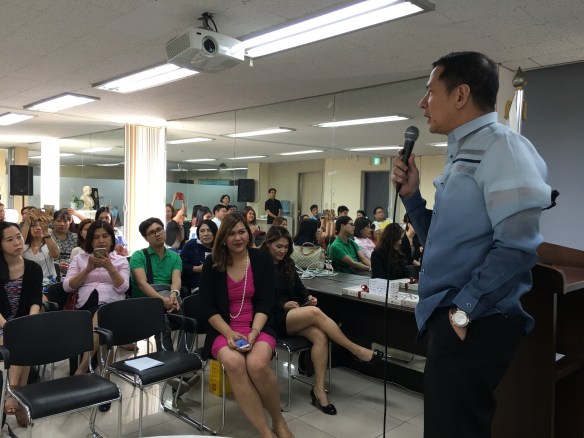
I’d been asked by the embassy to give a reading for the community—something I love to do whenever I’m abroad, as it puts me in touch with ordinary Filipinos striving to do their best in often very challenging circumstances. The Filipino, I like to say whenever the opportunity arises, is the modern-day Ulysses, roaming recklessly to the farthest reaches of the globe, but imbued with an unfailing sense of home. Now here they were, a crowd that filled the room beyond our most generous expectations—professionals, teachers, graduate students, Filipino-Korean couples, even the Ambassador himself, the dapper and articulate Raul Hernandez.

IMG_8681.jpg

The embassy had calendared my reading as its second Sentro Rizal activity, and with June 12 coming up, it seemed a good time to remind ourselves of the things that both divided and united us, and of the need to hang together as Filipinos, at a time and in a region of revived nationalisms. Even so I chose to do a very light reading, one that made fun of my own social ineptitude in cross-cultural situations, and thankfully it went over well with the audience. More than the reading, it was the ensuing Q&A and freewheeling chat over pancit and puto that proved most gratifying. I could sense the community’s strength of spirit, its determination to master a new cultural terrain.

I was especially happy to see a former student, Tech Apognol, now doing an MA in International Relations and speaking Korean. She’s hardly alone; the association of Filipino grad students in Korea now numbers 500, I was told, and there were plenty of masteral and doctoral scholarships for those inclined. “We can take classes in English,” one student named Eve told me.

Another grad student named RJ solved a mystery that had been bugging me for 40 years. Back then, I told him, I was a young writer employed by the National Economic and Development Authority, and one of my tasks was to help edit the Five-Year Development Plan, which was thicker than an encyclopedia because of its bloated prose. On the other hand, I recalled, the South Korean development plan that I used as a reference was no bigger and fatter than a paperback novel—and look, I told RJ, where Korea was now. “Ah, that’s easy,” RJ said. “It’s because the Koreans value brevity, and memos are expected to be no more than a page. The higher up the ladder papers go, the more concise they’re expected to be.”

The shopping was fun—just the flea markets for us, please, not the high-end shops—and the streetcorner food delicious, but it was, ultimately, our encounters with the people that added the most value to our visit. Kamsahamnida, Sukjoo, Cathy, Ella, and Tech for these memorable exchanges.

Penman No. 203: Another Filipino Winner at the IPSC

unnamed.jpg

Penman for Monday, June 13, 2016


EVERY MAY, at Dartmouth House in London, about 60 young men and women from all over the world gather to represent their respective countries at the International Public Speaking Competition (IPSC). Sponsored by the English Speaking Union (ESU), the IPSC is the world’s premier public speaking event for young people, bringing together the best minds of their generation to share their ideas about the planet’s most pressing concerns.

The Philippines has been sending representatives to the IPSC since 2002, and was granted International Charter Membership in October 2005. As a country we have performed superlatively, producing two world champions and at least four semifinalists. This 2016, I’m very happy to report that we notched another spectacular achievement, with Marco del Valle being named global first runner-up, after the representative from Mexico.

Just 20 and a Business Administration junior at UP Diliman, Marco is no stranger to competition, having already won six titles in business and marketing competitions, including the Henkel Innovation Challenge in Vienna, where he and his partner represented the Philippines and also placed second. Marco’s success comes as the latest in a long string of stellar finishes for young Filipino public speakers at the IPSC.

In 2004, 17-year-old Patricia Evangelista stunned everyone when she was named IPSC champion, presaging a successful career in print and broadcast journalism. In 2008, Gian Karlo Dapul became our second world champion at the IPSC, besting 57 other participants from 35 countries—an achievement made even more remarkable by the fact that he was only a Philippine Science High School senior then, competing against mostly college students. (The third-place winner that year, Rajab Ali Sayed of Pakistan, turned out to be half-Filipino.) In 2012, Bryan Chua made it to the semifinals, as did Germaine Chuabio in 2011, and Ervim Charles Orbase in 2010. (In 2012, Hong Kong’s representative in the finals, Ramon Joseph Valentin Romano, was actually a Filipino born of migrant parents.)

This year’s Philippine participation at the IPSC was made possible by the generous support of longtime partners Pilipinas Shell and Far Eastern University, led respectively by Ed Chua and Lourdes Montinola, who both sit on the board of ESU-Philippines. ESU-Philippines Chairperson Gigi Virata and President Marlu Vilches ably led this year’s selection process, along with ESU-Philippines regulars Linda Panlilio, Krip Yuson, and myself. As elated as we were by Marco’s performance, our joy was overshadowed by the recent and unexpected passing of two ESU-Philippine stalwarts—Ambassador Cesar Bautista, our chairman emeritus, and Loline Reed, who had very patiently and kindly guided our representatives in London, along with her husband Ken.

This year’s theme for the IPSC finals was “Integrity has no need of rules,” and Marco drew deeply on his personal experience to address the topic, declaring at one point that “Too often, we demonize people… who don’t live by our religious or social rules. But moral integrity isn’t about obeying rules. It’s about recognizing the fact that while we all make mistakes, we’re all capable of rising above them.”

He explains further: “Overall, my speech was about my relationship with my family, particularly my mother. In the speech (which is the same speech I gave for the national finals), I talked about the sacrifices my mother made in the face of different social norms, the same sacrifices that millions of people make every day. I talk about how our culture stigmatizes families who don’t fit the norm, and how that makes it harder for these families to function. I conclude, however, that the sacrifices we make for those we love will always outweigh any rules or social norms we might break.

“I’d have to say that my favorite part of the whole experience was getting to know the other contestants and hearing their stories. It’s one thing to place countries on a map, but it’s an entirely different thing to actually be roommates with someone from Serbia, to learn about Moroccan weddings and Estonian startup culture, and to hear stories of African democracy as told by someone from Ghana.

“As we went through the competition, I think the feeling we all got as contestants was that we weren’t competing against each other as much as we were sharing our own experiences. I was really happy to be able to show a bit of my culture to the world and share what makes Filipino culture special. Yet when you hear speech after speech from so many brilliant young minds around the world, you start to realize that there’s really not that much which separates us from other countries: we share the same dreams, the same fears, and the same ambitions. Above all, this is what I think the ESU IPSC really helped showcase: that it’s possible to celebrate our differences as individuals and as nations, while also respecting and recognizing the things we have in common. And in a world where fear and intolerance are rapidly becoming the political weapons of choice, I think it’s a lesson more people should learn.

“When I entered this competition, all I really hoped for was the chance to share my story and talk the causes I believe in. Thankfully, I’ve been given the chance to do so much more. Winning 1st runner-up is, for me, more than just a personal accomplishment. It’s a chance to show the world that the Filipino spirit is capable of anything.”

Marco’s IPSC experience mirrors that of his predecessors, most of whom have gone on to distinguished careers in public service, media, education, and business. Dr. Renzo Guinto of UP Manila, our IPSC representative in 2008, recalls that “I learned to understand, appreciate, and respect cultures and perspectives that are different from my own, which in turn bolstered my sense of empathy. I could say that the ESU contest played a crucial part in preparing me to become the global health advocate that I am today.”

Ryan Kaliph Buenafe, who as an FEU student was our first IPSC contestant in 2002 and who now serves as Global E-Learning Manager for the TelePerformance Group, attests that “The ESU content was about practice, revisions, then more practice and more revisions. Preparing for it meant that I had to tell a compelling story and message in a limited amount of time and engage the audience so they would be inspired by my story. This is not easy when you’re young. There’s no Wikipedia or Google shortcut. I had to work hard, then practice and revise. This is, as I have found out as an adult, a great preparation for life. We practice what we do so we can do it better and allow others to share their greatness (such as Dr. Jimmy Abad and Krip Yuson who helped me improve and revise my speech). It is our small but significant opportunity to share with the world, on a global stage, the story of our people and our selves…. If we are to learn from history and combat terrorism and hate, we need to connect as one people. ESU is a forum where such a connection is made possible and it has been the greatest experience of my youth.”

We can only hope that more young Filipinos like Marco will emerge to speak for the Philippines on the global stage and be heard for what they have to share. Mabuhay!

image2.PNG

(Photos by Giulia Rampinelli)

Penman No. 198: Mind-blowers and Eye-openers

IMG_8289.jpg

Penman for Monday, May 2, 2016


THE FIRST-EVER Knowledge Festival held by the University of the Philippines in Tagaytay City a couple of weekends ago proved true to its promise and offered mind-blowing, eye-opening discoveries galore, shoring up not only UP’s reputation as the country’s leading university but also that of the Filipino genius as a whole.

Part academic conference and part science fair, the festival brought together over 200 of UP’s top scientists and artists from the university’s many campuses all over the country to showcase the best and most promising products of their ongoing research. The festival also featured talks by experts on key academic and research issues (I excerpted my own keynote here last week), and presented the university’s expansion plans and the latest publications of the UP Press. A roundtable with members of the media had UP President Alfredo E. Pascual exchanging views with some of the country’s top journalists on future directions in Philippine higher education.

But it was the exhibits themselves that formed the living heart of the festival. Most were focused on science and technology, but UP’s most advanced endeavors in the arts, education, and mass communications were on display as well. What unified them was the element of interdisciplinarity, of crossing traditional academic turfs and boundaries to arrive at better solutions to age-old problems, or better products for the 21st century. Most of the projects were being financed by the university’s Emerging Interdisciplinary Research fund (EIDR), an ambitious program which has funneled many hundreds of millions of pesos into projects cutting across disciplines and with a positive impact on the government’s Key Result Areas (KRAs).

(I know—I get fidgety myself whenever I step on the road to Acronymia, but like I said in the open forum after my talk, artists—especially those in public life—have to learn to speak bureaucratese and to do the math if they want to engage outside their comfort zones, which is also key to getting grants.)

The exhibits were organized into six clusters: (1) agri/aquaculture, food, and nutrition; (2) health and wellness; (3) disaster risk management and climate change; (4) energy, environment and ecotourism; (5) technology, new materials and other products; and (6) progressive teaching and learning.

As a frustrated scientist (I entered UP as an Industrial Engineering major fresh out of Philippine Science High), I’m always fascinated by what goes on in S&T, and touring the science booths gave me an overview of the research and development in the field within UP. Among the dozens of projects on show, I lingered longest on a few: an analysis of the use of Twitter to keep track of typhoon events; the development of the Philippine Scientific Earth Observation Microsatellite (better known as Diwata-1, which is now in orbit) for disaster risk reduction; an ecosystem assessment of Laguna de Bay, a study aimed at finding ways to revive a dying lake; and a study on the use of microbes from shipworms (tamilok) as potential sources of enzymes for biofuel production. (I’ve had tamilok wriggling down my gullet on a dare during trips to Palawan, where they’re a delicacy, and I’d happily give them up to biofuels.)

In the health and wellness cluster were a flurry of projects ranging from a dengue detection kit to the development of best-practice guidelines for the better management of prevalent community diseases and the use of social media for promoting healthcare. In agriculture, a product called BioN promised to replace 30-50% of chemical fertilizers while increasing yields by 11%, keeping plants “healthy and green even in drought and in the presence of pests.”

Although it was a tucked away in a corner of the learning cluster, what especially caught my eye was a little black box called VISSER—short for “Versatile Instrumentation System for Science Education and Research,” a highly portable science kit which can do over 120 experiments in biology, chemistry, physics, engineering and environmental science. As it turned out, VISSER had been developed by a team headed by a fraternity brother of mine, physicist Dr. Giovanni Tapang, originally with some support from the University of Maryland. The argument for VISSER is compelling: more than a third of the country’s 13,000 high schools—catering to about 7 million students—have no labs, and of those that do, only 2,800 have access to digital tools. The VISSER kit isn’t cheap at over P40,000 per unit—about the price of a laptop—but its potentials are huge, with a total market value estimated at almost P60 billion. It isn’t just good science, but good business as well for technopreneurs.

And speaking of technopreneurship, few Pinoys can be more inspiring than Dr. Gonzalo “Al” Serafica, a much sought-after consultant on technology commercialization who also spoke in Tagaytay on how he developed new uses for microbial cellulose—known to most of us as the lowly nata de coco—for the global medical market as brain patches and artificial skin. A chemical engineer and also a PSHS alumnus like Dr. Tapang, Al Serafica holds 10 US and 20 international patents and co-founded Xylos Corporation in 1996, proving that crossing over from the lab to the boardroom isn’t only possible but, in many cases, necessary.

On the whole, the Knowledge Festival offered ample proof that with the right support and incentives, Filipino scientists, artists, and researchers can be right up there with their international counterparts, but we have a lot of catching up to do. As a UP study notes, we spend about half of what our ASEAN neighbors spend on education, and even less on R&D. But just showing ourselves what’s possible is a good start, and UP will soon be touring key exhibits not just around the UP system but to other universities as well.

And UP itself will keep growing, as I was mighty impressed to see in the display that featured ongoing and upcoming expansion projects: the UP Clark Green City that will include, among others, a new College of the Natural Environment and College of Designed Environments; the soon-to-open UP Bonifacio Global City that will host classes in law, engineering, business, architecture, labor and industrial relations, urban and regional planning, statistics, and distance education; the UP Professional Schools-South Road Properties in Cebu; the Philippine Genome Center in Diliman; the new UP Diliman Sports Complex rising out of the rubble of the old track oval; and an upcoming UP Cavite incubator campus.

If we can shoot satellites up into the cosmos and turn a coconut dessert into brain implants, you’d have to believe that the sky’s the limit for the Filipino genius—as long as we don’t get sidetracked by personality politics and medieval mindsets.

timpeake-20160427-diwata-1-deployment-001_FD3086695C6E4EA699A3E0129B0153AD.jpg

[Diwata-1 photo courtesy of ESA/Tim Peake]

Penman No. 197: Why the Arts Should Matter

IMG_7956.jpg

Penman for Monday, April 25, 2016


FOR THE first time ever, the University of the Philippines held a Knowledge Festival in Tagaytay last week, showcasing the most significant and interesting projects being undertaken by UP scientists, artists, and researchers, with an emphasis on interdisciplinarity. I was asked to present a keynote talk on “Why the Arts Should Matter.” Herewith, some excerpts:

It has become practically a cliché to say that our lives, and certainly our learning, would not be complete without some appreciation of the humanities. Our tradition of liberal education has primed us to the necessity of cultivating the “well-rounded individual” schooled in the basics of various disciplines.

Within my own field, I often find myself arguing for the importance of being able to adopt a rationalist outlook, of grounding our artistic judgments and perceptions on a concrete appreciation of our economic, social, and political realities. I’ve always urged my creative writing students to take an active interest in history, technology, business, and public policy as a means of broadening their vision and enriching their material as writers.

But conversely, let me ask: Why indeed are the arts and humanities important? I’ll turn to conventional wisdom and quote what should already be obvious, from the Massachusetts Foundation for the Humanities:

“The humanities enrich and ennoble us, and their pursuit would be worthwhile even if they were not socially useful. But in fact, the humanities are socially useful. They fulfill vitally important needs for critical and imaginative thinking about the issues that confront us as citizens and as human beings…. We need the humanities. Without them we cannot possibly govern ourselves wisely or well.”

What strikes me here is the word “govern,” which seems to me to be of utmost importance to us at this juncture of our history, and which is key to our topic today. The role of the humanities in our intellectual and cultural life is to enable us to govern ourselves wisely and well. They deal with issues and value judgments, with defining the commonalities and differences of human experience, hopefully toward an affirmation of our most positive human traits, such as the need to work together as families, communities, and societies. In sum, they help us agree on a common stake, based on which we can make plans, make decisions, and take action.

That notion of a common stake is crucial, especially on this eve of one of the most contested elections in our history. Despite all the predictable rhetoric (and the real need) for national unity, we find it difficult to unite beyond short-term political expediency because we remain unable to agree on our most common ideals—the national dream, as it were, or the direction of the national narrative. What is our story? Who is its hero? Are we looking at an unfolding tragedy, a realist drama, or a romantic myth? To go further, what is important to us as a people? Where do we want to go? What price are we willing to pay to get there?

These are questions that are answerable less by scientific research and inquiry than by artistic imagination and insight. It will be mainly the humanities and the social sciences that will provide that vision, in all its clarities and ambiguities, as it will be science and technology that will provide the means.

This does not mean that scientists and engineers will have little or nothing to contribute to the crafting of this vision; I firmly believe they should, and that one of our worst mistakes has been the fact that we have largely left national policy to the politicians, the priests, the lawyers, the soldiers, and the merchants. Scientists have had little say—and artists even less—in the running of this country and in plotting its direction. We may canonize our boxing champions and beauty queens—and even elect them senator—while our National Scientists and National Artists languish in obscurity and indifference.

Ours is an appallingly innumerate society. Most of our people do not know the simplest numbers that describe our lives, and much less what they mean. We are raised on concepts like the national flower and the national bird and the national tree, but even in college we are hard put to say what the national population, the national birth rate, or the Gross Domestic Product is, and why they matter. This innumeracy is balanced, sadly, by cultural illiteracy. Our notion of culture often consists of pretty images, pleasant melodies, theatrical gestures, and desirable objects.

We have much to do by way of cultural education, and artistic expression is a vital means by which this can be achieved. The arts are the key to those parts of us that reason and logic alone cannot reach.

But I came here this morning to go beyond the obvious, and to present an aspect of the arts that few national and even academic policymakers ever think about, and it’s this: the arts should matter not only because they’re good for the soul, but because they’re good for the body as well—taking the body to mean our economic and material well-being. In simple words, and moving from the philosophical to the practical sphere, the arts can mean big business.

The arts underlie what have been called “creative industries,” and these industries have made tremendous contributions to the economies of countries as diverse as the US, the UK, China, Japan, Brazil, and Thailand.

In 2009, when the Joint Foreign Chambers of the Philippines initiated a focus group discussion on creative industries in the Philippines, they defined the sector as embracing “a wide array of subsectors including advertising, animation, architecture, broadcast arts, crafts, culinary arts, cultural/heritage activities, design, film, literature, music, new media, performing arts, publishing, and visual arts.”

In 2010—the last year for which I have solid figures—copyright-based industries or CBIs contributed more than P661.23 billion to the economy, according to the Intellectual Property Organization of the Philippines. In GDP terms, the economic contribution of CBIs climbed from 4.82 percent in 2006 to 7.34 percent in 2010. Core CBIs comprising companies in the arts, media, and advertising largely accounted for this surge. A corresponding rise in employment occurred in the sector, from 11.1 percent of the total number of jobs in 2006 to 14.14 percent four years later.

There seems to be a greater awareness on the Philippine government’s part of the economic utility of our artistic talent. In 2012, for example, RA 10557 was passed to promote a “national design policy” highlighting “the use of design as a strategic tool for economic competitiveness and social innovation.”

However, culture as a whole remains a low priority, often subsumed to other activities like tourism, entertainment, and sports. And it’s getting worse; very recently, cultural funding by the NCCA—the largest source of government funding for the arts—practically dried up because of onerous conditions imposed on cultural organizations in the wake of the pork-barrel scam, requiring them to undergo a tedious accreditation process by, of all things, the DSWD. Unlike many progressive countries, we do not even see it fit to have a standalone Department of Culture, so the DBM and even the DSWD can push the NCCA around.

We need to see the arts as more than a frivolous diversion that keeps on drawing funds without producing appreciable pay-offs, like an exotic and expensive pet you keep around the house, but rather as an area of strategic and profitable investment that will yield both moral and material dividends. Just as we need to develop more PhD-level scientists and researchers, we need to support advanced practitioners and theorists in the arts, as they have every capability to achieve world-class status, with the right incentives.

Let me end with a message—perhaps even a plea—to those who hold the purse-strings of our institutions. That journal, that play, that exhibit, that concert, or that workshop is always more than a line-item expense. Supporting and patronizing these artistic endeavors is the price we pay to understand ourselves in all our complex, and wondrously unquantifiable, humanity—and also, in ways you may never expect, to create new knowledge and new wealth in many forms.


Penman No. 195: In the Afterglow

IMG_8194.jpeg

Penman for Sunday, April 10, 2016


AS MANY of you know by now, in the early hours of April 1st, a Friday, the UP Faculty Center went up in smoke. I was playing poker at my usual haunt, the Metro Card Club in Pasig, when I got a flurry of text messages from Krip Yuson, who had just heard of the fire on Facebook. Distraught, Krip sent me pictures of the unfolding scene—flames were billowing out of the FC’s upper floors, and it was clear that nothing and no one could possibly survive such a catastrophic event. I thanked Krip for the heads-up, put my cards down, and drove off to UP to see the fire for myself.

We live on campus, in a faculty bungalow on Juan Luna Street, a ten-minute walk from the FC, so UP was literally home for me. But I also held office at the FC, in the English Department, and the FC had been my official address for over 30 years since I began teaching in 1984. As I drove to Diliman I thought of my room, FC 1036, which I had had to myself since I came home from graduate school in 1991; before that, I’d shared FC 1012 with the late Angelito Santos and Ernie Bitonio, who became a lawyer and labor official.

Anyone who’s studied at UP Diliman would have gone through the FC at one point or another, and the place was rife with tales not only of intellectual and political adventure, but also of mischief of a baser, if more entertaining, nature. My favorite one, possibly apocryphal, had to do with an eminent lady professor going out on the window ledge and hanging on for dear life to spy on a neighbor whom she suspected of having an assignation with a student. Another hand-me-down scene involved two feuding scholars—one delivering a professorial chair lecture in CM Recto Hall while her nemesis handed out a vitriolic flyer at the door to anyone coming in.

It’s funny how the tragic can provoke the comic—and the professorial life certainly doesn’t lack for evidence of human frailty and folly—but it’s as good a response as any to personal loss, which was what the FC fire was really about. True, we lost a campus landmark and an academic institution. But buildings can be rebuilt—and the half-century-old FC was long overdue, anyway, for a massive renovation.

The FC’s subdivision into departments and then into individual rooms and cubicles guaranteed that each little corner would become treasured (and jealously guarded) personal space—not just mini-offices but mini-libraries and mini-galleries, showcases of both tradition and individual talent. Aside from the usual family pictures and diplomas (of which I actually saw precious few on display, perhaps in tacit admission of the silliness of flaunting one’s PhD in a boatload of them), shelves full of precious books and walls hung with choice art described the typical FC room, and each room’s state of order or chaos indelibly imprinted the tenant’s character on the visitor’s mind.

In UP, with historically low salaries and precious few incentives, a room of one’s own is an earned privilege. Professors are kings, and their offices are their castles and citadels, open to students and colleagues but impregnable to the unwelcome (except during martial law, when the military marched into the FC willy-nilly in search of Redheads). During the Diliman Commune in 1971, we’d renamed the place “Amado Guerrero Hall,” after the nom de guerre of Joma Sison, who had been an instructor with the English department.

Once aflame with revolution, now it was literally on fire, and three hours after the fire began, I watched as an eerie orange glow illuminated its interior. The text messages had shown tongues of fire curling out the windows, but the blaze had mellowed down a bit when I got there. Had I arrived at its peak, I would have been too excited to feel pain, but its muted state invited contemplation, which invited melancholy. I stood outside the building facing our department, facing my corridor, and understood that very little, if anything, would survive. (And of course the scene was not without its black—or should I say its blackened—humor; I overheard an exhausted fireman asking, “Does anyone have a cigarette?” I can’t write this account without thanking the dozens of firemen from all over who battled that inferno—you all deserved a good puff afterward.)

As my fellow FC denizens would do in the coming days, I began taking stock of what I was losing even as I watched: a Joya nude (one of two that Beng had saved from her days at Fine Arts; thankfully we had given one to our daughter Demi); a large giclée print of lilies gifted to us by Jaime Zobel; two paintings we had bought from a young Jason Moss; a National Book Award trophy by Agnes Arellano in the shape of a typewriter, my favorite among all my illustrious paperweights; my TOYM trophy by Napoleon Abueva, which, meaning no disrespect, did double duty as a hat rack; two of Beng’s serene waterscapes, which I had commandeered from her exhibitions; and a drypoint portrait that I had made myself (in another life as a printmaker) of her whom I was yet courting.

There were the books: among many others, a first edition of Without Seeing the Dawn, signed by its first owner, the novelist Zoilo Galang; a signed copy of Villa Magdalena by Bienvenido Santos; more first editions of NVM Gonzalez, Nick Joaquin, and F. Sionil Jose; and a copy of Ninoy Aquino’s prison testament, which Cory Aquino had signed and gifted to me in thanks for some speeches I had happily done for her pro bono.

And then of course there were my own books and papers—file copies of nearly all my books, and assorted publications, including 20 copies of the first printing of Penmanship, whose special paper I treasured and therefore hoarded; and my only copy of my dissertation. Luckily I had left only one of my fountain pens in the office, a Conklin desk set from around 1925, and a handsome crystal inkwell from Barcelona. Most of these could be replaced, but not the letters of friends and students over 30 years, nor the cane chair handmade by my late father-in-law, on which I took many a siesta.

IMG_6542.jpeg

In the end, I found myself mumbling, “It’s all just things,” but of course it wasn’t. Men don’t grieve well, and over the next few days I grew increasingly sullen and irritable. Last Monday I joined a supervised foray into the burnt-out premises, just to see what we could recover. Almost everything we knew and owned had turned to mounds of char, which remained warm and smoky beneath our booted feet. From my blighted corner I picked up a ceramic mug that had lost its bottom. I also rescued a porcelain guan yin that belonged to Jing Hidalgo, and the ravaged hulk of a Royal typewriter I had given Isabel Mooney two decades earlier. We staggered out with our loot, laughing, and then the desolation hit us.

IMG_8243.jpeg

My grandmother Mamay used to sing us a lullaby which Ilonggos will recognize, about how life and sweet things will simply drift up and away in bitter smoke, and that weekend some of that life and some of that sweetness rose up into the air.

“We Pinoys are disaster-proof,” I tweeted at some point, mindful of how small our plaints seemed compared to a Yolanda. I do believe that, and we literary types have probably used up all our phoenix metaphors in the fire’s afterglow. But I’ve also always believed in proper goodbyes, so before we haul in the new furniture into the inevitable new FC, here’s mine, to ash-covered memory.

(If you want to tour the aftermath of the FC fire with me, see the video here.)

Penman No. 194: A Tree Grows at the Met

IMG_8118.jpg

Penman for Monday, April 4, 2016


THE FIRST and last time I saw a show at the Manila Metropolitan Theater must have been in the 1990s, for a production of Nick Joaquin’s “Portrait of the Artist as Filipino.” The theater was in fine shape then, and I recall being as enthralled by the place itself as by the spectacle onstage.

As a young boy in the early ‘60s, my father had worked at the old Department of Public Works building across Plaza Lawton (before they became the Post Office and Liwasang Bonifacio), and I had often tagged along to play with his red-and-blue pencils and his swivel chair. The most entrancing element in that locale, truth to tell, was the giant pot above the old Insular Ice Plant that spewed what seemed to be a steady stream of boiling water into a waiting coffee cup; but my eyes would stray to the strange pinkish building in the distance and I would wonder what went on there and what it held.

I got my answer, thanks to Nick Joaquin, but a few Sundays ago, I had an even more amazing opportunity to know the Met more intimately than I would ever have imagined. Sadly the intimacy was that which might exist between a doctor and a patient, like a probe of cold steel into some tubercular organ.

My wife Beng belongs to Kasibulan, a group of women artists, and they had been invited to do a sketching session at the old theater that Sunday morning, alongside a cleanup operation to be undertaken by volunteers. Did I want to come along, perhaps to take pictures, or at least hold bags and run errands for the ladies as they drew arches and vanishing points? Of course I did.

But before I go any further, especially for the benefit of our millennial readers, let me give a backgrounder on the Met and its sorry fate.

When the Manila Metropolitan Theater opened on December 10, 1931, it was an architectural wonder to behold and to step into—an Oriental palace in pink coral, crowned by exquisite minarets, statues, sculpture, and tilework. The overall style was Art Deco, the rage at the time, spilling over from the West but adapted to its new setting in the East. It could seat almost 1,700 people, and it had been put together and adorned by some of Manila’s finest architectural and artistic talents—designed by Juan Marcos Arellano, built by Pedro Siochi and Co., and decorated by the Italian sculptor Francesco Riccardo Monti, the sculptor Isabelo Tampinco, the future National Artist Fernando Amorsolo, and by Juan Arellano’s brother Arcadio.

IMG_8086.jpg

Erected near the site of its predecessor, the Teatro del Principe Alfonso XII which burned down in 1867, the Metropolitan was meant to be the city’s premier cultural venue, a showcase of the Filipino artistic genius. In its heyday, it hosted celebrated singers such as Jovita Fuentes and Atang de la Rama; from highbrow opera to the more popular zarzuela and vaudeville, the Met had the best to offer. Though damaged during the war, it was rebuilt and continued to be a haven for artists and entertainers until it began to decline in the 1960s, as other venues—and the growth of moviehouses in such places as Avenida Rizal, Escolta, and Cubao, followed by the establishment of the posh and modern Cultural Center—gained primacy among audiences.

At one point or other in its slide to abject decrepitude, the Met became a boxing arena, a movie set, a martial arts studio, a gay bar, an ice cream parlor, a TV stage, and a refuge for the homeless, among other incarnations. In 1978, Imelda Marcos took an interest and had the theater restored to its old glory, but then it fell again into disrepair, and was shut down in 1996 in a wrangle over ownership between the city government and the GSIS. Gloria Macapagal Arroyo and Mayor Fred Lim renovated and reopened it in 2010, when it was declared a “National Treasure” by the National Museum, but yet again it succumbed to politics, bureaucracy, and benign neglect; after a concert by the rock band Wolfgang in mid-2011, it was locked up by the GSIS.

In July last year, the ownership question was finally settled with the GSIS selling the property off to the National Commission for Culture and the Arts (NCCA), and shortly after the NCCA received P270 million from the Department of Budget and Management (DBM) for a fourth and hopefully final restoration, which the NCCA expects to complete by 2017.

It was this Met that we entered that Sunday. We were greeted by my UP colleague and one of the restoration project’s consultant-architects, Gerard Lico, who assigned two young but very capable juniors to guide our group on an all-access tour of the building. The lobby was buzzing with the enthusiasm of student volunteers from National University who, after an orientation and a safety briefing, filed into the structure behind their team leaders.

We followed them into a dark and cavernous hulk (the electricity had yet to be brought back), and encountered a touching mix of fragility and resilience. The Met had to be cleaned prior to restoration, and thus we were being privileged to see it at its most hapless state. There was dust and rust everywhere, and the wooden floorboards, reduced to a pulp, were crumbling beneath our feet.

Even so it demanded attention and respect, and we trod slowly, reverentially. Through the squalor emanated a lingering magnificence—the echoes of long-stilled operas, the footfalls of performers scurrying down the corridors. In one room was a tangled mass of costumes—a sailor outfit unmistakably from The Sound of Music—and when we stepped out onto the broad stage, you almost expected the spotlights to burst into life and the phantom audience to roar in approval. There was a hole in the stage floor and water in the orchestra pit, but nothing, it seemed, beyond repair, beyond human care.

Out on the roofdeck, beneath the Moorish spires and the batik-inspired tiles, a small tree had sunk its rope-like roots into the masonry. I found myself hoping that it would be spared the restorer’s saw. Reprieves beget reprieves, and it would provide a fine organic testament to the Metropolitan’s endurance. (See more pics from our walking tour here.)

IMG_8072.jpg


Penman No. 193: Knowledge as Capital

2171790476_7c4dfcd25a

Penman for Monday, March 28, 2016


THE UNIVERSITY of the Philippines (UP) campus in Cebu City hosted the second presidential debate a couple of Sundays ago, and with education on the debate agenda, the setting couldn’t have been more appropriate. UP—so far, our only “national university” so designated—may be more than a hundred years old, but it continues to grow, particularly in places like the Visayas, Mindanao, and Central Luzon, where the demand for quality higher education is as great as ever.

Not too many people may have been aware of it, but in preparation for the debate—and indeed for the next national administration—UP President Alfredo E. Pascual commissioned a study by the university’s think tank, the Center for Integrative Development Studies (CIDS), to look into where we are in the regional scheme of things and how we can expect to catch up and compete with our more advanced neighbors.

Copies of the paper—titled “Knowledge-Based Development and Governance: Challenges and Recommendations to the 2016 Presidential Candidates”—were provided by UP to the staffs of the presidential candidates in advance of the Cebu debate. But knowing most politicians’ propensity to go for the sound bite and dwell on the personal, I tend to doubt if more than one or two of the candidates or their staffs found the time and the focus to read it.

It would be a pity if that indeed were the case, not only because of all the work that UP put into the paper (CIDS was backstopped by the offices of the President and the Vice President for Academic Affairs), but because of all the opportunities for development that we will likely miss, again, if our political leaders don’t heed what our top academic minds are saying.

The full text of the paper can be found here: http://www.up.edu.ph/wp-content/uploads/2016/03/20160315-UP-Knowledge-Paper-Final.pdf. For the benefit of our readers (and maybe the odd politician who will read this), I’ll unpack the technical jargon and get to the core of what the paper says and proposes.

It opens with an indisputable premise: Education is indispensable for economic development. More education means less poverty and income inequality, because it drives innovation and productivity, and helps people adjust to new challenges and opportunities.

But of course we already knew that. In a society like ours, we all look to education as the way out and the way forward, which is why our people slave for years overseas to put their kids through college. So sacred is education to the Filipino family that every candidate for public office, especially the Presidency, feels duty-bound to extol its virtues.

To be fair to the present administration, it’s put its money where its mouth is, for the most part. The study notes that “Since Benigno S. Aquino III assumed the presidency, government expenditure on public education has enjoyed annual increases. Out of the education sector‘s PHP364.9 billion budget for 2015, PHP43.3 billion was given to state universities and colleges—a 13.8 percent increase over the 2014 allotment…. Over PHP3 billion was made available for scholarships under SUCs and more than PHP2 billion for scholarships administered by the Commission on Higher Education. A total of PHP316 million (roughly 0.09 percent) was earmarked to fund research.”

That sounds good, but sadly it’s still not enough. The rest of our ASEAN neighbors spend an average of 5 to 6 percent of their GDP on education, but we try to make do with 3 percent. That’s why even our best universities lag behind their global and regional counterparts. The study notes that “In 2014, the University of the Philippines ranked only 8th out of the top 10 universities in ASEAN. In 2010, the Philippines ranked 89th in the global Knowledge Economy Index, far behind Singapore, which placed 19th.”

With all the new phones, computers, and call centers we see around us, we might be led to believe that the Philippines has become a high-tech haven, but that just isn’t so. (“We may be No. 1 in voice operations,” I once heard President Pascual say in relation to BPOs, “but were just around No. 9 in non-voice, which is where there’s more value-added. We need not just call center agents, but software engineers!”)

In its summary, the study observes that “Our level of technology remains low in quality and scale, and concentrated in low-productivity sectors. To catch up and move ahead faster, we need to raise our scientific and technological skills, which only better and more focused education can achieve.

“This calls for massive government investments in high-level knowledge capital—the so-called ‘suprastructure’ of economic growth. This human capital will create a knowledge-based economy driven not just by brawn but brains, tapping into one of our richest but least developed resources.”

In other words, and to put it plainly, we need more brainpower—more nerds, if you will—of the kind who can innovate, produce, do trailblazing research, and network with their global peers. That kind of knowledge can reap sizeable benefits for our economy, as it’s done for Singapore, China, Korea, and a host of other countries who’ve invested in their “suprastructure.”

But PhDs don’t come easy and don’t come cheap. UP argues that our government should have a plan to produce them systematically. The object of our educational system shouldn’t just be producing hordes of college graduates who can’t find good jobs, but graduates in fields and with skills that the economy actually needs. The best of them should be sent abroad for advanced degrees, and then brought home with sufficient incentives and an environment conducive to research. The UP paper goes even farther and recommends that in areas where we lack expertise, world-class professors and researchers should be enticed to teach here and work with their local counterparts, in the same way that Singapore was able to considerably shorten its learning curve.

While much of this will occur in science and technology, the paper wisely notes that “Because values are important in setting the right path to growth, the promotion of science and engineering should be closely integrated with the social sciences, the arts, and the humanities to ensure the holistic development of the Filipino.”

To spread the work and its benefits, the UP paper envisions a hubs-and-spokes model of development anchored on regional centers of excellence in certain fields—possibly even other national universities beyond UP.

There’s a lot more to be found in the study that was UP’s gift to the candidates—and thereby to the nation—but whether any practical good comes out of it will depend on the political leaders who govern our fortunes, and, ultimately, on us who vote them into office.

(Kindly note that as a “think paper” subject to further discussion, the study mentioned here does not necessarily reflect the position of the UP academic community as a whole, but rather of the researchers and offices involved.)


Penman No. 189: Hearing the Mermaids Singing

TS-Eliot-by-flickr-user-Burns-Library-Boston-College-e1390926344763.jpg

Penman for Monday, February 29, 2016


I GAVE my undergraduate class in Contemporary American Literature (English 42) a special treat the other week. Luckily for them, while moving things around the house, I came across a book that I’d picked up at a sidewalk sale in San Francisco several years ago—very probably one of the best bargain books I’d ever bought, at $6.99. It was a big, fat book titled Poetry Speaks, and it included 3 CDs containing nearly 150 poems by authors ranging from Alfred Lord Tennyson, Walt Whitman, and T. S. Eliot to Langston Hughes, Allen Ginsberg, and Sylvia Plath.

Now, there are many such compilations of poetry you can find online, but what makes this collection unique is that most of the poems are read by the poets themselves—yes, including Tennyson, Whitman, and Eliot, from the earliest days of sound recording. I thought that by sharing the recordings with my students, I would give them a unique opportunity to hear not only some of the world’s greatest and best loved poems but also how their authors actually sounded.

And while—like the children we sire into this world—a poem is on its own once it’s published, subject to the reader’s interpretation, a poet reading his or her own work gives us a privileged insight into the poet’s mind and sensibility. We listen for the general tone, the pace, the emphasis the poet gives to certain words and turns of phrase, even the way he or she ends a line and segues to the next. These inflections personalize the poem, and turn it from lines on a page to a breath in the air.

Let’s not forget that poetry preceded writing, and that, in our ancient past, poetry was meant to be recited, not read. It performed both a ritual and an entertainment function. The old epics contained and transmitted the story of the race, and elevated everyday speech to something close to magical (all of Shakespeare’s plays, when you take a closer look, were written in iambic pentameter). Even in more modern times, some poets still wrote mainly to be heard. The book’s introduction quotes William Butler Yeats as saying that “I wanted all of my poetry to be spoken in a stage or sung…. I have spent my life in clearing out of poetry every phrase written for the eye, and bringing all back to syntax that is for the ear alone.”

Sadly, poetry’s public aspect has diminished over the past century. Not only are today’s poems mainly meant for the printed page; their messages are also much more private, to the point of inscrutability. The study and appreciation of poetry has become an essentially academic exercise.

This disjunction between performance and privacy probably explains why poetry readings can become boring, with readers failing to connect with the audience, who can’t figure out what the poets are saying. It’s difficult enough to understand the poems on the page, and harder still to understand them while being mumbled.

I’ve often noted, with some dismay, how many of today’s readers of poetry bleed the life out of poems by mouthing the words with a mewling preciousness or otherwise in a mechanical march, without an understanding of the sense of the piece itself. Most poems are infused with vigor, with an attitude that the poet has taken toward the work and perhaps even its presentation to the world. Critics will argue with this proposition, but it stands to reason that no one should understand a poem better than the poet himself or herself.

Understanding and public presentation, however, are two different things, and not every poet can give their poems the intensity or the nuancing they deserve. That applies even to some poets in the CDs: forgivably, Tennyson sounds phlegmatic in his rendition of what should have been a rousing “Charge of the Light Brigade,” but he was already 80 when Thomas Edison recorded him in 1889.

By contrast, Robert Frost (reading “The Road Not Taken” and “Stopping by Woods on a Snowy Evening”) and Sylvia Plath (reading “Daddy” and “Lady Lazarus”) sound resonantly clear and confident. T. S. Eliot reads all eight minutes of “The Love Song of J. Alfred Prufrock” in a thin, reedy voice—now totally British, a complete transformation of the former American born in Missouri who moved to England at 25—but somehow it’s what you expect of the man and the poem. I was in the bathroom as I listened to Eliot over the speakers at full volume, and found myself following along: “I have heard the mermaids singing, each to each…”

ACTIVITIES LIST.jpg

And if you’d like to hear more such mermaids, I’d like to invite you to “Wordello,” a very special and unique literary reading hosted by the Likhaan Creative Writing Foundation to benefit writing scholarships and other worthwhile literary projects. The Likhaan Foundation has been the UP Institute of Creative Writing’s steadfast partner in many an undertaking, and we can’t endorse Wordello strongly enough.

Inspired by the Poetry Brothel in New York, Wordello will happen on Saturday, March 5, 2016 in Green Sun, 2285 Chino Roces Ave. Ext., Makati. Doors open at 5 PM. Tickets will be sold for P1,000 (students with IDs come in at half-price), which will cover the show, drinks, bar chow, and special presentations. I was told to expect “a rope bondage presentation, calligraphy writing on the back of a woman, tarot card readings”, and so on, which all sound positively intriguing, but before your imagination runs riot, let me assure the prayerful that the good ladies of the Likhaan Foundation are as convent-bred as they come, but thankfully with a wicked sense of humor.

The invited readers include Krip Yuson, Jing Hidalgo, Marne Kilates, Vim Nadera, RayVi Sunico, Neil Garcia, Ramil Digal-Gulle, Alma Anonas-Carpio, Peachy Paderna, Asha Macam, Danton Remoto, Juan Labella, Mii Marci, Franz Pantaleon, Eliza Victoria, Karen Kunawicz,
Claire Miranda, Monique Obligacion, Maxine Syjuco, Trix Syjuco, Cesare Syjuco, and myself.

For more information, please check out https://www.facebook.com/wordelloph/info?tab=page_info or contact Chichi Lizot at chichilizot@gmail.com.

See you all on March 5 at Wordello—let’s make the spoken word rock!

[Image from jubilee-centre.org]


Penman No. 187: Journalists and Fictionists

journalist-bw-laptop-o-e1282144424870.jpg

Penman for Monday, February 15, 2016


MY GRADUATE fiction writing workshop—CW 211—opened last month, and I was glad to see that all my 12 or so students were taking fiction with me for the first time. I don’t mind when students study with me over two or three semesters—especially the best ones you want to see through to their first book—but a fresh crop of faces is always a relief of sorts, because you can be assured that everything you say in class will be new to them.

As a first-day practice, I ask the class members to give a brief self-introduction, as a writing workshop is almost like a support group, and requires a certain degree of intimacy, so people should know each other right from the beginning. The self-intros also give me a sense of my students’ backgrounds, from which I might be able to get an idea—albeit a very tentative and imperfect one—of the kind of fiction I can expect from them.

This semester, I have several students coming from Journalism, and I told them, with a semi-serious laugh which they returned, that it was usually the journalists I had the most trouble with in Fiction class. Now why did I say that?

Let me explain, first of all, that I was a journalist myself, and still see myself as a part-time member of the press. Indeed when, in high school, I began firming up my ambition to become a writer, it wasn’t to become a novelist or a short story writer—it was to become a journalist, in the belief that there was nothing nobler and more exciting than to get the news and be the first to tell the world about it. I achieved that ambition—or at least the start of it—when I was hired as a general-assignments reporter by the Philippines Herald and later as a suburban correspondent by Taliba in 1972, as an 18-year-old dropout, but martial law put an abrupt end to that. It wouldn’t be until 20 years later, in 1993, when I was back in a newsroom, though no longer as a reporter but as an editorial writer for TODAY, and in 2001 as a copyeditor for the investigative magazine Newsbreak, about the same time that I began writing this Lifestyle column for the STAR.

That’s not much of a career as lifelong journalists go, but it’s been enough to leave me with a healthy respect for the work that journalists do, especially in comparison to that of the fictionist, which I became as well. Both are difficult, and require their own kind of discipline; neither is particularly remunerative, although journalism, if undertaken as a regular job, will at least provide a steady income, while fiction must remain a strictly part-time avocation for 99% of its practitioners in this country.

When I teach a class in Creative Writing, I always tell my CW majors that they should never feel superior to journalists, because they don’t know what it’s like to have to find, write, and turn in a story every afternoon of every working day. Creative writing students like to bitch that they don’t have enough material, enough inspiration, and enough time to finish their magnum opus (which at the end of all that whining might turn out to be profoundly underwhelming). Journalists can’t even complain about these things, because they simply don’t factor into the making and delivery of a news story. Material? That’s for you to find or create. Time? A few hours. Inspiration? Your paycheck. I’ve commiserated beerside with journalist-friends over the travails they had to suffer to get a particular story—but only after the story was sent in, and not before.

So with all this admiration and respect for journalists and their job, why do I say they give me problems as fictionists? I’m generalizing here, of course, but the answer isn’t too far from from what, ironically, is a journalist’s chief virtue: they can’t let go of the facts. They find it very difficult to switch to a make-believe mode, and even when they do, their stories are thinly-disguised newsfeatures wanting in compelling, internally driven drama. When you point out a problem in the narrative—say an unlikely turn in the plot—the journalist’s defense will invariably be, “Well, that’s what really happened!”

Unfortunately, in fiction, “It really happened” just doesn’t cut it. What’s real in fiction is what’s on the page. Real life might provide the material and the inspiration for the fictional story, but that story has to acquire a life of its own, regardless of its origins in fact. This is why I tell my students that everything they submit to the workshop is fair game for criticism, and that they can’t and shouldn’t take it personally when someone comments that “I think the mother in this story is very narrow-minded and selfish,” even if that mother was based on one’s beloved mom—it’s “the mother on the page,” as I call that character, that we’re following, believing, and either rooting for or disliking.

And the first day of fiction class is also when I trot out one of my favorite quotes, paraphrased from Mark Twain: “Of course fact is stranger than fiction; fiction, after all, has to make sense.” Just think about it: we accept incredible reports in the news that we wouldn’t buy for a minute in a short story, even in a fantasy, because we expect fiction to adhere to an internal dramatic logic, whether it’s set in a garage or in a galaxy far, far away. The factual world has no such givens; things just happen, often for no apparent reason. That’s why fiction had to be invented: to make sense of life in the raw and all of its inconsistencies, paradoxes, and mysteries. (The opinion writer aims to do that as well, but on the plane of the abstract, using words like “justice” and “freedom”, which you normally won’t find in a well-crafted story; they’d be implied.)

If it’s any comfort to the fact-loving journalist, there’s another kind of writer whom I’ve discovered to have equal difficulty transitioning to fiction: the poet, for whom every word and turn of phrase is painfully precious, and a ten-page story might as well be an epic. But that’s fodder for another time.


[Image from thenextweb.com]

Penman No. 184: Degrees and Diplomas

MI1107TAGAAXX_lg.jpg

Penman for Monday, January 25, 2015


IT WAS with much interest that my eye strayed last week to a story on the BBC website with the headline ‘Penguin scraps degree requirement.” The article went on to report that publishing giant Penguin Random House—presumably one of the world’s most literate employers—was no longer requiring applicants for any job in the company to show college diplomas.

“The firm wants to have a more varied intake of staff and suggests there is no clear link between holding a degree and performance in a job. This announcement follows a series of financial companies dropping academic requirements for applicants. Neil Morrison, human resources director, says they want talented staff ‘regardless of background’,” the article noted. The report went on to say that leading accounting firms such as Deloitte and Ernst & Young had also relaxed their educational requirements, with Deloitte changing its selection process so recruiters would not know what schools its applicants had attended.

It’s a novel idea that sounds fair and makes sense, but I’m sure it will take some time before Philippine businesses catch on, as obsessed as we Pinoys are with college diplomas, especially those that come from certain schools. Just scan the Sunday classifieds in any local newspaper—for jobs of any real economic and social worth, your typical non-equal-opportunity employer will demand a piece of parchment from a “Class A” university, which will count more than any previous experience you may have acquired.

Arguably, that wasn’t always the case. We baby boomers belong to a generation—probably the last one—for whom gutsiness and scrappiness was still the best way forward, rather than degrees and diplomas. Just ask any taipan how many of them have Wharton MBAs. One of them whom I happen to know, because I’ve written his family’s history—Filinvest founder Andrew Gotianun Sr.—didn’t go beyond two years of college at San Beda, and had to drop out because of his father’s unexpected demise. His wife Mercedes, Filinvest’s other dynamo (Andrew was the visionary, Mercedes the executor), graduated from UP with a BS in Pharmacy, magna cum laude—but what led to her success as a banker wasn’t college but streetsmarts. “I made friends with the owners of banks abroad and convinced them to lend me their operations manuals,” Mercedes told me, “which we then adapted to local conditions. That’s how Family Savings Bank began.”

Indeed it used to be that you could get places without a college degree, as long as you had talent and guts (you needed both—just one wouldn’t have done it). Among writers, in particular, a degree was a bonus, maybe even a demerit, in those pre-MFA (Master of Fine Arts, the writing degree of choice) days. The old conviction was that, to know how to write, you had to know how to read, and the serious would-be writer read a lot outside of school without having to be told. The real test of the writer was, well, in the writing—in the quality and the consistency of one’s craft, rather than in the number of English units one could present.

There was no finer example of this than the late National Artist NVM Gonzalez, who never finished college (he did go to National University), but who went on to a distinguished writing and academic career here and in the US. The late journalist I. P. Soliongco was another such titan in his field. My friends Pete Lacaba and Krip Yuson, both dropouts by choice, deserve honorary PhDs for all their work as far as I’m concerned—not that they would care—but more valuable is the fact that they’ve been asked to teach and to share their expertise with younger Filipinos.

My own dad Jose Sr. also dropped out of college—he was the smartest kid of his time in our province of Romblon and could have gone on to become a de campanilla lawyer, but was too poor and also perhaps too confident in his abilidad to go the full distance, and soon fathered me and my four siblings. Seeing him write as well as he did—he was a keen reader of novels and magazines—I grew up believing that I didn’t need a college degree, either, to get where I wanted, so I dropped out of UP in my freshman year to get a job as a newspaper reporter. My younger brother Jess, also a talented writer, obviously had the same impression and did exactly the same thing, dropping out of UP before landing jobs with San Miguel’s PR department and later becoming editor-in-chief of the Mindanao Cross. I went on to work with the National Economic and Development Authority for ten years, even earning a graduate UP diploma in Development Economics as a special student and working on special detail with the United Nations Development Programme, doing project studies. I began writing plays, stories, and screenplays and winning Palancas, and felt that I could have gone on for life with little more than my 21 undergraduate units in English and 30 grad units in Economics.

But one day in 1981—after attending the Silliman Writers Workshop and falling under the spell of Robert Graves—I decided to go back to school as a returning sophomore, at the age of 27. I found school exhilarating, and later quit my job to study full-time, with my wife Beng taking up the slack. To be honest, it wasn’t the fiction that roped me in, but the poetry of Sidney, Wyatt, Shakespeare, Dylan Thomas, Philip Larkin, and James Dickey, among others. Having tasted such ambrosia, I craved more, and so I went on to Michigan for an MFA and to Wisconsin for a PhD, both on fellowships, making up for lost time (BA at age 30, MFA at 34, PhD at 37). I told myself that there was nothing more that I wanted to do for the rest of my life but write, teach, and spend time with family. There was, I must say, a great material and emotional cost to these degrees, which had I known it then I might not have been willing to pay. But with the deed done, I can’t regret the fact that these degrees have allowed me to move up the job ladder and gain the respect of people who haven’t the faintest idea what I do.

I finished college not so I could get a good job, which I already had, or so I could append little letters to my name, which I hardly use outside of work. (No self-respecting writer, as far as I know, has ever flaunted his or her PhD; you’d simply be laughed out of the place.) I did it for love—for the love of knowledge, especially the kind of knowledge for which there exists no practical utility and which is therefore the purest and sweetest, and for the love of my parents, who deserved some payback for all their hard work and sacrifice.

Make no mistake: I do agree with Penguin in broadening their search for good people to those without diplomas from Harvard or Oxbridge to show. You could miss out on a Steve Jobs, a Bill Gates, or a Mark Zuckerberg that way. But you could also always drop out of college, do your thing, and go back when you have the time to finish up—like Steven Spielberg, Oprah Winfrey, and Shaquille O’Neal did. Make that “Dr. O’Neal”—Shaq even went on to pick up a doctorate in Education in 2012.

And what about my brother Jess? He went back to school, too, earning a BA in Journalism at age 49, and a Bachelor of Laws at age 55. A published author, he now practices and teaches law, completing our father’s dream. Sometimes, those degrees and diplomas do count—for all the right reasons.