Penman No. 222: An Education for the Well-Rounded Filipino

1094625733_b065e8bc1c_z

Penman for Monday, October 24, 2016


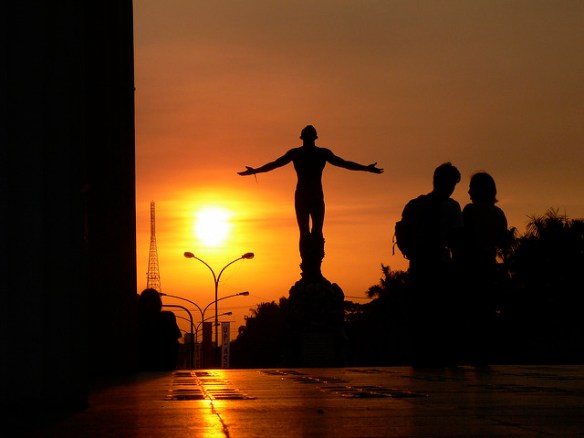
IN A few weeks’ time, several hundred professors at the University of the Philippines’ Diliman campus will gather together for an important vote on UP Diliman’s General Education program—long seen to be the hallmark of a UP education. It’s important because what happens there will determine, to a great extent, what “tatak UP” will mean for the next generation or two, and what being “the national university,” as its charter defines it, entails as far as the quality and the breadth of its offerings are concerned.

The raging battle seems to be over how many units (or class-hours a week) to allot to General Education subjects, which have traditionally covered basic and compulsory courses in such areas as language (English and Filipino), history, math, science, and philosophy.

There’s a menu of options on the table, ranging from a formidable 45 units to a scant 21, and an emerging compromise of 30-36 units in between; the mix of courses in these totals is also under negotiation. Those who want more want to ensure that every UP undergraduate—whether he or she plans to become a lawyer, an engineer, a surgeon, or a painter—can talk intelligently as a well-rounded citizen about the Katipunan and mitosis and perspective and Sophocles and interstellar travel. Those who prefer less want students to graduate from their programs sooner, for UP to remain competitive with other schools, and suggest that students can imbibe some GE skills both from their K-12 add-ons and from their higher-level classes.

I don’t mind saying that I put myself squarely on the 30+ side. We can’t keep complaining that young Filipinos can’t write or speak in proper sentences or don’t know who Apolinario Mabini was—without doing enough to fix the problem, given the chance. Sure, some of these learning points can be addressed in senior high; but subjects like History, English, and Philosophy will still be different when taught in UP’s staunchly secular context and pitched as adult concerns.

But never mind me—let’s give a listen to one of our most accomplished writers, the Leyte-born but now New York-based Gina Apostol, whose novels have won the 2013 PEN America/Open Book Award and National Book Awards in the Philippines. Some time ago, Gina wrote UP Diliman Chancellor Michael Tan to plead for the strengthening of UP’s GE program, and I got her permission to quote from that letter here:

I am writing as a graduate of the UP English department, 1980-1984, a former teacher at the department, and as a novelist whose work has been indelibly shaped by my education at UP—in particular, by its General Education program, to which I look back daily in my own work as a teacher and a writer.

My three published novels owe their genesis to that program. My current novel, William McKinley’s World, about the Philippine American War, began in a PI 101 class in a classroom at Palma Hall Annex, where my professor taught me about a war I never knew about.

In those first two years at UP, I learned to think. The General Education program made me into a writer. I went to a private high school in Leyte that certainly taught me well (arguably just as rounded as the current K-12 program); but I needed the General Education program at UP to make me whole—a critical consumer, a nationalist thinker, a global reader, and finally, it gave me ground to think honestly and seriously about what education means, it gave breadth of thought to allow me to become who I am—a novelist whose work is absolutely grounded in the questions that UP had asked of me in my first two years at the school.

It is my misfortune (though some call it luck) that I have ended up teaching in the States, living among an extremely lucky group of students: the wealthy enclave of Manhattan’s private schools. But every day, teaching my very privileged, very wealthy students who can enroll in any school they want, I can compare what they have to my education at Diliman, and I am daily impressed by the foundational, long view of knowledge grounded in the breadth of UP’s General Education curriculum.

My experience as an educator and an artist here in America is that the education I gained at the University of the Philippines is equal to and (given the state of America) too often exceeds the quality of education abroad. This is true of my fellow alumni who come to America: we understand how well we were prepared.

I cannot underline this enough: I know that UP provided me with an incalculable, a priceless education. I am writing to state emphatically that the General Education program at UP should be enriched, not reduced.

Even today, having been to and taught at several schools considered the best of their kind in America—so acculturated and mired in the world of the privileged as I am here in America—every day, in my classroom, I still marvel at the amazing comprehensive education I got at the University of the Philippines.

Here in Manhattan, these kids are killing themselves to get into colleges with the kind of education I got at UP. My own daughter went to the University of Chicago, and I will say that I was proud (and fascinated) to know my education as a freshman and sophomore was equal to her own rigorous coursework in the General Education program of the University of Chicago, where highly able freshmen have to go through the GE program. As you know, Chicago’s program still stands as a beacon of higher education in America today.

At UP, as my daughter was at Chicago, I was required to take philosophy, maths, history, sciences, and four rigorous courses in English that made me read across cultures (the stories of Akutagawa and D.H. Lawrence, Marquez and Achebe)—to read across time (Machiavelli and Madariaga, Rizal and Homer)—and to read across disciplines. I noted that just as at the UP in my time, the University of Chicago does not stint its students—my daughter was required to do the full two years of humanities reading before she did her majors, reading Hegel and Homer as a freshman and sophomore, as I was asked to do in Diliman. In my case, much of the knowledge that has stayed with me came in one packet (Dadufalza’s primer). The way UP taught its students to think then remains an incalculable benefit, equal to the best in America.

I repeat: I learned to think at UP, and the General Education curriculum made me into a novelist. It made me into a writer who can hold her own anywhere. It distresses me to think that the university will fail even one child, one student from the provinces, like me, who arrives at the university not knowing exactly who she could be—but now without the bulwark of its tough and extended humanities curriculum to point her to the myriad possibilities that creates not only engineers but also artists, not only scientists but also philosophers. The rigorous General Education program of UP is a boon to the country.

UP should strengthen its GE curriculum, not reduce it.

Please let me know how we, alumni across the world, can help to strengthen our alma mater. We love UP, we love our education, we would love to help.

Gina Apostol, AB English 1984


Penman No. 221: Teaching the Millennials

L1090932.JPG

Penman for Monday, October 17, 2016


THERE WERE no marching bands, greeting cards, or fireworks to mark the event, but World Teachers’ Day was celebrated last October 5. As unofficial or secular holidays like Mothers’ or Grandparents’ Day go, it’s a relatively new one, proclaimed by UNESCO in 1994 to draw attention to the key role teachers play in molding the citizens of every country. My calendar shows that I did nothing remarkable that Wednesday, my day off from teaching, so I very likely spent it on a foot-massage-movie-and-dinner date with Beng. But surely teaching would have crossed my mind, as it does every day, because we keep preparing for our next class even in our idle hours, wondering how we can make our students’ encounters with us more interesting and memorable.

I’ve been thinking about teaching a lot more lately, first because of the recent deaths of some valued mentors and colleagues. Just over the past month, our department lost two of its stalwarts—Professors Sylvia Ventura and Magelende “May” Flores. I’ve written quite a bit in this corner about Sylvia, my Shakespeare teacher, who fired up my enthusiasm for Elizabethan drama and poetry. May was an English-language specialist and textbook author, a sweet, imperturbable lady with a caring smile for everyone. (Continuing the tradition, May’s son Emil also teaches with the department and has become one of our prime experts on science fiction and creative nonfiction.)

The second reason is my own impending retirement, less than three years hence. It’s hard to believe that it’s been more than three decades since I gave up my PR job at a government agency to devote the rest of my life—as I told myself then—to studying, writing, and teaching. I never did become much of a scholar—I guess I did become the writer I wanted to be—but even this close to the end of an active career, the teacher in me is still a work in progress.

That’s because every teaching day is a new performance, even if—like it would be for a theater actor—the script may essentially be the same for courses you’ve taught for years. Every new batch of students brings with it a new mix of challenges—even, over the decades, a generational drift to adjust to. For example, a teacher can’t simply blame millennials for their lack of a historical memory, which we helped create; I try to get them interested in the past not for the past’s sake, but to show them how an appreciation of the past can help their future.

Teachers, in other words, have to keep learning about their students and their interests, so lessons remain fresh and relevant, rather than boring incantations regurgitated from ages past. We need to relate the lesson to the student’s present realities, which may seem daunting if you’re talking about, say, a 19th-century short story about the French bourgeoisie, but which can be done with a little imagination (in this case, I’d begin by talking about the Filipino middle class and its aspirations—“Where do you see yourself ten years from now?”).

But as vital as it is to connect directly with millennials, it’s just as important to remind them that there are many things in this world that may seem to have little or nothing to do with them that will still affect their lives—in other words, that we’re still motes in the grand scheme of things, and that Nature can be profoundly indifferent to our noisome plaints and woes.

That’s a harder lesson to impart, even to older students—to any person who hasn’t encountered something much larger than himself or herself, like a World War, or martial law, or a terrorist attack. In a me-centered universe, no one wants to feel disempowered, so I then have to challenge them into getting out of themselves and enlarging the sphere of personal actions they can take to improve not only their own future, but also that of their fellowmen.

Back when we ourselves were freshmen and sophomores in the early 1970s, this message came down to us in the exhortatory slogan “Serve the people!” Exactly how seemed a lot simpler to figure out back then, when a predatory dictatorship was looming over everything and everyone (a dreadful specter I thought I’d escaped forever). Today a young person’s options are far richer and more complex, with all manner of personal advocacies, NGOs, weekend CSR programs, and Facebook groups competing for one’s political attention.

But whatever the chosen means may be, the overriding need for building empathy remains, for leading young urban, middle-class Filipinos to see, to appreciate, and to grow their stake in a future that they share with the millions of others who live unlike them, many without the opportunities that they enjoy. We can’t truly be a nation—much less a Christian one—if we continue to dismiss the bullet-riddled bodies of the poor as trash because we find nothing in common with them.

A teacher’s job is to help students draw the line between two points, including and especially the most seemingly disparate ones. That includes the line between teacher and student, between student and student, and between student and society. If that’s all I’ve done these past three decades, I can retire happy.


AND NOW for something liberative. According to the exhibit notes, “Ebarotika! (You are Erotic, Eve) follows the story of Eve who dared venture into the forbidden. Her defiant act opened knowledge’s connection with sexuality, the knowledge of one’s sexual and erotic desire. But it also resulted in shame and punishment. Thus, many of us cover and hide our sexual and erotic life. Those who are bold enough to come into the open are subjected to stigma, discrimination, and death. Sexuality and the erotic are a source of life, joy, and pleasure. They are not objects of fear, horror, and anxiety. They must be opened, shared, and celebrated instead of being censored, concealed, and criminalized.”

Curated by Lia Torralba, Ebarotika! features 19 Kasibulan artists: Yasmin Almonte, Lot Arboleda, Chie Cruz, Cecil de Leon Escobar, Imelda Cajipe Endaya, Anna Fer, Lorna Fernandez, Kristin Garanchon, Lorna Israel, Amihan Jumalon, Nina Libatique, Eden Ocampo, Jonabelle Operio, Fel Plata, Rebie Ramoso, Benay Reyes, Doris Rodriguez, Christine Sioco, and Lia Torralba.

It opened last Saturday, but will run until November 23 at the Sining Kamalig Art Gallery located on the Upper Ground Floor of Ali Mall in Cubao, Quezon City. See you there!


Penman No. 218: History and Irony

11884866_supreme-court-extends-status-quo-ante-order_e9546b1e_m.jpg

Penman for Monday, September 26, 2016


I’D NEVER heard of Ramon Cualoping III and Marco Angelo Cabrera until their names were linked to the recent flap involving the use of no less than the Official Gazette in an apparent effort to sanitize the memory of Ferdinand E. Marcos by removing any reference to martial law—you know, the martial law that Marcos invoked to impose his dictatorial rule on his people from 1972 until he was deposed by a popular revolt in 1986. (Yes, he technically lifted martial law in 1981 but he continued to rule with a rubber-stamp legislature.)

Some Googling revealed that Cualoping was an Ateneo Communication Arts graduate, batch 2004, while Cabrera graduated from San Beda in 2013 and interned briefly with the Department of Foreign Affairs; he had also worked for Sen. Bongbong Marcos. Those are both fine backgrounds for jobs at the Presidential Communications Operations Office—just the kind of posting on which many young writers and lawyers aspiring for a political future have cut their teeth—and I can surmise from the dates provided that Messrs. Cualoping and Cabrera must be in their mid-30s and mid-20s, respectively—too young, therefore, to have personally known what the Gazette expunged.

In the interest of full disclosure, I was a government propagandist myself at an even younger age—19, fresh out of martial law prison. Having dropped out of UP and having worked for the Philippines Herald and Taliba just before martial law, I got a job with the PR section of the National Economic and Development Authority. The irony of going from writing incendiary flyers to trumpeting such new government projects as Pantabangan Dam wasn’t lost on me. But I was getting married and needed a job, and all the old media jobs were gone save for the Express and the Bulletin, so I was thankful for whatever came my way. (I would much later write hundreds of speeches for FVR, among other Presidents and political clients—mostly to pay the rent, occasionally for the sheer privilege—so don’t look at me as some crusading journalist.)

I don’t know what drove Messrs. Cualoping and Cabrera to the Palace; I’m assuming their motives were loftier than mine. I also don’t know what made them officially forget (hey, it’s the Official Gazette, right?) that FM declared martial law. I suspect they knew what happened, but chose to ignore the most salient fact about Marcos’ life, for reasons only they can tell. To his credit, Communications Secretary Martin Andanar effectively reprimanded his staff for the deliberate oversight and corrected the record.

I’ll leave further chastisement of these two gentlemen to the netizens who broke the story. From one PR pro to another, what I can tell them is this: I understand the job you have to do and even your private allegiances, but there are things—very big things much bigger than yourselves—that you just can’t sweep under the rug. Denying martial law or its disastrous effects on our society and economy is like telling Jews that the Holocaust never happened, or was actually a good thing. I salute you for your cheek, but what on earth were you thinking?

There’s a book I’d like to recommend to these two, one which I and a dozen other writers—all students during martial law—put out four years ago on the 40th anniversary of Proclamation 1081, titled Not on Our Watch: Martial Law Really Happened, We Were There. (For more on that book, see here: http://www.philstar.com/sunday-life/806191/lest-we-forget.) I wasn’t too enamored of the long title at that time, but now I appreciate the emphatic clarity of the thing; it’s just the sort of book martial law amnesiacs and deniers need to read.

16136602._UY475_SS475_.jpg

But even as we review history, there’s one thing that seems to have escaped many: the current debate about how to look at martial law and where to bury Ferdinand Marcos isn’t about the past; it’s about the future, and what kind of people we are and want to be.

I know that millennials tend to get beat up on because they don’t know enough about martial law, which is hardly their fault since we didn’t teach them enough about it. But it isn’t just them. When people my age express bewilderment over how Bongbong Marcos came so close to becoming Vice President despite his dad’s misdeeds, and how the Marcoses have survived so handsomely, I have to remind them that even under martial law, those of us who opposed Marcos were in the distinct minority. Most Filipinos supported martial law, actively or passively, or it wouldn’t have lasted so long. Like the Germans who supported Hitler, most Filipinos stood by while we faced the truncheons and firehoses—and even applauded 1081, early on, as the antidote to Communism (1972’s “war on drugs”). So what should we be so surprised about?

That’s why I’ve never referred to EDSA 1 as a revolution, because it wasn’t one in terms of changing anything fundamental in the structures and workings of our society. It was a popular uprising, a street revolt led by another faction of the ruling class, with broad support from the metropolitan middle class. That doesn’t mean I didn’t feel euphoric that February, and I still get teary-eyed when I remember the moment; I guess the poignancy comes from knowing what came afterward.

I have no doubt that if the Palace incumbent were to declare martial law today for whatever reason, a majority of Filipinos would support him, although a noisy few of us would be up in arms. Martial law ca. 1972 was also like that, and remained popular for many more years, especially among amoral businessmen who sang its praises until it hit them in the pocket. And then it all went downhill.

Contrary to what you might expect, I don’t see Marcos as a one-eyed ogre, but rather as a calculating Macbeth, keenly aware of his actions and perhaps even troubled by them. In my own turn with revisionism, I’ve even managed to convince myself—as I told the BBC in a recent interview on EDSA (a part which never got aired for lack of time)—that Ferdinand Marcos may have done us a final act of kindness by leaving without ordering a bloodbath. It’s an arguable notion (one I wouldn’t put on the Official Gazette) and it doesn’t change the fact that his regime took what it could until we bled, but as a fictionist and playwright, I like to imagine characters to be more complex than they seem.

A couple of years ago, at a cultural function in Quezon City, Mrs. Marcos preceded me by a few steps down a narrow staircase. She was clearly having a hard time navigating the stairs, and she looked back at me apologetically to say, “Hijo, I’m very sorry I’m keeping you.” I smiled and said, “It’s all right, Ma’am, please take your time.” I felt amused and strangely triumphant.

History is sometimes best seen as a series of comic and tragic ironies, which straight journalism and certainly government tabloids can’t dispense. Come to think of it, who gives a hoot about the Official Gazette? If you want to lie and get away with it, try fiction. I’d be happy to see Messrs. Cualoping and Cabrera in my graduate workshop.


Penman No. 217: We Were Young Together

PSHS10.jpg

Penman for Monday, September 18, 2016


I HAD the honor of being asked to speak at the 50th anniversary reunion of my Philippine Science High School batch (we chose to celebrate our entrance year, 1966, fearing that there’d be fewer of us to gather in five years). It was, I joked, the valedictory I never got to deliver, for reasons that will be shortly obvious. You’ll forgive the chest-thumping; every high school has a right to think it’s the best on the planet—perhaps some more so than others. Herewith, an excerpt:

I’ll begin with a shameless boast, and the boast is that over these past four decades, I’ve won quite a few awards and prizes for my work as a writer and teacher. But none of them has given me as much pride and pleasure as the knowledge that once upon a time in 1966, for one brief shining moment and for some miraculous reason, I topped the entrance exam to the Philippine Science High School.

It was a fleeting glory, and if I ever imagined myself a real genius I would be quickly disabused, because as you all know, after our first year, my grade in English was 1.0 and my grade in Math was 5.0. Only the kindness or perhaps the embarrassment of our administrators persuaded them that I was worth giving another chance and putting on probation, a break I’m forever thankful for.

I have never felt in more distinguished company than yours. Individually and collectively, you are the smartest people I have ever known, and it has nothing to do with PhDs or awards or high positions in government and business or least of all material wealth—although I’m sure we could all use a little more money. I know that I can sit with anyone of you and have an intelligent and funny conversation about anything from interstellar travel and Dutertean diplomacy to hugot lines and Pokémon—well, maybe not Pokémon.

Long before buzzwords like “world-class” and “globally competitive” came into fashion, there were smart kids who passed an entrance exam that decimated whole regiments of lesser beings, leaving a few good boys and girls standing after the slaughter, calmly noting the distinction between cousins and cosines, avocados and Avogadro, halitosis and mitosis.

PSHS2.jpg

Hey, these kids were us—gangly, smelly (after a good day’s work at the biology garden, or the agawan-base arena), cocksure in the classroom, and curious as hell about the opposite sex. Not surprisingly, boy-girl questions dominated the school’s philosophical life.

“What Is a PSHS Boy?” asked the Science Scholar ca. 1969, and the soul-searching answer came (courtesy of someone who should have known—a PSHS girl): “A PSHS boy is a new sociological specimen of the human race… a hardworking nekti achiever [who keeps] a well-tended garden near the bio pond…. a longhaired mod swinger around the campus [who] wears kooky sunglasses, stylish baggy pants, and necklaces… He crams love letters in his notebooks. When Mr. Mozrah asks him ‘What is social interaction?’, he recites his lovelorn adventures with Jennifer, Corrine, Paulette, etc….”

PSHS11.jpg

This penetrating study naturally occasioned a companion piece, published a year later under the thought-provoking title of “What Is a PSHS Girl?”, written by an expert on the subject, a PSHS boy.

“A PSHS girl,” this savant said, “is a rare biological specimen… She is only emotional, temperamental and irrational sometimes (well, half of the time… would you believe almost always?). Anger is not a word in her dictionary. You see, her dictionary starts with ‘boy’… A PSHS girl is the reading type. She reads Emily Loring and the like.”

PSHSGirlsDorm.jpg

It didn’t take too long for a PSHS girl—uhm, PSHS young woman activist—to trash that silly, bourgeois, sexist view. “Now is the time for awakening,” this budding feminist would write in the same Science Scholar just a year later. “Do you realize that today you are a mere tool of the man?… Our bourgeois-oriented society adds insult to injury by picking up things for you and opening doors for you—reminders of sexual disparity—the very chains you should set out to break.”

We don’t know how many chains were broken; some precious objects certainly were (er, windows, petri dishes, innocence, and rules). Talk about rules! A famous one—dated September 29, 1970, and issued by the PSHS Board of Trustees—decreed that PSHS scholars “remain single and be discreet about their boy-girl relationships in order to continue their studies at the PSHS.”

Perhaps another topic of passionate discussion—“Should Smut Movies Be Allowed?”—had something to do with this heated  state of affairs.

The guidance counselor warned: “If they only display the human body for art’s sake, then there’s nothing wrong.  But if what they show are the acts sacred to man and woman, and those which arouse man’s sexual instincts and cause him to do something about it, then definitely, smut movies should be banned!”

Not too definitely, a freshman objected: “In European countries, especially in Scandinavia, sex movies have become so ordinary that they now seem to be part of the people’s lives.  In the Philippines, there is indifference towards these movies.  The Board of Censors should allow more of them and let us see what the attitude of the public toward them will be in the future.” [Brilliantly said, young man, an answer truly worthy of a science scholar—we’re not watching smut movies, here, we’re watching popular attitudes!]

Ah, the times, they were a-changing.  “The opening of the intramurals ushered in a new sight on our campus,” reported a sports columnist (a distraught boy) in the Science Scholar in 1970.  “Where once only boys were seen, girls have materialized…. The girls’ presence cannot be ignored…. In so short a period, many can be said to equal the boys at their own game. Complaints have been heard from the girls that the boys have been monopolizing both the basketball court and the ping-pong tables.”

That should’ve told us that the days of the Young Gentlemen’s Club and the Girls’ Club—no one had the gumption then to set up a Young Gay and Lesbian Club—were coming to an end. Some brazen soul in our freshman class organized the UBAG (United Boys Against Girls), but that didn’t last too long. Biology would teach boys that uniting with girls instead of fighting them was the more natural and pleasurable thing to do.

For a few of us after high school, life may have been a breeze, but for most, I’m sure it’s been an uphill climb, full of rough patches, and you were just as astonished as I was to find that a high IQ did not guarantee happiness or prosperity or success and may even have made things worse because of our more acute awareness of the meaning of things. We learned that the smartest people can make the dumbest mistakes in love, money, and politics, and that sometimes we just don’t know squay about the things that truly matter. I even learned that you could be happily married to someone from UP High.

Most important of all lessons and legacies, we learned to serve the people. Whether we grew up to be NPA cadres or CEOs or lab rats or barrio doctors, we knew that our high school scholarship had to be repaid in faithful service to community and humanity, employing the scientific, rationalist outlook that even those of us who strayed from S&T never quite lost.

We were young together, and we will grow old together. As we’ve all learned from life, it isn’t who leads at the start of the race but who finishes first at the end who wins—although again I suspect that in the race of life, we’d rather finish last.

PSHS6671.jpg


Penman No. 214: Soon, Another Presidential Race

2013DoctorofLawsUP.JPG

Penman for Monday, August 29, 2016


NO, NOT for President of the Republic of the Philippines, but, for some Filipinos, an almost equally significant post—that of President of the University of the Philippines System, who will be chosen by the UP Board of Regents in a meeting in mid-November. Standing at the forefront of Philippine higher education, UP—recognized by its new Charter as “the national university”—very often sets the standards and the tone for other Philippine universities, especially State-funded ones, to follow. Thus, the position is much more than honorific or ceremonial; the UP President is expected to be a visionary, an executive, a manager, a motivator, a mentor, a democrat, a disciplinarian, a nationalist, and an internationalist all at once.

UP Presidents have been known to surprise their constituencies. The very first one, Dr. Murray Simpson Bartlett, was an American and, of all things, a Protestant pastor—and yet he envisaged the new institution as a “University for Filipinos.”

Edgardo J. Angara was a successful lawyer and a budding politician, having served as a delegate to the 1971 Constitutional Convention, when he was asked by outgoing UP President Onofre D. Corpuz to consider taking over in 1981. The reluctant nominee and non-academic turned out to be one of UP’s best presidents, restructuring the university’s organization, boosting faculty salaries, and reforming its curricula.

Francisco Nemenzo was a professed Marxist who modernized the university’s facilities and mindset, revitalizing UP’s core General Education program, and making better commercial use of UP’s vast landholdings. Emerlinda R. Roman broke barriers as UP’s first woman president, after having served twice as Chancellor of UP Diliman. A management expert, she was able to harness considerable resources on the crest of UP’s centennial in 2008 and to employ those to the UP community’s benefit.

Incumbent President Alfredo E. Pascual’s ascendancy to the presidency came as a surprise to nearly everyone—perhaps including Pascual himself—when the BOR elected him in 2010 on the first ballot, reportedly by a one-vote margin (by tradition, the BOR members agree on a unanimous vote after the fact). A Chemistry and MBA graduate who later spent many years in the private sector and with the Asian Development Bank, Pascual was seen to be an outsider and went off to a rocky start. But he proved to be a quick study, and has worked hard to raise UP’s international profile and its connections, to raise performance incentives for UP’s professors and researchers, and to expand the UP System’s reach.

Their successor, according to search guidelines recently released by the BOR, must meet the following basic standards: (1) hold a master’s degree, with a doctorate preferred; (2) have substantial academic experience at the tertiary level; (3) be able to serve the full term of six years before reaching the age of 70; and (4) have no conviction for administrative and criminal offenses.

Additionally, and just as importantly, they should demonstrate (1) a commitment to academic excellence and national development; (2) the political will and the skills to defend and promote academic freedom and the University’s institutional autonomy; (3) a commitment to democratic governance in the University based on collegiality, representation, accountability, transparency, and active participation of constituents; and (4) a commitment to preserve the public and secular character of the University. (There are more requirements, which you can check out in the guidelines here: http://www.up.edu.ph/call-for-nominations-for-the-next-u-p-president/.)

This early, several prominent academics and personalities have been heard or rumored to be interested in running for the presidency. They include UP Law Dean and popular radio host Danilo Concepcion; former UP Diliman Chancellor and physicist Caesar Saloma; current UP Diliman Chancellor, anthropologist, and newspaper columnist Michael Tan; current Vice President for Academic Affairs and marine biologist Gisela Concepcion; and former Senator and now Representative and UP Law alumna Pia Cayetano. The names of former Vice President for Academic Affairs and now National Historical Commission chief Maris Diokno and of former CSSP Dean Cynthia Bautista have also been mentioned. (My information, mind you, is based on coffeeshop chatter, and could very well be denied by any of these eminent persons tomorrow.)

In practical terms, and despite and away from all the spirited rhetoric we can expect of the campaign process, it will all come down to a matter of securing six votes among the 11 members of the BOR. The composition of that board is provided for by the new UP Charter, RA 9500 (which, as Dodong Nemenzo’s Vice President for Public Affairs, I among others had the privilege of lobbying for in the Senate before it passed under Emer Roman in 2008, perhaps the government’s greatest gift to UP on its centennial).

The BOR comprises the chairperson of the Commission on Higher Education, who also serves as the BOR’s chair; the incumbent UP President, who serves as co-chair; the chairs of the Senate and House committees on education; the president of the UP Alumni Association; the elected representatives of the UP faculty, staff, and student sectors; and three regents appointed at large by the President of the Philippines (the BOR will recommend a shortlist of persons chosen for their academic and professional accomplishments—at least two of them have to be UP alumni—but the President can technically make other selections). Effectively, therefore—considering that the two representatives from the Senate and the House will likely be Malacañang allies—the Philippine President can exercise tremendous influence in selecting the UP President.

Before the new Charter defined an odd-numbered BOR, a tie was possible. In 2004, the then 12-person BOR was deadlocked 6-6 between Emer Roman and the Palace candidate, then Ambassador to the UK Edgardo Espiritu. The tie was broken 7-5 in a second vote a week later.

It’s a critical choice for both the Palace and the University because UP’s history is replete with instances when the two presidents have clashed bitterly, with sometimes brutal consequences. Rafael Palma fought Manuel L. Quezon over political issues, including free speech at UP, as a result of which the government cut UP’s budget and denied Palma a gratuity upon his retirement in 1933 after a decade of service. (Upon Palma’s death in 1939, however, Quezon praised him as “a patriot, a scholar, and one of the noblest characters that ever lived,” and even had Palma’s interment delayed so he could personally attend.) Bienvenido Gonzalez and Elpidio Quirino also warred over academic freedom. Salvador Lopez stood up to his fraternity brother Ferdinand Marcos in defense of civil liberties.

Bearing these presidents and precedents in mind, if you have a candidate whom you feel should lead UP onward, take note that nominations will close on September 23; the BOR election will be held November 15; and the incoming UP President will take office on February 10, 2017.

I myself will be retiring from full-time teaching in three years and so will see only half of the next President’s term through, but whoever gets chosen should have an impact less on the outgoing profs like me than on the incoming freshmen of Batch 2017. Admittedly, UP could always do better at basketball, but choosing the next coach of the UP System could prove just as important to the shaping of the Filipino mind as the one that 16 million of us made just a few months ago.

1091857175_807c3b9981_z.jpg


Penman No. 212: A Lovely Place to Be

IMG_8775.JPG

Penman for Monday, August 15, 2016


IT WAS a few Sundays ago when I joined a group of artists and friends for lunch at a place that has to be on the must-see list of any Filipino art lover, especially those within driving range of Antipolo. We had been invited for lunch by Dr. Joven Cuanang, whose Pinto Art Museum we had visited once before, but this time it was the founder himself who was going to walk us around the place, so we all looked forward eagerly to meeting him and having a chat.

For those who’ve never heard of it or never been there, the best way to describe the Pinto (people, including myself, have been heard pronouncing it as PIN-to, but it’s really Pin-TO as in “door”) is to call it an art complex—mostly gallery, but also museum, restaurant, theater, library, and, apparently, research center. It’s also, quite simply, just a lovely place to be, with its buildings and galleries set on seemingly terraced hillsides leading naturally from one to the other, offering spectacular panoramas of the metropolitan skyline from every high point. Not surprisingly, it can get very busy on weekends, with as many as a thousand visitors streaming in through the gate (admission fees range from about P100 to P200).

IMG_8097.JPG

The Mediterranean-styled complex has that pleasing, thoughtfully curated ambience, the visual and sensory assurance of a well-managed experience. But of course, it wasn’t always so. The place began as a rough and weedy wilderness, which a young but visionary Dr. Cuanang bought up, patch by patch, more than four decades ago. “I started in 1972 with 1,000 square meters,” he reminisced. “Real estate prices fell after martial law and I was gradually able to acquire more land in the area.”

After EDSA, Joven fell in with a committee of prominent Antipolo residents and community leaders eager to spearhead the town’s cultural renaissance, but the good doctor soon decided to go it alone after an unpleasant brush with government corruption. He must have seen art and nature as the best cleansing agents, and he began supporting a posse of local artists, buying their work when they needed cash. Those artists later became the Salingpusa group, which considers Pinto its physical and spiritual home. “We didn’t have much then so the artists first exhibited their work by hanging them on a clothesline, and that practice became known as Sampayan,” said Cuanang.

Today that clothesline spans six buildings spread over 1.2 hectares, operated by the Silangan Foundation for Arts, Culture, and Ecology. Designed by Tony Leaño, the buildings blend effortlessly into the landscape, which is no accident because they were built around natural objects like the huge rocks that dotted the hillside. “We observed three principles in designing the place,” Cuanang noted. “First, don’t cut any trees. Second, follow the landscape. And third, minimal maintenance.”

As much as possible, Pinto’s buildings also employ natural ventilation, a notable exception being the air-conditioned library (where I was secretly pleased to find a couple of my books on the shelves). You’re never too far away from being reminded, however, that human whimsy is at work on Nature here, with oversized sculptures of mythological figures such as Icarus, Sisyphus, and Ariadne scattered about the greenery or soaring on rooftops.

While some come specifically for the scenic grounds, which are often rented for wedding shoots, most visitors flock to Pinto, understandably, for the art, which represents many of the most vibrant and brilliant works of our younger if lesser known artists. “You won’t see a single National Artist here,” Dr. Cuanang said, smiling and gesturing at the paintings and sculptures around him. “I keep my Bencabs at home!”

It’s refreshing and encouraging, in a way, not to see the usual parade of Amorsolos, Manansalas, Ocampos, and Botongs on display, and instead to find works by the likes of Elmer Borlongan, Jason Moss, Plet Bolipata, Tony Leaño, and Rodel Tapaya—at no diminution of quality, as these names could well be those of the National Artists of tomorrow. Salingpusa’s breathtaking 40 x 12-foot mural “Karnabal” is arguably the centerpiece of collection.

IMG_8049.JPG

Despite the plenitude of art offerings at Pinto and his obvious passion for art, Dr. Cuanang won’t think of himself a collector, the kind who spots and buys fine new work on the cheap for future profit. “I’m not here for the business,” he emphasized. “Too much art and discussion about art today is centered on the market.”

What truly interests the Harvard-trained neurologist, who still practices medicine after serving for many years as medical director of St. Luke’s, is wholeness of mind, body, and spirit, which he hopes to promote through the Pinto Academy of Arts and Sciences, a complex of facilities in a corner of the compound that comprises a large indoor theater, an amphitheater, a library, a function room, open decks, and gardens.

In a manifesto of sorts, Cuanang explained that “In medicine, healing is currently dominated by pharmaceuticals and technology, oftentimes to the detriment of the wholeness of a human being: mind, body, and soul. This perception is pervasive in our society. Fortunately, new knowledge in neuroscience research is affirming that the Arts and Sciences are in fact interconnected and mutually useful in preserving our wholeness, and together are powerful in the relief of our maladies.” The Academy, he added, “was built to promote conversation across disciplines to create, innovate and to pursue activities that celebrate this thought.”

The bridge between medicine and art, he pointed out, is neuroaesthetics, a branch of study that fascinates Dr. Cuanang. One of its chief proponents, Dr. Anjan Chatterjee of the University of Pennsylvania, poses its main concerns thus: “What in the brain triggers aesthetic experiences? And how does knowledge of basic brain mechanisms inform our understanding of these experiences? These questions are at the heart of an emerging discipline dedicated to exploring the neural processes underlying our appreciation and production of beautiful objects and artwork, experiences that include perception, interpretation, emotion, and action…. Neuroaesthetics is both descriptive and experimental, with qualitative observations and quantitative tests of hypotheses, aimed at advancing our understanding of how humans process beauty and art.”

It’s a lot to think about, for sure—but there’s no better place to ponder the glorious if sometimes dark mysteries of the human imagination than Joven Cuanang’s hilltop sanctuary.

Pinto Art Museum can be found on Sierra Madre Street in Grandheights Subdivision, Antipolo, and is open Tuesdays-Sundays, 9 am-6 pm.

IMG_8774.JPG

Penman No. 209: Coming: An American Museum of Philippine Art

OnglaoStudy1.jpg

Penman for Monday, July 25, 2016


AS YOU read this, I’ll be winging home with my wife Beng from California where we’ve spent the past two weeks engaged in a pioneering project that should bring the best of Philippine art to a broader American audience, if ongoing plans work out over the next few years.

Have you heard of the American Museum of Philippine Art? Probably not, since it’s still something of a pipe dream, but some people on both sides of the Pacific are blowing very hard on their pipes to make it happen. Those people include businessman Raffy Benitez, president of the Quezon City-based Erehwon Arts Center, and University of the Philippines professor and art expert Dr. Reuben Cañete, who developed the idea late last year after Erehwon’s successful involvement in a binational mural project at Chicago’s Field Museum sponsored by the John D. and Catherine T. MacArthur Foundation through Dr. Almira Astudillo-Gilles, a Chicago based Fil-Am writer and cultural advocate.

I reported on that project in this column last November 25, noting the warm response received by the participating Filipino and Filipino-American artists for their works—two murals, one at Erehwon and another at the Field—depicting the flows of Philippine culture and history from pre-Hispanic times to the present.

That positive experience encouraged Raffy and Reuben to conceive of a bigger and more enduring project that would bring Philippine art even closer to Americans—not just the huge and broadly dispersed Filipino community in the US, but the American public at large. Raffy and Reuben noted that the Mexicans and the Chinese, among other immigrant groups in America, both had their art museums, but that Filipinos—among the largest and fastest-growing minorities in America—did not.

Reuben recalled the long tradition of Filipino artists going over to the US to study and to work—such as Guillermo Tolentino, Victorio Edades, and Alfonso de Ossorio, among others—and observed that while strong cultural ties remained between the two countries, the connection was overwhelmingly one-way, with Philippine art (and music and literature, for that matter) being little known and appreciated in the US.

“In this age of globalization, art is now a global commodity that is exhibited and collected by various international venues, such as Art Basel Miami. Philippine Art, both in its historical as well as contemporary manifestations, must now be aggressively promoted in the United States, which is a major area of collection and promotion of global art,” Dr. Cañete would say in a concept paper on AMPA.

Karlota I. Contreras-Koterbay, a prizewinning Fil-Am sculptor and Director of the Slocumb Galleries at East Tennessee State University, agrees, writing that “There is a rich and dynamic art practice by Filipino-Americans in the US. However, there is a huge discrepancy in the visibility and recognition with regards to the idea and form of ‘Philippine Art’.

“The Philippines is the second highest Asian country whose citizens migrate to the US. The Filipinos have a long, complex history of immigration and residency in America, yet ‘Philippine Art’ is not as accessible nor recognizable in popular culture nor in the global art world. This statement does not claim that there is lack of talent nor creativity; on the contrary, there are thriving communities of artists, art groups and cultural workers who are making a difference in their respective locales, as well as receiving recognitions for their work in the field of arts.”

To take the first steps toward turning vision into reality, Raffy, Reuben, Beng, and I flew to LA to meet up with some prominent Filipino-American community leaders and artists to set up a foundation that would start the spadework on the museum. The American Museum of Philippine Art Foundation, Inc. (AMPAFI) was formally launched July 12 at the Holiday Inn in Diamond Bar, California, in a day-long meeting attended by a couple of dozen participants from all over the US.

Raffy Benitez will serve as chairman and president, and Reuben and I are joining him on the board, but we know that this project can’t be run from Manila, so the directors will also include art curator Karlota Contreras-Koterbay, physician Jose Botor Regullano, and engineer Ricardo Real Almonte. The officers include Fil-Am standouts Rafael Maniago, Art Zamora, Sal Budz Floriano, Rosie Vinluan Muñoz, Connie Buenaventura, Daniel Gutierrez Bassig, Dennis Martinez, Bobby Halili, Jess Española, Jun Sison, Ninette Tenza Umali, Ernan Ebreo, and Bernadette Escalona-Cooper. During the launch, a group of Fil-Am Artists headed by Paeng Maniago also rolled out a mural that they had executed to celebrate the occasion.

AMPAFIFound.jpg

We all realize that this project will take many years, enormous resources, and tremendous effort and optimism to realize. (Being Filipinos, we expect a lot of naysaying, and I’ve been Raffy’s chief buzzkiller whenever I think someone needs to pull his feet back to earth, but I have to admire the man’s guts and what he’s done at Erehwon, which you can preview here: http://erehwonartfoundation.org.) The museum as Raffy and Reuben envisage it is a mini-CCP, with enough spaces for exhibitions and performances (and even classes in Pinoy cooking), and the renowned architect Conrado Onglao was motivated and generous enough to contribute a prospective design for the building. That may be years down the road, but in the meanwhile, AMPAFI is taking early and doable steps toward building a countrywide arts community—a virtual museum, as it were—in cooperation with other groups such as Bernadette Escalona-Cooper’s Silicon Valley-based Global Artists’ Creative Collaboration for Empowerment (GACCE), whose leaders also attended the launch.

Karlota reports that “Our first two official projects are: ‘Nandito N Ako’ by 11 emerging Filipinx artists from the School of Art Institute of Chicago (SAIC) and possible community mural headed by NY-based artist Art Zamora with the Phil-Am organization and ETSU organized by Slocumb Galleries in the Northeast. This will be early October 2016 in time for Filipino Heritage Month. Also on the same month on the West Coast is the proposed Indie Film Showing in LA by special committee on fundraising head Ernan Ebreo. Both are curated programming for awareness campaign and fundraising efforts.”

(Wait a minute, did I read “Filipinx?” Indeed I did—and this trip was the first time I encountered the term myself, which seems to be gaining currency among young Fil-Ams, who define “Filipinx”—which I’ve heard pronounced as “Filipinics”—as an effort “to make the community more inclusive—we changed the O in ‘Filipino’ to an X to remain gender-neutral and recognize all genders that exist in the Filipinx community. There’s apparently been a lot of debate on this issue, which we’ll deal with some other time.)

The AMPA website is up at http://www.ampafi.org. Contributions and donations are, of course, very welcome, but more than that, we need goodwill, prayers, and strength of spirit to see this vision through. Mabuhay at salamat sa lahat!

AMPALogo2.jpg


Penman No. 208: Back to the Basics

IMG_8510.JPG

Penman for Monday, July 18, 2016


I’M VERY happy to report that on this my last three-year term as director of the University of the Philippines Institute of Creative Writing (UPICW), a number of key improvements in our programs will be taking place very soon that should bring creative writing closer to both its producers and its audiences. Much of this is made possible by support from UP’s Emerging Interdisciplinary Research Program (EIDR), a visionary fund initiated by UP President Alfredo E. Pascual and implemented by the Office of the Vice President for Academic Affairs headed by Dr. Gisela P. Concepcion.

Most significantly, we will be expanding our workshops to include an annual Basic Writers Workshop aimed at developing new and younger writers, and offering, every other year, a seminar for teachers and another for translators. We will also be holding, every semester, an Interdisciplinary Book Forum to bring together experts from various disciplines in a discussion of vital Philippine issues.

These new projects will supplement our regular flagship activities—the National Writers Workshop, held every summer for mid-career writers; the Likhaan Journal, an annual publication that showcases the best of new Philippine writing; the Akdang Buhay series of video interviews of Philippine literary luminaries; and panitikan.com.ph, the website we maintain as the world’s portal to Philippine literature. The UPICW also oversees the annual Madrigal-Gonzalez Best First Book Award and supervises the Gonzalo Gonzalez Reading Room (where our office has been temporarily housed since the Faculty Center burned down last April), and runs the Panayam lecture series featuring our fellows, associates, and advisers.

It’s a lot of work on top of our regular teaching and writing jobs, but it’s what a university-based writing center or institute is meant to do, and the UPICW—established in 1979—is a regional pioneer and leader in this respect, perhaps best known for the UP Writers Workshop that began in 1965 and which has taken place every summer for more than half a century since then. Generations of Filipino writers have gone through this workshop as a rite of passage, and workshops like it have sprung up in other places and universities around the country (the Silliman University workshop in Dumaguete was the first in 1962, and is still going strong).

About ten years ago, the UPICW decided to set itself apart from the other workshops and to perform a unique service to the writing community by focusing our summer workshop on mid-career writers—people with at least one published book or theatrical or film production to their credit—so we could deal with more advanced issues in writing and publishing. It’s been great so far, and we’d like to believe that we’ve helped to sustain the growth of Philippine literature in this time of global challenges and opportunities, but then again we keep remembering how critical the UP workshop’s intervention was in the lives and careers of young writers just starting out, as we all were at one time.

That’s why we agreed to bring back the beginners’ workshop—we’re calling it the Basic Writers Workshop for now, but we’ll think of a better name in the future—to touch base once again with our most promising young authors. And we’re going to do this very soon—over three days, from October 14 to 16, somewhere in the vicinity of the UP campus. Because it’s directed at younger writers—you’d have to be between 18 and 35 years old as of August 15, which is also the deadline for applications.

For our first BBW, we will be looking for works of speculative fiction—a popular genre that can be defined as defined as “a broad literary genre encompassing any fiction with supernatural, fantastical, or futuristic elements.” (Next year, we’ll most likely do young adult fiction). Applicants should submit two original, preferably unpublished stories in the genre in English or Filipino, with each story (which could be an excerpt from a novel in progress) running between 3,000 and 10,000 words. . Applications must be accompanied by a short CV providing the applicant’s contact details, education and employment history (if any), and list of published works and awards (if any). The stories and accompanying CVs must be submitted online to uplikhaan@gmail.com. We’ll be taking in six writers in English and six in Filipino, and successful applicants will receive a modest stipend, as well as board and lodging at the workshop venue.

The Workshop Director is Charlson Ong, with award-winning writers Eliza Victoria, Nikki Alfar, Willy Ortiz, and Vladimeir Gonzales serving as panelists and teaching staff. For inquiries, contact 9818500 (2116) and look for Luna Sicat Cleto, Deputy Director of the UP ICW, or email lcleto9@gmail.com.

We’re still planning out the teachers’ and translators’ seminars—tentatively set for January 2017 and 2018—but they’ll involve upgrading the skills of our high-school and college teachers in teaching new K-12 subjects like Creative Nonfiction, as well as developing more and better translators of texts (not necessarily just literary texts) between Filipino and English and possibly other Philippine languages. These seminars will acknowledge the key roles teachers and translators play in bringing new works and new knowledge to larger and younger audiences,

The UP Interdisciplinary Book Forum, which will start in September and be held every semester over the next two years, is another new project we’re all excitedly looking forward to. The forum will be based on a book recently published by the UP Press on a subject of broad interest, alternating between literary and non-literary titles. What will distinguish the forum will be a panel discussion on the book comprising experts from various fields such as anthropology, law, economics, biology, and medicine.

Our EIDR support runs for two years, possibly renewable for another two, so it’s going to be a very busy and interesting interlude in the history of the UPICW, and by the time we turn 40 in 2019—which is also when I retire from full-time teaching—we should have gone that much farther in realizing our mission of nurturing new writing by Filipinos for Filipinos and for the world.


Penman No. 207: The Best Student Speech Ever

66Lee2.jpg

Penman for Monday, July 11, 2016


I THOUGHT that the commencement speech I recently gave before the University of the Philippines’ College of Science graduates (excerpted here last week) was pretty good, but it was the student response given by Isaiah Paolo Lee (BS Molecular Biology and Biotechnology, summa cum laude)—known to his friends and teachers as “Pao”—that blew my socks off. I later emailed Pao to say that it was the best student speech I’d ever heard, and asked him for a copy to share with my readers, so here it is, and I hope this goes viral. (Pao acknowledges that his sister Jillian helped him along with the speech—hurray for sisters!)

My name is Isaiah Paolo Atienza Lee, and I am not your valedictorian. I am not the best, I am not the brightest, and I am here speaking to you right now because all the other summas backed out. I’m somehow supposed to talk to you about honor and excellence, so let me start with my story.

When I was in first year, I almost got kicked out because of Chem 16. I wasn’t even bad at the class. I just had a habit of scribbling on my forearm during exams, which was—in hindsight, understandably—interpreted as cheating. After an unchecked exam and a lot of stress, I ended up with a diagnosis of Asperger’s syndrome. On the whole, it was a less than ideal way to get psychological support and an 1.00 in Chem 16, but I didn’t fail the class, I didn’t get dismissed from UP, and I didn’t jump off a bridge. I could have, but I didn’t. That might not sound a lot like honor and excellence to you, but that’s the point.

The College of Science is made up of brilliant people. We can’t deny that. The College of Science is also made up of people who pretend to be engineering majors when questioned about their student numbers and people who tasted their Chem 16 unknown analysis samples out of desperation. We can’t deny that either. And we all answered our exams on bluebooks that might have varied in paper quality and might have shown different scores, but they all had the same message printed on the front: University of the Philippines, 1908, Bird, Honor, Excellence.

Our valedictorian is Mao Leung. He has a weighted average of 1.0375 and a girlfriend. I do not have a weighted average of 1.0375, and most of you won’t either. I’m not going to talk about who doesn’t have a girlfriend, because this is supposed to be a happy occasion. Mao Leung is a great guy, but we can’t all be like him, and that’s okay.

Prodigies are a curse for those who need a curve on the exam to pass and a blessing for the general public; as a whole, people tend to look at the people with the best averages and pin all the country’s hopes on them, leaving the rest of us to wonder what we’re supposed to do. The truth people have difficulty wrangling with is that not only do we not need a messiah, messiahs cannot solve our problems. This country just needs honor and excellence from every single one of us, every single day. Whatever it is you do, do it well, and do it for the people.

Are you going into a career in science? There might be days when you have to run PCRs from 7 to 12. That’s 7 in the morning to 12 midnight, by the way. Do it. There might be times that your graphs would be publication-worthy if only you could get rid of one annoying data point. Don’t do it. That is honor and excellence.

Are you going into medicine despite your teachers’ laments? You might end up spending most of your nights running on adrenaline and Dunkin’ Donuts because you have to stay in the hospital. Stay. There might be an occasional addict suffering from a shabu overdose that you have to tie down to a stretcher because he won’t stop kicking you. Treat him, and treat him again when he comes back. That is honor and excellence.

Are you going to get a girlfriend because studies first no longer applies? She might be angry at you for no easily identifiable reason. Stay calm, listen, and talk things out rationally. After an argument about taking relationship advice from some guy who was supposed to give a valedictory address, you might see a book she would like. Buy it for her. That is honor and excellence.

Are you going to be a full-time parent because you had a successful relationship? You might proudly send your child to UP only to learn that your precious iskolar ng bayan has turned into a class-cutting, DRP collecting, tuition-burning machine despite your warnings. Wake them up in the morning, give them their allowance, and support them without nagging. See to it that they march and that you get to be with them. That is honor and excellence.

Are you just thinking of going to UPTown Center for a celebratory dinner after this is done? You might have a hard time parking because, wow, that is a lot of people. Don’t hog the disabled parking spaces. You might be hungry because the ceremony was too long and parking was nigh impossible because you left the wheelchair spots alone. Be nice to your waiters. They have names. Address them by name, follow up your orders without snapping at them, and say thank you the way you would like to be thanked for doing a good job. That is honor and excellence.

Are you going to do anything at all in your life? Whatever it is, do it well, and do it for the people. Do it well if doing it well is clocking in 70 hours a week at a world-class research institution. Do it well even if doing it well is just staying awake for five more minutes to finish a chapter or a boring lecture. Do it well when it matters, and do it well even when it doesn’t. And do it for the people. Do it for the people even if you don’t like the people. Do it for the marginalized even when they don’t appreciate it. Do it for the privileged even when they cause Katipunan traffic. Do it for the people whether the person in question is a drug addict in the emergency room or your waiter at UPTown Center or a stranger on the internet or even just yourself, because it’s not about the gratitude, or the credit, or the reward, but about the people, and the work. That is honor and excellence.

The unphotogenic, non-headline-grabbing, narratively-unsupported fact is that large-scale change happens in fits and bursts and stops, and often on a scale you can’t see with an electron microscope. We hold ourselves up to unreasonable standards and are subsequently disappointed most of the time, when what matters is the work we do in increments, the lab hours that we log, and the people we encounter.

You might not make your own transgenic crops, but you can disabuse your family of any erroneous notions they may have about Bt talong. You might not eradicate crime in 3 to 6 months, but you can avoid catcalling. You might not make it to the newspaper’s front page, but you can make it to your mom’s proud parent Facebook post.

We often look to larger-than-life figures to celebrate honor and excellence, from Miss Universe to near-perfect-GWA graduates. I’m not saying it’s wrong to do so, but I believe the first place to seek it is within ourselves.

My name is Isaiah Paolo Atienza Lee. I am not the best, but I am good enough, I am not the brightest, but I am a UP graduate, and I am not your valedictorian, but I am going to tell you all to go out there and show the world what we’ve got.

[Photo from the UP Diliman Information Office]


Penman No. 206: Keeping Faith with Science

IMG_8781.jpg

Penman for Monday, July 4, 2016


IT’S GRADUATION season, and in a departure from tradition, the College of Science at the University of the Philippines invited a humanist—yours truly—to deliver the commencement speech before its graduates last June 26. In my opening, I adverted to my stillborn ambition to become a scientist at the Philippine Science High School. Herewith, some excerpts from my talk:

This isn’t really about me, but about how people like me once had a dream like yours, of working in a lab wearing a white coat, finding Nobel-prizewinning solutions to global hunger and disease—in other planets if not this one. I never did become a scientist or an engineer, but I like to think that I’m still doing science—through creative writing.

Within my own field, I often find myself arguing for the importance of being able to adopt a rationalist outlook, of grounding our artistic judgments and perceptions on a concrete appreciation of our economic, social, and political realities. I’ve always urged my creative writing students to take an active interest in history, technology, business, and public policy as a means of broadening their vision and enriching their material as writers.

I like to think that I continue to have—as Edward Hubble told the Caltech graduating class in 1938, “a healthy skepticism, suspended judgement, and disciplined imagination.”

To be honest, I didn’t know that quote until I read it in an excellent commencement speech delivered just two weeks ago, also at Caltech, by the neurosurgeon and public-health researcher Dr. Atul Gawande, who reminded the graduating class that despite the demonstrated power and beneficence of scientific thinking, science today is under attack from many fronts—from pseudoscientists, from politicians, from all kinds of pundits claiming that climate change is rubbish, that vaccines are bad for your babies, that all GMOs are harmful, and that guns keep people safe. Dr. Gawande even titled his talk “The Mistrust of Science,” and pointed to the emergence of alternative “cultural domains” eager to advance their own agenda at the expense of scientific scrutiny and analysis.

This is not to suggest that science is infallible—it would not be science if it were—but rather that science, in all of its negotiability, has become a political football, especially among the impressionable and uninformed. In our recent experience, for example, statistical surveys and voting machines were wholeheartedly embraced when they favored certain candidates, and torn apart when they did not.

More than ten years ago, I shared with another graduating class an observation that sadly remains true if not even truer today: a disturbing strain of anti-intellectualism in Philippine politics and society. The vulgar expression of this sentiment has taken the form of the suggestion that we can dispense with brains and education—yes, who needs algebra?—when it comes to our national leadership, because they have done us no good, anyway. And while we’re at it, let’s dispense with values, with decency, heck, with the law itself, because none of those things really worked, did they?

It is easy to see how this perception came about, and how its attractiveness derives from its being at least partially true. Many of our people feel betrayed by their best and brightest—the may pinag-aralan, as we are called in our barangays—because we are too easily co-opted by the powers that be. Ferdinand Marcos had probably the best Cabinet in our political history, well-stocked with prestigious PhDs; but in the end, even they could do little against their President and his excesses.

In a sense, therefore, we are all culpable and complicit in creating this monster of the anti-intellectual. Call it, if you will, the revenge of the flunkers (among whom I suppose I could be counted)—if accomplished academics can be employed by despots and crooks against the people, then the people can hardly be faulted for distrusting them.

For us UP graduates, the seductions of power will always be there. Power and wealth are also very interesting games to play, and few play them better than UP alumni—the power side more than the wealth, as I suspect that Ateneans and La Sallians are better at making money than we are.

But even these can put you out of touch. I have had friends in Malacañang and Makati who seem to have lost all sense of life, thought, and feeling on the street, beyond what their own commissioned surveys tell them. Worse, they seem to have lost touch with their old, honest, self-critical selves. They forgot all about Sophocles and poetry and mystery and music you can’t buy at Amazon. They see politics not as the opportunity to serve the people but to keep themselves in power. They take the law not as a means of dispensing justice, but as an inconvenience, an obstacle in the way of their popularity. Indeed a drug menace threatens our society, but there is still no drug more potent and more dangerous than power and its abuse.

We—scientists and artists—have to work together to find and to deploy an antidote to this creeping cynicism, to this wholesale surrender of sense and sensibility at the altar of political expediency and popularity. We may work in different ways, but we are both bound by our quest for the truth—which you approach by fact, and we approach by fiction.

You graduates of the UP College of Science have an additional responsibility: to keep faith with your mission and to hold true to your dream, not just for yourself and your family, but for your country and your people. Hold fast to science as a means not just of expanding the frontiers of knowledge, but also of using that knowledge to improve Filipino lives.

We know that science is often a long-term investment with no immediate and tangible benefits, and we can only hope that politicians can respect that, and can trust physicists searching for subatomic particles like the Higgs boson simply because, well, they’re there, somewhere, and could help us understand the universe better. We need brilliant young minds like that of a Nima Arkani-Hamed, exploring supersymmetry, or a Maryam Mirzakhani, the first woman mathematician ever to win a Fields Medal.

But we also need scientists who can relate more directly and more immediately to society—scientists who can work for peace, for social transformation, for empowering the poor and the weak, scientists in the service of the Filipino. We need scientists with ambition and vision, but also with conscience and humility.

Let me return in closing to some words from Dr. Gawande: “Science is not a major or a career. It is a commitment to a systematic way of thinking, an allegiance to a way of building knowledge and explaining the universe through testing and factual observation. The thing is, that isn’t a normal way of thinking. It is unnatural and counterintuitive. It has to be learned. Scientific explanation stands in contrast to the wisdom of divinity and experience and common sense. Common sense once told us that the sun moves across the sky and that being out in the cold produced colds. But a scientific mind recognized that these intuitions were only hypotheses. They had to be tested.”

I stand here to attest that even those like me who once dreamed of becoming scientists but chose another path in life know this to be true. In these times, when popular sentiment and demagoguery pose grave threats to reason and to the imagination, we need to remember to keep faith with science, as well as with art, to pursue our work despite and within an environment clouded over by politics, in this hour of great moral confusion. By continuing our work, we assert our freedom and our indomitable humanity.

Science and freedom go indispensably together. Science liberates the mind, and without freedom—without a society and a government open to new and contrarian ideas—knowledge cannot prosper. Science must help light the way forward in the resolution of key national issues. Is there proof that the death penalty really works as a deterrent to crime? Should all mining really be banned? Are nuclear plants and incinerators necessarily harmful? The answers may not always be pleasant or agree with our own beliefs, but only science will yield the truest ones.