Penman No. 91: The Pinoy McManus (Part 2)

ButchMetroMSEPenman for Monday, April 7, 2014

IN CASE you’re wondering where “The Pinoy McManus, Part 1” is, it came out in this corner almost two years ago, on May 28, 2012; and in case you’re wondering who or what a “McManus” is, let me reprise what that first piece was all about.

Jim McManus is a prizewinning journalist, novelist, and director of the Master of Fine Arts Program at the Art Institute of Chicago, whose fiction won him the Carl Sandburg Prize for the novel in 1996, and whose journalistic pieces—on everything from stem cell research to poker—have been published by the New York Times, Esquire, and Card Player Magazine, among many other periodicals. He’s been a Guggenheim and Rockefeller fellow as well.

In other words, in the writing game, Jim’s no slouch, and you’ll pardon me if I’ve felt a certain affinity to him, having shared the same interests and experiences—not the least a passion for poker. The fact that Jim and I are both writers and creative writing teachers is my official excuse for posting this column-piece in Arts & Culture rather than in the sports page. Now let’s get to the fun part.

Jim McManus was assigned by Harper’s to cover the 2000 World Series of Poker in Las Vegas as the backdrop for a murder investigation, but rather than watch the game from the sidelines, he decided to use his advance to buy a satellite seat (a kind of pre-tournament tournament, with a much smaller entry fee). That started an incredible run to the main event itself and, against all the odds, to the final table, where he finished in fifth place, beating out many established pros to win almost $250,000. He later chronicled that miraculous ascent to poker stardom in the book Positively Fifth Street: Murderers, Cheetahs, and Binion’s World Series of Poker, a copy of which I picked up in a second-hand bookshop some years ago.

Some years ago—about eight years now, to be more precise—was when I began playing no-limit Texas Hold ‘Em poker semi-seriously, starting with beer-soaked Friday-night home games among friends and progressing to the Pagcor-vetted Metrocard Club in Pasig’s Metrowalk, where Manila’s pokerati regularly converge. Since then, I’ve spent many a night at Metro, usually on 16-hour binges, playing low-stakes poker while pecking away on a biography or an essay on my laptop and subsisting on dry saltine crackers and hot tea and black coffee.

My excuse to indulgent Beng for these excursions is that I’m gathering material for my third novel, on which I’ve been at work for three years now, and which features a call-center agent who moonlights as a poker grinder. But heck, I’ll admit it, the game’s addicting, and while other old guys might prefer golf, my turf’s the green felt table, and the swish of the cards is music to my ears. I’ve learned a few things about the game and have even won a few small tournaments, but I’m still basically what the pros would call a fish, an amateur whose rank enthusiasm for playing will often get the better of him.

As I wrote for a magazine a couple of years ago in a piece titled “Confessions of a Fish,” I’m in it more for the rush than the money: “For fish like me, winning is less an outcome than a moment—a surge of adrenalin, a flood of endorphins—that can pass very quickly, but is a high well worth buying. It’s the high you get when you hit your flush or your inside straight on the river, busting your cocky opponent’s three aces or two-pair. Never mind that that rush is followed by a long, slow slide back into the doldrums, and that you’ll be driving home in the wee hours many thousands of pesos poorer. All a fish has to do is to remember that instant—that look of utter horror and disgust on the other guy’s face—and all the pain of losing fades away, like dirty water down a drain.”

Part 1 of my McManus article came out because I’d just then placed 20th in a big million-peso tournament at Metro, my best-ever finish at that point. Jim McManus actually read my Star column online and congratulated me for it; we exchanged messages and pleasantries, and I promised to take him up on his invitation to have coffee or a beer with him in Kenilworth, Illinois one of these days and have my copies of his books signed (I also have his definitive history of poker, Cowboys Full).

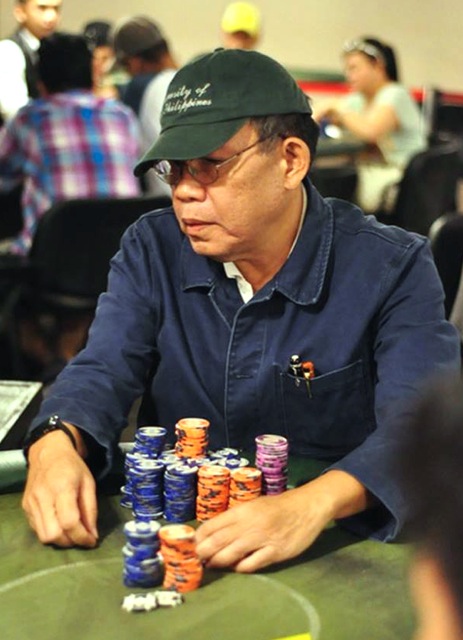
Now, Jim, if you’re still out there, here’s an update from the fanboy and wannabe: last week, I did myself one better, and made the final table of another major tournament, the P1-million Metro Summer Event. A million pesos is small beans by Las Vegas standards, but the first prize could have wiped out my credit-card bills and bought me a Montblanc or two, so I was all worked up for the four-day marathon.

Like Jim, I entered the MSE through a pre-tourney satellite, winning a ticket to the big game. We started out with 15,000 in chips, and at one point on Day 1—among over 400 other players in the pool—my stack went down to 7K. On Day 2 and with the pool down to a hundred, I hit a lucky streak and nursed my 40K stack to almost 380K; on Day 3, that ballooned to over 1.2 million (these are just chips, folks, not real money, so don’t get too excited). On Day 4, down to the final table of ten players, I went in as second chip-leader, but also as the oldest guy and the biggest fish in the pool of sharks.

The technical details that follow will fascinate only the poker cognoscenti: I got that far in the tournament because of some of the most incredible, heart-stopping suckouts or last-card, last-second turnarounds you ever saw. At one point, my opponent drew a flush on the flop against my Q-10, but I hit trips on the turn and a full house on the river. The wildest hand of the tournament had me going all-in against the chip leader with a pair of 9s; he called, and tabled a pair of 10s: I was, 90 percent, a dead duck right at the start. The first three cards or the “flop” rolled out, none of them a 9 or a 10, but with two clubs; the fourth or turn card was the 6 of clubs. My opponent held the 10 of clubs, so he wasn’t just leading from the get-go but also had a backdoor flush draw.

Only one card in the whole deck remained that could beat him, the 9 of diamonds; if any other card showed up, I’d be homebound (even if the fifth and last or “river” card was the 9 of clubs, he would still hit his flush). At this point, I got up and shouldered my man-bag (loaded with crackers, a cellphone power bank, and Splenda sweetener); I needed the Splenda, as I could smell and taste the bitterness of certain defeat. Then the dealer drew and turned over the river card—hallelujah, the 9 of diamonds, the absolute, 2-percent one-outer. My opponent collapsed against the wall as I heard choirs of angels singing “Ode to Joy.”

On the final day, after a good night’s sleep, I got up at 6, and did a 10-kilometer walk around the UP campus, running the “Chariots of Fire” theme in my head. This was my day of days; I showered, did my students’ grades and turned in my grade sheets, worked on one of the biographies in the pipeline, got a foot massage, then put on my “University of the Philippines” baseball cap and blue jacket—my battle gear—and went to the final table.

I held on that night, scribbling messages to myself over the breaks on a notepad with my faithful Agatha Christie, reminders like “Keep your head!” and “Patience, endurance, opportunity!” (It was probably the doodling more than the messaging that relaxed me.) With uncharacteristic smartness, I played it safe, tossing away nine out of every ten hands, preserving my stack while I let the others duke it out. Eventually I finished in second place, bowing to a friend and previous champion, a genial and exemplarily cautious player, TV and film director Tofie Runas.

The next day I brought Beng with me to Metro to claim my prize, to ensure that the money would go to good causes (I might treat myself to a pen or two, as a souvenir of the experience). “Heck, this beats the Palancas,” I told myself, remembering my first Palanca short-story win nearly 30 years ago, also a second-place finish. I could see Jim McManus grinning in Kenilworth, Illinois. He’d addressed me in his messages as “brother,” so here’s to you, brother Jim, and to all of us 60-somethings chasing thrills and spills on the green felt table.

Penman No. 81: Hello, Seniorhood

ButchBeng1974

Penman for Monday, January 13, 2014

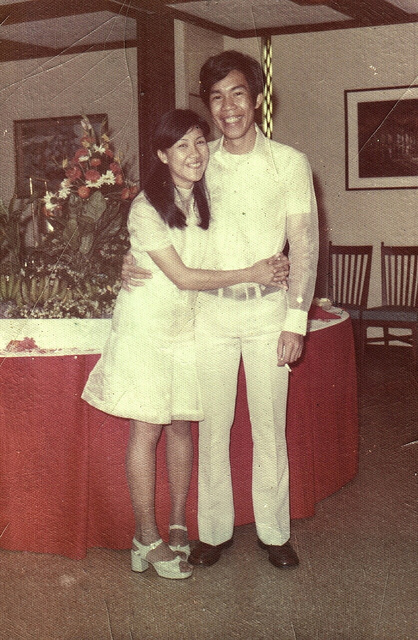
THIS WEDNESDAY the 15th, Providence permitting, I’ll be marking two milestones I frankly never thought I’d reach: I turn 60, and Beng and I will celebrate our 40th wedding anniversary. (That’s right, we got married in Manila’s City Hall on my 20th birthday. It seemed a cool idea at the time, but I’ve regretted it ever since—the timing, not the marriage—because it deprived us of an excuse to party twice.)

I’ll admit this only now, but I’ve been looking forward to seniorhood with growing anticipation over this past year. At 57 or 58 you might still be in denial, walking with a pronounced spring in your step to convince yourself and everyone else that all you need is a new pair of Merrells to unleash the inner tiger in you, but the fact is, within six months of 60, you can’t wait to get there and have the inevitable done with.

The last time I knew I had to be a senior soon was just last month, when I stood in a long line in the unseasonably sweltering heat at the DFA to submit my expiring passport for renewal. Taking pity on me, a guard came up to me and asked, “Sir, how old are you?”, obviously thinking to bump me up to the express lane where a few imperturbable seniors sat smiling. “I’ll be 60 in three weeks!” I said. Not good enough. I waited three hours.

I know something about seniors—I live with four of them in the house; I know their moods, their ailments and medications, their favorite TV dramas, their exquisite skill at swallowing fish heads and spitting out the eyeballs.

And there’s no diplomatic way of putting this, but for the past three years, I’ve been married to one (Beng’s folks didn’t know she was marrying a young innocent until we were in the car on the way to City Hall; I had to get parental dispensation). But to her enduring credit, elfin Beng often has to be “carded” in the restaurants, as they’d put it in the States, while all the salespeople and cashiers have simply albeit solicitously assumed that I have a senior card to show for a discount.

So I’ve been mooching off Beng’s seniority, tagging along with her when she goes to the head of the line come boarding time at the airport, or when we queue up for movie tickets. That’s when you realize that the next best thing to being a senior is marrying a card-carrying one. But Beng doesn’t find it funny when I tell her what a shock I get to wake up in the morning beside a lola. Well, I guess we’re even now.

Of course, in a sense, you can never get old enough, maybe not until you hit 80. At 60, there will always be writers in their 80s or 70s who can’t wait to remind you what a bumbling tyro you are compared to their accomplished selves. That’s all right, because having older people on your shoulders could be the only thing that will keep you young, or at least younger, not counting strange potions meant to stiffen, uhm, one’s resolve.

It’s a pleasant surprise to get this far, because ours was a generation that was supposed to die before we even hit 25. After stepping out of martial law prison at age 19, I’ve taken every breathing moment since as a kind of grace note.

As it turned out, the grace note was my marriage, running four decades long, another unexpected, shamelessly undeserved blessing. When Beng and I stood before a CFI judge—my mom’s boss—that nippy January in 1974, it was after just three months of being together. We were in love, surely—truly, madly, deeply—but we were also gasping for breath, seizing happiness when and while we could, thinking that the State’s long and murderous hand could break the spell at an instant. As it turned out, too, the predictable State was hardly the enemy, but the inconstant self. Some of those forty years proved hard and lonesome, thankfully not too many nor too long.

As we start the count toward our golden 50th, Beng and I have come to realize that there are a few things we need and want to do in the years ahead.

With some regret, we will seek and keep fewer friends—the real, not the Facebook, kind. We’d like to focus on family, work, good health, our private charities, and, of course, more time together. This will mean socializing less and staying home more, which will be all right, because we both have so much work to do and always less time to do it.

On the other hand, lest our world become too small, and with whatever we can spare from our perennially meager savings, we will travel up a storm—march up headless hilltops, wind through strange alleyways, and wander down foreign boulevards while our knees can. This May, I hope to realize a longstanding dream, which is to bring Beng to Venice, where I had a magical moment three years ago but where she’s never been (of course, she’ll have to stay with me at that dinky hostel in Mestre, across the water and next to the Asian food store that was my culinary lifeline in heathen Italy).

We might not even need to go that far. One of the most enjoyable dates Beng and I had over the recent holidays was in front of the TV, watching a late-night screening of “Funny Face” with Astaire and Hepburn in Paris and singing along to the Gershwin score. And then another day we took our quarterly stroll around the Quiapo area, imbibing the Oliver-Twistian energy of the hardware and music stalls on Raon and Evangelista, cherrypicking the dustiest of Avenida’s ukay-ukays, and consoling ourselves with cheap mami and siopao at the Pinsec place on Recto, because Ramon Lee’s chicken house was still closed for the New Year break. We’ve been to dreamier places like the Grand Canyon and Bellagio (the Italian and Vegas versions) but it’s these slumdog sorties that we’ll remember for the fun.

With our only child Demi well set in her own career in Southern California and well loved and cared for by her own man, we can and will help others achieve fullness in life by putting them through school and giving them the same kind of guidance we gave our daughter (“Don’t worry too much about grades, enjoy your education! Make your own mistakes! Learn to think on your feet! And never forget where you came from.”)

Where she came from, I think, was us. As I turn 60 and Beng and I turn 40 (which Demi, too, will be, come October), I’d like to think that beyond all the books and paintings we ever created, Beng and I did nothing better than produce Demi, whom I named—while Beng was still in a post-partum haze—Dalisay Emilia Poticar Dalisay, “Emilia” being my mother’s name. Demi loves her lola, but wasn’t too thrilled to grow up having to explain her redundant name to her classmates, with the anciently Shakespearean “Emilia” wedged in between. “Don’t worry,” I told her, “don’t you know that Demi Moore is really Dalisay Emilia Moore?” It didn’t fly. But hey, her name seemed like another cool idea at the time.

A couple of years ago, I wrote her this poem titled “To Our Unica Hija Demi, Born Dalisay Emilia Poticar Dalisay”:

It matters not if our names end with you

If no more Dalisays walk the earth

You were all we wanted in this world

Our most joyful blessing was your birth.

When at times we seem too far apart

Remember that we are your blood and breath

And that your name to us is like a distant bell

That you bore twice, and bore it well.

Here’s to the three of us, anak. We’re all growing older, but we’re doing it together. 

Butch Beng2013

Penman No. 65: Tried and Tested

Penman for Monday, Sept. 23, 2013

LAST WEEK’S piece on the kind of open-book exam I give my students reminded me of the toughest exams I myself had to take as a student. It’s been more than two decades since I last stepped into a classroom and sat opposite the professor’s table and chair, but the memory of those exams remains vivid—in some cases, distressingly so.

I have to declare, at the outset, that unlike most students, I liked exams, especially in subjects that I knew I would do well in. I got a thrill from being tried and literally tested; I saw the exam as a game of wits between me and my professor, and while my professor certainly knew much more than I did about the subject, I was always on the lookout for angles and insights that my professor might never have considered, and would therefore appreciate as something fresh. I disdained what professors call “spitback”—the rote regurgitation of points already discussed in class—knowing that many of my classmates were going to do just that.

I was, in other words, something of a smartass, and like all the annoying smartasses you remember and loved to hate from high school and college, I deserved and got my occasional comeuppance. Returning to college after a ten-year absence, I thought I could wing it in my Lit classes, but instead got the loudest wake-up calls I possibly could, from two professors known to be formidable “terrors” in the English department—Filonila Tupas and Damiana Eugenio—both of whom gave me a “5.0” in the objective quizzes that they began the semester with. Thankfully these were diagnostic quizzes, and the diagnosis was clear: I had to hit the books to do well, so I became a textual bloodhound, memorizing odd details and references (plants from Shakespeare: wild thyme, oxlips, woodbine, eglantine). I would not embarrass myself again—or so I thought.

Shakespeare and the Elizabethan age became a passion for me, a period fraught with dark political intrigue and steeped in grime yet also ennobled by some of the most sublime poetry ever written. It wasn’t even Shakespeare so much as the lesser poets and dramatists around him—Sidney, Wyatt, Webster, Middleton, Marlowe—who piqued my interest, thanks to a teacher who took kindly to an older student making up for lost time (I was 27 when I returned as a freshman to UP; my Paulinian colegiala classmate, Judy Ick—who would go on to become Dr. Ick, the real Shakespeare expert in the department—was just 17).

That teacher was the impeccably fashionable Prof. Sylvia Ventura, commended (as Shakespeare himself might have put it) by all the swains but feared by most of her students for the spot-passages exams she gave. (A spot-passage exam gives you nothing but an obscure passage drawn from the text of a play or a poem, for you to identify, contextualize, and discuss.) I thought I was doing pretty well in her class until the final exam, when I ran into a passage that might as well have been Greek. Knowing that I had absolutely no chance of identifying the passage correctly, I gathered my wits and used Shakespeare himself to explain my predicament, beginning my answer (whatever it was) with a quote from Act I, Scene 1 of A Midsummer Night’s Dream: “So quick bright things come to confusion!” Apparently it worked, because I escaped with a 1.25.

The toughest teacher I had in UP, however, was the legendary Wilhelmina Ramas, whose final exam on “The Idea of Tragedy” took us five hours and several bluebooks to finish—a herculean effort rewarded, in my case, with a niggardly (and probably accurate) 1.75. Soon after, I flew off the US for graduate school, and it was only then that I appreciated the rigor that my UP “terror” profs had put me through. Their American incarnations were tweed-suited dons rather than coiffed matrons, but they were no less demanding. I had come well prepared.

In my Shakespeare class at Michigan, taught by the pipe-smoking Russell Fraser, I felt like I had orchids coming out of my ears when Dr. Fraser commended me for being the only one in class to be able to answer his question about differentiating “hypotaxis” from “parataxis” (no, it has nothing to do with paid transportation). That still didn’t save me from the pain of Fraser’s final exam: a spot-passage exam, employing two totally unheard-of quotations from Shakespeare’s plays, with one question to answer: “Which is early and which is late Shakespeare, and why?” This was also an open-book exam that we had one day to complete; we were free to roam the library and to read Shakespeare from end to end.

Now, mind you, this was 1986, well before the Internet and Google; students were still using 5.25” floppy disks, if they were using computers at all (I wasn’t; I’d dragged my Olympia portable with me across the Pacific). Today my students would take seconds to find the answer to “early” and “late”, and maybe an hour to cough up a reasonable “why.” Back in ’86, it was all intelligent guesswork, knowing that no amount of speed-reading and cramming could possibly turn up those passages, let alone contextualize them. And Fraser knew that; whether we had the “early/late” part of the question right or wrong, he wanted to see us reasoning our way through our answers, given what we knew from class of the younger and the older Shakespeare. (Only later, in the age of Google, would I discover that Fraser was then at work on two books: Young Shakespeare, and Shakespeare: The Later Years.) I can’t recall how I scored on that exam—I passed the course with an A-minus—but it was the kind of exam that was both gut-wrenching and exhilarating at the same time; I loved it.

Still later, now doing my PhD at the University of Wisconsin-Milwaukee, I had a professor in Bibliography and Research named James Kuist. As mild-mannered as he was, Dr. Kuist had a fiendishly difficult task for us to complete. His exam question went like this: “The year is 1663 and I am a Fellow of the Royal Society. What books would be on my bookshelf?” So off we went to the library on a wild goose chase, and like an eager labrador retriever, I enjoyed the hunt, searching the stacks for the spoor of these antiquarian volumes.

Now that I’m the one giving the exams, I hope to come up with questions and problems that my students will remember 20 years from now, and still get a bit of a headache from—or let’s make that the pleasant buzz, the distant refrain, of an unusually agitated mind.

Penman No. 52: A Man of Many Hats

Me

Penman for Monday, June 24, 2013

I’VE BEEN writing about writing for the past eight weeks, so I hope my readers will indulge me this personal break, this little foray into male plumage.

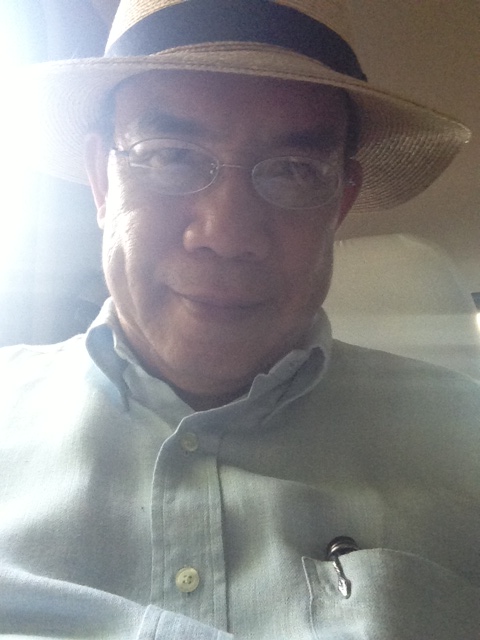
You’ll probably notice that, this week, I’m sporting a new picture for this column—the first time I’ve changed it in years. I liked that old picture (taken by Raymund Isaac) and had been using it whenever I was asked for one, but I think the time has come to be honest with myself and my readers and to admit that, well, I just don’t look like that anymore. I’ve grown—and I look—considerably older, though happily also a bit leaner, thanks to my diabetes-induced diet-and-exercise regimen.

The most visible change in my new avatar, however, is the hat—one of a few I’ve been regularly wearing over the past year. People have been wondering why I’ve adopted what seems to be a foppish affectation—a practice I share with other writer-friends like Rio Almario and Teo Antonio; notably, National Artists Bien Lumbera, Frankie Jose, Bencab, Billy Abueva, and the late NVM Gonzalez have been known to wear hats or caps of one kind or other. I don’t mean to suggest, by citing such exalted company, that wearing a hat will boost my literary stock in any way, although I do hope, in secret, to be taken a little more seriously by dumping all that straw on my balding pate.

The fact of the matter is that I’ve been wearing hats for more than 20 years now. I picked up my first fedora from the Milwaukee Hat Store back in 1989 or so, when I was a graduate student there—and if you know how bitter Midwestern winters can get, you’ll understand that it was more for practical protection than about making a fashion statement. The fashion side came in choosing a felt fedora over a baseball cap, going for a ‘40s or ‘50s look over a ‘90s one (I do keep a small hoard of baseball caps for my morning walks around the campus). I still keep a felt fedora for when I have to travel to the West during the cold months, but here in the steaming tropics, felt (“felt” simply means mashed wool pulp) isn’t too practical, so that a straw panama hat makes more sense. It was one such panama I brought home with me in 1991 when I finished my studies, and I wore that hat to UP graduations for years, until it got lost somewhere.

Here’s a bit of Panama Hat 101: the best panama hats aren’t made in Panama at all, but in Ecuador—in a town called Montecristi, and another called Cuenca (the best hats come from Montecristi, but the most come from Cuenca). It’s said that the black-banded straw hat we now call a panama got its name when President Theodore Roosevelt was pictured wearing one during a visit to the Panama Canal. There’s no set system of grading panama hats, but the best Montecristis are woven so finely that you can roll them for storage and travel, and they’ll spring back into shape. Depending on fineness and quality of weave, color of straw, and other imponderables, a “panama” (there are many mass-produced ones being passed off for the real thing) can be had for anywhere from $25 to $25,000, the latter made by master weaver Simon Espinal. (Thanks to Brent Black of brentblack.com for all this information.)

The hat I’m wearing in my picture is a Montecristi, but a bargain item I got lucky enough to find on eBay for a lot less than $100. (Yes, I wore it all the way home from Virginia to Manila.) EBay is a great source for hats, watches, and pens—my old-guy passions—but buying a hat is like buying shoes: you need to know your exact size, or even the smartest-looking specimen will bring you nothing but grief. (My hat size can be expressed either as 7-1/2 inches, 61 mm, or Large; of course, even with the numbers on hand, you can expect some issues with fit and finish, so it’s best to buy a hat at a store.)

What do I look for in a hat? A sensible profile—nothing that will make me look like a cowboy, a gangster, or a pop star—and good workmanship. Of course, utility is also important. I have a very light, foldable “vineyard hat” for long days in the hot sun—this was the hat I brought to Batanes—because your sweat just wicks off the fabric; another hat, a thicker canvas one called a Tilley Endurable, is beloved of archaeologists, and boasts of being the best hat in the world, made with “British hardware and Canadian persnicketiness.” Another favorite that’s been with me for about 15 years now is an Australian rancher’s rigid felt hat, an Akubra, whose wide brim provides great protection against sun and rain (and against an opponent’s prying eyes at the poker table).

But let’s face it: like many of life’s imponderables, in buying hats, attraction trumps function most of the time. Last November, on a trip to Melbourne, I had to kill some time while they cleaned my hotel room prior to check-in, and I found myself wandering off to a nearby shopping center and coming face-to-face with a gorgeous hat in the men’s section—it was made not from the traditional, fine toquilla straw, but the somewhat rougher raffia, and it was woven not in Ecuador but Bangladesh, but it was handsomely blocked, and sat perfectly on my head when I tried it, like Napoleon’s crown. A peek at the price tag made me shudder and I put it back on the shelf immediately, and walked out to a balmy Melbourne morning; but the balmier the morning became, the more I convinced myself that a hat was the best and most practical Australian souvenir I could bring home, even if my trip had barely begun, and within the hour I was back in the store, forking over a plastic card for a straw bauble.

I still wear that hat most days, alternating it with the whiter toquilla, which is softer and lighter but also much more fragile. (You can’t wear a toquilla panama in the rain.) I realized what a good choice I had made with the raffia hat when I woke up in a hotel room one morning to find the hat completely drenched by an overnight drip from the airconditioner above; a few hours’ drying, and it was good as new.

I often wonder when and why we Pinoys stopped wearing hats, in this eminently hat-friendly weather; if you take a look at any street scene from the 1930s, you’ll see Filipino men, rich and poor alike, wearing hats. Here and there—in places like Baliuag and Lucban—you can still buy a good locally made hat, but we have a long way to go to catch up with the weavers of Montecristi and Cuenca. With cheap Chinese-made baseball caps in abundance, I’m sure not too many people care. That’s all right—I’ll just keep wearing my silly hat to my senior’s sickbed, then tip it to my nurse when the time comes.

Hats

Flotsam & Jetsam No. 19: There’s a Snake in My Pocket

Agatha1SHE’S HERE—that obscure object of my ardent and longstanding desire, the Agatha Christie fountain pen from Montblanc. If you see me walking minus an arm and a leg, that’s what it cost me—but I’m deliriously happy. Here’s that red-eyed beast up close (yes, those eyes are real rubies):

AC

Penman No. 30: Music to Lose Weight by

Penman for Monday, Jan. 21, 2013

AS I’VE been reporting lately, I’ve lost quite a bit of weight since my doctor ordered me six months ago to take brisk walks and go on a sensible diet to fight the onset of Type-2 diabetes. I seem to have hit the wall at a weight loss of 45 pounds, but I guess I should be happy where I am, in the low 170s. With my blood sugar in the 100 range and my blood pressure steady at around 110/80, I’m a whole lot better off than where I was a year ago—and, I suspect, than many men my age.

But this isn’t about cholesterol, triglycerides, and all that; rather, it’s about another unexpected side benefit to all this huffing and puffing. Because I take 30-minute to one-hour walks around the UP Academic Oval several times a week, I’ve rediscovered all the music I’d stored away in my iTunes. I have about 2,000 songs all in all—apparently not much by the standards of today’s kids, some of whom I’ve seen to profess having 10,000 songs in their playlists (of which, I’m pretty sure, 9,900 will sound all the same to me).

As you can imagine, most of my music is made up of what seniors know as “standards”—vintage pieces from the likes of Doris Day and Bing Crosby that can put a 20-something to sleep in 30 seconds, the kind of music you’ll hear on FM radio at 2 pm. Of course I have the complete Beatles collection (and could probably sing 80 percent of it from memory), a boatload of Broadway, Sinatra from here to eternity, Michel Legrand in both English and French, opera like I knew Italian, enough bossa nova to make me wish I knew Portuguese, and instrumentals from the likes of Jackie Gleason (yes, he was also a bandleader). Henry “Pink Panther” Mancini, and Toots Thielemans, who can make a harmonica sound like a love letter with your address on the envelope.

I do have quite a few new songs—but “new” to me usually means something 20 or 30 years old. Instead of Linkin Park, I have Led Zeppelin; instead of the Eraserheads, I have Heber Bartolome and Banyuhay. OK, I have a couple of songs by Journey (what else but “Open Arms” and “Faithfully”) and one by INXS (“Afterglow”) but no Nirvana, no hip-hop, nothing to disturb my hard-won equanimity or my illusion that the world is anything but an ordered whole.

It’s that old-guy sense of order and purpose that drives my left foot in front of the right and the right in front of the left, for 2.2 kilometers around the oval until I reach the Oblation and then do it all over again. I have to believe that all of this exertion will actually mean or bring something good, and for that I need emphatically optimistic music.

Broadway, I find, best puts me in this mood. If anything—from Carousel to Les Miserables—Broadway’s been built on selling the power of love and the indomitability of the human spirit, so you could whistle a happy tune and never walk alone and look to the rainbow and be sure that the sun will come out tomorrow. I might start with something light like “Dites Moi” from South Pacific or “Question Me an Answer” from Lost Horizon, progress to something more dramatic like “We Kiss in A Shadow” from The King and I or “If Ever I Would Leave You” from Camelot, and then push myself for another turn around the oval with something truly rousing like “On the Street Where You Live” from My Fair Lady or “There Is Nothing Like a Dame” from South Pacific. I’m singing all of these in my head, but being deaf to the world with my noise-canceling earphones on (not the smartest idea on the open road), I’m sure—from the strange looks I get from people I pass by—that I’m making noises I’m not hearing.

Next to Broadway, my two favorite genres are Latin music and OPM. I don’t really speak anything more than schoolboy Spanish (thank God for the old Spanish Law, which of course all of us detested in our time), but whenever I listen to someone like Luis Miguel, I find myself feeling foolishly sorry that we kicked those Spaniards out. I have eight versions of “Sabor a Mi” in my iTunes, and savor both Andrea Bocelli’s and Ennio Morricone’s versions of “Amapola” (which Morricone used for the soundtrack of Once Upon a Time in America). Speaking of Morricone, how could anyone resist “Gabriel’s Oboe” from The Mission, especially when it’s Yo Yo Ma doing the honors? And speaking of Yo Yo Ma, how much sweeter can a cello get than on “Doce de Coco” from his Brazilian album?

Ah, Brasil, where hearts were entertaining June, and we stood beneath an amber moon…. I’ve told my wife June (also known as Beng) that when I croak, the kind of music I’ll want at my wake will be that of Antonio Carlos Jobim, especially “Desafinado.” There’s something in the gentle insistence of the bossa nova that speaks to my own temperament. And here I have to bring up one of my favorite divas (aside from the inimitable Barbra and our own Sharon—yes, I’m an unabashed Sharonian)—the Japanese-Brazilian chanteuse Lisa Ono, whose “Pretty World” never fails to add some lift to my shoes.

For something more soulful I’d turn to Laura Fygi’s “Abrazame”—and it may be an odd way of looking at these ladies, but if Laura Fygi and Lisa Ono’s voices were like ink, Laura’s would shade to purple and Lisa’s to green. To top off my Latin section, no single album gets more airplay in the car or in my earphones than the soundtrack of Woman on Top, which has an upbeat vibe you can listen to all the way to Baguio. (I was playing it in the car once while driving around Pampanga, and everyone with me wanted a copy.)

And did I say OPM? Much as I may appreciate exotic melodies like “Dein ist mein ganzes herz” or “Les moulins de mon coeur,” they can’t get me going like Sharon’s “I-Swing Mo Ako” or “Bituing Walang Ningning.” When I’m rounding that long bend around the Sunken Garden and am tempted to linger under the acacias for a lick of sweet sorbetes, I strengthen my resolve by drawing on “Sana’y Wala Nang Wakas”: “Kahit na ilang tinik ay kaya kong tapakan, kung iyan ang paraan upang landas mo’y masundan… Kahit ilang dagat ang dapat tawirin, higit pa riyan ang aking gagawin!

And that—plus a lot of kangkong and hasa-hasa in sour broth—was how I lost 45 pounds in six months.

Penman No. 29: Some Things Meant to Be

Penman for Monday, January 14, 2013 

MY LATE father Jose Sr.—Joe to his friends—would have turned 90 this coming Saturday. An incorrigible chain smoker, he died of an aneurysm in 1996, and there’s hardly been a day since when I haven’t thought about him. Whenever I travel, which is fairly often, I find myself talking to my dad to tell him, “Tatay, I wish you’d seen this, and this, and that.” He was a simple man whose feet never left his country nor, pretty much, his home; his joys were in the kitchen and in the garden, and his favorite pastime was doing crossword puzzles.

Indeed, in his own way, he was a man of words, a gifted writer who—like I would do, myself—ghost-wrote speeches for far more powerful but much less articulate men. As modest as our circumstances were, there were always books and magazines at home, and even before I could read or write, my father fired up my imagination by reading stories to me at bedtime. In brief, I would not have become a writer had it not been for him.

Nor, speaking of my quaint obsessions, a fountain pen collector. In his last days my father wrote with a cheap plastic Bic ballpen—the kind you can now buy by the box and forget or throw away after a few uses—but in his prime he had some Sheaffers and Parkers that he would load up with blue-black ink, whose ability to bloom into a dark-hearted rainbow on a wet napkin brought me endless fascination. Regretfully none of his fountain pens have survived—which is probably why, as with most enterprises driven by some deep longing, I keep amassing pens, as if they would somehow bring my father back.

Now, begging your indulgence, here’s where this memory detours into the story of a pen and of a box.

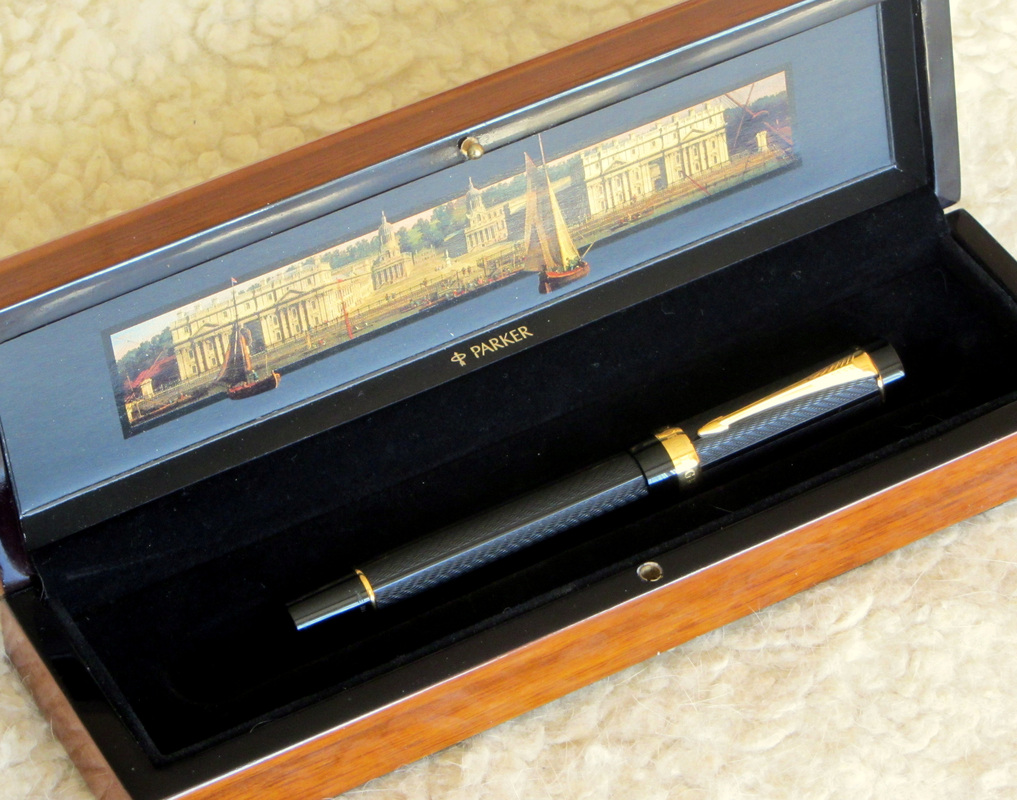
A few weeks ago, after months of eager questing, I acquired what collectors call a “grail” pen—an object of acute desire, usually for reasons of great beauty, scarcity, or some sentimental connection. In this case, it was purely a matter of esthetics and collectability: the Parker Duofold Greenwich Centennial would simply be a big, black, overpriced pen to most sensible people, but to me it was the noblest of the modern Duofolds, a reincarnation of a classic 1920s line that established the Parker name for the rest of the century. Made specifically to commemorate the Royal Observatory in Greenwich, England—which Beng and I visited around the time the pen was made in 1999—the pen was a special edition with a limited run, and had become rather hard to find.

When I found one on eBay at a price I could afford, I was ecstatic, filling my posts about the find with smileys and dancing bunnies. It was near-mint, the chevrons incised into its black cap and barrel deep and lustrous, its gold fittings rich and warm. Its regal nib was a joy to write with. I couldn’t have asked for more—or perhaps I could, as it came to me without its presentation box. Pens of this caliber always came in pretty wooden boxes in themselves worthy of collection, and indeed, in one discussion of the Greenwich in a forum I frequented, another collector had reported seeing “a small but fancy box with what appeared to be a European cityscape picture on the inside of the box cover.” I wasn’t sure why, but that description sounded oddly familiar to me then.

When the pen arrived from the US I put it to happy use, doodling away, writing loopy notes to no one. The Greenwich was truly an impressive pen and it sat haughtily in my pocket, but now and then I would be besieged by the collector’s constant fear of losing or dropping a valuable pen, and I would begin wishing that I had its box to put it to bed in, before I scored the exquisite chasing on the pen or, worse, let it slide out of my attention in one of my poker binges. But then of course, I didn’t have its box, and I couldn’t bear to stick it in anything beneath its stature.

And then, a few nights ago, something strange happened. As I was idly surfing away to more pleasant distractions (meaning, more pen-related Websites) in the middle of finishing the draft of another commissioned piece, I stumbled on a picture of the Greenwich in its original wooden box. And at that instant, the familiarity of the box and of its pictured scene overcame me, as I realized that, of course, I’d had that box somewhere in the house, somewhere in the very room I was in. Years ago, I had found the varnished receptacle in a thrift store in America, and had been taken by its plaintive beauty—plaintive because it was clearly a box for some majestic Parker pen (the Parker name was proudly emblazoned on it), but it was empty, and I had no idea then what model its proper occupant might have been.

I bought the box for a couple of dollars, and brought it home with me to the Philippines, where I decided that it would house the most precious pen in my collection—my dad’s battered Bic ballpen, the last thing he wrote with before he died. So I was certain I had it somewhere, and I began ransacking my den, pawing through shelves of empty pen and ink boxes (you can imagine what a collector’s nest looks like). Sure enough, there it lay behind a stack of ink bottles, the box that opened to a “European scene”—a cluster of neoclassical buildings foregrounded by a sailboat on the water. (I would later discover that it was a depiction of the Royal Naval College at Greenwich, seen from the north bank of the Thames.)

It was the box that had been designed for—and only for—the rarefied Parker Duofold Greenwich Centennial, and by some stroke of what the poets called serendipity, I had found the box years before I found the pen. I took my father’s crystal Bic in my hand and smiled, thinking, “Tatay, what strings did you pull to make this happen?”

So I put the Parker where it was meant to rest, and now I had to find new and no less suitable quarters for the Bic. Fortunately, on the same shelf was an old Japanese box, gleaming in black lacquer, that I had found in another discount store on Avenida Rizal, and which would originally have carried chopsticks. I didn’t think Tatay would have minded the switch, being an excellent cook.

And finally, I resolved that, in honor of Jose Quinton Dalisay, Sr., the Greenwich pen would henceforth use nothing but blue-black ink, a choice its golden nib seems perfectly content with. My other pens can gorge on Diamine Oxblood and other fancier concoctions, but I had been soundly persuaded that some things are just meant to be. (And here’s to a happy 90th, Tatay!)

Penman No. 21: Literary Networking in Bangkok

Penman for Monday, November 19, 2012

BENG AND I had hardly stepped off the plane from weather-beaten New York when we were off again to sunny Bangkok, this time to attend a conference of writers and translators from all over Asia and the Pacific. I asked Beng to come along because we hadn’t visited Bangkok in a few years and had always enjoyed the place. Here, again, we were helped by the fact that our unica hija Demi works in the hotel industry, and she was able to find us a nice place in Sukhumvit—the Aloft, Bangkok’s iteration of a global chain of smart boutique hotels. More on the Aloft in a bit.

I was there to take part in “Reaching the World,” billed as Bangkok’s first international literary showcase, under the auspices of the Asia Pacific Writers and Translators Association (AP Writers for short) and the South East Asian Writers (SEAWrite) Award, hosted by the Faculty of Arts of Chulalongkorn University. I sat on the 2010-2012 board of AP Writers with fellow Filipino professor and STAR columnist Isagani Cruz, who served as its chairman.

A sizeable delegation represented the Philippine literary community in Bangkok, aside from Gani and myself: writer and scholar Cristina Pantoja-Hidalgo, who now divides her time between UP and UST; UP English department chair and Southeast Asian literature expert Lily Rose Tope; poet and UP professor Isabel Mooney; fictionist and UP Mindanao professor Jhoanna Cruz; poet and DLSU professor Dinah Roma; essayist and UP professor Jeena Rani Marquez; and UST literature professor Timothy Sanchez. Novelist Charlson Ong, this year’s SEAWrite awardee from the Philippines, joined the Bangkok conference in its last couple of days, coming from the Singapore Writers Festival which I had attended last year.

AP Writers emerged out of an earlier organization, the Asia-Pacific Writing Partnership founded by Jane Camens who had also helped establish the Hong Kong International Literary Festival. Jane, an Australian writer who has lived, studied and worked in the US, the UK, China, Macau, and Hong Kong, has been an indefatigable spirit bringing writers from all corners of the region together, and she will now serve as AP Writers’ general manager. The Sri Lankan-born but Hong Kong-based humorist and essayist Nury Vittachi will serve as AP Writers’ new chairman, backstopped by the Chinese-Indonesian-American fictionist Xu Xi, who runs the MFA low-residency program at the City University of Hong Kong, and by the translator Shirley Young-Eun Lee, who has roots in Korea but who read Classics and Persian at Oxford.

As you can see from just that small corner of the organization’s membership roster, AP Writers is both as regional and as global as you can get. This reflects an increasingly obvious fact in today’s literary world: international and inter-cultural exposure has become vital for writers, to expand both their perspectives and their networks. By “network” we mean here that web of connections that emanates from the writer and his or her work to the other people involved in the process of literary production and dissemination—agents, editors, translators, publishers, critics, booksellers, critics, reviewers, teachers, researchers, and, of course, students and general readers.

This year, in Bangkok, AP Writers paid special attention (and gave formal recognition, in its full name) to a vital but largely neglected member of that network, the translator. A literary work can’t be read beyond its original market unless it’s translated into another language, and that requires the skills of a very small group of specialists around the world. Literary translation isn’t just the kind of word-for-word interpretation you might get from a software program or even a live person—it involves the understanding and translation of one culture into another, the conveyance of nuances that, paradoxically, will never be perfect but will achieve interesting effects of its own. (I’m reminded of a quote attributed to Salman Rushdie, about the most interesting words of a language being the untranslatable ones.) In Bangkok, we were privileged to be in the company of some of the world’s best translators, including the Australian Henry Aveling, who has undertaken many translations from Indonesian and Malay.

We were also treated to a tour of the stately and historic Mandarin Oriental Hotel on the Chao Phraya River, probably the only hotel in the world where writers are revered. AP Writers held its business meeting there, after being regaled by Harold Stephens, an American expat and raconteur who’s written 30 books on travel and adventure and who also happens to be married to a Filipina, with stories of the old hotel from the days when the likes of Joseph Conrad (then still a ship captain), W. Somerset Maugham, Noel Coward, and Graham Greene stayed over. There’s a room and a lounge now maintained in their honor at the hotel—where, fittingly enough, Charlson would receive his SEAWrite Award later in the week from Thai royalty).

Readings and socials are an important part of any literary conference, and while some readings can be interminable (let’s face it: authors love to hear themselves), now and then you come across an entirely original voice. This time around that voice was that of Jang Jin-sung, one of Kim Jong-il’s favorite poets who defected when he could no longer take what was going in in North Korea.

The gut-wrenching hunger and desolation that Jang spoke of in his homeland contrasted, ironically, with the culinary and visual opulence of Thailand, which makes every visit there worthwhile. Beng was landing in the new Suvarnabhumi airport for the first time and was awed by the experience, even more so when the sleek commuter train took us from the airport to the city center for a mere 20 baht (about 30 pesos). We dropped our bags off at the Aloft—a jazzy, upbeat hotel with free wi-fi, a great buffet breakfast, and an iPod stereo player in every room—and dashed off in a cab to catch the weekend market at Chatuchak.

Thailand is a shopper’s and diner’s paradise but Beng and I contented ourselves with a bag for her and an iPhone case for me—and lots of fresh fruit, spicy chicken rice meals, and heavenly foot massages. It may not have seemed too auspicious when the printed menu in one streetside restaurant offered us “Steamed Crap,” but we survived the typo.

We came away much impressed by the Thais’ devotion to culture and literature, good reason for Bangkok to be named the World Book Capital for 2013 by Unesco (a distinction that, I bemoaned, Manila would probably earn by 2053). At the welcome dinner, Bangkok’s urbane and genial governor, M.R. Sukhumbhand Paribatra, ducked out of his busy schedule overseeing preparations for an upcoming world indoor football championship to break bread and share jokes with writers and translators. I’d like to believe we were well worth his and each other’s time.

Penman No. 19: Autumn in New York

Penman for Monday, November 5, 2012

I FIRST visited New York 32 years ago, as a young man on his first trip abroad, and I can still remember the convulsive thrill that I felt as I peered out the window of my plane from Detroit and saw Manhattan’s spires rising toward me, to the accompaniment of a Gershwin tune.

At the same time, I looked at New York with not a little dread, both because of its sheer immensity and also its fearsome reputation for harboring mobsters and hucksters. While I marveled at the Christmas lights of Rockefeller Center, I also saw Times Square and Bryant Park at their worst, long before Rudy Guiliani came in with a broom, and 9/11 lent the city the kind of composure that comes with tragedy.

I’ve been back many times since—with my mother, daughter, and sister, and Beng’s sister living in the US, we try to visit every year—and over the years, I’ve slowly learned to trust if not to love this mother and mentor of modern cities, holding my wariness in check just long enough to let New York’s many and unexpected charms seep through and permeate my senses.

It’s a tired cliché by now, but while I go to my sister’s place outside of Washington, DC for rest and recuperation, I go to New York for the energy and the excitement, for the buskers in the subways playing everything from Vivaldi to That’s Amore, for Paul’s Burgers in St. Mark’s Place, for the two lions guarding the library (Patience downtown, Fortitude on the uptown side), for the $6/lb. Chinese takeouts, for the Art Deco flourishes nearly everywhere you look, for the Housing Works resale shops, for the discounted Broadway tickets, for the Sabrett’s hotdogs on the sidewalks, for the muscular subway, for the parks that sprout up amidst brownstone and cinderblock, for the warren of words that’s the Strand, and, of course, for the translucent glass stairway leading down to the reverse-heaven of the Apple Store.

New York can have the newest of the new—think of the iPhone 5 and the iPad mini—but oddly enough, what Beng and I enjoy most on our New York visits is seeking out old treasures (or what might be junk to most other people) in the thrift shops of 23rd Street and the flea markets of the Upper West Side and Hell’s Kitchen. Sometimes these treasures even come free, shamelessly dragged in off the street on my sister-in-law’s block in Forest Hills, like that miniature wooden Christmas sleigh that I salvaged last week off the top of a pile of detritus (the polite Roman word, I think, for garbage).

Inevitably, despite our absent intentions, every visit brings something new. Two years ago it was the magic of dusk in Coney Island, at the very end of the F subway line and, it seemed, of New York itself, so serene was that velvet hour with the amusement park’s fun machines in off-season repose. This year it was a day trip we took by train to a small village called Cold Spring, up the Hudson River, after learning that it hosted a cluster of antique shops and was a good place to catch the fall colors, besides.

It did not disappoint on either count; autumn declared itself resplendently for most of the 90-minute ride along the ribbon of the Hudson, and exploded in brilliant yellows and reds on our arrival in Cold Spring. As Beng and Mimi scoured the shops for old buttons, bottles, and trinkets, I strayed into a shop with a small door that turned out to be a huge warehouse of vintage knickknacks—among them, a lovely black hard-rubber-and gold Conklin ladies’ pen from around 1920 and a marbled Parker Vacumatic desk pen from 1935. Having earlier picked up a Waterman silver-overlay pen and a contemporaneous brass inkwell from 1915 at the Greenflea Market on the Upper West Side, I pronounced this trip sufficiently penworthy, and contented myself for the rest of the day with photographing the Hudson’s color-washed banks.

Another novelty on this trip was my first walk into and across the heart of Central Park, which I had somehow never done in three decades of visiting New York. All that time I had contented myself with reconnoitering the fringes of the park, forewarned by a score of movies and CSI New York episodes about the demons and dangers lurking within. On the Saturday that we crossed the park on our way to Greenflea, we met nothing more dangerous than sprightly squirrels and latter-day hippies channeling John Lennon in Strawberry Fields, the corner of the park across the Dakota Apartments, where Lennon lived and was shot dead (a few days after I left New York on my first visit there in 1980). And how can you walk across Central Park without (again) George Gershwin, Simon and Garfunkel, Barbra Streisand, and Liza Minnelli performing in concert in your dreaming head?

We had earlier visited the 9/11 Memorial downtown, where the Twin Towers used to stand; last year it had been under construction—and still was, to some degree, as the museum within has yet to open. But the two large reflecting pools were already in operation, acting like four-sided waterfalls whose constant flow—broken only, when we looked, by an almost unbearably theatrical rainbow—seemed to represent a perpetual dousing of the fires that burned the towers down, a cleansing of the evil and the ill will that came before and after the event. I had also been there in 2001, a few months before 9/11, and had seen the towers—had even gone up to the top of one of them on an earlier visit—but had no personal connection to the place. Still, I paused when I caught a name—one of almost 3,000 names etched deeply into the bronze railings around the pools—that was unmistakably Filipino: “Ronald Gamboa,” who turned out to be a 33-year-old Fil-Am, a manager at The Gap who died as a passenger on UA 175, one of the hijacked planes.

In yet another unintended irony, I’m writing this paean to New York from Lansing, Michigan, where I’m attending a conference and from where I’m supposed to fly back to JFK tomorrow and then back home to Manila on Thursday—but can’t, because New York and much of the American East Coast has been shut down by super storm Sandy, and I’m effectively stranded. If I can’t get back to JFK by Wednesday, I’ll have to rebook my Manila-bound flight, and stay in New York a little longer. That’ll be mildly annoying—but I can’t wait to spend a bonus weekend in Manhattan, poring over heaps of junk at the flea market, in quest of that golden glint that could be the clip of a 1936 Parker Vacumatic Oversize, one that George Gershwin himself might have scripted a tune or two with.