I TOOK these shots of dried fish in Cebu some years ago–something ghostlike about them fascinated me.
I TOOK these shots of dried fish in Cebu some years ago–something ghostlike about them fascinated me.
Penman for Monday, August 11, 2014
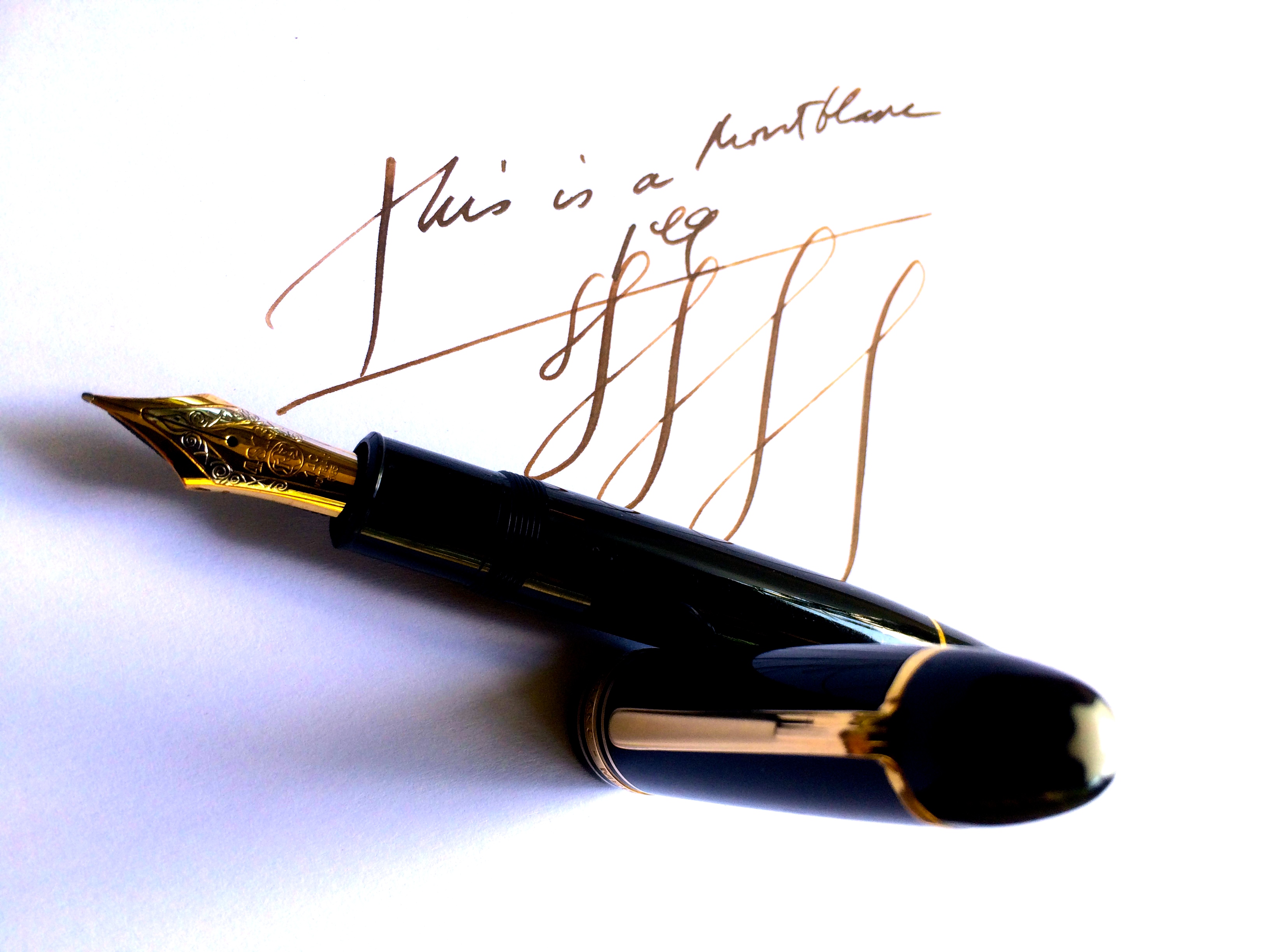
FOR THE past few decades, nothing has declared “I’m a fountain pen!” more emphatically than the Montblanc 149, also known as the Diplomat. This is the daddy of modern pens, the big kahuna, the standard by which other pens—fairly or unfairly—are measured. You’ll know a 149 when you see it. It’s as long and as fat as a cigar, which is probably why it’s been traditionally considered the quintessential man’s pen, the kind you’d find in the pockets of Supreme Court Justices, oldtime newspaper editors, and connoisseurs such as my friend the architect Toti Villalon, although fashionable but feisty ladies have been known to sport one.
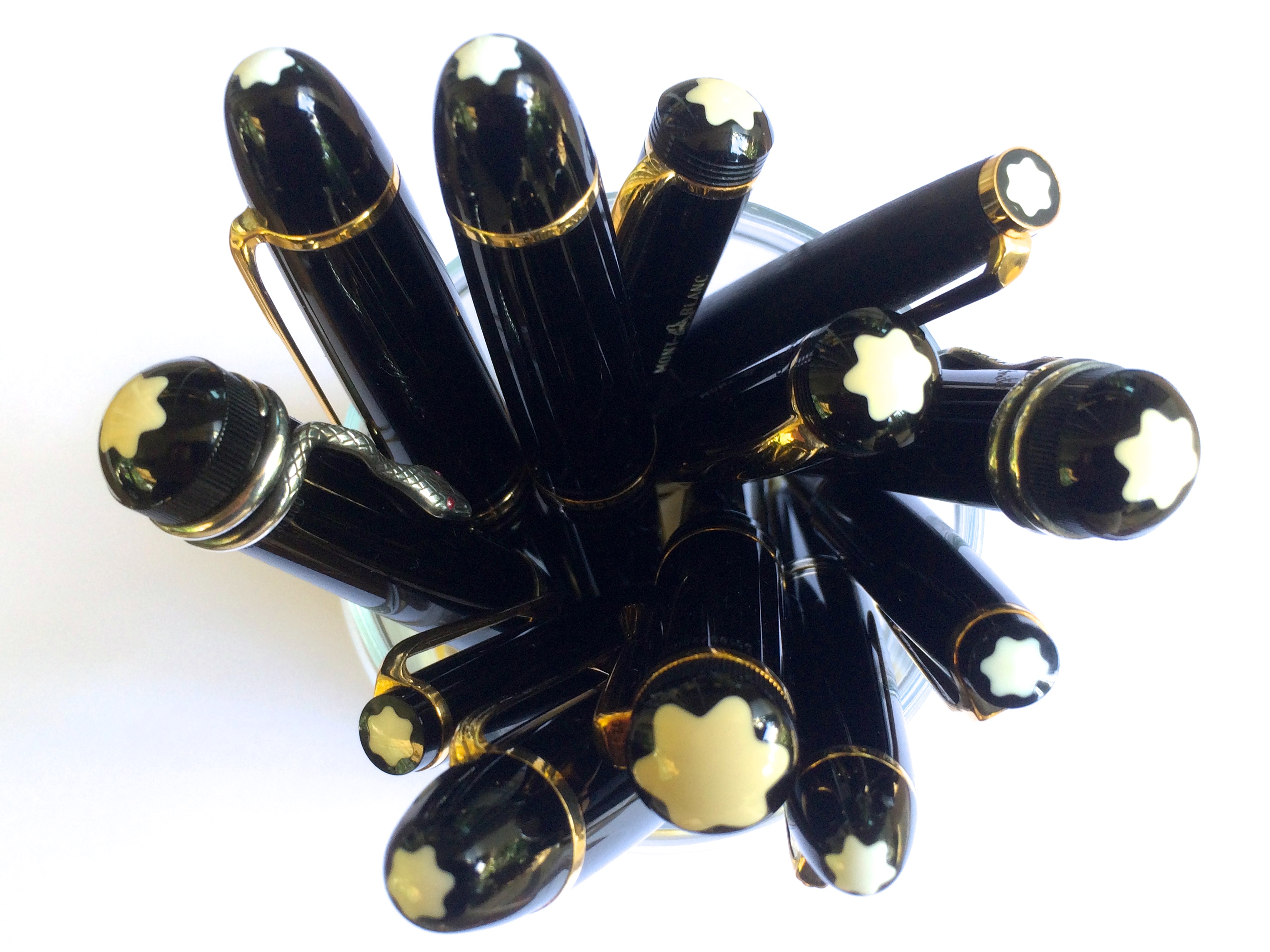
You’ll also know that that big black pen is a Montblanc because of the white star (sometimes also called the “snowflake”) on top of its cap. Montblanc, which started out in Germany in 1908 as the Simplo Filler Pen Co., later chose the now-iconic white star to suggest the snow-capped peak of Mont Blanc (“white mountain”), the highest massif in the Alps. You’ll see the number 4810 on a Montblanc nib because that’s the height, in meters, of the mountain. (Montblanc, the pen or the pen company, is always spelled as one word; Mont Blanc the mountain is always two.) Some 149s also will have a white diamond—or even nothing—in lieu of the “snowflake,” which can be construed as the Star of David: not good for sales in many places in the Middle East.
The 149’s cap ring (like that of the 146, its junior sibling) will have “Meisterstuck” engraved on it; that’s German for “masterpiece.” This year, Montblanc marks the 90th anniversary of the Meisterstuck line, of which the 149—introduced in the 1950s—remains the flagship; appropriately enough, a special 149 with rose-gold trim was produced to mark the event.
If imitation is the best form of flattery, then there’s no pen more admired—because none more copied—on earth than the 149 (or, more accurately, the slightly smaller 146, but most people wouldn’t know the difference). You can almost be sure that, somewhere in Shenzhen, there are shops and families devoted to one and one thing only: the production of fake Montblancs, for sale in such places as Shanghai’s Nanjing Road or for export by the container van to countries like the Philippines, where they will be sold as cheap corporate giveaways or passed off as the real thing to unsuspecting buyers. Given this traffic, there are websites and pages just as ardently dedicated to spotting Montblanc fakes (here’s a quick tip: if your “Montblanc”’s nib says anything like “Iridium Point Germany,” it’s fake—that’s a generic steel nib employed by many Chinese makers.)
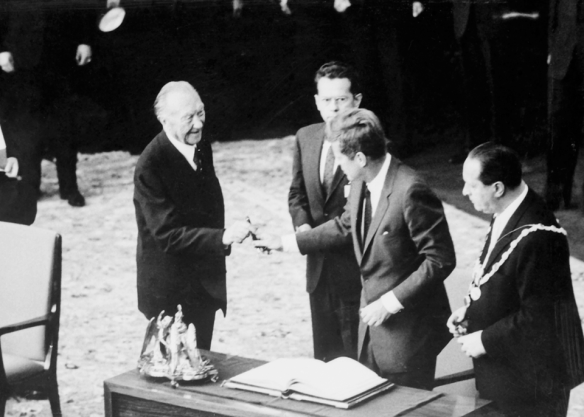
The real 149 is a classic, and deservedly so. Montblanc and the 149 gained popularity in the 1950s and the 1960s, as Americans returning from the War and from their growing contact with postwar Europe became more familiar and comfortable with things German, and with the high quality of German goods. There’s a story that when John F. Kennedy visited what was then West Germany to sign a treaty with his counterpart, Chancellor Konrad Adenauer, the German fumbled around for a pen, and JFK sprang to the rescue by offering his—a 149.
That 149, wherever it is now, should fetch a princely sum on the collectors’ market (like the big red Parker Duofold that Douglas MacArthur signed Japan’s surrender papers with). Indeed, even a new 149 (you can check it out locally at Rustan’s, the authorized dealer for the Philippines) will set most people back a few months’ wages. You can get a thousand cheap ballpoints for one 149—if a writing tool is all you’re looking for. Clearly, that’s not what 149 fanciers—yep, I’m one of them—have in mind.
Among 149 collectors, the pens to go for are not the shiny ones you can grab at the MB boutique, but the vintage ones made of celluloid from the 1950s and 1960s. The old, tricolor (gold-platinum-gold) nibs are also thought to be more desirable because they flex—the tines are soft and can spread apart, producing line variations that most modern fountain pens and certainly no ballpoints and rollerballs can.
At one time or another, I’ve had maybe ten 149s in the collection, which isn’t too strange because I buy and sell pens to support the habit. I usually pick them up on eBay for a whole lot less than they’d go for in the store, which also means I assume a lot of risks that newbies would be well advised to steer clear of. I’ve kept three of these, and regularly use one. When people ask me why I go around with such a fancy and expensive pen in my pocket, I tell them that it’s because it makes me feel like a real writer, and because I’m 60, and should be able to use and enjoy what I damn well please before I croak.
Not everyone is a fan of Montblanc and of the 149. There are legions of rabid Montblanc haters who eschew the brand in the belief (somewhat justified) that many people buy Montblanc to acquire instant status, and that the company itself has encouraged this pretentiousness by marketing the 149’s plastic as “precious resin.” Detractors see this as pure hype, designed to rack up sales among ambitious junior lawyers and middle managers.
Do you think I care what they say? I’ll never be able to afford the Range Rover or the rose-gold IWC Portuguese of my big-boy fantasies, but when I make loopy figure 8s with my vintage 149—found online for next to nothing at a small auction house in Ohio—I feel like there’s justice in the universe, after all.
I HELD this hand last night in PokerStars. Wish I had this everyday! (And don’t get excited, folks–it was a $1.50 cash game, but that’s just play money on the table.)
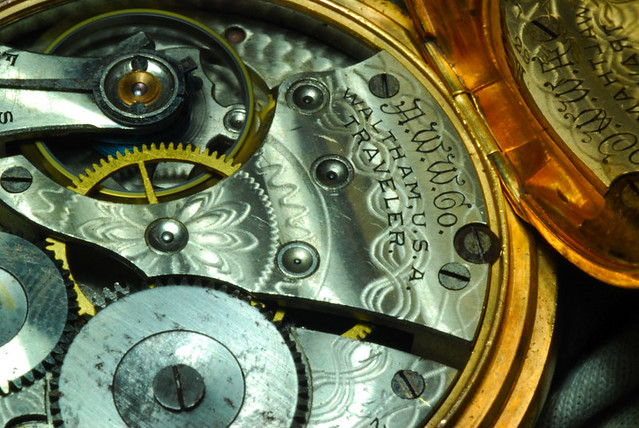
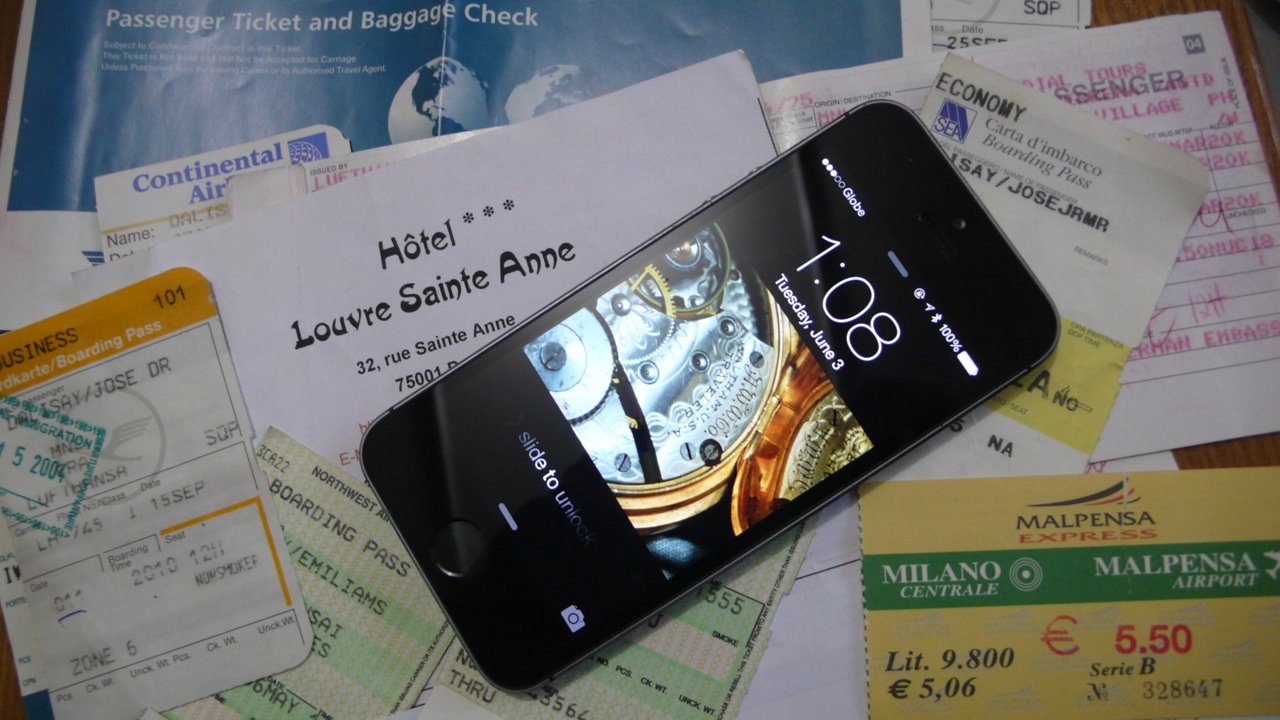
I ALSO collect old watches, and this is one of them, a Waltham Traveler pocket watch from around 1927. This picture is my wallpaper on my iPhone.
HAVING SOME fun with my Conway Stewart Marlborough and sepia ink that I mixed myself.
Penman for Monday, July 7, 2014
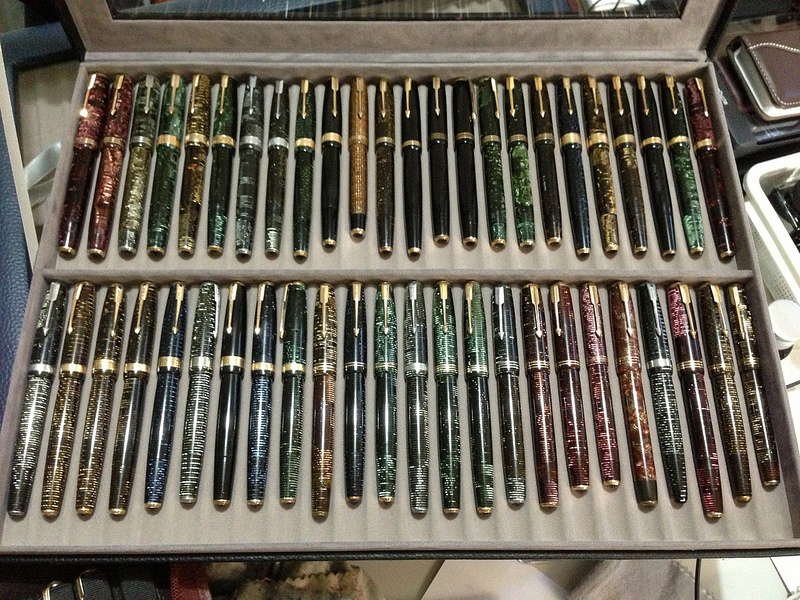
EVERY OTHER month or so, I take the 200+ contents of my fountain pen collection out of their wooden boxes and leather cases—a few of which reside in a fireproof safe—to ink, doodle with, clean, and reorganize. It’s a ritual that invariably leaves me pleased and at peace. Sometimes I reorganize the pens by age, sometimes by maker, sometimes by color or material.
Any serious collector of, well, seriously anything will recognize this behavior. And I do mean anything—I’ve met people who collect not just the usual stamps or coins or even watches and cars but barbed wire and tractor seats. (I met the tractor-seat fellow 25 years ago in a barn full of antiques in Ohio; when I expressed astonishment at his specialty, he turned around and said, with scholarly disdain at my ignorance, “There’s a fanny for every seat!”)
In the pen forums I inhabit, there’s a never-ending discussion about being either a “user” or a “collector,” the implication being that collectors are simply moneyed hoarders while users are simple, practical-minded folk who’ve never forgotten what things are for. I propose that the truth, as it often does, lies somewhere in between; many users are wannabe collectors, and most collectors have never stopped being users. It’s pointless to think of, say, a 1925 Waterman Sheraton or a 1934 Wahl Eversharp Doric as being just a pen you can write with, like a cheap ballpoint; they may have been utilitarian tools once, but somewhere along the way they crossed the line and became jewelry and art object.
At least that’s how I excuse amassing and periodically gloating over, say, my dozens of Parker Vacumatics, a 1930s-40s pen that forms the core of my collection. This was the pen I wrote my 1994 short story “Penmanship” about. (It’s a story about a story that I’ve often told, but the sum of it is that I found this 1938 Vacumatic Oversize in a pen shop in Edinburgh, paid a month’s salary for it, suffered buyer’s remorse, then decided to write a story about the pen, which won first prize in a contest that made me back my salary.) I know enough about Vacs that I can put you to sleep by mumbling mantras such as “Vac nomenclature covers a fascinating maze of models and colors—the Junior, the Major, the Standard, the Slender, the Debutante, the Oversize, the Senior, which is not to be confused with the Senior Maxima, since the Senior came out only in 1936….”
About 15 years ago it wasn’t pens but laptops—yes, Apple Macintosh Powerbooks, particularly the Duo line (the granddaddy of the MacBook Air and all those super-slim laptops people toss into their briefcases today). I had (and still have) about a dozen of these machines, which I used to take apart to upgrade the memory and hard drive (back when 240 megabytes made you king of the hill), before putting them back together again and then pressing the power button to hear that unmistakable startup chime that told me I had done everything right, so I could then step out and face the world and slay dragons and then sign memos.
So why do otherwise presumably sane people like me get our kicks by amassing strange objects most other people wouldn’t give a second look or drag into their homes even if you paid them to do it? I asked myself this question again last week as I changed out the inks (another ritual for the devotee) in my glorified Bics. Why do we take them out week after week, not to write a novel or a draft SONA but endless iterations of “I love this pen I love this pen”?
First of all, you want to be reassured that they’re still there. Collectibles have a way of walking away on little cat feet, and collectors have a sixth sense about what’s missing from the picture.
Second, you want to reassure yourself that you know why they’re there—that the objects have some aesthetic and monetary value. Perhaps that value’s known only to a very few people, which is not a bad thing, because it’s proof of your connoisseurship, of a certain esoteric form of expertise that’s taken you some time and expense to cultivate. It’s like getting a PhD in the truly little, truly fun things (and what’s a PhD these days except a lot of knowledge about very small things, hardly any of which is fun?).
You may be a total loser in nearly every other aspect of life—your face could resemble a well-worn shoe, your family may have deserted you for the coldest parts of Canada, your car could be an escapee from the junkyard—but if you know everything about tourbillons, carburetors, calibers, and (in my case) nibs, then you have good reason to face the world with pride if not arrogance; you have, after all, one of the world’s largest collection of GI Joes, or Tonkas, or Ken dolls, or whatever floats you boat.
Third, let’s go online and ask the experts. Dr. Mark McKinley, in a much-quoted piece on “The Psychology of Collecting” in The National Psychologist, goes back in time to note that “During the 1700s and 1800s there were aristocratic collectors, the landed gentry, who roamed the world in search of fossils, shells, zoological specimens, works of art and books. The collected artifacts were then kept in special rooms (‘cabinets of curiosities’) for safekeeping and private viewing. A ‘cabinet’ was, in part, a symbolic display of the collector’s power and wealth. It was these collectors who established the first museums in Europe, and to a lesser extent in America.”
Since I’m sure I don’t collect Sheaffers and Esterbrooks to show off my power and wealth, let’s see what M. Farouk Radwan (who holds an M. Sc., so who presumably knows what he’s talking about) says about the subject: “Since early years human beings used to collect food in order to feel safe and secure. Because acquiring food was a difficult process with uncertain outcomes humans learned to ease their anxieties by storing the food they needed. The same need, which is to feel secure, is the primary motivating force behind the creation of collections.
“Because life is uncertain and can easily make a person feel helpless some people use their collections to create a private comfort zone that they can control. By arranging and disarranging their collections compulsive hoarders can regain the sense of control over their lives. These actions reduce anxiety and helps those people cope with the uncertainty of the real world.”
So we go back to basic needs and instincts: food and security. McKinley puts these together: “For some, the satisfaction comes from experimenting with arranging, re-arranging, and classifying parts of a-big-world-out-there, which can serve as a means of control to elicit a comfort zone in one’s life, e.g., calming fears, erasing insecurity. The motives are not mutually exclusive, as certainly many motives can combine to create a collector—one does not eat just because of hunger.”
That’s a brilliant insight—“one does not eat just because of hunger”—and it leads to my favorite explanation of the psychology of collecting, propounded by Robert and Michele Root-Bernstein (co-authors of Sparks of Genius, the 13 Thinking Tools of the World’s Most Creative People) in “The Collection Connection to Creativity” (Psychology Today, May 2011):
“The fact is collecting exercises a number of important mental tools necessary for creative thinking. The collector learns to observe acutely, to make fine distinctions and comparisons, to recognize patterns within her collection. These patterns include not only the elements that make up the collection, but the gaps in it as well. Learning how to perceive what isn’t there is as important as knowing what is! And the collector also knows the surprise of finding something that doesn’t fit the collection pattern: Is the mismatch a fake? An exception? Something that belongs in another collection? Broken patterns are often the ones that teach us the most by challenging our preconceptions and expectations.”
Patterns, designs, mismatches, aberrations: early in 1937, just for a few months, Parker came out with a special Vacumatic, with the word “Vacumatic” etched in the gold-filled cap band. It’s one of the holy grails of Parker collectors, one of the rarest and most expensive of finds, and I have one. That should make it the crown jewel of my collection, but it isn’t; it’s the pen that made me write a story about it that’s the rarest one of all, that gives me a lifelong excuse for picking up tubes that squirt inks.
(If you like pens, join us at Fountain Pen Network-Philippines, www.fpn-p.org. We’re marking our sixth anniversary this week!)
Penman for Monday, June 16, 2014
LAST WEEK I wrote about some websites that you could check out if you’re planning to go on a trip, especially to some place you’ve never been before. Practically everything today can be planned online, from choosing destinations to booking flights and hotels and buying travel insurance. But what about when you’re already on the road?
This is where travel apps come in—“apps” being those small programs or applets (little applications) that come with your tablet or smartphone, or that can be downloaded to them. These apps can be lifesavers—literally, when you’re lost close to midnight in the bowels of a subway station in a strange city, without the foggiest idea how to get back to your hotel. Some will require an Internet connection, but many won’t, after their initial installation—and that’s when you’ll be happy and relieved that you had the foresight to install them when you could, before you even left for the airport. Whatever I’ll list here won’t be your only options—in many cases, there may even be other, better apps other will know about—but these are the ones I’ve roadtested myself, over many years of traipsing around the planet, with PDA (remember those?) or smartphone in hand. (Do note that I use an iPhone, but many of these apps gave their Android counterparts. For IOS devices, go to the App Store.)
Trip planning. If you travel often, you’ll need an all-around planner to organize your trips—remind you of your itinerary, make your bookings, check your flight status, provide weather forecasts, convert currencies, and such. Your datebook can take care of some of these things, but not all. For many years now, my reliable sidekick in this department has been an app called WorldMate, which can do all of the above, and more (it can also calculate tips).
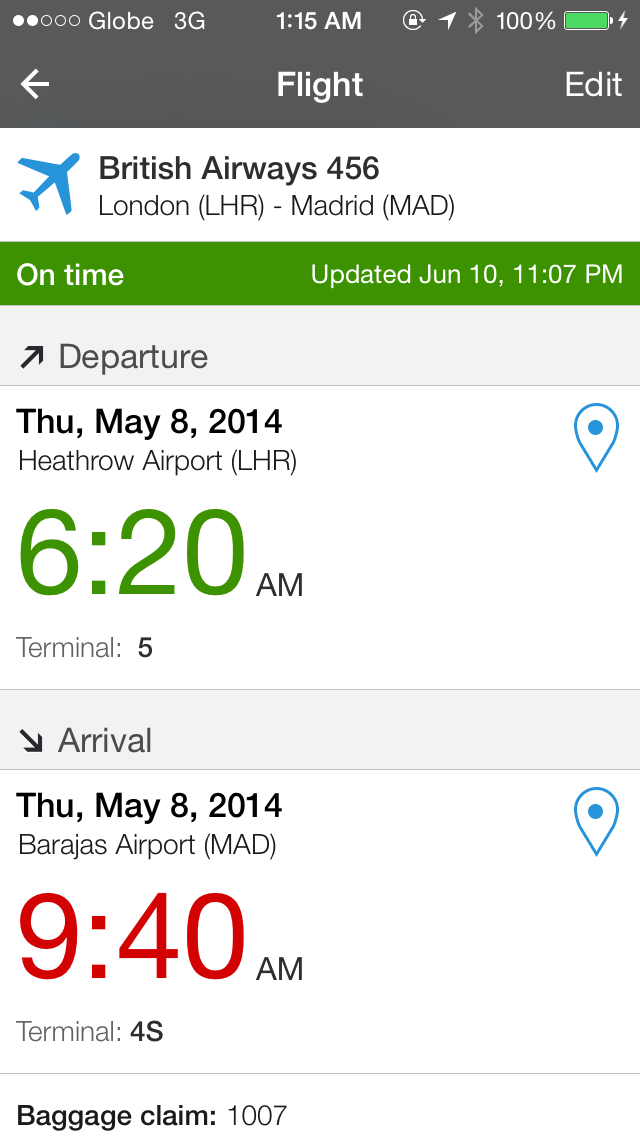
WorldMate’s strongest feature is its flight planner and notifier, which comes in really handy when you have a string of flights to take in a mad dash from one airport, one terminal, and one gate to another. Let’s say you’re flying Delta to Detroit via Tokyo Narita, or Cathay to London via Hong Kong. As soon as you make your booking and receive it in your email, all you do is forward your confirmation email or e-ticket to trips@worldmate.com. WorldMate will automatically digest that email and reflect your itinerary on the app on your phone or tablet—and, if you’ve configured WorldMate to sync with your datebook, it’ll show up on your calendar as well. If your flight gets delayed, WorldMate will advise you of it. It will give you your terminal on arrival and departure. (WorldMate has a free basic version and a paid Gold version with more features.)
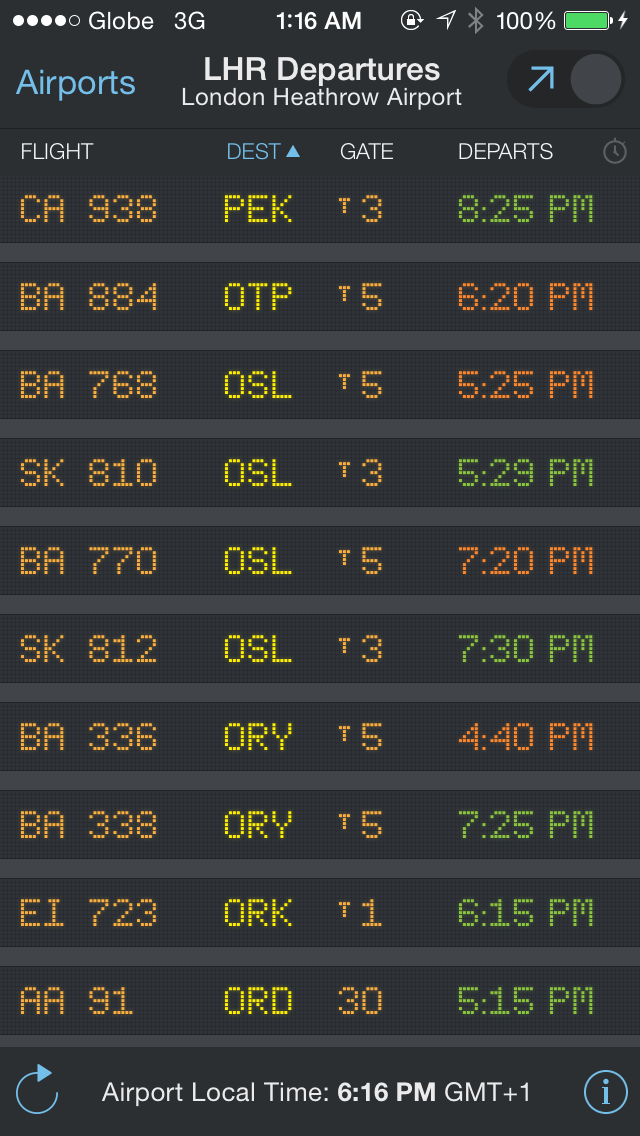
Flight tracking. You’re dashing to the airport in a cab, late for your flight, and you don’t even know which terminal or gate it will be leaving from (and if you’re really unlucky, you’ll be in Madrid, where Terminal 4 is several kilometers away from Terminal 2, and Terminal 4S takes another 20 minutes to get to); you’re praying like mad that your flight’s delayed. At this point, your friend is an app called FlightBoard, which tracks scheduled flights—arrivals and departures—at airports all over the world in real time. A similar app called FlightAware allows you to track all the flights between two airports for a given day, and to zero in on a particular one; if it’s up in the air somewhere over Siberia, it will show exactly where it’s supposed to be on a global map, much like you’d see on those onboard monitors. Both FlightBoard and FlightAware are free. (These apps are also good for when you’re meeting someone in Arrivals.)
Getting around. Once you’ve reached your destination, there are two things you’ll almost certainly need to get around: a city map, and a local transport (subway and bus) guide. Many airports will give you free city maps on arrival, and they’re fun to spread out on the table over breakfast to plan the day, but they’re a hassle to unfold at streetcorners and in the middle of the plaza to locate where you are and where you’re going (and at that instant, you might as well wear a T-shirt saying, “I’m a lost tourist—please, victimize me!”).
A good map stored in your digital device—without needing to go online, as you would with Google Maps—can save you a lot of anxiety, if not a lot of footsteps. On our recent sortie around Europe, I was glad to be guided by one invaluable resource: Ulmon maps of Barcelona, Venice, Florence, and Paris. All of these maps were free, and could be blown up to the level of individual streets and even alleys; if you feel lost, you could input the name of the nearest street, and it will locate your neighborhood in relation to popular landmarks. Clicking on the name of a hotel will give you rates; public transport stops are also indicated.
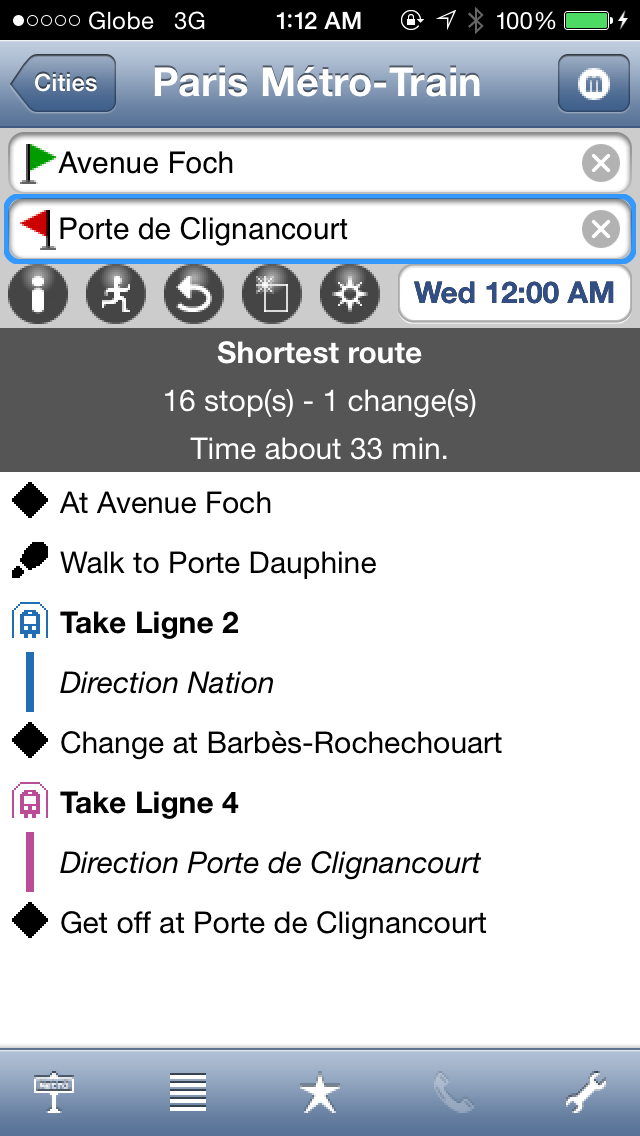
Speaking of public transport, nearly all the major cities of the world have some kind of subway or metro rail line, and this gives me an opportunity to introduce my favorite travel app of all time—and I mean that almost literally, because I’ve been using it in its various incarnations since 1999, or 15 years, an eternity in digital time. It’s called Metro, and it’ a guide to the world’s subways, metros, and bus lines. I first used Metro on my Palm Pilot when I was navigating around London, and the app—though regularly updated—has remained essentially the same. You choose a city (say Paris), and decide that, from your hotel on Avenue Foch, you want to go to the weekend flea market at the Porte de Clignancourt. You input “Avenue Foch” and “Clignancourt” and tap an icon, and Metro will yield the information that the shortest subway route will take 16 stops involving one change (at Barbes-Roucheouart—thankfully, you don’t need to know how to pronounce these names), for approximately 33 minutes total. Each subway stop is identified, as well as the direction of the train you should be taking. The best thing about Metro? It’s absolutely free, and works offline.
This list of apps could go on, but as travel is complicated enough, let’s keep it simple: for as long as you have these apps (WorldMate, FlightBoard, Ulmon Maps, and Metro), your next trip will be much less of a headache, and you can enjoy the view out the window rather than wonder and worry over where your train is going.
(Let me just add, before I forget: these apps will be totally useless if your phone or tablet is dead; I always travel with a universal adaptor, an extension cord, and a power bank for extra juice. If you blow air into my pants, I could go on a spacewalk.)
Penman for Monday, June 9, 2014
SOME FRIENDS who perhaps still miss the days when you dressed up for plane flights (even if it was only to Hong Kong) and carried your paper ticket in a cardboard sleeve asked me upon our recent return from Europe to draw up a digital roadmap for tourists. In other words, what kind of digital resources can tourists and travelers avail themselves of to ensure better, cheaper, and safer travel? By “digital resources,” we mean things that you can find online on the Internet, like hotels and their rates, or carry around with you on your mobile phone or laptop, like travel apps that can record and remind you of your bookings.
It used to be that all you needed in your carry-on was an alarm clock, the kind with two brass bells that roused you like your mother from your jetlagged slumber (if you remembered to set the alarm the night before). But now we travel with smartphones, laptops, tablets, and a raft of batteries, chargers, and adapters, the better to maintain that indispensable virtue, connectivity, also known as your digital tether to home, office, and social network. (All this should make us want to ask why we even left home and what a vacation is supposed to mean, but as everyone knows all too well these days, leaving home means bringing as much of it with you.)
So herewith, some of my favorite digital-travel tips and tricks:
Where to go. While our destinations are often chosen for us (a conference here, a wedding there), sometimes we actually have that rare and precious option of deciding where to go, budgets and schedules permitting. Everyone will have his or her own bucket list—I’d still like to visit South America, Scandinavia, and Eastern Europe someday—but Beng and I prefer to go around Asia for quick, cheap holidays, and are always on the lookout for special deals from regional airlines. Sign up with Cebu Pacific and Philippine Airlines, among others, for regular advisories on their packages. This way, we’ve visited Beijing, Kota Kinabalu, Hanoi, Shanghai and many other places nearby at giveaway fares (about P5,000 round-trip, all-in, for two of us to Beijing). Be open and adventurous, and be ready to book a trip months in advance to get the lowest fares. That also allows you to reconfigure your calendar around those trips.
How to get there. Again, check out airline offers, as well as travel agency packages. Make sure to factor in taxes and surcharges, which can bloat the final bill. What you want to get is the “all-in” price. Factor in baggage allowance; some airlines will charge you even for your first checked bag, especially on local flights. Budget airlines can offer aggressively low fares, especially off-season (that’s why we went to Beijing in December—freezing, but fewer fellow tourists to nudge you around), but it won’t hurt to check as many rates as you can. There are many online guides where you can check prices and book flights—Expedia, Orbitz, Travelocity, etc.—but I use SkyScanner (skyscanner.com.ph) a lot; it gives you the price in pesos, and immediately identifies the lowest price, with many other options. Sometimes it’s also good to check directly with the airline; recently, I found that Air France, on its own website, was offering a flight from Paris to Madrid that was lower than anyone else’s. Also, sometimes, cheapest may not always be the best for you. Cebu Pacific has great regional fares, but they often mean arriving in your destination around midnight, costing you a day and some anxiety in a strange airport. Adding a little more could also mean extras like a better plane and a better layover (we chose to fly BA to Madrid and back via Heathrow, to try out the new A380 and even marginally revisit London, one of our favorite cities). For local travel, don’t forget to explore your train and bus options—ground travel may be slower and not always cheaper, but you’ll see a lot more of the country.
Where to stay. Beng and I are lucky to get special rates from the Starwood chain (Westin, Sheraton, Le Meridien, etc.) because our daughter works there, but when we have to find other hotels, then TripAdvisor and Booking.com are our best friends. As a rule, I never book a hotel (even a Starwood one) without checking the TripAdvisor reviews, which can reveal problems like “great hotel, but terrible location” or uncover pluses like “free, strong wi-fi, two minutes’ walk from the Metro.” TripAdvisor can rank hotels according to your budget and other preferences, assigning one to five stars. Once, on a lark, Beng and I decided to go slumming in Hong Kong and stay in the cheapest dive we could find, so I reversed TripAdvisor’s rankings and found a one-star place on Nathan Road. It was cheap—and fun; we survived! Booking.com is another great guide to hotels and bed-and-breakfast places; they allow you to book often without any downpayment, cancellable without penalty within 24 hours of your stay. I booked our Venice hotel in Mestre and our Madrid airport hotel on this site. (A tip about Venice and Mestre—hotels in prime tourist spots like Venice can cost a fortune, but staying in places like Mestre, a very short train ride from Venice, can save you precious euros better spent on food and sightseeing.)
What to do. Every destination will have scores of travel guides online, but again, TripAdvisor’s thousands of reviews will give you a good sense of what’s worth visiting and what you can forego, especially on a tight budget and schedule (we passed up going to Halong Bay in Vietnam—pretty pictures, but a very pricey day trip). Like I wrote in a recent column, this is where we often let Serendipity take us by the hand and just let one streetcorner lead to another. Unlike many others, travel for us isn’t racking up a series of posed shots before famous landmarks; it’s about seeing what most other people will miss, or doing what most other tourists won’t. I don’t necessarily mean “going native,” which no one can honestly do on a three-day parachute tour, but finding or straying into unusual places, like that dusty, forgotten museum in Shanghai filled with dinosaurs and ancient, mummified Aryans, or that bookshop in Hanoi selling bright purple ink for 20 pesos a bottle.
Before I forget, and even before you begin your digital tour, scan, save, and upload (to one of your own email accounts) copies of your passport, visas, and travel insurance. (Yes, you can and should book travel insurance online—it’s one of those things you’ll be happy to never need.)
Next time, I’ll list and discuss specific apps—WorldMate, Metro, and FlightBoard, among others—and other tools (maps, photos, currency exchange) to help make that next trip of yours a more pleasant and fulfilling experience—as long as you don’t lose your tablet or smartphone.
Penman for Monday, May 26, 2014
MAYTIME IN Europe, particularly in Spain, is a festive season; Madrid has the same patron saint and feast day as many Philippine towns such as Lucban—San Isidro Labrador, on May 15—and so it was a fine time to be there these past two weeks. We missed the actual feast days, and in France all the buzz was going on in Cannes while we were in Paris, but it was just as well because the crowds were a bit smaller but the experiences no less interesting at the periphery.
As I mentioned last week, doing six cities—Madrid, San Sebastian, Barcelona, Venice, Florence, and Paris—in 12 days is murder for sexagenarians, and maybe not the best way to get to know places, but the intensity of this “amazing race” approach has its own advantages and surprises.
I’m usually an obsessive planner when it comes to travel, going digital as much as I can, months in advance—from consulting TripAdvisor to making plane and hotel bookings to reconnoitering possible spots to visit and downloading street maps, subway guides, and travel apps. (I’ll do a separate piece on this madness, one of these days.) This time, aside from some basic planning, we left many things to chance, going by such general interests as “museums and flea markets” or “art galleries and food” to guide us though a city. Serendipity (informed, to some extent, by a limited budget) proved to be the best tour guide, as we allowed one street to lead to the next, and open up to unexpected delights.
San Sebastian, or Donastia in Basque, was the wild card on our itinerary. The place doesn’t figure in most visitors’ travel plans, and frankly, as global-savvy as I pretend to be, I had to look it up on a Spanish map when our daughter Demi and her husband Jerry mentioned it to me. The two had met Anthony Bourdain at an event in California, and had asked him where in the whole world he would retire if he had his choice, and Bourdain didn’t take two seconds to answer “San Sebastian,” obviously because of the food.
That answer stuck with Demi and Jerry, and when the four of us started planning our European sojourn early this year—we made all our bookings in mid-January—San Sebastian was firmly on the list, although we knew very little about it. For me, the appeal was that it was up in Basque country, on the coast of the Bay of Biscay close to the French border, so it promised an atmosphere different from central Madrid, or Barcelona in the Balearic-Mediterranean south. I also relished the thought of taking the five-hour train ride cross-country; train travel is one of Europe’s most relaxing treats.
The Basque language, I’m sure, has its poetic charms, but to the untrained eye and ear (like mine) it might as well be Klingon, with a surfeit of X’s, K’s, and T’s. Many words have absolutely no relation to their Spanish or Latin counterparts; a restaurante in Spain or a ristorante in Italy is a jatetxea in Basque.
That said, food is a universal language, and while I’ve maintained a stubborn and silly pride in calling myself a culinary philistine (as usual, I brought six packets of ramen in my suitcase), I had to yield to the majesty of Basque cuisine, particularly their pintxos—the local version of the more familiar tapas. Laid out on the bar of every jatetxea we entered, and selling for a little over a euro each, the pintxos were scrumptious combinations of such staples as shrimp, crab, mushroom, asparagus, anchovy, jamon serrano, and bread.
Good, affordable food would be our constant on this tour, often found in rather unlikely places (no Michelin guide for us, just our budgets and our noses): the best pasta we’d ever had, in a nondescript restaurant in Florence; a roast chicken, rice, and salad dish at the Doner Kebab place beside our airport hotel in Madrid; a dish of stewed mushrooms in Madrid and then also in Barcelona.
Our next high came from shopping—albeit more with our eyes than our wallets. Beng and I are incorrigible flea and weekend market addicts, and we’ve been to a few of the world’s better-known ones, from Hell’s Kitchen in Manhattan and Portobello Road in London to Chatuchak in Bangkok and Panjiayuan in Beijing. Providentially, our European schedule coincided with the Mercat del Encants in Barcelona and the Marche aux Puces de Saint-Ouen at Clignancourt in Paris. Hundreds of stalls and tons of glorious junk met us in both places, from century-old magazines and posters to ‘20s flapper dresses and hats and erotic postcards of nubile maidens long vanished.
I did find quite a few fine fountain pens—only to realize, alas, or perhaps fortunately, that I should be happy with my present collection, and that looking without buying can be pleasure enough. I came home from Europe with a new panama hat from Madrid (where, I would find, it was quite the fashion) and a 4-euro, 1960s bottle of Pelikan ink in royal blue, still almost full and certainly usable, from Barcelona. Beng and I kept looking at marvelous pieces of décor and sighing, “If we had a larger house…” or “If we were younger….” and then taking a picture for the memory before walking away.
Third, next to food and markets, were the sights themselves. With limited time, we focused on museums, landmarks, and gardens. Everyone goes to Barcelona to see Gaudi’s outrageously magnificent Sagrada Familia, and we did, if only from the outside, from where there was more than enough to appreciate, from the strawberries to the scripted verses climbing up the spires. What resonated more deeply with me was a visit to the Castell de Montjuic, an imposing fortress with a tragic past, including the brief incarceration of Jose Rizal in 1896, shortly before his forcible return to the Philippines; an exhibition room in the fortress is named after Rizal.


Venice and Florence were the original reasons we thought of this tour; having visited them three years ago, I vowed to bring Beng along to see them, and we just had time for a long vaporetto ride around Venice in the gathering dusk and a day trip by train to Florence. Both cities offer a surfeit of majestic sights, but again it was less the landmark everybody knows than the accidental detour to a spectacular sunset from a little bridge and a view of steeples in the Tuscan countryside that mattered more.
Beng and I had been to Paris twice before, for very brief sorties like this one. In 1999 we almost literally breezed through Paris on a bus from England, on a 99-pound all-in weekend tour; Beng made the mistake of going to the onboard loo while we whipped past Rodin’s “The Thinker.” In 2002 we spent another couple of days in Paris on our way home from my month-long fellowship in Bellagio, and I was so starved for Chinese food that we ate nothing but Chinese, in the restaurants behind the Galeries Lafayette (we went back there last Sunday for a reprise, but the place was closed, much to our dismay).
We revisited the Louvre, and of course again the Mona Lisa (this time set a little farther back from the public than it used to be, but still accessible enough for the inevitable selfie). The Louvre draws 15,000 visitors a day, most of them, like us, paying the standard admission of 12 euros—a cost you’ll quickly forget the minute you step into the galleries. This time I happily stumbled into a hallway exhibiting three of the most iconic of French paintings: Delacroix’s Liberty Leading the People, Gericault’s The Raft of the Medusa, and David’s The Coronation of Napoleon. Somewhere in the Egyptian antiquities section, my knees began to wobble, and I knew it was time to declare an end to our museum-hopping.
What we’ll remember most from this trip is a leisurely walk through the Jardin des Tuileries, across the bridge to the Musee d’Orsay, then back to the big fountain in the park, trying to take in the immense joy and gloriousness of a spring day shared with the one person you’d like to see the world with. It was the gift of a lifetime, for which Beng and I would like to thank Demi, Jerry, and the gods of poker.
Penman for Monday, May 17, 2014
I’M WRITING this at the airport in Barcelona, awaiting the departure of our much-delayed flight to Venice. Beng and I are at the midpoint of a two-week jaunt through Europe, and we’ve just said goodbye to our unica hija Demi and her husband Jerry, who are going on to Rome and to Sardinia. We spent a blissful week together in Spain—meeting up in Madrid (Demi and Jerry live in California, in San Diego), then spending a couple of days each in San Sebastian and Barcelona.
I’m taking Beng to Venice and Florence in fulfillment of a promise I made three years ago, when I first visited those cities, to share the wonders of those cities with her, the artist and conservator who will surely gain more from the experience than I can; and then we’ll pass by Paris before flying back to Madrid, then home. For us, as footloose as we already are, it’s the trip of a lifetime—largely a treat from Demi and Jerry for our 40th anniversary, and partly realized by my recent poker windfall; I figured the stash was better spent popping our heads into a few museums and cathedrals rather than vanishing chip by chip back across the green felt table.
For reasons I just made obvious, we’re calling this our “Amazing Race,” a breathless dash across three countries in Europe, with layovers in London and Hong Kong, in 14 days. I know, I know—the seasoned travelers among us will say that this is no way to see Europe, and that one’s time is better spent savoring one or two places and their features to the last morsel than hopping like mad rabbits across borders and barely seeing or tasting anything. But while it’s our first time in Spain, Beng and I have been to Europe before, and are used to and prefer this kind of cherry-picking: a little of this and that, much the tapas and pintxos on offer in the restaurants of Madrid and San Sebastian. We’ll happily admit to being shameless tourists than National Geographic correspondents, although, of course, I can’t help taking the notes I’m now sharing with you.
Having gone around the planet quite a bit, we came to Spain quite late. I’d always wanted to see what Jose Rizal saw. Today’s Spain may be a vastly different place in many respects from Rizal’s time, but so much of Europe, and thus Spain, is immutably set in hard rock, and remains impervious to rain, wind, and time.
We flew into Madrid on a bright spring morning, and quickly discovered, to our great delight, that it was a city of parks, plazas, museums, monuments—and restaurants and bars. The first thing that hits you about Madrid is its architecture, steeped in neoclassical grandeur, the streets all at sharp angles converging in roundabouts capped by marble statues erected to the memory of heroes, not all of them warlike figures but rather also icons of art and literature. You’re never too far from reminders of Spain’s imperial legacy in Madrid. The first museum we visited was the Naval Museum, rich with exhibits from Spain’s colonial exploits, including the Philippines, represented by a roomful of precious artifacts from the San Diego wreck of 1600 and by yet another gallery of native weaponry from Filipino tribes.
Just a few blocks away was the Prado, Madrid’s temple devoted to its most sublime masters of centuries past—Velasquez, Goya, El Greco, and Sorolla, among others. Since visiting the Louvre more than a decade ago, I’ve always been amazed by the freshness and luminosity of paintings 500 years old; some of it, of course, is due to the skill of restorers like my wife (who was incidentally trained by Spanish teachers), but in a world lit by only candles and torches, the masters knew best how work with light and to use it to best effect.
But as enthralled as I was by this encounter with the finest art of the past, it was at the Reina Sofia museum—again within walking distance of most other places of interest in central Madrid—that I nearly fell on my knees as I approached and beheld Picasso’s massive Guernica, his enduring indictment of war. The Reina Sofia is Madrid’s modernist counterpart of the classical Prado, and its stunning façade alone and the plaza before it are well worth the visit. Here, Picasso, Miro, and Dali rule, along with many other less known but no less fascinating champions of new ways of looking at and representing reality and irreality. Here, as I did years ago at London’s Tate Modern, I remembered and understood again why classical art held me in awe, but modernism spoke more directly and more deeply to me—making me laugh, making me think, and making me angry or sad, sometimes all at once.
One more thing I noticed about Madrid’s museums and other attractions like the Botanical Garden and the Royal Palace: you may have to pay a modest fee to get in—it was 3 euros at the Naval Museum—but if you wait until the last couple of hours (6:00-8:00 pm at the Prado) or for special days, you could get in for free. Also, for the first time in my life (and I should add the first place, because nowhere in the Philippines did I get this favor), my university faculty ID gave me free entry. That’s a society that values its teachers.
For all our museum-hopping, my favorite “museo” turned out to be the Museo de Jamon, a chain of restaurants you’ll find on every other city block offering all manner of meat, and a scrumptiously wet seafood paella. I quickly grew addicted to bocadillo de jamon—thin slices of jamon serrano in crusty bread—which was on special at the Museo de Jamon for one euro apiece.


We did as tourists do: hang out at the Plaza Mayor and Plaza del Sol, watching an anti-fascist demonstration here (like Marcos, Generalissimo Francisco Franco died decades ago but his victims have yet to receive full justice) and a busker there (playing what else but Tarrega—whose Gran Vals many will inadvertently if cavalierly know as the source of the Nokia ringtone). We dipped churros in our chocolate at the Chocolateria San Gines, which has been in the business since 1894; but even this venerable chocolateria seemed a newcomer compared to the Restaurante de Botin, reputed to be the oldest running restaurant in the world, having opened in the same place in 1725. More contemporary-minded diners will prefer a quick bite at the trendy Mercado de San Miguel, an old market converted into a covered food court just off the Plaza Mayor, and neatly organized: all the meats here, all the sweets there, and so on.
The culinary and perhaps even cultural highlight of our Madrid sojourn took place in a hole-in-the-wall restaurant close to the Reina Sofia. Unlike me and even the far more adventurous Beng, Demi and Jerry are gourmets who seek out and relish fine food, but—perhaps out of respect for the philistine papa—we had resolved to eat like the locals on this trip, and so we spent our last night in Madrid feasting on paella, mushrooms, patatas bravas, and chicharrones, washed down with what apparently was Madrid’s if not Spain’s most popular beer—San Miguel. This is our beer, we tried to tell the genial restaurant owner in our best pidgin Spanish, but I don’t think the Empire heard us.