Penman No. 199: A Bell from Bauang

IMG_3136.JPG

Penman for Monday, April 25, 2016


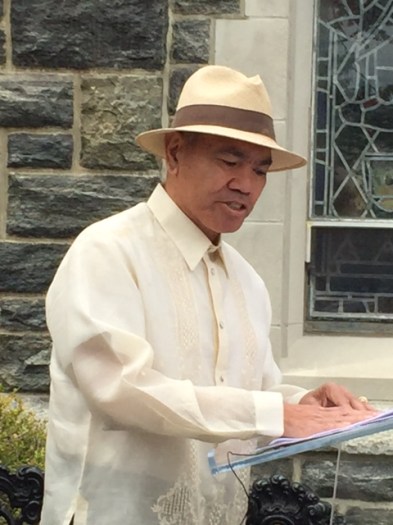
SANTIAGO “SONNY” Busa is one of the most remarkable people I’ve met. I was introduced to him when I spent some time in Washington, DC on a fellowship a couple of years ago, and from the very first time we sat down for a chat in the backyard of his home in the DC suburb of Annandale, Virginia, we hit it off. He possesses a hilarious, self-deprecating wit, is fascinated by history, and speaks, among other languages, Spanish, Ethiopian and Chinese. Ironically, though born in Eastern Samar—he was practically just a baby when his family moved to the US—Sonny doesn’t speak Filipino (or, we keep joking, pretends not to, so he can listen in on what everyone is saying).
IMG_3148.JPG

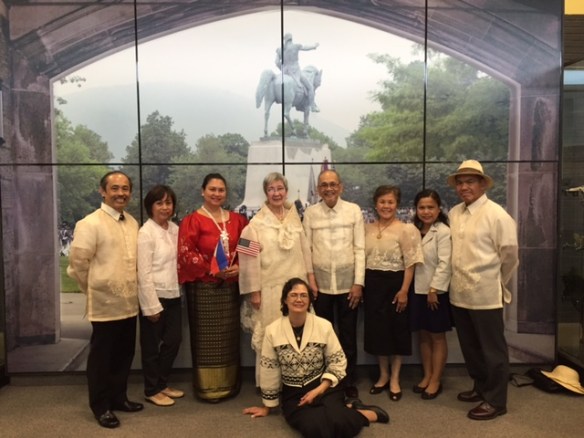
A retired diplomat who served as consul general at the American embassy in Manila, among other postings some years ago, Sonny had also been a US Army Ranger and parachutist, and taught International Relations at his alma mater, West Point. For all that, he’s a flaming liberal (like me), doesn’t believe in keeping an armory or packing a .45 to feel masculine or secure, and devotes much of his time to promoting the Philippines and Philippine concerns in America along with his lovely wife Ceres. Last year, he was a key figure in the commemoration of the Bataan Death March in New Mexico, where 5,000 soldiers and civilians marched across the desert for more than 26 miles—and they’ve been doing this for 27 years now!

But Sonny’s recent messages gave me a special reason to smile. He’s been a staunch advocate for the return of the three bells taken as war trophies by American troops from Balangiga, Samar in 1901—two bells remain in a “Trophy Park” in a military base in Wyoming, and another is in a military museum in South Korea. Despite the strenuous efforts of both Filipino and American activists to have those bells returned, it hasn’t happened yet.

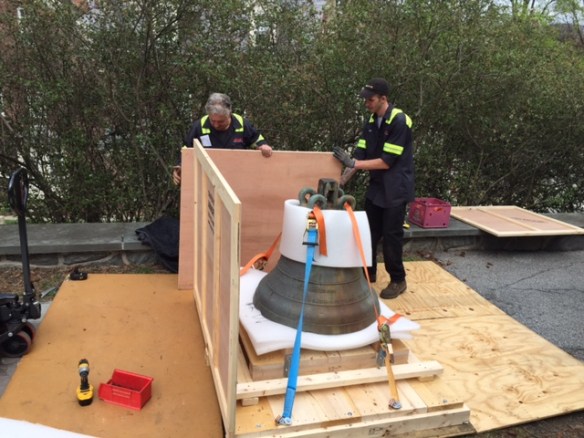
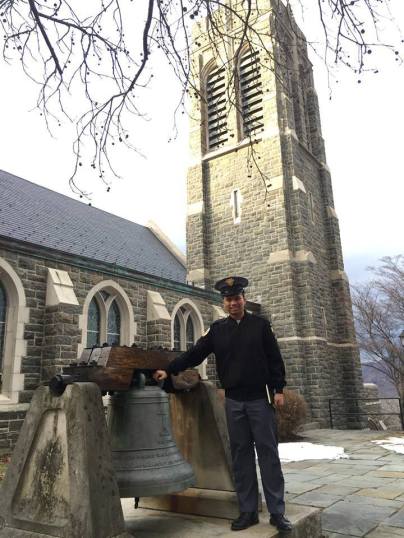
As it turns out, the Balangiga bells weren’t alone. In 1899, during the Philippine-American War (which the Americans insisted on calling an “insurgency” for the longest time), a Lieutenant Tom Berry took a bell from the Church of St. Peter and Paul in Bauang, La Union and shipped it to America, where it languished for over three decades in some Army warehouse. In 1933, the same soldier—now General Berry, the superintendent of West Point—had the bell taken out of storage to be displayed at the Catholic chapel of the academy.

Last January, acting on an inquiry from Fr. Ronald Raymund Chan of the Diocese of San Fernando, Lt. Gen. Robert Caslen, Jr.—the current superintendent of West Point and a friend of Sonny’s—wrote Fr. Chan back to say that “The bell currently displayed on the grounds of our Catholic Chapel here is apparently the bell in question. According to our own records, the markings on the bell itself matches all the descriptions you provided. While we have been honored to guard and display this bell for the past several decades, we would be glad to return the bell to its rightful home. We are currently in the process of making arrangements for the return of the bell to your Parish.”
IMG_3179.JPG

Aside presumably from Fr. Chan and the people of Bauang, no one was happier about this outcome than Sonny Busa, who had married Ceres in that chapel in 1977 in a military wedding, and had looked with fondness at the bell every time he visited the academy. He alerted me and some friends about the San Pedro bell last February, but asked us to keep quiet about it for the meanwhile until the return arrangements were finalized, fearing that Americans opposed to the return of any war booty—especially the Balangiga bells—would torpedo the move.

Last month, on the 29th, the send-off finally took place at West Point, with Sonny Busa, Philippine Consul General in New York Mario de Leon, and prominent members of the Filipino community in attendance. Another good friend of Sonny and mine, the Filipino-American historian Sharon Delmendo, stood as both proud witness and photographer. Another special participant was Filipino exchange Cadet Don Dalisay—to whom I would be glad to claim a relation, because Sonny says that he’s at the top of all his classes at West Point.
Dalisay Bell.jpg

In his message to me, Sonny—who had been put in charge of the turnover ceremony—emphasized that Gen. Caslen had “ordered the bell returned to La Union because it belongs in its rightful home. West Point above all stands for high morals in all that it does and teaches and keeping looted war booty is not part of its ethic. The people of La Union are hyper-excited and have already built a display stand. Once the bell arrives it will be big news in the whole of the Philippines as you can imagine.”

That truly is wonderful news, Sonny, and many thanks from your kababayans for your tireless efforts to help right the wrongs of the past and to remind us of our precious heritage.
IMG_3112.JPG

But sadly—as I write this on the eve of one of the most important and contentious elections of our modern history—I fear that too many of us have forgotten how valuable our democracy is, and what artifacts like the San Pedro bell stand for. At war with ourselves and with foreign invaders long gone, we seem far too willing to squander our votes on mindless whimsy and puerile petulance.

I so desperately pray we can prove ourselves deserving of that bell, Sonny. How hollow its ring would be otherwise—a death knell for sanity and decency, rather than the vibrant peal of freedom.

(Photos by Sharon Delmendo and Sonny Busa)
Penman No. 196: A Frenchman in Jalajala

Gironiere1.jpg

Penman for Monday, April 18, 2016


I USUALLY ask my wife Beng to ride out with me on a day trip during the Holy Week break, and this year our destination was rather unusual, in that it never figures in the travel plans of Manileños, although it’s a short and pleasant drive from Quezon City or Ortigas. We took the scenic route from Diliman via Antipolo, Teresa, and Morong, and soon found ourselves following the lakeshore of Laguna de Bay on the peninsula of Jalajala, Rizal, described by the guidebook as “a fourth-class municipality with a population of 30,074 people.”

We were there on the trail of an extraordinary author and adventurer who, nearly two centuries ago, had lived in Jalajala, and had written about his sojourn in a book that had been a favorite of mine for 40 years.

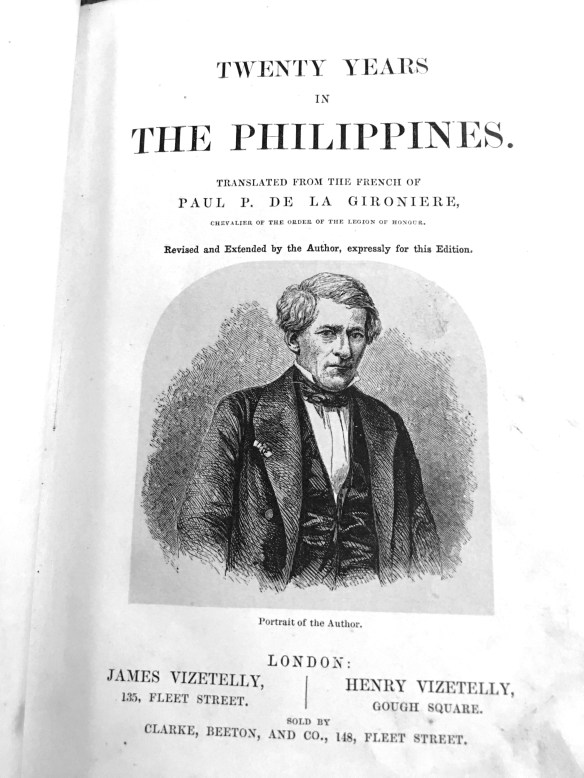
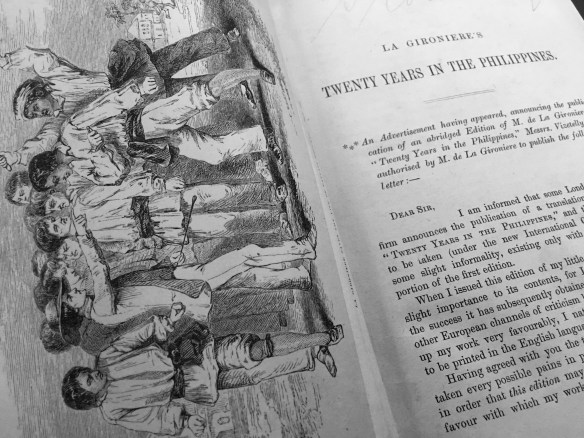
The book was Paul Proust de la Gironiere’s Twenty Years in the Philippines (subsequently expanded under the title of Adventures of a Frenchman in the Philippines), and I had recently acquired a copy on eBay, all the way from the UK—the first English edition published by James and Henry Vizetelly, undated but very likely from 1853, a year ahead of the American edition published by Harper & Bros. in 1854. The copy was far from mint, but it was in its original binding and still very readable, and wonderfully illustrated with engravings of local scenes.

Gironiere2.jpg

Gironiere was an adventurer from France who came to the Philippines in 1819 in his early 20s as a ship’s surgeon and stayed on for the next two decades, establishing himself as a landlord and farmer in what today is Jalajala, Rizal. His travails begin shortly after his arrival on the ship Cultivateur, and his account of a massacre shows why his book is—in that awful word coined by book reviewers—“unputdownable”:

I had only resided a short time at Cavite when that terrible scourge, the cholera, broke out at Manilla, in September, 1820, and quickly ravaged the whole island. Within a few days of its first appearance the epidemic spread rapidly; the Indians succumbed by thousands; at all hours of the day and of the night the streets were crowded with the dead-carts. Next to the fright occasioned by the epidemic, quickly succeeded rage and despair. The Indians said, one to another, that the strangers poisoned the rivers and the fountains, in order to destroy the native population and possess themselves of the Philippines.

On the 9th October, 1820 … a dreadful massacre commenced at Manilla and at Cavite…Almost all the French who resided at Manilla were slain, and their houses pillaged and destroyed. The carnage only ceased when there were no longer any victims. 

…Four hundred Indians surrounded me; the only way of dealing with them was by audacity. I said in Tagaloc to the Indian who had attempted to stab the captain: “You are a scoundrel.” The Indian sprang towards me; he raised his arm: I struck him on the head with a cane which I held in my hand; he waited in astonishment for a moment, and then returned towards his companions to excite them. Daggers were drawn on every side; the crowd formed a circle around me, which gradually concentrated. Mysterious influence of the white man over his coloured brother! Of all these four hundred Indians, not one dared attack me the first; they all wished to strike together. Suddenly a native soldier, armed with a musket, broke through the crowd; he struck down my adversary, took away his dagger, and holding his musket by the bayonet end, he swung it round and round his head, thus enlarging the circle at first, and then dispersing a portion of my enemies. “Fly, sir!” said my liberator; “now that I am here, no one will touch a hair of your head.” In fact the crowd divided, and left me a free passage. I was saved, without knowing by whom, or for what reason, until the native soldier called after me: “You attended my wife who was sick, and you never asked payment of me. I now settle my debt.”

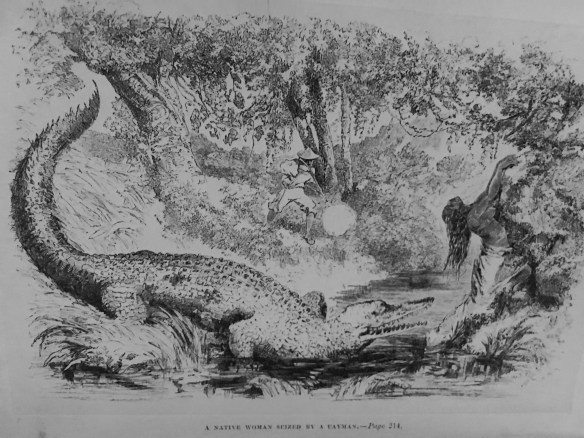
I had first read the book a long time ago, and kept my copy of Adventures, in a Filipiniana Book Guild edition reprinted locally in paperback by Burke-Miailhe in 1972, with a foreword by the eminent historian and economist Benito J. Legarda. In his foreword, Dr. Legarda says that Gironiere’s book was “probably the best seller among books about the Philippines in the 19th century,” noting that “What attracted the 19th century reader was of course the narration of several adventures, at that time considered unusual or bizarre. Among them may be enumerated the killing of man-eating crocodiles, the hunting of wild carabaos, the exploration of caves, the customs of pagan tribes, and the adventures of those caught in captivity by Moro pirates.”

IMG_8257.jpg

While granting that Gironiere’s accounts may have taken certain fanciful liberties, Legarda also considers the many real contributions the Frenchman made to his adopted soil, particularly as an agricultural pioneer who planted coffee, abaca, indigo, and rice on his 2,400-hectare estate in Jalajala, then part of Morong. Of Jalajala, Gironiere would write that it was “the greatest game preserve in the island: wild boars, deer, buffaloes, fowls, quail, snipe, pigeons of fifteen or twenty different varieties, parrots in short all sorts of birds abound in them.”

Gironiere returned to France in 1839, crushed by the deaths of his son, daughter, and wife, and he eventually remarried, and yet nothing, he said, “could induce me to forget my Indians, Jala-Jala, and my solitary excursions in the virgin forests. The society of men reared in extreme civilisation could not efface from my memory my past modest life.”

IMG_8124

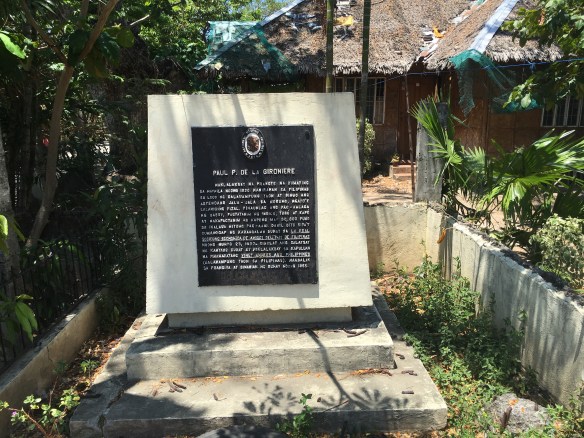
Was there anything left of Gironiere’s vast estate? All I could find on the Internet was a marker put up by the National Historical Institute in 1978 on what presumably had been his property, so I resolved to find at least that. We were there on the Wednesday of Holy Week, so I knew I had to catch someone at the municipio before it closed for the half-day, and fortunately a kind gentleman from the agriculturist’s office recognized the marker and offered to lead us there. And a short drive later, there it was, on a lot in the shade of towering acacia trees.

Nothing else would have suggested Gironiere’s presence, except possibly a stump of bricks in a corner of the lot. Not too far away was the water’s edge, and the slim profile of Talim Island, which Gironiere would have seen out his window. I struggled to imagine this spot as the center of a visiting Frenchman’s adopted life and holdings, his pursuit of bats and lizards, crocodiles and gold dust.

I didn’t feel let down; I was looking at an empty stage, but I knew the play, and I could hear the lead actor’s parting words: “Overwhelmed by the weight of troubles and of the laborious works I had executed, there was only one wish to excite me, and that was, to see France again; and yet my recollections took me continually back to Jala-Jala. Poor little corner of the globe… where my best years were spent in a life of labour, of emotions, of happiness, and of bitterness! Poor Indians! who loved me so much! I was never to see you again! We were soon to be separated by the immensity of the ocean.”