Hindsight No. 5: The Dropout Factor

Hindsight for Monday, February 14, 2022

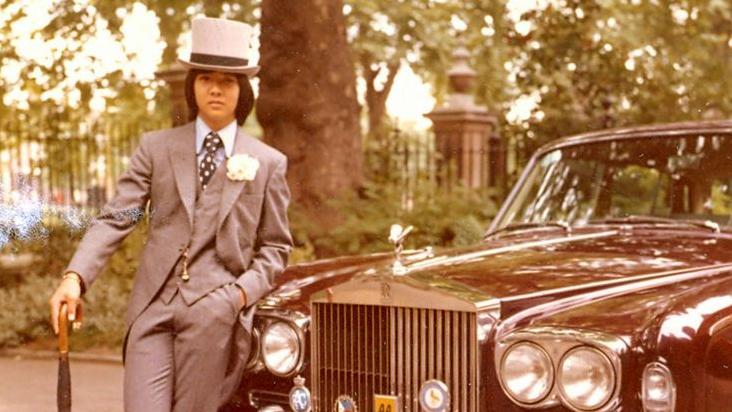
(Image from thetimes.co.uk)

HOW MUCH of a factor is Ferdinand Marcos, Jr.’s being a college dropout in making people decide whether he’s worthy of being voted President or not? The anti-Marcos forces seem to think it’s a viable issue, on two counts: first, that Junior failed to complete his studies at Oxford and subsequently at Wharton, despite the extravagant resources put at his disposal; and second, that Junior and his people have repeatedly asserted that he graduated from both institutions, despite clear evidence to the contrary. 

One would think that, in a country where higher education is widely seen to be the only ticket out of poverty, Junior’s profligate ways should have turned off if not outraged large swaths of the CDE electorate that everyone now acknowledges will effectively choose our next leader.

The picture of him posing as a top-hatted dandy in front of a Rolls Royce when he should have been sticking his nose into a book in the library should be sickeningly ridiculous to anyone who has had to take three sweaty and dusty jeepney rides to school. That he or his cohorts would insist that he has a BA and an MBA from the world’s top universities without proof of an actual diploma should offend anyone who failed to finish college, despite a bright mind and high grades, for lack of money—like my father did.

But sadly I suspect that for many of Junior’s supporters, the dropout factor is a non-issue, for a number of reasons. To begin with, going by the statistics, ours is a nation of dropouts. Even well before the pandemic, according to one study, the graduation rate from college was only 61%, which means that two out of every five students fell off the rails. So Junior should be in good company. 

I myself dropped out of UP in my freshman year because I was becoming increasingly more involved with student activism, and I was also itching to get a job and earn some money. Like many dropouts who managed well enough on their own, I wore my undergraduate status for many years like a badge of honor. But there came a point when I simply longed to learn in a more structured way, so I went back to school, and graduated with my AB at age 30.

To Junior’s defenders, dropping out of Oxford is understandable. “Oxford is even harder to get into than UP!” said one online. And besides, said another, he did get a special diploma, which “is already equivalent to having a degree. UK educ system is different from PH system. Between him showing certification vs emailing Oxford, I would believe him.”

As I noted in last week’s column on “Denial and Dissonance,” the politically captive mind will fashion creative explanations for everything from the “fake” landing on the moon to Donald Trump’s “stolen victory” over Joe Biden.

A Reddit thread on the topic overwhelmingly agreed that being a dropout wasn’t the problem; rather, lying about it was. “At least Erap admitted to being a dropout, and he still became President,” said one poster.

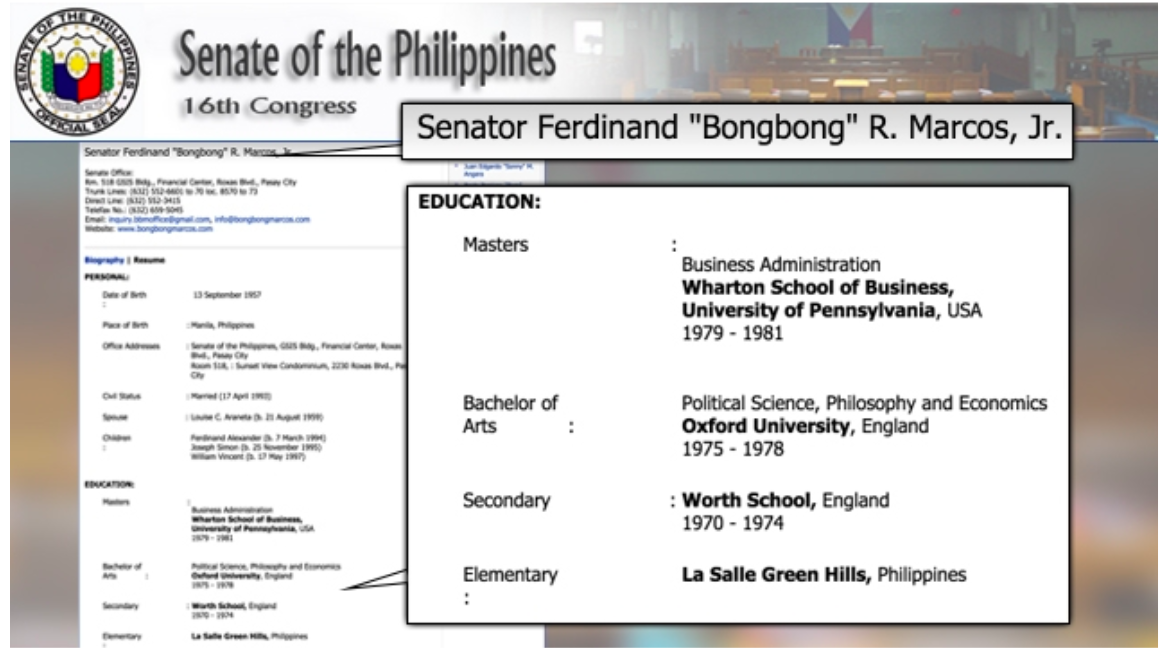
Publicly exposed, Junior back-pedaled. His official Senate resume in 2014—digitally preserved for all time on archive.org—clearly showed him claiming a master’s degree in Business Administration from Wharton and a Bachelor of Arts in Political Science, Philosophy, and Economics from Oxford. This has since been amended to “graduate coursework” for Wharton and a “special diploma” for Oxford.

(Image from rappler.com)

But there’s another side to this college-dropout issue that’s worth thinking about: what’s a diploma really worth, anyway, and what exactly have we done with ours?

We have many thousands of college graduates working well beneath their professional capabilities as domestic helpers overseas, or in jobs that require more use of their hands than their brains. So a diploma has never guaranteed success (and as Junior’s example shows, you can get very far in life without one). 

But also, since when was a college degree a measure of intellectual ability and, even more importantly, of moral probity? What has our incumbent Palace dweller done with his law degree, beyond assuring the tokhang brigade of his full protection and threatening to defy the Supreme Court? At least Ferdinand Sr. used his to cloak his every ploy with a veneer of legality. 

In terms of intellectual caliber, Marcos had probably the most illustrious Cabinet members in our history, with PhDs from the world’s foremost universities, but even they could not rein in his regime’s excesses, and some even abetted them. The good ones left early; a few tried to draw a line; others became willing accomplices to dictatorship and plunder. As idealistic and upright as they may have been or started out, Marcos suborned many of these technocrats and forever compromised the edukado in Philippine society, turning that respected figure into a minister at the foot of a despot, his wife, and their whimsy.

Our incumbent burnished anti-intellectualism into a virtue to curry favor with the crowds, and got flunkies with LLB’s to explain away his bad behavior like auditioning comedians. You listen to their tortured spiels and you ask, was this what they went to college for?

Wealth and power hold far more charm for many of us than schooling, because we see education as but a means to those ends. To be rich is to be smart and praiseworthy enough. If the rich behave imperially, impudently, irresponsibly—well, they earned it, didn’t they? We can forgive and excuse them no end; we still think like tenants thrilled to be invited into the big house for a cup of chocolate. 

We seem surprised and suspicious when a well-educated person with an honest heart claims to love and understand us, and promises to improve our lives, because we no longer recognize real goodness and ability when we see them. So we go with the devil we know, and who cares how he fared in History or Philosophy? As Ping Lacson puts it, logic was never our strong suit: “Ayaw mong manakawan, tapos, boboto ka ng magnanakaw?” I have a PhD, and I can’t figure that one out.

Hindsight No. 4: Denial and Dissonance

Hindsight for Monday, February 7, 2022

(Image from contemplativestudies.org)

I FIRST heard the phrase “cognitive dissonance” fifty years ago in UP from my friend Jose “Oying” Rimon, then a Mass Comm major just grasping the mechanics of social behavior. Oying would go on to become a population expert and close adviser to Bill and Melinda Gates on public health, capacities in which he had many occasions to see cognitive dissonance at work in shaping people’s attitudes and responses to development policy. 

I’m not a psychologist, so I’m going to have a real one, Dr. Sam Mcleod, explain what the concept means: “Cognitive dissonance refers to a situation involving conflicting attitudes, beliefs or behaviors. This produces a feeling of mental discomfort leading to an alteration in one of the attitudes, beliefs or behaviors to reduce the discomfort and restore balance…. When there is an inconsistency between attitudes or behaviors (dissonance), something must change to eliminate the dissonance.” 

The examples that usually turn up in the literature are fairly simple: you smoke, but know that smoking is bad for you; you know you need more exercise, but put it off for tomorrow, citing the workload on your desk.

Why is this relevant to our present situation? I’ll get to that in a minute. First, let me quote from an article by Dr. Eddie Harmon-Jones in Psychology Today wondering why so many Christian Americans still voted for and supported Donald Trump despite his patently un-Christian behaviors, such as adultery. “As president, he has engaged in many actions that seem immoral. How do so many still support him? Surely they must experience dissonance over this. How do they reduce this dissonance?” (For that matter, why did so many conservative Fil-Ams vote for Trump on the excuse that he was supposedly “pro-life,” ignoring his many other moral infirmities?)

Why do people believe what they want to believe, regardless of the hard facts and figures in front of them? How do they reconcile these contradictions in their minds to feel like they’re doing the right thing and to feel better about themselves? (The science suggests that we humans have a natural impulse toward feeling good.)

This is what the psychologists call reducing or resolving dissonance—accepting or acknowledging what the more logical part of your brain is saying, but then coming up with a rationalization or justification for sticking to your original belief anyway; or, with much more effort, you find a reason to cross over to the other side. Sure, smoking is bad for me, but so is anxiety; sure, maybe vaccines work for other people, but I’m not like other people—I haven’t been sick in twenty years; sure, I lied on my tax declaration—but haven’t bigger people done much worse?

Dissonance is a shade different from denial, which is the outright rejection of proven or provable fact. Holocaust deniers will insist it never happened; other neo-Nazis will say it did, but that the Jews brought it upon themselves, or that Hitler wasn’t to blame for the genocide. 

This is the stuff that conspiracies and conspiracy theories are made of—a little truth here and a little truth there, interwoven by threads of fanciful fabrications to create some semblance of alternative logic. Spun imaginatively and cast widely enough, this web of lies can begin to acquire the sheen of truth, or what passes for it among its believers.

Are those believers stupid or crazy? Not necessarily. An interesting paper by the psychologist Andrea Kohn Maikovich argues that terrorists aren’t simply the hate-filled loonies they’re often pictured to be. Rather, recruits go through a radicalization process during which they negotiate between their personal predisposition not to commit violence and the collective pressure to do more than carry placards on the street. When the dissonance hits its peak, some leave; those who stay have found a way to convince themselves that violence is good and necessary.

Writing for the Atlantic Monthly on “The Role of Cognitive Dissonance in the Pandemic,” Elliot Aronson and Carol Tavris note that “When people feel a strong connection to a political party, leader, ideology, or belief, they are more likely to let that allegiance do their thinking for them and distort or ignore the evidence that challenges those loyalties. The social psychologist Lee Ross, in laboratory experiments designed to find ways to reduce the bitter conflict between Israelis and Palestinians, took peace proposals created by Israeli negotiators, labeled them as Palestinian proposals, and asked Israeli citizens to judge them. ‘The Israelis liked the Palestinian proposal attributed to Israel more than they liked the Israeli proposal attributed to the Palestinians,’ he told us.”

In this context, it isn’t hard to see why pro-Marcos narratives can seem so compelling to many Filipinos, despite the clear and documented evidence of ill-gotten wealth (let’s say it plainly: theft), brutality, deception, and other abuses of power during the martial law years. They’re rich and powerful—which we all want to be—so they must have done something right.

People who are already rich don’t steal; it wasn’t FM Sr. who committed martial law’s excesses, but his administrators; EDSA 1 was nothing but a CIA operation; Imelda was never imprisoned, so she can’t be guilty of any charges thrown at her; the younger Marcoses knew nothing about what was going on, and so will be different from their parents; if the Marcoses were bad, the Aquinos and Lopezes are worse; et cetera. If you feel comfortable with any of these ideas, then you’ve made your own kind of sense of the past, even if you may not even have been there.

Of course, I have my own set of stubborn core beliefs and dissonances as well. I keep holding on to the idea that Filipinos are worth dying for, only to be disappointed by the way many of us choose our leaders. I believe in democracy, but I feel frustrated when it’s gamed by people who obviously don’t care much about it. 

According to cognitive dissonance theory, something has to give: your cherished notions, or the hard truth. It seems much easier just to give up hope, but there’s no real comfort nor resolution in that, either.

Hindsight No. 3: A False Nostalgia

Hindsight for Monday, January 31, 2022

SINCE MY belated debut on Facebook just over a month ago, I seem to have acquired something of a reputation for my posts about the past—not in the scholarly mode of a real historian, which I most certainly am not, but as a collector and keeper of objects that evoke strong associations with times and people long gone. These include century-old fountain pens and typewriters, and even older books and documents steeped in the accumulated oils of the hands that held them.

I’ll admit to having an intense, almost fetishistic, interest in the past—the 1930s are of particular significance to me, because I’m writing a novel set in that period—and I can identify with the romance conjured by postcards of ocean-going liners and of the old Manila Hotel. If you play “Smoke Gets in Your Eyes” on a turntable, you’ll float to the ceiling in my esteem. In my dreams, I fantasize about strolling into the Crystal Arcade one fine day in 1937 and stepping out with a fistful of Parker Vacumatic Senior Maxima pens while towing a cart with all 55 volumes of Blair and Robertson.

But that’s where the nostalgia ends. In many if not most respects—as I’ve told friends who, for example, ask me if UP’s fabled Cadena de Amor ceremony is worth reviving—there’s one place the past deserves to be, which is exactly where it is. Nostalgia is comforting precisely because the past is over, and because we tend to remember just the good parts, and even burnish them to perfection.

But it was never really all that good. Amorsolo’s maidens all seem fresh out of the batis and every Joseon prince’s robes on K-drama seem immaculately pressed even after a swordfight, but the past was literally a filthy place. Queen Elizabeth I was said to take a bath once a month. William Shakespeare and his friends wore those fluffy collars around their necks because that’s all they changed. The lovely ladies of Versailles doused themselves in perfume to quell the odor of their unwashed bodies. The “buntis” window grilles we now admire in old Manila houses were once drenched with dubious liquids being dumped on the street below.

Neither was it so peaceful. Even without counting the devastation of war, the past was fraught with danger, hardship, and unrest. It may have been a grand and glorious time for the rich in their cars and villas, but the masses were suffering in the farms and factories. Power was brazenly exercised, as in the torture and murder of Moises Padilla in 1951. Postwar congressmen carried .45s at their waist into the session hall. As a young police reporter in 1972, I learned where you could find a gun for hire for P500 per target.

We like to think that the past was simple, with fewer choices to be made. But it was never that simple for many without real choices. Poverty was and is never simple, because every morning the mind races to figure out where supper is coming from, and if Nanay can survive on a third of her prescribed dosage or on plain salabat.

All these come to mind when I hear Filipinos today—many of them not even in their 40s—talking about how a return to the “glory days” of Marcosian martial law would set this country back on track and bring us the prosperity, the peace, and the prestige we once enjoyed. I wonder what it is exactly they are “remembering,” and if they understand what putting a Marcos back in Malacañang will mean to this country. This goes beyond the historical amnesia we often hear about these days; the Dictionary of Obscure Sorrows calls it “anemoia,” a nostalgia for a time someone has never known, or that never happened.

No, I’m not calling them stupid or wicked by any means. In many cases they’re simply innocent or uninformed, and therefore suggestible. If they feel oppressed by the present and are facing an uncertain future, the past will acquire the appeal of the womb, offering safety and security. The idealization of martial law as a time when streets were wide and clean and when new buildings were rising right and left is a more inviting prospect for those who can’t be bothered with facts and figures about debt-driven growth, cronyism, and horrific abuses under military rule. (For those facts, check out https://newslab.philstar.com/31-years-of-amnesia/golden-era)

That even oldtimers can wax nostalgic over the Marcos years isn’t hard to understand. Like the Germans under Hitler, many if not most Filipinos then never saw a prison camp, never had a son or daughter tortured and salvaged, never had a business taken over by the regime. Those of us who actively resisted dictatorship were in a distinct minority—as we still are today. Complicity has to be endemic for despots to thrive.

But now once again we are called to arms, in a battle for the imagination—a battle of competing narratives and modes of narration. Will the cold, hard truth alone triumph over romantic fantasy, or will we need to be more inventive in our messaging to get through to those unlike us? Instead of just revisiting the past, should we dwell more on a rosy but realizable vision of the future? Instead of staking out May 9 as a referendum on martial law, should we double down on what a presidential election should be—a competition between platforms and qualities of leadership? (And then use the next six years to correct our history textbooks.)

It’s true that we have good reason to long for seemingly lost or threatened graces like statesmanship and civility (not to mention intelligence) in politics, as well as plain good manners and delicadeza. There are good things we can yet recover and revive from better days, with the right leadership and inspiration. But to do that, we have to save the future from those who would drag us back 50 years into a past that was as morally sordid, as violent, and as dispiriting as anything that ever happened in our history. 

Hindsight No. 2: Myth over Matter

Hindsight for Monday, January 24, 2022

(Image from indiatimes.com)

THERE’S HARDLY a week that goes by without me receiving a Viber notice from a friend warning me about another incoming message containing some innocuous line like “Let’s go to Latvia” or “Your mother will love this,” clicking which will trigger a dizzying spiral into digital damnation: your phone will freeze, all your passwords will be stolen, your half-naked selfies will be posted to your Village Association chat group, and whatever gender you declared will be reversed in all your official records. 

It’s all well-meant, of course; some friends will even add “Sharing, just in case”—meaning, they also suspect it’s fake, but meaning further, they’ll pass final judgment on to you, a privilege you should be thankful for—on the one-percent chance that it’s true.

I’ve taken it as my civic duty to look up the particular hoax online (easy: just add “hoax” or “scam” to whatever the key words are, and Google away) and to inform the senders of their mistake. Many will reply with a terse “Thank you.” Some will protest: “It wasn’t me—it was my silly sister-in-law who swore it was true, so I passed it on!” A few (some of these senders have PhDs) will even argue back: “Now, how sure are you that snopes.com is a real fact-checker? Who’s funding them? What’s their angle?” (Makes you wonder: if they were going to be that investigative, why didn’t they ask it about the hoaxer in the first place?)

Living in the age of fake news (or “alternative truths” as Donald Trump’s aide so nicely put it), we can’t be surprised any longer by the seemingly infinite pliability of the truth, which can be warped and twisted to the point of being barely recognizable. But as it turns out, that “barely recognizable” element is key. 

An article in WIRED from 2019 on “Why People Keep Falling for Viral Hoaxes” points this out: “The narrative that Big Bad Instagram is going to take all of your most intimate personal data points and use them for nefarious secret purposes is the sort of story that is primed to appeal to the average person… because it contains a kernel of truth: You have all this data out there on the internet, and God knows who has access to it.”

We sort of knew that already—the best lies have a little truth in them, encouraging our gullibility. When Ferdinand Marcos claimed to be a war hero with 33 medals to his name—only two of which were actually given in 1945, and both contested by his superiors—all the fellow basically had to show for proof was his picture in a uniform, surrounded by pretty hardware that you can buy today on eBay, and that was enough to make many believe that he had to be a hero.

What’s more breath-taking—and possibly more dangerous—are the outright fabrications, the brazen claims to this and that outrageous deed or achievement. You’d think that they’re too absurd to be swallowed by even the most credulous, but think again.

The story of the Tallano gold, now being trotted out on social media as the source of the Marcos fortune, is a case in point. The story that went around on Facebook is that the Tallano family—the descendants of the rulers of a pre-Hispanic, pan-Pacific kingdom called Maharlika—had paid the young lawyer Marcos 192,000 tons of gold. With one kilo of gold today at around P3 million, I don’t have enough zeroes on this line to tell you what that’s worth. And for what lawyerly labor, one wonders—a gazillion affidavits and deeds of sale? 

Never mind that Imee Marcos herself has denied this story, and even the “Yamashita gold” that her mother claimed in 1992 to have found its way to Ferdie. The late Bob Couttie had been exposing the Tallano claims as a fraud even in 2018. But the story has legs. You just have to go online to find testimonials like this from a “BQ”: “It’s true but they’re burying the truth. I myself held those documents—three reams of A4-sized paper, including the mother title of all the land here in the Philippines, which came from Great Britain!”

Never mind, too, that it’s clearly a minority of believers. It’s how and why they believe kooky fantasies like this that’s more intriguing. The WIRED article again points to a reason: that, for many people, mythmaking provides a coherent narrative, a story easier and more convenient to believe than the truth, which is often too messy and complicated to figure out.

In my fiction writing class, I often bring up my favorite quote from Mark Twain, paraphrased: “Of course fact is stranger than fiction; fiction, after all, has to make sense.” Like myth, traditional fiction has a familiar beginning, middle, and end—and even a “lesson” to clarify the haze in which we stagger through daily life.

As I said in a lecture sometime ago, “The most daring kind of fiction today is out of the hands of creative writers like me. It is being created by political propagandists who are spinning their own versions of the truth, and who expect the people to believe them. The short story and the novel are no longer the best media for this type of fiction, but the tweet, the Facebook feed, the YouTube video, and even the press conference.”

Today’s savviest political operators know this: spin a tale, make it sound appealing, trust ignorance over knowledge, and make them feel part of the story. “Babangon muli?” Well, who the heck who dropped us into this pit? It doesn’t matter. Burnish the past as some lost Eden, when streets were clean, people were disciplined, and hair was cut short—or else. Never mind the cost—“P175 billion recovered in ill-gotten wealth” is incomprehensible; “a mountain of gold to solve your problems” sparkles like magic.

Imagination is more powerful than reason—myth over matter. I hope the forces of the good and right can work with that.

Hindsight No. 1: A Time for Telling

Hindsight for Monday, January 17, 2022

IT WAS with great shock and sadness that I received the news of Manong Frankie Sionil Jose’s passing two Fridays ago; my recollections of him appeared online later that day. But just as jarring a surprise was a call I later received from Millet Mananquil, my editor in the Lifestyle section, and then from Doreen Yu, our Op-Ed editor, informing me that I had been chosen to take over FSJ’s column-space on this page.

It was a great privilege, of course, and I accepted it gratefully. But it also carried with it an awesome responsibility—to be honest, to be fair, to know enough about an issue to speak with some legitimacy about it, and also to be modest and open-minded enough to remember one’s inescapable fallibility. I don’t think that last one’s going to be a problem, because I’ve made mistakes often enough to know that—well, I make mistakes, some of which may have hurt people badly.

But last Saturday I turned 68, and with that age comes a keener sense of doing right, of accountability for one’s choices and judgments, as well as a greater tolerance for the shortcomings of others, though not of evil or of wrong itself. I intend to maintain those bearings in this new capacity.

Some readers may wonder how a Lifestyle writer like me—obsessed with fountain pens, old books, Broadway showtunes, and digital gadgetry—ends up doing op-ed, which seems a far more serious and consequential calling. A brief self-introduction might be in order.

I dropped out of UP as an engineering freshman in 1971 and, against all odds (not having spent one day in Journalism class, and being all of 18), landed a job as a features writer and general assignments reporter with the Philippines Herald in 1972. My first task was to fill up half the Features page every day—something that schooled me forever on the importance of deadlines and of resourcefulness, because I had to come up with the topics on my own. I moved to Taliba as a suburban correspondent; was arrested for my activism shortly after martial law was declared; spent seven months in prison; and upon my release joined the information staff of the National Economic and Development Authority, where I would work for the next ten years, picking up a diploma in Development Economics along the way.

I returned to school, finished up my academics all the way to a PhD (more for teaching than for my writing), and taught full-time while writing stories and film scripts. In the mid-1990s, thanks to my friend and now fellow-columnist Jarius Bondoc, I was hired as an editorial writer for the newly opened newspaper TODAY. Being busy with other aspects of management, our boss Teddyboy Locsin trusted me to do about three editorials a week, including the newspaper’s very first one. 

I discovered that opinion writing was exhilarating—but also, again, fraught with responsibility. It got to the point that I found myself wishing I could write something less driven by analysis and conscience—small things like my rickety VW Beetle, double-knit pants, and my love of crabs, instead of ponderous topics like prison reform, the defense budget, and Philippines 2000. (I still have 113 editorials that I wrote on my hard drive.) So I asked for—and got—a Lifestyle column called “Barfly” on the back page, which helped me decompress and kept me sane, reminding me that life was much more than politics and that beauty and fun were as important as anything else to happiness.

I’m going to keep that escape valve open—I’ve promised Millet that I’ll continue contributing my “Penman” column every now and then—but I’ll approach this new task with the loftiness of mind that it deserves (although you’ll excuse me if I sometimes prefer to take a more comic tack, as the best criticism is often served up with a smile). 

Unfortunately I’m not a political insider; I don’t make the rounds of kapihans and have become something of a happy recluse over the Covid lockdowns. You’ll see my politics soon enough—unabashedly liberal (with a small L), middle-force, intensely uncomfortable with both Right and Left extremes. (I came out of the Left and worked briefly for the Right as a sometime speechwriter for five Presidents—but not the last two.) I thank God every night for my family’s safety and for our blessings and for the well-being of others, but I’ve had my differences with Church dogma and would rather spend my Sundays reflecting on human frailty and redemption by reading a book or writing a story.

But I do have a deep and abiding love of history, of which I have so much more to learn. This is why I’m keeping FSJ’s “Hindsight” for this column’s title. (When I returned to UP to resume my undergraduate studies, I dithered between English and History, and chose English only because I was likely to finish it sooner). I agree with Manong Frankie, among many others, that one of the greatest obstacles to our nationhood is the fact that we have a very poor memory—much less an understanding—of our past. We’re reaping the bitter fruit of that amnesia now, in the prospect of electing a dictator’s son to the presidency, a full half-century after the father plunged this country into political and moral darkness by declaring martial law to perpetuate himself in power.

There—it’s when vexatious thoughts like that cross my mind that my fingers begin to itch and I want to editorialize, the complete opposite of my impulse as a fictionist to show and not tell. (I often begin my fiction-writing classes by comparing an editorial on, say, justice for the poor with a short story dealing with the same concern, but without once mentioning “justice,” “poverty,” and such abstractions.) But even as I remain a fictionist at heart, there’s a time for telling, for gathering up the threads of an unfolding narrative and declaring, in plain language, what they mean. That’s what I hope to do.

Penman No. 432: In memoriam, FSJ

Penman for Friday, January 7, 2022

TO THE chorus of voices mourning the passing of Manong Frankie Sionil Jose, let me add my own.

For a very long time, Manong Frankie and I were not what could honestly be called friends. I had said hurtful things about him and his work, and I could feel that he took that to heart. 

But we did begin on a very high and encouraging note. In 1983, he selected me and a few other Filipino writers—Rey Duque, Marj Evasco, and Fanny Llego among them, as far as I can remember—to attend a writer’s seminar in Bali that he and his friend the late Takdir Alisjabanah had organized to bring young Southeast Asian writers together. It was my first big international conference, and it was exhilarating to be talking literature on the fringe of a crater lake. I deeply appreciated that gesture on Manong Frankie’s part; through him I met such luminaries as Edwin Thumboo, Shirley Lim, and Cecil Rajendra. At that point I had read and appreciated The Pretenders and many of FSJ’s short stories.

Some years later, I was in America studying for my MFA in Michigan and then my PhD in Wisconsin, and at some point I was interviewed by National Public Radio about Philippine literature—I can’t recall why, or why me (it was probably just after EDSA, when the world’s eyes were upon us, and I was conveniently available)—and when FSJ’s name came up I indelicately repeated what I thought was the prevalent opinion then (and until much later) of his work among my fellow writers in English: that while he wrote about all the right things, his prose was far too plain and lacking in certain qualities. (It was an opinion that would understandably provoke a backlash from FSJ’s supporters who valued his substance more than his style.)

That must’ve gotten back to Frankie because—whether I just imagined it or not—I felt that I got the cold shoulder from him from then on. It didn’t help that he seemed to have a bone to pick with UP and creative writing workshops, and held the notion that we were out to create clones of our snooty selves, detached from the harsh realities of life on the ground. I (and many others) continued to be exasperated by his cantakerousness (I even called him “cranky Frankie”) and groaned at his propensity to lecture young writers to the point of scolding them for one shortcoming or other.

But even so no one could deny his massive and meaningful contributions to our literature and to the idea of a literature grounded on history and social reality. When I happened to serve on the preliminary committee vetting candidates for the National Artist Award the year he eventually won it, I had no problem putting my minor misgivings aside and voting for him.

I’m not sure when the thaw in our relationship began, but it must have been when we were both invited in 2017 to an NCCA-sponsored seminar in La Union where I was asked to give a talk on Manuel Arguilla. I knew he was going to be listening, and I have to admit that I wrote my lecture with him specifically in mind, wanting to reassure him that I wasn’t some city-boy snob who didn’t know one end of a carabao from the other and who couldn’t write about anything but professors sipping cappuccinos at Starbucks. Through Arguilla, I wanted him to know that I felt and understood—and indeed wrote about—his concern for common and unarticulated lives.

Later that year, when I spoke at the annual Palanca Awards dinner about how writers in our society often have to write for others for a living but also need to redeem themselves through their art, he approached me from below the podium and extended his hand to congratulate me, and I knew we had reconciled.

We were brought even closer when he and the late Sen. Edgardo J. Angara founded the Akademyang Filipino, asking me to serve as a trustee along with such stalwarts of civil liberties as former Justices Antonio Carpio and Conchita Carpio Morales. He would remind me, among the most junior members of that board, to make sure the Akademya survived him, pleading his age. (His daughter Jette, who sadly died just weeks before Frankie, was our very capable executive secretary.)

He and Manang Tess would invite me and Beng for dinner, and he was very happy and surprised when I presented him once with a copy of the maiden issue of Solidarity, which he had lost. In private, he told me something that assured me that we had, again, become friends.

Still, for all that, his mercurial politics continued to confound me. Separated by the Covid lockdown, our meetings stopped, although even if we had met I probably would not have been able to ask him to his face how he could reconcile his loathing of dictatorship with his approval for Marcos’ successor. Not I nor anyone else could have changed his mind. It was sad to see him savagely reviled for his contentious remarks about ABS-CBN and Maria Ressa, among other issues, but I suspect that there was a part of him that courted and reveled in the notoriety.

And that was what I learned about F. Sionil Jose: you had to take him as he was, all of a package, or reject him outright, which would also be a pity. Nearly all great writers had their quirks and imperfections, but it’s their work that survives and surpasses all our momentary misgivings.

Farewell, Manong!

My Wishes for the New Year

EVEN AS we all wish for a more benign 2022, free of Covid and conflict, we know deep within that our biggest battles lie ahead in the war between good and evil that it has always been—not between parties nor personalities nor platforms, but between those who will lie and steal and kill, and those who will fight for truth, justice, and prosperity for all.

Good and evil is as stark and simple as it gets, and no amount of spin or sophistry and certainly no surveys will change that. Even one good person in a roomful of the malignant and misled will still be right, and worthy of our praise and emulation.

And whatever happens in May, our struggles will not cease. Evil is a virus with infinite mutations. Our corrupt and power-hungry politicians are worse than Covid, and have infected the masses of our people with their lies and false promises. But they can be arrested and contained, with vigilance and resolve.

For myself, I cannot be a friend to anyone who willfully supports and benefits from those who will plunge our country into another six years of moral and economic ruin.

I look to 2022 as an opportunity to stand up and be counted among the forces of the good, whatever my personal faults and impairments may be. The only survey or judgment that will matter will be God’s, and I would like to be able to tell my Maker that I did the right thing when it mattered—that I managed to remember the difference between good and evil, and chose rightly.

I can only wish you feel the same, so we can have a truly happy and liberating New Year!

(Image from candles.lovetoknow,com)

Some Families, Very Large (A Christmas Story)

(I wrote and published this story twenty years ago for the Christmas issue of The Philippine STAR, and I’m posting it here as a Christmas offering to my readers, who may not have come across it yet.)

A FUNERAL parlor was the last place Sammy expected to be on Christmas Eve—especially since no one he knew had died. And despite his father’s assurances that the man who lay in the shiny white coffin was a distant uncle of his—maybe one of those people who had come over for games and drinks and had mussed his hair—Sammy could not remember the long, rat-like face in the picture that hung over the burial announcement. 

Sammy was only nine, but he had a good head for faces. The names escaped him—his father kept teasing him for being hard of hearing—but he made a game of attaching a face to something else: mud-caked shoes, yellow nails, pitted cheeks. Most of them were his father’s friends, and while he had seen very few of them between this Christmas and the last one, he felt reasonably sure he could recognize any of them again, if he met them on the street. They had walked many streets that morning, and he had seen many new faces, but he had met no one even vaguely familiar. 

Sammy also knew something about death and funeral wakes. When he was six, his playmate Leo had drowned in the black froth of the estero. He had watched from the bank as they fished out the boy’s body with a hook-tipped pole. Leo looked very fat and very oily, and his tongue stuck out of his mouth like a peeled banana. They had stuffed him into a coffin and set up a wake on the sidewalk, where the borrowed candelabra outshone everything else at night, and passersby threw coins into a plastic can, which Leo’s mother emptied into a large pocket in her apron now and then. Leo’s mother sold fish at the talipapa, like Sammy’s own mother, who sold vegetables when she wasn’t turning scraps of fabric into hand mops. 

But she was gone now, like many things they had let go of over the past few years: the motorcycle, his mother’s sewing machine, the television set, even a typewriter said to have been used by his grandfather, a writer of dramas for radio. Indeed, a small transistor radio was the only thing they had left over from the old times, and Sammy would sometimes imagine hearing his grandfather on it, saying all kinds of important, grown-up things, although the man had died many years before Sammy was born.

That morning, his father had shaken him awake with an unusual gleam in his eyes. “Eat and get dressed,” his father had said. “I’m taking you out.” 

Sammy shot up. “Where?” It had been weeks—months—since they had gone anywhere interesting, like the seawall or the basement of the mall, where there were all kinds of food—and rides, fabulous rides on pastel dragons and rampant horses and bug-eyed fish. That was the one time his father had won anything big—five thousand pesos, his father had said, although Sammy couldn’t imagine what five thousand pesos could buy. It certainly was enough for a few days of roast pork, fried rice, and noodles, and he could run to the corner store and ask for anything without having to mumble that word he had learned to dread, “Lista.” 

That moment came and went, replaced by the old routine of making his own meals—opening a can of sardines and dunking a piece of bread into the red mush, leaving the best parts for his sleeping father—before rushing off for the twenty-minute walk to school. He had never come around to hating his father, although he had many questions to ask. His child’s instincts told him that something was terribly wrong, but his father seemed to have an explanation for everything: Mama had gone back to her hometown, very far down south, to take care of her own dying father, and the government was having a hard time keeping her island from drifting farther away into the ocean; Papa lost his job as a filing clerk at the factory because someone didn’t like the way Papa cheered for his favorite basketball team; the kind and quantity of food on their table depended on one’s success at dilhensya, which was in turn dependent on one’s abilidad

These two words burned themselves into young Sammy’s brain: they were what got you ahead in the world, or at least what saved you from curling up in a spasm of hunger. That was a man’s most important job, Papa said: to put food on the table, no matter what. Sammy had some vague idea of what his father did: a classmate said that he had seen Sammy’s Papa at the jeepney stop, barking out destinations and herding passengers onto waiting rides. When Sammy asked him about it, the father said that he was actually a kind of policeman’s assistant, a volunteer enforcer of traffic rules and regulations. People needed to be told where to go, and how to get there fast. People paid for that kind of abilidad.

That day, they had visited three houses on opposite ends of the city. They waited all morning outside the gate of a large compound on Roberts Street in Pasay. Through a vent in the wall, Sammy could see a lawn as wide as the sea, and a fleet of cars and vans on the far side. There was an armed guard just inside the gate who spoke to them through perforations in the iron. “He’s my congressman,” his Papa said. “We were born in the same hometown. I voted for him in the last election. I just wanted to say Merry Christmas. I brought my son to greet him as well.” 

The guard snickered and said, “I’ll send him your compliments. Go home, he’s not here, he left very early.” A metal panel dropped in front of the holes. 

“I’ll wait! We’ll wait! He knows me, he shook my hand once at a wedding!” They stood outside and then sat on their haunches for another hour. 

“Let me tell you something. This guy,” his Papa whispered to Sammy, “this guy, I saw him hand out crisp new five-hundred peso bills during the campaign, like he was giving away mint candies. I know he’ll be good for something.” At a quarter to eleven, the heavy gate swung open, and a large Mercedes-Benz the color of midnight slid out. Father and son jumped to their feet. The Mercedes paused just out of the gate for a second as the guard exchanged words with the unseen passenger, then the car lurched forward and sped rightward, and the gate closed again before Sammy’s father could say anything. “I don’t think he recognized me,” the man said to the boy. “The last time he saw me, I was wearing a barong.”

They next went to Concepcion in Marikina to look for one of Sammy’s godfathers, whom neither Sammy nor his father had seen since his baptism, but when they got to the neighborhood and the address that Sammy’s Papa remembered, there was nothing there but the charred hulk of a plastics factory that hadn’t even been there the last time. Sammy’s father had only a hundred pesos left on him, and they used some of that for a lunch of two bowls of arroz caldo at a roadside stand. Sammy loved arroz caldo, and would have been happy to let the day end there, but his father had another address on his list. Sammy didn’t mind moving around—the rides themselves were interesting, and he marveled at how his father knew so many places. Even so he was getting tired and teary-eyed, his eyes and nostrils smarting from the dust and the gas fumes. Many jeepney transfers later, they reached Damar Village in Quezon City, where his father convinced the guard to let them into the village. 

They found the place they were looking for—a large white house with Roman columns and statues of fish with coins in their mouths. This, the father said, was the home of his former employer, Mr. Cua. Mr. Cua always had a soft spot for him and would not have let him go, he added, but too many people felt threatened by his smartness, and in the end Mr. Cua had no choice but to sacrifice him for the sake of industrial peace. Sammy’s father announced himself to another guard—this was, Sammy thought, truly a city of guards, and he wondered if his father had ever considered becoming one himself, seeing how they held the keys to everything—and again they waited while the guard checked them out with Mr. Cua. But even before the guard could get in the door, Mr. Cua himself emerged, wearing a Santa hat and leading a group of children out to the yard, where small tables had been set. Some of the children wore masks that made Sammy’s heart leap with envy—Batman, King Kong, and other cartoon and fairy tale characters he could only guess at. Sammy stared at a pigtailed Chinese-looking girl who stared back at him, and his father stepped forward to get to Mr. Cua before he could vanish. The guard still stood between the two men and Mr. Cua shrank back as if by instinct, but Sammy’s father began to speak. “Mr. Cua! How are you, sir? I was a clerk in your factory, remember me? My name is Felipe Dinglasan—” At this point the guard drew his gun and the children shrieked, and Felipe Dinglasan, not knowing what else to do, seized Mr. Cua’s hands and said, “I just came to say Merry Christmas, Mr. Cua! Look, I brought my son Sammy, he’s only nine, but he knows—I told him—what a great and generous man you are! Say good afternoon to Mr. Cua, Sammy!” The boy stepped forward and said, gravely, “Good afternoon, Mr. Cua.” The guard lowered his gun. Still shaking from what he thought might have been an assault on his life, Mr. Cua forced himself to laugh—to come up with his best Santa ho-ho-ho—and patted Sammy on the head. “Good afternoon, Sammy! Ho-ho-ho!” Sammy’s father sidled up to them and said. “Wait for your present, Sammy. Santa will give you a present.” Caught in the middle of another ho-ho-ho, the befuddled Mr. Cua reached for his wallet, looking desperately for small bills, but finding nothing smaller than a five hundred, he peeled out a bill and made a show of presenting it to the boy. “Merry Christmas, Sammy! Be a good boy!” All the children cheered as Sammy mumbled his thanks and as Mr. Cua glared at Felipe Dinglasan, who had the good sense to begin walking backwards, flashing his most non-threatening smile.

“What did I tell you, boy?” Felipe said as he flipped the five-hundred-peso bill between his hands, before folding it neatly and sticking it in his wallet. “All you need is a little ability—well, more than a little, more than a little!” Sammy got the feeling that he, too, had done something marvelous for the both of them, and the boy smiled in anticipation of a reward—a movie, perhaps, or, dare he say it, the one Christmas present he wanted most, the battery-powered laser sword he had seen at a Rizal Avenue shop window.

The sun had fallen now, and Sammy could imagine that incandescent saber cutting swaths in the gathering darkness.

But they walked past that store, and as large as the lump in his throat was, Sammy did not complain. “You must be getting hungry,” his father said, and Sammy nodded. “There’s this special noodle place I know, just around one of these corners, your mother and I used to go there. We deserve something special—special beef noodles, what do you say?”

“You’re the boss!” Sammy chirped, and they veered off into a warren of streets and alleys. Half an hour passed and still they could not find the noodle shop Felipe remembered. In the dark the streets looked even more alike. Sammy trudged behind his father, wishing, praying to be carried, but he was too big for such favors now, and he soldiered on as one alley led to another. Finally they emerged into a street with one side lit up like a carnival and smelling like flowers. Boys Sammy’s age ran from one end of it to another, and men and women sat in chairs on the sidewalk, smoking and chatting, scratching their ankles. Vendors sold fried bananas, jellied drinks, and duck eggs on the street. It seemed incredibly alive, this nook of the city, and Sammy soon understood why: it was a street of funeral parlors all in a row, and even Christmas saw no let-up in business here. Sammy himself felt his senses quicken, awakened by the sweetness of caramelized sugar.

Felipe Dinglasan felt revived as well, for in a trice he had spotted a group of men in a corner, huddled over what he did not need to see to know. Breathing even more hoarsely than when he had been walking, Sammy’s father drew a ten-peso bill from his wallet—the remainder of his last hundred—and gave it to the boy. “Get yourself something to eat,” he said. “I won’t be long.”

The money was enough for a large glass of gulaman and a packet of cookies. Sammy watched his father insinuate himself into the group of men—at first watching, then chatting the others up, then finally taking a place in the circle, his back to Sammy. Once or twice, Felipe cast a furtive glance over his back toward his son, knowing the boy would never stray too far away. When Sammy approached him, wanting only to ask if they were waiting for someone again, Felipe excused himself from the game and quickly found themselves a solution. “Aniceto Navarrete,” read the sign on the door, but it meant nothing to the boy. “You wait here,” his Papa said. “I knew this man, he was a cousin of mine in Dipolog, it’s always good to meet new family at Christmas.”

And this was how Sammy—finally yielding to boredom and fatigue—found himself straying into the quietest and most desolate funeral parlor of the lot, the Funeraria Dahlia. Indeed there was no one and nothing in it but the white coffin when Sammy stepped in. A weak bulb kept flickering overhead like a solitary Christmas light. Sammy took one of the back pews, and soon fell asleep. 

When Sammy awoke hours later, jarred by the retort of a tricycle on the street, there was a woman seated beside him, holding a glass of milky coffee in one hand and a lighted cigarette in the other. A curl of lipstick marked the coffee glass. She had a large, hooked nose, and she looked much older than Sammy’s mother. She wore a collarless black dress, and her hair towered above them both in a pile of buns. The first things that struck Sammy were the bags under her eyes, and her broad red lips.

“What’s your name, boy?” the woman said.

“I’m sorry, I’m sorry!” Sammy cried. “I was just waiting for my father!”

“I wasn’t telling you to go,” she said, flicking her ashes on the floor. “I was just asking who you were.”

“Sammy,” the boy said. “Samuel Dinglasan, ma’am.”

“Thank you,” the woman said, bowing to the boy. “My name is Mrs. Concordia Navarrete, and that’s my son Necing over there. Do you want some coffee? Are you old enough for coffee? Go get something to eat.” There was a small table on one side of the room with a thermos bottle, a jar of coffee, three or four Chinese apples, and a tin of butter cookies.

“No, ma’am, thank you, ma’am.”

“Well, then, suit yourself. Where’s your father?”

“Out there, ma’am.” Sammy could see his father, still hunched over the card game. 

Mrs. Navarrete looked at the men and blew a cloud of smoke in their direction. “He’ll be there all night. Unless—”

“Unless what, ma’am?”

“Nothing. My son Necing, he was going to be a lawyer. Do you know what a lawyer is?”

“No, ma’am.”

“A smart person—but never mind.”

“I know about smart persons, ma’am. My Papa is very smart.”

“Oh, is he, now?” Sammy noticed that Mrs. Navarrete’s eyebrows had no hair on them. “And just how did you find that out?”

Sammy began telling Mrs. Navarrete about his father, and the events of the day, as far as he understood them. When he got to the part about Mr. Cua and the guard with the gun, he giggled, although Mrs. Navarrete seemed very upset. “What’s so funny about that?” she asked.

“Well,” Sammy said, gesticulating breezily, “they were pointing a gun at Papa—and then they gave him lots of money!” It wasn’t how things worked—even Sammy knew that from the movies and from their games at recess.

“Well,” Mrs. Navarrete said, mulling over the story, “I suppose that’s funny. And where’s your mother, by the way?”

Sammy fell silent, and he looked fervently in Felipe’s direction, wanting to go home. The lady took his hand and her fingers felt like a bony animal perching on his. “Some families are large, very, very large,” she said. “Some families are small—very, very small.”

“My Papa says—” Sammy began, then paused, seized by a sudden doubt.

“Your Papa says?”

“My Papa says he knew your son. My Papa says they were cousins in Dipolog.”

“Is that soooo?” the woman said, arching her eyebrows again.

“What did you say your name was, again?”

“Samuel Dinglasan, ma’am. Samuel Occeña Dinglasan.”

“Dinglasan…. Weeell….. Like I said, some families are very large.  What else did your Papa say?”

“Papa says—”

“Papa says we should go home,” a voice behind them said, and there Felipe Dinglasan was, looking for all the world like he had lost everything, and while Sammy could not recall Mrs. Navarrete ever coming to their house, it did seem to him that she and his father had met before by the way she was sizing him up and his fortunes, that they were all relatives like he said, and therefore family. “I’m sorry if he’s been bothering you—”

“Not at all,” Mrs. Navarrete cried, getting to her feet. “Mr. Dinglasan, how good to see you, how nice of you to come and to pay your respects, it’s been such a long time!”

“But how—”

“Sammy here, of course, told me everything, reminded me of our connections—Dipolog, wasn’t it? Yes, Necing often told me about Dipolog, and how well he was treated by family when he came to visit. Please, have a seat—”

“But we really have to—”

“Go where, do what? It’s Christmas Eve—what should I call you again?”

“Ipe, ma’am—”

“Don’t call me ma’am, it’s always been Tita Connie. Lola Connie to you,” she said to Sammy. “But of course everyone forgot. That’s just how things are these days. I’m used to it. Tonight we meet, tomorrow no more, maybe never again. So take a look at your, uhm, cousin, go pay your respects—you, too, little boy, don’t be scared of the dead—while I make us some coffee.” Without taking another look at Felipe, she went to the small table and busied herself, lighting up another cigarette while pouring the water.

Sammy’s father lifted him up so he could see into the coffin, so they could both look very closely at Aniceto Navarrete for any kind of family resemblance. The dead man’s skin was very dark, and long thin whiskers stuck out stiffly from both sides of his mouth.

“You were right, Papa,” Sammy whispered. 

“Here, have an apple,” Mrs. Navarrete told Sammy when they regathered in the back row. “Rest up a bit and tell me stories, that’s all I ask, tell me stories. You, too, Ipe.” Leaning closer to him, she added, “And I’ll give you your fare in the morning.”

“Thank you,” Felipe croaked.

The woman made like she didn’t hear, and took the lid off the can of butter cookies. “Dunk these into your coffee, then close your eyes, and imagine you’re having ham and cake and grapes and cheese. The imagination, it’s a wonderful thing.” She demonstrated her technique with flair, holding the coffee and a cookie out as far as she could in front of her and shutting her eyes while joining the two.

“Yes!” Sammy shrieked, aping the woman. Even Sammy’s father found his own eyes closing.

The errant bulb flickered again and finally gave out, but not one of the three or the four of them knew it, not for a long moment.

(First published in the Philippine Star, December 24, 2001)

Martha, Martha (A Christmas Story)

(Twenty years ago, instead of a regular column, I wrote and sent in a Christmas story for The Philippine STAR, titled “Some Families, Very Large.” This year, I thought of doing that again, this time a story set in a Covid ICU–about loves and lives lost, power and disempowerment.)

THE GENERAL LOOKED hard at the tinsel star on the Christmas tree across his desk and convinced himself that it was leaning to the left, perhaps by an inch, and he wondered if he should fix it himself or let someone else do it for him. The tree was too tall even for him to reach the star on tiptoe, because his secretary and his aide had perched the four-foot tree on top of a painted stool to create more space beneath its plastic branches for the mound of gift-wrapped presents that began to arrive in the first week of December. 

Two years earlier, a mayor from Cagayan for whom the general had done a small favor had sent him a washing machine covered in gold foil, and he had raffled that off to the delighted staff, just like all the baskets of canned ham, English biscuits, and cheap California wine that gathered under the tree. Some came all the way from Manila, an eight-hour drive away, a token of the esteem in which the general was held, and of his prospects to make chief of staff. The most serious gifts never made it to the office; he was corrupt, for sure, but the general was nothing if not discreet, and he was proud of managing his affairs with a certain style. The Christmas tree and the pile of presents, to be honest, offended his sensibilities; it was too loud, almost vulgar, but it endeared him to his staff, and that was part of his charm, his ability to make people feel that they were being cared for. 

He was a man who could just as easily shoot a rebel in a back alley or a safehouse as he could lift a baby out of a flood to a chopper. Back at the Academy, he excelled both in boxing and mathematics, skills he later put to good use in Mindanao when he was honing his skills in procurement and dealing with unreasonable parties. The rough edges had come off as he rose up the ranks—now he knew smoother and more efficient ways to inflict pain or punishment and get things done—but the urge to ball up his fist and beat up someone senseless never quite left him, and he knew that the best gift time had given him was restraint, which accounted for his cool demeanor. 

As a young father, he had been heavy-handed with his son, now a ballet dancer in Chicago, but they had begun to learn how to talk over Facetime. His wife Martha never quite understood his sacrifices for the family, demanding that he account for the silliest things, and failing that she buried herself in bonsai clubs and Bible-study groups. At some point he discovered—she confessed—that she had had a brief affair with a college flame, an insurance executive they played mixed doubles with, and only the fact that he was then due for his first star stopped him from unloading an M-14 into his wife’s lover. Despite her tearful entreaties, he never expressed forgiveness, but neither did he mention the subject again. 

As the cars grew in the garage until they had to move houses, they aged together in a sullen but civil stalemate, remarking occasionally on the TV news and serving as wedding sponsors with practiced ease. At their last wedding in Tagaytay, he had caught her staring at him from across the aisle where the women were, and try as he might he could find no malice in her expression, as if they had done each other no wrong, and he remembered the soft and unlined face of the girl he married, and then she smiled and he looked away, feeling somewhat embarrassed. Now that the general was back in his regional outpost, he saw less and less of her, but that memory of Tagaytay lingered in his mind, and it bothered him that he couldn’t tell if it was the wife of the present or the bride of the past that called to him.

He was still looking at the star when his mobile phone rang, from an unknown number. That in itself was not surprising; sometimes his contacts and assets used burner phones. He let it ring four times before taking the call. He rushed out into the anteroom and told his secretary, “Get me a chopper, right now.”

THE DOCTOR SLUMPED against the wall and ripped off his face mask, in willful violation of the protocol that governed the use and disposal of PPEs. The prescribed order was gloves, gown, eye protection, and surgical mask—he had done it hundreds of times over the past many months—but bathed in sweat, he felt out of breath and was desperate for a smoke. To step out of the hospital even for a minute would be too complicated, so he punched a cold Tru-Orange out of the vending machine, gulped it down, inhaled what stale air he could in the corridor, replaced the mask, and staggered back into the ICU. Someone had strung up Christmas lights above the nurses’ station at the far end of the hallway and they blinked indifferently.

The doctor had not been home in two days and was living out of his locker, taking showers and catnaps and calling his daughter Sheryl when he could, but he had interrupted one of her Zoom lectures once and he made a note to be more mindful of the hour. Ellen was six hours behind in Lowestoft, which oddly enough would have worked better for his night shifts, but the last time they had spoken on Facetime, just before the Delta surge, she seemed not just six hours but six months, six years, behind, growing fainter and blurrier, although he could see the crisp numbers of the wooden clock on her wall and a shadow dipping into the picture. It would have been easier on both of them if they had said curt and final goodbyes and dropped all pretenses to remaining friends for Sheryl’s sake, but it was she who had made the last call, on the excuse of asking about the unexpected death of a batchmate from med school, and even as he merely repeated what he had read in their group chat, he could sense her staring more than listening, trying to recover details of his face, and in them, perhaps some sign of contrition. 

The doctor noticed that a new patient had been wheeled in during his break, and he glanced at her chart, not expecting to find anything outstandingly different: female, 52, a resident of Miranila Village, brought by ambulance to the ER after collapsing on the sidewalk from acute respiratory distress, positive for Covid, further tests pending. Despite her condition, he could see from her manicure and her slim, untroubled fingers that she was a woman of leisure; a pale stripe marked where her wedding ring would have been—put aside, along with her other personal effects, by the attending nurses.

It was nearly two years after the pandemic started, and the world outside the hospital had begun to resemble a happy memory of a time taken for granted: people on the street, stores open, cars locked in traffic, even a masked Santa Claus at the entrance of the mall. But in the Covid ICU the grim parade continued—of the unvaccinated, the careless, the unsuspecting, and the merely unlucky.

Two-thirds of the beds were full, each one of them a mess of tubes, machines, and bedsheets within which a body struggled mightily to remain viable despite the violence raging through its fevered blood. The patients once had faces, but now they had receded into their oxygen masks and blankets with only tethered limbs to gesture this or that, if at all. Early on in the pandemic, the doctor had toured the wards and spoken with each patient who came in who was still conscious, reading off their charts and asking about the weather in Paoay or about grandchildren, affecting a voice of benign reassurance. 

But then the cases came one after the other, like waves to an unmoving shore, and over the months they ate away at something in him, at the parts that remembered birthdays, green grass and gentle rain, the White Shoulders on Ellen’s cheek, the words that came after “let nothing you dismay.” There were no more stories to tell or to ask for in the Covid ICU, only predictable and unhappy endings prefaced by feeble grasps at hope. “Doctor, doctor,” some relative would call him, “we found it, the Tocilizumab! In a hospital in Bohol, of all places, can you believe it? We’ll have it airlifted in the morning.” And he would feign relief and take a deep sigh, knowing that the next morning could be too late, because this virus seemed to have a mind of its own, leaving it to God’s mercy or whimsy to decide which bodies would heal at home and which would burn in the oven. 

THE DOORS DOWN the hallway suddenly flew open and the general strode in, trailed by an aide and a flustered nurse. The doctor saw the intrusion through the window of the ICU and hurried out to head it off. The general was wearing a face mask but the doctor could see from the neck down who and what he was dealing with. 

“Where is she, where’s my wife?”

“Who, what’s her name?” 

“Arguelles. Martha Protacio Arguelles,” said the nurse. “The wife of—General Arguelles.”

The doctor could read the namepatch on the soldier’s fatigues and noted the two stars on his collar. 

“I want to see her now,” the general said, in that tone no subordinate had ever said no to.

“I’m sorry, general, but your wife is in the Covid ICU and no visitors are allowed in there. I’m Dr. Cañete—” 

“I’m not a visitor, I’m her husband—”

“And I’m her doctor—sir. Everyone who goes in there, they’re our patients, my colleagues and mine. We do our best to keep them alive—and you.”

“I’ll hold you responsible—”

“Of course, I understand.” And what will you do if she dies, the doctor thought—shoot me dead? Because some virus found its way down her throat and made a home and a neighborhood of her chest cavity? Because she did something foolish like stepping out and taking her chances, thinking the worst was over? “I can show her to you—from the outside. Here.”

The doctor walked him over to the window closest to Martha’s bed. There was little to see but her prostrate body swaddled in sky-blue sheets and the ventilator that straddled her face like some exotic, long-tailed animal. 

“How is she?”

“She can’t breathe on her own. You might have known she had lung problems, but Covid made it worse.” He could see the general looking intently at his wife, and he wondered about the thoughts running through the man’s head—a cadets’ ball, courtship, furtive sex, a wedding, childbirth, midlife, secrets, rages, regrets, distant thunder, black sand. “We’re still running tests for the usual complications—her heart, her liver, and so on. You seem to be a strong person, general, so I won’t sugar-coat my words. Mortality rates in the Covid ICU run to as high as 65 percent, lower for those on mechanical ventilation, but it’s never just about the numbers. Everyone here is on his own. Sometimes they fight hard, and sometimes they just give up.” 

“‘Surrender’ is not a word in my vocabulary,” the general said in a way that made it obvious he had used the expression dozens of times before, in speeches to the troops and at the poker table with governors and congressmen. “I can get you everything—anything—you need, just let me know…. I didn’t even know she was sick. She never told me anything.” The last time they spoke on the phone a few days earlier, she sounded chirpy, and was hoping to fly out with her friends to Bacolod, now that airports were reopening. 

“Maybe she didn’t know herself. Or maybe she did—she could have felt dizzy, had difficulty breathing, felt warm—some sick people like to stay in air-conditioned rooms or face the electric fan, did you know that? But women have such a high threshold for pain, and of course you know why, so they tend to say nothing, and endure it. Until it’s too late.”

“Is it? I mean, is it too late?” the general asked, but he wasn’t looking at the doctor. “There are—things, important things I want to tell her.” The general’s voice had come down to a near-whisper. He had flattened his palm against the glass.

The doctor remembered Ellen at the airport, flying off on the excuse of taking a position with the National Health Service, but really to get away from him and the overweening pride that came with being a savior of lives, so embracing of others and yet so hurtful toward those closest to him. What had he said to Ellen then? Perhaps something so banal as “Don’t forget to ask for an upgrade—tell them about your medical background”? Or was it “I’ll remind Sheryl of the time-zone difference”? It seemed much easier to tell a patient that he was dying and would be a jar of ashes by day’s end.

The general seemed lost in thought; his frame had gone limp, and the doctor felt a twinge of pity toward the man, but only a little. From what he knew of the military, you had to have done some pretty horrible things to reach certain positions, and surely this man was no exception. At the ICU, or just outside it, he had seen tycoons, society matrons, sports heroes, and media superstars fall to pieces as soon as he told them, “I’m sorry, but you can’t go in there.” 

But tonight he could be generous. It was Christmas, after all, and he could always say, how do you say no to a general? Perhaps the whole protocol was wrong—why keep the dying away from their loved ones? Could the possibility of infection be worse than forever leaving remorse or forgiveness unspoken? 

“You know, general—” he was about to say, when a nurse approached them with a logoed shopping bag from an upscale mall that told everyone where the general’s wife had been.

“General,” the nurse said with a tremor in her voice, “these are Madame’s things. We made sure everything was secure as soon as we realized whom it belonged to—and who she was. We put her cellphone and her jewelry and her handbag in there. Please, take them. We don’t want to be responsible for these valuables.”

The general was about to motion for his aide to get the bag and then he changed his mind and took it, thanking the nurse who scurried away. He looked around and found a vacant bench at the other end of the corridor. “Stay here,” he told his aide and, by implication, the doctor.

So Martha had gone shopping, not unusual for the time of year. Probably already feeling some discomfort and unsteady on her feet, she had gone out by herself to buy a few presents. The general laid out her goods on the bench—the iPhone, the ostrich Hermes, some lingerie he kept in its discreet wrapping, his favorite cologne, and, at the bottom, yet another bag from a luxury watch store with a stapled receipt that made him take a deep breath when he saw the six-figure price and an additional charge “For Engraving.” He knew she had the money—he had always made sure she did—but could he call her out for extravagance if it was meant for him? He smiled, and immediately he felt the pain of her possible loss even more deeply, at a moment when it seemed they had the world to gain. He would retire in three years from the military and be appointed by the President to head this or that authority, but before reporting for the new job he would take Martha on a cruise around the post-pandemic planet, from the fjords of Norway to sunny Belize. She was telling him something, and if he could only rush into that room and take her in his arms, he would. He had so many things to tell her as well.

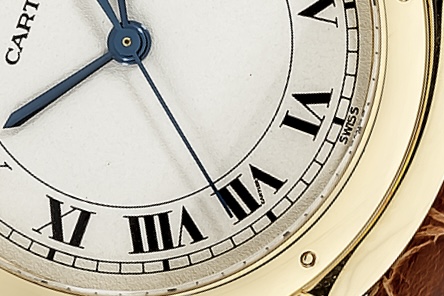
He could not contain his exhilaration and, abandoning all caution, he tore the receipt away and opened the bag. Inside was the watch box—an expensive but unfamiliar brand. He lifted the top and saw a gold watch with a brown crocodile strap, blued hands, and roman numerals on an ivory face. He had expected something in steel or titanium with a rotating bezel, something he could dive into the Great Barrier Reef with, or lead an assault into the jungles of Basilan with. But perhaps she was civilizing him further, completing his transformation into a proper gentleman. Perhaps she had asked the engraver to say this in script: “To my dearest Ronnie, For peace and joy in our golden years. Your loving Martha.” He could feel hot tears welling in his eyes. Oh, Martha, Martha, let us be happy, Lord give us time to be happy.

He turned the watch over and his face turned ashen beneath his mask. His chest tightened and he could not breathe.

The doctor rushed to his side. “General! General, are you all right? Look, if you want to see her—but only for a minute—”

The general looked up at him, and all the doctor could see was his eyes, but he recognized what he knew was the face of utter defeat. 

Penman No. 429: Becoming Miss Demeanor

Penman for Monday, December 6, 2021

(Photo from Pageanthology 101)

IF YOU’RE still wondering what to give your teenager or 20-something this Christmas (older folks can count as kids), I can recommend a highly unique book that came into my mailbox recently from a former student, titled A Creativity Mix Book by Hilom Pagasa. 

We’re often told—and it’s true—that Filipinos are a highly creative people, full of ideas and passions waiting to be expressed in some artful way. But even the most creative persons sometimes need help to turn that spark into a flame—something wondrous and illuminating, without burning down the house. This book can be immensely helpful in making that happen, even for people who may not think of themselves as being creative. There’s an artist and a poet in you, and this book will help you find it.

Written for these challenging times, it’s full of exercises, artworks, essays, poems, and other materials meant to make our Covid-benighted world bright and exciting again. The author describes herself as “just a housewife who wants to heal,” having battled bipolar disorder, but the book is about you, not her. Check it out on Lazada and other places online.

ALTHOUGH NOT much of a beauty pageant fan, I was dismayed to read about the recent experience of Ms. Gianna Llanes, a lovely young Filipina who flew to Mexico to represent the country at the coronation night of “Miss Glamour International 2021”—only to realize, along with five other candidates, that the whole thing was bogus, with no judges and no sponsors to be found for the big event. How anyone could dash the hopes of these ladies so summarily is beyond me, and I can only wish better luck for Gianna in her future endeavors, whether or not they involve chasing after a glittery tiara.

That sad episode also piqued my interest in “Miss Glamour International” and all these other new and relatively little known pageants that seem to have appeared all over the planet since I last took a long, hard look at Miss Universe in 1994. A quick check of Wikipedia turned up a lot more contests I’d barely or never heard of: Miss Global, Miss Globe International, Miss Grand International, Miss Heritage, Miss Model of the World, Miss Supertalent, Miss Supranational, and Miss Intercontinental, among others. As it turns out, the Philippines has figured prominently in many of these pageants, which should come as no surprise.

Back in the day, there were really only three big beauty contests to speak of—Miss Universe, Miss International, and Miss World (or four, if you add Miss Philippines, which was something of a prerequisite to all of the foregoing). It was, of course, Miss Universe that first captivated the Pinoy in 1952, when Armi Kuusela won the title and was promptly captivated by a Pinoy. (An aside I can’t resist making is the fact that Miss Kuusela, or Mrs. Hilario—she’s since become Mrs. Williams—attended a lecture I gave on the Philippines at the University of California San Diego fifteen years ago. We were introduced by a mutual friend, but I guess I was too starstruck to take a selfie.) 

I don’t need to reprise the long, illustrious list of Filipina beauties who’ve won titles at these pageants, major and minor, especially as I’m familiar with only the older ones, who enlivened my juvenile fantasies and who must be grandmothers by now. I guess what fascinates and also depresses me is how something that used to be a happy-go-lucky joyride—a pretty girl gets nudged or cajoled into joining a pageant, which strikes her as a ridiculous idea that the Mother Superior would surely object to, but she does it anyway just to see what it’s like—has been turned into a full-blown industry, with fashion designers and coaches for every quarter-turn. It’s no longer enough just to be fresh-faced and wide-eyed; you’ll need to be trained like a Marine recruit at boot camp so you can sashay in high heels beneath a canopy of feathers for which a whole ostrich farm died and answer questions about climate change and racial discrimination like a PhD candidate.

Online, there are even sites like missacademy.com that promise to turn you into Miss Demeanor, or whoever it is you dream of becoming: “We apologize for interrupting your stereotypical programming, but news flash… pageantry is getting a MAJOR makeover! Say goodbye to the trends of yesteryear and hello to MISS Academy–the future of pageants. Our training will get you primped, primed, polished and prepped in every aspect of competition. The skills you develop at MISS Academy are sure to give you an edge above the rest, in any arena of life, long after you retire the crown.” Not to be outdone, crowndiva.com offers private lessons in ten areas of training ranging from “wardrobe and accessories consultation and selection” to “pageant-specific makeup and hair lessons” for the price of $175 per hour. 

I have absolutely no doubt that our ladies have been prepared well enough by life in the Philippines to surmount any hurdles on their path to international (or universal) fame. I’m more worried by the possibility that, the way things are going, pageant organizers will soon run out of names for their ventures. Well, there’s still Miss Multinational, Miss Globalization, Miss Galaxy, Miss Cosmos, Miss Supernova, Miss Milky Way, Miss Constellation….