Penman No. 103: Too Much Drama

Penman for Monday, June 30, 2014

IN MY other life as a dramatist, which came to an end some years ago, I wrote about a dozen plays for the stage and more than twice as many television plays and screenplays, mostly for the late Lino Brocka. Lino and I happily turned out double-hanky tearjerkers with such rousingly commercial titles (which someone presumably from the marketing department thought up) as Kailan Mahuhugasan ang Kasalanan, Ano ang Kulay ng Mukha ng Diyos, Maging Akin Ka Lamang, Miguelito, ang Batang Rebelde, and my very first one, back in 1977, Tahan Na, Empoy, Tahan.

I may have stopped writing drama to focus on fiction and nonfiction, but now and then the old skills get a workout. I’ve always said that there’s no better training for a writer of fiction than to have been a playwright, because playwriting teaches dramatic economy—how to set up a scene, how to get the most out of your characters, how to use dialogue effectively (meaning, at its most complex, how to get your characters to say things they don’t mean, or to mean things they can’t say).

Last week, I said as much again to a group of writers and program analysts from a TV network who wanted to see how writers think. I told them that drama’s to be found not only in filmscripts or on the set—it’s all around us, taking place quietly in some fastfood joint or some bus stop or some hospital ward; the writer’s task is to see that drama, to palpate it from the tedium of everyday life, and to sharpen and brighten its edges so others can see the extraordinary in otherwise ordinary moments.

We’ll save the rest of the drama lesson for another day; I bring this up only to establish my bona fides when it comes to talking about drama, and about my thesis today, which is that—even for a writer of melodrama, for which I make no excuses—there seems to be entirely too much drama around us these days, or theater if you will. (There’s a subtle difference, if you think of drama as the situation and of theater as its enactment on some kind of stage.)

Case in point: I’m sure I’m not the only one who’s sick not only of Senator Bong Revilla’s whinings about the heat in his room at the “custodial center” (it’s not even a real prison, for Pete’s sake), but also of how the media has fussed over it like it was a real news story (“Can Congresswoman Lani make it back from Greenhills in 15 minutes with the air cooler? That’s all the time she has before visiting hours end!” said one radio reporter breathlessly.) My totally un-PC prescription? Give him the fan, give him whatever creature comfort he wants, but reduce his cell to about a third of its size and keep that one window, from which I hope he sees a mall, or something with lots of people and traffic in it. There’s no better reminder of what prison means than limited space and movement, no matter what you may have with you. (I remember watching a Marlboro neon sign blink at me on the far side of martial law prison, back in 1973; that was torture.)

Senator Jinggoy Estrada’s departure for the custodial center was only slightly less theatrical, thanks again to the media who couldn’t get enough of the father-and-son story being played out in all of its bitter if obvious irony. Of course we expected the family to bond around Jinggoy, and for tears to be shed; that’s any family’s natural privilege, and its natural response. Indeed what underwhelmed me, from my dramatist’s standpoint, was how predictable everything was from start to finish, especially the inevitable “Mayor Erap, ano’ng nararamdaman ninyo sa pagkakakulong ng inyong anak?” I wanted to scream, “E ano pa?”

I can just see the video highlights from these staged “surrenders” figuring in these politicos’ next campaigns: the prayers in church, the mug shots, the hugs and waves from distraught spouses, parents, and kids; the cell doors closing, as the music goes up and under, before we hear a murmured voice-over: “May bukas pa….”

Case in point Number 2: Sometimes silence is drama; when your wife refuses to explain why she doesn’t want to talk to you, that’s drama. When the Palace refuses to explain why it dropped Nora Aunor from the list of National Artist awardees, that’s drama. All President Noynoy’s spokesmen could say was “It’s the President’s prerogative….”, which is exactly what we heard from President Gloria’s spokesmen a few years ago, the only difference being that she made dagdag, while Noynoy made bawas. I did read something about Nora’s exclusion being “in the national interest,” but it boggles the mind to figure out exactly what that means. I can understand defending the Spratlys and Scarborough Shoal as being “in the national interest”; I can even understand rooting for Manny Pacquiao on fight day—temporarily setting all his other quirks and antics aside—as being “in the national interest.” But dropping Nora?

As I wrote in this corner a few months ago, I was on a large, multidisciplinary, second-level committee that endorsed Nora Aunor to a higher body (the NCCA and CCP Boards plus the National Artists); we endorsed Dolphy as well, and if I remember right, he and Nora got the same highest votes across the board. Granted that our recommendations were just that and subject to final approval upstairs, I feel among many others in the arts that we at least deserve a full and cogent explanation for all these pluses and minuses that take place in Malacañang. The Palace—and I don’t mean just the present occupant—has never been known to be a bulwark of artistic support and sensibility, if you look at funding for the arts in relation to everything else; if it never cared for or about the arts, why should it suddenly care—negatively at that—about Nora Aunor, whom the arts community clearly feels is deserving of its highest accolade? If you can’t help, at least don’t get in the way.

I’d been told by some Palace contacts that questions came up about Nora’s alleged drug use. OK, I said, it’s fair enough to raise these questions which presumably involve moral turpitude. But since when has it been fair to use morality as a standard for artistic excellence? We’ve had National Artists whose personal lives were hardly spotless, but whose art precisely may have been deepened and enriched by those encounters with their darker side. (Conversely, we’ve had National Artists who may present themselves as moral exemplars and accuse everyone else of some fatal shortcoming, but whose work is unremittingly mediocre and soporific.) Edgar Allan Poe, Salvador Dali, Jean-Michel Basquiat, and Miles Davis, among many others, would never qualify for state honors in their countries (not that they ever cared) if our Malacañang’s standards were employed.

Last case in point: I wholeheartedly agreed with the NCCA when it protested the Palace snub of Ms. Aunor, but also wholeheartedly disagreed with the NCCA when it reportedly protested allowing the use of our national heroes’ names for such popular products as beer. (Think “Cerveza Rizal” or “Mabini Beer.”) The reason given by objectors was that it would be a sign of disrespect for these heroes to associate something as morally undesirable as alcohol with them.

Really? Which planet are we on? Didn’t our heroes drink beer and stiffer forms of alcohol—in spite (or dare I say because) of which they performed heroic deeds, anyway? Rizal complained that his fellow ilustrados in Spain drank and womanized too much, but that hardly meant that he was completely abstemious in either department. He didn’t care much for hard liquor, but drank beer (like me, on whom single malt would be a total waste). George Washington was a beer guy as well, and even famously left a handwritten recipe for his own brew (later marketed in an “Ales of the Revolution” line). So will the moral police please lighten up? If Nora’s good enough to be a National Artist, then Jose Rizal should be good enough to go on a beer bottle, and I’ll hoist many a cold Rizal in his own honor.

Heroes aren’t heroes because they’re perfect human beings; they’re heroes because—despite some truly terrible character flaws and peccadilloes (one of them even shot his wife, remember?)—they left something indelible to the national spirit and imagination, enough for us to think of ourselves as a nation. Heroes and National Artists (the real ones and the best ones) can do that; politicians—whether in prison or in the Palace—can’t.
Penman No. 102: The Cream of the Crop

2014FulbrightPenman for Monday, June 23, 2014


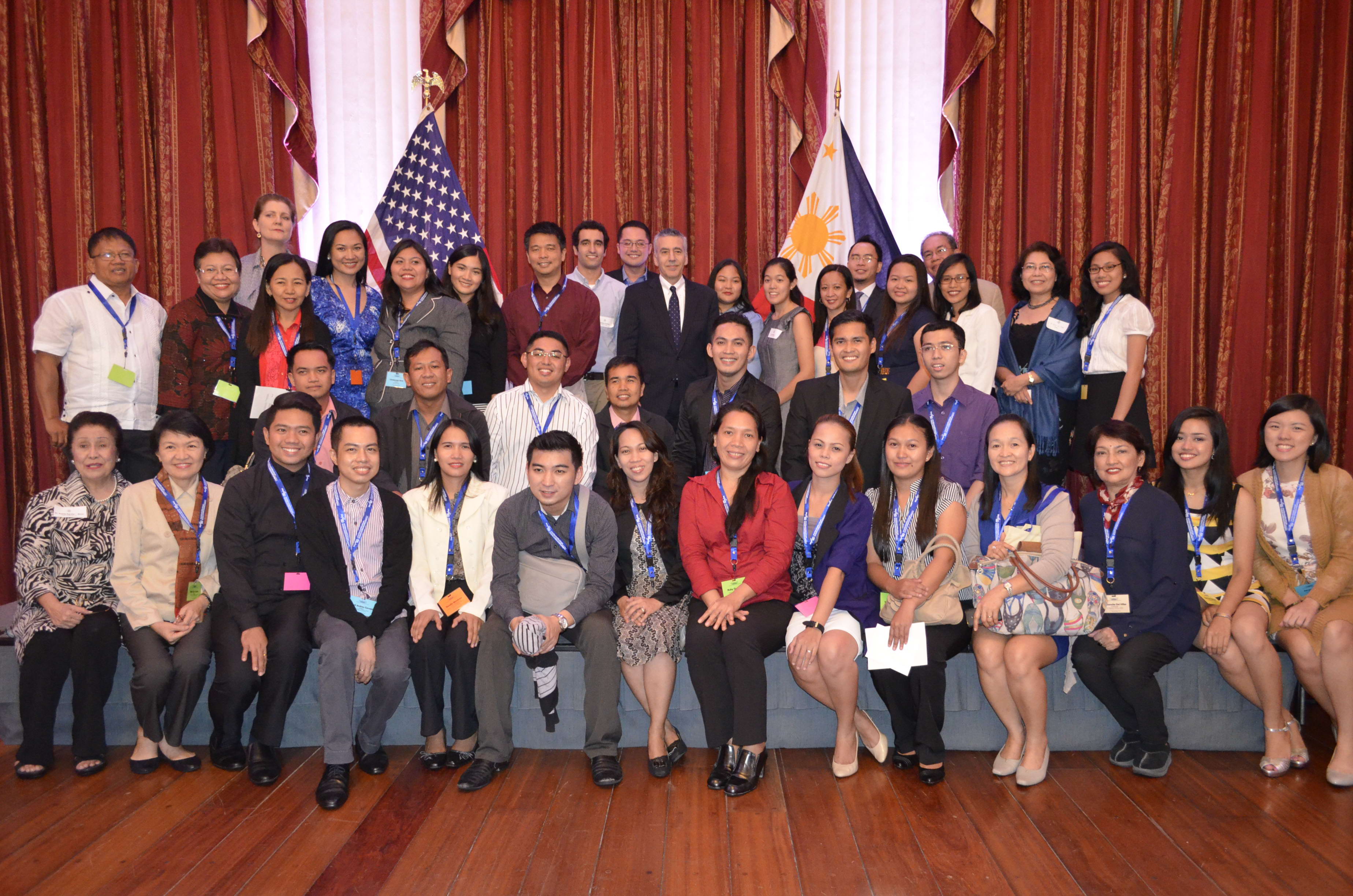
A FEW weeks ago, I was happy to attend a pre-departure orientation seminar for this year’s US-bound batch of Fulbright and Hubert Humphrey scholars. I’ve been to quite a few of these PDOs over the past decade or so, and normally I’d be there up front, giving one of the orientation talks.

I’m usually the closer at these seminars, my task being to remind our scholars to enjoy their stay in America and to learn all they can—and then to come home and serve their people. “Love America all you please,” goes my spiel, “but never forget where your home is, which is here—not even here in 21st century Makati, but in those parts of our country which languish in the 20th and even the 19th century. We go to the great schools of America not just to improve our lives but theirs—those Filipinos who cannot even read, or are too hungry and tired from work to read.”

Last month, I sat in the audience on the listening end, having been privileged with a Fulbright grant—again, after my first one nearly 30 years ago, when I left for the US to do my master’s at Michigan and my PhD at Wisconsin before returning in 1991. This September, if all goes well, I’ll be leaving for Washington, DC to do advanced research in connection with my ongoing book project on the First Quarter Storm, specifically to seek out American perceptions of and experiences with martial law in the Philippines, and also to interview Filipino-American activists from that period.

The Philippine-American Educational Foundation, headed by the very capable and amiable Dr. Esmeralda “EC” Cunanan, actually administers or acts as a conduit for several distinct scholarship programs that fall loosely under the “Fulbright” rubric, named after the late Sen. William J. Fulbright, who saw educational exchanges as the best way to promote international cooperation and understanding between America and the rest of the world. (The Fulbright program also sends out American scholars for studies abroad.) Indeed, as I often tell my American friends, one Fulbright scholarship will probably cost a hundredth of and produce a thousand times more enduring goodwill than one bomb. For us Filipinos, this is the pensionado concept brought over into a new century, with the important difference that our learning is no longer meant to serve American ends, but ours.

A scan of this year’s batch of outgoing scholars offers great hope for the future. Chosen from many hundreds if not thousands of applicants after rigorous evaluations and interviews, they represent truly the cream of the crop, and I felt honored to be in their company.

The so-called “classic” Fulbright scholars—those going for their master’s and PhD degrees—include the likes of Lisa Decenteceo of UP Diliman, who’s going for her PhD in Musicology at the University of Michigan in Ann Arbor (yay, go Blue!); Neil Andrew Mijares of the University of San Carlos, who’s doing an MA in Urban and Regional Planning at the University of Iowa; and Ramjie Odin of Mindanao State University-Maguindanao, who’s entering the PhD program in Fisheries and Allied Aquaculture at Auburn University.

Among my three fellow “senior” postgraduate scholars, despite the fact that she looks young enough to pass for an undergrad, is Marites Sanguila of Father Saturnino Urios University in Butuan, who’ll be going to the University of Oklahoma to undertake advanced research in “Species Diversity and Survival in a Changing Environment: Developing a New Center for Biodiversity Conservation.”

For many years now, there’s also been a special Fulbright program focused on agriculture, the Philippine Agriculture Scholarship Program for Advanced Research, which was set up at the initiative of then Agriculture Secretary Edgardo J. Angara to improve our agricultural expertise. This year’s nine grantees include Ma-Ann Camarin of MSU-Marawi who’s going to another MSU, Mississippi State University, to do doctoral dissertation research on (hold your breath) “Disease Surveillance and Study on the Bacterial Flora of Freshwater Prawn (Machrobrachium rosenbergii) as Biological Control Against Pathogenic Bacteria.” Meanwhile, Shirley Villanueva of the University of Southeastern Philippines in Tagum is going to the University of California-Davis to conduct research on the “Genetic Diversity of Native Chicken Groups in the Davao Region.”

Among the two US-ASEAN Visiting Scholars will be Jay Batongbacal of UP, one of our foremost legal experts on maritime law, who’ll be studying issues related to current disputes in the South China Sea. The three Hubert Humphrey fellows—all accomplished professionals in mid-career—include a PNP major and former Pasay City precinct commander, Kimberly M. Gonzales, who’ll be looking into public policy and administration concerns at the University of Minnesota.

To help Americans—especially Fil-Ams—learn Filipino, the Fulbright program is sending out three Foreign Language Teaching Assistants, who include Edward Nubla from the University of St. La Salle in Bacolod; he’ll be on his way to Skyline College in San Bruno, California. Lastly, four Filipino undergraduates will soon be spending a year on a US campus, thanks to the Fulbright program. They include Michiko Bito-on of Silliman University in Dumaguete, who’s taking up Mass Communications.

It’s heartening to see the diversity not only in these scholars’ expertise and concerns but also in their representation of all corners of the archipelago, ensuring that the Fulbright experience is shared not only by the usual suspects like me from Manila’s academia, but by bright young minds from north, south, and center.


SPEAKING OF the Filipino presence overseas, a big cultural event will take place in Hong Kong over this weekend, thanks to the efforts of the poet and scholar Armida M. Azada, who’s been based there for many years now.

On Friday, June 27, 5:30-7:00 pm, Mida will sit in conversation with visiting Filipino writers Joel Toledo, Charms Tianzon, and Daryll Delgado in a symposium on new Philippine writing titled “Our Words, Other Worlds,” at the Amenities Building, Lingnan University. The next day, at noon, Mida’s new book of poems, Catalclysmal: Seventy Wasted Poems will be launched at the 7th Floor of Hong Kong City Hall in Central. Earlier that morning, from 10:30 to 12 noon in the same venue, a free writing workshop will be held for Pinoy helpers and HK-Pinoy youth. On Sunday the 29th, from 6 to 7:30 pm, a poetry reading by Filipino writers and their friends will be held on the first floor of DB Plaza Terrace near Dymocks in Discovery Bay.

This is a wonderful thing that Mida Azada—a gifted poet who was a colleague at the UP Department of English before she moved to Hong Kong and the UK—is doing not just for herself but for her fellow Filipinos in the diaspora. As prizewinning poet Joel Toledo puts it in his endorsement of Mida’s new collection, “Cataclysmal is a collection of haunts and visitations. The poems here flit in and out of the Philippine archipelago, travelling to London, Hong Kong, and New York without losing touch of a Filipino rootedness. The poet’s concerns stray and meander from the personal and cathartic to the phenomenal and ultimately global. But Azada’s voice is keen and focused, filtered on the page by a careful attention to language. One may argue that this is the poetics of the expatriate ruminating on both the post-modern and post-colonial. Yet at the heart of this collection is fierce integrity, a resonant ‘I’ persona that won’t flinch. Here are poems that both strain to capture the fleeting and restrain from exoticizing the past. The poet Fanny Howe once wrote, “Double the beautiful/because they are so little.” While phenomena can sometimes be indeed cataclysmal, the hurtful is never wasted—so long as poems remember and reconstruct and, in time, recollect the sorrows, parse them into bliss.”

Mida, Joel, Charms, Daryll, and the other fine, memorable voices of their generation—they too are the cream of the crop.

Penman No. 96: A Lovely House, a Lively Conference

Penman for Monday, May 12, 2014


MY WIFE Beng’s profession as an art restorer and conservator brings her into contact with some very interesting people, and one of them is a quiet, unassuming man named Mike Santos, whose arrival at our home always causes the usually calm and cool Beng to groan in distress, not because of anything she holds against the fellow but because she’s sure that, invariably, he’s going to be bringing in another job that will test Beng’s skills as a restorer to the limit.

“Why do you do this to me?” I keep hearing Beng wail at the smiling Mike. One piece I remember him dropping on Beng was a century-old poster or banner of the Virgin Mary, apparently painted or printed on silk, lovely except for the fact that the silk was stained, tattered, and coming apart in places, like a battleworn flag. “Can this even be saved?” I recall thinking. But wonder of wonders, after weeks of careful and well-studied work, Beng was able to restore the piece and to return it to a happy Mike.

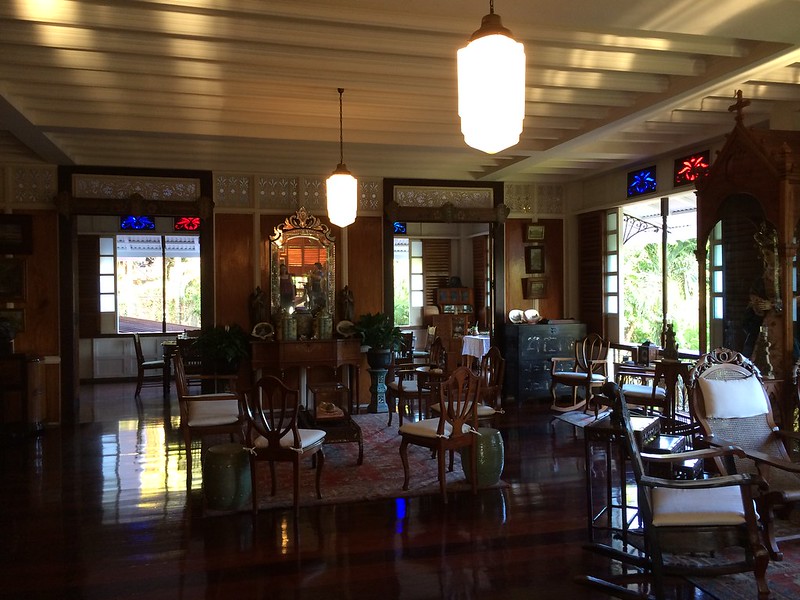
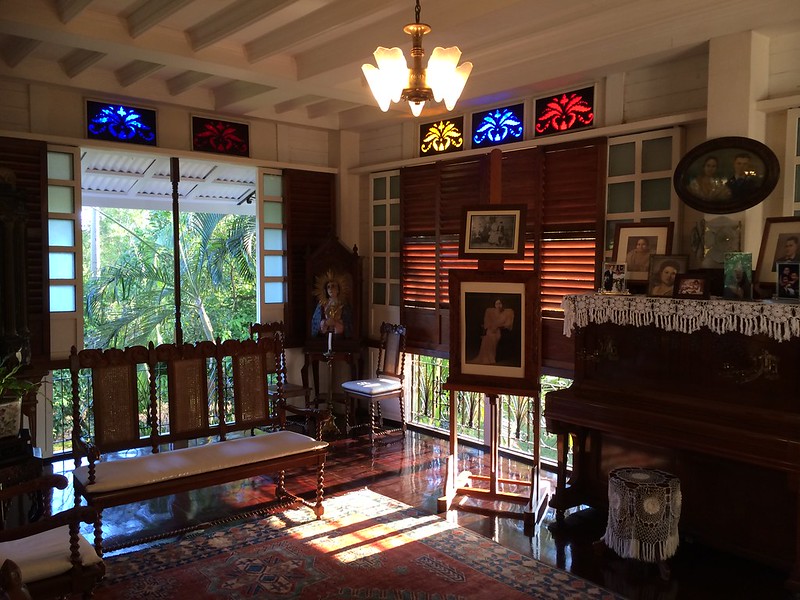
Perhaps in appreciation for all her labors, Mike invited Beng and the rest of her family—that meant me, my mother, Beng’s mother, Beng’s cousin Lando, and my sister Elaine and her husband Eddie who were visiting from the States—to merienda in his Antipolo home. But as sumptuous as it was, the merienda was just the climax to the real purpose and pleasure of the visit, which was the ancestral house itself.

The Santos house now stands on a hilltop lot in one of Antipolo’s subdivisions, and what’s remarkable about it isn’t just the beauty of the Spanish-American colonial architecture but the information you soon receive that this house was transported and rebuilt brick by brick and plank by plank from Navotas to Antipolo. It had been built by Mike’s grandfather Roman—the founder of Prudential Bank—for his young wife in 1917.

Over the decades, it withstood all kinds of natural and human challenges—Navotas’ chronic flooding periodically soaked the lower floor, and during the Second World War the Japanese used the house as a garrison and torture chamber, and of course the ravages of time took their toll on the structure and the furnishings—but sheer love of the house and what it stood for drove Mike and his family to save it before it got much worse. But it would have suffered the same fate over the decades where it stood, so the Santoses decided to move the house to high ground in Antipolo, where it now towers over its more modernistic neighbors.

We were delighted with our tour of the house, marveling at how well preserved the furnishings and appointments were, many of them handed down the generations. The merienda, of course, was excellent, with everything from suman to hot chocolate with pinipig and the sweet mangoes that Mike now grows on the family farm in Bulacan. The company and the stories of Mike and his neighbor Eddie Lindenberg made the afternoon even more special. Of course Beng didn’t get away scot-free: she got a glimpse of her next headache, another century-old painting on canvas of the Immaculate Heart of Jesus that had been cut into several pieces, with losses, then mounted on a wooden board. If it’s going to a house like Mike’s Antipolo manse, I’m sure Beng isn’t going to mind. Salamat, Mike!

THIS JULY, from the 17th to the 20th, another big regional conference will take place in Singapore, promising to bring Asia’s best and most active literary practitioners together under the auspices of Asia-Pacific Writers and Translators.

This moveable feast has been hopping around the region—these past two years, it’s been held in Bangkok, but previous meetings have taken place in Hong Kong and Australia, and next year we’ll get to host it in Manila. I’ve been to most if not all of these meetings—they put me on the APWT board last year, probably in recognition of the fact that a sizeable Filipino delegation has always attended these conferences—and they’ve invariably proven to be well worth the expense of going. (APWT is almost totally dependent on membership and conference fees, and many members like myself go on our own; since the annual conference happens somewhere just around Asia, it’s often doable on a budget fare, and members in academia can and do apply for travel grants to cover costs.)

The difference between APWT and other similar literary conferences is that APWT focuses on practice rather than theory; in other words, while it welcomes teachers, critics, and scholars, APWT is intended primarily for working writers and translators, so they can get together to discuss common concerns like publishing, copyrights, digital media, censorship, and various aspects of the craft. No long and abstruse academic papers are read at APWT; instead, writers and translators engage in lively, jargon-free conversation, sharing experiences across the region and the world.

This July in Singapore, the focus will be on “Bridging Cultures,” and the first keynote will be delivered by none other than our recent guest in Manila, the Singaporean novelist Suchen Christine Lim. Another keynote, titled “Border Lover in Uncertain Times: Story-Making Across Cultures, Languages, and Literary Forms” will be delivered bythe amazingly versatile and accomplished Merlinda Bobis, who was born and bred in Bicol but who has been a longtime resident of Australia, where she teaches at the University of Wollongong. I regularly teach one of Merlinda’s short stories, and am immensely proud of how she has been able to interject a Filipino voice into Australian literature.

According to the tentative program, I’ll be involved in at least two sessions. The first will be a roundtable that I’ll moderate on “Twisting the Truth: Truth in Fiction, Lies in Non-Fiction,” an exploration of storytelling as art and why we tell stories, with David Carlin, Lisa Walker, Michael Vatikiotis, and Philip McLaren. The second will be a session on “Writing Under Political Pressure,” moderated by Michael Vatikiotis, where I’ll be speaking with translator Alfred Birnbaum, who translated the work of Burmese novelist Nu Nu Yi, and with our own Menchu Sarmiento, who’ll be giving an overview on the literary work of some political prisoners in the Philippines.

Aside from myself and Menchu, fellow Filipino writers Christine Godinez-Ortega and Hope Sabanpan-Yu are also already on the tentative program, which can be accessed at http://wp.me/p2yK4I-bD. There’s still room for Filipino delegates to participate in panels they may be interested in and qualified for, but they’d have to register for the conference very soon, according to APWT’s executive director, Jane Camens, who has been the organization’s busybody all these years, and who’s hoping for another big turnout from the Philippines in Singapore. The full member registration is now S$60, and non-member registration is $$80 (in US$ that amounts to around $45 and $65).

Filipino writers and translators interested in attending the conference should know, again, that the organization has no funds to support individual writers, so they’ll have to book their own fares and lodgings for the July 17-20 event. I got online and booked budget airfares for myself and Beng, and then looked for and found a good, clean, cheap hotel—the only seeming downside being that it’s located in Geylang, Singapore’s red light district. This is going to be an interesting conference.

For more details, please check www.apwriters.com.

Penman No. 94: Poverty in Fiction

Penman for Monday, April 28, 2014
ONE OF the liveliest discussions we had at the recent UP National Writers Workshop in Baguio had to do with one of the oldest and yet still most current issues in writing—the depiction of poverty in fiction. A pocket debate arose over a workshop fellow’s short story, the protagonist of which was a 13-year-old boy, poor but streetsmart, who runs into some bad luck but, by the end of the story, is hit by a brain wave and dreams of opening a sawsawan, a kind of food stall, near the tricycle stand he works from.

It was an upbeat ending, an uptick to an otherwise beleaguered existence, but it provoked an unexpected reaction from some members of the workshop—fellows and panelists alike—who felt that the story offered false hopes, given that it was highly unlikely that a sawsawan would provide a real solution to the systemic problem of poverty in this country.

Of course, it’s typical of a UP workshop to get a response like that, and while I didn’t agree with that reading, I was rather glad about the fact that we had people on board who could look at writing and literature for more than felicity of language and agreeability of character and dramatic situation. Sharp-eyed and well-schooled critics these days can take a very long step backward and see things in stories that you or even the author never thought were there—buried or even unintended messages, hidden desires, the author’s own confused and febrile imaginings, latent ideologies. Authors in workshops—especially new ones—will sometimes cry foul at these readings or misreadings, protesting that they never intended their work to be taken that way.

The bad news for authors is that, in today’s critical environment—especially in academia—it’s all fair game; whatever you write can be interpreted in any which way by anyone, and the author’s intentions are often lost by the wayside, seemingly the least important factor to consider in appreciating the story. (In this sense, a writers’ workshop may be the only place where these intentions are given primacy—we try to find out what you really want to do or say with your piece, and then try to help you achieve that purpose.) But it’s not all necessarily bad, as even hostile criticism can be insightful and helpful in the long run to the writer intent on improving his or her craft and vision.

So we should understand when a keenly political critic looks at a story and says that it may be nicely written, but it’s essentially peddling a romantic confection by suggesting that something short of a revolution can banish mass poverty. (Here I may be overstating the specific comments made about that workshop story, but I’m pushing the argument to the extreme for greater clarity’s sake.)

We all agreed that no one does the poor a favor by romanticizing their plight and putting a halo above their heads (instead of saying “their” I should probably say “our,” because most of us are poor compared to the few same people we keep reading about in the glossies). The poor can be as vicious as they can be virtuous; desperation and desire can drive people to outrageously evil acts, and the very poor and the very rich—and the seemingly normal middle class between them—can be perfectly capable of it.

To be honest, my fiction actually deals more with the predicaments of the Filipino middle class, which for me remains the most fascinating source of characters because it’s also the most vulnerable. In a sense, the poor have nothing to lose, and the rich will always find a way to survive; but we, the middle class, entertain the most fervid and the most elaborate ambitions—we know exactly which brands and models to buy, all their technical specifications, sometimes even more so than the wealthy; we just don’t have the wherewithal. Hovering between plenitude and penury, we are one windfall away from a new house in the suburbs, and also one catastrophic illness away from utter destitution.

But I’ve written about the poor and the oppressed in my own fiction often enough (that cranky fellow who keeps implying that I’m some snooty señorito who never stepped on carabao pie and who writes workshop-processed fluff obviously hasn’t read my work). I’d call myself middle-class, but growing up and well into adulthood, we hit rock bottom many times; you all know the sob story, so I don’t need to go there again to vet my poor-boy cred.

What I always say and think about the poor is this: the poor are about more than their poverty. Poverty is awful and dehumanizing, but it’s what people do and how they act at a given disadvantage that I find interesting and even inspiring as a person and as an author, not the overwhelming odds themselves. I’ll leave the objective analysis of poverty to the social scientists and its alleviation to the activists; my job as a fictionist is to see and employ it as another means to understand why we do the things we do. Even poverty needs to be defamiliarized, and especially so, because we think we already know it, when we might not; one exercise I’ve given my writing students is to write a scene or a story about poverty without employing the usual clichés of the sampaguita flower-seller or the shanty in Payatas.

Getting back to the Baguio workshop, I took up the cudgels for the story, reasoning that I didn’t think the author intended for us to believe that the protagonist’s dream of becoming an entrepreneur would necessarily materialize and change his and his family’s life. Indeed the odds seemed stacked against him, and the objective if sad likelihood was that he would falter and fail. What grabbed me about the story was not the dark futility of hope, but the poignancy and the audacity (as Obama would have put it) of even hoping. At that particular moment, this boy thought he saw something better he could do and become—a “bossing,” as he described himself.

As I’ve said, the chances can’t look too good that this boy (nicknamed “Kadyot”) would become the next Manny Pangilinan. But this is where fiction and literature diverge from the social sciences. Fiction isn’t about certainties and probabilities—if anything, the best fiction doesn’t just tell you what you already know, but challenges what you think you know, and even makes the improbable reasonable if not inevitable.

I’ll even up the ante here, and ask why we should take it as an article of faith that this dreaming boy will fail, and that society can’t be changed one person, one family, and one community at a time. We don’t stop hoping or dreaming as individuals because systemic problems demand systemic solutions. The records of banks, cooperatives, and NGOs are full of these stories of lives transformed because one poor guy, maybe being a little silly, dared to dream of starting a business or learning a trade.

I suspect that part of our problem as university-based readers is that we have a traditional humanist bias, gained from decades of immersion in revolutionary politics, against the notion of capitalist enterprise. Mining, for example, will always be a villain in Philippine fiction, no matter what social and economic good the industry or particular companies may produce. Call me an unfashionable neoliberal, but I can’t buy into that kind of summary judgment. Anytime we authors employ simplistic social formulas to explain and to move our characters, the fiction loses, leaving us all the poorer.


Penman No. 93: Resurrecting Another Lost Master

143Penman for Monday, April 21, 2014

ON THIS Easter Monday, a kind of resurrection story seems to be in order. A few months ago, I wrote a piece about the late painter Constancio Bernardo, a lost master and pioneer of Philippine modernism whose life’s work was then about to be celebrated with a centennial retrospective at the Ayala Museum. Little did I know that—a few weeks later, and thanks to a chance encounter at a literary festival—I would learn of yet another and largely forgotten hero of early 20th century Philippine art.

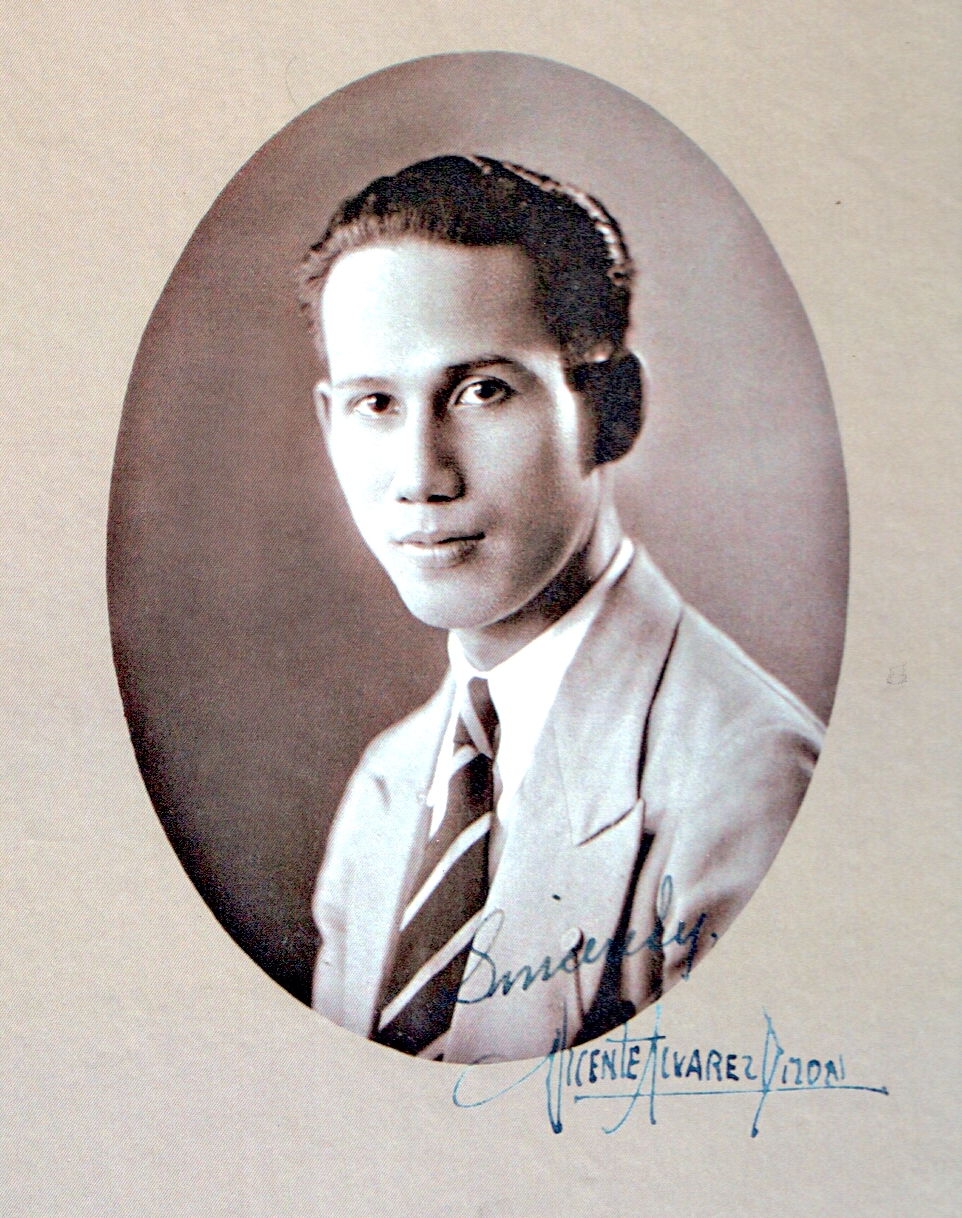
The venue was the Taboan Writers Festival, which we held this year in Subic, with closing ceremonies in Clark Field. It was at Clark that I met Josie Dizon Henson—a painter, writer, and community leader who gifted me with a pair of books she had written. One was a study on Kapampangan orthography, of more scholarly interest; the other book, which caught my fancy, was a slim but substantial, privately published volume titled After the Day’s Toil: A Golden Moment in Philippine Art, a biography of her late father, Vicente Alvarez Dizon and an account of his long-lost masterpiece.

Even at first mention, the name rang a bell in my mind. Two years ago, while doing research for a biography of the late nationalist thinker Emmanuel Q. Yap, I had met (at least by email) a painter named Daniel Dizon, one of Manoling Yap’s boyhood friends. Reminiscing on his friendship with the Yaps, Dan Dizon happened to mention the fact that his father had himself been an accomplished artist—so accomplished that he had won over Salvador Dali in an international competition in the US before the war. That amazing feat—and its doer, Vicente Alvarez Dizon—stuck in my memory. More on that Dali story later.

I had never heard of Vicente Alvarez Dizon before, and as it happened, I would not hear of him again until I met his daughter (and Dan’s younger sister) Josie in Clark. Hearing her name, I made the connection to Dan and to her father, and she seemed delighted to learn that I knew something about her father, and brought me a copy of her book. I set the book aside for a more leisurely read, and when that opportunity arose recently, I found myself engrossed by its account of another extraordinary Filipino life.

Born in Malate, Manila in 1905, Vicente graduated with a diploma from the School of Fine Arts with high honors in 1928. His talent got him a scholarship to Yale in 1934, a sojourn from which he emerged not only with his BFA but also with diplomas in Advanced Painting, Museum Administration and Art Appreciation. Back in Manila, he taught at UP, Mapua, and the National Teachers College; for the rest of his brief life, Dizon would become a staunch advocate of art education and art scholarship, tirelessly lecturing on art subjects around the country.

But his finest hour—the “golden moment” Josie’s book refers to in its title—was likely the Golden Gate International Exposition in San Francisco in 1939, an ambitious, visually opulent panorama that rivaled the New York World’s Fair that opened the same year on the opposite coast of America.

Within the exposition, International Business Machines, already an industry giant under its founder Thomas Watson, decided to sponsor an international art exhibition and competition featuring artists from 79 countries where IBM did business, including the Philippines. The Philippine pavilion in San Francisco actually displayed two other works by young Filipino masters, murals by Victorio Edades (assisted by Botong Francisco) and Galo Ocampo. But as fate would have it, it was Dizon’s painting that IBM chose to represent the Philippines.

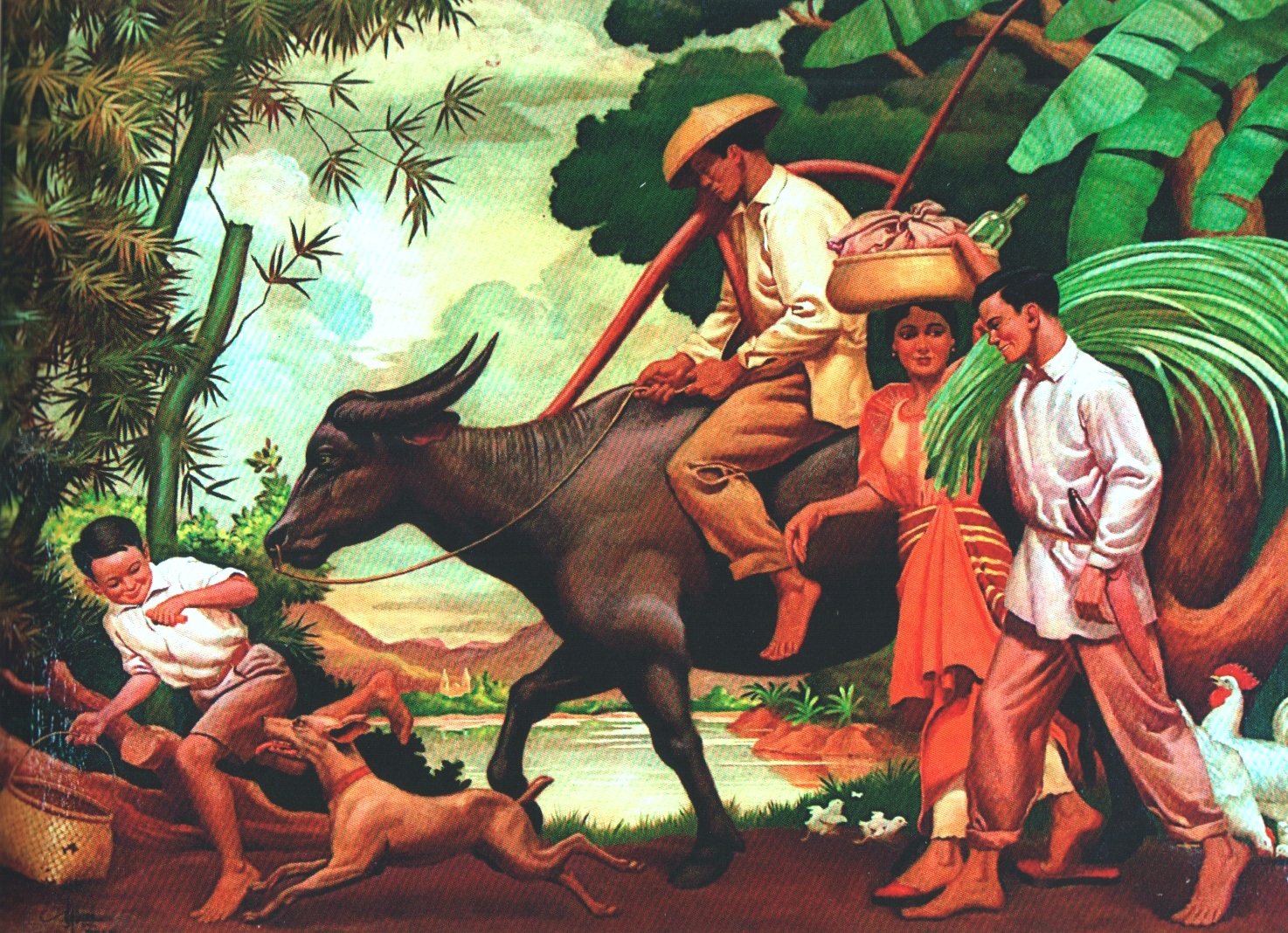
142The painting had been Vicente’s thesis project at Yale. Typical of its time in its evocation of a rustic, romantic countryside, the painting depicted a Filipino family—father, mother, son, carabao, and other farm animals—heading for home at the end of another working day. Because he worked on it at Yale, he had to use Caucasian models for his studies, but replaced the faces with their native counterparts in the final work. He apparently took it home upon graduation, because it was in Manila where IBM’s Philippine representative, Kevin Mallen, saw and bought the painting for IBM, which shipped it to America for the competition. When the results were announced, Dizon had won first prize, followed by Spain’s Salvador Dali and by the American Robert Philipps. (Coincidentally, at the other global fair in New York that same year, another Filipino, Fernando Amorsolo, also won first prize for his painting “Afternoon Meal of the Workers.”)

But that’s not where the remarkable story of this remarkable painting and its creator ends. Vicente himself, sadly, would die young and penniless in 1947 at just 42, afflicted with tuberculosis, a condition that, according to Dan, also ravaged the family’s finances. His masterpiece and legacy lived on—although it was almost lost.

In October 1980, the Batangas-born Filipino-American physician, Roger Pine, received a letter at his home in Princeton, New Jersey from a New York art dealer informing him of the availability of a painting with a Filipino theme titled “After the Day’s Toil,” 40 x 53 inches, signed “V. A. Dizon, 1936.” Would he be interested in looking at and possibly acquiring it? The dealer sent a transparency of the painting along.

The painting had last been seen by the Dizons in 1952, when it had been shipped from the US to Manila on loan from IBM for a local exhibition. And then it vanished. Further inquiries produced no leads other than the name of a New York gallery, which had no records of it.

When Roger Pine received the invitation from his dealer, he felt an instant connection to the painting, having grown up in a family of farmers. He knew nothing about the painting, the artist, nor its provenance, but he did know, especially after seeing the painting itself in New York, that he just had to have it. The dealer—who said that he had earlier tried to interest the National Museum in Manila to no avail—let the Pines have it on installment. It was also only in New York that Roger Pine realized that he had found and bought a long-lost prizewinner.

Next came the trans-continental search for the painter’s family—not an easy task in those pre-email, pre-Google days. It eventually took 25 years and a bit of luck—a dinner conversation during one of the Pines’ visits back in Manila—to connect the Pines with the Dizons. In 2006, the two families met, and the following year, two generations of Dizons trooped to Princeton, New Jersey to visit the Pines and to see, once again, Vicente’s painting. It was a tearful but joyful reunion, the kind of happy ending that deserves to be written about in a book. That’s what Josie Dizon Henson has done.

Poster 12x38

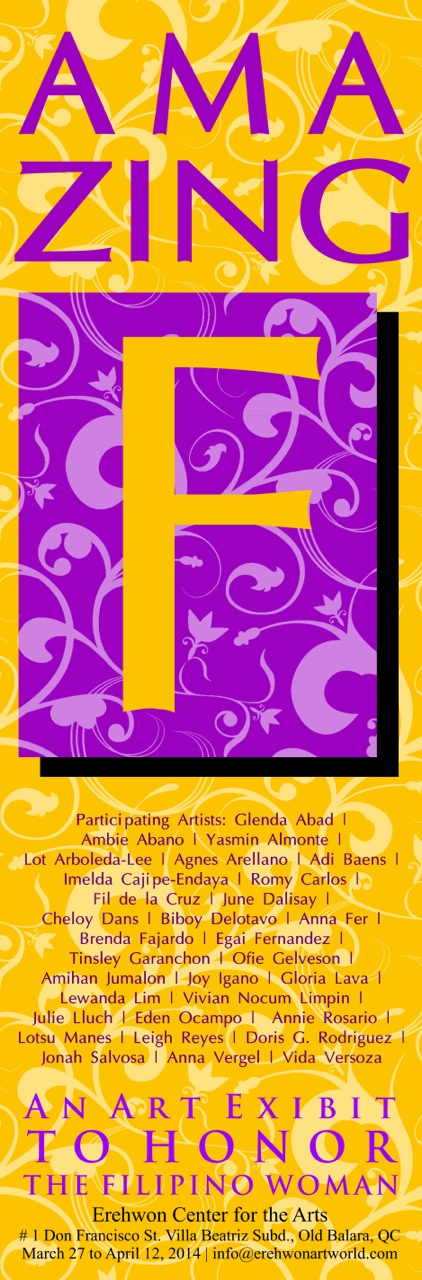
AND WHILE we’re on the subject of documenting Philippine art, let me note that, in celebration of the Filipino woman and of Women’s History Month, the Erehwon Center for the Arts in Quezon City recently hosted “Amazing F,” featuring some of the country’s leading artists, both women and men.

The participating artists included Glenda Abad, Ambie Abano, Yasmin Almonte, Lot Arboleda-Lee, Agnes Arellano, Adi Baens, Imelda Cajipe-Endaya, Romy Carlos, Fil de la Cruz, June Dalisay, Cheloy Dans, Biboy Delotavo, Anna Fer, Brenda Fajardo, Egai Fernandez, Tinsley Garanchon, Ofie Gelvezon, Amihan Jumalon, Joy Igano, Gloria Lava, Lewanda Lim, Vivian Nocum Limpin, Julie Lluch, Eden Ocampo, Annie Rosario, Lotsu Manes, Leigh Reyes, Doris G. Rodriguez, Jonah Salvosa, Anna Vergel, and Vida Verzosa.

Erehwon—located at #1 Don Francisco St, Villa Beatriz Subdivision, Old Balara, Quezon City—is fast becoming one of Metro Manila’s most vibrant art centers, hosting not just painters but also musicians like the Metro Manila Concert Orchestra. The Amazing F show, which ran until last week, was another of its projects to benefit the Erehwon Arts Foundation, which aims to run a residency program for talented but financially challenged young Filipino artists.

It was curated by Erehwon Arts Foundation Vice President June Poticar Dalisay, who said that “AMAZING F is an art exhibit that explores the different facets of the Filipino woman, a complex and enigmatic individual whose roles are varied and endless, affecting every sphere of our personal and public lives. She is warm, sweet, and compassionate, but she can also be can be cunning, feisty, and combative.” Don’t I know that—and yes, June, I stand amazed!

Penman No. 89: Camels and Scribes

d4966305xPenman for Monday, March 17, 2014

A FEW months ago, I wrote about the fountain pens that famous people like T. S. Eliot, Winston Churchill, and Neil Gaiman used, and especially about how Eliot’s pen had been donated by his widow Valerie to the Royal Society of Literature for members to sign themselves with into the society’s logbook. The more practical-minded will and should, of course, dismiss any such discussions of celebrity memorabilia as mere fetishism, an adoration of idle and otherwise meaningless objects.

Happily, that’s a charge I can live with, as an incorrigible collector of lovable old junk, particularly pens to which I’m drawn by some deep Freudian current I won’t even try to palpate. I never even excuse the fact that I collect pens not so much to write as to doodle with—I enjoy laying wet bright lines on a crisp sheet of paper and watching the ink spread and shade. Whatever words I may be forming really mean little; it’s the sheer pleasure of forming the words that matters for the moment, the joy of the first pictographer tracing the outline of a bull on a cave wall, of the medieval scribe illuminating the Book of Genesis.

Eliot and Co. weren’t collecting Watermans and Conway Stewarts, of course; they were putting them to work. In their time, everyone wielded a pen, from insurance executives like Wallace Stevens to ambulance drivers like Ernest Hemingway and Walt Disney. Soldiers carried pens with them to the trenches, using ink pellets they could dilute in water; today these wartime pens and their embedded pellets are highly prized.

I was thinking of just this scene last week when I came across a thread in a pen forum talking about the pen or pens that T. E. Lawrence—Lawrence of Arabia, immortalized by Peter O’Toole in the 1962 film epic—used in his desert campaigns. Lawrence was an indefatigable writer, and his Seven Pillars of Wisdom remains as interesting today as when he published it in 1922.

The forum discussion wasn’t really even about Lawrence’s pen but the ink he used; apparently, he preferred a special French-made ink, one that his pen could safely ingest and expel. India or carbon ink is fine for drawing but is usually too thick for use with conventional fountain pens, whose feeds or ink channels it will clog. A forum member (many thanks to “carlos.q” from Puerto Rico) had dug up a typewritten letter from Lawrence, who was back in Southampton, dated May 3, 1934 and addressed to a friend initialed “FV”. In it, he complains (note his curious abuse of the colon) that “I apologize for the ink. The only carbon ink that will run in a fountain pen is Bourgeois: and that is sold only by Reeve in the bottom of Charing Cross Road. I have emptied my bottle of all but the too-thick dregs: I cannot demand more by post: but as soon as the R.A.F. will pay my expenses to London for a working day I shall go to the shop and buy some, and again charge the excellent pen. Only carbon ink is ink—that I wholly agree. I badly want to reach London again, but cannot afford a private visit.” (It’s sad enough to see this proud man in such dire straits, but sadder still to know that he would be dead in a year, from a motorcycle spill.)

Lawrence’s pen—two of them, actually, a Swan and a Conway Stewart—would turn up in a Christie’s auction in 2007, realizing over $5,000. The pens were accompanied by a 1969 letter from a Lawrence associate establishing their provenance, which noted that they had both been “trodden on by a camel & broken,” although this likely applied only to the Swan, as the Conway Stewart pictured had been made much later than Lawrence’s camel-riding days. The letter does end, presciently: “They may be worth something one day.”

That’s something we all wish we could say for our possessions, hopefully without requiring the chunky foot of a roving dromedary to enhance their narrative value. Having just stepped into the gray zone of seniorhood, I often wonder what will become of my trove of mostly vintage Parkers, Sheaffers, Montblancs, Pelikans and what-not once I sign my last signature. They’ll be worth something, for sure, but all of them put together might not even be enough to trade up for a Rolex, so it isn’t their bankable value I’m thinking about, but the stories they carry, especially the dozen or so in my daily rotation: “This one I got from the Thistle Pen Shop in Edinburgh, and it led to a story that became a book; this one I found in the Greenhills tiangge, selling for a tiny fraction of its actual worth; this one was being sold by a shop in Auckland, but it was missing a tiny part, a tassie which I later found online at the Berliner shop in New York; this one I found in an antique shop on Morato, inscribed to a ‘Consuelo,’ who would have worn it as a pendant on a chain….” And so on.

Last year I told myself that I would try to unload about a third of the collection, thinking to keep just the best dozen or so by the time I turn 70, but turning 60 gave me an excuse to acquire even more ink-spitting baubles. How to say no to a half-priced Montblanc Oscar Wilde, the flamboyant companion to my black-and-formal Agatha Christie? Or the Onoto Magna Classic in mottled tortoiseshell, its golden tongue spinning tales in a summery green-gold (known to ink connoisseurs as Rohrer & Klingner Alt-Goldgrun)? Let me declare this here and now: camels are strictly forbidden from entering my barangay in UP Diliman; any large humpbacked mammal coming within a hundred meters of my house will be shot on sight (with liberal squirts of india ink).

Scribe

Now, if all this talk of bygone pen-mongering strikes a responsive chord in you—evoking the inner Lawrence or the inner Agatha (Christie tracked Lawrence’s footsteps in Syria, intrigued by his spying)—you might want to pay a visit to the newest pen palace in town, a veritable emporium of pens, papers, inks, and even wax seals.

The members of our local (and still growing on its sixth year!) pen club, the Fountain Pen Network-Philippines, were a captive crowd at the recent launch of Scribe’s new flagship store at the East Wing of Shangri-La Plaza Mall. Scribe’s owner, the lovely and gracious Marian Yu-Ong, recalled how the business began in 2002 as an importer of writing and reading products, before opening its first store in Eastwood Mall in 2009. Also featured at the launch were the works of three master calligraphers whom Scribe has designated its ambassadors: hand-lettering maven Fozzy Dayrit, advertising executive Leigh Reyes, and architect-conservator Mico Manalo.

Today, if you want to feast your eyes on the largest and most sumptuous range of quality pens, papers, and inks in Metro Manila, there’s really no other place to go but Scribe Writing Essentials—make that “places,” because aside from Shang and Eastwood, Scribe can also be found at Glorietta 5, SM Aura Premier, and SM Megamall Fashion Hall.

I paid a visit to Scribe’s new flagship store after the launch, and was impressed to find an assortment of quality pens that we used to have to order online or fly to Hong Kong, KL, or Singapore for, and at very competitive prices, brands like Pelikan, Sailor, Platinum, Kaweco, and TWSBI, as well as the more familiar Cross and Lamy.

Here’s my standing advice to fountain-pen newbies, faced with these choices: if you want one good, classic pen you can expect to use for the next ten years, invest in a Pelikan; if you want a good, well-designed pen with a great nib for a price that won’t break the bank, try the Taiwan-made TWSBI (twis-bee), a huge hit among pen aficionados. Then treat yourself to a bottle of J. Herbin ink and a Midori notebook, and before long you’ll be scanning the horizon for wayward camels.

(Upper photo from christies.com)

Penman No. 88: Whatever Happened to the New NAs?

Penman for Monday, March 3, 2014

I GOT a series of messages from a fellow member of the Philippine Macintosh Users Group a few weeks ago, but it had nothing to do with Macs or computers; of all things, it had to do with the actress Nora Aunor and the National Artist Award. I thought it was interesting and compelling enough to take up in this corner, since I’d been wondering about some of the same things myself.

Before I go one line further, let me say that I was a member of a fairly large lower-level committee that was part of the recent selection process for the National Artist Awards. I signed a non-disclosure agreement when I joined that committee, so nothing I say here will be emanating from our discussions in that committee, which will remain confidential.

What’s no longer a secret, since it’s emerged from other sources online, is that a number of people, including Nora Villamayor (aka Nora Aunor), have been recommended for recognition as National Artists. The recommendations of our committee went up to yet another committee or council for final evaluation, before being forwarded to the Office of the President for proclamation, prior to the conferment of the awards themselves.

So far, so good. The prescribed process was rigorously respected and followed by the National Commission for Culture and the Arts, which oversees it (the board of the Cultural Center of the Philippines weighs in, I believe, at the last stage prior to sending the final list off to Malacañang). This was of keen interest to many Filipino artists and the cultural community—not just the names of the prospective NAs, but even more importantly, the process itself—given how the Palace, in the past and most recently in 2009, had cavalierly disregarded the rules and common decency to hand out the award to its favorites.

It’s been half a year, however, since that final list reached the OP—and so far, that’s where it’s been, gathering dust and gathering rumor. The loudest of these rumors has it that Nora’s run-ins with the law—presumably a question of morals—have held up her proclamation, as well as that of the others in her batch, and those before them. (Let’s not forget that, as a result of the infamous dagdag-bawas that happened under GMA, the proclamation of legitimately nominated National Artists such as the late Federico Aguilar Alcuaz and Lazaro Francisco—not to mention that of the eminent musician Ramon Santos, who was unceremoniously dropped to make way for others far less qualified—was indefinitely postponed.) Another bit of speculation has it that the Palace was betting on the late Dolphy, rather than Nora, to make it through the selection process, and that if Dolphy’s not getting it, then neither will Nora.

That will be a very sad and silly thing to do, if there’s any truth to the scuttlebutt. I respect and admire the work of both Nora Aunor and Dolphy, and myself would like to see them both recognized as NAs. I’ve even had the pleasure and the privilege of writing a couple of filmscripts for Nora (among them, “Ina Ka ng Anak Mo”) and of writing a back-cover blurb for Dolphy’s searingly excellent autobiography, released shortly before his death.

But if Dolphy—the comic genius, but also easily the popular and sentimental choice—was indeed excluded for whatever reason from the final list of recommendees this time, penalizing Nora with a similar rejection isn’t going to make things right. Instead, I’d be the first to sign on to a new campaign to endorse Dolphy in the next round of selections. Employing a moral argument is just going to make things worse, by introducing a spurious element into the issue. The religious conservatives won’t like it, but the plain fact is that artistic excellence and personal morality have never made a necessary if a happy marriage; let’s not ask of our finest artists what we don’t and can’t demand of our national heroes.

Early last month, my PhilMUG friend Don Rapadas wrote NCCA Chairman Felipe de Leon, Jr. a letter to inquire about the case, and he gave me his permission to quote from that letter:

“I am Zandro G. Rapadas of the Nora Aunor for National Artist Movement, and it is my privilege to write to you and thank you for the honor you bestowed on Ms. Nora C. Villamayor at the 6th Ani ng Dangal Awards held last Sunday, February 2. It was a well-appreciated and regarded state recognition for the international honors that Ms. Villamayor brought to the country in 2013, particularly for her Best Actress wins at the 7th Asian Film Awards in Hong Kong, and at the 3rd Sakhalin International Film Festival in Russia.

“With all her achievements to date locally and abroad, there is no doubt that Nora C. Villamayor’s time has come to be officially recognized and honored as a National Artist, hence our official nomination of her to the Order of National Artists in November 2012….

“The media and the public have known of the six artists endorsed for confirmation, proclamation, and conferment by Malacañang since early October last year, and we welcomed it with much rejoicing, because a new set of National Artists means the restoration of trust and respect for this state honor, which was unfortunately tarnished with the 2009 controversy involving artists added by Malacañang for proclamation and conferment.

“We believe it was fair enough to make this information known to the public because the decision by the Joint Boards of the CCP and NCCA has already been made and submitted to Malacañang, and what follows should be transparency in the final stage of the process and, on the part of the public, vigilance to help ensure that the transgressions of 2009 will remain a thing of the past. After all, this is a state honor, and the institutions involved operate on public funds, hence the public interest. Moreover, the deciding officials are public officials, and a ‘public office is a public trust.’ Certainly, no one can take us to task for being watchful this time.

“And watchful we have been. We know that after the Honors Committee convened to discuss the endorsement, they went back to your office and requested you to comment on issues raised about morality and past legal cases against Ms. Villamayor, your candidate for National Artist for Film and Broadcast Arts. And we understand that the NCCA has informed Malacañang that it does not take issue with the points raised, and that the Office of the Executive Secretary, who chairs the Honors Committee, has acknowledged receiving this reply early in January this year, and was passed on to the Malacañang Protocol Office for the information of other members of the Honors Committee. Since then and up until last Tuesday, February 4, the latest tracking of its status notes that it’s still with the Protocol Office.

“Why it’s taken this long, we do not know and we do not understand. But what we do know is that out there in the print and social media recently, many are already wondering what’s keeping the Palace from officially proclaiming the new set of National Artists. And included in this anxious waiting are some questions on why the NCCA and CCP have kept mum on the matter. I have attached in this email correspondence a few of these expressions of concern against the long wait.

“On a final note, I wish to underscore that this is not just about our anxious waiting for Nora C. Villamayor’s own cause, but more importantly our desire to see that the original dignity of the National Artist honor is restored with full respect and regard for its original intent and purpose, despite it being subject to political prerogative.”

Don Rapadas’ last point is an important one to note—this is as much about the process as the person. February, our National Arts Month, would have been the perfect time to honor our new National Artists—including the rightful ones from the previous batch; let’s not wait another year to make these long-overdue amends to Philippine culture’s overlooked heroes, and let’s hope Don gets his answer soon. 

(Photo from philstar.com)


Penman No. 83: A Bag of Bread

IMG_20140110_155634Penman for Monday, January 27, 2014

ONE OF the most delightful gifts that Beng and I got a couple of weeks ago for my 60th birthday and our 40th wedding anniversary was a bag of oven-fresh bread, accompanied by a handwritten letter. I found the bread so literally warm, and the letter and its contents so unique, that I secured the permission of the sender to reproduce it for this column. It’s a testament to the persistence of good things and good intentions—and, of course, of good people in a world too often and too crassly ruled by the bottom line.

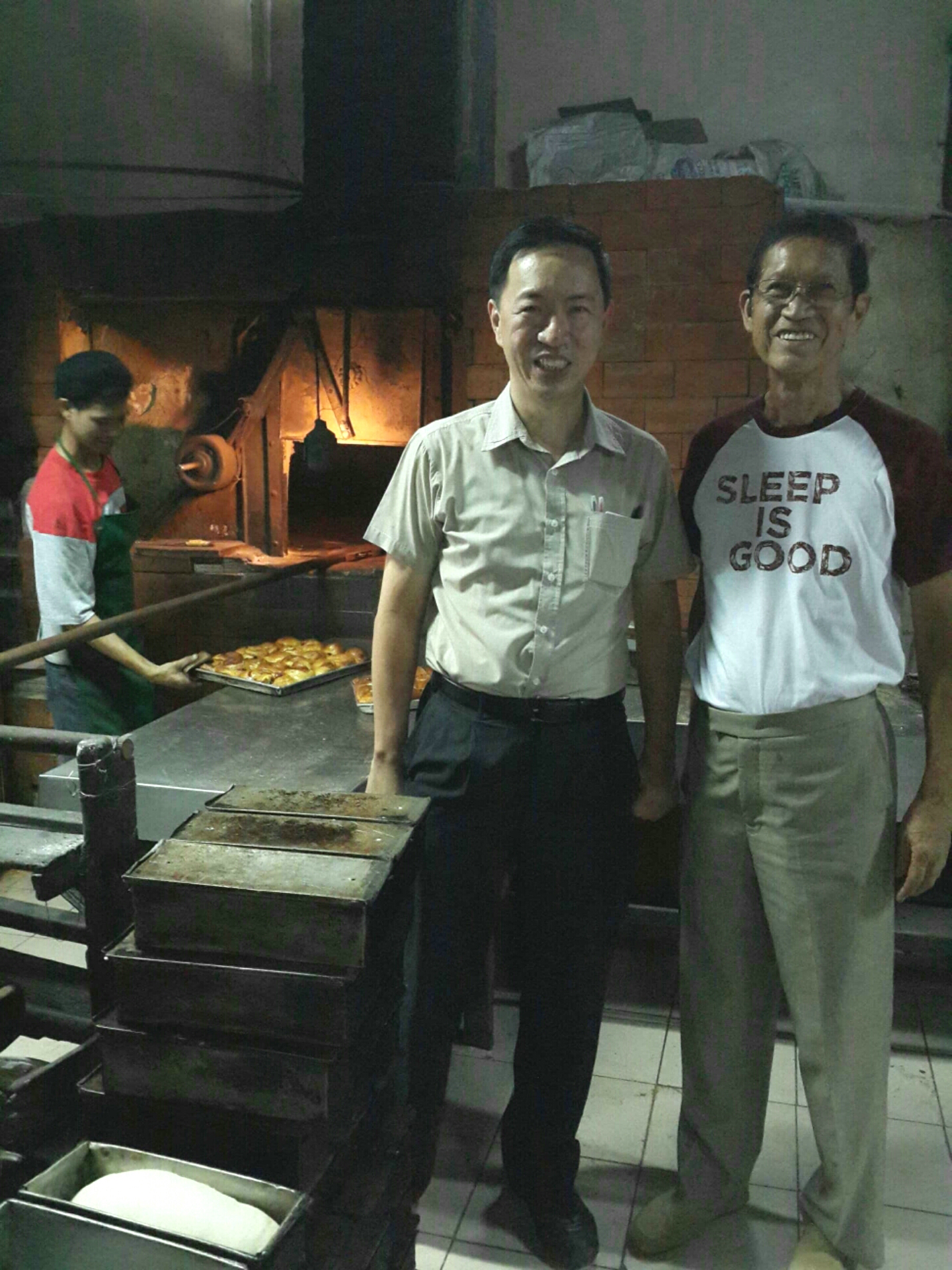
In part, the letter said: “I’m sending traditional pan de suelo breads which are pugon-baked on the suelo or floor of the 75-year-old wood-fired oven of Kamuning Bakery. The crust is crunchier and it should be reheated with a toaster and not with a microwave oven. Nick Joaquin, NVM Gonzalez, and others of past generations have written about this pan de suelo bread of the Philippines.

“I bought Kamuning Bakery just before Christmas, and have kept the old owners as minority shareholders so they can continue the traditions and tastes of this bakery. I also bought the land and old building. I invested here because I believe in the old owners, the pugon bakers who are artists and the staff with their unique commitment to their craft and vocation. I want to support this independent pugon bakery with their traditional no-preservative and no-additive Filipino breads, despite the huge challenges of this era of big multinationals, bakery chains and supermarkets and their mass-produced factory or industrial breads.”

2014-01-16 22.41.53

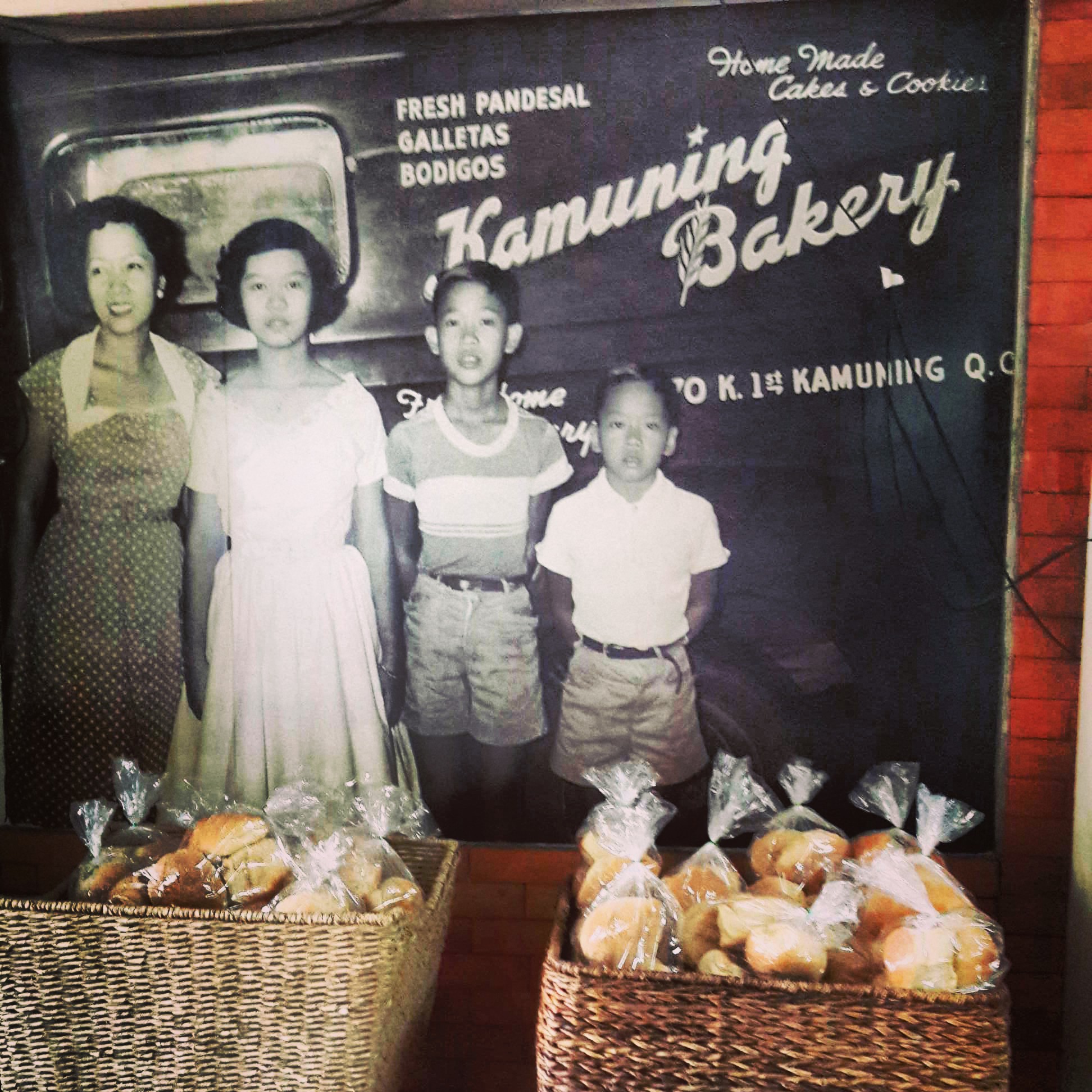
The sender of the bread and the letter was none other than my fellow STAR columnist Wilson Lee Flores, business chronicler extraordinaire and confidant of Filipino taipans. Wilson may move in those lofty circles, but his feet remain solidly on the ground—in this case, Kamuning and the oven floor on which pan de suelo is baked, unlike the more familiar pan de sal, which comes to life on metal trays. (Incidentally, many young Filipinos probably don’t know that kamuning—like the kamias that lends its name to the same street across EDSA—is a plant, Murraya paniculata, with tiny and fragrant white flowers.)

The Kamuning district is one of Quezon City’s oldest—in fact, the bakery was put up in its present location in 1939, when the city itself was established—and while modernization has inexorably overtaken many other parts of the city, Kamuning has managed to retain some of its 1940s charm and character, an effect assisted by the proliferation of antique and resale shops and even a vintage-car restoration outfit in the neighborhood.

You can’t get more original than Kamuning Bakery, which has stayed pretty much as it was when it opened. It’s been kept alive by the seventy-ish Ted Javier and his sister Beth Javier Africa, the son and daughter of the late Atty. Leticia “Letty” Bonifacio Javier, who co-founded the bakery with her husband Lt. Marcelo Javier.  Wilson tells the rest of the story: “It was President Quezon’s close ally Alejandro Roces, Sr. who suggested to the Bonifacio family of Los Baños Bakery that they open the new city’s first bakery. So they sent their newly-married daughter Atty. Leticia Bonifacio Javier and her husband Marcelo, who founded Kamuning Bakery.” Sadly, however, Marcelo, his father-in-law Major Miguel Bonifacio, and another of Ted’s uncles were killed by the Japanese during the Second World War.

So it fell to Letty to keep the bakery going with the help, in time, of her three young children, producing pan de suelo, described by Wilson as the “fist-sized version of pan de sal with a hard and crisp crust,” and of which Nick Joaquin wrote “colegialas got their gums toughened on their segundo almuerzo in the morning and, with hot chocolate, their meriendas in the afternoon.”

Indeed it was all the crunchy goodness that Wilson and Mang Nick promised, but don’t take it just from me. Just last month, a blogger named Tummy Traveler reported, after receiving her own gift bag of the bread, that “The pan de suelo was toasted just right. Just the right amount of crunch on the outside yet the bread still had that delicious moistness and softness on the inside. It had a faint hint of sweetness that went well with the salty corned beef together with my freshly brewed coffee and sausage.”

If all this sounds like a shameless plug, it is. Let’s help Wilson Lee Flores help keep a family and Pinoy tradition alive. I’m already planning a sortie there this weekend with Beng to stock up on the good stuff, and to visit an antique shop or two while we’re in the area. Kamuning Bakery can be found on 43 Judge Jimenez corner K-1st Street, one street inward on the left somewhere between EDSA and Tomas Morato, telephone 929-2216. They also have a Facebook page at https://www.facebook.com/kamuningbakery1939.

IMG_6589

WHILE I’M writing about bread and giving thanks to friends, let me thank another fantastic baker, Theresa Juguan, who with her family and husband Herwig hosted me and Beng in their home in Puerto Princesa over the post-Christmas break. A few months earlier, we had been first-time guests at their seaside villa just outside Puerto, and we struck up such a rapport that Theresa and Beng now call each other “sister.” I’ve also urged Theresa to write her cookbook-cum-autobiography, with her life-story being as remarkable as her cooking and baking.

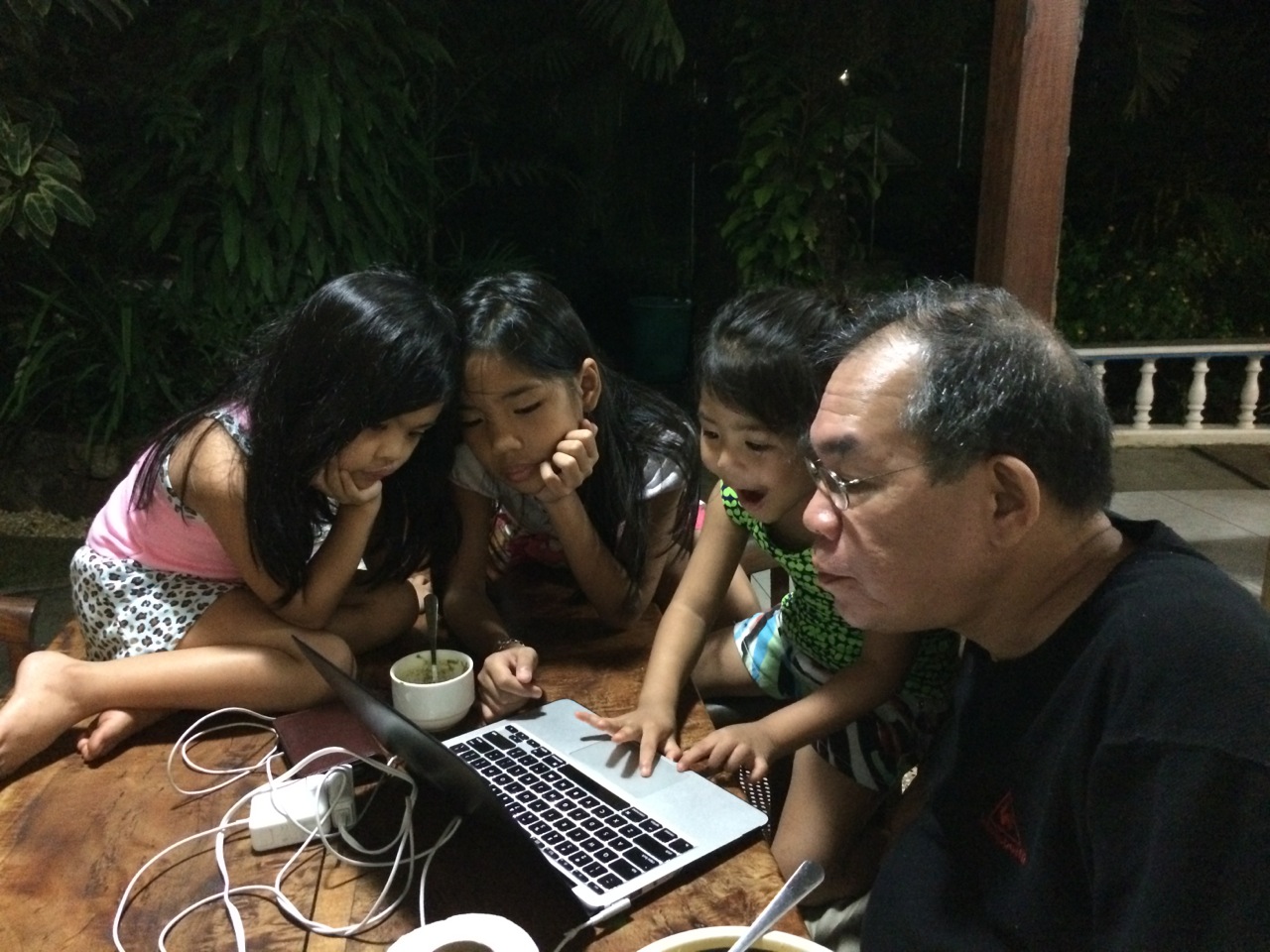
What I most enjoyed about this second visit, though, was playing “Tito Butch” to Theresa’s granddaughters, particularly five-year-old Zanique and her elder sister Zitroenne and cousin Zantelle, who amazed me with their precociousness. Since the in-house wifi was down, my MacBook Air—hooked up to cellular Internet—became the center of the girls’ attention. “Tito Butch,” they cried, “we want to play! Can we use your computer?” “Sure,” I said, “where do you want to go?” And here’s what floored me: these girls knew what a URL was and could recite it by heart: “W-W-W-dot-Y-8-dot-com!”

So I keyed in the address and sure enough, a website for online games popped up. “Go to Games for Girls!” shrieked the kids, and so we did, and they quickly zoomed in on “Cooking Games,” which featured the step-by-step cooking and baking of everything from spicy corn and shrimp salad to tiramisu. “You cook this,” said Zanique, “and I’ll cook this!” And so they did, in all earnestness, arguing over the sequencing and the measuring of the ingredients. (Beng and I had watched Zanique stick by her grandma in the kitchen, helping with the making of fresh lumpia and admonishing a tita who was going about it the wrong way.)

Thus are great cooks and bakers and great traditions made.


Penman No. 78: My FQS Project

CEGP Penman for Monday, December 23, 2013

FOR SEVERAL weeks now, some friends from way back—more than 40 years back—have been getting private messages from me, inviting them to take part in what could be an important historical project—important not only to our generation, but more especially to those who have come after us, who know so little about their past.

I’ve just begun what I consider to be my lifelong dream project: The First Quarter Storm: An Oral History. It’s not as if I don’t have enough books to write; at the moment, I’m working on five books in various stages (two nearly done, two halfway through, and this one just started), not to my mention my third novel, which has had to sit on the back burner. I’m no Superman, but I write books for a living, and take on every engagement as a privilege and a responsibility. Still, this one’s a special self-assignment.

After writing biographies and histories for such varied personalities as the Lava brothers, the business icon Washington SyCip, and the former Marcos associate Rudy Cuenca, I felt the time had come for me to do something for my own generation, whose political awakening came about in the late 1960s and early 1970s.

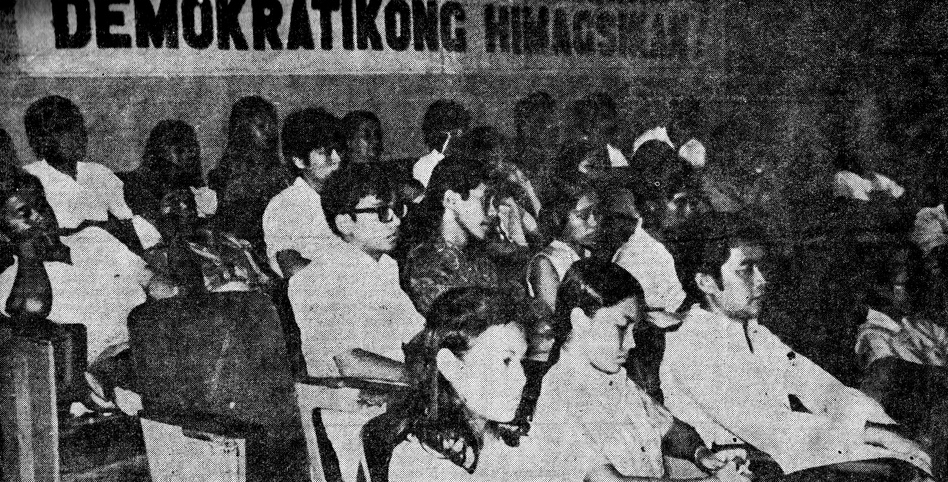
That was one of the most politically charged periods in recent Philippine history, a time many Filipinos my age call the “First Quarter Storm” or FQS, referring to the tumultuous years just before and after the declaration of martial law by President Ferdinand Marcos on September 21, 1972.

Those few months around martial law were both frightening and exhilarating, murderous and ennobling, challenging a generation of young Filipinos to offer themselves up to the altar of revolutionary resistance. The martial law regime would last for 14 years and claim thousands of lives, and cause deep damage to Philippine democratic institutions. By the time a peaceful street revolt restored democracy in 1986, the course of Philippine history and the complexion of that FQS generation had been irreversibly changed.

And yet today, 40 years later, many principals from the martial law regime remain entrenched in power along with pretty much the same ruling elite that prospered under martial law. Despite more democratic space, the same deep-seated problems of poverty and injustice remain. It is as if nothing has been learned—most Filipinos born after 1986 have no inkling of what happened before them—which is not surprising, because a definitive history of martial law and the FQS has yet to be written.

I’d like to help in redressing that amnesia by writing an oral history of the First Quarter Storm, a project that will involve conducting in-depth interviews with many of the surviving principals from that period—from the resistance, the government, the military, the religious, and ordinary citizens—while they are still alive and accessible. My interest in the subject is both personal and professional. As many readers know, I myself was imprisoned for seven months as an 18-year-old student activist in 1973, an experience that became the basis for my first novel, Killing Time in a Warm Place (Anvil Publishing, 1992).

I’ll focus less on the broad sweep of policy than on personal narratives, contextualizing these against particular flash points of the FQS. These personal accounts, I think, will reach deeper into the consciousness of Filipinos today and allow them to grasp the realities and implications of martial law more effectively than an academic paper could.

I’ll be looking for personal stories—including but not limited to or focused on the most harrowing cases of torture and imprisonment (although we’ll certainly have those, unavoidably and necessarily). I’ll be looking for stories of everyday life both aboveground and in the underground; of people preparing for demonstrations and for war, of dealing with separation from family and loved ones, of watching from the sidelines (or even the other side of the barricades), of trying to live an ordinary life amid the chaos, of achieving some kind of balance between the personal and the political. I want stories of courage, of doubt, of heroism, of betrayal, of commitment, of guilt, of loss, of survival. I’ll also be looking for funny, poignant, ironic stories. And then I’ll have an update on everyone interviewed—what they did and what they became after the FQS—for a brief epilogue.

I have no overarching agenda for this book, just an honest recording of people’s memories (as flawed or as self-serving as they may turn out to be), before those participants in and witnesses to history vanish. I don’t mean for this book to be a manifesto or an indictment or any kind of political treatise; I will maintain strict journalistic and scholarly neutrality, endeavoring to gather a multitude and a variety of voices. I will be contextualizing what people say with some factual background, but I will not editorialize or romanticize or make judgmental commentary. Rather than take an obvious stance, I will let the book’s stories speak for themselves, and will leave it to the professional historians and political scientists to use the book as material for their critical evaluations. (In the interest of full disclosure, let me acknowledge a grant from the National Historical Commission of the Philippines, which kindly offered their assistance after hearing about my project, as part of their own project for the documentation of the martial-law period.)

I’ve begun with a small group of people I know, which I expect to enlarge over the next year that I will devote to this project. (So far, they’ve included former SDK and later GMA spokesman Gary Olivar; former UP Vanguard and UPSCAn Ed Maranan; UP activist stalwart Rey Vea; former Makibaka member Sylvia Mesina; Cebu firebrand and now Judge Meinrado Paredes; colegiala-turned-activist Joy Jopson Kintanar; former UP Student Council Chairman and Upsilonian Manny Ortega; and Jesus Christ Superstar and Afterbirth mainstay Boy Camara, among others.) Of course, I’ll remain open to suggestions about whom else to reach out to. I’m particularly interested in stories from the military and the police, as well as from government officials, businessmen and ordinary citizens who may have vivid memories of that period. I’m interviewing people who were active in the Visayas and Mindanao. Sometime next year, on a visit to the US, I will also be interviewing US-based former activists and other principals.

If you think you have an interesting first-person story from that period that you can share with others—whatever your political position was then, or may be now—send me a message at my email at jdalisay@mac.com. (I’m not surprised—I do feel doubly responsible—when some interviewees tell me that “I’m telling you my story so my children will know what really happened and what I did.”) I can’t promise to include everyone’s story in the final manuscript, which will be subject to space and other editorial limitations (I’ll be sending everyone whose story will be included a copy of the text, for their final revisions and approval); but I can promise to be fair, and to render what people tell me as faithfully as possible.

By so doing, I hope that this book can contribute to a deeper understanding of how democracy has been challenged and has survived in the Philippines, and to continuing efforts at national reconciliation, by bringing out the human and more personal aspects of a nation in crisis and a society under stress. This way, it might also provide guideposts for the thinking and behavior of young 21st century Filipinos facing their own choices and challenges as individuals and as citizens. Wish me luck!

Penman No. 74: Constancio Bernardo, the Forgotten Master

AT MACULANGAN PhotographyPenman for Monday, November 25, 2013

THE STORY goes that when the noted abstractionist Josef Albers met Constancio Bernardo at Yale, where the young Filipino had gone to study on a Fulbright grant, he hailed the Filipino “not as a student, but as a peer.” Albers went on to predict that Bernardo—who completed both a second bachelor’s and an MFA degree at Yale—would become a resounding success upon his return to the Philippines in the early 1950s, given his abounding talent.

Indeed, Bernardo had left for the US with high hopes and with his mentor Fernando Amorsolo’s blessings; Amorsolo had reportedly singled out Bernardo as the student most likely to surpass him, especially since Constancio was then working in the same traditional figurative style of which Amorsolo was the acknowledged master.

Sadly and surprisingly, Albers’ rosy prediction would fail to materialize. Bernardo did come home after his Fulbright, but instead of being welcomed warmly by Amorsolo et al, Bernardo—now an accomplished and committed abstractionist—was shunned. He would continue to serve UP, teaching in the School (and later College) of Fine Arts as a teacher and administrator, and his body of work would continue to, establishing him firmly—in the words of art critic Leonidas Benesa—as “second to none in this country” in the field of abstraction, “particularly of the geometric-planar, optical-painting variety.”

For all that, Bernardo would never achieve the celebrity and commercial success enjoyed by his peers like H. R. Ocampo, Vicente Manansala, Carlos “Botong” Francisco, who—despite whatever vicissitudes they may have encountered in their own careers and lives—went on to be named National Artists. As trailblazing and as influential as Bernardo’s work was, he would be cited (again by Benesa, in 1978) as “the most underrated of the exponents of modern art in the Philippines.”

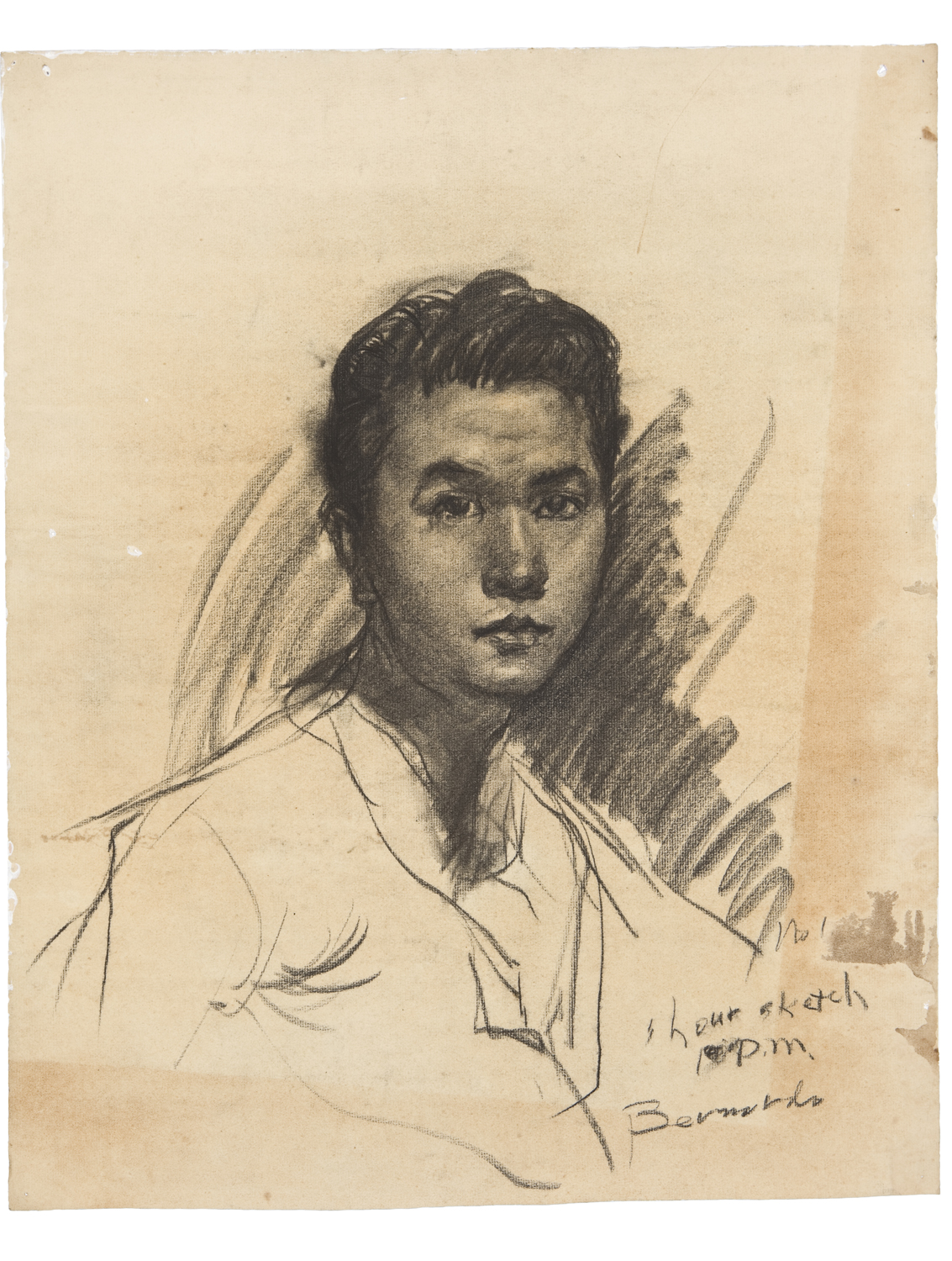
When he died ten years ago, in 2003, Constancio Bernardo was, effectively, a forgotten master, a luminary of Philippine painting whose star burned fiercely but in a dark and distant corner of the galaxy. (As it happened, I was UP’s Vice President for Public Affairs at the time, and attended Bernardo’s wake in my official capacity. Despite my own abiding interest in the visual arts, it was my first albeit belated encounter with Bernardo and his work, leading eventually to an invitation from the family for me to sit on the board of the Constancio Ma. A. Bernardo Foundation, which I accepted.)

It’s high time, then, that Filipinos rediscover and appreciate this lost master in their midst, a need that will be addressed starting this Wednesday the 27th, when a comprehensive retrospective exhibition of Constancio Bernardo’s work opens at the Ayala Museum in Makati. Including about a hundred representative works, the retrospective also coincides with the centenary of Bernardo’s birth, and will be on view until February 28th next year.

According to the exhibition notes penned by the art critic Carina Evangelista, “the exhibition provides the first opportunity to view the full range of Bernardo’s œuvre from a career span of more than sixty years and highlights his canvases of abstraction, lauded by a number of critics from the 1950s onward as among the most important examples of Philippine modernist painting but increasingly overlooked as the decades passed. While included in a number of group exhibitions and the subject of 22 solo exhibitions including retrospectives at U.P. Baguio in 1969, at the Museum of Philippine Art in 1978, and at the Cultural Center of the Philippines in 1990, Bernardo remains to be on the margins of the annals of Philippine art history. Dedicated to his lifelong art practice and his teaching career at the University of the Philippines, Bernardo staunchly resisted the limelight, eschewing the social scene of the art world and opting to work tirelessly in his studio.

“Within abstraction, his paintings ranged from geometric abstraction to Op art and abstract expressionism—each series structured with a formal mastery and infused with a depth of feeling singularly his. Obdurate in his self-effacing silence in his lifetime, his body of work preserved by the Museo Bernardo Foundation Inc., and CMa Bernardo Foundation for Fine Arts, proves to be the clearest evidence of enduring artistic expression.”

AT MACULANGAN Photography

To writer Francine Medina, “Constancio Ma. Bernardo has an indispensable place in Philippine art history. A prolific artist, he painted every day till his last breath, producing an impressive range of works from self-portraits that chronicled his quiet yet intense life; uncannily realistic still life paintings and nudes; to his highly praised fields of color in his ‘Perpetual Motion’ series. It was just that art was a necessary almost organic function that he needed to accomplish everyday.

“There was a palpable sense of completeness in the way he approached his works, a proof of his great involvement in each piece. He mixed his own paints, diligently worked in his studio, and made his handiwork complete by creating the frames for his art works.

“His quest for the ultimate painting was such that when he felt a work was not at par with his self-subscribed standards, he would paint over it or, as his closest peers would attest, throw it away, never to be seen or worked on again.”

It’s too bad that I never got to know the man when he was alive. I’ve made friends of many artists, and while they generally and understandably aren’t as voluble or as articulate as my writer-friends, many have led very interesting lives that deserve to be known and written about, quite apart from their creations. My wife Beng was a Fine Arts student at UP when Bernardo taught there, but being a Visual Communication major, she never got to study with him, unlike her contemporary, the former Fine Arts dean and modernist Nestor Vinluan, whose paintings clearly show Bernardo’s influence. She remembers him, however, as a quiet and kindly man, with a rather formal demeanor, someone who spoke only when he had to and who chose his words well.

In this restrospective exhibit, Constancio Bernardo’s works will speak for themselves, and hopefully lift him and his legacy out of the obscurity they don’t deserve.

(Let me acknowledge and thank Constancio’s son, the retired anthropologist Angelo Bernardo, for providing additional source material on the painter.)