Penman No. 43: Bencab and Biboy

Bencab and Jim LibiranPenman for Monday, April 22, 2013

EVERY SUMMER, when the UP National Writers Workshop caravan heads up to Baguio for a week-long literary retreat, our first stop right after we drop off our bags at the hotel is an art and ethnographic museum on Asin Road off Naguilian, built and run by National Artist Benedicto Cabrera, better known to all as Bencab. This Easter-Sunday visit with Bencab has become one of the staunchest of workshop traditions, as eagerly anticipated as the Friday evening poetry slam at the Mt Cloud bookshop.

Most years, there’ll be three National Artists in attendance at these meriendas—aside from Bencab himself, we’ll have workshop panelists Virgilio “Rio” Almario and Bienvenido “Bien” Lumbera with us (and if our prayers gets answered and poet Gemino “Jimmy” Abad gets named to this grandest of honors one of these days, there’ll be one more). It’s a treat for the workshop fellows, this leisurely afternoon with cultural heroes, and as mid-career writers with at least one major book or work behind them, they’re not expected to genuflect before the luminaries but to chat with them as peers—although, of course, it can’t be helped if some get star-struck and tongue-tied.

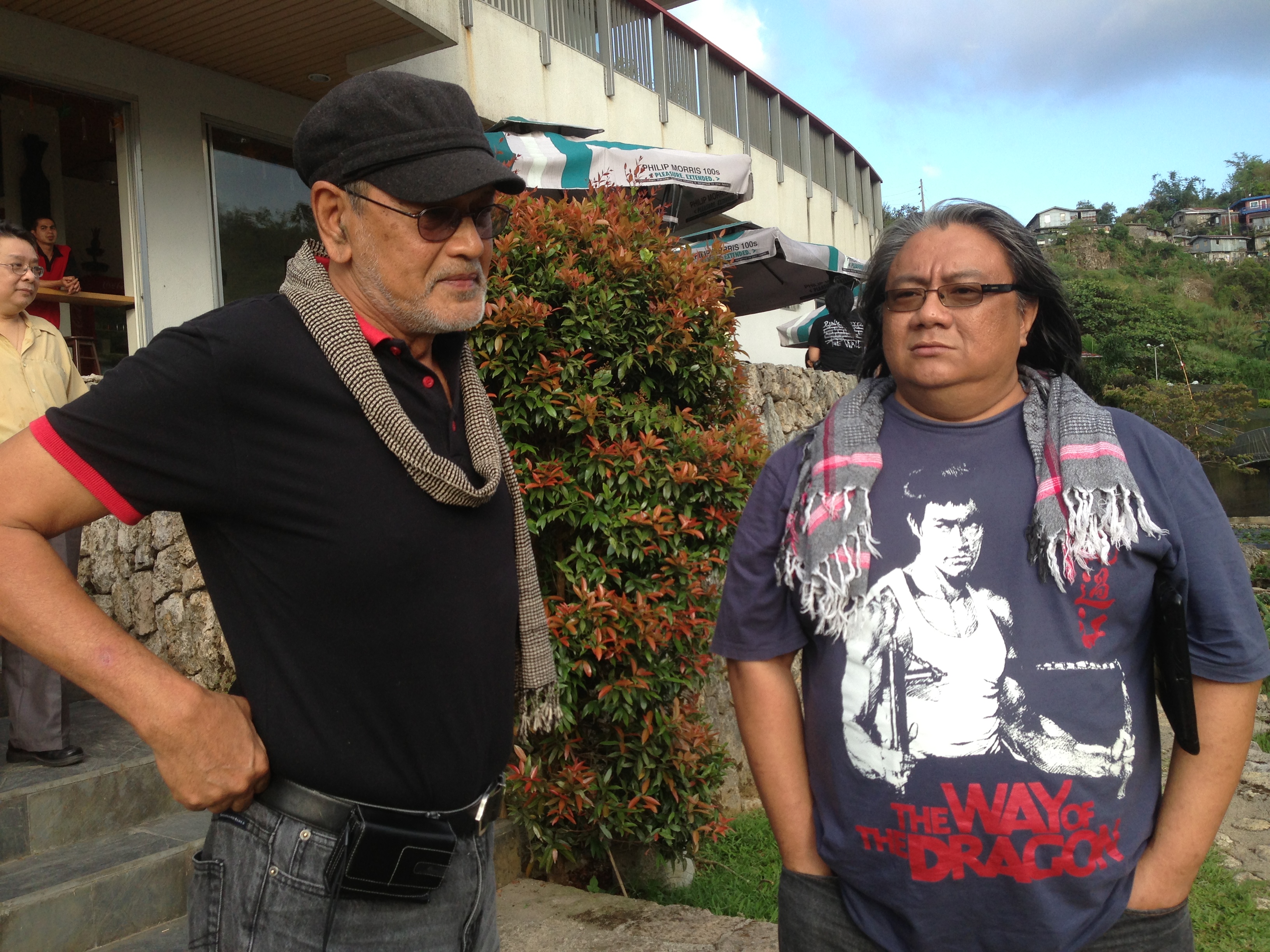
Bencab makes it easier for everyone by personally welcoming the workshop fellows (that’s him with filmmaker Jim Libiran, above) and leading them to the generous merienda, which also serves as his birthday celebration (he was born on April 10, 1942). Then he’ll lead a smaller group of fit and intrepid volunteers on a walking tour of the grounds, showing off new additions and developments.

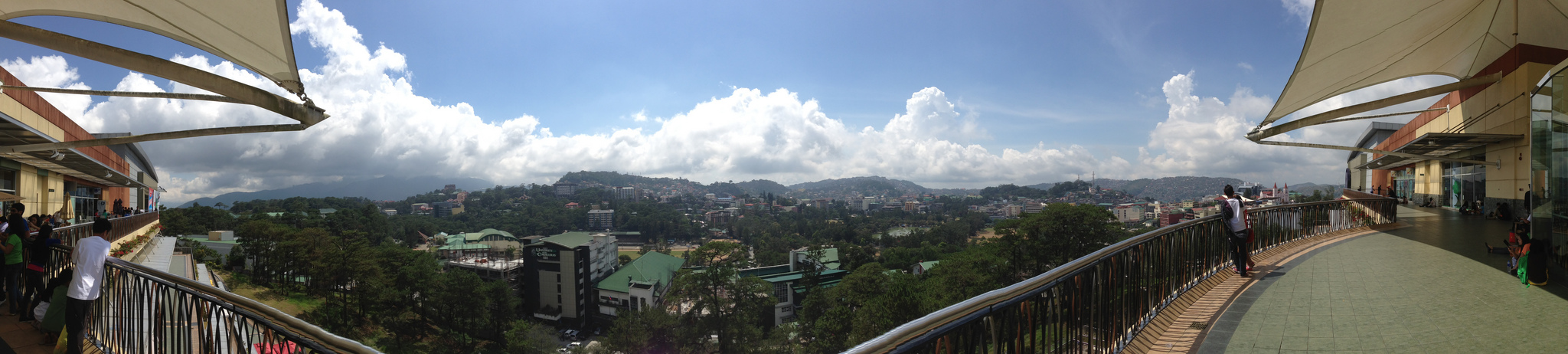
It has to be said that the Bencab Museum has become a reason unto its own to go up to Baguio. Built on one side of a gorge (Bencab had the foresight and thankfully the wherewithal to acquire both sides, to ensure the integrity of the view), the modernistic multilevel museum and its adjoining buildings dominate the landscape, a white counterpoint to green. It’s been 13 years since Bencab decided to move his studio from the old artists’ village in Tam-awan to Asin, and we’ve had the privilege of watching the museum grow from year to year, a few bricks and exhibits at a time. These days, the museum features not only paintings—Bencab’s own and those of some of the best young Filipino artists today—but a world –class collection of traditional Northern highlands art, including the iconic bulol. The sculpted grounds covering five hectares all in all feature plots of homegrown strawberry, coffee, and lettuce, and this time we got to meet the museum’s newest denizens, the delight of squealing children—15 Peking ducks in the pond.

Despite the entrance fee of P100 per person (discounted to P60 for seniors and students), the place attracts many hundreds of visitors on weekends, and if you’d rather have Benguet coffee than acrylic abstractions, the museum has Café Sabel (named after Bencab’s signature character) with a fabulous view.

I’ve admired Bencab’s work since the early 1970s, when I first met him at the old Printmakers Association of the Philippines shop on Jorge Bocobo in Malate. Fresh out of martial law prison—where I’d studied art with a fellow detainee, the printmaker Orly Castillo—I was apprenticing with the masters at PAP, and Bencab himself would drop by. Knowing my limitations, I soon shifted from prints to prose—but not before I met my wife-to-be, the artist June Poticar, at PAP; the other bonus of that brief foray into printmaking was a lifelong friendship with people like Bencab.

When we visited him last Easter Sunday, Bencab was just about to leave for New York to participate in an international exhibition and symposium with 17 other artists from the Spanish-speaking world. He spoke eagerly of the new commissions he had been working on, including an eight-foot sculpture for the recently inaugurated Solaire casino. Not too long ago, he had been a resident artist at the Ken Tyler Print Institute in Singapore; his pieces have been realizing premium prices at international auctions.

Here, I thought, was an artist who, at 71, was still at his productive prime, generously sharing his experience and his influence with younger artists and the public through the museum. But while he’s assumed a public persona, he’s never forgotten—like all good artists—to return to his studio beside the museum and to work in creative solitude. You can’t share what you don’t have, and Bencab’s been great at doing both. Thanks again, Ben, and we look forward to more visits and chats with you.

IMG_1016

I WAS also fortunate to have been invited last month to the opening of Antipas “Biboy” Delotavo’s 13th one-man show, titled “Mallcontents”, at the ArtInformal gallery on Connecticut Street in Greenhills. Biboy and I also go back a long way to 1978 when he illustrated the poster of the first movie I ever scripted, “Tahan Na, Empoy,” for director Lino Brocka. It turns out that Biboy was born a couple of months after me in 1954 (as were Jacky Chan and Kazuo Ishiguro, so I suppose I’m in good company, ha ha.)

Biboy has been called a social realist, an artist whose work carries an explicitly political agenda. Indeed his paintings have demonstrated a keenly political sensibility, an awareness of how ordinary Filipino lives are shaped if not mangled by forces much larger and more powerful. You can see this in one of his most familiar works, “Itak sa Puso ni Mang Juan,” which depicts a man on the street walking against the backdrop of a giant Coca-Cola sign—suggesting, perhaps, a form of cultural imperialism, of how we’ve allowed brands and loyalties like Coke to define our tastes and therefor define us.

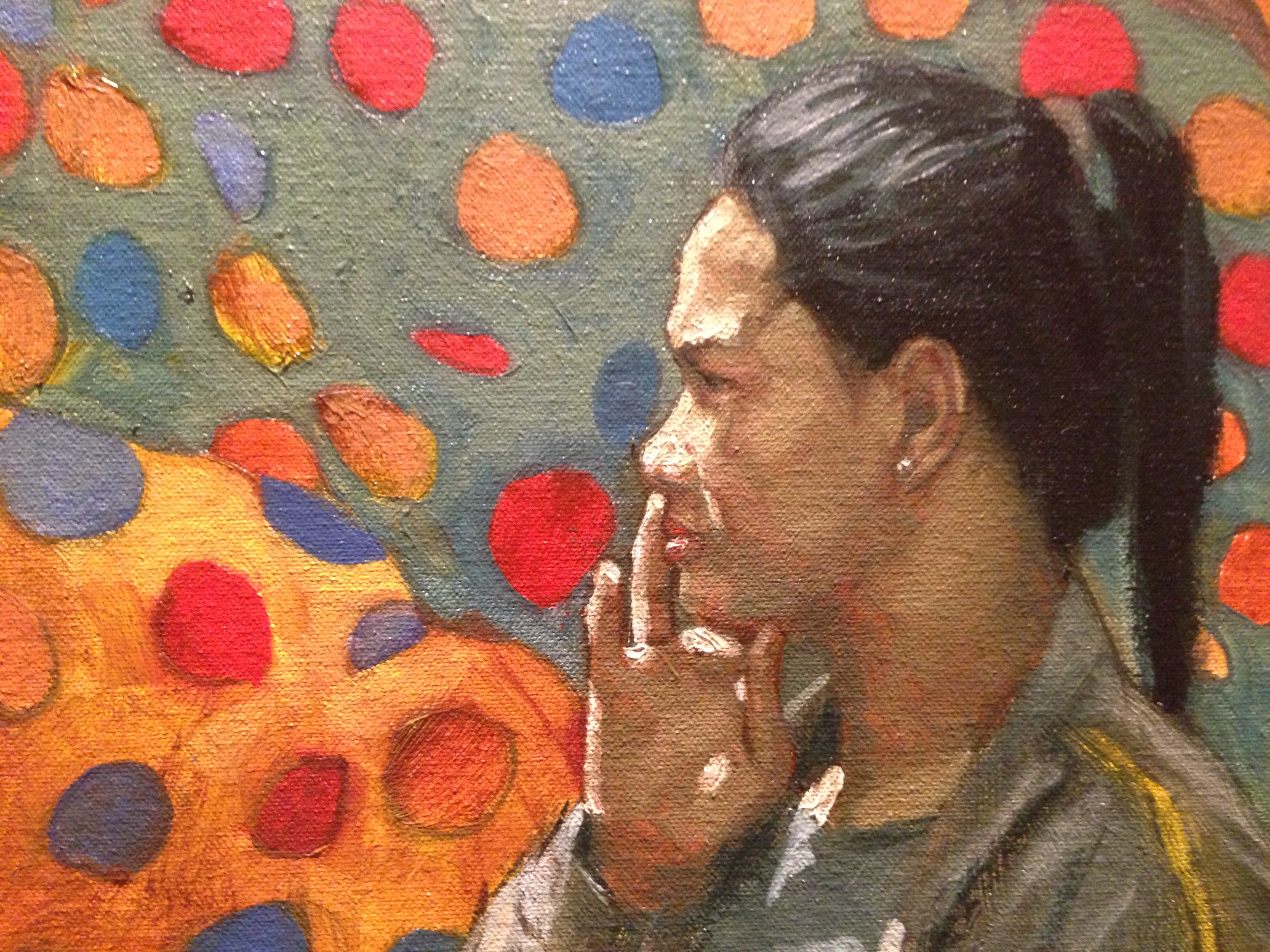
But whatever you may think of the politics of art, no one captures the contemporary, everyday Pinoy as sharply as Biboy Delotavo. His portraits of pedestrians in “Mallcontents” are painstakingly honest—neither pessimistic nor jubilant, neither warped nor romanticized. These are people just getting through another day, mulling over the usual problems (rent, supper, tuition, cellphone load, birth certificate, happiness, relief, rheumatoid arthritis); they don’t look particularly hopeful but they’re not despondent, either—they’re thinking about possible ways of coping. You look at a Delotavo portrait and see yourself and people you know, and you feel that one way or another you’ll survive, and the affirmation of that shared experience—of community and society—makes it well worth the visit to the gallery.

Penman No. 40: Some Things Fishy in New GenSan

Microtel

Penman for Monday, April 1, 2013

THE FIRST thing I realized when I flew down to GenSan last weekend was how big the plane was—a wide-bodied Airbus A340 that seated eight people across—and how the plane was almost full for our early morning flight. This wasn’t going to be some spit of land under a clump of coconut trees.

Oddly enough, in my nearly 60 years, I’ve been to almost all corners of this country and about two dozen others, but had never visited General Santos City, not even back when it was still called Dadiangas. I simply had no reason to, which explained why I was there this time—to help tell the story of the city and of its entrepreneurial spirit through a biography of one of its business pioneers and of his family. I had told my client that his story had to be the story of the city as well, and that my sheer ignorance of it—beyond a few touristic slogans and clichés I’d heard about the place being the country’s tuna capital and the home of boxing champs both faded and fabled—was a good thing, because I was going to be interested in everything about the city, as I always am especially on a first visit.

So I read as much as I could, online, about GenSan before coming over. I came across the story of how, back in the days of President Quezon, a group of 62 Christian settlers led by Gen. Paulino Santos arrived on a steamship on the shores of Sarangani Bay. They were the spearhead of thousands more who followed them from Luzon and the Visayas, displacing the native B’laan, who called the place Dadiangas, after a tree. Dadiangas was then just part of the municipality of Buayan. In 1954, Buayan was renamed General Santos, which became a city in 1968, and was reclassified into a highly urbanized city in 1988.

“Highly urbanized” might suggest something like Cebu or Davao, with sprawling suburbs, heavy traffic, and crowded malls, but GenSan clearly—and perhaps thankfully—isn’t in that same category yet. As your plane prepares to land at the new international airport in Bgy. Tambler—built with significant and some say suspicious American support, its runway is big enough to take Boeing jumbo jets and even the new Airbus A380—the view at the window is that of rolling hills and even of mountains in the distance. That tall, cone-shaped mountain looming almost 2,300 meters over the plains is an active volcano called Mt. Matutum, South Cotabato’s highest point. (On the flight home at dusk, these mountains would turn velvet, laced by low-hanging clouds.)

GenSan’s city center is about a 20-minute drive from the airport, and the businesses along the tree-lined highway still suggest the old frontier: rough-hewn lumber, hardware, heavy machinery. A familiar face pops out of a billboard beside a shop selling bottled water—but this isn’t just any water, it’s “PacMan H2O, Ang Pambansang Tubig.” This is Manny Pacquiao country—or would have been, more convincingly, if he hadn’t lost in that congressional bid some years ago to Darlene Custodio, now GenSan’s incumbent mayor. Congressman Pacquiao of course now represents neighboring Sarangani just across the river, but he remains very much a presence in GenSan, maintaining two big houses there (“Mansion 1” and “Mansion 2,” as the locals called them), plus a gym.

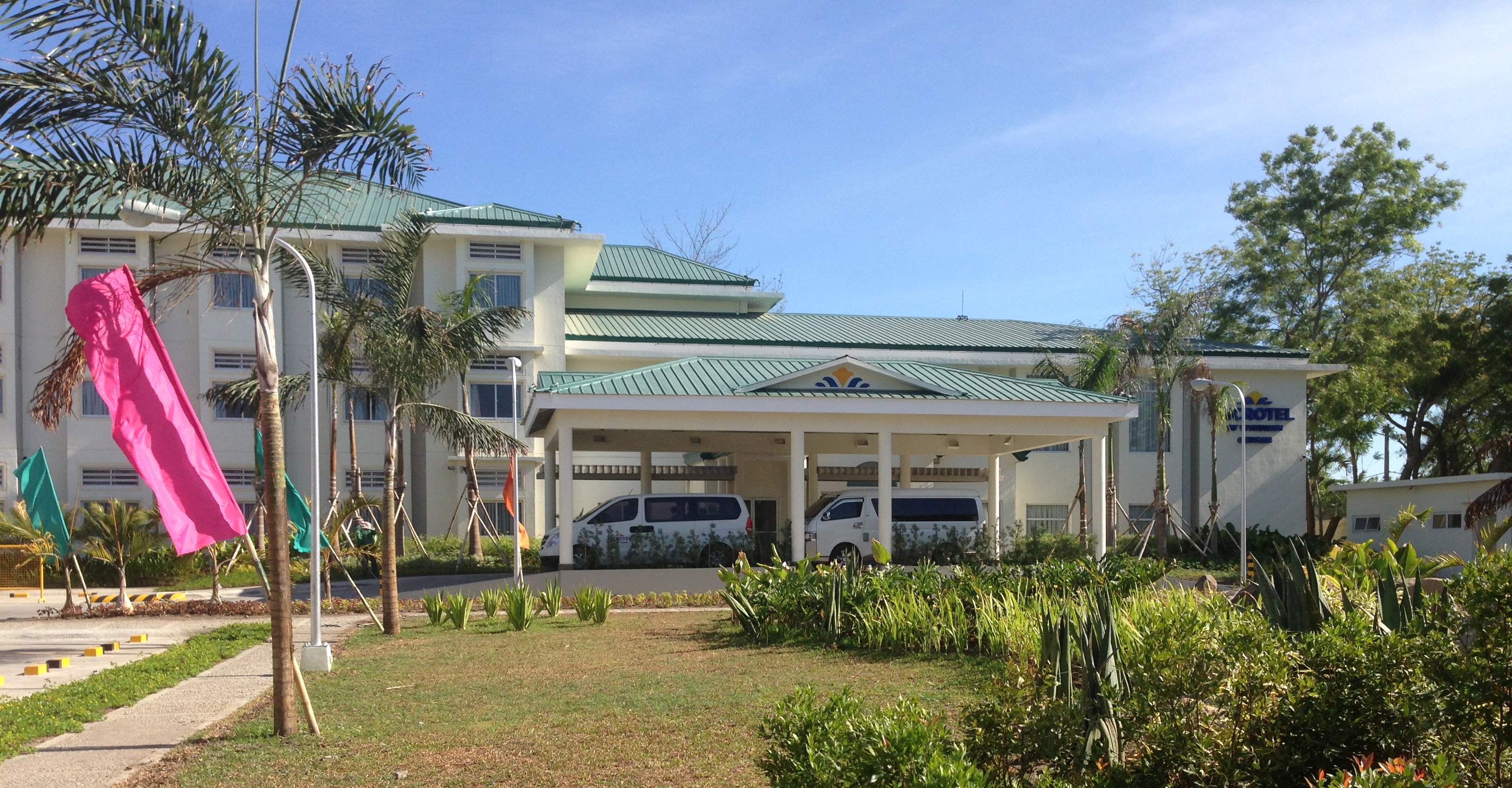
I was billeted at the Floirendo-owned Microtel, GenSan’s newest landmark along the national highway, not too far from the East Asia Royale Hotel, the city’s grandest. The Microtel was neat and comfortable, as a business hotel should be, and was flanked by an equally new strip of restaurants, culminating in a big McDonald’s fronting the highway (across, inevitably, a Jollibee). This sense of newness in this city of more than 500,000 people and almost 500 square kilometers was pervasive—down Santiago Boulevard off the main highway was GenSan’s own SM (what’s a Pinoy city without an SM?), which opened just last August and was already drawing crowds from the older Robinson’s, Gaisano, and the homegrown KCC mall. Not surprisingly, the vehicle of choice hereabouts was the SUV or its pickup variant, especially in white, with rows of them lining the parking lots.

Gen. Santos

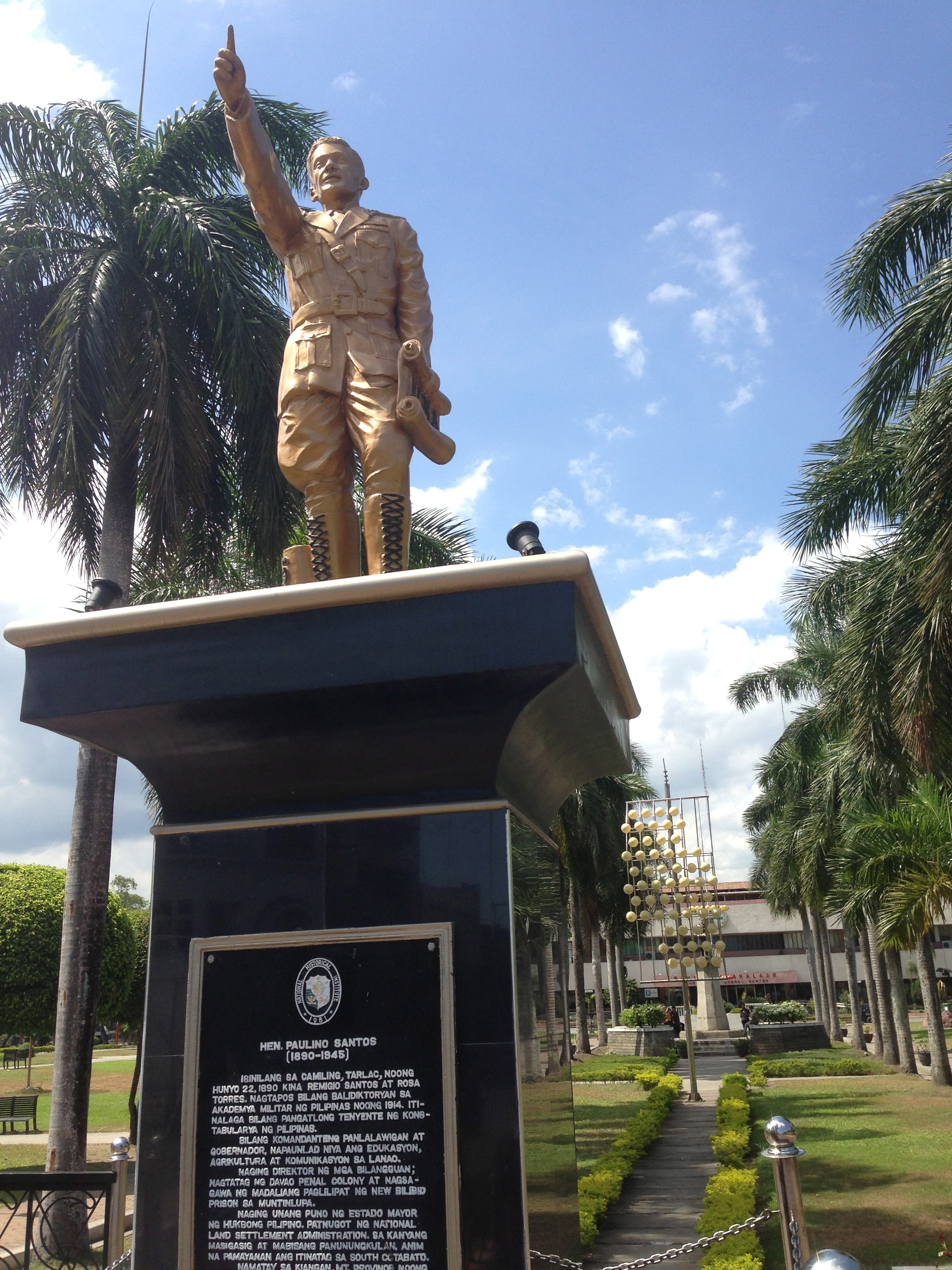
So what happened to the old GenSan? The former Buayan airport had been converted to an Air Force station, with goats and cows grazing beside the runway. I asked my guide to bring me to the older and poorer part of town, near the wharf and up Pioneer Avenue, towards City Hall. Now and then a house from the 1940s turned up, its paint long scoured and blistered by time and by the swirling dust that Gensan oldtimers remember. But even later structures looked forlorn or boarded up. “Everyone’s moved to SM,” said my guide. We got off a the park in front of City Hall to visit the statue of Gen. Santos, who headed Quezon’s land settlement program, and also to look for a living specimen of the dadiangas tree; surprisingly, we couldn’t find any, even when we went to a nearby plant nursery. “It has thorns and has yellow blossoms” was all the older people could tell us. There was no museum we could visit to look up the tree or a history of GenSan for that matter (and I’d be grateful for any leads from readers to a good history of Dadiangas or GenSan).

Most of my three-day visit went to work—interviews with my subjects and tours of plants and facilities—but it was very pleasurably punctuated by sorties to the local restaurants, and as a seafood addict, I found that I’d gone to heaven. I had to arm-wrestle the gargantuan crabs at Gusteau in the newish Sun City Suites complex (another popular local restaurant was Grab a Crab) and, of course, we were served schools of luscious tuna in all manner of preparation.

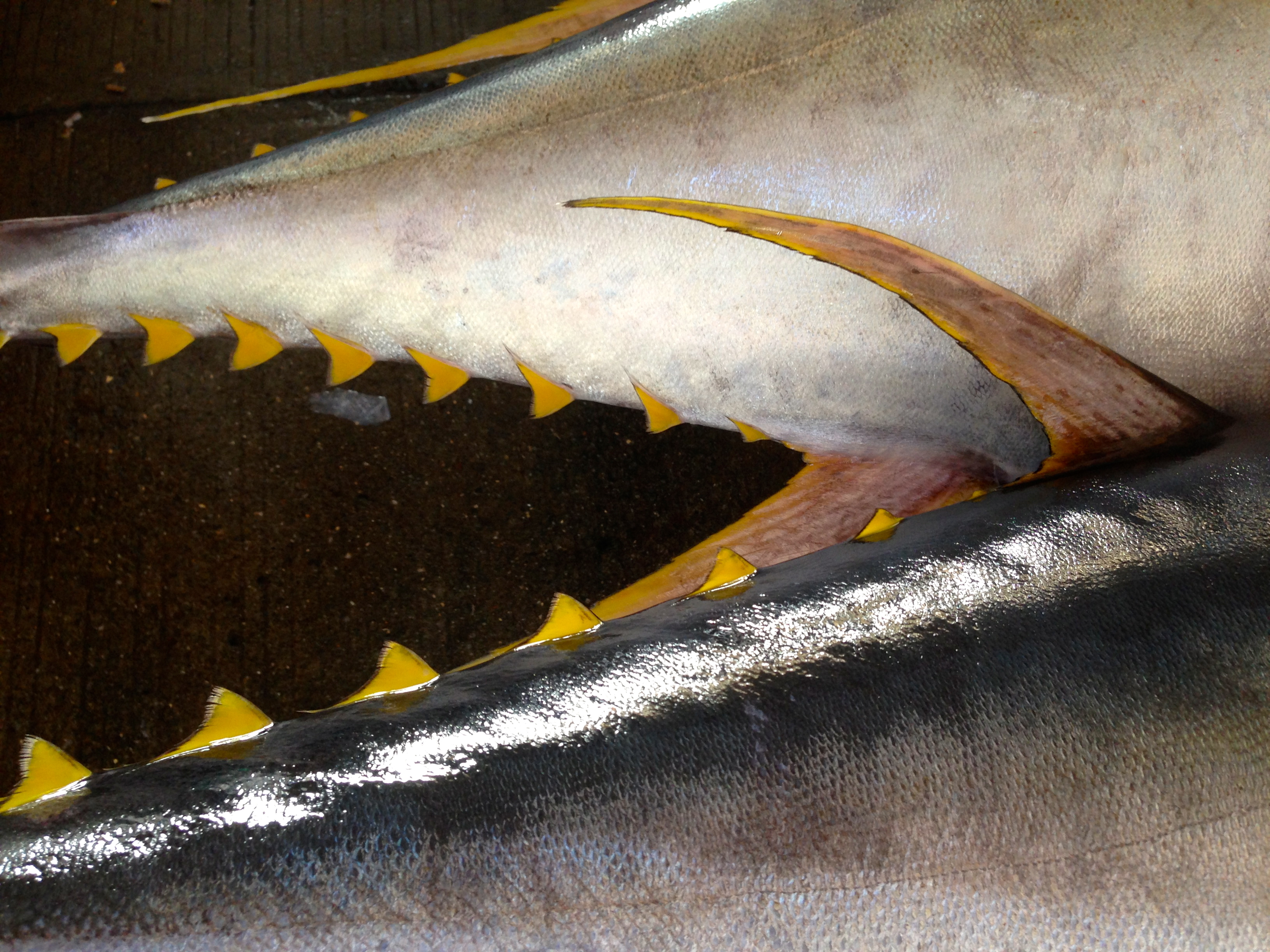
The sea being the source (excluding PacMan) of much of GenSan’s present wealth, I asked to see the city’s fish port in operation, and even as we arrived too late to observe the day’s tuna catch being unloaded for auction at 5:30 in the morning, the port was still abuzz with activity an hour later, with batches of tuna being graded, weighed and sorted out for resale to various end-buyers. I got a fascinating crash course in what we archipelagic Pinoys should know by heart but barely do—Tuna 101, or some things fishy in our economy and culture.

IMG_0925

I learned how tuna came in three basic varieties—bluefin (the premium kind that gets sold for record prices in Tokyo’s famous Tsukiji market—a 222-kg fish recently brought in US$1.78 million, or almost $8,000 per kilo); the more common yellowfin, which was what I saw that morning; and skipjack, the much smaller tuna that goes into canning and eventually onto your sliced bread. A Class A yellowfin could fetch P400 per kilo at the fish port, while its Class C brother could go for P180; the fish traders have to know which is which by sight and by an instinct honed through years of experience, although they could—only after buying their fish—take core samples from a natural slit under the dorsal fin to confirm their judgments.

I learned how the wooden boats that brought them in ventured out for weeks as far as the edge of the Indonesian border, the smaller ones returning with about 200 fish in their bellies, the larger with about 500. (The modern and large steel-hulled catchers of my hosts, the RD Corporation, remain at sea—with licenses to fish in Indonesia and Papua New Guinea—for as long as two years, employing helicopters to help track the migratory tuna; the “master fishermen” directing these operations on every vessel could earn as much as P200,000 a month—so get out of that call center, and learn to catch tuna!)

That afternoon, I visited a canning plant—the frustrated engineer in me would rather tour a factory than linger at a boutique—and saw how a skipjack gets thawed, pre-cooked, and stripped to its most useful parts by hand before it gets sterilized and canned for shipment in containers to the US, Europe, and Japan, among others. (The tuna that gets used in a Subway sandwich in New York and comes in a Subway-labeled can might have come from GenSan.)

Such was the energy fueling the new General Santos—but alas, it was more to be found in people than in the power lines, as the city remains plagued by chronic brownouts occurring twice a day in 3.5-hour stretches. Beyond another mall, GenSan needs more juice for its ice plants, its canneries, and its factories—in other words, for its future—and it can’t hurt to have even a small museum with a dadiangas tree in front to let weekend visitors like me know a little more about its past.

Penman No. 28: Traveling with Pens

Vacumatic

Penman for Monday, January 7, 2012 

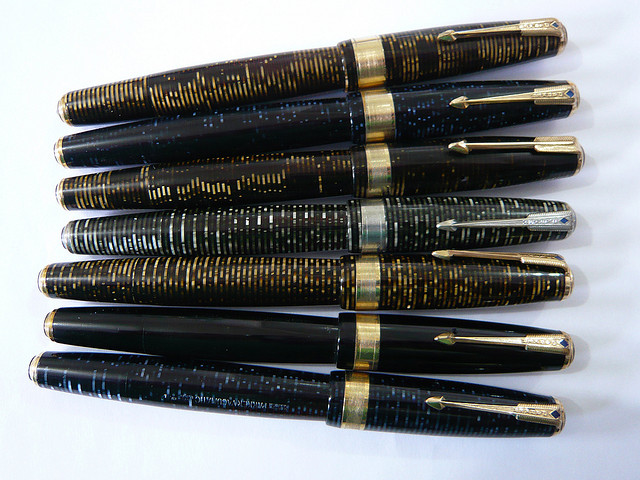
IT’S THE day before New Year, and I’m on my way to Kuala Lumpur with Beng for the last jaunt of the old year and the first of the new one. In my shirt pocket is a 1999 Parker Duofold Greenwich Centennial, a big black pen I’ve had for just a few days and which I’m putting through its paces; in my bag is a leather two-cigar case that’s transporting not Cohibas but two more Parkers—another Duofold, an orange International from around 2008, and a Vacumatic Oversize that goes all the way back to 1938.

I don’t even know why I travel with fountain pens. Lord knows how many valuable ones I’ve lost on the bus or in some stranger’s car, where it’s probably moldering under the back seat alongside an ossified wad of gum. (Probably the most valuable pen I lost, I didn’t even see. Twenty years ago, my grad-school friend Joe mailed me a pen in a box along with a book—I grabbed the book and threw away the box. “How was the pen?” asked Joe when I thanked him for the book. “What pen?” I asked. “The silver-filigree vintage Waterman that I tucked away in a corner of the box. It was meant to be a surprise,” Joe said. This was a couple of days after the box had gone to the dumpster in Milwaukee.)

It’s not like I write novels on the road, or write anything substantial, period, with my fountain pens. I have a thick pad of gorgeously creamy Clairefontaine paper at home, and all I ever write on it is “This is a Parker Duofold from 1931” or “This is a Bexley with a broad nib that I stubbed” or “This Waterman 52 flexes oh so nicely” and pages and pages of figure 8s. If I ever become truly famous, I suppose that pad of doodles and scribbles will be worth something to someone, but they’ll be disappointed if they’re expecting to find the first line of a new novel or some deep dark secret in it.

I keep that pad on my desk for whenever I get a new pen—maybe two or three times a month—for its ritual initiation: I’d write “This is a Pelikan M600 in tortoise” and see how the nib performs. I like my nibs broad, wet, and stubby, and if they aren’t any of these three (I do keep a few fines and mediums unmodified), I work on them with very fine 2500-grit sandpaper, finishing off the job with an 85-peso nail buffer from a Korean cosmetics shop (it always raises eyebrows when I walk into one of these mall shops and get three nail buffers all at once).

It takes care and patience, but there’s a lot you can do to improve the flow of ink in new pens, whose nibs will sometimes be “hard” writers requiring just a bit of tweaking to perform optimally. Beyond the flow, modifying the nibs themselves requires special knowledge and more than a dash of daring; I can stub or flatten nibs and make them write more smoothly, but it takes the skills and workbench of someone like my friend JP Reinoso to turn them into crisp cursive italics. For even more difficult jobs like straightening bent tines or adding iridium or tipping material to old nibs, we go to the best of the world’s so-called “nibmeisters”—people like John Mottishaw, Greg Minuskin, Mike Masuyama, and the now-retired Richard Binder.

But where was I? Oh, traveling with fountain pens. As I was saying, it’s something no one really needs to do these days. In fact, I also bring along a ballpoint or a rollerball pen for the inevitable task of filling out immigration and customs forms, especially those that require duplicate copies. (It was the necessity of the carbon copy, back in the ‘40s, that would eventually spell the death of the age of soft-nibbed fountain pens and the start of the world’s love affair with the ballpen or the “biro” as it was first called, after its inventor Laszlo Biro.)

A vintage fountain pen in your pocket might even spell fashion disaster inflight. Today’s air cabins are properly pressurized, and I should say that I’ve yet to have a pen burp on me airside and cause an inky bloom on my shirtfront, but there’s enough anecdotal evidence out there to suggest that not all pens or filling systems may be so well behaved. Conventional pen wisdom says that you fly with your pen either completely empty or completely filled.

Being a gambler, I travel with fully loaded pens. I might write a line or two with them on the road in my Moleskine notebook, but again it’s not the writing I carry them with me for—for that menial task, I have the trusty MacBook Air that I’m typing this piece on, in seat 7-D of our AirAsia flight. So what is it that I need to bring three pens for to an exotic destination like KL—where, ironically, I’m going to be picking up five more pens for friends from PenGallery (www.pengallery.com), one of Asia’s and the world’s best pen shops?

I suppose my pens are like the kids or pets I never had—and I know, I know, sometimes kids are better left at home, but you still want to know that they’re safe and that they’re where they’re supposed to be, and what better place can they be but right with you? I can’t possibly bring all of my dozens of pens along—I keep about nine or ten of them in the daily rotation—so I choose favorites for the week, and perhaps go for a mix of old and new, of ink colors (my staples being blue-black, which reminds me of my father’s writing, and oxblood, which lives up to its sanguinary promise), and of nib sizes (a fine or a medium for note-taking, a broad stub for signatures). A pen’s pleasures are both visual and tactile—the smooth curl of a line or a letter on the page, the feel of a precisely tuned instrument at your fingertips. Knowing that these pleasures are literally within reach, wherever I may be, gives comfort.

I like my modern Duofolds (a reprise of a classic design from the 1920s) because of their heft and balance, but I’ve taken the burgundy 1938 Vacumatic out of its 18-year storage and put it in my cup of daily writers after convincing myself that if I had a pen this precious but never used it, then I would have foregone one of life’s rarest privileges. (Yes, this is the very pen I found in Edinburgh in 1994 and which provoked the writing of the short story “Penmanship,” a desperate attempt to justify the impulse buy of the pen and to recover its cost.)

As you can see, I’m something of a Parker partisan, although I like and collect all kinds of pens, including the relatively inexpensive but ever-reliable TWSBI and Lamy. I have nothing against Montblancs—I have quite a few of them and treasure one of my 149s for its ability to write a sharp wet line even after weeks of being left unattended—but I remind my corporate and lawyer friends that there are other fine pens out there without a white star on the cap, such as Pelikans and Sheaffers, and they don’t all come with five-figure price tags. (Try Scribe Writing Essentials at Eastwood Mall and the pen counters at National Book Store for more options, or join our pen club at http://groups.yahoo.com/group/fpn-p/ for more information and great company.)

Speaking of vintage pens, I found a couple of noteworthy ones just before Christmas in an antiques shop in Quezon City. I had taken Beng out to lunch at a Japanese restaurant and right beside it was Siglo, which we hadn’t visited in ages. There under glass were two pens that had been waiting all that time for me: a 1920s Waterman safety pen inscribed “Conchita”, and a 1947 Parker 51 once owned by a “Julian T. Navarro.” Some pen collectors don’t like these personalizations, but I’ve never minded them, taking them as provenance and proof that these once were more than objects for someone’s collection.

Vintage pens

Like I told another collector-friend, I see myself much less as an owner than a caretaker of things that will pass on and give delight to someone else, and hopefully revive some tender memory of me. I have no way of knowing who “Conchita” was, but thanks to the wonders of Google, I was able to locate the obituary of Julian T. Navarro, who was born in the Philippines in 1907 and who died in California in 2003. He had been a war veteran, and then a contractor, and would have been 40 when he got the Parker in 1947—a man just approaching his peak at the end of a devastating war. I can just imagine him writing with that Parker, its now heavily tarnished gold cap gleaming in his hand. What hope and optimism would have flowed out of that pen.

I suppose that’s why I bring these babies home, and carry them around with me wherever I go.

KRIP YUSON already wrote the literary tributes I would’ve offered for the late Emy Arcellana and Jerry Araos, so let me just add my fervent sympathies to the families of these dear departed friends. Their lives enriched and brightened ours, and they will be much missed. Beng had visited Jerry just a week or two before the end, and he had told her, “I want to go home.” And so he did.

Penman No. 23: Some Enchanted Melbourne

8212804971_0496af41be

Penman for Monday, Dec. 3, 2012

PENMAN READERS have been getting earfuls from me about writing and literature these past few weeks, so I’m going to hold off for another week or so about what we discussed at the recent Bedell Nonfictionow conference in Melbourne, Australia, and instead talk about Melbourne itself—a place I fell in love with on my last couple of days there, for reasons you’ll find below.

Except for a brief stopover once on my way home from Sydney, I’d never been to Melbourne, and I was both honored and excited to have been invited to come over for the conference, which was being hosted by RMIT University, right in the heart of the city. I was billeted at the Rydges Hotel, a few blocks away from RMIT, and the location proved to be a godsend, as everything I needed and wanted to see seemed to lie within a half-hour’s walk from the hotel.

I had a choice of airlines to take from Manila to Melbourne, but only Philippine Airlines had a straight, overnight flight that was also ideal for busy people—I left Manila at 8:40 pm and flew into Melbourne (which is three hours ahead) shortly past 7 am, less than eight hours total, with the whole new day ahead. (And let me note my satisfaction with PAL’s new Boeing 777-300 planes, which give you a lot of legroom even in economy, and offer individual entertainment screens.)

A cab ride from the Tullamarine airport to the city center took some 25 minutes and cost AUD$55 (right now, the Australian dollar, which used to trade below the US dollar, is stronger than its American counterpart). Tipping isn’t required or expected in Australia—where good minimum wage legislation has made sure that workers don’t depend on gratuities for their basic income—but anyway I handed back my $4-plus in change to my Indian-Australian cab driver, who must’ve been happy he’d picked up a Filipino. (“I knew a girl from the Philippines once,” he told me, pronouncing “Philippines” with a long I, “and she called me Pogi.” He also introduced me to the “hook turn”—an unusual and apparently uniquely Melburnian traffic practice that involves driving up to the middle of the road if you’re about to make a right turn and just hanging there until you get the green light.)

I’d arrived too early for my hotel room to be ready, so I left my suitcase with the desk and promptly began exploring my environs—initiating, in the process, the Melbourne leg of my daily one-hour constitutional. (Since I depend on GPS and an Internet connection—using a free Nike app for the iPhone—to track my walks and count my calories, I had to go on data roaming, which reminds me to share this tip with my fellow footloose Filipinos: try Globe’s Bridge Data Unlimited or BDU program, which gives you what its title says for a flat fee of $40 for five days or $27 for three days, all around the region, including Hong Kong and Australia. It saves you from having to look for the nearest Starbucks for the free wi-fi, and from paying exorbitant wi-fi rates at hotels. Look it up on the Globe website or dial *143#.)

As it turned out, the very street next to the hotel was Bourke Street, one of Melbourne’s main shopping arteries. I had no intention of spending a single dollar on frivolous goods even before I’d uttered a word at the conference to earn my keep—but three hours to kill on Shopping Boulevard proved to be a prescription for disaster, and I happily walked out of the David Jones store with a new raffia plantation hat, for the price I would’ve paid for a new Parker Duofold. There, I told myself, goes the Penfolds shiraz I’d been planning to splurge on; it was going to be the cheap, old Hardys or tap water from this day forward. But instead of wallowing in buyer’s remorse, I took finding that souvenir within my first hour in the city as sheer serendipity. While summer in Australia was still a few days down the road, nothing seemed more perfect for me in Melbourne than that straw hat, putting me in a good mood for the rest of my stay and keeping my balding head warm through the chilly evenings.

8208091296_2dd1dedf23_m

Founded in 1887, RMIT University (the old Royal Melbourne Institute of Technology) is one of the world’s top 100 universities, with strengths in engineering and communications. It occupies a sprawling campus in Melbourne’s city center, in buildings that range from Victorian yellowstone to quirky postmodern. And that, I would come to realize, pretty much described Melbourne itself—a crazy-cut mix of old and new, of tradition and innovation, of the safe and predictable and of the risky and risqué. Across our RMIT building—topped by a green blob that threatened to devour the building like a sci-fi nightmare—was the venerable State Library of Victoria, on whose front lawn people sunbathed and pleaded various causes ranging from the plight of Palestine to same-sex marriage.

I fell for Melbourne on my fourth and last day, when I took a more circuitous walking route across the Yarra River, which was filled with rowers practicing their strokes. Viewing the city from its South Bank, I could appreciate the quaintness of the 102-year-old Flinders Street Station, still holding its own against the onrush of the new century. The banks of the Yarra were litter-free, the water looked clean enough to swim in, and the air was clear and cool and kind to my walker’s lungs; how long would it be, I thought, until I could see a Pasig like this?

But my biggest surprise still lay ahead: just a few hundred steps short of completing eight kilometers, I decided to hit that mark by exploring the blocks behind my hotel—which happened to be in the Chinatown/theater district—and stumbled on the lovely Princess Theater. Playing, for the last two days, was a touring production of South Pacific (featuring, as Bloody Mary, the Filipino-Australian singing sensation Kate Ceberano).

I’m a sucker for Broadway—especially the old, romantic, sunlit Broadway of the ‘50s and ‘60s—and I can sing nearly every word of the South Pacific soundtrack, but had never seen it onstage. When I first learned that I was going to Melbourne, I’d Googled the city, and had seen this production mentioned and wished fervently that I’d get to see it; but I’d simply assumed that the Princess was too far out of my way and that I’d have no time for theater. But now it was right there in front of me—the stuff of my boyhood dreams, beckoning me like Bali Ha’i.

It was my last evening in Melbourne, and I’d accepted an invitation to an early dinner at my hotel with a bright, young Filipino-Australian couple, Fatima and her husband Rick Measham. But they’d said that they also had a show to catch at 7:30, so I figured I was safe if I booked a ticket for the evening performance. “What’s the cheapest seat in the house?” I croaked to the lady at the box office. She handed me a seat plan and X’d the topmost row: “$89.99.” I gulped—I’d never paid $90 for any show, not even on Broadway; but this was South Pacific, and I was in the South Pacific, and I would probably never see it again for the remainder of my sorry life, so I forked the money over.

I later told the Meashams that I was also going to the theater after dinner. “What show?” South Pacific. “That’s hilarious,” said Fatima. “We’re going there, too!” So we all walked the two or three blocks to the Princess, and I went on up to my eyrie in the bleachers. I was all by my lonesome in my row, and, taking pity on me, the usher invited me to move down, but I told him I was happy where I was—for there I could and did sing along, my straw hat on my lap, as the wondrous play unfolded far beneath me, and I felt my juvenile crush on Mitzi Gaynor surging back, even as I remembered my girl back home and wished she had been next to me in Melbourne.

The soundtrack was still playing in my earphones as I boarded my flight home the next morning, and I felt younger than springtime for having taken those few extra steps around the block.

Penman No. 21: Literary Networking in Bangkok

Penman for Monday, November 19, 2012

BENG AND I had hardly stepped off the plane from weather-beaten New York when we were off again to sunny Bangkok, this time to attend a conference of writers and translators from all over Asia and the Pacific. I asked Beng to come along because we hadn’t visited Bangkok in a few years and had always enjoyed the place. Here, again, we were helped by the fact that our unica hija Demi works in the hotel industry, and she was able to find us a nice place in Sukhumvit—the Aloft, Bangkok’s iteration of a global chain of smart boutique hotels. More on the Aloft in a bit.

I was there to take part in “Reaching the World,” billed as Bangkok’s first international literary showcase, under the auspices of the Asia Pacific Writers and Translators Association (AP Writers for short) and the South East Asian Writers (SEAWrite) Award, hosted by the Faculty of Arts of Chulalongkorn University. I sat on the 2010-2012 board of AP Writers with fellow Filipino professor and STAR columnist Isagani Cruz, who served as its chairman.

A sizeable delegation represented the Philippine literary community in Bangkok, aside from Gani and myself: writer and scholar Cristina Pantoja-Hidalgo, who now divides her time between UP and UST; UP English department chair and Southeast Asian literature expert Lily Rose Tope; poet and UP professor Isabel Mooney; fictionist and UP Mindanao professor Jhoanna Cruz; poet and DLSU professor Dinah Roma; essayist and UP professor Jeena Rani Marquez; and UST literature professor Timothy Sanchez. Novelist Charlson Ong, this year’s SEAWrite awardee from the Philippines, joined the Bangkok conference in its last couple of days, coming from the Singapore Writers Festival which I had attended last year.

AP Writers emerged out of an earlier organization, the Asia-Pacific Writing Partnership founded by Jane Camens who had also helped establish the Hong Kong International Literary Festival. Jane, an Australian writer who has lived, studied and worked in the US, the UK, China, Macau, and Hong Kong, has been an indefatigable spirit bringing writers from all corners of the region together, and she will now serve as AP Writers’ general manager. The Sri Lankan-born but Hong Kong-based humorist and essayist Nury Vittachi will serve as AP Writers’ new chairman, backstopped by the Chinese-Indonesian-American fictionist Xu Xi, who runs the MFA low-residency program at the City University of Hong Kong, and by the translator Shirley Young-Eun Lee, who has roots in Korea but who read Classics and Persian at Oxford.

As you can see from just that small corner of the organization’s membership roster, AP Writers is both as regional and as global as you can get. This reflects an increasingly obvious fact in today’s literary world: international and inter-cultural exposure has become vital for writers, to expand both their perspectives and their networks. By “network” we mean here that web of connections that emanates from the writer and his or her work to the other people involved in the process of literary production and dissemination—agents, editors, translators, publishers, critics, booksellers, critics, reviewers, teachers, researchers, and, of course, students and general readers.

This year, in Bangkok, AP Writers paid special attention (and gave formal recognition, in its full name) to a vital but largely neglected member of that network, the translator. A literary work can’t be read beyond its original market unless it’s translated into another language, and that requires the skills of a very small group of specialists around the world. Literary translation isn’t just the kind of word-for-word interpretation you might get from a software program or even a live person—it involves the understanding and translation of one culture into another, the conveyance of nuances that, paradoxically, will never be perfect but will achieve interesting effects of its own. (I’m reminded of a quote attributed to Salman Rushdie, about the most interesting words of a language being the untranslatable ones.) In Bangkok, we were privileged to be in the company of some of the world’s best translators, including the Australian Henry Aveling, who has undertaken many translations from Indonesian and Malay.

We were also treated to a tour of the stately and historic Mandarin Oriental Hotel on the Chao Phraya River, probably the only hotel in the world where writers are revered. AP Writers held its business meeting there, after being regaled by Harold Stephens, an American expat and raconteur who’s written 30 books on travel and adventure and who also happens to be married to a Filipina, with stories of the old hotel from the days when the likes of Joseph Conrad (then still a ship captain), W. Somerset Maugham, Noel Coward, and Graham Greene stayed over. There’s a room and a lounge now maintained in their honor at the hotel—where, fittingly enough, Charlson would receive his SEAWrite Award later in the week from Thai royalty).

Readings and socials are an important part of any literary conference, and while some readings can be interminable (let’s face it: authors love to hear themselves), now and then you come across an entirely original voice. This time around that voice was that of Jang Jin-sung, one of Kim Jong-il’s favorite poets who defected when he could no longer take what was going in in North Korea.

The gut-wrenching hunger and desolation that Jang spoke of in his homeland contrasted, ironically, with the culinary and visual opulence of Thailand, which makes every visit there worthwhile. Beng was landing in the new Suvarnabhumi airport for the first time and was awed by the experience, even more so when the sleek commuter train took us from the airport to the city center for a mere 20 baht (about 30 pesos). We dropped our bags off at the Aloft—a jazzy, upbeat hotel with free wi-fi, a great buffet breakfast, and an iPod stereo player in every room—and dashed off in a cab to catch the weekend market at Chatuchak.

Thailand is a shopper’s and diner’s paradise but Beng and I contented ourselves with a bag for her and an iPhone case for me—and lots of fresh fruit, spicy chicken rice meals, and heavenly foot massages. It may not have seemed too auspicious when the printed menu in one streetside restaurant offered us “Steamed Crap,” but we survived the typo.

We came away much impressed by the Thais’ devotion to culture and literature, good reason for Bangkok to be named the World Book Capital for 2013 by Unesco (a distinction that, I bemoaned, Manila would probably earn by 2053). At the welcome dinner, Bangkok’s urbane and genial governor, M.R. Sukhumbhand Paribatra, ducked out of his busy schedule overseeing preparations for an upcoming world indoor football championship to break bread and share jokes with writers and translators. I’d like to believe we were well worth his and each other’s time.

Flotsam & Jetsam No. 15: One Night in Bangkok

ALMOST AS soon as we got home from New York, Beng and I flew out to Bangkok where I  was speaking at a conference. We stayed in a boutique hotel in Sukhumvit, a lively district that becomes even livelier after dark. I ran into this outdoor “bar” complete with disco lights outside our hotel—a new life for an old VW Kombi. Cheers!

Penman No. 19: Autumn in New York

Penman for Monday, November 5, 2012

I FIRST visited New York 32 years ago, as a young man on his first trip abroad, and I can still remember the convulsive thrill that I felt as I peered out the window of my plane from Detroit and saw Manhattan’s spires rising toward me, to the accompaniment of a Gershwin tune.

At the same time, I looked at New York with not a little dread, both because of its sheer immensity and also its fearsome reputation for harboring mobsters and hucksters. While I marveled at the Christmas lights of Rockefeller Center, I also saw Times Square and Bryant Park at their worst, long before Rudy Guiliani came in with a broom, and 9/11 lent the city the kind of composure that comes with tragedy.

I’ve been back many times since—with my mother, daughter, and sister, and Beng’s sister living in the US, we try to visit every year—and over the years, I’ve slowly learned to trust if not to love this mother and mentor of modern cities, holding my wariness in check just long enough to let New York’s many and unexpected charms seep through and permeate my senses.

It’s a tired cliché by now, but while I go to my sister’s place outside of Washington, DC for rest and recuperation, I go to New York for the energy and the excitement, for the buskers in the subways playing everything from Vivaldi to That’s Amore, for Paul’s Burgers in St. Mark’s Place, for the two lions guarding the library (Patience downtown, Fortitude on the uptown side), for the $6/lb. Chinese takeouts, for the Art Deco flourishes nearly everywhere you look, for the Housing Works resale shops, for the discounted Broadway tickets, for the Sabrett’s hotdogs on the sidewalks, for the muscular subway, for the parks that sprout up amidst brownstone and cinderblock, for the warren of words that’s the Strand, and, of course, for the translucent glass stairway leading down to the reverse-heaven of the Apple Store.

New York can have the newest of the new—think of the iPhone 5 and the iPad mini—but oddly enough, what Beng and I enjoy most on our New York visits is seeking out old treasures (or what might be junk to most other people) in the thrift shops of 23rd Street and the flea markets of the Upper West Side and Hell’s Kitchen. Sometimes these treasures even come free, shamelessly dragged in off the street on my sister-in-law’s block in Forest Hills, like that miniature wooden Christmas sleigh that I salvaged last week off the top of a pile of detritus (the polite Roman word, I think, for garbage).

Inevitably, despite our absent intentions, every visit brings something new. Two years ago it was the magic of dusk in Coney Island, at the very end of the F subway line and, it seemed, of New York itself, so serene was that velvet hour with the amusement park’s fun machines in off-season repose. This year it was a day trip we took by train to a small village called Cold Spring, up the Hudson River, after learning that it hosted a cluster of antique shops and was a good place to catch the fall colors, besides.

It did not disappoint on either count; autumn declared itself resplendently for most of the 90-minute ride along the ribbon of the Hudson, and exploded in brilliant yellows and reds on our arrival in Cold Spring. As Beng and Mimi scoured the shops for old buttons, bottles, and trinkets, I strayed into a shop with a small door that turned out to be a huge warehouse of vintage knickknacks—among them, a lovely black hard-rubber-and gold Conklin ladies’ pen from around 1920 and a marbled Parker Vacumatic desk pen from 1935. Having earlier picked up a Waterman silver-overlay pen and a contemporaneous brass inkwell from 1915 at the Greenflea Market on the Upper West Side, I pronounced this trip sufficiently penworthy, and contented myself for the rest of the day with photographing the Hudson’s color-washed banks.

Another novelty on this trip was my first walk into and across the heart of Central Park, which I had somehow never done in three decades of visiting New York. All that time I had contented myself with reconnoitering the fringes of the park, forewarned by a score of movies and CSI New York episodes about the demons and dangers lurking within. On the Saturday that we crossed the park on our way to Greenflea, we met nothing more dangerous than sprightly squirrels and latter-day hippies channeling John Lennon in Strawberry Fields, the corner of the park across the Dakota Apartments, where Lennon lived and was shot dead (a few days after I left New York on my first visit there in 1980). And how can you walk across Central Park without (again) George Gershwin, Simon and Garfunkel, Barbra Streisand, and Liza Minnelli performing in concert in your dreaming head?

We had earlier visited the 9/11 Memorial downtown, where the Twin Towers used to stand; last year it had been under construction—and still was, to some degree, as the museum within has yet to open. But the two large reflecting pools were already in operation, acting like four-sided waterfalls whose constant flow—broken only, when we looked, by an almost unbearably theatrical rainbow—seemed to represent a perpetual dousing of the fires that burned the towers down, a cleansing of the evil and the ill will that came before and after the event. I had also been there in 2001, a few months before 9/11, and had seen the towers—had even gone up to the top of one of them on an earlier visit—but had no personal connection to the place. Still, I paused when I caught a name—one of almost 3,000 names etched deeply into the bronze railings around the pools—that was unmistakably Filipino: “Ronald Gamboa,” who turned out to be a 33-year-old Fil-Am, a manager at The Gap who died as a passenger on UA 175, one of the hijacked planes.

In yet another unintended irony, I’m writing this paean to New York from Lansing, Michigan, where I’m attending a conference and from where I’m supposed to fly back to JFK tomorrow and then back home to Manila on Thursday—but can’t, because New York and much of the American East Coast has been shut down by super storm Sandy, and I’m effectively stranded. If I can’t get back to JFK by Wednesday, I’ll have to rebook my Manila-bound flight, and stay in New York a little longer. That’ll be mildly annoying—but I can’t wait to spend a bonus weekend in Manhattan, poring over heaps of junk at the flea market, in quest of that golden glint that could be the clip of a 1936 Parker Vacumatic Oversize, one that George Gershwin himself might have scripted a tune or two with.