Penman No. 55: A Foray into Fantasy

TresePenman for Monday, July 15, 2013

WE HAD an interesting discussion in my graduate Fiction Workshop class the other week about fantasy.  I’d asked my students to do an exercise—a short piece of fiction with which they could introduce themselves and their work to the rest of the class at the start of the semester—and one of them had chosen to do fantasy. It was a very well written piece, to be sure, about a child who meets an elfin spirit in a tree in their backyard, but I wanted to push the limits of our appreciation of fantasy, if we were going there at all, so I didn’t let it go at that, and raised a few questions and possibilities.

As my students and readers know, I’m a hardcore realist myself in my own fiction, operating on the notion that there are enough mysteries and wonders to be found and explored in everyday life to have to invent more. That doesn’t mean I can’t or don’t appreciate fantasy, or science fiction, which I’ve enjoyed since grade school. Like most readers, I like to be transported to other worlds and other possibilities, as a relief—or, let’s face it, an escape—from the tedium of the here and now.

That said, there are fantasies and there are fantasies, and just because a story’s a fantasy doesn’t mean that anything goes, or that the rules of credibility and plausibility can be thrown out the window. I suspect that readers of fantasy can be just as discerning and demanding as readers of realist fare; they may even be so familiar with the genre and its conventions that they will be ultrasensitive to any radical departure, good or bad, and will feel grievously shortchanged if their expectations aren’t met. Freshness of treatment and insight is key. Fantasy stories that just repeat what’s been said and done before will fail to excite the reader, who’s always demanding something new and different.

So what, to my mind, is a superior fantasy? I’m going to give an answer that will sound a little strange: it’s fantasy that’s premised on the familiar, but takes off into parts unknown, if only again to reflect back on the familiar, or what we thought we knew. In other words, fantasy is ultimately not about complete detachment from reality, but rather the defamiliarization of reality. I’m sure that more sophisticated theorists out there have made pretty much the same point (theory isn’t my strong suit, and I’d much rather reason my way through a problem), but it’s really quite simple: by taking a step back from reality and looking at it from a distance, we notice fresh things about that we would have missed up close. Fantasy provides that distance, even a certain distortion that emphasizes some previously obscure aspects of a picture or a situation over others.

Like I said, I haven’t written much fantasy—the most fanciful story I wrote, back in 1978 (when our daughter Demi was four, thinking that she would read and appreciate it when she turned 12) was a pseudo-historical tale titled “The Mirror,” set in pre-Hispanic Philippines, about the arrival of the first mirror to our shores. I had fun doing that, so I can see how liberating this kind of exercise can be for writers who feel stifled by having to deal with what’s right before them. Reality can be claustrophobic, especially when it’s dark and narrow, as it often seems to be.

But if I were to write fantasy again—and this was what I advised my young student to do—I would play with the possibility of taking off from somewhere unexpected, some place or some point that doesn’t have the word “fantasy” twinkling above it in stardusted letters.

I’m fascinated, for example, by what would happen if our authors tried to fuse freewheeling fantasy with grungy realism, employing our most familiar and even our most sordid realities as a launching pad for a journey to the surreal and the irreal. Of course, like most things in art and literature, this has been done before by many fantasists and fabulists. As I suggested earlier, the best way to lie is to begin with the seeming truth, instead of a flagrant falsehood. (One great example of this approach is the graphic story contributed by Budjette Tan and Kajo Baldisimo to our Manila Noir book—which had a very successful launch at NBS Glorietta last July 6, by the way—which begins with a series of gruesome murders on the MRT and turns into a supernatural detective story.)

The imperative of this fusion is at its most urgent in our society, ridden as it is with poverty, violence, and corruption, and yet also uplifted and ennobled by the Filipino’s deep spirituality and by our unyielding imagination. I proposed to my students that in a society such as ours, even fantasy has a social function: not necessarily as an escape, but as a means with which—even briefly—to distance ourselves from our pains and to look at them without hurting too much, so we could deal with them better upon our inevitable return. For us, the most ambitious and the most meaningful fantasy will take our stark social realities into account: you can’t set great fantasy in Tagaytay Highlands, because living there is already a fantasy for most Filipinos; you’d be jumping off a very low platform if you did that.

I threw this impromptu suggestion into the discussion: instead of locating the encounter with the duende or the benign spirit in a backyard that already seems magical (nature—trees, waterfalls, caves, and such—is very often used as an entry point to the other world), why not set it somewhere you least expect a duende to appear (a place “most hostile to romance,” as Joyce put it in “Araby”)?

Think, for example, of a suburban bank branch full of people, toward closing time. A father, a mother, and their young daughter are there, because the dad needs to withdraw some cash to make a down payment on a second-hand car they’d been saving up for. The mom chats with the girl and fixes her ribbons while the dad does his business at the counter. It’s a pleasant day, and soft music plays in the background. Suddenly masked men barge into the bank and announce a holdup. A robber scoops up the dad’s money, but he begins to say something, and gunshots fill the air. (At this point, we don’t know yet if the father has been shot, or if the guards have opened fire.) The little girl is in utter terror, shaking in the iron grip of her screaming mother. At this point, the duende appears, suspending time, and maybe even the trajectories of bullets.

Unlikely? Of course. Corny? Could be. But it’s certainly less predictable than a leafy bower, or a cloud on a hilltop.

Again, I’m a hardcore realist, but I’d be the last to say that our people don’t need fantasy. We most certainly do, especially our poorest children, who’ve been battered and savaged by the realities of life, working in the streets or in some sweatshop when they should be in school, reading books and singing songs. They need fantasy to reclaim their sense of wonder, to see beyond the rust and grime and filth of their surroundings; they can be sustained and delivered not so much by fairy godmothers as by their imagination, which always offers hope.


FROM MY friend Jane Camens, the busybody behind the Asia Pacific Writers and Translators Association (APWriters), comes this message about a call for submissions to an international anthology of flash fiction—the term in vogue for very short stories (also called “short shorts” or “sudden fiction”). Flash Fiction International, to be published by W.W. Norton of New York, is seeking stories from anywhere in the world—especially the Asia Pacific. Jane says that “the stories should be under 750 words, in English translation or original English. Previously published work (within the last 10 years or so) is preferred. But new manuscripts are also considered. Submissions may be sent by email with attachment to Robert Shapard at his email rshapard@hawaii.edu . The submissions deadline is August 15. Submission limit is three stories.” Be so advised!

(Trese image from tumblr.com)
 

Penman No. 54: Calling All Filipino Writers

APWTPenman for Monday, July 8, 2013

I’LL BEGIN with a sheepish apology (and a word of thanks) this week, for a stupid mistake I made in my piece about hats a couple of weeks ago. I was in the car on my way to a meeting in Makati last Wednesday when I realized to my great horror that I’d written something very wrong, and resolved to fix the problem in the blog version of my column at www.penmanila.ph, but of course, before I could do that, an alert reader named “Nestie U” caught the error and pointed it out to me. I’d written that “felt” meant “mashed leather pulp,” but it’s certainly not—it’s wool, not leather. It probably won’t mean much to most people, but if we self-proclaimed wordmeisters don’t get finicky about words and what they mean exactly, then who else is going to care? Many thanks again, Nestie, for reminding me of what a confused and forgetful fellow I could be, sometimes.


THIS IS going to be a week of announcements, not because I’m too lazy to write a properly thought-out column—you know how I can go on and on about my pet causes and peeves—but because my involvement in certain literary organizations and concerns gives me access to news and information that (given the usual space limitations) might not even make it to the literary or culture section of most newspapers. (Here in the STAR, of course, we do our best to keep you abreast of the most important and interesting goings-on in the cultural front.) So let’s get on with the literary news—these just in!

For writers, the first and most vital announcement I have to make is a call for all alumni of writers’ workshops sponsored by the National Commission for Culture and the Arts (NCCA) to take part in a tracer study being conducted by the National Committee on Literary Arts, on which I sit as a member.

Most people don’t know this, but the NCCA—the government’s funding agency for cultural programs—has been supporting most if not all of the country’s major writing workshops for almost 20 years now. Without the NCCA’s substantial support, these workshops would have been forced to shut down a long time ago, or would never have become as highly developed as they are now. The workshops enable young writers to meet both their peers and their seniors, examine and affirm the writers’ talent, and initiate them into a community that can help sustain their productivity for life.

The UP workshop, for example, has been held every year for almost half a century, and while we now take only 12 fellows a year, we used to have more, so if you average everything at about 20 fellows per batch, we would have produced almost 1,000 alumni fellows since the beginning. Add to these the fellows who’ve gone to the Silliman, Iligan, Iyas (La Salle Bacolod), and other NCCA-supported workshops in the regions.

Like any other government agency, the NCCA has to be publicly accountable for how it spends the people’s money, so we at the NCLA thought of initiating a tracer study to see exactly how these workshops have helped our writers in their careers—say, in terms of books written and published and awards won for their work, among other criteria.

We’ve asked Dr. Christine Godinez-Ortega of MSU-IIT to be the project leader for the first phase of this project, and Christine and her team have formulated a set of questions that we’d like all workshop alumni from 1994 to 2010 to respond to. If you’ve attended and benefited from one of these workshops, please click on the link following and fill out the form.  http://www.msuiit.edu.ph/ research-extension/ncca/ tracer.php. Your response will go a long way to help sustain government support for the development of Philippine literature, as well as create a very helpful database and virtual network of all workshop alumni.

The second item on this week’s literary agenda is another call, this time for papers to submit to the “Reaching the World 2013” conference, scheduled for October 3-6, 2013 in Bangkok, Thailand. Spearheaded by the Asia-Pacific Writers and Translators Association, the conference is co-sponsored by Chulalongkorn University, the SEAWrite Award, and the Bangkok Metropolitan Administration.

Among many other Filipino writers, I’m one of the founding members of APWriters (www.apwriters.org), which has become one of the most active and viable organizations of writers and academics in the region. Last year, a formidable contingent of Filipino writers attended this conference, also in Bangkok, and our participation there left a very positive impression on the organizers and our fellow delegates, so much so that this year, I’ve been asked to head the Academic Committee that will receive proposals for papers and presentations.

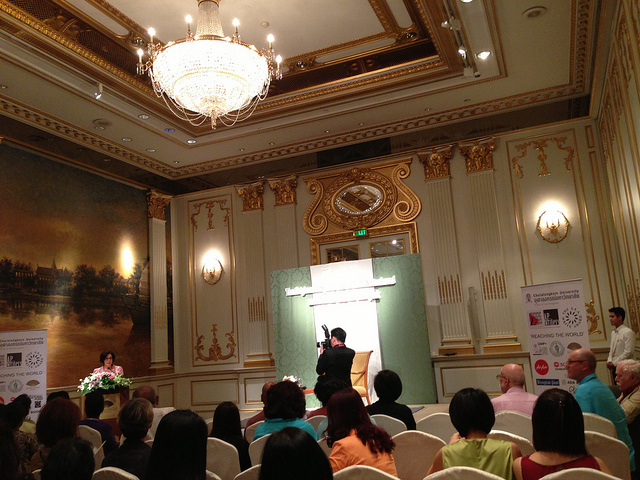
Bangkok has been named by UNESCO as the World Book Capital for 2013, which is why we’re returning there (aside from the fact that Bangkok and Thailand are worthy of visiting for food, fabulous sights, fantastic shopping, foot massages, and other pleasures anytime, given any reason or excuse). Its famed Oriental Hotel has also hosted the annual SEAWrite Award, honoring the region’s best writers. (That’s a session from last year’s conference in the pic above.)

“Reaching the World 2013” will bring together authors, literary translators, scholars, teachers of Creative Writing, publishing professionals, and others from Asia and beyond. This three-day international conference with workshops and a free public day will enable writers, readers, scholars, students, publishing industry professionals and interested members of the public to network and share their work.

APWriters is a fairly open and friendly organization, and you just have to be a writer, a translator, a teacher, or have an interest in either writing or translation to sign up. Even in the academic area of the organization and the conference, we try to remain accessible, preferring discussions on topics of broad application to obscure and highly specialized ones that only a very few can understand and appreciate.

This year, for the conference, we are inviting papers and presentations on the following subthemes: Teaching Creative Writing; Literary Translations; Cultural Identity; Food in Literature; Music/Art in Literature; Online Writing; Young Writers; Literary Fiction; Creative Nonfiction (including biography and memoir); Poetry; Genre Fiction; and other related topics. Our main focus, however, will be the teaching of writing.

To offer a presentation or longer paper with a focus on teaching and practice of creative writing, email me, Jose (“Butch”) Dalisay, Chair of AP Writers’ Academic Committee, at jdalisay@mac.com. Deadline: August 10.

To offer a presentation or longer paper on literary translation, email Eliza Vitri Handayani, Chair of AP Writers’ Translation Committee, evhandayani@gmail.com. Deadline: August 10.

If you’re teaching Creative Writing at a university which offers this discipline and would like to offer a half-day or full-day workshop, send a paragraph describing the workshop you’d like to offer along with a brief bio to AP Writers’ Board Member Xu Xi at xu.xi@cityu.edu.hk.

If you would like to read your poetry or discuss your creative writing on the panels at the public forum on Sunday, October 6, in the Bangkok Arts & Culture Centre, or if you want to launch a new book at “Reaching the World 2013,” email Jane Camens at admin@apwriters.com.

I’ve reminded the early birds who’ve already emailed me to express their interest in presenting a paper that they will have to produce a ten-minute-maximum version of their paper (and that time will include setting up PowerPoint, should they need it). I’ve noticed that here in Asia, we tend to be too respectful of each other in terms of extending time limits, which many paper presenters routinely ignore, droning on and on without compunction. Well, I’m going to pull the plug on any such miscreant (I think it’s a gross discourtesy to the next speaker and to the audience itself to speak beyond one’s allotted time), so please practice your presentation with an alarm clock before leaving home.

There’ll be a small conference fee (last year it was only USD$50 per participant) and we have no travel funding whatsoever to offer anyone, including ourselves, so save up and book a budget fare early, and see you in Bangkok in October!


Penman No. 53: Manila, femme fatale

Manila-NoirPenman for Monday, July 1, 2013

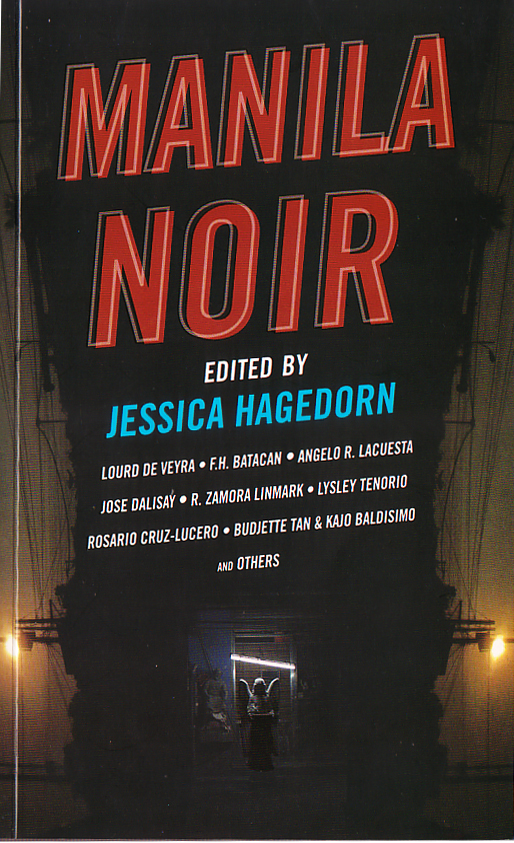
FIRST OF all, I’d like to invite my readers to the launch this coming Saturday of a unique and exciting new book, a collection of stories to which I made a modest contribution. The book’s title is Manila Noir, and it contains 14 stories written mainly by Manila-based authors, with each story focused on a specific district of the metropolis (mine, not surprisingly, was Diliman).

Edited by the accomplished Jessica Hagedorn, whose own Dogeaters made waves in international publishing in 1990, Manila Noir is the latest book in a long series published by Akashic Press—a series that includes books set in places as diverse as Chicago, Copenhagen, and Delhi. This local version (reprinted by Anvil Publishing) features pieces from Gina Apostol, Budjette Tan & Kajo Baldisimo, F.H. Batacan, Jose Dalisay Jr., Lourd de Veyra, Eric Gamalinda, Jessica Hagedorn, Angelo Lacuesta, R. Zamora Linmark, Rosario Cruz-Lucero, Sabina Murray, Jonas Vitman, Marianne Villanueva, and Lysley Tenorio.

Here’s what Publishers Weekly says about the book: “While certain cities in past Akashic volumes might appear to lack an obvious noir element, Manila (like Mexico City, which shares many of the same problems) practically defines it, as shown by the 14 selections in this excellent anthology. As Hagedorn points out in her insightful introduction, Manila is a city burdened with a violent and painful past, with a long heritage of foreign occupation. The specters of WWII (during which the city suffered from U.S. saturation bombing), and the oppressive 20-year reign of dictator Ferdinand Marcos live on in recent memory. The Filipino take on noir includes a liberal dose of the gothic and supernatural, with disappearance and loss being constants.”

As the French word for “black” suggests, noir is a mode of storytelling that dwells on the dark side of human nature, with crime as a central element or a specter hovering above the story.

In her introduction, Hagedorn herself notes that “I think of Manila as the ultimate femme fatale. Complicated and mysterious, with a tainted, painful past. She’s been invaded, plundered, raped, and pillaged, colonized for four hundred years by Spain and fifty years by the US, bombed and pretty much decimated by Japanese and American forces during an epic, month-long battle in 1945. Yet somehow, and with no thanks to the corrupt politicians, the crime syndicates, and the indifferent rich who rule the roost, Manila bounces back. The people’s ability to endure, adapt, and forgive never ceases to amaze.”

And this book, I guarantee you, will not fail to amaze. Join us—Jessica and my co-authors—for a round of brief readings, a Q&A, and a book signing session from 4 to 6 pm, July 6, at National Book Store Glorietta 1 in Makati. See you there!


IT WAS with deep sadness that I received, by text message, the news of the sudden passing of one of my dearest friends, Luverne Gueco. Luverne was also a brother in the profession, having served as foreign news editor at the Inquirer for many years. But more important to me than that, he was my kumpare, my confidante, and my partner in crime 30 years ago, when we were all in our mid-20s and romping through life like young men do. Luverne and I were part of a rather remarkable stable of writers and artists in the Economic Information Staff of the National Economic and Development Authority, a group recruited and supported by our visionary boss, Dr. Gerry Sicat.

It was a group that included former newsmen Jun Medina, Wilson Bailon, and Efren Cabrera; the now-Canada-based poet Patty Rivera; writers Fidel Rillo, Lilia Santiago, Jess Santiago, Reuel Aguila, Eric Caruncho, Joey Papa, and Minnie Quemuel; the future lawyer and now Undersecretary Rey Cruz; and let’s not forget a pretty artist named Beng, who worked with fellow artists Anna Nolasco and Herick Ventura. Not surprisingly, our immediate supervisor was himself an artist, the tenor Frankie Aseniero.

Although we were working under martial law, the NEDA then felt like a kind of Camelot, and we were all grateful for the little haven that Dr. Sicat created for long-haired, irreverent types like us (another officemate, albeit in another division, was the renowned playwright and another dear friend, the late Bienvenido “Boy” Noriega). As an ex-detainee, I failed my security clearance check, but Dr. Sicat took it upon himself to cover for me and sent me to the Development Economics program in UP to cool off for a year.

Luverne was in the thick of all this, one of the most dependable writers in the group. He had also been with the Left, and the stories he shared about what he had gone through seared themselves into my memory, so much so that I used the most painful one—about a rebel who took it upon himself to execute his wife after discovering she was an enemy spy—in my first novel, Killing Time in a Warm Place (1992).

After hours, our friendship developed in countless pool halls, beerhouses, and girlie bars (we were certainly no saints). We played pusoy, darts, and billiards with wild abandon. Luverne was a gifted pool player—this was the dawning of the age of the Pinoy pool champion, when Amang Parica was still king and young bucks like Bata Reyes and Django Bustamante were still hungry for glory. (I, on the other hand, was what the pros derisively called a “tama-bola,” a guy who could barely hit the target with the cue ball, let alone pocket it.) When Luverne married his wife Judith and became a dad, I became godfather to his son Elias. Luverne was always a motorcycle kind of guy, and had his share of bad spills, but when he went out looking for his first car, I convinced him to get the same car I already had—a VW Beetle.

Perhaps fittingly, Luverne collapsed while doing what he loved doing most—playing pool. I’m not sure if it was a stroke or a heart attack, but the end came swiftly. He was only 62.

I’m devoting all this space to the passing of someone who lived the quiet, uneventful life of a desk editor not just to mourn the loss of a friend, but also of the kind of friendship forged in the real world. Ironically, I didn’t see much of Luverne after NEDA—these past 30 years—and our last meeting was about a year ago, but there was never a moment during those decades when I wouldn’t have listed him among my six closest friends, people whom I could count on to help me in a bind, no questions asked, and to whom I would throw the same lifeline. How many people have earned your trust and affection like that?

I’m not on Facebook—one of the country’s last holdouts—for one stubborn reason: I can’t accept the Facebook definition of “friend.” To be my friend, we should have broken bread and maybe a few precious other things together; we should have rejoiced and despaired together; we should have found each other’s weakest spots, but let them be; we should have disagreed on many things, but agreed on more. On Facebook, “friendship” is a convenience, just as easily disposed of with a mouse click to “unfriend.” I’d much rather wait five years to talk to someone like Luverne and pick up where we left off as if those five years had been just yesterday.

Penman No. 52: A Man of Many Hats

Me

Penman for Monday, June 24, 2013

I’VE BEEN writing about writing for the past eight weeks, so I hope my readers will indulge me this personal break, this little foray into male plumage.

You’ll probably notice that, this week, I’m sporting a new picture for this column—the first time I’ve changed it in years. I liked that old picture (taken by Raymund Isaac) and had been using it whenever I was asked for one, but I think the time has come to be honest with myself and my readers and to admit that, well, I just don’t look like that anymore. I’ve grown—and I look—considerably older, though happily also a bit leaner, thanks to my diabetes-induced diet-and-exercise regimen.

The most visible change in my new avatar, however, is the hat—one of a few I’ve been regularly wearing over the past year. People have been wondering why I’ve adopted what seems to be a foppish affectation—a practice I share with other writer-friends like Rio Almario and Teo Antonio; notably, National Artists Bien Lumbera, Frankie Jose, Bencab, Billy Abueva, and the late NVM Gonzalez have been known to wear hats or caps of one kind or other. I don’t mean to suggest, by citing such exalted company, that wearing a hat will boost my literary stock in any way, although I do hope, in secret, to be taken a little more seriously by dumping all that straw on my balding pate.

The fact of the matter is that I’ve been wearing hats for more than 20 years now. I picked up my first fedora from the Milwaukee Hat Store back in 1989 or so, when I was a graduate student there—and if you know how bitter Midwestern winters can get, you’ll understand that it was more for practical protection than about making a fashion statement. The fashion side came in choosing a felt fedora over a baseball cap, going for a ‘40s or ‘50s look over a ‘90s one (I do keep a small hoard of baseball caps for my morning walks around the campus). I still keep a felt fedora for when I have to travel to the West during the cold months, but here in the steaming tropics, felt (“felt” simply means mashed wool pulp) isn’t too practical, so that a straw panama hat makes more sense. It was one such panama I brought home with me in 1991 when I finished my studies, and I wore that hat to UP graduations for years, until it got lost somewhere.

Here’s a bit of Panama Hat 101: the best panama hats aren’t made in Panama at all, but in Ecuador—in a town called Montecristi, and another called Cuenca (the best hats come from Montecristi, but the most come from Cuenca). It’s said that the black-banded straw hat we now call a panama got its name when President Theodore Roosevelt was pictured wearing one during a visit to the Panama Canal. There’s no set system of grading panama hats, but the best Montecristis are woven so finely that you can roll them for storage and travel, and they’ll spring back into shape. Depending on fineness and quality of weave, color of straw, and other imponderables, a “panama” (there are many mass-produced ones being passed off for the real thing) can be had for anywhere from $25 to $25,000, the latter made by master weaver Simon Espinal. (Thanks to Brent Black of brentblack.com for all this information.)

The hat I’m wearing in my picture is a Montecristi, but a bargain item I got lucky enough to find on eBay for a lot less than $100. (Yes, I wore it all the way home from Virginia to Manila.) EBay is a great source for hats, watches, and pens—my old-guy passions—but buying a hat is like buying shoes: you need to know your exact size, or even the smartest-looking specimen will bring you nothing but grief. (My hat size can be expressed either as 7-1/2 inches, 61 mm, or Large; of course, even with the numbers on hand, you can expect some issues with fit and finish, so it’s best to buy a hat at a store.)

What do I look for in a hat? A sensible profile—nothing that will make me look like a cowboy, a gangster, or a pop star—and good workmanship. Of course, utility is also important. I have a very light, foldable “vineyard hat” for long days in the hot sun—this was the hat I brought to Batanes—because your sweat just wicks off the fabric; another hat, a thicker canvas one called a Tilley Endurable, is beloved of archaeologists, and boasts of being the best hat in the world, made with “British hardware and Canadian persnicketiness.” Another favorite that’s been with me for about 15 years now is an Australian rancher’s rigid felt hat, an Akubra, whose wide brim provides great protection against sun and rain (and against an opponent’s prying eyes at the poker table).

But let’s face it: like many of life’s imponderables, in buying hats, attraction trumps function most of the time. Last November, on a trip to Melbourne, I had to kill some time while they cleaned my hotel room prior to check-in, and I found myself wandering off to a nearby shopping center and coming face-to-face with a gorgeous hat in the men’s section—it was made not from the traditional, fine toquilla straw, but the somewhat rougher raffia, and it was woven not in Ecuador but Bangladesh, but it was handsomely blocked, and sat perfectly on my head when I tried it, like Napoleon’s crown. A peek at the price tag made me shudder and I put it back on the shelf immediately, and walked out to a balmy Melbourne morning; but the balmier the morning became, the more I convinced myself that a hat was the best and most practical Australian souvenir I could bring home, even if my trip had barely begun, and within the hour I was back in the store, forking over a plastic card for a straw bauble.

I still wear that hat most days, alternating it with the whiter toquilla, which is softer and lighter but also much more fragile. (You can’t wear a toquilla panama in the rain.) I realized what a good choice I had made with the raffia hat when I woke up in a hotel room one morning to find the hat completely drenched by an overnight drip from the airconditioner above; a few hours’ drying, and it was good as new.

I often wonder when and why we Pinoys stopped wearing hats, in this eminently hat-friendly weather; if you take a look at any street scene from the 1930s, you’ll see Filipino men, rich and poor alike, wearing hats. Here and there—in places like Baliuag and Lucban—you can still buy a good locally made hat, but we have a long way to go to catch up with the weavers of Montecristi and Cuenca. With cheap Chinese-made baseball caps in abundance, I’m sure not too many people care. That’s all right—I’ll just keep wearing my silly hat to my senior’s sickbed, then tip it to my nurse when the time comes.

Hats

Penman No. 51: A Kick in the Pants

Editing

Penman for Monday, June 17, 2013

MORE THAN a couple of times this past summer, in nearly all the writers’ workshops I attended as a lecturer or panelist—in Baguio, Hong Kong, Dumaguete, and Iligan—I found myself saying the same thing to some hapless fellow. I said it as nicely but as firmly as I could: “This needs a kick in the pants.”

By that I didn’t mean that the story in question deserved to be tossed into the trash bin. Workshop panelists of yore were wont to say such hurtful things, if only to watch the fellow on the hot seat squirm and burst into bitter tears, but I’d like to think that we’re long past that kind of cruelty. We do our best to be more helpful these days, and my comment was made in that benign spirit, as unfriendly as it may have sounded.

So what exactly was my beef?

It had to do with an observation I’ve often raised in this corner in respect of much of the new writing by young people that I come across in my classes and in workshops. And that’s the frustrating fact that many young writers don’t know what a real story is—a complete, fully rendered, emotionally engaging and satisfying story, the kind of story you’d like to read over and over again, and that leaves a welt on your memory for years afterward.

Here’s what I keep seeing young writers do: they’ll detail a character and a situation to bits, explaining all manner of complication besetting their hero. They can do this very well, being in possession of an English honed by TV, Hollywood, and Starbucks, an English they don’t just write but speak in everywhere they go.

But when things just begin to get really interesting—somewhere on Page 9, when something you didn’t expect looks like it’s just about to happen—the author pulls the plug and declares the story over, as if to dismiss the reader with a coy “That’s enough.” The idea seems to be that this intensely focused, microscopic investigation of a character and a problem—say, a young woman’s ironic inability to make meaningful connections to others, despite the fact that she works in a call center—is enough.

But it’s not—there’s been loads of exposition, but the story hasn’t really moved far beyond us knowing who this person and what her problem is. We’re still in the problem, which the author has worried like a bad tooth, but it hasn’t really been brought to a point of real drama—the kind of drama that gives us headaches and heart palpitations because we’re that engrossed in the conflict and its possible outcome. But how many stories written today leave you breathless like that, aching to turn the page?

Too many drafts I’ve seen resort to abrupt conclusions—premature ejaculations, if you will—because of the writer’s unwillingness or inability to take real risks with the story, indicating either a fear of the unknown (which no real writer can afford to have) or, in some cases, a lack of the kind of emotional maturity and sophistication you need to be able to navigate the dimly lit paths the human mind and heart can take. Instead of producing real dramatic substance, many young writers depend on tricks of language—on witticisms, for example, instead of wisdom—to carry the story.

And please don’t tell me they’re just trying to be “postmodern.” I know and can enjoy a good postmodern story when I see one—such as Donald Barthelme’s “The Balloon” or Dino Buzzati’s “The Falling Girl”, both of which I teach in my short story class. Postmodern stories have a very sharp edge—they need to, to gut the conventions that came before them. A poorly executed traditional story doesn’t bring it one step closer to being postmodern.

Just for the exercise, let me take up an example of the fully rendered, fully dramatized short story that I’ve been adverting to: “Paul’s Case,” written by Willa Cather in 1905. The story is set in Pittsburgh—even then already wallowing in industrial grime—where the artistically-inclined 16-year-old Paul is dreaming of bigger things, and spends his time as an usher in the theater, pretending to be bigger than who he really is. Now, many young writers would stop there in the theater scene, content to mark the irony between the glittering stage and the sooty reality of Pittsburgh outside. Not Cather: she forces Paul into a real dilemma by putting a large sum of money in his hands—money his father expects him to deposit in the bank; at this point, Paul snaps and buys a train ticket to New York City, the paradise of his fantasies. This would be Ending B for many writers, thinking that it’s enough for Paul to decide to leave Pittsburgh, come what may.

But again, not Cather: she brings Paul to New York, where he lives it up like a prince for a week, buying up clothes and treating himself to fancy meals, until the inevitable news comes that he is wanted as a fugitive and that his storybook life will soon come to an end. This should be good enough for Ending C: a long, last wistful look at New York’s dizzying opulence, then a step into an indeterminate future. But Cather goes further, not content with ambiguity: she brings Paul out to some desolate backyard out of town, where he makes a final if foolish gesture of defiance, hurling himself in front of an oncoming train, at which instant “the disturbing visions flashed into black, and Paul dropped back into the immense design of things.”

That’s what I mean by pushing the narrative to its farthest limits, subjecting the character to intense pressure, indeed to the breaking point (although Paul arguably never breaks in his composure, meeting the end with inimitable style). While I generally don’t like and discourage ending stories with the death of the protagonist (many writers use death as a convenient way out rather than thinking the problem through), here the death comes as a logical conclusion, the enactment of the final scene in Paul’s theatrical conception of himself.

Or take the case of Kerima Polotan’s 1952 classic, “The Virgin,” where the schoolmarmish Miss Mijares meets a man who—despite being beneath what she imagines to be her social station—awakens her dormant desires. Most student writers today would actually end with that encounter, with Miss Mijares getting all worked up about this handyman who can fix wooden birds. But Polotan, of course, can’t be content with just setting things up; she brings man and woman together, in a jeepney on a rainy night, and drops them off where they both don’t expect to be, until “her flesh leaped, and she recalled how his hands had looked that first day, lain tenderly on the edge of her desk and about the wooden bird (that had looked like a moving, shining dove) and she turned to him with her ruffles wet and wilted, in the dark she turned to him.”

So how do you bring a story to that memorable point?

When I tell my students that I want to give them and their stories a kick in the pants, I could be meaning one of two things:

1. As I explain above, I’d like them to push their narratives to a point beyond the visible horizon, to that “somewhere we’ve never been” that even the capable writer himself or herself will not have predicted until he or she began writing the story. (I never plot my stories beforehand; I may have a vague notion of how it will end, but I’d rather let the story itself lead me at some point, so everything remains fresh and wonderful, rather than plotted and predictable. If I can plot it, someone else can, in the same way—in which case, why even bother?)

2. I’d like them to step out of their comfort zones and immerse themselves in the cultural, social, and economic life of the nation. I suspect that this is, indeed, the deeper problem, one of cultural illiteracy and alienation: our young writers, especially those who grew up in privileged surroundings, know and may even care little about the rest of society, and therefore can’t have much to say about the world beyond their own gated villages and schools. Again I can appreciate fantasy and its attractions, but I think it’s tragic if a Filipino teenager knows more about Hogwarts than Cubao. The challenge I pose to my young spec-fic writers is to bring Hogwarts to Cubao, to find the extraordinary in the seemingly ordinary.

So, all together now: raise the stakes, and push the narrative! Bring us somewhere we’ve never been!

Penman No. 50: More Than Islands

IMG_1517

Penman for Monday, June 10, 2013

LAST WEEK, I realized another lifelong dream. Nearing 60, I’ve had the privilege of traipsing all over the planet, but I’d never been to Batanes, the northern spearpoint of our vast archipelago. The occasion was a seminar held by the National Commission for Culture and the Arts, specifically its Literary Arts committee, for the province’s teachers and writers on the development of local and regional literature. Truth to tell, we went there less to teach than to learn, so remote and strange was Batanes to me and my fellow committee members, who had come from as far down south as Zamboanga.

I can’t pretend to have discovered everything good and bad about Batanes in the few days we spent there, but we saw and heard enough to make us want to both rejoice and, occasionally, shake our heads in anger and sadness.

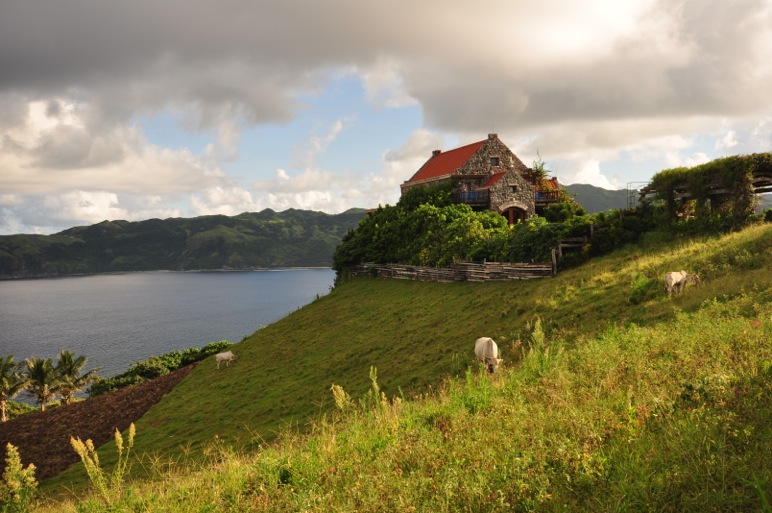
Happily there’s much, much more to celebrate about Batanes than to mourn. “Breathtaking” is almost an understatement for this cluster of islands. If there was such a thing as “panoramania,” or landscape overload, Batanes would be the cause of it, with seemingly endless and unfailingly spectacular views coming one after the other, just around the bend. The greenery covering the undulating hills is marked by a latticework of hedgerows, which act both as property boundary markers and as windbreakers. Despite the many first-class concrete roads beribboning the islands, Batanes is still clearly 4X4 country, better suited for cattle and goats than people, and no Batanes landscape would be complete without a cow or two in the picture, grazing placidly away even on the steepest of hillsides. Nearly everything on the main island of Batan happens in the shadow of the cloud-capped, 1,009-meter Mt. Iraya, although it should be fairly easy to find an undisturbed corner in one of the many coves around the island.

With a near-nonexistent crime rate, Batanes is one of those places where residents still keep their doors unlocked, where you can walk the highway at night without fear of being waylaid, and where—on my early morning strolls in the capital of Basco—I was greeted more than once with a beaming “Good morning!”

The “Basco Hymn”, with words and music penned by the mayor himself, Demy Marag, captures this lightheartedness well: “Hampas ng alon mo ay musika sa pandinig ko / Luntiang bundok mo, ginhawa’y dulot nito / Ihip ng hangin mo, haplos sa katawang hapo / Ngiting nasasalubong, ligayang totoo.”

You can find those words on one of the most useful and inexpensive PR giveaways I’ve come across, handed to us by Mayor Demy’s staff: a cardboard fan shaped like a kavaya, the leaf of the breadfruit tree, which the local people use as plates and food wrappers. Practical to begin with because of the withering heat, the fan was also very informative, in that it contained interesting facts about Basco—among them, that the population of the entire province is just somewhere above 16,000, half of whom live in Basco. The fan also highlighted Basco’s and Batan Island’s major tourist attractions.

Only in his mid-thirties, the poetically gifted Demy Marag is a Broadcast Communication graduate from UP; after graduation in 1998, he worked in the industry and with an NGO for a few years before eventually answering the calling that lodged his grandfather in the governor’s office decades earlier. A big sign just outside the municipal hall posts the mayor’s cell phone number and those of other key municipal offices; you can call them anytime. Now on his last term, Demy says that his biggest headache in Basco is zoning, with new buildings cropping up all over town, likely in response to the surge in tourism and commerce.

There are, of course, many other problems a remote province like Batanes has to contend with. Over a light merienda at the impossibly picturesque (had enough of these superlatives yet?) Fundacion Pacita, Basco’s energetic vice mayor, Ann Viola, explained how the typical Batanes resident, though not wealthy, was basically self-sufficient, producing enough for oneself and one’s family through fishing and farming. (You can appreciate this wiry self-containment in the fact that you’d be hard put to find an obese or even chubby Ivatan, and they don’t look emaciated, either.) Since transport costs are prohibitively high, producing goods for export poses a huge problem.

DSC_6610

Indeed, there’s literally a price to pay for all that glorious isolation: a liter of gas costs P70—which was cheap, said our guide, considering that it had shot up to P150 at some point a year ago. Bewilderingly, there are hardly any fresh fruits to be found in Basco—no bananas, pineapples, star apples, or jackfruit—and the only fruit that kept turning up on the dessert tray was the obviously imported apple, very likely from nearby Taiwan, which is closer to Batanes than much of the rest of the Philippines.

Tourism should be the province’s logical economic booster, and good, affordable bed-and-breakfast places like the Amboy Hometel, where we stayed, can be found. (For those with more elastic budgets, the Fundacion Pacita is a matchless choice.) Tours by van are readily available, taking you to the best spots—the Vayang rolling hills, the boulder-strewn Valugan beach, and the lighthouse on Naidi Hill, among many others. A day trip to nearby Sabtang Island, just half-an-hour away by ferry, is also well worth it, particularly for the stone houses of Savidug.

DSC_6695

It’s getting there that’s the big hurdle for most people. PAL Express and SkyJet fly three times a week from Manila to Basco, and a local airline called NorthSky makes a hop to Cagayan, but flights are sometimes canceled for lack of passengers. Only cargo vessels now dock in the harbor. As a regular one-way plane ticket to Manila costs about P9,000, a Basco native could spend his or her whole life without ever stepping on Luzon. “If you have a medical emergency and can’t be treated here, or airlifted to Manila, you’ll die,” said the vice mayor.

Another problem is the pernicious presence of poachers from Taiwan, who come down to the islands to steal the pretty arius tree, which they use for bonsai, and also fish the waters using state-of-the-art detectors—intrusions against which the local fishermen and Coast Guard are no match. It’s too bad that these criminal acts should spoil the relationship between Batanes and Taiwan, whose people—linguistically, for one—have much in common.

That remoteness and expensiveness, however, has its pluses for the locals. “It keeps the riff-raff away,” said a resident. “If it were that cheap to come to Batanes, we’d have drug dealers coming here before you know it.”

My message for the teachers and writers of Batanes was the same one I gave at the closing ceremonies of the recent Iligan National Writers Workshop. I was, I told them, an island boy, and proudly so—I was delivered by a midwife a short walk from the water’s edge in an island in Romblon, in a house with a straw roof and a bamboo-slat floor—and we Filipinos, come to think of it, all live on islands, some of them just bigger than others. But the challenge to our writers and teachers is to help us become more than a collection of islands. Our writers have to find and emphasize what we share in common as a people, even as we celebrate the things that make us unique. By building a bridge of words, Batanes can come much closer to the rest of the country.

I’d like to thank our guides—Chriz Annmarie Bayaras and Juliet Gulaga of the Batanes Heritage Foundation, Inc.—for a most productive week.


SPEAKING OF Iligan, MSU-Iligan Institute of Technology is capably led by Chancellor Sukarno Tanggol, a public-administration expert and another UP graduate who chose to return to his roots in Mindanao after serving as Ambassador to Kuwait to help raise the quality of education there. Dr. Tanggol recalled, jokingly, how he had lost all his poems and therefore his literary ambitions when his laptop got stolen years ago, but he’s making up for that by pledging his strong support for cultural programs in MSU-IIT, most notably the writers’ workshop and the institute’s resident performing company, IPAG.

The wonderful thing about attending a region-based workshop like Iligan’s is being able to listen to commentary and criticism in a flurry of languages—Filipino, English, Cebuano, Hiligaynon, and even more obscure ones like Higaunon (spoken in parts of Bukidnon)—and somehow, with some effort and patience—to make sense of it all. This is the nation in progress, the nation at work, rightly de-centered from Manila, celebrating the vibrancy and vitality of literary talent beyond the metropolitan mainstream.

A fantastic discovery in Iligan was the talent of a young Higaunon poet named Shem Linohon from Central Mindanao University. Though perfectly fluent in English, Shem has chosen to write in Higaunon, to help preserve his people’s language and experience. At one point, Shem broke down in tears as he recalled the depredations his people have had to go through at the hands of oppressors and landgrabbers; but more than anger, Shem has the skill with which to fight back, and we can only wish him and his people well. Another happy find was Carmie Flor Ortego of Leyte Normal University, who can write about a Homeric character like Penelope in Catbalogan. Bright and earnest, young writers like Shem and Carmie make me proud and happy to be a teacher of writing.

Penman No. 49: To the Writer at 25 (Part 2)

John and ChristinePenman for Monday, June 3, 2013

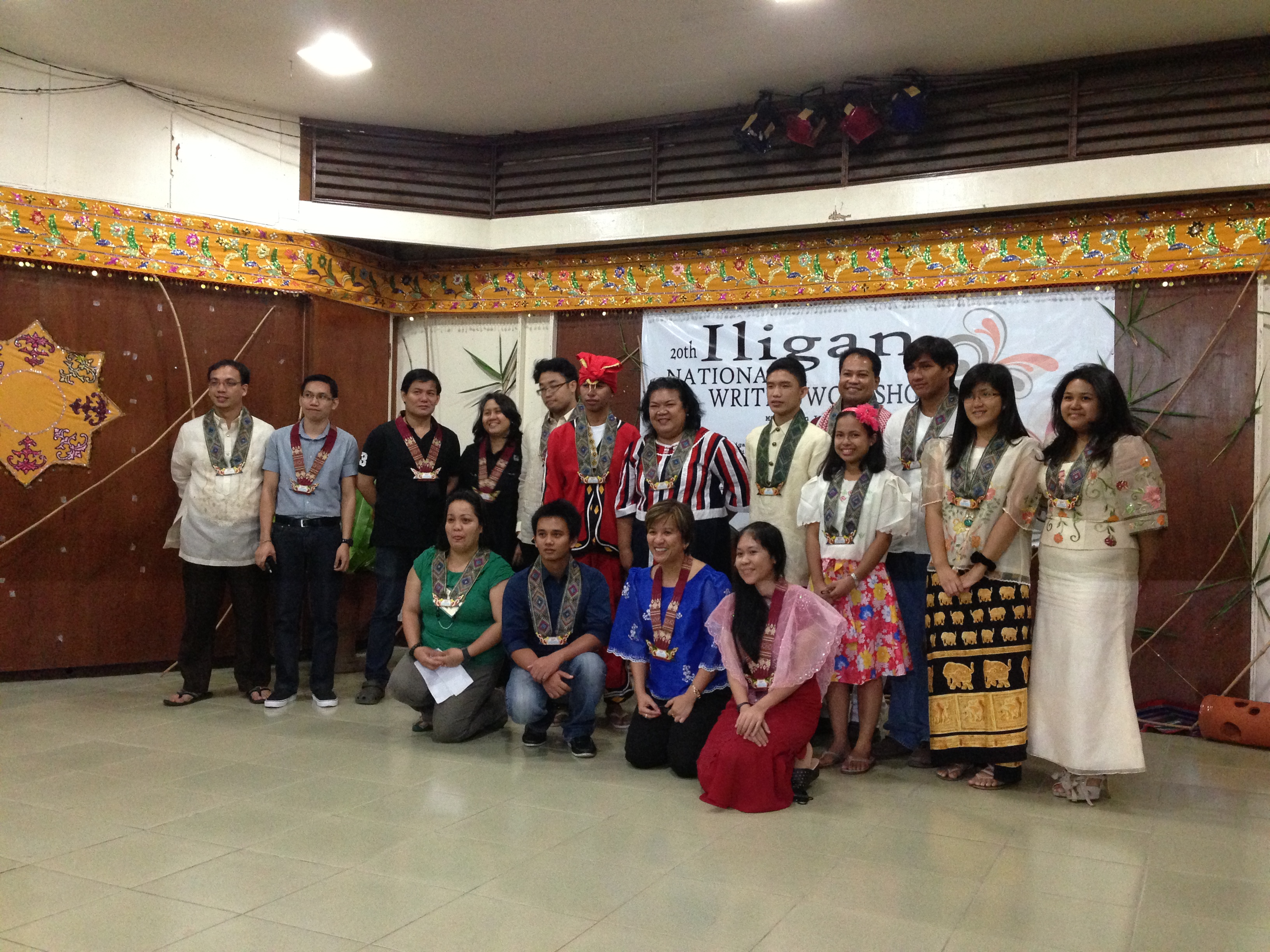
TO CONTINUE from last week, here’s what I told my young audience at the 20th Iligan National Writers Workshop (that’s them in the picture above, with panelists John Iremil Teodoro and Christine Godinez-Ortega in the foreground) at the MSU-Iligan Institute of Technology:

Writing in The Atlantic a few years ago, Max Fisher addressed the question of age and artistic productivity. “When in life are we most creative?” he asked. “Do we peak when we are young and energetic, or old and experienced?” Fisher brought up three answers, each with its own champion.

First, he suggested, “We peak young.” He quoted Kazuo Ishiguro—who incidentally is my exact age, born 1954—who said: “There’s something very misleading about the literary culture that looks at writers in their 30s and calls them budding or promising, when in fact they’re peaking.” According to Ishiguro, he had been “haunted by the realization that most of the great novels had been written by authors under 40.”

Second, “We peak in middle age.” Fisher cites a psychologist from UC-Davis who established that while “poets and physicists tend to produce their finest work in their late 20s… geologists, biologists and novelists tend to peak much later, often not until they reach late middle age…. Unlike poets, who peak early and fade quick, fiction writers tend to ripen and mature with age.”

Finally, says Fisher, “We peak old (sometimes).” Here he falls back on Malcolm Gladwell of Tipping Point fame, who points out that “Some poets do their best work at the beginning of their careers. Others do their best work decades later. Forty-two per cent of Frost’s anthologized poems were written after the age of fifty. For Williams, it’s forty-four per cent. For Stevens, it’s forty-nine per cent.”

I myself suspect that, with enough research, we can come up with all kinds of numbers to support any one of these propositions. There will always be the prodigious Marlowes and Poes and Rizals and Plaths who will streak like a comet across the night sky in their 20s and 30s—and perhaps not incidentally die soon after. Some writers, even if they live long, will produce a burst of brilliant work in their early years, and then drop the pen, or be little heard from again.

Paz Marquez Benitez published the classic “Dead Stars” when she was 31, and Angela Manalang Gloria came out with her book of poems, which she would be known for, at 33—but they would forever be those 30-somethings and no older in our literary appreciation. Nick Joaquin published his first poem, “The Innocence of Solomon,” at 20, “May Day Eve” when he was 30, and “Portrait of the Artist as Filipino when he was 34, but The Woman with Two Navels wouldn’t come until he was 44, and of course he continued writing and publishing practically until his death at 86 in 2004. NVM Gonzalez was 26 when he published The Winds of April in 1941; he was 43 by the time he wrote “Bread of Salt” in 1958, and 46 when he published The Bamboo Dancers in 1960. And like Joaquin, Gonzalez demonstrated longevity, working well into his last years. Speaking of longevity and sustained production, we have Leo Deriada and Tony Enriquez, plugging away, I’m sure, at another prizewinning novel or story, as they’ve been doing all these decades.

We’ll see, however, that most of our best writers, especially those who lived past their 70s, produced their most memorable work between their 20s and 40s. Rarely have we found a Dostoyevsky, who published The Brothers Karamazov four months before he died at 59 (my present age). Jose Garcia Villa’s writing might as well have ended with the comma poems of Volume Two in 1949, although he lived for nearly half a century more. Franz Arcellana’s literary legacy really lies in Selected Stories, published in 1962 when he was 46; I know of no more stories that he wrote until his death 40 years later in 2002.

You can draw your own conclusions and prescriptions, but this is mine: write what you can when you can, the sooner the better. The best time to write that story or that poem in your head is today, not tomorrow, and never mind if it turns out to be bad, because that’s what tomorrow is for, for the insightful and merciless and inspired revision that separates the mediocre writer from the truly talented and committed.

Of course I should also say that to writers of my generation, with a slight difference: write what you can while you can, because tomorrow may not come around. Today we live in an intensely youth-oriented culture, and some days it may seem like only the young get all the attention—which they deserve—but we are not in competition with them. Rather we are competing with ourselves, with time itself, and with the ages.

Now, what would I do—or what would I advise a writer to do—if I were 25 today?

1. Focus on your first book. If you write only one book in your life, then this will be the most important thing you will leave behind, not counting your children—or maybe even counting them. Your first book will be even more important than an MFA or your MFA thesis, which, truth to tell, no one but your defense panel will read. Some students I know dithered for years in a vain attempt to perfect their MFA or PhD thesis projects. For me, much of that was wasted time. Do a thesis worthy of passing—and then spend time cleaning up the text and shaping it into a reader-worthy book, a book with your name on the spine. And of course there are good books and bad books, and some days you wish an awful author had desisted from publishing and spared a few trees. But you’ll have to take your chances and get that bad first book out of the way, or you’ll never get to your good second one.

2. Focus on your second book. Your first book will likely have expended everything you’d always wanted to say. So now, what? Once you’ve mined your own young and unavoidably angsty life for material, what’s left for you to write about? Why, the world of course, although that world may seem awfully small at 25, especially if you haven’t been looking too closely at anyone but yourself and your friends. The real challenge of writing for me isn’t writing about oneself—which is, admittedly, an inexhaustible subject, a continuing mystery—but about strangers, whom the writer then makes as familiar as oneself. That’s what the best writers have done—perform great acts of invention, of transport, of sheer imagination. You have to believe to believe that there is more than one book—indeed, more than one life to plumb—in you.

3. Attend a workshop or two, but learn to hunker down and to work on your own. Young writers today seem enamored of workshops, and that’s understandable to a point, as writing is among the loneliest of labors anyone can assume, and the young writer will need the affirmation and the comfort of the company that workshops provide. But workshops can’t be a crutch; life isn’t an eternal summer where you can keep tinkering with a draft in the hope that someone out there in some workshop will finally like it. Past your second or third workshop, keep the workshop in your head, and begin to write, in productive solitude, in the silent company of your presumptive fellows—Chekhov, Rilke, Salinger, Joaquin, Alfon, Gordimer, Lahiri, or whoever moves you to do as they did.

4. Stop arguing, and leave the polemics and the criticism to others. You don’t have time for that, and it can distract you from what you should be doing, which is writing more of your own work. While criticism can help clarify our own aims and means, these debates can sap too much of a writer’s psychic energy, energy one needs for his or her own poetry.

5. Lastly, listen to old fogeys like me, and listen closely—but make up your own minds, make your own mistakes, and don’t be afraid to make them, or you’ll never get anything right. Not everything you write will be a work of genius; indeed, much of it will very likely be immemorable. But if you endeavor to write well and to write enough, sooner or later, that masterpiece you might be remembered by will come. Desperate to earn a living from his writing, Chekhov wrote more than 200 stories in his lifetime; except for the most devoted fan, no more than a dozen of these stories will be familiar to us as classics. But he would not have come up with that glittering dozen if he hadn’t written 190 other less worthy pieces. So nothing is ever wasted in writing. Your misfires and your false starts are part of your investment in the enterprise of a lifetime.

Would Rizal be Rizal without the Noli and the Fili and Mi Ultimo Adios? Perhaps, but he would be a diminished Rizal, whose martyrdom would have lost much of its resonance. Will it be sacrilege to suggest that we admire Rizal less for his actions than for his writings? Were his writings not, in fact, largely his deeds? In any event, they are what live on—what he wrote at 25 and in the few years left to him after that.

As Hippocrates put it so well, “Ars longa, vita brevis,” often transposed into “Life is short, but art lives long.” May we all write something worthy of surviving us—the sooner the better.

Penman No. 48: To the Writer at 25 (Part 1)

INWWPenman for Monday, May 27, 2013

LAST WEEK, it was Iligan’s turn to host me, among other writers, for the 20th National Writers Workshop under the auspices of the MSU-Iligan Institute of Technology and the National Commission for Culture and the Arts, and I was honored to deliver the keynote, which I’m excerpting this week and next. Here’s what I said:

It’s always a pleasure to be in the company of friends and comrades in the profession, including many luminaries of our national literature who happen to be based in the Visayas and Mindanao. I’m especially glad to be addressing our young fellows, for whom I wrote this talk, for special reasons that will be shortly clear. In fact, I’ve decided to title this talk “To The Writer at 25,” aimed at writers of that age, give or take a couple of years.

Why 25? Let me cite a statistic that, depending on how you take it, could either be empowering or overpowering. It’s a figure that’s been there all along but which no one seems to have thought about too much, probably because no one really knew what to make of it or recognized its potential significance.

And here’s that fact: Jose Rizal finished writing Noli Me Tangere in December 1886 and published it by March 1887. At that point, he was still no more than 25 years old.

Rizal had less than ten years to live after that. But by the time he was executed by the Spaniards in 1896, he had written two novels and parts or fragments of five more, as well as dozens of important essays and poems.

Think of that for a minute—the Noli by age 25, the Fili by age 30, and a lifetime’s work by 35. If only for these, then—at least in my book—Jose Rizal does deserve to be a national hero, and not incidentally a National Artist.

Those of us who are now far north of 25 might recall what we were doing at that age. We may have been already writing by then—I know I was—but I doubt that we were laboring at or even thinking about a Noli, or even a novel, at that time.

At 25 I was married and a father, and I’d won a few literary prizes, certainly not enough to convince me or anyone else that I would go on to any kind of greatness, but enough to suggest to me that the rest of my life would be inscribed by literature, that I would do well to take it seriously, for better or for worse. I was out of school, and I had not even gone to my first writers’ workshop, but I knew, in my blood and bones, that I would go on to write more and more things, as inchoate as those things were to me then.

Indeed, for most of us not named “Jose Rizal,” 25 seems to be a good landing on the steps, a firm pre-departure point for a future in writing. Interestingly enough, in his famous essay “Tradition and the Individual Talent,” published when he was 31, T. S. Eliot specified 25 as the age by which one should have made some crucial commitments—among them, an embrace of tradition or “the historical sense, which we may call nearly indispensable to anyone who would continue to be a poet beyond his twenty-fifth year.”

It wasn’t even at 25 but a few months after turning 24 that Fyodor Dostoyevsky published his first novel titled Poor Folk, now nearly forgotten in the wake of his greater and more mature work but a critical and commercial success in its time. In fact, so intent was Dostoyevsky on pursuing a literary career that he published his second novel, The Double, a month after Poor Folk.

Edgar Allan Poe was even more precocious, publishing his first book of poetry at 18; he had three collections of poetry by his 22nd year, and turned to prose at 24, winning a prize for his story “MS. Found in a Bottle.”

Eighteen was also the age when Sylvia Plath published her first story in Seventeen magazine, in 1950; that year, she wrote in her journal: “I can never read all the books I want; I can never be all the people I want and live all the lives I want.”

I could go on and on, about this and that writer having written this and that work at this and that young age, but you catch my drift. While there may be no real prodigies in writing, there have been, on the other hand, many precocious people who began producing significant work around their 25th year.

I bring this up because, as I prepare to embrace seniorhood in a few months, I find myself often asking if I have written enough, if I were to keel over tomorrow. But enough for what? Perhaps the more accurate question would be, did I write enough of what I could, when I could? What does age have to do with output and insight?

This is what I’d like to talk about a bit this morning, this relationship between age and productivity in creative writing. I would have liked to say not only in creative writing but in the other arts as well, but this is where writing perhaps differs the most from music, painting, and so on. As I’ve often pointed out before, true prodigies don’t exist in literature, unlike in music or mathematics—no Mozarts who can write full symphonies or Ramanujams who can solve complex equations at a preciously tender age.

We don’t find full-blown adult novels written by eight-year-olds, which was Mozart’s age when he composed his Symphony No. 1 in E Flat Major. Prodigies also abound in painting—The Huffington Post lists at least ten of them, one of whom, nine-year-old Kieron Williamson, recently sold 24 paintings worth almost $400,000 in one month and was reported to be preparing for a retrospective—yes, a retrospective.

Why don’t we have a Brothers Karamazov or even a Gone With the Wind written by a third-grader? The reason is obvious: writing involves more than vocabulary; it requires social experience, which can only come with growing up.

Even so, Rizal did an awful lot of growing up very quickly to be able to dish out the Noli and Fili by his 30th year.

It was in my 30th year, in 1984, that I came out with my first book, Oldtimer and Other Stories. Throughout the mid-to-late 1970s, my officemate and I, the late playwright Bienvenido “Boy” Noriega Jr., then both in our early 20s, had carried on a fierce but friendly competition in the arena of playwriting. I drew first blood, with a first-prize win over Boy’s second place in the 1976 CCP Playwriting Competition—our mutual teacher in playwriting, Prof. Amelia Lapeña Bonifacio, came in third—but that was the first and last time I won over Boy, over many CCP and Palanca competitions that followed. As a result, I shifted from playwriting in Filipino to the short story in English, where I felt I was safe from Boy. But in the meanwhile, we made another friendly dare—to come out with our first books by our 30th year. As it happened, we both made it—barely: he published Bayanan-Bayanan at Iba Pang Mga Dula in 1982, after turning 30; I published Oldtimer in 1984, a month before turning 31.

I recall these things because I also recall the intense awareness of age and time that accompanied our writing then. We felt under the constant pressure of a deadline—and I don’t mean just the Palanca deadline, although that was mightily important to us then, at a time when there was very little publishing going on, and competitions were literally the only game in town. Ours, after all, was the generation of the First Quarter Storm, of a brave but bloody activism that saw many of its acolytes fall at the steps of the altar in their teens and early 20s. If there was anything important we wanted to do—like write a book, or get married, or father a child—we had to do it sooner than later, because life was very likely going to be short, if not nasty and brutish.

Of course we will never really know how long we will live or when we will die—that remains life’s greatest mystery, and it’s still with some astonishment that I realize I’ll be turning 60 in January—so we really can’t tell when our most productive years will be, or when we’ll write the piece that we will hope to be remembered by. (Conclusion next week.)