Penman No. 14: Free Ericson Acosta

AcostaPenman for Monday, Oct. 1, 2012

LAST MONDAY, I wrote about recalling the horrors of martial law, which had been declared 40 years earlier. That same day, I had a chance encounter with a young woman named Kerima Tariman Acosta, whose husband Ericson has now been languishing in a Samar jail for a year—a political prisoner under a new regime four decades after martial law.

My interest in the case was piqued not just because of the obvious irony, but because Ericson was a former editor of the Philippine Collegian and a poet—in other words, a brother-in-arms as a writer.

Ericson was arrested on Feb. 13, 2011 by soldiers of the Philippine Army near San Jorge in Samar, without a warrant; Kerima says that he was carrying only his laptop, a cellphone, and some money, having been conducting human rights research in that militarized community on behalf of a peasant group, Kapawa. Later, however, his captors produced a grenade, which they claimed Ericson had in his pocket; they would later charge him with illegal possession of explosives, which Ericson vehemently denies, saying that the grenade was planted to link him to the New People’s Army.

Upon his arrest, says Kerima, Ericson was interrogated for 44 hours, tortured, and forced to admit that he was an NPA member. He was moved from detention in a military camp to the Calbayog sub-provincial jail, but soldiers from the local infantry battalion were sent to camp out in this jail to guard him.

Meanwhile, his case has been crawling through the courts. Prominent legal and artists’ groups have rallied behind Ericson’s release—including the National Union of People’s Lawyers, which has taken on his defense, the College Editors Guild of the Philippines, and International PEN, among others—arguing that he was arrested illegally to begin with and was tortured, and that the charge against him was manufactured on the spot. Still, he remains in prison, despite an urgent plea from his family for his release, or at least for an opportunity for him to be seen by a doctor, because he had been sick with renal and prostate problems even before his arrest.

I’ve been a firm believer in President Noynoy Aquino’s “Daang Matuwid” campaign, but something like this makes me wonder how well we’ve truly exorcised—if we have, at all—the demons of our martial-law past, particularly in terms of reining in the abuses of our military, and of educating them (and thereby ourselves) on the value of respecting human rights.

We’ve let convicted murderers and child-rapists go free, although PNoy’s men can say that that was under a previous and truly morally abominable administration. Ericson Acosta was arrested under PNoy’s watch. What’s worse, it turns out that Ericson is hardly alone. When human rights activists tracked him down in Catbalogan, they found five more political prisoners in the city jail. These activists estimate that more than 350 people still languish in Philippine prisons because of their political beliefs.

The President can reclaim the moral high ground not just by remembering what Marcos and his military did to his father—as he did on the 40th anniversary of martial law—but by acting differently and speedily to bring justice to these cases, as he would have wished someone did for Ninoy, and not simply fall back on the old Palace excuse of “Let the military do its job.” Experience shows that when you do that, you let the butchers loose on the people. I haven’t lost hope in reform within the military mindset, but it takes a Commander in Chief to set the tone and give the orders.

If the government thinks that the evidence against Acosta is strong and irrefutable, it should prove its case, and prove it quickly. Otherwise, it should free Ericson Acosta and the others like him—arrested for patently political reasons 40 years after martial law—to put that era squarely in the past.

* * * * *

ON A happier note, I’d like to mention a new book whose author exemplifies the best of what a Filipino can be and can achieve internationally. Dr. Jojo Sayson is a Fil-Am physical therapist and motivational speaker, a UST graduate who has done pioneering research work for NASA and who heads a foundation that helps children with cancer and other debilitating diseases.

His biography, Springboard to Heaven: The Jojo Sayson Adventure (Image Workshop Press, 2012)—co-authored and edited by biographer and film director James Riordan—chronicles the journey of a poor Manileño boy who leaves to work in the US with $170 in his pocket and who goes on to become a scientist engaged in finding solutions to the problem of lower back pain—not my back or yours, but that of the NASA astronaut, who has to endure weeks if not months of microgravity in space, which puts unusual stresses on the body. To understand this problem more thoroughly, Sayson himself went through microgravity training, and out this came a landmark paper published in Aviation, Space, and Environmental Medicine in 2008. Jojo must have enjoyed the experience, because he subsequently applied to join NASA’s astronaut corps as a mission specialist for 2013.

To quote from the book: “Astronauts report that the ‘fetal tuck or cannonball position,’ with knees-to-chest, relieves their back pain. The article presents research and references to describe the possible reasons for this relief, their clinical consequences and the rationale of the numerous proposed exercise countermeasures suggested for astronauts to perform in space to increase spinal loading. (These countermeasures also may prevent herniated disks which can occur post-flight.) The authors also suggest the possibility of employing, in conjunction with the countermeasures, a harness designed by Sayson to stimulate spinal compression and reduce disc expansion.”

That’s heavy technical stuff, but what’s more interesting and important for most of us Pinoys is to see another kababayan opening new doors abroad not just for Filipinos, but for humanity itself.

The book is now available at National Book Store, Powerbooks, and Bestsellers.


Doy, vic manarang, nilo tayag
gringo, mike defensor, gary olivar, miro quimbo, oying rimon

Randy david, raul pangalangan
Penman No. 13: Random Reflections on Martial Law

HBD

Penman for Monday, Sept. 24, 2012

LAST FRIDAY marked the 40th anniversary of the imposition of martial law in the Philippines by Ferdinand Marcos, and the occasion gave rise to much reminiscing among those of us who went through that dark period. I myself was interviewed by a TV station and asked to speak at a forum at the University of the Philippines about my experience with martial law, which I fictionalized in my first novel, Killing Time in a Warm Place (Anvil, 1992).

Of course I’ve never really stopped thinking about martial law all these years, but not until this anniversary did I force myself to sit down and write what martial law really meant to me and what it taught me—the “me” being no longer the 18-year-old boy who was arrested for “subversion” and detained for seven months in Fort Bonifacio, but the 58-year-old man who managed to live far longer and to see more things than he expected.

What I will write down here are entirely my own impressions and conclusions as a private citizen. I am not a political scientist or an ideologue, although I did work as a journalist, and, ironically, as a government PR man in the late 1970s, when there were few other jobs to be had, after my release from detention. I’m sure that some readers and even my friends will find something to quarrel with in these observations, which will be good, because I don’t think we ever really sat down and summed up what that period meant to us, beyond saying—as we should—“Never again!” So, herewith, my random reflections on martial law:

1. It wasn’t as bad as what the Argentines and Chileans went through in their darkest days of state terror. But that comparison’s pointless and even cruel when it’s your body or that of someone you love being laid out in the interrogation room, when it’s your family desperately seeking an abductee, running from prison to prison. The government called it “smiling martial law,” but don’t be fooled—horrific things happened to ordinary citizens in those camps and prisons. It may have been good for business—at least at first—but it was an unmitigated nightmare for designated enemies of the state.

2. An armed forces cannot be at war with its own people. Martial law irreversibly politicized if not corrupted the military, so that it has had to be re-indoctrinated to support the people rather than the ruling elite. I don’t know how far it’s come along in this respect.

3. America can be a great friend, but it will always look out for its own interests first, and those interests don’t always coincide with ours. American politics is coldly opportunistic; the rhetoric of freedom and democracy can easily be used as window dressing for American commercial policy. Ferdinand Marcos and martial law wouldn’t have lasted that long without America’s imprimatur; even though some insist that it was the Americans themselves who took him out—that EDSA was a CIA plot—it was American support that entrenched him in the first place.

4. It takes a people to build a nation—not one leader, certainly not one despot and his cohort. Martial law turned us into blind followers, trusting the leader to make crucial decisions for the rest of us. Except for those who resisted the dictatorship, the rest of us were complicit in it; we wanted it to work and gave it our tacit approval, because it seemed to offer a simple and efficient solution to age-old problems. It also takes a thorough process—not quick fixes like martial law, street revolts, or coups—to secure deep and enduring change.

5. The Church can be a potent and progressive political force when it wants to. Much as I may be dismayed by the intransigence of the Church on social issues such as the RH bill—and indeed I no longer consider myself a practicing Catholic because of this—I acknowledge the contributions and sacrifices of many religious workers to the fight for freedom.

6. We all have our weaknesses and our limits. I saw how people who spoke big words could fall silent at the merest hint of torture, and how even the toughest ones could break at the edge of the unendurable. I have since learned not to demand of others what I could not demand of myself. At the same time, I saw that ordinary people can also be capable of extraordinary courage. Their heroism has made me wonder if I who survived was worthy of it.

7. On a purely personal level, one of post-martial law life’s most awful discoveries was that, incredibly, there were worse things than martial law, worse pains that one could receive, or inflict on oneself and on other people. A government can do only so much evil; the rest you can do yourself. But redemption is always possible for the self-aware, and I suppose that’s what many of us have been striving for these past 40 years.

* * * * *

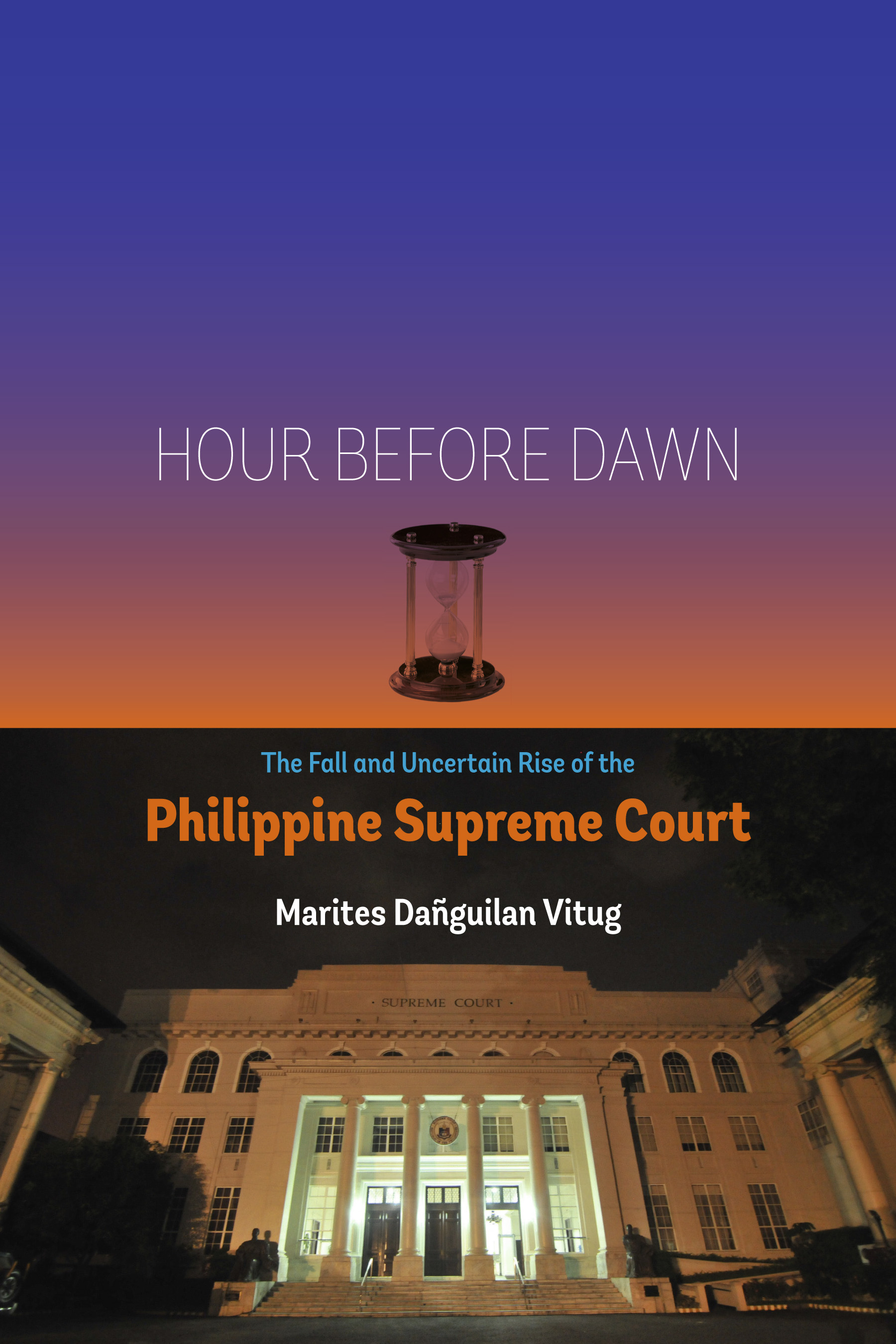
SPEAKING OF September 21, that was also the day last week when I failed to attend an important book launching in Makati because I was teaching my graduate class in Diliman at that same time. The book was Marites Danguilan Vitug’s Hour Before Dawn: The Fall and Uncertain Rise of the Philippine Supreme Court (Clever Heads Publishing, 2012), which I copyedited, along with its predecessor, the acclaimed and bestselling Shadow of Doubt: Probing the Supreme Court (Newsbreak, 2010).

It’s a copyeditor’s great privilege to read a book—and even reshape it to some extent—before anyone else does, aside from the author and the book designer. With Marites—with whom I worked for many years on Newsbreak—I always know that I’m in for a political junkie’s treat, as she will patiently go behind the scenes to reveal the inner workings of our most important yet also most inscrutable institutions, like the Supreme Court.

Without spoiling the suspense, here’s what I can say about Hour Before Dawn and why you should grab it before they run out of copies: if you’ve ever really wondered why Chief Justice Renato Corona had to be impeached and what the Supreme Court was like under his watch, read this book. If you’ve also wondered what Lourdes Sereno is really like and what kind of Chief Justice she’s going to be, read this book.

As its full title suggests, Hour Before Dawn offers both darkness and light, ample cause for both dismay and hope. It demystifies the Supreme Court and the Justices who preside over our fates, showing them to be as fallibly human as the rest of us, and yet also mindful of the higher judgment of history.

I don’t know if this book is going to earn its author another slew of death threats and libel suits, but I think it should be required reading for every law student, lawyer, and judge in this country—make that every citizen-at-large who hasn’t given up hoping for impartial justice.

Penman No. 12: A Spectacle of Orientalia

AK

Penman for Monday, Sept. 17, 2012 

I BELONG to a generation that grew up on Broadway musicals—before Broadway got all dark and grungy, and even if we’d never been to Broadway at that point. Thanks to the movies and to vinyl, it was perfectly possible to be transported from Boni Avenue in Mandaluyong to Salzburg and Manhattan, or from Barrio Malinao in Pasig to the South Pacific and Siam. It’s hardly surprising that today, as a grown man approaching 60, I can still sing songs from South Pacific, Carousel, The King and I, West Side Story, The Sound of Music, My Fair Lady, and Camelot with the verve, albeit without the voice, that I had at 17.

I’ve since had the opportunity to catch some musicals on Broadway and the West End, and while I’ve marveled at the visual and vocal pyrotechnics of such modern classics as Phantom of the Opera and Les Miserables, I miss the brave optimism of the old musicals—where, even in death, there was always a glimmer of hope in the end (“You’ll Never Walk Alone” in Carousel, “Somewhere” in West Side Story). I didn’t know then that this defiant cheerfulness was part of a commercial formula; I didn’t care. All I knew was that it felt good to whistle a happy tune, and that, approaching my crush du jour’s abode, I wanted to burst into a heartfelt rendition of “On the Street Where You Live” outside her window.

And so when I recently received an invitation from a long-time Penman reader and correspondent—the accomplished musical theater director Freddie Santos—to a preview performance of The King and I, there was no way that I was going to resist or refuse. The show took place at the Newport Performing Arts Theater at Resorts World a couple of Sundays ago, and my wife and I (or, as I rechristened the two of us, “The Beng and I”) arrived three hours early to see what the Resorts World buzz was all about, being staunch denizens of the North.

“I feel like I’m in Macau” was Beng’s first impression, and soon it was my jaw’s turn to drop when we entered the plush and capacious Newport Theater. It seemed like a daunting cavity to fill, but nothing fills space like music, and as soon as the overture began and the curtains rose, we were all elsewhere.

I had seen the Yul Brynner-Deborah Kerr film version of the musical many times, and so I wondered how Freddie Santos was going to convey all that convincingly in a practically all-Filipino production, but I needn’t have worried. Freddie earns this shameless plug: this is a wondrously good show, so good that The Beng and I will gladly return as paying patrons with friends to see it all again.

In a sense, The King and I is almost pre-programmed to succeed—which only raises the bar for any director assigned to it. Most musicals can be lucky to have more than one or two showstoppers that people will be singing afterwards (say, “I Know Him So Well” from Chess and “What I Did for Love” from A Chorus Line)—often without any idea of where the song came from. The King and I has at least seven of them: “I Whistle a Happy Tune”; “Getting to Know You”; “Hello, Young Lovers”; “We Kiss in a Shadow”; “Something Wonderful”; “I Have Dreamed”; and “Shall We Dance”. (The most difficult piece of all of these to essay—“Something Wonderful”—brought Beng to tears, although, without meaning to diminish Gina Respall’s achievement, I should add that Beng cries every time she sees The King and I, particularly when Yul Brynner dies in the title role.) Incidentally, Gina—as the sympathetic Lady Thiang—is a Filipino performer now based in London, where she has also played the role.

As was to be expected, the veteran Leo Valdez played King Mongkut with comic aplomb and authority. Monique Wilson (on leave from the London Performance School where she is a department head) inhabited her character thoroughly.

No Broadway musical can be complete without a pair of star-crossed lovers—think of Joe Cable and Liat in South Pacific, and of Tony and Maria in West Side Story—and the Tuptim-Lun Tha subplot in The King and I lends the narrative a romantic urgency that counterpoints the Anna-King relationship, which never goes beyond mild flirtation. Tanya Manalang as Tuptim and Lawrence Martinez as Lun Tha carried their duets with powerful poignancy.

The sets and costumes—the latter sourced directly from Thailand—were sumptuous. The allegorical “Uncle Tom’s Cabin” playlet was a masterful demonstration of ingenious stagecraft.

Of course it isn’t just Orientalia on display; after all, there’s no more quintessential East-meets-West piece of theater than The King and I. The 1951 Rogers and Hammerstein musical—based on Margaret Landon’s 1944 bestseller Anna and the King of Siam—purports to chronicle the contact between the British Anna Leonowens and Mongkut (great-grandfather of the present King Bhumibol) and thereby the incipient modernization of Thailand, but the academic in me has to add, at the risk of being a spoilsport, that the truth was far more prosaic than the play, which one critic called “a confection built on a novel built on a fabrication.” Some online sleuthing will quickly reveal that there was a real Anna (1831-1915) and she did go to the Siamese court to teach Mongkut’s wives and children for almost six years, and Mongkut did find her “a difficult woman,” but no, they didn’t waltz around the room “on a bright cloud of music.” Indeed, the movie musical was banned in Thailand when it first came out.

That said, people go to musical theater not for history and scholarship but for spectacle and romance. This unabashed and otherwise silly translation of human emotion and experience into song and dance is after all, from the very outset, a conscious departure from fact and reality, striving for truths of the heart rather than of the mind. Trust the historians and the journalists to lay out the facts, which can and should be appreciated in their own good time; but these momentary fictions and our need for them are also, inalienably, part of what make us human.

In other words, The Beng and I had an enormously good time, and we spent the long ride home singing along to the soundtrack I played off my iTunes in the car. The next morning, I took my usual walk around the UP Oval, with the Peabo Bryson-Leah Salonga version of “I Have Dreamed” streaming through my ears.

The show opened to the public just last Saturday and will run until December, with ticket prices ranging from P1,000 to P2,400—certainly not loose change for cash-strapped Pinoys, but think again of how much you’d be saving by not having to fly to London or New York for the chance of enjoying a world-class musical experience.

(Photo by Geoffrey Yusooncho)

Flotsam & Jetsam No. 10: Sundays Are for Pens

IT BEING a rainy Sunday here in Manila, I thought I’d take out some of my fountain pens—vintage and modern—for some routine maintenance (read: boy plays with toys). I took this shot of the pens with my iPhone, and I rather like its antique-y look.

And while we’re at it, here are the pens in my current rotation. Can you identify them?

Flotsam & Jetsam No. 9: Confessions of a Fish

For Esquire Magazine / July 2012

THERE’S A saying among poker players that if you can’t figure out who the fish is at your table within the first half-hour, then the fish is you. The fish is, of course, the prey in the ocean, regular lunch fare for the sharks, the poker player who’ll go all-in on a pair of Queens because they’re the best hand he’s had all evening despite an Ace and a King showing on the table.

But let’s make this easy without having to wait for 29 more minutes: I’ll admit it, I’m a fish, 90 percent of the time. I go into a poker game not really to win—though I’ll be happy if I do, and thank you very much—but to play cards, which can be very different from playing to win. How so?

First of all, let’s define what winning in poker is. Logically speaking, winning is a positive outcome—literally, a result at the end of the day that yields you a bigger bankroll than you started out with. If you’re a poker pro, which I’m certainly not, this can be your only definition of winning: going home with even just a couple of thousand pesos more in your pocket, whether from a tournament or a cash game, after having risked, say, anywhere between P5,000 and P10,000 in play.

For fish like me, winning is less an outcome than a moment—a surge of adrenalin, a flood of endorphins—that can pass very quickly, but is a high well worth buying. It’s the high you get when you hit your flush or your inside straight on the river, busting your cocky opponent’s three Aces or two pair. Never mind that that rush is followed by a long, slow slide back into the doldrums, and that you’ll be driving home in the wee hours many thousands of pesos poorer. All a fish has to do is to remember that instant—that look of utter horror and disgust on the other guy’s face—and all the pain of losing fades away, like dirty water down a drain.

A “grinder” or a “rounder”—someone who’ll play hundreds of hands in a day, on the felt table or online, just to come out with a little more than what he would’ve made driving a cab or flipping burgers or calming down irate Texans from a call-center cubicle—can’t afford that kind of drama. That’s one way of spotting the pros: they’ll fold pocket Kings when they have to with the faintest cluck of the tongue, almost as easily as if they’d been holding a Seven-Deuce.

Like you might have noticed, I observe my fellow players a lot. That’s my official excuse for spending 16-hour binges at the tables—typically checking in after lunch and playing in the 2:30 tournament, busting out by 6 pm, signing up for the 7 pm tournament, and again busting out by midnight, just a few places short of finishing in the money, and staying on at the cash tables until 5 am, when UP’s gates open and I can drive home with a little back massage from the rosy fingers of dawn. I’m writing a novel with a poker player in it—a call center fellow whose wife has been sleeping with her boss and whose only consolation, if you can call it that, is the draw of the cards and the gambler’s unflinching conviction that, one inevitable day, he’s going to strike it rich. Throw in a messy love story—a cute dealer with a thuggish boyfriend—and you have a novel.

So I’ve been taking notes about the game and its practitioners, in between throwaway hands. Seriously: I get a lot of writing done over those stretches, and it used to be easier when I was using a BlackBerry instead of an iPhone. I sit at the tables for so long that I have to bring an extended battery for use from about 2 am onwards, and I wouldn’t have traded the BlackBerry for the iPhone’s crappy battery life if I didn’t need to surf and look up my eBay bids while playing (more fish tells: impatience, distraction).

And so I dutifully observe the comings and goings of the cross-dressing diva whose girlish giggles disguise a strong, solid game; the starlet whose privates I’d met in a sex video before I met the rest of her; the loudmouthed balikbayan cursing the last card, or the “river”; the dealer bouncing back from pregnancy to another kind of succulence; the masseuse in hospital scrubs kneading a bare, shiny back as large and as dark as Africa. They used to play “Pokerface” to death on the PA but that’s been replaced by B.O.B.: “Beautiful girls all over the world I could be chasing but my time would be wasted….” How could I be wasting my time when I’m meeting people and learning songs like these? Never mind that any dude my age is addressed as “Daddy” or “Tatang” at the tables; put on shades, a hoodie, and Sennheisers, and you’ll feel 30 years younger.

I’ve written down lines like “The ceaseless murmur of chips sounds like a forest of crickets” and “There’s nothing more cruel than the indifference of cards” and “The dealer’s fingers darted like a skittish crab across the felt, picking up chips at every stop” (let’s add this for the wannabe Hemingways out there: copyright, Butch Dalisay, 2012). I’d like to think that, one of these days, those lines will turn like Moses’ snake—whapak!—into a novel that will win a prize that will recoup all my losses from all those donkey calls.

Ah, the donkey. Anatomically and taxonomically, donkeys have very little to do with fish, but in poker, they might as well be the same animal. The donkey will make a bad call holding an insufferably bad hand—something like a Three and a Seven off-suit—in the deathless hope that the flop, the first three community cards, will be Four, Five, and Six. And you know what? Sometimes it happens. And that’s what the donkey-fish lives for, to the dismay of the pros, who also have an attitude problem of their own, to the effect that “Unless you’re holding at least an Ace-King, you have no right to call my pocket Queens.”

As for the cards themselves, I’ve seen and had them all: a royal flush (three times), an Ace-high flush beaten by a one-outer straight flush (my best hand ever), a four-of-a-kind beaten by a straight flush (my worst hand ever). In the middle of a boring meeting at the English department, I run these games through my head like YouTube videos, savoring every flip of the cards, almost forgetting that, in many cases, I was on the losing end.

That’s why I’m a fish. I’m here for the endorphins, and they don’t come cheap.

(Photo courtesy of pilipinaspoker.com)

Penman No. 12: Singapore’s Cultural Renaissance (2)

Penman for Monday, Sept. 10, 2012

ANYONE WHO doubts that Singapore is going through a cultural renaissance just has to drop by places like the Goodman Arts Center, the Arts House, the National Library Board building, and any one of the many museums that have sprung up around the city-state city-state celebrating everything from historical heritage to biodiversity and toys.

On a recent media visit to Singapore, I was shown by my hosts from the National Arts Council around many of these cultural hotspots, and they offered a wealth of insights into contemporary Singaporean society and its concerns.

Housed in what used to be a school run by the La Salle Brothers, the  seven-hectare Goodman Arts Center in the Mounbatten district opened last year and has quickly become Singapore’s largest arts enclave, serving as a studio, meeting place, and performance venue for both local and international artists. Studios in the GAC are generously subsidized by the government, and “There’s a long waiting line of artists wanting to use the center,” said Evan Hwong of The Old Parliament House Ltd., which manages the GAC.

Being a complex of converted school buildings, there is nothing particularly impressive about the GAC on the outside; but open one of the many doors and instantly a world of artistic creation meets the eye and swarms the senses. During our visit, we encountered Jerry Hinds, an expat Briton who’s helping young Singaporean cartoonists sharpen their skills not just in terms of drawing but also in sharpening their narratives; Iskander, a longtime transplant from the Netherlands, who’s working to help people see comics not just as entertainment but also as an art form; Sonny Liew, Malaysian-born but Singapore-based, who’s already drawn for Marvel Comics; Japanese artist Eriko Hirashima, who’s turning books into art objects in themselves; and Singaporean copywriter Amanda Lee and artist Winnie Goh, whose Studio Kaleido explores crossovers between visual and literary art.

Not only professional artists are welcome at the GAC. Ongoing at the GAC this month and open to the public are a batik painting workshop, a professional singing course in Mandarin, and classes in contemporary dance, hot glass bead-making, bookmaking, and pottery, among others.

Theater has always been particularly strong and popular in Singapore, and performance venues abound, such as the landmark durian-shaped Esplanade, the elegant Arts House at the Old Parliament Building along the river, and the Drama Theater of the School of the Arts.

We had a special encounter with an icon of Singaporean theater, the playwright and novelist Stella Kon, at the Peranakan Museum which had dedicated an exhibit to her play Emily of Emerald Hill, much performed and beloved of generations of Singaporeans since it debuted in 1982. Although born in Edinburgh (she later reacquired Singaporean citizenship), Stella is of Peranakan origins, referring mainly to the Chinese who settled centuries ago in certain places around the Straits of Malacca, particularly in Penang, Melaka, and Singapore. The Peranakans have contributed richly to the economy, culture, and cuisine of their host countries; most outsiders will recognize, for example, the sarong kabaya immortalized by the TV ad’s “Singapore girl,” a stylized version of traditional Peranakan dress.

Emily of Emerald Hill is a long dramatic monologue in English (most recently and brilliantly performed by the cross-dressing Ivan Heng) that takes the audience through the colorful life of Emily Gan, who rises from poor Peranakan girl to powerful matriarch. It’s a sad story but one that has resonated powerfully with its viewers (it’s being taught here in the Philippines by Dr. Lily Rose Tope, our new departmental chair in UP, in her Southeast Asian literature class), and it’s too bad that we didn’t get to see the play, but meeting the author herself as we walked through the Peranakan Museum was a special treat. “It used to be that being Peranakan was something of a disadvantage,” said Stella, “but today’s it’s become chic.”

The stories of the Peranakan—and much more—are lodged in the National Library of Singapore on Victoria Street, a breathtakingly modern building whose collections comprise not only the traditional hardbacks but a growing library of digitized e-books as well. (Just how far ahead Singapore is in the digital game struck me when I overheard someone mention a “Donate your old iPad” campaign being undertaken there for the use of schoolchildren.) “We don’t actually keep all that many books here,” a reference librarian told me, “because they’re sent out to the public libraries.” In other words, Singaporeans are busy reading. The National Library Board also runs a vigorous publishing program, and its products—such as an annotated bibliography of contemporary Singaporean literature in English—are available for free to anyone interested. The library’s collections are searchable online. At the time we visited, a large and groundbreaking exhibit featuring the letters of Singapore’s colonial founding father, Sir Stamford Raffles, was just about to open; there was also an exhibit upstairs of the personal memorabilia and writing tools (the pens were of particular interest to me) of some of Singapore’s most prominent writers. And here’s a travel tip: the best view of Singapore’s skyline can be had at the National Library’s Pod venue, open by special arrangement.

We ended our visit with dinner and music at Timbre at the Arts House, a bar and restaurant along the breezy riverfront operated by a group led by Danny Loong. Danny was himself a musician but has moved on to become one of Singapore’s leading arts managers and music entrepreneurs. (Danny told me that he was due to fly to Manila soon to judge at a blues-band competition; he’s also brought some Pinoy bands over to Singapore.) The music scene in Singapore was varied and dynamic, Danny told us—and we could hear that for ourselves, as a local trio essayed Bon Jovi on acoustic guitars. Some years ago, a Singaporean rap tune called “Why You So Like Dat?”—in Singlish, of course—was a big hit on the airwaves, and you can still catch it on YouTube. A message on the TV monitors at Timbre reminded the audience that they could send in their dedications to one another via SMS. It was a Monday, just the start of the work week, but the young Singaporeans around us were clearly enjoying themselves—and the great food and wide range of beers—at prices that weren’t going to bust anyone’s wallet.

It’s this kind of popular enthusiasm that Singapore’s cultural planners want to tap into, toward the creation of even more original material that would engage Singaporeans of all ages and levels. There’s a master plan behind all this, and it’s contained in the recently released Final Report of the Arts and Culture Strategic Review, which noted among others that “Since 1988, our cultural vibrancy has increased exponentially, with activities rising almost twenty-fold. Local audiences now have a year-round selection of festivals, fairs, events and activities to choose from. Demand for arts and culture has kept pace with vibrancy, with ticketed attendances and museum visitorship rising three-fold and eight-fold respectively.”

The review is a very detailed plan that our own cultural poobahs can learn a thing or two from—such a streamlining funding requirements for the arts (the NCCA, bound by COA procedures, makes our artists go through hoops of fire for the simplest things). And it should be noted that Singapore’s National Arts Council is backstopped by its Ministry of Culture, Community, and Youth—leaving us, again and parochially, one of the few large Asian countries without a Department of Culture to spearhead these initiatives at the highest levels of government.

On a more personal note, I was happy to be able to indulge myself this last visit in some of my favorite Singapore pastimes—feasting on the chicken rice at the Kopitiam, looking for bargains at the Sunday flea market on Sungei Road, and ducking into the Aesthetic Bay pen shop at ION Orchard for a bottle of ink. On my last morning walk, I stumbled serendipitously into a sidestreet that led me to Emerald Hill, the setting of that fabled play.

And even in Singapore’s smallest corners I found a Pinoy connection. Chatting with Kenny Leck, the owner of Books Actually (who publishes handsome little poetry chapbooks under the Math Paper Press imprint), I discovered that a Filipino poet—my old student and beer buddy Joel Toledo—lived just across the street in Tiong Bahru. Joel’s in Singapore to do his PhD, and has begun to make his mark there, with his Ruins and Reconstructions sitting on the same shelf alongside the works of Alvin Pang, Edwin Thumboo, and Kirpal Singh. I flipped through a copy of the Asia Literary Review in the bookshop, and found contributions by the Ateneo poet Anne Carly Abad and the Leyte-based poet Michael Carlo Villas. One way or another—and let’s not forget the forthcoming Singapore Literary Festival in November—Filipinos will figure in Singapore’s cultural reawakening.

Penman No. 11: Singapore’s Cultural Renaissance (1)

Penman for Monday, Sept. 3, 2012

I’VE BEEN to Singapore many times since my first visit in 1983—almost yearly, in fact, since 2008—but I don’t think I understood and appreciated the place as much as I did when I flew in again last weekend to cover the launch of this year’s Singapore Writers Festival. What I found was not only a vibrant writing and publishing scene, barely mindful of the censorship we instinctively associate with that city-state, but also an explosion of artistic talent in fields as diverse as cartooning, music, and theater. This week I’m going to report on the SWF and writing in Singapore, and next week I’ll talk about the other arts.

For Filipinos more accustomed to thinking about Singapore as a place for upscale shopping and high finance, the notion of “Singaporean culture and arts”may seem a strange one. Singapore, we’ve assumed, just buys and borrows someone else’s art. Indeed, thirty years ago, Singaporean writers were humble enough to acknowledge the fact that they had a lot of catching up to do. In his introduction to 1983’s Stories from Singapore, George Fernandez observed that “Multiracial Singapore is in the throes of evolving a national literature. In this field of national literature in English we are certainly only a fledgling, and we have much to learn from the older and more experienced countries like the Philippines and India.”

That was then. Today, the reality is that—thanks to substantial government support and to a newfound confidence among Singaporean writers and artists—Singapore has become a major cultural hub in Southeast Asia, attracting international talent while nurturing its own.

The Singapore Writers Festival—whose 15th edition will run from November 2 to 11—is a case in point. Formerly held every two years, its organizers have seen fit to turn the SWF into an annual event, bringing it up to the level of other regional events such as the Sydney Writers Festival and the Hong Kong International Literary Festival.

I was a participant in last year’s SWF, engaged in a very lively conversation with the British playwright and novelist Caryl Phillips, but it was different to be going backstage this time and to watch the event being set up. The festival was being launched more than two months in advance to start generating publicity and ticket sales, but our small press group (which included Susan Wyndham of the Sydney Morning Herald and Parisa Pichitmarn of the Bangkok Post) was treated to a preview of the kind of talent to expect at the festival itself, and to an introduction to the Singapore book scene.

Before we even met the authors, we met the books—and a familiar authorial accessory, beer. “Books & Beer” is a regular event that takes place around Singapore at different venues, and this time it was at Lil Papas Wieners Bistro at Tanjong Pagar Plaza, right next to the central business district. Aside from selling a mindboggling variety of craft beers from all over the world, Lil Papa’s features a revolving library operating on a simple principle: bring a book, and take one home. The crowd is decidedly young, but the books on the shelves go beyond perennial favorites Neil Gaiman, Haruki Murakami, and Alex Garland to include Anthony Burgess, John Fowles, and John Le Carre.

At Select Books on Armenian Street, we sat down with a group of Singaporean or Singapore-based writers—Hadijah Rahmat, who writes poetry and fiction in Malay; KTM Iqbal, a Tamil poet; Chow Teck Seng, a poet and fictionist in Chinese; Shamini Flint, an ex-lawyer from Malaysia whose crime mysteries and children’s books in English have sold over 500,000 copies since she began writing six years ago; and Neil Humphreys, a British humorist who has made Singapore his home and whose most recent book, Return to a Sexy Island, recently made Singapore’s bestseller list.

The multiracial composition of the group couldn’t have been more Singaporean, representing the four official languages (English, Malay, Chinese, and Tamil) and the experiences—both pluses and minuses—as well of each of these writers and the language they wrote in. Not surprisingly, Neil and Shamini found it easiest to break through to a larger market—Neil had just returned from a book launch in Malaysia—but even so, barriers remain. “I found that my publishers were much more interested in book with no Asian content,” said the eminently adaptable Shamini, whose books have gone as far as South Africa. Chow Teck Seng saw a way out of the madding crowd by publishing his poems with photographs and other catchy graphics that seem to have clicked with younger readers.

I was both relieved and distressed to find that Singaporean and Filipino authors had much in common. Books are expensive in Singapore, averaging about S$17 (almost P600) for paperbacks and $30 for hardbacks. With a population of 6 million, the market is inherently small. Translation grants—vital in a multiracial, multilingual society—are new and few. “We don’t read each other” was a lament I heard more than once, particularly across the linguistic divide. With the exception of Neil and Shamini, most local writers still need to keep day jobs, usually as teachers.

As for taboos and political no-no’s, they’re still in place—writing too pointedly about race and religion could land you in the hot seat, and Salman Rushdie’s Satanic Verses is still officially banned—but Singaporean writers have learned to test and push the limits. Humphrey’s solution is humor—lots of it. “I’m known as the foreigner who whacks Singapore and survives,” he said. “Regulation encourages creativity,” another writer told me. An anti-homosexuality statute is still in the books, but that hasn’t stopped Jee Leong Koh from writing and publishing overtly gay poetry. And sometimes the poetry comes from people you least expect to write poems, especially traditional sonnets, such as Joshua Ip—the pseudonym of a major in the Singaporean army—whose Sonnets from Singlish has been gaining some traction in the bookshops.

Speaking of book stores, there are around 40 of them in Singapore, including a few prized “indie” bookshops such as Select and Books Actually. The recent global closure of Border’s was a big letdown for book buyers, but old reliables like Kinokuniya are still operating, and even sell some local literature.

There’s a palpable sense of a cultural and literary renaissance in the place, and the forthcoming SWF will be sure to project Singapore’s cultural vitality even more strongly, with Pulitzer prizewinner Michael Cunningham (The Hours), travel essayist Pico Iyer, and Man Asian prizewinner Shin Kyung-Sook leading an impressive list of literary luminaries in attendance (including our own novelist Charlson Ong). All in all, the SWF will feature 138 local and 46 international writers in 200 events spanning ten days.

“And for the first time, we’re having a festival fringe focused on the origins of desire and sexuality in literature,” said the young and energetic festival director Paul Tan, from the National Arts Council. The staid riverside Arts House, which used to be the parliament building, will be hosting dicsussions on (surprise, surprise) 50 Shades of Grey and burning questions like “Do women write better sex?” and “Can you be a feminist and still enjoy women’s magazines?”

If only for that, it should be worth booking a visit to Singapore between November 2 and 11.

Penman No. 10: Laurels for the Lyceum

Penman for Monday, August 27, 2012

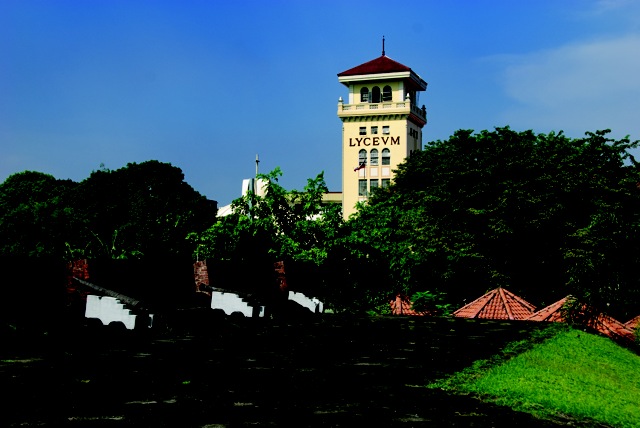
LAST JULY, a school that has done more for Philippine education and public leadership than most Filipinos realize quietly celebrated its 60th anniversary. Tucked away in a corner of old Intramuros, the Lyceum of the Philippines University—known to generations of Manileños simply as the Lyceum—may seem to outsiders to be just one of the many private colleges and universities that sprang up in the metropolis in the 20th century and managed to stagger into the 21st, dazed and confused by the challenges of globalization and the daunting economics of higher education.

Not quite. Today, the LPU is a progressive six-campus university system, with full-grown offshoots in Batangas, Laguna, and Cavite, and a law school in Makati. Its original and main campus in Manila is home to 13,500 students who are enjoying the benefit of an education anchored squarely on one foot in the classical tradition and, on the other, in new, responsive programs designed to give them an advantage in today’s economy.

I rediscovered the Lyceum in the course of writing the biography of the Lyceum’s longtime president and moving spirit, the late Sen. Sotero H. “Teroy” Laurel, the son of the school’s founder, former President Jose P. Laurel.

There’s no question that the bigger, better-known schools—UP, Ateneo, La Salle, and UST, in particular—dominate Philippine higher education and the preferences of Filipino parents and their wards. These are universities that have produced most of our presidents and heroes, big-name artists and athletes, cutting-edge scientists, business tycoons, and government leaders. They have traditionally catered to, and have also helped to form and strengthen, the Philippines’ intellectual and economic elite. And need we add that these schools, their titanic rivalries, and their alumni (both illustrious and otherwise) hog the media’s attention.

But what we don’t appreciate as much is the fact that so many more of us went to smaller schools that have also offered a good and (importantly to many) an affordable, accessible education that prepared our young people well for productive and gainful lives.

This was the vision of former President Laurel when, close to retiring from a long career in government and politics, he thought of setting up what he called “an Alexandria for the masses,” drawing its name from Aristotle’s school, the lykeion. In a book that he wrote around the same time, Laurel lamented: “How can our schools develop moral character among the young, when the schools themselves have become the centers of shocking scandals in such matters as the procurement of supplies, the selection of textbooks, or in the case of private education, the diploma mills? And where will both teachers and pupils get the inspiration for developing moral character, when they see all around them high officials who have been involved in all sorts of irregularities?

“… The truth is, the wonderful institution established by mankind, known as education, can have only one function and this is the pursuit, in the words of our Mabini, of truth, honor and justice. It can have only one sublime and overriding purpose: the recognition and dignification of the human personality.”

The “old man” Laurel, as was often called, was well positioned and prepared to assume the academic mission that his fellow Tanaueño, Mabini, had effectively bequeathed to him. He himself had a prodigious intellect, capped by a doctorate in law from Yale and honed in service with all three branches of the government—as senator, Associate Justice of the Supreme Court, and Justice Secretary—before his service as wartime president.

The Lyceum opened in July 1952 on a 1.3-hectare lot that used to be the site of the old San Juan de Dios Hospital in Intramuros, acquired for the family by Laurel’s indefatigable wife Paciencia. Teroy Laurel, who had returned from his studies in the US and who was running a law practice with his good friend and compadre Jovito “Jovy” Salonga, joined the school as his father’s executive secretary, perhaps little knowing then that the Lyceum would be the great labor and crowning glory of his own life, apart from his work in the 1971 Constitutional Convention and the Cory-era Senate.

“Jovy used to tell me that he and Teroy would go to Intramuros in the evenings to watch the construction of the school. Jovito was, I believe, the one who drew up the corporation papers, as his line was corporate law,” says Teroy’s widow Lorna.

The new Lyceum may have been a tiny school compared to its well-established neighbors, but it had one thing going for it, something that the Laurel name (the wartime charges of collaboration—eloquently disputed by Salonga, who had suffered torture under the Japanese—notwithstanding) was able to invite: prestige. As I note in my forthcoming book, “The new school had assembled the most formidable array of legal luminaries that one could put together in the Philippines at that time. These were men who would lend their names to Manila’s major streets after their time. Jose P. Laurel was the school president, the dean of the law school was Claro M. Recto, and on the Lyceum faculty were such men as Law Vice-Dean Ambrosio Padilla, Sen. Pedro Sabido, Jorge Vargas, Leon Guinto, Eusebio Lopez, Ramon Avanceña, Aguedo Agbayani, Justo Albert, Isagani Cruz, Marcos Herras, Neptali Gonzales, Roberto Concepcion, Arturo Tolentino, and Gil Puyat—men who had been or would become senators, congressmen, mayors, Cabinet secretaries, and Justices of the Supreme Court.”

Not surprisingly, the law school became one of the Lyceum’s bastions. This was accompanied by very strong programs in Journalism, Foreign Service, and Political Science, with the likes of Jose Lansang Sr., Francisco Lava, Emmanuel Yap, and Jose Ma. Sison on the faculty roster. They instructed and inspired a generation of young nationalists who included Journalism majors Satur Ocampo and Tony Zumel.

The Lyceum would go on to produce a veritable rainbow of luminaries including at least 17 ambassadors and eight Justices, three generals, three senators (Jinggoy Estrada, Ernesto Herrera, Panfilo Lacson), Speaker Sonny Belmonte, Gov. Grace Padaca and three other governors, media men Isagani Yambot, Fred Gabot, Gus Abelgas, Gerry Baja, and Deo Macalma, actor Cesar Montano, film director Joel Lamangan, Philamlife president Rodrigo de los Reyes, and education advocate Milwida Guevara, among many others.

New offerings in such areas as Hotel and Restaurant Management, Computer Science, and (in its Batangas campus) Robotics and Digital Animation and Marine Transportation keep revitalizing the traditional curriculum and assure the Lyceum’s continuing responsiveness to the times.Today, Teroy’s eldest son Bobby is on top of LPU-Manila as its president, assisted by his sister Sallie. Under the watchful eye of their mother Lorna, most of the other Laurel siblings—notably Peter, who serves as president of LPU-Batangas—are also involved in this unique family enterprise, proving themselves worthy of their father’s and grandfather’s name, and giving thousands of young Filipinos a fighting chance for a better future.


Penman No. 9: Battling the Big D

Penman for Monday, August 20, 2012

I USED to boast to friends that I could (and did) eat whatever I wanted with gay abandon—lechon, crispy pata, chicharon, fried chicken, and generally anything that once wagged a tail. I guzzled three bottles of Coke a day, slurped one (or two) cups of ice cream, and feasted on chocolate cake like a condemned prisoner. My excuse was that, by all indications, my side of the family wasn’t genetically predisposed to hypertension and all that jazz, and my last exams didn’t show anything worth worrying about. Sure, I had attacks of gout once or twice a year, and sure, I was overweight by at least 30 pounds—but these minor annoyances weren’t going to kill me, were they? I went back to the buffet table and piled on the pancit.

Not anymore. Two months ago, I was diagnosed with Type 2 diabetes—thanks to my mom, who’d developed the same condition late in life and who badgered me to let her test me with her kit, and to Beng, who dragged me to the doctor for a proper check-up and a talking to. The diagnosis confirmed that I was now in the exalted company of Ernest Hemingway, Mario Puzo, H. G. Wells, Elvis Presley, Thomas Edison, Ella Fitzgerald, Andrew Lloyd Webber, Neil Young, Sharon Stone, Elizabeth Taylor, Mae West, and Gary Valenciano.

Of course I knew something like this was coming. Guys who think they’re so smart will typically predict the future then do absolutely nothing about it, being less interested in the outcomes than in their prescience. In other words, we’re masters of denial, especially when it comes to our own bodies, which we think are the same ones we messed around with when we were 25, give or take a few (dozen) pounds. Of course I’d read up on diabetes long before I heard the word from my doctor’s mouth. Of course I knew that diabetes was a serious disease—at least for other people.

What jolted me into confronting cold reality were the figures that turned up on my mom’s tiny tester—three-digit figures that, no matter how I finessed the argument, kept telling me that “You’re going to lose your toes and die a slow, horrible death—unless you do something about it, now!” Guys will believe blinking statistics before they believe their wives, so those figures hit home, and hit hard.

That grim refrain kept running through my mind as my good doctor walked me through what I already knew but never quite believed was going on inside me—things about glucose and insulin and aerobic-this and Metformin-that. “Studies have shown that the best way to deal with Type 2 diabetes isn’t just medication, but a combination of a healthy diet, daily exercise, and Metformin,” my doctor intoned. Glancing up from my lab test results to my spillover gut, he added, “In other words, Professor, you need to undergo a complete lifestyle change if you want to lick diabetes before it licks you.”

Those were the words I both dreaded and wanted to hear. A gauntlet thrown, a clarion call, a battlecry—or, to put it plainly, a death threat.

I respond well to death threats. I scare easily, so this was exactly what I needed—a push over the railing, but a lifeline at the same time. “First of all, you need to lose weight—at least one pound a week.” The receptionist had weighed me before I stepped in for my consultation and I was entering the ring against the Big D at 218 pounds. There was going to be a requiem for a heavyweight if I didn’t watch it.

In a sense, getting diagnosed with diabetes was a relief. Ever since I turned the corner at 50, I’d always wondered what it was that was going to drag me down in a fight to the finish. A lot of worse things could still happen, but it was good to have a nemesis with a name that I could focus on and use as a reason for that “complete lifestyle change” I suppose I’d been secretly wishing for, but just never found the excuse to undergo.

About seven years ago, I’d lost nearly 40 pounds over several months just playing badminton, and that was the last time I could see clear to my toes without bending over. The badminton stopped—the victim of a long cold spell in the American Midwest, where I went as an exchange professor—and the starches, the fats, and the Coke began piling up again in my midsection, deciding that I was too cozy a host to vacate. My waist size ballooned from the mid-30s to 40, generously measured below the bulge.

The doctor wrote me a prescription and orders for all kinds of blood exams, with instructions to return for another consultation two months hence. I walked out of that clinic brimming with resolve. This was going to be something personal, something very personal, between me and, well, me.

If you’re looking for an ironic twist to this story, there isn’t any—yet. Those two months are nearly up and, much to my own surprise, I’m happy to report so far, so good. From 218 pounds, I’m down to 202—I even hit 199 one glorious day after walking 10 kilometers. I walk at least 30 minutes or 3 kilometers a day rain or shine (I’m probably the only guy you’ll see around the UP Oval toting an umbrella), and my walking shoes now go everywhere with me, like they recently did in Hong Kong even when a typhoon was blowing. I’m looking forward to losing another 10 to 15 pounds before the year is over.

Best of all, I seem to have tamed my prodigious appetite. I’ve survived—nay, thrived—on a diet of breakfast cereal, fish, kangkong, brown rice, lettuce, fruits, and the occasional slice of lean meat and cup of no-sugar-added ice cream. In two months I’ve had no more than three glasses of Coke, and only when I absolutely needed to. I keep a candybar in my bag or pocket in case I feel hypoglycemic (unfortunately, unlike our former Chief Justice, my diabetes doesn’t come with a huge dollar account), but so far it’s remained unopened. Lots of water, and again, lots of walking.

I haven’t become a health nut or an exercise freak; I certainly have no intentions of wagging my finger at other people, telling them to do this and not to eat that—something I’ve always hated being done to me. I’m just offering up this testimonial, for the benefit of all my fellow fat cats out there approaching their seniorhood, to the effect that sometimes the best thing you can get, before it’s too late, is a bad diagnosis. And never mind, for now, the glitter and the cash of the big literary prizes; the only figures I want to see are small ones—on my bathroom scales and on my glucose meter. I’m going to do my darnedest best to make sure that, when I croak, it won’t be because of the Big D.

(Photo from http://3.bp.blogspot.com)

Penman No. 8: A Hotel with a View

Penman for Monday, August 13, 2012

A MONTH ago, I was invited out to lunch by Bobby Laurel and his sister Sallie Laurel-Lopez, who both help manage the Lyceum of the Philippines University which was established by their grandfather, the late President Jose P. Laurel, Sr., in Intramuros 60 years ago. I’m writing a biography of Bobby’s and Sallie’s father, the late Sen. Sotero “Teroy” Laurel, and we’d set up the lunch to interview some old Laurel family friends.

The interviews went well, as I’d expected. What came as a pleasant surprise was the venue for our lunch—the Bayleaf Hotel, specifically its 9 Spoons restaurant on the 9th floor. Bayleaf is just a few steps away from the main LPU campus. Externally, the nine-story building blends in with the Spanish colonial architecture of the district; it was an old building acquired from the Licaros family, and subsequently and brilliantly renovated by TI Vasquez Architects & Planners. Its interiors and amenities couldn’t be more modern, with five function rooms that can accommodate up to 500 people, and large LCD TVs and wi-fi access all over the place.

I saw these rooms and the Bayleaf’s suites myself, having asked for a guided tour of the place after a sumptuous lunch at the 9 Spoons (so named after the nine children of Teroy and Lorna Laurel; and before I forget, the crowd favorite at the 9 Spoons lunch buffet—the crunchy bagnet—is to die for). The 57 rooms—which start at around P4,000 a night, including breakfast—are very smartly appointed.

On top—literally—of all these is the Bayleaf’s killer feature, which isn’t even in the building itself: the view. The Bayleaf’s roof deck offers a 360-degree view of Manila Bay, Intramuros, and has quickly become the hotel’s choicest spot. The weather permitting, you could do worse than sit here at sunset with friends, sharing a cold beer.

The Bayleaf’s facilities tie in neatly with the Lyceum’s offerings in Culinary Arts and Hospitality Management, among its strongest programs today (historically, the school had been known for its Law, Foreign Service, and Journalism programs). LPU President Bobby Laurel, however, clarified that “We’re running Bayleaf as a business first, and as a training ground second. I’d describe it as a 3-4-5 star hotel: 3-star price, 4-star amenities, 5-star service. We got the best people we could find to run it. This is going to be an investment, a learning experience that we can duplicate in the other campuses if we do it right.” An avid and talented amateur photographer, Bobby also did some of the pictures in the hotel and the Cioccolata coffee shop on the ground floor.

The next time you’re in Intramuros and feel like having a hearty lunch or a cool drink at day’s end, give Bayleaf a try. Better yet, stay overnight and enjoy the view. I never thought I could say this about a city whose infernal traffic and grime I’ve resigned myself to embracing, but from the Bayleaf’s roof deck, Manila never looked so good.

* * * * *

SPEAKING OF Manila, I don’t get my fellow Manileños who’ve been griping about how badly Manila was portrayed in The Bourne Legacy, with its visual emphasis on the city’s poorer districts. I wonder what they were expecting when the Bourne people came over and said they were going to shoot here. Greenery? Bonifacio High Street? They can get that more cheaply—miles and miles of it—in Southern California.

Of course Manila isn’t all poverty (don’t we know that, every time we ride or drive into one of its gated communities, leaving our pedestrian IDs at the guardhouse), and of course it isn’t fair to portray just one side of things. But movies aren’t about fairness, especially action thrillers with the singleminded purpose of pumping more adrenaline into your bloodstream. They’re about achieving a certain effect, a mood or a backdrop against which the plot can move forward without too many distractions.

If there’s anything to complain about in the movie, it’s how the plot—so rich and complex at the beginning—seems to peter out in the end, after the long and well-executed chase scene. I don’t mean this to be a spoiler, but this movie is begging for a sequel (as if it wasn’t already a sequel to a sequel). Since Jeremy Renner and Rachel Weisz—who turned in very creditable performances—have already sailed off into the sunset (and more literally than you think), I don’t imagine we’re going to see more of Manila in this franchise’s future. Time to hit the slums of Mumbai?

* * * * *

THE RECENT flood—all the more infuriating to many because it didn’t even have a name—reminded me of my own baptism as a reporter for the Philippines Herald back in 1972. I was 18, a freshman dropout who’d wangled his way into a reportorial job at a broadsheet, realizing the dream of my albeit brief lifetime.

I’d been with the Herald for just a few months writing mainly news features when what would be called the July-August floods of 1972 broke over our heads and turned Manila and much of Central Luzon into a giant bowl of mud soup, like Ondoy a month long. That truly was a downpour of biblical proportions.

I did some research at Public Works and realized that the flood plans for Central Luzon hadn’t been reviewed or revised since 1935. I wrote that story up, and got it into the front page—the first time anything I wrote was ever worth the front page, so I’ve kept the clipping to this day.

But more interesting things were in store for me. I reported for work one morning, only to be told to return that evening and to pack a change of clothes. I was going to be sent out on a Navy ship to cover relief operations in Pangasinan, which was still heavily flooded. The ship turned out to be an LST, a Landing Ship Tank, which seemed to me to be a large metal box floating on the ocean—that’s certainly what it felt like when we sailed in rough waters along the coast that night.

The next morning my photographer and I disembarked in Lingayen Gulf, wading into the water like an invading army, and plunged into the wettest excursion of my life. The US bases were still around, and the folks at Clark had sent a big rubber raft along, and I clambered aboard, half-reporter and half-flood victim, to get stories from the flood. We spent a cold night at the governor’s house amidst bags of relief goods, after I’d phoned in my story to a deskman who took it all down on a typewriter with the phone clenched between his cheek and shoulder (ever wonder how newsrooms worked before cellphones and email?).

The following day an American helicopter arrived, a Jolly Green Giant they might have been using in Vietnam, and we hopped aboard—not knowing that its next stop was Clark Air Force Base. Stepping out of the chopper—smoother than any plane I’d ever flown, although I hadn’t flown too many then—I saw and gawked at all those warbirds on the Clark tarmac and imagined for a minute what it would be like to be transported out of this infernal wetness into some place like California; but I settled for the chocolate cake at the commissary (another word added to my vocabulary).

Sunny California would come into my life eight years later. Back in the office the next day, the desk then sent me out to interview Mrs. Imelda Marcos in Malacañang about the Palace’s relief work. She met me in front of a mountain of Nutribuns. I don’t remember much of what she said—charmed witless, I suppose. What can I say? I was eighteen, with hardly a notion that, just a few weeks down the road, an even darker and longer storm was about to fall all over the islands.