Qwertyman No. 94: Artificial Intelligence

Qwertyman for Monday, May 20, 2024

DR. CHICHOY Carabuena had a problem. He wanted the school he owned and ran—the Generoso Carabuena Academy of Pedagogy in Santa Vicenta—to place higher in both national and international rankings, partly so he could raise tuition fees, and also so he could claim bragging rights among his university-president friends and drinking buddies. He had inherited the school from his grandfather; Generoso Carabuena was a banker who had collaborated with the Japanese and stolen the money they left behind to open a school for teachers, which was his wife’s dream, becoming a war hero in the process for outsmarting the enemy. 

The school had done well enough to the point that Chichoy’s dad Ramoncito could buy a Mercury Capri that he regularly drove to Manila to carouse in its nightclubs. Chichoy was the product of one of Ramoncito’s dalliances with the agreeable ladies, and it fell on him to rescue both the business and the family name from ruin and disrepute. He had been managing a carinderia for Pinoy workers in Dubai when the call came, and always wanting to become someone of substance, he returned to Sta. Vicenta to turn the daughters and sons of hog butchers and vegetable growers into teachers, like he imagined himself to be. Surely higher education wasn’t all that different from running a restaurant and coming up with the right menu at the right price for your customers. He had secretly dreamed of becoming a mayor, a congressman, or even governor, but first, he had to make a name for himself and make money.

Somewhere along the way he picked up a “Dr.” from a diploma mill and dressed the part, coming to his office even in the warmest of days in coat and tie. “More than anything else,” he would lecture his new recruits, “first impressions count, so before you even become a teacher, you have to look like a teacher, walk like a teacher, and sound like a teacher!” He had a faux marble statue made of his grandfather to greet visitors at the school entrance, and another one of Jose Rizal standing behind Generoso, as if looking on in approval. 

But lest people think he was beholden to the past, Chichoy Carabuena peppered his speeches with 21st-century mantras like “disruption,” “innovation,” “sustainability,” “customer-centric,” and, yes, “21st-century.” “The great challenge to higher education today,” he would often declaim, “is to produce graduates attuned to a global climate of disruption and innovation, mindful of evolving needs and opportunities in the marketplace of ideas while seeking sustainable and synergistic 21st-century solutions to problems rooted in our feudal and neocolonial history.”

Those speeches were written for him by his former executive assistant named Mildred, a UP graduate whom he had to fire when his wife discovered them smooching in his office—an act he vehemently insisted to be no more than a paternal gesture, much like  former President’s public bequeathal of a kiss on a married woman, a defense that gained no ground. His wife personally chose his next EA, a former SAF commando named Dogbert; making the best of the situation, Chichoy paraded Dogbert around as his bodyguard, spreading the rumor that his life was under threat from unspecified enemies determined to keep the quality of Philippine education down. “We can give them no quarter,” he declared at the last CHED event he attended. “We must resist, with all impunity, those who aim to keep our poor people shackled to the twin pillars of ignorance and idiocy!” He missed Mildred in those moments, but he felt quite pleased with his growing self-sufficiency in speechwriting, thanks to his new discovery, ChatGPT. Of course it never quite came up to his standards, so he tweaked the prose here and there, like that reference to Samson that he hoped would bring the house down.

But now, reading the reports of top Philippine universities slipping in their rankings in the usual Times Higher Education and Quacquarelli-Symonds surveys, Dr. Carabuena saw an opportunity for his modest HEI to rise. “As their mystique diminishes, so our aura will grow,” he informed an indifferent Dogbert. “We just need to come up with sustainable innovations that will disrupt the status quo.” Dogbert handed him a slim folder. “Sir, someone wants to see you, to apply for the position of Academic Vice President.” It was a position that Chichoy himself had held concurrently to save on salaries, but now he felt obliged to pass it on to a real expert. He flipped the folder open and saw the picture of a cute Chinese-looking woman going by the name of “Dr. Alice Kuan.” Chichoy was mesmerized. “Send her in—and get out!”

When Dr. Alice Kuan stepped into Chichoy’s office, he felt himself enveloped in a miasma of jasmine, peonies, and five spices—everything good he remembered from his only visit to China many years ago. Her lips were lotus-pink, her skin ivory-white, and here and there dumplings suggested themselves to his imagination. “Good morning, Dr. Kuan! Please, have a seat! You’re here to apply for the AVP job?”

“Yes, Mr. President,” she said with a quarter-moon smile, “and I come with many ideas for both improving your curriculum and raising revenues through academic innovations.”

“Innovations! I like that! Like what?”

“Why artificial intelligence, of course! We could use AI to teach many of our courses, reducing costs. Also, we could bring in more foreign students from—uhm—friendly neighboring countries, while creating part-time employment opportunities for them in—uhm—online entertainment, for which we could even lease out some of your campus property. It would create a huge economic boost for Sta. Vicenta!” 

Temple bells rang in Chichoy’s mind. Not only was she fetching; she was smart! Suddenly he could see his political future brightening. He wanted to know more about this adorable avatar, and only then did he notice how patchy her resume was. 

“Your birth certificate was filed when you were…. 17?”

“Was it? I don’t remember.”

“Which elementary school did you go to?”

“I don’t remember. Maybe homeschooling?” She threw him an exasperated sigh. “Look, Dr. Carabuena, does it matter? I can have AI do a perfect resume if that’s what you want. If not, I can take my ideas to the Fontebello Institute of Technology in San Bonito just an hour away, and maybe they’ll be more receptive to disruptive innovations—”

“No, no, no! Disruptive, I like disruptive! Please, Dr. Kuan, stay in your seat! I’ll have somebody prepare your contract. Dogbert!”

(Image generated by AI.)

Qwertyman No. 81: An F for Philippine Education

Qwertyman for Monday, February 19, 2024

AN IMPORTANT document that’s been showing up in the inboxes and on the desks of both government and private-sector policymakers these past couple of weeks leaves no room in its title for misinterpretation: “Miseducation: The Failed System of Philippine Eduation.” Released last month by the Second Congressional Commission on Education or Edcom II, the report covers just the first year of the commission’s comprehensive review of the state of Philippine education. But the scenario it presents is so grim that, in the words of one of its crafters, “If this were Singapore, they would be declaring a national emergency.”

But then again, that may be the whole point. We are no Singapore—and indeed one of the report’s most damning and embarrassing findings is that “Our best learners are comparable only to the average student in Malaysia, Thailand, Brunei and Vietnam, and correspond to the worst performers in Singapore.”

Edcom II picks up from where its predecessor left off more than three decades ago, when Edcom I was set up under the leadership of then Sen. Edgardo J. Angara to undertake a similar review. In July 2022, RA 11899 created Edcom II to find ways of harnessing the educational sector “with the end in view of making the Philippines globally competitive in both education and labor markets” over the next three years. Edcom II was also charged with drafting the necessary laws to make this happen. It’s just begun its work, with in-depth studies and assessments of our educational system from the ground up, but its early findings already show how difficult the road ahead will be toward the global competitiveness the commission was set up for.

I’ll just quote a few observations from a summary of the highlights of the nearly 400-page full report: 

In terms of the Program for International Student Assessment (PISA) undertaken by the Organization for Economic Cooperation and Development (OECD) in 2018 and 2002, “Grade 10 Filipinos scored lowest among all ASEAN countries in Math, Reading, and Science, besting only Cambodia, with more than 75% of our learners scoring lower than Level 2, or the minimum level of proficiency in Math, Reading, and Science…. Grade 10 Filipinos scored lowest among all ASEAN countries in Math, Reading, and Science, besting only Cambodia, with more than 75% of our learners scoring lower than Level 2, or the minimum level of proficiency in Math, Reading, and Science.” This was the same survey that showed our best learners barely catching up with Singapore’s laggards.

“The proficiency level of our children across social class, rural and urban residence, gender, language at home, type of school, and early childhood center attendance is dismally low.” This means that our deficiencies cut across the social and economic spectrum and can’t be put down to just a question of money.

To underscore the global crisis in education (yes, it isn’t just us), the World Bank and UNESCO have come up with the concept of “learning poverty,” which they define as a child’s inability to read and understand a simple text by age 10. Among some Asian countries recently surveyed for learning poverty, Singapore and South Korea scored the lowest at 3; China came in at 18, India at 56, and the Philippines was highest at 91.

And for those who insistently argue that the problem with our education is that we don’t use English enough, and early enough, Vietnam, which uses Vietnamese as its medium of instruction in the primary grades, has consistently outscored us in nearly all indices, as have Malaysia and other countries that rely on their own languages to move ahead.

A good part of the report dwells on how important it is for government to intervene as early as possible in our children’s growth and development, to prime them for a proper education. Edcom II looked into the problem of “stunting,” a measure of childhood maldevelopment, most easily seen when children are too short for their age, because of malnutrition or poor health. This has implications for the child’s ability to learn.

“The Philippines has one of the highest prevalence of stunting under-five in the world at 26.7%, greater than the global average of 22.3%. Policies are in place, but implementation has been fragmented, coverage remains low, and targeting of interventions has been weak.” (For example, more than 98% or 4.5 million children 2-3 years old are not covered by the DSWD’s supplementary feeding program.)

Here’s another eye-popping revelation: “Since 2012, only 27 textbooks have been procured for Grade 1 to Grade 10, despite  substantial budget allocations. DepEd’s budget utilization data shows that from 2018 to 2022 alone, a total of P12.6 billion has been allocated to textbooks and other instructional materials, but only P4.5 billion (35.3%) has been obligated and P952 million (7.5%) has been disbursed.” Not to mention the fact that many of these textbooks are riddled with errors!

Higher education presents its own host of problems and challenges. “Higher education participation is high given our income level,” the report notes. However, “Access to ‘quality’ higher education narrowed in the last decade…. Most beneficiaries of the tertiary education subsidy were not the poorest…. Between 2018 and 2022, the proportion of the poorest of the poor [in higher education] declined markedly, from 74% to 31%.”

A key part of the problem is the quality of our teachers, who themselves are poorly educated. “Between 2009 and 2023, the average passing rate in the licensure examinations for elementary (33%) and secondary (40%) has been dismally low, when compared to passing rates in other professions. Worse, between 2012 and 2022, 77 HEIs offering BEEd and 105 HEIs offering BSEd continued operations despite having consistently zero passing rates in the LET.”

Our supervisory agencies themselves need to be properly staffed. “The staffing levels in CHED and TESDA have not kept pace with the growing responsibilities of the agencies and the increased investments in education from both the public and private sectors. 

CHED’s budget increased by 633% from 2013 to 2023, but the agency’s staffing complement only increased by 22.7%, from 543 to 666 within the same period.”

The money’s clearly there, but it’s not being spent where it should be. “Budget allocated to education is increasing, but there is a tertiary tilt despite profound gaps in basic education….While government investments have increased substantially, the bulk of the additional resources went to higher education–which is typically regressive. From 2015 to 2019 per capita spending surged from P13,206 to P29,507. Meanwhile profound gaps remain in Early Childhood Care and Development and basic education…. 30–70% of the school MOOE budget is spent on utility bills alone, which leaves meager funds available for improvement projects and initiatives that could address local needs and support better learning.”

We could go on and on—and the full report (downloadable at https://edcom2.gov.ph/) does. But you get the picture: Philippine education gets an F. The question is, will our national leadership recognize this as the national emergency that it clearly is, and respond accordingly?

Hindsight No. 10: A Princely Welcome

Hindsight for Monday, March 21, 2022

IT WAS a little burp in the flood of election-related stories that we’ve been wading through all month so it may have gone unnoticed by most, but it piqued my interest strongly enough to take note of it for a future column, and here it is.

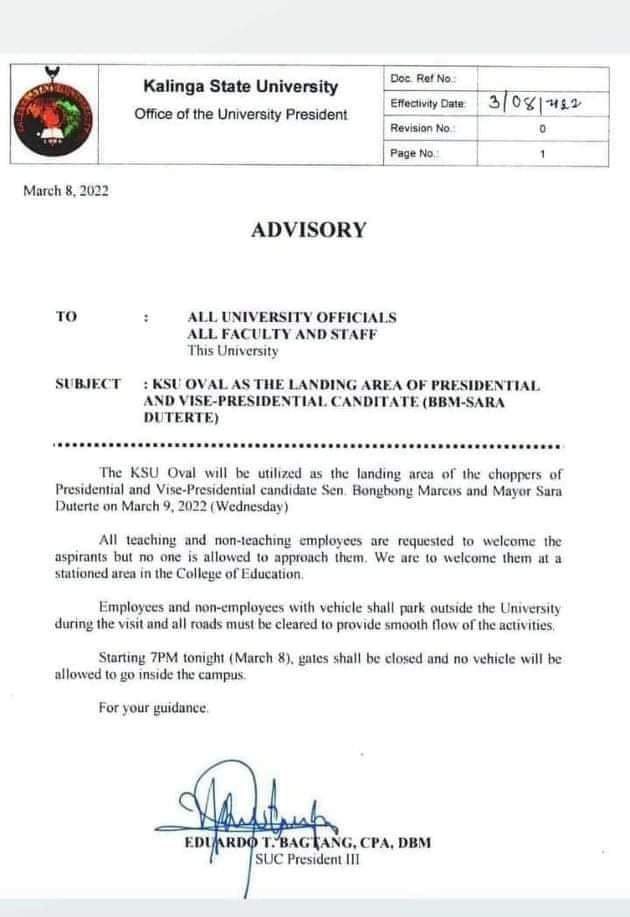
Last March 8, the faculty and staff members of Kalinga State University in Tabuk, Apayao received a memo from their president, Dr. Eduardo T. Bagtang, informing them that the KSU Oval was going to “be utilized as the landing area of the choppers” of presidential and vice-presidential candidates Bongbong Marcos and Sara Duterte the following day. Accordingly, all teaching and non-teaching employees were “requested to welcome the aspirants but no one is allowed to approach them. We are to welcome them at a stationed area in the College of Education.” 

The memo was replete with misspellings and other small infelicities that initially caught my attention as an English teacher, but let’s get past those to the substance of the memo, which was clearly aimed at giving the “Uniteam” combo a warm and hospitable reception. 

Was there anything wrong with that, legally or morally? I’m not entirely sure, which is why I’m raising the question. To be honest, my knee-jerk reaction—as a self-declared non-fan of candidates who avoid debates—was to say yes. To be fair, however, it’ll be good to look at it from both sides, as a study of our culture and its political aspects. The DepEd, the Civil Service Commission, and the Comelec all have rules prohibiting public officials and employees from electioneering. Did the KSU memo cross that line? Was a “request” tantamount to an order?

Just between us Pinoys, it seems the polite and civil thing for a state university president to welcome political candidates. State universities and colleges depend on government support, and whichever parties or officials come to visit, we deem it acceptable if not adroit for SUC presidents to (let’s not say “curry favor”) establish cordial relationships with those in power, or expect to be. (And before we forget, let’s congratulate CHED Chairman Dr. Prospero “Popoy” de Vera, last year’s KSU graduation speaker, for having been named an “adopted son” of Kalinga just this month on the occasion of his visit to KSU.)

Hospitality is arguably ingrained in the Filipino. When then vice-presidential candidate Mar Roxas visited Davao City in November 2009, then Mayor Rodrigo Duterte pulled out all the stops to give him a royal welcome, and even endorsed him for being “clean.” Of course seven years later, running against each other, Rody was calling Mar “the most incompetent Filipino ever to run for president,” but they could both look back to happy memories of walking the streets of Davao together, and of Mar even driving Rody’s pickup truck then. 

Political incumbents routinely welcome campaigning candidates to their territory, which the visitors can spin to their advantage. When Isko Moreno visited Cotabato to meet with BARMM Interim Chief Minister Ahod Ebrahim last month, newspapers were quick to interpret the Manileño’s introduction by Ebrahim as “our incoming president” as a “virtual endorsement” of his candidacy. It was denied the next day by the BARMM spokesman, but denials don’t stick that well in the memory. 

Of course there are thorny exceptions to this ritual politesse. The logistical obstacles reportedly thrown in the way of VP Leni Robredo’s massive rallies by some local politicians and their allies come to mind. Not only were these hosts inhospitable but openly hostile, as if they had been visited and threatened (they probably were) by a pink virus. 

In contrast to the red carpet prepared by KSU President Bagtang and his staff for the BBM-Sara team, a “welcome activity” being planned by the Baybayog National High School in Alcala, Cagayan for Leni set for March 12 had to be scrapped after questions about its “official” nature. The school had sent consent forms for parents to allow their children to attend the activity—deemed “official” because Leni was still, after all, the sitting Vice President, and waving as her convoy passed would have been part of their “civic duty”—but the plan was dropped, to avoid controversy.

This reminds me how it used to be pretty normal for us, when we were kids, to stand at attention under the hot sun for visiting dignitaries, wave flags or flowers, and cheer like our lives depended on it (and maybe, in some ways, they did). We thought politicians, priests, generals, and CEOs were all respectable people and worthy of our admiration. When we realized they were not, the flags and flowers turned into streamers and placards. This is why all but the bravest and most progressive politicians have been loath to set foot in liberal citadels like UP, where a reception of another kind awaits them.

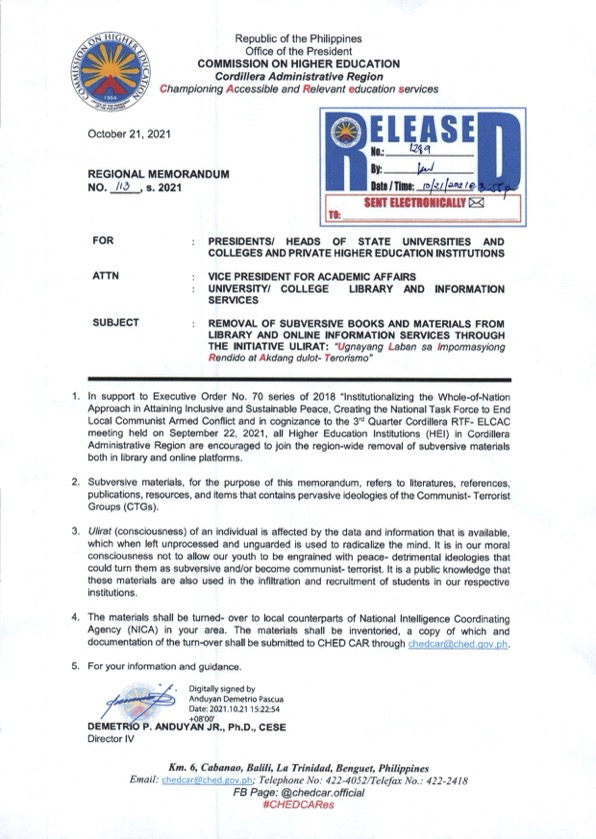
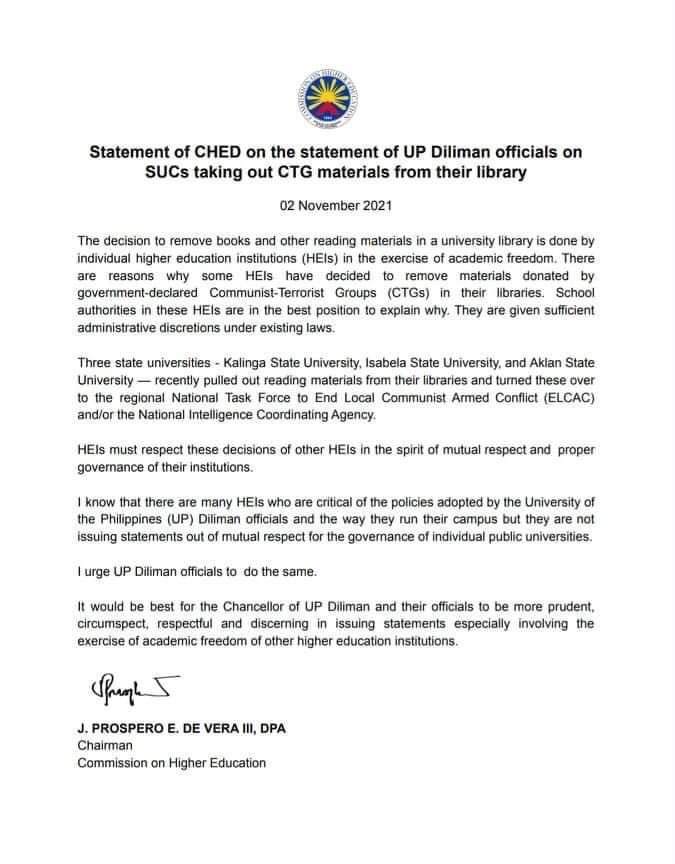
Now, KSU is clearly not UP, by which statement I do not wish to denigrate the strides KSU has made in higher education, which can be found on its website. I refer to the intellectual atmosphere and spirit that inhabit each school and how these are fostered by their constituencies and leadership. KSU, I now recall, was also one of three SUCs that pulled out “subversive” books from their libraries last year in compliance with a much-criticized CHED memo urging them to toe the anti-Red line. Given that background, I shouldn’t have been surprised to find it opening its arms wide to the “Uniteam,” which says it wants national unity for and with everyone—as long as they don’t read, teach, and keep certain naughty books. 

But let’s not be too judgmental, as the campaign season is far from over, and it’s possible that candidates Robredo, Lacson, Pacquiao, Moreno, and de Guzman might yet decide to visit Tabuk, and land their choppers on the greens of KSU. In that case I expect Dr. Bagtang to be his old congenial self and to issue more memos requesting the faculty and staff to welcome the visitors, although I doubt that VP Leni and Ka Leody will be landing in such princely fashion.

The Real Subversion

(Image from The Washington Post)

A Statement by UP Professors Emeriti on the Banning of “Subversive” Books

November 11, 2021

WE, PROFESSORS Emeriti at the University of the Philippines, express our strongest support for the University Council of UP Diliman in its protest against the recent memorandum issued by the Commission on Higher Education in the Cordillera Administrative Region urging libraries in that region to remove “subversive” books and materials from their collections. 

Far from being of tangential concern to us in UP, this memorandum is an assault on academic freedom in all Philippine universities, as it sets the stage for further and possibly even more repressive measures in schools across the country. Any threat to academic freedom in any Philippine school or university is a threat to the whole system and has to be confronted instantly and squarely, regardless of whether individual institutions choose to deny the threat or to acquiesce to it. While the memorandum seems to present the removal of “subversive” books as non-compulsory, we all know how such directives, in the culture of our bureaucracy, can have coercive and chilling effects. 

We are appalled by the CHED Chairman’s subsequent statement describing the compliance of some state universities with the CHED memorandum as an “exercise of their academic freedom.” This is disingenuous if not perverse. Academic freedom is neither exercised nor asserted by submitting to its suppression. It is not the bureaucratic freedom of corporate bodies to do as they wish. It does not mean that academic leaders can invoke the principle as a personal right of administrators to define and delimit the intellectual endeavors of their entire constituencies. It is a transcendent principle that implies preserving sources of history and ideas for present and future scholars, even if these are currently unfashionable or politically incorrect. Its enshrinement in our Constitution prevents the State or other institutional bodies from restricting the rights of academics and limiting them in their intellectual pursuits.

The CHED Chairman also decries UP Diliman’s response to the CHED memorandum as a form of “disrespect” toward other institutions. But indeed the greater disrespect manifest here is that of the fundamental and constitutionally protected right of all Philippine institutions of higher learning to academic freedom. This is the real subversion taking place—the takeover of academic administrations and governance by political appointees more intent on executing some external agenda than performing their duty to defend academic freedom and excellence against all incursions.

Many of us still recall the darkest days of martial law, when our campuses and offices were raided by soldiers in search of “subversive” books. Professors and students were imprisoned for their beliefs, and books were burned for their content. Never again should the military or the government itself determine which books we can read and teach. Never should academic freedom be compromised in the name of national security. 

Again we must emphasize that academic freedom is prerequisite to academic excellence, which cannot prosper under conditions of political repression or oversight. As repositories of knowledge, university libraries must remain open to all books, so their ideas can be critiqued and contested in the classroom and laboratory, in the crucible of truth and reason. To ban books is to promote ignorance and intellectual servility, and to condone its practice is to betray one’s sacred calling as a producer and propagator of knowledge. 

We call on the CHED to revoke this ill-conceived memorandum and on our Board of Regents and university administrators to resist any efforts from within and outside UP to curtail academic freedom. We reaffirm the primacy of the faculty in all matters of academic policy and practice, of which our libraries are an integral part. To defend books and libraries is to defend democracy itself, whose strength derives from a diversity of ideas and beliefs. To that end, we recommit ourselves, and urge our colleagues in active service to do as well.

Signed:

Gemino H. Abad

Jasmin Acuña

Florian Alburo

Virgilio S. Almario

Violeta Bautista

Apolonio Chua

Ma. Cecilia Gastardo-Conaco

Gisela Concepcion

Lourdes J. Cruz

Virginia Cuevas

Jose Dalisay

Randolf S. David

Emmanuel S. de Dios

Ma. Serena Diokno

Erlinda Echanis

Cecilia Florencio

Cristina P. Hidalgo

Angelito Manalili

Ma. Lourdes San Diego-McGlone

Manolo G. Mena

Evelyn Mae Mendoza

Flora Elena Mirano

Solita Monsod 

Francisco Nemenzo

Epictetus Patalinghug

Ernesto Pernia

Rafael Rodriguez

Emerlinda R. Roman

Ramon Santos

Gerardo P. Sicat

Guillermo Tabios III

Michael L. Tan

Nicanor G. Tiongson

Amaryllis Torres

Lina Valcarcel

Corazon Villareal

Roy Ybañez

Rosario T. Yu