
Qwertyman No. 115: Why I Teach

Qwertyman for Monday, October 14, 2024
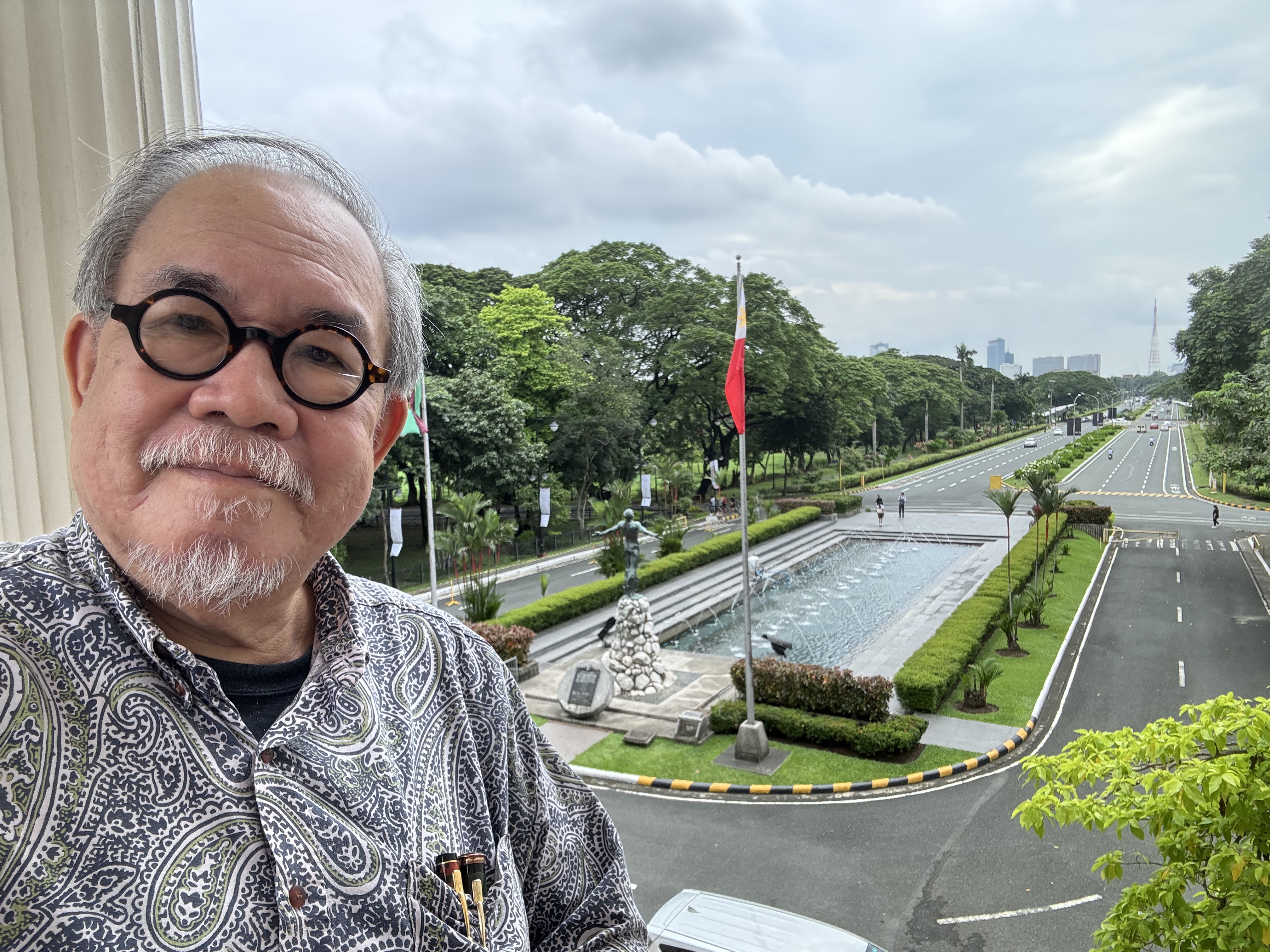
LAST OCTOBER 5, we marked World Teachers Day—not one of our most popular or noisiest holidays (it isn’t even an official one), but one that gives us pause to remember some of the most important people in our young lives. I taught for 35 years before I retired in 2019, and I still teach one writing subject every semester as professor emeritus, so I suppose I wanted to be that “VIP” in someone’s life. 

When we teach writing—and not even creative writing, but composition—to freshmen, we take young people by the hand and help them make sense out of their lives and their ideas, such as they are. The term “composition” applies as much to the writer as to the text: one composes oneself, drawing out the essentials and leaving out the dross. Creative writing pushes that process one step farther, by turning to the imagination instead of one’s limited experience for material and insight. 

The creative writing teacher’s task is not only to encourage but also to guide and to train that imagination, sparing the student from having to reinvent the wheel but affording him or her the thrill of self-discovery. 

It’s an inarguably fine and noble mission. On the other hand, and in economic terms, the teaching of creative writing is brutally inefficient. In a typical workshop class of 20 people, an instructor would be fortunate to find two or three with real talent—an aptitude for language, a maturity of insight, a stylistic flair. Among those, far fewer will have the discipline and perseverance to write and write well for life.

So why should we even persist, or expend public funds to produce boatloads of people who will probably never write the kind of line you will mumble in your half-sleep, or will cry out to the heavens in your most painful or most euphoric moment?

For one, because producing good creative writers is like mining for precious stones, where a ton of ore might have to be torn out of the earth and sifted through to produce one small jewel-grade rock, which has yet to be cut and shaped by expert hands. 

We must also persist in teaching creative writing because the production of new literature reinvigorates and replenishes our imagination as a people, our imagination of ourselves. It is that imagination, however dark, that gives us hope and makes reality endurable. The truth of numbers—of GDP and ROI and per capita income and population growth rates—is important (I’ve often remarked what a terribly innumerate society we are); but it is a limited and even sometimes deceptive truth that barely begins to tell our story. History does this, but without much latitude for pure conjecture. As in painting and the other arts, creative writers have often simply done, and done first, what critics and theorists would later describe and systematize. Creative writing is a breath of intuition caught on paper.

But I also teach creative writing in the conviction that every student—no matter the person’s background—has at least one good story to tell, and that it is our task as teachers to release that story. Most of my students may come to my classes merely to pass the time, or fulfill a requirement, or satisfy a craving for some critical attention; many may never write another story in their lives. But I want them to come out appreciating and respecting the liberative and ameliorative power of art—which is a fancy way of saying that, for those of us who will never be mistaken on the street for Brad Pitt or Superman, here we can be and do anything, for as long as we make artistic sense.

As K. Patricia Cross, professor emerita of higher education at Berkeley, reminds us, “The task of the excellent teacher is to stimulate ‘apparently ordinary’ people to unusual effort. The tough problem is not in identifying winners: it is in making winners out of ordinary people.”

Anyone can write anything, but not everyone can be a writer. By the same token, not every writer can be a teacher. People who have no problems stringing seamless paragraphs of compound-complex sentences can’t give a lecture or an exercise worth an ATM receipt. It takes a different sensibility—and, yes, another set of talents (or what I call a whole bunch of P’s—preparation, perseverance, patience, and passion)—to teach well and to endure in the classroom.

I feel passionate about teaching in UP and in this country, and in giving back to them, through my students, what they have given me. But teaching is not a word I often say in the same breath as love. I cannot honestly say that I love teaching, in the sense of wanting to do it for most of my waking hours, or missing it terribly when I’m doing something else. Teaching is one of the most exhausting jobs you can get. The job doesn’t begin or end in the classroom; it just happens there.

Every time I step into a classroom, I pause at the doorway to expel a deep sigh and collect my thoughts, wondering if I have enough to sustain a 90-minute performance. As the American novelist Gail Godwin famously said, “Good teaching is one-fourth preparation and three-fourths theatre.” Indeed I spend the last ten minutes before class writing a script in my head: I will say this; I will do this; I will bring these props and use them at some point; I will ignite an argument; I will leave them with a question that will buzz in their ears for a week. Even bad stories can be turned to great lessons; where’s the teaching point? How can I say it without crushing or diminishing the person? 

It doesn’t always work—sometimes I simply collapse into my chair and count away the minutes—but we all attempt some variation of this drill. Basically, we are saying: I will do my best to make this day worth their time and mine. It’s what they expect; it’s what I promised.

It is not love but duty that drives me to teach—although duty, perhaps, can also be a form of love; a love not of the thing itself but of some larger principle. That principle to me is service—service to country, people, university, and service to the great and truly free republic of the imagination.

“How do you know that what you’re doing matters?” I was asked once. “How can you tell if you’re making a difference?” My answer was, I don’t know, I can’t tell. But for a teacher, the only distinguished achievement that counts is the quality of one’s students. You are distinguished by their achievement, and in this sense, I have been distinguished aplenty.
Penman No. 151: A Workshop in Biography


IMG_7561

Penman for Monday, June 1, 2015

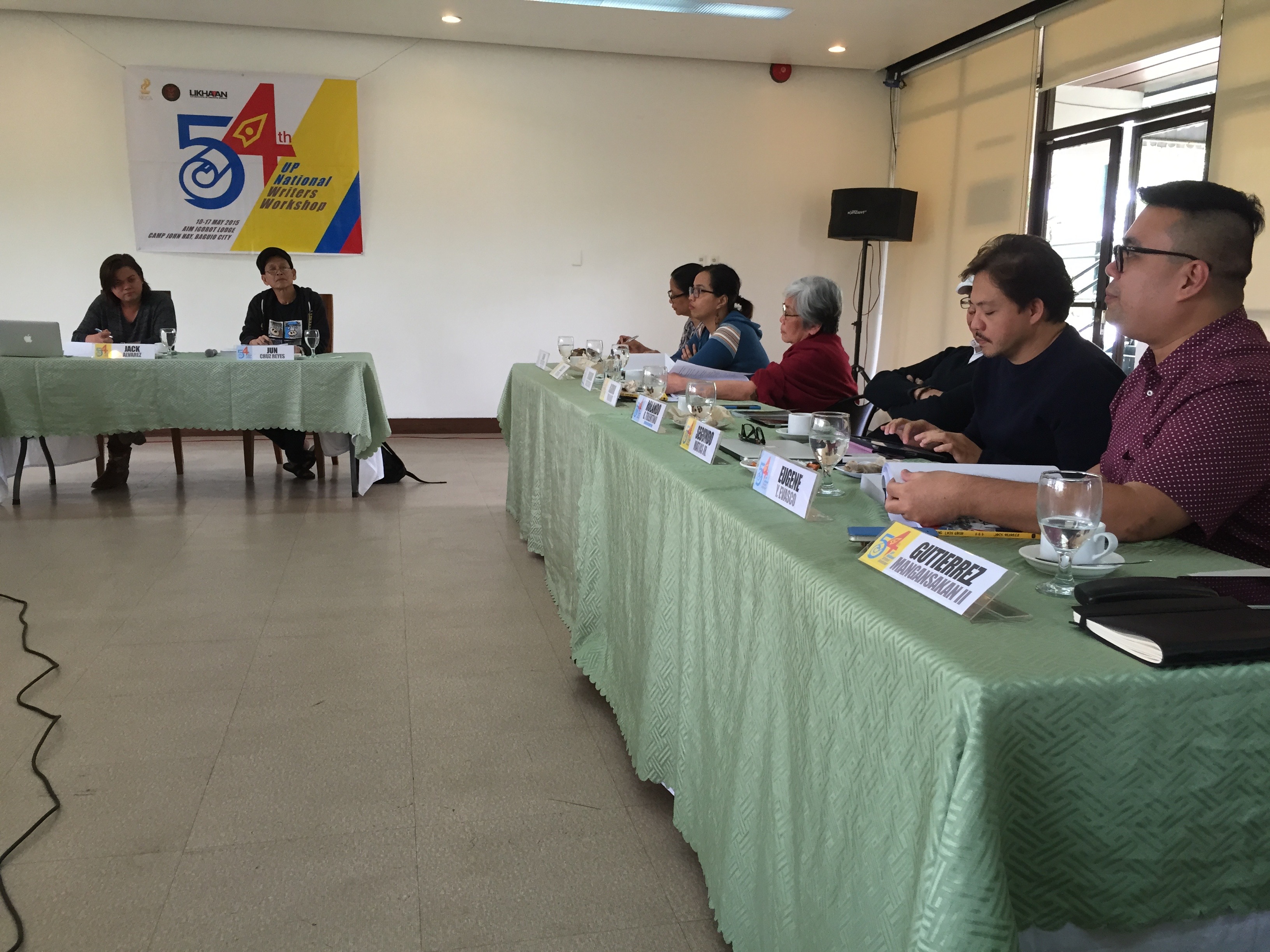
BECAUSE OF my trip to Canada, I was able to attend only one day of this year’s UP National Writers Workshop, which took place from May 10 to 17 in Baguio. I immediately went to work that morning leading a discussion of a biographical project submitted by one of the twelve fellows.

It was a topic I was keenly interested in, because of my own work in biographical writing. (Two of my biographies—A Man Called Tet: The Story of Enrique T. Garcia, Jr. and Edgardo J. Angara: In the Grand Manner—were published and launched recently by Anvil Publishing and the University of the Philippines Press, respectively.) I’m at work on a few more, and if it becomes my lot to be known primarily for my accounts of other people’s lives than for my own fiction, then I can’t complain, having assumed a rather unique responsibility and occupation, among a few others in our writing community.

As a grade-schooler, I devoured biographies in the library, finding that the lives of successful or significant people—whether here or in faraway lands—inspired me to try harder and do more in my own difficult existence. I especially enjoyed the life stories of scientists, explorers, soldiers, artists, and heroes. Of course, these elementary editions were highly simplified, and very likely glossed over the human imperfections—sometimes gross—that these characters possessed, which more mature biographies would reveal if not revel in. No matter; at that time, the overarching greatness of their deeds lent a luminous aura to these characters’ profiles, and I have to believe that I emerged all the richer for reading those books.

The idealization of a life was one issue we discussed at the workshop. There are many kinds of biographies, and I took the occasion to go over a simple classification of these kinds.

On one extreme would be hagiography—literally, writing about saints, and therefore the sunny sanctification of the subject as though everything that he or she did were beyond reproach. On the dark end would be the hostile or malicious biography, written for no other reason than to malign its subject as indelibly as possible, even at the expense of the truth. To its left would be the critical biography—a sober, perhaps scholarly, and more even-handed study of a life, sparing nothing and no one (least of all the subject) in pursuit of the presumptive truth, although these works could also carry their own agenda.

Farther on would come the kind of work that I and some others do on commission, for which I’ve coined the term “sympathetic biography,” a largely positive presentation of a subject’s life—without skirting, however, the major controversies and issues publicly known to involve the subject. Is it the whole truth and nothing but the truth? Realistically, I would expect not, and not because I think my subjects deliberately lie to me, but because it’s in human nature to present the best side of oneself. (I think Dolphy set the bar for searing candor and self-awareness in his autobiography, Hindi Ko Ito Narating Mag-Isa; I can’t imagine politicians or business figures being so open about their private lives.)

A sympathetic biography may be a half-filled glass to many, but it puts something on the table to be seen and seen through. I expect—I would hope—that whatever I write about my subject will be interrogated by more knowledgeable critics and scholars. This is why I urge my clients to be as forthright as possible and to deal with whatever issues they may have been embroiled in, because we live in a highly skeptical environment where questions never cease, especially online.

But to get back to the workshop, we were glad to succeed in our continuing quest for the discovery and encouragement of bright new writing talent across the archipelago. The UP Writers Workshop is different from most others in that it engages mid-career writers—people of proven ability with at least one published book, or major stage or film production to their name. We deal with them less as students than as younger brothers and sisters in the profession.

The critics of writing programs and workshops who think that all they produce are clones and sound-alikes of those teaching these courses should take a look at our roster of fellows and their work. These young writers sound nothing like us, and even after the workshop, they’ll continue working with their own material in their own styles, because we instructors do our best to recognize and preserve the originality of their voices.

The best help we can give them is to provide a response—whether it be a gut reaction or a learned reading that draws on a certain context—from our side of the generational divide, although they get responses as well from their peers, which might just be more useful and valuable to them, coming from people who share their vibe.

This year, we welcomed the following: Jack A. Alvarez (Creative Nonfiction); Armida Mabitad Azada (Poetry); Kristoffer Brugada (Nobela); Resty Cena (Nobela);

Gutierrez M. Mangansakan II (Creative Nonfiction); Isidro T. Marinay (Biography);

Segundo D. Matias Jr. (Kuwentong Pambata); Rhoderick V. Nuncio (Nobela); Will P. Ortiz (Nobela); Benedict Bautista Parfan (Poetry); Charlie Samuya Veric (Poetry); and Eliza Victoria (Fiction). Watch these names, because if you haven’t read or heard about them already, you will soon.

What many don’t realize is what a precious resource we have in these programs and workshops here in our part of the world. Our friends from the region have begun to notice what a liberal and nourishing environment we have for young writers. There’s still patronage and paternalism in the system to be sure—this is Asia, after all—but it’s much less pronounced and potentially stifling than elsewhere. Our tradition is for the younger ones to tell their elders “Up yours!”—until they start putting on the poundage and the gray hairs themselves.

Speaking of writing programs, it was with great alarm and dismay that I received news of the planned closure of one of Asia’s most unique and successful graduate writing programs—the low-residency Master of Fine Arts (MFA) program at the City University of Hong Kong.

The low-residency formula allows students from Hong Kong and around the region to enroll for an MFA and work online with mentors from all over the world, flying in to HK just once or twice a year for intensive workshops and face-to-face interaction. Some Filipinos have gone through the program, and I’ve had the privilege to lecture and to read at a couple of sessions over the years.

The City University administration says that the program costs too much to maintain, but ironically the program turned the corner this year financially, so it can’t be just the money. We wonder if someone up there sees creative writing as a threat to socialism with Chinese characteristics. City U ‘s mandarins should know that Hong Kong’s and China’s prestige and goodwill derive from programs like this—and not from building lighthouses and airstrips in the South China Sea.

Penman No. 38: Why I Teach Creative Writing

English Class

Penman for Monday, March 18, 2013

LAST THURSDAY, I delivered the keynote speech at a conference of creative writing teachers held at the University of the Philippines, and this was part of what I told them:

I’m going to propose an idea that will probably sound like heresy today: I teach creative writing not to promote the science or the politics of literature, but to help enlighten the mind and ennoble the spirit. These are big words, but creative writing is a big thing. It has been a big thing for a very long time, and one might even argue that it got a lot smaller when it became an academic discipline, subject to the vagaries and vicissitudes of departmental politics, and the constant and sometimes annoying need to justify its existence to those who ask, with ill-concealed derision, “Can creative writing be taught?”

Let me humor that point for a minute. No one ever asks if music can be taught, or if ballet can be taught, or if painting can be taught—and yet, in all of these artistic endeavors, a mentor-mentee relationship has been the practice if not the rule for ages. It may be that writing is a more solitary act, and indeed, until the 20th century, was something self-taught, and people like Shakespeare and Nick Joaquin wrote without the benefit of a BACW or an MFA.

But most people aren’t Shakespeare and aren’t Nick Joaquin, and we’re no longer in the 17th or even the 20th century. Genius can take care of itself; most people can’t, particularly in a time when what are seen to be the more practical necessities of life militate strongly against a young person’s decision to choose a life of art. This, I believe, is the social function of artistic education today—the preservation and promotion of art as a vital human enterprise, alongside the sciences and the professions, without which society would fail, in the absence of the self-critical mirror that the artistic imagination provides.

Those of us who teach creative writing—or music, or dance, or painting, and so on—should fight to claim our space in academia, not because we need the jobs (which of course we do), but because society needs us for its own well-being, as nurturers of our people’s imagination. Like life itself, each work of art emerges from a synthesis of method and mystery, and sometimes the happiest and most wondrous results arise from what may seem to be accident and serendipity. But as a social project, the production of art cannot be left to chance.

This is particularly significant in the context of a country and a society like ours, whose people remain in dire need of a sense of nationhood—a sense that can only be artificially defined if not distorted by politicians, but more authentically apprehended by artists. The stories, poems, essays, and plays that our students write are this generation’s understanding of who and what we are, and this has been one of the key principles of my own teaching of creative writing: to help the student find not only himself or herself, but to find himself or herself in the community of others, in the life of the nation.

Thus, this semester in my graduate fiction class, I have asked my students to write about characters decidedly unlike themselves, to explore a milieu larger than their immediate and familiar surroundings. “Write about what you know” is what we often tell them, and that’s fine for starters; but I like to push this further and to suggest, as the title of one of my books says, that the knowing is in the writing, that they will never really know their subject until they’ve written all they could about it, until they’ve stood at the edge of the unknown and made that headlong freefall into the abyss of the human condition.

In this respect, allow me to make some observations about the state of the art as I see it in our students’ work. As a writer and a teacher of creative writing, I’ve been privileged to come across the work of some of our best young writers today—in my classes, in workshops, and in literary competitions—and to note their strengths and weaknesses.

The strengths are rather obvious to me—most notably, sharp and felicitous language. It always surprises me how—at a time when it’s become customary to deplore the deterioration of the language skills of our young people—new writers keep emerging who can use English with a mastery and confidence I didn’t have at their age. I suppose that comes from an earlier and more natural affinity with English, which many Filipino writers of this post-martial law generation not only write but think and speak in—at home, at school, at work, at play.

Another hallmark of our younger writers—not only in English but in Filipino and other Philippine languages as well—is their awareness and deployment of more contemporary literary theories that have done away with the stodgy realism of old, and value freshness of approach and cleverness of idea. They write in and from the margins, employ unusual points of view, play around with their use of time, and assume a variety of voices. They cross genres, mix languages, and generally don’t seem to care or worry too much about what other people might think of their work (except for readers of their own generation), and about whom they get published by.

That’s all well and good, but let’s go to the downside of things.

The most persistent shortcoming I’ve noticed in my students’ work is their inability or unwillingness to go beyond the safe and the familiar, to push the story to the farthest limits of its dramatic possibilities. They can take risks with treatment and technique, but in terms of the human drama at the core of the piece, they fall short. In other words, they’re great at writing scenes, sketches, and setups—vignettes that define a character or a situation—but, with a few outstanding exceptions, they won’t go over the edge and take us somewhere we’ve never been. They may be technically polished and even perfect, but they are immemorable and add little to our understanding of ourselves as Filipinos. They don’t connect to a larger audience beyond the university, making what we do seem even more esoteric and irrelevant to many. We often talk in these corridors about the need to popularize science, but what about the popularization of art?

Now, I’m not making a pedestrian demand for our art to be simple and accessible, or to be held to a standard of social relevance as the measure of excellence. I firmly believe that art is intrinsically elitist, even if its aims may not be. Whether among the most common folk or the most privileged, only a few possess the sensibility and the skill to create art.

All I’m asking for is for us to encourage our students to see writing not only as a means of self-expression but as a form of engagement with the larger human community—a love letter, as it were, to the world at large, perhaps full of pain and disappointment and yet remaining open to appeal and negotiation, if not reconciliation. This, I suppose, is what I meant by “enlightenment and ennoblement”—a recognition and admission of oneself, through art, as a human being, with all of its attendant privileges and responsibilities.

That’s the challenge you and I have to pose and, ourselves, to meet: to help produce not only great art, but great art that somehow matters. By “matters”, I don’t mean that it will foment a revolution the next day or the next year, but that it will, one way or another affirm and enrich our sense of humanity and community.

The fact is that very few of our students—counting even the CW majors—will go on to become writers for life. That’s all the more reason why their brief encounters with us should be memorable ones. No matter how poorly conceived or executed, a work sincerely presented for workshop by a student still represents an act of the imagination, which deserves respectful consideration. The best students will benefit the most, taking our admonitions to heart in the same way that I can still remember what my writing teachers told me. From Mrs. Vea, my English teacher in high school: “Good writing doesn’t depend on your mood.” From Franz Arcellana: “This is good, but it needs rounding out.” From my American professor Nick Delbanco: “Don’t forget the narrative line!” What have we told our students that they will remember 40 years hence?

I have always believed that every student has at least one good story, poem, or essay in him or her—and if we draw that out of them before they move on to become lawyers, engineers, and politicians, then we shall have done our duty. If we can inspire the best of them to consider taking the same breathless gamble we took in devoting ourselves to the life of words, then we shall have gone beyond performing our teacherly duties to helping secure the future of the Filipino imagination.