Qwertyman No. 157: Rebalancing the UP-IRRI Partnership

Qwertyman for Monday, August 4, 2025


SINCE ITS establishment in 1960 by an agreement between the Ford and Rockefeller Foundations and the Philippine government, the International Rice Research Institute (IRRI) has been known around the world as a leader in agricultural research and a provider of much-needed and applicable solutions to global hunger. With so many people and economies dependent on rice, IRRI’s outputs—especially the famous “IR8” and similar high-yielding varieties—were hailed as gamechangers for billions, reportedly staving off famine in India in the 1960s and spurring “green revolutions” around Asia. The first President Marcos was a staunch supporter of IRRI, folding its “miracle rice” into his Masagana 99 program, which temporarily achieved self-sufficiency in rice but ultimately failed from bad credit and also proved environmentally destructive.

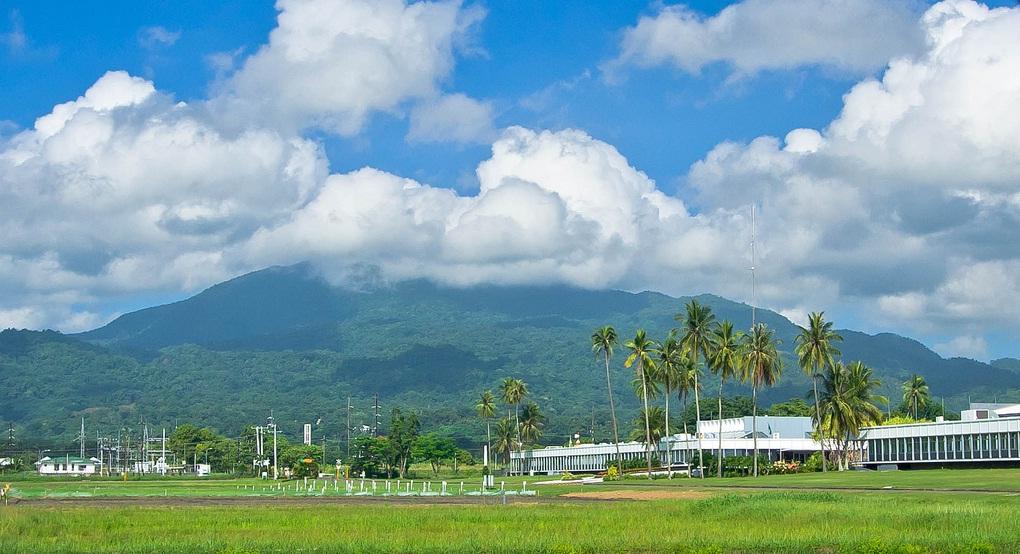
Headquartered in Laguna on the campus of the University of the Philippines Los Baños (UPLB), IRRI and its achievements became a source of pride for the Philippines, which not only hosted the institute but provided much of its manpower—the scientists in its labs and the farmers tilling its experimental plots, among other staff workers. (That sentiment, it should be noted, isn’t universally shared. A coalition of NGOs and individuals called MASIPAG, opposed to the kind of genetic engineering that IRRI and even UPLB does, sees IRRI as “a research arm of big agrochemical corporations in turning the food and environmental crisis into their businesses.”)

While that’s being debated, another issue has come up between IRRI and UP over the land that IRRI has been using, at the nominal rate of P1 a year for the past 65 years. IRRI’s lease on that land, totaling almost 280 hectares, expired last June 30. UP needs and wants some of that land back for its own use, especially with UPLB’s ambitious plans for the establishment of an Agro-Industrial and Information Technology Park in the area.

UP contends that IRRI has actually been using just around half of that property, so it would be good to put those idle hectares to more productive use, following UPLB’s comprehensive land use plan calling for more buildings for administration and research, housing, support services, engineering, and social sciences. It’s not simply getting land from IRRI (land that, let’s be clear, is really UP’s); according to UP’s Vice President for Legal Affairs Rey Acosta, in exchange for the land UPLB needs for its expansion, the UP System is offering IRRI new land to lease across its various campuses in Mindanao, Iloilo, Leyte, Cebu, Baguio, as well as its land grants in Quezon and Laguna, for both rice and non-rice crop research.

The land exchange was part of a new agreement that UP had proposed to IRRI to replace the expired lease. UP also wanted IRRI to pay more realistic rates for the land it was using. One key factor to consider was that since 1972, IRRI had fallen under the ambit of CGIAR (formerly the Consultative Group for International Agricultural Research), a global research network. CGIAR is apparently funded by contributions from many international agencies and countries including the Philippines, but exactly how it funds IRRI or what its legal status is in the Philippines is unclear to me. 

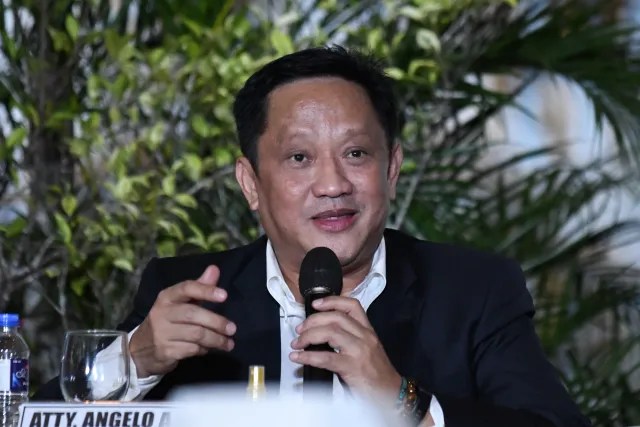
Under the IRRI charter, the Philippine Secretary of Agriculture and the UP President sit on its board of trustees as ex officio members, but the rest, including the Director General, are international experts nominated either by CGIAR or the outgoing board. It would have been at a board meeting that UP President Angelo Jimenez first brought up UP’s proposals over a year ago in anticipation of the end of IRRI’s lease—which, at the bottom line, UP is under no obligation to renew. Last June, IRRI submitted a counter-proposal ceding much less land than UPLB needed, asking for a much longer lease extension period (25 instead of 10) for much less money than UP deemed fair.

Negotiating in good faith, UP agreed to concessions such as giving IRRI almost 200 hectares for its use, and the possibility of a 25-year lease, subject to periodic reviews, if certain conditions were met. But instead of dealing with UP in the same spirit, IRRI went to court for a TRO, represented by one of the Philippines’ most influential (and must I add expensive) law firms. 

There are quarters in the Philippine academic and scientific community that will be happy to see IRRI go—MASIPAG might stand on the far extreme, but even more moderate voices have noted that much of the research that IRRI was known for can now be undertaken by the Philippine Rice Research Institute or PhilRice. Even so, UP’s leadership maintains that it continues to value its historic partnership with IRRI—based on a more balanced and lawful relationship. “We don’t want IRRI to leave,” said President Jimenez. “We would be happy for IRRI to stay but under fair and reasonable terms.” 

For the sake of not just the Philippines’ but the region’s and indeed the world’s food security, we should hope that this disagreement over how to best use that land in Los Baños doesn’t end up in a messy court case involving money, influence, and public relations. IRRI enjoys a generally positive reputation that, rightly or wrongly, most Filipinos still believe in. After 65 years, it’s time to renegotiate an agreement that will more directly and clearly benefit Philippine agriculture and education through its national university, ensure environmentally safe research, remunerate us fairly, and make IRRI the good global citizen an institution of its stature and intentions needs to be.

Qwertyman No. 144: A Better Fighting Chance

Qwertyman for Monday, May 5, 2025

TWO WEEKS ago, almost 18,000 young Filipinos and their parents awoke to the good news that they had qualified for admission to the University of the Philippines through the UP College Admission Test (UPCAT). Over 135,000 high school students had applied, so this year’s admission rate stood at just over 13%, almost 7% higher than last year’s outcome.

Whatever UP’s critics may think it’s become, entry into one of its eight constituent universities remains the highest of aspirations for many Filipino families, especially the poor for whom the tuition and cost of living at top private universities is impossible without a scholarship. 

UP oldtimers like to recall the days, decades ago, when the quality of public education was still high enough for public and private high school graduates to compete on fairly even terms for admission into UP. It wasn’t unusual for some provinciano wearing chinelas to step into a UP classroom or laboratory and beat the daylights out of some elite-school fellow in academic performance. Many of those provincianos—the likes of Ed Angara, Miriam Defensor, Billy Abueva, and Dodong Nemenzo—went on to stellar careers in government, education, the arts, and industry. UP was clearly doing what it was supposed to do, as its past President Rafael Palma put it: to be “the embodiment of the hopes and aspirations of the people for their cultural and intellectual progress.”

Ironically, by the time the UP Charter was revisited and revised a century after its founding in 2008, giving it the unique status of being the “national university,” UP’s student profile had changed. Jokes about UP Diliman’s parking problems began to underline the popular perception that UP was no longer a school for Filipinos across the archipelago and across income strata but one for the privileged, mainly from the big cities. The introduction of free tuition in state universities and colleges in 2017, while well intentioned, even resulted in subsidizing the children of the rich in UP, who could well have afforded going to Ateneo or La Salle.

But some good news is emerging, as this year’s UPCAT results bear out. Starting with last year’s UPCAT, there’s already been a reversal of the trend favoring graduates from private high schools, with 55% of qualifiers now coming from public and 45% from private high schools. UP President Angelo Jimenez—himself a boy from the boonies, coming out of tribal roots in Bukidnon—has pledged to do even more to give poor students outside of the big cities a better fighting chance of getting into UP.

“We started this banking on two things,” he says, “that UP will respond to the challenge of transforming the so-called common clay—the less-advantaged—into fine porcelain, and that the less-advantaged will respond to the challenge of opportunity. The task of leadership now is to set the enabling environment, structures, and systems to ensure the success of this two-pronged strategy. It’s a big bet, and it gets bigger. We still have the non-UPCAT track. This includes our Associate in Arts program, UPOU’s ODeL, talent-based modes, and finally, the UP Manila School of Health Sciences in Tarlac, Aurora, Palo, and Cotabato. We cannot solve all problems, we are not lowering standards. In fact, we must demand excellence regardless of social and economic status, and enforce it. But we are dropping rope ladders so people long staring up from the base of the fortress walls can have a better chance of scaling its sheer drop with something better than their bare hands.”

Those rope ladders include adding more UPCAT testing centers in faraway places, ultimately to have at least one in each province—a goal that will be met later this year. The testing centers are also being moved from private to public high schools. “We’ve seen that more students tend to participate when the tests are given in their national high schools,” says UP Office of Admissions director Francisco de los Reyes. Aside from more testing centers, UP is helping disadvantaged students prepare better for UPCAT through its Pahinungod volunteers, who distribute reviewers using real items from past UPCATs (these reviewers are also downloadable for UPCAT applicants) and use them for UPCAT simulations, guiding students even with such details as shading the exam oblongs. (De los Reyes reports that wrong shading has caused 20% of their machine counting errors.)

These steps are clearly paying off. Davao de Oro (formerly Compostela Valley), which previously accounted for less than 10 UPCAT qualifiers, has just produced 31, after a testing center was put up in Nabunturan. 

UP’s support for poor students doesn’t end with UPCAT. Every year, thousands of qualifiers from so-called Geographically Isolated and Disadvantaged Areas (GIDAs), even after passing UPCAT against all odds, fail to show up for enrollment after realizing that they cannot afford the costs of living on a UP campus. UP has rolled out a P50-million Lingap Iskolar program that provides such disadvantaged qualifiers who meet certain standards P165,000 a year to cover housing, meals, transportation, books, cellphone load, and other expenses. Almost 200 Lingap Iskolar grants were given out last year. In UP Manila, private donors fund daily meals for over 30 students.

I’m particularly happy to report that a dear friend of mine, Julie Hill, recently donated almost P21 million that will be used for a new Agapay Fund that will go toward the upkeep of poor students in UP’s School of Health Sciences, which has a unique ladderized program that enables rural midwives to become nurses, and nurses to become doctors. The program has already produced about 200 doctors who have served their communities back. 

Among them was Dr. Hannah Grace Pugong, who recently landed in the top 10 of the medical board exams, after placing No. 1 in the midwifery and No. 3 in the nursing exams. Dr. Pugong will soon be deployed under the Department of Health’s Doctors to the Barrios (DTTB) program, fulfilling her return service commitment. It is an obligation she willingly embraces, saying that “I have often reminded myself that how I treat my patients should reflect how I want my family members to be treated by other health workers.” 

If that’s not what being a national university should be about, I don’t know what is.

Qwertyman No. 99: A Call to Engage

Qwertyman for Monday, June 24, 2024

I WASN’T going to start this column on this note since I had another topic in mind, but it occurred to me that these two concerns may after all be related and have a bearing on one another.

You may have missed it since it was just local news, but a few weeks ago, elections were held for the University of the Philippines Student Council (UPSC) in Diliman—historically, the breeding ground of young hopefuls destined for national politics. It’s always been a tight and sometimes even bitter contest of personalities and platforms, strategies and tactics, rhetoric and resources. Given its superior organization, ideological discipline, and progressive platform, the student Left has held an advantage in these elections over the past few decades, but vigorous and sometimes successful challenges have arisen from centrist parties appealing to more student-oriented causes. 

The outcome is often eagerly awaited. But last month, something incredible happened. The “abstain” vote won, leaving the posts of chairperson, vice chairperson, and many councilors unfilled—and they will so remain. 

It would be easy to read this as a sign of apathy, especially given that only 36.7 percent of the student body voted this year, but those “abstain” votes sent a clear and deliberate message: we don’t want any of you, we want something or someone better—could we please have some real change around here?

I could understand that; as a teacher (I still teach optionally, even if I’m retired), I’ve opened the classroom door to scores of student candidates asking for five minutes to make their campaign pitch, and almost invariably, it’s the same familiar litany of complaints over this and that (the same ones we ourselves mouthed half a century ago)—valid complaints, to be sure, but thoroughly tired and uninspiring. And when you ask, even in your mind, “So what are you going to do about it?”, you can hear the answer coming: “Elect us, and we’ll show you!” I let my students raise the difficult questions (that’s what I train them to do) and share their discomfort and embarrassment when they don’t get the specific and well thought-out answers they deserve.

Now, put that scene on “pause,” and let me report on another UP matter (even if you’re not from UP, this likely concerns you because UP accounts for about 20 percent of our national budget for higher education).

Last week, on the occasion of UP’s 116th founding anniversary, President Angelo A. Jimenez formally presented a set of ten “flagship programs” to the media and the public which his relatively new administration will seek to undertake—not necessarily complete, but at least initiate—over the remaining five years of his tenure. These programs were the result of year-long consultations with the university’s academic and administrative leaders. They cover academic excellence; inclusive admissions; research and innovation; Open Distance e-Learning (ODeL); Archipelagic and Oceanic Virtual University (AOVU); active and collaborative partnerships; arts and culture; expansion of public service offices; Quality Management System (QMS) and Quality Assurance (QA); and digital transformation. 

Jimenez (or “PAJ” as the university community calls him) was quick to explain that rather than being new or distinctly separate programs, these are really thematic priorities that pull together many existing threads from UP’s wide range of teaching and research expertise. For example, the AOVU concept whereby UP will undertake a more comprehensive but also more coordinated study of our marine resources—our “blue economy”—draws on UP’s longstanding experience in marine science, fisheries, and maritime law, with the added emphasis on our archipelagic geography as a strength rather than a weakness. This will be supported by such innovations as UP Los Baños’ new PhD offering in Environmental Diplomacy and Negotiations aimed at developing leaders from around Southeast Asia who can bring good science into environmental conflict management and sustainable development.

There are many aspects and details of the ten flagship programs that deserve deeper discussion—and some will certainly be challenging if not controversial—but some key themes resonated with me most strongly as a former administrator, a teacher, and a UP fanatic since my childhood days when my mom (UP Educ. 1956) indoctrinated me by playing a record of “UP Beloved” and “Push On, UP” over and over again on our turntable.

Likely of greatest impact to most Filipinos was PAJ’s pledge to democratize UP even further by adopting policies that will bring in more students from underrepresented and marginalized sectors of the country, to correct the lopsidedness of UP’s student profile now favoring private and largely metropolitan high school graduates without necessarily compromising UP’s high admission standards. One way would be by engaging more UP student and faculty “Pahinungod” volunteers to help in teaching disadvantaged students pre-UPCAT, and also by providing sustained support to such students who pass the UPCAT but decide to stay out because of the high expenses of studying in a UP campus (a budget has been set aside to support 350 of these students under the Lingap Iskolar program).

But the key word of the day was “service,” which has been added by PAJ to UP’s traditional motto of “Honor and Excellence.” (I know there’s been some grumbling, in typical UP fashion, over the process by which that decision was arrived at, leading me to sigh and ask, “Is that even a fight worth picking? Isn’t ‘service’ the one thing we can all implicitly agree on?”) Jimenez wants UP to be more engaged with the people, with communities, with other universities, citing programs such as UP Tacloban’s response to the seasonal red tides that render mussels unsafe to eat but still useful as extracted material for pharmaceuticals and cosmetics.

Above all, service should be a mindset that impels UP students and faculty members to find meaningful roles on their own in their community, whether local, national, or global. It struck me that perhaps this was what our student politicians needed to find and articulate, beyond sloganeering about often abstract issues—how can I serve you and our people, as I am, where I am? What can I do for you?

That “abstain” vote should be minded by the administration as well, and not just in UP. Our youth are seeking to be engaged and inspired—but their cynicism will abate only if they see, in their elders, the exemplars of the integrity and accountability, aside from ability, that any prospective servant of the people should bring to the job.

(Image from upd.edu.ph)

Qwertyman No. 60: UP’s Southern Pivot

Qwertyman for Monday, September 25, 2023

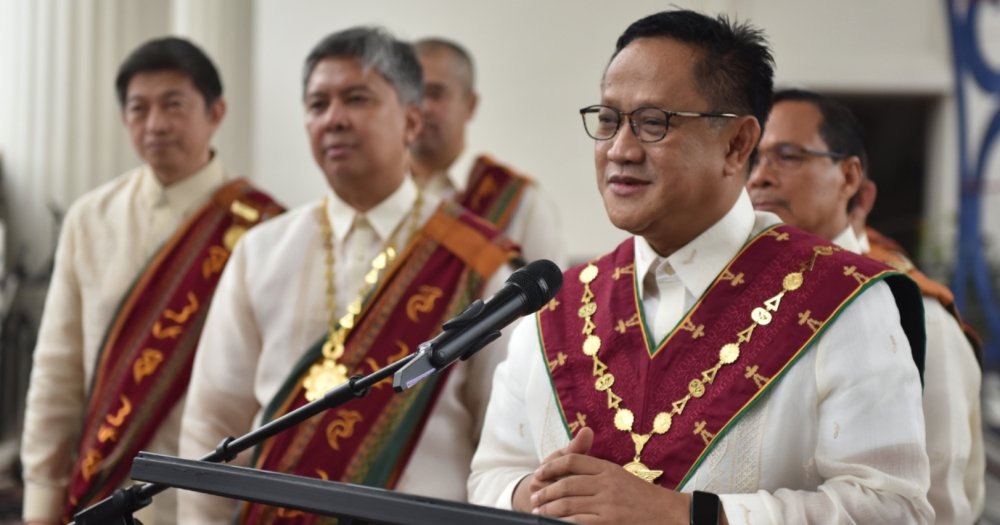
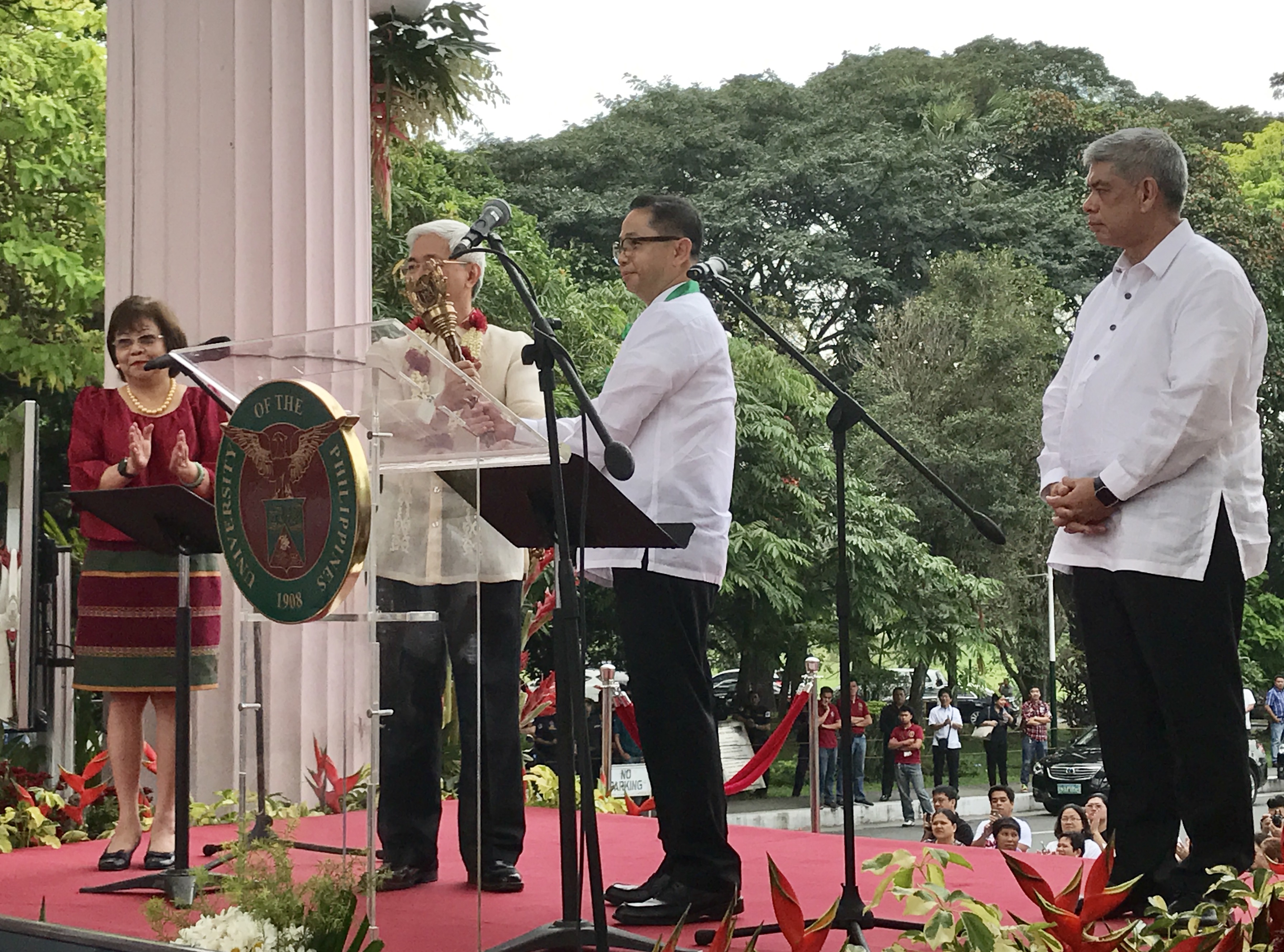
AT HIS formal investiture as the University of the Philippines’ 22nd president last September 14 in Davao, Atty. Angelo “Jijil” A. Jimenez made clear what his and UP’s priorities were going to be for the next six years of his administration: a renewed emphasis on service and equity, and more collaboration with other state universities and colleges (SUCs) and private higher education institutions (HEIs).

These priorities, he said, sprang naturally out of what he called the “three moral paradoxes” facing UP, the country’s “national university” mandated by RA 9500 to lead in Philippine higher education.

The first one he mentioned in his speech was the fact that, despite more than a century of UP producing national leaders, the country remains beset by mass poverty and economic and social inequality. “Beyond nurturing the Filipino mind and spirit, should UP have been more explicitly charged with raising our people’s material welfare? Are we doing enough at present to promote economic progress and social justice among our people?”

The second was his observation that UP, conceived as a “university for the Filipino people,” primarily serves the children of well-off, urban-based families, with 60 percent of its freshman population coming from private schools, “and our admissions policy unfortunately does not do enough to correct that bias.” Jimenez wants UP to help more underprivileged youth from the countryside prepare for, take, and pass the UPCAT, aside from other measures that can be undertaken to democratize access to a UP education.

Third, UP accounts for a fifth of the national budget for higher education, with the balance to be shared by more than 110 other SUCs, but was UP doing enough to share its academic resources with other schools? “If not everyone can come to UP, then UP must go not only where it can help raise academic standards, but also where it can cooperate and collaborate as an equal partner, and learn from SUCs with advanced and specialized expertise in certain areas,” said Jimenez.

Following through on his commitment to place UP at the service of HEIs all over the country, Jimenez convened an “SUC Summit” on the day after his investiture, attended by about 80 SUC presidents and representatives, to map out areas of collaboration between them and UP. Earlier, UP had also inked an agreement with officials of the Bangsamoro Autonomous Region in Muslim Mindanao (BARMM) to assist the latter in promoting access to quality education, improving health outcomes, strengthening the capabilities of SUCs and LGUs, and rehabilitating conflict-affected communities.

UP’s southward pivot was no accident. A former student leader and labor lawyer by training—he served as labor attaché in wartorn Iraq—Jimenez was born in Butuan, of Manobo blood. “It was a long way from Butuan to Baghdad, but in many ways, it is even longer from Mindanao to Manila. We have been so accustomed to thinking of Manila as the capital and Mindanao as the periphery, forgetting that once upon a time, the reverse was true. That imbalance is now being redressed, with Mindanao shaping up as our gateway to ASEAN, as the political and economic force that it has always been…. That it took the national university 115 years to have a president from Mindanao tells us something about we Mindanawons—and especially those of us who come from lumad origins—have had to contend with.”

So it was more than symbolic that Jimenez chose to hold his investiture not in Diliman, UP’s seat of administrative and academic power, but in UP Mindanao, one of the UP System’s eight “constituent universities” (and interestingly, the only one created by congressional fiat, after a push by Mindanawon lawmakers in the 1990s to have a UP of their own). 

President Jimenez also emphasized that he was adding one important word to UP’s longstanding motto of “Honor and Excellence.” That word was “Service,” a reminder to every Isko and Iska, as UP’s students are called, that their education is a debt to be repaid to the Filipino people for the rest of their lives.

These are noble and praiseworthy ambitions—most significantly, Jimenez’s desire to open UP up to the children of the poor, to break the tightening lock of privileged students on admission to the country’s premier state university. Ironically, because of the politically expedient but economically questionable free tuition law, public funds are subsidizing the college education of many children whose parents could very well afford to pay full tuition, while leaving the truly needy even farther behind. 

This wouldn’t be the first time that the “excellence vs. equity” issue came up for re-evaluation. UP oldtimers will recall when high school valedictorians and salutatorians from all over the country merited automatic entry into UP, ensuring broader geographical coverage. During the time of President Edgardo Angara, a system allowing disadvantaged students to come in via “presidential discretion” was put in place, but this was reportedly abused and later junked. (When I served as Vice President, I—and other UP officials—would routinely get calls from politicians, friends, and frantic parents hoping that we could work some magic to get their children in. I said I would rather resign than even try to compromise UP’s admissions system—it just doesn’t work that way in UP, even if it might elsewhere.)

Any strategy for producing an intellectual elite based on talent alone will favor those who come from strong elementary and high school backgrounds, most likely our top private and science high schools. On the other hand, especially given the sorry state of our public schools (this, even before budgetary diversions to “confidential funds”), you can’t just bring in students from all over just to make sure of equal representation; many of these poorly prepared students will suffer, as would the university itself. 

It’s a complicated but vital question: what primary purpose should UP serve? With universities today encouraged to join the global rat race run by Quacquarelli Symonds, Times Higher Education, Shanghai Ranking Consultancy, and other ratings bodies (businesses, that’s what they are), are we forgetting more basic needs by chasing after these costly metrics?

Jijil Jimenez’s heart seems to be in the right place in calling for UP to return to its roots—as he returned to his in Mindanao—as a university of the people, but working out the details will be a challenge. If he can rally the faculty behind him and get government support, then he can yet be one of  UP’s most effective and even beloved presidents.

(Photo from sunstar.com.ph)

Qwertyman No. 47: An Open Door

Qwertyman for June 26, 2023

A FEW weekends ago, the traffic was tied up in knots around the University of the Philippines campus in Diliman, where we live, and we knew why. Many thousands of high school seniors hoping to enter UP were taking the university’s UPCAT or entrance exam, which had gone back to its old physical, face-to-face format after two years of being suspended in favor of a statistical formula because of the pandemic. This year, over 100,000 applicants took the UPCAT, out of whom about a tenth will be taken in, the actual number of admissions being determined by the capacity of UP’s eight “constituent universities” like UP Los Bañ0s and UP Mindanao, aside from Diliman, to absorb new freshmen.

As a campus resident and now a retired professor who still teaches a course every semester (an option I avail myself of, just to keep my foot in the classroom and know what the young people are thinking), I witness this ritual every year, and smile every time I see those bright and eager faces, squinting at the sun and looking a little lost; the first challenge every UP freshman faces is finding out where things are and the fastest way to get from Point A to Point B. 

That’s literally thinking on your feet, which is a survival skill we inculcate in our students. If there’s a smarter way to solve a problem than brute force, we’ll find it. (I recall how, in the middle of an exam for a Shakespeare class which I usually aced, I was stumped for the right answer, and in despair just responded with a quotation from A Midsummer Night’s Dream: “So quick bright things come to confusion!” My professor let me off with a 1.25.)

Frankly or perhaps unkindly, UP people are called pilosopomagulang, or maangas by those unfamiliar or uncomfortable with the forthrightness and cleverness that our academic culture encourages. At worst, we’re called “godless communists” by those who don’t see how packed our chapels and parking lots are (although of course, today, the most successful communists are called oligarchs). On this point, I can guarantee you that no one can be more annoyed if not enraged by a UP person than another UP person; our faculty feuds are legendary. Indeed that has become a liability with some employers who prefer to hire graduates who will simply do as they’re told without asking “Why?”

“Why?” may indeed be the wrong entry-level thing to say, but it’s also what has moved science and society forward, quickly followed by “How?” If no one asked it, we’d still be chasing animals over clifftops for food and sacrificing our first-borns for bigger harvests. This urge to apply reason to the most basic of human and natural functions again can be occasionally irritating, especially when it is accompanied by the unflinching (or perhaps juvenile) certitude that one is absolutely right. 

As a teenage activist in Diliman, I was sure that the only way out of the mess we were (and continue to be) in was an armed revolution; Marxist logic said so. Approaching 70, I’m just glad that I lived long enough to reason my way out of it, but looking back at that pimply 17-year-old who carried Harry Shaw’s College English in one hand and Mao’s Little Red Book in the other, I can understand why I thought the way I did. And no, it wasn’t like my professors force-fed me with rebellious notions. I was a reasonably bright kid who read the news—murders and massacres here, extreme poverty and hunger there, corruption and scandal all around, with few of our leaders seeming to care—and I was looking for a comprehensive and compelling framework to explain all this and map out a route forward. The Left offered that.

It’s important to note that then, as now, most UP students and certainly most Filipino students didn’t feel the same way and do as I and my comrades did, which was to put activism over academics. Our protests may have hogged the headlines and typecast UP for good as a school for rebels (although it had been a hotbed of student protest since Quezon’s time), but the majority of UP students then continued attending their classes, turning in their assignments, and picking up their diplomas, as was their right. Like I often emphasize, as vocal dissidents, we were (and are) in a distinct minority. That comes with the territory of resistance—not just in a university but in society as a whole.

Given what’s happened since, were we wrong to protest and did we waste our youth (and, as some politicians and red-tag-happy trolls might say, our people’s money as well)? Some of us persisted and stayed on that path; many paid with their lives, or devoted the entirety of their lives to their cause. Some turned 180 degrees and now rabidly renounce their past, casting their lot with their former enemies. Some, like me, now see moderate liberalism as the only viable way forward—to endure and survive, gaining ground from one generation and one community to the next, instead of in one fell swoop. Somehow I understand all of these outcomes, which are all human, all fallible, and none of them assured of success. I can only be hopeful, and not certain, that my option is the best one.

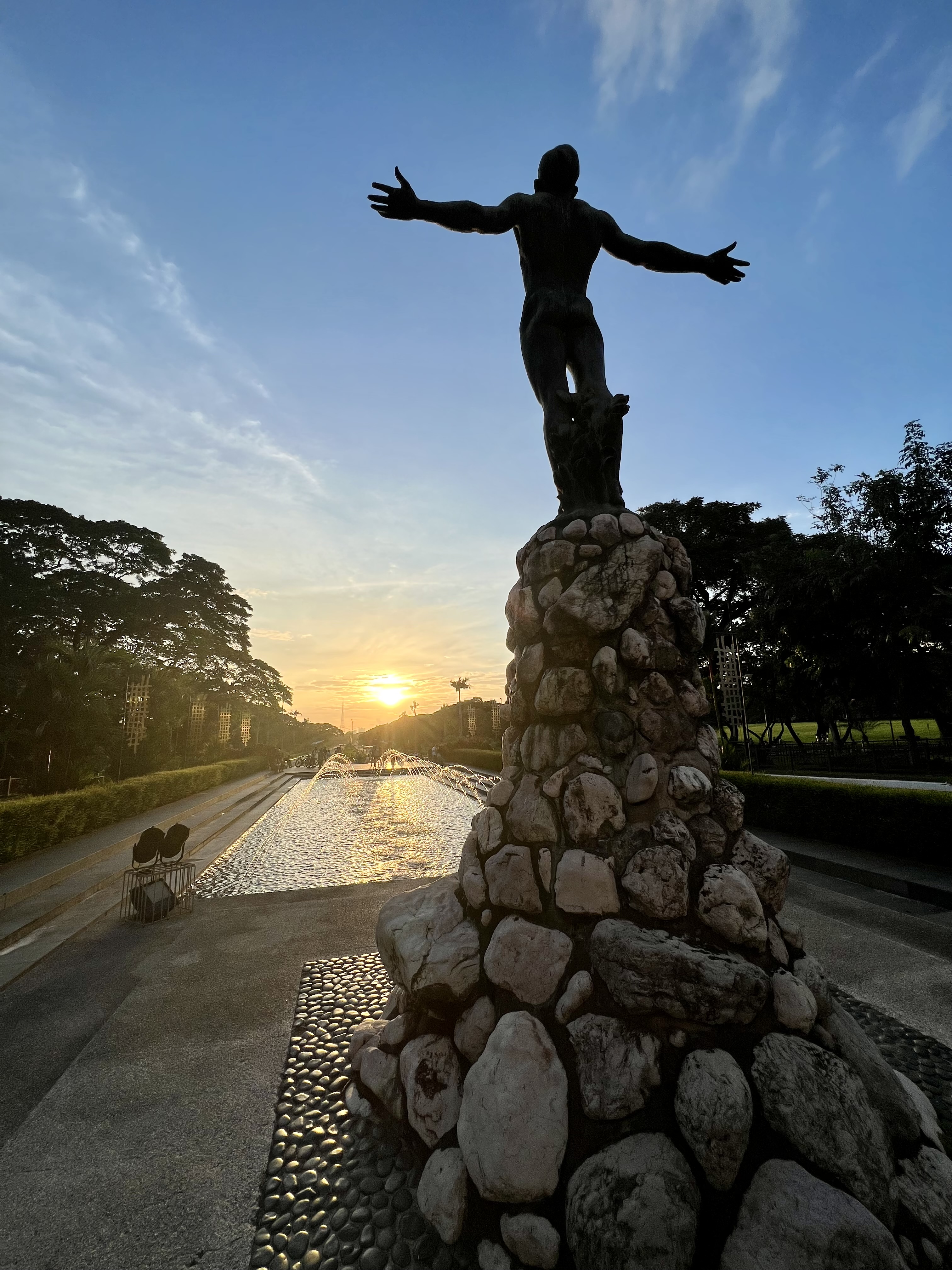
As I looked at the UPCAT examinees posing for selfies in front of the Carillon and the Oblation in Diliman, I remembered that eight UP students are now facing charges for their recent attempt to storm past a closed door at Quezon Hall to protest an unpopular decision by the Board of Regents. Among the complainants’ grievances, ostensibly, was that the wooden door was part of UP’s heritage, and had to be protected at all costs.

That saddened me, because the last image that one could imagine to stand for a university like UP is that of a closed and impregnable door. UP’s true heritage doesn’t lie in its furniture but in its tradition of free speech, and even of protest, the occasional overflow of passion included. I can only pray that UP’s new and compassionate president, Jijil Jimenez, can draw on his own activist past to see that point, and to keep an open door for his constituents to his mind and heart.

Qwertyman No. 26: UP’s New President

Qwertyman for January 30, 2023

TWO FRIDAYS from now, a change of leadership will take place at the University of the Philippines, when outgoing President Danilo L. Concepcion turns his office over to Atty. Angelo “Jijil” A. Jimenez. Elected by the Board of Regents last November after what was known to be a tightly contested three rounds of voting, Jimenez will serve for the next six years as UP’s 22nd president. (By tradition, the BOR’s formal announcement of the vote declares it to have been “unanimous” although, to the best of my knowledge, it never has been, at least in modern times.)

Jimenez is no stranger to UP’s political and academic culture. A sociology and law graduate from UP with a master’s in management from the National University of Singapore, Jimenez served twice on the Board of Regents as Student Regent in 1992 and as Regent from 2016 to 2021. 

How he will win over the faculty is something else. It’s no secret that many professors emeriti and other faculty members—myself included—openly declared themselves in support of the candidacy of UP Diliman Chancellor Fidel Nemenzo, whom his supporters saw to have the best academic and administrative experience among all the six candidates for the position. That did not mean that no one else was qualified, and the BOR apparently saw something more in Jimenez that we did not, and so we will have to live with that decision.

The faculty’s chief concern may have been that Jimenez has never taught full-time in UP, raising fears that he might not appreciate or respect UP’s academic culture as strongly as a UP president should.

Academic culture is hard to explain to outsiders, but it is a way of life founded on intellectual meritocracy, on the idea that authority and respect are earned through hard-won knowledge, the currency of learning. And “intellectual” here doesn’t simply mean knowing something and being smart (and in some cases, insufferably arrogant), but actually doing something about it—through teaching, research, or some form of social action. Universities value people who contribute to our understanding of ourselves and to the improvement of human life. This is more than gaseous talk that nobody else can understand. It’s doing the deep thinking that nobody else will do, because they either have no interest or see no profit in it, or because they’re not trained to. A national university like UP, funded by our taxes, applies that thinking and learning to real-world problems and places its resources at the service of society. UP demonstrated this social commitment during the pandemic through the heroic sacrifices of its staff at the Philippine General Hospital and the research conducted by the Philippine Genome Center, among others.

Nonetheless, I can sense that despite their initial misgivings, many members of UP’s academic community are willing to give Jimenez a chance to prove himself as a protector and promoter of UP’s interests rather than someone imposed by the powers-that-be to bring the unruly natives to heel. 

“Jijil knows UP’s academic culture, and he listens. He studies things carefully before making a decision,” a highly respected colleague who knows (and once taught) Jimenez assured me. I have to say that in the few times that I met and observed him when I served as Concepcion’s VP for Public Affairs, I was impressed by Jimenez’s grasp of the issues and his willingness to learn. And this will not be the first time that someone perceived to be an outsider was chosen to sit in Quezon Hall; the most notable and perhaps the most effective of such predecessors was Edgardo J. Angara in the 1980s, who had no qualms about using his powers to modernize and streamline UP’s aging bureaucracy, against stiff resistance from within.

Jimenez has led a colorful life that included being posted as labor attaché in war-torn Iraq and him and his wife adopting a baby girl who was left at their doorstep. As a labor lawyer, he will understand the plight of the disempowered, and know how to speak to power and, just as importantly, to negotiate with it as well. 

Ultimately, it will be his character that will be on trial—how he will perform and decide under pressure from both left and right, what values lie at his moral core, and how he will steer the university and ensure its well-being under an indifferent if not hostile political regime. 

PAAJ, as he will be known in UP (Concepcion was PDLC), will have to contend with the rabid red-taggers at UP’s gates (and some of them well within its campuses), who will expect him to deliver UP, and specifically Diliman, on a platter to Malacañang. Curiously, just before the voting, Jimenez—a Duterte appointee to the Board of Regents—was denounced by another newspaper’s resident canine as a communist, alongside Fidel Nemenzo. UP has never had a shortage of detractors rooting for nothing less than its closure, but expect the troll armies to work overtime the minute PAAJ asserts its academic freedom.

Internally, Jimenez will have to deal with the conditions and demands of a constituency just emerging from the temporary and unnatural constraints imposed by the pandemic and eager to spring back into normal academic life but with even more incentives to work and to teach. Some colleagues will berate me for this, but “serve the people” no longer seems to be reason enough to study and to teach in UP. The sense of entitlement afflicting society at large has also crept into UP’s culture, with students complaining about their grades, freshly hired instructors complaining why they haven’t been promoted, and professors complaining why their work wasn’t given more points in their evaluation. Economic issues are easy to understand in a time of rampant food prices (and gross profligacy on the part of public officials), but this goes beyond a bigger paycheck. 

Given his two stints on the Board of Regents, Jimenez will be familiar with these issues down to their minutiae, as perhaps a lawyer can best comprehend. Appointing a capable executive staff will be key to his success, but again, they can only act on judgments emanating from the president’s fundamental sense of good and bad and right and wrong.

Arguably, the visible function of university presidents has changed in recent times, from being exemplars of scholarship and ideological firebrands to resource generators and managers. (Concepcion was particularly adept at the latter role.) How Angelo A. Jimenez will distinguish himself over the next six years will be a story entirely his to craft. I will be eager to read it, and wish him well.