Penman No. 150: Looking Eastward in Toronto

IMG_7573 (1)Penman for Monday, May 25, 2015

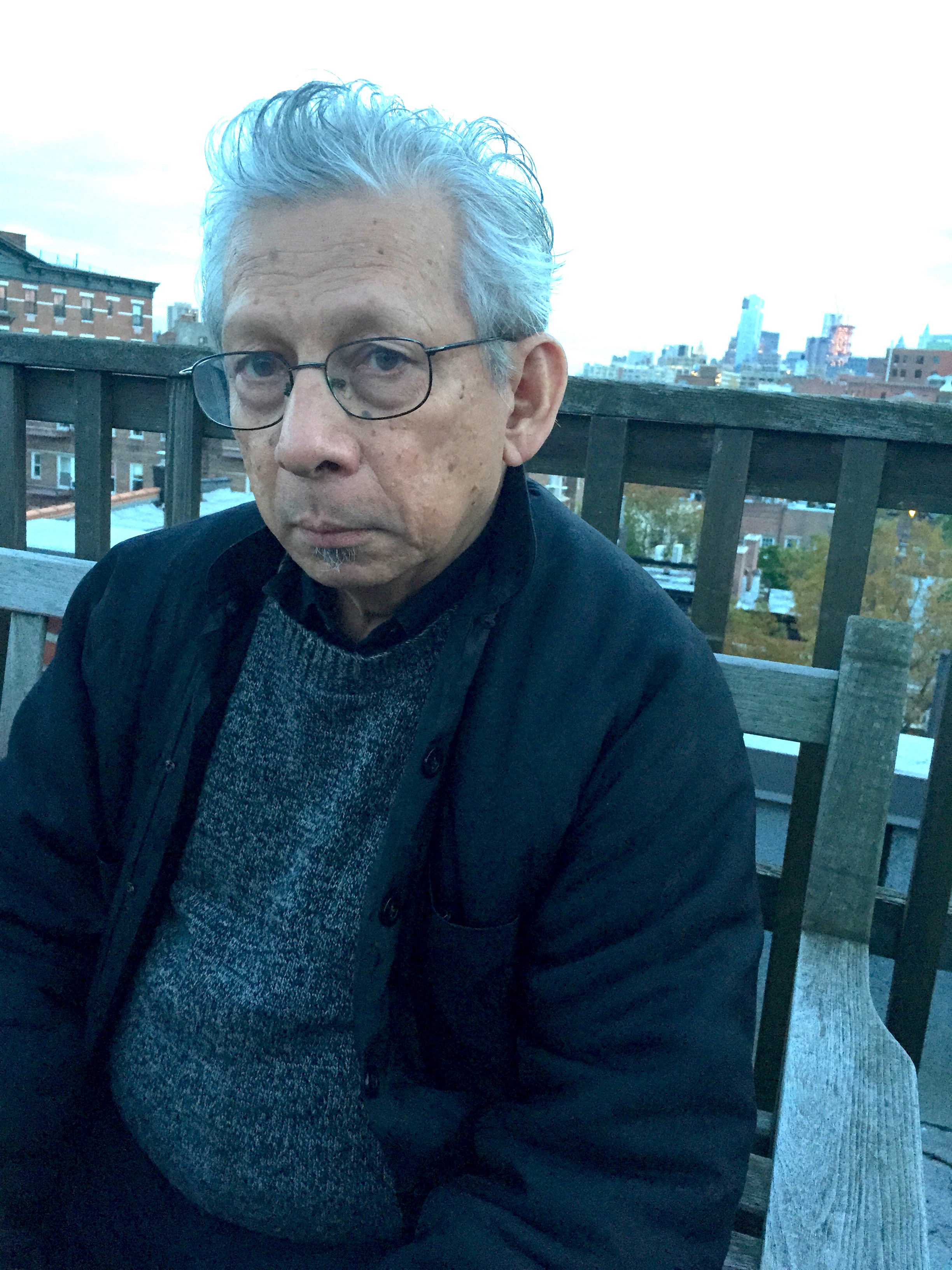
I FLEW out to Toronto in Canada a little over a week ago to take part in that city’s Festival of Literary Arts, possibly the first Filipino author to join that long-running festival, now on its 15th year. Previously, the festival had focused on South Asia (India, Pakistan, Bangladesh, Sri Lanka), but has recently opened itself up to more representation from East Asia, Africa, and the Caribbean, thus my inclusion in this year’s roster of invited writers and speakers.

Over a weekend, from Friday to Sunday (May 15-17), several dozen representatives from these regions and from Canada met in various venues on the scenic campus of the University of Toronto and its environs to tackle issues and problems besetting writers and publishers from outside the global centers. How does a writer from the periphery break through to the center? Or is that “periphery” its own legitimate center? Is yearning for publication and validation in the West a vestige of the colonial mindset, an experience shared by all the countries represented in Toronto?

Aside from these seminal discussions, of course, the meeting was first and foremost a festival, a sharing of the artists’ finest work, and I felt privileged to be introduced to authors and creations I would otherwise have totally missed or blithely ignored. With many of the authors coming from expatriate and postcolonial backgrounds, the offerings were rich and deeply nuanced, the talents outstanding.

Among others, I discovered a major international writer in the festival director, the novelist M. G. Vassanji, who had been born in Tanzania in East Africa, and whose account of his pilgrimage to his ancestral roots across the ocean (A Place Within: Rediscovering India) is a modern classic of creative nonfiction—a sympathetic but unsentimental and often searingly critical chronicle of his encounter with the sprawling reality of India today.

The visit also allowed me to reconnect with some old Filipino friends who had migrated to Toronto and had built new lives there. I was very graciously taken out to a scrumptious dimsum lunch in Toronto’s fabled Chinatown by Patty Rivera and her husband Joe. Patty and I worked together 40 years ago as writers and editors at the National Economic and Development Authority (an unlikely Camelot for young writers and artists under the patronage and protection of then-Sec. Gerry Sicat).

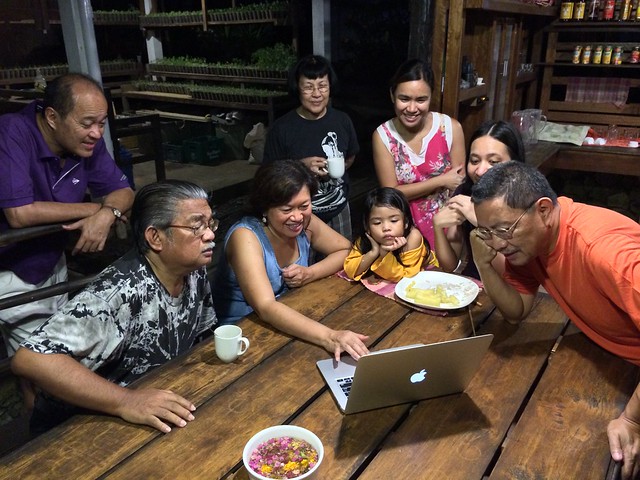
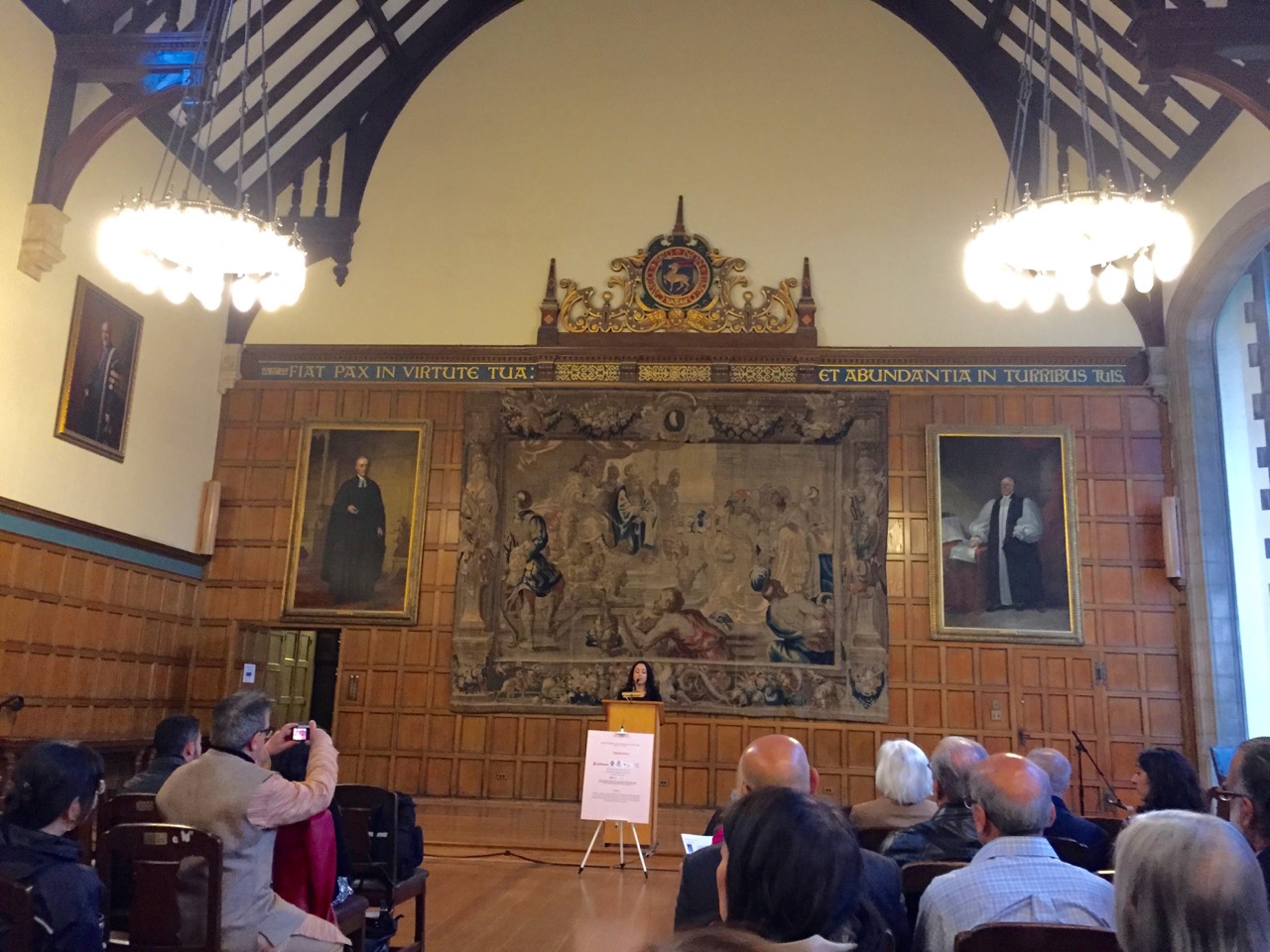
Though trained and still active as an editor and journalist, Patty has since developed into an accomplished and prizewinning poet, with three volumes to her name. Her first collection, Puti/White, was shortlisted for the 2006 Trillium Book Award for Poetry. Patty’s husband Joe, a former Ford executive who also wrote plays in the Philippines, became a lawyer in Canada and then, upon his recent retirement, turned to painting, an avocation in which he demonstrates a most unlawyerly exuberance. I also met and was happy to engage with some Alpha Sigma fraternity brothers led by Amiel “Bavie” de la Cruz, who now runs his own accounting firm in Toronto. IMG_7597 (1) Patty and Joe arranged a reading for me with a large and lively group of Toronto-based Pinoys (including Hermie and Mila Garcia, the moving spirits behind Canada’s longest-running Filipino newspaper, the Philippine Reporter, and expat poet Naya Valdellon); this was held in the very stylish apartment of writer-artist Socky Pitargue, and a great time was had by all as we threshed out the travails of Philippine literature and politics, two deathless topics that occupy me on every one of these overseas sorties. DALISAY_HMG_8056-300x168 Yet another meaningful encounter I had, thanks to the festival organizers, was with two classes of high school students at the Mother Teresa Catholic School in Scarborough, a Toronto suburb with a high concentration of Asian students, including Filipinos. These teenagers had very likely never met a living writer before, let alone a Filipino one, and I was glad to try and show them that we do exist, and that we have something to say. I, too, learned something from their teacher Kathy Katarzyna, who ended our session with a terrific quote from the Canadian poet Leonard Cohen: “There’s a crack in everything…. That’s how the light gets in.”
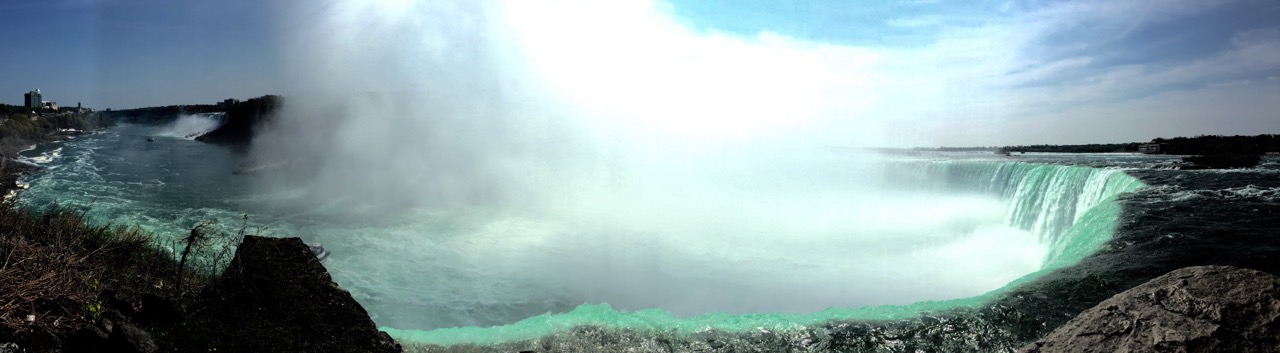
Many thanks to the Sri Lankan poet Aparna Halpe for taking me to the school. Of course, my thanks wouldn’t be complete without acknowledging the help and support of my sister Elaine Sudeikis and her husband Eddie, who flew in from Washington, DC to join me at the festival and to show me Toronto and a bit of Ontario (most notably Niagara Falls—we walked over to the US side as well for my shortest visit to the US, ever). Ed’s dad Al—all of 92 but still feisty—also gave me a little taste of Lithuania in Toronto.

And the visit would never have happened for me without the recommendation of Prof. Chelva Kanagayakam, an eminent scholar and festival founder whom I’d met in Manila, who tragically died of a heart attack a few months before the festival, on the very day he was inducted into the Royal Society of Canada. I found Toronto itself to be a highly livable and largely safe city (guns are under strict control in Canada), with a vibrant ethnic mix.

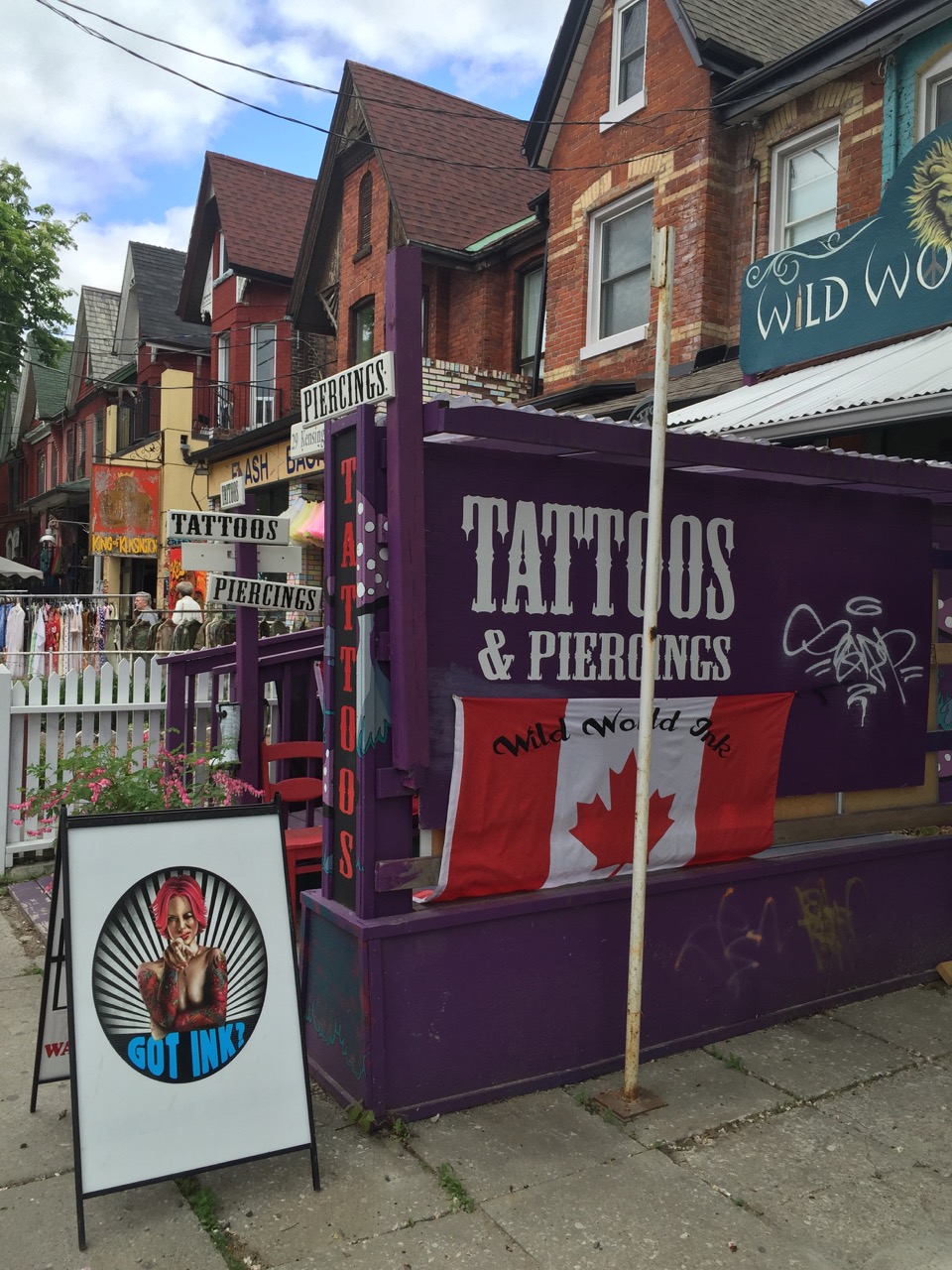
One out of every two Torontonians comes from somewhere else, and Vietnamese, Tibetan, and Puerto Rican restaurants stand cheek-by-jowl beside each other, not to mention a Chinatown noted to be among North America’s best culinary havens. (A Pinoy food store aptly named “Butchokoy” stood a block away from my lovely B&B—a three-storey house from 1853—on Dunn Street.) Victorian structures still in use by the university and the city government contrast sharply with ultramodern architecture in an eclectically energetic skyline. Seekers of the funky and the quirky can have their fill in the city’s counterculture-inspired Kensington Market. IMG_7691 (1) For someone schooled in Americana, this exposure to things Canadian was an interesting re-education—to think, for example, in terms of “Tim Hortons” instead of Starbucks or Seattle’s Best; of “Roots” instead of Gap; of “Hudson Bay” instead of Sears or JC Penney, etc.
But the most useful re-orientation took place for me at the festival itself, in reminding me that we have a lot to learn from South Asia as far as developing readerships in local languages is concerned, among other issues. We Filipinos think we’re well traveled and globally savvy, but we actually don’t get around enough in terms of mixing with our fellow Asians, let alone Africans. We seek out Western—specifically American—tutelage and patronage, often to our own deep disappointment.

It seems ironic that I had to learn this in Toronto—a true cosmopolis like New York—but sometimes you have to stand in the West for a better view eastward.

[Group photo from philippinereporter.com]
Penman No. 122: A Meeting in Manhattan

IMG_5861Penman for Monday, November 10, 2014


BENG AND I were in Philadelphia and New York these past two weekends, so I could do more interviews for my martial-law book project and also get in touch with a few old friends. I normally keep a very low profile and don’t tell or call people when I travel to places where friends are living, not because I’m a snob, but because I don’t want to be a bother, knowing what it’s like when somebody drops in from the blue and throws your schedule out of whack.

But there are always some friends you never mind breaking your routine for, and who never seem to mind, either, if you break theirs. And I was glad to meet up in Manhattan with two such writer-friends, the poet and essayist Luis “Luigi” Francia and the fictionist Gina Apostol, both of whom live and work in New York. Luigi teaches at Hunter College and Gina at the Fieldston School.

The first time I met Luigi, many years ago in a Malate bar on one of his visits home from New York where he has been living since 1970, I remember seeing his calling card, which described him thus beneath the name: “POET. EDITOR. PRINCE.” It seemed cheeky and chic, and I was deeply impressed, being none of the above. (I’ve since written some middling poetry and have done my share of editing chores, but remain utterly unprincely.)

IMG_5856

I had the recent pleasure of writing a blurb for Luigi’s forthcoming collection of essays titled RE: Reviews, Recollections, Reflections, to be published by the University of the Philippines Press, and this is what I said:

“Luis Francia knows New York and America better than many of the native-born, but he never loses his moorings, his critical awareness of what it means to be Filipino-American. But these essays are about far more than racial politics, as they chronicle the travails of that most blessed and in other ways most cursed of citizens—the artist, particularly the artist abroad, for whom alienation acts as a lens that magnifies and reshapes every little thing that crosses the eye. The most arresting and delightful reads are his portraits of the expatriate masters who preceded him in America—most notably Jose Garcia Villa, lover of martinis and hater of cheese. Despite the plaints, Francia has been clearly and distinctly privileged to be where he has been and to see what he has seen, and he shares that privilege with us in this well-wrought collection.”

Gina was my batchmate when I returned to finish my undergrad studies in UP in the early ‘80s; I was ten years older than everyone else, so I was kuya to all of them. It was a time when we were all dreaming of finding a way to take our graduate studies abroad—as English and writing majors, we wanted to become the next Gabriel Garcia Marquez, the next Sylvia Plath, the next Ian McEwan, the next Pablo Neruda, and so on; as Pinoys, we wanted to see America. Eventually, we just became our older selves, but we did get to see the States through one ticket-paying subterfuge or other—for me, a Fulbright grant; for Fidelito Cortes, a Wallace Stegner fellowship; for Ramon Bautista, an assistantship at Wichita. But we had to compete for these, while all the brilliant Gina had to do was to lick a few stamps and mail a couple of her typewritten stories off to John Barth, who directed the writing program at Johns Hopkins and who wrote her back forthwith to offer her an assistantship, smitten as he was with her talent. It was pure magic, in those pre-email days.

That brash young woman from Tacloban who flew off to Baltimore would go on to write several prizewinning novels. Gun Dealers’ Daughter, published by W. W. Norton, won the 2013 PEN Open Book Award given by the PEN American Center to outstanding works by authors of color to promote racial and ethnic diversity within the literary and publishing communities. (Luigi himself had won this prize in 2002, the first year it was given, for his nonfiction book The Eye of the Fish.)

Here’s what the judges said about that novel in their citation: “You will read Gun Dealers’ Daughter wondering where Gina Apostol novels have been all these years (in the Philippines, it turns out). You will feel sure (and you will be correct) that you have discovered a great fiction writer in the midst of making literary history. Gun Dealers’ Daughter is a story of young people who rebel against their parents, have sex with the wrong people, and betray those they should be most loyal to…. This is coming of age in the 1980s, Philippine dictatorship style, where college students are killed for their activism. The telling is fractured, as are the times…. Not only does this novel make an argument for social revolution, it makes an argument for the role of literature in revolution—the argument being that literature can be revolution.”

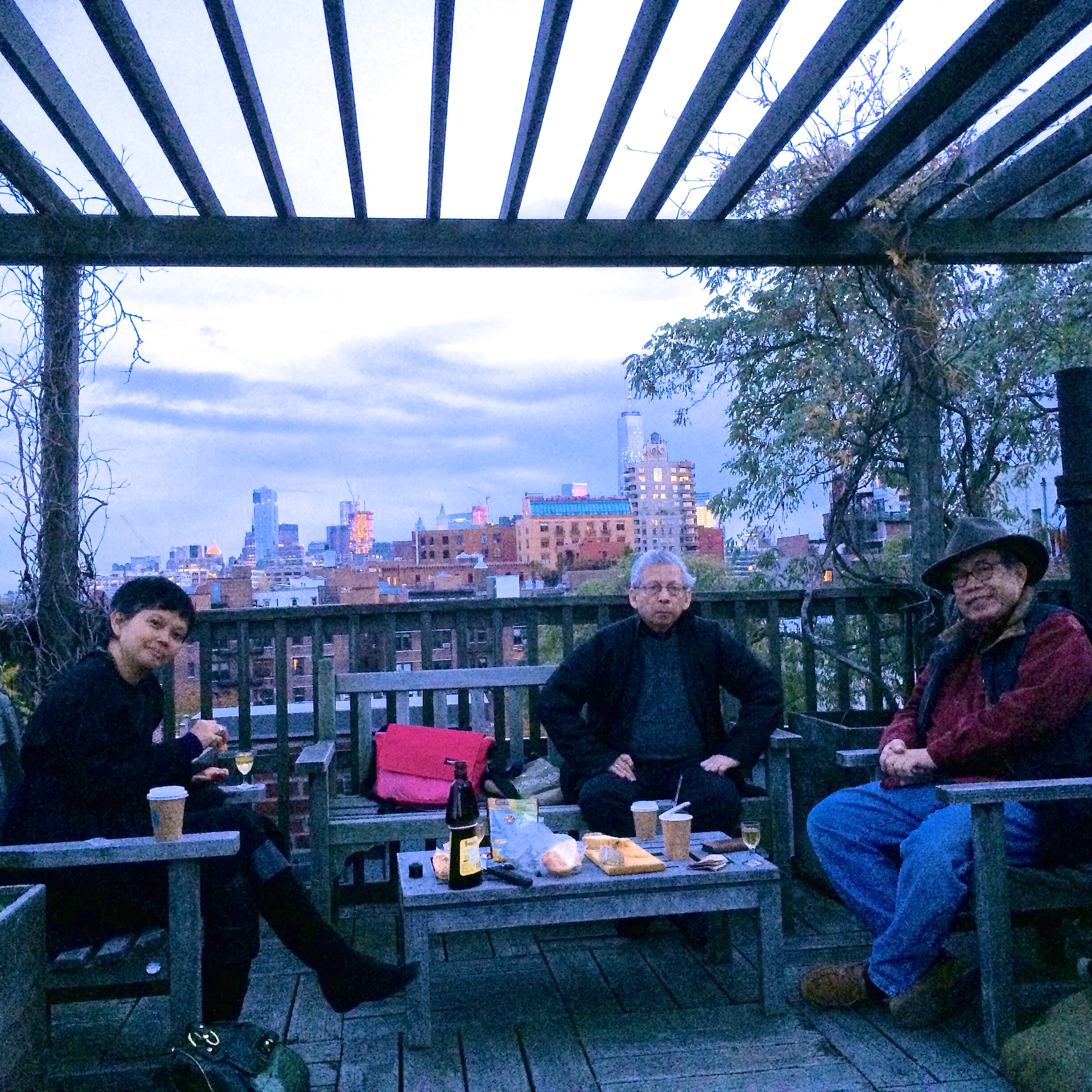
These then were the two literary luminaries who happened to be my friends (or should that be the other way around?) whom I was happy to set up a date with in a coffee shop in the West Village, near the High Line (an elevated garden and walkway that deserves its own story, among other New York landmarks). The coffee place was full, so we brought our steaming cups instead up to the roof deck of Gina’s apartment a few blocks away, pausing for a picture in front of the late Jose Garcia Villa’s old place on Greenwich Street. “This was where he held court,” said Luigi, one of Villa’s acolytes. “Nonoy Marcelo also lived in this area for many years, and I did, too, back when the rent was 65 dollars a month.” Then Gina added, “That white place is where John Lennon and Yoko Ono lived.” And I thought, if they’d stayed here instead of moving to the Dakota, he might still be alive.

We went up to the roof deck and Beng and I savored the scenery in all its 360-degree magnificence, as the sun set in the west and the full moon rose in the east, competing with the Empire State’s tricolor spire. We talked books, life, and loves over Frangelico, bread, and cheese; channeling Villa, I steered clear of the curd. Looking sharp and happy despite a recent illness, Gina said that her iPhone’s Siri had told her, in response to a question, “I’m just glad to be alive!” At that instant, we all were.

Flotsam & Jetsam No. 37: The 2014 APWT Conference Tentative Program

ASIA-PACIFIC WRITERS AND TRANSLATORS

Bridging Cultures: Creative Writing and Literary Translation in Asia Today

17-20 July 2014 

The Art House, 1 Old Parliament Lane, Singapore

Program (Draft@24 April)* 

*Sessions or times are likely to change, so check back before the event.

Our ‘roundtables’ are so-called to encourage audience participation in conversations started by the featured authors.

Speaker biographies can be found here: http://apwriters.org/singapore-2014-conference/biographies-whos-speaking-and-youll-meet-at-bridging-cultures/

Thursday 17 July

08:30     Blue Room           Sign in, collect conference badge and handout.

Tea/coffee, courtesy of the Arts House and NBDC

09:00     CHAMBER           Welcome and Introduction.

09:15    CHAMBER            Opening Keynote (TITLE TBA) by Suchen Christine Lim.

09:50    CHAMBER            ROUNDTABLE. ‘What is Literature For? featuring the conference keynotes: Suchen Christine Lim with Linda Jaivin and Merlinda Bobis. Moderator TBC.

11.00     Blue Room           Refreshments, courtesy of the Arts House and NBDC

11:30     LIVING ROOM   ROUNDTABLE. Poetry: Art and Soul of It – This is a free-wheeling conversation about what poetry is and isn’t, led by Alfian bin Sa’at, Martin Alexander, Mani Rao, Menka Shivdasani, and Joshua Ip. Moderated by Jennifer Crawford.

11:30     CHAMBER           ROUNDTABLE. Twisting the Truth: Truth in Fiction, Lies in Non-Fiction. An exploration of story-telling as art and why we tell stories, with David Carlin, Lisa Walker (TBC), Michael Vatikiotis and Philip McLaren (TBC) – Moderated by Jose Dalisay.

12:45    Blue Room           Lunch, courtesy of the Arts House and NBDC.

2:00      WORKSHOPS (4 hours) with Martin Alexander (COUNCIL ROOM) and Tim Tomlinson (Green Room). SEE DETAILS. http://apwriters.org/singapore-2014-conference/creative-writing-and-editing-workshops/

2:00        LIVING ROOM   ROUNDTABLE. The Art of Remembering. This broad conversation about writing memoir will be kicked off by Sally Breen, Tony Birch), Jessie Cole (TBC), and Victor Marsh in conversation with Francesca Rendle-Short.

2:00       CHAMBER            ROUNDTABLE. The Art of Forgetting. Fiction can take us away from our ‘real’ lives into different ways of seeing the world. Novelists talk about their work, featuring Kathryn Koromilas, Dipika Mukherjee (TBC) and Angelo Loukakis, in conversation with Maria Carmen Sarmiento. 

2:45        LIVING ROOM   Conversation on Writing Today from Pakistan with Iram Shafique and Farheen Chaudhry and Qaisra Shahraz.

2:45        CHAMBER           Changes to the Literary Landscape in Indonesia. A panel discussion led by John H. McGlynn with others (TBC) includingIwan Sulistiawan who will talk about changes ‘From Discrimination to Multiculturalism: Indonesian Chinese in Indonesian Novels’. Moderated by Michael Vatikiotis.

3:30     Blue Room       Refreshment, courtesy of the Arts House and NBDC

3:45    LITERARY WALK (TBC), organized by the Arts House. Meander through the fiction, non-fiction and fantasy of Singapore with award-winning writer Rosemary Lim (TBC). You will follow in the footsteps of Joseph Conrad and Somerset Maugham, explore locations that inspired Rex Shelley and Edwin Thumboo. Discover Singapore as muse to novelists, playwrights and poets as you travel in time from colonial days to the present day through words and imagination.

4:00       Earshot Café     NEW WORK- Book Launches.

Help celebrate the launch of five new books. Menka Shivdasani launches an anthology of women’s writing from India; Eu Yoke Lin will launch her first book of poetry; John McGlynn launches a translation of a classical Malay tale “Krakatau: The Tale of Lampung Submerged”; Victor Marsh launches his memoir that draws on his experiences as a disoriented Australian who is initiated by a young guru; and Mani Rao will launch a Singapore edition of echolocation (Math Paper Press). Details will be available on a separate link.

6:30      Blue Room        Welcome Cocktails (TBC) – courtesy of the Arts House and NBDC

EARSHOT CAFÉ (?)     Singapore Outloud (TBC). Poetry and short fiction readings with participating moderators Martin Alexander and Alfian Sa’at.

Friday 18 July

09:00     WORKSHOPS (4 hours) with Tony Birch (COUNCIL ROOM) and Nury Vittachi (Green Room). http://apwriters.org/singapore-2014-conference/creative-writing-and-editing-workshops/

09:00    CHAMBER            KEYNOTE: ‘Border Lover in Uncertain Times: Story-Making Across Cultures, Languages, and Literary Forms’ by Merlinda Bobis

09:45     CHAMBER           RoundtableWhat Women in Asia Write About Now, with Merlinda Bobis, Menka Shivdasani (TBC),Mridula Chakraborty, Farheen Chaudhry, and Qaisra Shahraz. Moderated by Judith Buchrich

09:45     LIVING ROOM Roundtable – TBA

10.15     Blue Room           Refreshments, courtesy of the Arts House and NBDC

10:45    LIVING ROOM   Gender Politics: Forcing the Issue– Victor Marsh, Jhoanna Cruz and Alfian Sa’at speak about issues that brought them out as writers. Moderator TBC.

10:45     CHAMBER           Changes to the Literary Landscape and New Publishing Opportunities (#1). This session discusses new magazines and other platforms with Zafar Anjum, Simon Clews, Martin Alexander, Kulpreet Yadav and others TBC, with participating moderator Kelly Falconer (Asia Literary Agency).

12:30    Blue Room           Lunch, courtesy of the Arts House and NBDC

1:00        LIVING ROOM   Book launches. Help celebrate the launch of books by Lydia Kwa, Bhavna Khemlani, Bob D’Costa and Farheen Chaudhry. Details will be available on a separate link.

2:00    Workshops (4 hours) with Sally Breen (COUNCIL ROOM) and Merlinda Bobis (Green Room). See http://apwriters.org/singapore-2014-conference/creative-writing-and-editing-workshops/

2:00     CHAMBER      Writing Under Political Pressure. ‘Prison Makes Poets of Us All,’ wrote Filipino political prisoner Alan Jazmines. Maria Carmen Sarmiento discusses the literary work of some political prisoners in the Philippines. At the age of 18 Jose Dalisay was himself a political prisoner for seven months under Filipino martial law (1973) and wrote his first novel about that experience (1992). He now writes nonfiction history of that period. Others on this panel include Alfred Birnbaum who translated the censored work of Burmese novelist Nu Nu Yi. Moderated by Michael Vatikiotis.

2:00        LIVING ROOM   How Translation Transforms both Text and Translator with Alfred Birnbaum, Andrea Berrini, Sun Xuefen (TBC) and Linda Jaivin, moderated by Mani Rao.

2:45        CHAMBER           Links and Fragments into Narrative Wholes

What can be done when a novel gets stuck – when the writer just cannot imagine what the next action is?  Tim Tomlinson has suggestions, while prolific author Nury Vittachi adds advice of his own. Cristina Hidalgo who has authored more than 30 books will also offer a few tips. Moderator TBC. 

2:45        LIVING ROOM     IN CONVERSATION. Shirley Lee, translator of North Korean poet Jang Jin Sung’s recently published disturbing memoir Dear Leader, in conversation about the book, its success and the issues associated with its translation, in conversation with her with her agent Marysia Juszxakiewicz of Peony Literary Agency. TBC

3:30        Blue Room           Refreshments, courtesy of the Arts House and NBDC

4: 00       CHAMBER           Roundtable. On Teaching Creative Writing in English and the Influence of the Mother Tongue. Join this discussion withDai Fan who teaches one of the few English language creative writing courses in China, Jayanthi Manoj who teaches in Trichy, India, Filipino teacehers Hope Sabanpan-Yu and Christine Godinez-Ortega (TBC), and Indigenous Australian author and professor Tony Birch. Moderated by Francesca Rendle-Short.

4:00     LIVING ROOM

5:30        EARSHOT CAFÉ                 Singapore Outloud #2 – Poetry and short fiction readings with participating moderators Joseph Ip and Mani Rao.

Saturday 19 July

09:00     Workshop (4 hours) with Francesca Rendle-Short (COUNCIL ROOM). See details. http://apwriters.org/singapore-2014-conference/creative-writing-and-editing-workshops/

09:00        CHAMBER        KEYNOTE: Found in Translation – In Praise of a Plural Worldby Linda Jaivin.

09:45     CHAMBER           RoundtableTranslation Thrills and Spills. Translators speak about their translation process and challenges, and share hilarious moments from their experience translating authors and poets who are too close, too far, and even omnipresent. Linda JaivinKyoko Yoshida, Andrea Lingenfelter and Menka Shivdasani with participating moderator Mani Rao.

09:45   LIVING ROOM   CONVERSATION “ASIAN SAVVY”. Changes to the Literary Landscape and New Publishing Opportunities (#2). Join in this lively conversation led by Nury Vittachi who contends that ‘Asia’ is poised to lead the literary world.

10.15     Blue Room           Refreshments, courtesy of the Arts House and NBDC

10:45     CHAMBER           How Translation Transforms both Text and Translator with Alfred Birnbaum, Andrea Berrini, Sun Xuefen (TBC) and Linda Jaivin, moderated by Mani Rao.

10:45     LIVING ROOM   Language and Politics: New Dynamics. Has the role of English shifted significantly in a postcolonial scenario? A dominant group can seize, assimilate, domesticate … is it any different when translating from English to vernacular languages? When so-called local, native or indigenous texts present culturally specific contexts, how can they be translated into more ‘universal’ contexts without misrepresentation? What goes into making non-English texts, “world literature”? If translation has now been exposed as colonial discourse, has it changed in a postcolonial context? Mridula Chakraborty, Antonette Talaue, Shafique Iram, Dipika Mukherjee(TBC) and/or Shirley Young-Eun Lee (TBC), moderated by Shelly Bryant.

12:30    Blue Room           Lunch, courtesy of the Arts House and NBDC

SPECIAL LUNCHTIME ANNOUNCEMENTS

1)      Re: Joint issue of Griffith REVIEW/ASIA LITERARY REVIEW publishers Susan Hornbeck (GR) and Martin Alexander (ALR), introduced by Jane Camens.

2)      Re: World Readers Award by Nury Vittachi.

3)      Overview of 2015 Meeting in the Philippines with Jose Dalisay (and the Filipino organizers).

1:00        CHAMBER           ANNUAL GENERAL MEETING of AP Writers. All members of AP Writers welcome. Appointment of a new Director and a new Translation Chair, account by the Executive Director of finances, and other matters aimed at improving and expanding AP Writers.

3:00        Blue Room           Refreshments, courtesy of the Arts House and NBDC

3:30 pm Literary Walk #2 TBC organized by the Arts House.

5:00        EARSHOT CAFÉ     Singapore Outloud #3 Readings, with participating moderators Bernice Chauly (TBC) and Sally Breen.

Sunday 20 July FREE PUBLIC DAY

 Full Public Program to come.

10:00   WORKSHOP Bring Out Your Best at POETRY SLAM with Marc Nair, organized by Word Forward. For poets intending to participate in our closing poetry slam. (Registered conference participants can perform in the Slam without attending this workshop.) Details to be provided soon.

From 10 AM, all day

  • Author conversations with Singapore and visiting authors before a public audience.
  • Readings with a Singapore audience.
  • Children’s session (2 pm) with Nury Vittachi. Other possible authors for this children’s session Bhavna Khemlani? Cris Barbra Pe? Angelo Loukakis? Others?
  • CLOSING EVENT

POETRY SLAM, organized by Word Forward.

Penman No. 79: Men of Letters (1)

ImagePenman for Monday, December 30, 2013

I’M AN incorrigible pack rat; I keep restaurant receipts and bus tickets from the 1970s, business cards from associates long forgotten or even departed, and notes and memos from various points of my engagement with one bureaucracy or other. These odds and ends molder in a large wooden baul that sits in a corner of my office, a chest Beng and I bought for our daughter’s wedding but which somehow stayed with me (our unica hija Demi will still get that baul, contents and all, on one of her visits home from California). Other old letters I keep in a leather briefcase, itself now an artifact, a souvenir from my first trip to the US in 1980.

I was rummaging through the papers in that chest and that briefcase a few weeks ago, looking for something I could contribute to the benefit auction we were holding for Writers’ Night, when I stumbled on some letters I’d received (and some I sent—I dutifully Xeroxed my outbound mail then) from writer-friends. The most interesting ones were those that opened a window on my friends’ minds as writers and as persons—as young men, really, on the road to emotional, intellectual, and artistic maturity.

One of those friends I exchanged long letters with was the late Bienvenido “Boy” Noriega Jr., very probably our finest playwright, and something of a prodigy who headed the Policy Coordination Staff at the National Economic and Development Authority in his early 20s; Boy went to Harvard in 1978, when he was 26, for his master’s in Public Administration, but cross-enrolled in theater courses at the same time. Another was poet Fidelito Cortes, who beat me out to a Wallace Stegner fellowship at Stanford in the mid-1980s (and who made up for it by greeting me in San Francisco with the gift of a Stanford sweatshirt when it was my turn to come in 1986). I also wrote letters to film director Lino Brocka, who preferred to use the telephone to respond (quite often forgetting, when I was in Milwaukee, that it was 2 am when he was calling from Quezon City).

Boy always hand-wrote his letters in small, fine script; Lito, like myself, used a typewriter; our letters went on for pages and pages, reporting on what we were writing, seeing, and thinking at that time, aware that we were standing on the doorstep of our lives’ great labors.

This week and next, let me share some excerpts from our exchanges, leaving aside more personal references. I’m translating Boy’s from the Filipino original.

Harvard U, 3 Nov 78

Dear Butch,

My drama course is the most exciting of all my subjects. We’re studying all the major dramatists. We’re done with Ibsen, Strindberg, Chekhov, Wilde, Shaw… Wagner, Dumas fils and Buchner, and soon to follow will be Brecht, Pirandello, Beckett, Miller, Williams, O’Neill, etc. The best for me are still Ibsen and Chekhov—Ibsen for characterization and Chekhov for his mastery of dramatic devices such as economy in dialogue, choice of moments, verbal counterpoint, and so on. You know, it’s only now that I’ve discovered how Chekhovian my [three-act play] Bayan-Bayanan is. When I get back home, I can return to it and give it a final revision because I know now how I can still tighten and improve it. One more thing I admire about Chekhov is his lifestyle—shy, pensive, self-assured.

I don’t know if I can still write for the CCP [Literary Contest]—I’m too pressed for time. What about you, are you all set for this, or are you working on your Filmfest entry first? My dilemma in joining contests always seems to be that I worry about how to write my play in a way that the judge who’s in a hurry will grasp. If it isn’t well-made (meaning, it has a very clear plot), it could be hard to appreciate or to draw attention. I guess that if Chekhov joined our contests, he’d lose…. His style is so refined compared to mine. Once, for example, he was asked what the “character” of one of his characters was, and he answered, “He wears a yellow tie,” and everything was in that answer.

19 Jan 79

What are the entries to the Manila Film Festival—are they any good? Have they started the songfest? These would be good to get into—I have a lot of ideas for songs, about country and love and life—but I need to look for a good composer and a good singer….

There must be many more good playwrights such as Sophocles, Shakespeare, Racine and Moliere, but I still don’t know them well enough. I’d like to understand them all—because I’d like to teach drama someday (as a sort of sideline in case I become a full-time writer). It looks like I keep looking to [Rolando] Tinio as a model—whatever is in my field, I’d like to know.

…. The more I learn here, the more I’m aware that there’s so much I don’t know. The truth is, I need philosophy, psychology, and more to put everything together in my head. What I’m doing now is crash education. My letter’s getting awfully long. I’m just trying out the ideas I’ve been picking up. That’s because I don’t have any students yet. I remember when PETA asked us to give a lecture about our plays. I feel like I wasn’t able to say anything. The audience’s orientation was also so different. That will never happen to me again. I will also organize my ideas.

…. This will be all for now, because I’m getting sleepy. It looks like both of us keep writing such long letters. I hope we’re not just repeating ourselves. But it seems to me that we’re progressing.

2 March 79

About some of the points you raised in your letter—you’re right about speechwriting there. The Philippines or the world won’t change because of one speech. I’ve tired of this myself. The problem there is, every presidential speech has to be a speech to impress. It would be easier if it were just a speech to inform. Another problem is that we still lack in achievement and vision, so it’s really hard to impress. If there’s truly a lot to show, there wouldn’t be much need for talk, right?

…. The finitude of everything probably remains debatable. Or maybe I’m just being optimistic—I suspect that man will always discover something to overcome natural forces…. In general, I think I’m still optimistic. Maybe this is because I believe there’s a God who guides our actions. The “meaning” of life probably just doesn’t manifest itself in its consequences (in its practical results) but in the way life is used. Could be in some small things (small acts of charity, love, etc.) that we sometimes fail to notice.

…. There was a point in my brief life (before I turned 21) when I asked myself these things—what was the purpose of life? Why are people the way they are? And so on. Every now and then, I still raise the same questions, but I’m no longer dismayed, like I used to be. I’m no longer surprised, either…. When I come home, I’ll write some essays (I’m preparing my topics)—I’d like to be able to contribute to the field of thought. I have so many plans.

Boy Noriega died of cancer in 1994 at 42; I was away on a writing fellowship in Scotland, working on what would become Penmanship and Other Stories, when I heard about it. I later put his letters to me together and gave copies of them to his family. Next week, some fun with Fidelito.

Penman No. 75: A Writers’ Auction, and Shakespeare in Asia

DalisayBrillantesPenman for Monday, December 2, 2013

THIS IS going to be a very busy and exciting week on the literary front at the University of the Philippines in Diliman. First off, the UP Institute of Creative Writing will be hosting Writers’ Night on Friday, December 6, sustaining what’s become a longstanding annual tradition. Meanwhile, on Thursday and Friday, the Department of English and Comparative Literature will also be hosting its first international conference on “Shakespeare in Asia,” bringing together leading Shakespeare scholars from around the region and the US to affirm the Bard’s continuing relevance to global literature and society.

(It should also be mentioned that Philippine PEN will be holding its annual Congress December 3-4 at the Henry Sy Sr. Hall of De La Salle University, with the theme of “Literature of Concord and Solidarity: The Writer as Peacemaker,” and that FILCOLS—the Filipinas Copyright Licensing Society, Inc., which manages copyright payments for Filipino authors—will be holding its annual general meeting at the Claro M. Recto Hall in UP Diliman at 4 pm, December 6, just before Writers’ Night proper.)

Writers’ Night will consist of three segments, after the FILCOLS meeting: the awarding of the annual Madrigal-Gonzalez Best First Book Award, which this year will go to a Filipino author writing in English, and the launch of the 7th annual edition of Likhaan: the Journal of Contemporary Philippine Literature, which the UPICW publishes. Capping the evening will be a live auction of writers’ memorabilia, featuring donations by writers—including three National Artists—for the benefit of other writers left in dire need by recent disasters in the Visayas. We’ve received word that while no one we knew died in the wake of supertyphoon Yolanda, some writer-friends were badly savaged by the storm; while lives are of course the first priority, the loss to a writer of his or her home, and books and manuscripts among one’s few belongings, can also be deeply traumatic. We hope to be able to address some of these needs through the auction.

Writers’ Night actually debuted with an auction in 1996—I can’t believe it was 17 years ago!—and it was a blast. I came away with several handwritten manuscripts donated by Greg Brillantes and Cirilo Bautista, as well as a novel (Villa Magdalena) signed by Bienvenido Santos. Gina Apostol went home with NVM Gonzalez’s chair.

This year, to spice things up, we’ve solicited donations from National Artists Virgilio Almario (a signed copy of his very first book), Bien Lumbera (two CDs of his songs, also signed), and Frankie Sionil Jose (yet to be confirmed, but hopefully a book or manuscript). Poet Jimmy Abad has very graciously given an important group of his manuscripts, including the handwritten draft of the early poem “Fugitive Emphasis,” and more than a dozen copies of various issues the trailblazing and now rare Caracoa poetry journal from the 1980s. Alma Miclat is donating a copy of the hardbound edition of her late daughter Maningning’s book Voice from the Underworld, signed with her Chinese chop.

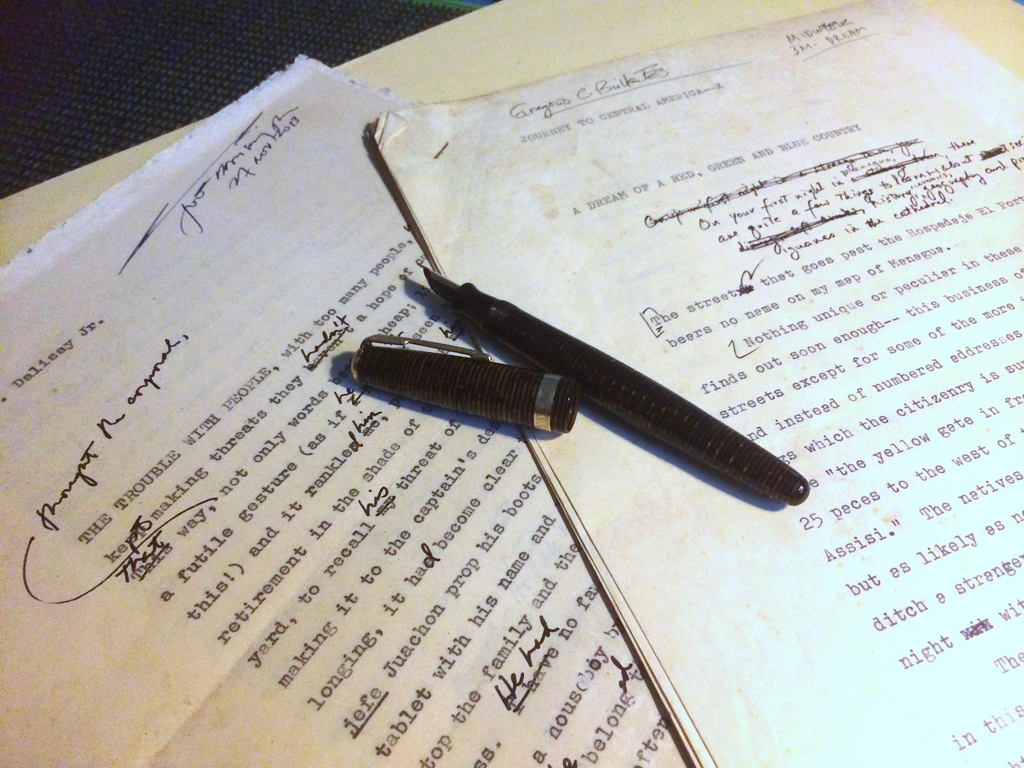
And to acknowledge how kind the Fates have been to me this year as they have been harsh to others, I will be donating a fully-functional, like-new Parker Vacumatic fountain pen from the early 1940s, in golden-pearl finish with a smooth, fine 14K nib, a pen I’ve actually written with and written about in my story “Penmanship”; although it’s about 70 years old, the pen is ready to write, and will carry a lifetime personal service warranty from me (if it ever breaks down, I’ll fix it for free). I will also be donating the signed original 11-page typescript of my 1986 short story “The Body,” with my edits on it, and re-donating one of the three Brillantes manuscripts I got in 1996, the signed, edited 6-page typescript of the essay “A Dream of a Red, Green, and Blue Country,” chronicling a visit to Nicaragua. (I’m sure Greg won’t mind; he’s one of the most generous people I’ve known, and I wish he could join us on Friday; come to think of it, if he hadn’t donated these papers to us in 1996, they might’ve joined the soggy mess that Ondoy made of his formidable library.)

Between now and Friday, we’ll expect more donations from writers (who can also donate books for the benefit book sale—it’s been a Writers Night custom to bring and toss a book into a box as a kind of admission fee). Bring your donations over to us at the UPICW in Diliman, or contact our admin officer Ronnie Amuyot at 0922-811-4449 if you need yours to be picked up. We’ll try to be as liberal with the live auction as we can—we’ll take cash, checks, and promissory notes, and you can even leave your bids with or text them to Ronnie before the auction if you’re away. We’ll display some of the choicest items at the Faculty Center before Writers Night itself.

Writers’ Night is free and open to all Filipino writers, writing and literature students, and their friends. Do come and join us at CM Recto Hall, UP Diliman, from 6 pm up this Friday; there’ll be food and drinks, and a lot of goodwill to go around.

JUDY CELINE Ick was an 18-year-old sophomore sporting a punk hairdo when we first met in Prof. Sylvia Ventura’s Shakespeare class in the early 1980s (a returning student, I was a decade older), and sharp as she was, you wouldn’t have known then that she would go on to become UP’s and one of Asia’s top experts on Shakespeare, completing a doctoral dissertation on him at the University of Massachusetts-Amherst on a Fulbright grant. I was finishing my own PhD in Wisconsin when she came over, and Judy and I would trade notes, sharing a passion for English Renaissance drama (the over-the-top theatrics of which would put your typical Viva/Regal movie to shame); but while I was just enjoying the verbiage and the swordplay, Judy’s focus on Shakespeare was deep and intense.

That focus has logically led to Dr. Ick convening the first international conference sponsored by the UP Department of English and Comparative Literature on  “Shakespeare in Asia” this Thursday and Friday, Dec. 5-6, also at the Faculty Center.

Like the old days, Judy wrote me a long note to root for her guy: “I’d really like to see our fellow academics and literary aficionados get a taste of what is a burgeoning field on the global Shakespeare scene. Asian Shakespeare is hot!—the subject of many critical collections, journal special editions, conference panels, and now even a tenure-track specialization in some of the more prestigious universities in the world.

“And why not? Around Asia Shakespeare has been produced and reproduced in the most exciting ways. Many regional theater companies continuously stage highly-imaginative versions of Shakespeare in local theater forms like Beijing Opera, Noh, Kathakali, Kabuki, wayang kulit, etc. The Japanese have elevated the Shakespearean anime and manga into an art form. (But then, of course, they also have Shakespearean manga porn (!)—itself a distinct métier.) Bollywood has produced critically acclaimed versions of Macbeth and Othello among other Shakespearean films. Even that award-winning Chinese martial arts film, The Banquet (starring your favorite Zhang Ziyi) is an adaptation of Hamlet. [Penman’s note—I’m more of a Michelle Yeoh fellow.]

“Sadly, many Filipinos are unaware of just how exciting Asian Shakespeare is. Our ability to read Shakespeare in the original, unlike many of our Asian neighbors, has proven both a blessing and a curse. While we are able to revel in the joys of the Bard’s very words, our imagination of his work has been very limited by that Englishness. Exposure to the vibrant work of our neighbors in Asia can change all that.

“A few months back, I had the surreal privilege of spending a day in Taipei with Stephen Greenblatt. We were the only two foreign guests at the inauguration of the Taiwan Shakespeare Association. He was there because, well, he was Stephen Greenblatt—eminent Shakespeare scholar, general editor of the Norton anthologies, longtime chairperson of Harvard’s English department, and author of some of the most influential literary criticism of the twentieth century. At some point, we got to talking about Asian Shakespeare and I was very inspired by what he had to say. ‘The Anglo-American hegemony,’ he asserted, ‘has just about played itself out and Asia is really where everything is now turning. Even Shakespeare.’

“I don’t think you’ll hear a clearer voice for the ‘Anglo-American hegemony’ in our profession than Stephen Greenblatt yet even he recognizes the coming primacy of Asian Shakespeare. I don’t think we Filipinos should get left behind because we have much to contribute. The conference is an important first step as it offers a far-reaching introduction to the field. We’ll have the top Shakespeareans from Taiwan, Japan, Korea, the US and India talking about how they play out ‘Asian Shakespeare.’ We’ll also feature films and filmed performances from India, Japan and China. Of course, Filipino artists who have boldly adapted Shakespeare will join in dialogue. The whole affair is capped off with an exciting new theater piece called ‘Have Thy Will,’ a staging of the sonnets devised and directed by Ron Capinding featuring some stellar performers—Ricky Abad, Frances Makil-Ignacio, Dolly De Leon, and Teroy Guzman. More info is available at the conference website: http://conference.up.edu.ph/shakespeareinasia2013/.”

Thanks, Judy—and this, Yolanda, is our response to you: a mightier torrent of words, a stronger companionship among writers. To quote one of my favorite Shakespeare sonnets (55), “Not marble, nor the gilded monuments / Of princes, shall outlive this powerful rhyme.”

Penman No. 71: Writers on Retreat

Penman for Monday, November 4, 2013

BY WHICH I don’t mean writers pulling back or running scared (for which, to be persnickety about it, the prepositional phrase should be “in retreat”), but rather writers doing something they need to do every now and then, if they are to produce more noteworthy novels, poems, and plays—recharge, rewind, recover, then write and rewrite, preferably in some form of isolation or seclusion.

As I reported last week, I went with a small group of writers and friends down to Palawan on the first Adverbum Retreat for Writers organized by the Chicago-based Almira Astudillo-Gilles. We stayed at Ambrosia, The Amazing Villa (which, as it turned out, is just past Puerto Princesa in Sitio Bubusawin in Barangay Apurawan, in the municipality of Aborlan), run by Herwig Gielen and his wife Theresa. The idea was to give writers some R&R while they worked on their current projects, and in this case it was in a place remote enough that we were out of text, email, and Internet contact for a week (except for literally a few moments, twice, when we drove out to another barangay and sailed out to a point about 30 minutes offshore to catch a weak cellular signal and a few messages).

Writers’ retreats—some private and personal, some institutional—have had a long and colorful history. The Huffington Post’s UK edition has a list of 19 of the more unique ones, including a rotating hut that George Bernard Shaw built in the bottom of his garden near Hertfordshire; Dylan Thomas had a boat house in Wales, Virginia Woolf a hut in Sussex, J. K. Rowling her Edinburgh café, and George Orwell a house on a remote Scottish island. And Henry David Thoreau, of course, had Walden Pond.

Rowling’s caffeinated sequestration aside, modern retreats have evolved into much more sociable residencies, where not just one but several writers inhabit a home together for some time, each with his or her own space to work on an individual project. This setup acknowledges the fact that, in most cases, writers need not only to write but also to talk, preferably with fellow writers who understand what the whole fuss over words and ideas is all about, if only for an hour or two each day before each one slinks back into his or her own burrow.

While they may engage groups of writers, a writers’ retreat or residency isn’t like a workshop, where the focus is on helping younger and newer writers with matters of craft and other professional concerns. A residency is a gathering of peers, and while socialization is encouraged, privacy is respected, and no detailed reports or submission of outputs is expected, on the understanding that mature artists will proceed and produce at their own pace, without need of overbearing guidance or monitoring.

I’ve been privileged to attend a few of these residencies—which, until we had Adverbum in Palawan, were all overseas. One of the most popular ones (at least among writers) was the Hawthornden International Retreat for Writers in Lasswade, Midlothian, Scotland, about 45 minutes by bus out of Edinburgh. More than a dozen Filipino writers have now gone to Hawthornden over the past 20 years, including the likes of Krip Yuson, Ricky de Ungria, Danton Remoto, Marj Evasco, Rofel Brion, and Eric Gamalinda, and, among the younger ones, Sarge Lacuesta, Mia Gonzalez, and Chingbee Cruz.

I went to Hawthornden in 1994, thanks to a British Council grant (you have to apply directly to Hawthornden for a fellowship, which covers board and lodging in the 15th-century castle, but it used to be, in pre-recessionary days, that the British Council provided funds for the round-trip fare). The castle has several rooms for residents, each named after a famous writer (I stayed, I think, in “Boswell”), and you get your name inscribed on that room’s door once you submit the published proof of your work after your residency. The fellowship lasts for about four weeks, and you share the castle over that period with three or four other writers from around the world. There may be more staff than fellows at any given time, and the only time you meet the others is at 6 pm, when you “foregather” for sherry before dinner. Breakfast is at your own time and pace, and lunch (usually a generous sandwich and lentil soup) is served on a tray at your door, as if you were in some exclusive prison. (There is, in fact, a dungeon-like prison beneath the tower, but thankfully no writers have had to stay there; another of Hawthornden’s features is its proximity to Rosslyn Chapel, recently made famous by The Da Vinci Code, which had yet to be written when we were visiting it.)

Rather more opulent were two other residencies I later attended in Italy: the Rockefeller Foundation’s Bellagio Center in northern Italy, near Como and Milan, in 2002, and Civitella Ranieri in 2011. Bellagio was a medieval palace turned into a villa and a haven for artists and scholars by the Rockefeller Foundation, and today it offers residencies to a broad range of academics, artists, and professionals. When I went there to work on Soledad’s Sister, my fellow fellows comprised an American architect, a Russian pianist, a British Bible scholar, a South African novelist, and a South African arms expert, among others. The batches in Bellagio were much bigger, at about ten to a dozen per month-long batch. Like Hawthornden, what it took was an application consisting largely of a proposal for a work-in-progress, and samples of one’s past work. (I should add that I failed on my first application, but made it on my second try, so nothing is ever guaranteed with these things.) Many Filipinos have also gone to Bellagio—among them F. Sionil Jose, and many in the Hawthornden group, the usual suspects—including non-artists such as lawyer Raul Pangalangan; next year, fictionist Menchu Sarmiento will be going there to work on a new book of stories.

Civitella Ranieri is another medieval castle in Umbria, just outside Perugia, but here admission is by invitation only, and it’s limited to artists (writers, painters, musicians, dancers, filmmakers, and so on). Among other Filipinos, poet Mark Cayanan and novelist Miguel Syjuco were Civitella fellows this year, preceded by artist Lan Tuazon (2012), writer Gina Apostol (2009), and musicians Chino Toledo (2004) and Ramon Santos (1999).

How productive can one get in these places? I suppose it depends on your own work habits and, in a sense, on the setup of the place and the fellowship itself. I hate to admit this as a digital junkie, but I produced the most work—four new stories and a short novel in a month—when I was offline in Hawthornden, having gone there in pre-digital times; I did write “Penmanship” on a 286-SX laptop and a floppy disk, but otherwise had no cellphone or wifi to distract me. Bellagio was good for a few chapters, but the villa’s intensely social schedule (and the overpowering beauty of the scenery) proved surprisingly less than ideal for sustained work. Civitella Ranieri resulted in 30,000 words of new fiction and final revisions on a book of poetry. And Palawan? I did final revisions on a biography, and edited several chapters for a friend’s book of travel essays.

Could I have gotten all this new work done at home, in the boonies of Diliman? Maybe. But distance strangely provides more clarity and urgency to things we take for granted in too-familiar surroundings, and a lake or an ocean to view outside one’s window can only help the imagination and refresh both body and spirit.

LET ME take this opportunity to acknowledge and to thank another of our Palawan sponsors, aside from Cebu Pacific—the Hotel Centro in downtown Puerto Princesa, where we stayed for the final night of our getaway. I’ve been to Puerto often, and can say that this new 111-room hotel is one of the city’s finest, located close to its most important locations. The rooms are clean and well-furnished, with free wifi (a godsend after a week’s digital dieting), and a very attentive staff who can also arrange special package tours around the city and Honda Bay and to the Underground River for you. The Sicily Bar on the fifth floor is set up for meetings and conferences. We had a sumptuous poolside dinner under a tent, a perfect point of re-entry to urban living after a week of sylvan solitude. Check them out at www.hotelcentro.ph for more details and reservations.

Penman No. 61: TSE, Sir Winnie, Neil, and Other Penmen

WritersPenman for Monday, August 26, 2013

A FEW months ago, I was thrilled to read the news that TS Eliot’s pen had been lodged with the Royal Society of Literature, replacing a quill pen that had been owned by Charles Dickens and used by the society’s fellows to sign themselves into the exclusive club. Now based in Somerset House in London, the society counts some 500 fellows among its members, and not surprisingly these have included some of British literature’s most illustrious names both ancient and modern, from Yeats to Rowling. (Fourteen new fellows can be elected to the society every year; they need to have published at least two outstanding books and gained the acclaim of their peers.)

The story, according to The Guardian, was that Dickens’ quill pen had understandably lost its sharpness, and that a replacement was therefore in order (members can also choose to use Lord Byron’s pen, reportedly still in fine shape). Eliot’s widow (his second, actually) Valerie had just died in 2012 and had willed his pen to the RSL, making the turnover possible. (Before we leave the subject of quill pens altogether, let me note that these medieval tools took a lot more to make than pulling big feathers from the butts of geese, including tempering in hot sand and sharpening with what came to be logically known as a pen knife.)

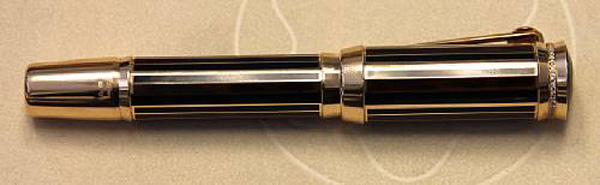
It took some Googling before I found a picture of Eliot’s pen, which was never identified in the news stories (picture above courtesy of The Telegraph). From what I knew of vintage pens, it was a Waterman in black hard rubber with two wide gold bands, on one of which was inscribed Thomas Stearns Eliot’s initials. It had been a gift from his mother Charlotte; Eliot had moved to England from the US in 1914 when he was 25, so the pen, which dates to that period or a little earlier, might have been a parting gift.

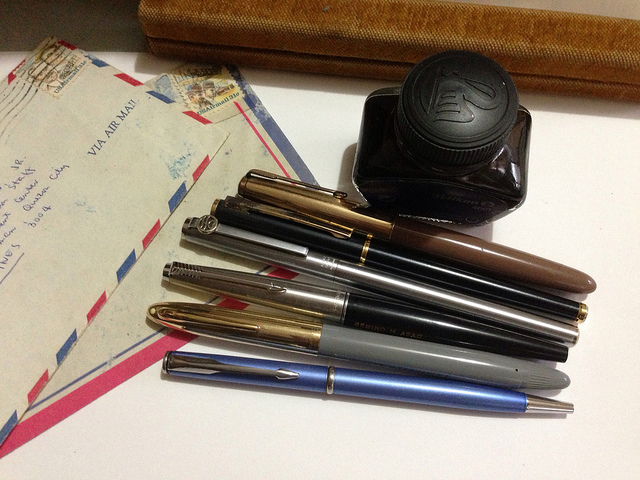
I remembered Eliot’s pen over last week’s rains when, with nothing much else to do at home (that’s not quite right—I always have something to write, but am a horrible procrastinator), I took out my pens for a ritual rubdown and came across a few I hadn’t seen in a long time. That was because these were special pens kept in a special corner—pens donated to my collection by writer-friends, pens they had actually used in their work. Over the years, as word got around of my fascination with fountain pens, generous friends and patrons like Don Jaime Zobel de Ayala and Wash SyCip have gifted me with lovely pens, which I continue to treasure.But the pens I’ve assiduously run after have been those of my fellow writers, especially older friends who started writing with them in the pre-computer age.

My little writers’ corner now includes pens from National Artists Franz Arcellana, NVM Gonzalez, and Virgilio Almario, as well as from dear friends and colleagues Doreen Fernandez, Jimmy Abad, and Jing Hidalgo. They range in kind from a Parker 51 from Franz and a Montblanc 220 from Doreen to well-used ballpoints from NVM and Rio. (I’m still hoping, one of these days, to be able to ask for pens from Bien Lumbera, Frankie Jose, the late Tiempos, and Greg Brillantes, among others.) Needless to say, these pens will never be sold on eBay. If and when we open a Writers’ Museum, or at least a permanent display like they have at the National Library of Singapore, I might consider loaning or passing them on, but for now they’ll stay with me in my man-cave, feeding my fetishist longings alongside books signed by Nick Joaquin, Jose, Brillantes, Bienvenido Santos, JM Coetzee, Frank McCourt, Kazuo Ishiguro, Junot Diaz, and Edward Jones. (Some of these—the non-Filipino ones, excepting Junot’s—I wouldn’t mind putting on the block someday.)

Before typewriters and word processors made everybody’s writing look like everybody else’s, writers and their pens enjoyed a special relationship, some more so than others.

Mark Twain, a friend to Filipinos in his staunch opposition to American imperialism, preferred the Conklin Crescent Filler, a pen that used an inverted half-moon of gold to press down on the rubber sac in the barrel to release ink. It was a very popular filling system in its time and Twain became something of a poster boy for Conklin, so when the company was recently revived (like so many other long-dormant pen makers, on the heels of a neo-traditionalist trend boosting fountain pen sales), it named its flagship pen what else but the Mark Twain.

But Twain’s popularity never came close to that of British Prime Minister Winston Churchill, who was reported to have used a Conway Stewart—a venerable British brand recently revived—through the dark days of the war. So formidable a figure was Churchill that not only Conway Stewart but Montblanc and Onoto have also come out with pens in his honor.

Onoto—another British pen maker, associated with Thomas de la Rue which used to print our banknotes in the pre-BSP days—also claimed Sir Winnie among its famous users. In the age before paid celebrity endorsements, catching someone popular using your product was good as an endorsement, and was free besides. The minders of today’s Onoto have come up with incontrovertible proof—a letter sent by the young Churchill in November 1915 to his wife Clementine from the trenches in France, where he talks about “the venomous whining and whirring of the bullets which pass overhead.” But the clincher for the company was the ending: “Send me also a new Onoto pen. I have stupidly lost mine.”)

Speaking of the French, Fountain Pens: History and Design quotes the French theorist Roland Barthes waxing ecstatic over his pens: “In the end, I always come back to fountain pens. The important thing is that they can ensure the graceful handwriting I care so much about…. I have too many fountain pens and don’t know what to do with them. Yet, as soon as I see one, I can never resist buying it.”

There’s probably no more famous user of a fountain pen today than Neil Gaiman, who employs quite a range of them, from among the 40 to 50 he reputedly owns—a TWSBI, a Pilot, a Lepine, a Delta, and a Visconti, among others—not just to sign books but to actually write his novels with. He lives, he says, in “a house full of Macs” and is a self-confessed iPod freak, but he told the BBC that, with pens, “I found myself enjoying writing more slowly and liked the way I had to think through sentences differently. I discovered I loved the fact that handwriting forces you to do a second draft, rather than just tidying up and deleting bits on a computer. I also discovered I enjoy the tactile buzz of the ritual involved in filling the pens with ink.”

Pen addicts (the fancy name is “stylophiles”) can never have just one pen to use, so we prefer to talk about “the rotation,” that merry-go-round of favorites we keep constantly inked and polished, ready to be taken for a ride. There’s a lot of debate in the group over whether one should carry one’s most precious pens; I’m of the school that believes that life is short and runs ever shorter, so that fine pens, like Rolexes and Patek Philippes, should be carried with pride and reasonable care. I can’t tell you how many pens I’ve lost in my practice of this carpe diem philosophy, but I have no regrets.

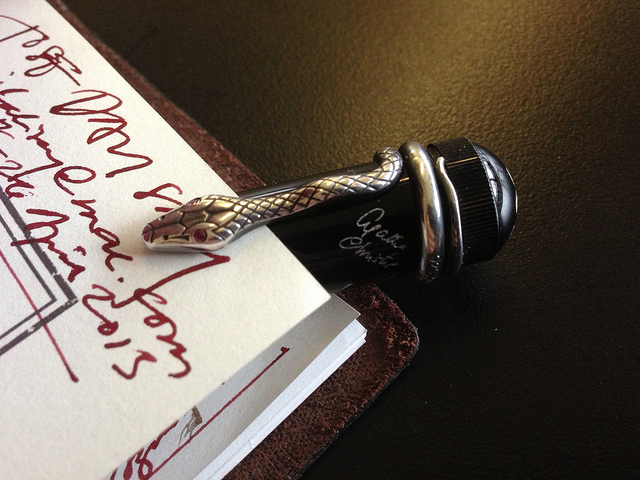
These days, my most faithful pocket companion and favored pen in hand is a 20-year-old Agatha Christie, a largish black pen with a clip in the form of a sinuous snake, a tribute to its exalted namesake and her penchant for mystery. This gorgeous pen has written nothing more noteworthy than, well, notes, but having it in my pocket puts a lift in my step, and even doodling with it puts me in a trance, poised as it were to write until its cache of ink (either Rohrer and Klingner Sepia or Diamine Oxblood) runs dry.

Agatha

In these digital times, of course, hardly anyone except Neil Gaiman really writes stories and novels with a pen anymore, and even this piece is being written on a MacBook Air, which is threatening to croak any minute now for want of juice. That was the beauty of the pen, a writing instrument you could pop into your pocket and pull out as the inspiration or necessity struck you, batteries and brownouts be damned. I’m sure that Tom, Mark, Winnie, Roland, and Neil would wholeheartedly agree.

Penman No. 49: To the Writer at 25 (Part 2)

John and ChristinePenman for Monday, June 3, 2013

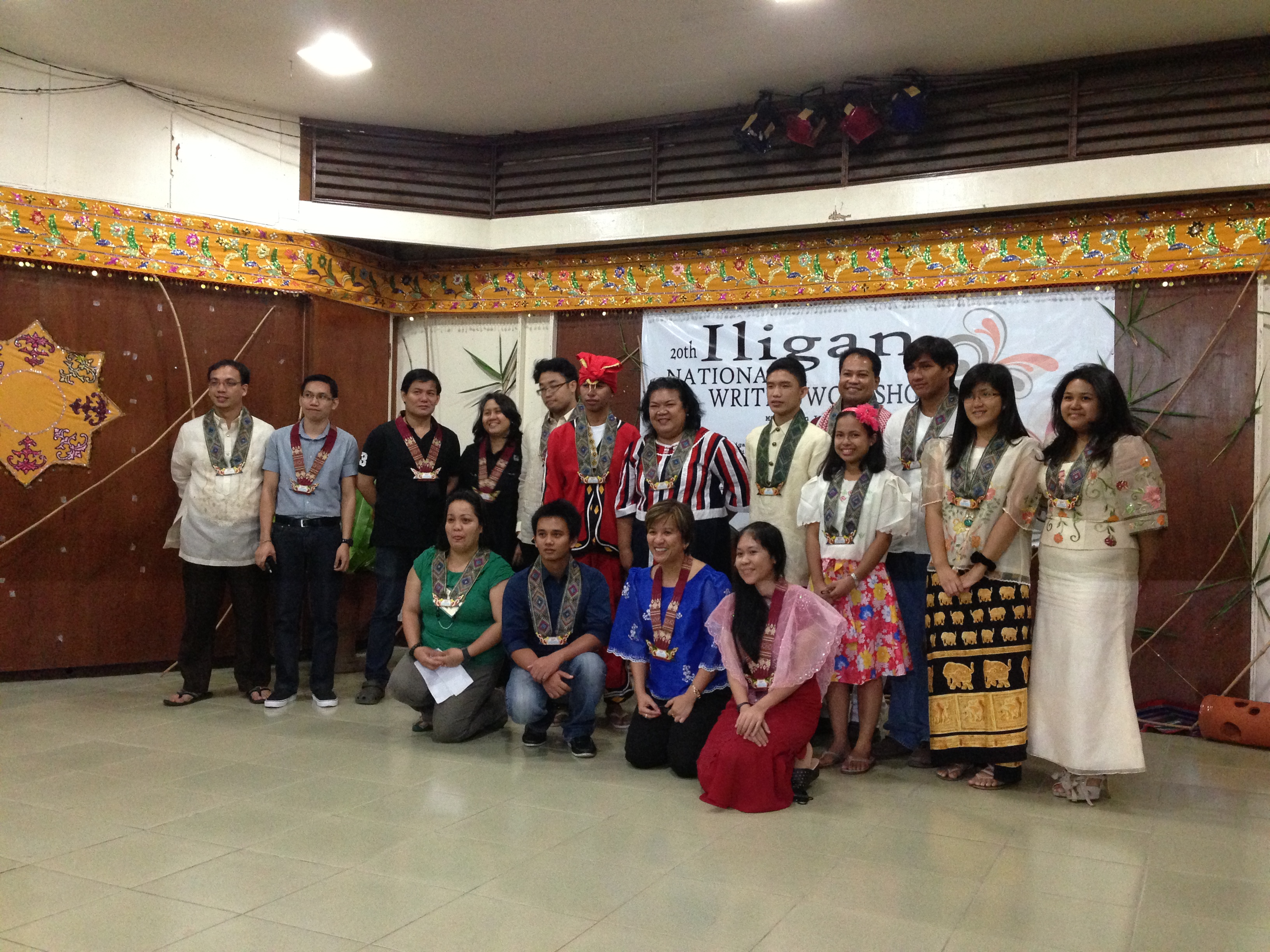
TO CONTINUE from last week, here’s what I told my young audience at the 20th Iligan National Writers Workshop (that’s them in the picture above, with panelists John Iremil Teodoro and Christine Godinez-Ortega in the foreground) at the MSU-Iligan Institute of Technology:

Writing in The Atlantic a few years ago, Max Fisher addressed the question of age and artistic productivity. “When in life are we most creative?” he asked. “Do we peak when we are young and energetic, or old and experienced?” Fisher brought up three answers, each with its own champion.

First, he suggested, “We peak young.” He quoted Kazuo Ishiguro—who incidentally is my exact age, born 1954—who said: “There’s something very misleading about the literary culture that looks at writers in their 30s and calls them budding or promising, when in fact they’re peaking.” According to Ishiguro, he had been “haunted by the realization that most of the great novels had been written by authors under 40.”

Second, “We peak in middle age.” Fisher cites a psychologist from UC-Davis who established that while “poets and physicists tend to produce their finest work in their late 20s… geologists, biologists and novelists tend to peak much later, often not until they reach late middle age…. Unlike poets, who peak early and fade quick, fiction writers tend to ripen and mature with age.”

Finally, says Fisher, “We peak old (sometimes).” Here he falls back on Malcolm Gladwell of Tipping Point fame, who points out that “Some poets do their best work at the beginning of their careers. Others do their best work decades later. Forty-two per cent of Frost’s anthologized poems were written after the age of fifty. For Williams, it’s forty-four per cent. For Stevens, it’s forty-nine per cent.”

I myself suspect that, with enough research, we can come up with all kinds of numbers to support any one of these propositions. There will always be the prodigious Marlowes and Poes and Rizals and Plaths who will streak like a comet across the night sky in their 20s and 30s—and perhaps not incidentally die soon after. Some writers, even if they live long, will produce a burst of brilliant work in their early years, and then drop the pen, or be little heard from again.

Paz Marquez Benitez published the classic “Dead Stars” when she was 31, and Angela Manalang Gloria came out with her book of poems, which she would be known for, at 33—but they would forever be those 30-somethings and no older in our literary appreciation. Nick Joaquin published his first poem, “The Innocence of Solomon,” at 20, “May Day Eve” when he was 30, and “Portrait of the Artist as Filipino when he was 34, but The Woman with Two Navels wouldn’t come until he was 44, and of course he continued writing and publishing practically until his death at 86 in 2004. NVM Gonzalez was 26 when he published The Winds of April in 1941; he was 43 by the time he wrote “Bread of Salt” in 1958, and 46 when he published The Bamboo Dancers in 1960. And like Joaquin, Gonzalez demonstrated longevity, working well into his last years. Speaking of longevity and sustained production, we have Leo Deriada and Tony Enriquez, plugging away, I’m sure, at another prizewinning novel or story, as they’ve been doing all these decades.

We’ll see, however, that most of our best writers, especially those who lived past their 70s, produced their most memorable work between their 20s and 40s. Rarely have we found a Dostoyevsky, who published The Brothers Karamazov four months before he died at 59 (my present age). Jose Garcia Villa’s writing might as well have ended with the comma poems of Volume Two in 1949, although he lived for nearly half a century more. Franz Arcellana’s literary legacy really lies in Selected Stories, published in 1962 when he was 46; I know of no more stories that he wrote until his death 40 years later in 2002.

You can draw your own conclusions and prescriptions, but this is mine: write what you can when you can, the sooner the better. The best time to write that story or that poem in your head is today, not tomorrow, and never mind if it turns out to be bad, because that’s what tomorrow is for, for the insightful and merciless and inspired revision that separates the mediocre writer from the truly talented and committed.

Of course I should also say that to writers of my generation, with a slight difference: write what you can while you can, because tomorrow may not come around. Today we live in an intensely youth-oriented culture, and some days it may seem like only the young get all the attention—which they deserve—but we are not in competition with them. Rather we are competing with ourselves, with time itself, and with the ages.

Now, what would I do—or what would I advise a writer to do—if I were 25 today?

1. Focus on your first book. If you write only one book in your life, then this will be the most important thing you will leave behind, not counting your children—or maybe even counting them. Your first book will be even more important than an MFA or your MFA thesis, which, truth to tell, no one but your defense panel will read. Some students I know dithered for years in a vain attempt to perfect their MFA or PhD thesis projects. For me, much of that was wasted time. Do a thesis worthy of passing—and then spend time cleaning up the text and shaping it into a reader-worthy book, a book with your name on the spine. And of course there are good books and bad books, and some days you wish an awful author had desisted from publishing and spared a few trees. But you’ll have to take your chances and get that bad first book out of the way, or you’ll never get to your good second one.

2. Focus on your second book. Your first book will likely have expended everything you’d always wanted to say. So now, what? Once you’ve mined your own young and unavoidably angsty life for material, what’s left for you to write about? Why, the world of course, although that world may seem awfully small at 25, especially if you haven’t been looking too closely at anyone but yourself and your friends. The real challenge of writing for me isn’t writing about oneself—which is, admittedly, an inexhaustible subject, a continuing mystery—but about strangers, whom the writer then makes as familiar as oneself. That’s what the best writers have done—perform great acts of invention, of transport, of sheer imagination. You have to believe to believe that there is more than one book—indeed, more than one life to plumb—in you.

3. Attend a workshop or two, but learn to hunker down and to work on your own. Young writers today seem enamored of workshops, and that’s understandable to a point, as writing is among the loneliest of labors anyone can assume, and the young writer will need the affirmation and the comfort of the company that workshops provide. But workshops can’t be a crutch; life isn’t an eternal summer where you can keep tinkering with a draft in the hope that someone out there in some workshop will finally like it. Past your second or third workshop, keep the workshop in your head, and begin to write, in productive solitude, in the silent company of your presumptive fellows—Chekhov, Rilke, Salinger, Joaquin, Alfon, Gordimer, Lahiri, or whoever moves you to do as they did.

4. Stop arguing, and leave the polemics and the criticism to others. You don’t have time for that, and it can distract you from what you should be doing, which is writing more of your own work. While criticism can help clarify our own aims and means, these debates can sap too much of a writer’s psychic energy, energy one needs for his or her own poetry.

5. Lastly, listen to old fogeys like me, and listen closely—but make up your own minds, make your own mistakes, and don’t be afraid to make them, or you’ll never get anything right. Not everything you write will be a work of genius; indeed, much of it will very likely be immemorable. But if you endeavor to write well and to write enough, sooner or later, that masterpiece you might be remembered by will come. Desperate to earn a living from his writing, Chekhov wrote more than 200 stories in his lifetime; except for the most devoted fan, no more than a dozen of these stories will be familiar to us as classics. But he would not have come up with that glittering dozen if he hadn’t written 190 other less worthy pieces. So nothing is ever wasted in writing. Your misfires and your false starts are part of your investment in the enterprise of a lifetime.

Would Rizal be Rizal without the Noli and the Fili and Mi Ultimo Adios? Perhaps, but he would be a diminished Rizal, whose martyrdom would have lost much of its resonance. Will it be sacrilege to suggest that we admire Rizal less for his actions than for his writings? Were his writings not, in fact, largely his deeds? In any event, they are what live on—what he wrote at 25 and in the few years left to him after that.

As Hippocrates put it so well, “Ars longa, vita brevis,” often transposed into “Life is short, but art lives long.” May we all write something worthy of surviving us—the sooner the better.

Penman No. 48: To the Writer at 25 (Part 1)

INWWPenman for Monday, May 27, 2013

LAST WEEK, it was Iligan’s turn to host me, among other writers, for the 20th National Writers Workshop under the auspices of the MSU-Iligan Institute of Technology and the National Commission for Culture and the Arts, and I was honored to deliver the keynote, which I’m excerpting this week and next. Here’s what I said:

It’s always a pleasure to be in the company of friends and comrades in the profession, including many luminaries of our national literature who happen to be based in the Visayas and Mindanao. I’m especially glad to be addressing our young fellows, for whom I wrote this talk, for special reasons that will be shortly clear. In fact, I’ve decided to title this talk “To The Writer at 25,” aimed at writers of that age, give or take a couple of years.

Why 25? Let me cite a statistic that, depending on how you take it, could either be empowering or overpowering. It’s a figure that’s been there all along but which no one seems to have thought about too much, probably because no one really knew what to make of it or recognized its potential significance.

And here’s that fact: Jose Rizal finished writing Noli Me Tangere in December 1886 and published it by March 1887. At that point, he was still no more than 25 years old.

Rizal had less than ten years to live after that. But by the time he was executed by the Spaniards in 1896, he had written two novels and parts or fragments of five more, as well as dozens of important essays and poems.

Think of that for a minute—the Noli by age 25, the Fili by age 30, and a lifetime’s work by 35. If only for these, then—at least in my book—Jose Rizal does deserve to be a national hero, and not incidentally a National Artist.

Those of us who are now far north of 25 might recall what we were doing at that age. We may have been already writing by then—I know I was—but I doubt that we were laboring at or even thinking about a Noli, or even a novel, at that time.

At 25 I was married and a father, and I’d won a few literary prizes, certainly not enough to convince me or anyone else that I would go on to any kind of greatness, but enough to suggest to me that the rest of my life would be inscribed by literature, that I would do well to take it seriously, for better or for worse. I was out of school, and I had not even gone to my first writers’ workshop, but I knew, in my blood and bones, that I would go on to write more and more things, as inchoate as those things were to me then.

Indeed, for most of us not named “Jose Rizal,” 25 seems to be a good landing on the steps, a firm pre-departure point for a future in writing. Interestingly enough, in his famous essay “Tradition and the Individual Talent,” published when he was 31, T. S. Eliot specified 25 as the age by which one should have made some crucial commitments—among them, an embrace of tradition or “the historical sense, which we may call nearly indispensable to anyone who would continue to be a poet beyond his twenty-fifth year.”

It wasn’t even at 25 but a few months after turning 24 that Fyodor Dostoyevsky published his first novel titled Poor Folk, now nearly forgotten in the wake of his greater and more mature work but a critical and commercial success in its time. In fact, so intent was Dostoyevsky on pursuing a literary career that he published his second novel, The Double, a month after Poor Folk.

Edgar Allan Poe was even more precocious, publishing his first book of poetry at 18; he had three collections of poetry by his 22nd year, and turned to prose at 24, winning a prize for his story “MS. Found in a Bottle.”

Eighteen was also the age when Sylvia Plath published her first story in Seventeen magazine, in 1950; that year, she wrote in her journal: “I can never read all the books I want; I can never be all the people I want and live all the lives I want.”

I could go on and on, about this and that writer having written this and that work at this and that young age, but you catch my drift. While there may be no real prodigies in writing, there have been, on the other hand, many precocious people who began producing significant work around their 25th year.

I bring this up because, as I prepare to embrace seniorhood in a few months, I find myself often asking if I have written enough, if I were to keel over tomorrow. But enough for what? Perhaps the more accurate question would be, did I write enough of what I could, when I could? What does age have to do with output and insight?

This is what I’d like to talk about a bit this morning, this relationship between age and productivity in creative writing. I would have liked to say not only in creative writing but in the other arts as well, but this is where writing perhaps differs the most from music, painting, and so on. As I’ve often pointed out before, true prodigies don’t exist in literature, unlike in music or mathematics—no Mozarts who can write full symphonies or Ramanujams who can solve complex equations at a preciously tender age.

We don’t find full-blown adult novels written by eight-year-olds, which was Mozart’s age when he composed his Symphony No. 1 in E Flat Major. Prodigies also abound in painting—The Huffington Post lists at least ten of them, one of whom, nine-year-old Kieron Williamson, recently sold 24 paintings worth almost $400,000 in one month and was reported to be preparing for a retrospective—yes, a retrospective.

Why don’t we have a Brothers Karamazov or even a Gone With the Wind written by a third-grader? The reason is obvious: writing involves more than vocabulary; it requires social experience, which can only come with growing up.

Even so, Rizal did an awful lot of growing up very quickly to be able to dish out the Noli and Fili by his 30th year.

It was in my 30th year, in 1984, that I came out with my first book, Oldtimer and Other Stories. Throughout the mid-to-late 1970s, my officemate and I, the late playwright Bienvenido “Boy” Noriega Jr., then both in our early 20s, had carried on a fierce but friendly competition in the arena of playwriting. I drew first blood, with a first-prize win over Boy’s second place in the 1976 CCP Playwriting Competition—our mutual teacher in playwriting, Prof. Amelia Lapeña Bonifacio, came in third—but that was the first and last time I won over Boy, over many CCP and Palanca competitions that followed. As a result, I shifted from playwriting in Filipino to the short story in English, where I felt I was safe from Boy. But in the meanwhile, we made another friendly dare—to come out with our first books by our 30th year. As it happened, we both made it—barely: he published Bayanan-Bayanan at Iba Pang Mga Dula in 1982, after turning 30; I published Oldtimer in 1984, a month before turning 31.

I recall these things because I also recall the intense awareness of age and time that accompanied our writing then. We felt under the constant pressure of a deadline—and I don’t mean just the Palanca deadline, although that was mightily important to us then, at a time when there was very little publishing going on, and competitions were literally the only game in town. Ours, after all, was the generation of the First Quarter Storm, of a brave but bloody activism that saw many of its acolytes fall at the steps of the altar in their teens and early 20s. If there was anything important we wanted to do—like write a book, or get married, or father a child—we had to do it sooner than later, because life was very likely going to be short, if not nasty and brutish.

Of course we will never really know how long we will live or when we will die—that remains life’s greatest mystery, and it’s still with some astonishment that I realize I’ll be turning 60 in January—so we really can’t tell when our most productive years will be, or when we’ll write the piece that we will hope to be remembered by. (Conclusion next week.)

Penman No. 36: Literary Networking

3288650777_5fbf76ee05_z

Penman for Monday, March 4, 2013

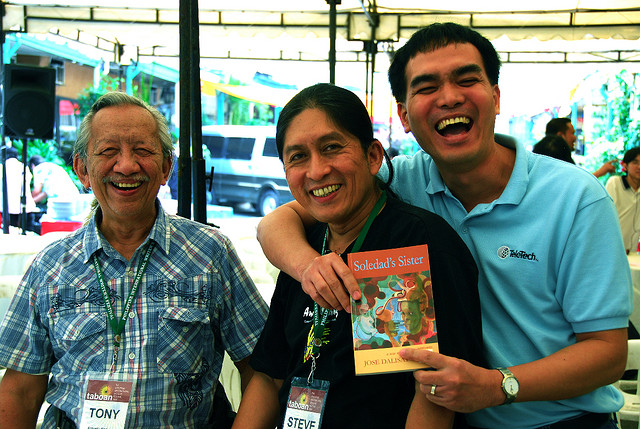
AT THE recent Taboan Philippine Writers Festival held in Dumaguete last month, I sat on a panel devoted to the topic of “Literary Networking,” which deals with how writers come into contact with one another and with other people in the profession—publishers, editors, agents, and, of course, readers, teachers, and critics—to improve and to promote their writing.

In my column two weeks ago, I noted how writing can be one of the loneliest if not most thankless endeavors anyone can undertake, especially in a country where writing is considered to be little more than a hobby. Networking helps reduce that sense of isolation and creates communities of writers and other literary professionals who are all looking for that same one thing: the next great read. So today I’m going to list down some of the most effective ways of literary networking, hoping that our writers, especially the young ones, can avail themselves of these venues to extend their reach.

School. As every high school graduate knows, friendships forged in school tend to be stronger and last for life. The university is where most writers decide to become writers and find that they’re not alone in their love of words. The bonds that lead to what some critics would call “cliques” and “cabals” start naturally in school, and may even be formalized in groupings such as the famous pre-war Veronicans and post-war Ravens at the University of the Philippines. Today, literary organizations such as the UP Writers Club, the Thomasian Writers Guild, and the DLSU Writers Guild keep the flame alive on Philippine campuses. MFA programs, especially those abroad, can create larger networks, although the atmosphere in these programs tends to be more competitive.

Workshops. Related but not limited to school, workshops bring young and new writers together in what amounts to a combination of boot camp and support group. The idea behind a writers’ workshop is that collective wisdom can improve individual talent, and like most adages, this may be generally but not always true. For writers needing company and affirmation, workshops can feel like a refuge, if not a narcotic—and indeed some go workshop-hopping. For Filipino writers, entry-level and local or regional workshops and mid-career and national workshops exist—a strength unique within the region.

Conferences and festivals. They may run only a few days, but they can be intense and can connect a writer to the big stars and luminaries of literature. I’ve been able to meet Nobel laureates and Pulitzer and Booker prizewinners in these events, and while such contacts may be fleeting—I have no illusions about these worthies remembering me the day after—they can be tremendously inspiring to newer writers, and also demystify the literary gods and make one feel a fundamental commonality with others around the world. Conferences and festivals also have much more value beyond elbow-rubbing and camaraderie—they are a great source of new ideas, particularly in areas that are relatively new to us Filipinos—literary editing and literary agencies, for example.

Fellowships and residencies. Fellowships and residencies involve applying for and securing grants to places that allow writers the opportunity to work in productive seclusion for periods ranging from a few weeks to a year. For many years now, Filipino writers have successfully applied for some of the world’s most prestigious fellowships and residencies—in Iowa, Breadloaf, Macdowell, Stanford (the Wallace Stegner fellowship), and Yaddo in the United States, and Hawthornden, Bellagio, Norwich (the David TK Wong fellowship), Bogliasco, Chateau de Lavigny, and Civitella Ranieri in Europe. While isolation is part of the idea, one is never entirely alone in these places, and strong friendships and professional connections will inevitably arise between fellows.

Prizes and competitions. By their very nature, prizes and competitions tend to divide rather than unite people, but writers at their best will recognize and admire talent in the other, and so these venues also become fertile ground for networking. They also bring other important elements into the picture—agents, publishers, and critics, who take note of the winners and help them on with their careers. In this regard, I’m happy to acknowledge the fact that my being shortlisted for the Man Asian Literary Prize some years ago was probably the most significant single boost for my literary career. I didn’t win the prize, but the publicity helped me find an agent (or, actually, he found me) who then secured Italian, French, American, and Spanish translations and editions for my two novels. I also developed very fruitful contacts around the region, particularly with my fellow short-listee, the Chinese-Indonesian-American writer Xu Xi, who now directs the low-residency MFA program at the City University of Hong Kong.

Social media. In this age of Facebook and Yahoogroups, can writers possibly resist the urge to network online? The Internet is chock full of writers’ groups and mailing lists (see writers-network.com, for example) that allow anyone with writing aspirations to sign up.

Of course—as I’ve often been reminded—networking of any kind has its downsides. It can become intrusive (which is why I’ve obstinately refused to get on Facebook), and just as in other spheres of our lives, not everyone you meet will be friendly and benign. Some writers can be the most obnoxiously difficult people to deal with, and quite a few are better read than met. That said, it’s almost always good to hear another human voice in the wilderness, and you can’t get more human than a writer using language to explore and to prove what it means to be human.


LAST WEEK’S piece on radio provoked this lively response from a faithful correspondent, the lawyer Rem Maclang:

“Pardon me, Butch, but we never ‘return’ to radio—every now and then, we turn to it.  Even with the advent of IT, which has engulfed our daily life with a variety of novel communication gadgets long after the radio became our can’t-be-without home companion, it has never left the scene. Radio’s exalted role in the annals of our country cannot be taken for granted. It was through radio that the grim and sad but inspiring Voice of Freedom broadcast about the Fall of Bataan was heard worldwide, and [radio that announced] the return of MacArthur. EDSA 1 could not have happened within the short span of four days had it not been for radio that broadcast the announcements of Cardinal Sin and June Keithley. Radio was responsible in making our growing-up years a whole lot more enjoyable while being informative. If TV is the idiot’s box, radio is the dreamer’s delight.”