Penman No. 20: Report from Lansing

Icophil

Penman for Monday, November 12, 2012


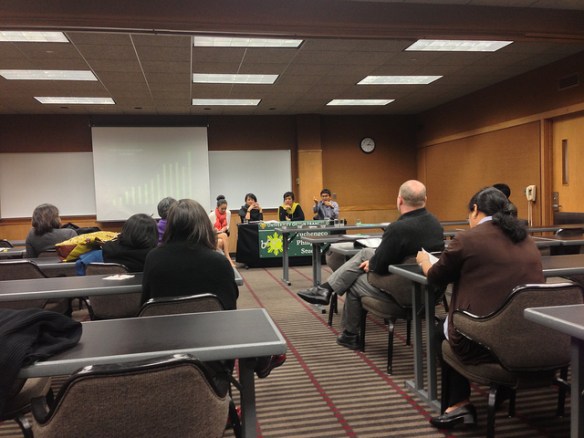
THANKS TO superstorm Sandy, which shut down nearly all public traffic on the US East Coast, my flight back to New York from Lansing, Mich. was canceled a couple of weeks ago, requiring me to stay for the last day of the International Conference on the Philippines (Icophil), where I had come to read a paper. I’d planned on leaving that Tuesday because our departure for Manila was set for Thursday, and I wanted the extra day to tie up loose ends and do some last-minute shopping with Beng, who was waiting at her sister’s in New York. But Sandy nixed all that, threatening even my flight home.

But Providence must have had other things in mind, because that last day at Icophil turned out to be a most productive one for me, in terms of making new contacts and friends and listening to provocative presentations.

Let me report, first of all, that Icophil 2012—the ninth of this once-in-four-year series—was a resounding success, with about 250 participants signing in, well over the 150 the organizers had been expecting. This means that there’s a lot of interest in the Philippines and in Philippine studies out there, not only from us Filipinos but also from foreign scholars specializing in Philippine concerns and affairs. (And if you’re wondering why, ask instead why not—given how we’re a fairly large country of more than 90 million people, living in one of Asia’s richest cultural crossroads and exporting our labor and talent to nearly every other country on the planet.) Indeed, about half or more than half of all the participants I met at Icophil weren’t based in the Philippines (from where, admittedly, going to international conferences can be quite expensive, especially without university or government support).

What were they interested in? As Icophil’s programme went, everything from archaeological digs, Pinoy boxing, and the Ati-atihan festival to the economy, indigenous peoples, peace building, and electoral reform. There’s never a dearth of subjects to be explored where the Philippines is concerned, and every door at Icophil was an invitation to a new dish at an intellectual smorgasbord. Everyone I spoke to agreed that they had a hard time choosing which session to attend, and I myself ended up walking into session rooms almost at random, imbibing whatever was on offer to get the full range of things.

I learned a lot by listening to Jay Gonzalez—who teaches political science while also serving as an assistant boxing coach at the University of San Francisco—talk about how he used boxing as an entry point to introducing his students to Filipino and Asian values and attitudes. Robert Balarbar of the National Museum explained the intricate process by which he and his team restored Botong Francisco’s “The Progress of Medicine in the Philippines,” a painting now hanging at the Philippine General Hospital. Robin Hemley of the University of Iowa undertook his own investigation of the controversy surrounding the alleged discovery of the Stone Age Tasaday tribe in Mindanao in 1971—a discovery soon denounced by critics as a hoax—and came to the tentative conclusion that the truth was probably somewhere in between the claims of both believers and naysayers. Sharon Delmendo, a professor at St. John Fisher College in New York who has written extensively about Philippine-American relations, shared the early fruits of her recent research on the “Manilaners”—Jewish refugees from Nazi persecution who found refuge in Manila under the auspices of President Manuel Quezon. Her findings were supported by film footage and interviews put together by independent Fil-Am filmmaker Sonny Izon. Speaking of film, award-winning director Nick Deocampo closed the conference with a screening of his brilliantly animated new documentary on American influences in Philippine cinema.

I’m becoming something of a recluse the older I get, but Icophil—and that extra day—reminded me of how valuable and important it was to keep in touch with fellow academics, particularly those engaged in significant and interesting research that very few other people can be expected to undertake. That’s the burden of scholars and scholarship: their concerns may seem obscure if not downright silly and useless to more practically oriented people, but their ultimate service is to help us better understand ourselves.

They don’t do our thinking for us so much as lay out possible ways of thinking about a problem or situation like migration, conservation, or resource management. I’m fairly sure that many scholars would make lousy executives (although this has been resoundingly disproved in some cases), but their insights into human and social behavior, not to mention their understanding of the physical and natural world, help politicians and businessmen make smarter decisions (unfortunately, not always more socially beneficial ones).

At Icophil, over the farewell dinner that I would have missed had I left on schedule the day before, I also had the pleasure of meeting Stephen Feldman and Mario Feir, who together run Asian Rare Books (www.asianrarebooks.net) from One McKinley Place in Global City. ARB had operated in New York City for over three decades before moving to the Philippines, where Stephen and Mario oversee an incredible, multi-thousand-volume collection of rare books. It’s accessible by appointment only, and I fully intend to avail myself of their kind invitation to visit them one of these days.

To digress a bit, I had one more reason to be rushing home to the Philippines, notwithstanding Sandy. As a shameless, diehard ‘60s liberal, I’m a big Obama fan, and wanted to see him re-elected. But I seem to have had a personal history with American presidential elections: I was in the United States on my first visit when Ronald Reagan won in 1980, and there again as a grad student when George Bush the Father won in 1988. In 2008, I was also in the US on a family visit, but left just a few days before the election, and Barack Obama won. Call it a voodoo jinx, but I knew I had to be out of there before November 6 if I wanted my guy to win. And that’s what happened—Beng and I managed to fly out of JFK on November 1, a day after the airport reopened. Barack, you owe me a big one.

Penman No. 19: Autumn in New York

Penman for Monday, November 5, 2012

I FIRST visited New York 32 years ago, as a young man on his first trip abroad, and I can still remember the convulsive thrill that I felt as I peered out the window of my plane from Detroit and saw Manhattan’s spires rising toward me, to the accompaniment of a Gershwin tune.

At the same time, I looked at New York with not a little dread, both because of its sheer immensity and also its fearsome reputation for harboring mobsters and hucksters. While I marveled at the Christmas lights of Rockefeller Center, I also saw Times Square and Bryant Park at their worst, long before Rudy Guiliani came in with a broom, and 9/11 lent the city the kind of composure that comes with tragedy.

I’ve been back many times since—with my mother, daughter, and sister, and Beng’s sister living in the US, we try to visit every year—and over the years, I’ve slowly learned to trust if not to love this mother and mentor of modern cities, holding my wariness in check just long enough to let New York’s many and unexpected charms seep through and permeate my senses.

It’s a tired cliché by now, but while I go to my sister’s place outside of Washington, DC for rest and recuperation, I go to New York for the energy and the excitement, for the buskers in the subways playing everything from Vivaldi to That’s Amore, for Paul’s Burgers in St. Mark’s Place, for the two lions guarding the library (Patience downtown, Fortitude on the uptown side), for the $6/lb. Chinese takeouts, for the Art Deco flourishes nearly everywhere you look, for the Housing Works resale shops, for the discounted Broadway tickets, for the Sabrett’s hotdogs on the sidewalks, for the muscular subway, for the parks that sprout up amidst brownstone and cinderblock, for the warren of words that’s the Strand, and, of course, for the translucent glass stairway leading down to the reverse-heaven of the Apple Store.

New York can have the newest of the new—think of the iPhone 5 and the iPad mini—but oddly enough, what Beng and I enjoy most on our New York visits is seeking out old treasures (or what might be junk to most other people) in the thrift shops of 23rd Street and the flea markets of the Upper West Side and Hell’s Kitchen. Sometimes these treasures even come free, shamelessly dragged in off the street on my sister-in-law’s block in Forest Hills, like that miniature wooden Christmas sleigh that I salvaged last week off the top of a pile of detritus (the polite Roman word, I think, for garbage).

Inevitably, despite our absent intentions, every visit brings something new. Two years ago it was the magic of dusk in Coney Island, at the very end of the F subway line and, it seemed, of New York itself, so serene was that velvet hour with the amusement park’s fun machines in off-season repose. This year it was a day trip we took by train to a small village called Cold Spring, up the Hudson River, after learning that it hosted a cluster of antique shops and was a good place to catch the fall colors, besides.

It did not disappoint on either count; autumn declared itself resplendently for most of the 90-minute ride along the ribbon of the Hudson, and exploded in brilliant yellows and reds on our arrival in Cold Spring. As Beng and Mimi scoured the shops for old buttons, bottles, and trinkets, I strayed into a shop with a small door that turned out to be a huge warehouse of vintage knickknacks—among them, a lovely black hard-rubber-and gold Conklin ladies’ pen from around 1920 and a marbled Parker Vacumatic desk pen from 1935. Having earlier picked up a Waterman silver-overlay pen and a contemporaneous brass inkwell from 1915 at the Greenflea Market on the Upper West Side, I pronounced this trip sufficiently penworthy, and contented myself for the rest of the day with photographing the Hudson’s color-washed banks.

Another novelty on this trip was my first walk into and across the heart of Central Park, which I had somehow never done in three decades of visiting New York. All that time I had contented myself with reconnoitering the fringes of the park, forewarned by a score of movies and CSI New York episodes about the demons and dangers lurking within. On the Saturday that we crossed the park on our way to Greenflea, we met nothing more dangerous than sprightly squirrels and latter-day hippies channeling John Lennon in Strawberry Fields, the corner of the park across the Dakota Apartments, where Lennon lived and was shot dead (a few days after I left New York on my first visit there in 1980). And how can you walk across Central Park without (again) George Gershwin, Simon and Garfunkel, Barbra Streisand, and Liza Minnelli performing in concert in your dreaming head?

We had earlier visited the 9/11 Memorial downtown, where the Twin Towers used to stand; last year it had been under construction—and still was, to some degree, as the museum within has yet to open. But the two large reflecting pools were already in operation, acting like four-sided waterfalls whose constant flow—broken only, when we looked, by an almost unbearably theatrical rainbow—seemed to represent a perpetual dousing of the fires that burned the towers down, a cleansing of the evil and the ill will that came before and after the event. I had also been there in 2001, a few months before 9/11, and had seen the towers—had even gone up to the top of one of them on an earlier visit—but had no personal connection to the place. Still, I paused when I caught a name—one of almost 3,000 names etched deeply into the bronze railings around the pools—that was unmistakably Filipino: “Ronald Gamboa,” who turned out to be a 33-year-old Fil-Am, a manager at The Gap who died as a passenger on UA 175, one of the hijacked planes.

In yet another unintended irony, I’m writing this paean to New York from Lansing, Michigan, where I’m attending a conference and from where I’m supposed to fly back to JFK tomorrow and then back home to Manila on Thursday—but can’t, because New York and much of the American East Coast has been shut down by super storm Sandy, and I’m effectively stranded. If I can’t get back to JFK by Wednesday, I’ll have to rebook my Manila-bound flight, and stay in New York a little longer. That’ll be mildly annoying—but I can’t wait to spend a bonus weekend in Manhattan, poring over heaps of junk at the flea market, in quest of that golden glint that could be the clip of a 1936 Parker Vacumatic Oversize, one that George Gershwin himself might have scripted a tune or two with.

Penman No. 17: Another October, Another Michigan

Penman for Monday, October 22, 2012

LIKE I mentioned last week, I’m in the US to visit family and to participate at the International Conference on the Philippines (Icophil), which is taking place Oct. 28-30 at Michigan State University in East Lansing, Michigan.

Dealing with all aspects of Philippine Studies, Icophil happens every four years, and it’s been held around the world—mainly in the US and the Philippines, but also in Australia and the Netherlands; the upcoming conference in Michigan will be the ninth. Icophil’s international reach reflects not only the global Filipino diaspora, but also the growing interest and engagement of non-Filipino scholars in Philippine affairs. While most participants still come from the Philippines, a significant number of speakers and panelists come from foreign universities.

Icophil also provides scholars an opportunity to assess the state of Philippine Studies around the world, in a roundtable organized by Prof. Belinda Aquino of the University of Hawaii at Manoa, who is Icophil’s founding chair. Convenors for this year’s conference are the eminent scholars Dr. Roger Bresnahan of MSU and Dr. Bernardita Churchill of UP.

Aside from us Filipinos, this meeting will bring together Filipinists from the US, Japan, Singapore, Thailand, Australia, France, Russia, Spain, and the Netherlands. By institutional affiliation, the confirmed Filipino participants will include Jose Buenconsejo, Marilyn Canta, and myself (UP Diliman)); Filomeno Aguilar, Jr., Czarina Saloma-Akpedonu, and Lisandro Claudio (Ateneo de Manila); Paul Dumol and Clement Camposano (University of Asia and the Pacific); Raymundo Rovillos (UP Baguio); Teresita Ang See (KAISA); Nick Deocampo (Center for New Cinema);  Genevieve L. Asenjo (DLSU); Hope Sabanpan-Yu (University of San Carlos), Kristian Cordero (Ateneo de Naga); and Prisciliano Bauzon (University of Southern Mindanao).

Icophil 2012’s keynote speaker will be an international expert on climate change, Dr. Rodel Lasco, Senior Scientist and Philippine Program Coordinator of the World Agro-Forestry Centre (ICRAF) and Affiliate Professor, UPLB School of Environmental Science and Management. A recipient of the Outstanding Young Scientist Award in 1997, Dr. Lasco has been a member of the Intergovernmental Panel on Climate Change since 1999. In 2009, he was elected to the National Academy of Science and Technology of the Philippines.

Trailers for two new and interesting documentaries will be shown: one by MSU Prof. Geri Alumit-Zeldes on the two Filipino nurses who were wrongly convicted for murdering their patients in Ann Arbor, Mich. in the mid-1970s, and another, by filmmaker Sonny Izon, about the “Manilaners”—Jewish refugees from the Nazi Holocaust who found refuge in Manila through the intercession of President Manuel Quezon. Filmmaker Nick Deocampo will also be showing a documentary on American influences on Philippine cinema.

The panel discussions cover a predictably broad range of topics, from indigenous peoples, the Pinoy diaspora, and peace-building to economic relations, modernization, and popular culture (one of my early favorites on the program: “Automats, Supper Clubs, Drive-ins, and Quarantined Carinderias: The Contradictions of Restaurant Culture in Post-War Manila” by Peter Keppy of the Netherlands Institute for War Documentation).

I expect to be ruffling a few academic feathers with my chosen topic, which just happens to be one of my recent areas of expertise: “The Commissioned Biography: Confessions of a Hired Gun.” I’ll be speaking less as an academic than a professional writer, and I’ll try to keep it light, but I’ll be dealing with some serious ethical and academic questions raised by the practice of biographical writing from a sympathetic point of view, as opposed to the independent and critical stance expected of the unpaid scholar. Aside from payment for the writer and PR for the subject, can there be anything to be gained from the commissioned biographies that have appeared in recent years on Philippine shelves? Can they be of any service to the academic historian, political scientist, and litterateur? My provisional answer is yes, but I’m going to have to prove my case.

I tacked on the official part of this trip to my annual vacation so it’s not costing UP anything, but I have another personal reason for going to Icophil. I’m a proud graduate of Michigan State’s archrival, the University of Michigan (MFA ’88), but it was MSU (the “other” Michigan) and East Lansing that hosted me for more than two months on my first visit to the US (and my first trip abroad) in 1980. I’d never been away from my home and family for so long, and it was here that my 30-year-plus relationship with America took off. I would even write about that first autumn—about a foray into the yellow forest in my backyard called Sanford Woods—in my first novel, Killing Time in a Warm Place (1992):

“Sandbar, Sandfar, Sanford. Sanford Woods. In the shock of autumn, the first of my life, I took a walk in Sanford Woods with Estoy. Estoy himself had arrived in the United States just the previous year to take a Ph.D. in Development Economics on a fellowship, and I took the train up to Michigan the first chance I got to leave the conference in New York. I had never stepped into a forest of red and gold before, and for the first few minutes I trod carefully on the layered ground, as though disturbing it would hurtle me back in a swirl of pretty leaves to prison camp. We let ourselves be taken in and covered by that new season: we watched the squirrels shimmy up the trunks, and, coming into a patch of pure, delirious yellow, I persuaded Estoy to pose for a snapshot he could send home to his wife Marie. He stood stiffly against the color, hands in his jacket pockets, and he muttered an oath about the cold, but his grin was true. On the way back we observed how fat the squirrels were. In Manila, Estoy said, they’d be roasting on a spit, if they ever got that big. I said that there probably was a law preventing people from doing that in this country.”

That fellow “Estoy” was based on a real character, a friend who passed away a few years ago, whose life was marked by both blinding brilliance and consuming darkness. I barely told his story in the novel, and it will be a moving experience for me to retrace our steps into those woods, in another October more than three decades after.

More comic is the memory of my first kitchen disasters in that new country: of how I walked miles to the nearest Asian food store, craving food from home, and then eagerly frying a panful of dilis in my dorm room, only to have people hammering on my door, asking where that awful smell was coming from; and of stashing bottles of Coke in the freezer and forgetting about them, to be greeted by a ragged waterfall of black ice upon opening the fridge.

I’ll have a thing or two to say in East Lansing, but I’m really looking forward to more private conversations with the squirrels and sugar maples of Sanford Woods.


Penman No. 6: The Two Helen Richeys

Penman for Monday, July 30, 2012

ONE OF the things that users and collectors of vintage items like fountain pens have to deal with is the fact that these objects were once owned by people who are now, to put it starkly, dead. Through some circuitous route, something that they once held and possibly cherished has come down to us, making its way halfway around the world and providing another lifetime of service and pleasure to its new owner.

Quite a number of the 100+ vintage pens in my collection have names inscribed on them. Since these pens come mainly from the 1930s and 1940s, and since a fountain pen (especially a gold-nibbed one as opposed to a “school pen” that kids like me learned to use in the 1950s and 1960s) would have been something that adults would have owned, it’s reasonable to assume that these names belonged to persons long gone.

Some collectors don’t like these inscriptions and engravings, seeing them as imperfections that drastically lower the monetary value of the objects they’re imprinted on. I strongly disagree. I take them as part of the pen’s provenance, a direct link to the man or woman who once held the pen in his or her hand—who wrote letters of love and joy or anger and sorrow, who signed checks that grew a business and cards that made someone’s day. Few things are more private and personal than a pen—it told your deepest secrets, and you can choose and customize a nib to write exactly the way you want it to.

When I started collecting pens thirty years ago, there was no Internet as we know it today, so there was no way short of spending hours poring over genealogical records to establish just who someone like “F. J. QUIRK”—the donor of my first Parker Vacumatic—was. By the time I got hold of a pen-and-pencil set of Parker Mandarin Duofolds belonging to “BLANCHE SAVIDGE” a few years ago, it took me only a few seconds to discover that Blanche had died at age 95 in December 2007; she had been a longtime teacher in her community in Pennsylvania, had never married, and was described as a “staunch Republican.” Or was she indeed my Blanche? Another Blanche Savidge, born ten years later in 1923, died in 2010 at the age of 87 in El Paso, Texas (curiously enough, she had also been an active Republican). The likelihood, of course, was that it was the Pennsylvania Blanche who owned my Duofolds, because I got them in November 2008, when the Texas Blanche was still alive.

This puzzle came to mind again a couple of weeks ago when I received a bunch of old pens from my sister Elaine in Virginia—pens I had picked up on eBay, with the idea of keeping a few and selling off the rest. One of the pens in the batch was a sweet little Sheaffer Balance in red-veined gray pearl and gold trim from 1934 (after you deal with these pens for a few years, you’ll know their names and birthdates by heart). I had expected something bigger—most of the time, you never really know when all you have on eBay are the pictures, with very little description—so I decided, to help recover my costs on the other pens, that this Sheaffer would go to the pile for sale, as pretty as it was.

Before posting it for sale, however, I gave in to my curiosity and Googled the name on the pen: HELEN RICHEY. The pen looked so fresh and the name was embossed so sharply in gold that it appeared that the pen had been used very little, if at all, these past 78 years. Assuming that Ms. Richey had been at least 20 when she received the pen—it was a high-end Sheaffer that a parent or a spouse might have given Helen on a graduation or a birthday—she would be approaching 100 today, were she alive.

What I found on Google and Wikipedia floored me. There were, inevitably, a number of Helen Richeys that appeared in the search, but at the top of the list were two—the first, an Australian dancer who still serves a judge on the Australian edition of Dancing with the Stars; scratch that one out. The other prominent Helen Richey was a pioneering woman aviator (or “aviatrix,” as they used to be called), the first woman to be hired as a commercial pilot by a US airline. Born in 1909, this Helen once partnered with Amelia Earhart in a transcontinental air race, finishing creditably, and was the first woman to carry mail by air and among the first to teach flying. Sadly her life and career took a tragic downturn: an all-male pilots’ union forced her out of the cockpit, and she committed suicide in 1947.

What an amazing life that was; what an education I’d had in just five minutes, and what an honor it would be if I had the flying Ms. Richey’s pen in my hand. The year this Sheaffer was made, 1934, was also the year Richey won the first national women’s air race in Pennsylvania, and the year she was hired by Central Airlines, a precursor of United. Might the Sheaffer have been a presentation gift, quickly put aside in her rush to return to the cockpit?

As fascinating as that scenario was, I then remembered that the pen came to me from a seller in Illinois, and so I Googled “Helen Richey Illinois”, and discovered yet another Helen Richey, a lady who had been born in Gerlaw, Illinois in 1919, and who had died in the area in February 2012. Suddenly it made more sense for her to be the pen’s Helen; I had bought the pen on eBay in May, a few months after her death, presumably as part of her estate. While she was no barnburner, this Helen had also lived a full life, working in a local school.

And that, I thought, was that—until I did some figuring and realized that the second Helen would have been only 15 when the pen came into the stores and into her purse; not impossible, but unlikely. Furthermore, this Helen had had two husbands—William Nicol and then John Richey—so that “Richey” was her second husband’s surname (John died in 1995). So she got the Sheaffer only after her second wedding; her eldest son George Nicol still lives in Texas and whose age is given by LinkedIn at around 60-64, putting his birthdate at between 1948 and 1952, suggesting that Helen didn’t get married until she was at least 28. Even if she was with William for only a few years before marrying John, she still would have had to be in her 30s—in the early 1950s—when she got the Sheaffer with John’s surname on it.

Given that the 1950s were flush with swanky new pen designs, why would anyone give a loved one, or even oneself, a pen from 1934? Was it possible, even vaguely, that the other, the airborne Helen, whose timeframe accounts much better for the pen, had some Illinois connection? I’ve yet to find out.

More strange connections exist: if this were the flyer’s pen, I’d give it to my son-in-law, who works in the aviation industry and who collects aviation memorabilia in San Diego, California, where a pictorial biography of Helen Richey can be found at the Air and Space Museum.

I’ll leave it to those with sharper genealogical skills and better resources to tease this mystery out. In any case, now that I know this much about both Helen Richeys, I’m keeping the pen, which has suddenly made a friend, across the years and miles, of perfect strangers.

 (Helen Richey’s photo from mckeesportheritage.org)

Flashback No. 4: What Fil-Ams Can Do

This being the Fourth of July, and my daughter Demi having taken her oath as an American citizen a couple of weeks ago, I thought I’d repost this piece I wrote for the now-defunct San Francisco-based magazine Filipinas a few years ago.

Manileño for January 2007

I HAD a very pleasant and engaging semester as a visiting professor at St. Norbert College in De Pere, Wisconsin, last fall, a welcome break from my teaching duties at the University of the Philippines, where I should be back in harness by the time you read this. Not only did my stint at SNC allow me to introduce the Philippines to about 50 of my own students, only three of whom were Filipino-Americans; I was also able to speak before several groups of students and compatriots in other schools—the University of Michigan, the University of California at San Diego, and Marian College in Fond du Lac, Wisconsin.

With UCSD having one of the biggest Asian-American student populations among US universities, my encounter with the students there after my formal talk proved the longest and most challenging. Here, a student raised a question that I would hear in other places: what was the best thing Filipino-Americans could do for Filipinos and the Philippines?

I’m sure that it’s a question that occupies Filipino-Americans all the time, and for which there are any number of answers, some easier and more obvious than others.

When a supertyphoon hits the Philippines and ravages the land, then relief goods are always welcome; when poor Filipino boys and girls can’t go to school despite their talents, their lives can be changed by scholarships from Fil-Ams who also worked their way up the educational and economic ladder. Many US-based doctors make regular pilgrimages home on medical missions to poor communities. Some Philippine schools receive loads of used books and computers from their alumni in America.

All of these efforts are noble and much appreciated, for sure. A few of them may have been undertaken more to burnish the image of the donor than to uplift the lot of the receiver, but in the end, it doesn’t matter: some public or private good has been done.

At the same time, such humanitarian projects are basically defined by a relationship of dependency, with America as the perennial giver and the Philippines as perpetual receiver. It’s a relationship that, like I told the students in San Diego, can sometimes grate on both sides, with Fil-Ams feeling like the only thing they’re useful for is another donation to another needy cause, and Filipinos feeling like they’re seen as little more than mendicants.

It gets worse when—dependency or not, and whether out of frustration, bossiness, or a genuine concern—some Filipino-Americans dispense quick and easy prescriptions for the cure of Philippine maladies as though nobody back home had the brains or the guts to come up with such ideas on their own.

One such bromide Pinoys often hear is, “Why don’t you just unite behind the President and stop bickering with one another?” Sounds good, but it makes me wonder why more than two million Filipino-Americans can’t get together under, say, just one dozen regional associations and one alumni association for each major university or college, and elect a congressman or US senator among themselves.

The fact is that the best and worst of our culture manifest themselves on both sides of the ocean. Our generosity, our sense of self-sacrifice for the good of the family, our commitment to education, and our industry and resourcefulness have helped us back home as much as they have gained our compatriots a firm footing in American society. On the other hand, the same sorry habits of inggitan, intrigahan, and siraan have fragmented Filipinos in Manila and Manhattan, in Cebu and Chicago, in Davao and Detroit (I’m using these cities metaphorically, but I’m sure you can supply the damning details). One of the worst examples I heard of recently had to do with the visit some years ago of a Philippine president to a Midwestern city—only to find two competing Fil-Am organizations holding two separate programs in two hotels facing each other across the street.

So what did I tell the bright and idealistic Fil-Am students who asked me what I thought they could best do for the Philippines?

Be good Americans, I said—whatever that may mean to each of them. Get engaged in America’s political processes, and make a difference in your own sphere of action. Vote not just for fellow Filipino-Americans—although a few more such voices in high places could help the community as a whole—but for political leaders who will make responsible decisions that will benefit peoples everywhere, including Filipinos.

As the world’s only remaining superpower, America needs all the critical intelligence (and I don’t mean military intelligence) it can muster, and Filipino-Americans can make themselves heard on both domestic and foreign-policy issues, instead of simply going with the flow and making themselves as inconspicuous as possible.

And what’s our claim to being in a unique position to tell Americans and American leaders something they don’t know? Well, we lived with America for half a century. As I often tell my American friends, we were their first Vietnam; and yet we also view America with much greater affection—some would say unreasonably so—than they can ever expect from Afghanistan or Iraq.

Overseas charity is good for the soul and is always welcome; but as they say, it begins at home, as does good global citizenship.