Penman No. 125: A Date with the Doctrina

1024x1024-1510204Penman for Monday, December 1, 2014


NO VISIT to Washington, DC would be complete without looking into the Library of Congress, which stands behind the US Capitol, perhaps in a symbolic juxtaposition of knowledge and power. The library was, in fact, originally lodged with the Congress, but had to be rebuilt when British troops sacked and burned the Capitol in 1814, starting with the wholesale purchase of Thomas Jefferson’s personal collection of almost 7,000 books for about $24,000.

The LOC has come a long way since then; Jefferson’s volumes are still on display, but they have been joined by 36 million more books, not to mention more than 120 million more non-book items such as photographs, manuscripts, recordings, and sheet music. It’s easily the world’s largest library, adding some 12,000 new items to its roster every day, largely because of the copyright registration process. According to the LOC, half of its collections are in languages other than English—about 480 languages all in all, including nearly 3 million items from Asia.

A simple search of the LOC collections shows that there are more than 40,000 items here related to the Philippines (including, should you want to hear it, a recording of William Howard Taft talking about the Philippines shortly before he became President in 1909). The LOC has early editions of Jose Rizal’s Noli and Fili, which, along with other important Rizaliana, were put on special display at the Asian Reading Room in 2011 to commemorate Rizal’s 150th birth anniversary.

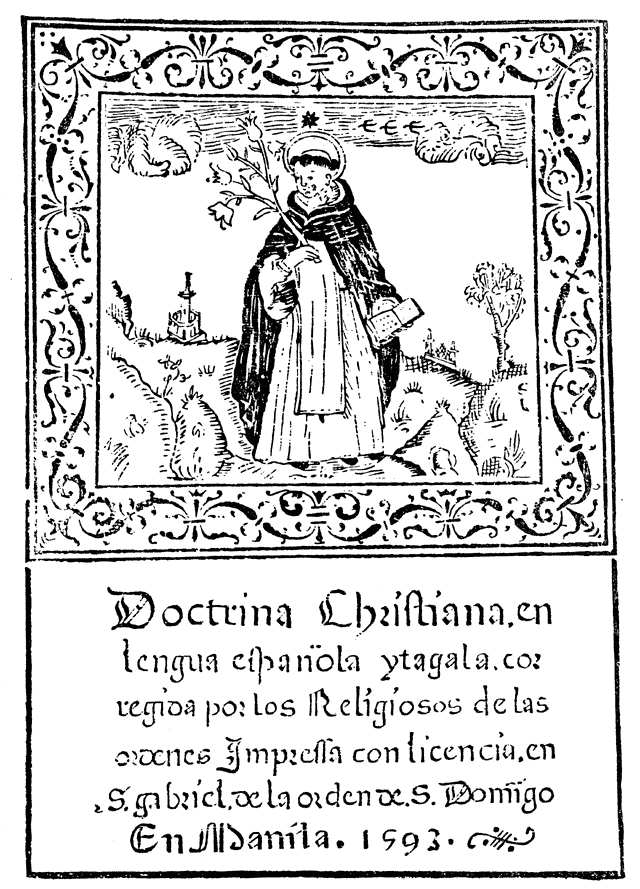
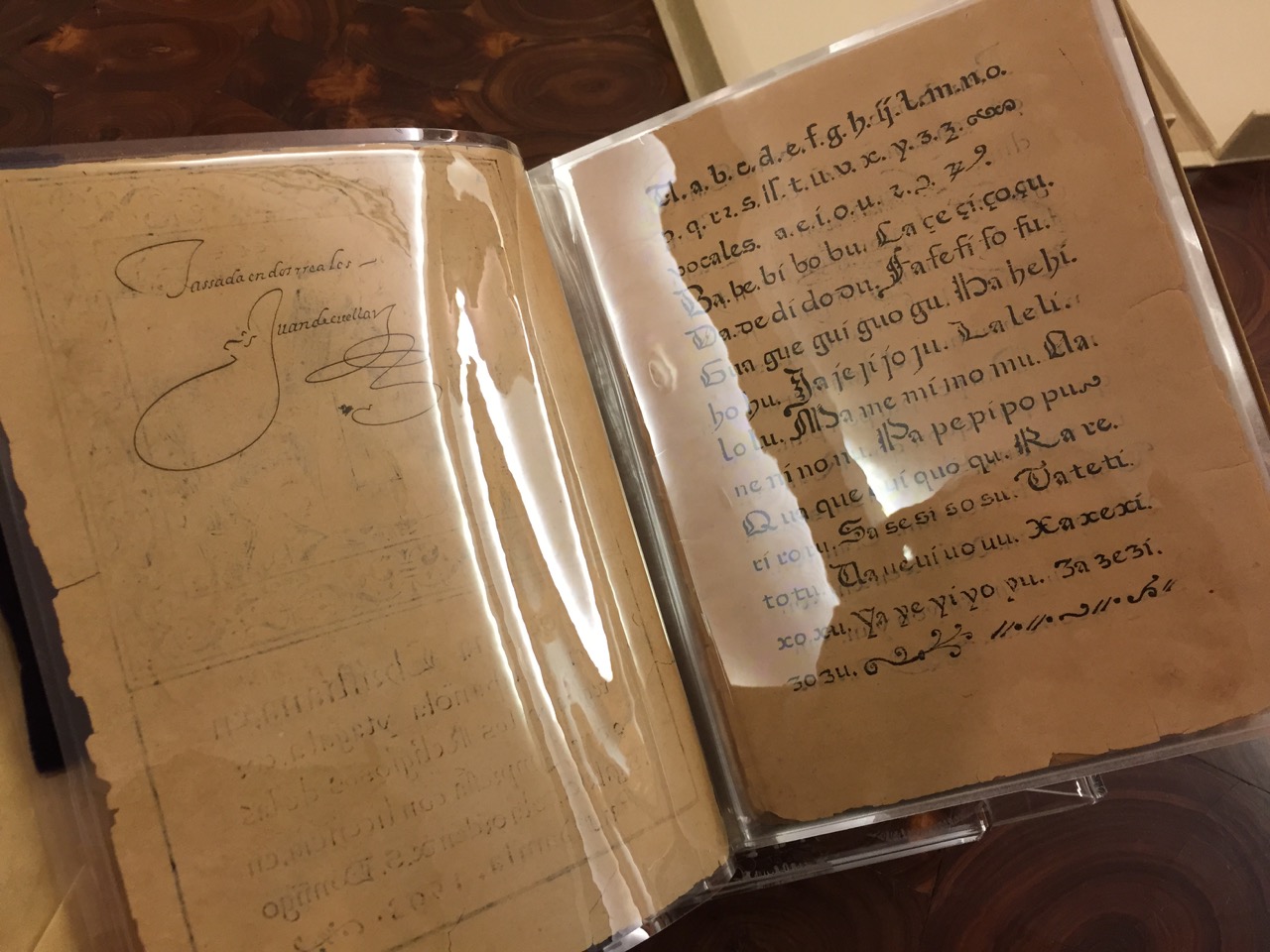
Last week, thanks to the combined efforts of the Filipino-American community in Washington and former LOC librarian and Fil-Am activist Reme Grefalda, I had the once-in-a-lifetime opportunity to see the crown jewel of the LOC’s Philippine holdings—the only known copy in the world of the 1593 Doctrina Christiana, the first book published in the Philippines.

The Doctrina is essentially a catechism, a collection of common prayers, including the Lord’s Prayer and the Hail Mary. Being basic prayer books, there had been other Doctrinas published earlier in other countries. The Philippine version was put together by Fray Juan de Plasencia, a Franciscan friar who helped found many Philippine towns, including Antipolo, Lucban, Meycauayan, and Tayabas. In 1585 he wrote King Philip II of Spain that he had already written several religious and scholarly books that could help spread the faith in the islands—including the Doctrina and studies of the Tagalog language—and asked for royal assistance in funding their publication.

But the good friar died in 1585, and it wouldn’t be until some years later, in 1593, when we see Governor General Gomez Perez Dasmariñas writing the King to present him with copies of the Doctrina in two versions—Tagalog and Chinese—and to explain that he had granted a license for the printing of these books (under Dominican auspices) because of their great value to the evangelization effort. And then, so the story goes, all copies of the Doctrina vanish, until the Tagalog one reappears—presumably the royal copy—in Paris in 1946, where it’s bought by an American dealer, who then resells it along with many other books in a lot to the American book collector and onetime Sears Roebuck chairman Lessing J. Rosenwald (1891-1979), who then bequeaths his collection, including the Doctrina, to the Library of Congress upon his death.

IMG_6183

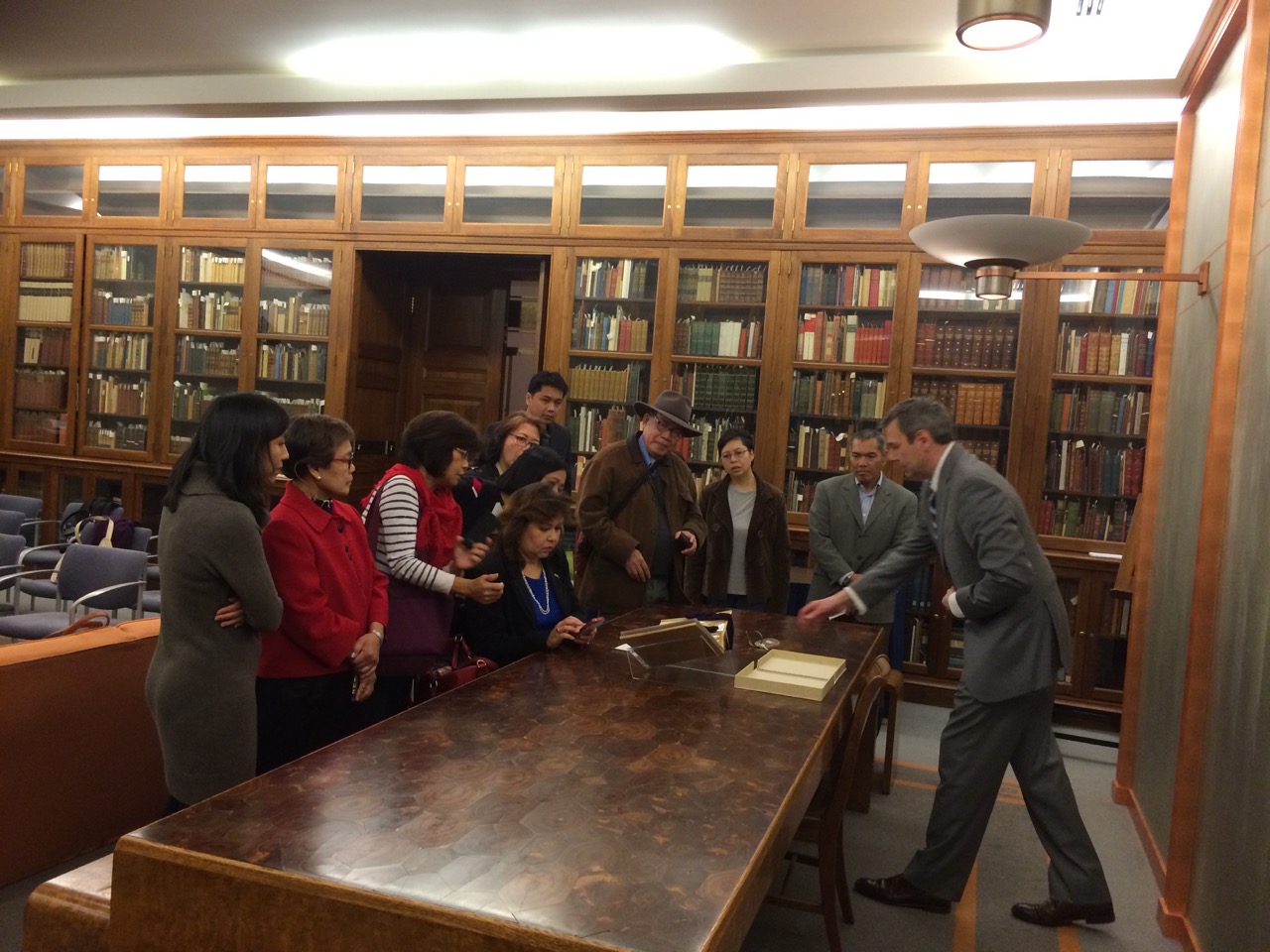
So the LOC’s copy, as far as we know, is the only one of its kind, and it was with great anticipation that Beng and I joined a group of ten Filipino and Filipino-American scholars and advocates who were kindly admitted by the LOC’s Rare Books Division to a private viewing of the Doctrina, with LOC librarian Eric Frazier doing the honors. (While waiting for our appointment, we had taken in a few of the LOC’s other prime offerings including the Gutenberg Bible, which is on permanent display near the stupendous main lobby that welcomes visitors, and the Magna Carta, on loan from the Lincoln Cathedral.)

I should’ve read up more on the Doctrina before we went up there, but I was surprised by two things I realized only when I saw the book up close: its relatively small size, and the fragility of its paper. It’s only about 9 by 7 inches, not much bigger than a contemporary textbook. It was a further surprise to hear Eric say that “As far as I know, among the millions of books we have at the LOC, this is the only one whose every page is sheathed in Mylar.”

IMG_6150

I had asked Eric about the condition of the book and the paper, having seen and even handled other books from the 1600s (many of which, printed on stout, crisp linen paper, look good as new, and have survived in much better shape than the acid-lined paper of the 1800s and 1900s). The Doctrina, as it turns out, was printed xylographically—like a woodblock with the letters carved out—on mulberry paper (other sources say rice paper, although that term may have covered other papers made from mashed material). I’m not a professional historian, so I stand to be corrected on these presumptive facts by people who know vastly more about the Doctrina Christiana and about the history of books than I do (two immediately come to mind, our foremost book historians: Dr. Von Totanes and Dr. May Jurilla).

It was with the greatest of care and respect that we flipped those pages, and we saw what generations of the faithful must have seen (that is, if they saw the book at all): a syllabary, followed by prayers and other articles of faith, presented in Spanish, Tagalog, and baybayin, that pre-Hispanic script that survives in our consciousness only in the Katipunan “ka.” What’s remarkable is how fundamentally familiar the text of the prayers is: “Aba guinoo Maria matoua cana, napopono ca nang gracia. ang panginoon dios, ce, nasayyo. Bucor cang pinagpala sa babaying lahat….”

And so it went, a cry of praise and supplication across the ages, come to life again at our trembling fingertips.

I can only hope that, perhaps through an arrangement with a responsible Philippine institution, the Doctrina can be brought back to the Philippines for a special exhibition (the forthcoming Papal visit would have been the perfect occasion), or at least that more Filipinos in the US could see it, along with the other Philippine holdings at the LOC. It does take time and effort to arrange for a viewing, but in the meanwhile, the full digital copy of the book, provided by the LOC, can be found here: http://tinyurl.com/knpzkn5. For more information on the Doctrina Christiana and this particular copy, see the notes of Project Gutenberg editor Edwin Wolf at http://tinyurl.com/p6uqlvr.

Penman No. 124: Pinoys on the Potomac

cropped-logo-rizal-washington8Penman for Monday, Nov. 24, 2014


ERWIN TIONGSON and his wife Titchie are in their early 40s, successful professionals and the parents of young sons; they live in Fairfax, Virginia, a pleasantly wooded suburb just outside of Washington, DC. An Atenean from Nueva Vizcaya, Erwin teaches Econometrics at Georgetown University, while Titchie, a prizewinning writer, has chosen to stay at home to look after the children. Outwardly they might seem to be just another Filipino couple living the good American life, steadfastly focused on the present and the future. But their true passion inclines elsewhere, as Beng and I would discover in one of the most fascinating encounters we’ve had in our current American sojourn.

I’d first heard about Erwin from another new Fil-Am friend, Sonny Busa, a retired Marine, a former consul and instructor in international relations at West Point. (Sonny, in turn, had been introduced to me by upstate-NewYork-based Sharon Delmendo, who has done a lot of research on Philippine-American relations—so now you see how the academic circuit works.) Sonny had mentioned to me that there was a Filipino in the community who had taken it upon himself to chronicle the history of the Philippine presence in Washington and the surrounding area—more than a century of visits and residencies by Filipino politicians, diplomats, writers, artists, musicians, and other personages whose life and work, in one way or another, drew them to the American capital.

That’s how I found the website that contained all this information—a WordPress site titled “Philippines on the Potomac: Filipino-American Stories in Washington, D.C.” (https://popdc.wordpress.com). If you’ll take a minute to click on that link, you’ll discover what I did, with a child’s wonderment at the entrance of a carnival: short articles and accompanying photographs tracing the connections between Filipinos and Washington, DC.

As might be expected, the big political figures, especially those from the Commonwealth and postwar period, dominate the reportage: Manuel L. Quezon, Carlos P. Romulo, Sergio Osmeña, Manuel Roxas, and Jose Abad Santos. But cultural luminaries are also well represented: Juan Luna, Jose Garcia Villa, Juan Arellano, Enya Gonzalez, Fernando Amorsolo, and Bienvenido Santos, among others.

Quezon had served as Resident Commissioner—effectively our ambassador—in Washington until 1916, and when he went to the US on his wartime exile and died in New York in 1944, it was at the Cathedral of St. Matthew the Apostle in Washington—not too far from where our embassy now sits—where his funeral mass was held prior to his interment at Arlington (less than 20 years later, John F. Kennedy would follow the same route; MLQ’s remains were moved to the Philippines after the war, and now lie at the Quezon Memorial).

Carlos P. Romulo and his family lived in a home on Garfield Street for 16 years, CPR having served in many capacities, from aide de camp to Gen. Douglas MacArthur to Resident Commissioner, ambassador, and president of the United Nations General Assembly. (One of the website’s most remarkable images has an old sepia photograph of the Romulos superimposed exactly over the same spot in front of the present house, which has barely changed.)

The site provides a treasure trove of other historical facts—including, inevitably, tidbits of information that serious scholars might dismiss as trivia, but which enthusiasts like me can’t get enough of. The sculptor and National Artist Guillermo Tolentino, for example, once worked as a waiter in Washington, and somehow managed to meet President Woodrow Wilson and to present him with the gift of a small statue, which Wilson kept in his room until his death; Wilson later helped Tolentino get a scholarship to art school. We also learn that Juan Luna and Felipe Agoncillo went to Washington in 1899 to campaign against the Treaty of Paris, and stayed at the Arlington Hotel, where they were spied upon by the Secret Service. (All these stories are properly attributed and referenced, by the way.)

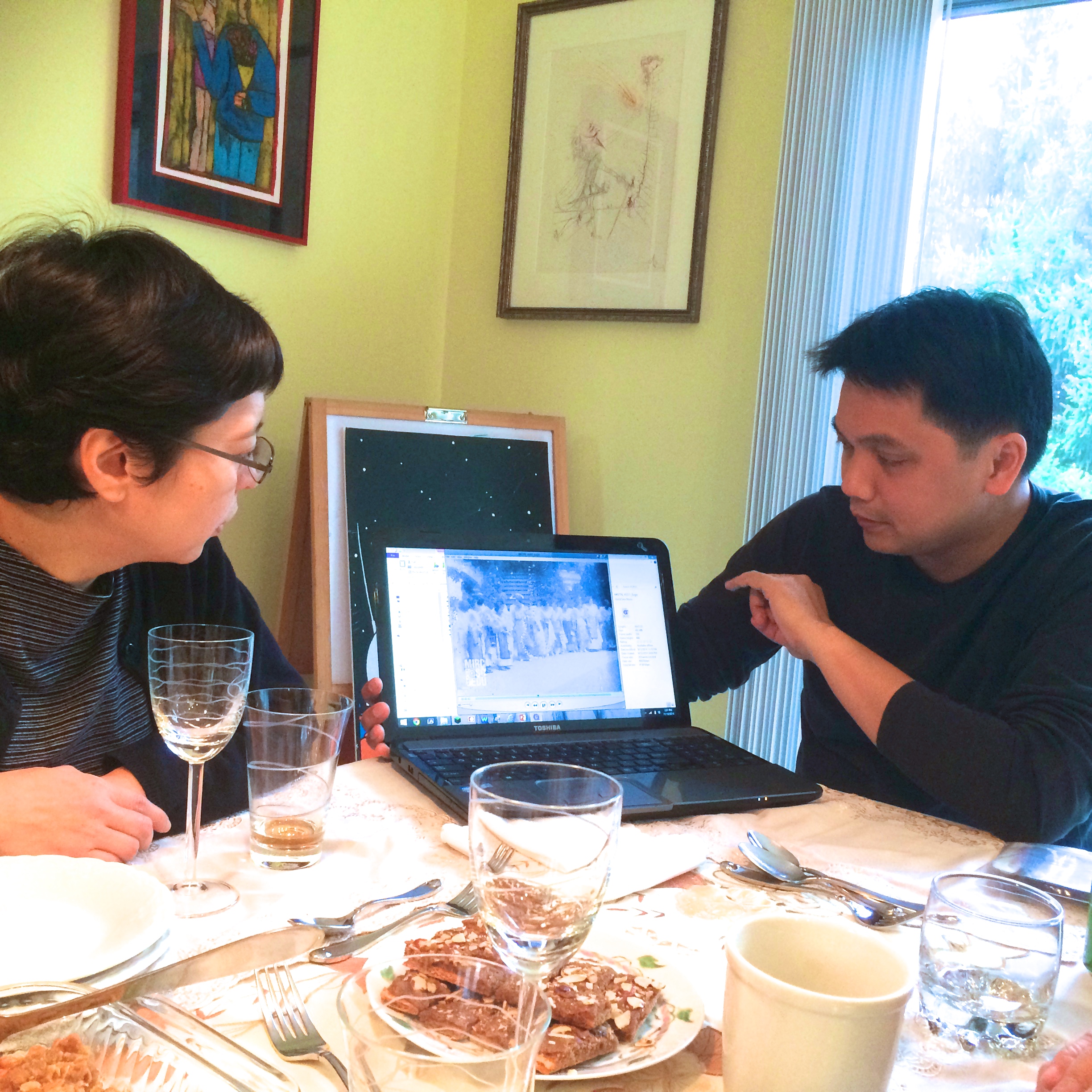
Better than just poking around the website, the Tiongsons invited us to lunch and show-and-tell, and I couldn’t wait. Learning of my current affiliation with the George Washington University, Erwin had pointed me to an article written by CPR’s granddaughter Liana relating how Romulo had coached a debating team from the University of the Philippines in an engagement with the GWU team, over this issue: “Resolved, That the Philippine Islands should be granted immediate and complete independence.” The debate took place on April 18, 1928 at GWU’s Corcoran Hall. “UP won,” said Erwin. “It was the team’s fifth victory, after defeating Stanford, California, Utah, and Colorado. The team would go on to defeat all their other opponents—a total of 14 universities, if I remember correctly.”

Tiongsons

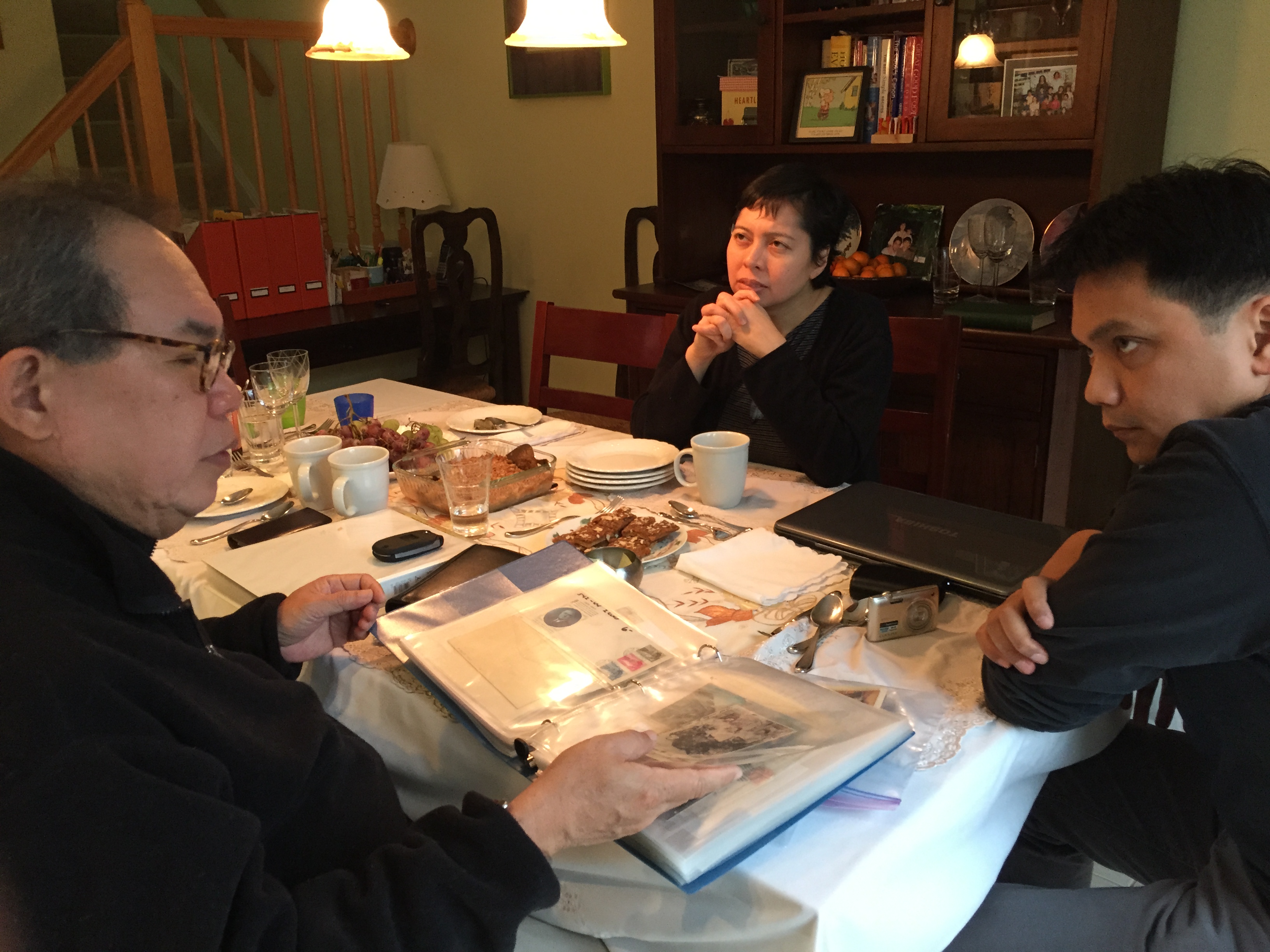
Even more interesting were the personal stories that Erwin and Titchie shared with us (after a sumptuous lunch of home-made corned beef and baked salmon, which all by itself was well worth the Sunday visit). I can’t go too deeply into the details now, but Beng and I were thrilled to share Erwin’s elation over his most recent discovery, a book that had been inscribed by Maximo Kalaw, MLQ’s private secretary, to a “Nina Thomas”—who turned out to be the American lawyer the young Quezon had been engaged to (he broke off the engagement after being advised that marrying an American was political suicide). Erwin made contact with Nina’s heirs in Virginia; she never married, but she passed on Quezon’s monogrammed walking stick and their engagement ring to her niece.

Erwin also showed us a movie poster from 1946 of Anna and the King of Siam, featuring Rex Harrison, Irene Dunne, and a little-known actress named “Chabing”—who turned out to be Isabel Rosario “Dimples” Cooper, Douglas MacArthur’s girlfriend (not mistress) between marriages; after MacArthur left her, she resumed her film career (she was notable for having recorded the first on-screen kiss in Philippine movies in 1926), assuming the single name “Chabing,” whose filmography you can look up on IMdb.

It was also a treat to listen to a radio recording of Jose Garcia Villa, made in the 1950s, of him reading his “Lyric 17” (1942) which famously begins with “First, a poem must be magical….” Most moving was the 20-minute documentary of President Quezon’s funeral—directed by no less than the renowned director John Ford—that Erwin had magically retrieved from somewhere in the many university libraries, archives, and museums that he still haunts in search of fugitive Filipiniana. He has begun a collection of war correspondence from the early 1900s and the Second World War; one 1902 letter poignantly retained a swatch of jusi, which the wife of an American official in Iloilo wanted her folks to see.

We could have stayed there the whole day, reveling in our memories of the grand old men of Philippine letters—NVM Gonzalez, Ben Santos, Nick Joaquin, Manuel Viray; I shared my own little adventures in cultural retrieval. But Beng and I had sadly had to trundle out again into the autumn chill, warmed by our imaginations, and in my ears rang a line from Viray’s poem about his old house in Washington, on Cathedral Avenue, which the Tiongsons had also located: “A streak of light aslant / On the screen door creeps up the line of dusty books.”


Penman No. 122: A Meeting in Manhattan

IMG_5861Penman for Monday, November 10, 2014


BENG AND I were in Philadelphia and New York these past two weekends, so I could do more interviews for my martial-law book project and also get in touch with a few old friends. I normally keep a very low profile and don’t tell or call people when I travel to places where friends are living, not because I’m a snob, but because I don’t want to be a bother, knowing what it’s like when somebody drops in from the blue and throws your schedule out of whack.

But there are always some friends you never mind breaking your routine for, and who never seem to mind, either, if you break theirs. And I was glad to meet up in Manhattan with two such writer-friends, the poet and essayist Luis “Luigi” Francia and the fictionist Gina Apostol, both of whom live and work in New York. Luigi teaches at Hunter College and Gina at the Fieldston School.

The first time I met Luigi, many years ago in a Malate bar on one of his visits home from New York where he has been living since 1970, I remember seeing his calling card, which described him thus beneath the name: “POET. EDITOR. PRINCE.” It seemed cheeky and chic, and I was deeply impressed, being none of the above. (I’ve since written some middling poetry and have done my share of editing chores, but remain utterly unprincely.)

IMG_5856

I had the recent pleasure of writing a blurb for Luigi’s forthcoming collection of essays titled RE: Reviews, Recollections, Reflections, to be published by the University of the Philippines Press, and this is what I said:

“Luis Francia knows New York and America better than many of the native-born, but he never loses his moorings, his critical awareness of what it means to be Filipino-American. But these essays are about far more than racial politics, as they chronicle the travails of that most blessed and in other ways most cursed of citizens—the artist, particularly the artist abroad, for whom alienation acts as a lens that magnifies and reshapes every little thing that crosses the eye. The most arresting and delightful reads are his portraits of the expatriate masters who preceded him in America—most notably Jose Garcia Villa, lover of martinis and hater of cheese. Despite the plaints, Francia has been clearly and distinctly privileged to be where he has been and to see what he has seen, and he shares that privilege with us in this well-wrought collection.”

Gina was my batchmate when I returned to finish my undergrad studies in UP in the early ‘80s; I was ten years older than everyone else, so I was kuya to all of them. It was a time when we were all dreaming of finding a way to take our graduate studies abroad—as English and writing majors, we wanted to become the next Gabriel Garcia Marquez, the next Sylvia Plath, the next Ian McEwan, the next Pablo Neruda, and so on; as Pinoys, we wanted to see America. Eventually, we just became our older selves, but we did get to see the States through one ticket-paying subterfuge or other—for me, a Fulbright grant; for Fidelito Cortes, a Wallace Stegner fellowship; for Ramon Bautista, an assistantship at Wichita. But we had to compete for these, while all the brilliant Gina had to do was to lick a few stamps and mail a couple of her typewritten stories off to John Barth, who directed the writing program at Johns Hopkins and who wrote her back forthwith to offer her an assistantship, smitten as he was with her talent. It was pure magic, in those pre-email days.

That brash young woman from Tacloban who flew off to Baltimore would go on to write several prizewinning novels. Gun Dealers’ Daughter, published by W. W. Norton, won the 2013 PEN Open Book Award given by the PEN American Center to outstanding works by authors of color to promote racial and ethnic diversity within the literary and publishing communities. (Luigi himself had won this prize in 2002, the first year it was given, for his nonfiction book The Eye of the Fish.)

Here’s what the judges said about that novel in their citation: “You will read Gun Dealers’ Daughter wondering where Gina Apostol novels have been all these years (in the Philippines, it turns out). You will feel sure (and you will be correct) that you have discovered a great fiction writer in the midst of making literary history. Gun Dealers’ Daughter is a story of young people who rebel against their parents, have sex with the wrong people, and betray those they should be most loyal to…. This is coming of age in the 1980s, Philippine dictatorship style, where college students are killed for their activism. The telling is fractured, as are the times…. Not only does this novel make an argument for social revolution, it makes an argument for the role of literature in revolution—the argument being that literature can be revolution.”

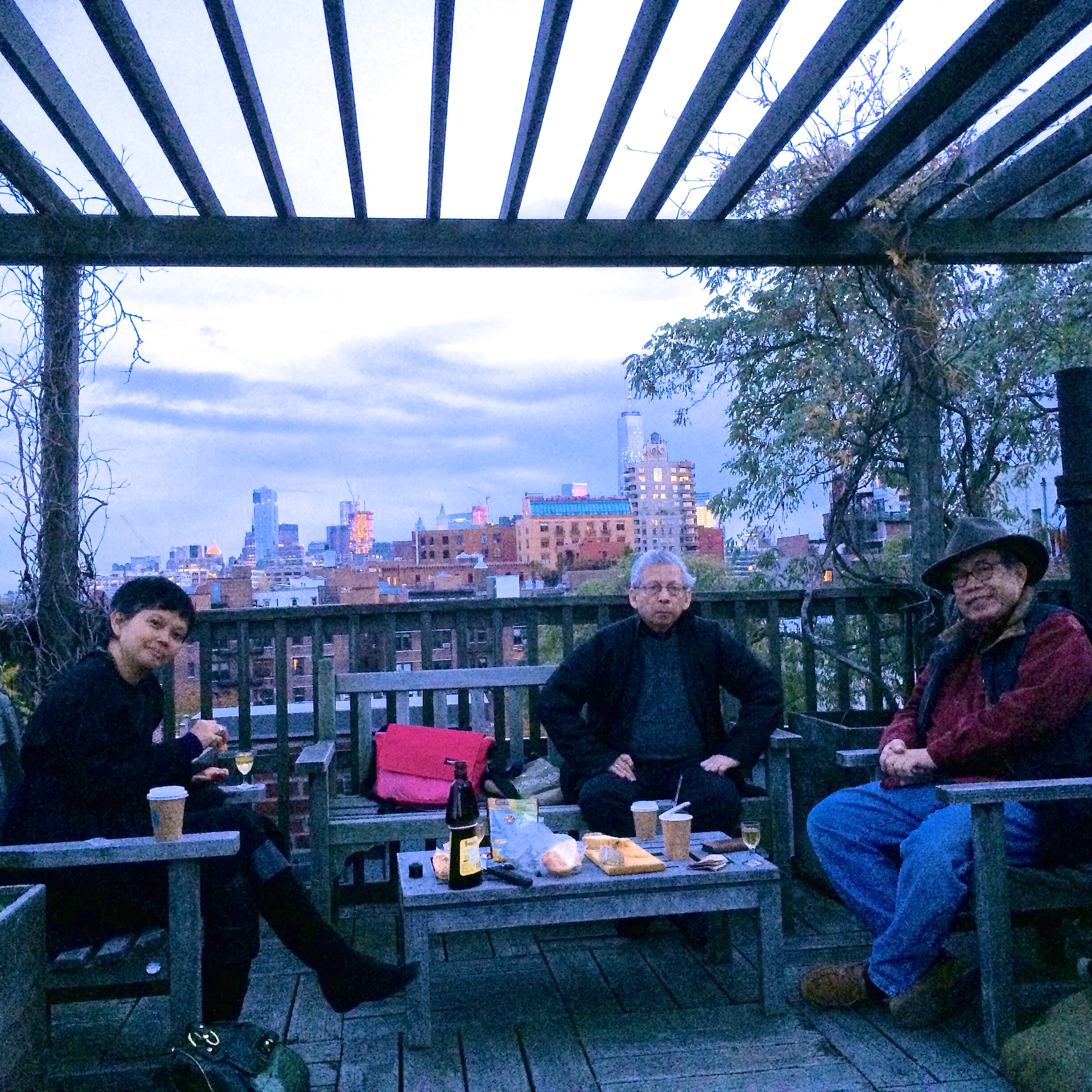
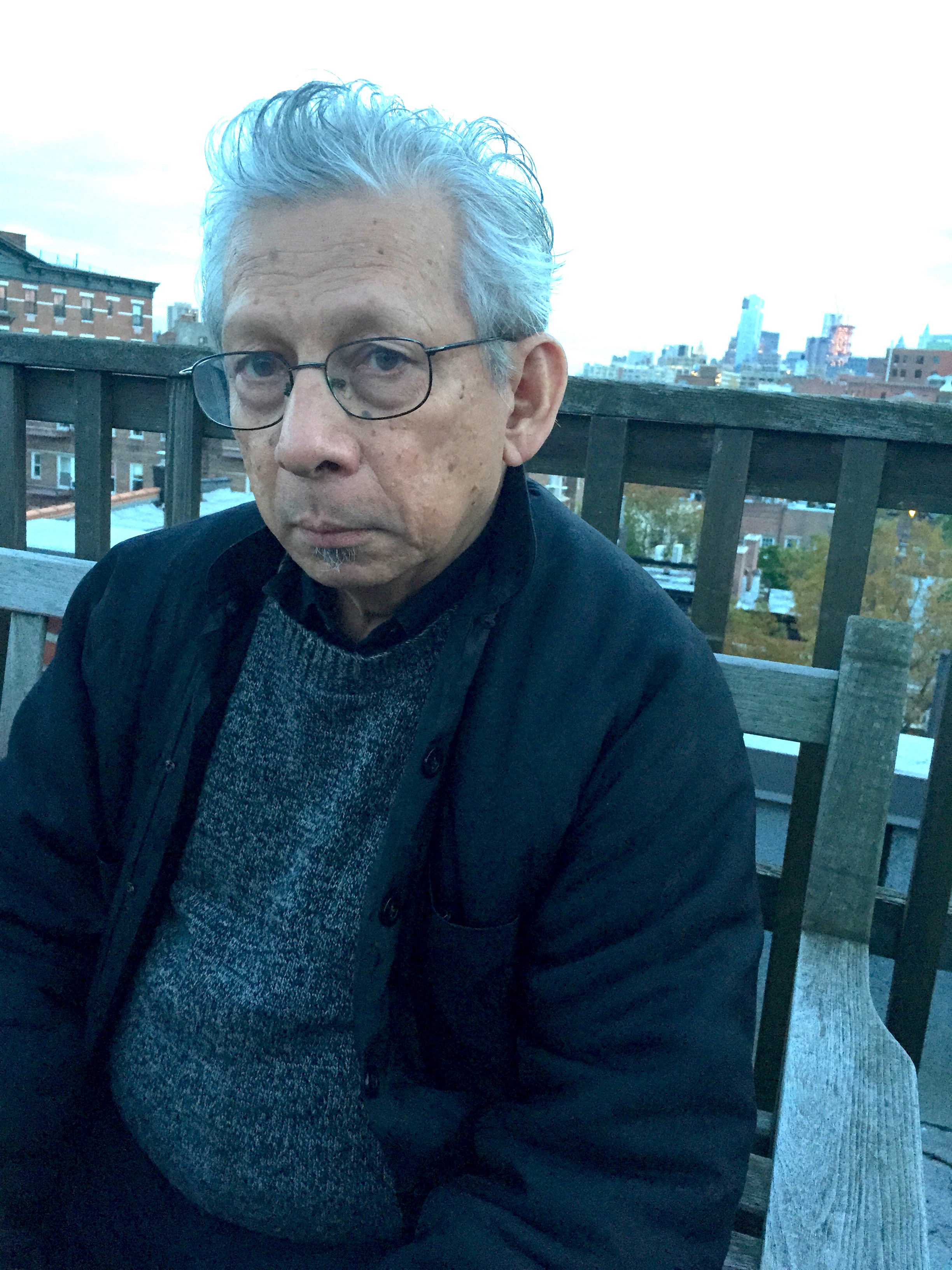
These then were the two literary luminaries who happened to be my friends (or should that be the other way around?) whom I was happy to set up a date with in a coffee shop in the West Village, near the High Line (an elevated garden and walkway that deserves its own story, among other New York landmarks). The coffee place was full, so we brought our steaming cups instead up to the roof deck of Gina’s apartment a few blocks away, pausing for a picture in front of the late Jose Garcia Villa’s old place on Greenwich Street. “This was where he held court,” said Luigi, one of Villa’s acolytes. “Nonoy Marcelo also lived in this area for many years, and I did, too, back when the rent was 65 dollars a month.” Then Gina added, “That white place is where John Lennon and Yoko Ono lived.” And I thought, if they’d stayed here instead of moving to the Dakota, he might still be alive.

We went up to the roof deck and Beng and I savored the scenery in all its 360-degree magnificence, as the sun set in the west and the full moon rose in the east, competing with the Empire State’s tricolor spire. We talked books, life, and loves over Frangelico, bread, and cheese; channeling Villa, I steered clear of the curd. Looking sharp and happy despite a recent illness, Gina said that her iPhone’s Siri had told her, in response to a question, “I’m just glad to be alive!” At that instant, we all were.

Penman No. 121: Souvenirs of Washington

SouvenirPic

Penman for Monday, November 3, 2014

A COUPLE of weeks ago, walking from my sister’s office in downtown Washington, DC to the library of the George Washington University, I paused at the corner of 19th and I (or “Eye”) Streets, and was overcome by a sense of déjà vu. I vaguely recognized the place, but something had changed—the old Presidential Hotel was no longer there, replaced by the Presidential Plaza, a grayish, nondescript commercial building replicated on a hundred other blocks in the city. It was what had stood at that spot that I suddenly missed: the hotel, built in the 1920s—and me, more than half a lifetime younger and suitcase in hand, looking up at my first American abode.

It was September 1980, I was 26 years old, and I was on my first foreign trip—to the United States, no less, thanks to a generous and visionary boss who thought that a budding writer like me could benefit from some exposure to the outside world. He arranged for a grant that would introduce me to media organizations and practices in various places in the US for three months, and within a month of being told that I was leaving, I was—all gussied up in a scratchy double-knit suit, which was what I thought any Stateside-bound traveler worthy of respect was supposed to wear.

After stops in Honolulu and San Francisco, I arrived in Washington on a nippy autumn morning. My first American mystery greeted me in a sign just outside the airport: “PED XING.” What on earth did that mean, I thought—could there be so many Chinese in Washington? I took a cab to my hotel, the Presidential on 19th and I, and was met by the doorman, who suspiciously resembled—and indeed was—a kababayan. I felt instantly relieved. He seemed happy to see me as well, and after effusive introductions and references to the motherland, he showed me to my room, up on the fifth floor.

Unable to sleep, I stepped out, still in my suit, and surveyed the streets around me. I got hungry and saw a classy-looking restaurant at the corner. I had several hundred dollars on me—partly my allowance, and partly my life savings—in cash; I felt rich. I stepped into the place, and ordered quarter of roast chicken. It cost me eight dollars, and I dutifully tacked on a 15% tip, like the guidebook said. I walked around the corner to K Street, and saw a luggage store; I walked in, and all too quickly fell in love with a saddle-leather Schlesinger briefcase. “How much?” I asked. “One hundred dollars,” the lady said. “I’ll take it!” I said, and forked the cash over; it would be eight years before I would get my first credit card, but that’s another story.

I walked back to my hotel, feeling very businesslike with that briefcase that smelled positively posh, and just outside the hotel, on the bus stop along the sidewalk, I noted my second American mystery: another sign that said “No Standing.” How was one supposed to catch a bus or a cab, I wondered, if they couldn’t stand there, and I couldn’t see any seats, either. I fell asleep that afternoon, with the Schlesinger beside me in bed, only to be woken up by a loud rap on my door. It was my kababayan the friendly doorman, and it must have been past nine in the evening. “Padre,” he whispered, “could you lend me twenty dollars? I have a hot date tonight and don’t want to disappoint her, I’m just a little short!” He winked conspiratorially, and I slipped him the twenty, and went back to bed.

Many more interesting things would happen to me during that visit, but that was the last I saw of my new kaibigan and of my twenty bucks. The next day, I went back around the street to look for a breakfast place, and saw my first McDonald’s. It was my first American fast-food experience, and I felt flustered by the array of comestibles on offer overhead. Forgetting for a second where I was, I glanced at the two Pinoy-looking ladies in the line beside me and asked, in Tagalog, “Miss, paano ba umorder dito?” and they told me how. They turned out to be secretaries at the World Bank. Later that day, when I told the cook at the cafeteria in our sponsoring institute about my eight-dollar lunch, she laughed and said, “You shoulda framed that chicken!” before serving me a full meal for $2.50.

Since I was going to be in Washington just briefly being flying onward to my main destination in East Lansing, Michigan, I resolved to make the most of my visit by touring as much of DC as I could. Our daughter Demi was just six years old, and I sent her postcards and pictures that I took of squirrels running around the White House lawn. Outside the Smithsonian, I lingered before the souvenir carts before choosing a tall ceramic (at least that’s what I thought) mug that said—what else—“Souvenir of Washington, DC” and featured the relief facade of the Capitol building. (I would later discover, back in Manila, that the mug was made of plaster, and made in Taiwan.)

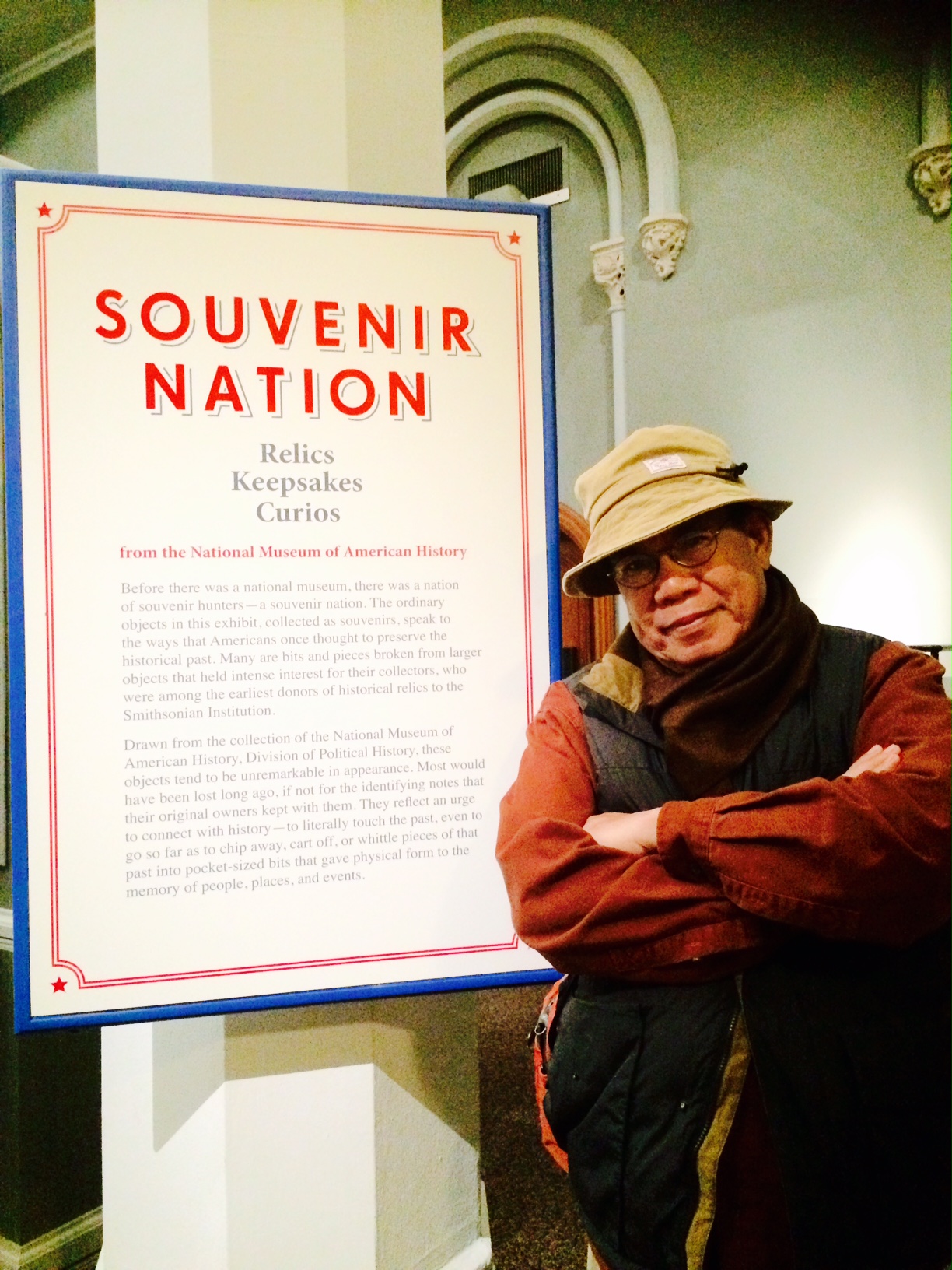
All these came back to me as I stood at that corner of 19th and I, feeling a little foolish but feeling even luckier to be alive at all and back in the same spot, much bulkier from ingesting untold hundreds of chickens and Big Macs since then, but not all that much the wiser. And as it happened, when I walked the other day into the Smithsonian Castle, on exhibit was “Souvenir Nation”—a show of how people have kept pieces of the past to form their own personal histories.

I’m over souvenir mugs, but I still keep that Taiwanese token on a shelf back in Diliman as a reminder of one’s innocence or stupidity—one or the other, although I can be fairly sure by now that there’s hugely far more of the latter in Washington than the former. And I still have the Schlesinger briefcase, all beat up as it should be after 34 years, but still handsome in a rugged way, which is more than can be said for its owner. No, I’m not over fine leather briefcases; I saw the very same case on eBay last week, selling slightly used for $25, and I snatched it up to replace the old one—as a souvenir of this great and wondrous city of Washington, DC.

Penman No. 119: Bulosan in the Heart

Penman for Monday, October 20, 2014


TAKING A short break from my fellowship in Washington, DC, Beng and I flew off to the West Coast a couple of weeks ago for a weekend with our daughter Demi and her husband Jerry. Demi was celebrating her 40th birthday (can you believe it?) and had sent us tickets to join them in Seattle; they live in San Diego, but they’d loved Seattle from a previous visit and wanted to share that discovery with us.

Over three days, we did the Seattle thing, and had loads of fun: the Pike Place Market, the Space Needle, a glimpse of the Chihuly glass garden, antiquing in Snohomish, and a boys’ tour of the Boeing plant in Everett. But it was an unexpected turn in the program that made it all the more worthwhile.

On the drive into the city from the airport, I had mentioned to Jerry (who had been born in Rhode Island to parents from Bicol) that two Asian-American icons—Carlos Bulosan and Bruce Lee—were buried in Seattle. Jerry’s an engineer in the aviation industry, but like Demi, he has a keen interest in culture and in his roots.

Bulosan’s name holds a special significance for our family. In high school, with some help from Beng, Demi had put together a book report on America Is in the Heart—Bulosan’s sprawling semi-autobiographical novel about the Filipino immigrant experience in America, first published by Harcourt Brace in 1946. I myself had written my undergraduate thesis at the University of the Philippines on Bulosan, fascinated by his often paradoxical appreciation of America, which he described as being at once “so kind and yet so cruel.”

Born in Pangasinan, he shipped out to Seattle in 1930, and never returned until his death from bronchopneumonia, also in Seattle, on September 11 (yes, 9/11) in 1956. (There’s some debate over the year of his birth, which has been variously listed as 1911, 1913, and 1914.) In the US, without the benefit of college, he became a voracious reader and taught himself to write, and became known both as a writer and a labor activist. Since the 1970s, many critics such as Epifanio San Juan Jr. have championed a reappreciation of Bulosan and his work; in 1973, the University of Washington Press republished America Is in the Heart, which was translated into Filipino as Nasa Puso ang Amerika by Carolina S. Malay and Paula Carolina S. Malay and published by Anvil in 2000.

When Demi and Jerry made plans to marry in 2007, I knew what I was going to give them as a wedding gift. After a long and eventful search culminating in a meeting with the seller in a Jollibee in Diliman, I had just acquired a first edition of America Is in the Heart, and carried it with me to San Diego. This copy had been inscribed by Bulosan to his friend Fred Ruiz Castro: “This story of my life will, I hope, bring me closer to you and our native land through our good friend J. C. Dionisio, with my best wishes, Carlos Bulosan, Los Angeles, 3-6-1946.”

Upon receiving the book in Manila almost a month later, Castro—who became Chief Justice in 1976—also signed it on April 4, 1946. I signed the book on a following page on April 2, 2007, and Beng and I presented it to Demi and Jerry on April 15. The book now rests proudly on their bookshelf in San Diego. (When I first wrote about this in my column—about finding that “holy grail” of a signed first edition and giving it to our only child on her wedding in America—I got a pleasant surprise upon my return: the gift of another copy of an early edition, acquired by another Filipino writer when he was in college, Greg Brillantes. That book, signed by Greg, now sits on my topmost shelf in Diliman.)

Now back to Seattle. On our last full day there, after touring the Boeing plant in the morning while our wives did their own thing downtown, Jerry and I were hit by the same brain wave in the car: why not look for Carlos Bulosan’s grave and pay our respects to our literary hero? A little Googling quickly revealed his gravesite, at the Mt. Pleasant Cemetery on Queen Anne Hill. We picked up Beng and Demi at the hotel, and located the cemetery not too far away.

GPS helped bring us there, but it couldn’t pinpoint the exact grave among the many hundreds on the site; thankfully, Google also yielded a picture of the grave itself, and the four of us spread out across the cemetery, looking for visual markers—particularly a white obelisk in the distance; it took about 20 minutes until Demi yelled “I found it!”

It was, ironically, very close to the cemetery gates, on the left side. Beng picked some flowers nearby and offered them at the foot of the marker, which read: “CARLOS BULOSAN 1914-1956 Writer Poet Activist,” followed by an epitaph that Bulosan himself had written: “Here here the tomb of Bulosan is / Here here are his words dry as the grass is.” It was a pretty spot, truth to tell, and the grass was hardly dry. After the cemetery, we visited Seattle’s International District near the waterfront, to peek at the Bulosan exhibit through the windows of the historic Eastern Hotel, where Bulosan and other Filipino cannery workers lived.

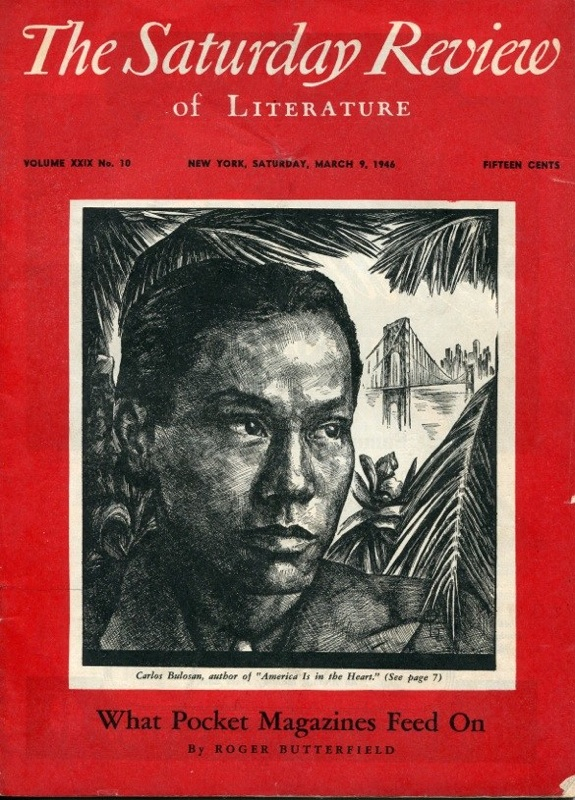
Demi and Jerry don’t know it yet, but they have another Bulosan memento coming from me: a copy of the Saturday Review of Literature from March 9, 1946, on the cover of which the famous pen-and-ink portrait of Bulosan first appeared. One of these days, I’ll pay another homage, to the Bulosan memorabilia on exhibit at the University of Eastern Pangasinan in Binalonan, where they keep copies of his letters, commemorate September 11 as Carlos Bulosan Day, and teach a 3-unit course on his life and works. There’s a trove of material on him at the University of Washington library, and perhaps on another visit to Seattle, with more time, I might look into that, too. But as every Fil-Am and indeed every Filipino should know, a pioneering voice like Carlos Bulosan’s can ring everywhere and forever, in the heart.

Bulosan

Penman No. 117: The Way We Were

IMG_4726Penman for Monday, October 6, 2014


I’D LIKE to thank the people who’ve given me their time and accorded me their hospitality during my current visit to the US. I’m here to do more research for a book project—an oral history of the First Quarter Storm (the story of my generation, in other words)—and so far I’ve had wonderfully productive interview sessions with some people who were either active participants in the anti-martial law movement or were on the other side of things (or simply on the roadside) at the time.

Those who’ve helped me out, either as interview subjects or facilitators, include former campus journalist and retired engineer Gerry Socco and his wife Chet; lawyer Rodel Rodis; editor Rene Ciria-Cruz; tech journalist and developer Joey Arcellana; and journalist Gemma Nemenzo and her husband, Col. Irwin Ver. All of them are conveniently based in the San Francisco Bay Area, so Beng and I flew out there from DC for a long weekend of interviews and reunions with old friends.

Rodel and I go back all the way to the Philippine Science High School, where I served as Rodel’s associate editor when he helmed The Science Scholar. It was also in high school—when I myself became editor in chief—that I first heard of Joey Arcellana from our adviser, Mrs. Agnes Banzon Vea (mother of the accomplished Doy and Rey Vea), who told me one day: “There are two young writers I’d like you to read. One of them writes for the UP Collegian, and his name is Joey Arcellana. The other is still in high school and writes for the Highlights, and his name is Gary Olivar.” Gemma, who now edits the ezine Positively Filipino, also edited the late, lamented Filipinas magazine, which I used to write a column for. Gerry I knew from the pre-martial law College Editors Guild of the Philippines, and we met again in the worst of possible circumstances—as fellow political prisoners in Bicutan; today, in our sixties, we share an unabashedly bourgeois passion for collecting vintage pens and watches.

In Washington, DC, where I’m formally based through my association with the George Washington University, I’ve been lucky to meet and to interview one of the torchbearers of the anti-Marcos resistance on the East Coast, Jon Melegrito, a retired librarian at GWU who now writes for the DC-based fortnightly Manila Mail. I’ve also been glad to gain the insights of three former State Department officials: former Ambassador John Maisto, who headed the old Office of Philippine Affairs and served in Manila in the late 1970s; his colleague Hank Hendrickson who now serves as executive director of the US-Philippines Society, of which Amb. Maisto is the president; and Santiago “Sonny” Busa, a Filipino-American who has served as consul in Manila, Addis Ababa, and Kuwait, and who has taught International Affairs at West Point. I’ll be doing a bit more traveling to see people in New York and possibly the Midwest.

So far, I’ve interviewed about 30 people for the book, which I’ve begun to write at my sister’s place in Virginia. It’s very strange in a way to write about bloody encounters in coconut groves in the Philippine South while reveling in the sight, outside my window, of bluejays and robins perched on the branches of trees just beginning to acquire an autumnal glow. But perhaps it’s precisely this physical and psychological estrangement that I need to handle such an emotional project—emotional, at least, for members of my generation.

Sometimes what I hear gets a bit too much; for the first time, after having written and published over 25 books with a very dry eye, I wept as I listened to an account of someone I knew shooting—executing—someone who had been her best friend. At the same time, events that might have been terrifyingly life-threatening 40 years ago can now sound absolutely hilarious—or deadpan ironic, such as when firebrand Fluellen Ortigas, selected as one of the Ten Outstanding Students of 1968, stands beside President Marcos at the awarding ceremonies, with a book titled The Essentials of Marxism in hand. “Join my staff,” Marcos tells him. “I can’t,” Ortigas replies. “You’re going to be a dictator!” Ortigas would later work for Ninoy Aquino, go underground in Panay, get arrested before martial law, get released in 1976, flee to the US via Sabah, get an MBA, and become a businessman in San Francisco.

I have many more stories like Flue’s to tell, each with its own highlights and insights—Elso Cabangon being ambushed on Taft Avenue and taking four bullets, one of them tearing through his cheek; Boy Camara auditioning for the role of Judas before eventually playing Jesus Christ, Superstar; a female comrade being married in the rites of the Party, one hand on her heart, and the other on Mao’s Quotations (it’s a marriage, like many in the movement, that will unravel). But they’ll have to wait until the book itself, which I hope to finish by early next year.

Even now, many old friends and comrades are probably wondering why I haven’t approached them yet or asked so-and-so to be interviewed, because they have interesting and important stories to tell. I’m sure they do, and I have to extend them my apologies in advance, simply because I just don’t have the time or space at the moment to include everything and everyone I should be covering. I’m almost certain that this oral history will lead to a sequel, all the way to EDSA (a book that someone else should begin writing soon). Some people I’ve asked haven’t replied or have declined, and I can only respect their implied wish to be left alone.

Again, this book will be about the past, and while we might bemoan the innocence we lost, or even wax romantic about the way we were, I don’t think too many of my respondents will want to relive their lives in exactly the same way, knowing what they do now. We might not regret what we did—it arguably needed to be done—but we or our children don’t have to repeat it, if it can be helped. That’s how history helps the future.

Penman No. 93: Resurrecting Another Lost Master

143Penman for Monday, April 21, 2014

ON THIS Easter Monday, a kind of resurrection story seems to be in order. A few months ago, I wrote a piece about the late painter Constancio Bernardo, a lost master and pioneer of Philippine modernism whose life’s work was then about to be celebrated with a centennial retrospective at the Ayala Museum. Little did I know that—a few weeks later, and thanks to a chance encounter at a literary festival—I would learn of yet another and largely forgotten hero of early 20th century Philippine art.

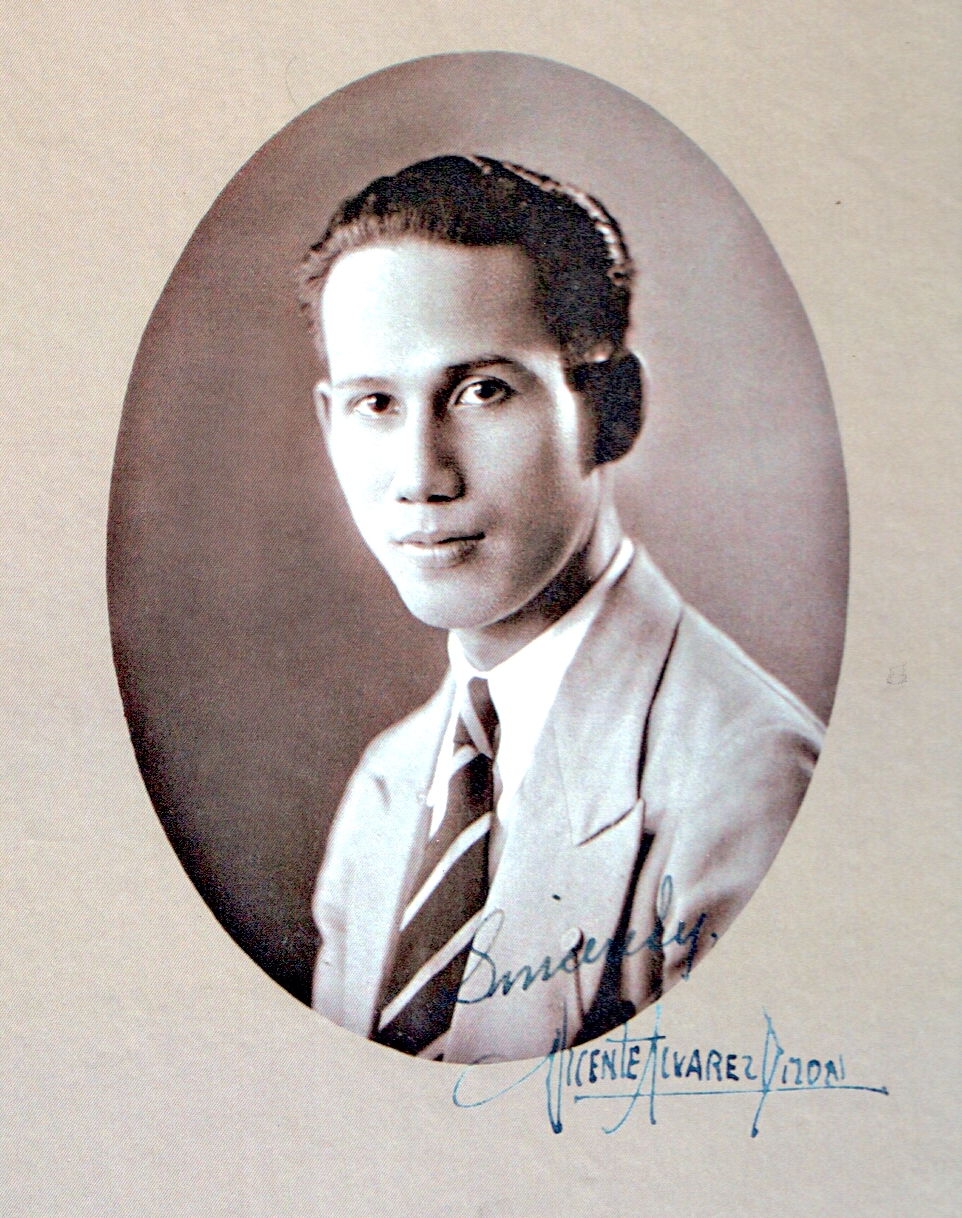
The venue was the Taboan Writers Festival, which we held this year in Subic, with closing ceremonies in Clark Field. It was at Clark that I met Josie Dizon Henson—a painter, writer, and community leader who gifted me with a pair of books she had written. One was a study on Kapampangan orthography, of more scholarly interest; the other book, which caught my fancy, was a slim but substantial, privately published volume titled After the Day’s Toil: A Golden Moment in Philippine Art, a biography of her late father, Vicente Alvarez Dizon and an account of his long-lost masterpiece.

Even at first mention, the name rang a bell in my mind. Two years ago, while doing research for a biography of the late nationalist thinker Emmanuel Q. Yap, I had met (at least by email) a painter named Daniel Dizon, one of Manoling Yap’s boyhood friends. Reminiscing on his friendship with the Yaps, Dan Dizon happened to mention the fact that his father had himself been an accomplished artist—so accomplished that he had won over Salvador Dali in an international competition in the US before the war. That amazing feat—and its doer, Vicente Alvarez Dizon—stuck in my memory. More on that Dali story later.

I had never heard of Vicente Alvarez Dizon before, and as it happened, I would not hear of him again until I met his daughter (and Dan’s younger sister) Josie in Clark. Hearing her name, I made the connection to Dan and to her father, and she seemed delighted to learn that I knew something about her father, and brought me a copy of her book. I set the book aside for a more leisurely read, and when that opportunity arose recently, I found myself engrossed by its account of another extraordinary Filipino life.

Born in Malate, Manila in 1905, Vicente graduated with a diploma from the School of Fine Arts with high honors in 1928. His talent got him a scholarship to Yale in 1934, a sojourn from which he emerged not only with his BFA but also with diplomas in Advanced Painting, Museum Administration and Art Appreciation. Back in Manila, he taught at UP, Mapua, and the National Teachers College; for the rest of his brief life, Dizon would become a staunch advocate of art education and art scholarship, tirelessly lecturing on art subjects around the country.

But his finest hour—the “golden moment” Josie’s book refers to in its title—was likely the Golden Gate International Exposition in San Francisco in 1939, an ambitious, visually opulent panorama that rivaled the New York World’s Fair that opened the same year on the opposite coast of America.

Within the exposition, International Business Machines, already an industry giant under its founder Thomas Watson, decided to sponsor an international art exhibition and competition featuring artists from 79 countries where IBM did business, including the Philippines. The Philippine pavilion in San Francisco actually displayed two other works by young Filipino masters, murals by Victorio Edades (assisted by Botong Francisco) and Galo Ocampo. But as fate would have it, it was Dizon’s painting that IBM chose to represent the Philippines.

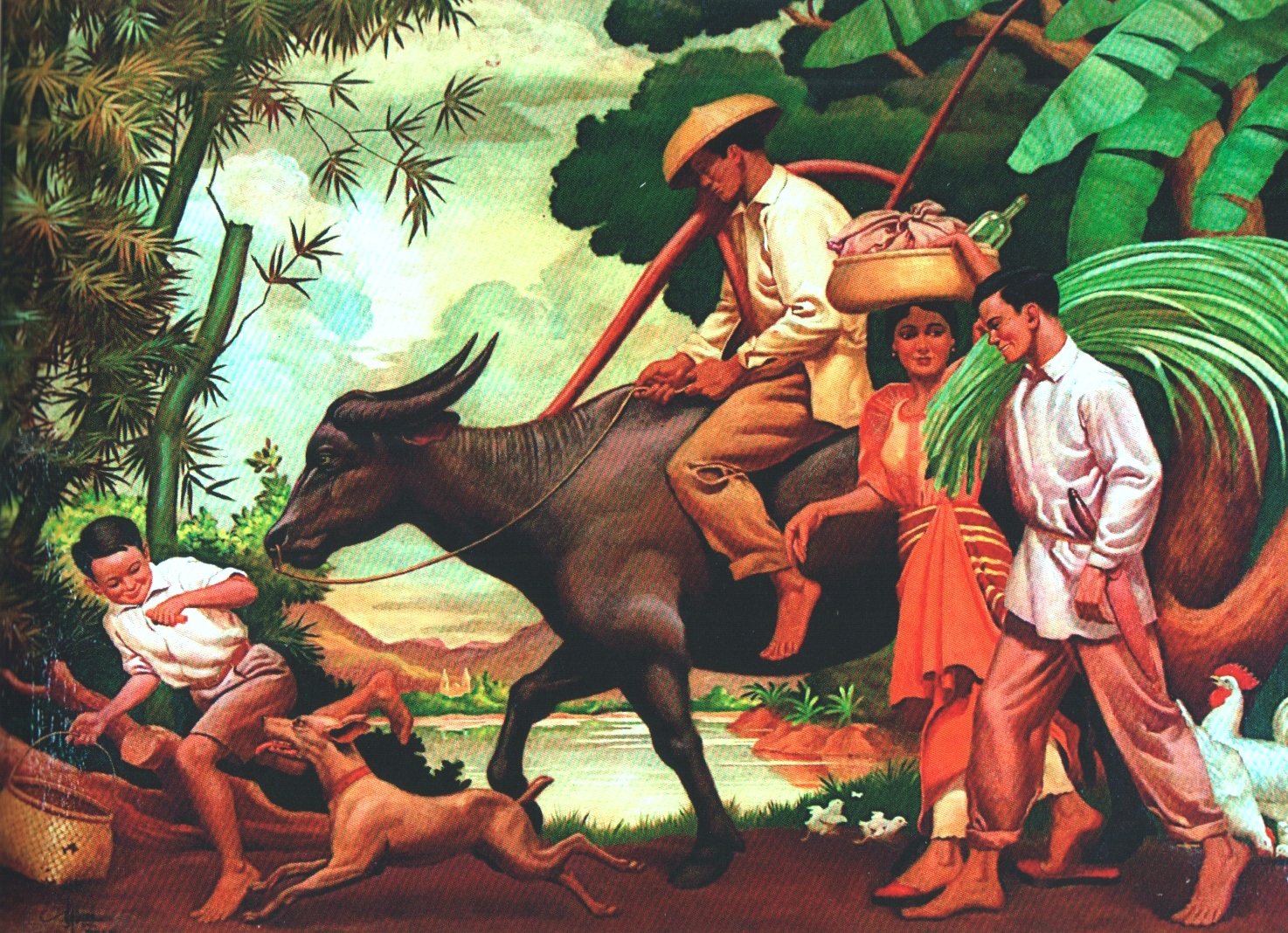
142The painting had been Vicente’s thesis project at Yale. Typical of its time in its evocation of a rustic, romantic countryside, the painting depicted a Filipino family—father, mother, son, carabao, and other farm animals—heading for home at the end of another working day. Because he worked on it at Yale, he had to use Caucasian models for his studies, but replaced the faces with their native counterparts in the final work. He apparently took it home upon graduation, because it was in Manila where IBM’s Philippine representative, Kevin Mallen, saw and bought the painting for IBM, which shipped it to America for the competition. When the results were announced, Dizon had won first prize, followed by Spain’s Salvador Dali and by the American Robert Philipps. (Coincidentally, at the other global fair in New York that same year, another Filipino, Fernando Amorsolo, also won first prize for his painting “Afternoon Meal of the Workers.”)

But that’s not where the remarkable story of this remarkable painting and its creator ends. Vicente himself, sadly, would die young and penniless in 1947 at just 42, afflicted with tuberculosis, a condition that, according to Dan, also ravaged the family’s finances. His masterpiece and legacy lived on—although it was almost lost.

In October 1980, the Batangas-born Filipino-American physician, Roger Pine, received a letter at his home in Princeton, New Jersey from a New York art dealer informing him of the availability of a painting with a Filipino theme titled “After the Day’s Toil,” 40 x 53 inches, signed “V. A. Dizon, 1936.” Would he be interested in looking at and possibly acquiring it? The dealer sent a transparency of the painting along.

The painting had last been seen by the Dizons in 1952, when it had been shipped from the US to Manila on loan from IBM for a local exhibition. And then it vanished. Further inquiries produced no leads other than the name of a New York gallery, which had no records of it.

When Roger Pine received the invitation from his dealer, he felt an instant connection to the painting, having grown up in a family of farmers. He knew nothing about the painting, the artist, nor its provenance, but he did know, especially after seeing the painting itself in New York, that he just had to have it. The dealer—who said that he had earlier tried to interest the National Museum in Manila to no avail—let the Pines have it on installment. It was also only in New York that Roger Pine realized that he had found and bought a long-lost prizewinner.

Next came the trans-continental search for the painter’s family—not an easy task in those pre-email, pre-Google days. It eventually took 25 years and a bit of luck—a dinner conversation during one of the Pines’ visits back in Manila—to connect the Pines with the Dizons. In 2006, the two families met, and the following year, two generations of Dizons trooped to Princeton, New Jersey to visit the Pines and to see, once again, Vicente’s painting. It was a tearful but joyful reunion, the kind of happy ending that deserves to be written about in a book. That’s what Josie Dizon Henson has done.

Poster 12x38

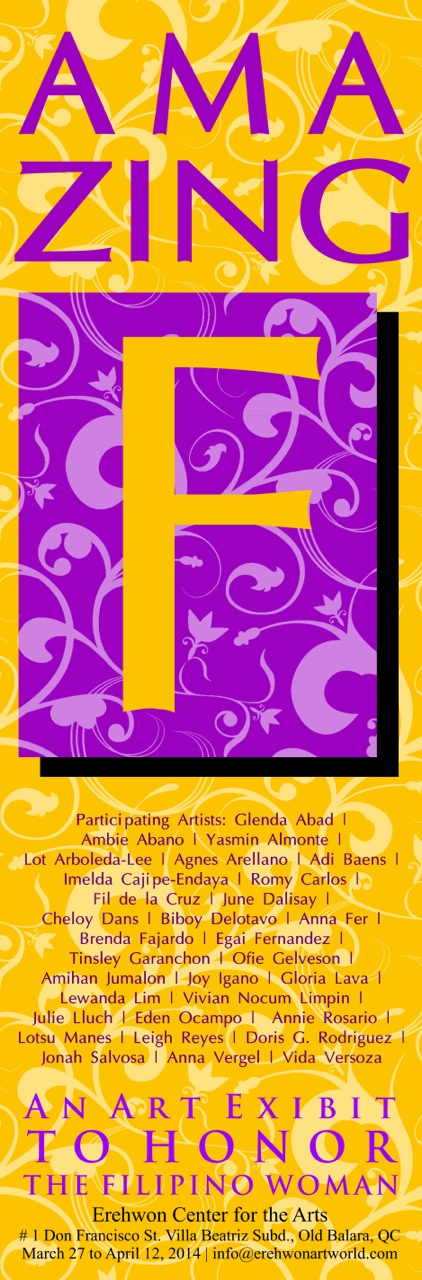
AND WHILE we’re on the subject of documenting Philippine art, let me note that, in celebration of the Filipino woman and of Women’s History Month, the Erehwon Center for the Arts in Quezon City recently hosted “Amazing F,” featuring some of the country’s leading artists, both women and men.

The participating artists included Glenda Abad, Ambie Abano, Yasmin Almonte, Lot Arboleda-Lee, Agnes Arellano, Adi Baens, Imelda Cajipe-Endaya, Romy Carlos, Fil de la Cruz, June Dalisay, Cheloy Dans, Biboy Delotavo, Anna Fer, Brenda Fajardo, Egai Fernandez, Tinsley Garanchon, Ofie Gelvezon, Amihan Jumalon, Joy Igano, Gloria Lava, Lewanda Lim, Vivian Nocum Limpin, Julie Lluch, Eden Ocampo, Annie Rosario, Lotsu Manes, Leigh Reyes, Doris G. Rodriguez, Jonah Salvosa, Anna Vergel, and Vida Verzosa.

Erehwon—located at #1 Don Francisco St, Villa Beatriz Subdivision, Old Balara, Quezon City—is fast becoming one of Metro Manila’s most vibrant art centers, hosting not just painters but also musicians like the Metro Manila Concert Orchestra. The Amazing F show, which ran until last week, was another of its projects to benefit the Erehwon Arts Foundation, which aims to run a residency program for talented but financially challenged young Filipino artists.

It was curated by Erehwon Arts Foundation Vice President June Poticar Dalisay, who said that “AMAZING F is an art exhibit that explores the different facets of the Filipino woman, a complex and enigmatic individual whose roles are varied and endless, affecting every sphere of our personal and public lives. She is warm, sweet, and compassionate, but she can also be can be cunning, feisty, and combative.” Don’t I know that—and yes, June, I stand amazed!

Penman No. 80: Men of Letters (2)

FCPenman for Monday, January 6, 2014

I CAN’T remember now how the poet Fidelito Cortes fell into our circle of beer-guzzling, Yeats-quoting friends in Diliman back in the early 1980s, but I do know that he was there, on December 10, 1984, when my very first book (Oldtimer and Other Stories) was launched without much fanfare in UP. I know that, because after the event, we went for more drinks in a restaurant on Katipunan (where serving beer was still illegal then, because of some silly ordinance), and Fidelito was with us.

Also there was the late Ernesto “Cochise” Bernabe II, a popular figure on campus and an English major who had been fortunate enough to visit Stanford, and who had come back with some application forms for that university’s famed Wallace Stegner fellowship. We all feigned indifference to Cochise’s offering (who needed Stanford?), but weeks later, we would discover that at least four of us had applied for the Stegner-me, Krip Yuson, Fidelito, and I think Mon Bautista (not the currently telegenic one, but a gifted fictionist from Mindoro).

Imagine our surprise and envy when, come April, we heard that it was Fidelito whom Stanford had accepted for the one-year, well-funded fellowship, with nothing much to do but write and attend workshops on Stanford’s plush campus in Palo Alto, California. But then we shouldn’t have been surprised, as Lito was an extraordinarily good poet, whose work resonated with a deep and quiet melancholy.

Lito flew off to Stanford in August 1985; I would follow to Ann Arbor, Michigan, in 1986, having snagged a Fulbright. Mon Bautista got a fellowship to Kansas, I think it was. (In an even more remarkable turn, our friend and beermate Gina Apostol wrote a fellow named John Barth directly at the University of Maryland, showing him a short story that she had written, titled “Earthquake in Mexico”; Barth wrote her back, offering her a scholarship, and thus began the Leyteña Gina’s long and continuing sojourn in the US). It was, in other words, a time when another generation of young Filipino writers began looking abroad, and specifically to the US, for opportunities to broaden their horizons (before we would discover Australia, Singapore, Japan, China, and other places closer to home).

Lito, in a way, had always been prepared to go Stateside; he’d never been there prior to the Stegner, but he had imbibed its pop culture so well that he routinely beat the crap out of us in Trivial Pursuit, particularly in the sports category, where he seemed to know all the NFL teams and their key players by heart; not to be outdone in colonial education, I commanded the geography portion, having memorized the US states and their capitals since my grade school days.

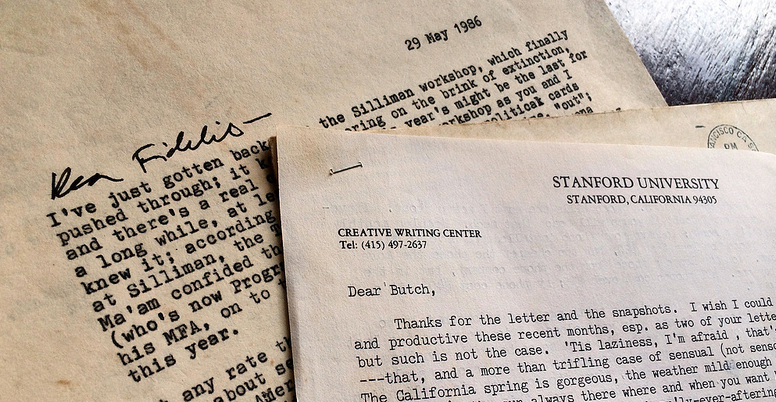
On January 18, 1986, I wrote Fidelito:

Dear Fidelito, 

Thanks a lot for your Christmas card and the Stanford forms. Unfortunately, I only got the forms yesterday (you mailed them Dec 16-a month ago!), so their users will have to wait till next year…. The “US or bust” fever continues, probably because it’s application time; we’re getting deluged by inquiries about getting into a US university, any university; the GRE and TOEFL people are raking it in…. Still no news about my acceptance; I’m hoping for either Michigan or Colorado…. We’re running out of rumors, unless you count election-fever rumors, one of the most persistent (I hear it every night, in my dreams) of which is that as a token of the American government’s displeasure with the travesty of democracy in this country, all educational assistance grants are to be terminated forthwith…. Seriously, there’s a tremendous outpouring of effort and initiative here these days, even among the most unlikely people, in support of the Cory-Doy duo; it looks like everybody’s going to be voting; the boycott boys are unusually quiet; still nearly everyone agrees that while Cory has a real chance if the votes are counted straight, there’s just no way the old man’s going to yield his seat with a smile; the US is taking a beating in the crony press; there’s even talk of declaring Bosworth p. non grata…. I hope they declare me and Beng & Demi personae non grata, and ship me out on the next plane. So don’t be in too much of a hurry to get home. By the way, Isabel plans to do her MA paper for Abad’s class on your poetry. Keep it up-statistically speaking, there’s got to be one beach blonde out there somewhere who’s into football, Yeats, and Filipino poets.

A few months and a couple of letters later, Lito wrote, on April 13, 1986:

Dear Butch,

Thanks for the letter and the snapshots. I wish I could say I’ve been busy and productive these recent months… but such is not the case. ‘Tis laziness, I’m afraid, that’s responsible for my silence-that, and a more than trifling case of sensual (not sensory) disorder called hedonism. The California spring is gorgeous, the weather mild enough for tees and shorts (cherchez les femmes), the sun is always there where you want him. “In short there’s simply not a more congenial spot for happ’ly-ever-aftering than here in Palo Alt(o).”

…. As far as I’m concerned, I’m going to be happy when the Stegner-ship is over. I’ll hate leaving Stanford, of course, which has such breathtakingly beautiful women, and San Francisco, and ditto, and ditto scenery, but to balance these, I’ll be glad to get away from the pressure of the workshop. I was kidding when I said that I had been doing nothing lately; on the contrary. I’ve always felt the pressure to produce, to bring something to class, and I’ve been prolific like I’ve never been before. Of course, I’m not being ungrateful-after all, I’m writing poems and they’re all before me, but I’d like to relax. Hence I’m applying for a seven-month fellowship in Provincetown, Mass. Where the only thing I have to do is write at my own pace. I hope I get in.

Denise Levertov has left. I say this not without a sigh of relief, for she has been hard on our poetry and hard on us as poets. She insists on precision, and with great justification, but boy! It’s difficult to sit still while she’s working on your poem. We became friends, mainly because as a leftist intellectual-and with a wonderful revolution going on in the Philippines-she was glad to have an actual Filipino in her class. But she still fills me with awe, and of course she’s scarred us, one way or another, with sharp criticism. I think that the inevitable consequence of studying under such a famous and demanding teacher is not that your work necessarily gets better, but that you become demanding yourself, and unfortunately more so upon those other than yourself, and you tend to take as your own your teacher’s biases and peculiar orientation. I’m afraid, Butch, that when you see me again, I will have become more opinionated and dogmatic-hence obnoxious-about craft and art. Denise has supplied me with ammunition (30 rounds on line breaks alone; 40 on the poem’s sonic structure; etc), and you will find that I can’t wait to pull the trigger.

Being here has allowed me to experience a lot of the literary life, I’ve heard Joyce Carol Oates, Adrienne Rich, Thom Gunn, Wendell Berry, Michael McClure, Robert Duncan, Alex Haley read and lecture. I had lunch with Berry. Muriel Spark and John Irving are coming in the spring to lecture and read. If it’s possible to OD on the stuff, I would’ve done so, but I keep attending readings and classes. I’m reading Leon Edel’s Henry James, and I’m beginning to understand what commitment to literature is…. Two girls have offered to marry me, to keep me here, can you beat that? But I’m too proud, I guess, although pride is for swallowing. Write soon, Butch, and keep on writing. Yours,

Fidelito

Lito and I exchanged hello’s over Christmas-me from Manila and he from New York, where his lovely wife Nerissa teaches at Stony Brook. It was great to be in touch again after all these years-I had to warn him that these incriminating letters were coming out-but as fast and convenient as email is, nothing beats a scribbled signature and a postage stamp.

Penman No. 56: Cheers for The Mango Bride

mango bride final cover copyPenman for Monday, July 22, 2013

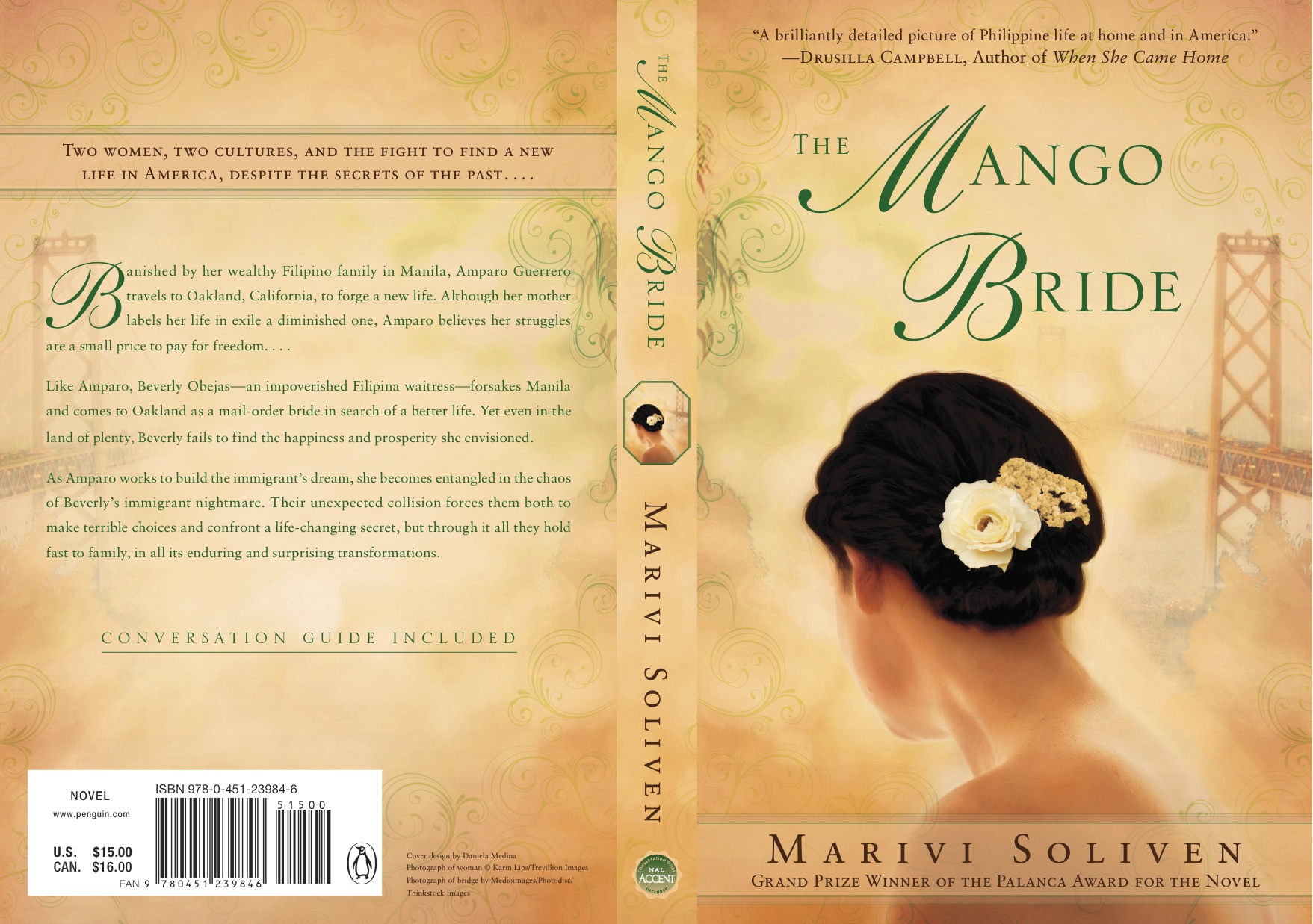
IT ISN’T every day or even every year that a Filipino author gets published by Penguin Books—I can think of only Jose Rizal, Jose Garcia Villa, Jessica Hagedorn, and Miguel Syjuco, off the top of my head—so when Marivi Soliven told me a couple of years ago that her new novel The Mango Bride (New York: NAL Accent, 2013) had been picked up by a division of Penguin, I immediately sent her a congratulatory note. But I didn’t realize the extent of Marivi’s achievement until I received a copy of the published book and read the novel in a mad dash to the ending.

Again, that doesn’t happen to me very often; given my crushing workload, it usually takes me weeks and even months to finish a new book, which is why I habitually decline invitations to do book reviews, not wanting to keep the authors and publishers waiting interminably. But Marivi’s case was different, because I was reading the book not as a beetle-browed critic, but as a mentor and a friend; as it happened, Marivi—whose husband John Blanco teaches literature at the University of California in San Diego, where they’ve been living for many years now—was also my daughter Demi’s English teacher in UP, and since Demi herself moved to San Diego, we’ve all kept in pretty close touch.

All this chumminess and this moving around has a point, and it’s directly related to The Mango Bride, which deals with the powerful tides, both social and personal, that continue to deliver many thousands of our countrymen to America. It tracks two Filipino women—the to-the-manor-born Amparo Guerrero, who gets banished to Oakland following an unwanted pregnancy that threatens to bring shame and scandal on her family, and Beverly Obejas, a plucky girl who also ends up in Oakland following the well-traveled path of the mail-order bride.

There is, of course, more in common between these two women than meets the eye, and it will hardly be a spoiler to say that their trajectories will cross. The task of the novel’s plot is to bring these two seemingly very different characters together—Amparo is a carefree college coed, while the orphaned Beverly works as a waitress—and when they do, toward the novel’s explosive climax, the author completes a narrative coup, with both dramatic inevitability and irony.

But more than a story of individuals, The Mango Bride is also a story of Filipino families rich and poor, which is to say that it presents Philippine society as an unfolding telenovela—bitchy matrons, philandering patriarchs, wayward sons, gay go-betweens, suffering servants, and all. This is, unabashedly, the source of the novel’s power, its appreciation of life in its broad, harsh strokes.

But unlike a telenovela, Soliven’s masterful prose lends the novel a fineness of detail that extends the pleasure of reading beyond mere plot and character into language. Here’s how she presents Amparo’s first experience of sex (as novelists know, a sex scene is always one of the hardest things to do well, and do freshly): “If there was something Amparo learned that first night, it was that the rhythm of passion was deeply satisfying for its simple circularity. Mouths making pillows of opposing lips, the call and response of interlocking sighs, a passel of caresses, cascading one into the other as waves folding into sea foam. Afterward, they gathered the thin sheets about them and curled into each other, chin to chin, chest to breast, dozing twins in a cotton womb.”

There’s a brilliant scene where Amparo tries to tell her boyfriend Mateo that he’s gotten her pregnant, but an elephant—literally—strides into the picture, having escaped from a circus and running red lights all the way down EDSA. It’s unexpected pay-offs like this that keep lifting the novel above the pedestrian, that remind us of an important literary talent at work, one with an unfailing feel for her material, whether we’re in Forbes Park or North Cemetery or a grocery in Oakland.

There will, I expect, be some complaining over the coincidences that mark the plot, but even here the improbable seems fated, precisely because of the novel’s implicit message: that we are closer to each other than we think, and might do well to acknowledge and accept that closeness while we can.

Marivi says that she began the novel in 2008 in the frenzy of NaNoWriMo (National Novel Writing Month—November, to most people) and completed it two years later. It won the Grand Prize for the Novel in the 2011 Palancas, but was extensively revised by Marivi for international publication.

If you want to buy the book and see if you can share my enthusiasm, it’s available at National Bookstore. But here’s the best part: if you want to meet Marivi herself and get her to sign your copy for you, she’ll be in town very soon for a series of readings and talks, thanks to NBS, which is sponsoring her visit.

She’ll be spending an afternoon with us in UP Diliman on Wednesday, August 7, from 2:30 to 4 pm at CM Recto Hall. The UP Institute of Creative Writing and the Department of English and Comparative Literature will co-sponsor the event, which is open to all. See you there!

SPEAKING OF new books, I was happy to have attended the recent launch of a rather unusual book—unusual because it’s a bilingual Spanish-English edition—titled La Oveja de Nathan (Nathan’s Sheep), by the late novelist Antonio M. Abad. Translated into English by Lourdes Castrillo Brillantes (a professor of Spanish at UP, and the lovely wife of our friend and literary kuya Greg Brillantes), the novel won the Premio Zobel in 1928, and was being published for the first time.

The Premio Zobel was initiated by the pioneering businessman Enrique Zobel de Ayala in 1920 to preserve the linguistic and cultural heritage of Spanish in the Philippines in the face of what Nick Joaquin would have called unbridled sajonismo. The Philippines and Filipinos had imbibed English like it was God’s own drink, and bold measures had to be taken to ensure the survival of Spanish in the new American age. Over the next many decades, the Premio Zobel did just that, and more, granting recognition to the best literary works written by Filipinos in Spanish, as well as the most valuable cultural contributions made by Filipinos to the cause of hispanidad.

Abad’s novel was one of the earliest winners of the prize (which Prof. Brillantes herself would later win), and its present publication by the Premio Zobel Collection, the Filipinas Heritage Library, and Georgina Padilla y Zobel (Enrique’s granddaughter) could not be more timely, as it deals with Filipinos caught between powerful political forces.

I’d have to admit that Sra. Georgina’s thoughtfulness in sending over an invitation to my house, with my name and address hand-lettered with a fountain pen, was what convinced me to drive across town in rush-hour traffic to catch the launch. Of course, the late author’s son, the poet Jimmy Abad, is also a dear friend, and Jimmy’s moving poetic tribute to his father’s legacy (delivered, in customary Jimmy Abad fashion, straight from memory) was well worth the excursion.

Penman No. 26: New Novelist in Town

OFW AwardPenman for Monday, Dec. 23, 2012

IT’S ALWAYS a pleasure to welcome a new novelist into our ranks, and today will be one of those happy days when we acknowledge the arrival—literally and figuratively—of a new talent in our midst, Dr. Almira Astudillo Gilles, or just Almi to her friends.

Almi flew in from Chicago as one of 29 recipients of the 2012 Presidential Awards for Filipino Individuals and Organizations Overseas, which were given out last December 5 by President Aquino at Malacañang. I had met her at the ICOPHIL conference in Michigan last September, although she had introduced herself to me by email earlier, as a fellow Filipino eager to make contact with other writers in the US and the Philippines.

Last December 9, Almi also launched her first novel, The Fires Beneath: Tales of Gold (San Francisco: Philippine American Writers and Artists, Inc., 2012), at the Ayala Museum. The novel deals with how a poor man’s discovery of ancient gold in the Philippine South changes him, his family, and his community. I haven’t finished reading the book, but I’ve been much impressed by her sharpness of eye and precision of language.

Writing about Quiapo and Binondo, for example, Gilles observes that “In Quiapo, the Golden Mosque is flanked by the Church of the Black Nazarene while the Binondo Chinese worship at Our Lady of China. On the sidewalks surrounding both places, vendors set up storefronts assembled from canvas, corrugated metal, or pieces of plywood, displaying items promising an easier spiritual journey. ‘Bypass purgatory,’ the vendors hawk. ‘Take one step closer to paradise… at a fraction of retail.’ Most believe, all pray. Both acts of nature and man cause great suffering. Metropolitan Manila lies beneath sea level and all it takes is one bad rainy season to show the inadequacy of the government’s flood control system. But the people take this all in stride. They buy both prayer beads and rubber boots.”

Since she was busy enjoying a well-deserved Christmas break with her family in the Philippines, I asked Almi to respond to a few questions I sent her by email, to map out the unlikely course she took to becoming a novelist from a professional background in the social sciences.

BD: Tell me something about yourself and your background.

AAG: I spent a few childhood years in Frankfurt, Germany where my father was assigned by the World Bank. Hence, English was the first language I learned formally. I was in premed psychology at UP Diliman and switched to AB psychology in my third year because I never intended to be a doctor and the subjects were getting harder. I graduated cum laude, and went to work for Sycip, Gorres, and Velayo (management consulting). After two years, I left for graduate school in the US, where I eventually finished a doctorate in social science, a master’s in political science, and a master’s in labor and industrial relations, all from Michigan State U. I also met my husband there, a doctoral student in economics, and got married there, on campus. My husband works in the telecommunications industry. I have a 22-year-old-son who works for Facebook and a 17-year-old daughter who’s starting college next year. I have a brother in Vancouver, Canada, and a brother and sister in the Philippines. My parents live in Manila.

BD: What started you writing?

AAG: I started writing poetry when I was about seven years old, and as I grew older I also started writing essays which were often published in the school newspaper. After graduate school, I joined the management faculty at De Paul University as adjunct professor, and taught at other area universities as well. At the same time, I had young children and my husband was traveling frequently. None of my childcare arrangements were satisfactory. After I grew dizzy and almost fainted in one of my classes (a night class for graduate MBAs), I went to see a doctor the next day and was diagnosed with hypertension, which apparently had been going on for quite a while. I then decided to quit teaching (I was teaching at campuses all over the Chicago area and would often get home around 11 at night) and try my hand at writing. My children’s book, Willie Wins, was published soon after, and I was hooked on writing. I started out writing for children since I had young ones of my own, and have published poetry, essays, short stories (one of which won a national award in the US), and plays for community theater. Now that my children are older, I thought I’d try something more adult, hence this novel.

BD: Where did the idea for this novel come from?

AAG: My friend’s sister was curator of the gold exhibit at the Ayala Museum, and she suggested I write a novel based on the discovery of the Surigao treasures. It took me about three years to finish, but I was working on other projects as well. I was fortunate that a video series of this story already existed, and I used that as reference.

I wanted the novel to reflect the tug between secularism and religiosity, and tried to delineate this struggle through my main characters (the gold discoverer and his family). Since I consider myself as a writer of the diaspora, I was careful to maintain a high level of authenticity about the Filipino experience (especially since the setting is the Philippines), while trying to appeal to American readers as well. Several chapters were workshopped at a master novel writing class led by a Northwestern University professor, and they were all white (no writer of color). While they liked the voice and style, they defined it as magical realism—a sad commentary on their knowledge of other cultures since the characters, setting, scenes were typical of a Filipino lifestyle. Some were also uncomfortable with my sentence construction (I tried to mimic the rhythms of Tagalog) but generally they liked the novel very much. In a writing workshop organization to which I belong, I’m the only Filipino writer (of English), and the only Filipino writer I know of actively publishing in the Midwest, so I feel I have to work extra hard to publicize my work and get the American readership to be more open to Filipino writing in English.

BD: What did your presidential award mean to you, and where do you go from here?

AAG: I write full time, but I guess you can say that days are filled with a lot of community organizing in addition to my writing projects. I’m very active in the Filipino American community in Chicago, and have a good working relationship with the Field Museum of Natural History. I try to promote Filipino culture whenever I can and am also invited by many schools to talk to students about multicultural writing. I’ve spoken at institutions and conferences all throughout the US, most notably at the Smithsonian Institution in Washington DC.

I’m humbled by the achievements of all the awardees—they are really exceptional people who have given so much back to the Philippines. I’m grateful that my writing has been recognized (Willie Wins is the most widely circulated Filipino American children’s book in the US, available in many schools and libraries, and is on the reading list of most multicultural publications), but I feel that a presidential awardee is obligated to continue to serve. My other passion is conservation and the environment (as president of the UP alumni group in Chicago, we raised funds for a marine study in UP Visayas), and I’m always trying to push both literacy and conservation. I’m encouraged by the feedback I get about my efforts because many have told me that I have motivated them to either write or start doing something to save the environment. I try to use the award to open doors so that I might do more, and the awards have been very effective in helping me to connect to others whom I might recruit for my cause.

AND SPEAKING of new novels, I’m awaiting an early copy of Marivi Soliven Blanco’s The Mango Bride, a comic romp through contemporary Filipino relationships, which will be released by Penguin in the US this coming April. Like Almi, the San Diego-based Marivi started out writing stories for children. Their examples should encourage more Filipinos, especially women, to make their mark in global publishing.