Penman No.205: Sojourn in Seoul (2)

IMG_8666.jpg

Penman for Monday, June 27, 2016


HAVING PLANNED our trip to Seoul months in advance, I made a point of touching base with some local contacts for possible meetings—something I usually don’t do, wary of disturbing people with my unseasonable presence. But with a week to kill in one city and with some longstanding connections in place, I thought it would be even more ill-mannered if I didn’t at least tell them that I was going to be in town.

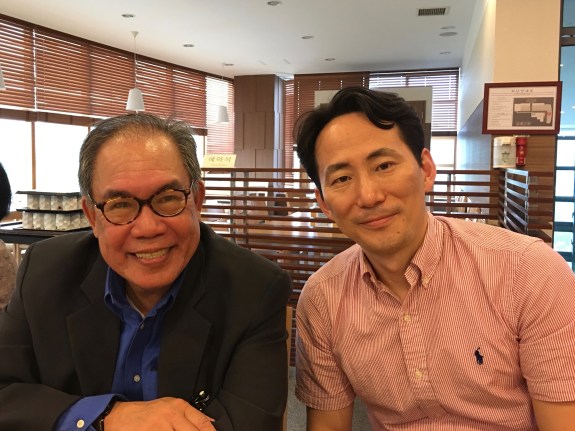
One of those connections was Dr. Sukjoo Sohn, who teaches English at Dong-a University in Busan, Korea’s big industrial center four hours by train from Seoul. Sukjoo—a specialist in world literature—happens to be married to Catherine Rose Torres, one of our bright new young fictionists who now serves as First Secretary and Consul at our embassy in Berlin. I’d first met Catherine in 2011 when I attended the Singapore Writers Festival and she was with our embassy there, and I was later very happy to write a blurb for her first book, Mariposa Gang and Other Stories (UST, 2015).

It’s really these personal connections that make for global literary networking, the value of which I can’t overemphasize. In 2014, Sukjoo translated one of my stories for publication in Global World Literature, which is put out by some of Korea’s foremost literary scholars and critics in that area. Through Sukjoo, I was also able to contribute an article to the Korea-based journal Asia, in which I wrote about some of our most gifted and exciting younger writers. As a result of that article, one of our best young non-fictionists, Sandra Nicole Roldan, will be visiting Seoul this week to attend the 2016 Asia Literature Creative Workshop.

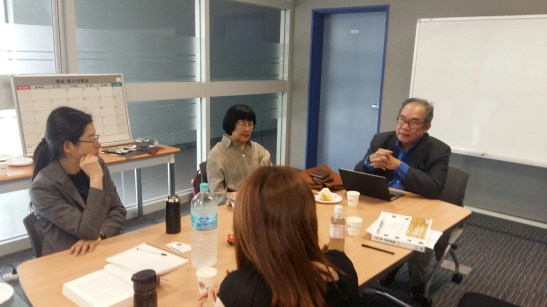
And so our connections continue and deepen. When they learned that I was visiting Korea, Sukjoo’s organization invited me to a special meeting, so I could tell them more about Philippine literature. That gathering took place at Seoul National University toward the end of our visit, and a very fruitful and engaging encounter it turned out to be. Perhaps I shouldn’t have been surprised, but their very first question had nothing to do with lyric poetry: “What do you think of your new President, Rodrigo Duterte?”

It will take more than this column to share my answer with you, but suffice it to say for now that we talked about our colonial history, our Catholic predisposition to suffering, the two Joses (not me) by which our literature is best known overseas, class as the key divisor in our literature and society, Korea’s and the Philippines’ shared experience of dictatorship, and the irony of having to deal with a resurgent Park and a resurgent Marcos, and our younger writers’ affinity with Gaiman, Murakami, and Wattpad.

We discussed my translated story, “In the Garden,” which I’d written in the 1980s about militarization in the countryside and the moral duty of a teacher caught in the crossfire. While the topics were unavoidably contentious, our meeting itself was thoroughly pleasant and mutually informative, capped by dinner, shop talk, and, yes, chatter about Lee Min-ho.
meeting 2.jpg

The second highlight of our visit—away from the malls and the flea markets—was a meeting with the Filipino community in Seoul, which had also been pre-arranged by Catherine through her Seoul colleague, the very capable Third Secretary and Vice Consul Ella Mitra.

It was a Sunday—our last full day in Korea—and much to our surprise, the embassy was open and bustling with people, with a wedding taking place right in Ella’s office. (“We can officiate at weddings,” Ella told us, “as long as the two parties are both Filipino citizens. We’re open on Sundays because that’s when most of the community can come.”) There were over 40,000 Filipinos in Korea, Ella informed me, many employed as factory workers in jobs that the locals themselves prefer not to do.

I’d been asked by the embassy to give a reading for the community—something I love to do whenever I’m abroad, as it puts me in touch with ordinary Filipinos striving to do their best in often very challenging circumstances. The Filipino, I like to say whenever the opportunity arises, is the modern-day Ulysses, roaming recklessly to the farthest reaches of the globe, but imbued with an unfailing sense of home. Now here they were, a crowd that filled the room beyond our most generous expectations—professionals, teachers, graduate students, Filipino-Korean couples, even the Ambassador himself, the dapper and articulate Raul Hernandez.

IMG_8681.jpg

The embassy had calendared my reading as its second Sentro Rizal activity, and with June 12 coming up, it seemed a good time to remind ourselves of the things that both divided and united us, and of the need to hang together as Filipinos, at a time and in a region of revived nationalisms. Even so I chose to do a very light reading, one that made fun of my own social ineptitude in cross-cultural situations, and thankfully it went over well with the audience. More than the reading, it was the ensuing Q&A and freewheeling chat over pancit and puto that proved most gratifying. I could sense the community’s strength of spirit, its determination to master a new cultural terrain.

I was especially happy to see a former student, Tech Apognol, now doing an MA in International Relations and speaking Korean. She’s hardly alone; the association of Filipino grad students in Korea now numbers 500, I was told, and there were plenty of masteral and doctoral scholarships for those inclined. “We can take classes in English,” one student named Eve told me.

Another grad student named RJ solved a mystery that had been bugging me for 40 years. Back then, I told him, I was a young writer employed by the National Economic and Development Authority, and one of my tasks was to help edit the Five-Year Development Plan, which was thicker than an encyclopedia because of its bloated prose. On the other hand, I recalled, the South Korean development plan that I used as a reference was no bigger and fatter than a paperback novel—and look, I told RJ, where Korea was now. “Ah, that’s easy,” RJ said. “It’s because the Koreans value brevity, and memos are expected to be no more than a page. The higher up the ladder papers go, the more concise they’re expected to be.”

The shopping was fun—just the flea markets for us, please, not the high-end shops—and the streetcorner food delicious, but it was, ultimately, our encounters with the people that added the most value to our visit. Kamsahamnida, Sukjoo, Cathy, Ella, and Tech for these memorable exchanges.
Penman No. 196: A Frenchman in Jalajala

Gironiere1.jpg

Penman for Monday, April 18, 2016


I USUALLY ask my wife Beng to ride out with me on a day trip during the Holy Week break, and this year our destination was rather unusual, in that it never figures in the travel plans of Manileños, although it’s a short and pleasant drive from Quezon City or Ortigas. We took the scenic route from Diliman via Antipolo, Teresa, and Morong, and soon found ourselves following the lakeshore of Laguna de Bay on the peninsula of Jalajala, Rizal, described by the guidebook as “a fourth-class municipality with a population of 30,074 people.”

We were there on the trail of an extraordinary author and adventurer who, nearly two centuries ago, had lived in Jalajala, and had written about his sojourn in a book that had been a favorite of mine for 40 years.

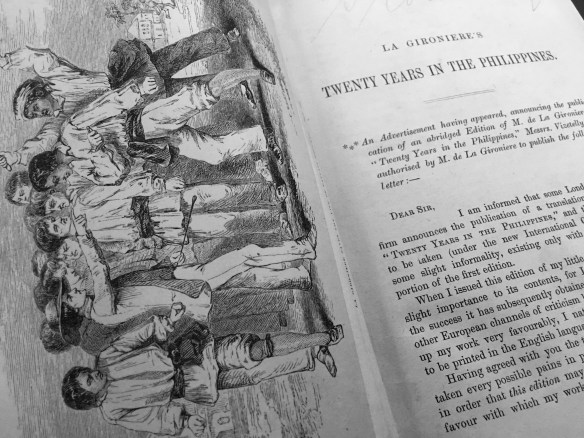
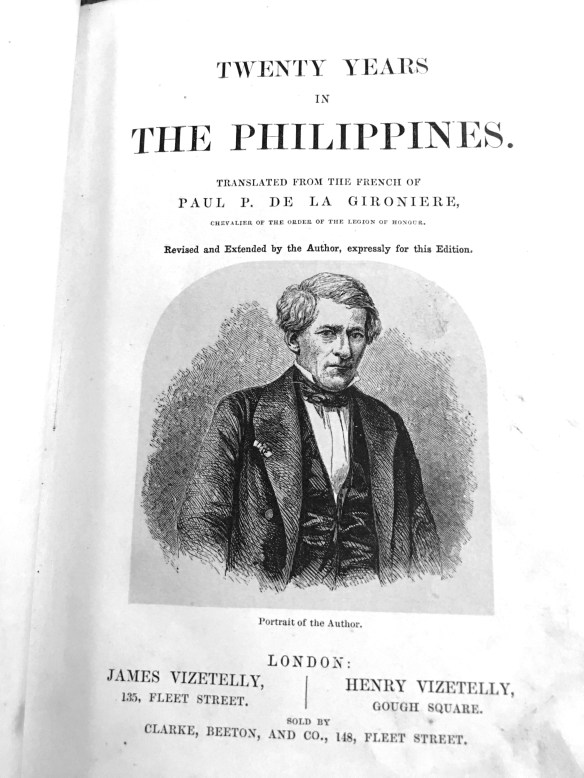
The book was Paul Proust de la Gironiere’s Twenty Years in the Philippines (subsequently expanded under the title of Adventures of a Frenchman in the Philippines), and I had recently acquired a copy on eBay, all the way from the UK—the first English edition published by James and Henry Vizetelly, undated but very likely from 1853, a year ahead of the American edition published by Harper & Bros. in 1854. The copy was far from mint, but it was in its original binding and still very readable, and wonderfully illustrated with engravings of local scenes.

Gironiere2.jpg

Gironiere was an adventurer from France who came to the Philippines in 1819 in his early 20s as a ship’s surgeon and stayed on for the next two decades, establishing himself as a landlord and farmer in what today is Jalajala, Rizal. His travails begin shortly after his arrival on the ship Cultivateur, and his account of a massacre shows why his book is—in that awful word coined by book reviewers—“unputdownable”:

I had only resided a short time at Cavite when that terrible scourge, the cholera, broke out at Manilla, in September, 1820, and quickly ravaged the whole island. Within a few days of its first appearance the epidemic spread rapidly; the Indians succumbed by thousands; at all hours of the day and of the night the streets were crowded with the dead-carts. Next to the fright occasioned by the epidemic, quickly succeeded rage and despair. The Indians said, one to another, that the strangers poisoned the rivers and the fountains, in order to destroy the native population and possess themselves of the Philippines.

On the 9th October, 1820 … a dreadful massacre commenced at Manilla and at Cavite…Almost all the French who resided at Manilla were slain, and their houses pillaged and destroyed. The carnage only ceased when there were no longer any victims. 

…Four hundred Indians surrounded me; the only way of dealing with them was by audacity. I said in Tagaloc to the Indian who had attempted to stab the captain: “You are a scoundrel.” The Indian sprang towards me; he raised his arm: I struck him on the head with a cane which I held in my hand; he waited in astonishment for a moment, and then returned towards his companions to excite them. Daggers were drawn on every side; the crowd formed a circle around me, which gradually concentrated. Mysterious influence of the white man over his coloured brother! Of all these four hundred Indians, not one dared attack me the first; they all wished to strike together. Suddenly a native soldier, armed with a musket, broke through the crowd; he struck down my adversary, took away his dagger, and holding his musket by the bayonet end, he swung it round and round his head, thus enlarging the circle at first, and then dispersing a portion of my enemies. “Fly, sir!” said my liberator; “now that I am here, no one will touch a hair of your head.” In fact the crowd divided, and left me a free passage. I was saved, without knowing by whom, or for what reason, until the native soldier called after me: “You attended my wife who was sick, and you never asked payment of me. I now settle my debt.”

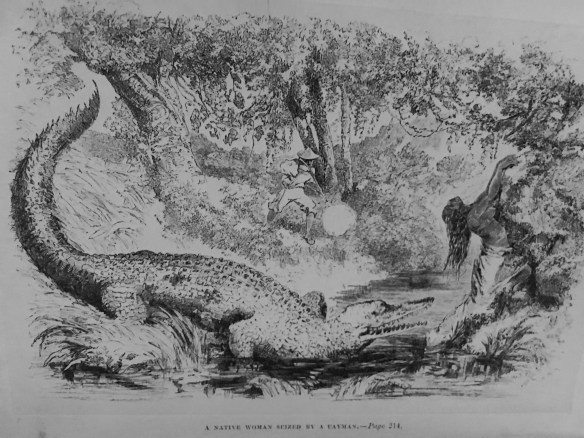
I had first read the book a long time ago, and kept my copy of Adventures, in a Filipiniana Book Guild edition reprinted locally in paperback by Burke-Miailhe in 1972, with a foreword by the eminent historian and economist Benito J. Legarda. In his foreword, Dr. Legarda says that Gironiere’s book was “probably the best seller among books about the Philippines in the 19th century,” noting that “What attracted the 19th century reader was of course the narration of several adventures, at that time considered unusual or bizarre. Among them may be enumerated the killing of man-eating crocodiles, the hunting of wild carabaos, the exploration of caves, the customs of pagan tribes, and the adventures of those caught in captivity by Moro pirates.”

IMG_8257.jpg

While granting that Gironiere’s accounts may have taken certain fanciful liberties, Legarda also considers the many real contributions the Frenchman made to his adopted soil, particularly as an agricultural pioneer who planted coffee, abaca, indigo, and rice on his 2,400-hectare estate in Jalajala, then part of Morong. Of Jalajala, Gironiere would write that it was “the greatest game preserve in the island: wild boars, deer, buffaloes, fowls, quail, snipe, pigeons of fifteen or twenty different varieties, parrots in short all sorts of birds abound in them.”

Gironiere returned to France in 1839, crushed by the deaths of his son, daughter, and wife, and he eventually remarried, and yet nothing, he said, “could induce me to forget my Indians, Jala-Jala, and my solitary excursions in the virgin forests. The society of men reared in extreme civilisation could not efface from my memory my past modest life.”

IMG_8124

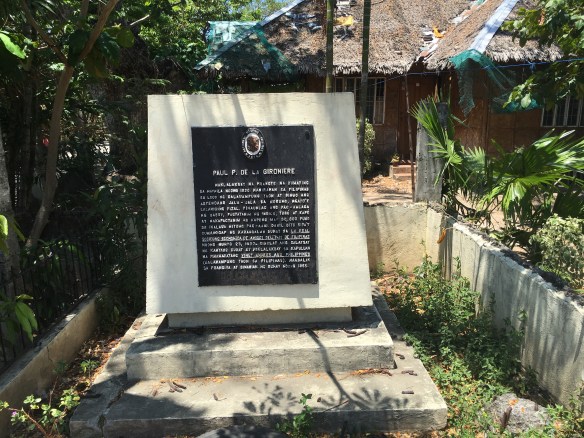
Was there anything left of Gironiere’s vast estate? All I could find on the Internet was a marker put up by the National Historical Institute in 1978 on what presumably had been his property, so I resolved to find at least that. We were there on the Wednesday of Holy Week, so I knew I had to catch someone at the municipio before it closed for the half-day, and fortunately a kind gentleman from the agriculturist’s office recognized the marker and offered to lead us there. And a short drive later, there it was, on a lot in the shade of towering acacia trees.

Nothing else would have suggested Gironiere’s presence, except possibly a stump of bricks in a corner of the lot. Not too far away was the water’s edge, and the slim profile of Talim Island, which Gironiere would have seen out his window. I struggled to imagine this spot as the center of a visiting Frenchman’s adopted life and holdings, his pursuit of bats and lizards, crocodiles and gold dust.

I didn’t feel let down; I was looking at an empty stage, but I knew the play, and I could hear the lead actor’s parting words: “Overwhelmed by the weight of troubles and of the laborious works I had executed, there was only one wish to excite me, and that was, to see France again; and yet my recollections took me continually back to Jala-Jala. Poor little corner of the globe… where my best years were spent in a life of labour, of emotions, of happiness, and of bitterness! Poor Indians! who loved me so much! I was never to see you again! We were soon to be separated by the immensity of the ocean.”