Penman No. 273: A Privileged Friendship

IMG_7575

Penman for Monday, October 16, 2017


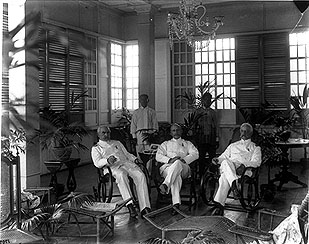
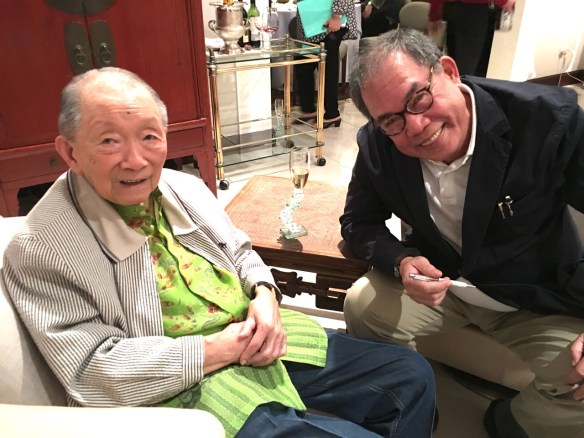
THE LAST time I saw Wash SyCip was from a far distance. It was his 95th birthday on June 30, 2016, and a long line of well-wishers—businessmen, politicians, and other celebrities—had queued up at the ballroom of the Shangri-La Makati to greet him and have their pictures taken with the icon. I thought for a second about falling in line, just to say hello, but then decided against it, already having spent more time with Wash than most people except his closest associates. He looked more frail than I had ever seen him, even as he kept up a cordial countenance seated in his chair on a raised dais, and I felt content to remember the sprightlier octogenarian I had first met a decade earlier.

Of course I knew who Washington SyCip was well before then; my wife Beng worked as an artist in the communications department of SGV in the 1980s, but I had never met the man himself—not until an opportunity arose to bid for and to write his biography in early 2006, when he was turning 85. I felt very fortunate to have been chosen for the job—and that’s what it was to me then, a job, albeit one involving an illustrious subject. I had no inkling that I was about to enter into a privileged friendship, something that would extend well beyond the writing of a book.

I had already done books for and about other personages in politics and business, and would do many more after Wash. But none of them—meaning no disrespect to or disregard for my other clients—would come close to the biography I would write for Wash, and it had everything to do with the uniqueness of the man, who lived not only an extraordinarily long life but also one far more colorful than you would credit an accountant for.

For months, we met Saturday mornings in his seventh-floor SGV office, and chatted for a couple of hours about phases of his life, proceeding chronologically from his childhood to the key decision to open his own accounting firm, a moment that I would later decide to open the book with. (Wash: Only a Bookkeeper was published in 2009 by the SGV Foundation and the Asian Institute of Management, and won the National Book Award for Nonfiction in 2010.) Immediately I felt at ease with his polite formality; no artificial chumminess there or dramatic flourish, just a quiet consistency of well-remembered detail, everything from trying to learn the foxtrot for a graduation dance and breaking Japanese codes in Calcutta to carrying a cold, dressed duck under his arm on the New York subway to bring to a lady friend.

Most readers, I’m sure, were looking for the grand contours, the big business decisions—and there’s all that in the book—but I tried to keep things homely, and was glad that Wash was game for it. He liked to play “Lara’s Theme” from Dr. Zhivago on his iPod—but not being a techie, often forgot to recharge it.

When he learned that I collected pens, he sent a bunch of them over to my house; I opened the box and saw that he had gifted me with some very nice ballpoints, which I thanked him for. When a perceptive associate gently reminded him that I collected not ball pens but fountain pens, he sent another box of the correct writing instruments—CEOs like him typically received scores of these as gifts and stored them away in drawers—with an apologetic note, even more graciously acknowledged by the ecstatic recipient. And every Christmas we would receive a box filled with some lovely piece of décor handcrafted by a microenterprise he supported in Cebu.

He had a soft spot for Filipino talent of all kinds. He once hosted a party at his home for President Cory Aquino, some ambassadors, and similarly lofty people. After dinner, he sprung a surprise on them. “Just get into your cars and follow me!” he announced with a twinkle in his eye. He led the convoy to a dimly downscale stretch of Boni Avenue, down into the happy maw of Club Mwah, the gay musical revue. Cory had a blast, and I had fun watching Wash garlanded by that feathery parade.

Sometimes I dropped by his office or chatted with him in the corner of a soirée to hear him share his views on current goings-on, both of us probably thinking that they would be useful inputs to the centennial update of his biography, but really just to catch up. It was these unscripted asides, his inviting trust, that I felt most privileged by. I suppose biographers come in through some special door, and with Wash, that door always seemed open.

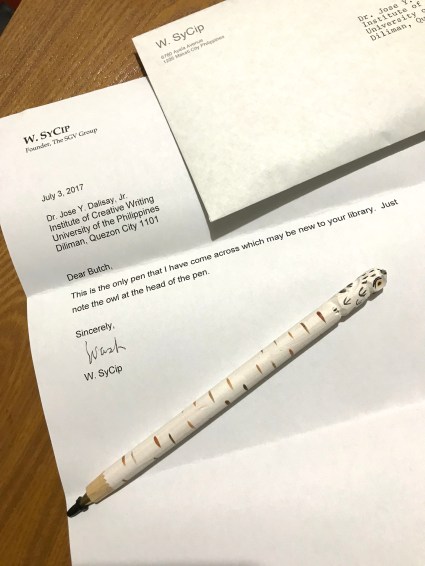
Last July I received an envelope from Wash, and even without opening it I could feel that it contained a pen inside. “Dear Butch,” said the accompanying note, “This is the only pen that I have come across which may be new to your library. Just note the owl at the head of the pen. Sincerely, Wash.” It was a ballpoint, but I didn’t mind—owls (and turtles) were his trademark avatars.
IMG_3207

His generosity was well known, but it was never the showy or sentimental kind. He believed above all in the capability of the poor to learn and to lift themselves up with a little help. Despite the American citizenship he had to accept in a time of war, he thought and acted as a true global Filipino.

When he passed away last week on a plane above the Pacific—bridging the two shores he knew best, and still on the job at 96—I was requested to draft an obituary, and I replied, choking, that it was going to be my honor. It was the first—and, almost certainly, the only—time I would shed a tear for someone I wrote about.
Penman No. 272: A Poet of Nature

Junyee

Penman for Monday, October 9, 2017


IT’S NATIONAL Artist season again, with the deadline for nominations for the next group of NAs falling last September 30. It’s a triennial exercise that raises some very fundamental questions about how the arts figure in our national life and consciousness, and what we value in art.

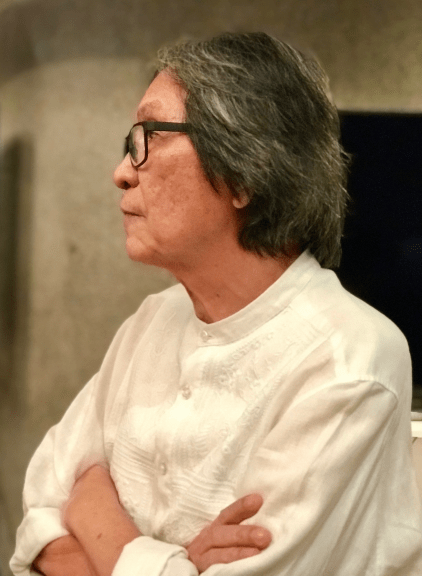
There’ll surely be an impressive roster of nominees to review, each name with its own merits to recommend it. But among all those presumptive candidates, the one I’ll be rooting for is a lanky, genial, youthful-looking septuagenarian who goes simply by the name “Junyee,” short for the Luis E. Yee, Jr. that only his family and closest friends probably know.

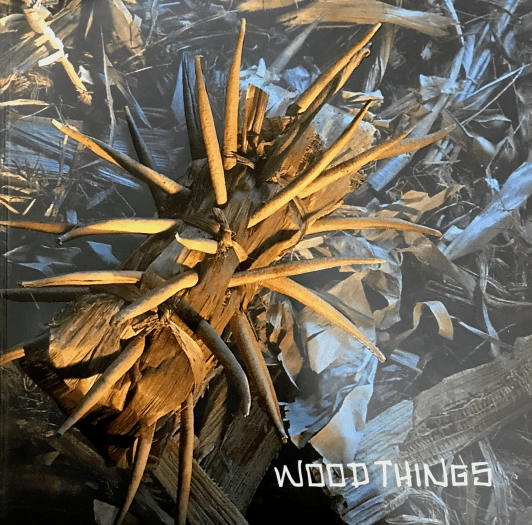
I’ve known Junyee and his work for some time now, but I was even more impressed by its breadth and quality as I listened to him address a large crowd that had gathered for the launch of his artistic biography Wood Things at the CCP lobby last Tuesday.

Like many artists, Junyee has a certain shyness about him that prevents more aggressive self-advertisement, so let me sing his praises for him in the hope that he finally gets the recognition due his lifetime of labors.

If you’ve never met him but read the book (written with grace and deep insight by the equally gifted artist Jose “Bogie” Tence Ruiz), the first thing that will strike you will be the life itself, the engrossing narrative of how a boy born in the hinterlands of northern Mindanao at the height of the Japanese Occupation nurtured a native talent that would, much later in life, see his works celebrated in France, Cuba, Israel, Japan, and Australia, among other cultural capitals.

The boy drew his first inspirations from the bales of scrap paper his father imported to use as wrappers in their general store, bundles that contained American and local comics depicting worlds far removed from Agusan del Norte. Later moving to Cebu, he found a job with a funeral parlor, first as a janitor and a clerk, then as a beautician for corpses, and later as an embalmer, all the while ogling the art supplies in the local department store, never yielding his dream.

In 1964, he received a scholarship to study Fine Arts at the University of the Philippines, and apprenticed with the renowned sculptor and later National Artist Napoleon “Billy” Abueva. The opportunity opened Junyee’s eyes to a whole new world of modernism, and eventually he broke out on his own, even as the prevailing forces of the 1970s—the psychotropic seductions of Carlos Castañeda on the one hand and the First Quarter Storm on the other—pulled him in different directions. While Junyee held progressive sentiments, Tence Ruiz notes that “He was inherently a maverick individualist who, while recognizing the need for collective actions to affect change, saw how formulaic and uncreative propaganda could get.”

WoodThings.png

And that’s key to the kind of visionary and yet also political art Junyee would produce over the next four decades—an art that manifests an abiding love of life, and of nature as the bringer of that life. In his preface to the book, artist Hugo Yonzon III writes that “The dominant and recurring theme of his installation is nature or, more precisely, the respect for it. There is none of the theatrics of LED lights or the electronic sounds that characterize such art especially in the Western world. A twig, a pod, a tree bark, local hemp, and then some. Period.”

“Installation” is a word that would inextricably be attached to Junyee’s art, as he explored and promoted the genre well before the term itself became fashionable, always and again drawing on nature for his materials and inspiration, from the seminal Balag of 1970 to the installations now dotting the campuses of Diliman and Los Baños, in which latter place he has found his literal and spiritual home, amid the trees and rocks that he never sees just as objects but as bearers of messages, like the 10,000 tombstone-like stumps of wood he laid out on the CCP grounds in 2007 to bemoan illegal logging and the catastrophic flooding it induced.

Junyee is a master sculptor and painter, and a wordsmith as well—his sensitive lyrics add a more personal touch to the book—but he is, ultimately, a poet of nature, who can make wood and stone speak and sing in joy, sorrow, and just the sheer excitement of living.

Lotsu.jpg

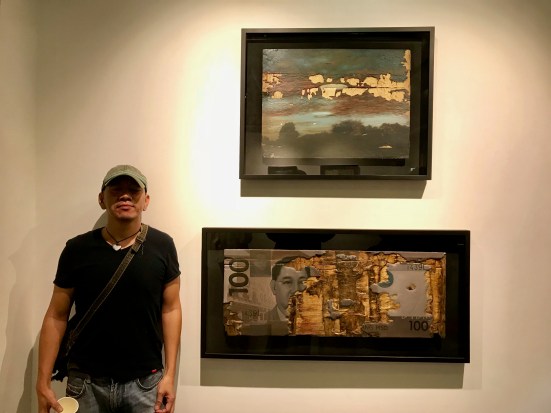
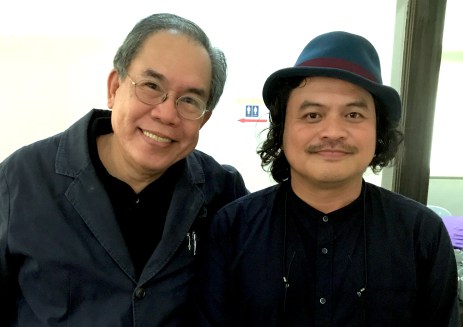
Speaking of artists, let me draw your attention to a younger painter in mid-career by the name of Lotsu Manes, whose seventh one-man exhibit titled “Handumanay” (after the Visayan word for keepsake or memorial) is now running at the Eskinita Gallery on the 2nd floor of Makati Cinema Square until October 23.

We’d known Lotsu since he was a small boy running on the beach of our hometown in Alcantara, Romblon, and took notice when he won the Grand Prize in the Shell Art Competition of 1996. “Handumanay” shows him maturing well beyond the meticulous craftsmanship that distinguished his earlier work to a more conceptual understanding of time and memory, and of the preciousness of what remains in his termite-ravaged portraits and landscapes.

At the opening, I was also glad to speak with curator and sculptor Renato “Ato” Habulan, who has been mentoring younger artists like Lotsu toward a less technical and more philosophical appreciation of their own work and vision.

Seeing Lotsu in his prime, chatting with Ato Habulan, and applauding Junyee at his book launch all left me warmly reassured that—even and especially in these terror-stricken times—art, like music as the poet Congreve put it, “hath charms to soothe the savage breast, to soften rocks, or bend the knotted oak.”

Penman No. 265: Photography as Propaganda

Empire.jpg

Penman for Monday, August 21, 2017


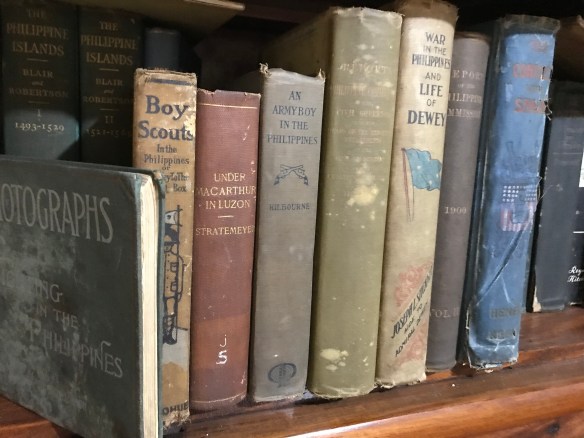
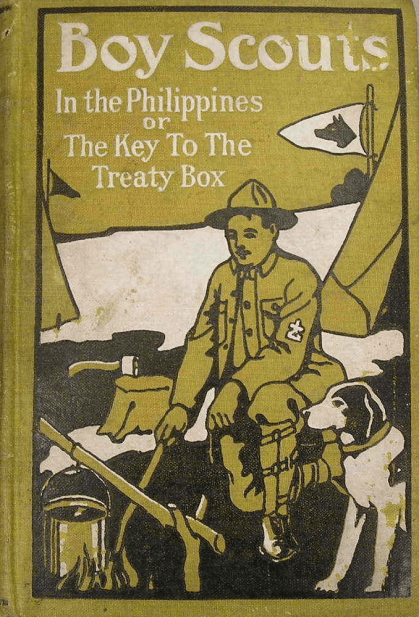
I HAVE a cabinet in my home office where I keep shelves of my most valued books—first editions, signed copies, antiquarian volumes, and such. One shelf is occupied by a special mini-collection of books from the turn of the 20th century, from the late 1800s to the early 1900s, most of them having to do with what we’ve come to call the Philippine-American War. Bearing titles like War in the Philippines and Life of Dewey, Under MacArthur in Luzon, and An Army Boy in the Philippines, the books purport to chronicle—“celebrate” might be the better term—the occupation of the Philippines by the United States from 1898 onward.

I picked up many of these books more than 20 years ago when I was a graduate student in the American Midwest and on the prowl for Philippine-related material in used bookstores and flea markets. When eBay came along, I found many more, and was pleased to secure a few, often for less than $20 plus shipping.

While old, these books weren’t necessarily rare, because they must have been printed in the high tens or hundreds of thousands as a form of patriotic propaganda that straddled journalism and popular entertainment. Often written in a triumphal tone and exulting in the victory of America—then a rising naval and imperial power—over decrepit Spain, they blended into travelogues exploring the US’ new possessions—Cuba, Puerto Rico, Hawaii, and the Philippines—turning a military project into a story of adventure in exotic lands.

Shelf.jpg

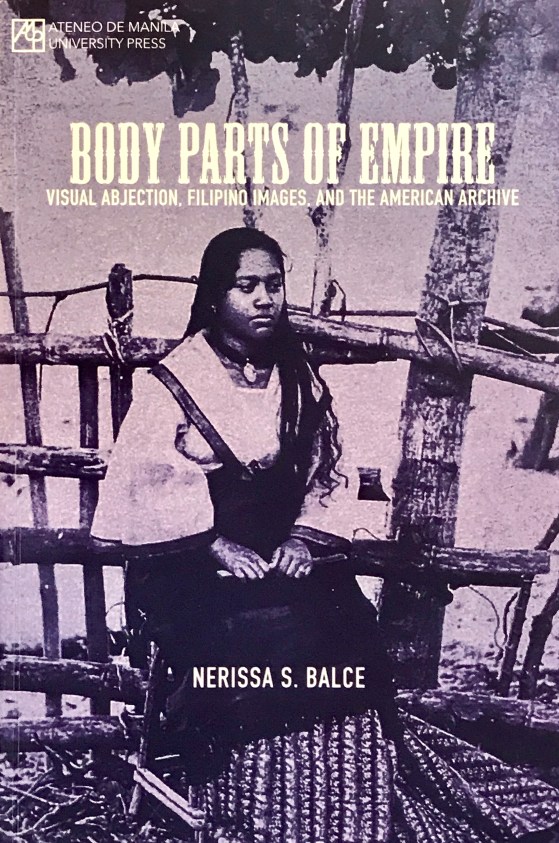
These stories—and their accompanying illustrations—were very much on my mind last week when Beng and I attended a fascinating lecture at Ateneo de Manila University by an expert who had made that dark period (which few Americans and, sadly, just as few Filipinos seem to remember) part of her academic specialty. Dr. Nerissa Balce was in Manila to read from and talk about her book Body Parts of Empire: Visual Abjection, Filipino Images, and the American Archive (AdMU Press, 2017; U of Michigan Press, 2016), and we thought it was a good opportunity to catch up with and learn from an old friend (she married my Trivial Pursuit antagonist, the poet Fidelito Cortes).

After working as a journalist in Manila, Nerissa went to the University of California-Berkeley for a PhD in Ethnic Studies, took a postdoc at the University of Oregon, and taught at the University of Massachusetts-Amherst before joining the State University of New York-Stony Brook’s Department of Asian and Asian American Studies.

Through photographs and a refreshingly lucid lecture shorn of much of the academic jargon that often renders these presentations impenetrable to many listeners—even fellow professors like me—Nerissa showed how American photographers who were (to use a later term) embedded with the US military forces used their work to celebrate but then also obliquely if unintentionally criticize the violence of a colonial war. Photographs, she would argue in her book, have a life of their own, once taken and published; they may have been originally meant to depict the power of one side over another, and the abject position of the presumptive loser in the conflict, but seen or used a different way, they can convey other messages, like the subject’s insistent humanity or resistance.

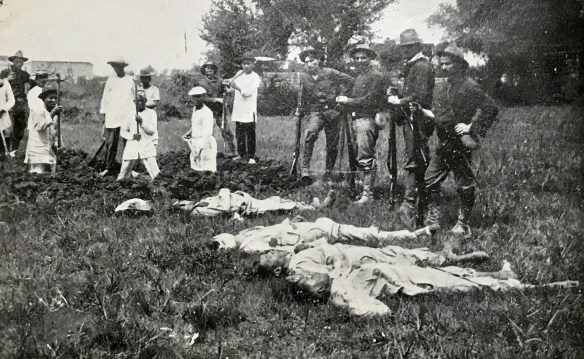
I’d seen many such images in my books from that war; one of them—F. Tennyson Neely’s Fighting in the Philippines—typically portrays American soldiers towering angularly over the slack corpses of Filipino “insurgents” (as our fighters would be referred to for the longest time) as Filipino gravediggers prepare to bury their compatriots. This was what Washington wanted the American public to see: visual proof of American power and dominance. It must have been effective propaganda, especially when accompanied by narratives explaining America’s “civilizing” mission.

Soldiers.jpg

But, as Nerissa and other scholars point out, the very same photographs proved useful to those opposed to America’s imperial expansion. The Anti-Imperialist League published a collection of antiwar poems using a picture of a corpse-filled trench as its frontispiece. “The different political uses for the same photograph suggest the paradoxical power of the photographic image, and how photographs can celebrate as well as expose the violence of colonialism and war.” She goes beyond the battlefield to discuss how the empire shaped our image, and how that image, in a way, shaped the empire. Pictures of native women doing embroidery suggested a colony stabilizing into happy domesticity under a benign regime.

I’m not a historian, but if you want a reasonably reliable account of that period, read Brian McAllister Linn’s The Philippine War 1899-1902 (The University Press of Kansas, 2000); to see how that war was waged on the cultural front, Balce’s book makes a great companion piece. In this present time when, more than ever, pictures speak louder than words, and dead men’s bodies have begun to pile up again, we’d have to wonder what new empire is growing out of the shadows.

ph-china-drugwar.jpg

[Photo from philstar.com]


Penman No. 259: A Showcase of Cordillera Culture

IMG_2071

Penman for Monday, July 10, 2017


I WENT up to Baguio a couple of weeks ago to give the commencement address before the Class of 2017 of the University of the Philippines-Baguio (UPB), and began my talk by reminiscing how, as a young boy, “I eagerly anticipated visiting this city, which used to involve a train ride to Damortis, La Union, before transferring to a bus that would wind its way up Naguilian Road. I recall my nostrils tingling when they caught the scent of pine. In high school in the 1960s, Baguio meant the CMLI, Teachers Camp, marching on Session Road to proclaim ‘student power,’ pretty faces from a school called St. Theresa’s, and a dark and exciting place called the Basement—which some of your older teachers might remember.”

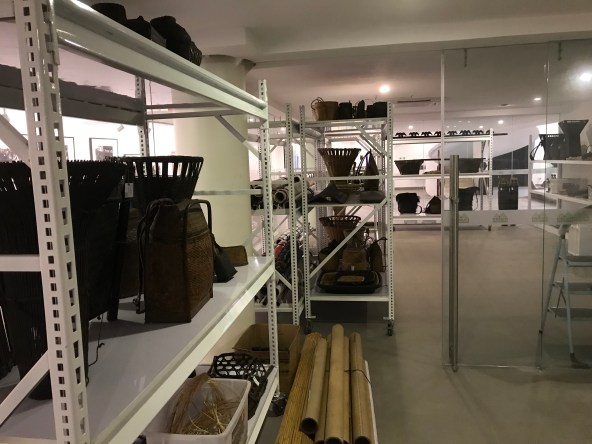
You can find the rest of that speech on my blog at http://www.penmanila.ph—it seems to have acquired a life of its own—but the real highlight of my Baguio sojourn turned out to be a visit to the new Museo Kordilyera on the UPB campus along Gov. Pack Road.

UPB, you have to realize, is unique among UP’s campuses in that it sprawls all over a hilltop, so that anything you build on it has to adapt to its challenging topography. When you think of what the builders of the Rice Terraces had to do, you get an idea of how creative and adaptive UPB’s architects have had to be to maximize the use of its property, keeping aesthetics in mind as well as safety, in this earthquake-troubled city.

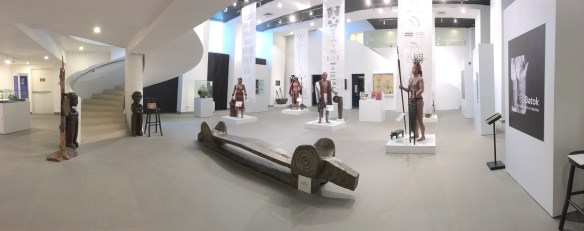
UPB Chancellor Ray Rovillos, himself a historian and one of UP’s most capable administrators, had offered to take us on a personal tour of the new museum the day after graduation, and Beng and I happily took him up on it. The three-level Museo looks little more than a glass box with a few exhibits at ground level, but it’s when you take the stairs going underground that your jaw falls at seeing what UPB’s combination of careful scholarship, administrative commitment, and sheer perseverance has produced.

Formally opened last January under the administration of then UP President Fred Pascual, the museum draws on the curatorial work undertaken by Professor Emeritus Delfin Tolentino, Jr., Prof. Victoria Diaz, archivist Cristina Villanueva and museum director Dr. Analyn “Ikin” Salvador-Amores.

IMG_2050

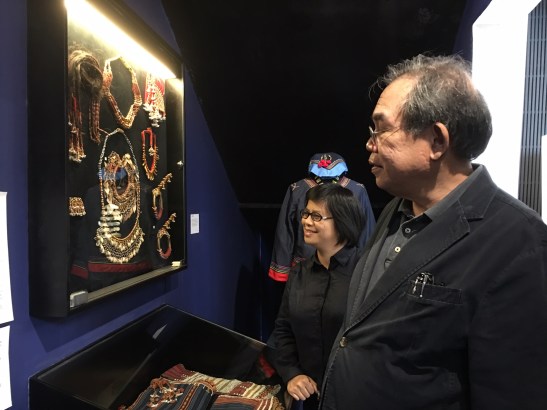
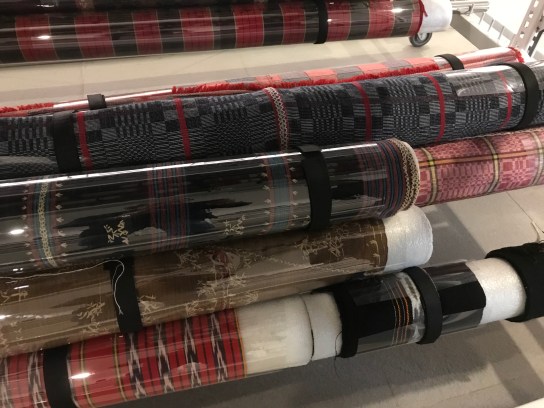
What immediately catches the eye, of course, are the life-size representations of various indigenous people in full tribal dress and gear—so accurately researched, Ikin would tell us, that some people in the community didn’t even know their ancestors had worn them. Going over the intricate weaves and beadwork, Beng and I exchanged stories with Ikin about similar objects we had seen deep in the bowels of Chicago’s Field Museum. While part of the museum’s mission is the visual showcase for the public, an equally important aspect is the scholarly research it hopes to engender. Century-old artifacts are kept in cabinets, yet to be studied, and donations from collectors are welcome to deepen the museum’s holdings.

IMG_2083

A Ford Foundation scholar at Oxford University, Ikin had published a landmark study titled Tattooing Ink, Tapping Identities: Tradition and Modernity in Contemporary Kalinga Society, North Luzon, Philippines (Quezon City: UP Press, 2013), the culmination of a long fascination with the practice and origins of tattooing that began with an encounter with an old woman in Baguio’s market almost 30 years ago.

A corner of the museum is devoted to books published by the UP Press and by the Cordillera Studies Center, which has established itself as the most important source of expertise in its area. Prominently displayed are the three excellently written and produced monographs that accompanied the launch and opening exhibits of the Museo Kordilyera: Batok (Tattoos): Body as Archive by Analyn Salvador-Amores; The Indigenous, In Flux: Reconfiguring the Ethnographic Photograph by Roland Rabang; and Jules De Raedt: Life Works, Lived Worlds by Victoria Lourdes C. Diaz. Anyone wanting deeper insights into the ways of the highlands would do well to consult June Prill-Brett’s Tradition and Transformation: Studies on Cordillera Indigenous Culture (Baguio City: Cordillera Studies Center, 2015).

Worthy of commendation for the museum’s modern but welcoming design is Architect Aris Go and the 90 Design Studio team that has been helping Chancellor Rovillos and UPB make the most of their limited space—a service Aris has also extended to UPB’s new and handsome Science Research Center, another fine example of environmentally adaptive architecture.

The UPB people were eagerly awaiting the visit of one of the country’s most fervent advocates of indigenous culture and arts, Sen. Loren Legarda, which was planned for mid-July. Knowing the senator’s passion for all things Filipino, I urged Ikin and Chancellor Ray to secure further support from her for the museum and its adjoining auditorium, which will host many conferences on indigenous culture in the years to come.

Besides the ube jam and peanut brittle at Good Shepherd—and, of course, the splendid art exhibits and architecture to be found in the Bencab Museum on Asin Road (Bencab has donated some of his most important pieces to the UPB museum)—Baguio visitors now have another must-see stop on their itinerary. The Museo Kordilyera is open Tuesday-Sunday 9 am-5 pm for a nominal entrance fee. For more information, check out its Facebook page here: https://www.facebook.com/upbmuseokordilyera/.

IMG_2084

Penman No. 255: A History Book Project Like No Other

8601068._UY630_SR1200,630_

Penman for Monday, June 19, 2017


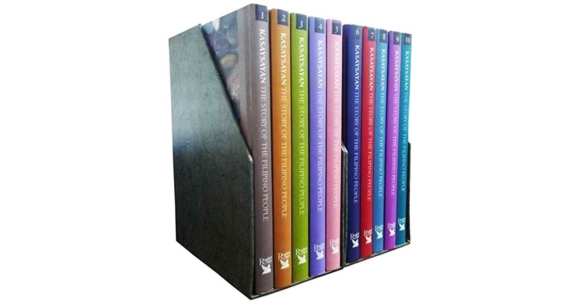
LAST MONDAY’S celebration of Independence Day reminded me of the Philippine Centennial nearly 20 years ago, when I took part in the launch of the first and still the biggest book project I’ve taken on in my professional life. I’ve edited about as many books as I’ve written—more than 30—and 10 of those were all for one massive undertaking, Kasaysayan: The Story of the Filipino People (Asia Publishing Co., 1998).

It was a 10-volume history of the Philippines like no other, put together by some of country’s foremost historians, academics, and writers, a joint project of Reader’s Digest Asia and A-Z Direct Marketing, which was then Reader’s Digest’s local distributor at a time when the family-friendly monthly was still going strong.

The idea was hatched in 1996 in anticipation of the forthcoming Centennial between A-Z’s late president Lirio Sandoval and the indefatigable Tere Custodio, who became the project director; Reader’s Digest Asia would foot most of the bill. Their idea was that while Philippine histories and encyclopedias had existed, none of them seemed comprehensive, popularly accessible, and visually compelling enough.

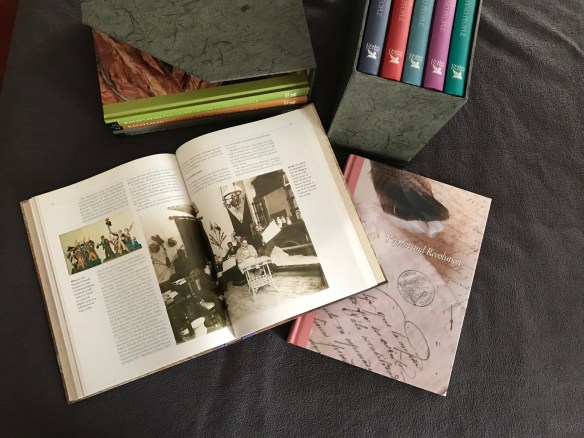
Tere shopped around for an executive editor, and I think it was our mutual friend Gina Apostol who suggested me (to my everlasting gratitude). We then took on two key and stellar talents, both of them sadly now gone—Doreen Fernandez as our editorial consultant and Nik Ricio as our book designer. Together, we planned out a 10-volume series, each full-sized volume no less than 300 pages, with an average of at least one picture—many of them never published before, acquired from international and private collections—on every page, 3,500 images in all.

The volume titles previewed the series’ coverage and contents: The Philippine Archipelago; The Earliest Filipinos; The Spanish Conquest; Life in the Colony; Reform and Revolution; Under Stars and Stripes; The Japanese Occupation; Up from the Ashes; A Nation Reborn; and A Timeline of Philippine History.

To write each of these volumes, we recruited our most eminent historians and experts—people like Dr. Milagros Guerrero, Fr. John Schumacher, Dr. Ricardo T. Jose, and Dr. Ma. Serena Diokno. Each volume was also supplemented by around 20 essays, contributed by the country’s top writers and cultural figures from Dr. Bienvenido Lumbera to Jessica Zafra—on topics ranging from early forms of Philippine writing and wartime “Mickey Mouse” money to 16th-century Visayan warriors and the origins of the kundiman. (My own single contribution as a writer to the series was an essay on the First Quarter Storm.)

It seemed like a gargantuan project, and indeed it was, requiring not only the production of enormous amounts of historical scholarship and pictorial research (the latter task headed by no less than Romy Gacad) but also the management of a budget hitherto unheard of in local publishing and, more dauntingly, of over 200 egos. I also organized a small team of sub-editors to help me get the job done, and sent them memos emphasizing the need for readability; every author’s brief, after all, was “to write in a style that can be understood by the Filipino high school and college student, without compromising the seriousness of the work as history.” The Internet in the Philippines was in its rudimentary stage; we had email, but still moved files around in floppies.

We gathered the editorial team for the first time one day in January 1997, setting for ourselves the formidable goal of launching 10 new, profusely illustrated books in June 1998, or 18 months hence. Against all odds, that goal was met. I would write as a promotional blurb at the end that “Here, finally, is the story of the Filipino: told from a Filipino viewpoint, but with a full appreciation of the modern Filipino’s engagement in a rapidly globalizing society.”

That priceless experience would teach me everything I needed to know as a textual editor, leaving much of the people management to the thoroughly professional and unwavering Tere. Including the essays, I read, edited, and proofread a million words; I sat side-by-side with Nik poring over the layout, adjusting the text to remove—as the perfectionist in him demanded—rivers, widows, and orphans (publishing terms you’d do well to Google), and writing and positioning subheads for visual relief.

One more task remained for me, which was to draft speeches for the two principal guests of honor at the grand book launch at the Manila Hotel on June 1—President Fidel V. Ramos and former President Corazon Aquino. I’ve sadly lost the draft I did for Cory, but I still have notes that have FVR saying:

“If the art of narrative or of storytelling is the art of making sense of seemingly random or disparate events, then Kasaysayan is our story, our understanding of ourselves, our version of the same events that other writers have used to keep us subjugated and alien unto ourselves. Written from our point of view, this version—this vision—is one that must empower us, that must make us whole, that must enable us to better ourselves and our future. We cannot change history, but history can change us.”

The handsomely boxed ten-volume set initially sold for P16,000; a few months ago I learned that surplus sets were being marketed in some Manila bookstores for as low as P2,000. That sounds to me like the bargain of the century—especially if you have a teenager in the house in need of a sense of history, or just want to see our history in a way you never did before.

IMG_2029

Penman No. 254: Another Filipino Writer in Norwich

l1030996

Penman for Monday, June 12, 2017


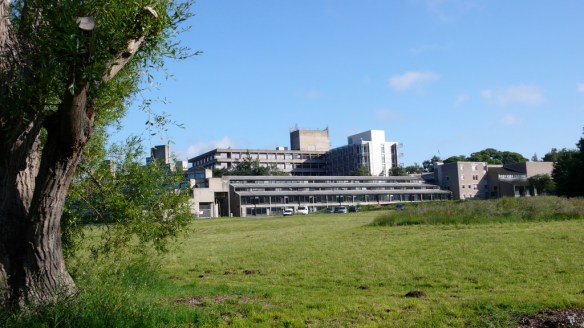
IT’S BEEN nearly 20 years since I received the news that I had won the biggest writing grant of my life. I was 45 and raring to work on my second novel, and had a germ of an idea, suggested by the sad parade of caskets that arrived almost daily at Manila’s international airport. I knew that our overseas workers and their experience was the big story of that period, but I needed time away from teaching to get started on the project, so I applied for a new grant that was being offered at the University of East Anglia in the UK for what was described then as “a novel of Asia.”

The UEA website describes that fellowship thus: “The David T. K. Wong Creative Writing Fellowship is a unique and generous annual award of £26,000 to enable a fiction writer who wants to write in English about the Far East to spend a year in the UK, at the University of East Anglia in Norwich. The Fellowship is named for its sponsor Mr. David Wong, a retired Hong Kong businessman who has also been a teacher, journalist and senior civil servant, and is a writer of fiction. The Fellowship was launched in 1997 and the first Fellow appointed from 1st October 1998.” (Collections of short stories are now accepted in lieu of the novel. The UEA and its writing program are acknowledged to be the leader in the field in the UK, with Booker Prize winners Kazuo Ishiguro, Ian McEwan, and Anne Enright among their distinguished alumni.)

2586062407_3c893e8374_b

I honestly can’t remember now how I chanced upon the Wong Fellowship—these were the early days of the Internet in the Philippines, when modems screeched like mating cats before connecting over phone lines—but Beng and I soon packed our bags for the privilege of a lifetime. It would take a few more years, but that idyllic journey eventually gave birth to Soledad’s Sister, which was shortlisted for the inaugural Man Asian Literary Prize in 2007 and published in 2008. I was only the second Wong Fellow, and after me, in 2003, another Filipino followed me to Norwich—Lakambini Sitoy, now based in Denmark, whose novel Sweet Haven also began taking shape in Norwich.

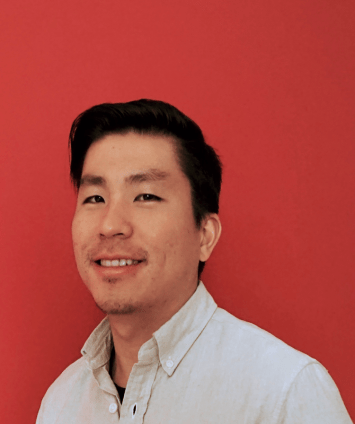
Last month came the terrific news that yet another Filipino, Nathaniel Go, had been named the new David T. K. Wong Fellow, besting dozens of other applicants from around the world. I was so elated by the news that I sought out Nathan, as he prefers to be called, by email, and got this story from him:

DGo

“I was born and grew up in Davao City. This is quite a statement to make nowadays as Davao has suddenly received a lot of attention. But back then, I remember a quiet and laid-back existence, highlighted every summer with the sickly sweet smell of mangoes, as our neighbor who owned a farm, would bring in basket after basket from their harvest. When it rained, water buffaloes would sometimes stop traffic outside our house by bathing in the large potholes filled with mud. The best thing to have come out of such a childhood, of course, is my love of books. Our bookshelf was quite small and included such juvenilia as the Bobbsey Twins, Hardy Boys, and Nancy Drew. Choose Your Own Adventure was also a hit back then. The Bible was a staple. Agatha Christie’s mysteries were the gold standard. Eventually, once I developed a taste for books I quickly sought new titles from our school library.”

Nathan was a voracious reader, so much so that his school librarian once dared him to bring a truck to borrow the whole collection. He left home at 16 and went to Ateneo de Manila, but moved to the US shortly after to join his siblings in California, where he finally got to study what he had always wanted—literature, linguistics, political science, and screenwriting. He worked briefly as a paralegal before giving in to his muse and studying fiction at the University of Michigan and at the Iowa Writers’ Workshop. A PEN Center USA Emerging Voices Fellow, Nathan has taught creative writing at the Braille Institute. He will be working on his first novel in Norwich. But as far as he’s come in the world, Nathan still writes about the Philippines and still considers it his home.

“I go back every now and then and I’m always surprised by how fast things are changing, but how—underneath the changes—the fundamental things remain the same,” he says. “These fundamental things are hard to articulate, but I guess that’s where my stories come in. As an author, I straddle an identity and the space between a true insider and outsider of the Philippines. I write about Davao and I write about the small Filipino Chinese community there that I belong to, because that’s the kind of stories I’d never read while growing up.”

Three Filipino fellows in 19 years is surely worth cheering about, but I can’t help thinking—having seen the talent out here—that we (and other homegrown Southeast Asians) could be sending more fictionists to Norwich, and Nathan’s triumph is a welcome reminder of that wonderful possibility. For more information about the David T. K. Wong Fellowship, look here: https://www.uea.ac.uk/literature/fellowships/david-tk-wong-fellowship.

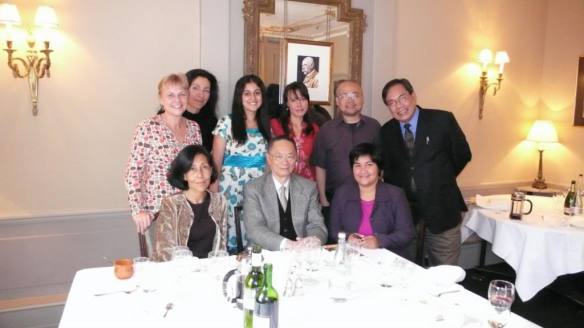
(Pictured on top are the Wong Fellows at a reunion with David T. K. Wong in London, 2008. Image of Nathan Go courtesy of UEA.)

Penman No. 252: Eurocentrism in Philippine Literature

IMG_1638

Penman for Monday, May 21, 2017


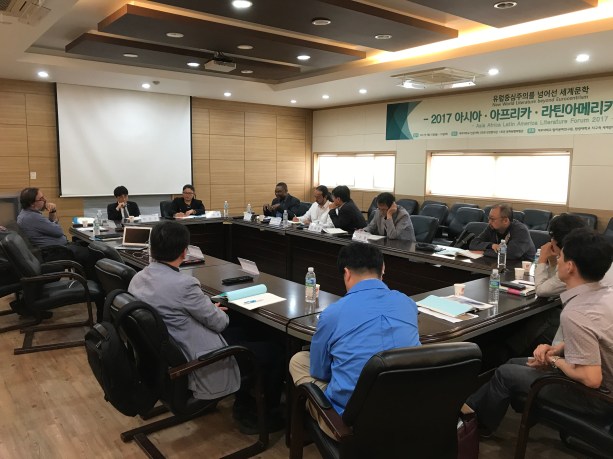
I FLEW out to Jeju, South Korea two Sundays ago to represent the Philippines in a conference organized by the World Literature Forum on “New World Literature Beyond Eurocentrism.” I had invited there by my friend Dr. Sukjoo Sohn, who teaches English in Dong-a University in Busan, to join a group of distinguished scholars and writers that included Dr. Nelson Maldonado-Flores from Rutgers University, Dr. Harry Garuba from the University of Cape Town, Dr. Miguel Rocha Vivas from the Pontificia Universidad Javeriana in Bogota, and Dr. Ignacio Lopez-Calvo from the University of California, Merced.

That’s enough doctors to make up a literary hospital, although it’s doubtful that any or all of us could do much to save a patient. And while I have those three little letters to append to my name when I have to, I always feel a bit out of place in a roomful of literary critics and theorists, being more of a storyteller who strayed into academia. But then you really don’t need a PhD to figure out what happened to us and the way we write.

 I began by giving the background of our colonial history under Spain and the United States, and how colonialism shaped our education and literature in certain ways that are unique in Asia. Here’s the rest of what I said, and I beg your indulgence if you’ve seen or heard snippets of these remarks from previous presentations:

This historical background should explain why, unlike most of its neighbors in Asia, the Philippines has had a staunchly Eurocentric tradition in its literature, which proceeds from our Eurocentric and Christian orientation in education. By “Eurocentric” here I really mean “Anglo-American,” because our Spanish connections have been largely and perhaps sadly lost.

Today, young Filipino writers seeking broader audiences continue to write in English, and many do so online, on platforms such as Wattpad and Amazon, which are circumventing the traditional publishing routes and processes. Because of the Internet and its democratic access and global reach, there is renewed interest in writing in Filipino and the other major Philippine languages—we have more than 100 across our archipelago. But there remains a strong impetus to get published overseas, specifically the West, where Filipino authors such as Jessica Hagedorn and Miguel Syjuco have made some breakthroughs. Literary agents are a new phenomenon in this wavelet of international publishing, and now every good Filipino author seems to need one.

Is this a good or a bad thing? It deserves to be emphasized that while our literary bridge to the world remains the English language, our material has long been local—our authors write about Filipino characters, problems, and conditions. Those conditions inescapably include our hybridity, which we have come to embrace with all of its contradictions. Indeed, when the late novelist NVM Gonzalez was asked what language he wrote in, he famously replied “I write in Filipino, using English.”

Postcolonial and hybrid literatures like ours provide support for the argument of the empire writing back. When I teach my undergraduate course in American literature, for example, I always remind my students that we are studying America and its culture not to become Americans, but to become better Filipinos.

I believe, therefore, that the best way to deal with Eurocentrism or, to put it another way, the legacy of Western colonization is to employ and turn its tools, primarily its language, so the West can see us now as we would like to be seen—in our own image, not theirs. Whether originally written in English or in English translation, a new Filipino novel published in Trump’s America or today’s troubled Europe is an act of political engagement, not a submission to the old master.

Meanwhile the need remains to enlarge our own internal audiences, in our own languages, without need of validation from New York or London.

Among most writers I know in the Philippines, the issue of whether to write in English or Filipino or some other Philippine language has ceased to be the kind of issue that paralyzes the writing hand; you write in the language you know, and through which you can do more knowing; otherwise, quite simply, you can’t and you don’t. A good number of us have gone bilingual, using whichever language seems more appropriate to the task.

And we feel much more relaxed about this than we did four decades ago, partly because we realize that Filipino writers in English and Filipino often come up against the same objective constraints (e.g., limited readerships in the age of video), and also because of what I’d call the de-Americanization of English.

Certainly English remains the language of the elite, and it’s still the language that everyone wants to learn. But I think we’ve come around to accepting that writing is always more than language, and always more than politics—it’s insight, it’s craft, it’s feeling. What the writer tries to convey is imaginative experience; language is but part of that experience. The language is part of the writing—a vital and inalienable part of it—but the writing is always larger and more complex than the language.

We are now more aware than ever of the fact that while we inherited English as a colonial tongue, we must now use it as 21st-century Filipinos still trying to define who we are and what we want to be.

As Salman Rushdie put it in Imaginary Homelands, “…We can’t simply use the language the way the British did; it needs remaking for our own purposes. Those of us who do use English do so in spite of our ambiguity towards it, or perhaps because of that, perhaps because we can find in that linguistic struggle a reflection of other struggles taking place in the real world, struggles between the cultures within ourselves and the influences at work upon our societies. To conquer English may be to complete the process of making ourselves free.”

This, of course, is the whole burden of postcolonial writing, which, as Bill Ashcroft observes in The Empire Writes Back, “abrogates the privileged centrality of ‘English’ by using language to signify difference while employing a sameness which allows it to be understood.” English is no longer a colonial yoke but a liberative weapon. Achebe was sufficiently confident and hopeful that he could deal with this change: “I feel that the English language will be able to carry the weight of my African experience. But it will have to be a new English, still in full communion with its ancestral home but altered to suit new African surroundings.”

Substitute “Filipino” for “African”, and there we are, and here we are.


Penman No. 247: On the Wings of Women

LadyPilots

Penman for Monday, April 16, 2017


IN MY line of work, I get to edit a wide range of books, from institutional histories and biographies to annual reports and technical manuals. They’re all important to my clients, of course, and I accord them all the same seriousness and diligence they should expect from a professional editor.

But now and then a project comes along that’s not only significant but truly interesting, and one of them was the book I recently edited for Philippine Airlines—Stories from the Heart: Buong Pusong Alaga (PAL, 2017)—that the company launched to celebrate its 76th anniversary. The book is a collection of vignettes about PAL’s people, from the ground crews to the pilots and flight attendants to the president and CEO himself, and tells all kinds of stories from delivering babies in mid-flight to having the Pope as a passenger.

But some of the stories I found most fascinating had to do with PAL’s women—especially those who keep the planes up in the air. As a belated salute to National Women’s Month, let me share a few of those stories:

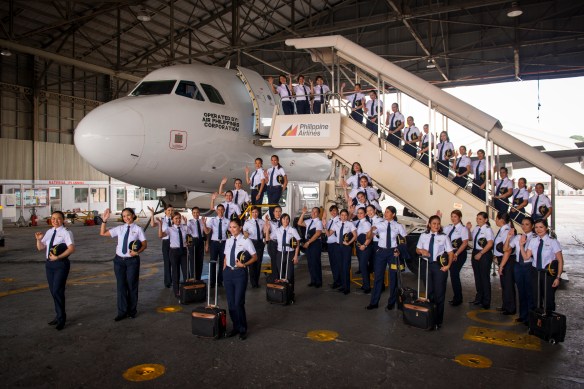
Since Capt. Aimee Carandang-Gloria became the first female to take the helm of a PAL plane in 1993, the number of lady pilots in the airline has continued to grow in recent years—from 20 in late 2012 to 54 (39 from PAL and 15 from PAL Express) in 2016.

“Yes, we’re still a minority, but a growing one. We just recently added a provision in our Operations Manual regarding female pilots. It’s a giant step for us,” says A320 pilot Capt. Emi Inciong-Ragasa.

A lady pilot on the flight deck is not something passengers see every day. But when they do, a magical moment always happens, attended by much curiosity and awe. “I remember a few times when some parents, upon seeing me, would exclaim, ‘Look, she’s a lady pilot!’ and would ask if I could have my picture taken with their daughter,” says A320 pilot Kelloggs Tioseco.

Aside from the occasional picture-taking on the side, these ladies get no special treatment—and they don’t expect it. They go through the same training, read the same manuals, and soar and slog through the same skies as the men.

“Ever since I could remember, I’ve wanted to be a pilot. I remember being in awe of this big machine that graced the blue skies,” says Capt. Ragasa. Emi comes from a family of pilots. Her husband is B777 First Officer Terrence Ragasa, and her father-in-law is former Air Force General Ramon Ragasa.

Having been with PAL for 11 years, she aspires to be a hands-on mother while enjoying her flying career. She doesn’t mind being on long layovers but she makes sure that she regularly sees her two-year old son. “I have only one chance to raise my son well. I arrange my schedule to spend more time with him,” she says.

AVP for Pilot Affairs and A320 pilot Lilybeth Tan Ng says that taking red-eye flights were much easier to handle than waking up in the wee hours of the morning to attend to her motherly duties. “Flying a plane is easier than being a mother. Flying comes with a manual while motherhood doesn’t. So you had to learn by instinct as the answers were not always easy to find.”

A330 pilot Cherryl Flores crossed over from military to commercial flying. She had been a registered nurse in a military hospital in Zamboanga City before joining the Philippine Air Force, where she served as an instructor pilot for four years. Cherryl was a bemedaled UH-IH helicopter combat utility pilot in the PAF. She was also the first and only female PAF pilot to be certified as Pilot-in-Command of UH-IH in Night Vision Goggles by the US Air Force.

Cherryl’s husband, a ship crew member, gave up his job to take care of their first-born. “When I was pregnant with my first-born, we decided that one of us had to stop working to attend to our child. My husband selflessly gave way to me so I could chase my dream of flying planes.”

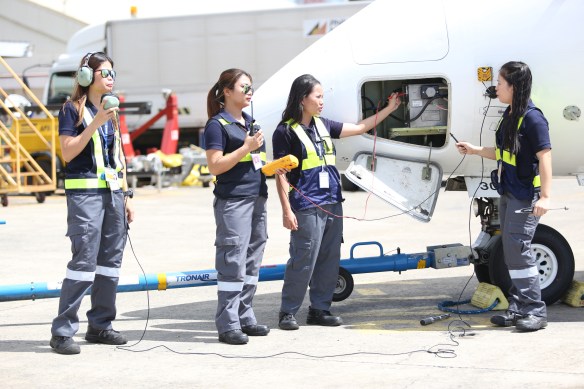
That same tenacity can be found in the seven female mechanics checking cables and wirings, overhauling systems, and replacing parts among the platoons of men working at PAL Express’ maintenance and engineering.

Avionics mechanic Maridel David wanted to work in an airline since her youth. “In Bicol, whenever we saw a helicopter flying overhead, we ran and followed it as far as we could,” she recalls. When she entered college, she chose to study BS Aviation Electronics Technology at the Philippine State College of Aeronautics.

LadyMechs

Before becoming an avionics or aircraft mechanic, one has to undergo a one-year Maintenance Training Program (MTP), which comprises six months of classroom training and six months’ field exposure. In school, the proportion of male to female students has always been high. “There have always been very few females in aviation and I find it a privilege to become one of them,” says another avionics mechanic, Mercedes Sabordo.

“My motto in life has always been, if they can do it, I can do it. We’re all equal when it comes to the job, because this is what I studied for. So whatever they can do, I can do as well,” says Elaine Saldivar, an aircraft engineer in PALEx for two years now.

More than the physical tasks, the job of an aircraft and avionics mechanic requires critical decision-making that can only be learned through time and experience.

“You have to be really smart if you enter the field of aviation. You have to be ready to go head to head with the men if you want to learn. It’s a long process of continuous learning, like getting a doctorate so you can really be an expert at what you do,” attests Engr. Rhona Abrera, an avionics mechanic. Rhona herself has overhauled and then rebuilt an airplane. From one task card to another, she finished the job after several attempts. “It’s most fulfilling when you can troubleshoot the problem right away. It’s ‘mission accomplished’ when you can watch the plane fly.”

Maridel adds that she treats a plane like her “baby” and would always talk to them. “At morning dispatch, I talk to the plane and say, ‘Baby, safe flight,” she quips.

So, go girls, and many thanks and congratulations to PAL’s Pinky Balagtas and Paeng Evangelista for piloting this project and for letting me use these excerpts!


Penman No. 243: A New Master of Prose

Jurado2

Penman for Monday, March 20, 2017


BECAUSE OF my new administrative duties at the University of the Philippines, I was able to join the UP Writers Workshop for only two days this year, but it was time enough to make a wonderful discovery in the person of a Filipino-American writer whom I had never met before but whose voice, I predict, will resonate more loudly in the years to come.

There are 12 fellows, as usual, in the 2017 workshop, all of them mid-career writers who already have at least one book or film or theater production under their wings and who are currently at work on new projects. This workshop has become a rite of passage for most Filipino writers, and it’s always a privilege for those of us who’ve been on top of it to be able to help our finest literary talents in Filipino, English, and other Philippine languages achieve their potentials.

I wish I could have met all of this year’s fellows, but as it happened, it was Wilfredo “Willy” Pascual whom I got to know best, because we gave lectures about writing together to a large audience of teachers, writers, and students in UP Los Baños. From his talk and workshop and from a subsequent chat with him, I learned that Willy—born in 1967 in San Jose, Nueva Ecija—is a largely self-taught writer who has now spent half of his life overseas, mainly in Thailand and the US. “I had a checkered education,” he says laughing, “with a year in UST, a year in CEU, and so on, but I never finished anything.” It’s clear that his real education came from his voracious reading and his varied experiences, some of which are memorably chronicled in his first book, the privately published Kilometer Zero.

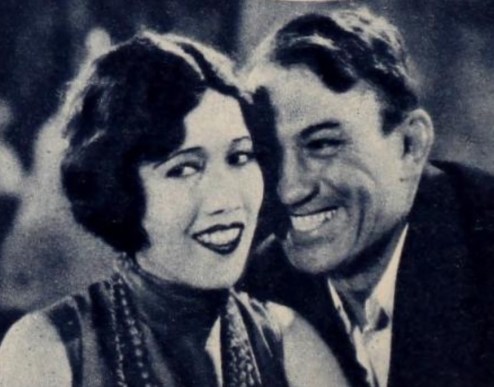
But what fascinated me about Willy’s work is his ongoing project, a long essay about his search for the personal story of a little-known Filipino-American actress from Cebu named Elena Jurado, who appeared in a small role as an Arabian dancer in a silent film titled White Hands. The essay is, of course, really about two searches: one for Elena, and the other for what Willy—a gay Filipino-American—calls his “rightful place.”

We ask our workshop fellows to preface their work with their “poetics”—an explanation of why they write what they write—and here’s part of what Willy wrote there:

“I remember the artist Roderico Jose Daroy (1954-2014) who rescued shards, refuse, and fragments and brought them home. The objects occupied an entire floor in a rented bungalow in Bangkok. I saw his orderly spread of old picture frames, hardened watercolor cakes, vintage prints in various stages of decomposition. I walked around it, sat down as if on a shore contemplating the sea of dissolution in front of me. They were meant to be exposed to the elements, the flow of time. There was an inherent wildness to it, a constant beginning and ending. I felt tethered to it. I like things that grow. Decay. And all the deviations in between. If I could be a superhero for one day, I would like to have the powers of mutability and permeability. I would be a grain of purple rice, an industrial crane that in a whim can turn into a broken microscope, the gum you are chewing now. My secret joy will be those states in between when I am neither one nor the other.”

And this comes from the essay itself:

“Elena Jurado was interviewed by Wilbur Hall, a forty-plus miner and rancher who wrote weekly features for the Chronicle. The paper ran Wilbur’s story with photos of the fair Filipina actress next to the bearded Hobart Bosworth in a dapper single-breasted suit and bowtie. The 55- year-old, tall and blue-eyed Bosworth, widely known in his time as the Dean of Hollywood, had portrayed historical figures and beloved literary characters lost in time and strange places. He slept for twenty years as Rip Van Winkle and missed the American Revolution. In the earliest film version of L. Frank Baum’s everlasting tale, he was the wizard who appeared in different forms and a disembodied voice. With the magisterial Bosworth holding a script, Elena was introduced in these publicity stills, short wavy hair parted on one side, wearing the adorned ensemble of the Filipina gown of her time. Gone were the European voluminous bell-shaped skirt and the indigenous wrap-around tapis. In its place was a more streamlined cut with an elegant trail pooled on the floor. The upper garment was a fine gauzy layer of fabric: the collarless blouse winged with elbow-length sleeves—wide, airy, suited for warmer climates; the Spanish-influenced scarf folded around her shoulders and fastened in front. She smiled at the camera, listened to Bosworth, and struck a dramatic pose—arms outstretched, palms upward, head slightly turned, lips parted, eyes yearning, almost ethereal. I’m not exactly sure what to make of this vessel’s gesture and expression, this suspended aria. She looked like she had broken through the clouds. And if there was a word or even a sigh uttered, it had been preceded by Bosworth’s pointing finger.

“…. Thousands flocked to the movie palace on opening day and saw a golden throne in the foyer’s octagonal rotunda. Overhead, a cast iron lamp illuminated the vaulted ceiling. The rotunda led to two grand staircases with tapestries on the wall. One depicted the siege of Troy, the other the birth of Rome, the twin brothers Remus and Romulus suckling a she-wolf. Inside the auditorium, the world’s largest gooseneck steel brass supported the balcony. Spanning 108 feet and weighing ninety tons, it braced the boxed seats occupied by industry giants, among them Rudolph Wurlitzer, William Hearst, and Michael de Young. Theirs were the most expensive seats at ninety cents each, commanding a full view of the auditorium: the ceiling’s central dome, its light changing from fiery sunrise to purple dusk; the walls lavished with bold relief, every column, pilaster and parapet carved with scrolls, swags, urns and coat of arms—an inflamed vision in rose and old gold, multiplying and morphing endlessly, excessive, consuming. You think you’re seeing more but you’re not really sure what you’re seeing.

“…. I spent weeks in the archives poring over Jacobs’ photos with a magnifying lens. How do you not lose yourself in this exuberant tangle of forest and empires? The more I saw, the more I read; and the more I read, the more details I saw in each photo. It sucked me into a vortex. My eyeballs became porous and the hungry gaze of ghosts streamed through them. In this world of men and empires, a young Filipina appeared on the giant screen.”

There’s a stunning conclusion to Willy Pascual’s search—he actually locates her gravestone—and I can’t wait for the essay to be finished and for this prose master’s second book to appear.

WillyP


Penman No. 234: A Glimpse of Interesting Manila

im_cover3e

Penman for Monday, January 16, 2017

ASIDE FROM the fountain pens which I’ve recently stopped collecting, I’ve long nursed another, quieter passion, albeit on a much more modest scale. Since my grad-school days in the American Midwest in the 1980s, I’ve been drawn to old books from and about the Philippines. Sadly I can’t read Spanish—one of the great regrets of my college life, a casualty of our generation’s sweeping rejection of everything that smacked of colonialism (except, ironically, English)—so my pickings have been confined to books in English, largely from the late 1800s to the early 1900s.

I stumbled on the first of these books—and began to be conscious of their significance—while I was poking around antique and thrift shops for pens. The Midwest, with its many universities and industries (not to mention pen companies like Parker and Sheaffer), was a cornucopia of all things old and wonderful, and inevitably my eyes would drift to the dusty bookshelves that typically carried cookbooks, old Bibles, local lore, and Western novels.

Now and then, however, I’d get lucky and come across a book with some Philippine connection, usually from around the early years of the American occupation. With titles like Uncle Sam’s Boys in the Philippines and Our New Possessions, these books celebrated American imperialism, the novel fact that it now had a colony across the Pacific that deserved to be introduced to curious readers in Kansas and Missouri.

bsp

I remember finding the massive two-volume Our Islands and Their People for $10 in a Milwaukee antique store, only to have to leave them behind when I flew home from graduate school in 1991. But I did bring back a small trove of similar material, and have added to them since then, largely via eBay.

My Holy Grail had been a first edition of Carlos Bulosan’s America Is in the Heart (I would acquire one later locally in the most interesting circumstances—I’ve told the story here—and would give it to my daughter Demi as a wedding present), but another precious book I was relieved to have saved from the Faculty Center fire by foolishly leaving it in my car is a first English edition from 1853 of Paul P. de la Gironiere’s The Adventures of a Frenchman in the Philippines, an eBay pickup from the UK.

I’m not an antiquarian by any means; I lack the vision, the resources, and the scholarship for that. To be honest, I haven’t even read everything I’ve collected, a pleasure I’m saving for my impending retirement. I just like salvaging these well-worn volumes from the scrap heap, or from some dark corner where they can’t possibly be appreciated. They’re neither particularly rare nor valuable—only two or three have cost me more than $100—but they all contain very interesting, if sometimes horrifying, stories about America’s imperial project.

s-l400

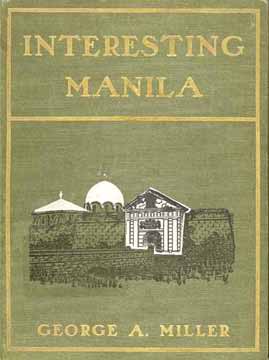
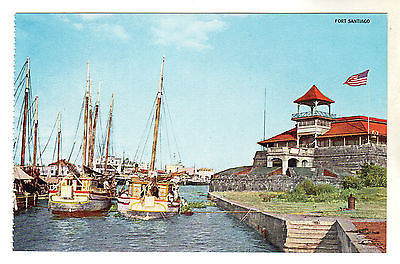
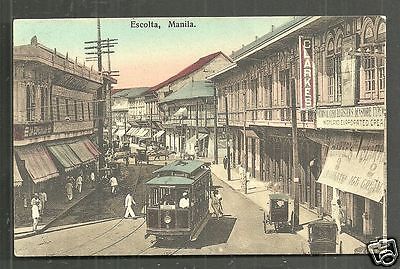
It’s difficult, even for a Filipino, not to be entertained by the descriptions in these early travelogues, revive as they do the nostalgic charm of a vanished era. Take, for example, Interesting Manila by George A. Miller, first published in Manila in 1906 by E.C. McCullough, a $10 purchase from a bookseller in Massachussetts.

Its evocation of the past reminds us that Manila was already old even then: “Beautiful these old churches were in their scars and moss and vines. Many have been spoiled by fresh coats of paint. But who can sit silent in their vaulted aisles without hearing from those stained and mellow walls, whispered prayers of priests who long since have vanished, and shadow chants of acolytes who have joined the choir invisible?… My first experience in a Manila church was at High Mass in Santo Domingo at the early hour. There were sixteen hundred candles shining in the gloom of the old sanctuary, and a thousand worshipers were kneeling on the polished floor. Among the high arches gathered the smoke of the incense, and way up in the dome the morning sun streamed red and gold through the colored glass.

“The chanting of the priests reverberated through the aisles like the noise of a cataract, and the answer of the prostrate people was like the murmur of many waters upon the sand. Then the great organ with its thundering reeds made the old pile ring and shout like some strong giant in sport, and in the succeeding silence the people waited in awe for what might follow. What did follow was the chanting of the boys’ choir without accompaniment, and the effect from the high gallery was as if the voices came from everywhere, the very stones had suddenly become vocal and joined in the acclamation.”

In a voice we might be hearing today, Miller laments the thoughtless “restoration” of these old buildings: “The present Malate church has been restored until it is of little interest. The old tile roof, the hole in the west gable made by American shot, and the walls with shrubs and trees growing in their crevices made a building worth going to see, but now it is all paint and corrugated iron.”

The vividness and vigor of the experiences described can be exhilarating: “One of the really delightful experiences that many people have never discovered is that of a trip up the Pasig at sunset. We took the car to Santa Ana and at five-thirty stood by the river and were besieged by a dozen vociferous banqueros, who contended for the distinguished honor of carrying our lunch basket to the landing. The bancas all looked alike, but there must be the preliminary diplomatic stunts as to distance and price. Tagalog, English, and bad Spanish were mixed in a verbal storm for five minutes and then we were aboard and off for Fort McKinley.”

Sometimes these colonial reports afford us a priceless glimpse into our prewar treasures, likely long gone: “There are about twelve thousand volumes on these shelves,” Miller notes of the Franciscan library. “The library of the Recoletos contains about nine thousand volumes; that of the Augustinians eleven thousand, and the Dominicans have eighteen thousand. Most of the collections contain several copies of the celebrated ‘Flora de Filipinas’ by Fr. Blanco and his co-laborers. This work is in six volumes and an index and is a remarkable piece of scientific research. The best edition contains two volumes of colored plates of the flora of the archipelago, and the press work done, in Barcelona, is of the best.”

And then again quite often the interest doesn’t come out of the narrative itself but in the perspective, which almost inevitably involves some triumphal trumpeting of America’s virtues. Miller’s assertion of the Westerner as a man of action and of the Oriental as a laidback soul is typical of these white male observers’ musings:

“The West is known by its deeds, the East by its dreams. The Anglo-Saxon lives in the concrete, the Oriental in the shadows. The American, having found a ‘proposition’ in a field, makes haste and sells all that he has and buys that field that he may dig therein and get ‘results.’ The Oriental inhales the drowsy fumes of some far-off good that was, or is, or is to come—it little matters which—and is content.”

Interesting Manila, indeed—but even more interesting was what these books said of their linen-suited writers.

s-l400-1

philippines02