Penman No. 73: A New Home in Erehwon

IMG_2568Penman for Monday, November 18, 2013

I HAD a good chat with Metro Manila Concert Orchestra founding music director Josefino “Chino” Toledo recently at the inauguration of the MMCO’s new rehearsal space at the Erehwon Center for the Arts in Quezon City. Also a gifted composer and conductor, Chino is a fellow professor of mine at the University of the Philippines, and a batchmate under UP’s Arts Productivity System. We’ve run into each other during UPAPS ceremonies, but never really got to talk until the Erehwon event.

But let me digress a bit and say something about Erehwon itself first. Founded a couple of years ago by businessman Rafael Rivera Benitez, Erehwon is actually a big white building nestled in a corner of Old Balara in Quezon City (you can find the map and more details on www.erehwonartworld.com) that Raffy converted and devoted to serving as Metro Manila’s newest arts mecca—a studio cum gallery cum performance space cum residency and meeting venue.

Raffy himself is an old friend and compadre of mine, someone I spent one of life’s most privileged experiences with—prison time and space in Fort Bonifacio under martial law, when both of us were in our late teens. He made his mark in the baking and printing businesses, but late in life (he very recently turned 60), Raffy decided to pursue another passion—patronage of the arts, giving rise to Erehwon. (People our age will remember the late, lamented Erehwon Bookshop in Ermita—which was right next to my old NEDA office on Padre Faura, providing me with a perennial excuse for an extended lunch break. That Erehwon, however, has nothing to do with the new one.)

And now, thanks to Raffy Benitez and Erehwon, the Metro Manila Concert Orchestra will have a new home through a venue grant offered by Erehwon to the MMCO, which until lately was lodged with Miriam College, where Chino Toledo also held certain responsibilities. Its arrangement with Miriam having ended, the MMCO needed a white knight to come to its rescue, and that turned out to be Erehwon, which has also been seeking partners to work with in arts promotion.

Erehwon couldn’t have found a better partner than the MMCO, which was established in June 2000 and has since become one of the country’s leading semiprofessional orchestras. I asked Chino what set the MMCO apart from the others, and he told me that they were especially receptive to new and young Filipino composers and musicians. I noticed, during the inauguration, that the orchestra’s musicians were predominantly young, most of them clearly in their 20s and 30s. That’s exactly the kind of push our young musical talents need, particularly as orchestral music, like theater, involves the effort of a community working as one, and an individual really succeeds only insofar as he or she can find membership and nurturance within that community.

The MMCO now counts about 50 musicians in its ranks, coming from various schools in the metropolis. (“The number of people in an orchestra will vary depending on the piece,” Chino told me, “but at full complement, an orchestra like the New York Philharmonic could have as many as a hundred members.”) They hold an average of one concert a month, and practice at least twice a week. The conductor, Chino explained, functions as the team coach, and the concert master acts as the captain ball, leading the execution of the coach’s plan.

Funding is always a problem, Chino added; as a semi-professional orchestra, the MMCO does its best to pay its members what they deserve, but as with most other artistic endeavors, it’s love of music that really drives the group and Chino himself forward, and sustains the commitment of a faithful corps of supporters that include Executive Director Chinggay Lagdameo and MMCO Foundation President Corazon Alma de Leon.

Here’s hoping that the MMCO’s move to Erehwon will result in a new season of growth and prosperity for the orchestra and for Philippine music as a whole.

SPEAKING OF cultural initiatives, last week marked the staging of the fourth Philippine International Literary Festival (formerly known as the Manila International Literary Festival), spearheaded by the National Book Development Board in cooperation with four universities in Manila—the University of the Philippines, Ateneo de Manila University, the University of Sto. Tomas, and De La Salle University—and the Ayala Museum. The urban setting was deliberate, because this year’s festival theme was “Text and the City,” focused on how centrally the city figures in Philippine and regional literature.

I joined a panel at UST with colleagues Jing Hidalgo and Charlson Ong in a discussion of how the city informs our writing. In broad terms, I noted that the city, not surprisingly, has figured in a major way in Philippine fiction, particularly in English, because most of the fiction published in the Philippines has been written by city-based middle-class writers. It has often been presented as the site of violence, poverty, and corruption, in contrast to the romantic conception of the countryside as a place of peace, plenitude, and spiritual regeneration. In more politically aware writings, however, that line has become blurred, as the feudal roots of urban wealth and power become more clearly exposed.

Our focus on the familiar city, however, comes at a great price—the near-absence of new writing that deals with the Philippine countryside in anything but a romantic mode. (By “romantic” here I mean I mean not only the highly idealized representations of rural maidens by the likes of Fernando Amorsolo, but also my politicized generation’s expectation of ascending into the mountains—joining the armed struggle—as a kind of revolutionary apotheosis.) As it happened, I was in Baler, Aurora that weekend, and rushed back to Manila at dawn to make it in time for the UST event. On the six-hour ride, over mountain roads with a view of the great ocean, I remarked how conspicuously absent the sea and the mountains were in our contemporary literature, despite the fact that we pride ourselves in being a vast archipelago. Our stories today take place in Starbucks Katipunan, or in some cozy corner of Bonifacio High Street that may as well be another country.

IMG_2722

In UP, I was happy to introduce an old friend, the Singaporean fictionist Suchen Christine Lim, a guest and featured speaker of the festival along with other international writers including the Hong Kong-based fictionist Xu Xi and cultural critic Peter Swirski. Suchen is a delightfully gifted writer whose title story in the collection The Lies That Build a Marriage (available at National Book Store) blew me away; her prose is crisp and to the point, but her command of character displays the depth and sophistication of her perception.

I noted how the Philippines and Singapore have had a long and special literary relationship, probably nurtured by the fact that we share the same colonial language, English. Among writers, Frankie Sionil Jose was a contemporary and good friend of Edwin Thumboo; Krip Yuson, Charlson Ong and I have had fruitful contact with Kirpal Singh, Robert Yeo, and Chris Mooney-Singh; our younger writers like poet Joel Toledo (who’s doing a PhD in Singapore) have their counterparts in Alvin Pang and Joshua Ip. Some years ago, Filipino and Singaporean poets got together to produce a joint anthology titled Love Gathers All. You’ll note that all of these pairings are between men, so it’s refreshing and important to remember that women writers have also figured prominently in Singaporean literature, aside from Suchen Lim—the fictionist Catherine Lim and the playwright Stella Kon among them.

Next year, Singapore will host the Asia-Pacific Writers and Translators conference, followed by us in 2015. It’s events like these that will help put the Philippines where it deserves to be, squarely on the global literary and cultural map.

Penman No. 71: Writers on Retreat

Penman for Monday, November 4, 2013

BY WHICH I don’t mean writers pulling back or running scared (for which, to be persnickety about it, the prepositional phrase should be “in retreat”), but rather writers doing something they need to do every now and then, if they are to produce more noteworthy novels, poems, and plays—recharge, rewind, recover, then write and rewrite, preferably in some form of isolation or seclusion.

As I reported last week, I went with a small group of writers and friends down to Palawan on the first Adverbum Retreat for Writers organized by the Chicago-based Almira Astudillo-Gilles. We stayed at Ambrosia, The Amazing Villa (which, as it turned out, is just past Puerto Princesa in Sitio Bubusawin in Barangay Apurawan, in the municipality of Aborlan), run by Herwig Gielen and his wife Theresa. The idea was to give writers some R&R while they worked on their current projects, and in this case it was in a place remote enough that we were out of text, email, and Internet contact for a week (except for literally a few moments, twice, when we drove out to another barangay and sailed out to a point about 30 minutes offshore to catch a weak cellular signal and a few messages).

Writers’ retreats—some private and personal, some institutional—have had a long and colorful history. The Huffington Post’s UK edition has a list of 19 of the more unique ones, including a rotating hut that George Bernard Shaw built in the bottom of his garden near Hertfordshire; Dylan Thomas had a boat house in Wales, Virginia Woolf a hut in Sussex, J. K. Rowling her Edinburgh café, and George Orwell a house on a remote Scottish island. And Henry David Thoreau, of course, had Walden Pond.

Rowling’s caffeinated sequestration aside, modern retreats have evolved into much more sociable residencies, where not just one but several writers inhabit a home together for some time, each with his or her own space to work on an individual project. This setup acknowledges the fact that, in most cases, writers need not only to write but also to talk, preferably with fellow writers who understand what the whole fuss over words and ideas is all about, if only for an hour or two each day before each one slinks back into his or her own burrow.

While they may engage groups of writers, a writers’ retreat or residency isn’t like a workshop, where the focus is on helping younger and newer writers with matters of craft and other professional concerns. A residency is a gathering of peers, and while socialization is encouraged, privacy is respected, and no detailed reports or submission of outputs is expected, on the understanding that mature artists will proceed and produce at their own pace, without need of overbearing guidance or monitoring.

I’ve been privileged to attend a few of these residencies—which, until we had Adverbum in Palawan, were all overseas. One of the most popular ones (at least among writers) was the Hawthornden International Retreat for Writers in Lasswade, Midlothian, Scotland, about 45 minutes by bus out of Edinburgh. More than a dozen Filipino writers have now gone to Hawthornden over the past 20 years, including the likes of Krip Yuson, Ricky de Ungria, Danton Remoto, Marj Evasco, Rofel Brion, and Eric Gamalinda, and, among the younger ones, Sarge Lacuesta, Mia Gonzalez, and Chingbee Cruz.

I went to Hawthornden in 1994, thanks to a British Council grant (you have to apply directly to Hawthornden for a fellowship, which covers board and lodging in the 15th-century castle, but it used to be, in pre-recessionary days, that the British Council provided funds for the round-trip fare). The castle has several rooms for residents, each named after a famous writer (I stayed, I think, in “Boswell”), and you get your name inscribed on that room’s door once you submit the published proof of your work after your residency. The fellowship lasts for about four weeks, and you share the castle over that period with three or four other writers from around the world. There may be more staff than fellows at any given time, and the only time you meet the others is at 6 pm, when you “foregather” for sherry before dinner. Breakfast is at your own time and pace, and lunch (usually a generous sandwich and lentil soup) is served on a tray at your door, as if you were in some exclusive prison. (There is, in fact, a dungeon-like prison beneath the tower, but thankfully no writers have had to stay there; another of Hawthornden’s features is its proximity to Rosslyn Chapel, recently made famous by The Da Vinci Code, which had yet to be written when we were visiting it.)

Rather more opulent were two other residencies I later attended in Italy: the Rockefeller Foundation’s Bellagio Center in northern Italy, near Como and Milan, in 2002, and Civitella Ranieri in 2011. Bellagio was a medieval palace turned into a villa and a haven for artists and scholars by the Rockefeller Foundation, and today it offers residencies to a broad range of academics, artists, and professionals. When I went there to work on Soledad’s Sister, my fellow fellows comprised an American architect, a Russian pianist, a British Bible scholar, a South African novelist, and a South African arms expert, among others. The batches in Bellagio were much bigger, at about ten to a dozen per month-long batch. Like Hawthornden, what it took was an application consisting largely of a proposal for a work-in-progress, and samples of one’s past work. (I should add that I failed on my first application, but made it on my second try, so nothing is ever guaranteed with these things.) Many Filipinos have also gone to Bellagio—among them F. Sionil Jose, and many in the Hawthornden group, the usual suspects—including non-artists such as lawyer Raul Pangalangan; next year, fictionist Menchu Sarmiento will be going there to work on a new book of stories.

Civitella Ranieri is another medieval castle in Umbria, just outside Perugia, but here admission is by invitation only, and it’s limited to artists (writers, painters, musicians, dancers, filmmakers, and so on). Among other Filipinos, poet Mark Cayanan and novelist Miguel Syjuco were Civitella fellows this year, preceded by artist Lan Tuazon (2012), writer Gina Apostol (2009), and musicians Chino Toledo (2004) and Ramon Santos (1999).

How productive can one get in these places? I suppose it depends on your own work habits and, in a sense, on the setup of the place and the fellowship itself. I hate to admit this as a digital junkie, but I produced the most work—four new stories and a short novel in a month—when I was offline in Hawthornden, having gone there in pre-digital times; I did write “Penmanship” on a 286-SX laptop and a floppy disk, but otherwise had no cellphone or wifi to distract me. Bellagio was good for a few chapters, but the villa’s intensely social schedule (and the overpowering beauty of the scenery) proved surprisingly less than ideal for sustained work. Civitella Ranieri resulted in 30,000 words of new fiction and final revisions on a book of poetry. And Palawan? I did final revisions on a biography, and edited several chapters for a friend’s book of travel essays.

Could I have gotten all this new work done at home, in the boonies of Diliman? Maybe. But distance strangely provides more clarity and urgency to things we take for granted in too-familiar surroundings, and a lake or an ocean to view outside one’s window can only help the imagination and refresh both body and spirit.

LET ME take this opportunity to acknowledge and to thank another of our Palawan sponsors, aside from Cebu Pacific—the Hotel Centro in downtown Puerto Princesa, where we stayed for the final night of our getaway. I’ve been to Puerto often, and can say that this new 111-room hotel is one of the city’s finest, located close to its most important locations. The rooms are clean and well-furnished, with free wifi (a godsend after a week’s digital dieting), and a very attentive staff who can also arrange special package tours around the city and Honda Bay and to the Underground River for you. The Sicily Bar on the fifth floor is set up for meetings and conferences. We had a sumptuous poolside dinner under a tent, a perfect point of re-entry to urban living after a week of sylvan solitude. Check them out at www.hotelcentro.ph for more details and reservations.

Penman No. 70: Digital Detox and Ambrosia in Puerto Princesa

Penman for Monday, October 28, 2013
AFTER MORE than 20 years of being a digital junkie—usually traveling with nothing less than a Macbook Air, an iPhone, an iPad mini, a standby dual-SIM Nokia, sometimes a Nikon DSLR, two digital voice recorders, and a boatload of spare chargers and batteries—I never thought the day (much less the week) would come when I could pretty much do away with the cellular phone and the Internet.

But very recently, it happened—thanks to a writers’ retreat organized by a tirelessly dedicated Fil-Am writer and hosted by two of the most wonderful and interesting people I’ve ever met. (If this normally reserved writer runs out of superlatives this week, it will be for good reason.)

Almira Astudillo-Gilles has two master’s degrees and a PhD in Sociology, and could have been set for life working in business or academia, but she’s chosen the prickly path of creative writing to find another form of fulfillment. Having published a prizewinning book for children and a novel set in the Philippines, among other works, Almi—whom I met last year at the Philippine Studies conference in Michigan—put her mind to establishing a restful retreat for writers in need of a little solitude to recharge and to get some new work done. Marshaling her organizational resources and with the help of some private and institutional sponsors, Almi led our group to the first Adverbum Retreat for Writers at a hillside villa in Palawan.

IMG_4458

In the group, aside from Almi and myself, were writers Edgardo Maranan, Ricardo de Ungria, and Jhoanna Lynn Cruz, and guests Joel Tan-Torres and his daughter Marjette, who had writing projects of their own; my wife Beng, of course, was with us, bringing her drawing and painting kits along.

The hillside villa is about 1 ½ hours by van from downtown Puerto Princesa, way past Iwahig and a little beyond Napsan, on a road that alternates between patches of smooth concrete and gravel the size of pomelos. (Technically speaking, the villa is just out of Puerto, in Sitio Bubusawin, Barangay Apurawan, municipality of Aborlan. You’d have to remember that Puerto Princesa is the country’s largest city in terms of land area, at almost 254,000 hectares, a bit larger than Davao.) If you’re looking for city comforts, go no farther than the new Robinson’s mall downtown.

I’d have to say that, as a certified metrophile and mall rat, I was daunted and distressed by the villa’s promise of a complete “digital detox—guaranteed NO Internet and NO cellular connection”; I hadn’t gone offline for more than a day in years. I’m not on Facebook, but I check out eBay, PhilMUG, and the news a dozen times a day, and with four book projects in the works, I felt like I was about to vanish into the dark side of the moon. I was placated only by the promise that, should the isolation prove intolerable, we could get a cellphone signal by venturing out farther into the boonies or on the water. And probably worse than the digital detox, I’m a self-described culinary philistine who hates cheese and anything vaguely Frenchy and who thrives on canned sardines and instant noodles; the prospect of being fed fresh vegetables spiced up by offerings from the backyard herb garden sent me into a panic, so I stocked up on ramen and chocolates at the grocery before boarding the van to the villa.

As it turned out, and to my own great surprise, my fears and anxieties proved largely groundless. The detox was made easier by the loveliness of the villa itself—a symphony in wood and stone, perched on a hillside overlooking a long trackless curve of beach and ocean (the silken beach alone would make you wonder why you’d need to go to crowded Boracay), under the shadow of cloud-enshrouded mountains. More than the place, we were relaxed by its owners—a Filipino-Belgian couple whose love for one another and for life itself is manifest in the way they keep their villa and feed and treat their guests.

Gielens

Theresa Juguan is a livewire, a brilliantly imaginative chef who may not have been born with a silver spoon in her mouth but who more than made up for the lack of privilege and opportunity with pluck, inspiration, and a single-minded determination to show the world just how good she could be. Theresa trained as a midwife, but discovered that she had a gift for baking, and was soon delivering fresh loaves and cupcakes instead of babies. The baking led to cooking, which she does with a liberal dash of the herbs she grows in her garden and, she says, “with emotion.”

Unlike most chefs we watch on TV, she doesn’t feel the need to taste what she’s cooking every five minutes or so; she knows in her bones, she says, how the dish will turn out. One guest remarked on the exquisiteness of her pork, which she had served him untasted; she doesn’t eat pork herself and can barely touch it. During our stay, we were served such seemingly simple but delectable creations made with crayfish, octopus, spring rolls, chapatti, and free-range chicken, most of it prepared with as little salt as possible, if any, to let the natural flavors of the ingredients pop.

Theresa also happens to be a talented and impeccably tasteful architect and interior designer, having designed and laid out the villa pretty much by herself. The very first thing that greets visitors to the villa is a striking trellis from which hair-like roots hang like a diaphanous pink curtain.

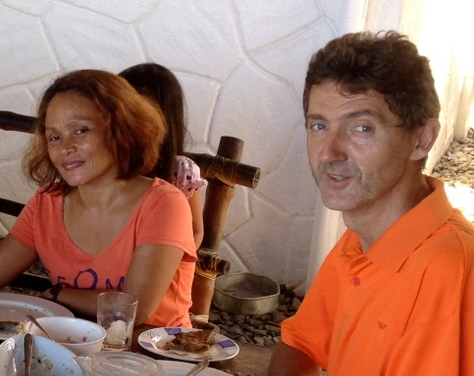
Her Belgian husband Herwig Gielen—you can call him “Gilles” (pronounced JIL)—was a businessman in the Philippines who one day found himself facing a very irate and demanding client—Theresa—and who was immediately captivated by her gutsiness, very much unlike the sweet, docile, marriageable types that expats like him tended to meet. If Theresa is an earth-goddess type, Gilles is a lanky, amiable god, indeed more shepherd than deity, in the attention he devotes not only to his wife and to the villa but to every small detail that will enhance the guest’s experience, from the virgin coconut oil and citronella concoction he prepares against insects and their bites to the ice for their cocktails and the generator that lights the place up after sundown.

As if the place needed yet another secret charm, you might get to meet Theresa’s five-year-old granddaughter Zanique (Theresa had been widowed before meeting Gilles), whom Beng and I instantly fell for like tipsy dominoes. She doesn’t talk much, preferring the company of her lola and her pet puppy Nitro, but she loves to draw and, not surprisingly, to cook, imbibing Theresa’s mastery of the kitchen.

Surprisingly, after being in operation for a couple of years, the Gielens had never really come around to finding a real name for their place—a visitor called it an “amazing villa” and the name (entirely true) stuck—but they took advantage of the presence of so many writers to cast about for another name, and my suggestion (ahem) was deemed acceptable: henceforth, this corner of Eden will be called Ambrosia, The Amazing Villa, after ambrosia, the food of the gods.

And let me thank Cebu Pacific for sponsoring the flights of the writers on this retreat (some members of the group, including Beng, paid their way through for the presumptive privilege of our company, and we think this can be a model for future workshop-retreats where aspiring or non-professional writers can spend some time and discuss their work with the pros). Since Beng and I are hopelessly footloose but can afford little more than budget fares, we’ve been traipsing all around Asia on one Cebu Pacific promo or other and I’ve been writing regularly about these trips and flights, but the Palawan trip was the first time I actually got a free ticket from CP. When our flight back to Manila was delayed for four hours by maintenance work on NAIA’s radar and runway congestion, Cebu Pac handed out packed lunches to the waiting passengers—nothing on the level of Theresa’s gourmet creations, but welcome nonetheless.

I’ll talk more about the retreat itself and about another place in Puerto well worth visiting—the new Hotel Centro downtown—in a forthcoming column. In the meanwhile, you can check out the Gielens’ place here and here (and you can write Gilles at herwiggielen@yahoo.com for more information—they have a home in downtown Puerto and attend to their email there; do give them some time to respond, as they may be away at the villa).

All I can add is, when my iPhone began chirping back to life on the road back in Iwahig, I felt a deep pang of regret; my message-less and therefore trouble-free week was over. Bon appetit!

Penman No. 61: TSE, Sir Winnie, Neil, and Other Penmen

WritersPenman for Monday, August 26, 2013

A FEW months ago, I was thrilled to read the news that TS Eliot’s pen had been lodged with the Royal Society of Literature, replacing a quill pen that had been owned by Charles Dickens and used by the society’s fellows to sign themselves into the exclusive club. Now based in Somerset House in London, the society counts some 500 fellows among its members, and not surprisingly these have included some of British literature’s most illustrious names both ancient and modern, from Yeats to Rowling. (Fourteen new fellows can be elected to the society every year; they need to have published at least two outstanding books and gained the acclaim of their peers.)

The story, according to The Guardian, was that Dickens’ quill pen had understandably lost its sharpness, and that a replacement was therefore in order (members can also choose to use Lord Byron’s pen, reportedly still in fine shape). Eliot’s widow (his second, actually) Valerie had just died in 2012 and had willed his pen to the RSL, making the turnover possible. (Before we leave the subject of quill pens altogether, let me note that these medieval tools took a lot more to make than pulling big feathers from the butts of geese, including tempering in hot sand and sharpening with what came to be logically known as a pen knife.)

It took some Googling before I found a picture of Eliot’s pen, which was never identified in the news stories (picture above courtesy of The Telegraph). From what I knew of vintage pens, it was a Waterman in black hard rubber with two wide gold bands, on one of which was inscribed Thomas Stearns Eliot’s initials. It had been a gift from his mother Charlotte; Eliot had moved to England from the US in 1914 when he was 25, so the pen, which dates to that period or a little earlier, might have been a parting gift.

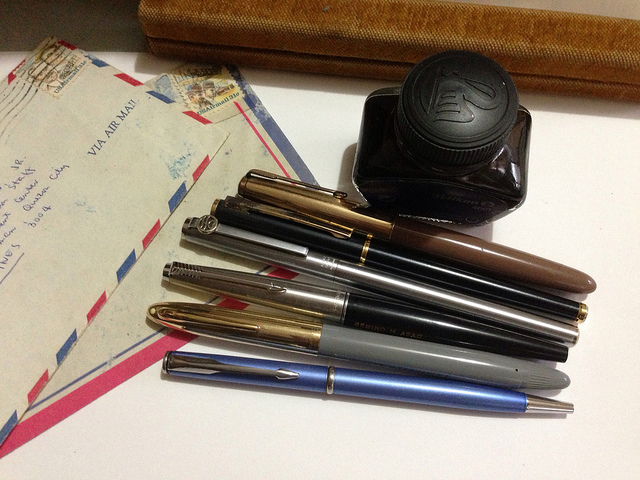
I remembered Eliot’s pen over last week’s rains when, with nothing much else to do at home (that’s not quite right—I always have something to write, but am a horrible procrastinator), I took out my pens for a ritual rubdown and came across a few I hadn’t seen in a long time. That was because these were special pens kept in a special corner—pens donated to my collection by writer-friends, pens they had actually used in their work. Over the years, as word got around of my fascination with fountain pens, generous friends and patrons like Don Jaime Zobel de Ayala and Wash SyCip have gifted me with lovely pens, which I continue to treasure.But the pens I’ve assiduously run after have been those of my fellow writers, especially older friends who started writing with them in the pre-computer age.

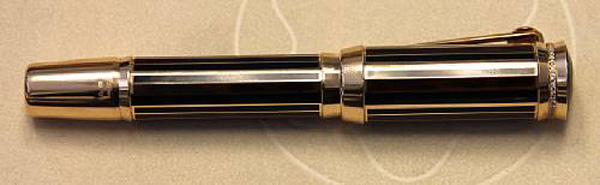
My little writers’ corner now includes pens from National Artists Franz Arcellana, NVM Gonzalez, and Virgilio Almario, as well as from dear friends and colleagues Doreen Fernandez, Jimmy Abad, and Jing Hidalgo. They range in kind from a Parker 51 from Franz and a Montblanc 220 from Doreen to well-used ballpoints from NVM and Rio. (I’m still hoping, one of these days, to be able to ask for pens from Bien Lumbera, Frankie Jose, the late Tiempos, and Greg Brillantes, among others.) Needless to say, these pens will never be sold on eBay. If and when we open a Writers’ Museum, or at least a permanent display like they have at the National Library of Singapore, I might consider loaning or passing them on, but for now they’ll stay with me in my man-cave, feeding my fetishist longings alongside books signed by Nick Joaquin, Jose, Brillantes, Bienvenido Santos, JM Coetzee, Frank McCourt, Kazuo Ishiguro, Junot Diaz, and Edward Jones. (Some of these—the non-Filipino ones, excepting Junot’s—I wouldn’t mind putting on the block someday.)

Before typewriters and word processors made everybody’s writing look like everybody else’s, writers and their pens enjoyed a special relationship, some more so than others.

Mark Twain, a friend to Filipinos in his staunch opposition to American imperialism, preferred the Conklin Crescent Filler, a pen that used an inverted half-moon of gold to press down on the rubber sac in the barrel to release ink. It was a very popular filling system in its time and Twain became something of a poster boy for Conklin, so when the company was recently revived (like so many other long-dormant pen makers, on the heels of a neo-traditionalist trend boosting fountain pen sales), it named its flagship pen what else but the Mark Twain.

But Twain’s popularity never came close to that of British Prime Minister Winston Churchill, who was reported to have used a Conway Stewart—a venerable British brand recently revived—through the dark days of the war. So formidable a figure was Churchill that not only Conway Stewart but Montblanc and Onoto have also come out with pens in his honor.

Onoto—another British pen maker, associated with Thomas de la Rue which used to print our banknotes in the pre-BSP days—also claimed Sir Winnie among its famous users. In the age before paid celebrity endorsements, catching someone popular using your product was good as an endorsement, and was free besides. The minders of today’s Onoto have come up with incontrovertible proof—a letter sent by the young Churchill in November 1915 to his wife Clementine from the trenches in France, where he talks about “the venomous whining and whirring of the bullets which pass overhead.” But the clincher for the company was the ending: “Send me also a new Onoto pen. I have stupidly lost mine.”)

Speaking of the French, Fountain Pens: History and Design quotes the French theorist Roland Barthes waxing ecstatic over his pens: “In the end, I always come back to fountain pens. The important thing is that they can ensure the graceful handwriting I care so much about…. I have too many fountain pens and don’t know what to do with them. Yet, as soon as I see one, I can never resist buying it.”

There’s probably no more famous user of a fountain pen today than Neil Gaiman, who employs quite a range of them, from among the 40 to 50 he reputedly owns—a TWSBI, a Pilot, a Lepine, a Delta, and a Visconti, among others—not just to sign books but to actually write his novels with. He lives, he says, in “a house full of Macs” and is a self-confessed iPod freak, but he told the BBC that, with pens, “I found myself enjoying writing more slowly and liked the way I had to think through sentences differently. I discovered I loved the fact that handwriting forces you to do a second draft, rather than just tidying up and deleting bits on a computer. I also discovered I enjoy the tactile buzz of the ritual involved in filling the pens with ink.”

Pen addicts (the fancy name is “stylophiles”) can never have just one pen to use, so we prefer to talk about “the rotation,” that merry-go-round of favorites we keep constantly inked and polished, ready to be taken for a ride. There’s a lot of debate in the group over whether one should carry one’s most precious pens; I’m of the school that believes that life is short and runs ever shorter, so that fine pens, like Rolexes and Patek Philippes, should be carried with pride and reasonable care. I can’t tell you how many pens I’ve lost in my practice of this carpe diem philosophy, but I have no regrets.

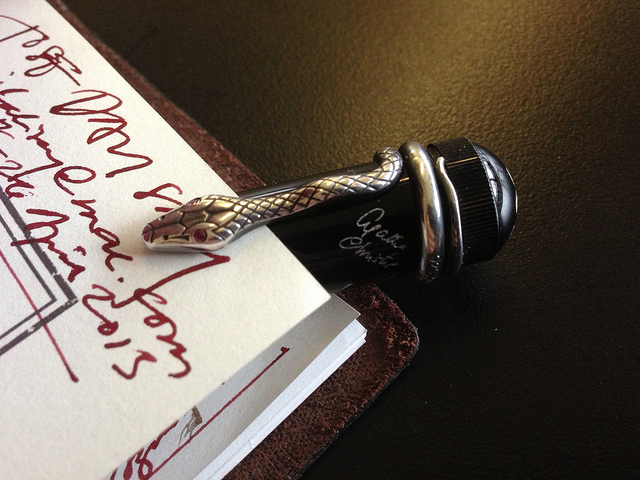
These days, my most faithful pocket companion and favored pen in hand is a 20-year-old Agatha Christie, a largish black pen with a clip in the form of a sinuous snake, a tribute to its exalted namesake and her penchant for mystery. This gorgeous pen has written nothing more noteworthy than, well, notes, but having it in my pocket puts a lift in my step, and even doodling with it puts me in a trance, poised as it were to write until its cache of ink (either Rohrer and Klingner Sepia or Diamine Oxblood) runs dry.

Agatha

In these digital times, of course, hardly anyone except Neil Gaiman really writes stories and novels with a pen anymore, and even this piece is being written on a MacBook Air, which is threatening to croak any minute now for want of juice. That was the beauty of the pen, a writing instrument you could pop into your pocket and pull out as the inspiration or necessity struck you, batteries and brownouts be damned. I’m sure that Tom, Mark, Winnie, Roland, and Neil would wholeheartedly agree.

Penman No. 56: Cheers for The Mango Bride

mango bride final cover copyPenman for Monday, July 22, 2013

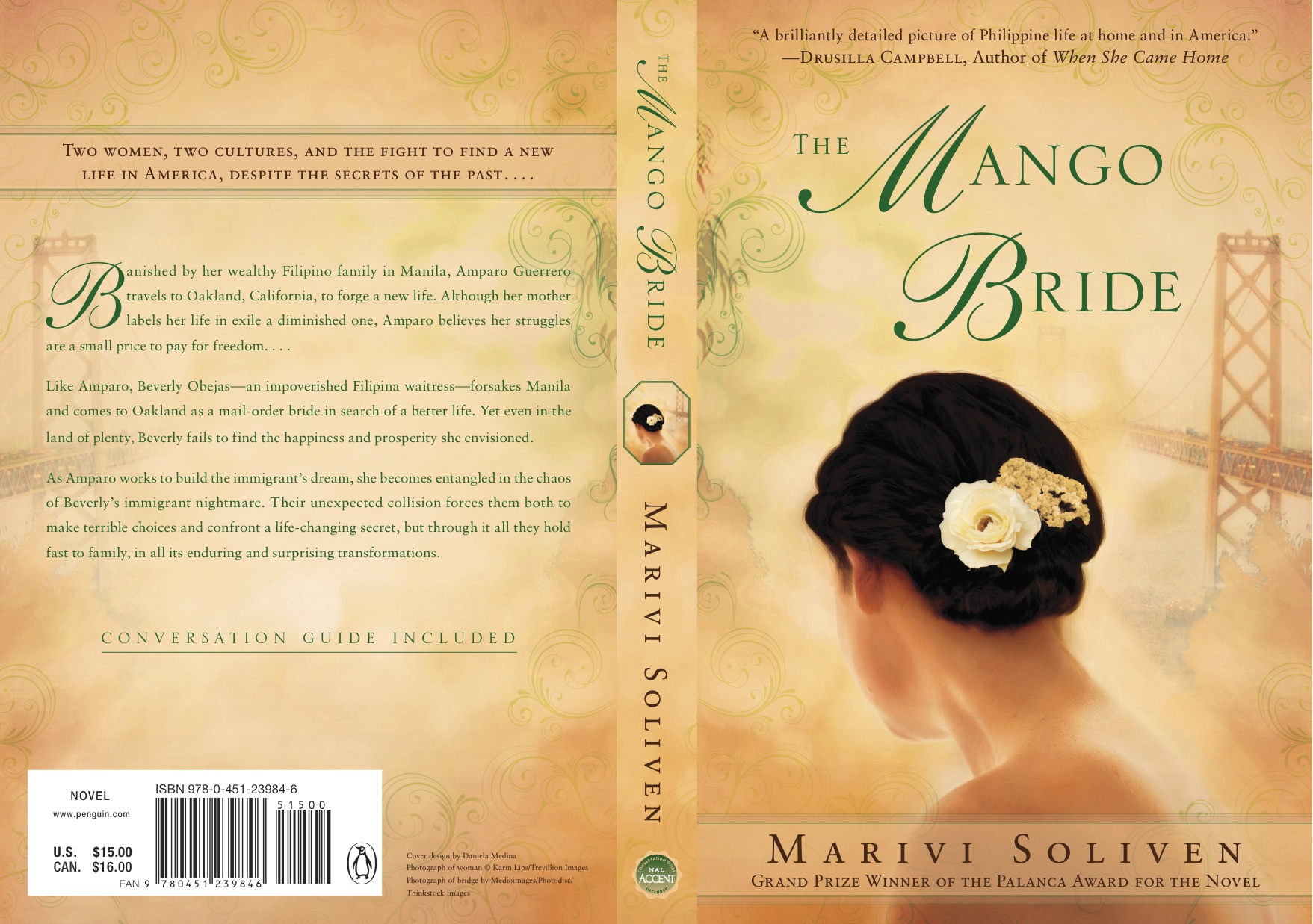
IT ISN’T every day or even every year that a Filipino author gets published by Penguin Books—I can think of only Jose Rizal, Jose Garcia Villa, Jessica Hagedorn, and Miguel Syjuco, off the top of my head—so when Marivi Soliven told me a couple of years ago that her new novel The Mango Bride (New York: NAL Accent, 2013) had been picked up by a division of Penguin, I immediately sent her a congratulatory note. But I didn’t realize the extent of Marivi’s achievement until I received a copy of the published book and read the novel in a mad dash to the ending.

Again, that doesn’t happen to me very often; given my crushing workload, it usually takes me weeks and even months to finish a new book, which is why I habitually decline invitations to do book reviews, not wanting to keep the authors and publishers waiting interminably. But Marivi’s case was different, because I was reading the book not as a beetle-browed critic, but as a mentor and a friend; as it happened, Marivi—whose husband John Blanco teaches literature at the University of California in San Diego, where they’ve been living for many years now—was also my daughter Demi’s English teacher in UP, and since Demi herself moved to San Diego, we’ve all kept in pretty close touch.

All this chumminess and this moving around has a point, and it’s directly related to The Mango Bride, which deals with the powerful tides, both social and personal, that continue to deliver many thousands of our countrymen to America. It tracks two Filipino women—the to-the-manor-born Amparo Guerrero, who gets banished to Oakland following an unwanted pregnancy that threatens to bring shame and scandal on her family, and Beverly Obejas, a plucky girl who also ends up in Oakland following the well-traveled path of the mail-order bride.

There is, of course, more in common between these two women than meets the eye, and it will hardly be a spoiler to say that their trajectories will cross. The task of the novel’s plot is to bring these two seemingly very different characters together—Amparo is a carefree college coed, while the orphaned Beverly works as a waitress—and when they do, toward the novel’s explosive climax, the author completes a narrative coup, with both dramatic inevitability and irony.

But more than a story of individuals, The Mango Bride is also a story of Filipino families rich and poor, which is to say that it presents Philippine society as an unfolding telenovela—bitchy matrons, philandering patriarchs, wayward sons, gay go-betweens, suffering servants, and all. This is, unabashedly, the source of the novel’s power, its appreciation of life in its broad, harsh strokes.

But unlike a telenovela, Soliven’s masterful prose lends the novel a fineness of detail that extends the pleasure of reading beyond mere plot and character into language. Here’s how she presents Amparo’s first experience of sex (as novelists know, a sex scene is always one of the hardest things to do well, and do freshly): “If there was something Amparo learned that first night, it was that the rhythm of passion was deeply satisfying for its simple circularity. Mouths making pillows of opposing lips, the call and response of interlocking sighs, a passel of caresses, cascading one into the other as waves folding into sea foam. Afterward, they gathered the thin sheets about them and curled into each other, chin to chin, chest to breast, dozing twins in a cotton womb.”

There’s a brilliant scene where Amparo tries to tell her boyfriend Mateo that he’s gotten her pregnant, but an elephant—literally—strides into the picture, having escaped from a circus and running red lights all the way down EDSA. It’s unexpected pay-offs like this that keep lifting the novel above the pedestrian, that remind us of an important literary talent at work, one with an unfailing feel for her material, whether we’re in Forbes Park or North Cemetery or a grocery in Oakland.

There will, I expect, be some complaining over the coincidences that mark the plot, but even here the improbable seems fated, precisely because of the novel’s implicit message: that we are closer to each other than we think, and might do well to acknowledge and accept that closeness while we can.

Marivi says that she began the novel in 2008 in the frenzy of NaNoWriMo (National Novel Writing Month—November, to most people) and completed it two years later. It won the Grand Prize for the Novel in the 2011 Palancas, but was extensively revised by Marivi for international publication.

If you want to buy the book and see if you can share my enthusiasm, it’s available at National Bookstore. But here’s the best part: if you want to meet Marivi herself and get her to sign your copy for you, she’ll be in town very soon for a series of readings and talks, thanks to NBS, which is sponsoring her visit.

She’ll be spending an afternoon with us in UP Diliman on Wednesday, August 7, from 2:30 to 4 pm at CM Recto Hall. The UP Institute of Creative Writing and the Department of English and Comparative Literature will co-sponsor the event, which is open to all. See you there!

SPEAKING OF new books, I was happy to have attended the recent launch of a rather unusual book—unusual because it’s a bilingual Spanish-English edition—titled La Oveja de Nathan (Nathan’s Sheep), by the late novelist Antonio M. Abad. Translated into English by Lourdes Castrillo Brillantes (a professor of Spanish at UP, and the lovely wife of our friend and literary kuya Greg Brillantes), the novel won the Premio Zobel in 1928, and was being published for the first time.

The Premio Zobel was initiated by the pioneering businessman Enrique Zobel de Ayala in 1920 to preserve the linguistic and cultural heritage of Spanish in the Philippines in the face of what Nick Joaquin would have called unbridled sajonismo. The Philippines and Filipinos had imbibed English like it was God’s own drink, and bold measures had to be taken to ensure the survival of Spanish in the new American age. Over the next many decades, the Premio Zobel did just that, and more, granting recognition to the best literary works written by Filipinos in Spanish, as well as the most valuable cultural contributions made by Filipinos to the cause of hispanidad.

Abad’s novel was one of the earliest winners of the prize (which Prof. Brillantes herself would later win), and its present publication by the Premio Zobel Collection, the Filipinas Heritage Library, and Georgina Padilla y Zobel (Enrique’s granddaughter) could not be more timely, as it deals with Filipinos caught between powerful political forces.

I’d have to admit that Sra. Georgina’s thoughtfulness in sending over an invitation to my house, with my name and address hand-lettered with a fountain pen, was what convinced me to drive across town in rush-hour traffic to catch the launch. Of course, the late author’s son, the poet Jimmy Abad, is also a dear friend, and Jimmy’s moving poetic tribute to his father’s legacy (delivered, in customary Jimmy Abad fashion, straight from memory) was well worth the excursion.

Penman No. 49: To the Writer at 25 (Part 2)

John and ChristinePenman for Monday, June 3, 2013

TO CONTINUE from last week, here’s what I told my young audience at the 20th Iligan National Writers Workshop (that’s them in the picture above, with panelists John Iremil Teodoro and Christine Godinez-Ortega in the foreground) at the MSU-Iligan Institute of Technology:

Writing in The Atlantic a few years ago, Max Fisher addressed the question of age and artistic productivity. “When in life are we most creative?” he asked. “Do we peak when we are young and energetic, or old and experienced?” Fisher brought up three answers, each with its own champion.

First, he suggested, “We peak young.” He quoted Kazuo Ishiguro—who incidentally is my exact age, born 1954—who said: “There’s something very misleading about the literary culture that looks at writers in their 30s and calls them budding or promising, when in fact they’re peaking.” According to Ishiguro, he had been “haunted by the realization that most of the great novels had been written by authors under 40.”

Second, “We peak in middle age.” Fisher cites a psychologist from UC-Davis who established that while “poets and physicists tend to produce their finest work in their late 20s… geologists, biologists and novelists tend to peak much later, often not until they reach late middle age…. Unlike poets, who peak early and fade quick, fiction writers tend to ripen and mature with age.”

Finally, says Fisher, “We peak old (sometimes).” Here he falls back on Malcolm Gladwell of Tipping Point fame, who points out that “Some poets do their best work at the beginning of their careers. Others do their best work decades later. Forty-two per cent of Frost’s anthologized poems were written after the age of fifty. For Williams, it’s forty-four per cent. For Stevens, it’s forty-nine per cent.”

I myself suspect that, with enough research, we can come up with all kinds of numbers to support any one of these propositions. There will always be the prodigious Marlowes and Poes and Rizals and Plaths who will streak like a comet across the night sky in their 20s and 30s—and perhaps not incidentally die soon after. Some writers, even if they live long, will produce a burst of brilliant work in their early years, and then drop the pen, or be little heard from again.

Paz Marquez Benitez published the classic “Dead Stars” when she was 31, and Angela Manalang Gloria came out with her book of poems, which she would be known for, at 33—but they would forever be those 30-somethings and no older in our literary appreciation. Nick Joaquin published his first poem, “The Innocence of Solomon,” at 20, “May Day Eve” when he was 30, and “Portrait of the Artist as Filipino when he was 34, but The Woman with Two Navels wouldn’t come until he was 44, and of course he continued writing and publishing practically until his death at 86 in 2004. NVM Gonzalez was 26 when he published The Winds of April in 1941; he was 43 by the time he wrote “Bread of Salt” in 1958, and 46 when he published The Bamboo Dancers in 1960. And like Joaquin, Gonzalez demonstrated longevity, working well into his last years. Speaking of longevity and sustained production, we have Leo Deriada and Tony Enriquez, plugging away, I’m sure, at another prizewinning novel or story, as they’ve been doing all these decades.

We’ll see, however, that most of our best writers, especially those who lived past their 70s, produced their most memorable work between their 20s and 40s. Rarely have we found a Dostoyevsky, who published The Brothers Karamazov four months before he died at 59 (my present age). Jose Garcia Villa’s writing might as well have ended with the comma poems of Volume Two in 1949, although he lived for nearly half a century more. Franz Arcellana’s literary legacy really lies in Selected Stories, published in 1962 when he was 46; I know of no more stories that he wrote until his death 40 years later in 2002.

You can draw your own conclusions and prescriptions, but this is mine: write what you can when you can, the sooner the better. The best time to write that story or that poem in your head is today, not tomorrow, and never mind if it turns out to be bad, because that’s what tomorrow is for, for the insightful and merciless and inspired revision that separates the mediocre writer from the truly talented and committed.

Of course I should also say that to writers of my generation, with a slight difference: write what you can while you can, because tomorrow may not come around. Today we live in an intensely youth-oriented culture, and some days it may seem like only the young get all the attention—which they deserve—but we are not in competition with them. Rather we are competing with ourselves, with time itself, and with the ages.

Now, what would I do—or what would I advise a writer to do—if I were 25 today?

1. Focus on your first book. If you write only one book in your life, then this will be the most important thing you will leave behind, not counting your children—or maybe even counting them. Your first book will be even more important than an MFA or your MFA thesis, which, truth to tell, no one but your defense panel will read. Some students I know dithered for years in a vain attempt to perfect their MFA or PhD thesis projects. For me, much of that was wasted time. Do a thesis worthy of passing—and then spend time cleaning up the text and shaping it into a reader-worthy book, a book with your name on the spine. And of course there are good books and bad books, and some days you wish an awful author had desisted from publishing and spared a few trees. But you’ll have to take your chances and get that bad first book out of the way, or you’ll never get to your good second one.

2. Focus on your second book. Your first book will likely have expended everything you’d always wanted to say. So now, what? Once you’ve mined your own young and unavoidably angsty life for material, what’s left for you to write about? Why, the world of course, although that world may seem awfully small at 25, especially if you haven’t been looking too closely at anyone but yourself and your friends. The real challenge of writing for me isn’t writing about oneself—which is, admittedly, an inexhaustible subject, a continuing mystery—but about strangers, whom the writer then makes as familiar as oneself. That’s what the best writers have done—perform great acts of invention, of transport, of sheer imagination. You have to believe to believe that there is more than one book—indeed, more than one life to plumb—in you.

3. Attend a workshop or two, but learn to hunker down and to work on your own. Young writers today seem enamored of workshops, and that’s understandable to a point, as writing is among the loneliest of labors anyone can assume, and the young writer will need the affirmation and the comfort of the company that workshops provide. But workshops can’t be a crutch; life isn’t an eternal summer where you can keep tinkering with a draft in the hope that someone out there in some workshop will finally like it. Past your second or third workshop, keep the workshop in your head, and begin to write, in productive solitude, in the silent company of your presumptive fellows—Chekhov, Rilke, Salinger, Joaquin, Alfon, Gordimer, Lahiri, or whoever moves you to do as they did.

4. Stop arguing, and leave the polemics and the criticism to others. You don’t have time for that, and it can distract you from what you should be doing, which is writing more of your own work. While criticism can help clarify our own aims and means, these debates can sap too much of a writer’s psychic energy, energy one needs for his or her own poetry.

5. Lastly, listen to old fogeys like me, and listen closely—but make up your own minds, make your own mistakes, and don’t be afraid to make them, or you’ll never get anything right. Not everything you write will be a work of genius; indeed, much of it will very likely be immemorable. But if you endeavor to write well and to write enough, sooner or later, that masterpiece you might be remembered by will come. Desperate to earn a living from his writing, Chekhov wrote more than 200 stories in his lifetime; except for the most devoted fan, no more than a dozen of these stories will be familiar to us as classics. But he would not have come up with that glittering dozen if he hadn’t written 190 other less worthy pieces. So nothing is ever wasted in writing. Your misfires and your false starts are part of your investment in the enterprise of a lifetime.

Would Rizal be Rizal without the Noli and the Fili and Mi Ultimo Adios? Perhaps, but he would be a diminished Rizal, whose martyrdom would have lost much of its resonance. Will it be sacrilege to suggest that we admire Rizal less for his actions than for his writings? Were his writings not, in fact, largely his deeds? In any event, they are what live on—what he wrote at 25 and in the few years left to him after that.

As Hippocrates put it so well, “Ars longa, vita brevis,” often transposed into “Life is short, but art lives long.” May we all write something worthy of surviving us—the sooner the better.

Penman No. 44: Pen Boys’ Weekend

Chito and JPPenman for Monday, April 29, 2013

AS IF two trips up to Baguio in early April weren’t enough, I went up a third time later this month. But while my previous sorties had to do with literature—high-minded work, you might say—this third one was purely for fun… and, well, okay, some education of the esoteric kind. That education, I hope, properly qualifies this piece for the Arts & Culture section, particularly as it has to do with my favorite subject of discussion, fountain pens—that’s right, those inky instruments of insistent individuality.

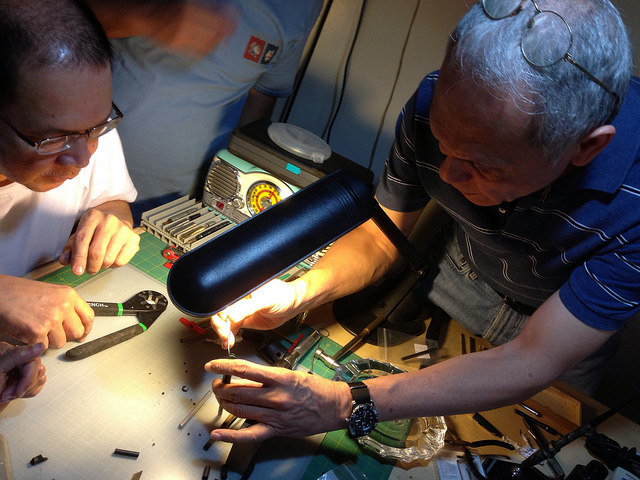
The members of our five-year-old pen club, the Fountain Pen Network-Philippines or FPN-P, had long planned to hold a vintage-pen-repair workshop in Baguio, and this month it finally happened. Why Baguio? Because that’s where our host—the Bali-based Fil-Am pest exterminator (seriously, that’s what he does for a living) Butch Palma—keeps house when he’s in the Philippines, with a veritable pen repair shop and laboratory in the basement. After some hemming and hawing, seven diehards signed up for the workshop: the onetime mechanic, nurse, and now banker JP Reinoso, our local “nibmeister” or master of nib repair and modification; the retired pharmaceuticals executive Chito Limson; the lawyer and DepEd Undersecretary Albert Muyot; the UP engineering major Jonathan Isip, our resident geek and IT specialist; the UP Special Ed grad student Cesar Salazar, who’s had as rich and varied a business background as any; and the two Butches, Dalisay and Palma.

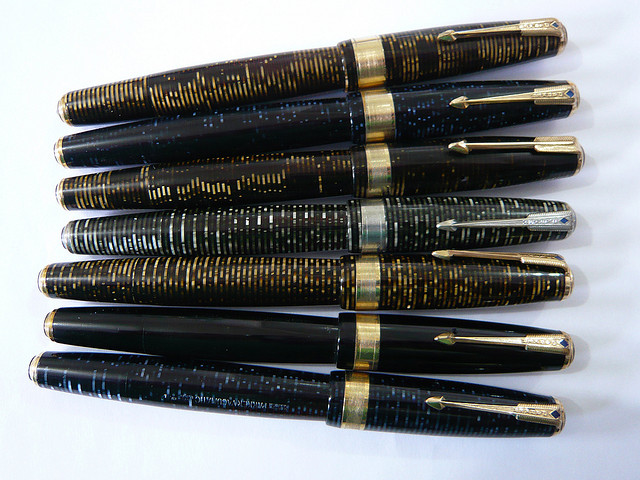
In FPN-P, my tocayo and I are known as the vintage-pen guys, since our collections (about 200 pens for me, and double that for The Other Butch, or TOB as he’s affectionately called in the group) lean heavily toward prewar pens. I have about 60 Parker Vacumatics—fabulous pens and eye candy, with colorful shimmering stripes—and have learned to repair them myself; TOB also likes Vacs, Sheaffers, and gold pens, and is far more advanced and experienced at repair than the rest of us. But what’s even more impressive about TOB is his armory of pen-repair tools, including a mean-looking heat gun and Dremel drill, maintained and arranged as carefully as a conscientious dentist might treat his picks and forceps. (The comparison isn’t as fanciful as it may seem; the dental pick is one of a pen repairman’s most constant friends.)

Fountain-pen repair is a lot like vintage-car restoration. You want the final product to come out all spiffy and shiny, but there’s a lot of work to do—often insanely complicated work—under the hood. You don’t need just the skills, which no one really teaches; you also need the parts, supplies, and tools, which can be as arcane as they come, such as an inner-cap puller for Parker pens, sac protectors for Sheaffer Touchdowns, lever boxes for hard-rubber Watermans, and rubber sacs and diaphragms of many sizes. These aren’t things you can pick up at True Value; they have to be sourced online, and then painstakingly practiced with, inevitably at the cost of a priceless pen or two.

And when a repair newbie’s eagerness outstrips his skills or his patience, disaster happens. Thirty years ago, as I was just getting hooked on pens, I found a rare, mustard-colored Parker 51 Vacumatic in a thrift shop in Michigan for 25 cents—not bad for a pen worth at least 1,000 times more—and promptly cracked the barrel with a twist of the pliers. (Memo to self: heat the barrel with a hair dryer before attempting disassembly, to let the plastic expand.)

Vacumatics

You would’ve thought that—dozens of fixed Vacumatics later—I would be a master at this, and maybe I thought so, too. But at TOB’s workshop, I made another dumb newbie mistake: using a tool I didn’t know without reading or following instructions. The tool in point was TOB’s heat gun, which sends out a blast of hot air like some kind of light saber. I was kidding my tocayo about his having a heat gun instead of a hair dryer because—well, if you see his shiny, saintly pate, you’ll understand why—and then I turned the heat gun on a 1940 Vacumatic that I was going to use to demonstrate my graduate-level skills to the nervous newbies. But, alas, before I could say “This is how…”, the heat gun vaporized a chunk of the pen’s barrel, and there in a smoky wisp went another of George S. Parker’s creations, having survived for over 70 years before some dumb monkey with a PhD zapped it to pen heaven.

Happily the rest of our weekend’s forays into the art of reviving dead writing instruments went much less dramatically, with positive results. Taking a break from headaches in primary education, Usec Albert (one of three Usecs in FPN-P, big fountain pens being a lawyer’s weapons of choice) learned how to replace a “jewel” or an ornament in the butt of a ca. 1960s Parker 61, Chito repaired the 1940s Vac of San Beda Prof. Pidoy Velez (threatening to bill him P8,000 per hour for the three-hour service), JP showed me how to breathe life back into a 1930s Touchdown, and TOB put together a pretty 1938-ish blue Esterbrook using a cap and barrel rummaged from my parts bin (and I found a black Vac barrel from his, to replace the one I ruined), so in the end, everything worked out just fine for the pen boys. (And just to get this straight, at least a third of FPN-P’s more than 300 registered members are female, some of them—the amazingly talented Ms. Leigh Reyes instantly comes to mind—blessed not only with formidable pen collections but with divine calligraphic skills as well.)

We didn’t do too badly as amateur pen repairmen go, but we were glad to be reminded that for truly difficult jobs and truly valuable pens, there are pros we can always tap around the world for their unique expertise. For the longest time, the bible of pen repairmen was the late Frank Dubiel’s “Da Book,” but a new generation of more scientifically savvy restorers has taken over. The legendary Richard Binder (who lent his name to the word “binderized,” to mean exquisitely finetuned and smoothened nibs) has himself retired, but nibmeisters John Mottishaw and Greg Minuskin can still refashion a perfect nib from a sorry scrap of gold, and out in Nebraska, Danny Fudge still services my Vacs and Duofolds when I can’t bear to break them myself. Ron Zorn in upstate New York has a backlog of at least six months, but he’s almost the only one who can properly put back a broken pen together—not with superglue or epoxy, but with a solvent weld that takes months to cure. (Can anyone here in Manila do these things? Beyond the simple repairs we did, the short and plain answer is no; Montblanc does do basic repairs in its service center in Rustan’s Makati, and sends on the tougher jobs to Hong Kong and Gemany.)

Is it worth it? That depends on how much you value your pens. If it’s a P500 Schneider or Inoxcrom, replacing it might be cheaper than attempting a fix; if it’s your grandfather’s Wahl Doric or Waterman Patrician, a $30 solution from Danny Fudge (plus postage, of course) will be a bargain. As far as I’m concerned, and as far as I can help it, every old pen deserves a second chance, if only because they’ll never be made again the way they were back in the 1920s. (That’s not entirely true: companies like Conway Stewart have come out with splendid revisions of the old classics, but these pens could cost you more than an iPhone.)

Boys being boys, and with our precious cargo back in their leather cases, we gathered around the table over scotch and coffee, and babbled into the wee hours about a host of manly subjects: cars and carburetors, terabytes and audio formats, Paul Simon and the Beatles, swords and light sabers, Malcolm Gladwell and Jared Diamond. Now and then some new words and brilliant ideas slipped into the conversation: hadoken, innumeracy, dyscalculia; now and then wives and women were mentioned, but not too often. And every five minutes or so, the talk drifted back to pens, about how gorgeous but oh how expensive the prewar Omas Extra Lucens was, about how Sheaffer Vac-Fills use a bewildering range of rod sizes, and, yes, how quickly vintage celluloid can melt in the wrong hands.

Such was our pen boys’ weekend, and—as I’m sure our wives appreciated—there are worse things men can spend their weekends on and weekends with than leaky Vacumatics.

Penman No. 15: Nerds and Nationalists

Penman for Monday, Oct. 8, 2012

THIS WEDNESDAY, the fraternity I’ve belonged to for over 40 years will be celebrating its first half-century.

I joined Alpha Sigma almost as soon as I stepped into the University of the Philippines in Diliman as a wet-eared freshman in 1970. It was one of the three things I wanted to be a part of in UP, an ambition I’d nurtured over my high school days at Philippine Science—the Philippine Collegian student newspaper, Alpha Sigma, and an activist organization (which turned out to be the Samahang Demokratiko ng Kabataan, via the Nationalist Corps).

They were indeed all of one package: I looked up to Alpha Sigma because the Collegian was then being lorded over by fraternity members like Vic Manarang and Tony Tagamolila, both editors in chief, and Gary Olivar, who wrote a column. It seemed to be the frat where all the cool and brainy guys were, but more than that, it also attracted a strong core of dedicated activists—people like the then-imprisoned Nilo Tayag (one of the original founders) and a quiet but intense young fellow named Benny Tiamzon, now reputed to be the supremo of the New People’s Army.

I can imagine how strange this must sound to many readers who think of writers and academics as deskbound people who should have better things to do than gather around a campfire like cavemen, chug beer, and thump their chests, literally and figuratively. Indeed, in this age of Facebook, NGOs, and Rotary Clubs, fraternities can be seen by people as something of an anachronism, a throwback to feudal privilege and the days of Big Men on Campus. Frankly, I can’t blame them. Just about the only thing most of us hear about frats today is when they haze poor, hopeful neophytes to a bloody pulp. And as far as I’m concerned, frats that do that deserve to be treated like the criminals they are—punished in court and summarily outlawed.

I’d be the last to deny that there’s a lot of childish and sometimes fatal stupidity you can associate with this kind of alpha-male bonding. But to be just as honest, at least back in the day when I was a 17-year-old looking up at the Oblation, there were worse choices I could have made than to join up with this happy bunch of nerds and nationalists.

Alpha Sigma’s founders established it in UP in 1962 precisely to go against the grain of traditional fraternities, which seemed to be interested only in beating each other up, in finding cushy jobs for their alumni, and parading their cars around campus. The initials “AS” may have been suggested by the frat’s base in the College of Arts and Sciences, but they soon stood for “Advocates of Scholarship” and “Alay sa Sambayanan.”

Since then, the fraternity has produced a long line of brothers who have distinguished themselves in nearly all fields of endeavor—not just in the usual categories of business and politics, but also in the arts, in engineering, in public health, and, of course, in public service.

To name just a few, they include the likes of Smart Communications founder Doy Vea, sociologist and journalist Randy David, legal scholar and professor Raul Pangalangan, and the late playwright Boy Noriega. Dodo Banzon runs PhilHealth; over in Seattle, Oying Rimon manages the public health portfolio of the Gates Foundation. I could go on and on with this list, but you get the idea.

We have many brods in mainstream politics—Sen. Gringo Honasan, Cong. Miro Quimbo, and former GMA men Mike Defensor and Gary Olivar among the most prominent of them. But the Left can also count Alpha Sigmans among its most revered figures; aside from the aforementioned Nilo Tayag, Tony Tagamolila, and Benny Tiamzon, they include Billy Begg and Joey Calderon who, like Tony, heroically gave up their lives in the fight against the dictatorship.

Like blood brothers, we have differences, disagreements, and debates within the fraternity, which is a healthy thing. If I thought a brod was doing wrong, I’d consider it my duty and indeed the best thing I could do for him to tell him so. I’ve never believed in a culture of silence and secrets, nor in blind obedience. I do appreciate the opportunity that the fraternity has provided for people from opposite sides of the political fence to meet and to argue civilly without fear of being bashed or punished—something I wish we could do more of in our society at large. I can’t forget that on the run during martial law, many of us found shelter and succor with the brods.

And for the young men who come to UP like I did many years ago and who find their way into our brotherhood, I have a standard set of messages waiting for them. Build up both your mental and physical strength, I say, but eschew violence—it has no place in the university. Value scholarship and service; develop your talents, so you can serve the people better. Be an example for others to emulate.

When a resident brod enrolls in my class and introduces himself to me, I tell him that I will expect more from him than from his classmates, and that he had better be ready to recite on demand, because I don’t ever want it said that I gave a brod a free cut or went easy on him. That’s how we can maintain high standards of behavior and performance within the fraternity, and guarantee that it won’t decline into irrelevance.

If you’re an Alpha Sigman and would like to reconnect with 50 years of a glorious tradition of excellence and service, join us in our grand reunion this Wednesday evening, at the Shangri-La Makati. Please email me for more details.