Qwertyman No. 97: The City That Works

Qwertyman for Monday, June 10, 2024

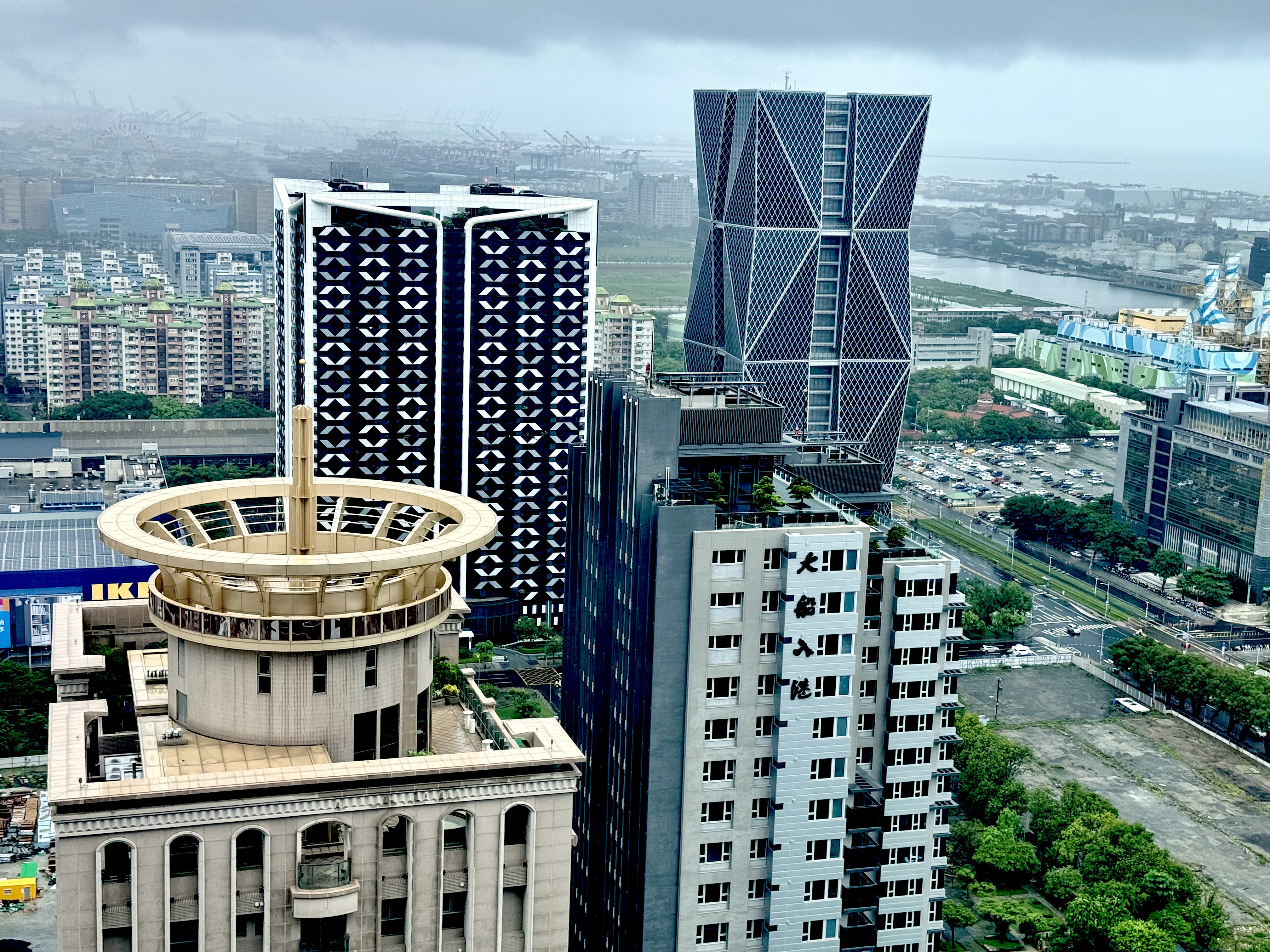
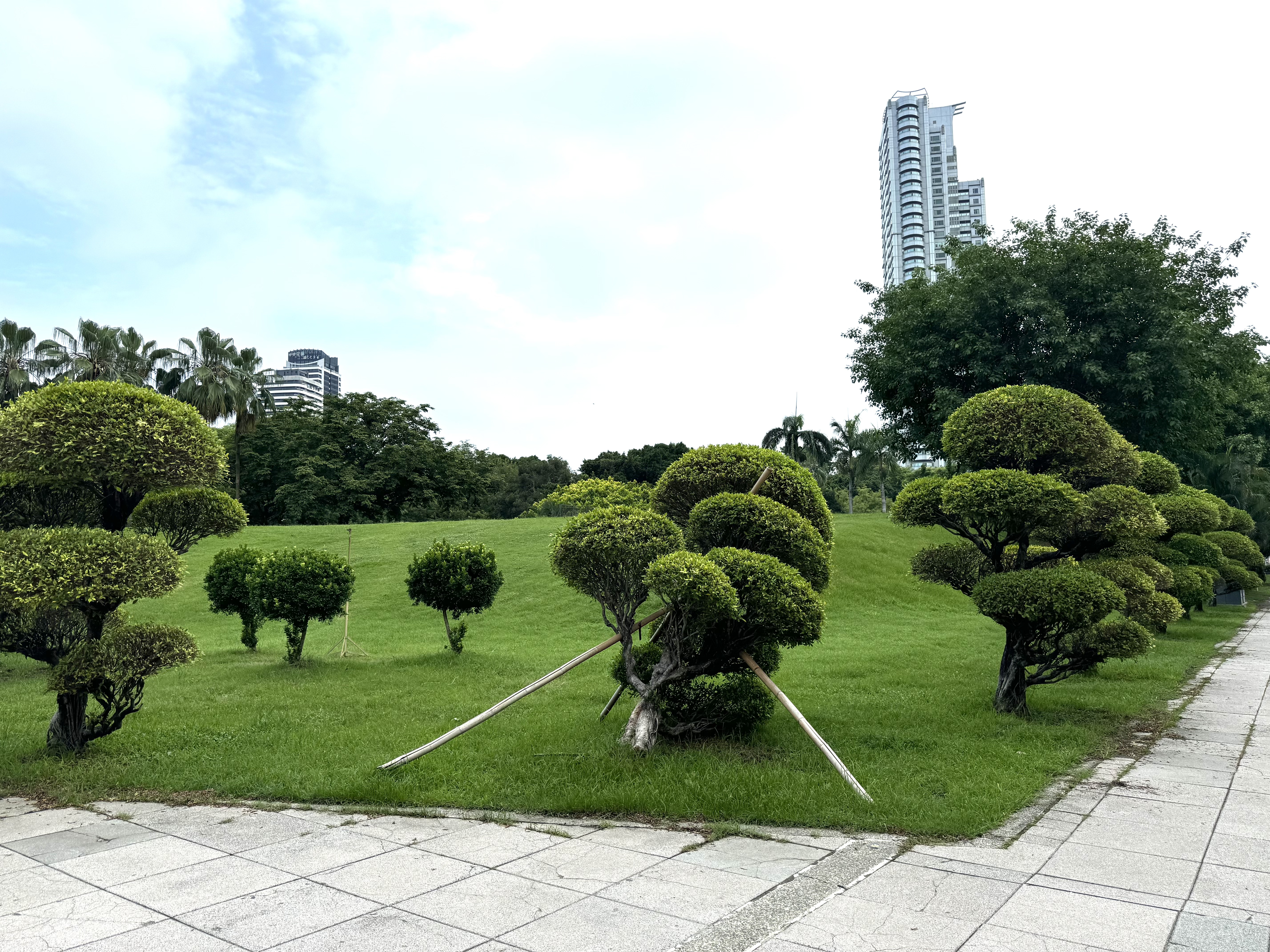
I WAS back last week in the city of Kaohsiung in Taiwan with a group of writers from the University of the Philippines Institute of Creative Writing, at the invitation of Dr. Eing Ming Wu of the Edu-Connect Southeast Asia Association, an education NGO seeking to establish stronger ties between Taiwanese universities and their counterparts south of Taiwan. We were there to meet with our literary and academic counterparts, but also to acquaint ourselves with contemporary Taiwanese society and culture. What we found along the way was a city and a government that works—a model we have much to learn from.

It was my second time in Kaohsiung and my sixth in Taiwan since my first visit in 2010, but those earlier sorties were either for tourism or for attending meetings and conferences, so we never really got to immerse ourselves in the place and its people. This time, Dr. Wu made sure that we went beyond casual handshakes and pleasantries with city and university officials to engage our hosts in in-depth conversations.

The first thing that usually strikes visitors about Taiwan is how modern it looks, especially when flying in through Taipei—the High Speed Rail (HSR), the wide roads, the skyscrapers (think Taipei 101, once the world’s tallest), the late-model cars. For quick comparisons, consider this: Taiwan’s population, at 24 million, is about a fifth of ours; in terms of land area, we are almost ten times larger; its nominal per capita GDP, however, is almost ten times larger than ours at US$35,000. Not surprisingly, Taiwan now ranks around 20th in the world in terms of its economic power.

That power came out of decades of dramatic transformation from an agricultural to a highly industrialized economy, starting with massive land reform and the adoption of policies that spurred export-driven growth. Industrialization itself went through key phases from the production of small, labor-intensive goods to heavy industry, electronics, software, and now AR/VR and AI tools and applications.

At a briefing at the Linhai Industrial Park by Dr. Paul Chung, a US-trained engineer who was one of the architects of this economic miracle, we learned how Taiwan built up the right environment for economic growth through such strategies as the creation of industrial parks (there are now 67 of them covering more than 32,000 hectares, with 13,000 companies employing 730,000 people and generating annual revenues of more than US$260 billion—almost eight times what all our OFWs contribute to the economy). The Taiwanese government has also implemented a one-stop-shop approach to investments, bringing together the approvals of many ministries and local governments under one roof.

Consistently, in modern times, the private sector has led the way forward, with the government acting as facilitator. This was much in evidence in Kaohsiung, Taiwan’s southern industrial hub that was, until relatively recently, a virtual cesspool, the prime exemplar of industrialization gone amuck. A strategic seaport, Kaohsiung grew out of the need to export Taiwanese sugar during the Japanese occupation (1895-1945); the sugar industry gave rise to railways that went far up north to Keelung and became the backbone of the country’s transport system. After the war, the Kuomintang who displaced the Japanese did little to improve things until a visionary mayor undertook reforms that cleaned up the place. Industry also achieved important synergies by adopting policies toward carbon neutrality and reducing waste—for example, one company’s blast furnace slag is being used to pave roads, and harmful carbon monoxide emissions have been rerouted as inputs to chemical companies.

Kaohsiung today is a city of 2.8 million people, a showcase of how runaway industrialization and urban blight can be reversed through good governance and political will. “People need responsible, responsive, and accountable government,” says Dr. Wu, a public-administration expert who worked for 15 years with five Kaohsiung mayors and who now serves as a visiting professor at UP’s National College of Public Administration and Governance (NCPAG). 

A longtime visitor to the Philippines, Dr. Wu has made it his personal mission to promote Philippine-Taiwanese people-to-people relations—a concept he calls “taiwanihan”—in the conviction that the two countries have much to learn from each other and form a natural geographical, economic, and cultural partnership. “We are each other’s closest neighbor,” Wu says. “Taipei is 96 minutes away by train from Kaohsiung, but Kaohsiung is only 90 minutes away by air from the Philippines.” 

Wu and his colleagues at NCPAG have been exploring the possibilities of developing a corridor of cooperation between Southern Taiwan and Northern Philippines, given their proximity. “We have the technology, you have the resources like biomass,” he adds, pointing out as well that taiwanihan doesn’t just mean a one-way relationship, but that the Philippines can also assist Taiwan with its growing needs, such as engineering talent and manpower. Some 8,000 Filipinos now work in Taiwanese factories, but Taiwan’s demand for highly skilled workers will only get higher as it moves into the next phase of its development, which will be heavily dependent on AI.

Artificial intelligence already takes care of many of Kaohsiung’s more mundane needs such as remote traffic monitoring and even the paid parking of vehicles, which has been outsourced by the government to a private entity. “We buy services, not things,” explains Dr. Wu. “The government provides the land for the parking, the private sector supplies the technology and the hardware. This is our version of public-private partnership: the government listens to the private sector, which can use the city as its lab.” 

E-governance and decentralization led us to an unusual sight: we visited City Hall on a weekday and saw very few people in the lobby, unlike its Philippine counterparts. That doesn’t mean that government is distant from the citizens, as a “1999” complaints center receives and fields calls online or in person, employing the disabled to man its booths. 

And even as AI has taken the forefront, it was abundantly clear that human intelligence and human priorities remained important. Good community governance, for one thing, was key to clean and peaceful neighborhoods (their village officials are appointed rather than elected, eliminating vote-buying). Their libraries alone show how and why the Taiwanese are succeeding: they not only have hundreds of thousands of books available to their citizens, but they have innovations such as the “Adopt-a-Book” program by which you borrow a book just based on a previous reader’s recommendation, and books in both Braille and regular text, so that sighted readers can read along with the blind and enjoy a story together. A city that goes that far to meet its people’s needs can’t fail.

Penman No. 463: Masters of the Old and New

Penman for Sunday, June 10, 2024

THE WORK of two outstanding Filipino artists drew my attention last month, in events that could be considered retrospectives of remarkable if somewhat divergent careers. 

The first was the exhibition “Looking Back” mounted by Fernando Modesto at the Galerie Hans Brumann in Makati, running until June 30, which gathers some of the painter’s best work over the past five decades, many of them from the private collection of the longtime Manila resident Brumann himself. That Brumann—now 83, and also a renowned artist and jeweler—was letting go of these pieces struck me much less as a disposal of worthy objects than a bequeathal, an opportunity to share the best of Modesto with other collectors. Laid low by a stroke some years ago, “Mode” as his friends know him remains mentally as sprightly and mischievous as ever; and he has striven and managed to produce new work despite his condition, taking off from the Mode we knew.

That Mode was irrepressibly bright, witty, and playful. In contrast to the somber and even dismal realism of many of his contemporaries from the 1970s onwards, Mode made light of things, opening up a world of freedom and delight in an oppressive universe. 

The playfulness, at one point, was literal. In 2018, writing in Frieze magazine, Cristina Sanchez-Kozyreva reported on the Ateneo Art Gallery’s recreation of an early Modesto installation from 1974 titled Dyolens(Marbles) that involved laying out thousands of marbles on the floor for visitors to kick around. That was about the time I first met him during my days as a printmaker in Ermita; Mode had already gained fame—or notoriety if you will—for his depictions of pendant penises, which even then were clearly meant not to offend but to make one smile.

The Brumann exhibit documents Mode’s progression from tongue-in-cheek wit to transcendent wisdom, opening a door into a world we can only hope to inhabit, where angels reach for a shimmering sun (or are they playing volleyball?) in an iridescent haze, or float face-up in a cosmic pool. His most recent work such as King of the Islands II (2021) retains that rare equanimity in the cool blue gaze of its subject.

If Fernando Modesto is a master of the modern, the second painter who caught my eye reminded me of how much richness remains to be discovered in our artistic past. May 24 saw the launching of Matayog na Puno: The Life and Art of Hugo C. Yonzon, Jr. (published by Onyx Owl, 248 pages), on the centennial birthdate of Yonzon. Authored by Hugo’s son Boboy and the late Neal Cruz, the book chronicles the life and work of a man for whom art was both a passion and a living. Hugo’s career harkened back to a time when the line between fine and commercial art was blurry and perhaps not all that important, for as long as the artist gave the work his all. 

Yonzon had to leave school early to take a job—just the first of one or many—and he would go on to become much more of a journeyman, one viscerally engaged in the trade, than an aesthete or academic. “Yonzon was always invited to the various sessions held by the Saturday Group and other weekday groups that tried to establish their name and weight in the art scene,” says the book. “But he never stayed long nor drew enough on-the-spot sketches; although he had an eye for women, nude sketching did not interest him. He would rather banter and drink a cup of coffee, then return promptly to his favorite themes in his perpetually makeshift studio.”

He was friends with some of the best artists and illustrators of his time, including Mauro “Malang” Santos and Larry Alcala. Having worked as an illustrator and as an art director for an advertising agency, Hugo wielded an extremely versatile brush, adjusting his style and treatment to the client’s needs. It got to the point that visitors to his one-man show became confused, seeing so many different styles on display, but that range was a great part of the reason for Hugo’s popularity. 

But he kept returning to his favorite themes—the pastoral, the folk, the heroic, the visual representation of what he imagined Filipinos at their best and most essential to be. This appealed to the sensibilities of patrons such as First Lady Imelda Marcos, who generously supported Yonzon. Hugo was tireless in his painting and gave his friends huge discounts to the point that his wife Betty felt compelled to manage his financial affairs.

His lifestyle was appropriately flamboyant. “Dad was a loud but chic dresser,” recalls his eldest daughter Minnie. “When psychedelic colors and prints were in vogue, his long-sleeved shirts were in paisleys and reds and greens. Why, he even painted the air scoop of our brand-new Beetle in paisley!”

The life depicted in the book is fascinating, full of struggle and drama, but ultimately it is the art that imprints itself in our consciousness—one full of vigor, color, inventiveness, and variety, celebratory in every way of the near-mythic Filipino. The writer and art critic Lisa Nakpil would say that Yonzon, who died in 1994, was the “underrated master of heroic Filipino iconography,” and this book clearly shows us why.

Qwertyman No. 92: The Return of the Old Normal

Qwertyman for Monday, May 6, 2024

FEW WILL remember it, but yesterday, May 5, marked the first anniversary of the official end of the Covid-19 pandemic as a global health emergency, as announced by the World Health Organization. Of course it didn’t mean that Covid was over and gone—it would continue to mutate into thankfully less lethal variants—but the worst was over. It had infected more than 765 million people around the world, and killed almost 7 million of them; in the Philippines, as of last month’s latest figures, over 4 million of us caught Covid, and we lost more than 66,000 friends, family members, and neighbors to the disease.

It’s amazing what a difference a year makes. The pandemic rules had been relaxed long before May 5 last year, and much of 2023 and 0f the present year had been spent by us trying to get back to life as we knew it pre-Covid at a frenetic pace—engaging in that new term, “revenge travel,” buying new cars, building new homes, and as of last week, complaining about the infernal heat wave like it was the worst thing to have plagued us in decades (maybe it was—since Covid). For the most part, we seem to have willed Covid out of our minds, eager to replace its bitter memories with fresh and happy ones—an entirely human thing to do, to cocoon ourselves against the pain of loss. Are we in the “new normal,” or have we returned to the old?

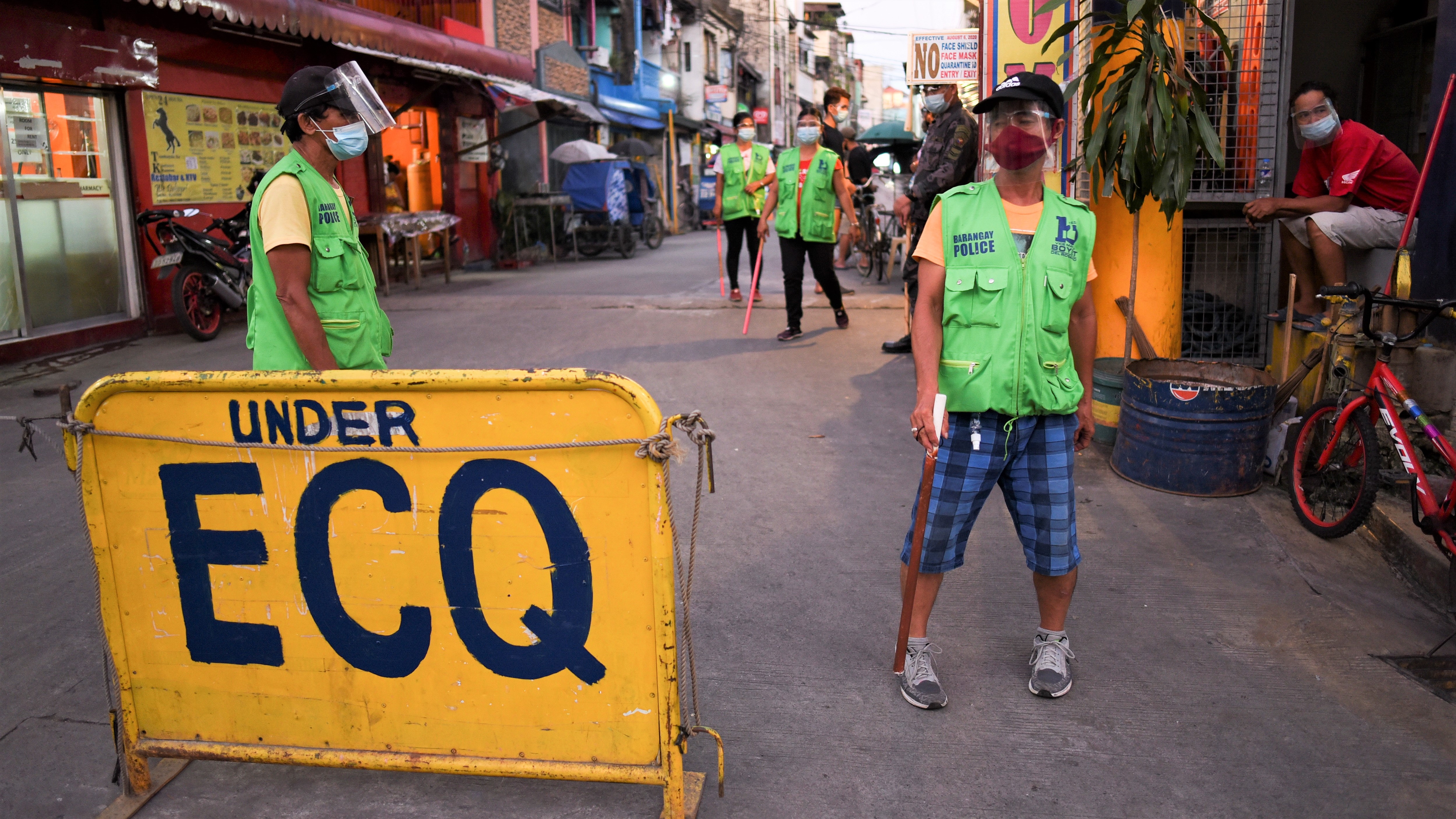
I remember most vividly the paranoia that gripped the country during the pandemic’s early days—the first reports of people we knew dying horrible deaths in isolation, the terror following a sudden and suspicious onset of coughing and fever, the constant fear of carrying the virus home to the innocent and the infirm in one’s shoes, one’s clothes, one’s merest touch, the rapid disappearance of disinfectants and bread from the shelves, the inevitable closure of cinemas and restaurants, the anxious eyes peering above face masks and through face shields, the physical boundaries beyond which only a select few could cross—and, of course, the near-endless wailing of sirens announcing the imminence of death and dying. Unfamiliar words and phrases entered our vocabulary: co-morbidities, social distancing, quarantine, lockdown, ECQ, EECQ, RT-PCR, community pantry, antigen, remdesivir, hydroxychloroquine, Ivermectin, Sinovac (and anti-vaxx), etc.

Like many others, I lost friends to Covid, from very early on when no one knew what was really going on and what could be done to save patients who were turning up feverish and could hardly breathe. One of them was my own cardiologist, who reportedly assisted a patient whom he didn’t know carried the virus. Others were academics and senior officials returning from conferences overseas. Fortunately, no one in our families died of the disease, although many of us, myself included, later caught it at some point despite all precautions. When I did catch it, I have to admit that it was with a strange sense of relief, not only because I could now count myself a participant in a grand if horrible experience, and also because I imagined, perhaps foolishly, that I would be rewarded with some kind of immunity from further and worse infection.

Those of us who survived Covid hopefully did so with a more profound appreciation of the gift and value of life, and of the need to do good in the time we have left. But the 2022 elections only seemed to prove the power of political patronage, which became even more keenly felt during the pandemic, when local officials down to the barangays held sway over their constituents like never before. Covid sharpened the already stark contrast between rich and poor, from access to what were seen as the most effective vaccines to self-declared exemptions from certain restrictions like liquor-lubricated parties and literal hobnobbing. In the end, the virus didn’t discriminate, scything rich and poor alike, although the poor, living in cramped communities, were always more likely to fall ill and die.

What the public often failed to witness—and therefore can’t remember—were the stories of the frontliners who met Covid head-on and served as heroes behind the scenes. I’m now working with Dr. Olympia Malanyaon—a pediatric cardiologist who also served as Director of the Information, Publication, and Public Affairs Office of UP Manila—on a book she’s writing to document the efforts of UPM and of the Philippine General Hospital (which is part of UPM) to respond to the Covid crisis. The PGH, the country’s largest public hospital, was designated a Covid-referral hospital almost as soon as the pandemic broke, and its people found themselves in the vortex of an unprecedented medical and social crisis, and we want to tell their stories in this forthcoming book.

The word “hero” gets bandied around a bit too easily these days, but if there was a time for heroes to emerge, it was during the pandemic, when what used to be the most routine decisions (“Should I report for work today?”) could mean a matter of life and death. When the death toll mounted, many PGH staff resigned for fear of infecting their families, but many more stayed on, with nurses pulling 16-hour shifts and some doctors remaining on duty for as long as 30 hours.

Even utility workers recalled how pitiful the plight of the afflicted was. One said that “They had no one with them, not even when they died. They would be put into body bags, which could not be opened. Then they would be cremated the next day, without being seen by their families.” And then, the staff felt shunned by society when they went home as ordinary neighbors. “When we ordered at the fastfood, the guard shooed us away when he learned that we worked in the Covid unit,” recalled another. “I was very upset. It felt very degrading to work so hard, to line up for food when you got hungry, only to be turned away.”

Thankfully, the crisis also brought out the best in some other Filipinos, such as those who poured their time and money into community pantries that served the hardest hit. For a while back there, we saw and felt the glimmer of our inner heroes. It was a spirit that I hoped would be sustained into a broader and more enduring wave of change in 2022, but as the pandemic receded, we realized how much of the old normal yet remained.

Covid made us aware of the precariousness of our health as individuals. Looking forward to 2025, I wonder what it will take for our people to value their well-being as a society and as a nation.

(Image from Reuters/Lisa Marie David)

Penman No. 460: The Fil-Canadians Speak

Penman for Sunday, March 10, 2024

WE’VE BECOME quite familiar by now with the writings of our Filipino-American brethren across the Pacific, thanks to the success of such breakthrough works as Jessica Hagedorn’s Dogeaters, Ninotchka Rosca’s State of War, R. Zamora Linmark’s Rolling the R’s, Marivi Soliven’s Mango Bride, and Gina Apostol’s Insurrecto, and to the bridging efforts of such literary stalwarts as Luis Francia, Alfred Yuson, and Cecilia Manguerra Brainard. Of course, they had many antecedents, going back to at least Carlos Bulosan, followed by Jose Garcia Villa, Bienvenido Santos, NVM Gonzalez, and Alberto Florentino, among many other expatriates. 

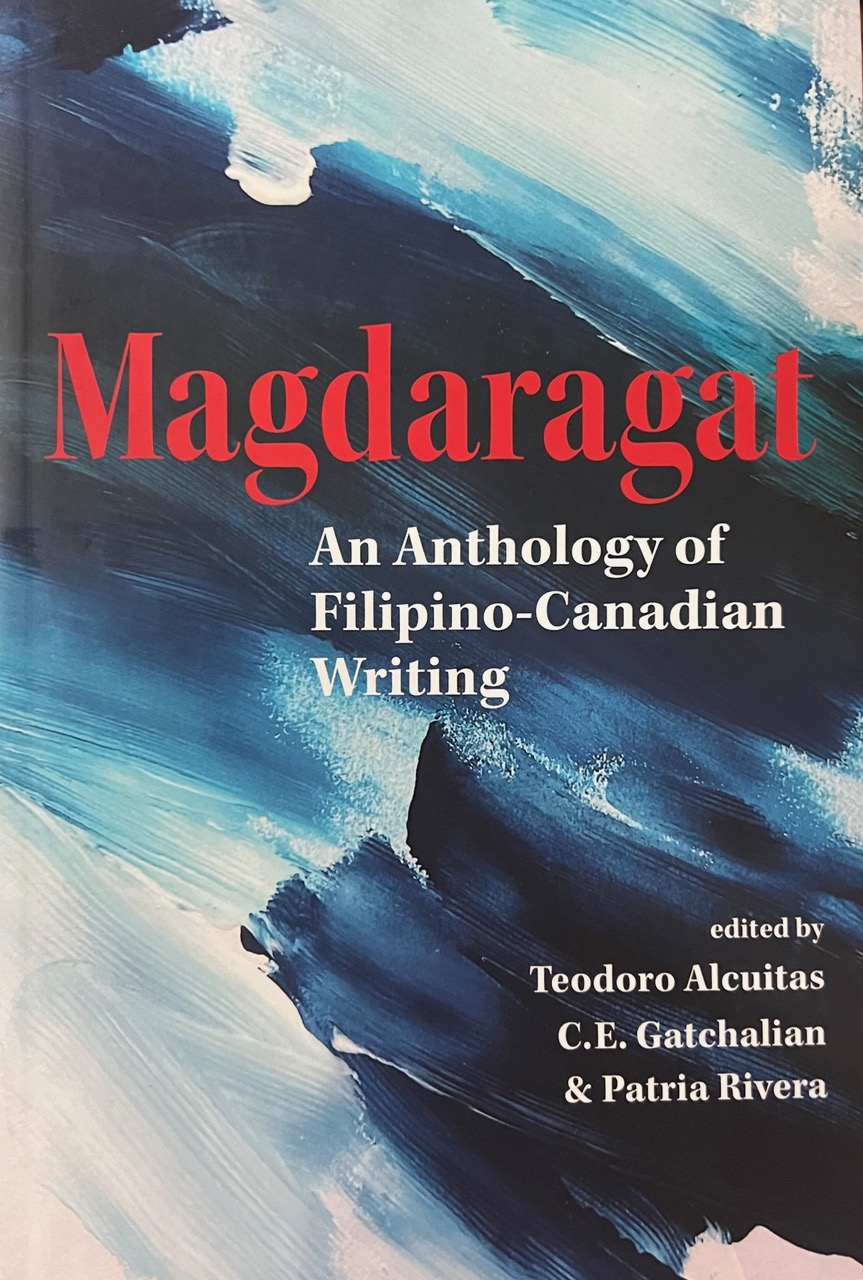
But hardly a whisper has been heard from our Filipino-Canadian cousins, as if their experience—whatever it’s been—were simply an extension or an echo of their southern compatriots, with no distinguishing qualities. There’s a reason for that, which we’ll get into shortly, but first let me announce, with both joy and relief, that the long silence is over. Filipino-Canadian literature is introducing itself to the world—and to us in particular—with the publication of the landmark Magdaragat: An Anthology of Filipino-Canadian Writing (Toronto: Cormorant, 2023), edited by Teodoro Alcuitas, C. E. Gatchalian, and Patria Rivera.

I was first alerted to this hefty 390-page volume by one of the editors, Patty Rivera, an old friend from way back who developed into a fine, prizewinning poet when she, her husband Joe, and their family migrated to Canada decades ago. Arriving in Canada in late July 1987, Patty recalls that moment pregnant with both hope and not a little dread that every FOB immigrant seems fated to step into: 

“The air steamed with purpose when summer meant another life to live. From every corner, a mirror to reflect on. Outside our window, the children’s park, though trees, appeared bruised from the dark slits on the windowpanes. Thorny Vineway. Did our new street name augur of tomorrows yet to come? Would our life in this new country lead to a path laid with thorns? We were young at the time, and everything looked promising. We were alive in this new country and were no longer afraid, the years in the future distant and to be savored. We were ready to be every person we chose or wanted to be.”

Today there are nearly one million Filipinos in Canada, which itself is inching close to 40 million. Some years ago, Filipinos edged out the Chinese as the largest group of immigrants in Canada. Many are highly educated, and many work in health care, leading perhaps to a kind of stereotyping of the Fil-Can as caregiver. To be fair, that’s probably how we home-based Pinoys ourselves imagine our Canuck brethren to be, followed inevitably by “Now why did they go to Canada and not America?”

Magdaragat’s editors try to answer that: “It’s the American Dream, after all, that Filipinos chase; Canada is the consolation prize if America, for whatever reason, doesn’t pan out. While, according to historical records, the first Filipinos arrived in what would eventually become the United States in 1587, Filipinos didn’t arrive on Canadian shores (Bowen Island, BC, to be exact) until close to three centuries later, in 1861. In addition, Canada’s population is a tenth of the United States’. Filipino-Canadian history is, thus, of a smaller scope than Filipino-American history. But within that scope are issues unique to Filipinos in Canada that makes Fil-Can history a distinct subject in its own right, not merely an ancillary of Fil-Am history.”

There are, we discover, subtle but important nuances to the Filipino-Canadian experience:

“Another, more insidious, survival issue Filipinos in Canada have to navigate: the passive-aggressive racism of white Canadians. The brazenness of white American racism is well documented (and spotlighted and hyper scrutinized because of the United States’ status as an imperial power); in contrast, white Canadian racism often slips under the radar because it is more typically characterized by microaggressions. The favorite Canadian refrain vis-à-vis racism—‘We’re not as bad as Americans’—constitutes what might be called “maple-washing”: the relentless washing over of all instances of Canadian racism with the claim that it’s still not as horrible as what has transpired in the United States. Accordingly, the racism Filipinos in Canada experience—and which makes its way into some of the pieces in this anthology—is more insidious than its American counterpart and is characterized by shocking ruptures in a strenuously maintained politesse.”

But what about the literature of that experience? Magdaragat provides ample and eloquent proof of the Filipino-Canadian’s desire to reconnect with the homeland while charting their own course in the new country, as this passage from Deann Louise Nardo’s “Where Do You Come From” illustrates:

“I come from dirt and sand, the scribbled writing of an ancestor in a trance, the sound of droplets on skylights, unopened buds on trees, and the sleep dust in my mama’s eyes. I come from cacao beans and the callouses on fishermen’s hands, the arthritic crackle of my grandmother’s hands as she tends to the garden and mends nets. I come from the silver iridescence of stretch marks, the swirl pattern inside tree barks, the razor-thin whiskers of cats, and eerie creaking of Maplewood floors. I come from lengthwise half-cut bamboo wall sheathing, river mud and buried shards of broken glass, of broken tsinelas and confused roosters singing tik-ti-la-ok at three in the morning.”

There’s a long story by Nathalie de los Santos that alone may be worth the price of the book for its sweeping, multigenerational narrative of the immigrant experience from Bohol to New Brunswick, and from Filipino to Filipinx. The young Kay laments that “Even my relatives can be like this, they remind me how I’m not Filipino enough when I don’t know something about our culture. But then some people here believe I’m not Canadian just by looking at me. When I’m asked, ‘Where you from?’ it implies that. Who am I then?… But, maybe all of this is coming from the same place of hurt?” 

The Fil-Cans have spoken, and theirs are voices worth listening to.

Penman No. 458: An Artist in Leather

Penman for Sunday, January 7, 2024

FEW WILL remember this, but one of the very first things I wrote about when I began this column for the STAR back in mid-2000 was my passion for leather. By that I mean good, well-crafted leather briefcases, bags, watch straps, and such accessories beloved of both men and women seeking a timeless alternative to today’s synthetics. There’s still nothing like leather to suggest authenticity, tradition, pedigree, and care—care because it requires skillful crafting as well as devoted maintenance by its user.

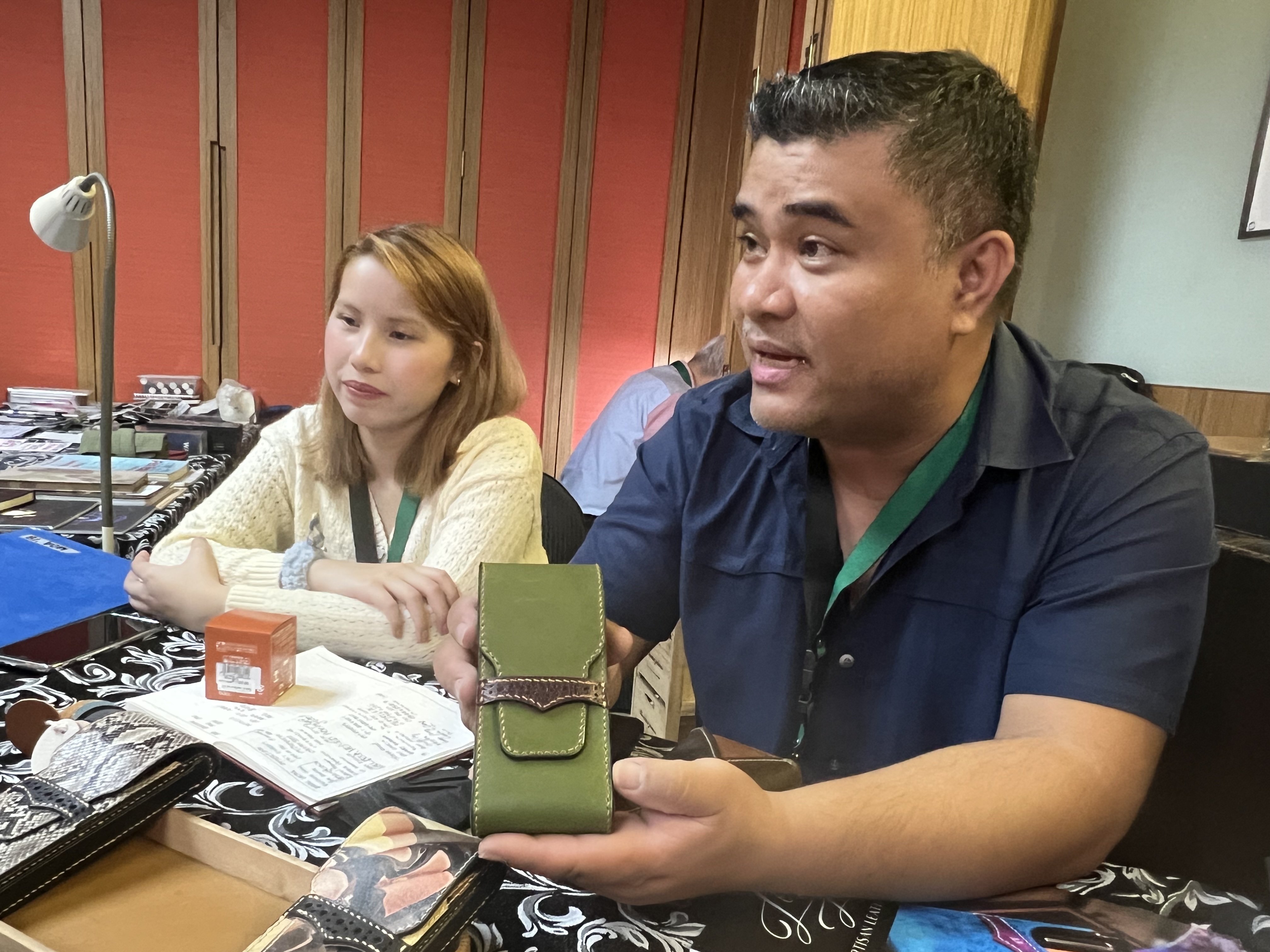
All these came to mind when I first met Raymund Nino Bumatay, who goes by the trade name “Amon Ginoo,” at the Manila Pen Show last March, where he introduced his Leather Luxe line of luxury pen cases. At my age, and having seen quite a bit of what’s out there, I’m a difficult man to please, but Amon’s work ticked all the boxes (except perhaps one—affordability, which we’ll get to later), particularly the quality and craftsmanship that connoisseurs demand. He catered to a highly specialized clientele, so I wanted to know how he could merge art and business and succeed on both counts. 

Amon was engaged in graphic design and marketing when the pandemic hit, hitting his profession badly. Over the long lockdowns, he began thinking of ways to both express himself creatively and make some money. That was when the idea of making leather cases for fountain pens came to him, spurred on by instructional YouTube videos. Why pens?

“I have been a fountain pen enthusiast since 2015,” Amon told me. “I started out with a simple and reliable Lamy Safari that’s still with me, and while journaling and writing were a common pastime during the lockdowns of 2020, I yearned to make something by hand that would house my humble fountain pen collection. This was why the very first and noteworthy leathercraft that I successfully completed was a fountain pen case.”

Amon, it must be said, is but one of a new generation of fountain pen collectors and users, among whom Filipinos now rank among the world’s largest and most enthusiastic communities. The Fountain Pen Network-Philippines (FPN-P), which I helped found in 2008, began with 20 members but now counts more than 13,000 in its Facebook group, most of them successful young professionals between 30 and 45, along with more senior CEOs, Cabinet undersecretaries, topnotch lawyers and doctors, and aging professors like me. 

This was Amon’s ready-made market. Most people will do with just one pen that they’ll typically clip into their breast pocket or toss into a bag, but for fanatical collectors who amass hundreds of pens and carry a dozen of them around to pen meets, good cases are de rigueur. For everyday use, a three-pen leather case is normal. 

Amon wouldn’t be alone in supplying this market. Aside from imports, some other local artisans have been making quality pen cases. But Amon’s are on a whole other level, employing the choicest leather and featuring exquisite and even bespoke designs, which account for their premium pricing. His cases are, to put it plainly, truly world-class.

First, of course, he had to learn his craft. “After making a couple of leather fountain pen cases with one of my daughters, my wife asked what I was planning to do with all those prototypes. I explained that those were just practice pieces that I wanted to perfect and play around with. She insisted that I sell them so I could make this venture sustainable. My wife urged me to start branding these handmade pieces, saying they would serve as great homes for the pen collections of other enthusiasts. It took me a year and a half to muster the courage to finally put a brand to the craft I started and to begin offering my goods to FPN-P members. Thus was LeatherLuxePh born.” 

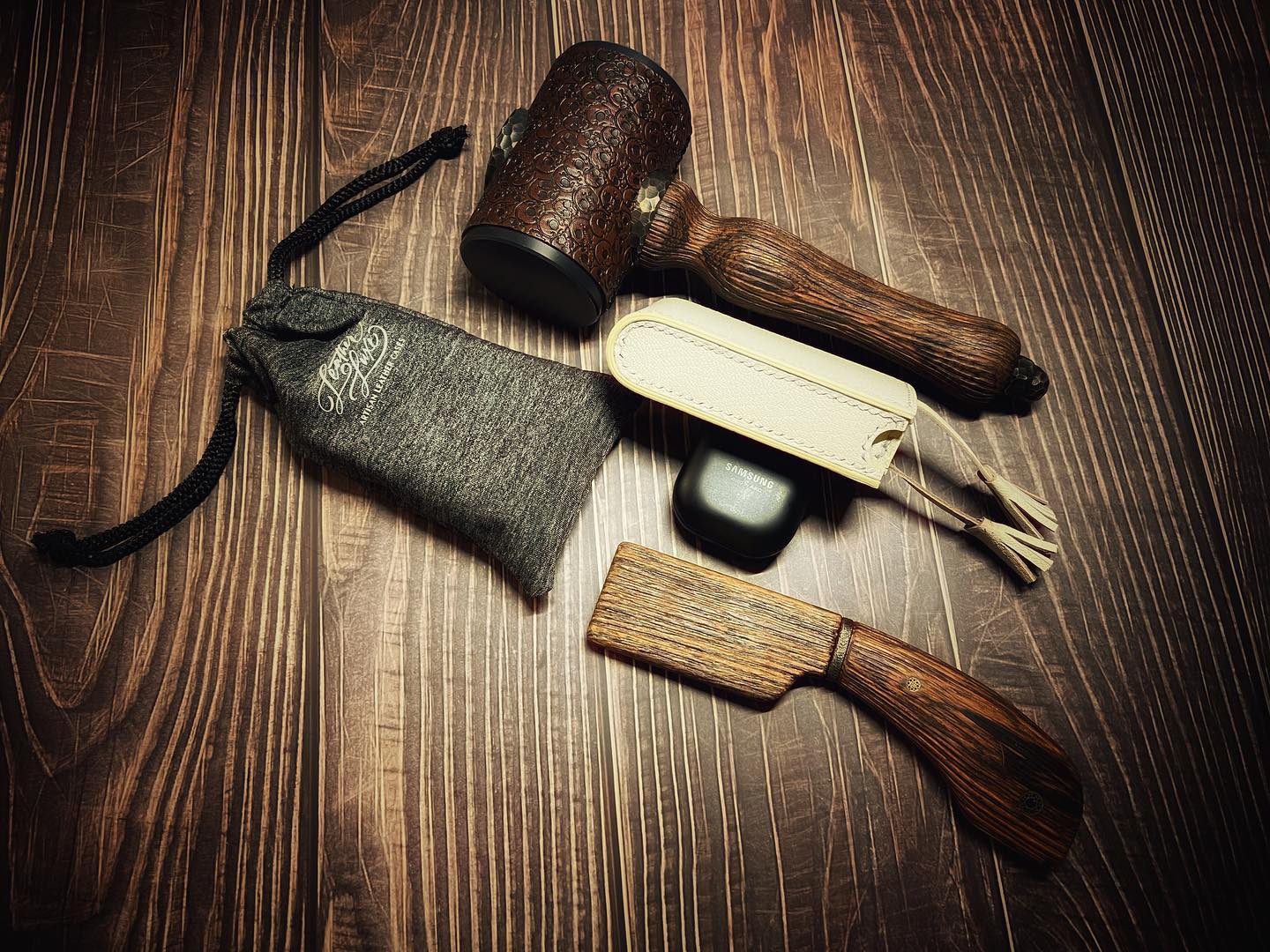
He was soon spending long hours trying out new methods and designs, aside from amassing leathercrafting tools from around the region and from Europe. And then there was the key aspect of the leather itself. “When I was just starting, I got my leather from Marikina, but when things began to get serious, I had to resort to Italian and French leather, sourced from distributors in Singapore, South Korea, and Hong Kong. I’ve also sourced leather from Brazil and Indonesia.” Aside from top-grade hides, he also uses exotic leathers such as snakeskin, ostrich, and stingray. “Each pen case is meticulously handcrafted, handstitched, and assembled by hand. The hand stitching alone needs a calm and steady hand, but I find it relaxing. We have spared no expense in choosing the best leathers, tools and supplies available and continually reach out to our clients to be able to share in their experience and further improve on what we have started.”

Amon found a receptive audience among FPN-P’s advanced collectors, whose five- or even six-figure Montblancs and Nakayas couldn’t just be carried around in pedestrian plastic or cardboard boxes. Among Amon’s repeat clients is CEO Jun Castro, who says that “I need a pen case for my big pens. Normal size pen cases would not fit them or be too tight to easily take them out.” Amon, who is based in Baguio, would even come down to work with clients to make sure he meets their very specific needs.

Of course, I had to ask Amon if he planned to expand LeatherLuxePh’s line beyond fountain pen cases, given the narrow niche it occupies. Yes, he says—but not too far from his base that he would compromise quality. “I’ve noticed that most Pinoy leathercrafters flock to bags, wallets, belts, and the like. New entrants usually resort to pricing that tends to undermine the artisan side of the craft. We decided to focus on pen cases precisely because very few of us do it. But we’ll venture into related items such as leather covers for journals and even a traveler’s kit for fountain pen enthusiasts. We’ll also tap the international fountain pen market this 2024 as a proud Pinoy brand.”

The upcoming 2024 Manila Pen Show on March 16-17 should be the perfect venue for LeatherLuxePh’s new products and designs. Can’t wait to see what this artist in leather comes up with next! (Meanwhile, check out LeatherLuxePh on FB and IG.)

Qwertyman No. 74: A Church for All Humanity

Qwertyman for Monday, January 1, 2024

YOU NEVER see me write about religion, because I believe it’s an intensely personal thing (albeit with a communal aspect), but I can’t help being surprised and saddened by what seems to me to be the latent homophobia—intentional or otherwise—brought to the surface by Pope Francis’ recent statement allowing Church blessings for same-sex couples. Despite the fact that that statement was heavily qualified—that it wasn’t to be seen as “sanctification,” etc.—it still triggered a violent backlash from conservative Catholics, clergy and lay persons alike, who protested that the edict violates established Church doctrine. 

Some of these objectors are my good friends (and they will remain so, unless they say otherwise). Many among them will proclaim that they’re not homophobic at all, that gay people and couples are among their best friends, and that they’re merely upholding a key tenet of their faith—which just happens to exclude homosexuals from the blessings of the Church, because they’re fundamentally living in sin.

But I can’t see how that attitude—which some might call a holier-than-thouness—advances Christian love and charity. Pope Francis’ halfway gesture is compromised enough as it is, but would still have been a welcome step toward redefining a church that’s tried to keep a stiffly male face—despite the many gay people in its ranks—for millennia.

I grew up a church-going Catholic boy (inevitably for a La Sallista) but stopped going to Mass a long time ago, as a liberal feeling distanced from the Church’s positions on such hot-button issues as birth control, abortion, divorce, and homosexuality, not to mention its too-cozy relationship with authoritarian regimes in many places around the world. 

I do admire and support the efforts of many priests, nuns, and other religious to confront and ameliorate our social problems and fight for justice and freedom. I continue to pray, many times a day and at bedtime, for the sick and the oppressed, and to thank God for my blessings. I never formally studied theology nor the history of religions, but from what I can gather (and here I invite the experts to instruct me) what distinguishes the Catholic Church from others is its emphasis on good deeds as the path to heaven, rather than faith alone. You have to earn your sainthood; it is neither promised nor can it be bought. If so, that appeals strongly to me, as I’m sure it does to others. 

But whenever I think of the Vatican and its hierarchy of old men whose meals are answered for by the alms of billions of the faithful and investments in blue-chip companies and real estate, among others, I remember a side of the Church that depends on its moral authority to survive as both a keeper of beliefs and as a global industry. 

No one is surprised by the sordid financial and sexual scandals that have rocked the Church, as they merely prove that some people who run it are as fallible as anyone else. This is not why I left the Church, which I still want to think of as something transcendent, an idea of community above the mortal men and women who make up its body. What disaffected me was the arrogance of its orthodoxy—in which, among religions, it is hardly alone.

I’ll grant that every religion needs a body of core beliefs, some of which will be non-negotiable; if you don’t like what you see, you’re free to go somewhere else. I understand the dismay of the faithful over “cafeteria-style” religion where you can pick and choose what to practice and what not. But I had thought, perhaps mistakenly, that religions have a stake in inclusivity, in upholding beliefs and values that embrace persecuted minorities (as the Christian church itself once was).

I’ll acknowledge that apostates like me probably have no business lecturing devout believers on matters of doctrine. But this isn’t even about the finer points of doctrine, but rather about the broad strokes of faith and, ultimately, what and who that faith serves. If issues like gay relationships and marriage and divorce are to be the line in the sand that separates the true Church from the false (rather than, say, love of neighbor), then sadly I must stay out (to which the conservative core can say “good riddance,” or otherwise pray for my wayward soul). Exclusionary policies are never just internal matters, because they affect the perception of the excluded; indeed, they affect the excluded, and those who identify with them.

Pope Francis has been the first Pope in a long time to have revived my hope in a Church that finally embraces the idea of an inclusive love of humanity as central to its practice, if not its survival. The closing of minds and hearts in our growing Trumpian dystopia calls for a far more powerful spiritual force to overwhelm the spitefulness gripping much of the world today. I would rather look up to Pope Francis and such other figures as the Dalai Lama—rather than a consistory of ambitious cardinals and bishops—to show the way forward. 

I hope I won’t be alone in suggesting that much more work remains to be done, even beyond Pope Francis, toward such liberative measures as the ordination of women, for the Roman Catholic Church to be not just a church for the 21st century, but for all time, and for all humanity.

(Photo from cnn.com)

Qwertyman No. 62: Remembering Ed Hagedorn

Qwertyman for Monday, October 9, 2023

LIKE MANY Filipinos, I was surprised to hear last week that former Puerto Princesa mayor and Palawan congressman Edward “Ed” Hagedorn had passed away aged 76. It was a peaceful death, according to reports, which might have raised some eyebrows among those who knew him and his colorful past. Beyond surprised, I felt genuinely sad, because I had met the man and been much impressed by what he had been able to achieve, despite the brickbats thrown his way by his enemies and critics until the very end. (Only last July, the Sandiganbayan found him guilty of malversation of public property for failing to return some firearms issued to him when he was mayor.)

Hagedorn was one of those larger-than-life figures who stick in your memory like a barnacle. I came to know him two decades ago when he needed someone to write a book about Puerto Princesa’s regreening; I was available and happy to fly down to Puerto to see for myself what the buzz was all about, and looked forward to quiet beachside chats over beer and broiled squid. Instead I found myself rattling in the front seat of Hagedorn’s SUV on earthen roads at breakneck speeds, absorbing his stories, which never failed to make me wonder, “Is this guy for real?” But he was—a true politico, to be sure, who ate controversy for breakfast, but also a game-changer who left an indelible imprint on the community he served, just as Dick Gordon did for Subic and Bayani Fernando did for Marikina.

In memory of that man, let me share some unpublished notes I took for that project (which itself was overtaken by events, but that’s another story). Flash back to the early 2000s, and say hello to Ed Hagedorn:

With his well-combed pompadour, mestizo looks, and neat moustache, Hagedorn looks like a cross between actor-turned-President Joseph “Erap” Estrada and rebel-turned-Senator Gregorio “Gringo” Honasan. The resemblance goes beyond the physical, and the key lies in the movement of these men from the fringe to the center, in their mutation from outcast to power player.

For a man once feared as a teenage toughie, gambling lord, logger, and survivor of at least two assassination attempts, the two-term mayor of Puerto Princesa, Palawan, can be surprisingly gentle and charming. He speaks with an easy smile and a quiet, slightly raspy voice, the golden pin of a Christian dove bright on the collar of his gray bush jacket. He knows that the past hangs on his shoulders—something he has the honesty and the good PR sense not to deny—but he speaks much more enthusiastically about Puerto Princesa’s future, and its own transformation from sleepy island town to a global model for ecotourism, as acknowledged by no less than the United Nations.

Hagedorn appreciates the irony of his situation, and attributes his conversion to a religious faith that he now applies with a fanatic’s fervor to his job. Mayor since 1992, Hagedorn drove his former partners in crime out of the city, set down clear and strict environmentalist policies, especially those having to do with illegal logging, illegal fishing, and waste disposal. Today most of the land within Puerto has been reforested; a “Baywatch” program patrols the water; and a cigarette butt on the open street is about as common as hen’s teeth.

The story of Puerto Princesa’s regreening into a world-class showcase of Philippine environmentalism is an inspiring one, but the Hagedorn story is clearly the stuff of action movies. In fact, not one but two movies have already been made about the flamboyant mayor, who reconnoiters the city in his Chevy Suburban, wearing his trademark wraparound Cazal sunglasses and Rolex wristwatch (“It’s fake,” he says with a grin). 

He doesn’t drink, but until a few years ago couldn’t quit smoking, needing the nicotine to keep him going on typical killer workdays that begin at 6:00 a.m. and end at around 1:00 or 2:00 a.m. the next morning. (He kicked the habit in 2002.) “When I came into office in 1992,” he says, “I inherited the grand total of P26,000, plus one tractor and two dump trucks. In three years, we were able to pave 340 kilometers of roads—just 1,000 kilometers more to go!” Appalled by the city’s conditions when he assumed the mayorship, Hagedorn declared a state of calamity to gain access to P20 million in calamity funds; the government balked at his move, but the courts have since upheld the mayor. He talks about setting up International Environmental University on a large estate already blocked off in Puerto for environmental development.

People wait along the road for his SUV and flag him down. He stops to listen to an assortment of complaints; a secretary takes down notes and his instructions. Like a good politician, Hagedorn has a phenomenal memory: hosting several hundred guests at a banquet at a major hotel, he greets all the luminaries present by name, without notes. The next day he takes his guests to a bayside sari-sari store for a snack of cheap sweet biscuits and soft drinks; the tab comes out to P155; he hands the giggling storeowner a P500 bill and tells her to keep the change. “Don’t evict, develop,” he says of a squatter community that had sprung up on the bayshore. He has also set up 160 low-cost housing units on 100-square meter lots, payable at P500 a month for 25 years. Like an automatic wristwatch, the man’s mind is constantly working, kept alive by motion.

In quick succession, the mayor answers the typical interviewer’s questions:

“Is there anyone next to God whom Edward Hagedorn fears?” Answer: “My wife Ellen!”

“Whom did you grow up admiring the most?” Answer: “The Godfather!”

“Any political plans?” A job, he says, that would let him do more for the environment.

When Joseph Estrada was forced out of the Palace in early 2001, his staunch friend Ed Hagedorn stood by him to the end. That probably cost him the governorship in the election that May, when he challenged incumbent Gov. Joel Reyes for the job, running under the fallen Erap’s standard. We’ve heard that many trees have also fallen since in Palawan’s forests—one of them, reputedly the province’s largest, said to have been carted off to become a centerpiece for a politician’s house. 

I remember remarking then that to call Ed Hagedorn a saint would send St. Ignatius of Loyola—himself a colorful character in his time—into a spasm, but Edward Hagedorn is beginning to look like someone we’ll sorely miss when those trees start coming down for some bigshot’s dining table.

Penman No. 455: A Musical for Our Generation

Penman for Sunday, October 1, 2023

PINOYS WHO came of age in the 1990s like our daughter Demi, born 1974, will swear by “Ang Huling El Bimbo” as their collective anthem—not just the song, but the whole musical and its score by the Eraserheads, who might as well be Martians to Beatles and Woodstock fans like me. On her last vacation her from her long and happy life in California, Demi made sure that she and her cousin KC got to see the show, no matter the cost, and the two girls stepped out of the theater misty-eyed. 

It got me wondering if our generation—boomers, I think we’re called—had something similar to get us all thoughtful and even weepy about what we’d been through. If you were born in the ‘50s, you’d be in your late 60s or in your 70s by now, and that’s a long time to be alive, relatively speaking, especially given that so many of us died so young (read my Qwertyman piece on this from a few weeks ago on “A long grace note”). That usually means college, jobs, marriage, kids, affairs, separations, houses, cars, debts, accidents, ailments, responsibilities, recognitions, disappointments, losses, homecomings, and all the sundry little things that make up a life. That’s what happened to us, and the ordinariness of it doesn’t seem to suggest much worthiness as entertainment material. 

But someone our age apparently thinks otherwise, and beyond just thinking about it, has actually co-written and produced a musical titled “Silver Lining” for our generation—and our children who may want to understand what their folks went through, and why they think the way they do.

That someone is Jack Teotico, better known these days as the man behind Galerie Joaquin, Fundacion Sanso, and other art-related ventures that have opened doors for Filipino artists here and abroad. (When we last met, he was on his way to Madrid to scout prospects for a gallery there.)

Jack and I happen to be friends for half a century now, having met at UP where we were both student activists. We had actually been grade-school batchmates in La Salle Green Hills but hadn’t really connected there. We were both arrested after martial law, and our lives would inevitably intersect every now and then. An economist by training, he headed the Fiber Industry Development Authority at one time, while I worked for the National Economic and Development Authority. We ran into each other more often when he devoted himself almost exclusively to the art world.

Still, it was a great surprise when he told me, at his recent 70th birthday party, that he was staging a musical titled “Silver Lining,” using songs he had written over the years. I knew Jack also loved music and had been performing with a group called Rockitwell.

“I think it’s time to share our generation’s experience,” Jack said. “Not just the political part, but our story of growing up and growing old, the friendships we make along the way, the trials we’ve been through, and what life looks like today from our point of view.” No literary piece touching on the 1970s would be complete or credible without mentioning or implicating martial law, and it’s there in the dark shadows of Jack’s story, but he’s chosen to foreground what to most people were the more familiar rituals and milestones of early adulthood—high school and college life, relationships, love and loss, acceptance, and intimations of mortality. 

Based loosely on real-life events, the musical traces the journey of three high-school buddies who, in their senior years, form a band for their Golden Anniversary homecoming, drawing in their wives and children. They soon decide to work on a musical together—so yes, this a play within a play—and as they do so, the past unfolds in poignant contrast to the present. Even as the narrative unavoidably reaches into the darkest corners of our lives—dependencies, betrayals, disappearances, and such—it ends of a note of hope and redemption.

Working with Palanca-prizewinning scriptwriter Joshua Lim So and musical director Vince Lim, Jack tells these stories through songs with titles like “Brothers,” “Losing Our Way,” “Rambolan,” and “Atin Ito.” The script is in Taglish, given the middle-class milieu of the characters, and the melodies should be easily relatable, reflecting the musical variety of the period covered, from ballads to disco. 

Directed by Maribel Legarda, the musical is headlined by veteran actor Ricky Davao as Leo, Joel Nuñez as Anton, Raul Montesa as Raul, and Nenel Arcayan as Josie, with Krystal Brimner playing a special role as Julia.

As every Broadway aficionado knows (and Jack is one), musical theater is a risky business, but I suspect that Jack really isn’t into this for the money, but rather to leave his signature on our cultural memory. He’s done more than enough to support and promote other artists, and indeed it’s time for him to tell his own story—our story.

“Silver Lining” will have a limited run of only six performances over two weekends  at the Carlos P. Romulo Auditorium in RCBC Plaza, Ayala Avenue, Makati City—at 8 pm on Fridays, October 20 and 27, 8 pm on Saturdays October 21 and 28, and a 3 pm matinee on Sundays, October 22 and 29. Book your tickets now via Ticket2Me or bit.ly/silverliningmusical.

Qwertyman No. 57: An Invitation to SERVE

Qwertyman for Monday, September 4, 2023

AT 5 PM next Saturday, the 9th of September, a new book will be launched at Fully Booked in BGC. Published by the Ateneo de Manila University Press and simply titled SERVE, the book has 19 authors—yes, I’m one of them—and one editor, the much-respected Jo-Ann Maglipon. What connects all is that they were college editors during the first Quarter Storm of the early 1970s, and survived to go on to distinguished careers in media, education, business, and public service. The book dwells much less on martial law—a previous volume titled Not on Our Watch: Martial Law Really Happened, We Were There that came out in 2012 dealt with that—than with its aftermath, and the afterlife that the activists of our generation were fortunate to have, given how many of our comrades gave up their lives to the cause of justice and freedom.

What did these activists do after martial law? What are they thinking now? Some of the names in this book will be familiar to the contemporary reader, who may not even have known of their activist background (reg-taggers, pay close attention).

Some of us—like Jimi FlorCruz, Sol Juvida, and Thelma Sioson San Juan—remained journalists all their working lives, stationed in very different places and capacities but bound by a commonality of interest in the truth. Others like Sonny Coloma, Manolet Dayrit, Ed Gonzalez, Diwa Guinigundo, the late Chito Sta. Romana, and Judy Taguiwalo took the path of government service, finding themselves in a position to effect real change, although sometimes under very difficult if not adversarial circumstances. Yet others including Angie Castillo, the late Jones Campos, Mercy Corrales, and Senen Glorioso found fulfillment in entrepreneurial and corporate work, applying their progressive values to management. For Elso Cabangon, Bob Corrales, and Diwa Guinigundo, their circuitous journey led to a re-encounter with their spirituality, and to embracing their faith as their personal advocacy. Like many veterans of the First Quarter Storm, Alex and Edna Aquino were able to build new and productive lives overseas, without yielding their investment in Philippine concerns. Quite a few of us—Derly Fernandez, Ed Gonzalez, Judy Taguiwalo, Rey Vea, and myself—chose to pursue our activism in academia, if only to ensure the transmission of critical inquiry to another generation. 

The authors were under no compulsion to conform to an ideological standard, except to extol the spirit of service to the people, the overarching theme of their youth and now their continuing commitment, indeed their legacy. There’s pathos in these accounts, but also humor and, inevitably, irony, perhaps the defining tone of our postmodern age: Thelma Sioson San Juan finds herself seated across Deng Xiaoping’s granddaughter at a Ferragamo show in Beijing’s Forbidden City; Manolet Dayrit learns of his appointment as Secretary of Health on a visit to President Gloria Macapagal-Arroyo in Malacañang; Ed Gonzalez becomes president of the Development Academy of the Philippines under President Joseph Estrada, but then joins EDSA 2; Sonny Coloma looks out the window of his Malacañang office to where students like him had demonstrated against Marcos.

With most of the writers here now in their seventies or inching close to it, we could have been chronicling the joys of grandparenting, journeys to far-off places, exotic menus, succulents and bromeliads, and homeopathic remedies for the aches of aging. Having retired from the formal workplace, we thought we had settled into a privileged and imperturbable kind of peace, earned over decades of political, economic, and spiritual struggle. 

We celebrated our seniorhood as the ultimate victory, for a generation that did not expect to live beyond thirty, and not because of some acquired disease but because of the throbbing cancer at the core of our society that claimed many of our peers in the prime of their youth. We may have thought for a while that we had defeated and expunged that cancer, only to realize that it had never left, was always there, lying cruelly in wait for a chance to ravage us again—and not only us this time, but our children and grandchildren as well.

And so—albeit no longer lean and shaggy-haired, perhaps benignly forgetful of car keys and personal anniversaries—we gather again at the barricades we put up against a fascist dictatorship fifty years ago, of which our memories remain surprisingly and painfully sharp. They say that the old remember distant things more clearly than what happened yesterday, and we offer proof of that. The experience of martial law coded itself into our DNA, and even the few among us who surrendered their souls to Mephistopheles cannot shake away that indelible past—one we bear with pride, and they with guilt and shame.

This time our barricades consist not of desks and chairs but of memory itself and, more formidably, of hope, courage, and a continuing faith in the good. Beyond memoirs, more than recollections of our youthful selves, we now present the stories of the lives we built and the paths we took after martial law, along with our reflections on how time and experience have reshaped us, clarified our values, and strengthened our resolve to serve our people in multifarious ways. 

Our view of politics inevitably evolved over time as the world itself changed over the past five decades. These essays and stories cover a wide range of themes and treatments, and demonstrate how “serve the people” has grown and evolved with its advocates, taking multifarious forms from working in civil society and practicing good governance to promoting artistic expression, academic freedom, and insightful journalism. We wish to prove that even the worst of times and the worst of leaders are not only survivable but can be changed, so that whatever lies ahead, the better Filipinos in us will prevail.

Given the number of authors and their families and friends, we expect a full house at the launch, so you might want to wait and get your copy of the book from Fully Booked or from AdMU Press’ online channels. However the book finds its way to you, it will be worth your while.

Penman No. 453: The Distance to Brillantes

Penman for Sunday, August 6, 2023

I’VE OFTEN written about how Gregorio C. Brillantes has been the bane of my writing life, a fellow short story writer and Palanca Hall of Famer whom I never had the pleasure of seeing in second place after me (the reverse has been the natural order of things). When the Ateneo Press recently launched his Collected Stories and asked me to speak at the event, I felt like a jealous juvenile again at 69, with the 90-year-old Greg in a wheelchair in front of me, and cheekily boasted that, at last, I had one over him: his collection had 39 stories while mine (Voyager and Other Fictions, 2019) had 44. 

Of course, it was a hollow boast, because any one of Greg’s stories is easily worth two or three of mine. That’s how highly I hold this man in my esteem, and why I wrote this blurb for him: “Few writers turn me into a blushing fan. Gregorio C. Brillantes is one of them. Like his papal namesake Gregory the Great, who wrote a massive 35-volume commentary on the Book of Job, Greg Brillantes has been an untiring and unsparing chronicler of his time and place…. His fiction is infused with power and luminosity; he surprises, but never screams.” 

In an art card that Ateneo Press used to promote the book, I said further: “More than a master of language, Gregorio Brillantes is a master of our Filipino sense and sensibility, particularly those parts we find hard to put into words or to recognize as our truest selves. We see life in his stories as through a gossamer screen that filters out  the harshest light; that screen is his own sensibility, suffused with a deep and tolerant understanding of pain as pleasure’s shadow.”

(The young Greg with John Updike.)

But really—putting all the fanboy talk aside—why Brillantes? What did I and my students—and what can every young writer of fiction—learn from him?

To get right down to brass tacks, I’ll take one of his best-known stories and dissect parts of it that should show what not only good but masterful writing is all about. 

“The Distance to Andromeda” has been mistakenly described by some as a science-fiction story, but it is not, although science fiction figures prominently in it. Without going into what the story means, what Brillantes demonstrates here, technically, is his acuity of observation and grasp of relevant detail, which is basic to any writer’s armamentarium. Too many young writers fuss over the elements of what their Ultrawave Galactic Terminator Machine should contain, glossing over the seemingly inconsequential gray matter of daily living that congeals into human drama. 

In “Andromeda,” the boy Ben’s post-apocalyptic fantasies are foregrounded by domestic business. See how Brillantes constructs a scene: “He dribbles an imaginary basketball toward the kitchen, skidding on the floor, feints and jackknifes a neat shot through the door. His sister-in-law Remy is giving her baby his supper of porridge from a cup. The child gurgles a vigorous greeting at the boy, and Remy laughs at the wonder of her son’s knowing the infant-accents of his language. The kitchen is bright and intimate with its rich cooking smells: Pining bustles about the old Mayon stove, and the girl with the pigtails smiles her crooked-toothed smile from the lithographed calendar on the wall.”

It doesn’t seem much and the young reader may feel bored by the lack of “action,” but note how, in fact, the scene is full of action—physical and emotional action, of the kind absent from too many stories being written today about morose characters sipping cappuccinos at Starbucks and ruminating over their wayward romances and work-life balance. “Get your characters off their butts,” I always tell my students, and Brillantes does.

A Brillantes story is an accretion of impressions, ideas, and emotions. It’s that kind of preparation that earns Brillantes the right to orchestrate this kind of paragraph later in the story: “He catches the streak of a shooting star from the corner of his eye. Instantly his waiting becomes a sharp alertness: he holds his breath and the strangeness comes into him once more, the echo of an endless vibration. But it is no longer an abstract aching for the relief of words: it speaks within him, in a language full of silence, becoming one with his breathing, his being, and the night, and the turning of the Earth: incomprehensible, a wordless thought, an unthought-of Word: like the unseen presence of One who loves him infinitely and tenderly. The fear has gone, the lonely helpless shrinking he felt on the bridge, walking home: love surrounds him, and no evil can touch him here, in his father’s house.”

For a story written in the author’s mid- to late twenties, “The Distance to Andromeda” already lays out, in full, Brillantes’ talent and vision, his familiar themes of family and love, of doubt and faith, of Rilke’s God “who holds this falling / Gently in his hands, with endless gentleness.”

It is a story that I myself could not have written, as I inhabit a more sordid and much sadder world in my fiction, with little to draw on but my characters’ residual sense of goodness for their salvation. Brillantes celebrates—consecrates—the mundane joys of the middle class, even as he underscores their fragility and transience. I write as well about these people—doctors, teachers, boys on the verge of manhood—but they tend to be more visceral in their responses. My other literary hero and model is Bienvenido Santos, who can make music of melancholy, and I try to straddle the breach between these two gentlemen, although again my characters prefer the low life.

But young writers: read Gregorio Brillantes. Understand what truly breathtaking means by reading two of my favorite stories of his: “The Cries of Children on an April Afternoon in the Year 1957” and “The Flood in Tarlac.” If you read them and still wonder what good fiction is, then you might as well be looking up at the sky to find Andromeda, because that’s how far you have to go.