Penman No. 476: Angels over Angela

Penman for Sunday, August 10, 2025
AS A collector of many things old and wonderful—vintage fountain pens and typewriters, antiquarian books, and midcentury paintings—I occasionally come across the stray and even the strange object that I simply can’t say no to.

My wife and I are inveterate junkers—as I’ve often written about, we travel the world not to visit magnificent palaces, posh boutiques, or Michelin-starred restaurants. Rather, we dive right into a city’s flea markets, resale shops, and discount stores to see what treasures could be had for a song.

But travel costs money, so the next best thing is to go to the Web for the online equivalent of flea markets, among which there’s none larger than eBay, with millions of items on sale at any given minute. Having been on eBay almost since it opened 30 years ago, and with a feedback score over 1,500 (100% positive), I practically live in it, checking out its offerings several times a day, using targeted searches for certain pens, old books, and Filipiniana. 

You’d be surprised how much Philippine material exists out there. I’ve repatriated paintings, maps, magazines, engravings, and such, feeling it my patriotic duty to bring them home. I have collector-friends scouring eBay just as diligently for Philippine medals, coins, stamps, and postcards—the results of which often turn up on our own auction sites, sometimes for millions.

Another virtual flea market that junkers like me habitually visit is the Facebook Marketplace. Facebook is full of selling groups devoted to everything from antiques, collectibles, and furniture to used clothes, fake gold bars, and broken appliances. They all end up at the Marketplace—which, frankly, was the principal reason I finally went on FB, after resisting for many years. I didn’t want to make friends and influence people—I wanted to shop for cheap gadgets like used iPhones and Apple laptops (both of which I’ve bought on FB many times) as well as the odd collectible, like the 1897 two-volume facsimile edition of Don Quixote that I picked up at a Jollibee, and a large pastel seminude by the modern Japanese master Ryohei Koiso.

But as with eBay, and because we’re right at home, nothing interests me more on FB Marketplace than Philippine material, and just this past month two outstanding discoveries reminded me why I should keep an eye out for the good, the strange, and the beautiful.

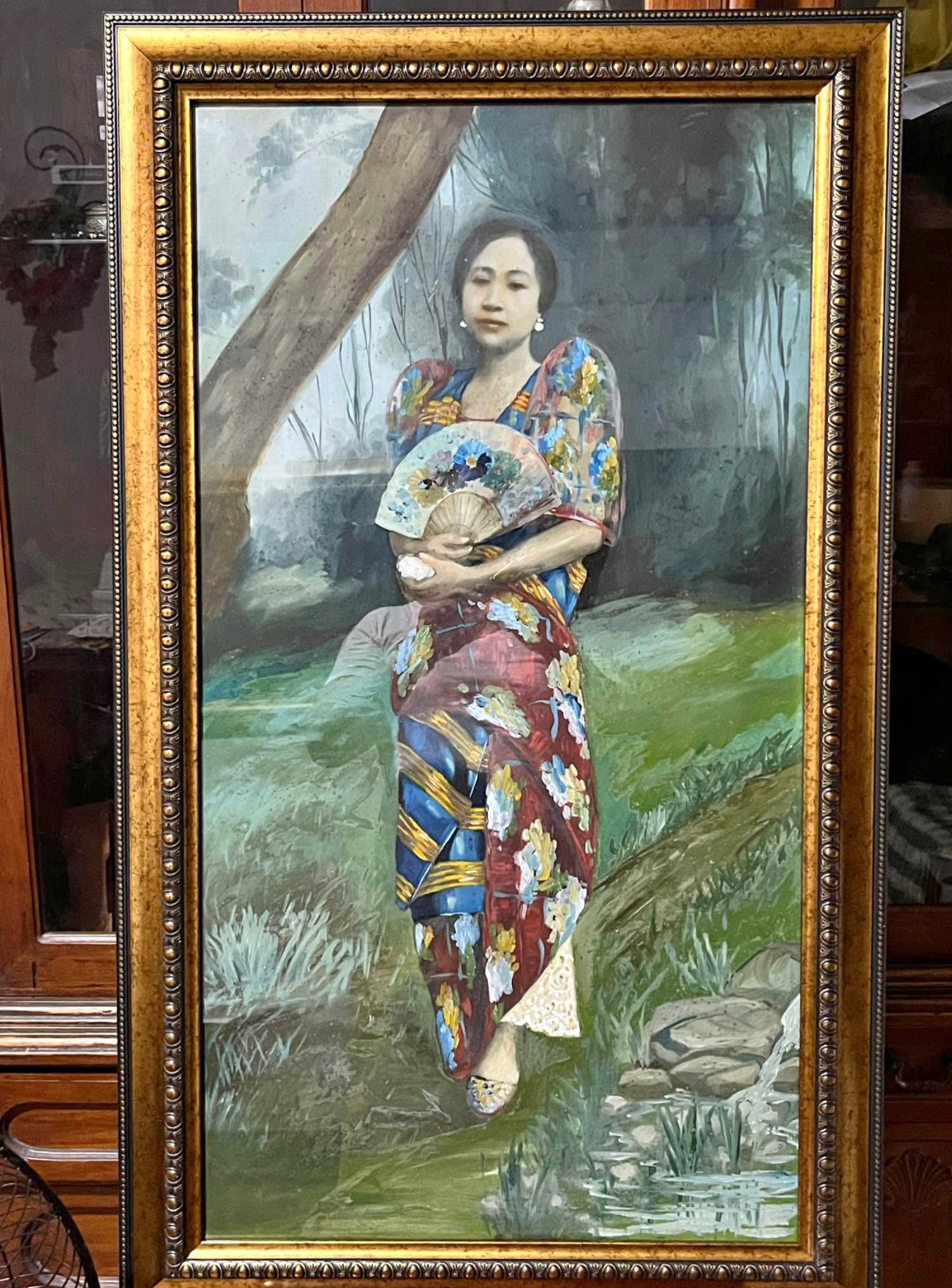
The first was a stunningly lovely picture of a Filipino woman in native dress, apparently from before the war. The dress seemed to have been colorized, but by hand and not digitally as we often find these days.
As soon as I saw that picture on FB, I knew that I had to have it (or to put it more nicely, I knew I had to get it for Beng). The seller posted it as an “acrylic on board from the 1950s,” which I wondered about but was just barely possible, with acrylic paint beginning to be used in the 1940s. (All the seller could tell me was that it had come from an old house in Sampaloc, and that he had nicknamed her Esther.)

It could have been a modern giclée print or a lithograph, but assured that it was indeed a painting under glass—the seller was highly reputable and lived just 15 minutes away from me—I took a chance and asked how much. Given a quote just in the four figures (I was expecting something significantly higher), I instantly “mined” it, as they say on the Marketplace.

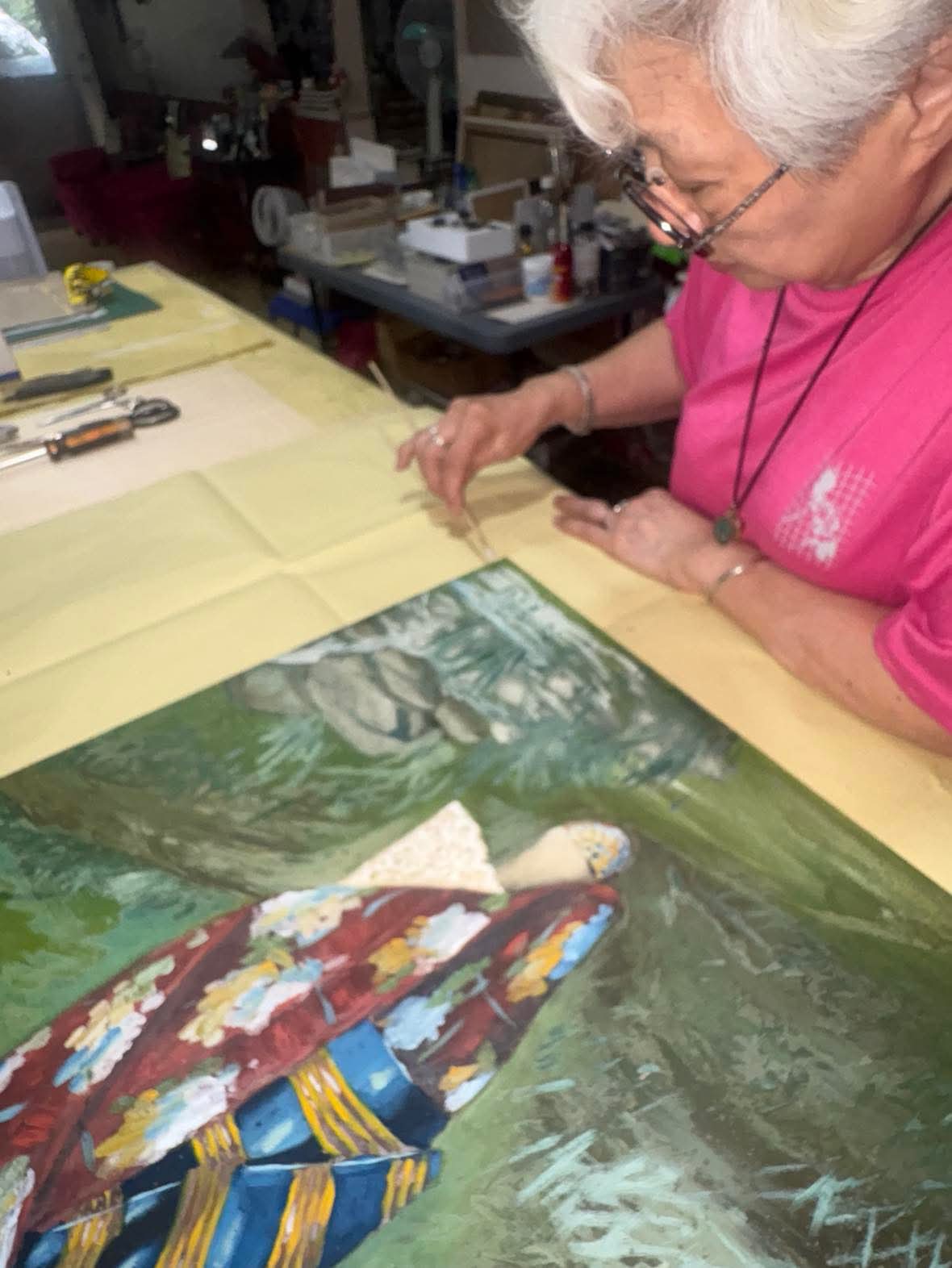
When it arrived, Beng and I couldn’t believe our luck. It was large and gorgeous, but what medium was it? The painting was under glass, and we could see the paint strokes but not discern the texture of canvas. There were some mold spots under the glass, and some adhesions (this is where it pays to be married to an art restorer who has done all the Philippine masters from Luna and Hidalgo to Amorsolo and Magsaysay-Ho). Beng looked more closely at the face of the woman and, informed by her practice, realized what it was—a foto-óleo! 

It was a new word for me, which of course I looked up. Google’s AI Overview had more to say about the technique behind the picture:

“Foto-óleo refers to a technique of hand-painting oil colors onto black and white photographs to enhance their appearance, making them more lifelike and visually appealing. This practice was popular in the Philippines during the mid-19th to mid-20th centuries, particularly in portraiture before the widespread use of color photography. According to the National Museum of the Philippines, it was a way for families, especially those of middle-class and prominent backgrounds, to signify their wealth and social standing. The National Museum of the Philippines and other institutions have collections of foto-óleos, some of which are displayed in exhibitions like ‘Larawan at Litrato: Foto-óleo and Picture Portraits in the Philippines (1891-1953)’.”

Before he let go of the picture, the seller asked me to take good care of his “Esther,” and we certainly will!
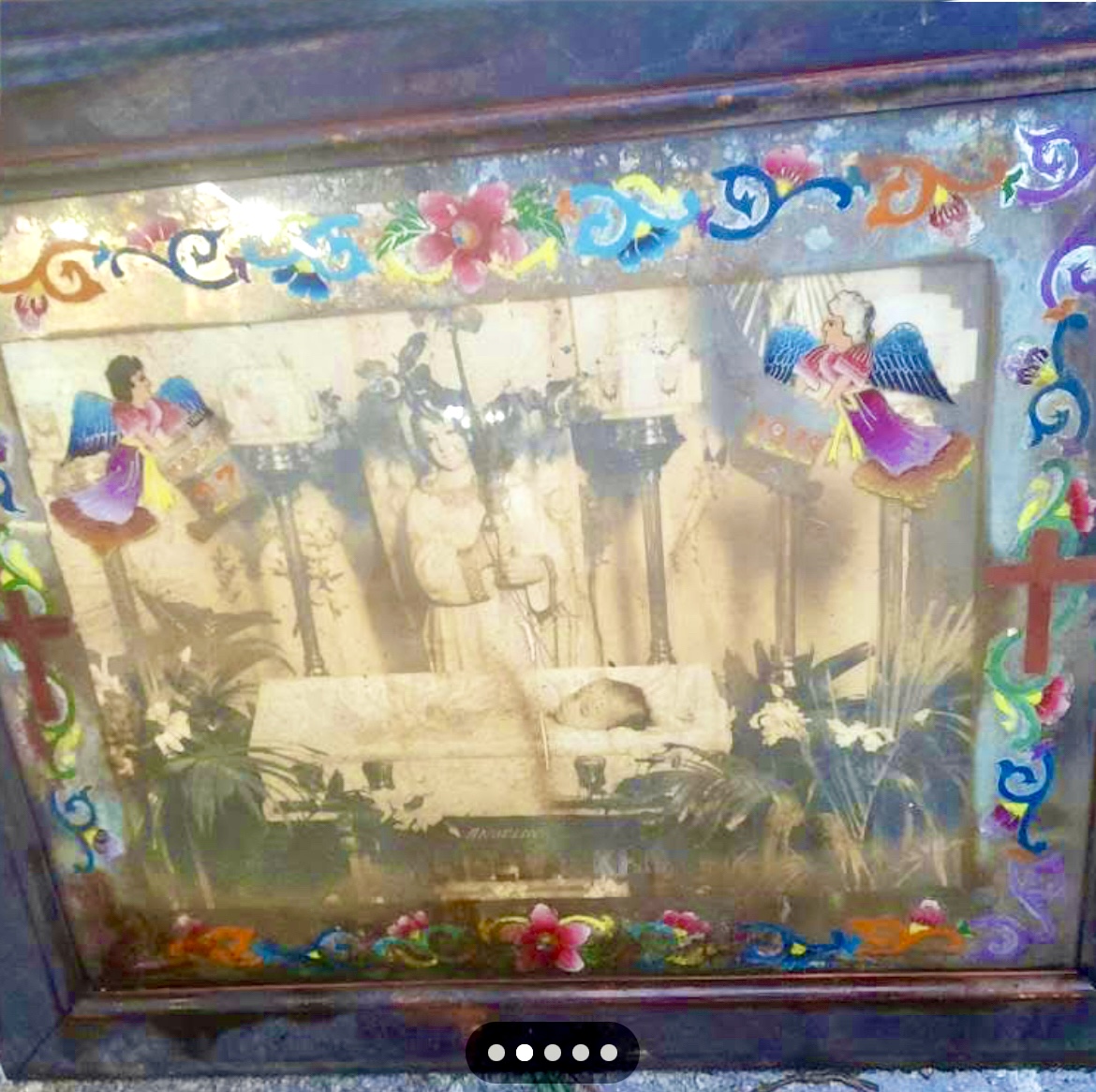
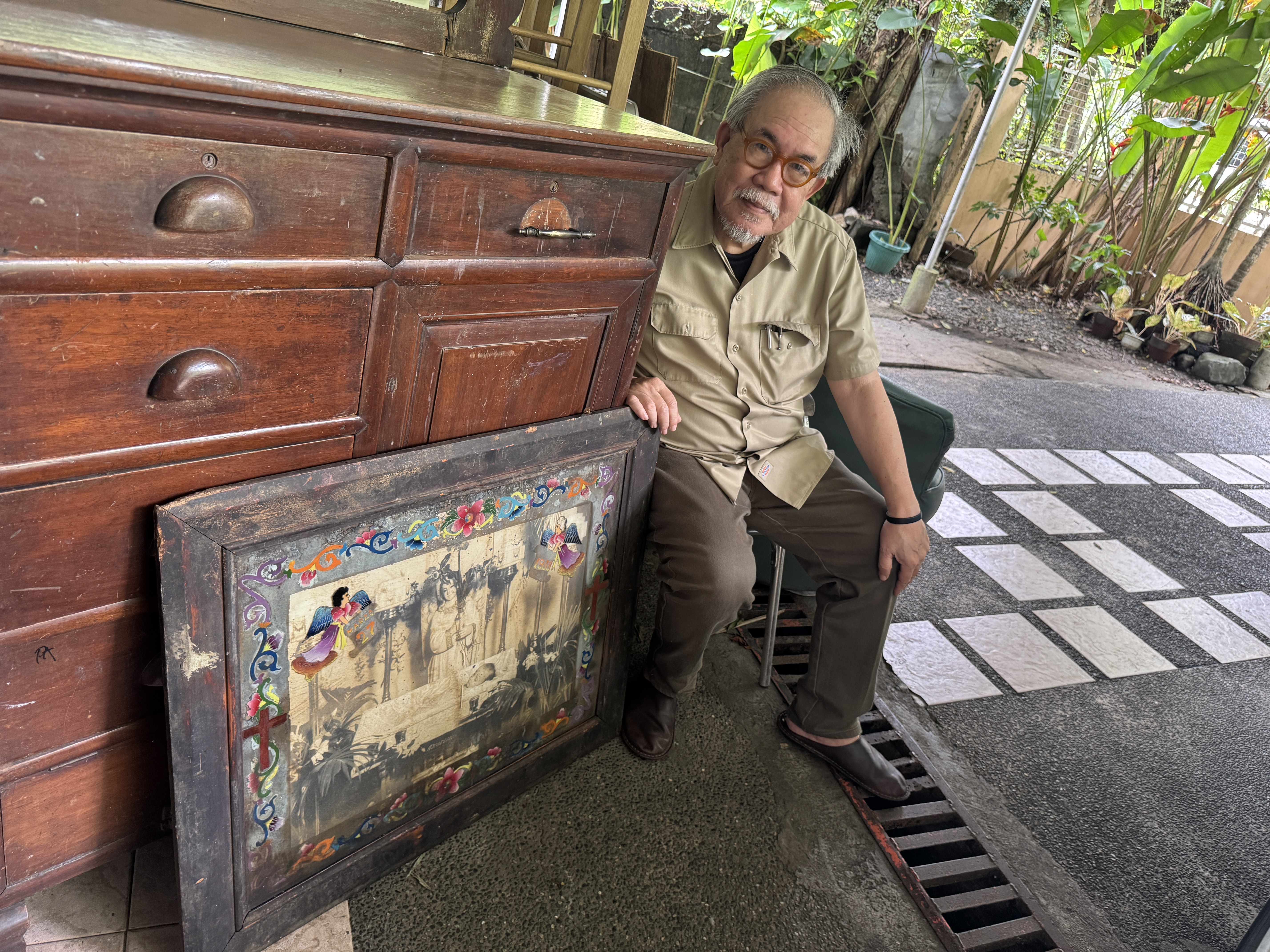
Just two days later arrived one of the most beautiful but also the saddest of my discoveries on FB Marketplace. My first reaction upon seeing it online—as might be any viewer’s—was a shudder of realization at what its subject was. But when I zoomed in on the details, I was soon taken and comforted by the care and love and the unspoken grief with which this child named Angela, whose passing on March 27, 1938 is marked, was sent off by her family.

These recuerdos de patay, as keepsake funeral pictures were then called, seemed more than a testament to the dead; they also exalted the living who cared enough to invoke the eternal watchfulness of glass-painted cherubs and angels over Angela.

And so began for Beng the task of restoring the funeral picture of young Angela. As the picture had presumably not been taken out of its frame for over 80 years, both the photograph and the glass were full of dust and grime. Hundreds of mold or age spots pimpled the surface.

The decorative border had been painted on the glass from the inside—but as Beng established after a quick solubility test, the painter didn’t use oil or enamel but likely tempera which dissolves in water, so she will have to be very careful to make sure its surprisingly vivid colors don’t come off. The narra frame will be cleaned and retained. It may be a morbid memento to some, but as art it gives Angela another life beyond March 27, 1938.

These two finds on FB Marketplace, heavy with emotion, reminded me that collecting sometimes goes beyond fun and profit. It involves respect and even reverence for a past that left us some brilliant images to remember it by.
Penman No. 464: A Fantasy Memoir

Penman for Sunday, July 7, 2024

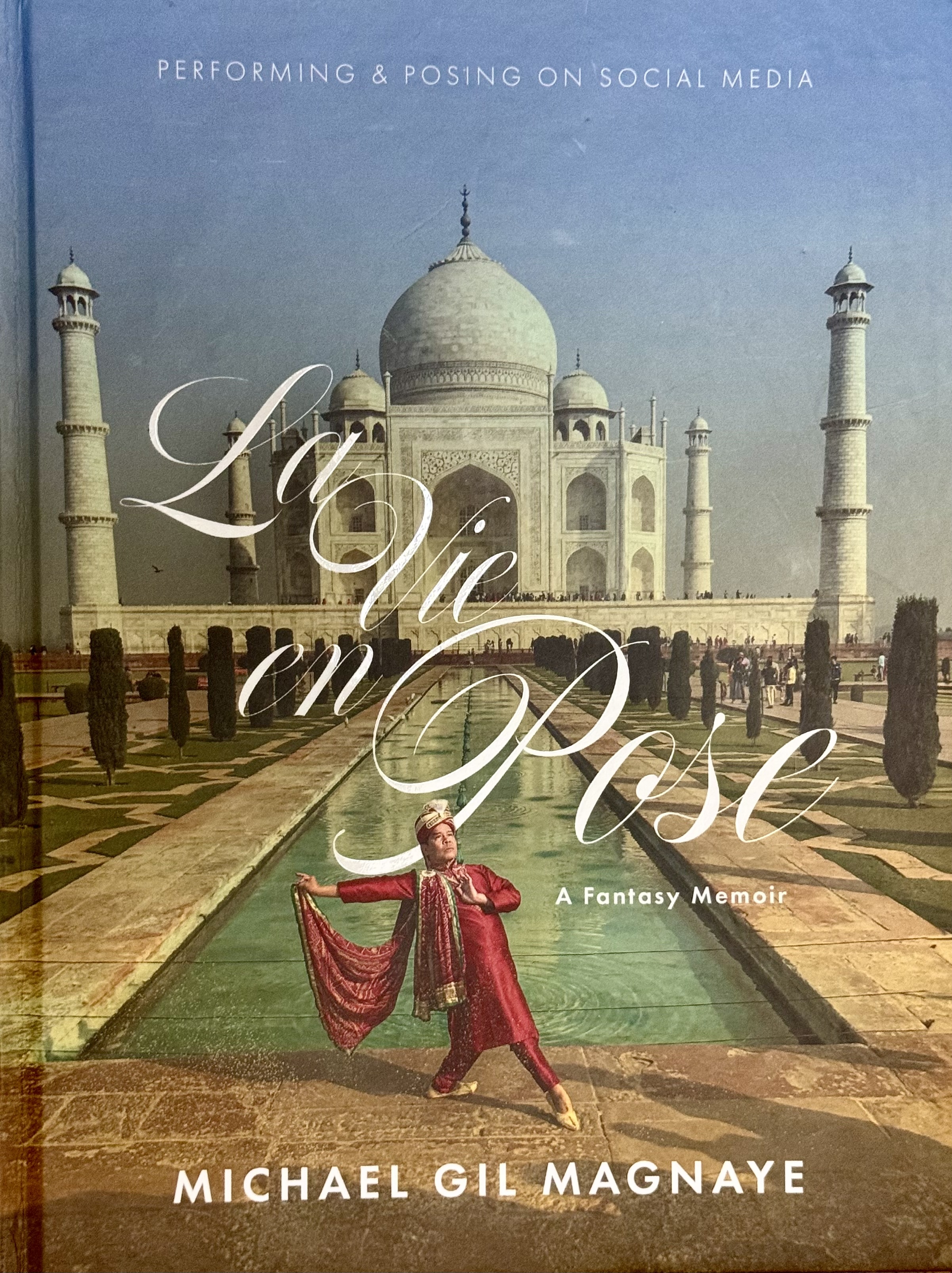
THE AUTHOR calls his book a “fantasy memoir,” and if it’s a genre you’re not familiar with, you wouldn’t be alone. Or maybe that’s just because you’re a dour and straight septuagenarian like me who doesn’t go out too much, watches true-crime shows to relax, and presses his pants and shines his shoes because, well, that’s the way it should be. I later googled the term, just to see what’s out there, and much to my surprise, it does exist—a genre defined by “imagination, escapism, and dreams,” with the stipulation that these fantasies, or products of the mind, are just as valid as memory in recreating one’s life.

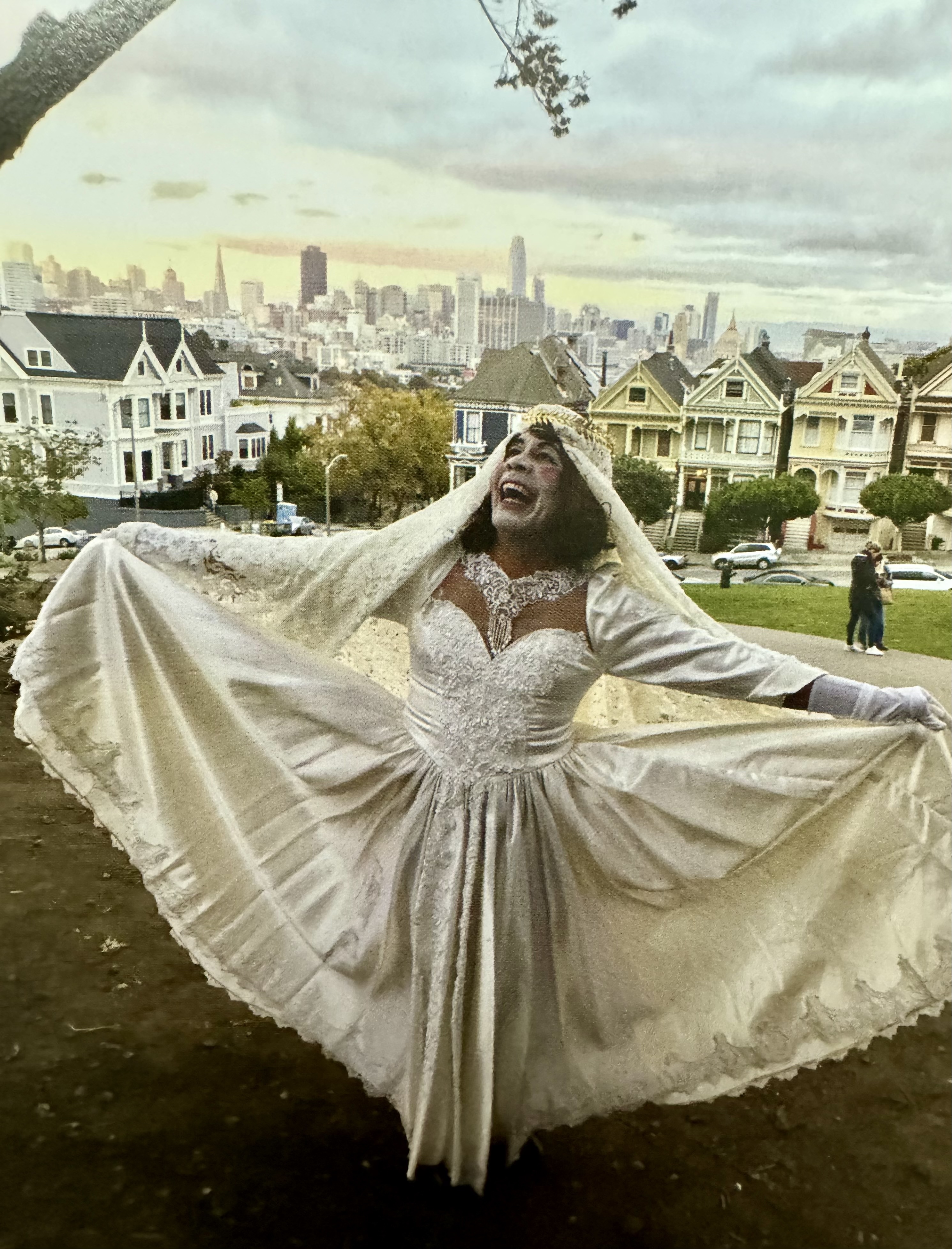
Thankfully, from the cover onward, Michael Gil Magnaye’s La Vie en Pose makes it purpose clear to the most casual and non-literary of readers: to have fun—while raising some very serious questions on the side about who and what we are (or pretend to be), what poses we ourselves assume, consciously or not, in our everyday lives, and how our identities are constructed by something so simple as what we wear.

La Vie en Pose is one of those rare books one can truly call “inspired,” resulting from the kind of half-crazy “What if?” lightbulb moment that strikes you over your tenth bottle of beer at 3 in the morning. Unlike many such flashes, this one stayed with Gil, took firmer shape, and turned into a virtual obsession—a first book to be completed by his 60th birthday, not just any book, not one of dry prose between the covers, but one certain to make a personal statement for the ages.

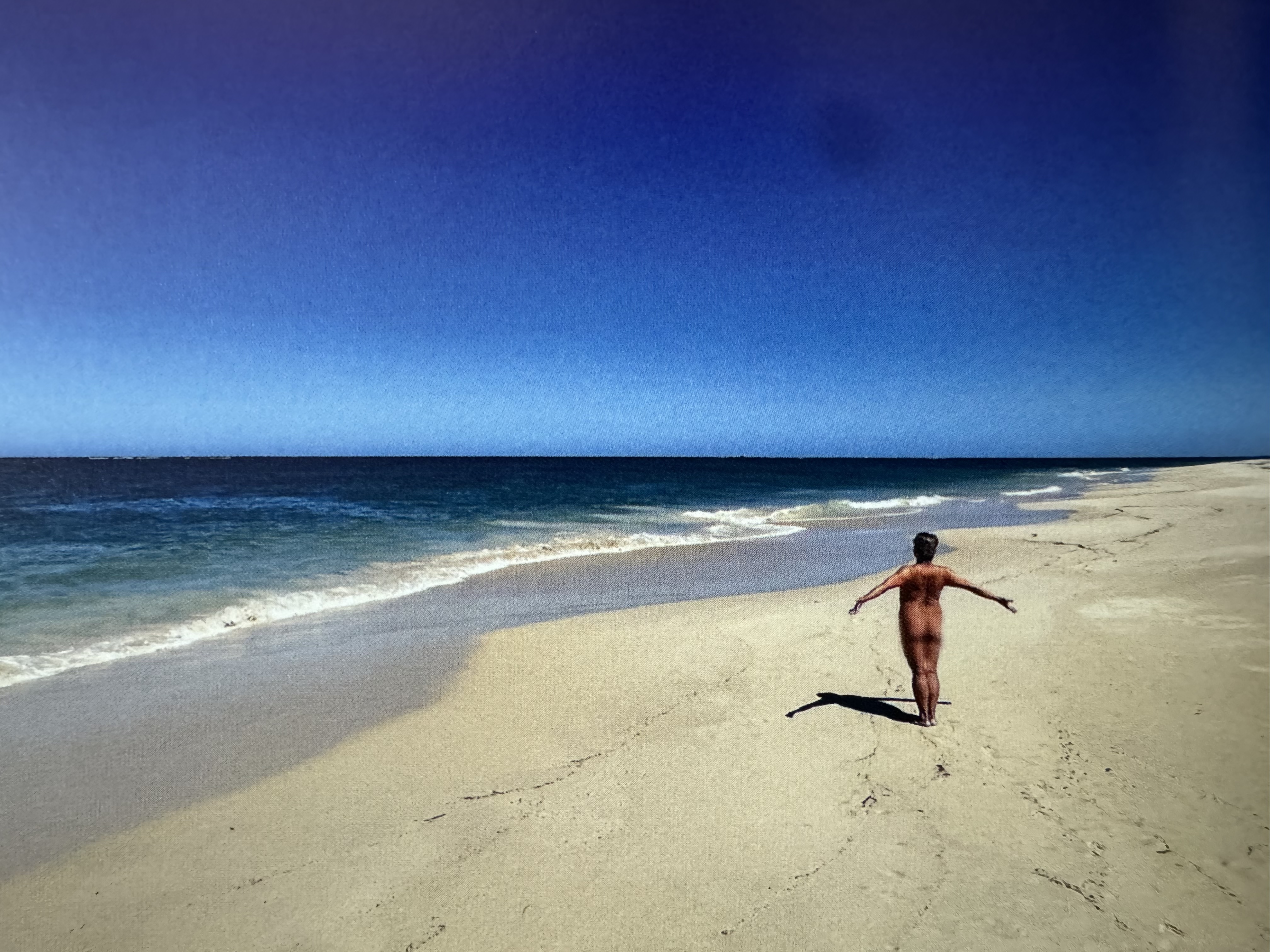
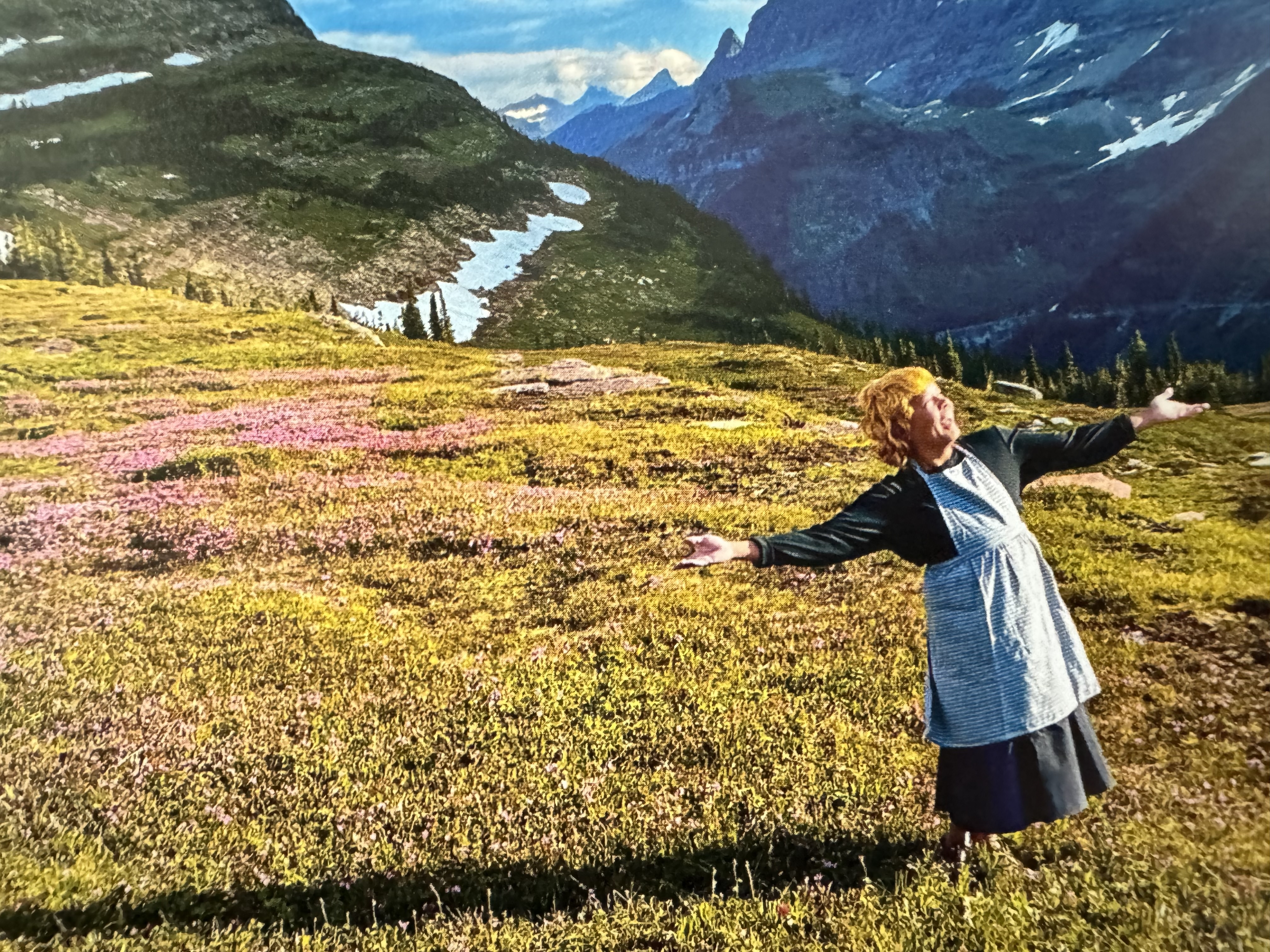
Magnaye, who works as an advisor to an international NGO, describes the book as “a fantasy memoir told in a hundred photographs of the author in costume, striking a pose around the world. Designed and photographed over a decade, these vignettes depict media celebrities, politicians, literary characters and wholly fictitious figures drawn from Magnaye’s fertile imagination. The collection offers satirical, often hilarious commentary on noteworthy personalities in pop culture, politics and history, from Game of Thrones to Bridgerton, from Jackie Onassis to Ruth Bader Ginsburg.”

Divided into eight chapters and edited by the celebrated Fil-Am writer Marivi Soliven, the book takes Gil around the world (none of this is AI—the photography took many years and plane flights to complete), posing in various locales and contexts, often in costume, to mimic or to pay homage to familiar figures and situations. The pop-culture setups will likely elicit the most laughs and smiles—Tina Turner, Maria von Trapp, and of course Barbie all get their comeuppance—and the UP Oblation poses (thankfully just backsides) show the malayong lupain that our iskolars ng bayan have reached (Gil studied and taught Humanities in UP before going to Stanford for his master’s). The levity aside, he strikes thoughtful, almost architectural, poses against spare backdrops. He draws his husband Roy, a normally reticent software engineer, into take-offs on couples (Ari and Jackie, Ennis and Jack). The effect is both riotous and reflective, a visual essay on how pop and political culture have overwhelmed us, but also how we have appropriated and domesticated them for our own purposes, if only to say, “Hey, I can be as good that!”

The poet and queer theorist J. Neil Garcia explains it better in this note he posted online about the 30thanniversary of the landmark Ladlad anthology he co-edited with Danton Remoto: “Queer creativity is itself an integral component of the equality message, and not simply a means to an end. Since the freedom of the imagination is perhaps where all freedom begins, it is clear that giving the queer artist the power or the ability to create their own texts and art works needs to be seen as a vital objective of the equality movement, one of whose primary interests must be in securing this imaginative and/or cognitive ability above all. Hence, we need to insist on the truth that queer creativity isn’t simply a tool to promote the equality message and other activist agendas; rather, queer creativity itself is part of the agenda—is part of the equality message itself (and so, queer creativity is not just a means to an end; quite crucially, as the best evidence and enactment we have of individual and collective agency, even against the harshest of odds, it is an end, in itself).”

For Gil—whom I was friends with back when he still had a girlfriend and confronting his sexuality—the book is more than a personal celebration (he launched it in UP last June 23 to mark his 60th birthday); it’s also an assertion of his rights as a queer (the preferred term these days to “gay”) person—and by extension, of all other LGBTQ+ people as well—to express themselves creatively. In his introduction, he notes that “This book is born at a fraught moment in gender politics. Some states in the US have passed legislation that attacks transgender youth for their chosen wardrobe or preferred pronouns. A drag artist in the Philippines has been jailed for performing an irreverent dance interpretation of a Catholic hymn. Such adverse events would seem to suggest that cross-dressing is an act of subversion. I would argue that cross-dressing and mimicry are strategies that drag queens, drag kings, non-binary performers, and gender benders employ to resist, challenge, navigate, and extricate themselves from systems imposed by traditional constructs. And it’s a lot of fun.”

La Vie en Pose most surely is. Copies might still be available at the UP Center for Women’s and Gender Studies.

Penman No. 448: Designing for the Eye and Mind

Penman for Sunday, March 5, 2023

I DON’T normally review books—even books sent to me with a request to be reviewed, which I apologetically ask authors not to do, unless they’re willing to wait a year or two. That’s because I prefer to enjoy books rather than to critique them, which sounds too much like the kind of work I happily retired from. But every now and then, along comes a book I simply can’t ignore, because it’s just too important or maybe just too beautiful to be put aside.

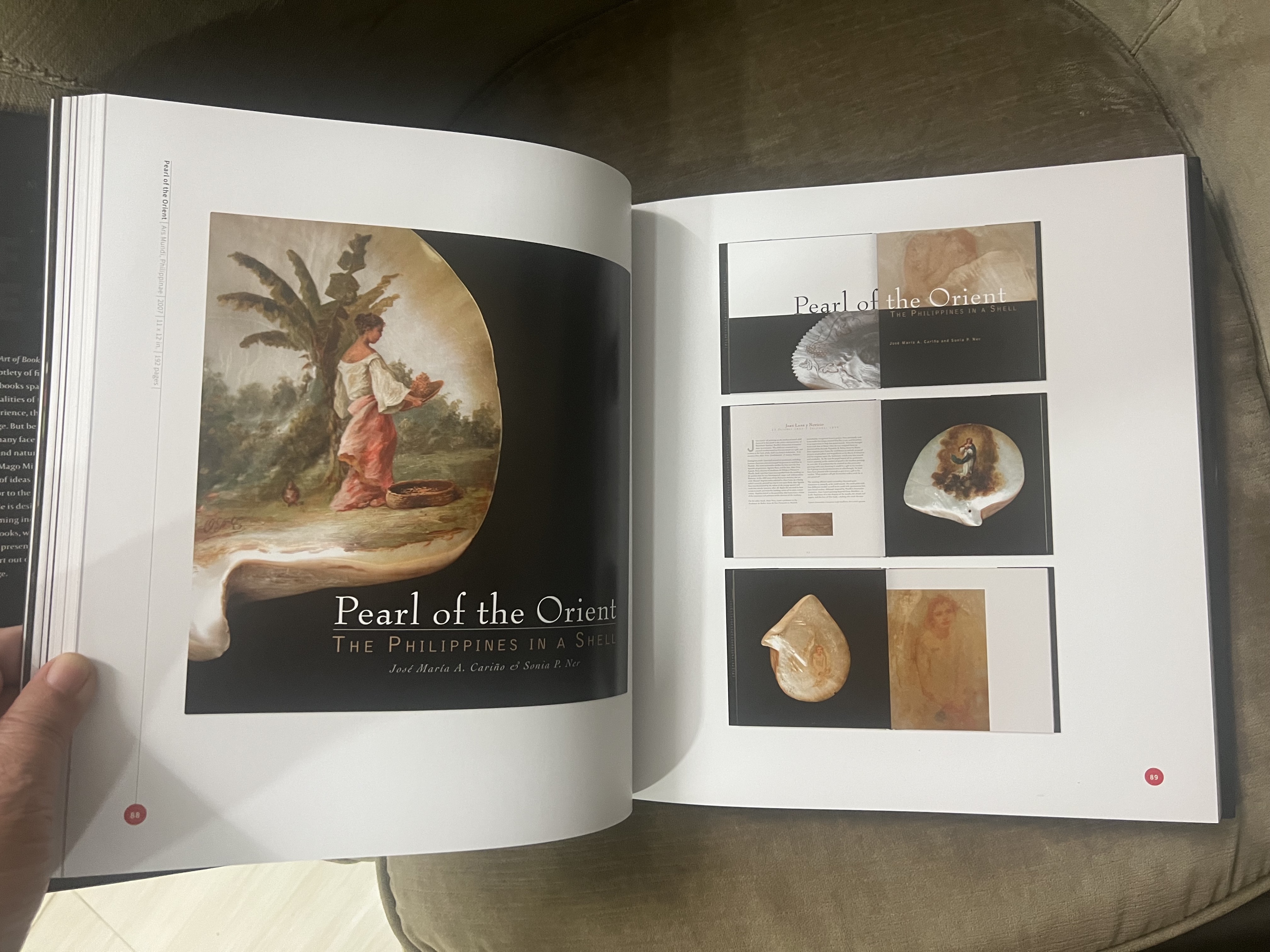
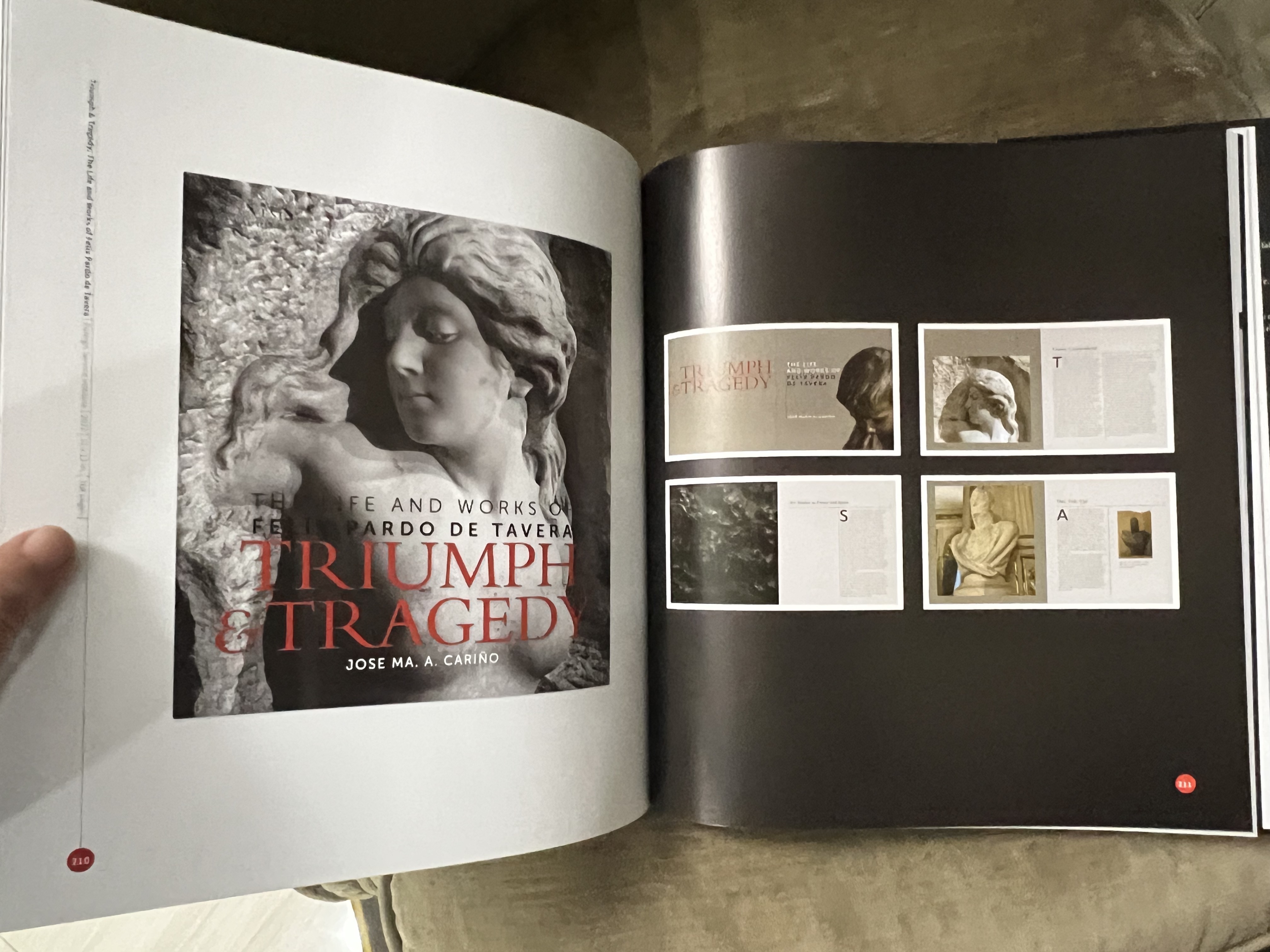
One such book—both important and beautiful—was dropped off at my doorstep last week, and as soon as I opened it, I knew I had to share my knowledge of its existence with fellow enthusiasts of art and design. The book was Felix Mago Miguel: The Art of Book Design, written by Felix’s wife Amelia F. Zubiri-Miguel, edited by Ambassador Jose Ma. Cariño, and published by the Foreign Service Institute.

One of the most talented and prolific Filipino book designers of our time, Felix has designed more than 130 books over the past 20 years, and I’ve been fortunate to have authored and edited a good number of those, including several coffee-table books and the biographies of Edgardo J. Angara and Leonides S. Virata. This hefty 264-page book is a biography, treatise, and catalogue all in one, a fine embodiment and example of its own subject, sumptuously produced not just to showcase Felix’s work but also to discuss his theory and experience of book design.

Ours has always been a country of gifted authors with endless stories to tell, but only recently has enough attention been paid to the proper design, production, and marketing of our books. The growth of Philippine publishing and the opening of foreign markets to Philippine material has spurred some of that interest as a matter of economic necessity, but the general appreciation of book design remains low. 

As an author myself, I’ve always been fussy about how my books look; I didn’t work that hard just to come out with an ugly book with my name on it. But sadly not all authors or publishers share that worry. As Felix himself laments, we Pinoys have a famous fear of spaces—horror vacui—and tend to cram our pages with as much text as we can, as if wide margins (and better readability) were a waste of precious paper.

Coffee-table books, which are Felix’s particular area of expertise, present both special challenges and opportunities. Being typically meant for promotional rather than commercial purposes, CTBs have large budgets that will allow for better production. But a poorly thought-out or executed design can render those millions useless. I’ve groaned at obviously expensive book projects ruined by gaudy or overly busy covers, barely readable type, narrow margins, and bad paper. (One of my biggest pet peeves is printing text over a photograph for that artsy effect, rendering it illegible.)

Felix’s background as a painter (and as a graduate of the Philippine High School for the Arts and the UP College of Fine Arts) allows him to see a book project not just as a technical challenge but also an intellectual exercise—a process of understanding what the book really wants to say, and translating that into a visual language.

“A book project is always like a thesis, a problem to be solved, an experience to be fleshed out,” he says. “Everything for me begins with figuring out what the book is trying to say and how best to say it. I do my best to learn the narrative, reading to understand it, absorbing its contents. If there are visuals already, I go through them, looking for the narrative that I just read among the photos and illustrations. Doing these things enables me to better feel the book and the direction it will go. My goal is to find the personality of the book, to figure out who is talking and to decide on what kind of experience is best—to design the book in such a way that, as Rita Jacobs says, it may be the only way that it can be presented.”

He designs as much for the mind as for the eye. As Amelia puts it, “Though people may say that a designer’s job is all simply a matter of art, my years of seeing Felix working have told me that it is not. At the end of the day, he always ends up more knowledgeable, better informed, and wiser with insights not just from the manuscripts but from the totality of the discussions and the time he had spent with his clients, which is probably the best bonus and priceless privilege that comes with the job, because at the end of every project, a really beautiful book needs to be more than just pretty to look at.”

Felix adds: “As designers, we become builders of experience. We may not have the privilege of letting our audience touch the skin or the sinews of what they are looking at, but if we did well in our work, what one designed becomes an exhilarating, unforgettable experience. Not only do we introduce the authors and their voices, but through a well-designed book, readers may experience the same things vicariously. What is separated by time and space is connected through emotions. And a book that touches your soul is indeed an experience to be cherished.

“After learning the technical aspects of design—the use of typography, colors, spaces, photos and illustrations, pages, covers, and printing—I realized, I have a new medium. And just like in painting, the medium is not the end of the painting; it is just part of it, because more importantly, there is a story to be told and that story is the priority of the design. My role is to ensure that this invisible visual force will allow the story to be told.”

And tell the story Felix does, in an inimitably pleasing and tasteful style that more than does justice to his material. I look forward to our next project together, whatever that may be—a writer can only write better knowing how superbly his work will look in a capable designer’s hands. 

Penman No. 365: “Tenderness Is Radical”

49686189_10155871898421881_8712630533357568000_n.jpgPenman for Monday, August 5, 2019
 

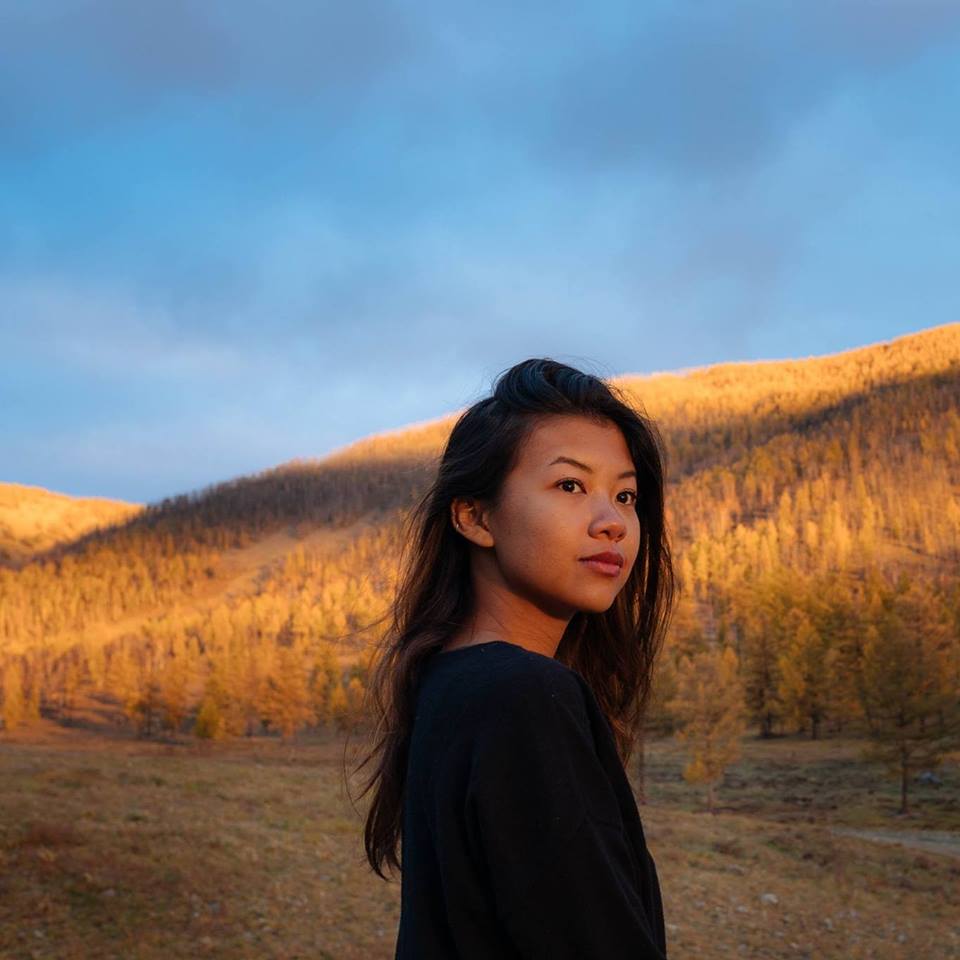
A RECENT talk of mine to the graduates of the College of Arts and Letters at the University of the Philippines seems to have gone viral, but what people don’t know is that there were several of us who addressed the graduates that night—it was a testimonial dinner, not the commencement ceremony itself. All the other speakers shared delightfully inspiring remarks, but one impressed me in particular—Hannah Reyes Morales, a young but already globally renowned documentary photographer who graduated with a Speech Communication degree from UP just eight years ago. Hannah has done prizewinning work for the likes of the New York Times and National Geographic, some of which you can find on www.hannah.ph. I asked for and got her permission to share excerpts of her talk.

Today, I want to talk to you about building the possible.

When I left these halls I was a scrawny 20-year-old, putting herself through the last four semesters of school by selling ukay clothes online and photographing drunk people in bars on weekends near Tiendesitas as an event photographer. I couldn’t join my friends in eating out because I couldn’t afford it, I owed rent money to the building in Xavierville where I lived, and my mom was convinced that any dreams I had for a career in the arts and photography were a quirk and a passing fancy, and that after graduation I should apply for a job as a teller in a bank.

I honor this part of my journey. It was during this period that I learned to speak with strangers, to hustle for each paycheck, and what the true necessities were. I learned to be efficient with my time, but I never, ever lost sight of the work my heart wanted to do.

I hope that you figure out how to build a home where your creativity, your curiosity, your sense of purpose, and your wildness can keep growing. Because if there is one thing I am sure of, it’s that the world needs more safe hands working towards better.

As a photographer I’ve had the privilege of being welcomed into people’s spaces. I’ve had the privilege of being able to ask people to help me understand things I couldn’t quite grasp.

Each day that I get to take photographs is a day that I get to confront the world. Each day that I get to take photographs is a day that the world confronts me, and tells me the truth.

I’ve been offered meals by people who were hungry, allowed into moments of great vulnerability. I’ve photographed people swept up in conflicts that they had nothing to do with. I’ve seen people driven from their homes. I’ve witnessed loss and devastation.

And in the midst of horrors I saw how beauty and kindness persist. People with incredible grace, reminding me that the world doesn’t owe me anything. I met Puti, a young girl in extreme poverty, who called herself a queen. I carry her story with me every day, I hold it in my heart.

Their truths have informed my own. I hope when you meet people with a vastly different reality that their truths might also inform yours.

And when you’ve finally built towards freedom, use it to plant gardens around you, to build bridges and safe spaces. Manila can be a hostile place for artists and for dreamers. I don’t know what I would have done without people who make it less so.

My life is only possible because of the love that my friends embrace me with, the safety that enables me to do more, to dream bigger, to imagine all that is possible yet.

My own strength stems from love, my bravery blooms from the tenderness of others.

As artists our hearts and minds are needed by our land. Our gaze, and our ability to think differently are needed in envisioning better for our country, and our world.

Our generation—yes, I’d like to think that I’m still part of this generation—inherits a future that needs visionaries. Climate change, refugee crises, the rise of impunity are all realities that await outside these doors.

When I opened my eyes what I saw brought me to tears. But I always knew that closing my eyes again would not make the adversity stop. There will be those who will tell you to just keep them shut, to care a little bit less. They will tell you that you will be happier if you didn’t give a damn.

It took me a while to own that that was never who I was. It took me a minute to understand that sensitivity wasn’t a weakness. That tenderness is radical.

There is a line from Audre Lorde that I hold on to, very fiercely.  ‘When I dare to be powerful, to use my strength in the service of my vision, then it becomes less and less important whether I am afraid.’

So today I implore you to use your strength—whatever form it takes—in the service of your vision. Make your time here count. Pay attention to that which makes you feel awake, and living—the hard work will come.

And lest we forget: the good, the beautiful, the wild, and the miraculous await outside these doors, too. Keep them alive.


Penman No. 232: The Other Leni

2330687643.jpg

Penman for Monday, January 2, 2017


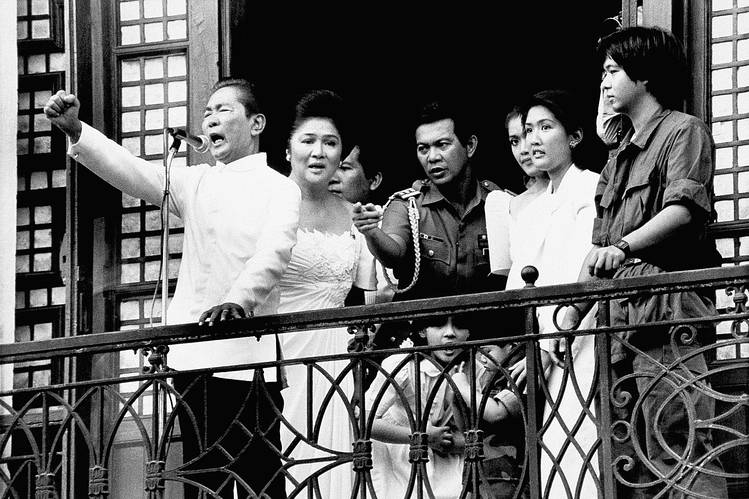
PROMPTED BY the rumors swirling around Vice President Leni Robredo and her possible replacement in that post by Sen. Bongbong Marcos in a January judicial coup, my ruminations drifted over Christmas to the Marcos legacy, and how differently Filipinos see it, and why. At my usual poker table, for example—where I face millennials more than fellow seniors—a question I often hear whenever the Marcoses come up in conversation is, “Why, were they really that bad?” I wouldn’t be surprised if it came from a 30-something, but it’ll typically come from someone my age or older, who lived through the same period—or did they?

Those of us who worry about the historical revisionism or amnesia that seems to have overtaken us may be forgetting something else—that, just like in Hitler’s Germany, the dictatorship wouldn’t have lasted that long without some significant degree of popular acceptance or complicity. One of my pet theories about our martial law experience is that those of us who fought it were in a distinct minority, still are, and will be again. Most Filipinos never had the Metrocom or the ISAFP breaking down their doors; most Filipinos never had a son or a daughter shot or raped or imprisoned because of their beliefs; most Filipinos were already too poor to feel they had been stolen from. Many seniors—with understandable appreciativeness, especially at this point of their dialyzed and hypertensive lives—will remember only the medical complexes that Mrs. Marcos built.

If the present administration felt confident enough that it could get away with the Marcos burial, it can only be because it thought this way as well, and gambled on it. It understood that for far too long—and in the increasingly rare instances when it was even brought up in school—martial law, Philippine-style, had been depicted as a war between President Marcos and the communists, not as a systematic campaign of oppression and plunder waged by a dictator against his own people. Now that the CPP-NDF was having coffee in the Palace, what was the problem?

If we’re talking about educating Filipinos—and not just millennials—about martial law, the case will have to be made that it was an economic, political, and moral disaster for all Filipinos—not just for the Left, not just for some businessmen, and not just for some rival factions of the same elite. We were all materially impoverished and morally compromised by it—and continue to be, despite EDSA’s flickering promise. (And if you still don’t know or can’t remember exactly what the Marcoses did, here’s a report from The Guardian to refresh your memory.)

I’ll let that contention simmer for now, because what actually led me to write this column, my very first of the new year, was an essay on another Leni that I was reading online, titled “Fascinating Fascism,” written by the late Susan Sontag and published in February 1975 in the New York Review of Books.

It must have been the image of some black-shirted (but surely well-intentioned?) young men giving clenched-fist salutes in front of the Rizal monument that led me to revisit the Hitler Youth and Nazi iconography—less to condemn it (let’s give the trolls a rest) than to see why it was so effective and appealing. There’s a scene from 1972’s hit movie Cabaret that might suggest why fascism, as Sontag says, can be so fascinating even and especially to ordinary folk, and you can watch that clip on YouTube here. It’s that of an angelic boy singing “Tomorrow Belongs to Me”—at least it starts that way—and it’s masterful moviemaking, showing within minutes how something so bright can be so chilling.

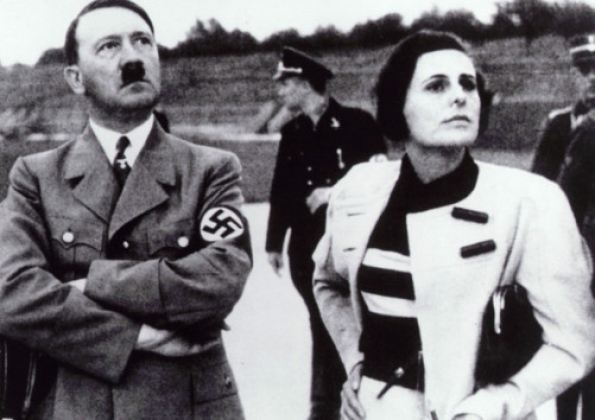
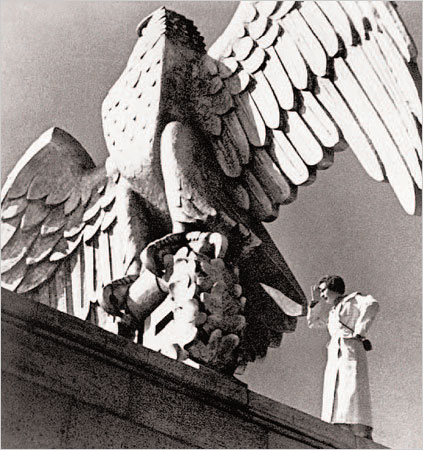
And speaking of moviemaking, this brings me to the other Leni—the German filmmaker Leni Riefenstahl (1902-2003), who directed the seminal Nazi propaganda films Triumph of the Will, about the party’s mammoth Nuremberg rally in 1934, and Olympia, about the 1936 Berlin Olympics. Her work would be hailed as technically brilliant and she herself as “an artist of unparalleled gifts” even by American critics—given especially that she was a woman trying to succeed in a male universe—and after the war, conveniently “de-Nazified,” she became something of a media darling, claiming that she had been politically naïve and knew nothing about the Nazis’ war crimes; she even joined Greenpeace and released a dreamy underwater movie on her 100th birthday.

triumph-of-the-will-leni-riefenstahl

(Photo from kinoimages.com)

But in her powerful essay on fascist aesthetics, Sontag cuts Riefenstahl no slack, painstakingly proving that contrary to Riefenstahl’s later assertion, she was a willing and willful collaborator of Hitler and Goebbels. The essay is a marvel both of scholarship and insight, something many writers today—who wrap themselves up in opaque critic-speak but yet fear or disdain to take a clear moral stance—can learn from. The full text can be found here.

This next leads me to a confession I’ve made before: that as a young screenwriter, I too was complicit in the making of a monumental film which would have been Marcos’ answer to Riefenstahl’s myth-making epics. It must have been around 1978 when I got word from Lino Brocka, with whom I had just begun to work, asking me to accompany him to a meeting called by Mrs. Marcos. It was the peak of martial law, and no one could say no, unless you were prepared to go to the hills or to march in the streets, as we obviously weren’t—not yet.

As it turned out, Imelda had summoned seven other leading film directors and their writers as well, and we were assembled at the Goldenberg mansion in Arlegui near Malacañang. Our marching orders—as Imelda would explain to us over the next many hours alongside her aesthetics of cinema (“No shots of squatter shanties!”)—were to produce an eight-part filmic history of the Philippines from Magellan to Marcos. Lino and I drew the Gomburza episode. We ended past midnight, after a personally guided tour of the premises and their precious artifacts, and were sent home with curfew passes.

The film was shot in pieces and later stitched together by the National Media Production Center—there’s a reference online to a “Kasaysayan ng Lahi” film being entered by the Philippines to an international film festival in Tashkent—but I never saw it and had no idea where the reels were kept until a friend told me a couple of years ago that they were stored somewhere in the offices of the Philippine Information Agency in Quezon City. In a sense I was glad that for some reason the film never hit Manila’s screens (at least not that I know of), as it would only have added to the perpetuation of a fable.

But then again, with a restoration underway (and I’m not referring to crumbling celluloid), it might yet play in your friendly neighborhood theater—and worse, in the blinding daylight. Like I texted a friend, somehow 2017 feels like 1971, all over again.

bn-mt815_0225ph_p_20160225035224

(Photo from wsj.com; photo of Hitler and Riefenstahl above from documentary.org)


Penman No. 177: Compress, One More, Wacky!

IMG_6071.jpg

Penman for Monday, December 7, 2015


GET SEVEN or more Pinoys together for a group photo and you’ll invariably hear this mantra: “Compress! One more! Wacky!” To the uninitiated foreigner—already surprised by our propensity to grab them by the arm for a quick and giggly shot—they’re orders that demand translation, so here goes:

“Compress!” technically means that not everyone can fit into the shot and that everyone should therefore squeeze together, at which point people will take a deep breath and turn sideways, turning a 40” midsection into what they imagine is a svelter 38”. This process can morph into a quick trip-to-Jerusalem rearrangement of the subjects, if the hold-your-breath trick doesn’t work. “Small ones in front!” or “Kneel! Kneel!” will be the next order of business, followed by a flurry of to-ing and fro-ing, and split-second negotiations over who’s taller than the other by half an inch, or whose knees can take the bending.

“Compress!” can also mean some young swain’s opportunity to snuggle up to an unsuspecting loved one. But even without the side benefit of romance, “Compress!” manifests the Pinoy’s sense of personal space, which is to say, ”I’ll let you dig your elbow into my rib cage, or touch your knee against mine—but I warn you, go no further, lest you think me immodest!”

The coming of the selfie—or more precisely, that new word I picked up from a book launch last week, the “groufie”—has made compression even more necessary than ever—which, let’s admit it, is a lot more fun than the scientific solution, which is to get a wider-angle lens.

“One more!” reaffirms the Pinoy’s fatalistic conviction that something will surely go wrong and that the first shot taken will prove to be a bad one, or will mysteriously vanish into some dark photographic abyss, from which no memorable snapshot ever returneth. This seems to have been more likely to happen in the bygone days of film, when everything from a faulty sprocket to invasive sunlight could spoil the most carefully posed portrait. But the onset of digital photography has clearly offered no measure of assurance to the Pinoy, who remains deathly suspicious of solitary shots, and who will scream, from the back of the pack, “One more!,” as if the course of history depended on the preservation of that instant.

And so the photographer dutifully fires off a few more shots, giving the subjects a chance to modulate and modify their poses and expressions—more often for naught, because the Pinoy’s fatalistic conviction that something will surely go wrong just happens to be correct, and the camera almost always takes the shot at the worst possible millisecond, when one’s mouth is half-open or one’s eyes are half-closed. This foreknowledge, seared by experience into the Pinoy’s subconscious, likely accounts for the multiplicity of shots taken at every occasion, and “One more!” is never meant to be taken literally, but rather to resound like an echo.

Let’s not forget the equally inevitable complication to this phase. Just when it seems all the angles have been exhausted and the smiles have dried on people’s incisors, some latecomer—who had been blithely chatting away on her cellphone across the grounds, in full view of the pictorial entourage—just has to make a mad dash across the grass, yelling, “Wait! Me, too!” And being the world’s most hospitable people, Pinoys will invariably accommodate the catcher-upper with a frozen smile, even as their eyes glare at her like live coals. And having wedged herself into the frame with a cheery sigh, Ms. Latecomer, of course, will have every right to demand “One more!”

“Wacky!” is probably the most perplexing word in the vocabulary of Pinoy photography for the foreign observer. “Compress!” and “One more!” at least make practical sense, but the command to go “Wacky!”—sometimes given in dead seriousness by some phlegmatic photographer—taxes Occidental logic. To visitors who’ve never witnessed it—meaning, you haven’t been here for more than 24 hours—“Wacky!” means assuming some ridiculous stance, or putting on a clownish face, the permutations of which are theoretically endless, but which typically reduce themselves to tongues stuck out, googly eyes, hands like Mickey Mouse ears, and poses like zombies or broken marionettes.

It isn’t all that strange when the subjects of the “Wacky!” shot are fifteen years old and younger—after all, it’s second nature to juveniles, who don’t need to be asked to act like they were, well, kids. It approaches the bizarre when—say at the closing of the 16th Annual Meeting of the Southeast Asian Society of Gerontology or of the National Consultative Assembly of Tripartite Wage Boards—grown men and women in shiny barongs and power suits are exhorted to do their “Wacky!” best, and deliver on demand.

Professional anthropologists and sociologists (who do the same thing at their conventions, for certain) will have a proper explanation for this behavior, but it can’t be too far-fetched to surmise that the photographic display of Pinoy wackiness is meant to be a healthy release of our inhibitions, even a democratizing gesture of self-effacement and bonhomie. It’s good to look and feel silly once in a while. Never mind that, given our itch to socialize, to see and be seen, “once in a while” happens three times a week on average.

As Paul Anka put it, “the times of your life” will always be worth remembering, and always worth compressing for, one more time, the wackier the better.


Penman No. 123: The Power of Panorama

Penman for Monday, November 17, 2014


I’M BY no means a professional photographer, but as a fairly frequent traveler and occasional journalist, I’ve had to take my own photographs to accompany my articles and my blog pieces. Not surprisingly, some of my pictures have been good, some bad, although I would hope that I’ve shot more of the former than the latter overall. I’ve been dabbling in photography, after all, since the 1970s, when we learned to develop and print our own black-and-white film, and were ever aware of how much film and paper cost, not to mention the SLRs and the lenses that we lugged around.

Digital photography, of course, has changed all that. I started toting a 2-megapixel Canon Ixus around 2001—costing me what a new iPhone 6 would today—and instantly I knew that there was no going back to dark rooms and smelly chemicals, at least for an amateur like me. (That Ixus, by the way, took amazingly sharp shots, one of which I still use as the wallpaper for my big iMac—proof that it isn’t all about megapixels.) Since then I’ve dealt with a train of other digital Canons, Casios, Panasonics, and Leicas, all of them rangefinders. And then, a few years ago, I switched to a Nikon DSLR, followed by the inevitable and financially excruciating lens chase that every photography enthusiast knows. Eventually I got those I really wanted—a long zoom, an ultrawide—and happily shot away in sorties to China, the US, Israel, Corregidor, Batanes, and many other places worth toting a heavy bagful of gear to.

And then the iPhone 4 came along. All of a sudden, I had a phone whose camera seemed good and sharp enough for most daily uses (night is something else). More and more, I began taking just the iPhone and leaving the bulky DSLR behind. Aside from and because of its small size, shooting with your phone’s camera has its advantages; you can shoot unobtrusively, within seconds of spotting your subject, and you won’t look like you’re begging to be mugged and to have your precious cargo carted away.

Cameraphones, conversely, have their disadvantages. They’re generally not too good for night shots, unless your subjects are brightly lit, and while the digital zoom can make your subjects bigger, the closer you get, the grainier the image becomes. In other words, for best quality and for mission-critical work, there’s really no perfect pocket substitute for the big cameras and lenses. (Other than the Nikon, my favorite standalone camera for many years was the Leica D-Lux 3, which created razor-sharp images in the 16:9 format.)

But that said, for most uses that don’t require more than a 4”x 6” printout or screen image, an iPhone’s camera will do just fine. My iPhone 5s was the only camera I brought with me on our family’s two-week jaunt across Western Europe last May, and it served us superbly in Madrid, Barcelona, San Sebastian, Venice, Florence, and Paris—all places with fabulous photographic possibilities. Sure, I missed the kind of tightly cropped detail that a telephoto lens is great for, but casual tourism is mostly about scenery, which means that wide-angle or panoramic shots are more useful.

This brings me to my topic for the week, the power of panorama. It’s a power that’s been right there in your iPhone since iOS6 (and very possibly in other smartphones as well), waiting to be unleashed. A panorama is a very wide, narrow picture that covers practically everything before you, and maybe even behind you. The built-in Camera app on the iPhone offers several options for picturetaking: time-lapse, slo-mo, video, photo, square, and pano.

We take most pictures with the “photo” option, yielding a regular rectangular frame, vertical or horizontal. If you’re happy with those pictures, fine. But you should know that, especially when you’re in a spectacular tourist spot and need or want to capture as much of that scene to bring home with you, then the “pano” or panoramic option can be your best friend.

It takes a bit of self-training, and there are many guides online to help you take a good panoramic pic (just Google “taking panoramic shots with an iPhone”). What it basically involves is choosing and standing at a good vantage point, opening the camera, choosing “pano”, pressing the button, then moving on your heels in a semi-circle from left to right, following the guide arrow until the full panorama is taken.

Your first shots will likely be misfires, full of unwanted detail, bodies with missing heads, the same person appearing in two or three different spots, very bright and then very dark bands, and so on. But over time, you’ll get the hang of it, and learn to avoid the pitfalls. For example, you’ll learn to generally avoid scenes with lots of moving figures (although the motion blur and duplication of people can also be aesthetically appealing); you’ll learn to pre-visualize the scene, deciding just how much to cover instead of the full 240-degree sweep of the app.

If you’re careful and lucky (you’ll need to be both), you can capture a scene that’s not only visually breathtaking, but also socially observant, like a Hogarth drawing with a lot of interesting detail in the little corners. That’s what I was going for in my pano shot of an afternoon in Madrid’s Plaza del Sol, where an anti-fascist rally literally marched right into the restful mood of other Madrileños in the frame. My shot of the riverfront of Cold Spring in upstate New York seeks to blend natural scenery with human habitation, and that of an early evening in Manhattan’s Bryant Park plays on light and shadow, and the city’s iconic skyline.

Don’t forget that you can and probably should crop and edit the image afterwards, to remove ragged edges up and down caused by uneven shooting (you weren’t following the arrow, tsk tsk), to go for a tighter frame, and to adjust the exposure. Consider, too, other apps like Google’s free Photo Sphere, which yields even more stunning—and seamless—360-degree pictures, for a fully immersive experience approaching virtual reality.

Whether you’re in your office or on top of the Great Wall of China, a good panoramic shot can be your best and most comprehensive reminder of where you were and what it felt like. But you’d have to remember the option. Speaking of the Great Wall, we were there a couple of Decembers ago, all by our freezing lonesome in Mutianyu. Rendered speechless by the majesty, it was only on the van back to downtown Beijing that I realized that I’d been on top of the world—and forgot to take it all in.

Flotsam & Jetsam No. 35: New Pens for the New Year

THE HOLIDAYS and turning 60 this month gave me all kinds of excuses to acquire new pens, and here are two of the best ones: a Montblanc Oscar Wilde, issued in 1994, and an Onoto Magna Classic in tortoiseshell, handmade in the UK just last month. I’m broke but happy 😉

They do look good beside my old mainstay, the Agatha Christie. It’s like having three gorgeous girlfriends to take out on a date (shhhh, don’t tell Beng!).