Penman No. 460: The Fil-Canadians Speak

Penman for Sunday, March 10, 2024

WE’VE BECOME quite familiar by now with the writings of our Filipino-American brethren across the Pacific, thanks to the success of such breakthrough works as Jessica Hagedorn’s Dogeaters, Ninotchka Rosca’s State of War, R. Zamora Linmark’s Rolling the R’s, Marivi Soliven’s Mango Bride, and Gina Apostol’s Insurrecto, and to the bridging efforts of such literary stalwarts as Luis Francia, Alfred Yuson, and Cecilia Manguerra Brainard. Of course, they had many antecedents, going back to at least Carlos Bulosan, followed by Jose Garcia Villa, Bienvenido Santos, NVM Gonzalez, and Alberto Florentino, among many other expatriates. 

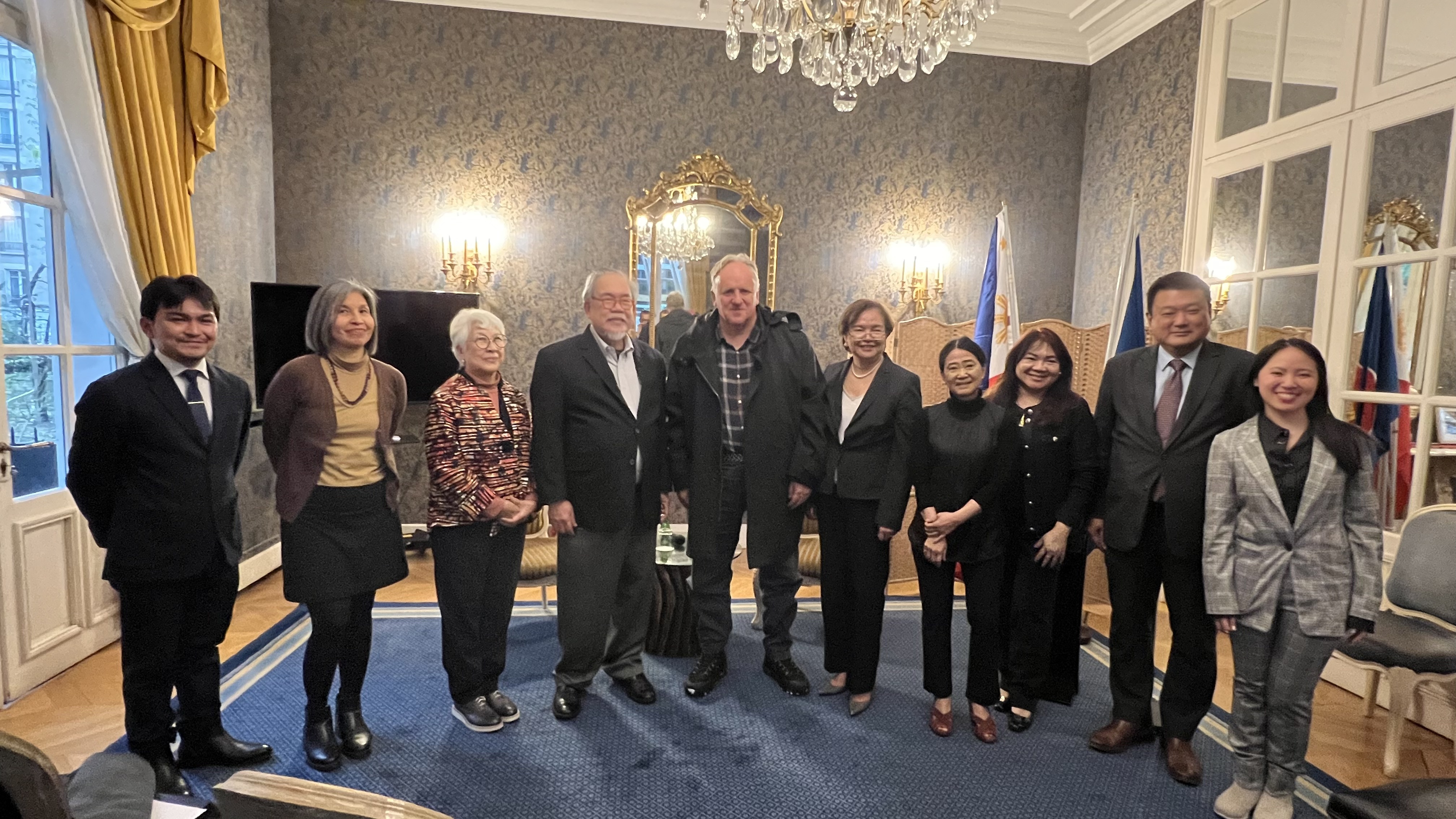
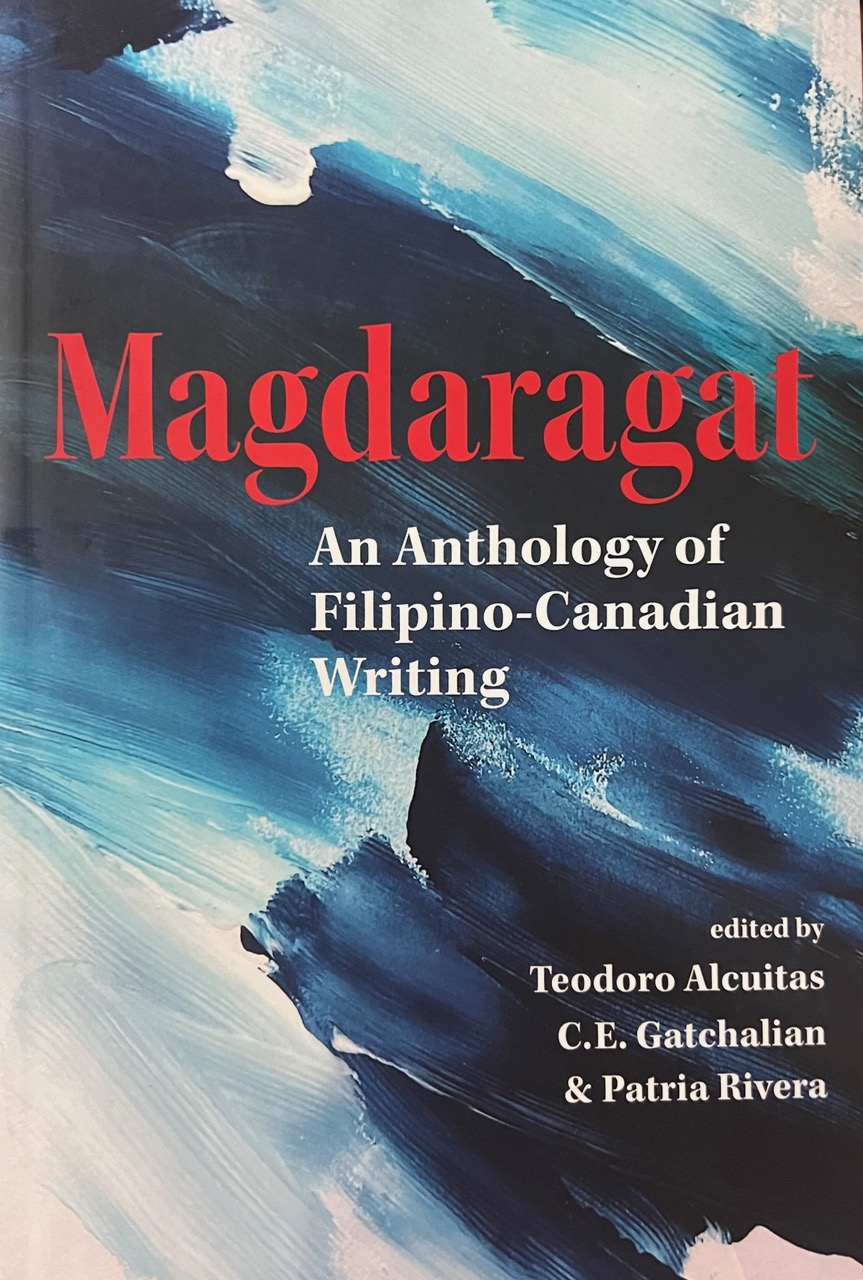
But hardly a whisper has been heard from our Filipino-Canadian cousins, as if their experience—whatever it’s been—were simply an extension or an echo of their southern compatriots, with no distinguishing qualities. There’s a reason for that, which we’ll get into shortly, but first let me announce, with both joy and relief, that the long silence is over. Filipino-Canadian literature is introducing itself to the world—and to us in particular—with the publication of the landmark Magdaragat: An Anthology of Filipino-Canadian Writing (Toronto: Cormorant, 2023), edited by Teodoro Alcuitas, C. E. Gatchalian, and Patria Rivera.

I was first alerted to this hefty 390-page volume by one of the editors, Patty Rivera, an old friend from way back who developed into a fine, prizewinning poet when she, her husband Joe, and their family migrated to Canada decades ago. Arriving in Canada in late July 1987, Patty recalls that moment pregnant with both hope and not a little dread that every FOB immigrant seems fated to step into: 

“The air steamed with purpose when summer meant another life to live. From every corner, a mirror to reflect on. Outside our window, the children’s park, though trees, appeared bruised from the dark slits on the windowpanes. Thorny Vineway. Did our new street name augur of tomorrows yet to come? Would our life in this new country lead to a path laid with thorns? We were young at the time, and everything looked promising. We were alive in this new country and were no longer afraid, the years in the future distant and to be savored. We were ready to be every person we chose or wanted to be.”

Today there are nearly one million Filipinos in Canada, which itself is inching close to 40 million. Some years ago, Filipinos edged out the Chinese as the largest group of immigrants in Canada. Many are highly educated, and many work in health care, leading perhaps to a kind of stereotyping of the Fil-Can as caregiver. To be fair, that’s probably how we home-based Pinoys ourselves imagine our Canuck brethren to be, followed inevitably by “Now why did they go to Canada and not America?”

Magdaragat’s editors try to answer that: “It’s the American Dream, after all, that Filipinos chase; Canada is the consolation prize if America, for whatever reason, doesn’t pan out. While, according to historical records, the first Filipinos arrived in what would eventually become the United States in 1587, Filipinos didn’t arrive on Canadian shores (Bowen Island, BC, to be exact) until close to three centuries later, in 1861. In addition, Canada’s population is a tenth of the United States’. Filipino-Canadian history is, thus, of a smaller scope than Filipino-American history. But within that scope are issues unique to Filipinos in Canada that makes Fil-Can history a distinct subject in its own right, not merely an ancillary of Fil-Am history.”

There are, we discover, subtle but important nuances to the Filipino-Canadian experience:

“Another, more insidious, survival issue Filipinos in Canada have to navigate: the passive-aggressive racism of white Canadians. The brazenness of white American racism is well documented (and spotlighted and hyper scrutinized because of the United States’ status as an imperial power); in contrast, white Canadian racism often slips under the radar because it is more typically characterized by microaggressions. The favorite Canadian refrain vis-à-vis racism—‘We’re not as bad as Americans’—constitutes what might be called “maple-washing”: the relentless washing over of all instances of Canadian racism with the claim that it’s still not as horrible as what has transpired in the United States. Accordingly, the racism Filipinos in Canada experience—and which makes its way into some of the pieces in this anthology—is more insidious than its American counterpart and is characterized by shocking ruptures in a strenuously maintained politesse.”

But what about the literature of that experience? Magdaragat provides ample and eloquent proof of the Filipino-Canadian’s desire to reconnect with the homeland while charting their own course in the new country, as this passage from Deann Louise Nardo’s “Where Do You Come From” illustrates:

“I come from dirt and sand, the scribbled writing of an ancestor in a trance, the sound of droplets on skylights, unopened buds on trees, and the sleep dust in my mama’s eyes. I come from cacao beans and the callouses on fishermen’s hands, the arthritic crackle of my grandmother’s hands as she tends to the garden and mends nets. I come from the silver iridescence of stretch marks, the swirl pattern inside tree barks, the razor-thin whiskers of cats, and eerie creaking of Maplewood floors. I come from lengthwise half-cut bamboo wall sheathing, river mud and buried shards of broken glass, of broken tsinelas and confused roosters singing tik-ti-la-ok at three in the morning.”

There’s a long story by Nathalie de los Santos that alone may be worth the price of the book for its sweeping, multigenerational narrative of the immigrant experience from Bohol to New Brunswick, and from Filipino to Filipinx. The young Kay laments that “Even my relatives can be like this, they remind me how I’m not Filipino enough when I don’t know something about our culture. But then some people here believe I’m not Canadian just by looking at me. When I’m asked, ‘Where you from?’ it implies that. Who am I then?… But, maybe all of this is coming from the same place of hurt?” 

The Fil-Cans have spoken, and theirs are voices worth listening to.

Qwertyman No. 83: It Isn’t Just Money

Qwertyman for Monday, March 4, 2023

MY RECENT column titled “An F for Philippine Education” apparently struck a chord among many readers who messaged me to say how appalled they were by the findings of the Second Congressional Commission on Education or Edcom II. Released just last January, the commission’s report graphically displayed just how poorly young Filipinos are faring in their schooling, especially when compared to the Asian neighbors they’ll be competing with for jobs down the road. 

To recapitulate just one particularly distressing finding, our best high-school learners are performing at a level comparable to the worst of Singapore. I read as much as I could of the report not just to be able to write about it, but—as an educator myself—to find out how this disaster happened.

There’s clearly a lot of blame to be thrown around for this situation, but to be fair, the report makes it clear at the outset that Philippine education’s systemic failures and shortcomings go back many decades, to problems being recognized by previous studies (notably Edcom I in the early 1990s) but left unattended rather than decisively acted upon. 

“This report was not crafted to point fingers,” say the report’s framers. “Our intention, instead, was to find things out and to instill a sense of urgency, along with a sense of doability—a clear horizon, and perhaps a sketch of the map toward that horizon.”

Its noble intentions notwithstanding, the report is a 400-page indictment of what successive Philippine administrations have failed to do, and it isn’t like they didn’t know or weren’t told. There’s been a plethora of studies of Philippine education between the two Edcoms in the 30 years separating them, and they’ve identified many of the same chronic problems plaguing the system today. The report identifies 28 “priority areas” such as governance and financing, in each of which specific problems and their implied solutions are discussed. 

One aspect that drew my attention was that of funding, which many of us, including myself, have thought to be the big problem of Philippine education: throw more money at it, and maybe it will go away. It turns out to not be the case, or in the very least, not the only major issue. Our “more” still isn’t enough, and even with more, the money needs to be spent, and spent wisely.

At the time of Edcom I, the report notes that the Philippine government spent only 2.7% of GDP on education, rising to 3.6% from 2014 to 2022, and to a high of 3.9% in 2017 (do take note that these are percentages of Gross Domestic Product, not the national budget). That comes very close to the global minimum of 4.0% set by the Incheon Declaration, but still falls short of Malaysia’s 4.2% and Singapore’s incredible 25.8% in 2018. Even so, our expenditures on education are rising to an average of 16 to 17% of the national budget for 2023 and 2024, compared to 10.7% in 1987.

Nevertheless, we still spend significantly less on education than our Asian neighbors, and the PISA results show a direct correlation between levels of spending on education and national scores in math, reading, and science. It’s also possible that we’re spending our education money in the wrong places. The report notes that “Between 2015 and 2020, increased government allocations to education were actually mostly at the tertiary level, with per student expenditure rising from only P13,206 to P29,507. In contrast, during the same period, investments at the primary level modestly improved and even fluctuated.”

And it seems like in some cases, we’re not even spending it at all. As I noted in my earlier column, from 2018 to 2022 alone, the Department of Education had a total budget of P12.6 billion allocated to textbooks and other instructional materials, but only P4.5 billion or about a third of this was obligated and only P952 million or less than 8% of it was disbursed for only 27 textbooks for Grades 1 to 10, since 2012. The budget of the Commission on Higher Education grew by 633% from 2013 to 2023, but it wasn’t spent on the additional people that its expanding responsibilities required, with its staffing complement increasing by only 22.7%, from 543 to 666 within the same period. 

There’s a lot of room for reform in education, but Edcom II zeroed in on a problem even more basic than funding in trying to change things—one of institutional culture. “Scholars have criticized the sector’s inability to implement reforms due to frequent changes in leadership, resistance to change within the government, and the agency’s ‘culture of obeisance’ (Bautista et al., 2008)—a bureaucracy accustomed to jaded compliance.”

This reminded me of a point raised by a reader named Peter Traenkner, an expat who recently visited Norway where their youngest son and his family live.

“Almost everybody admires the Nordic educational system,” Peter wrote me. “Their economic growth took off just after 1870, way before their welfare states were established. What really launched the Nordic nations (Norway, Denmark, Sweden, Finland) was generations of phenomenal educational policy. The 19th-century Nordic elites realized that if their countries were to prosper they had to create truly successful ‘folk schools’ for the best educated among them. 

“They realized that they were going to have to make lifelong learning a part of the natural fabric of society. Education meant for them the complete moral, emotional, intellectual and civic transformation of the person. For them education is intended to change the way students see the world, to help them understand complex systems and see the relations between things—between self and society, between a community of relationships in a family and a town.

“The Nordic educators worked hard to cultivate each student’s sense of connection to the nation: ‘That which a person did not burn for in his young years, he will not easily burn for as a man.’ That educational push seems to have had a lasting influence on the culture. All Nordic countries have the lowest rates of corruption in the world. They have a distinctive sense of the relationship between freedom and communal responsibility.

“High social trust doesn’t just happen. It results when people are spontaneously responsible for one another in the daily interaction of life, when institutions of society function well. When you look at the Nordic educational system, you realize that the problem is not only training people with the right job skills. It’s having the right lifelong development model to instill the mode of consciousness people need to thrive in a complex pluralistic society.”

In other words, we have to remember that education is about much more than teaching people the right skills so they can become good workers and earn good money. It has to teach them good citizenship, and their stake in the success of the nation.

Qwertyman No. 82: How Young Filipinos See Their Future

Qwertyman for Monday, February 26, 2024

THIS SEMESTER, I’m teaching an undergraduate class in UP called “Professional Writing,” a course I designed more than twenty years ago to help English and Creative Writing majors (and other seniors in search of interesting electives) get a handle on what the “real world” out there expects of them, in the kind of everyday jobs they’re likely to land. Not Shakespeare, not Jose Garcia Villa, not lyric poetry and neither the full-length play, but rather the more mundane assignments you get paid a salary for: business letters, press releases, feature articles, AVP scripts, brochures, and speeches. 

I find myself telling my students that, in a way, what I’ll be teaching them—which is basically how to conform to organizational or institutional standards and norms—is counter-intuitive to what’s been thought of as the UP way of asserting oneself and even questioning authority. This mythified UP “yabang” or “angas” could be one reason why UP graduates don’t rank at the top of employable prospects for corporations. 

So I feel like I have to teach my students the virtues of humility and sufferance, of sticking with a job and doing it well even if it’s not the coziest or smartest thing in the world to do, and of the importance of execution and delivery with no excuses, no (audible) complaints, on time, and against all odds. Before they break the rules, they should know the rules, so they’ll know exactly what they’re breaking and why (I bring up how Picasso was a realist before he turned to Cubism).

Of course, I also tell them that the door swings both ways—they can also walk out of a job they can no longer take (like I’ve done a few times in my own career), but not before thinking through the consequences and figuring out one’s options. Innovation and initiative are great to show on the job—but they can also backfire if not handled well, given people’s (and many managers’) ingrained resistance to change. In other words, prepare for and learn how to deal with adversity, which can be a better teacher than I’ll ever be.

It’s going to be an interesting semester, seeing how the students are responding to my provocations. One of those provocations was our first in-class writing exercise, which was a “visioning” of sorts, where I asked them to look 20 years ahead (preparatory to their next task, which is to write a job application letter). I’m sharing some of their responses below (excerpted here with their authors’ permission) to give readers an idea of how young Filipinos see themselves in their own future. There’s a palpable strain of pessimism in these responses—and that’s understandable, but it worries me. We shouldn’t saddle our successors with the notion that things can only get worse. So I’m making a note to myself: teach reality, teach adversity, but above all, teach hope. Having survived this long, despite everything we had to go through, should yield a useful lesson or two.

Student A: I remember telling myself upon entering college, “If I end up becoming one of those people I despise—a heartless doctor, a vain lawyer, all in the name of shameless success—I’d rather not enter UP.” Twenty years from now, the Philippines—and by extension, me included—will probably still be trying to heal from all the abuse that accumulated through time. In my dejection, I see the country still having a hard time distinguishing the morally right from wrong. Yet I hope that it would be otherwise. My hope sees differently from my rational musings, my hope sees the tide calming, a time I no longer have to convince my father of a reality so transparent it bites us in the face like a serpent.

Student B: I struggle to think of what the future holds for me. Truth be told, I struggle to think of a future with me in it at all. I find that thinking of the future brings with it a wave of dread, because even if the state of the country miraculously improves, there will always be a bigger power that inevitably ruins things for everyone else. However, if I somehow manage to be present still, (through either sheer luck or spite), I will likely be working at an office or a school somewhere. I’ll have a cat or two if the landlord allows it. Who knows if I’ll ever get married. The only thing I’m sure of is that I won’t have children—I can’t, in good conscience, bring someone else into this mess of a world.

This all sounds pessimistic, but in reality, I would actually call myself an optimist in day-to-day life. I want to think the best of people, and I believe that people are inherently kind. There is still a chance for things to improve, for everything to work out, but I can’t ignore the sinking feeling that it’ll only get worse from here. It might seem like we’ve already hit rock bottom, but somewhere, some world leader has brought a shovel and they’re ready to dig.

Student C: In many ways the country is a better place. People are more free to be who they are and love who they love, without fear. We have made leaps and bounds of progress in research and development. Science creates new technology, and we artists learn new ways to create, adapt, and keep toe-to-toe. Because I’ll be damned before I let the machines win. Yes, life is better. For those who can afford it. I want to afford it. But those braver than me fight for a future where everyone need not to. Because that’s the thing about human nature. Fighting is instinctual. Through war, poverty, and inequality, there will always be people fighting for something better. Many because they have no choice but to fight or die—fight to survive. Others because they owe it to someone, maybe themselves, to be the source of hope they want to see or have seen before. 

The country is far from perfect in 2044. Those selfish, like myself, have found a good life amidst a rotten core. We have survived. I have survived. Now it’s time to finally be brave. In 20 years, I know I’ve learned so much. Let me teach what I can. 

Qwertyman No. 81: An F for Philippine Education

Qwertyman for Monday, February 19, 2024

AN IMPORTANT document that’s been showing up in the inboxes and on the desks of both government and private-sector policymakers these past couple of weeks leaves no room in its title for misinterpretation: “Miseducation: The Failed System of Philippine Eduation.” Released last month by the Second Congressional Commission on Education or Edcom II, the report covers just the first year of the commission’s comprehensive review of the state of Philippine education. But the scenario it presents is so grim that, in the words of one of its crafters, “If this were Singapore, they would be declaring a national emergency.”

But then again, that may be the whole point. We are no Singapore—and indeed one of the report’s most damning and embarrassing findings is that “Our best learners are comparable only to the average student in Malaysia, Thailand, Brunei and Vietnam, and correspond to the worst performers in Singapore.”

Edcom II picks up from where its predecessor left off more than three decades ago, when Edcom I was set up under the leadership of then Sen. Edgardo J. Angara to undertake a similar review. In July 2022, RA 11899 created Edcom II to find ways of harnessing the educational sector “with the end in view of making the Philippines globally competitive in both education and labor markets” over the next three years. Edcom II was also charged with drafting the necessary laws to make this happen. It’s just begun its work, with in-depth studies and assessments of our educational system from the ground up, but its early findings already show how difficult the road ahead will be toward the global competitiveness the commission was set up for.

I’ll just quote a few observations from a summary of the highlights of the nearly 400-page full report: 

In terms of the Program for International Student Assessment (PISA) undertaken by the Organization for Economic Cooperation and Development (OECD) in 2018 and 2002, “Grade 10 Filipinos scored lowest among all ASEAN countries in Math, Reading, and Science, besting only Cambodia, with more than 75% of our learners scoring lower than Level 2, or the minimum level of proficiency in Math, Reading, and Science…. Grade 10 Filipinos scored lowest among all ASEAN countries in Math, Reading, and Science, besting only Cambodia, with more than 75% of our learners scoring lower than Level 2, or the minimum level of proficiency in Math, Reading, and Science.” This was the same survey that showed our best learners barely catching up with Singapore’s laggards.

“The proficiency level of our children across social class, rural and urban residence, gender, language at home, type of school, and early childhood center attendance is dismally low.” This means that our deficiencies cut across the social and economic spectrum and can’t be put down to just a question of money.

To underscore the global crisis in education (yes, it isn’t just us), the World Bank and UNESCO have come up with the concept of “learning poverty,” which they define as a child’s inability to read and understand a simple text by age 10. Among some Asian countries recently surveyed for learning poverty, Singapore and South Korea scored the lowest at 3; China came in at 18, India at 56, and the Philippines was highest at 91.

And for those who insistently argue that the problem with our education is that we don’t use English enough, and early enough, Vietnam, which uses Vietnamese as its medium of instruction in the primary grades, has consistently outscored us in nearly all indices, as have Malaysia and other countries that rely on their own languages to move ahead.

A good part of the report dwells on how important it is for government to intervene as early as possible in our children’s growth and development, to prime them for a proper education. Edcom II looked into the problem of “stunting,” a measure of childhood maldevelopment, most easily seen when children are too short for their age, because of malnutrition or poor health. This has implications for the child’s ability to learn.

“The Philippines has one of the highest prevalence of stunting under-five in the world at 26.7%, greater than the global average of 22.3%. Policies are in place, but implementation has been fragmented, coverage remains low, and targeting of interventions has been weak.” (For example, more than 98% or 4.5 million children 2-3 years old are not covered by the DSWD’s supplementary feeding program.)

Here’s another eye-popping revelation: “Since 2012, only 27 textbooks have been procured for Grade 1 to Grade 10, despite  substantial budget allocations. DepEd’s budget utilization data shows that from 2018 to 2022 alone, a total of P12.6 billion has been allocated to textbooks and other instructional materials, but only P4.5 billion (35.3%) has been obligated and P952 million (7.5%) has been disbursed.” Not to mention the fact that many of these textbooks are riddled with errors!

Higher education presents its own host of problems and challenges. “Higher education participation is high given our income level,” the report notes. However, “Access to ‘quality’ higher education narrowed in the last decade…. Most beneficiaries of the tertiary education subsidy were not the poorest…. Between 2018 and 2022, the proportion of the poorest of the poor [in higher education] declined markedly, from 74% to 31%.”

A key part of the problem is the quality of our teachers, who themselves are poorly educated. “Between 2009 and 2023, the average passing rate in the licensure examinations for elementary (33%) and secondary (40%) has been dismally low, when compared to passing rates in other professions. Worse, between 2012 and 2022, 77 HEIs offering BEEd and 105 HEIs offering BSEd continued operations despite having consistently zero passing rates in the LET.”

Our supervisory agencies themselves need to be properly staffed. “The staffing levels in CHED and TESDA have not kept pace with the growing responsibilities of the agencies and the increased investments in education from both the public and private sectors. 

CHED’s budget increased by 633% from 2013 to 2023, but the agency’s staffing complement only increased by 22.7%, from 543 to 666 within the same period.”

The money’s clearly there, but it’s not being spent where it should be. “Budget allocated to education is increasing, but there is a tertiary tilt despite profound gaps in basic education….While government investments have increased substantially, the bulk of the additional resources went to higher education–which is typically regressive. From 2015 to 2019 per capita spending surged from P13,206 to P29,507. Meanwhile profound gaps remain in Early Childhood Care and Development and basic education…. 30–70% of the school MOOE budget is spent on utility bills alone, which leaves meager funds available for improvement projects and initiatives that could address local needs and support better learning.”

We could go on and on—and the full report (downloadable at https://edcom2.gov.ph/) does. But you get the picture: Philippine education gets an F. The question is, will our national leadership recognize this as the national emergency that it clearly is, and respond accordingly?

Qwertyman No. 80: Bringing UP to the People

Qwertyman for Monday, February 12, 2024

SINCE IT was established in 1908 as a “university for Filipinos,” the University of the Philippines has grown into a system of eight “constituent universities,” each with a certain degree of autonomy but all of them unified by a common vision, shared practices, and high academic standards. UP began in Manila, followed by Los Baños and then Diliman, which became UP’s flagship campus after the war. 

Of course, as the country’s premier public university and with its relatively hefty budget, there was pressure on UP to go out even farther, especially beyond Luzon, to become truly more representative of the Filipino people. In the past, that form of democratization was achieved to some extent by UP’s old policy of accepting valedictorians and salutatorians from high schools all over the country; once in UP, these provincianos did well, and many went on to positions of national leadership. 

But the general decline in public education and UP’s more stringent admissions policy have changed all that, so that the majority of successful UPCAT applicants now come from private high schools in the big cities. As nearly everyone agrees, that’s not what a presumably “national” university is supposed to do—meaning, giving quality education to the children of the affluent at the expense of ordinary taxpayers (I say “nearly,” because there are a few on the “excellence” side of this “excellence vs. equity” argument who also argue that the State’s best strategy going forward is simply to fund and support the country’s best minds, no matter where they come from—kind of Singapore-style, but then we’re no Singapore). 

Also, a UP education doesn’t happen just with a student’s admission. Even now that the law has made public university education free (ironically, again, subsidizing rich metro kids), many UPCAT passers from the regions never show up, or drop out early on, because of the prohibitive costs of living and studying in Manila, especially. They could have gone to UP if it were closer to where they were, pointing to the continuing need for more UP units to be opened in our far-flung regions. (To this day, for example, no UP has been established in Bicol, although to be fair, that region is already being served by many excellent universities.)

The traditional reluctance by the UP Board of Regents to open UPs here and there has been based on sound academic reasoning: building and opening a physical school is easy, but establishing academic programs with qualified faculty is much harder, especially in so-called “hardship” posts, to which presumably Manila-based faculty will have to be enticed to relocate until enough local capability is built up. A UP education should come with a guarantee that a degree earned, say ,in Baguio or Iloilo is equivalent in quality and efficacy to one earned in Diliman or Manila. 

There were early attempts to “democratize” UP by setting up teaching outposts as far north as Vigan, where a UP Northern Luzon Junior College was opened in 1930, complementing a similar Junior College in Cebu. (That college in Cebu, interestingly enough, was almost shut down shortly after it opened for lack of funding. Then UP President Jorge Bocobo was too proud and proper to accept a P5,000 donation from Cebuano UP alumni, because it had been raised from sweepstakes. Politicians jumped into the fray, with some arguing that Cebu needed support as a “moral alternative” to Manila, only to be reminded that Cebu was no prelapsarian paradise, with at least “three cabarets and five moviehouses,” according to an unofficial history of UP. The day was saved only when Gov. Mariano Cuenco threw P8,000 into the pot.)

In the late 1950s, President Vicente Sinco set up a Department of Extramural Studies to undertake extension classes in Iloilo, Davao, Zamboanga, San Pablo, Subic, and Clark Airforce Base. 

Thus were the seeds sown for today’s full-blown UP System, which has Diliman, Los Baños, Manila, Visayas, Mindanao, Cebu, Baguio, and the Open University among its constituents.

Each of these CUs has its own specific strengths, history, and traditions—Manila is also UP’s and the country’s health sciences center, with the Philippine General Hospital as its crown jewel; Los Baños celebrates Loyalty Day, which began in honor of faculty and students who took part in World War I (yes, I). UPOU is a regional leader in distance learning, providing a UP education even to OFWs abroad.

A particularly bright spot in this stellar array is UP Mindanao, which is marking its 29th anniversary later this month. When it was established by RA 7889 on February 20, 1995 under President Fidel V. Ramos, it was met with much skepticism even from within UP, and there were dire predictions that it would fail within a few years. The indifference was caused by the fact that UPMin was the first CU to come into being through legislative fiat, rather than the usual process of study and approval by the Board of Regents. What had happened was that UP alumni from Mindanao had banded together to demand a UP on their island, given its economic and political importance. Mindanao’s political leaders led by Reps. Prospero Nograles and Elias B. Lopez rallied to their cause, and UPMin was born.

Almost three decades later, it’s clear that that decision was the right one to make. Despite many teething problems—the path to UPMin’s hilly campus in Mintal was so rough that people took to calling it “Abortion Road”—UP Min has gone on to become an educational powerhouse in the region, particularly in such specializations as Agribusiness Economics. On the cultural front, UPMin leads in such studies as “Mindanao epics as pre-colonial roots of Philippine nationalism” and “Planning and architecture from the vernacular dwellings of Mindanao.” Its writers such as poet and former Chancellor Ricardo M. de Ungria and fictionist and Dean Jhoanna Lynn Cruz are nationally renowned. 

It was no accident that, when he was choosing a site for his investiture last September as UP’s 22nd president, Atty. Angelo A. Jimenez—UP’s first Mindanawon and lumad president, having been born a Manobo in Butuan City—chose UP Mindanao. Keenly conscious of his opportunity to make historic changes, Jimenez has pledged to improve access to a UP education even further, especially for the poor and the underrepresented. 

We look forward to a time when the children of farmers, fisherfolk , and factory workers can walk UP’s hallways again with their heads held high—if not in Diliman, then in a capital city closer to home. It will go a long way toward making UP a truly “national university,” and help build a stronger and more cohesive nation.

.

Qwertyman No. 79: Hymns of Repentance

Qwertyman for Monday, February 5, 2024

A CERTAIN senator was quoted some time ago as saying that Filipinos supporting the intentions of the International Criminal Court to probe the Duterte administration’s bloody tokhang campaign should be made to sing the national anthem 1,000 times to regain their sense of patriotism. The clear message was that, if you were in favor of an international body looking into local crimes and liabilities, you were being anti-Filipino. 

It wasn’t surprising, of course, given that the good senator was among those prominently mentioned as possible defendants in the case. In jest, he said that if he were found guilty, he would miss his grandchildren if he were incarcerated in the Hague. And just to be sure, he added that not all people in jail are guilty—he certainly wasn’t.

Without commenting on the merits or demerits of a hypothetical ICC case against officials of the previous administration—something we have enough lawyers on both sides to perorate upon—I’ll just observe that the quality of justice the senator and his likely dock mates can expect from the ICC will surely be far better than that received by the victims of summary and extrajudicial executions under the regime of tokhang. In the very least, guilty or not, they will be alive and reasonably comfortable, although they might temporarily miss the company of family and friends, as those bereaved by tokhang have come to experience for all eternity.

I was intrigued by the suggestion that repeated singing of “Lupang Hinirang” would make a better Filipino out of me, or at least make me think of the ICC as some kind of fire-breathing Godzilla threatening to incinerate the Filipino race off the face of the earth.

There are far more effective songs  for instilling love of country. Yoyoy Villame’s “Philippine Geography” will teach us more about the country we say we’re dying for than our anthem, which must have been sung hundreds of times in the halls of Congress without much palpable effect on the patriotism of some occupants. At least I’m assuming it’s regularly sung there; if not, then perhaps our senator can start a little closer to home.

(As for professing one’s innocence, oldtimers will remember Diomedes Maturan’s “Huwag Kang Manalig sa Bulong-Bulungan” (remade by Victor Wood). Even Billy Joel warbled that “Although this is a fight I can lose, the accused is an innocent man!”)

On a more serious tangent, let me swipe a page from a recent talk given by UP President Angelo A. Jimenez, himself a lawyer, at a seminar of police officials on the thorny topic of national security and human rights:

“Our police officers should be commended for the seizure of a total of P6.2 billion worth of illegal drugs in the first half of 2023. The PNP’s Intensified Cleanliness Program, aligned with the Philippine Anti-Illegal Drugs Strategy, has employed a coordinated approach among government agencies to create drug-free communities. This shows that a serious and successful war on drugs can be undertaken without any needless loss of life, for as long as we observe the law, fight corruption, and remember the need for compassion in a just society. Even drug suspects have rights—indeed, even convicted prisoners—and we maintain our moral superiority by respecting those rights, even as we dispense justice. Only then and only thus can we regain our people’s trust.

“Ours is a society that operates on leadership by example. If people see their public officials and law enforcers doing the right thing, they will follow suit. If they see the law being flouted by these very same people—such as unauthorized government SUVs using the bus lanes along EDSA—they feel entitled and emboldened to do wrong themselves. Exemplary behavior at the top will create and strengthen the moral foundation for a responsible and law-abiding citizenry. We cannot demand what we ourselves cannot supply or enforce.”

Frankly, I myself doubt that a full-blown ICC investigation will prosper under the present dispensation, which reportedly promised the senator that not a hair of his (but then, where’s the hair?) would be touched by the ICC, back when the two camps were—just to use an idiomatic expression, and meaning no malice—as thick as thieves.

Now that the knives are out between the erstwhile allies, the ICC card seems to be in play again, teasing us with the possibility of justice being done, but I’m not holding my breath. It’s just too big a risk for those in power to take, too wide a door to open—like Cha-cha for ostensibly just economic provisions. Who knows what other crimes the ICC will unearth, who else they will indict, and how far back they will go? Once you give people a taste of respect for human rights, why, they’d be at it like potato chips—they’ll keep wanting more. There’d be chaos in the streets and no, sir, we can’t have any of that, just when we need law and order.

For this reason alone, I don’t think our good-humored senator has anything to worry about, neither from the Palace nor from the Hague. He can finish his term, retire to his farm in peace, shoot the breeze (or something else) with his old boss, and have his memoirs ghost-written. Unless, of course, a certain lady succeeds in clawing her way to the top, in which case the senator—still fairly young as senior politicos go—can expect a new lease on his public life and serve afresh, perhaps in the Cabinet, where men and women of action belong, rather than in the Senate, where they’re reduced to preening and tweaking their moustaches.

Someone with far greater and indisputable jurisdiction will take over this case and pronounce ultimate judgment; he will need no rapporteur, no investigating party, no authorization, no earthly prison; his verdict will be unappealable. His brand of justice will make the ICC look like talent-show judges by comparison. Those found guilty will be killing lots of time in a very warm place. Some people better start learning and singing hymns of repentance.

Qwertyman No. 78: Fighting Windmills in Masungi

Qwertyman for Monday, January 29, 2024

“ONDOY STARTED here.” If that memory of the catastrophic flood that turned much of Metro Manila into a deadly swamp in 2009 doesn’t chill you, then little else will.

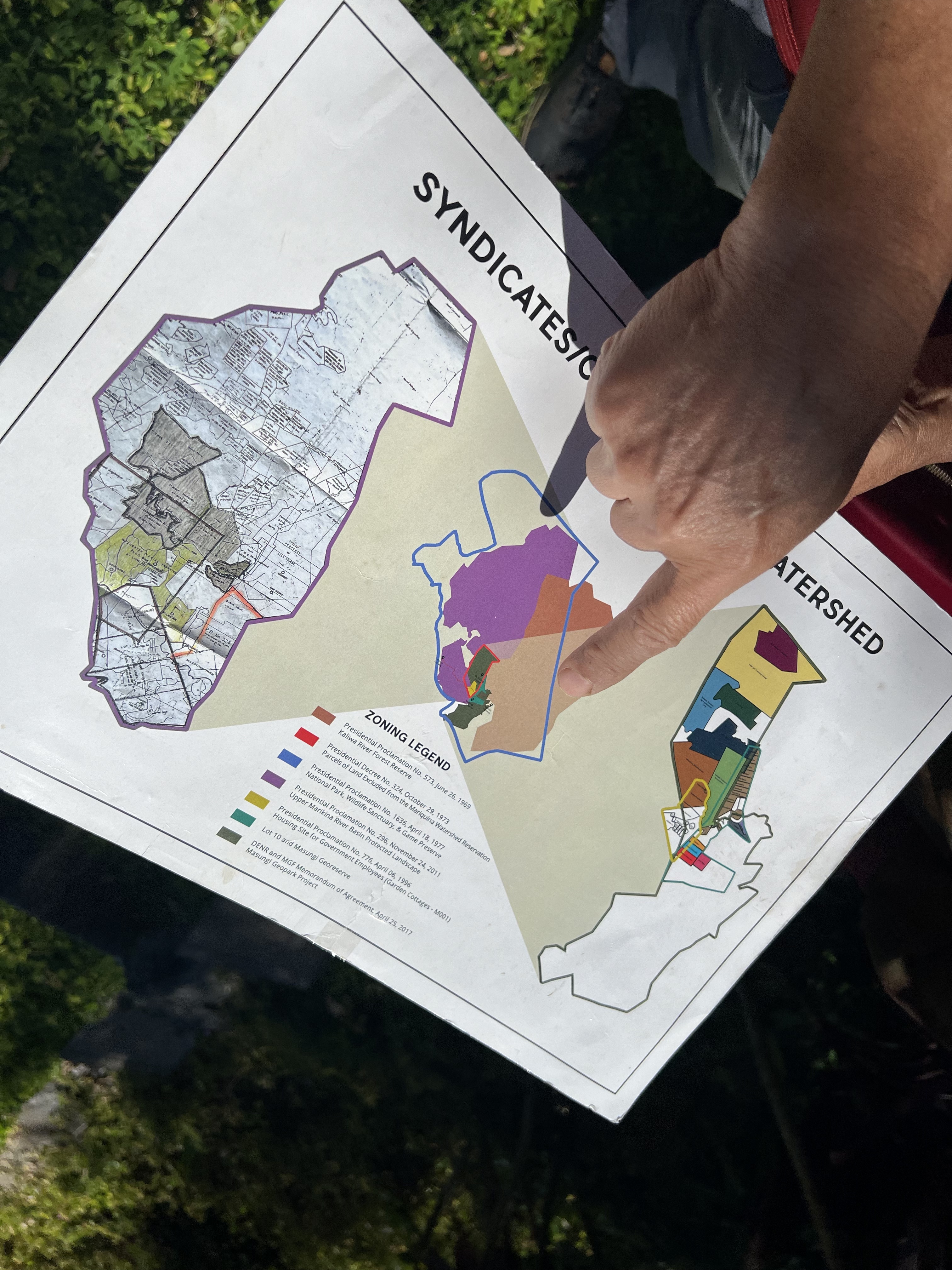
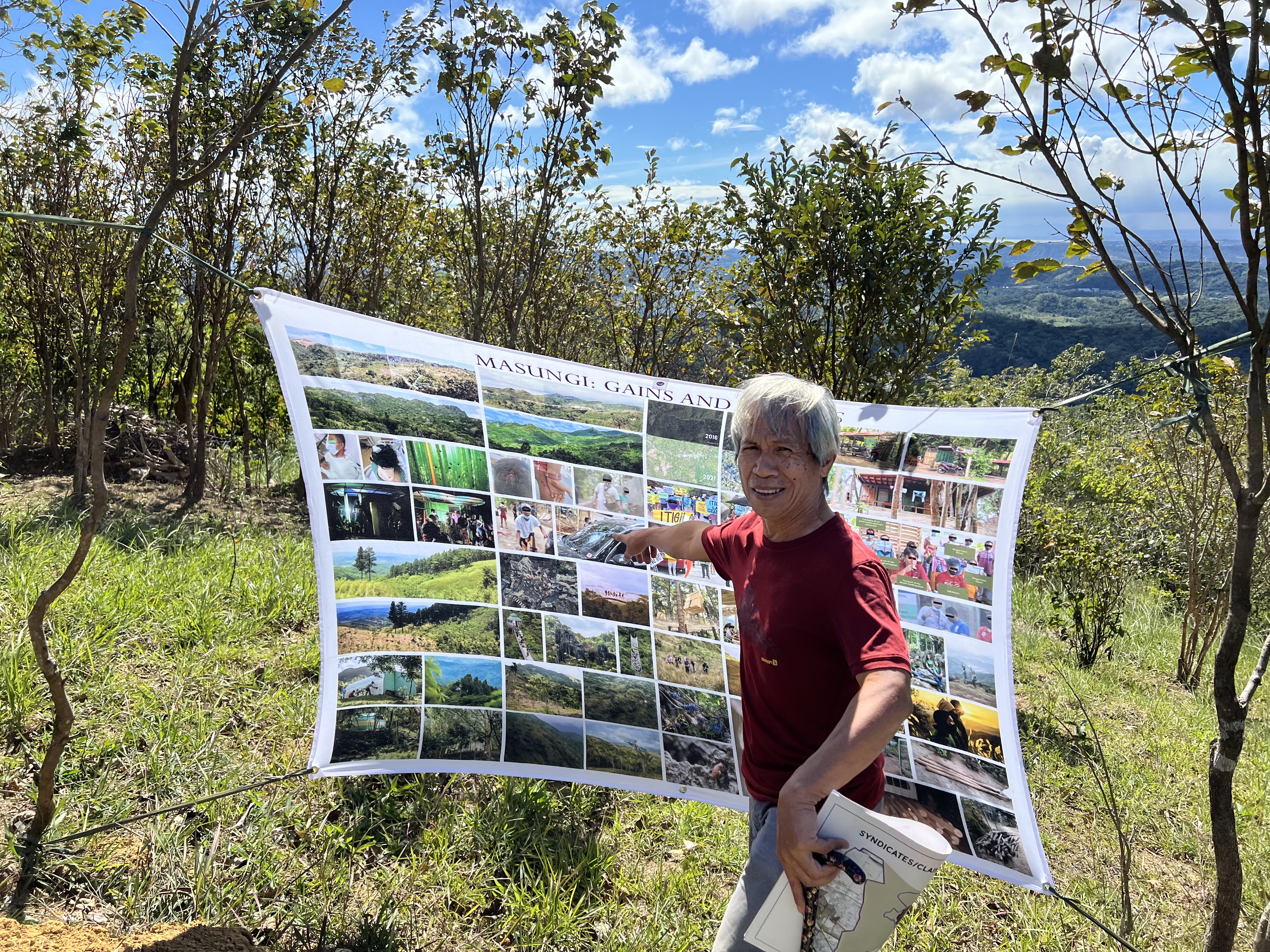
The man telling me this as he sweeps his hand over the vast Upper Marikina Watershed below and around us is Ben Dumaliang. At 68, Ben is exceptionally articulate for a civil engineer, but he needs to be, because he’s no longer just building houses. For almost 30 years, he’s been building the Masungi Georeserve—a 3,000-hectare expanse of mostly forest land on the slopes of the Sierra Madre along the boundary of Tanay and Baras, Rizal.

Masungi sits on the watershed that both nourishes and protects Metro Manila, providing it with fresh water while helping to keep flooding in check—if things like trees and streams are where and how they’re supposed to be. And there’s the problem, that helped a freak downpour like Ondoy become the biblical torrent it turned out to be. 

“Much of this was logged over not too long ago,” says Ben. “We had to reclaim the land from the loggers, the quarry companies, and the land speculators, and then reforest it.”

Today the Masungi Georeserve is about as close to a natural Eden as you can get this close to the city—about 30 kilometers from where I live in Diliman—with lush new growths of Philippine trees, unique plants and animals such as the purple jade vine and the Masungi microsnail, and hundreds of endemic species including 72 kinds of birds.

But it wasn’t always that way, as Ben recalls the georeserve’s unlikely beginning. “This was government land that the Department of Environment and Natural Resources (DENR) intended to use for employee housing back in the 1990s. In 1996, my construction company, Blue Star, won the bidding for the housing project, and we began building roads on the property and making improvements on it. However, the land had been chopped up among various syndicates, and the DENR failed to deliver on its obligation to clear the land of settlers, and after a while people lost interest in living here, and the housing project stalled.”

In the meanwhile, Ben had begun to appreciate the natural beauty of the place, despite its ravaged state, and started developing parts of it—particularly the centrally located Lot 10, which remains the hub of the georeserve. He began taking the land back from its illegal settlers, who included rich and powerful people who had put up cottages in the area.

Almost immediately, he began to get blowback. “Our rangers were shot at and mauled when they tried to do their job, and the police did nothing about it.”

Not surprisingly, Ben says that a group of police generals had apportioned parts of the watershed among themselves, citing the Marcos-issued PD 324 which had declared these lands alienable (conveniently forgetting that PD 324 was effectively repealed by Marcos himself under the Forestry Code aka PD 705 and by Presidential Proclamation 1636 prohibiting tree cutting and dwelling in the watershed). 

In 2015, Ben’s daughters Billie and Ann set up the Masungi Georeserve Foundation, to which Blue Star entrusted the care and management of the area. (Ben is a principal in both entities, and both daughters remain active in the foundation.)

It was in 2017 that the most auspicious turn happened for Masungi. Then newly appointed DENR Secretary Gina Lopez visited the place, liked what she saw—particularly what Ben and his people were doing to restore and conserve the forest—and had a contract drawn up between the DENR and the foundation granting it the right and obligation to replant the georeserve. 

Today sturdy growths of Benguet pine crown the hilltops of the watershed. The georeserve is thick and picturesque with trees, orchids, and returning wildlife. A limited number of ecotourists come every day to hike trails that weave through the sharp karst limestone landscape.

But not far below the pine trees, Sitio San Roque in Baras remains host to a bustling community (that reportedly includes, yes, at least one police general and one high-ranking government official who owns a pool resort, against whom a case had been filed but who was allowed to retire with full benefits). “The syndicates and rogue officials are the root cause of deforestation and environmental degradation,” says Ben. “I fear for my life and my family’s,” he admits. “It’s very easy to die in a place like this.” (For more background information, refer to my fellow columnist Jarius Bondoc’s piece from September 13, 2023, titled “DENR ignoring public appeals to evict watershed landgrabbers.”)

The threats are more than personal. Insanely, the Bureau of Corrections managed to secure 270 hectares in the heart of the reserve to build a new national penitentiary and its headquarters there. The DENR also reportedly agreed for Tanay to build wind turbines on the ridge overlooking Lot 10. Neither project can possibly be good for jade vines, microsnails—and people, for that matter.

Some days, Ben feels like he’s fighting windmills in Masungi—and not just the literal ones, either. He doesn’t understand what he sees as the antipathy of the DENR toward him and the foundation. The DENR wants his contract canceled, ostensibly because he had gotten Sec. Lopez to sign it when she was ill and just before she left office after failing to be confirmed (Ben denies this, saying she was the one who insisted on the contract getting done. “They seem to think I’m getting rich from this, but in fact I’ve been drawing from my own resources for the georeserve,” he explains. The MGF gets no funding from the government and relies on its limited income and on private support for its operations.) DENR Sec. Ma. Antonia Yulo-Loyzaga, he says, has ignored all his letters and requests to meet to thresh out any issues between them.

Nature reserves don’t grow just trees—they breed enemies, few of them natural; most walk on two feet.

(On a rather distressing side note, I have good and trustworthy friends on both sides of this issue messaging me to believe this and not to believe that. For the moment, I’ll have to believe the evidence of my eyes, but to be fair, I invite the DENR to send me their comments, and specifically their answer to this simple question: “What is the Masungi Georeserve Foundation doing wrong?”) 

Qwertyman No. 76: What I Have Learned

Qwertyman for Monday, January 15, 2024

PARDON ME if I wax a bit personal today, as I turn 70, much to my great surprise, coming from a generation that didn’t expect to live past 25. I’ve often noted that in your 20s, you seek purpose and direction; in your 30s, stability in terms of love, family, and work; in your 40s, professional success and serious money; in your 50s, acclaim and reputation; and in your 60s, good health and comfort. Now, on the threshold of my 70s, I find myself accepting and preparing for the inevitable, the average life expectancy of the Filipino male now hovering at 72.

More significantly, my wife Beng and I are also celebrating our 50th anniversary. I’ve never quite resolved if it was a good idea to get married on my birthday—and just my 20th at that—but there was never any doubt that marrying Beng was the smartest decision I ever made, and that waking up beside her every January 15 is the best birthday gift I could ever ask for.

But I’ll spare you the love story, which, like all good love stories, has had its fragile moments. For now, let me share some lessons and insights I’ve learned from surviving the First Quarter Storm, martial law, EDSA, GMA, Ondoy, Yolanda, tokhang, and, for the moment, BBM. They’re by no means complete, and I still have a lot of learning to do in what I hope to be at least another decade of avoiding the lyres up there (or the pitchforks down there). But they’ll serve for now, hopefully to encourage newlyweds and young ones to hang on for the long and bumpy but also often exhilarating ride. 

First, survival matters. Fifty years ago, my comrades and I were all prepared to give up our lives for our cause, but today I’ll have to ask, “Must I?” Heroic self-sacrifice is symbolically important and can inspire others to take personal risks for the greater good, but a genuine and strategic movement for change cannot consist solely of martyrs willing to die in combat; its core must be formed of patient plodders willing and able to undertake the mundane tasks and chores of nation-building within their families and communities. For that one will need to co-exist with evil, if need be, if only to survive it and be able to do better. Co-existence does not necessarily mean surrender or acceptance, merely an affirmation of one’s right to live as well as anybody else. Resistance can take many forms, not all of them fatal; we need to be clever and resourceful in championing the truth, which is often starkly simple and clear but sometimes also just as complicated as the well-fashioned lie. 

Second, tolerance and cooperation are key to every successful relationship, whether it be a marriage or co-existence in a deeply fractured society. But also key to this idea is self-knowledge, which builds self-confidence and a greater willingness to understand and accept the other, and to educate oneself. Many early marriages falter because the protagonists are simply too young, too vulnerable, and still struggling to define themselves. Growing up on one’s own is difficult enough; growing up together is even more challenging, but necessary. I was 20 when I became a husband, and later that year, a father, and didn’t really know how to be either. Thankfully Beng and I had good role models in our own parents, and enough love to work things out and see things through. Eventually, we learned to define ourselves in terms of the other—so that today, for me, no trip is worth taking without Beng, and her joys and successes are mine as well. Forgiving oneself and accepting one’s imperfections are not only as important as acknowledging the other’s, but are prerequisites to mutual self-improvement.

Third, “compromise” is not a bad word, if we are to survive as a nation together and as individual citizens. In our 20s—much surer of our convictions than of our own squishy selves—we viewed the world in black and white, certain that the enemy was out there, was not us or within us, and had to be rejected and battled in all arenas, on all levels. I’ve since learned that life can’t be lived on an all-or-nothing, take-it-or-leave-it basis, and that one has to negotiate with oneself as well as with others to keep whole and sane. An absolutist will never find peace, nor satisfaction, and likely never happiness. Learning to take things as they are—and working from there—can be harder than to merely insist on things as they should be, and to do nothing when they are not. Just as important as highlighting our differences are finding and building on the things we can agree upon—like resistance to foreign encroachment on our territory, which helps clarify our self-image—regardless, though still mindful, of our suspicions of the other’s motives. Opportunistic politics can sometimes be the inadvertent handmaiden of good outcomes.

Fourth, I’ve learned my limitations, and to do my best within my foreshortened horizon. I’ve realized that I can be happy in not trying to do too much, living in the moment, and finding fulfillment in small achievements that bring change and hope to other people. I haven’t given up my dreams for a more just, progressive, and provident society, and will continue to fight for those ideals, but I will choose activities and means that will lead to something I can see and hold (and that others can repeat, improve upon, and grow for the future). Big ideas are great, but small deeds can be just as valuable. I want to make a difference in someone’s life today. 

And finally, there is an afterlife. I frankly don’t know if there’s a heaven or a hell as the colorful posters in my grade-school religion class depicted them, but what I’m sure of from having attended countless funerals is that an important part of that afterlife and of its very proof is the life of those you will leave behind. When you die, others live on; they’ll talk about and even shed tears for you for a few days, and then they’ll move on to more pressing matters like tax amnesties and next Tuesday’s price of gas. Now and then your name will come up over morning coffee or a late-night beer, and the smile, the laugh, the sigh, the wince, or the cuss word that your memory will provoke will say everything about who you were and what your life was all about. I’ll be happy with a smile—maybe a bit regretful, but mostly pleased to have crossed paths with and even to have learned something from me. Mabuhay!

(With many thanks to May Tobias-Papa for the illustration)

Qwertyman No. 75: Trump 2.0

Qwertyman for Monday, January 8, 2024

IN MY column last week, I mentioned the “Trumpian dystopia” threatening to take over the United States and many other rightward-leaning societies and governments around the world. 

A “dystopia” is, of course, a place or a situation where everything has been turned on its head, where the bad has become good and the wrong has become right, and where the things we most feared or abhorred have become the norm. You find this in George Orwell’s 1984, where the government controls everything; younger readers and viewers will relate to Suzanne Collins’ The Hunger Games, where citizens are sacrificed for the Capitol’s entertainment. In other words, it’s social and political hell for those reared in the kind of postwar liberalism that eschews racial discrimination, authoritarianism, gender inequality, and religious intolerance, among other shibboleths.

It’s hard to believe that much of America seems to be marching in lockstep toward that dystopia under a revived Donald Trump, wh0m nearly all polls see as leading the race for the US presidency, which will be at stake in November this year. On this date three years ago, he was squarely in the doghouse in the aftermath of the shockingly violent assault on Congress on January 6 by Trump partisans unwilling to accept that he had lost to Joe Biden in the election. Even his closest allies at that time distanced themselves from his apparent captaincy of that bloody caper, although many of them have returned to his kennel. 

Nearly a full presidential cycle later, he’s back in the Republican saddle, way ahead of a pack of rivals who, save one, have refused to denounce Trump for what he is: the greatest single threat to American democracy because of what he represents (leaving aside foreign tyrants like Vladimir Putin and Kim Jong-un). That, not surprisingly, is President Joe Biden’s exact description of him, so some might say it’s biased, but to remain unbiased against Donald Trump is to lie prostrate in front of a steamroller, begging to be annihilated.

It doesn’t help that the incumbent is 81 years old, palpably slow, avuncular, and whispery where Trump screams into people’s ears (to the delight of many). Their age difference—just four years—isn’t actually all that much, but beyond personalities, it’s a difference in cultures, and perhaps of understanding how politics works in this post-Facebook age, where obnoxiousness has become a virtue and regularity a liability.

Trump thrives on notoriety, parlaying the four indictments involving 91 criminal charges against him—plus the two disqualifications from state ballots—into a kind of a badge of courage, flipping prosecution into persecution. Rather than fracture his base, any attack on Trump (and any attack by him) only seems to consolidate the estimated 30-40% of hardcore Trumpers who now effectively define the Republican party, the tail wagging the dog.

Among the most repugnant (and, by Trumpian logic, among the most attractive) of his recent statements has been his denunciation of undocumented migrants as “poisoning the blood of our country,” specifically mentioning Latin America, Africa, and Asia as the sources of what in other speeches he has called rapists, terrorists, and Covid carriers.

You would think that that kind of Hitlerian rhetoric would galvanize the Hispanic and Asian-American—not to mention the African-American—communities in America against Trump, but no. If anything, his support among these groups seems to be rising, driven ironically enough by his hardline position on immigration, the very same factor that made these minorities possible to begin with.

What I’m interested in is how the Filipino-American community will respond to Trump 2.0, and what that will say of us as a people, albeit as one of many minorities in America’s multiracial society.

There are now about 4 million Filipino-Americans; half of them, 2 million, are voters. (To put this in context, the US population now stands at 336 million, of whom 170 million are voters.) Historically, Filipino-American voters have leaned Democrat, with a majority of them voting for Hillary Clinton and Joe Biden in 2016 and 2020. But a very vocal (though perhaps somewhat less visible, as many people tend to reveal their preferences only in the voting booth) “Filipinos for Trump” movement exists, and if trends persist will likely gain more traction this time around.

In 2020, Filipino pro-Trumpers cited “family, religion, and faith” as the main reasons they were backing him, like many American evangelicals, despite all the evidence to the contrary in Trump’s personal behavior and speech. For many, it all came down to one issue—abortion—the right to which has now been successfully rolled back by the Supreme Court’s conservative majority. This time around, the flashpoint will likely be immigration, a global problem abetted by collapsing economies and repressive regimes. Well-settled minorities such as Filipino-Americans derive a strong sense of entitlement from all the personal sacrifices and legal processes they went through to acquire their citizenship, and feel cheated by migrants scrambling across the border. This kind of single-issue vote—a gross simplification and reduction of values into one criterion—favors demagogues like Trump, who work through two-dimensional posterization.

A more interesting—and more sinister—reading of Trump’s popularity came up in a recent guest essay in the New York Times by Matthew Schmitz, arguing in his title that “The Secret to Trump’s Appeal Isn’t Authoritarianism,” but rather that “Mr. Trump enjoys enduring support because he is perceived by many voters—often with good reason—as a pragmatic if unpredictable kind of moderate” and “a flexible-minded businessman who favors negotiation and compromise.” That logic, while fetching, predictably drew quick rebukes. One reader said: “Thanks, Mr. Schmitz, but we’re already well aware of this. Italians liked Mussolini because he ‘made the trains run on time.’ This is exactly our point. This is how dictatorships happen.”

That brought me back to our own long and continuing affair with despotism, and how sharply simplified populist sloganeering can cut through and cut down on complex reasoning—with devastating consequences for democracy, here and across the Pacific. 

(Photo from colorlines.com)

Qwertyman No. 74: A Church for All Humanity

Qwertyman for Monday, January 1, 2024

YOU NEVER see me write about religion, because I believe it’s an intensely personal thing (albeit with a communal aspect), but I can’t help being surprised and saddened by what seems to me to be the latent homophobia—intentional or otherwise—brought to the surface by Pope Francis’ recent statement allowing Church blessings for same-sex couples. Despite the fact that that statement was heavily qualified—that it wasn’t to be seen as “sanctification,” etc.—it still triggered a violent backlash from conservative Catholics, clergy and lay persons alike, who protested that the edict violates established Church doctrine. 

Some of these objectors are my good friends (and they will remain so, unless they say otherwise). Many among them will proclaim that they’re not homophobic at all, that gay people and couples are among their best friends, and that they’re merely upholding a key tenet of their faith—which just happens to exclude homosexuals from the blessings of the Church, because they’re fundamentally living in sin.

But I can’t see how that attitude—which some might call a holier-than-thouness—advances Christian love and charity. Pope Francis’ halfway gesture is compromised enough as it is, but would still have been a welcome step toward redefining a church that’s tried to keep a stiffly male face—despite the many gay people in its ranks—for millennia.

I grew up a church-going Catholic boy (inevitably for a La Sallista) but stopped going to Mass a long time ago, as a liberal feeling distanced from the Church’s positions on such hot-button issues as birth control, abortion, divorce, and homosexuality, not to mention its too-cozy relationship with authoritarian regimes in many places around the world. 

I do admire and support the efforts of many priests, nuns, and other religious to confront and ameliorate our social problems and fight for justice and freedom. I continue to pray, many times a day and at bedtime, for the sick and the oppressed, and to thank God for my blessings. I never formally studied theology nor the history of religions, but from what I can gather (and here I invite the experts to instruct me) what distinguishes the Catholic Church from others is its emphasis on good deeds as the path to heaven, rather than faith alone. You have to earn your sainthood; it is neither promised nor can it be bought. If so, that appeals strongly to me, as I’m sure it does to others. 

But whenever I think of the Vatican and its hierarchy of old men whose meals are answered for by the alms of billions of the faithful and investments in blue-chip companies and real estate, among others, I remember a side of the Church that depends on its moral authority to survive as both a keeper of beliefs and as a global industry. 

No one is surprised by the sordid financial and sexual scandals that have rocked the Church, as they merely prove that some people who run it are as fallible as anyone else. This is not why I left the Church, which I still want to think of as something transcendent, an idea of community above the mortal men and women who make up its body. What disaffected me was the arrogance of its orthodoxy—in which, among religions, it is hardly alone.

I’ll grant that every religion needs a body of core beliefs, some of which will be non-negotiable; if you don’t like what you see, you’re free to go somewhere else. I understand the dismay of the faithful over “cafeteria-style” religion where you can pick and choose what to practice and what not. But I had thought, perhaps mistakenly, that religions have a stake in inclusivity, in upholding beliefs and values that embrace persecuted minorities (as the Christian church itself once was).

I’ll acknowledge that apostates like me probably have no business lecturing devout believers on matters of doctrine. But this isn’t even about the finer points of doctrine, but rather about the broad strokes of faith and, ultimately, what and who that faith serves. If issues like gay relationships and marriage and divorce are to be the line in the sand that separates the true Church from the false (rather than, say, love of neighbor), then sadly I must stay out (to which the conservative core can say “good riddance,” or otherwise pray for my wayward soul). Exclusionary policies are never just internal matters, because they affect the perception of the excluded; indeed, they affect the excluded, and those who identify with them.

Pope Francis has been the first Pope in a long time to have revived my hope in a Church that finally embraces the idea of an inclusive love of humanity as central to its practice, if not its survival. The closing of minds and hearts in our growing Trumpian dystopia calls for a far more powerful spiritual force to overwhelm the spitefulness gripping much of the world today. I would rather look up to Pope Francis and such other figures as the Dalai Lama—rather than a consistory of ambitious cardinals and bishops—to show the way forward. 

I hope I won’t be alone in suggesting that much more work remains to be done, even beyond Pope Francis, toward such liberative measures as the ordination of women, for the Roman Catholic Church to be not just a church for the 21st century, but for all time, and for all humanity.

(Photo from cnn.com)