Hindsight No. 4: Denial and Dissonance

Hindsight for Monday, February 7, 2022

(Image from contemplativestudies.org)

I FIRST heard the phrase “cognitive dissonance” fifty years ago in UP from my friend Jose “Oying” Rimon, then a Mass Comm major just grasping the mechanics of social behavior. Oying would go on to become a population expert and close adviser to Bill and Melinda Gates on public health, capacities in which he had many occasions to see cognitive dissonance at work in shaping people’s attitudes and responses to development policy. 

I’m not a psychologist, so I’m going to have a real one, Dr. Sam Mcleod, explain what the concept means: “Cognitive dissonance refers to a situation involving conflicting attitudes, beliefs or behaviors. This produces a feeling of mental discomfort leading to an alteration in one of the attitudes, beliefs or behaviors to reduce the discomfort and restore balance…. When there is an inconsistency between attitudes or behaviors (dissonance), something must change to eliminate the dissonance.” 

The examples that usually turn up in the literature are fairly simple: you smoke, but know that smoking is bad for you; you know you need more exercise, but put it off for tomorrow, citing the workload on your desk.

Why is this relevant to our present situation? I’ll get to that in a minute. First, let me quote from an article by Dr. Eddie Harmon-Jones in Psychology Today wondering why so many Christian Americans still voted for and supported Donald Trump despite his patently un-Christian behaviors, such as adultery. “As president, he has engaged in many actions that seem immoral. How do so many still support him? Surely they must experience dissonance over this. How do they reduce this dissonance?” (For that matter, why did so many conservative Fil-Ams vote for Trump on the excuse that he was supposedly “pro-life,” ignoring his many other moral infirmities?)

Why do people believe what they want to believe, regardless of the hard facts and figures in front of them? How do they reconcile these contradictions in their minds to feel like they’re doing the right thing and to feel better about themselves? (The science suggests that we humans have a natural impulse toward feeling good.)

This is what the psychologists call reducing or resolving dissonance—accepting or acknowledging what the more logical part of your brain is saying, but then coming up with a rationalization or justification for sticking to your original belief anyway; or, with much more effort, you find a reason to cross over to the other side. Sure, smoking is bad for me, but so is anxiety; sure, maybe vaccines work for other people, but I’m not like other people—I haven’t been sick in twenty years; sure, I lied on my tax declaration—but haven’t bigger people done much worse?

Dissonance is a shade different from denial, which is the outright rejection of proven or provable fact. Holocaust deniers will insist it never happened; other neo-Nazis will say it did, but that the Jews brought it upon themselves, or that Hitler wasn’t to blame for the genocide. 

This is the stuff that conspiracies and conspiracy theories are made of—a little truth here and a little truth there, interwoven by threads of fanciful fabrications to create some semblance of alternative logic. Spun imaginatively and cast widely enough, this web of lies can begin to acquire the sheen of truth, or what passes for it among its believers.

Are those believers stupid or crazy? Not necessarily. An interesting paper by the psychologist Andrea Kohn Maikovich argues that terrorists aren’t simply the hate-filled loonies they’re often pictured to be. Rather, recruits go through a radicalization process during which they negotiate between their personal predisposition not to commit violence and the collective pressure to do more than carry placards on the street. When the dissonance hits its peak, some leave; those who stay have found a way to convince themselves that violence is good and necessary.

Writing for the Atlantic Monthly on “The Role of Cognitive Dissonance in the Pandemic,” Elliot Aronson and Carol Tavris note that “When people feel a strong connection to a political party, leader, ideology, or belief, they are more likely to let that allegiance do their thinking for them and distort or ignore the evidence that challenges those loyalties. The social psychologist Lee Ross, in laboratory experiments designed to find ways to reduce the bitter conflict between Israelis and Palestinians, took peace proposals created by Israeli negotiators, labeled them as Palestinian proposals, and asked Israeli citizens to judge them. ‘The Israelis liked the Palestinian proposal attributed to Israel more than they liked the Israeli proposal attributed to the Palestinians,’ he told us.”

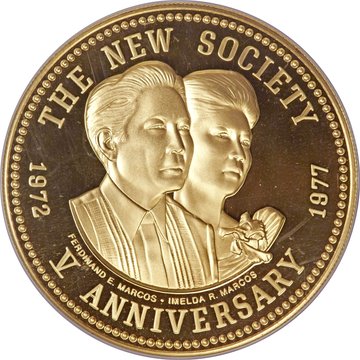
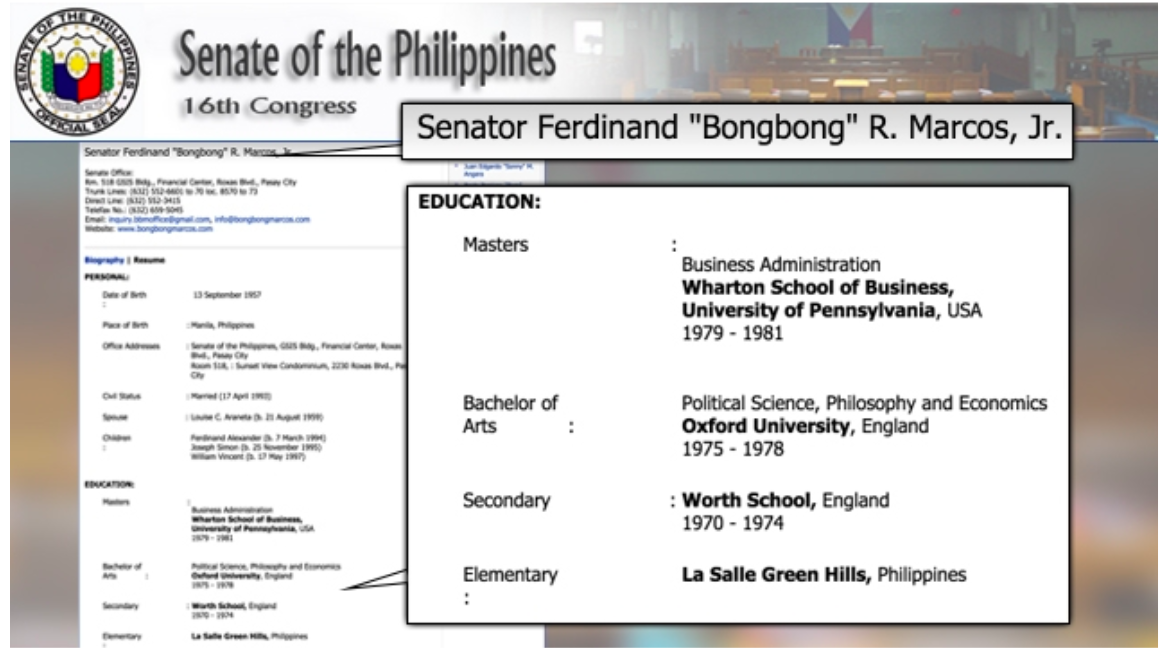
In this context, it isn’t hard to see why pro-Marcos narratives can seem so compelling to many Filipinos, despite the clear and documented evidence of ill-gotten wealth (let’s say it plainly: theft), brutality, deception, and other abuses of power during the martial law years. They’re rich and powerful—which we all want to be—so they must have done something right.

People who are already rich don’t steal; it wasn’t FM Sr. who committed martial law’s excesses, but his administrators; EDSA 1 was nothing but a CIA operation; Imelda was never imprisoned, so she can’t be guilty of any charges thrown at her; the younger Marcoses knew nothing about what was going on, and so will be different from their parents; if the Marcoses were bad, the Aquinos and Lopezes are worse; et cetera. If you feel comfortable with any of these ideas, then you’ve made your own kind of sense of the past, even if you may not even have been there.

Of course, I have my own set of stubborn core beliefs and dissonances as well. I keep holding on to the idea that Filipinos are worth dying for, only to be disappointed by the way many of us choose our leaders. I believe in democracy, but I feel frustrated when it’s gamed by people who obviously don’t care much about it. 

According to cognitive dissonance theory, something has to give: your cherished notions, or the hard truth. It seems much easier just to give up hope, but there’s no real comfort nor resolution in that, either.

Hindsight No. 3: A False Nostalgia

Hindsight for Monday, January 31, 2022

SINCE MY belated debut on Facebook just over a month ago, I seem to have acquired something of a reputation for my posts about the past—not in the scholarly mode of a real historian, which I most certainly am not, but as a collector and keeper of objects that evoke strong associations with times and people long gone. These include century-old fountain pens and typewriters, and even older books and documents steeped in the accumulated oils of the hands that held them.

I’ll admit to having an intense, almost fetishistic, interest in the past—the 1930s are of particular significance to me, because I’m writing a novel set in that period—and I can identify with the romance conjured by postcards of ocean-going liners and of the old Manila Hotel. If you play “Smoke Gets in Your Eyes” on a turntable, you’ll float to the ceiling in my esteem. In my dreams, I fantasize about strolling into the Crystal Arcade one fine day in 1937 and stepping out with a fistful of Parker Vacumatic Senior Maxima pens while towing a cart with all 55 volumes of Blair and Robertson.

But that’s where the nostalgia ends. In many if not most respects—as I’ve told friends who, for example, ask me if UP’s fabled Cadena de Amor ceremony is worth reviving—there’s one place the past deserves to be, which is exactly where it is. Nostalgia is comforting precisely because the past is over, and because we tend to remember just the good parts, and even burnish them to perfection.

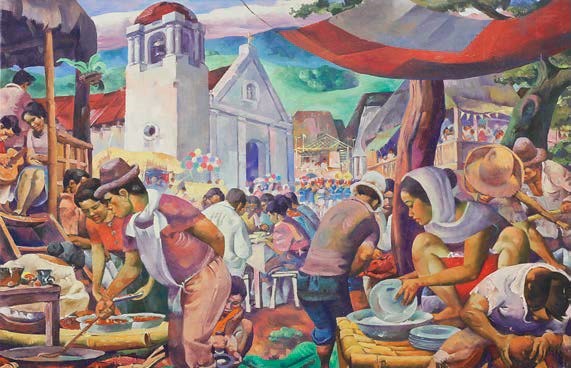
But it was never really all that good. Amorsolo’s maidens all seem fresh out of the batis and every Joseon prince’s robes on K-drama seem immaculately pressed even after a swordfight, but the past was literally a filthy place. Queen Elizabeth I was said to take a bath once a month. William Shakespeare and his friends wore those fluffy collars around their necks because that’s all they changed. The lovely ladies of Versailles doused themselves in perfume to quell the odor of their unwashed bodies. The “buntis” window grilles we now admire in old Manila houses were once drenched with dubious liquids being dumped on the street below.

Neither was it so peaceful. Even without counting the devastation of war, the past was fraught with danger, hardship, and unrest. It may have been a grand and glorious time for the rich in their cars and villas, but the masses were suffering in the farms and factories. Power was brazenly exercised, as in the torture and murder of Moises Padilla in 1951. Postwar congressmen carried .45s at their waist into the session hall. As a young police reporter in 1972, I learned where you could find a gun for hire for P500 per target.

We like to think that the past was simple, with fewer choices to be made. But it was never that simple for many without real choices. Poverty was and is never simple, because every morning the mind races to figure out where supper is coming from, and if Nanay can survive on a third of her prescribed dosage or on plain salabat.

All these come to mind when I hear Filipinos today—many of them not even in their 40s—talking about how a return to the “glory days” of Marcosian martial law would set this country back on track and bring us the prosperity, the peace, and the prestige we once enjoyed. I wonder what it is exactly they are “remembering,” and if they understand what putting a Marcos back in Malacañang will mean to this country. This goes beyond the historical amnesia we often hear about these days; the Dictionary of Obscure Sorrows calls it “anemoia,” a nostalgia for a time someone has never known, or that never happened.

No, I’m not calling them stupid or wicked by any means. In many cases they’re simply innocent or uninformed, and therefore suggestible. If they feel oppressed by the present and are facing an uncertain future, the past will acquire the appeal of the womb, offering safety and security. The idealization of martial law as a time when streets were wide and clean and when new buildings were rising right and left is a more inviting prospect for those who can’t be bothered with facts and figures about debt-driven growth, cronyism, and horrific abuses under military rule. (For those facts, check out https://newslab.philstar.com/31-years-of-amnesia/golden-era)

That even oldtimers can wax nostalgic over the Marcos years isn’t hard to understand. Like the Germans under Hitler, many if not most Filipinos then never saw a prison camp, never had a son or daughter tortured and salvaged, never had a business taken over by the regime. Those of us who actively resisted dictatorship were in a distinct minority—as we still are today. Complicity has to be endemic for despots to thrive.

But now once again we are called to arms, in a battle for the imagination—a battle of competing narratives and modes of narration. Will the cold, hard truth alone triumph over romantic fantasy, or will we need to be more inventive in our messaging to get through to those unlike us? Instead of just revisiting the past, should we dwell more on a rosy but realizable vision of the future? Instead of staking out May 9 as a referendum on martial law, should we double down on what a presidential election should be—a competition between platforms and qualities of leadership? (And then use the next six years to correct our history textbooks.)

It’s true that we have good reason to long for seemingly lost or threatened graces like statesmanship and civility (not to mention intelligence) in politics, as well as plain good manners and delicadeza. There are good things we can yet recover and revive from better days, with the right leadership and inspiration. But to do that, we have to save the future from those who would drag us back 50 years into a past that was as morally sordid, as violent, and as dispiriting as anything that ever happened in our history. 

Hindsight No. 2: Myth over Matter

Hindsight for Monday, January 24, 2022

(Image from indiatimes.com)

THERE’S HARDLY a week that goes by without me receiving a Viber notice from a friend warning me about another incoming message containing some innocuous line like “Let’s go to Latvia” or “Your mother will love this,” clicking which will trigger a dizzying spiral into digital damnation: your phone will freeze, all your passwords will be stolen, your half-naked selfies will be posted to your Village Association chat group, and whatever gender you declared will be reversed in all your official records. 

It’s all well-meant, of course; some friends will even add “Sharing, just in case”—meaning, they also suspect it’s fake, but meaning further, they’ll pass final judgment on to you, a privilege you should be thankful for—on the one-percent chance that it’s true.

I’ve taken it as my civic duty to look up the particular hoax online (easy: just add “hoax” or “scam” to whatever the key words are, and Google away) and to inform the senders of their mistake. Many will reply with a terse “Thank you.” Some will protest: “It wasn’t me—it was my silly sister-in-law who swore it was true, so I passed it on!” A few (some of these senders have PhDs) will even argue back: “Now, how sure are you that snopes.com is a real fact-checker? Who’s funding them? What’s their angle?” (Makes you wonder: if they were going to be that investigative, why didn’t they ask it about the hoaxer in the first place?)

Living in the age of fake news (or “alternative truths” as Donald Trump’s aide so nicely put it), we can’t be surprised any longer by the seemingly infinite pliability of the truth, which can be warped and twisted to the point of being barely recognizable. But as it turns out, that “barely recognizable” element is key. 

An article in WIRED from 2019 on “Why People Keep Falling for Viral Hoaxes” points this out: “The narrative that Big Bad Instagram is going to take all of your most intimate personal data points and use them for nefarious secret purposes is the sort of story that is primed to appeal to the average person… because it contains a kernel of truth: You have all this data out there on the internet, and God knows who has access to it.”

We sort of knew that already—the best lies have a little truth in them, encouraging our gullibility. When Ferdinand Marcos claimed to be a war hero with 33 medals to his name—only two of which were actually given in 1945, and both contested by his superiors—all the fellow basically had to show for proof was his picture in a uniform, surrounded by pretty hardware that you can buy today on eBay, and that was enough to make many believe that he had to be a hero.

What’s more breath-taking—and possibly more dangerous—are the outright fabrications, the brazen claims to this and that outrageous deed or achievement. You’d think that they’re too absurd to be swallowed by even the most credulous, but think again.

The story of the Tallano gold, now being trotted out on social media as the source of the Marcos fortune, is a case in point. The story that went around on Facebook is that the Tallano family—the descendants of the rulers of a pre-Hispanic, pan-Pacific kingdom called Maharlika—had paid the young lawyer Marcos 192,000 tons of gold. With one kilo of gold today at around P3 million, I don’t have enough zeroes on this line to tell you what that’s worth. And for what lawyerly labor, one wonders—a gazillion affidavits and deeds of sale? 

Never mind that Imee Marcos herself has denied this story, and even the “Yamashita gold” that her mother claimed in 1992 to have found its way to Ferdie. The late Bob Couttie had been exposing the Tallano claims as a fraud even in 2018. But the story has legs. You just have to go online to find testimonials like this from a “BQ”: “It’s true but they’re burying the truth. I myself held those documents—three reams of A4-sized paper, including the mother title of all the land here in the Philippines, which came from Great Britain!”

Never mind, too, that it’s clearly a minority of believers. It’s how and why they believe kooky fantasies like this that’s more intriguing. The WIRED article again points to a reason: that, for many people, mythmaking provides a coherent narrative, a story easier and more convenient to believe than the truth, which is often too messy and complicated to figure out.

In my fiction writing class, I often bring up my favorite quote from Mark Twain, paraphrased: “Of course fact is stranger than fiction; fiction, after all, has to make sense.” Like myth, traditional fiction has a familiar beginning, middle, and end—and even a “lesson” to clarify the haze in which we stagger through daily life.

As I said in a lecture sometime ago, “The most daring kind of fiction today is out of the hands of creative writers like me. It is being created by political propagandists who are spinning their own versions of the truth, and who expect the people to believe them. The short story and the novel are no longer the best media for this type of fiction, but the tweet, the Facebook feed, the YouTube video, and even the press conference.”

Today’s savviest political operators know this: spin a tale, make it sound appealing, trust ignorance over knowledge, and make them feel part of the story. “Babangon muli?” Well, who the heck who dropped us into this pit? It doesn’t matter. Burnish the past as some lost Eden, when streets were clean, people were disciplined, and hair was cut short—or else. Never mind the cost—“P175 billion recovered in ill-gotten wealth” is incomprehensible; “a mountain of gold to solve your problems” sparkles like magic.

Imagination is more powerful than reason—myth over matter. I hope the forces of the good and right can work with that.

Hindsight No. 1: A Time for Telling

Hindsight for Monday, January 17, 2022

IT WAS with great shock and sadness that I received the news of Manong Frankie Sionil Jose’s passing two Fridays ago; my recollections of him appeared online later that day. But just as jarring a surprise was a call I later received from Millet Mananquil, my editor in the Lifestyle section, and then from Doreen Yu, our Op-Ed editor, informing me that I had been chosen to take over FSJ’s column-space on this page.

It was a great privilege, of course, and I accepted it gratefully. But it also carried with it an awesome responsibility—to be honest, to be fair, to know enough about an issue to speak with some legitimacy about it, and also to be modest and open-minded enough to remember one’s inescapable fallibility. I don’t think that last one’s going to be a problem, because I’ve made mistakes often enough to know that—well, I make mistakes, some of which may have hurt people badly.

But last Saturday I turned 68, and with that age comes a keener sense of doing right, of accountability for one’s choices and judgments, as well as a greater tolerance for the shortcomings of others, though not of evil or of wrong itself. I intend to maintain those bearings in this new capacity.

Some readers may wonder how a Lifestyle writer like me—obsessed with fountain pens, old books, Broadway showtunes, and digital gadgetry—ends up doing op-ed, which seems a far more serious and consequential calling. A brief self-introduction might be in order.

I dropped out of UP as an engineering freshman in 1971 and, against all odds (not having spent one day in Journalism class, and being all of 18), landed a job as a features writer and general assignments reporter with the Philippines Herald in 1972. My first task was to fill up half the Features page every day—something that schooled me forever on the importance of deadlines and of resourcefulness, because I had to come up with the topics on my own. I moved to Taliba as a suburban correspondent; was arrested for my activism shortly after martial law was declared; spent seven months in prison; and upon my release joined the information staff of the National Economic and Development Authority, where I would work for the next ten years, picking up a diploma in Development Economics along the way.

I returned to school, finished up my academics all the way to a PhD (more for teaching than for my writing), and taught full-time while writing stories and film scripts. In the mid-1990s, thanks to my friend and now fellow-columnist Jarius Bondoc, I was hired as an editorial writer for the newly opened newspaper TODAY. Being busy with other aspects of management, our boss Teddyboy Locsin trusted me to do about three editorials a week, including the newspaper’s very first one. 

I discovered that opinion writing was exhilarating—but also, again, fraught with responsibility. It got to the point that I found myself wishing I could write something less driven by analysis and conscience—small things like my rickety VW Beetle, double-knit pants, and my love of crabs, instead of ponderous topics like prison reform, the defense budget, and Philippines 2000. (I still have 113 editorials that I wrote on my hard drive.) So I asked for—and got—a Lifestyle column called “Barfly” on the back page, which helped me decompress and kept me sane, reminding me that life was much more than politics and that beauty and fun were as important as anything else to happiness.

I’m going to keep that escape valve open—I’ve promised Millet that I’ll continue contributing my “Penman” column every now and then—but I’ll approach this new task with the loftiness of mind that it deserves (although you’ll excuse me if I sometimes prefer to take a more comic tack, as the best criticism is often served up with a smile). 

Unfortunately I’m not a political insider; I don’t make the rounds of kapihans and have become something of a happy recluse over the Covid lockdowns. You’ll see my politics soon enough—unabashedly liberal (with a small L), middle-force, intensely uncomfortable with both Right and Left extremes. (I came out of the Left and worked briefly for the Right as a sometime speechwriter for five Presidents—but not the last two.) I thank God every night for my family’s safety and for our blessings and for the well-being of others, but I’ve had my differences with Church dogma and would rather spend my Sundays reflecting on human frailty and redemption by reading a book or writing a story.

But I do have a deep and abiding love of history, of which I have so much more to learn. This is why I’m keeping FSJ’s “Hindsight” for this column’s title. (When I returned to UP to resume my undergraduate studies, I dithered between English and History, and chose English only because I was likely to finish it sooner). I agree with Manong Frankie, among many others, that one of the greatest obstacles to our nationhood is the fact that we have a very poor memory—much less an understanding—of our past. We’re reaping the bitter fruit of that amnesia now, in the prospect of electing a dictator’s son to the presidency, a full half-century after the father plunged this country into political and moral darkness by declaring martial law to perpetuate himself in power.

There—it’s when vexatious thoughts like that cross my mind that my fingers begin to itch and I want to editorialize, the complete opposite of my impulse as a fictionist to show and not tell. (I often begin my fiction-writing classes by comparing an editorial on, say, justice for the poor with a short story dealing with the same concern, but without once mentioning “justice,” “poverty,” and such abstractions.) But even as I remain a fictionist at heart, there’s a time for telling, for gathering up the threads of an unfolding narrative and declaring, in plain language, what they mean. That’s what I hope to do.

Penman No. 433: Finally, Facebook

Penman for January 16, 2022

My Lifestyle column in the Philippine STAR, “Penman,” has now been moved to every other Sunday, to avoid the awkwardness (and extravagance) of having two of my columns appear in the paper on Mondays. My takeover of F. Sionil Jose’s “Hindsight” on the Op-Ed page debuts tomorrow.

I WAS sixteen years late to the party, but I finally gave in and opened a Facebook account last June under my name, initially just for family. A few weeks ago I began accepting “friends,” of which I now have about 600, and I don’t intend to add too many more, although time and tolerance could change that reticence as well.

I resisted joining Facebook all those years for all the reasons some of my real-life friends remain staunch holdouts. Foremostly, it seemed to diminish and commodify the idea of friendship, replacing what should have been forged over conversation, coffee, and even conflict with a few keystrokes. Even now, looking at the roster of my newfound “friends,” I know—and do not really regret—that less than half of them are people I have actually broken bread or raised a toast with.

Honest to God, not being a politician, I don’t need 5,000 friends; I wouldn’t even know what to do with 1,000 of them. If they all pledged to buy my next book, then maybe I’d reconsider and lower the bar by a foot or two, in the cause of promoting literacy and my Fountain Pen Rescue Fund.

And then of course Facebook is a total timesuck, defined by the Urban Dictionary as “the void that gets created by engaging in an activity that seems like it will be short but ends up taking up huge amounts of time.” It’s just not human not to read and then not to respond to comments on your posts, and then not to read the posts of others and not to react to them.

Every “tag” might as well be a distress call; somewhere out there you’re being praised or reviled, and you just have to pause that report you’re drafting for the Board of Regents or that article you’re refereeing for the Journal of Linguistics to see what Cookie has been saying about that encounter in Boracay or Chef Dodo’s opinion of your dinuguan recipe.

As it is, even deciding who gets to be your Facebook “friend” or not raises all kinds of vexing and time-consuming moral dilemmas. I don’t know how others do it, but I review nearly every request I receive, going through that person’s profile—and not just our common “friends”—to see who and what’s behind the name. My rule of thumb is, if I really know you—and like you—then you’re in; if I know you by reputation, I might even feel honored, and click “confirm.” If I’ve never met or heard about you at all—which isn’t your fault or any fault for that matter—then I evaluate your application for virtual “friendship” using my shamelessly subjective criteria.

First, I check to see if you’re a real person, or that you are who you say you are. Early on in this “friendship” game, I received a slew of requests from impossibly pretty and shapely ladies, which made me wonder why I had waited sixteen years to enter paradise. (They all seemed to have one or two common “friends” with me, always the same persons, so I know who’s been extraordinarily amiable out there.) Out of curiosity (I swear!), I accepted one such request, and almost instantly got a private message that invited me to become her digital pen pal, because she was lonely and unoccupied in some far-off country. I wanted to tell her to buy my book of funny essays, or even my short stories, to relieve her boredom, but I had an inkling that creative nonfiction wasn’t going to be the bridge between us.

I checked out her posts—all of them suggestive of her good health and weight maintenance, and of her preference for clothes that did not consume too much fabric (kudos for sustainability)—only to notice that they had all been posted on the same day! My wonderment quickly turned to dismay, realizing that I, among other papas of the world, was being suckered into hell by this honeypot, who was very likely some ugly fellow like me named George or Brando. And so I sadly punched “delete,” as I did for the many others who would follow in Ms. Lonely’s wake.

Second, I check to see if you’re interesting and if we’ll get along. If all you can show me are endless updates of your profile picture—here’s me on the beach, here’s me with my dog, here’s me with a balloon, here’s me lifting weights—then we really don’t need each other, thank you. I have a soft spot for all kinds of artists, and I don’t necessarily just go for the famous or abundantly talented ones; I’ve signed in struggling young people because I admire honest effort.

If you’re a benign plantita proud of your grandkids, your succulents, and your muffins, you’re in—the world needs you! If you became my friend just to sell me something, you’re out (unless you buy my book first). Now here’s a killer: if I see even the slightest sign of you supporting dictatorship, book-banning, EJK, and fake news, you’re out. (I know we’re supposed to make friends across the political divide, hold hands, and sing “Kumbaya,” but I didn’t join Facebook to get my daily dose of aggravation.)

Penman No. 432: In memoriam, FSJ

Penman for Friday, January 7, 2022

TO THE chorus of voices mourning the passing of Manong Frankie Sionil Jose, let me add my own.

For a very long time, Manong Frankie and I were not what could honestly be called friends. I had said hurtful things about him and his work, and I could feel that he took that to heart. 

But we did begin on a very high and encouraging note. In 1983, he selected me and a few other Filipino writers—Rey Duque, Marj Evasco, and Fanny Llego among them, as far as I can remember—to attend a writer’s seminar in Bali that he and his friend the late Takdir Alisjabanah had organized to bring young Southeast Asian writers together. It was my first big international conference, and it was exhilarating to be talking literature on the fringe of a crater lake. I deeply appreciated that gesture on Manong Frankie’s part; through him I met such luminaries as Edwin Thumboo, Shirley Lim, and Cecil Rajendra. At that point I had read and appreciated The Pretenders and many of FSJ’s short stories.

Some years later, I was in America studying for my MFA in Michigan and then my PhD in Wisconsin, and at some point I was interviewed by National Public Radio about Philippine literature—I can’t recall why, or why me (it was probably just after EDSA, when the world’s eyes were upon us, and I was conveniently available)—and when FSJ’s name came up I indelicately repeated what I thought was the prevalent opinion then (and until much later) of his work among my fellow writers in English: that while he wrote about all the right things, his prose was far too plain and lacking in certain qualities. (It was an opinion that would understandably provoke a backlash from FSJ’s supporters who valued his substance more than his style.)

That must’ve gotten back to Frankie because—whether I just imagined it or not—I felt that I got the cold shoulder from him from then on. It didn’t help that he seemed to have a bone to pick with UP and creative writing workshops, and held the notion that we were out to create clones of our snooty selves, detached from the harsh realities of life on the ground. I (and many others) continued to be exasperated by his cantakerousness (I even called him “cranky Frankie”) and groaned at his propensity to lecture young writers to the point of scolding them for one shortcoming or other.

But even so no one could deny his massive and meaningful contributions to our literature and to the idea of a literature grounded on history and social reality. When I happened to serve on the preliminary committee vetting candidates for the National Artist Award the year he eventually won it, I had no problem putting my minor misgivings aside and voting for him.

I’m not sure when the thaw in our relationship began, but it must have been when we were both invited in 2017 to an NCCA-sponsored seminar in La Union where I was asked to give a talk on Manuel Arguilla. I knew he was going to be listening, and I have to admit that I wrote my lecture with him specifically in mind, wanting to reassure him that I wasn’t some city-boy snob who didn’t know one end of a carabao from the other and who couldn’t write about anything but professors sipping cappuccinos at Starbucks. Through Arguilla, I wanted him to know that I felt and understood—and indeed wrote about—his concern for common and unarticulated lives.

Later that year, when I spoke at the annual Palanca Awards dinner about how writers in our society often have to write for others for a living but also need to redeem themselves through their art, he approached me from below the podium and extended his hand to congratulate me, and I knew we had reconciled.

We were brought even closer when he and the late Sen. Edgardo J. Angara founded the Akademyang Filipino, asking me to serve as a trustee along with such stalwarts of civil liberties as former Justices Antonio Carpio and Conchita Carpio Morales. He would remind me, among the most junior members of that board, to make sure the Akademya survived him, pleading his age. (His daughter Jette, who sadly died just weeks before Frankie, was our very capable executive secretary.)

He and Manang Tess would invite me and Beng for dinner, and he was very happy and surprised when I presented him once with a copy of the maiden issue of Solidarity, which he had lost. In private, he told me something that assured me that we had, again, become friends.

Still, for all that, his mercurial politics continued to confound me. Separated by the Covid lockdown, our meetings stopped, although even if we had met I probably would not have been able to ask him to his face how he could reconcile his loathing of dictatorship with his approval for Marcos’ successor. Not I nor anyone else could have changed his mind. It was sad to see him savagely reviled for his contentious remarks about ABS-CBN and Maria Ressa, among other issues, but I suspect that there was a part of him that courted and reveled in the notoriety.

And that was what I learned about F. Sionil Jose: you had to take him as he was, all of a package, or reject him outright, which would also be a pity. Nearly all great writers had their quirks and imperfections, but it’s their work that survives and surpasses all our momentary misgivings.

Farewell, Manong!

My Wishes for the New Year

EVEN AS we all wish for a more benign 2022, free of Covid and conflict, we know deep within that our biggest battles lie ahead in the war between good and evil that it has always been—not between parties nor personalities nor platforms, but between those who will lie and steal and kill, and those who will fight for truth, justice, and prosperity for all.

Good and evil is as stark and simple as it gets, and no amount of spin or sophistry and certainly no surveys will change that. Even one good person in a roomful of the malignant and misled will still be right, and worthy of our praise and emulation.

And whatever happens in May, our struggles will not cease. Evil is a virus with infinite mutations. Our corrupt and power-hungry politicians are worse than Covid, and have infected the masses of our people with their lies and false promises. But they can be arrested and contained, with vigilance and resolve.

For myself, I cannot be a friend to anyone who willfully supports and benefits from those who will plunge our country into another six years of moral and economic ruin.

I look to 2022 as an opportunity to stand up and be counted among the forces of the good, whatever my personal faults and impairments may be. The only survey or judgment that will matter will be God’s, and I would like to be able to tell my Maker that I did the right thing when it mattered—that I managed to remember the difference between good and evil, and chose rightly.

I can only wish you feel the same, so we can have a truly happy and liberating New Year!

(Image from candles.lovetoknow,com)

Martha, Martha (A Christmas Story)

(Twenty years ago, instead of a regular column, I wrote and sent in a Christmas story for The Philippine STAR, titled “Some Families, Very Large.” This year, I thought of doing that again, this time a story set in a Covid ICU–about loves and lives lost, power and disempowerment.)

THE GENERAL LOOKED hard at the tinsel star on the Christmas tree across his desk and convinced himself that it was leaning to the left, perhaps by an inch, and he wondered if he should fix it himself or let someone else do it for him. The tree was too tall even for him to reach the star on tiptoe, because his secretary and his aide had perched the four-foot tree on top of a painted stool to create more space beneath its plastic branches for the mound of gift-wrapped presents that began to arrive in the first week of December. 

Two years earlier, a mayor from Cagayan for whom the general had done a small favor had sent him a washing machine covered in gold foil, and he had raffled that off to the delighted staff, just like all the baskets of canned ham, English biscuits, and cheap California wine that gathered under the tree. Some came all the way from Manila, an eight-hour drive away, a token of the esteem in which the general was held, and of his prospects to make chief of staff. The most serious gifts never made it to the office; he was corrupt, for sure, but the general was nothing if not discreet, and he was proud of managing his affairs with a certain style. The Christmas tree and the pile of presents, to be honest, offended his sensibilities; it was too loud, almost vulgar, but it endeared him to his staff, and that was part of his charm, his ability to make people feel that they were being cared for. 

He was a man who could just as easily shoot a rebel in a back alley or a safehouse as he could lift a baby out of a flood to a chopper. Back at the Academy, he excelled both in boxing and mathematics, skills he later put to good use in Mindanao when he was honing his skills in procurement and dealing with unreasonable parties. The rough edges had come off as he rose up the ranks—now he knew smoother and more efficient ways to inflict pain or punishment and get things done—but the urge to ball up his fist and beat up someone senseless never quite left him, and he knew that the best gift time had given him was restraint, which accounted for his cool demeanor. 

As a young father, he had been heavy-handed with his son, now a ballet dancer in Chicago, but they had begun to learn how to talk over Facetime. His wife Martha never quite understood his sacrifices for the family, demanding that he account for the silliest things, and failing that she buried herself in bonsai clubs and Bible-study groups. At some point he discovered—she confessed—that she had had a brief affair with a college flame, an insurance executive they played mixed doubles with, and only the fact that he was then due for his first star stopped him from unloading an M-14 into his wife’s lover. Despite her tearful entreaties, he never expressed forgiveness, but neither did he mention the subject again. 

As the cars grew in the garage until they had to move houses, they aged together in a sullen but civil stalemate, remarking occasionally on the TV news and serving as wedding sponsors with practiced ease. At their last wedding in Tagaytay, he had caught her staring at him from across the aisle where the women were, and try as he might he could find no malice in her expression, as if they had done each other no wrong, and he remembered the soft and unlined face of the girl he married, and then she smiled and he looked away, feeling somewhat embarrassed. Now that the general was back in his regional outpost, he saw less and less of her, but that memory of Tagaytay lingered in his mind, and it bothered him that he couldn’t tell if it was the wife of the present or the bride of the past that called to him.

He was still looking at the star when his mobile phone rang, from an unknown number. That in itself was not surprising; sometimes his contacts and assets used burner phones. He let it ring four times before taking the call. He rushed out into the anteroom and told his secretary, “Get me a chopper, right now.”

THE DOCTOR SLUMPED against the wall and ripped off his face mask, in willful violation of the protocol that governed the use and disposal of PPEs. The prescribed order was gloves, gown, eye protection, and surgical mask—he had done it hundreds of times over the past many months—but bathed in sweat, he felt out of breath and was desperate for a smoke. To step out of the hospital even for a minute would be too complicated, so he punched a cold Tru-Orange out of the vending machine, gulped it down, inhaled what stale air he could in the corridor, replaced the mask, and staggered back into the ICU. Someone had strung up Christmas lights above the nurses’ station at the far end of the hallway and they blinked indifferently.

The doctor had not been home in two days and was living out of his locker, taking showers and catnaps and calling his daughter Sheryl when he could, but he had interrupted one of her Zoom lectures once and he made a note to be more mindful of the hour. Ellen was six hours behind in Lowestoft, which oddly enough would have worked better for his night shifts, but the last time they had spoken on Facetime, just before the Delta surge, she seemed not just six hours but six months, six years, behind, growing fainter and blurrier, although he could see the crisp numbers of the wooden clock on her wall and a shadow dipping into the picture. It would have been easier on both of them if they had said curt and final goodbyes and dropped all pretenses to remaining friends for Sheryl’s sake, but it was she who had made the last call, on the excuse of asking about the unexpected death of a batchmate from med school, and even as he merely repeated what he had read in their group chat, he could sense her staring more than listening, trying to recover details of his face, and in them, perhaps some sign of contrition. 

The doctor noticed that a new patient had been wheeled in during his break, and he glanced at her chart, not expecting to find anything outstandingly different: female, 52, a resident of Miranila Village, brought by ambulance to the ER after collapsing on the sidewalk from acute respiratory distress, positive for Covid, further tests pending. Despite her condition, he could see from her manicure and her slim, untroubled fingers that she was a woman of leisure; a pale stripe marked where her wedding ring would have been—put aside, along with her other personal effects, by the attending nurses.

It was nearly two years after the pandemic started, and the world outside the hospital had begun to resemble a happy memory of a time taken for granted: people on the street, stores open, cars locked in traffic, even a masked Santa Claus at the entrance of the mall. But in the Covid ICU the grim parade continued—of the unvaccinated, the careless, the unsuspecting, and the merely unlucky.

Two-thirds of the beds were full, each one of them a mess of tubes, machines, and bedsheets within which a body struggled mightily to remain viable despite the violence raging through its fevered blood. The patients once had faces, but now they had receded into their oxygen masks and blankets with only tethered limbs to gesture this or that, if at all. Early on in the pandemic, the doctor had toured the wards and spoken with each patient who came in who was still conscious, reading off their charts and asking about the weather in Paoay or about grandchildren, affecting a voice of benign reassurance. 

But then the cases came one after the other, like waves to an unmoving shore, and over the months they ate away at something in him, at the parts that remembered birthdays, green grass and gentle rain, the White Shoulders on Ellen’s cheek, the words that came after “let nothing you dismay.” There were no more stories to tell or to ask for in the Covid ICU, only predictable and unhappy endings prefaced by feeble grasps at hope. “Doctor, doctor,” some relative would call him, “we found it, the Tocilizumab! In a hospital in Bohol, of all places, can you believe it? We’ll have it airlifted in the morning.” And he would feign relief and take a deep sigh, knowing that the next morning could be too late, because this virus seemed to have a mind of its own, leaving it to God’s mercy or whimsy to decide which bodies would heal at home and which would burn in the oven. 

THE DOORS DOWN the hallway suddenly flew open and the general strode in, trailed by an aide and a flustered nurse. The doctor saw the intrusion through the window of the ICU and hurried out to head it off. The general was wearing a face mask but the doctor could see from the neck down who and what he was dealing with. 

“Where is she, where’s my wife?”

“Who, what’s her name?” 

“Arguelles. Martha Protacio Arguelles,” said the nurse. “The wife of—General Arguelles.”

The doctor could read the namepatch on the soldier’s fatigues and noted the two stars on his collar. 

“I want to see her now,” the general said, in that tone no subordinate had ever said no to.

“I’m sorry, general, but your wife is in the Covid ICU and no visitors are allowed in there. I’m Dr. Cañete—” 

“I’m not a visitor, I’m her husband—”

“And I’m her doctor—sir. Everyone who goes in there, they’re our patients, my colleagues and mine. We do our best to keep them alive—and you.”

“I’ll hold you responsible—”

“Of course, I understand.” And what will you do if she dies, the doctor thought—shoot me dead? Because some virus found its way down her throat and made a home and a neighborhood of her chest cavity? Because she did something foolish like stepping out and taking her chances, thinking the worst was over? “I can show her to you—from the outside. Here.”

The doctor walked him over to the window closest to Martha’s bed. There was little to see but her prostrate body swaddled in sky-blue sheets and the ventilator that straddled her face like some exotic, long-tailed animal. 

“How is she?”

“She can’t breathe on her own. You might have known she had lung problems, but Covid made it worse.” He could see the general looking intently at his wife, and he wondered about the thoughts running through the man’s head—a cadets’ ball, courtship, furtive sex, a wedding, childbirth, midlife, secrets, rages, regrets, distant thunder, black sand. “We’re still running tests for the usual complications—her heart, her liver, and so on. You seem to be a strong person, general, so I won’t sugar-coat my words. Mortality rates in the Covid ICU run to as high as 65 percent, lower for those on mechanical ventilation, but it’s never just about the numbers. Everyone here is on his own. Sometimes they fight hard, and sometimes they just give up.” 

“‘Surrender’ is not a word in my vocabulary,” the general said in a way that made it obvious he had used the expression dozens of times before, in speeches to the troops and at the poker table with governors and congressmen. “I can get you everything—anything—you need, just let me know…. I didn’t even know she was sick. She never told me anything.” The last time they spoke on the phone a few days earlier, she sounded chirpy, and was hoping to fly out with her friends to Bacolod, now that airports were reopening. 

“Maybe she didn’t know herself. Or maybe she did—she could have felt dizzy, had difficulty breathing, felt warm—some sick people like to stay in air-conditioned rooms or face the electric fan, did you know that? But women have such a high threshold for pain, and of course you know why, so they tend to say nothing, and endure it. Until it’s too late.”

“Is it? I mean, is it too late?” the general asked, but he wasn’t looking at the doctor. “There are—things, important things I want to tell her.” The general’s voice had come down to a near-whisper. He had flattened his palm against the glass.

The doctor remembered Ellen at the airport, flying off on the excuse of taking a position with the National Health Service, but really to get away from him and the overweening pride that came with being a savior of lives, so embracing of others and yet so hurtful toward those closest to him. What had he said to Ellen then? Perhaps something so banal as “Don’t forget to ask for an upgrade—tell them about your medical background”? Or was it “I’ll remind Sheryl of the time-zone difference”? It seemed much easier to tell a patient that he was dying and would be a jar of ashes by day’s end.

The general seemed lost in thought; his frame had gone limp, and the doctor felt a twinge of pity toward the man, but only a little. From what he knew of the military, you had to have done some pretty horrible things to reach certain positions, and surely this man was no exception. At the ICU, or just outside it, he had seen tycoons, society matrons, sports heroes, and media superstars fall to pieces as soon as he told them, “I’m sorry, but you can’t go in there.” 

But tonight he could be generous. It was Christmas, after all, and he could always say, how do you say no to a general? Perhaps the whole protocol was wrong—why keep the dying away from their loved ones? Could the possibility of infection be worse than forever leaving remorse or forgiveness unspoken? 

“You know, general—” he was about to say, when a nurse approached them with a logoed shopping bag from an upscale mall that told everyone where the general’s wife had been.

“General,” the nurse said with a tremor in her voice, “these are Madame’s things. We made sure everything was secure as soon as we realized whom it belonged to—and who she was. We put her cellphone and her jewelry and her handbag in there. Please, take them. We don’t want to be responsible for these valuables.”

The general was about to motion for his aide to get the bag and then he changed his mind and took it, thanking the nurse who scurried away. He looked around and found a vacant bench at the other end of the corridor. “Stay here,” he told his aide and, by implication, the doctor.

So Martha had gone shopping, not unusual for the time of year. Probably already feeling some discomfort and unsteady on her feet, she had gone out by herself to buy a few presents. The general laid out her goods on the bench—the iPhone, the ostrich Hermes, some lingerie he kept in its discreet wrapping, his favorite cologne, and, at the bottom, yet another bag from a luxury watch store with a stapled receipt that made him take a deep breath when he saw the six-figure price and an additional charge “For Engraving.” He knew she had the money—he had always made sure she did—but could he call her out for extravagance if it was meant for him? He smiled, and immediately he felt the pain of her possible loss even more deeply, at a moment when it seemed they had the world to gain. He would retire in three years from the military and be appointed by the President to head this or that authority, but before reporting for the new job he would take Martha on a cruise around the post-pandemic planet, from the fjords of Norway to sunny Belize. She was telling him something, and if he could only rush into that room and take her in his arms, he would. He had so many things to tell her as well.

He could not contain his exhilaration and, abandoning all caution, he tore the receipt away and opened the bag. Inside was the watch box—an expensive but unfamiliar brand. He lifted the top and saw a gold watch with a brown crocodile strap, blued hands, and roman numerals on an ivory face. He had expected something in steel or titanium with a rotating bezel, something he could dive into the Great Barrier Reef with, or lead an assault into the jungles of Basilan with. But perhaps she was civilizing him further, completing his transformation into a proper gentleman. Perhaps she had asked the engraver to say this in script: “To my dearest Ronnie, For peace and joy in our golden years. Your loving Martha.” He could feel hot tears welling in his eyes. Oh, Martha, Martha, let us be happy, Lord give us time to be happy.

He turned the watch over and his face turned ashen beneath his mask. His chest tightened and he could not breathe.

The doctor rushed to his side. “General! General, are you all right? Look, if you want to see her—but only for a minute—”

The general looked up at him, and all the doctor could see was his eyes, but he recognized what he knew was the face of utter defeat. 

The Real Subversion

(Image from The Washington Post)

A Statement by UP Professors Emeriti on the Banning of “Subversive” Books

November 11, 2021

WE, PROFESSORS Emeriti at the University of the Philippines, express our strongest support for the University Council of UP Diliman in its protest against the recent memorandum issued by the Commission on Higher Education in the Cordillera Administrative Region urging libraries in that region to remove “subversive” books and materials from their collections. 

Far from being of tangential concern to us in UP, this memorandum is an assault on academic freedom in all Philippine universities, as it sets the stage for further and possibly even more repressive measures in schools across the country. Any threat to academic freedom in any Philippine school or university is a threat to the whole system and has to be confronted instantly and squarely, regardless of whether individual institutions choose to deny the threat or to acquiesce to it. While the memorandum seems to present the removal of “subversive” books as non-compulsory, we all know how such directives, in the culture of our bureaucracy, can have coercive and chilling effects. 

We are appalled by the CHED Chairman’s subsequent statement describing the compliance of some state universities with the CHED memorandum as an “exercise of their academic freedom.” This is disingenuous if not perverse. Academic freedom is neither exercised nor asserted by submitting to its suppression. It is not the bureaucratic freedom of corporate bodies to do as they wish. It does not mean that academic leaders can invoke the principle as a personal right of administrators to define and delimit the intellectual endeavors of their entire constituencies. It is a transcendent principle that implies preserving sources of history and ideas for present and future scholars, even if these are currently unfashionable or politically incorrect. Its enshrinement in our Constitution prevents the State or other institutional bodies from restricting the rights of academics and limiting them in their intellectual pursuits.

The CHED Chairman also decries UP Diliman’s response to the CHED memorandum as a form of “disrespect” toward other institutions. But indeed the greater disrespect manifest here is that of the fundamental and constitutionally protected right of all Philippine institutions of higher learning to academic freedom. This is the real subversion taking place—the takeover of academic administrations and governance by political appointees more intent on executing some external agenda than performing their duty to defend academic freedom and excellence against all incursions.

Many of us still recall the darkest days of martial law, when our campuses and offices were raided by soldiers in search of “subversive” books. Professors and students were imprisoned for their beliefs, and books were burned for their content. Never again should the military or the government itself determine which books we can read and teach. Never should academic freedom be compromised in the name of national security. 

Again we must emphasize that academic freedom is prerequisite to academic excellence, which cannot prosper under conditions of political repression or oversight. As repositories of knowledge, university libraries must remain open to all books, so their ideas can be critiqued and contested in the classroom and laboratory, in the crucible of truth and reason. To ban books is to promote ignorance and intellectual servility, and to condone its practice is to betray one’s sacred calling as a producer and propagator of knowledge. 

We call on the CHED to revoke this ill-conceived memorandum and on our Board of Regents and university administrators to resist any efforts from within and outside UP to curtail academic freedom. We reaffirm the primacy of the faculty in all matters of academic policy and practice, of which our libraries are an integral part. To defend books and libraries is to defend democracy itself, whose strength derives from a diversity of ideas and beliefs. To that end, we recommit ourselves, and urge our colleagues in active service to do as well.

Signed:

Gemino H. Abad

Jasmin Acuña

Florian Alburo

Virgilio S. Almario

Violeta Bautista

Apolonio Chua

Ma. Cecilia Gastardo-Conaco

Gisela Concepcion

Lourdes J. Cruz

Virginia Cuevas

Jose Dalisay

Randolf S. David

Emmanuel S. de Dios

Ma. Serena Diokno

Erlinda Echanis

Cecilia Florencio

Cristina P. Hidalgo

Angelito Manalili

Ma. Lourdes San Diego-McGlone

Manolo G. Mena

Evelyn Mae Mendoza

Flora Elena Mirano

Solita Monsod 

Francisco Nemenzo

Epictetus Patalinghug

Ernesto Pernia

Rafael Rodriguez

Emerlinda R. Roman

Ramon Santos

Gerardo P. Sicat

Guillermo Tabios III

Michael L. Tan

Nicanor G. Tiongson

Amaryllis Torres

Lina Valcarcel

Corazon Villareal

Roy Ybañez

Rosario T. Yu

Penman No. 427: Lights and Loudspeakers

Penman for Monday, November 8, 2021

THE ELECTION season is upon us, and for Pinoys for whom Christmas begins in September, November 15 can’t come soon enough to start figuring out who they’ll be voting for on May 9, a full half-year down the road. That date should really have been October 8, the official deadline for the filing of candidacies, but given our penchant to further complicate the already-complicated, we just had to set the stage for the last-minute substitution dramas we expect to happen by next Monday.

What couldn’t wait for November 15 or even October 8 was the onset of the propaganda war—the long series of campaigns and battles for our hearts and minds, with the prize being the right to seat someone you think you know and who thinks they know you in the Palace by the Pasig. And if there’s anything we can depend on to display Pinoy character and creativity at their best and worst, it will be a political exercise like a presidential election, during which people who had been largely content with watching telenovelas, munching sweet corn, playing pusoy, and sharing some kakanin with the neighbors suddenly rediscover their convictions, prejudices, longings, and peeves, and jump onto one bandwagon or another, many with knives drawn. (Of course, there are others who had been suffering in silence and gritting their teeth for the past five years, just waiting for the trumpet to sound from the top of the hill.) 

As a boy in the 1960s whose father kept getting roped into some politico’s campaign, I reveled in the hoopla that heralded every election. The contending parties held rallies in the plaza or the bukid (depending, I guess, on whose side the incumbent mayor was), and places more often attended by dog poo and carabao dung were transformed into one-night circuses. 

The stages were festooned with banderitas, and the lights and loudspeakers promised an evening of entertainment, at least from the movie stars, singers, and comedians whom the people really came for, before the real jokers running for congressman or mayor came onstage. Bands played as pickpockets worked the crowd. They gave away fans, hats, key fobs, stickers, and anything they could stamp a candidate’s face on, and if you were lucky you got a T-shirt—flimsy as hell and reeking of paint thinner or whatever it was they used for silkscreening. I’m sure some folks got more than that, but being too young to vote, I missed out on the serious stuff backstage.

The speeches were loud and bombastic, and you stood in rapt attention, feeling like a droplet in a huge surging wave about to engulf the nation. (Decades later, someone would call this “astroturfing.”) One particularly artful speaker might weave a tale of woe, of how the people had only themselves to blame for all the misery they had sunk into, because they had cast their lot with the other party in the previous election. (Decades later, someone would call this “gaslighting.”) Every candidate promised the moon, the stars, and a galaxy or two of blessings dependent on his or her election: more artesian wells, more puericulture centers, free dental clinics, free coffins, and a lechon for every barrio’s fiesta (loud applause). At some point, some bags of rice and boxes of milk might even go around, the word “RELIEF” overstamped with its new donor’s name.

No self-respecting campaign today would not claim a party color or motif—pink, white, blue, checkered, etc. (What was that? Pink as well? Maybe I should have said “No self-respecting campaign today would claim another party’s color.”) Back in the day, this didn’t seem to be a big deal. The Nacionalista Party’s colors were red, white, and blue, while the Liberal Party’s colors were—well, red, white, and blue. At least, if you were a Liberal today and a Nacionalista tomorrow, which sometimes happened, you didn’t have to change your wardrobe or your paraphernalia.

Neither do I recall proprietary hand signs then, like the Cory-Laban “L” that helped to overthrow her predecessor, and FVR’s jaunty thumbs-up. Ferdinand Marcos flashed the “V” sign, but that had been around for ages, and is now more widely associated with young girls in white socks trying to look their cutest for the camera. I suppose it stands for “victory,” although the “V” word that springs to mind most quickly when I hear that particular name is “vaults.” (Is there such a word as “villions,” like a billion billions?) Mayor Isko has appropriated the “No. 1” sign, with the forefinger pointing up, as if to suggest he has nowhere else to go. (That other mayor who became President, which must inspire Isko, prefers raising the next finger.) 

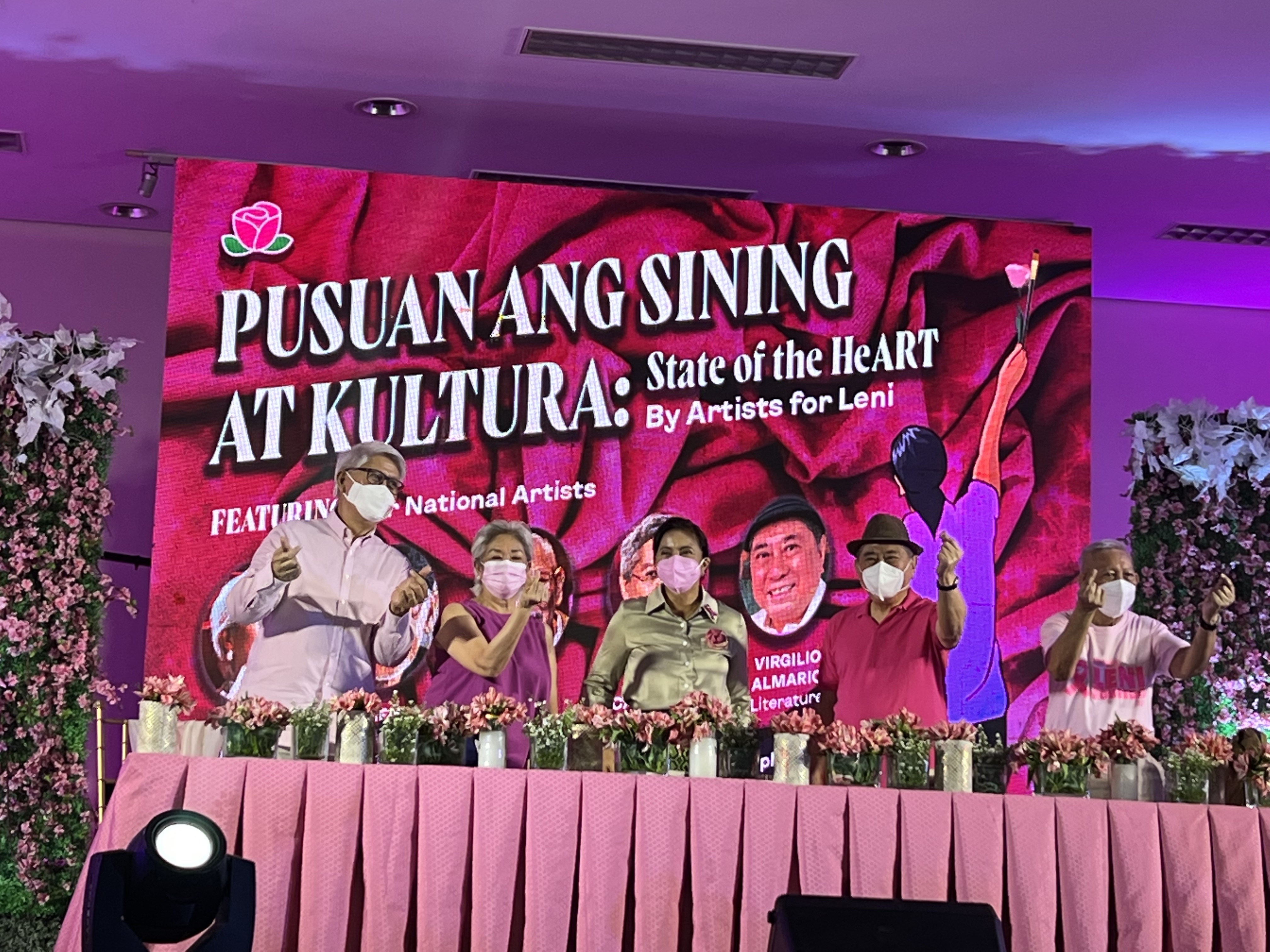
Frankly Leni’s hand sign remains a bit of a mystery to me, and I haven’t seen one from the boxer and the police general. At any rate I doubt this election will be won with carpal contortions. After all, there are only so many things you can do with your fingers, and the Vulcan “Live long and prosper” hand salute is difficult enough to master.

The fight, as everyone says, has gone to the Internet and the airwaves, and while we may like to believe that everything has changed in half a century, the very players on the field tell us they haven’t—only the lights and the loudspeakers have. So now, as ever, truth, reason, and justice will remain the underdogs, and those who root and clap for the jokers will end up getting their pockets picked.

(Photo from asiatimes.com)