Flotsam & Jetsam No. 9: Confessions of a Fish

For Esquire Magazine / July 2012

THERE’S A saying among poker players that if you can’t figure out who the fish is at your table within the first half-hour, then the fish is you. The fish is, of course, the prey in the ocean, regular lunch fare for the sharks, the poker player who’ll go all-in on a pair of Queens because they’re the best hand he’s had all evening despite an Ace and a King showing on the table.

But let’s make this easy without having to wait for 29 more minutes: I’ll admit it, I’m a fish, 90 percent of the time. I go into a poker game not really to win—though I’ll be happy if I do, and thank you very much—but to play cards, which can be very different from playing to win. How so?

First of all, let’s define what winning in poker is. Logically speaking, winning is a positive outcome—literally, a result at the end of the day that yields you a bigger bankroll than you started out with. If you’re a poker pro, which I’m certainly not, this can be your only definition of winning: going home with even just a couple of thousand pesos more in your pocket, whether from a tournament or a cash game, after having risked, say, anywhere between P5,000 and P10,000 in play.

For fish like me, winning is less an outcome than a moment—a surge of adrenalin, a flood of endorphins—that can pass very quickly, but is a high well worth buying. It’s the high you get when you hit your flush or your inside straight on the river, busting your cocky opponent’s three Aces or two pair. Never mind that that rush is followed by a long, slow slide back into the doldrums, and that you’ll be driving home in the wee hours many thousands of pesos poorer. All a fish has to do is to remember that instant—that look of utter horror and disgust on the other guy’s face—and all the pain of losing fades away, like dirty water down a drain.

A “grinder” or a “rounder”—someone who’ll play hundreds of hands in a day, on the felt table or online, just to come out with a little more than what he would’ve made driving a cab or flipping burgers or calming down irate Texans from a call-center cubicle—can’t afford that kind of drama. That’s one way of spotting the pros: they’ll fold pocket Kings when they have to with the faintest cluck of the tongue, almost as easily as if they’d been holding a Seven-Deuce.

Like you might have noticed, I observe my fellow players a lot. That’s my official excuse for spending 16-hour binges at the tables—typically checking in after lunch and playing in the 2:30 tournament, busting out by 6 pm, signing up for the 7 pm tournament, and again busting out by midnight, just a few places short of finishing in the money, and staying on at the cash tables until 5 am, when UP’s gates open and I can drive home with a little back massage from the rosy fingers of dawn. I’m writing a novel with a poker player in it—a call center fellow whose wife has been sleeping with her boss and whose only consolation, if you can call it that, is the draw of the cards and the gambler’s unflinching conviction that, one inevitable day, he’s going to strike it rich. Throw in a messy love story—a cute dealer with a thuggish boyfriend—and you have a novel.

So I’ve been taking notes about the game and its practitioners, in between throwaway hands. Seriously: I get a lot of writing done over those stretches, and it used to be easier when I was using a BlackBerry instead of an iPhone. I sit at the tables for so long that I have to bring an extended battery for use from about 2 am onwards, and I wouldn’t have traded the BlackBerry for the iPhone’s crappy battery life if I didn’t need to surf and look up my eBay bids while playing (more fish tells: impatience, distraction).

And so I dutifully observe the comings and goings of the cross-dressing diva whose girlish giggles disguise a strong, solid game; the starlet whose privates I’d met in a sex video before I met the rest of her; the loudmouthed balikbayan cursing the last card, or the “river”; the dealer bouncing back from pregnancy to another kind of succulence; the masseuse in hospital scrubs kneading a bare, shiny back as large and as dark as Africa. They used to play “Pokerface” to death on the PA but that’s been replaced by B.O.B.: “Beautiful girls all over the world I could be chasing but my time would be wasted….” How could I be wasting my time when I’m meeting people and learning songs like these? Never mind that any dude my age is addressed as “Daddy” or “Tatang” at the tables; put on shades, a hoodie, and Sennheisers, and you’ll feel 30 years younger.

I’ve written down lines like “The ceaseless murmur of chips sounds like a forest of crickets” and “There’s nothing more cruel than the indifference of cards” and “The dealer’s fingers darted like a skittish crab across the felt, picking up chips at every stop” (let’s add this for the wannabe Hemingways out there: copyright, Butch Dalisay, 2012). I’d like to think that, one of these days, those lines will turn like Moses’ snake—whapak!—into a novel that will win a prize that will recoup all my losses from all those donkey calls.

Ah, the donkey. Anatomically and taxonomically, donkeys have very little to do with fish, but in poker, they might as well be the same animal. The donkey will make a bad call holding an insufferably bad hand—something like a Three and a Seven off-suit—in the deathless hope that the flop, the first three community cards, will be Four, Five, and Six. And you know what? Sometimes it happens. And that’s what the donkey-fish lives for, to the dismay of the pros, who also have an attitude problem of their own, to the effect that “Unless you’re holding at least an Ace-King, you have no right to call my pocket Queens.”

As for the cards themselves, I’ve seen and had them all: a royal flush (three times), an Ace-high flush beaten by a one-outer straight flush (my best hand ever), a four-of-a-kind beaten by a straight flush (my worst hand ever). In the middle of a boring meeting at the English department, I run these games through my head like YouTube videos, savoring every flip of the cards, almost forgetting that, in many cases, I was on the losing end.

That’s why I’m a fish. I’m here for the endorphins, and they don’t come cheap.

(Photo courtesy of pilipinaspoker.com)

Penman No. 12: Singapore’s Cultural Renaissance (2)

Penman for Monday, Sept. 10, 2012

ANYONE WHO doubts that Singapore is going through a cultural renaissance just has to drop by places like the Goodman Arts Center, the Arts House, the National Library Board building, and any one of the many museums that have sprung up around the city-state city-state celebrating everything from historical heritage to biodiversity and toys.

On a recent media visit to Singapore, I was shown by my hosts from the National Arts Council around many of these cultural hotspots, and they offered a wealth of insights into contemporary Singaporean society and its concerns.

Housed in what used to be a school run by the La Salle Brothers, the  seven-hectare Goodman Arts Center in the Mounbatten district opened last year and has quickly become Singapore’s largest arts enclave, serving as a studio, meeting place, and performance venue for both local and international artists. Studios in the GAC are generously subsidized by the government, and “There’s a long waiting line of artists wanting to use the center,” said Evan Hwong of The Old Parliament House Ltd., which manages the GAC.

Being a complex of converted school buildings, there is nothing particularly impressive about the GAC on the outside; but open one of the many doors and instantly a world of artistic creation meets the eye and swarms the senses. During our visit, we encountered Jerry Hinds, an expat Briton who’s helping young Singaporean cartoonists sharpen their skills not just in terms of drawing but also in sharpening their narratives; Iskander, a longtime transplant from the Netherlands, who’s working to help people see comics not just as entertainment but also as an art form; Sonny Liew, Malaysian-born but Singapore-based, who’s already drawn for Marvel Comics; Japanese artist Eriko Hirashima, who’s turning books into art objects in themselves; and Singaporean copywriter Amanda Lee and artist Winnie Goh, whose Studio Kaleido explores crossovers between visual and literary art.

Not only professional artists are welcome at the GAC. Ongoing at the GAC this month and open to the public are a batik painting workshop, a professional singing course in Mandarin, and classes in contemporary dance, hot glass bead-making, bookmaking, and pottery, among others.

Theater has always been particularly strong and popular in Singapore, and performance venues abound, such as the landmark durian-shaped Esplanade, the elegant Arts House at the Old Parliament Building along the river, and the Drama Theater of the School of the Arts.

We had a special encounter with an icon of Singaporean theater, the playwright and novelist Stella Kon, at the Peranakan Museum which had dedicated an exhibit to her play Emily of Emerald Hill, much performed and beloved of generations of Singaporeans since it debuted in 1982. Although born in Edinburgh (she later reacquired Singaporean citizenship), Stella is of Peranakan origins, referring mainly to the Chinese who settled centuries ago in certain places around the Straits of Malacca, particularly in Penang, Melaka, and Singapore. The Peranakans have contributed richly to the economy, culture, and cuisine of their host countries; most outsiders will recognize, for example, the sarong kabaya immortalized by the TV ad’s “Singapore girl,” a stylized version of traditional Peranakan dress.

Emily of Emerald Hill is a long dramatic monologue in English (most recently and brilliantly performed by the cross-dressing Ivan Heng) that takes the audience through the colorful life of Emily Gan, who rises from poor Peranakan girl to powerful matriarch. It’s a sad story but one that has resonated powerfully with its viewers (it’s being taught here in the Philippines by Dr. Lily Rose Tope, our new departmental chair in UP, in her Southeast Asian literature class), and it’s too bad that we didn’t get to see the play, but meeting the author herself as we walked through the Peranakan Museum was a special treat. “It used to be that being Peranakan was something of a disadvantage,” said Stella, “but today’s it’s become chic.”

The stories of the Peranakan—and much more—are lodged in the National Library of Singapore on Victoria Street, a breathtakingly modern building whose collections comprise not only the traditional hardbacks but a growing library of digitized e-books as well. (Just how far ahead Singapore is in the digital game struck me when I overheard someone mention a “Donate your old iPad” campaign being undertaken there for the use of schoolchildren.) “We don’t actually keep all that many books here,” a reference librarian told me, “because they’re sent out to the public libraries.” In other words, Singaporeans are busy reading. The National Library Board also runs a vigorous publishing program, and its products—such as an annotated bibliography of contemporary Singaporean literature in English—are available for free to anyone interested. The library’s collections are searchable online. At the time we visited, a large and groundbreaking exhibit featuring the letters of Singapore’s colonial founding father, Sir Stamford Raffles, was just about to open; there was also an exhibit upstairs of the personal memorabilia and writing tools (the pens were of particular interest to me) of some of Singapore’s most prominent writers. And here’s a travel tip: the best view of Singapore’s skyline can be had at the National Library’s Pod venue, open by special arrangement.

We ended our visit with dinner and music at Timbre at the Arts House, a bar and restaurant along the breezy riverfront operated by a group led by Danny Loong. Danny was himself a musician but has moved on to become one of Singapore’s leading arts managers and music entrepreneurs. (Danny told me that he was due to fly to Manila soon to judge at a blues-band competition; he’s also brought some Pinoy bands over to Singapore.) The music scene in Singapore was varied and dynamic, Danny told us—and we could hear that for ourselves, as a local trio essayed Bon Jovi on acoustic guitars. Some years ago, a Singaporean rap tune called “Why You So Like Dat?”—in Singlish, of course—was a big hit on the airwaves, and you can still catch it on YouTube. A message on the TV monitors at Timbre reminded the audience that they could send in their dedications to one another via SMS. It was a Monday, just the start of the work week, but the young Singaporeans around us were clearly enjoying themselves—and the great food and wide range of beers—at prices that weren’t going to bust anyone’s wallet.

It’s this kind of popular enthusiasm that Singapore’s cultural planners want to tap into, toward the creation of even more original material that would engage Singaporeans of all ages and levels. There’s a master plan behind all this, and it’s contained in the recently released Final Report of the Arts and Culture Strategic Review, which noted among others that “Since 1988, our cultural vibrancy has increased exponentially, with activities rising almost twenty-fold. Local audiences now have a year-round selection of festivals, fairs, events and activities to choose from. Demand for arts and culture has kept pace with vibrancy, with ticketed attendances and museum visitorship rising three-fold and eight-fold respectively.”

The review is a very detailed plan that our own cultural poobahs can learn a thing or two from—such a streamlining funding requirements for the arts (the NCCA, bound by COA procedures, makes our artists go through hoops of fire for the simplest things). And it should be noted that Singapore’s National Arts Council is backstopped by its Ministry of Culture, Community, and Youth—leaving us, again and parochially, one of the few large Asian countries without a Department of Culture to spearhead these initiatives at the highest levels of government.

On a more personal note, I was happy to be able to indulge myself this last visit in some of my favorite Singapore pastimes—feasting on the chicken rice at the Kopitiam, looking for bargains at the Sunday flea market on Sungei Road, and ducking into the Aesthetic Bay pen shop at ION Orchard for a bottle of ink. On my last morning walk, I stumbled serendipitously into a sidestreet that led me to Emerald Hill, the setting of that fabled play.

And even in Singapore’s smallest corners I found a Pinoy connection. Chatting with Kenny Leck, the owner of Books Actually (who publishes handsome little poetry chapbooks under the Math Paper Press imprint), I discovered that a Filipino poet—my old student and beer buddy Joel Toledo—lived just across the street in Tiong Bahru. Joel’s in Singapore to do his PhD, and has begun to make his mark there, with his Ruins and Reconstructions sitting on the same shelf alongside the works of Alvin Pang, Edwin Thumboo, and Kirpal Singh. I flipped through a copy of the Asia Literary Review in the bookshop, and found contributions by the Ateneo poet Anne Carly Abad and the Leyte-based poet Michael Carlo Villas. One way or another—and let’s not forget the forthcoming Singapore Literary Festival in November—Filipinos will figure in Singapore’s cultural reawakening.

Penman No. 11: Singapore’s Cultural Renaissance (1)

Penman for Monday, Sept. 3, 2012

I’VE BEEN to Singapore many times since my first visit in 1983—almost yearly, in fact, since 2008—but I don’t think I understood and appreciated the place as much as I did when I flew in again last weekend to cover the launch of this year’s Singapore Writers Festival. What I found was not only a vibrant writing and publishing scene, barely mindful of the censorship we instinctively associate with that city-state, but also an explosion of artistic talent in fields as diverse as cartooning, music, and theater. This week I’m going to report on the SWF and writing in Singapore, and next week I’ll talk about the other arts.

For Filipinos more accustomed to thinking about Singapore as a place for upscale shopping and high finance, the notion of “Singaporean culture and arts”may seem a strange one. Singapore, we’ve assumed, just buys and borrows someone else’s art. Indeed, thirty years ago, Singaporean writers were humble enough to acknowledge the fact that they had a lot of catching up to do. In his introduction to 1983’s Stories from Singapore, George Fernandez observed that “Multiracial Singapore is in the throes of evolving a national literature. In this field of national literature in English we are certainly only a fledgling, and we have much to learn from the older and more experienced countries like the Philippines and India.”

That was then. Today, the reality is that—thanks to substantial government support and to a newfound confidence among Singaporean writers and artists—Singapore has become a major cultural hub in Southeast Asia, attracting international talent while nurturing its own.

The Singapore Writers Festival—whose 15th edition will run from November 2 to 11—is a case in point. Formerly held every two years, its organizers have seen fit to turn the SWF into an annual event, bringing it up to the level of other regional events such as the Sydney Writers Festival and the Hong Kong International Literary Festival.

I was a participant in last year’s SWF, engaged in a very lively conversation with the British playwright and novelist Caryl Phillips, but it was different to be going backstage this time and to watch the event being set up. The festival was being launched more than two months in advance to start generating publicity and ticket sales, but our small press group (which included Susan Wyndham of the Sydney Morning Herald and Parisa Pichitmarn of the Bangkok Post) was treated to a preview of the kind of talent to expect at the festival itself, and to an introduction to the Singapore book scene.

Before we even met the authors, we met the books—and a familiar authorial accessory, beer. “Books & Beer” is a regular event that takes place around Singapore at different venues, and this time it was at Lil Papas Wieners Bistro at Tanjong Pagar Plaza, right next to the central business district. Aside from selling a mindboggling variety of craft beers from all over the world, Lil Papa’s features a revolving library operating on a simple principle: bring a book, and take one home. The crowd is decidedly young, but the books on the shelves go beyond perennial favorites Neil Gaiman, Haruki Murakami, and Alex Garland to include Anthony Burgess, John Fowles, and John Le Carre.

At Select Books on Armenian Street, we sat down with a group of Singaporean or Singapore-based writers—Hadijah Rahmat, who writes poetry and fiction in Malay; KTM Iqbal, a Tamil poet; Chow Teck Seng, a poet and fictionist in Chinese; Shamini Flint, an ex-lawyer from Malaysia whose crime mysteries and children’s books in English have sold over 500,000 copies since she began writing six years ago; and Neil Humphreys, a British humorist who has made Singapore his home and whose most recent book, Return to a Sexy Island, recently made Singapore’s bestseller list.

The multiracial composition of the group couldn’t have been more Singaporean, representing the four official languages (English, Malay, Chinese, and Tamil) and the experiences—both pluses and minuses—as well of each of these writers and the language they wrote in. Not surprisingly, Neil and Shamini found it easiest to break through to a larger market—Neil had just returned from a book launch in Malaysia—but even so, barriers remain. “I found that my publishers were much more interested in book with no Asian content,” said the eminently adaptable Shamini, whose books have gone as far as South Africa. Chow Teck Seng saw a way out of the madding crowd by publishing his poems with photographs and other catchy graphics that seem to have clicked with younger readers.

I was both relieved and distressed to find that Singaporean and Filipino authors had much in common. Books are expensive in Singapore, averaging about S$17 (almost P600) for paperbacks and $30 for hardbacks. With a population of 6 million, the market is inherently small. Translation grants—vital in a multiracial, multilingual society—are new and few. “We don’t read each other” was a lament I heard more than once, particularly across the linguistic divide. With the exception of Neil and Shamini, most local writers still need to keep day jobs, usually as teachers.

As for taboos and political no-no’s, they’re still in place—writing too pointedly about race and religion could land you in the hot seat, and Salman Rushdie’s Satanic Verses is still officially banned—but Singaporean writers have learned to test and push the limits. Humphrey’s solution is humor—lots of it. “I’m known as the foreigner who whacks Singapore and survives,” he said. “Regulation encourages creativity,” another writer told me. An anti-homosexuality statute is still in the books, but that hasn’t stopped Jee Leong Koh from writing and publishing overtly gay poetry. And sometimes the poetry comes from people you least expect to write poems, especially traditional sonnets, such as Joshua Ip—the pseudonym of a major in the Singaporean army—whose Sonnets from Singlish has been gaining some traction in the bookshops.

Speaking of book stores, there are around 40 of them in Singapore, including a few prized “indie” bookshops such as Select and Books Actually. The recent global closure of Border’s was a big letdown for book buyers, but old reliables like Kinokuniya are still operating, and even sell some local literature.

There’s a palpable sense of a cultural and literary renaissance in the place, and the forthcoming SWF will be sure to project Singapore’s cultural vitality even more strongly, with Pulitzer prizewinner Michael Cunningham (The Hours), travel essayist Pico Iyer, and Man Asian prizewinner Shin Kyung-Sook leading an impressive list of literary luminaries in attendance (including our own novelist Charlson Ong). All in all, the SWF will feature 138 local and 46 international writers in 200 events spanning ten days.

“And for the first time, we’re having a festival fringe focused on the origins of desire and sexuality in literature,” said the young and energetic festival director Paul Tan, from the National Arts Council. The staid riverside Arts House, which used to be the parliament building, will be hosting dicsussions on (surprise, surprise) 50 Shades of Grey and burning questions like “Do women write better sex?” and “Can you be a feminist and still enjoy women’s magazines?”

If only for that, it should be worth booking a visit to Singapore between November 2 and 11.

Penman No. 10: Laurels for the Lyceum

Penman for Monday, August 27, 2012

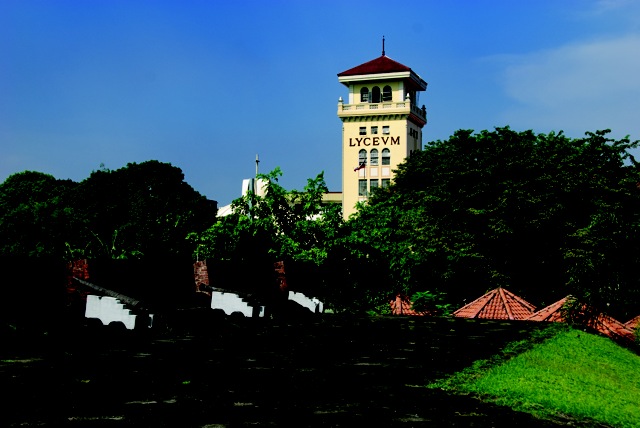
LAST JULY, a school that has done more for Philippine education and public leadership than most Filipinos realize quietly celebrated its 60th anniversary. Tucked away in a corner of old Intramuros, the Lyceum of the Philippines University—known to generations of Manileños simply as the Lyceum—may seem to outsiders to be just one of the many private colleges and universities that sprang up in the metropolis in the 20th century and managed to stagger into the 21st, dazed and confused by the challenges of globalization and the daunting economics of higher education.

Not quite. Today, the LPU is a progressive six-campus university system, with full-grown offshoots in Batangas, Laguna, and Cavite, and a law school in Makati. Its original and main campus in Manila is home to 13,500 students who are enjoying the benefit of an education anchored squarely on one foot in the classical tradition and, on the other, in new, responsive programs designed to give them an advantage in today’s economy.

I rediscovered the Lyceum in the course of writing the biography of the Lyceum’s longtime president and moving spirit, the late Sen. Sotero H. “Teroy” Laurel, the son of the school’s founder, former President Jose P. Laurel.

There’s no question that the bigger, better-known schools—UP, Ateneo, La Salle, and UST, in particular—dominate Philippine higher education and the preferences of Filipino parents and their wards. These are universities that have produced most of our presidents and heroes, big-name artists and athletes, cutting-edge scientists, business tycoons, and government leaders. They have traditionally catered to, and have also helped to form and strengthen, the Philippines’ intellectual and economic elite. And need we add that these schools, their titanic rivalries, and their alumni (both illustrious and otherwise) hog the media’s attention.

But what we don’t appreciate as much is the fact that so many more of us went to smaller schools that have also offered a good and (importantly to many) an affordable, accessible education that prepared our young people well for productive and gainful lives.

This was the vision of former President Laurel when, close to retiring from a long career in government and politics, he thought of setting up what he called “an Alexandria for the masses,” drawing its name from Aristotle’s school, the lykeion. In a book that he wrote around the same time, Laurel lamented: “How can our schools develop moral character among the young, when the schools themselves have become the centers of shocking scandals in such matters as the procurement of supplies, the selection of textbooks, or in the case of private education, the diploma mills? And where will both teachers and pupils get the inspiration for developing moral character, when they see all around them high officials who have been involved in all sorts of irregularities?

“… The truth is, the wonderful institution established by mankind, known as education, can have only one function and this is the pursuit, in the words of our Mabini, of truth, honor and justice. It can have only one sublime and overriding purpose: the recognition and dignification of the human personality.”

The “old man” Laurel, as was often called, was well positioned and prepared to assume the academic mission that his fellow Tanaueño, Mabini, had effectively bequeathed to him. He himself had a prodigious intellect, capped by a doctorate in law from Yale and honed in service with all three branches of the government—as senator, Associate Justice of the Supreme Court, and Justice Secretary—before his service as wartime president.

The Lyceum opened in July 1952 on a 1.3-hectare lot that used to be the site of the old San Juan de Dios Hospital in Intramuros, acquired for the family by Laurel’s indefatigable wife Paciencia. Teroy Laurel, who had returned from his studies in the US and who was running a law practice with his good friend and compadre Jovito “Jovy” Salonga, joined the school as his father’s executive secretary, perhaps little knowing then that the Lyceum would be the great labor and crowning glory of his own life, apart from his work in the 1971 Constitutional Convention and the Cory-era Senate.

“Jovy used to tell me that he and Teroy would go to Intramuros in the evenings to watch the construction of the school. Jovito was, I believe, the one who drew up the corporation papers, as his line was corporate law,” says Teroy’s widow Lorna.

The new Lyceum may have been a tiny school compared to its well-established neighbors, but it had one thing going for it, something that the Laurel name (the wartime charges of collaboration—eloquently disputed by Salonga, who had suffered torture under the Japanese—notwithstanding) was able to invite: prestige. As I note in my forthcoming book, “The new school had assembled the most formidable array of legal luminaries that one could put together in the Philippines at that time. These were men who would lend their names to Manila’s major streets after their time. Jose P. Laurel was the school president, the dean of the law school was Claro M. Recto, and on the Lyceum faculty were such men as Law Vice-Dean Ambrosio Padilla, Sen. Pedro Sabido, Jorge Vargas, Leon Guinto, Eusebio Lopez, Ramon Avanceña, Aguedo Agbayani, Justo Albert, Isagani Cruz, Marcos Herras, Neptali Gonzales, Roberto Concepcion, Arturo Tolentino, and Gil Puyat—men who had been or would become senators, congressmen, mayors, Cabinet secretaries, and Justices of the Supreme Court.”

Not surprisingly, the law school became one of the Lyceum’s bastions. This was accompanied by very strong programs in Journalism, Foreign Service, and Political Science, with the likes of Jose Lansang Sr., Francisco Lava, Emmanuel Yap, and Jose Ma. Sison on the faculty roster. They instructed and inspired a generation of young nationalists who included Journalism majors Satur Ocampo and Tony Zumel.

The Lyceum would go on to produce a veritable rainbow of luminaries including at least 17 ambassadors and eight Justices, three generals, three senators (Jinggoy Estrada, Ernesto Herrera, Panfilo Lacson), Speaker Sonny Belmonte, Gov. Grace Padaca and three other governors, media men Isagani Yambot, Fred Gabot, Gus Abelgas, Gerry Baja, and Deo Macalma, actor Cesar Montano, film director Joel Lamangan, Philamlife president Rodrigo de los Reyes, and education advocate Milwida Guevara, among many others.

New offerings in such areas as Hotel and Restaurant Management, Computer Science, and (in its Batangas campus) Robotics and Digital Animation and Marine Transportation keep revitalizing the traditional curriculum and assure the Lyceum’s continuing responsiveness to the times.Today, Teroy’s eldest son Bobby is on top of LPU-Manila as its president, assisted by his sister Sallie. Under the watchful eye of their mother Lorna, most of the other Laurel siblings—notably Peter, who serves as president of LPU-Batangas—are also involved in this unique family enterprise, proving themselves worthy of their father’s and grandfather’s name, and giving thousands of young Filipinos a fighting chance for a better future.


Penman No. 9: Battling the Big D

Penman for Monday, August 20, 2012

I USED to boast to friends that I could (and did) eat whatever I wanted with gay abandon—lechon, crispy pata, chicharon, fried chicken, and generally anything that once wagged a tail. I guzzled three bottles of Coke a day, slurped one (or two) cups of ice cream, and feasted on chocolate cake like a condemned prisoner. My excuse was that, by all indications, my side of the family wasn’t genetically predisposed to hypertension and all that jazz, and my last exams didn’t show anything worth worrying about. Sure, I had attacks of gout once or twice a year, and sure, I was overweight by at least 30 pounds—but these minor annoyances weren’t going to kill me, were they? I went back to the buffet table and piled on the pancit.

Not anymore. Two months ago, I was diagnosed with Type 2 diabetes—thanks to my mom, who’d developed the same condition late in life and who badgered me to let her test me with her kit, and to Beng, who dragged me to the doctor for a proper check-up and a talking to. The diagnosis confirmed that I was now in the exalted company of Ernest Hemingway, Mario Puzo, H. G. Wells, Elvis Presley, Thomas Edison, Ella Fitzgerald, Andrew Lloyd Webber, Neil Young, Sharon Stone, Elizabeth Taylor, Mae West, and Gary Valenciano.

Of course I knew something like this was coming. Guys who think they’re so smart will typically predict the future then do absolutely nothing about it, being less interested in the outcomes than in their prescience. In other words, we’re masters of denial, especially when it comes to our own bodies, which we think are the same ones we messed around with when we were 25, give or take a few (dozen) pounds. Of course I’d read up on diabetes long before I heard the word from my doctor’s mouth. Of course I knew that diabetes was a serious disease—at least for other people.

What jolted me into confronting cold reality were the figures that turned up on my mom’s tiny tester—three-digit figures that, no matter how I finessed the argument, kept telling me that “You’re going to lose your toes and die a slow, horrible death—unless you do something about it, now!” Guys will believe blinking statistics before they believe their wives, so those figures hit home, and hit hard.

That grim refrain kept running through my mind as my good doctor walked me through what I already knew but never quite believed was going on inside me—things about glucose and insulin and aerobic-this and Metformin-that. “Studies have shown that the best way to deal with Type 2 diabetes isn’t just medication, but a combination of a healthy diet, daily exercise, and Metformin,” my doctor intoned. Glancing up from my lab test results to my spillover gut, he added, “In other words, Professor, you need to undergo a complete lifestyle change if you want to lick diabetes before it licks you.”

Those were the words I both dreaded and wanted to hear. A gauntlet thrown, a clarion call, a battlecry—or, to put it plainly, a death threat.

I respond well to death threats. I scare easily, so this was exactly what I needed—a push over the railing, but a lifeline at the same time. “First of all, you need to lose weight—at least one pound a week.” The receptionist had weighed me before I stepped in for my consultation and I was entering the ring against the Big D at 218 pounds. There was going to be a requiem for a heavyweight if I didn’t watch it.

In a sense, getting diagnosed with diabetes was a relief. Ever since I turned the corner at 50, I’d always wondered what it was that was going to drag me down in a fight to the finish. A lot of worse things could still happen, but it was good to have a nemesis with a name that I could focus on and use as a reason for that “complete lifestyle change” I suppose I’d been secretly wishing for, but just never found the excuse to undergo.

About seven years ago, I’d lost nearly 40 pounds over several months just playing badminton, and that was the last time I could see clear to my toes without bending over. The badminton stopped—the victim of a long cold spell in the American Midwest, where I went as an exchange professor—and the starches, the fats, and the Coke began piling up again in my midsection, deciding that I was too cozy a host to vacate. My waist size ballooned from the mid-30s to 40, generously measured below the bulge.

The doctor wrote me a prescription and orders for all kinds of blood exams, with instructions to return for another consultation two months hence. I walked out of that clinic brimming with resolve. This was going to be something personal, something very personal, between me and, well, me.

If you’re looking for an ironic twist to this story, there isn’t any—yet. Those two months are nearly up and, much to my own surprise, I’m happy to report so far, so good. From 218 pounds, I’m down to 202—I even hit 199 one glorious day after walking 10 kilometers. I walk at least 30 minutes or 3 kilometers a day rain or shine (I’m probably the only guy you’ll see around the UP Oval toting an umbrella), and my walking shoes now go everywhere with me, like they recently did in Hong Kong even when a typhoon was blowing. I’m looking forward to losing another 10 to 15 pounds before the year is over.

Best of all, I seem to have tamed my prodigious appetite. I’ve survived—nay, thrived—on a diet of breakfast cereal, fish, kangkong, brown rice, lettuce, fruits, and the occasional slice of lean meat and cup of no-sugar-added ice cream. In two months I’ve had no more than three glasses of Coke, and only when I absolutely needed to. I keep a candybar in my bag or pocket in case I feel hypoglycemic (unfortunately, unlike our former Chief Justice, my diabetes doesn’t come with a huge dollar account), but so far it’s remained unopened. Lots of water, and again, lots of walking.

I haven’t become a health nut or an exercise freak; I certainly have no intentions of wagging my finger at other people, telling them to do this and not to eat that—something I’ve always hated being done to me. I’m just offering up this testimonial, for the benefit of all my fellow fat cats out there approaching their seniorhood, to the effect that sometimes the best thing you can get, before it’s too late, is a bad diagnosis. And never mind, for now, the glitter and the cash of the big literary prizes; the only figures I want to see are small ones—on my bathroom scales and on my glucose meter. I’m going to do my darnedest best to make sure that, when I croak, it won’t be because of the Big D.

(Photo from http://3.bp.blogspot.com)

Penman No. 8: A Hotel with a View

Penman for Monday, August 13, 2012

A MONTH ago, I was invited out to lunch by Bobby Laurel and his sister Sallie Laurel-Lopez, who both help manage the Lyceum of the Philippines University which was established by their grandfather, the late President Jose P. Laurel, Sr., in Intramuros 60 years ago. I’m writing a biography of Bobby’s and Sallie’s father, the late Sen. Sotero “Teroy” Laurel, and we’d set up the lunch to interview some old Laurel family friends.

The interviews went well, as I’d expected. What came as a pleasant surprise was the venue for our lunch—the Bayleaf Hotel, specifically its 9 Spoons restaurant on the 9th floor. Bayleaf is just a few steps away from the main LPU campus. Externally, the nine-story building blends in with the Spanish colonial architecture of the district; it was an old building acquired from the Licaros family, and subsequently and brilliantly renovated by TI Vasquez Architects & Planners. Its interiors and amenities couldn’t be more modern, with five function rooms that can accommodate up to 500 people, and large LCD TVs and wi-fi access all over the place.

I saw these rooms and the Bayleaf’s suites myself, having asked for a guided tour of the place after a sumptuous lunch at the 9 Spoons (so named after the nine children of Teroy and Lorna Laurel; and before I forget, the crowd favorite at the 9 Spoons lunch buffet—the crunchy bagnet—is to die for). The 57 rooms—which start at around P4,000 a night, including breakfast—are very smartly appointed.

On top—literally—of all these is the Bayleaf’s killer feature, which isn’t even in the building itself: the view. The Bayleaf’s roof deck offers a 360-degree view of Manila Bay, Intramuros, and has quickly become the hotel’s choicest spot. The weather permitting, you could do worse than sit here at sunset with friends, sharing a cold beer.

The Bayleaf’s facilities tie in neatly with the Lyceum’s offerings in Culinary Arts and Hospitality Management, among its strongest programs today (historically, the school had been known for its Law, Foreign Service, and Journalism programs). LPU President Bobby Laurel, however, clarified that “We’re running Bayleaf as a business first, and as a training ground second. I’d describe it as a 3-4-5 star hotel: 3-star price, 4-star amenities, 5-star service. We got the best people we could find to run it. This is going to be an investment, a learning experience that we can duplicate in the other campuses if we do it right.” An avid and talented amateur photographer, Bobby also did some of the pictures in the hotel and the Cioccolata coffee shop on the ground floor.

The next time you’re in Intramuros and feel like having a hearty lunch or a cool drink at day’s end, give Bayleaf a try. Better yet, stay overnight and enjoy the view. I never thought I could say this about a city whose infernal traffic and grime I’ve resigned myself to embracing, but from the Bayleaf’s roof deck, Manila never looked so good.

* * * * *

SPEAKING OF Manila, I don’t get my fellow Manileños who’ve been griping about how badly Manila was portrayed in The Bourne Legacy, with its visual emphasis on the city’s poorer districts. I wonder what they were expecting when the Bourne people came over and said they were going to shoot here. Greenery? Bonifacio High Street? They can get that more cheaply—miles and miles of it—in Southern California.

Of course Manila isn’t all poverty (don’t we know that, every time we ride or drive into one of its gated communities, leaving our pedestrian IDs at the guardhouse), and of course it isn’t fair to portray just one side of things. But movies aren’t about fairness, especially action thrillers with the singleminded purpose of pumping more adrenaline into your bloodstream. They’re about achieving a certain effect, a mood or a backdrop against which the plot can move forward without too many distractions.

If there’s anything to complain about in the movie, it’s how the plot—so rich and complex at the beginning—seems to peter out in the end, after the long and well-executed chase scene. I don’t mean this to be a spoiler, but this movie is begging for a sequel (as if it wasn’t already a sequel to a sequel). Since Jeremy Renner and Rachel Weisz—who turned in very creditable performances—have already sailed off into the sunset (and more literally than you think), I don’t imagine we’re going to see more of Manila in this franchise’s future. Time to hit the slums of Mumbai?

* * * * *

THE RECENT flood—all the more infuriating to many because it didn’t even have a name—reminded me of my own baptism as a reporter for the Philippines Herald back in 1972. I was 18, a freshman dropout who’d wangled his way into a reportorial job at a broadsheet, realizing the dream of my albeit brief lifetime.

I’d been with the Herald for just a few months writing mainly news features when what would be called the July-August floods of 1972 broke over our heads and turned Manila and much of Central Luzon into a giant bowl of mud soup, like Ondoy a month long. That truly was a downpour of biblical proportions.

I did some research at Public Works and realized that the flood plans for Central Luzon hadn’t been reviewed or revised since 1935. I wrote that story up, and got it into the front page—the first time anything I wrote was ever worth the front page, so I’ve kept the clipping to this day.

But more interesting things were in store for me. I reported for work one morning, only to be told to return that evening and to pack a change of clothes. I was going to be sent out on a Navy ship to cover relief operations in Pangasinan, which was still heavily flooded. The ship turned out to be an LST, a Landing Ship Tank, which seemed to me to be a large metal box floating on the ocean—that’s certainly what it felt like when we sailed in rough waters along the coast that night.

The next morning my photographer and I disembarked in Lingayen Gulf, wading into the water like an invading army, and plunged into the wettest excursion of my life. The US bases were still around, and the folks at Clark had sent a big rubber raft along, and I clambered aboard, half-reporter and half-flood victim, to get stories from the flood. We spent a cold night at the governor’s house amidst bags of relief goods, after I’d phoned in my story to a deskman who took it all down on a typewriter with the phone clenched between his cheek and shoulder (ever wonder how newsrooms worked before cellphones and email?).

The following day an American helicopter arrived, a Jolly Green Giant they might have been using in Vietnam, and we hopped aboard—not knowing that its next stop was Clark Air Force Base. Stepping out of the chopper—smoother than any plane I’d ever flown, although I hadn’t flown too many then—I saw and gawked at all those warbirds on the Clark tarmac and imagined for a minute what it would be like to be transported out of this infernal wetness into some place like California; but I settled for the chocolate cake at the commissary (another word added to my vocabulary).

Sunny California would come into my life eight years later. Back in the office the next day, the desk then sent me out to interview Mrs. Imelda Marcos in Malacañang about the Palace’s relief work. She met me in front of a mountain of Nutribuns. I don’t remember much of what she said—charmed witless, I suppose. What can I say? I was eighteen, with hardly a notion that, just a few weeks down the road, an even darker and longer storm was about to fall all over the islands.

Penman No. 7: Creative Writing in Hong Kong

Penman for Monday, August 6, 2012

I WAS honored a couple of weeks ago to be invited to visit the City University of Hong Kong to conduct a workshop for their graduate writing students and to give a reading before a gathering of some of Hong Kong’s brightest writing talents, students and teachers alike.

I’d been to CityU before—two years ago, I attended a literary conference there, then stayed on for the Hong Kong Literary Festival. Established only in 1984, CityU (I kept calling it CUHK, until I realized that these initials were already in use by the Chinese University of Hong Kong) has distinguished itself as one of Hong Kong’s most dynamic and modern campuses, oriented toward the world and the future. Aside from the more traditional disciplines, for example, it has a School of Creative Media which teaches everything from Animation to Computational Art and a newly opened School of Energy and Environment where students can specialize in Climate Science and Energy Technology, among others.

The focus on business and technology is hardly surprising in a place like Hong Kong. What struck me was its apparent bid to become a cultural leader in the region as well—and not just in things Chinese, but in areas dominated and nearly monopolized by Western centers of learning.

A case in point was the CityU program that brought me over—Asia’s first and, so far, only low-residency Master of Fine Arts in Creative Writing (MFA) program. Only in its third year, the program has already attracted many first-rate students and teachers from around Asia and much farther beyond.

At the program’s helm is Xu Xi, a gifted fictionist and essayist who’s the living example of hybridity—she’s Indonesian Chinese, was raised in Hong Kong, and took her MFA at the University of Massachusetts-Amherst. She teaches at Vermont College, but has taken time out to direct the writing program at CityU. Though she’s now an American citizen, Hong Kong is in Xu Xi’s blood and imagination, permeating her fiction. She’s become one of the prime movers of creative writing in the region; we were fellow finalists for the inaugural Man Asian Literary Prize in 2007, and she came over as a panelist at the Dumaguete Writers Workshop two years ago.

In setting up their program, Xu Xi and CityU were deftly capitalizing on Hong Kong’s strategic position as an entrepot attracting people from all over the world, with its large expat community and a new generation of Chinese students writing in English. CityU’s English department was built up and strengthened by the likes of language and literature expert Kingsley Bolton (who gave a wonderful lecture on how the Chinese learned and used English, when I was there) who, a few years ago, co-edited a book with Ma. Lourdes Bautista on Philippine English.

The MFA, of course, remains the global standard for advanced studies in creative writing. (In a radio interview, my fellow Distinguished Visiting Writer, the English novelist Jill Dawson, and I were asked the perennial question: “If Charles Dickens didn’t need an MFA to write his novels, why should anyone?” We answered just as predictably: “You don’t need the MFA to write a novel, but it helps you to focus on writing your novel in an age full of distractions, which Dickens didn’t have to deal with. Besides, if painting and music can be taught and learned, so can writing.”)

There are hundreds of MFA and MA Creative Writing programs around the world today—the MFA tends to be longer and more intensive, and is considered a terminal degree—causing us teachers of writing to ask in wonder and consternation: “Why do so many people want to be writers?” The MFA’s low-residency version has been a recent innovation, with Xu Xi’s Vermont College among the pioneers; there are now around 50 such programs in the US, but only CityU offers one with a distinctly Asian orientation.

Under such programs, students sign up for one-on-one distance mentoring with the program’s international teaching staff, recruited from among the world’s best writers (including our very own New York-based poet Luis Francia). Once a year, for about ten days during the Hong Kong summer, everyone gets together on the CityU campus in Kowloon Tong for a series of intensive day-long workshops with the majority of the faculty in attendance. Students are required to produce a creative thesis, a substantial body of work, and the program should be doable in two years. (Two Filipinos—Karla Delgado and Sheree Chua—are in the program; I also met students from the US, the UK, Australia, and, of course, Hong Kong and China.)

There are pluses and minuses to this kind of arrangement, but it’s clearly a boon to those who may otherwise be too busy or just don’t have the option of attending classes and workshops physically in a university, especially a foreign one. It’s less expensive than a traditional campus-based MFA—certainly less than a US or a UK degree—given that one needs to fly in to Hong Kong only occasionally. But Hong Kong being what it is, it’s by no means cheap, especially for Filipinos used to paying UP tuition fees. The costs aside, the international character of the program in terms of both its students and faculty is its strongest aspect, privileging, for once, an Asian sensibility over the usual Anglo-American bias in creative writing in English.

This was something we could’ve done at the University of the Philippines—we’ve had a 30-year lead over everyone else in the region, after all, in offering degrees in Creative Writing—but sadly we just don’t have the funds and the flexibility to attract the kind of international teaching staff you need for a program of this scale and orientation.

But thinking in terms of the region, CityU’s MFA program is a boost for Asian writing and teaching as a whole, the beginning of the reversal of a century-old paradigm where we learned to write in English only in and from the West.

Penman No. 6: The Two Helen Richeys

Penman for Monday, July 30, 2012

ONE OF the things that users and collectors of vintage items like fountain pens have to deal with is the fact that these objects were once owned by people who are now, to put it starkly, dead. Through some circuitous route, something that they once held and possibly cherished has come down to us, making its way halfway around the world and providing another lifetime of service and pleasure to its new owner.

Quite a number of the 100+ vintage pens in my collection have names inscribed on them. Since these pens come mainly from the 1930s and 1940s, and since a fountain pen (especially a gold-nibbed one as opposed to a “school pen” that kids like me learned to use in the 1950s and 1960s) would have been something that adults would have owned, it’s reasonable to assume that these names belonged to persons long gone.

Some collectors don’t like these inscriptions and engravings, seeing them as imperfections that drastically lower the monetary value of the objects they’re imprinted on. I strongly disagree. I take them as part of the pen’s provenance, a direct link to the man or woman who once held the pen in his or her hand—who wrote letters of love and joy or anger and sorrow, who signed checks that grew a business and cards that made someone’s day. Few things are more private and personal than a pen—it told your deepest secrets, and you can choose and customize a nib to write exactly the way you want it to.

When I started collecting pens thirty years ago, there was no Internet as we know it today, so there was no way short of spending hours poring over genealogical records to establish just who someone like “F. J. QUIRK”—the donor of my first Parker Vacumatic—was. By the time I got hold of a pen-and-pencil set of Parker Mandarin Duofolds belonging to “BLANCHE SAVIDGE” a few years ago, it took me only a few seconds to discover that Blanche had died at age 95 in December 2007; she had been a longtime teacher in her community in Pennsylvania, had never married, and was described as a “staunch Republican.” Or was she indeed my Blanche? Another Blanche Savidge, born ten years later in 1923, died in 2010 at the age of 87 in El Paso, Texas (curiously enough, she had also been an active Republican). The likelihood, of course, was that it was the Pennsylvania Blanche who owned my Duofolds, because I got them in November 2008, when the Texas Blanche was still alive.

This puzzle came to mind again a couple of weeks ago when I received a bunch of old pens from my sister Elaine in Virginia—pens I had picked up on eBay, with the idea of keeping a few and selling off the rest. One of the pens in the batch was a sweet little Sheaffer Balance in red-veined gray pearl and gold trim from 1934 (after you deal with these pens for a few years, you’ll know their names and birthdates by heart). I had expected something bigger—most of the time, you never really know when all you have on eBay are the pictures, with very little description—so I decided, to help recover my costs on the other pens, that this Sheaffer would go to the pile for sale, as pretty as it was.

Before posting it for sale, however, I gave in to my curiosity and Googled the name on the pen: HELEN RICHEY. The pen looked so fresh and the name was embossed so sharply in gold that it appeared that the pen had been used very little, if at all, these past 78 years. Assuming that Ms. Richey had been at least 20 when she received the pen—it was a high-end Sheaffer that a parent or a spouse might have given Helen on a graduation or a birthday—she would be approaching 100 today, were she alive.

What I found on Google and Wikipedia floored me. There were, inevitably, a number of Helen Richeys that appeared in the search, but at the top of the list were two—the first, an Australian dancer who still serves a judge on the Australian edition of Dancing with the Stars; scratch that one out. The other prominent Helen Richey was a pioneering woman aviator (or “aviatrix,” as they used to be called), the first woman to be hired as a commercial pilot by a US airline. Born in 1909, this Helen once partnered with Amelia Earhart in a transcontinental air race, finishing creditably, and was the first woman to carry mail by air and among the first to teach flying. Sadly her life and career took a tragic downturn: an all-male pilots’ union forced her out of the cockpit, and she committed suicide in 1947.

What an amazing life that was; what an education I’d had in just five minutes, and what an honor it would be if I had the flying Ms. Richey’s pen in my hand. The year this Sheaffer was made, 1934, was also the year Richey won the first national women’s air race in Pennsylvania, and the year she was hired by Central Airlines, a precursor of United. Might the Sheaffer have been a presentation gift, quickly put aside in her rush to return to the cockpit?

As fascinating as that scenario was, I then remembered that the pen came to me from a seller in Illinois, and so I Googled “Helen Richey Illinois”, and discovered yet another Helen Richey, a lady who had been born in Gerlaw, Illinois in 1919, and who had died in the area in February 2012. Suddenly it made more sense for her to be the pen’s Helen; I had bought the pen on eBay in May, a few months after her death, presumably as part of her estate. While she was no barnburner, this Helen had also lived a full life, working in a local school.

And that, I thought, was that—until I did some figuring and realized that the second Helen would have been only 15 when the pen came into the stores and into her purse; not impossible, but unlikely. Furthermore, this Helen had had two husbands—William Nicol and then John Richey—so that “Richey” was her second husband’s surname (John died in 1995). So she got the Sheaffer only after her second wedding; her eldest son George Nicol still lives in Texas and whose age is given by LinkedIn at around 60-64, putting his birthdate at between 1948 and 1952, suggesting that Helen didn’t get married until she was at least 28. Even if she was with William for only a few years before marrying John, she still would have had to be in her 30s—in the early 1950s—when she got the Sheaffer with John’s surname on it.

Given that the 1950s were flush with swanky new pen designs, why would anyone give a loved one, or even oneself, a pen from 1934? Was it possible, even vaguely, that the other, the airborne Helen, whose timeframe accounts much better for the pen, had some Illinois connection? I’ve yet to find out.

More strange connections exist: if this were the flyer’s pen, I’d give it to my son-in-law, who works in the aviation industry and who collects aviation memorabilia in San Diego, California, where a pictorial biography of Helen Richey can be found at the Air and Space Museum.

I’ll leave it to those with sharper genealogical skills and better resources to tease this mystery out. In any case, now that I know this much about both Helen Richeys, I’m keeping the pen, which has suddenly made a friend, across the years and miles, of perfect strangers.

 (Helen Richey’s photo from mckeesportheritage.org)

Penman No. 5: Encounters with History

Library

Penman for Monday, July 23, 2012

I HAD an unusual encounter with history last week, by way of two sorties to two different exhibits that turned out to have a bit more to do with each other than I might’ve initially thought.

The first trip was something I’d been meaning to do for years but just never came around to doing—a visit to the Presidential Museum and Library at Malacañan Palace. (Our tour guide took pains to point out that “Malacañan” referred specifically to the presidential seat of power and the more popular “Malacañang” to the entire place itself; I think we’ll go with Malacañang for the rest of this piece.)

It’s one of those sad ironies that we footloose Filipinos can make elaborate and expensive plans to visit the White House and Buckingham Palace without ever setting foot on our own presidential abode. It could be that for far too long—particularly all those years of martial law—Malacañang didn’t lend itself to friendly visitations by ordinary citizens. That, plus the fact that we Pinoys have never had much of a sense of history, beyond routine celebrations of Independence Day and tired if not tiresome commemorations of Edsa 1. We’ve been schooled to think of history as high drama, as a calendar of big events, forgetting that those events were forged in offices, classrooms, factories, and the shade of mango trees.

Malacañang is, of course, the perfect theater for high drama—one of the balconies in the museum was the setting for that famous picture of Ferdinand Marcos and his family vowing defiantly to stay and to fight on, shortly before decamping to America in February 1986—but it was also, and remains, home and office to a long succession of men and women who led the country, people doing nothing more earth-shattering on most days than signing letters of condolences and felicitations and proclamations declaring this or that period to be National Fire Prevention Week.

As a museum rat, I’ve always been fascinated by presidential and royal regalia, and by the mementoes left behind by the high and mighty—not to be awed by them, but to appreciate their humanity behind the pomp and the poses. George Washington’s signature blue coat is on display at the Smithsonian, but so are his dentures, which must have hurt far worse than mine, and I don’t even have to worry about putting a country together; the mock pockets on Jose Rizal’s jacket in Dapitan betray a sharp fashion sense even in exile (and the smallness of his body size—a surprise to many Filipinos expecting a titan of a hero—merely accentuates his real stature).

Last week, thanks to the invitation of Ronnie Geron—an undersecretary in the palace and an avid member of Fountain Pen Network-Philippines—our group of over 30 fountain-pen enthusiasts got to visit and tour the Presidential Museum and Library. Since fountain pens themselves are something of an anachronism, stepping back into presidential history was a treat for all of us, and we can’t be blamed for feeling that the highlight of the tour was staring at Emilio Aguinaldo’s pen, or what remained of it—a piece we quickly identified as being very likely a Waterman 52 in mottled red hard rubber (a sorry shell of a pen, in exchange for which I offered to provide a near-mint example from my collection—but no one seemed to be too interested).

There were no other pens to be found that day in the museum and library, but there were roomfuls of other memorabilia, from the time of the Spanish and American governors-general to the prewar, postwar, and recent presidents: photographs, paintings, clothes, books, furniture, documents, and campaign materials. Every president had either a room or a corner devoted to materials from his or her presidency, and our very knowledgeable guide—a young man named Louie—walked us through the history of every room, mindful that the building itself was historic, quite apart from its residents.

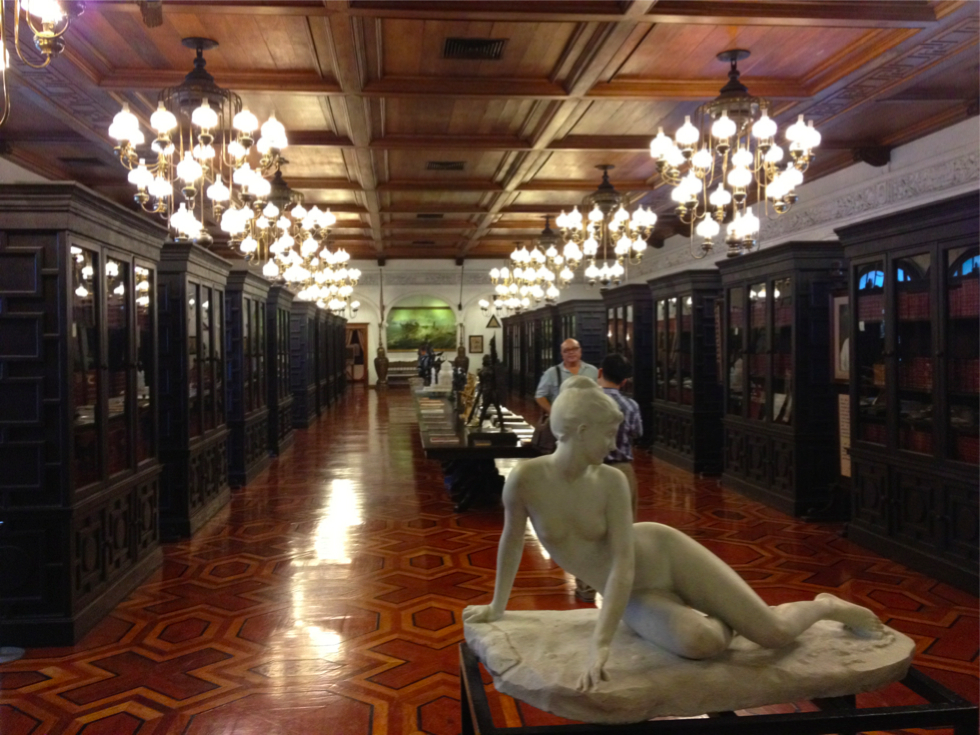
The museum and library are located in what is now known as Kalayaan Hall, a 1921 structure used by the Americans as their Executive Building; the Marcoses called it Maharlika Hall, but Cory Aquino gave it its present name. Aside from the Main Hall and Library (or the Gallery of Presidents), the building also contains the Old Waiting Room Gallery, with materials from the Spanish era; the Old Executive Secretary’s Office, with rare Rizaliana; the Old Governor-General’s Office, the Osmeña Cabinet Room, the West and East Staircases, the Quezon Executive Office, the Quirino Council of State Room, the Roxas Cabinet Room, and the Northeast and Southeast Galleries. Plan on spending at least an hour to see and imbibe everything.

What most Filipinos (including many of us) don’t know is that tours of the Presidential Museum and Library are available for a minimal fee to individuals or groups who make the necessary arrangements beforehand. (Call 784-4286 local 4945 or email pml@malacanang.gov.ph for details.) The entrance is through Gate 6, and parking can be had at the Freedom Park just outside the gates.

Another exhibit that I made a point of looking into was one at the Cultural Center of the Philippines Main Gallery, titled “ReCollection 1081: Clear and Present Danger (Visual Dissent on Martial Rule),” co-curated by Marika Constantino and Ruel Caasi, and staged by the CCP in cooperation with the Liongoren Gallery. ReCollection 1081 brings together a selection of artworks produced by Filipino artists during and after martial law, as well as publications produced by both the underground and alternative press.

Those who lived through martial law can’t possibly miss the irony of the exhibition venue—much hated and derided in Imelda Marcos’ time as the domain of the elite, but long since reclaimed by more ordinary folk.

This show was already written about by Constantino herself a few days ago here in the Star, so I’ll just have a few points to add—chiefly, that the artist’s protest against oppression, injustice, and exploitation both preceded and continued after martial law (see Jaime de Guzman’s Sabbath of the Witches, 1970, and Nunelucio Alvarado’s Tunok sa Dahon, 1986).

It was martial law, of course, that provoked both the most explicit and subtlest forms of protest, demanding both courage and wit of the artist, and this range of responses is on full display in the exhibit. Assembling these works was already a feat in itself, considering how many more such works (and their creators) have been lost in the crossfire. Their survival into another century and their installation in the cultural bastion of the dictatorship is sweet poetic justice.

ReCollection 1081 runs until September 30.