Qwertyman No. 173: A Page from 1937

Qwertyman for Monday, November 24, 2025
I”M NOT a historian, although there are times I wish I were, and at an early crossroads in my youth, I actually had to choose between Literature and History for my major, settling for the former only because I thought I could finish it faster. But I’ve retained a lifelong interest in history, for the treasure trove of stories to be found in the past and for what those stories might foretell of the future. 

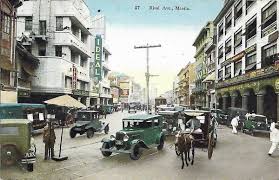
I’m particularly fascinated by the prewar period—what Filipinos of the midcentury looked back on as “peacetime” and what Carmen Guerrero Nakpil called our “fifty years in Hollywood,” which were enough to occlude much of the influence of our “three hundred fifty years in a convent” under the Spanish. It was an age of many transitions, from the jota to jazz, from the caruaje to the Chevrolet, from tradition to that liberative and all-embracing buzzword, the “modern.” Much of that went up in smoke during the Second World War, but you can still catch the ghost of this lost world on the Escolta, among other vestiges of our love-hate affair with America. (You might want to visit the Art Deco exhibition at the National Museum of Fine Arts, ongoing until May 2026; I have some items on display there.)

So entranced have I been by this time that I decided, during the pandemic, to set my third novel in it, at the birth of the Commonwealth and upon Quezon’s assumption of ultimate power, an upstairs-downstairs narrative about the comprador upper class and the world of the Manila Carnival set against the embers of the Sakdal uprising, the fuming and scheming Aguinaldistas, and the netherworld of printing-press Marxists and tranvia pickpockets. Progress has been slow because novels always take the back seat to life’s more pressing needs, but I still hope to get this done if it’s the last thing I do.

The research for the book, however, has brought its own rewards. Among my main sources for the background has been a slim volume—long out of print and now very  hard to find—titled The Radical Left on the Eve of War: A Political Memoir by James S. Allen (Quezon City: Foundation for Nationalist Studies, 1985). Allen (actually a pseudonym for Sol Auerbach) was an American scholar and journalist, an avowed Marxist who traveled to the Philippines in 1936 and 1938 with his wife Isabelle, also a member of the American Communist Party, to meet with local communists and socialists (then headed by Crisanto Evangelista and Pedro Abad Santos, respectively) and to get a sense of the Philippine situation under American rule. 

Even that early, the threat of a Japanese invasion was already looming on the horizon and causing great anxiety in the Philippines; Japan had earlier occupied Manchuria and as much as a quarter of the entirety of China by 1937. It seemed like a confrontation between Japan and the United States was inevitable, although some Filipino nationalists—fiercely anti-American—preferred to ally themselves with their fellow Asians than with prolonged white rule. At the same time, others like Pedro Abad Santos feared that the independence Quezon sought would be granted prematurely to give the US an excuse to abandon the islands and avoid confronting the Japanese. 
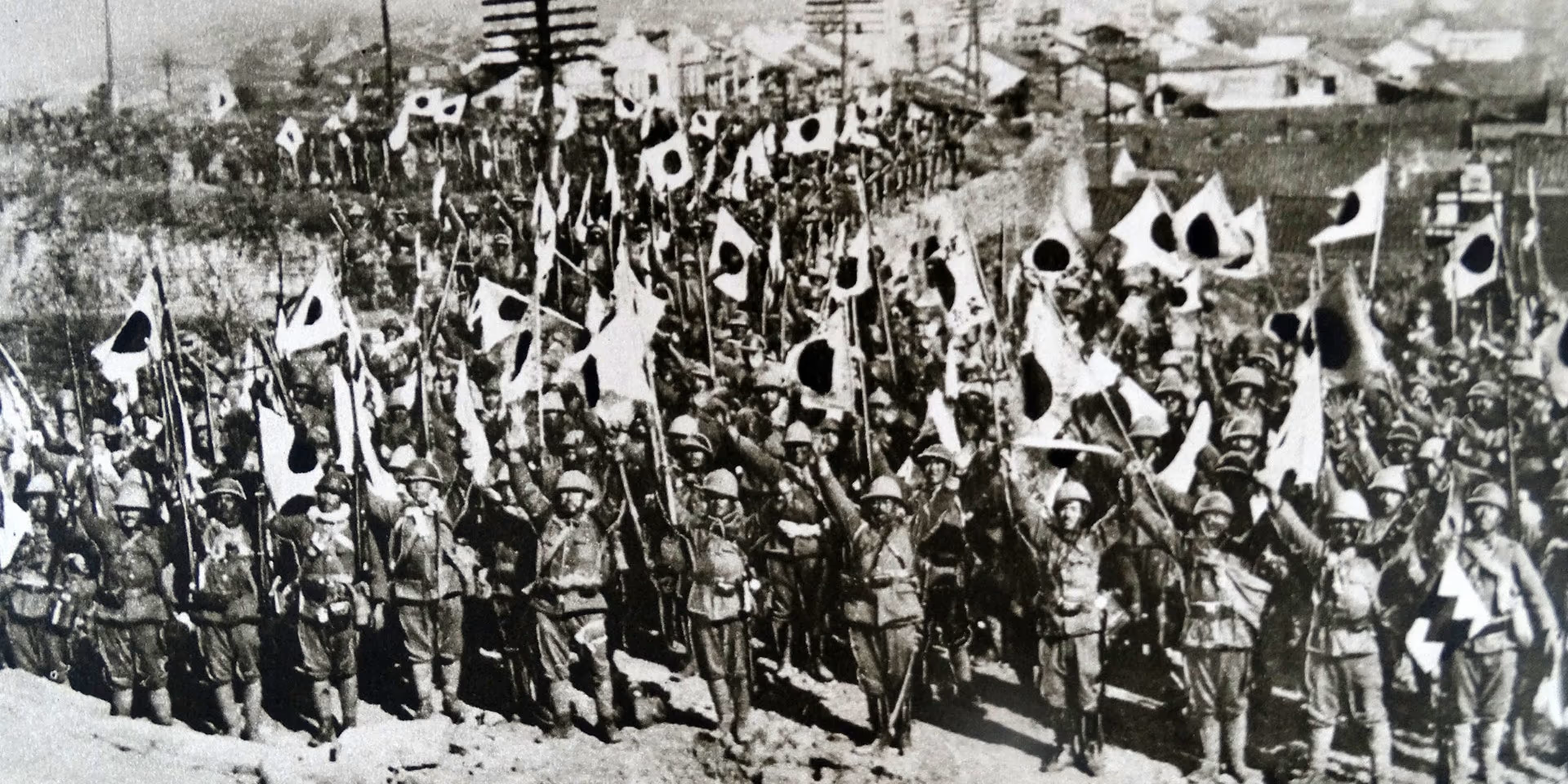
This is where I tell you why I’m bringing up James Allen’s memoirs this Monday—because of our present situation vis-à-vis China and (in one of history’s ironic reversals from victim to victimizer) its growing domination of the South China Sea. In Quezon, Filipinos had a leader who was deeply mistrusted and opposed by many; the United States’ willingness to defend the Philippines was in doubt; and the threat of a foreign invasion was clear and imminent. 

Allen actually sat down with Quezon for a long interview at the latter’s invitation, and was impressed by the man’s grasp of politics and his singular ambition. But the article that came out of that encounter displeased MLQ; Allen, after all, was still a communist at heart, which makes the following quotation—from a letter Allen would compose and send to his American colleagues in October 1937—even more interesting. I’ll leave it to you to observe the parallels, and to cast them against the Marcos-Duterte issues of our time.

“Filipino Marxists and radicals need to relate independence from the United States to the world crisis created by fascism. The immediate concern in the struggle for an independent and democratic Philippines is to safeguard the country against the threat of Japanese aggression. The objectives of complete independence from the United States and the internal democratic transformation must be obtained without endangering such gains as have been made or subjecting the country to new masters. The people must be awakened to the prime and pressing danger to their national existence. The United States is moving toward alignment with the democratic powers against the fascist bloc, albeit slowly and indecisively.


“Roosevelt is shifting somewhat toward the Left of Center to keep pace with his mass support from the surging labor movement and anti-fascist and anti-war popular sentiment. The national interests of the Philippines call for vigilance and precautions against Japanese aggression. This coincides with the interests of the United States in the Pacific area, and it would be folly not to take full advantage of this concurrence. In the broader perspective, the outcome of the struggle in China will be crucial for all the peoples of the Far East, and if the United States were to withdraw from the Philippines this would be a serious blow against China and encouragement to Japan’s designs upon Southeast Asia and the islands of the Pacific. The cause of Philippine independence at this time can best be served by cooperation with the United States.


“The situation also requires a change in the attitude toward Quezon, from frontal attack to critical support. Unprincipled opposition for the sake of opposition-as with some leading participants in the Popular Alliance is dangerous, for it plays into the hand of pro-Japanese elements and sentiments. Quezon certainly is not an anti-fascist, but he is not intriguing behind the scenes with Japan. The greatest opposition to his early independence plan comes from the landed proprietors, particularly the sugar barons, while it enjoys support among the people. The Popular Alliance should also support the plan, including provisions for mutually satisfactory economic, military and diplomatic collaboration after independence. Though Quezon is far from being a Cardenas or Roosevelt in his domestic policies, every effort should be made to move him away from his pro-fascist and land baron support by providing him with mass backing for such pro-labor and progressive measures as are included in his social justice program. In sum, the Popular Alliance should encourage a national democratic front devoted to the preservation of peace in the Pacific, the safeguarding of Philippine independence, and defense and extension of democracy in the country.”
Qwertyman No. 101: The Truth Sometimes Stutters

Qwertyman for Monday, July 8, 2024

LIKE MANY other global citizens with an interest in American politics, I watched the recent presidential debate between President Joe Biden and former President Donald Trump with alarm and dismay, emerging profoundly depressed by Biden’s lackluster performance. His rousing State of the Union speech last March, which I also watched, had raised my expectations, as it surely did the Democratic Party’s, that he would come out swinging and send Trump flying out of that arena with the punch to end all punches. 

He managed to throw a few good ones—I especially liked “You have the morals of an alley cat!” But in the end—or should I say, pretty much throughout the debate–he lost steam, stuttered, and strayed. Fighting Joe stayed home; Soporific Joe turned up. Even Trump, who lied his way through the debate with his customary sneer and swagger, seemed surprised by the win being handed to him by his opponent and by all the media commentators looking on. 

Those commentators would later do the math and conclude that Trump had told about 30 lies and misrepresentations over the 90-minute bout, while agreeing that Biden had also made some false assertions, though none as outrageous as Trump’s charge that Democratic policy included killing babies even after they were born. None of this post-mortem will matter to Trump’s base, used to swallowing whatever comes out of The Donald’s mouth as God’s own truth. It mattered to Biden’s, because it seemed to confirm their deepest fears—and what had until then been a nasty snicker from the other side—that the incumbent was mentally and physically inadequate to the task of leading America for four more years, let alone beating Trump in November. 

When I reviewed the transcript of that debate—which I suspect will rank near the bottom in the history of presidential debates for quality of thought and expression—I had to conclude that the truth was poorly told and the lies came through loud and clear. Biden ran through the numbers with professorial precision: “40 percent fewer people coming across the border illegally… billionaires pay 8.2 percent in taxes… $8,000 per family written off under the Affordable Care Act… everybody making under $170,000 pays 6 percent of their income,” and so on. But Trump’s strategy was much simpler—just repeat the same incendiary claim, over and over again, and don’t bother with the details: “the worst president we ever had, the worst administration in history, we’re no longer respected, they think we’re stupid, we opened our borders to people from mental institutions, insane asylums, terrorists, people are dying all over the place….” 

In rhetorical heaven, the truth would ring like a bell and be heard from sea to shining sea, while falsehood would seethe and slither in whispery incoherence. Instead, what we saw confirmed the opposite—that in today’s media, prone to hyperbole and uncritical amplification, the brazen lie will travel farther than the complicated truth, which can be messy, inconvenient (as Al Gore pointed out), and unpopular. 

Furthermore, and even worse, the truth all by itself won’t win elections. We’ve seen that happen many times, and we don’t even need to cross the Pacific for proof. 

In the second op-ed column I wrote for this corner more than two years ago titled “Myth over matter,” I said that “The most daring kind of fiction today is out of the hands of creative writers like me. It is being created by political propagandists who are spinning their own versions of the truth, and who expect the people to believe them. The short story and the novel are no longer the best media for this type of fiction, but the tweet, the Facebook feed, the YouTube video, and even the press conference.”

“Today’s savviest political operators know this: spin a tale, make it sound appealing, trust ignorance over knowledge, and make them feel part of the story. ‘Babangon muli?’ Well, who the heck who dropped us into this pit? It doesn’t matter. Burnish the past as some lost Eden, when streets were clean, people were disciplined, and hair was cut short—or else. Never mind the cost—’P175 billion in ill-gotten wealth’ is incomprehensible; “a mountain of gold to solve your problems” sparkles like magic.”

Biden isn’t just fighting Trump, but a growing global disdain for intellectual acuity, in favor of populist platitudes and despotic bombast. Sadly none of this analysis, of which Joe Biden surely must be aware more than anyone else, is going to help him and his party defend democracy in America if he sticks to his dated notion of an idealist America that clearly no longer exists. To buy time and opportunity for that hope, he may have to do what he has never done, and yield his place to a fitter champion. (Biden famously labored to overcome a childhood stutter and being bullied for it by reciting Yeats and Emerson in front of a mirror.)

Both the New York Times and the Washington Post have called for Biden to stand down, a rising chorus that has been joined by important leaders and donors of the Democratic Party. There’s wishful speculation that—despite the obligatory public display of bravado and strong familial support—the more sensible Joe will prevail and see the election as being more than a personal Rubicon but indeed, as he himself puts it, an existential battle for democracy itself. If Biden goes down, the chances are he won’t be alone; the Republicans will win both the House and the Senate, giving Trump virtual carte blanche to reshape the rest of America in his own sour image. (And for us Filipinos, a Trump win will mean even less leverage in the West Philippine Sea, not that the US under any president will likely go to war on our behalf for a pot of soil at high tide; but isolationist Trump will be far more willing to bargain our rights away with China for economic and political gain.)

As distant onlookers with a strategic investment in November’s outcome, let’s pray that Sensible Joe will get the better of Fighting Joe, and give the stuttering truth a chance.

Qwertyman No. 98: Panahon Not

Qwertyman for Monday, June 17, 2024

WHOEVER URGED President Marcos Jr. to issue that memo mandating all government agencies and schools to sing the new “Bagong Pilipinas” hymn and recite the accompanying pledge at flag ceremonies should be banished to the farthest reaches of Malacañang, in the archives chronicling his predecessors’ most stupid mistakes.

PBBM was already riding a cresting wave of nationalism (bordering, let’s admit it, on Sinophobia for many) because of Chinese aggression in the West Philippine Sea and scandals related to offshore gambling operations run by Chinese in the country. He also earned grudging points from even his staunchest critics and detractors for seemingly being open to investigating the human rights excesses of his iron-fisted predecessor and sanctioning the arrest of one of that man’s most notorious cronies (an unsuccessful operation that Vice President Sara Duterte found the delicacy to deplore for its “excessive use of force,” which you never heard her say about her papa’s murderous tokhang campaign). 

Bongbong Marcos, in other words, was beginning to look and sound like what Rodrigo Duterte never could: a president with a grasp of the issues and a sensitivity to public opinion. Even former Associate Justice Antonio Carpio, a prominent figure in the opposition in 2022, praised BBM for the latter’s recent foreign policy speech in Singapore, where he cited the Treaty of Washington whereby Spain ceded Philippine territory beyond what was stipulated in the Treaty of Paris. “This finally corrects the greatest misconception in Philippine history,” said Carpio, a militant advocate of Philippine territorial rights, “a watershed moment in our fight to defend our island territories and maritime zones in the West Philippine Sea.” 

No, it didn’t mean that the old pre-EDSA issues were forgiven and forgotten, nor that new ones like the dubious Maharlika fund haven’t emerged over the first two years of his tenure, on top of his wanderlust. But BBM has had the good luck—if you can call it that—of inheriting Chinese expansionism and the Duterte legacy, and the good sense to get on the right side of these thorny concerns. 

Granted, there’s no real way to know if his deviation from Digong’s Sinophilia and trigger-happiness is sincere and not just a ploy to torpedo Inday Sara’s claim to succeeding him and install his own man. At this point, it doesn’t seem to matter much; so brazen has Chinese aggression been that even Duterte’s boys in the Senate have felt compelled to wear “West Philippine Sea” T-shirts, even as their lesser allies pose as “peaceniks” who somehow saw nothing wrong with the former president waging war on his own people.

So did BBM’s team—or BBM himself—think that this was the right time to reap some of that PR dividend, consolidate his gains, and foist the “Bagong Pilipinas” brand on the country through a new song and pledge?

The implicit rationale, we can understand. It’s a page right out of his dad’s New Society playbook: use music—indeed, use culture and education—to generate team spirit, or at least some semblance of it. That’s what anthems, hymns, and fight songs are for, from the American Civil War’s “Battle Hymn of the Republic” to the quintessentially English “Jerusalem” and the Nazi “Horst Wessel Lied.” Here in the Philippines, no martial-law morning was complete without the “Bagong Lipunan” (its real title was “Bagong Pagsilang”) song playing on the radio. 

To be fair (if it’s even possible to say that, given that the regime put me in prison for seven months in 1973), it was a catchy, well-written song, with a martial (what else) rhythm; that we still remember at least the tune five decades later attests to the success of its imprinting. It resurfaced on the airwaves shortly after BBM took office in 2022, reviving apprehensions of a New Society 2.0, but it seems to have been pulled shortly after, leading me to suspect that BBM, after all, wanted to be taken on his own and move away from his father’s shadow, which would have been the smart (if nearly impossible) thing to do.

But the imposition of this “Bagong Pilipinas” hymn and pledge again invites uncomfortable parallels and comparisons with what FM Sr. did—and I don’t mean just having the martial-law anthem composed and played, but everything else that came with the New Society: the corruption, the arrests and killings, the submission of our institutions to autocratic rule. 

If you don’t want to go there, let’s talk about just the “Bagong Pilipinas” song itself—have you even heard it? I’m not a music critic, but even I can tell that it’s barely singable, with an uneven tempo, with immemorable lyrics, the constant refrain of which is “Panahon na ng pagbabago” (“It’s time for change”), probably the tritest political message there ever was. You need a trained choir and a band capable of trumpet flourishes to render the piece effectively; I can be convinced that this will work only if I see and hear the President himself and his Cabinet singing the song from memory at the Malacañang flag ceremony (and let’s add the new Senate President, who has embraced the directive).

I don’t know how many millions went to the lyricist and composer of the song, who have mysteriously remained anonymous; clearly, they weren’t the late National Artists Levi Celerio and Felipe de Leon, who worked together on the “Bagong Lipunan” hymn. Perhaps BBM’s critics should be happy that they weren’t that good because, presidential mandate or not, this hymn and its equally problematic pledge seem fated to be ignored and forgotten for their sheer unusability, superfluity, and irrelevance.

PBBM should have been advised that at a time when the nation needs to pull together against a visible external threat, we need constancy, not change, not confusion over who and what we are. We need our one and only National Anthem more than ever, and the same Pledge of Allegiance we have been reciting since our childhood years. Panahon naPanahon not.

Qwertyman No. 97: The City That Works

Qwertyman for Monday, June 10, 2024

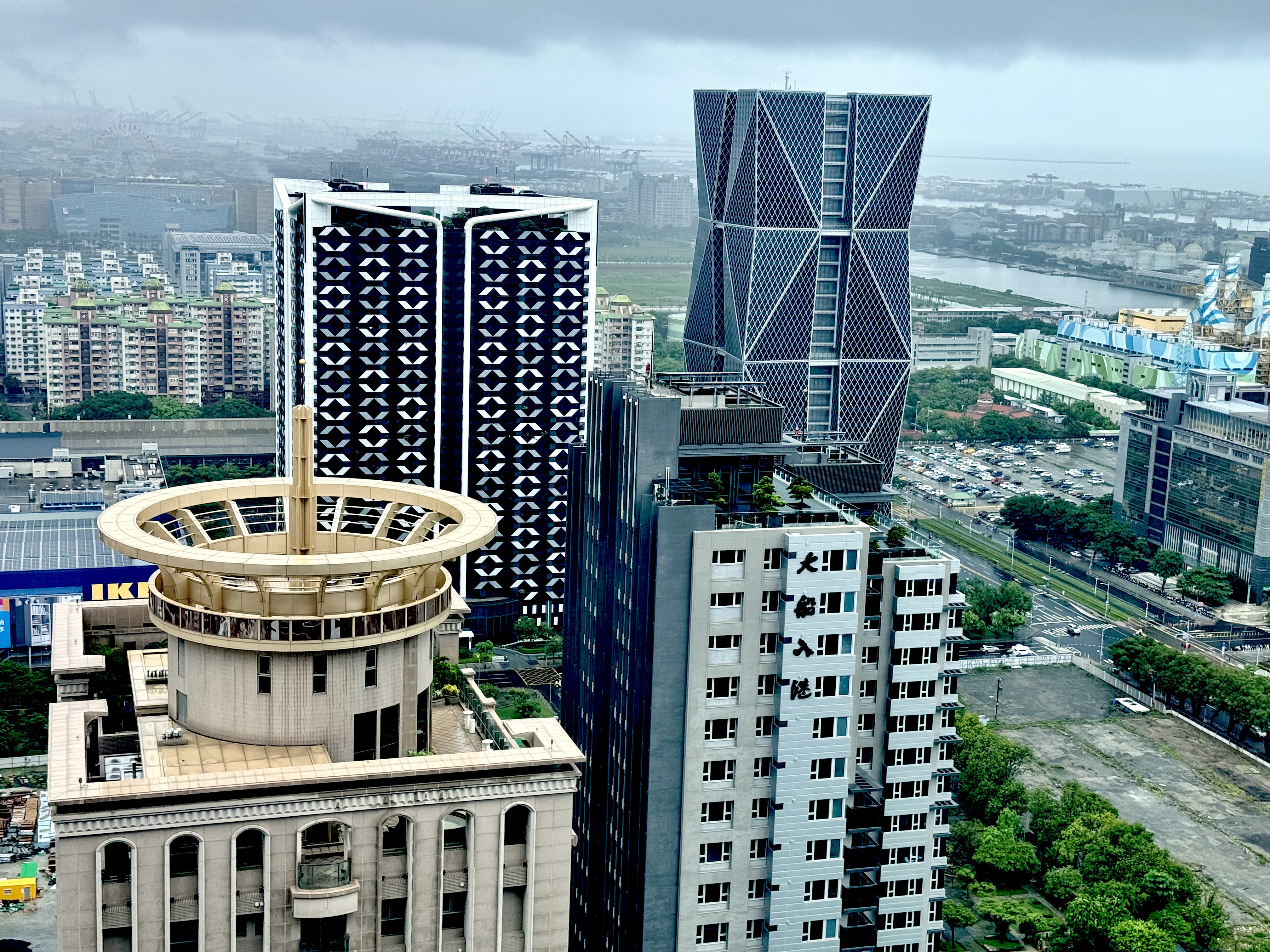
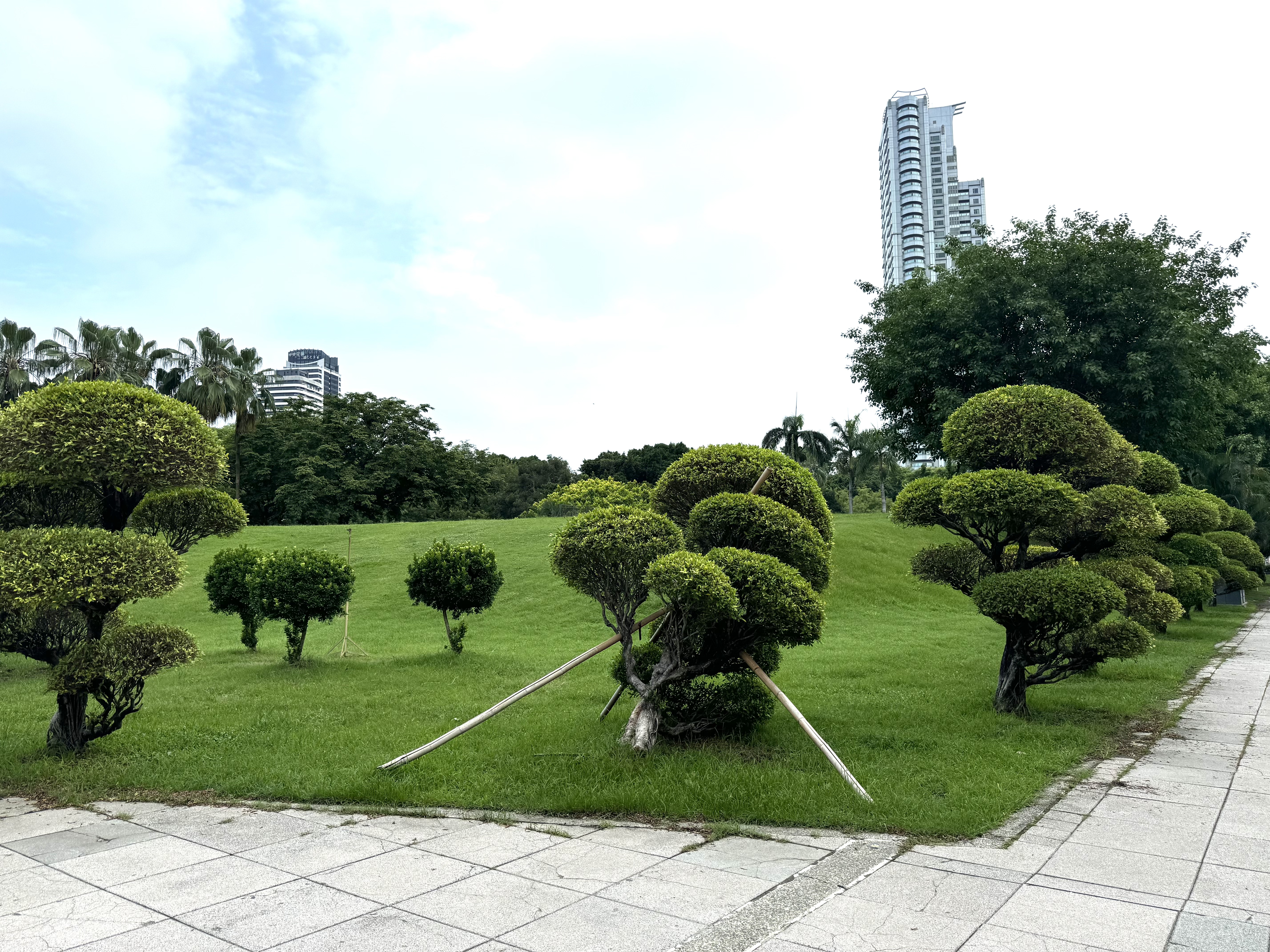
I WAS back last week in the city of Kaohsiung in Taiwan with a group of writers from the University of the Philippines Institute of Creative Writing, at the invitation of Dr. Eing Ming Wu of the Edu-Connect Southeast Asia Association, an education NGO seeking to establish stronger ties between Taiwanese universities and their counterparts south of Taiwan. We were there to meet with our literary and academic counterparts, but also to acquaint ourselves with contemporary Taiwanese society and culture. What we found along the way was a city and a government that works—a model we have much to learn from.

It was my second time in Kaohsiung and my sixth in Taiwan since my first visit in 2010, but those earlier sorties were either for tourism or for attending meetings and conferences, so we never really got to immerse ourselves in the place and its people. This time, Dr. Wu made sure that we went beyond casual handshakes and pleasantries with city and university officials to engage our hosts in in-depth conversations.

The first thing that usually strikes visitors about Taiwan is how modern it looks, especially when flying in through Taipei—the High Speed Rail (HSR), the wide roads, the skyscrapers (think Taipei 101, once the world’s tallest), the late-model cars. For quick comparisons, consider this: Taiwan’s population, at 24 million, is about a fifth of ours; in terms of land area, we are almost ten times larger; its nominal per capita GDP, however, is almost ten times larger than ours at US$35,000. Not surprisingly, Taiwan now ranks around 20th in the world in terms of its economic power.

That power came out of decades of dramatic transformation from an agricultural to a highly industrialized economy, starting with massive land reform and the adoption of policies that spurred export-driven growth. Industrialization itself went through key phases from the production of small, labor-intensive goods to heavy industry, electronics, software, and now AR/VR and AI tools and applications.

At a briefing at the Linhai Industrial Park by Dr. Paul Chung, a US-trained engineer who was one of the architects of this economic miracle, we learned how Taiwan built up the right environment for economic growth through such strategies as the creation of industrial parks (there are now 67 of them covering more than 32,000 hectares, with 13,000 companies employing 730,000 people and generating annual revenues of more than US$260 billion—almost eight times what all our OFWs contribute to the economy). The Taiwanese government has also implemented a one-stop-shop approach to investments, bringing together the approvals of many ministries and local governments under one roof.

Consistently, in modern times, the private sector has led the way forward, with the government acting as facilitator. This was much in evidence in Kaohsiung, Taiwan’s southern industrial hub that was, until relatively recently, a virtual cesspool, the prime exemplar of industrialization gone amuck. A strategic seaport, Kaohsiung grew out of the need to export Taiwanese sugar during the Japanese occupation (1895-1945); the sugar industry gave rise to railways that went far up north to Keelung and became the backbone of the country’s transport system. After the war, the Kuomintang who displaced the Japanese did little to improve things until a visionary mayor undertook reforms that cleaned up the place. Industry also achieved important synergies by adopting policies toward carbon neutrality and reducing waste—for example, one company’s blast furnace slag is being used to pave roads, and harmful carbon monoxide emissions have been rerouted as inputs to chemical companies.

Kaohsiung today is a city of 2.8 million people, a showcase of how runaway industrialization and urban blight can be reversed through good governance and political will. “People need responsible, responsive, and accountable government,” says Dr. Wu, a public-administration expert who worked for 15 years with five Kaohsiung mayors and who now serves as a visiting professor at UP’s National College of Public Administration and Governance (NCPAG). 

A longtime visitor to the Philippines, Dr. Wu has made it his personal mission to promote Philippine-Taiwanese people-to-people relations—a concept he calls “taiwanihan”—in the conviction that the two countries have much to learn from each other and form a natural geographical, economic, and cultural partnership. “We are each other’s closest neighbor,” Wu says. “Taipei is 96 minutes away by train from Kaohsiung, but Kaohsiung is only 90 minutes away by air from the Philippines.” 

Wu and his colleagues at NCPAG have been exploring the possibilities of developing a corridor of cooperation between Southern Taiwan and Northern Philippines, given their proximity. “We have the technology, you have the resources like biomass,” he adds, pointing out as well that taiwanihan doesn’t just mean a one-way relationship, but that the Philippines can also assist Taiwan with its growing needs, such as engineering talent and manpower. Some 8,000 Filipinos now work in Taiwanese factories, but Taiwan’s demand for highly skilled workers will only get higher as it moves into the next phase of its development, which will be heavily dependent on AI.

Artificial intelligence already takes care of many of Kaohsiung’s more mundane needs such as remote traffic monitoring and even the paid parking of vehicles, which has been outsourced by the government to a private entity. “We buy services, not things,” explains Dr. Wu. “The government provides the land for the parking, the private sector supplies the technology and the hardware. This is our version of public-private partnership: the government listens to the private sector, which can use the city as its lab.” 

E-governance and decentralization led us to an unusual sight: we visited City Hall on a weekday and saw very few people in the lobby, unlike its Philippine counterparts. That doesn’t mean that government is distant from the citizens, as a “1999” complaints center receives and fields calls online or in person, employing the disabled to man its booths. 

And even as AI has taken the forefront, it was abundantly clear that human intelligence and human priorities remained important. Good community governance, for one thing, was key to clean and peaceful neighborhoods (their village officials are appointed rather than elected, eliminating vote-buying). Their libraries alone show how and why the Taiwanese are succeeding: they not only have hundreds of thousands of books available to their citizens, but they have innovations such as the “Adopt-a-Book” program by which you borrow a book just based on a previous reader’s recommendation, and books in both Braille and regular text, so that sighted readers can read along with the blind and enjoy a story together. A city that goes that far to meet its people’s needs can’t fail.

Qwertyman No. 94: Artificial Intelligence

Qwertyman for Monday, May 20, 2024

DR. CHICHOY Carabuena had a problem. He wanted the school he owned and ran—the Generoso Carabuena Academy of Pedagogy in Santa Vicenta—to place higher in both national and international rankings, partly so he could raise tuition fees, and also so he could claim bragging rights among his university-president friends and drinking buddies. He had inherited the school from his grandfather; Generoso Carabuena was a banker who had collaborated with the Japanese and stolen the money they left behind to open a school for teachers, which was his wife’s dream, becoming a war hero in the process for outsmarting the enemy. 

The school had done well enough to the point that Chichoy’s dad Ramoncito could buy a Mercury Capri that he regularly drove to Manila to carouse in its nightclubs. Chichoy was the product of one of Ramoncito’s dalliances with the agreeable ladies, and it fell on him to rescue both the business and the family name from ruin and disrepute. He had been managing a carinderia for Pinoy workers in Dubai when the call came, and always wanting to become someone of substance, he returned to Sta. Vicenta to turn the daughters and sons of hog butchers and vegetable growers into teachers, like he imagined himself to be. Surely higher education wasn’t all that different from running a restaurant and coming up with the right menu at the right price for your customers. He had secretly dreamed of becoming a mayor, a congressman, or even governor, but first, he had to make a name for himself and make money.

Somewhere along the way he picked up a “Dr.” from a diploma mill and dressed the part, coming to his office even in the warmest of days in coat and tie. “More than anything else,” he would lecture his new recruits, “first impressions count, so before you even become a teacher, you have to look like a teacher, walk like a teacher, and sound like a teacher!” He had a faux marble statue made of his grandfather to greet visitors at the school entrance, and another one of Jose Rizal standing behind Generoso, as if looking on in approval. 

But lest people think he was beholden to the past, Chichoy Carabuena peppered his speeches with 21st-century mantras like “disruption,” “innovation,” “sustainability,” “customer-centric,” and, yes, “21st-century.” “The great challenge to higher education today,” he would often declaim, “is to produce graduates attuned to a global climate of disruption and innovation, mindful of evolving needs and opportunities in the marketplace of ideas while seeking sustainable and synergistic 21st-century solutions to problems rooted in our feudal and neocolonial history.”

Those speeches were written for him by his former executive assistant named Mildred, a UP graduate whom he had to fire when his wife discovered them smooching in his office—an act he vehemently insisted to be no more than a paternal gesture, much like  former President’s public bequeathal of a kiss on a married woman, a defense that gained no ground. His wife personally chose his next EA, a former SAF commando named Dogbert; making the best of the situation, Chichoy paraded Dogbert around as his bodyguard, spreading the rumor that his life was under threat from unspecified enemies determined to keep the quality of Philippine education down. “We can give them no quarter,” he declared at the last CHED event he attended. “We must resist, with all impunity, those who aim to keep our poor people shackled to the twin pillars of ignorance and idiocy!” He missed Mildred in those moments, but he felt quite pleased with his growing self-sufficiency in speechwriting, thanks to his new discovery, ChatGPT. Of course it never quite came up to his standards, so he tweaked the prose here and there, like that reference to Samson that he hoped would bring the house down.

But now, reading the reports of top Philippine universities slipping in their rankings in the usual Times Higher Education and Quacquarelli-Symonds surveys, Dr. Carabuena saw an opportunity for his modest HEI to rise. “As their mystique diminishes, so our aura will grow,” he informed an indifferent Dogbert. “We just need to come up with sustainable innovations that will disrupt the status quo.” Dogbert handed him a slim folder. “Sir, someone wants to see you, to apply for the position of Academic Vice President.” It was a position that Chichoy himself had held concurrently to save on salaries, but now he felt obliged to pass it on to a real expert. He flipped the folder open and saw the picture of a cute Chinese-looking woman going by the name of “Dr. Alice Kuan.” Chichoy was mesmerized. “Send her in—and get out!”

When Dr. Alice Kuan stepped into Chichoy’s office, he felt himself enveloped in a miasma of jasmine, peonies, and five spices—everything good he remembered from his only visit to China many years ago. Her lips were lotus-pink, her skin ivory-white, and here and there dumplings suggested themselves to his imagination. “Good morning, Dr. Kuan! Please, have a seat! You’re here to apply for the AVP job?”

“Yes, Mr. President,” she said with a quarter-moon smile, “and I come with many ideas for both improving your curriculum and raising revenues through academic innovations.”

“Innovations! I like that! Like what?”

“Why artificial intelligence, of course! We could use AI to teach many of our courses, reducing costs. Also, we could bring in more foreign students from—uhm—friendly neighboring countries, while creating part-time employment opportunities for them in—uhm—online entertainment, for which we could even lease out some of your campus property. It would create a huge economic boost for Sta. Vicenta!” 

Temple bells rang in Chichoy’s mind. Not only was she fetching; she was smart! Suddenly he could see his political future brightening. He wanted to know more about this adorable avatar, and only then did he notice how patchy her resume was. 

“Your birth certificate was filed when you were…. 17?”

“Was it? I don’t remember.”

“Which elementary school did you go to?”

“I don’t remember. Maybe homeschooling?” She threw him an exasperated sigh. “Look, Dr. Carabuena, does it matter? I can have AI do a perfect resume if that’s what you want. If not, I can take my ideas to the Fontebello Institute of Technology in San Bonito just an hour away, and maybe they’ll be more receptive to disruptive innovations—”

“No, no, no! Disruptive, I like disruptive! Please, Dr. Kuan, stay in your seat! I’ll have somebody prepare your contract. Dogbert!”

(Image generated by AI.)

Qwertyman No. 88: Wanted: Gentlemen

Qwertyman for Monday, April 8, 2024

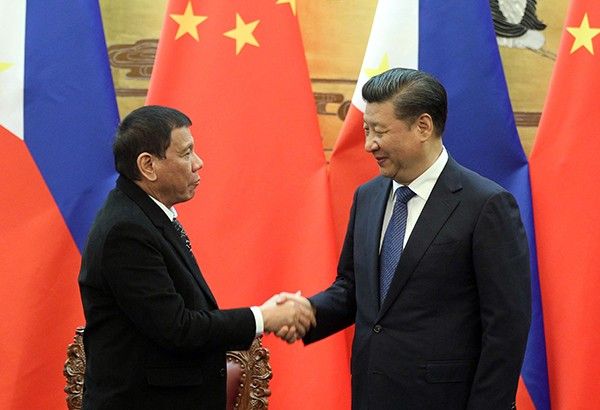
A SHIPLOAD (let’s get that consonant right) of questions has been raised over the “gentleman’s agreement” alleged to have been entered into between former President Rodrigo Duterte and China’s Xi Jing Pin over the disputed Ayungin Shoal in the West Philippine Sea. China has suggested as much, complaining about the present administration’s “inaction” over what it apparently considered a done deal.

According to former Duterte spokesman (should we also call him “former human rights lawyer”?) Harry Roque, Duterte and Xi did pledge between them to “maintain the status quo” in the troubled zone, meaning, there would be no rebuilding or reinforcement of Philippine installations there—specifically referring, I suppose, to the hopelessly decrepit BRP Sierra Madre that has to be the sorriest and loneliest maritime outpost in the world. 

Chinese Coast Guard cutters have routinely tried to block Philippine vessels attempting to resupply the Sierra Madre. A month ago, four Filipino sailors were injured when they were water-cannoned by the Chinese, and their ship rammed. Our resupply ships have been running these Chinese gauntlets to reach the marines on the grounded Sierra Madre, which symbolically enforces our claim to the Spratly Islands, or that portion of it we call the Kalayaan Islands group. This was precisely the kind of situation that Duterte and Xi reportedly tried to avoid with their agreement.

Upon hearing his former colleague’s explosive revelations, former presidential counsel Salvador Panelo quickly went on the air to dismiss them as the fabrications of a publicity-seeker, assuring the public that Digong himself had denied the report. He added that his old boss would never have sold out the country that way. In fact, Panelo claimed, Duterte had brought up the Philippines’ arbitral victory against China at the Hague with Xi—a judgment Duterte had ironically threatened to toss into the wastebasket as nothing more than “a piece of paper.” Roque then went on to explain that the “gentleman’s agreement” covered not just Ayungin Shoal but the entire West Philippine Sea, enlarging its scope exponentially. If it was a lie to begin with, as Panelo suggested, well, the lie got much bigger.

This spectacle of two Duterte mouthpieces not just speaking at cross-purposes but putting each other down would be immensely entertaining if our national territory and patrimony weren’t at stake. It doesn’t really matter who between these two, uhm, gentlemen is right, or whom we end up believing. What’s clear is that either way, beyond token whimpers and some lip service to sovereignty, Duterte and his crew never did much to defend Philippine territorial and maritime rights in the WPS, debating with their local critics on the issue more than with the Chinese, even waging a vain effort to denigrate the Hague ruling and those who had fought so hard for it. 

Given the new administration’s popular pivot toward a more aggressive stance on China, we can understand if Duterte and his boys seem scrambling to be seen as having been patriots all along. Who knows, maybe they were, and maybe we poor kibitzers were just too dumb or too dense to see that. 

Remember when Duterte made that famous “wastebasket” remark in May 2016? Then-spokesman Roque tried to spin that by saying no, no, no, you have to “apply the proper construction” (his exact words) to that statement—meaning (hold your breath), “He really didn’t mean it that way. Instead, go back to his UN speech where he vowed to defend the Philippines against China. When he said ‘I’ll throw this into the wastebasket,’ he wasn’t speaking for himself, he was speaking from the point of view of the Chinese.”

Huh? Forgive me if I can’t wrap my non-lawyerly mind around this “proper construction,” let alone explain why a Philippine president should be expressing the Chinese view.

To help sort this mess out, Sen. Risa Hontiveros has called for a hearing to find out if, indeed, Duterte and Xi had, as the young ones put it, an “MU” over Ayungin and the WPS. Predictably, Panelo thinks this probe will be a “waste of time,” insisting that the reported “gentleman’s agreement” never happened. 

Another newspaper quotes an anonymous Chinese official saying, like Roque, that it did. Under the reported terms of the deal, China would allow the Philippines to resupply the BRP Sierra Madre for as long as it did not reinforce or rebuild the ship. (How the agreement supposedly applies to the entire WPS as Roque claims remains murky.)

One would think that a true, broader, and more meaningful “gentleman’s agreement” in the West Philippine Sea would involve the non-building of offensive structures and bases, the avoidance of violent confrontation, respect for our fishing rights, and freedom of navigation for all nations in international waters—all of which the Chinese have flouted with impunity. Instead—and if true—all our former president did was to ask the Chinese for permission to resupply our own aging and ailing vessel, in exchange for a promise to let it rot. Whether that’s treason or patriotism, you be the judge.

Pending further inquiry, I myself suspect that some kind of bargaining did take place, but I somehow doubt that it was a gentleman’s agreement. For that you’d need at least two gentlemen in the house.

Qwertyman No. 37: Time for Winter-Melon Soup

Qwertyman for Monday, April 17, 2023

AS I SHOULD have expected, last week’s Qwertyman piece on a recent visit I made to Taiwan as an ordinary tourist provoked a small firestorm from readers who berated me for my “ignorance” of the “one-China policy,” because I had described Taiwan as a “country” in my column.

I replied politely to these objections, explaining that (1) while I was aware that our government, among most others in the world, subscribed to the one-China policy, I wasn’t the government, and (2) that “country” to this writer was more of a state of mind, if not of fact (and if we have to be persnickety about fact, then consider that Wales and Scotland are accepted as countries within the United Kingdom). 

One of my reactors was gracious enough to yield the point and leave me be, but another insisted that I had China all wrong—that it had no unfriendly intentions toward the Philippines, and that its occupation of what we hold to be our islands in the South China Sea was a mere enforcement of its historic rights to those territories. “Absolutely no intentions of invading the Philippines?” Hasn’t that already begun?

My column also prompted some reflections from an old friend and comrade in the fight against the martial-law dictatorship. Commenting on China’s threats to bring Taiwan under its heel, by force if necessary, my friend remarked: “It’s hard to comprehend how the leaders of big, powerful China could feel justified in unleashing death and destruction against the people of small but proud Taiwan, a country that poses no threat, and against fellow Chinese of near identical racial and cultural origin. After all, isn’t this the China that I, and many of us, not too long ago, emulated as the model for ‘liberating’ our own country, and whose proletarian ideology we embraced as the formula for ushering a new and better age for humanity? How is this a manifestation of Mao’s ringing slogan to ‘Serve the People?’

“But then we’re seeing the same perversion of once lofty ideals in the current behavior of Russia, the progenitor of ‘egalitarian socialism,’ now immersed in a barbaric project to decimate the people of Ukraine, members of their own Slavic family. Yes, Putin doesn’t call himself socialist but it was this system that trained and tutored him, and whose humiliation he’s trying to undo…. However, in light of the current behaviors of Russia and China, the two foremost homes of the Marxist experiment, and in light of the incontrovertible failure of Joma Sison’s project in our country, we who dabbled in this belief system need to step back and take a good hard look.”

I thanked my friend for his ruminations, which I completely identify with. Indeed, as fervent if naïve activists in the 1970s, we looked up to Mao’s China as a beacon of socialist virtue. Today’s Red-taggers would have fulfilled their month’s quota with the likes of me. I kept Mao’s “Little Red Book” in my shirt pocket, and could spout quotations like “Political power grows out of the barrel of a gun” and “A revolution is not a dinner party, or writing an essay, or painting a picture, or doing embroidery; it cannot be so refined, so leisurely and gentle, so temperate, kind, courteous, restrained and magnanimous. A revolution is an insurrection, an act of violence by which one class overthrows another.” 

On my first visit to China in 1987, our guide was surprised that I could sing “Sailing the Seas Depends Upon the Helmsman” and that I wanted to visit Mao’s tomb. “What do you want to visit him for?” our guide asked in consternation. “He killed my father during the Cultural Revolution!” 

In various capacities as a tourist, a journalist, a writer, and academic, I have visited China many times since that first encounter, and have seen how its people—honest, hardworking, hopeful people like us—have managed to survive and prosper under a challenging succession of regimes and global conditions. I observed how the government was intent on modernizing its economic and physical landscape, razing down whole rows of hutongs or old communities in cities to make way for swanky new high-rises. On one visit to Shanghai, I couldn’t resist noting the irony of how the historic site of first National Congress of the Chinese Communist Party—a sacred shrine of that ideology—was located in the heart of what has become one of the city’s glitziest and most upscale districts, Xintiandi, in close proximity to a posh French restaurant.

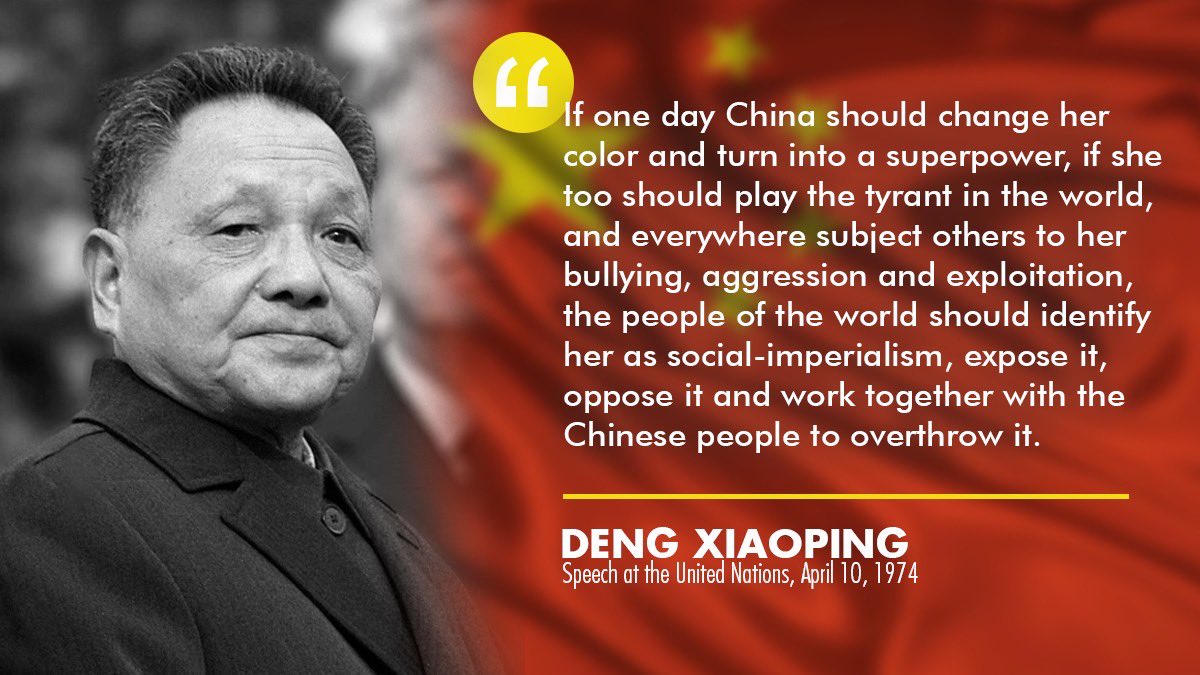
I don’t think anyone can fault China for its transformation into an economic powerhouse, or even deny that its strong central planning was a key factor in making that happen, especially under Deng Xiaoping. What I’m sad about (and this statement will probably cost me my next Chinese visa, but no matter) is how this China has remained a tyrant to its own people and a bully to its neighbors—something that it doesn’t need to be, except to flex the almighty power of the CCP. 

If it wants to, it could yet become an example of a confident and benign socialism—something the CCP will never dare to embrace, for fear of seeming soft, especially in the face of American, Japanese, Korean, and yes, Taiwanese resistance. I can’t help thinking that while there may be “one China” in whatever configuration the politicians propose, there are indeed two Chinas in our hearts—the one we have been historically and culturally enmeshed with and want to love, and the other that won’t rest until we kowtow to its might.

And before the pro-Beijing troll machine springs into action, let me say this again: I separate governments and regimes from the people they theoretically represent and should be serving. (We also have to be reminded that there are significant political factions in both Beijing and Taipei, and that Chiang Kai-shek’s Kuomintang were no angels when they “liberated” Formosa from the Japanese, only to take it over.)

I have written favorably (and critically when I had to) about both China and Taiwan without any sponsorship from either entity’s government. There are powerful lobbies for both sides right here in this country—one even offered to send me on an “observation tour,” which I gently declined, aware of the political subtext; I would go, I said, on my own dime, and I did. (Which is not to say I will refuse “observation tours” of the south of France, Tahiti, the Nordic fjords, the Patagonian forests, and other bucket-list destinations not likely to invade the Philippines.)

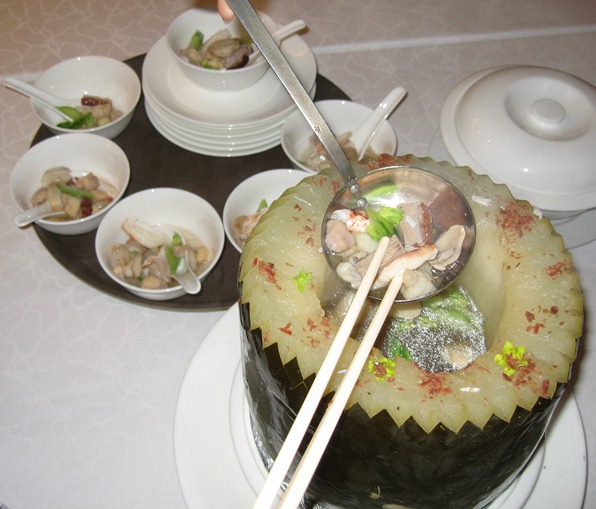
To Beijing’s and Taipei’s cheerleaders, chill out and enjoy the scenery; some calming winter-melon soup might help to keep the vitriol down.

Qwertyman No. 36: A Tourist in Taiwan

Qwertyman for Monday, April 10, 2023

MY WIFE Beng and I visited Taiwan with friends on a five-day holiday just before Holy Week, and returned home dog-tired but deeply impressed by what we had seen: a country not just surviving but staunchly moving forward, progressive and optimistic, despite living under the constant threat of invasion by its hulking neighbor and self-declared owner, China.

It was my fourth visit to Taiwan and my wife’s second, so we had witnessed the island’s wonders before. But we went back—this time with friends who had never been there—precisely because it had much to offer as a vacation spot. For me, Taiwan has largely been about food (especially the beef-brisket noodles and fruits like the giant atis and cherimoya), technology (like the exhilarating 3D I-Ride it has exported to Hollywood), and culture (exemplified by the legendary jadeite cabbage at the National Palace Museum). Economists and political scientists will surely have much more to look for and investigate in Taiwan, but my unsophisticated cravings were fully satisfied. 

The tourist in me observed that Taiwan had achieved First-World status, with elevated expressways, high-rise housing, clean waterways, and extensive transport networks. Taipei’s shops were open past 10 pm, catering to a busy nightlife. We took a day trip out to visit the Chimei Museum in Tainan, and boarded the High Speed Rail that zoomed down the island’s west coast at 236 km/h. Despite Taiwan’s high level of industrialization, the countryside remained lush with forests and greenery, and Taipei’s streets were litter-free. True, there were homeless people gathered around Taipei’s Main Station, living out of shopping carts and camping tents, but we had seen far worse in New York and San Diego. Some old-school courtesies persisted: on the subways and buses, younger riders still stood up to yield their seats to seniors.

That said, it was hard for me to shake off the feeling that we were experiencing an ephemeral pleasure. As we took a bridge over a river in Taipei, and reveled in the vista of a thoroughly modern city rising from its ancient roots as a Spanish trading outpost, I remarked to Beng, half-facetiously, that a few Chinese bombs could pulverize all that. China, I said, could “Ukrainize” Taipei, and blow the 101-storey Taipei 101 building, the National Palace Museum, the Shilin Night Market, and all the other attractions we associate with this city into smithereens. Beng said that I shouldn’t be making such horrible jokes, but I had to wonder how much of what I said was indeed a joke and how much of it was dire possibility.

The threat is certainly there—and has been there since 1949, when Chiang Kai-Shek’s losing Nationalist forces retreated to the island, took it over, and turned it into a thorn in Communist China’s side. China has repeatedly used shows of force around Taiwan to demonstrate its readiness and capability to employ “resolute and forceful measures to defend (its) national sovereignty and territorial integrity,” and while no explosively significant confrontations have taken place, China’s saber-rattling has only grown louder, provoked by presumptive American guarantees to help defend Taiwan in the event of a Chinese attack, and possibly emboldened by Russia’s invasion of Ukraine. (The US, of course, has been rattling its own sabers, particularly with the acquisition of more basing rights in the Philippines.)

You’d think that the specter of invasion would switch Taiwan into full military mode, with air-raid drills and sirens and tanks and soldiers in the streets, but no. When we were there, it was business as usual, with no sense of urgency, even as Taiwanese President Tsai Ing-Wen met with US House Speaker Kevin McCarthy in California, raising the cross-straits temperature further.

Taiwan-watchers such as David Sacks, whose post was republished by the influential Council on Foreign Relations last November, have warned against complacency, especially in the wake of Russia’s Ukrainian misadventure. According to Sacks, “Despite these growing worries and initial steps, actions remain far below where they need to be to deter China and respond to potential Chinese aggression. The increases to Taiwan’s defense budget over the past six years are commendable, but at 2.4 percent of gross domestic product (GDP), it is still well below where it needs to be…. While there is a recognition that the civilian population will need to play a large role in defending the island, the conversation about how to reform Taiwan’s reserve force is still in its infancy, with little consensus on what its role should be. Taiwan’s military lacks the munitions it would need to withstand an initial Chinese assault and its military services continue to pursue legacy platforms such as fighter jets and large naval vessels that will have little utility during a conflict. It is far from certain that there is buy-in across the military for adopting an asymmetric defense strategy.

“Beyond the military realm, Taiwan needs to do much more to increase the resilience of its society and decrease its reliance on trade with China…. Over 40 percent of Taiwan’s exports go to China or Hong Kong. While there is wide agreement that this is a major vulnerability, there is a certain amount of defeatism, with few ideas of how to reduce this dependence without massive government intervention.

“While the government is taking steps (albeit insufficient) to address the growing threat China poses, there is a worrying gap between officials and the public. Opinion polls reveal that Taiwanese people are not concerned about an invasion and believe war is unlikely in the next decade…. Understandably, most want to focus on improving their lives. There is a fine line, however, between stoicism and complacency.”

Is this a fatalism that we Filipinos seem to share? If China attacks Taiwan, can the Philippines be next, and what will we or can we do about it? (In my admittedly  pedestrian view, China has no need for a military invasion of the Philippines—which will be costly and troublesome, given our geography—so long as it achieves full control of the South China Sea. It will be cheaper and easier to subvert and suborn the government, if it wants pro-China policies to prevail.)

I was glad to be just a tourist in Taiwan, enjoying my cherimoya, instead of being a defense analyst pondering the medium term—or, for that matter, being a local fruit seller who might one day find a gaping hole where the orchard used to be.

(Photo from thetimes.co.uk)

Qwertyman No. 29: Balloon over Boracay

Qwertyman for Monday, February 20, 2023

WHEN THE balloon was first spotted high over Boracay, some people thought it was a new ride, a welcome addition to the banana boats and paragliders that the tourists couldn’t seem to get enough of. 

“How much does it cost? Where does it land?” asked Akmal from landlocked Uzbekistan, whose belly was white as fish and whose hair reminded the locals of the red seaweed that sometimes strayed into the island’s waters. 

“Does it have a basket? I don’t see any people,” said Frida from icy Norway, who had actually flown on hot-air balloons where they were popular, as in Turkey’s Cappadocia and California’s Napa Valley. 

“It’s not from here,” said Gordo, the boy from Manoc-Manoc whose job it was to lash the ferry boats from Caticlan to their moorings and to take the hand of passengers stepping onto the pier. He had seen everything there was to see in Boracay in all of his seventeen years, from the shameless couplings on the surf to the occasional victim washed up on the shore, and all cuts of humankind from cigar-chomping Texans to barrel-chested Samoans, and he knew what belonged and what didn’t. This silver dot in the sky definitely did not. 

As if having a mind of its own, the balloon drifted north of the island to Yapak over Puka Shell Beach, then back down again over White Beach, where it attracted even more observers. Men who had been using their telescopes and cameras to focus on the usual bathing beauties turned their gear skyward to where people were pointing, and those with the longest lenses snapped pictures of the aerial intruder, for posting on Instagram and Facebook as the curiosity of the day.

Unknown to them, however, the balloon had been spotted much earlier by the government’s Aerial Surveillance Bureau, whose chief had hastily summoned his staff to an emergency meeting at the ASB’s secret command center, on the fringe of a golf course in southern Manila. The ASB’s Director O, a retired Air Force general, was still pulling off his gloves when his subordinates dropped into their seats and the lights went out. A blurry image of the drifting balloon appeared onscreen.

“This unidentified object entered our airspace above the Spratlys at 0423 hours, when it was too dark to be seen by our human spotters. It has since set course for Boracay Island, above which it has remained since 0933 hours, when it was finally spotted by one of our boys who was chasing a monkey up a coconut tree. Now the question is, what is it, who sent it, and why is it here? Is it friend or foe? The President expects me to report to him in the Palace in one hour and I need answers!”

“Sir, if I may,” said his Deputy Director M, “it looks exactly like the one they shot down over the USA and Canada. It’s a weather balloon from—from that country—equipped with advanced surveillance hardware and sophisticated communications capabilities.” It had been ordered since the previous administration not to mention “that country” by name in discussions of national security, so as not to give offense to a favored neighbor, and the habit had stuck, even in private conversations.

“Let’s not jump to conclusions!” said Director O. “There are many other countries perfectly capable of sending up these balloons. For all we know it could be a Lithuanian, a Ugandan, or a Wakandan balloon. I’m not going to upset the ambassador from that country with unproven allegations about his country’s behavior—however outrageous, obnoxious, and objectionable its actions are in the West Philippine Sea, just between you and me.”

“But why is it here, sir? And why Boracay?”

“Good question. Don’t quote me on this, but during the last National Security Council meeting, we were told that that country is preparing to reveal a new Thirteen-Dash Line map, supposedly drawn in the 16th century just before the Spanish came, that extends all the way to Boracay!”

“What?! But Stations 1, 2, and 3 are inalienable parts of our national patrimony! As Winston Churchill said, ‘We shall fight on the beaches, we shall fight on the landing ground, we shall fight on the hills, we shall never surrender!’”

“Yes, but in Boracay, people make love, not war. Imagine having to clean up all that white sand after an invasion. Another six-month lockdown! Can Philippine tourism afford it?”

“So what do we do, sir? Do we bring down this balloon?”

“With what? I already called the Air Force to see if they could fly by the object, but all of our fighters are undergoing maintenance—change oil, check battery, adjust brakes, etc.”

“What about kwitis?”

“Are you making a bad joke in a national emergency?”

“No, sir! The DOST and DND have a secret research program based in Bulacan called the Katipunan Weapons Initiative To Initiate Security, or KWITIS. It’s a multi-stage kwitis that can protect the archipelago against missiles, drones, asteroids, and UFOs like the Boracay balloon! It’s totally indigenous and sustainable, because it uses kawayan for the frame and kiping for decoration and employs out-of-work firecracker makers in the off-season—”

Just then another aide burst into the conference room, breathless with news.

“Sir! Turn on the TV! The balloon is down. The balloon came down!”

They switched to a live feed from CNN, which showed the balloon settled on the beach, its silver skin acting like a mirror for the dozens of kibitzers crowding around it, taking their selfies and groufies with gay abandon. A couple of local policemen who had tried to restrain the crowd were taking their selfies as well, flashing the “heart” hand-sign. “The balloon touched down about fifteen minutes ago on its own, and it is quickly becoming the center of what could become the biggest Boracay party ever! There are still no obvious indications of where it came from or why it is here, but this balloon seems to be totally harmless, so far, even ‘cute,’ according to Loujay, who’s visiting from London,” gushed the reporter. 

And then small puffs of red, blue, and yellow smoke came out of the metal box at the bottom of the balloon, and for a minute the people shrieked and began running away, but as the smoke dispersed and the people inhaled the fumes, their faces lit up in ecstasy and they began dancing. Music also poured out of the balloon—the frenetic techno club mix that brought even the masahistas and the barbecue vendors to their feet.

“I know that, sir! That’s Stefano DJ Stoneangels!” said Deputy Director M, whose shoulders began moving up and down. “This is even more mysterious than we thought. We are under attack!”

“Indeed we are,” said Director O. “We need to investigate further. Pack up, boys, and bring your trunks, we’re going to Boracay!”

(Image from madmonkeyhostels.com)

Hindsight 14: Weaponizing the Youth

Hindsight for Monday, April 18, 2022

ONE OF the most troubling episodes of the war now raging in Ukraine happened a couple of weeks ago not in Kyiv or the eastern region—where ghastly atrocities have taken place—but in Penza, a city in western Russia. A 55-year-old teacher named Irina Gen was arrested after a student reportedly taped her remarks criticizing the Russian invasion; the student’s parents got the tape, and turned it in to the authorities, who went after Ms. Gen. She now faces up to ten years in prison for violating the newly minted law against “spreading fake news” about Russia. Earlier, in the city of Korsakov, students also filmed their English teacher Marina Dubrova, 57, for denouncing the war; she was arrested, fined, and disciplined.

That the Russian state is punishing its critics is nothing new. It’s reprehensible, but you expect nothing less from the place and the party that invented the gulag, that frozen desert of concentration camps where millions suffered and died over decades of political strife and repression, mainly under Joseph Stalin. 

What I found particularly alarming was the role of students as informants, a virtual extension of the secret police that are the staple of repressive societies. This, too, is nothing new. Throughout modern history, despots have drawn on their nations’ youth to lend a semblance of energy and idealism to their authoritarianism, ensure a steady stream of cadres, and at worst, provide ample cannon fodder.

In Russia, the Komsomol rose up in 1918 to prepare people between 14 and 28 for membership in the Communist Party. Four years later, the Young Pioneers took in members between 9 and 14, and just to make sure no one who could walk and talk was left out, the Little Octobrists were organized in 1923 for the 7-9 crowd. 

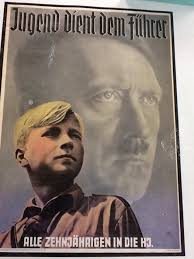
The Hitler Youth was preceded and prepared for by youth organizations that formed around themes like religion and traditional politics, and it was easy to reorient them toward Nazism. An all-male organization matched by the League of German Girls, the Hitler Youth focused on sports, military training, and political indoctrination, but they soon had to go far beyond marching in the streets and smashing Jewish storefronts. Running short of men, the Germans set up a division composed of Hitler Youth members 17 years and under, the 12th SS-Panzer Division Hitlerjugend. It went into battle for the first time on D-Day in June 1944; after a month, it had lost 60 percent of its strength to death and injury.

Chairman Mao relied on China’s teenage cadres—the Red Guards—to unleash the Cultural Revolution in 1966 against the so-called “Four Olds” (old customs, culture, habits, and ideas, which came to be personified in elderly scholars and teachers who were beaten to death or sent off to prison camps for “re-education”). 

Under Ferdinand Marcos Sr.’s martial law, the Kabataang Barangay was created by Presidential Decree 684 in 1975 to give the Filipino youth “a definite role and affording them ample opportunity to express their views.” That sounds innocuous enough, and indeed the KB would go on to engage in skills training, sports, sanitation, food production, crime prevention, and disaster relief, among other civic concerns, under the leadership of presidential daughter Imee. 

At the same time it was clearly designed to offset leftist youth organizations like the Kabataang Makabayan and the Samahang Demokratiko ng Kabataan by drawing on the same membership pool and diverting their energies elsewhere—more specifically, into becoming the bearers and defenders of the New Society’s notions. (Full disclosure: I was an SDK member, but my younger siblings were KB.)

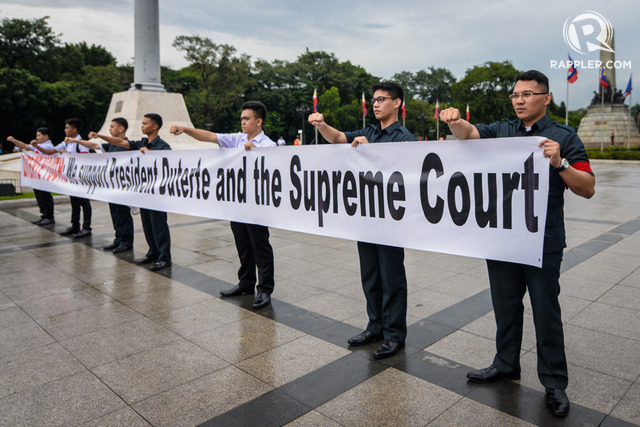
I would never have thought that the “Duterte Youth” meant something else, but it does; evidently, it’s just shorthand for “Duty to Energize the Republic through the Enlightenment of the Youth Sectoral Party-list Organization.” Organized in 2016 to support the Davao mayor’s presidential campaign and later his policies as President, the Duterte Youth have affected quasi-military black uniforms and fist salutes. Its leader, Ronald Cardema, reportedly brushed off comparisons with the Hitler Youth by pointing out that the Germans had no patent on the “youth” name, which he was therefore free to use. (Uhmm… okay.)

Adjudged too old to represent the youth in Congress (his wife Ducielle took over his slot), Cardema was appointed to head the National Youth Commission instead, from which perch he then directed “all pro-government youth leaders of our country… to report to the National Youth Commission all government scholars who are known in your area as anti-government youth leaders allied with the leftist CPP-NPA-NDF.”

I acknowledge how Pollyannish it would be to expect young people and even children to be shielded from the harsh and often cruel realities of today’s world. The war in Ukraine, the Taliban in Afghanistan, and the pandemic are just the latest iterations of conflicts and crises that have turned 12-year-old boys into executioners in Sierra Leone and child miners in Bolivia, Madagascar, and, yes, the Philippines. 

Their enlistment in political causes—of whatever orientation—is another form of maltreatment or abuse for which we have yet no name, but few governments or anti-government rebels will let them be. Their minds are soft and malleable, their fears obvious and manipulable, their rewards simple and cheap. With the right incentives and punishments, it can be easier to turn them into monsters or machines than to safeguard their innocence. They can be weaponized.

I’ve mentioned this in another column, but there’s a scene in the classic movie Cabaret, set in the Nazi period, where a handsome and bright-faced boy in a brown uniform begins to sing what seems to be an uplifting song about “the sun on the meadow.” But as it progresses we realize that it’s a fascist anthem which is picked up by ordinary folk with chilling alacrity. Watch this on Youtube (“Tomorrow Belongs to Me”) and then look at your son or nephew, or the children playing across the street. If you want, you could vote to have them marching and singing a similar tune in a couple of years.

(Photo from Rappler.com)