Penman No. 160: Hemingway in Manila

HemingwayManilaPenman for Monday, August 3, 2015

THE LAST time I thought about Ernest Hemingway, it was a few weeks ago when I was teaching his controversial 1927 short story “Hills Like White Elephants,” one of my all-time favorites for its compactness and subtlety, not to mention its grasp of human psychology.

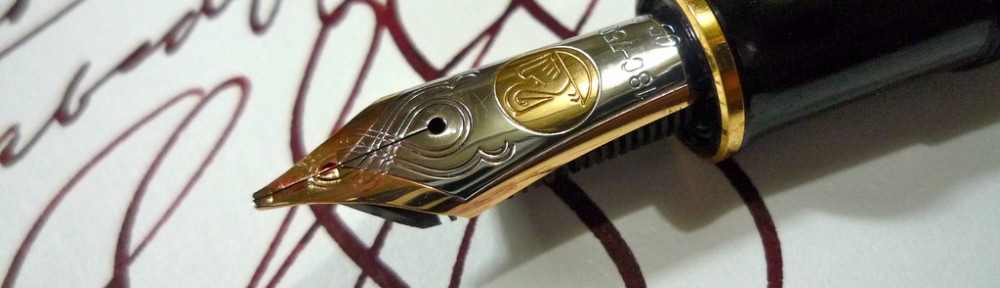
Coincidentally, when I was giving that lecture, one of the pens in my pocket was an Ernest Hemingway—the first in a series that Montblanc called its Writers Edition pens, issued in 1993. Considered one of the “holy grails” of pen collectors, it had been generously given to me by a fellow member of the Fountain Pen Network-Philippines (www.fpn-p.org); we had a small business arrangement, but the cost of my own service was so negligible that the pen was practically a gift, most thankfully accepted.

My pen’s inscribed with Hemingway’s signature, but ironically, I don’t think Hemingway was ever much of a fountain-pen person, and being the practical, outdoorsy person he was, would probably have disdained carrying anything fancier than a Parker Jotter. He was actually known to favor pencils and typewriters—Angelina Jolie bought his 1926 Underwood as a wedding gift to Brad Pitt—and he wrote this down to explain why:

“When you start to write you get all the kick and the reader gets none. So you might as well use a typewriter because it is much easier and you enjoy it that much more. After you learn to write your whole object is to convey everything, every sensation, sight, feeling, place and emotion to the reader. To do this you have to work over what you write. If you write with a pencil you get three different sights at it to see if the reader is getting what you want him to. First when you read it over; then when it is typed you get another chance to improve it, and again in the proof. Writing it first in pencil gives you one-third more chance to improve it. That is .333 which is a damned good average for a hitter. It also keeps it fluid longer so that you can better it easier.”

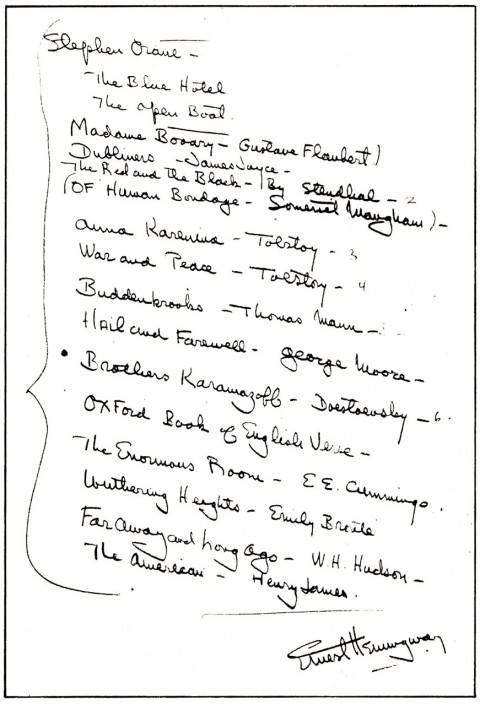
I’ve since located an online sample of Hemingway’s handwriting—likely in pencil—which has him drawing up a list of recommended readings for young writers (among them, Stephen Crane’s short stories, Madame Bovary, The Brothers Karamazov, and The Oxford Book of English Verse). It’s comforting to know that his penmanship is a lot like mine—cramped, stiff, and generally ugly.
HemNote

One of the things that I forgot to mention to my audience—a group of English teachers—was that Hemingway once visited Manila, in February 1941, with the clouds of war already hovering above Europe, where the young Ernest had served as an ambulance driver in World War I. (Ambulance driving seemed to be strangely attractive to young men who would soon make a name for themselves in the arts and letters. Aside from Hemingway, these illustrious WWI volunteers included the writers John Dos Passos, E. E. Cummings, W. Somerset Maugham, and Archibald MacLeish, the composer Maurice Ravel, and the filmmakers Jean Cocteau and Walt Disney.)

In another uncanny connection to fountain pens, Hemingway and Dos Passos served in Italy close to the factory of the Montegrappa fountain pen company, as Montegrappa continues to recall on its website: “Close to the Elmo-Montegrappa factory was situated the Villa Azzalin, which during the conflict. was converted into a field hospital. Two volunteer ambulance drivers for the Italian Red Cross at that time were the famous writers Ernest Hemingway and John Dos Passos, both of whom spent many happy hours visiting the factory and experimenting and testing various Montegrappa fountain pens, and availing themselves of the Company’s after-sales service.”

But back to Hemingway in Manila.

An article by Brown University Prof. George Monteiro in The Hemingway Review (Fall 2010) talks about Hemingway’s short 1941 visit, a stopover on his longer assignment to China as a journalist. Accompanying Hemingway then was his third wife Martha Gellhorn, herself a distinguished writer, a novelist and a war correspondent. (Annoyed by her frequent absences—she would be the only woman to land with the Allied troops on D-Day—Ernest wrote her to ask, “Are you a war correspondent, or wife in my bed?” She led a long and colorful life after her divorce from Hemingway, and tragically, like Ernest, died by her own hand at the age of 89 in 1998.)

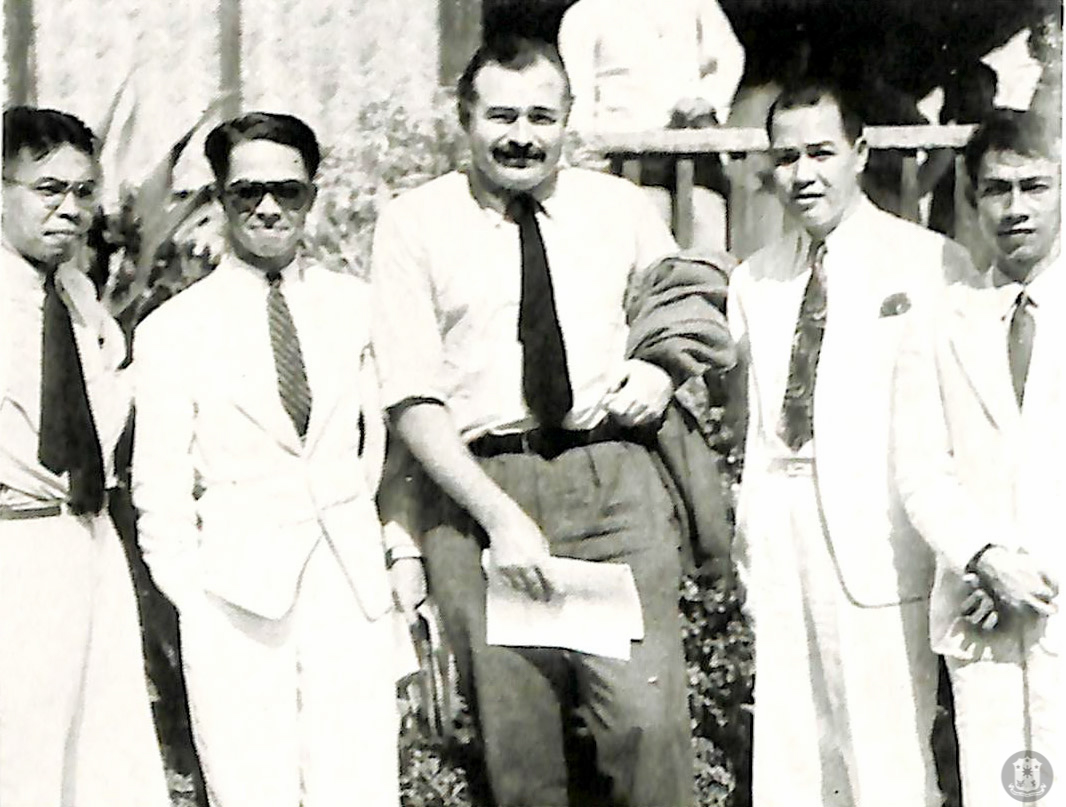
Flying to Hong Kong by Pan Am Clipper from San Francisco via Honolulu and Guam, Ernest and Martha stopped by in Manila for a few days and stayed at the Manila Hotel, and managed to meet with representatives of the Philippine Writers League, which was then led by Federico Mangahas. There’s a picture in the Flickr photo gallery maintained by Malacañang’s Presidential Museum and Library (whose Director, Edgar Ryan Faustino, just happens to be a member of FPN-P), taken from A.V.H. Hartendorp’s Philippine Magazine, showing Hemingway meeting with Filipino writers.

Seeing it reminded me of a similar picture of the big white Ernest looming over a small brown young Filipino named Nestor—a picture that NVM Gonzalez himself showed me in the 1990s, which sadly may have been lost in the fire that later razed the Gonzalez home in Diliman. Monteiro’s account mentions that Hemingway shared this bit of wisdom with his Filipino counterparts: “I think a writer’s gravest problem, always, is to write the truth and still eat regularly.”

Unfortunately I couldn’t access the rest of the Monteiro article online (you need membership access to Project MUSE), but I read enough of it to understand that brief as it was, Hemingway’s stopover created quite an impact, enough for the Manila Hotel to use a quote from the big guy as one of its taglines: “If the story’s any good, it’s like Manila Hotel.” The bayside hotel, founded in 1912, has of course hosted other luminaries such as Douglas MacArthur, John Wayne, John F. Kennedy, and the Beatles, aside from another popular postwar writer, James Michener.

As we all know, Hemingway killed himself with his favorite shotgun in July 1961, seven years after receiving the Nobel Prize for literature, in a fit of depression. It was a sad ending to a many-splendored life that we were privileged to glimpse, however briefly.
Penman No. 140: An Oktoberfest for Writers

Penman for Monday, March 16, 2015


FOR THE past several years now, I’ve been actively involved in a regional organization called the Asia Pacific Writers and Translators (APWT), which has shaped up to be the liveliest and most active such grouping that I’ve joined. Writers and literary academics can join any number of professional associations and interest groups all over the world—ranging from the venerable and highly respected PEN to the more academically-oriented Modern Languages Association—and each of them will have their individual qualities and strengths, but nothing has worked quite as well for me as APWT.

The difference, I’ve found, is that this is a network that actually works as a network should—members get to know each other and help each other out on matters of both professional and personal concern; many become good friends, so you can always depend on being able to ring up a fellow writer in every port around the region for tea and sympathy. We meet as an organization once a year—it began in India, but has moved around to Hong Kong, Australia, Thailand, and Singapore. The Filipino delegation to these annual conferences has been increasingly large and substantial. Moreover, these participants are much less the familiar, senior faces like me than new, young, aspiring writers eager to establish their own contacts and networks.

This year, for the first time, APWT will be meeting in Manila, from October 22 to 25. As a member of the APWT Board, I’m helping to spread the word this early so Filipino writers can prepare to join the conference and present proposals for presentations at the conference sessions.

APWT 2015 is being spearheaded by the University of the Philippines’ Department of English and Comparative Literature, headed by its very capable chair, Dr. Lily Rose Tope, with funding from the National Commission for Culture and the Arts. Also providing key support are De La Salle University and the University of Sto. Tomas, with further assistance from the British Council, Ateneo de Manila University, and Anvil Publishing.

For this year’s conference theme, we chose something close to our contrarian hearts: “Against the Grain: Dissidence, Dissonance, and Difference in Asia-Pacific Writing and Translation.” That’s a mouthful, but just think of going “against the grain” or against the current. Like I wrote in a blurb for the conference, “That theme comes out of several centuries of an other-mindedness that seems to come naturally to Filipinos. We’re very agreeable people, but we love to argue, sometimes just for the sake of it, and value freedom of speech above everything else. That makes for a robust if raucous democracy where there are absolutely no taboos or sacred cows.” In other words, in Manila, we can talk about anything in any way we like—which you can’t necessarily say for our more, uhm, circumspect neighbors.

We’re fortunate to have the Sri Lankan-born and now London-based Booker Prize finalist Romesh Gunesekera among our keynote speakers, especially since Romesh grew up in the Philippines, where his father was one of the founders of the Asian Development Bank. APWT 2015 will open and take place for the first two days in UP Diliman, then move to La Salle and UST on its closing day. (On opening night, Anvil will host a launch and poetry reading at the thematically apt Conspiracy bar on Viasayas Avenue.)

Aside from the main plenaries and readings, there will be at least ten breakout sessions for panels on such possible topics as literature in a time of terror; taboo and transgression; writing violence, writing trauma; transmedial translation (writing across disciplines); publishing outside the center; writing within/without/beyond the canon; regional literatures in a global context; the writing life; and translating Westward, translating in-country. We will also have a special “new voices” session and several workshops with renowned international experts.

So let me lead the call for proposals for presentations by interested Filipino authors. By “presentations,” we mean informal but well-thought-out discussions of literary topics of broad interest lasting no more than 10 minutes. APWT is not the venue for long, narrowly focused academic papers; you may wish to present popularized abstracts of such work, if applicable.

At APWT, people don’t read papers; they talk. We value the idea of writers and translators in conversation—among themselves, and with the audience. For this reason, we’ll make sure that the 10-minute limit will be strictly imposed (and I won’t mind wading in and pulling the plug myself), to allow for a longer and livelier Q&A. We will discourage the use of PowerPoint unless absolutely necessary to minimize setup delays and glitches.

By “proposals,” we mean a paragraph or two about your chosen topic, its significance and possible connection to the theme, and the main points you’d like to raise about it. The broader the appeal of the topic and the sharper the edge, the likelier it will be accepted. Proposals sharing a common thread will be grouped together.

Please provide a brief CV (with a high-resolution photograph, if possible) highlighting your background and expertise, as well as your contact information. Direct all submissions and inquiries to apwt2015@gmail.com. (No deadline has been set yet for proposals, but we’ll close the panels when we have enough of them; simple participation will be open until the conference itself.)

We’d also like to remind potential participants that APWT has no funds for the travel and lodging of participants, and has traditionally subsisted on the private initiative of its members, who are strongly encouraged to seek sponsorships for their participation. A modest conference and membership fee will be collected to help sustain the association’s other activities. We can send individual invitations either upon acceptance of your proposal or upon request. For more information about APWT, visit our website at www.apwriters.org.

See you at APWT 2015!


Penman No. 139: Memo to the Palancas

Penman for Monday, March 9, 2015

[THIS JUST IN: Mrs. Sylvia Palanca-Quirino, director-general of the Palanca Awards, called me to announce that the implementation of the copyright rule discussed below will be suspended pending a review to be conducted by the foundation.]

THE PALANCA Awards—the country’s best known and, especially for young writers, still the worthiest literary award to go for—are entering their 65th year this year. I was happy to be reminded of this milestone by an email I recently received from a representative of the Carlos Palanca Memorial Awards for Literature Foundation, which administers the awards. The rules and entry forms, I was told, were now available at http://palancaawards.com.ph/newPalanca/entries.php.

I took a peek at that page—not because I was thinking of joining, something I haven’t done in 15 years since I was inducted into the Hall of Fame—but because I was curious to see what was going on with the Palancas, to which I and hundreds of other Filipino writers owe so much of whatever we’ve made of ourselves and of our work.

For the members of my generation—those of us who began our writing careers under martial law, when there were hardly any publishing venues and free speech was under the gravest threat—the Palancas were a lifeline, engendering the production of good new work, even though much of this would come to light only after 1986.

The Palanca Awards have also been vital to the encouragement and promotion of new writing from the regions and from young writers, for whom special categories have been added. Its biennial prize for the novel—which is up for grabs again this year—is key to the production of new work in this flagship genre, which I’ve argued is really our only way to get our writing known to publishers and audiences overseas.

For all these, the Palanca Foundation and family deserve every Filipino writer’s deep gratitude.

I should note, however, something I spotted in the rules that might be cause for concern. Pardon the long quote, but you’ll see why this should raise eyebrows:

“21. In submitting the Work(s) the contestant and parent/guardian (if applicable) (the “Contestant”) accepts and agrees to the rules of the contest (the “Rules”). In the case of a winning Work or Works, the Contestant further grants and assigns to the Sponsor the concurrent and non-exclusive right to exercise the full copyright and all other intellectual property rights over such Work(s), as well as all intellectual property rights over the Contestant’s previous Palanca Award prize–winning work(s) if any, (collectively, the “Work(s)”), and waives all moral rights over all his or her Palanca Award prize-winning Work(s) in favor of the Sponsor.

“This grant, assignment, and waiver of rights (the “Sponsor’s Rights”), may be exercised by the Sponsor to the extent permitted under existing laws applicable at the time of exercise. The Sponsor’s Rights shall extend to all forms of storage, transmission, dissemination, and communication, presently existing or subsequently created. To the extent permitted by law, the Sponsor’s Rights shall be worldwide, continuous, and may be exercised by the Sponsor for the maximum time allowed by applicable law. In furtherance of education the Sponsor reserves the right to donate copies of individual winning Works or compilations of Winning Work(s) to public and private educational institutions and public libraries.

“To promote Philippine Literature in the modern world of information technology, the Sponsor intends to make the winning entries accessible through the Internet or other electronic media, to serve as a literary archive of the contest. The website or other media to be established for this purpose are intended to be a repository of the award-winning Works, recording the history of the development of Philippine literature over the years through the Palanca Awards. In making the Work(s) thus available to the public, the Sponsor intends purely to promote literary appreciation for and public awareness of such Work(s), and not to commercially exploit the same. Contestants must indicate on the Official Entry Form whether they agree to have their Work(s) posted on the CPMA website and made available for downloading by the public for free in the event that a prize is awarded for the entry; in the absence of any indication in the entry form, it is presumed that the author has agreed to such inclusion of the Work. To encourage use for educational purposes, winning Work(s) shall be posted on the website in their entirety. Should any winning author subsequently instruct the Sponsor in writing to include or remove the Work(s) from the Internet archive, such instruction will be honored and the Work shall be included or removed from the Internet archive within a reasonable time from Sponsor’s receipt of the author’s written instruction. The exclusion of any winning Work or Works from the website shall not constitute a waiver of any of the Sponsor’s Rights.

“The prize money which may be awarded to the Contestant for the Work(s) shall constitute full payment for the Sponsor’s Rights, and shall be in lieu of any royalties or other compensation to the Contestant.”

Please correct me if I’m wrong (and I hope I am), but this this reads to me—and I wonder who else will read the rules so carefully—practically like a blanket waiver or surrender of one’s rights to the present work, including those to one’s previous winning works, as well as e-book rights—to the foundation. Unless you explicitly say no, your winning work could also be published in its entirety online and downloaded.

In this age when Filipino writers have just begun to understand the value of their work as intellectual property and to exercise those rights, this rule could be a deal-breaker for many established authors wanting to join the competition, and a rather onerous imposition on new writers dying to get a break.

Some other Palanca oldtimers like fellow Hall of Famer Krip Yuson and I have had the occasional pleasure of a private lunch with Palanca Awards director-general Sylvia Palanca-Quirino to informally review the rules and update them if necessary. Since Sylvia’s not been too well lately, we haven’t had this privilege, else I would have told her personally what I’m saying now, thinking that this over-claiming of intellectual property rights could have been a well-intentioned oversight meant to facilitate the promotion of Philippine literature.

But since the rules are out there and the competition is now officially open to all, I feel obliged—on behalf of my fellow writers—to go public with this appeal to review and moderate those rules, to make for a competition that’s freer, fairer, and more fun.

(Image from palancaawards.com)

Penman No. 122: A Meeting in Manhattan

IMG_5861Penman for Monday, November 10, 2014


BENG AND I were in Philadelphia and New York these past two weekends, so I could do more interviews for my martial-law book project and also get in touch with a few old friends. I normally keep a very low profile and don’t tell or call people when I travel to places where friends are living, not because I’m a snob, but because I don’t want to be a bother, knowing what it’s like when somebody drops in from the blue and throws your schedule out of whack.

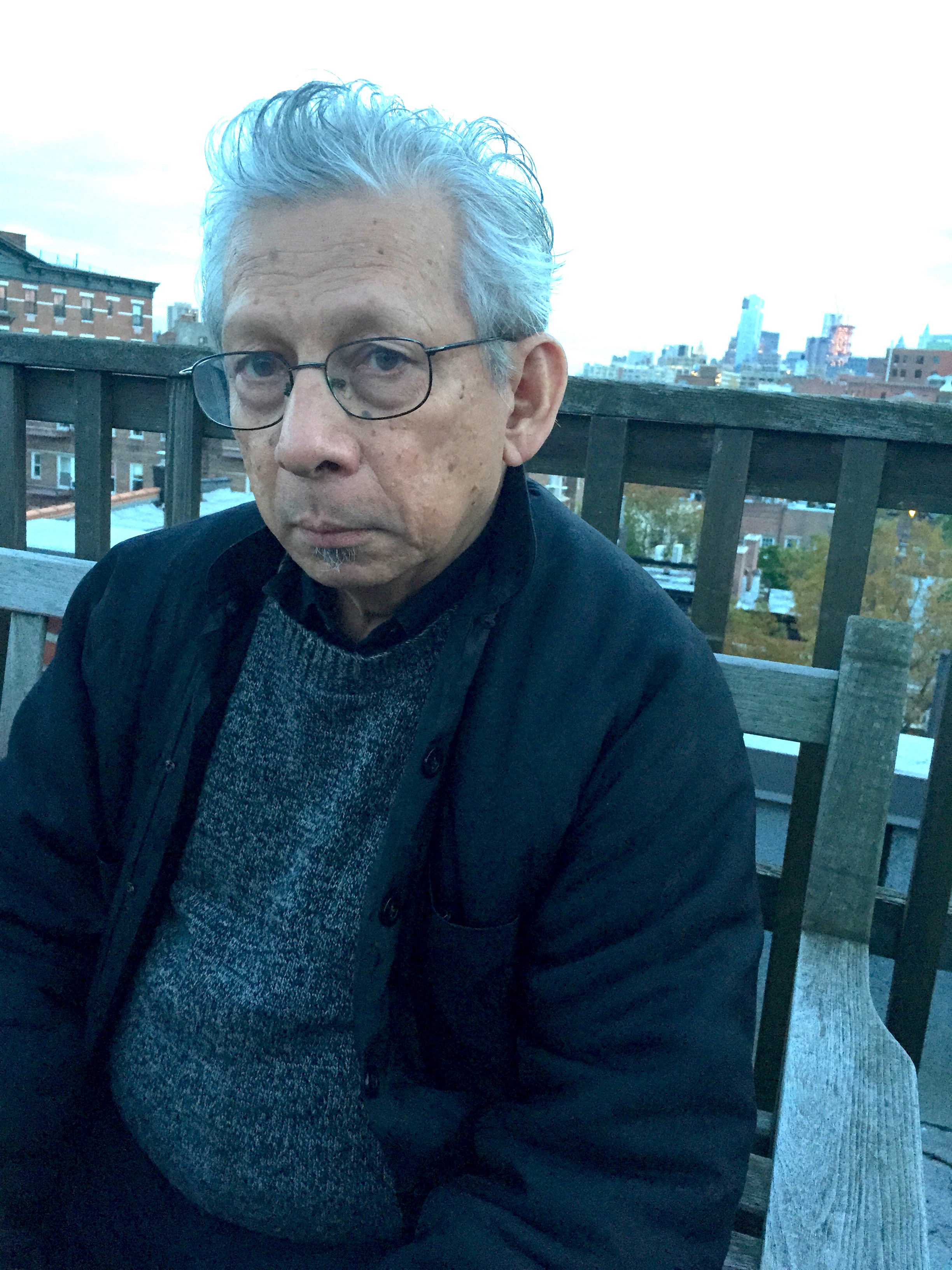
But there are always some friends you never mind breaking your routine for, and who never seem to mind, either, if you break theirs. And I was glad to meet up in Manhattan with two such writer-friends, the poet and essayist Luis “Luigi” Francia and the fictionist Gina Apostol, both of whom live and work in New York. Luigi teaches at Hunter College and Gina at the Fieldston School.

The first time I met Luigi, many years ago in a Malate bar on one of his visits home from New York where he has been living since 1970, I remember seeing his calling card, which described him thus beneath the name: “POET. EDITOR. PRINCE.” It seemed cheeky and chic, and I was deeply impressed, being none of the above. (I’ve since written some middling poetry and have done my share of editing chores, but remain utterly unprincely.)

IMG_5856

I had the recent pleasure of writing a blurb for Luigi’s forthcoming collection of essays titled RE: Reviews, Recollections, Reflections, to be published by the University of the Philippines Press, and this is what I said:

“Luis Francia knows New York and America better than many of the native-born, but he never loses his moorings, his critical awareness of what it means to be Filipino-American. But these essays are about far more than racial politics, as they chronicle the travails of that most blessed and in other ways most cursed of citizens—the artist, particularly the artist abroad, for whom alienation acts as a lens that magnifies and reshapes every little thing that crosses the eye. The most arresting and delightful reads are his portraits of the expatriate masters who preceded him in America—most notably Jose Garcia Villa, lover of martinis and hater of cheese. Despite the plaints, Francia has been clearly and distinctly privileged to be where he has been and to see what he has seen, and he shares that privilege with us in this well-wrought collection.”

Gina was my batchmate when I returned to finish my undergrad studies in UP in the early ‘80s; I was ten years older than everyone else, so I was kuya to all of them. It was a time when we were all dreaming of finding a way to take our graduate studies abroad—as English and writing majors, we wanted to become the next Gabriel Garcia Marquez, the next Sylvia Plath, the next Ian McEwan, the next Pablo Neruda, and so on; as Pinoys, we wanted to see America. Eventually, we just became our older selves, but we did get to see the States through one ticket-paying subterfuge or other—for me, a Fulbright grant; for Fidelito Cortes, a Wallace Stegner fellowship; for Ramon Bautista, an assistantship at Wichita. But we had to compete for these, while all the brilliant Gina had to do was to lick a few stamps and mail a couple of her typewritten stories off to John Barth, who directed the writing program at Johns Hopkins and who wrote her back forthwith to offer her an assistantship, smitten as he was with her talent. It was pure magic, in those pre-email days.

That brash young woman from Tacloban who flew off to Baltimore would go on to write several prizewinning novels. Gun Dealers’ Daughter, published by W. W. Norton, won the 2013 PEN Open Book Award given by the PEN American Center to outstanding works by authors of color to promote racial and ethnic diversity within the literary and publishing communities. (Luigi himself had won this prize in 2002, the first year it was given, for his nonfiction book The Eye of the Fish.)

Here’s what the judges said about that novel in their citation: “You will read Gun Dealers’ Daughter wondering where Gina Apostol novels have been all these years (in the Philippines, it turns out). You will feel sure (and you will be correct) that you have discovered a great fiction writer in the midst of making literary history. Gun Dealers’ Daughter is a story of young people who rebel against their parents, have sex with the wrong people, and betray those they should be most loyal to…. This is coming of age in the 1980s, Philippine dictatorship style, where college students are killed for their activism. The telling is fractured, as are the times…. Not only does this novel make an argument for social revolution, it makes an argument for the role of literature in revolution—the argument being that literature can be revolution.”

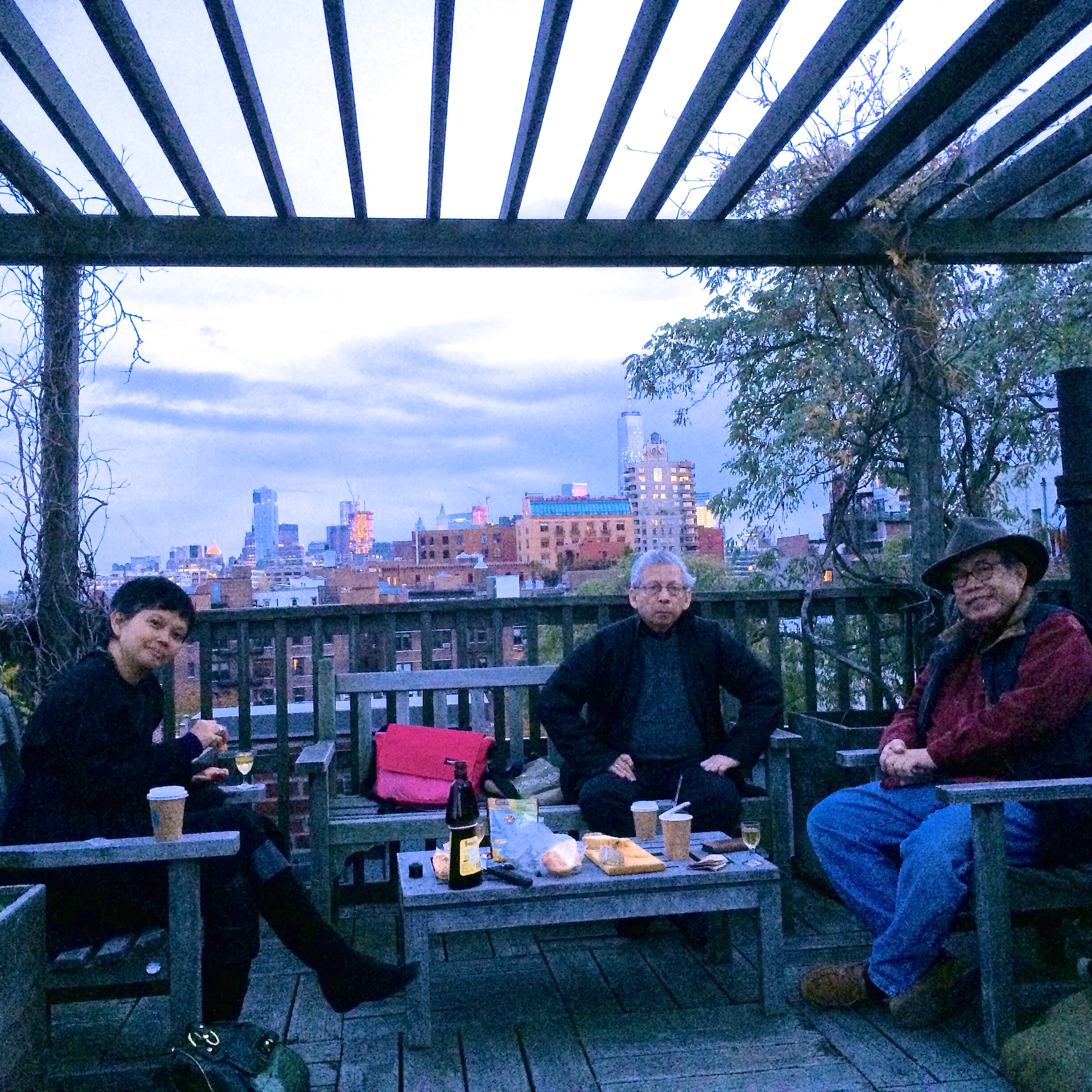
These then were the two literary luminaries who happened to be my friends (or should that be the other way around?) whom I was happy to set up a date with in a coffee shop in the West Village, near the High Line (an elevated garden and walkway that deserves its own story, among other New York landmarks). The coffee place was full, so we brought our steaming cups instead up to the roof deck of Gina’s apartment a few blocks away, pausing for a picture in front of the late Jose Garcia Villa’s old place on Greenwich Street. “This was where he held court,” said Luigi, one of Villa’s acolytes. “Nonoy Marcelo also lived in this area for many years, and I did, too, back when the rent was 65 dollars a month.” Then Gina added, “That white place is where John Lennon and Yoko Ono lived.” And I thought, if they’d stayed here instead of moving to the Dakota, he might still be alive.

We went up to the roof deck and Beng and I savored the scenery in all its 360-degree magnificence, as the sun set in the west and the full moon rose in the east, competing with the Empire State’s tricolor spire. We talked books, life, and loves over Frangelico, bread, and cheese; channeling Villa, I steered clear of the curd. Looking sharp and happy despite a recent illness, Gina said that her iPhone’s Siri had told her, in response to a question, “I’m just glad to be alive!” At that instant, we all were.

Penman No. 119: Bulosan in the Heart

Penman for Monday, October 20, 2014


TAKING A short break from my fellowship in Washington, DC, Beng and I flew off to the West Coast a couple of weeks ago for a weekend with our daughter Demi and her husband Jerry. Demi was celebrating her 40th birthday (can you believe it?) and had sent us tickets to join them in Seattle; they live in San Diego, but they’d loved Seattle from a previous visit and wanted to share that discovery with us.

Over three days, we did the Seattle thing, and had loads of fun: the Pike Place Market, the Space Needle, a glimpse of the Chihuly glass garden, antiquing in Snohomish, and a boys’ tour of the Boeing plant in Everett. But it was an unexpected turn in the program that made it all the more worthwhile.

On the drive into the city from the airport, I had mentioned to Jerry (who had been born in Rhode Island to parents from Bicol) that two Asian-American icons—Carlos Bulosan and Bruce Lee—were buried in Seattle. Jerry’s an engineer in the aviation industry, but like Demi, he has a keen interest in culture and in his roots.

Bulosan’s name holds a special significance for our family. In high school, with some help from Beng, Demi had put together a book report on America Is in the Heart—Bulosan’s sprawling semi-autobiographical novel about the Filipino immigrant experience in America, first published by Harcourt Brace in 1946. I myself had written my undergraduate thesis at the University of the Philippines on Bulosan, fascinated by his often paradoxical appreciation of America, which he described as being at once “so kind and yet so cruel.”

Born in Pangasinan, he shipped out to Seattle in 1930, and never returned until his death from bronchopneumonia, also in Seattle, on September 11 (yes, 9/11) in 1956. (There’s some debate over the year of his birth, which has been variously listed as 1911, 1913, and 1914.) In the US, without the benefit of college, he became a voracious reader and taught himself to write, and became known both as a writer and a labor activist. Since the 1970s, many critics such as Epifanio San Juan Jr. have championed a reappreciation of Bulosan and his work; in 1973, the University of Washington Press republished America Is in the Heart, which was translated into Filipino as Nasa Puso ang Amerika by Carolina S. Malay and Paula Carolina S. Malay and published by Anvil in 2000.

When Demi and Jerry made plans to marry in 2007, I knew what I was going to give them as a wedding gift. After a long and eventful search culminating in a meeting with the seller in a Jollibee in Diliman, I had just acquired a first edition of America Is in the Heart, and carried it with me to San Diego. This copy had been inscribed by Bulosan to his friend Fred Ruiz Castro: “This story of my life will, I hope, bring me closer to you and our native land through our good friend J. C. Dionisio, with my best wishes, Carlos Bulosan, Los Angeles, 3-6-1946.”

Upon receiving the book in Manila almost a month later, Castro—who became Chief Justice in 1976—also signed it on April 4, 1946. I signed the book on a following page on April 2, 2007, and Beng and I presented it to Demi and Jerry on April 15. The book now rests proudly on their bookshelf in San Diego. (When I first wrote about this in my column—about finding that “holy grail” of a signed first edition and giving it to our only child on her wedding in America—I got a pleasant surprise upon my return: the gift of another copy of an early edition, acquired by another Filipino writer when he was in college, Greg Brillantes. That book, signed by Greg, now sits on my topmost shelf in Diliman.)

Now back to Seattle. On our last full day there, after touring the Boeing plant in the morning while our wives did their own thing downtown, Jerry and I were hit by the same brain wave in the car: why not look for Carlos Bulosan’s grave and pay our respects to our literary hero? A little Googling quickly revealed his gravesite, at the Mt. Pleasant Cemetery on Queen Anne Hill. We picked up Beng and Demi at the hotel, and located the cemetery not too far away.

GPS helped bring us there, but it couldn’t pinpoint the exact grave among the many hundreds on the site; thankfully, Google also yielded a picture of the grave itself, and the four of us spread out across the cemetery, looking for visual markers—particularly a white obelisk in the distance; it took about 20 minutes until Demi yelled “I found it!”

It was, ironically, very close to the cemetery gates, on the left side. Beng picked some flowers nearby and offered them at the foot of the marker, which read: “CARLOS BULOSAN 1914-1956 Writer Poet Activist,” followed by an epitaph that Bulosan himself had written: “Here here the tomb of Bulosan is / Here here are his words dry as the grass is.” It was a pretty spot, truth to tell, and the grass was hardly dry. After the cemetery, we visited Seattle’s International District near the waterfront, to peek at the Bulosan exhibit through the windows of the historic Eastern Hotel, where Bulosan and other Filipino cannery workers lived.

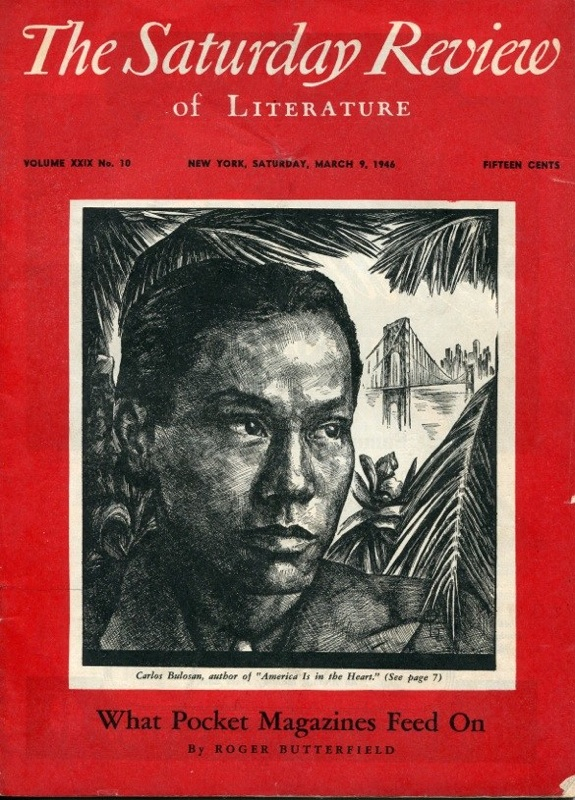
Demi and Jerry don’t know it yet, but they have another Bulosan memento coming from me: a copy of the Saturday Review of Literature from March 9, 1946, on the cover of which the famous pen-and-ink portrait of Bulosan first appeared. One of these days, I’ll pay another homage, to the Bulosan memorabilia on exhibit at the University of Eastern Pangasinan in Binalonan, where they keep copies of his letters, commemorate September 11 as Carlos Bulosan Day, and teach a 3-unit course on his life and works. There’s a trove of material on him at the University of Washington library, and perhaps on another visit to Seattle, with more time, I might look into that, too. But as every Fil-Am and indeed every Filipino should know, a pioneering voice like Carlos Bulosan’s can ring everywhere and forever, in the heart.

Bulosan

Penman No. 63: A Poet Speaks

CBautistaPenman for Monday, Sept. 9, 2013

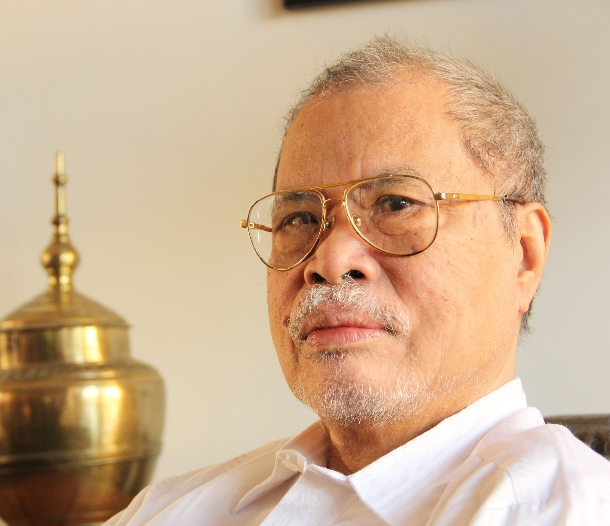
NOW 72, Cirilo F. Bautista towers over the writers of his generation. Though primarily known as a poet in English, Cirilo—“Toti” to his friends—also writes formidable fiction in both English and Filipino. His books of poetry alone number a dozen, and have won the country’s most prestigious prizes, including the Centennial Prize in 1998. Until his retirement, he was a full professor and writing guru at De La Salle University, and had, at some time or other, taught at other major universities here and abroad. His poetry is deep and complex, conscious of the need to separate the emotional from the intellectual—difficult to many—but not without wit and humor.

Bautista has been nominated for the hallowed title of National Artist, and it’s an honor he would richly deserve and invest with the necessary achievement and gravitas. I can only hope that the bestowers of this award will take this view—shared by many in our literary community—when they sit down next to consider our National Artist awardees. I can be fairly sure that there will be great rejoicing and little dissension when that happens, unlike the controversy that met the last batch of dagdag-bawas “laureates.”

Last Sunday evening, I was privileged to hear Cirilo speak at the 63rd Palanca Memorial Awards for Literature at the Manila Peninsula. He had been asked by the contest sponsors to be evening’s guest of honor. Although forced to use a wheelchair by muscular dystrophy, Cirilo showed no sign of slowing down where his mind was concerned. That night, in a mixture of polemic and poetry reading, Cirilo lamented the diminished role of the poet (by extension, the artist) in Filipino society, diminished since the days of Jose Rizal, when poets were heroes and heroes were poets.

With his permission, I’m excerpting portions of his speech, in the hope that more Filipinos will take notice of their poets in general, and of one named Cirilo F. Bautista in particular. What follows are his remarks:

Small as the Philippines is, smaller still is its literary community—poets and fictionists caught in the bright dream of making a difference in its aesthetic and cultural development. Some are good, many are terribly bad. I speak of the good ones only since charity has no place in the critical evaluation of artistic excellence. To those who live with words, who are engaged in the art of counting syllables and harmonizing metaphors, whose constant fear is not finishing their work, to be poets in the Philippines is to live in a surreal world whose stress and strains shape their concept of existence. People regard you as a specimen of some strange thing to encounter, to examine, even to touch. But not of something to take seriously. You live on the border, on the periphery, on the edge of society, considered unique, but nothing more. The institution that you represent—the world of fine writing—has not made the priority list of any government in the history of the country, whatever our political fathers may say about the importance of cultural advancement. Poetry receives no significant financial allocation, no institutional support, no artistic infrastructure. Not that the poets should depend on the government, but that since the government is tasked with the overall progress of the people, certain measures must be taken to insure that poets do not wallow in the quagmire of neglect.

… Now we see manifestations of the absence of support for the poets. Poets are generally unknown in their own country. Few read them but in the lingering and strengthening vestiges of colonialism prefer the work of Western writers. We are led by the nose by American capitalist interest in the arts. We read what they give us, and have not been sincere and brave enough to assert our own taste and preferences.  Our culture is a borrowed culture, disguised as modernistic simply because it arrived on the Internet. But of the values that assert our roots, they seem to have been devoured by TV novelas and rock concerts. Our taste is largely a mixture of truncated native idealism and borrowed Western adventurism. That we adapt to them may be our virtue, given difficult times; that we are controlled by them may be our downfall. But like them we do. They appeal to that inexplicable part of us that needs to resolve the ironies and contradictions of our existence. And it is in this that, quite strangely enough, the poets seem naturally equipped to provide explanations.

… I am a veteran poet; as I have said, I have published some 12 books of poetry. None of them made a print run of one thousand copies. By American standards I should be rich from the sale of these books, but I am not. It seems they are read only by the inquisitive and misdirected. On a few occasions when, feeling generous, I give my books to relatives and acquaintances, they ask me why I am punishing them. Those who don’t like reading poetry considering reading it a punishment; that’s the only way of interpreting the situation. And poetry becomes a burden to society which has reached a certain stage of insensitivity to the stark harmonies of the soul. This baffles me. I can’t understand why in an affluent society like ours (we are called Third World only by the political elite who handle the greater portion of our national budget for self-improvement and establishing political dynasties), a true literary resurgence cannot take place, or why we cannot remedy the effects of a fractured culture and mismanaged patrimony. The elite in society do not buy Filipino books but patronize foreign ones. It is their pride to be amongst the first to have the work of this or that European poet or novelist, but they will ignore the works of their countrymen. Is this colonial mentality or crab mentality? They still find it difficult to believe in Filipino excellent artistry, or they will down to lower ground Filipinos who exhibit excellent artistry. I find this prevalent among the young who regard foreign shores as sources of cultural inspiration. Always the Filipino is never first in their appraisal.

… It is of course an error to belittle our poets. They have proven that they can compete with the best in the world, given certain assistance and patronage. Their works appear in international publications, they have won important prizes, they are invited to global conferences and festivals of art, they exchange ideas with prominent figures of contemporary literature. Why then are they not patronized in their own country? As I said, I’m baffled by this, short of saying what I don’t want to say—that like crabs we pull down those we perceive to be making names for themselves, and consign to neglect the products of those names. Some are even proud not to be readers of Filipiniana.

… We are proud to point to a poet as our national hero. A poet laureate reflects a country’s coming to terms with the importance of poetry in the overall conduct of its affairs, but mostly with the progress of its artistic sensibility. Poetry is a civilizing factor that drives away the rudeness and coarseness of practical existence. It confers on the individual a high sense of being-ness and a true perspective of life. The poet laureate serves as a bridge to connect the people’s aesthetic education and spiritual well-being. It is seeing their world in another way, and making connections with realities that seem hazy at the start. A moon is not a moon, flying is not leaving the ground—but something else. What? That’s the exquisite area of poetic discovery that only the knowledgeable may enter.

(Photo courtesy of the Cultural Center of the Philippines)

Penman No. 57: On Politics in Fiction

BaldwinPenman for Monday, July 29, 2013

I WAS in Hong Kong last weekend to talk to an international group of graduate writing students about a subject that, I proposed, we were all acutely aware of and very likely had done something in, but rarely dwelt on in creative writing class (although we do discuss it a lot in a reading or critical context): the relationship between literature and politics, or self and society. I’d put together a module that explored the way various authors from different environments have dealt with political subjects, primarily in fiction.

The selections I chose—15 short stories and three novels from all over—covered a range of specific issues from race to sexuality, and also a range of approaches and techniques. We discussed these examples, paying close attention to how the authors drew attention to their causes and concerns in an aesthetically satisfying and politically effective manner.

My students came from the UK, the US, India, New Zealand, and Singapore, and many lived in Hong Kong or mainland China. Therefore, they represented a broad range of social and political experiences, which also informed their responses to the fiction we took up. (We Pinoys—at least the older ones among us—are relatively immersed in political literature and discourse, given our history and our circumstances; whether as readers or writers, we can’t avoid Rizal, and why should we? Despite more recent forays into postmodernism, speculative fiction, and other fresher approaches, our fiction remains stolidly realist in the mainstream, compelled to account for the harrowing truths that drip from our headlines.)

We opened by discussing three stories that dealt with the thorny issue of race—thornier, of course, in some countries and societies than others. Race may not be as visible and as contentious a political factor with us Filipinos as it is in, say, Singapore or Malaysia, not to mention the US and the UK, if only because we have assimilated the Chinese, for example, so well into our bodies and body politic that it will be nigh impossible to mount anything anti-Chinese without cutting off our own noses. That doesn’t mean that we’re above or beyond racism, regionalism, and ethnic bias; this will raise some hackles, but I suspect that we Pinoys practice a benign racism in insisting that all our PBA imports should be black. It’s for this reason, among others, that I make sure I cover African-American material in my classes.

The three race-related stories that I chose were James Baldwin’s “Going to Meet the Man,” Nadine Gordimer’s “Six Feet of the Country,” and Alice Walker’s “Everyday Use.” Baldwin and Walker dealt with the African-American experience, and Gordimer with apartheid in South Africa. (I wish I’d found a Chinese or Malaysian story dealing with race issues, and will do that the next time I do this module.)

Not only were the Baldwin, Gordimer, and Walker stories gut-wrenchingly powerful pieces of prose. They also represented different approaches to the same presumptive subject of the search for racial equality and self-realization, and this was what I wanted my students to see: how you could be so potently political, so committed to your cause, and yet also so level-headed and so composed that you never lose control of your material, or otherwise strangle it with heavy-handedness.

“Going to Meet the Man” was published in 1965 at the peak of the civil rights campaign in the US, and Baldwin—one of America’s most prominent black writers—could have written a typical story featuring a black character struggling against injustice and racial oppression at the hands of the white majority. All these elements are in the story, but James Baldwin does the daringly unexpected: for his narrator, he assumes the voice of Jesse, a white sheriff. The mild-mannered Jesse is a patronizing racist who can’t understand how blacks could be so upset with their lot that they would march in the open and disturb the peace, forcing him to take punitive action. Jesse also has a far more domestic problem: he can’t get it up for his wife, and the only way he can solve that is to pretend, strangely enough, that she’s black. But the story’s most horrifying moment comes from Jesse’s past, from his recollection of a childhood “picnic” that turns out to be the brutal lynching of a black man.

Nadine Gordimer’s story, first published in 1953—four decades before the formal abolition of apartheid in South Africa—is also told from the point of view of a white man, a landowner who albeit reluctantly takes up the cudgels for his black workers when the white authorities make a ghastly administrative mistake and return the wrong corpse for the man’s relatives to bury. (“There are so many black faces—surely one will do?”) The white protagonist here acts not out of politically enlightened outrage, but rather out of a deep annoyance with the bureaucracy, as if he himself had been personally offended. (And yes, before you ask, the tragicomic mix-up of bodies here would inspire my own Soledad’s Sister many years later.)

Alice Walker would gain fame for The Color Purple, a sprawling novel with a large cast of characters, but before that she wrote the story “Everyday Use,” which focuses on the home visit of a young, college-educated black woman to her poor mother and sister. Told from the mother’s point of view, the story shows how differently the educated and politically empowered daughter Dee now acts from those she left behind—she wants her mother to give her a precious quilt, a family heirloom, that she plans to use as a piece of décor, and can’t understand when her mother refuses to give it to her, since the quilt has been promised to her sister Maggie, who’ll be putting it to everyday use. Thus, no matter how much Dee may have gained in the city in political and cultural sophistication (she has even changed her name to “Wangero” in her own affirmation of black power), she has clearly lost touch with her own roots, no longer able to recognize the truly authentic and truly valuable.

What’s there to learn for writers from these three examples?

First, that good, sharp authors reject the obvious, and are willing to take risks with their material and their treatment. For his central character, Baldwin chose the antagonist, the one more difficult to portray with fidelity, if you’re on the other side; rather than demonize Jesse, Baldwin presents him with not a little sympathy, making him even more alarming. Rather than the victim, Gordimer chose to focus on the man in the middle, the individual caught in a moral dilemma; the man’s bravado is ultimately ineffectual, but his decision to act challenges the reader more likely to fence-sit in the same circumstances. Walker takes on the natural protagonist with her all-black cast, but also highlights the important differences between them, reminding us that “race” comprises individuals and great divergences of experience and belief.

Second, that they don’t come to easy conclusions, and allow for the complexity and even the complicity of their characters to come through. You don’t do characters and their readers a favor by creating flawless heroes and thoroughly hateful villains. Real life very often lies somewhere in between.

In other stories by authors such as Gabriel Garcia Marquez, John Updike, Cynthia Ozick, and our own Merlinda Bobis, my students and I also saw how authors with very strong political messages to convey did so, more effectively, by employing restraint and ambiguity, rather than excess and unyielding certainty. In other words, the best writers trust the intelligence and the natural humanity of their readers to lead them to what is reasonable and just. If you want to write good political fiction, first create good art, and leave the sloganeering to the editorial writers.

(Photo from time.com)

Penman No. 56: Cheers for The Mango Bride

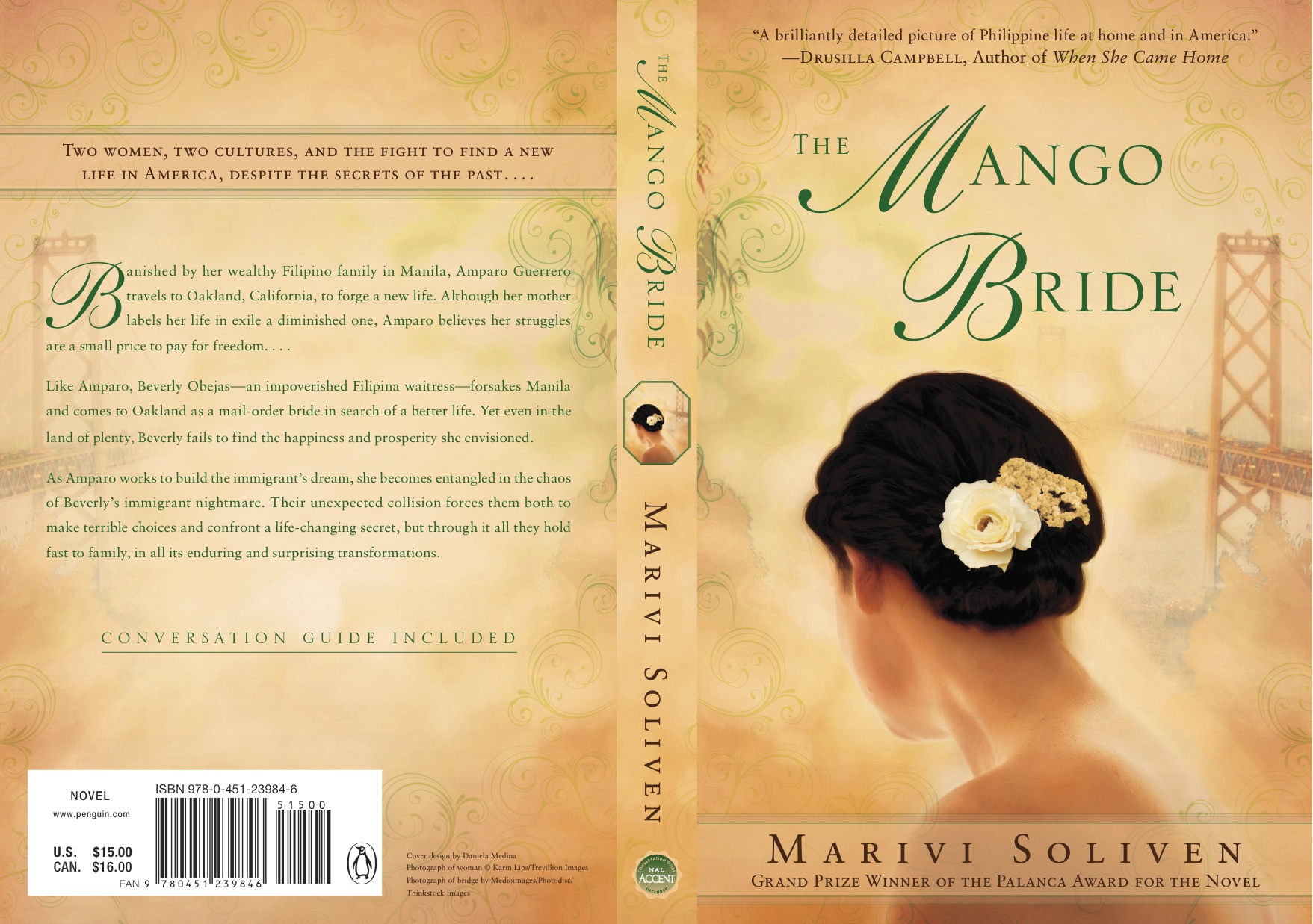
mango bride final cover copyPenman for Monday, July 22, 2013

IT ISN’T every day or even every year that a Filipino author gets published by Penguin Books—I can think of only Jose Rizal, Jose Garcia Villa, Jessica Hagedorn, and Miguel Syjuco, off the top of my head—so when Marivi Soliven told me a couple of years ago that her new novel The Mango Bride (New York: NAL Accent, 2013) had been picked up by a division of Penguin, I immediately sent her a congratulatory note. But I didn’t realize the extent of Marivi’s achievement until I received a copy of the published book and read the novel in a mad dash to the ending.

Again, that doesn’t happen to me very often; given my crushing workload, it usually takes me weeks and even months to finish a new book, which is why I habitually decline invitations to do book reviews, not wanting to keep the authors and publishers waiting interminably. But Marivi’s case was different, because I was reading the book not as a beetle-browed critic, but as a mentor and a friend; as it happened, Marivi—whose husband John Blanco teaches literature at the University of California in San Diego, where they’ve been living for many years now—was also my daughter Demi’s English teacher in UP, and since Demi herself moved to San Diego, we’ve all kept in pretty close touch.

All this chumminess and this moving around has a point, and it’s directly related to The Mango Bride, which deals with the powerful tides, both social and personal, that continue to deliver many thousands of our countrymen to America. It tracks two Filipino women—the to-the-manor-born Amparo Guerrero, who gets banished to Oakland following an unwanted pregnancy that threatens to bring shame and scandal on her family, and Beverly Obejas, a plucky girl who also ends up in Oakland following the well-traveled path of the mail-order bride.

There is, of course, more in common between these two women than meets the eye, and it will hardly be a spoiler to say that their trajectories will cross. The task of the novel’s plot is to bring these two seemingly very different characters together—Amparo is a carefree college coed, while the orphaned Beverly works as a waitress—and when they do, toward the novel’s explosive climax, the author completes a narrative coup, with both dramatic inevitability and irony.

But more than a story of individuals, The Mango Bride is also a story of Filipino families rich and poor, which is to say that it presents Philippine society as an unfolding telenovela—bitchy matrons, philandering patriarchs, wayward sons, gay go-betweens, suffering servants, and all. This is, unabashedly, the source of the novel’s power, its appreciation of life in its broad, harsh strokes.

But unlike a telenovela, Soliven’s masterful prose lends the novel a fineness of detail that extends the pleasure of reading beyond mere plot and character into language. Here’s how she presents Amparo’s first experience of sex (as novelists know, a sex scene is always one of the hardest things to do well, and do freshly): “If there was something Amparo learned that first night, it was that the rhythm of passion was deeply satisfying for its simple circularity. Mouths making pillows of opposing lips, the call and response of interlocking sighs, a passel of caresses, cascading one into the other as waves folding into sea foam. Afterward, they gathered the thin sheets about them and curled into each other, chin to chin, chest to breast, dozing twins in a cotton womb.”

There’s a brilliant scene where Amparo tries to tell her boyfriend Mateo that he’s gotten her pregnant, but an elephant—literally—strides into the picture, having escaped from a circus and running red lights all the way down EDSA. It’s unexpected pay-offs like this that keep lifting the novel above the pedestrian, that remind us of an important literary talent at work, one with an unfailing feel for her material, whether we’re in Forbes Park or North Cemetery or a grocery in Oakland.

There will, I expect, be some complaining over the coincidences that mark the plot, but even here the improbable seems fated, precisely because of the novel’s implicit message: that we are closer to each other than we think, and might do well to acknowledge and accept that closeness while we can.

Marivi says that she began the novel in 2008 in the frenzy of NaNoWriMo (National Novel Writing Month—November, to most people) and completed it two years later. It won the Grand Prize for the Novel in the 2011 Palancas, but was extensively revised by Marivi for international publication.

If you want to buy the book and see if you can share my enthusiasm, it’s available at National Bookstore. But here’s the best part: if you want to meet Marivi herself and get her to sign your copy for you, she’ll be in town very soon for a series of readings and talks, thanks to NBS, which is sponsoring her visit.

She’ll be spending an afternoon with us in UP Diliman on Wednesday, August 7, from 2:30 to 4 pm at CM Recto Hall. The UP Institute of Creative Writing and the Department of English and Comparative Literature will co-sponsor the event, which is open to all. See you there!

SPEAKING OF new books, I was happy to have attended the recent launch of a rather unusual book—unusual because it’s a bilingual Spanish-English edition—titled La Oveja de Nathan (Nathan’s Sheep), by the late novelist Antonio M. Abad. Translated into English by Lourdes Castrillo Brillantes (a professor of Spanish at UP, and the lovely wife of our friend and literary kuya Greg Brillantes), the novel won the Premio Zobel in 1928, and was being published for the first time.

The Premio Zobel was initiated by the pioneering businessman Enrique Zobel de Ayala in 1920 to preserve the linguistic and cultural heritage of Spanish in the Philippines in the face of what Nick Joaquin would have called unbridled sajonismo. The Philippines and Filipinos had imbibed English like it was God’s own drink, and bold measures had to be taken to ensure the survival of Spanish in the new American age. Over the next many decades, the Premio Zobel did just that, and more, granting recognition to the best literary works written by Filipinos in Spanish, as well as the most valuable cultural contributions made by Filipinos to the cause of hispanidad.

Abad’s novel was one of the earliest winners of the prize (which Prof. Brillantes herself would later win), and its present publication by the Premio Zobel Collection, the Filipinas Heritage Library, and Georgina Padilla y Zobel (Enrique’s granddaughter) could not be more timely, as it deals with Filipinos caught between powerful political forces.

I’d have to admit that Sra. Georgina’s thoughtfulness in sending over an invitation to my house, with my name and address hand-lettered with a fountain pen, was what convinced me to drive across town in rush-hour traffic to catch the launch. Of course, the late author’s son, the poet Jimmy Abad, is also a dear friend, and Jimmy’s moving poetic tribute to his father’s legacy (delivered, in customary Jimmy Abad fashion, straight from memory) was well worth the excursion.

Penman No. 54: Calling All Filipino Writers

APWTPenman for Monday, July 8, 2013

I’LL BEGIN with a sheepish apology (and a word of thanks) this week, for a stupid mistake I made in my piece about hats a couple of weeks ago. I was in the car on my way to a meeting in Makati last Wednesday when I realized to my great horror that I’d written something very wrong, and resolved to fix the problem in the blog version of my column at www.penmanila.ph, but of course, before I could do that, an alert reader named “Nestie U” caught the error and pointed it out to me. I’d written that “felt” meant “mashed leather pulp,” but it’s certainly not—it’s wool, not leather. It probably won’t mean much to most people, but if we self-proclaimed wordmeisters don’t get finicky about words and what they mean exactly, then who else is going to care? Many thanks again, Nestie, for reminding me of what a confused and forgetful fellow I could be, sometimes.


THIS IS going to be a week of announcements, not because I’m too lazy to write a properly thought-out column—you know how I can go on and on about my pet causes and peeves—but because my involvement in certain literary organizations and concerns gives me access to news and information that (given the usual space limitations) might not even make it to the literary or culture section of most newspapers. (Here in the STAR, of course, we do our best to keep you abreast of the most important and interesting goings-on in the cultural front.) So let’s get on with the literary news—these just in!

For writers, the first and most vital announcement I have to make is a call for all alumni of writers’ workshops sponsored by the National Commission for Culture and the Arts (NCCA) to take part in a tracer study being conducted by the National Committee on Literary Arts, on which I sit as a member.

Most people don’t know this, but the NCCA—the government’s funding agency for cultural programs—has been supporting most if not all of the country’s major writing workshops for almost 20 years now. Without the NCCA’s substantial support, these workshops would have been forced to shut down a long time ago, or would never have become as highly developed as they are now. The workshops enable young writers to meet both their peers and their seniors, examine and affirm the writers’ talent, and initiate them into a community that can help sustain their productivity for life.

The UP workshop, for example, has been held every year for almost half a century, and while we now take only 12 fellows a year, we used to have more, so if you average everything at about 20 fellows per batch, we would have produced almost 1,000 alumni fellows since the beginning. Add to these the fellows who’ve gone to the Silliman, Iligan, Iyas (La Salle Bacolod), and other NCCA-supported workshops in the regions.

Like any other government agency, the NCCA has to be publicly accountable for how it spends the people’s money, so we at the NCLA thought of initiating a tracer study to see exactly how these workshops have helped our writers in their careers—say, in terms of books written and published and awards won for their work, among other criteria.

We’ve asked Dr. Christine Godinez-Ortega of MSU-IIT to be the project leader for the first phase of this project, and Christine and her team have formulated a set of questions that we’d like all workshop alumni from 1994 to 2010 to respond to. If you’ve attended and benefited from one of these workshops, please click on the link following and fill out the form.  http://www.msuiit.edu.ph/ research-extension/ncca/ tracer.php. Your response will go a long way to help sustain government support for the development of Philippine literature, as well as create a very helpful database and virtual network of all workshop alumni.

The second item on this week’s literary agenda is another call, this time for papers to submit to the “Reaching the World 2013” conference, scheduled for October 3-6, 2013 in Bangkok, Thailand. Spearheaded by the Asia-Pacific Writers and Translators Association, the conference is co-sponsored by Chulalongkorn University, the SEAWrite Award, and the Bangkok Metropolitan Administration.

Among many other Filipino writers, I’m one of the founding members of APWriters (www.apwriters.org), which has become one of the most active and viable organizations of writers and academics in the region. Last year, a formidable contingent of Filipino writers attended this conference, also in Bangkok, and our participation there left a very positive impression on the organizers and our fellow delegates, so much so that this year, I’ve been asked to head the Academic Committee that will receive proposals for papers and presentations.

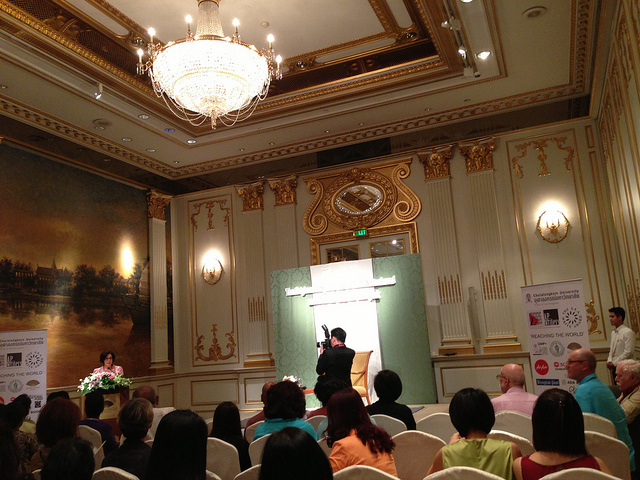
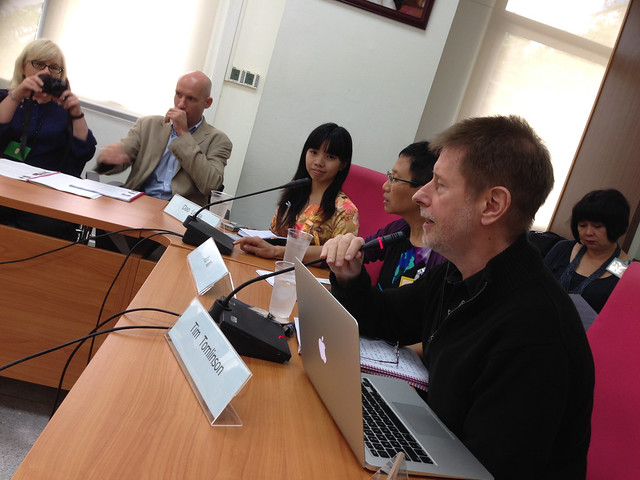
Bangkok has been named by UNESCO as the World Book Capital for 2013, which is why we’re returning there (aside from the fact that Bangkok and Thailand are worthy of visiting for food, fabulous sights, fantastic shopping, foot massages, and other pleasures anytime, given any reason or excuse). Its famed Oriental Hotel has also hosted the annual SEAWrite Award, honoring the region’s best writers. (That’s a session from last year’s conference in the pic above.)

“Reaching the World 2013” will bring together authors, literary translators, scholars, teachers of Creative Writing, publishing professionals, and others from Asia and beyond. This three-day international conference with workshops and a free public day will enable writers, readers, scholars, students, publishing industry professionals and interested members of the public to network and share their work.

APWriters is a fairly open and friendly organization, and you just have to be a writer, a translator, a teacher, or have an interest in either writing or translation to sign up. Even in the academic area of the organization and the conference, we try to remain accessible, preferring discussions on topics of broad application to obscure and highly specialized ones that only a very few can understand and appreciate.

This year, for the conference, we are inviting papers and presentations on the following subthemes: Teaching Creative Writing; Literary Translations; Cultural Identity; Food in Literature; Music/Art in Literature; Online Writing; Young Writers; Literary Fiction; Creative Nonfiction (including biography and memoir); Poetry; Genre Fiction; and other related topics. Our main focus, however, will be the teaching of writing.

To offer a presentation or longer paper with a focus on teaching and practice of creative writing, email me, Jose (“Butch”) Dalisay, Chair of AP Writers’ Academic Committee, at jdalisay@mac.com. Deadline: August 10.

To offer a presentation or longer paper on literary translation, email Eliza Vitri Handayani, Chair of AP Writers’ Translation Committee, evhandayani@gmail.com. Deadline: August 10.

If you’re teaching Creative Writing at a university which offers this discipline and would like to offer a half-day or full-day workshop, send a paragraph describing the workshop you’d like to offer along with a brief bio to AP Writers’ Board Member Xu Xi at xu.xi@cityu.edu.hk.

If you would like to read your poetry or discuss your creative writing on the panels at the public forum on Sunday, October 6, in the Bangkok Arts & Culture Centre, or if you want to launch a new book at “Reaching the World 2013,” email Jane Camens at admin@apwriters.com.

I’ve reminded the early birds who’ve already emailed me to express their interest in presenting a paper that they will have to produce a ten-minute-maximum version of their paper (and that time will include setting up PowerPoint, should they need it). I’ve noticed that here in Asia, we tend to be too respectful of each other in terms of extending time limits, which many paper presenters routinely ignore, droning on and on without compunction. Well, I’m going to pull the plug on any such miscreant (I think it’s a gross discourtesy to the next speaker and to the audience itself to speak beyond one’s allotted time), so please practice your presentation with an alarm clock before leaving home.

There’ll be a small conference fee (last year it was only USD$50 per participant) and we have no travel funding whatsoever to offer anyone, including ourselves, so save up and book a budget fare early, and see you in Bangkok in October!


Penman No. 47: Another Summer in Silliman

Dumaguete

Penman for Monday, May 20, 2013

LAST WEEK had me enacting another familiar ritual—sitting on the panel of the 52nd edition of the Silliman University National Writers Workshop in Dumaguete City. The oldest of all the country’s literary workshops, Silliman’s is also the longest at three weeks—a format it has retained for many decades now, certainly since I was a fellow myself in 1981. Three weeks of poetry, ocean, and boozing by starlight may be a young writer’s dream escapade, but old geezers like us panelists can’t take that much time off from the more mundane claims of life, so we sign up for no more than a week, and this year I took the middle week.

I shared the week’s paneling duties with a couple of old friends: the prizewinning short story writer and now Silliman workshop director Susan Lara and the Mindanao-based poet and retired rocker Ricky de Ungria, as well as the La Salle-based playwright and historian Vic Torres and a poet and car mechanic that the workshop flew in from Hong Kong, David McKirdy. (David’s “car mechanic” tag isn’t just being cute—that’s his real profession, and an enviable one it is, since he specializes in repairing vintage Rolls Royces, and flies around the world to revive Silver Shadows from the 1930s and such.)

Quite by chance, this panel acquired a trademark of sorts: David and I turned up in the panama hats we’d been accustomed to wearing, and Susan also sported a black hat, prompting Ricky and Vic to procure hats themselves, and soon the panel resembled a gathering of Mafiosi or mandarins.

Hatters

On the other side of the table were this year’s fellows: Corina Marie B. Arenas, Nolin Adrian de Pedro, Patricia Mariya Shishikura, Brylle Bautista Tabora, and Lyde Gerard Villanueva for poetry; Tracey de la Cruz, Sophia Marie Lee, Rhea Politado, and Patricia Verzo for fiction; Jennifer de la Rosa Balboa, Ana Felisa Lorenzo, and Arnie Q. Mejia for creative nonfiction; and Mario Mendez for drama. In addition, two special fellows joined the workshop from Singapore: Christine Leow and Nurul Asyikin from Singapore Management University.

Every batch of fellows is arguably unique and different from its predecessors, but writers and workshops being what they are, the panelists will often find themselves dealing with the same old problems and challenges, albeit in new manifestations. Last week, in our sessions at the Rose Lamb Sobrepeña Writers Village in Camp Lookout in Valencia, we found an abundance of fresh writing talent, but also the need, as ever, to bring focus and refinement into the work of young wards.

I’ll spare you the usual writing lesson (don’t worry, you’ll get an earful in the weeks to come, as I have more workshops on the schedule), but this week I kept hearing myself muttering my mantras: (1) “Raise the stakes, and push the narrative!”; (2) “Why this day, and why this hour? Choose the best point of attack for your story!”; and (3) “Think cinematically! What’s in the frame? How far way are we from what we’re looking at?”

Thankfully it wasn’t all work, and there were timeouts aplenty from the daily dose of criticism that the fellows got.

A high point of the week was Wednesday spent at Antulang Beach Resort in Siaton, about an hour from downtown Dumaguete. Run by the very amiable and capable Anabelle Lee-Adriano and her husband Edu, Antulang alone is one great reason to fly in to Dumaguete and to spend a long week or weekend there. The 11-hectare, 48-room resort runs along a strip of white beach lapped by crystalline blue-green water, and while the resort itself stands high above the water, a path winds down to the beach, with the vertical distance providing some privacy for bathers and beachcombers. (For a glimpse of what we saw and experienced, check out Antulang’s website here: http://www.antulang.com/new/main.html.)

Antulang

When you get tired of the beach, Antulang offers an alternative that I daresay no other beach resort in the whole archipelago has: thousands of good books in its Edith L. Tiempo Reading Room, a cozy little corner devoted to Dumaguete’s literary mother. I was very pleased to sign two books of mine that were on the shelves, but even more fun was talking with Edu and Annabelle about books and movies we all remembered and liked—the novels and autobiographical works of Han Suyin (after whom the Adrianos’ daughter Suyen was named), and The Seventh Dawn starring Capucine and William Holden. Anyone who likes Han Suyin and Capucine is a friend of mine!

As a bonus, the Adrianos brought us to the nearby house of their friend Karl Aguila, one of the country’s brightest young talents in sculpture and design. There’s no better showcase of Karl’s work than the sandstone-colored house itself, perched on a promontory overlooking scenic Tambobo Bay. With Mt. Talinis on the opposite side, it was just the sort of place where fabulous novels might get located, if not written.

Aguila

A candlelit poolside dinner was also tendered on the fellows’ and panelists’ behalf by Simon Stack and his wife Virginia (or “Tata”), with Simon’s gracious mom Joanna assisting them with the hosting. The Stacks have transplanted themselves from New York and the Bahamas to settle in Dumaguete, where Tata helps run a school for Koreans. Simon and Tata have become welcome and welcoming members of Dumaguete’s cultural community, and whether he’s playing the sitar, reciting Milton from memory, or rapping like a New York gangsta—which he did in the after-dinner reading—Simon shows how comfortable he feels in the bosom of that community.

Again I’d like to thank the workshop sponsors—the NCCA, the Edilberto and Edith Tiempo Creative Writing Center, the United Board of Christian Higher Education in Asia, the US Embassy, and, of course, Silliman University—for having me over and making these memorable encounters possible. Thanks, too, to workshop coordinator Ian Casocot for facilitating everything.

Next up in my datebook: the Iligan writers workshop, where I’ll be by the time you read this.

Chicago

ON A side note, and just as I expected, my piece on fountain-pen repair a few weeks ago—as esoteric as it may have sounded to many—generated quite a number of responses and inquiries from readers, and fresh sign-ups at our fountain-pen club at http://groups.yahoo.com/group/fpn-p/. I’m always pleasantly surprised by how many people out there remember writing with pens, and still enjoy doing so despite the general shift from letters to digits in our daily life.

I’m almost ashamed to report that despite my crazy summer schedule, I managed to squeeze in a week-long trip to the US in early May, ostensibly to pick my mother up in Virginia and to accompany her home, but also to make a quick two-day trip to the Midwest for the 2013 Chicago Pen Show, to gorge on an overdose of vintage Parkers, Sheaffers, Watermans, and nearly every other pen maker known to man. This is what the boy in me slaves away at all kinds of tedious jobs for: a day at the toy store, also known as pen heaven.

If you have any questions about your fountain pens—whether they’re heirlooms from your grandfather’s drawer or the pen you sign big contracts with—I’d be happy to try and answer them by email, time permitting. (To answer in advance a common question about value, I’d urge you to go online to ebay.com, and do a search for your pen under the “Completed” listings. That will give you a fair idea of how much your pen is worth in today’s market—which, I should forewarn you, will often be much less than the sentimental value you or your family might attach to the object.)

And if you feel like disposing of that useless old pen that won’t write, let me be your trashcan.