Unknown's avatar

About penmanila

A Filipino collector of old fountain pens, disused PowerBooks, '50s Hamiltons, poker bad beats, and desktop lint.

Penman No. 192: Reveling in the Risqué

IMG_7981.JPG

Penman for Monday, March 21, 2016


ONE THING I always knew but have seen more evidence of lately is that fact that when women get together, wonderful and even magical things happen. I suppose it has to do with the female predisposition to cooperate (versus the male impulse to compete). Case in point: the hugely successful literary reading billed as “Wordello,” which I plugged in this corner last month.

It had been conceived as a fund-raising project by the ladies of the Likhaan Creative Writing Foundation for the benefit of, among others, the UP Institute of Creative Writing (which I head, so I have a million reasons to be appreciative). But it turned out to be much more than just another reading of poetry and prose, mindful of how such events rarely go beyond sedate, even solemn undertakings where people stand up and mumble before politely attentive audiences.

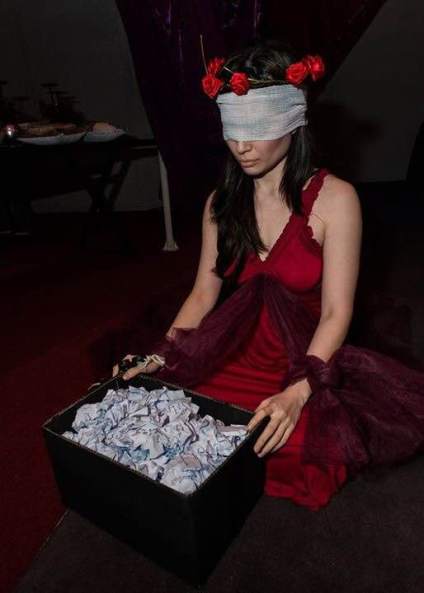
This was one evening devoted to reveling in the risqué, to pushing the boundaries of the acceptable in a way that brought us back to the freer, more spirited Sixties. Remarkably, it had been organized by a group of middle-aged women as proper and as pedigreed as they come, people you’d normally associate with golf and afternoon tea. But the Likhaan ladies are also very fine writers in their own right, mentored by no less than Jing Hidalgo, and quite a few of them have taken classes with us in UP, so it was no surprise to find them indulging their subversive side.

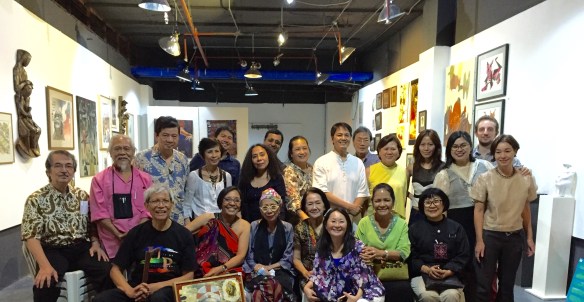
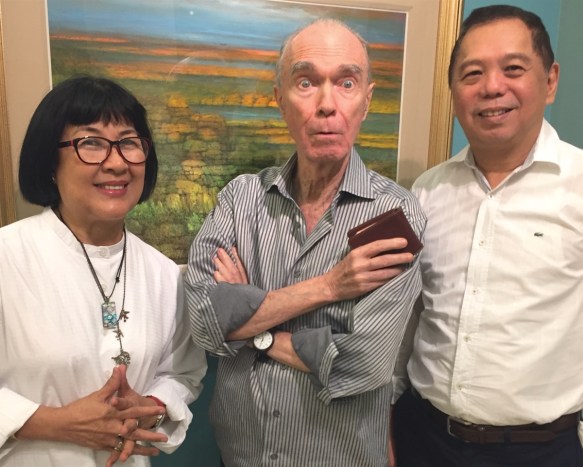
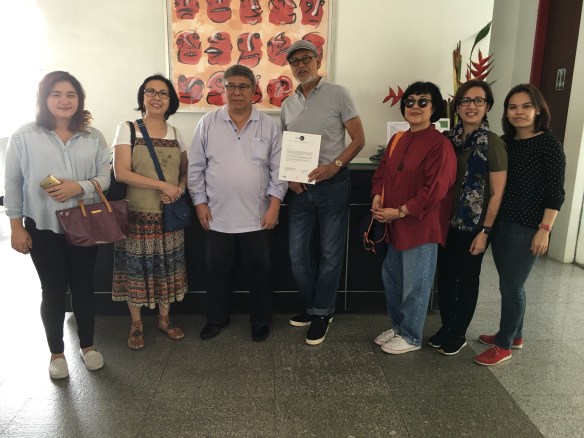
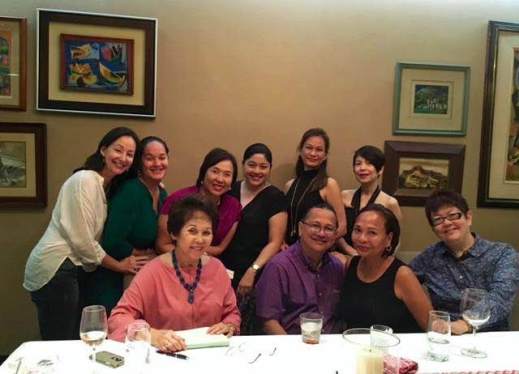
I’d never been to the venue at the Green Sun on Chino Roces Avenue Extension, and when Beng and I got there last March 5, we expected to walk into just another hotel-and-restaurant lobby setup. Instead, a large corner of the place had been transformed, just for the evening, into a virtual bordello, with ladies in bare backs and slinky black lingerie well, slinking around. When I found my bearings, I was glad to run into and to chat with old friends like writers Charlson Ong, JB Capino (on a home visit from Illinois, where he’s been based), Carla Pacis, Cecille Lopez Lilles, Mabek Kawsek, Linda Panlilio, Bambi Harper, and Cesar Aljama, as well as BenCab and Annie Sarthou.

Most of the readings proved appropriately racy, and I had to explain that I had come as a bashful patron, choosing to read something fairly short and chaste. But elsewhere in the room, something smoky and sexy was going on. We had to leave a little early for another commitment that evening, so I asked Likhaan Foundation’s Chichi Lizot, the writer-translator busybody behind the project, to tell us what happened next, and how they put on such a good show in the first place. Here’s Chichi’s summing-up:

“We had heard of ‘poetry brothels,’ not only in New York and Paris, but also in other parts of the world. Were we ready for it here? The idea of presenting poetry, bordello-style, in a land of taboos was both daunting and exciting. It was then that ‘Wordello,’ coined by a poet and friend who joins some of us for drinks every so often, RayVi Sunico, was born.

“Working on the concept, pinning down sponsors, inviting poets, and finding a venue accessible to all began six months ago. Creating and feeding our social media sites got going in December. A handful of active members found friends along the way willing to help, spurred by the untrodden approach towards literature. There is something about the forbidden that excites.
IMG_7972.JPG

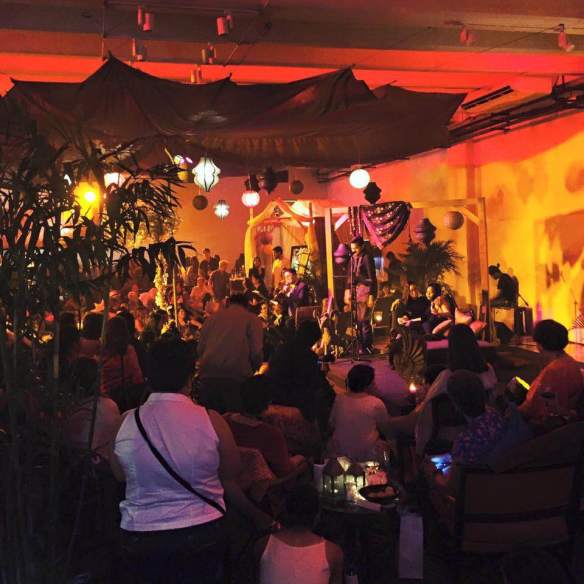
“Then came the evening of Wordello. Stepping into its entrance of beaded curtains after going through the ultra-modern corridors of Green Sun was like being transported into a secret world—of red, orange and magenta, of incense, alcohol, and erotica. It was a den of iniquity. It was Moulin Rouge—and much more. There were candles and Persian lamps. Carpets. Palm trees. Griffins standing guard. And in a cage, a masked executioner wielding an axe.

“The youngest in the audience must have been fifteen, the oldest, ninety-two. Some came in their chauffeur-driven imports, the others in jeepneys—any clothed, or rather, unclothed, comme il fallait. And as they hobnobbed with friends and strangers alike, they discovered a tarot reader of a monk in a nook somewhere. In a tent draped in extravagant silk, a body calligrapher was engrossed in a woman’s back, oblivious to spectators. Books and art pieces were up for grabs in different corners, incongruous yet fitting. The lively activity at the bar provided no respite to bartenders only eager to please. Omnipresent conversations thrived.

“And then from nowhere, a young poet delivered a line. Loud and clear. A male voice cried out from another corner. The room was stunned into silence. Yet another demanded attendance—this time female—delivering utterances from across the expanse of subdued light. Fifteen poets in a flash mob of sorts embarked us on a journey, harbingers all, of what was about to unfold. Their words were tame in comparison to the almost three hours of poetry, skits and the performing arts—mostly unbridled and unafraid. One or two in the audience left after the fifth number, scandalized. Most stayed, to either endure or embrace the words spoken by the inimitable and the sans pareil, and the fledgling.
IMG_7974.JPG

“The place was packed, denying access to waiters serving bar-chow. Seated comfortably in deep couches were the elderly. Many were happily relaxed on intricate pillows, risers, and carpets on the floor. Chairs had to be added in every space possible for the weary, but quite a few were content standing behind the bar or around divans, mesmerized.

“Sensei Shinobi, who performed the Japanese art of bondage on a defenseless but willing wisp of a woman, was saved for last. As we turned into voyeurs, watching with awe the dexterity with which Shinobi beautifully and artfully crafted rope around the young woman’s body, no one dared breathe. It was art in the sublime. And as he hoisted his model on a single metal ring that dangled from a scaffolding, and then twirled her around, a pin could have been dropped and heard.”

Bravo, Chichi, and merci beaucoup! Until the next iteration of what now deserves to be the year’s sauciest literary event.
IMG_7973.JPG


(Photos by Vidal Lim)


Penman No. 191: For Love of Art and Artists

FullSizeRender-4.jpg

Penman for Monday, March 14, 2016


MUCH AS I’d want, I can’t possibly go to all the literary and arts events I get invited to, so I’ve occasionally had to deputize my wife Beng (June Mercy Dalisay to others)—a painter and an art restorer—to do the kibitzing for me. Or, I should really say, for herself, because, as president of the Erehwon Art Foundation, she often has more immediate reasons than I do to meet with artist-friends and luminaries from the arts world.

One recent event I was truly sorry to miss was a special raffle and auction held last February 27 for the benefit of Beng’s dear friend Norma Liongoren, doyenne of the Liongoren Gallery, sister, mother, and confidant of artists young and old. The Church Café, a Bible study group founded by Norma, initiated a fund-raising project for her, called “For Love of Norma.” The group was composed of writers Alma and Mario Miclat, painter Imelda Cajipe-Endaya, writers Fe and Roger Mangahas, sculptor Julie Lluch, and Magel Cadapan, Norma’s gallery assistant and curator.

Norma’s artist friends donated almost 150 artworks to the cause, and Simoun Balboa, manager of the Sining Kamalig gallery in Cubao, lent the venue. A mini-concert and performance was put together by pastor Ed Lapiz, together with the Day by Day Ministry, Kaloob Dance Group, and Jerry Dadap’s Andres Bonifacio Concert Chorus.

The event proved a resounding success, with the spirited bidding raising a substantial sum for Norma, who very graciously and bravely left her hospital bed to join the party with her husband Fred to personally give thanks. The audience—all deeply moved by Norma’s gesture—included writers Gilda Cordero-Fernando, Menchu Sarmiento, and Wilson Lee Flores, gallery owner Silvana Diaz, artists Junyee, Gus Albor, Adie Baens Santos, Anna Fer, and Ato Habulan, diplomat Al Vicente, Quezon City busybody Ruby Palma, pulmonologists Rene Cheng and Julius Dalupang, activist Princess Nemenzo, GSIS museum head Ryan Palad, and journalist Jenny Juan, who emceed the event. Beng helped organize the auction-raffle, which lasted well into the evening, along with businessman and art collector Sonny Go.

IMG_8407.jpeg

A few weeks earlier, Beng also attended a media event organized by her friend Ricky Francisco, an independent curator and fellow conservator, at the Fundacion Sanso in San Juan. This time I’ll let Beng’s words speak for themselves:

“It was a sunny afternoon when I walked up the steps of the new and modern building of the Fundacion Sanso. I passed through a lobby with minimal furniture but glimpsed lovely watercolor paintings that filled the walls.

“I was late and the media event had started. I tried to be inconspicuous and sat between sculptor Toym Imao and a dignified elderly gentleman who turned out to be the artist himself, Juvenal Sanso. He looked at me and smiled. I smiled back and said a few words. He didn’t say anything and just nodded his head. Later I would know why.

“Gilda Socorro Salita, managing director of Fundacion, briefed the guests and media people on the series of events for the celebration of Sanso’s 70th year as an artist. The retrospective includes art exhibits at the Ateneo Art Gallery, the Vargas Museum, and the Lopez Museum. By the time this report comes out, the first in a series of exhibitions will have started, entitled ‘Other: Zobel and Sanso,’ an exhibition of prints and drawings at the Ateneo Gallery. This exhibition is free and runs until May 20. As a memento of the afternoon, the media kits given to everyone included a charming bookmark lifted from an old plate and printed on cream paper by Pandy Aviado.

“The guests began to leave but I decided to stay behind so I could talk to Sanso some more. But it was Ricky Francisco and gallery owner Jack Teotico whom I found myself with. Jack was one of the founders of the Fundacion, which serves as a repository of Sanso’s personal collection of artworks, books, and other mementos representing seven decades not only of creative work but also of travels and lasting friendships nurtured and preserved despite great distances. An old friend from our UP days, Jack invested not only funds but also much time and effort in gathering good people to run the gallery and museum.

“When I asked Jack why the artist seemed to have a hard time hearing, Jack told me the story of how, during the Second World War and when there was heavy fighting between the Japanese and Americans in Manila, a bomb landed just a few feet away from Sanso. He sustained injuries on his arm and still has tiny bits of shrapnel embedded under his skin. However, his hearing was greatly affected, and he remains practically deaf on the left side.

“The afternoon settled quietly into dusk as I was transported to many places and events from stories Jack and Ricky narrated—Sanso as a child of an affluent family in Spain, his country of birth; the blue-eyed Sanso as a young boy in Sta. Ana, Manila speaking fluent Tagalog, playing with boys of his age and forging strong friendships with his playmates, especially one with Henry Sy; Sanso as he diligently worked on his drawings with his teacher Alejandro Celis; Sanso as a student at the UP College of Fine Arts in Padre Faura and his friendship with artists Araceli Dans and Larry Alcala; and his entry ‘Incubus’ winning first prize in a competition held in the 1950s and sponsored by the Art Association of the Philippines then headed by Purita Kalaw-Ledesma.

“It was time to leave but before I did, I treated myself to the mesmerizing display of visual delights that represented Sanso’s beautiful watercolors from the Brittany series as well as the paintings representing memories of Parañaque and Cavite. Sanso’s haunting and mysterious images in the retrospective Elogio de Agua or Hymns to Water keep running like a lovely brook in a quiet corner of my heart. The exhibit can be viewed until October 1st at Fundacion Sanso, 32 V. Cruz St., San Juan City, Metro Manila.”

Many thanks, Beng, for that glowing report, which makes we wish I had been there to chat with the artist (and now I’ll know to stay on his right side). I’d always been engrossed by Sanso’s dark waterscapes and their vegetal inhabitants, made even more intriguing by the total absence of human figures.

IMG_8042.jpg

I did, however, tag along on a day trip up to Baguio last week with the folks of the Erehwon Art Foundation led by Beng and the foundation’s chairman, Boysie Villavicencio, on a very special mission: to receive the donation of an etching press to the foundation by none other than National Artist Benedicto Cabrera. I’ve been a frequent guest of Bencab’s at his museum because UP’s summer writers’ workshops have always begun with a visit with Ben (except this May, when we move to Los Baños), and I’ve watched that museum grow from a few stakes in the ground to the breathtaking complex and tourist attraction that it’s become.

Bencab was as gracious as ever in meeting us, and his donation of one of his two etching presses will be a great boost to Erehwon and to other Filipino printmakers. The press used to belong to National Artist Arturo Luz, who gave it to Ben in the 1990s. Erehwon is now planning a printmaking workshop with Fil de la Cruz, Ambie Abano, and other noted printmakers leading novices into the art.

As a former printmaker myself, I just might reignite this old passion, this fascinating interplay of paper, ink, and metal. It was at the old Printmakers Association of the Philippines (PAP) workshop and gallery on Jorge Bocobo in Ermita that I met Beng in the early 1970s, so without art and a shared love of it, we’d never have married, and this column-piece would never have happened.

Penman No. 190: A Makati Staycation

IMG_7988

Penman for Monday, March 7, 2016


THE WORD “staycation” must have been invented for people like my wife Beng and me, who now and then like to laze around in a hotel away from home, though not too far away that we’d have to book a flight or take a long bus ride. For those who’ve been living under a rock, a “staycation” is defined as “a holiday spent in one’s home country rather than abroad, or one spent at home and involving day trips to local attractions.”

For us Pinoys, a staycation is halfway to heaven. It’s neither home nor Hawaii; usually, it means parking the car and one’s brood in a local hotel, then spending the weekend pigging out on restaurant fare and TV marathons, scouting the nearby shops, and flopping around in the pool. So it’s not free, but it won’t break the bank, either.

Of course, there will be people who—for perfectly good reasons—will ask, “Why even bother? Why not just stay at home?” Yes, sure, home won’t cost you a thing, but that won’t do what a staycation does, which is to play and pretend for a blessed couple of days that you’re somewhere or someone else, like a tourist in your own country. A fancy word critics might use for the experience is “defamiliarization,” which is looking at the same old things with new eyes, producing unexpected effects.

Well, Beng and I got a pleasant dose of defamiliarization a couple of weekends ago when a friend generously passed us a staycation package that she and her husband couldn’t avail themselves of, and we found ourselves at the door of a hotel that we’d never really noticed before, in a neighborhood we’d never really lived in before.

The neighborhood, of all places, was Makati. Both steadfast northerners, Beng and I have lived in Quezon City nearly all our adult lives, and crossing Guadalupe Bridge—despite the many thousands of times we’ve done it for business and pleasure sorties to the south—still means crossing a psychological barrier. Makati was always just a place for shopping or for work, or otherwise for attending some bash at a big hotel. And I realized that until that weekend, it had probably been at least 15 years when we last slept over in Makati, thanks to our daughter Demi who was then working for a big hotel chain.

So it was about time we got a bit cozier with our southern metropolis, and off we went to the City Garden Grand Hotel at the corner of Makati and Kalayaan Avenues, a 33-storey, 300-room structure that I vaguely remembered seeing rising but had never stepped into. (An older and smaller cousin, the City Garden—minus the “grand”—was just across the street, and I almost mixed up the two.) The drive up the parking ramp was a bit steep and the elevator could have used a shot of adrenaline in its pulleys, but that would turn out to be the first and last of our complaints.

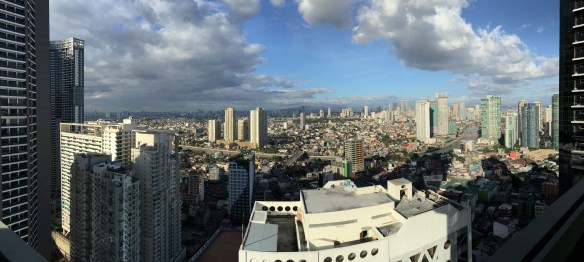
We were booked into a junior suite on the 30th floor, with a spacious living room and entertainment area (and a large sofa that could have easily slept one more) plus a bedroom with a king-size bed; the suite also contained one big bathroom and two toilets, two TVs, a full-size fridge, a microwave, and a coffeemaker—plus, let’s not forget that most essential of today’s amenities, free wi-fi. In other words, it was a hotel easily at par with its four-star counterparts in Hong Kong or Singapore in terms of creature comforts. We were on the north side of the building, so throwing our curtains open revealed a vista we weren’t used to seeing—our part of the city, stretching from the Pasig to the hills of Antipolo.

IMG_7958.jpg

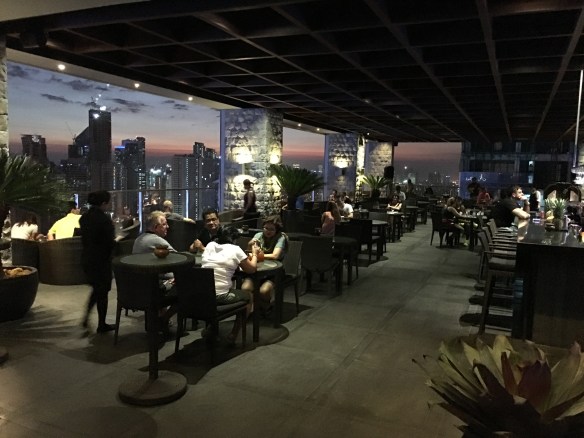
An even better view could be had just two floors up, as we soon discovered. The City Garden Grand’s piece de resistance is arguably its 32nd-floor Firefly roofdeck bar, which offers a nearly 360-degree perspective of Manila and its environs. (A terrace on the 33rd floor is used for weddings and other special events.) Looking southward at sunset, Laguna de Bay shimmered on the left and Manila Bay glowed on the right, while behind us the darkening north soon lit up like a bed of stars. With a cold beer in hand, the swimming pool bubbling in a corner of the roofdeck, a barbecue on the grill casting its savory spell, and the city twinkling at our feet, we felt utterly transported. The sense of estrangement was enhanced by the preponderance of foreigners in the hotel’s clientele—Australians, Brits, and Germans, it seemed to me, who were leveling up from backpacking.

Beng’s a huge fan of breakfast buffets, and even more than dinner, we both look forward to a hearty breakfast to start the day with, and will often judge a hotel by its breakfast buffet; we’d rather live with a smaller room than a skimpy spread. In this respect, the City Garden Grand passed with flying colors, offering a range wide enough to please everyone, from mushroom with truffles to crispy dangguit (and the menu rotated from one day to the next, providing even more variety).

But the best was yet to come, as we were to discover at dinner. Beng and I usually prefer to go Chinese, but as a set dinner at the hotel’s Spice restaurant on the 7th floor was included in the “Love and Luck” package, we decided to give it a try, despite my well-known and admittedly strange aversion to fine dining. Dinner proved a pleasant shock to my pedestrian palate, from the organic mixed salad of shrimp toast and edible flower in strawberry vinaigrette to the broccoli and garlic soup with beetroot foam and focaccia bread to the entrée of beef wellington with bone marrow sauce (Beng’s choice) or sous vide of New Zealand salmon with brown butter asparagus (mine). (I may be a culinary philistine, but I’m addicted to food and cooking shows, so I knew at least what sous vide involved and meant—in short, scrumptious.) The dessert of deconstructed strawberry shortcake with berry coulis and chocolate marble proved too much, on top of everything—we ordered just one and happily had the other taken out.

IMG_8001.jpg

We were so impressed that we asked to see the chef, and were even more floored when he turned out to be no imported Frenchman or Swiss but an entirely homegrown 24-year-old, Ariel “Yeye” dela Umbria, a proud graduate of NCBA’s HRM program.

The surroundings of a hotel are always part of the package, and Beng and I were glad to spend the weekend exploring Century City Mall (just a couple of blocks away) and the Greenbelt-Glorietta area (a longer 20-minute walk, but good for the exercise). Of course, the entire Kalayaan-Jupiter district is a prime restaurant and entertainment zone, which we’ll revisit at greater leisure one of these days.

Meanwhile, our warmest thanks to that friend for the weekend break and for giving us more reasons to enjoy the metropolis; 30 floors up, it never looked so good.

IMG_7991


Penman No. 189: Hearing the Mermaids Singing

TS-Eliot-by-flickr-user-Burns-Library-Boston-College-e1390926344763.jpg

Penman for Monday, February 29, 2016


I GAVE my undergraduate class in Contemporary American Literature (English 42) a special treat the other week. Luckily for them, while moving things around the house, I came across a book that I’d picked up at a sidewalk sale in San Francisco several years ago—very probably one of the best bargain books I’d ever bought, at $6.99. It was a big, fat book titled Poetry Speaks, and it included 3 CDs containing nearly 150 poems by authors ranging from Alfred Lord Tennyson, Walt Whitman, and T. S. Eliot to Langston Hughes, Allen Ginsberg, and Sylvia Plath.

Now, there are many such compilations of poetry you can find online, but what makes this collection unique is that most of the poems are read by the poets themselves—yes, including Tennyson, Whitman, and Eliot, from the earliest days of sound recording. I thought that by sharing the recordings with my students, I would give them a unique opportunity to hear not only some of the world’s greatest and best loved poems but also how their authors actually sounded.

And while—like the children we sire into this world—a poem is on its own once it’s published, subject to the reader’s interpretation, a poet reading his or her own work gives us a privileged insight into the poet’s mind and sensibility. We listen for the general tone, the pace, the emphasis the poet gives to certain words and turns of phrase, even the way he or she ends a line and segues to the next. These inflections personalize the poem, and turn it from lines on a page to a breath in the air.

Let’s not forget that poetry preceded writing, and that, in our ancient past, poetry was meant to be recited, not read. It performed both a ritual and an entertainment function. The old epics contained and transmitted the story of the race, and elevated everyday speech to something close to magical (all of Shakespeare’s plays, when you take a closer look, were written in iambic pentameter). Even in more modern times, some poets still wrote mainly to be heard. The book’s introduction quotes William Butler Yeats as saying that “I wanted all of my poetry to be spoken in a stage or sung…. I have spent my life in clearing out of poetry every phrase written for the eye, and bringing all back to syntax that is for the ear alone.”

Sadly, poetry’s public aspect has diminished over the past century. Not only are today’s poems mainly meant for the printed page; their messages are also much more private, to the point of inscrutability. The study and appreciation of poetry has become an essentially academic exercise.

This disjunction between performance and privacy probably explains why poetry readings can become boring, with readers failing to connect with the audience, who can’t figure out what the poets are saying. It’s difficult enough to understand the poems on the page, and harder still to understand them while being mumbled.

I’ve often noted, with some dismay, how many of today’s readers of poetry bleed the life out of poems by mouthing the words with a mewling preciousness or otherwise in a mechanical march, without an understanding of the sense of the piece itself. Most poems are infused with vigor, with an attitude that the poet has taken toward the work and perhaps even its presentation to the world. Critics will argue with this proposition, but it stands to reason that no one should understand a poem better than the poet himself or herself.

Understanding and public presentation, however, are two different things, and not every poet can give their poems the intensity or the nuancing they deserve. That applies even to some poets in the CDs: forgivably, Tennyson sounds phlegmatic in his rendition of what should have been a rousing “Charge of the Light Brigade,” but he was already 80 when Thomas Edison recorded him in 1889.

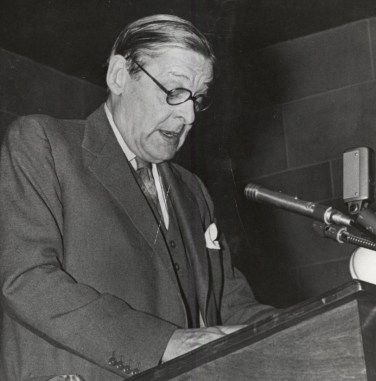
By contrast, Robert Frost (reading “The Road Not Taken” and “Stopping by Woods on a Snowy Evening”) and Sylvia Plath (reading “Daddy” and “Lady Lazarus”) sound resonantly clear and confident. T. S. Eliot reads all eight minutes of “The Love Song of J. Alfred Prufrock” in a thin, reedy voice—now totally British, a complete transformation of the former American born in Missouri who moved to England at 25—but somehow it’s what you expect of the man and the poem. I was in the bathroom as I listened to Eliot over the speakers at full volume, and found myself following along: “I have heard the mermaids singing, each to each…”

ACTIVITIES LIST.jpg

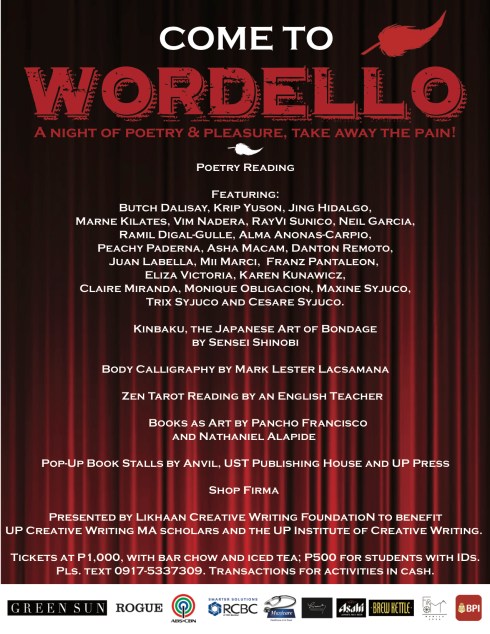
And if you’d like to hear more such mermaids, I’d like to invite you to “Wordello,” a very special and unique literary reading hosted by the Likhaan Creative Writing Foundation to benefit writing scholarships and other worthwhile literary projects. The Likhaan Foundation has been the UP Institute of Creative Writing’s steadfast partner in many an undertaking, and we can’t endorse Wordello strongly enough.

Inspired by the Poetry Brothel in New York, Wordello will happen on Saturday, March 5, 2016 in Green Sun, 2285 Chino Roces Ave. Ext., Makati. Doors open at 5 PM. Tickets will be sold for P1,000 (students with IDs come in at half-price), which will cover the show, drinks, bar chow, and special presentations. I was told to expect “a rope bondage presentation, calligraphy writing on the back of a woman, tarot card readings”, and so on, which all sound positively intriguing, but before your imagination runs riot, let me assure the prayerful that the good ladies of the Likhaan Foundation are as convent-bred as they come, but thankfully with a wicked sense of humor.

The invited readers include Krip Yuson, Jing Hidalgo, Marne Kilates, Vim Nadera, RayVi Sunico, Neil Garcia, Ramil Digal-Gulle, Alma Anonas-Carpio, Peachy Paderna, Asha Macam, Danton Remoto, Juan Labella, Mii Marci, Franz Pantaleon, Eliza Victoria, Karen Kunawicz,
Claire Miranda, Monique Obligacion, Maxine Syjuco, Trix Syjuco, Cesare Syjuco, and myself.

For more information, please check out https://www.facebook.com/wordelloph/info?tab=page_info or contact Chichi Lizot at chichilizot@gmail.com.

See you all on March 5 at Wordello—let’s make the spoken word rock!

[Image from jubilee-centre.org]


Penman No. 188: Risk and Reward in the Collectibles Market

14314401260_4553a0384a_b

Penman for Monday, February 22, 2016


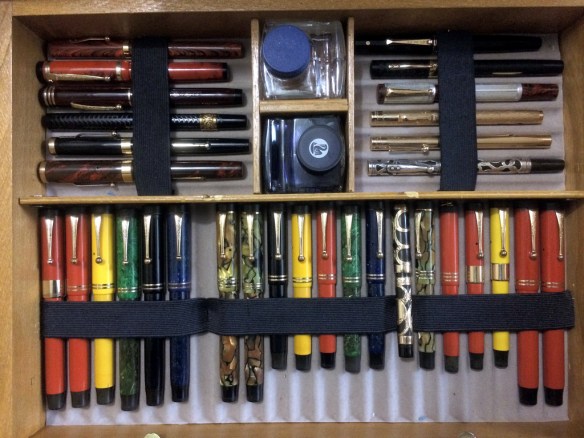
I’M GOING to be talking a lot about pens in the next paragraphs, so you might think of turning away if they hold no interest for you, but this is really about collecting and purchasing decisions as a whole, and could just as well apply to cars, watches, Star Wars figurines, and whatever else people hoard in their inner sanctums. If you’ve been bitten by the collecting bug, do read on.

Dr. Jonathon Deans is an Australian economist who specializes in the study of energy and commodity markets, and who teaches economics at the University of Newcastle. But away from his day job, Jonathon pursues a hobby with equal passion: collecting fountain pens. And unlike most of his fellow stylophiles (the fancy word for the addiction) who simply chase after and gloat over their inky toys, Dr. Deans has managed to merge his two interests by running a highly regarded blog on “Pen Economics” (www.peneconomics.com), tracking and discussing the vicissitudes of the global market for writing instruments.

Jonathon happened to be in town these past two months to accompany his partner Lisa, a Colombo Plan fellow and Development Economics student at De La Salle University, whose Economics department is headed by Dr. Gerardo “Bombit” Largoza—by uncanny coincidence, another fountain-pen collector and fellow member of Fountain Pen Network-Philippines (www.fpn-p.org). This happy confluence led to DLSU sponsoring a well-attended lecture two Saturdays ago by Dr. Deans at La Salle on “Adventures in the Fountain Pen Economy.” (He’s left for now, but will be back in April.)

Jonathon explained that central to the economics of the matter is the idea of price vs. value, and where value (how strongly we desire the product) exceeds price, a purchase will likely be made. I listened with great interest and some amusement to his observation that many buyers of modern pens are risk-averse. He admitted that he was one such person himself, and noted further that he valued a close relationship with his favorite pen dealer—even at the cost of paying a certain premium over regular prices—because of the many benefits afforded by such relationships, chiefly personalized service and unparalleled solicitude.

dgxBJDT

I couldn’t agree more with Jonathon (who gave a brilliantly comprehensive and insightful overview of the global fountain pen industry and particularly of our behavior as consumers). My amusement, however, came from my realization that while we thought alike on many important things (like our shared love of the Montblanc Ernest Hemingway, a pen considered a “holy grail” by many collectors), we differed in a few basic respects, particularly my greater willingness to take risks, to navigate the choppy waters of eBay to fish for rare species of vintage pens. But then, of course, I’m a poker player, so am more comfortable with taking calculated risks (and losing as well, because of over-optimistic calculations). My collection contains mostly vintage Parkers and modern Montblancs, so I found myself asking, what makes consumers favor one over the other?

The risks in buying, say, a 1928 Parker Duofold vs. a brand-new Parker Premier seem obvious. The modern pen should be shiny and trouble-free, and if it shows any problems or defects will be replaced under warranty. Being older than your grandfather, a vintage pen could be broken, leaky, warped, or missing parts, or otherwise difficult to operate, maintain, and repair.

So why do vintage buyers and collectors seem more willing to take more risks, and even court them? One trade-off is a generally lower cost. If the items work or if you can make them work, then they will likely be well worth their price. But there are also unquantifiable values to be added to vintage objects, values that help account for their allure: the cachet of age and relative scarcity or even rarity, the history of the object itself and its provenance, and materials and workmanship you won’t find on the modern factory floor.

In buying vintage collectibles, risk can be reduced by knowledge. For the highly knowledgeable buyer or collector, who will be aware of the common pitfalls of the vintage trade, the opportunity of acquiring a rare object at low or reasonable cost far outweighs the risk of receiving an object not as described, with no return option, or needing service. (Those risks will be even more diminished in direct physical sales, not online. But even online, the risks of buying pens long-distance—whether vintage or modern—are drastically reduced by eBay’s built-in money-back guarantee: if you don’t get the product as advertised, your money will be refunded.)

Indeed this ratio of risk to reward forms a great part of the thrill and satisfaction of vintage acquisition. While buying a new car from a dealership can be pleasurable, it’s hard to equal the excitement of finding, say, a 1952 Volkswagen Hebmuller tucked away in an old garage. While these two buyers will likely be two different people buying for different motives, many collectors will weigh both options, anticipating and investing in the collectibles of the future as shrewdly as they assemble the best pieces from the past.

With very few exceptions, vintage pens can only be bought on the second-hand market, where warranties and returns normally don’t apply. They are often sourced by enthusiasts and pickers in the wild, from estate sales, yard sales, resale shops, pawnshops, and small, out-of-the way antique shops. Eventually many get aggregated by dealers who sell online, on eBay and in their Web stores. The transition from a sale at the flea market to one concluded via PayPal is important, because here a certain measure of security can be afforded the buyer, not to mention the possibility of paying less for a prized pen at auction. (I’d typically pick up a $200 pen for $50, and resell it for $100 to finance other purchases.)

In fact, as far as eBay is concerned, I’ve probably had 1,000 transactions on eBay these past 19 years, and in the two or three times I’ve had to avail myself of its money-back guarantee, it worked without a hitch. This leaves just the risk of being disappointed and of being inconvenienced by the refund process.

Knowing this, the knowledgeable eBay buyer can take even more risks with the pen itself—that poorly photographed Vacumatic could be a sought-after Oversize, and therefore worth paying $50 more for. While the eBay guarantee will not refund the buyer in case the pen turns out not to be the desired Oversize (if it wasn’t advertised as such), it can give the buyer an extra boost of confidence to make a purchase, any purchase, in the way that gamblers may tend to play more aggressively in comfortable and well-secured casinos.

So yes, there are indeed more risks involved in buying vintage, and buying online; but the rewards, both physical and psychic, are also potentially great, and as Dr. Deans emphasized in his talk, when the buyer perceives value exceeding price, a purchase will be most likely happen, to the dismay of our bank accounts and hapless partners.

[Photo of Jonathon by Chito Gregorio]

Penman No. 187: Journalists and Fictionists

journalist-bw-laptop-o-e1282144424870.jpg

Penman for Monday, February 15, 2016


MY GRADUATE fiction writing workshop—CW 211—opened last month, and I was glad to see that all my 12 or so students were taking fiction with me for the first time. I don’t mind when students study with me over two or three semesters—especially the best ones you want to see through to their first book—but a fresh crop of faces is always a relief of sorts, because you can be assured that everything you say in class will be new to them.

As a first-day practice, I ask the class members to give a brief self-introduction, as a writing workshop is almost like a support group, and requires a certain degree of intimacy, so people should know each other right from the beginning. The self-intros also give me a sense of my students’ backgrounds, from which I might be able to get an idea—albeit a very tentative and imperfect one—of the kind of fiction I can expect from them.

This semester, I have several students coming from Journalism, and I told them, with a semi-serious laugh which they returned, that it was usually the journalists I had the most trouble with in Fiction class. Now why did I say that?

Let me explain, first of all, that I was a journalist myself, and still see myself as a part-time member of the press. Indeed when, in high school, I began firming up my ambition to become a writer, it wasn’t to become a novelist or a short story writer—it was to become a journalist, in the belief that there was nothing nobler and more exciting than to get the news and be the first to tell the world about it. I achieved that ambition—or at least the start of it—when I was hired as a general-assignments reporter by the Philippines Herald and later as a suburban correspondent by Taliba in 1972, as an 18-year-old dropout, but martial law put an abrupt end to that. It wouldn’t be until 20 years later, in 1993, when I was back in a newsroom, though no longer as a reporter but as an editorial writer for TODAY, and in 2001 as a copyeditor for the investigative magazine Newsbreak, about the same time that I began writing this Lifestyle column for the STAR.

That’s not much of a career as lifelong journalists go, but it’s been enough to leave me with a healthy respect for the work that journalists do, especially in comparison to that of the fictionist, which I became as well. Both are difficult, and require their own kind of discipline; neither is particularly remunerative, although journalism, if undertaken as a regular job, will at least provide a steady income, while fiction must remain a strictly part-time avocation for 99% of its practitioners in this country.

When I teach a class in Creative Writing, I always tell my CW majors that they should never feel superior to journalists, because they don’t know what it’s like to have to find, write, and turn in a story every afternoon of every working day. Creative writing students like to bitch that they don’t have enough material, enough inspiration, and enough time to finish their magnum opus (which at the end of all that whining might turn out to be profoundly underwhelming). Journalists can’t even complain about these things, because they simply don’t factor into the making and delivery of a news story. Material? That’s for you to find or create. Time? A few hours. Inspiration? Your paycheck. I’ve commiserated beerside with journalist-friends over the travails they had to suffer to get a particular story—but only after the story was sent in, and not before.

So with all this admiration and respect for journalists and their job, why do I say they give me problems as fictionists? I’m generalizing here, of course, but the answer isn’t too far from from what, ironically, is a journalist’s chief virtue: they can’t let go of the facts. They find it very difficult to switch to a make-believe mode, and even when they do, their stories are thinly-disguised newsfeatures wanting in compelling, internally driven drama. When you point out a problem in the narrative—say an unlikely turn in the plot—the journalist’s defense will invariably be, “Well, that’s what really happened!”

Unfortunately, in fiction, “It really happened” just doesn’t cut it. What’s real in fiction is what’s on the page. Real life might provide the material and the inspiration for the fictional story, but that story has to acquire a life of its own, regardless of its origins in fact. This is why I tell my students that everything they submit to the workshop is fair game for criticism, and that they can’t and shouldn’t take it personally when someone comments that “I think the mother in this story is very narrow-minded and selfish,” even if that mother was based on one’s beloved mom—it’s “the mother on the page,” as I call that character, that we’re following, believing, and either rooting for or disliking.

And the first day of fiction class is also when I trot out one of my favorite quotes, paraphrased from Mark Twain: “Of course fact is stranger than fiction; fiction, after all, has to make sense.” Just think about it: we accept incredible reports in the news that we wouldn’t buy for a minute in a short story, even in a fantasy, because we expect fiction to adhere to an internal dramatic logic, whether it’s set in a garage or in a galaxy far, far away. The factual world has no such givens; things just happen, often for no apparent reason. That’s why fiction had to be invented: to make sense of life in the raw and all of its inconsistencies, paradoxes, and mysteries. (The opinion writer aims to do that as well, but on the plane of the abstract, using words like “justice” and “freedom”, which you normally won’t find in a well-crafted story; they’d be implied.)

If it’s any comfort to the fact-loving journalist, there’s another kind of writer whom I’ve discovered to have equal difficulty transitioning to fiction: the poet, for whom every word and turn of phrase is painfully precious, and a ten-page story might as well be an epic. But that’s fodder for another time.


[Image from thenextweb.com]

Penman No. 186: What the Fax?

Fotolia_1659378_XS.jpg

Penman for Monday, February 1, 2016


A CASUALTY of the recent upgrade in my home-office setup, which I reported on last week, turned out to be something I hadn’t given much thought to in a very long time—my fax machine, or rather the fax part of my multi-function printer. Moving to a new Internet service provider also happened to mean giving up my old telephone line—one which was practically dedicated to faxing—and I realized, while plugging this line in and unplugging that one, that I really didn’t need a fax machine anymore. Who still sends faxes these days, anyway?

I tried to think of the last time I’d received a truly useful fax message, and I honestly couldn’t remember when that happened. A few years ago, my wife Beng would still receive faxed invitations to bid on certain government contracts for her art restoration business, until I told her to tell her senders that they were better off just emailing the invitations to her, which I suppose they did, because the faxes stopped. I even used to get spam faxes advertising car loans and real estate deals, which was the most annoying thing, because unlike junk email, faxes ate up your paper and your ink.

I’ve written requiems in this corner to late, lamented technologies, especially those having to do with writing and communication. In July 2011, I wrote one for the typewriter, noting that an Indian outfit called Godrej and Boyce—the last company in the world still making typewriters—was closing shop. In August 2013 I performed the same sad ritual for the telegraph (which sent its last full stop, again, in India). For a time, the fountain pen seemed fated to be tossed to the dustbin, thanks to the advance of the ballpoint, the rollerball, and of course the computer, but it’s undergone a remarkable resurgence, although more as a fashion accessory than a writing tool. We can write odes to the newsroom telex, the rotary phone, and the pager (I still have my EasyCall beeper, and when I stuck a battery into it the other day, just to see, it still gave off a faint green glow).

But the fax? Does anyone and will anyone truly miss the fax?

Before we try to answer that question, let’s take a long step backward and recall how the fax (short for “facsimile”) was born—in 1843, from a patent applied for by Alexander Bain, a Scottish inventor who’s also credited for the electric clock. The patent was for “improvements in producing and regulating electric currents and improvements in timepieces, and in electric printing, and signal telegraphs,” and one of its results was a contraption, using two pendulums, that transferred an image line-by-line from one to the other. Frederick Bakewell improved on the idea with his “image telegraph” in 1848, and in 1861, the Italian Giovanni Caselli did both men better with his “Pantelegraph,” the first commercial fax service between Paris and Lyon—more than a decade before the first working telephones! (Thank you, Wikipedia, for the factoids.)

The heyday of the fax was back in the 1980s, and that’s where many of us baby boomers will remember it from—particularly the smelly rolls of chemically impregnated paper that you needed to keep feeding the machine (and the Xerox machine in the corner, which wasn’t quite ready to take plain paper yet). Having a fax machine at home meant you were busy and important, and having a phone line dedicated to it meant you were doubly busy and doubly important. For senders, the thing to say was “Fax tone, please!” and if your listener heard you right, you got an ear-ache from the resultant screech.

We were still faxing in the 1990s, by which time I was an editorial writer and Lifestyle columnist for the newspaper TODAY. That meant I had to send my piece in by fax—email and Word attachments hadn’t quite caught on, yet. I remember what a thrill it was to pair my computer—a PowerBook 2400c, the precursor of today’s ultrathin MacBook Air—with my Nokia 6210, through the wonders of infrared. You had to line up the two devices so that their IR ports matched exactly, and in those days before Bluetooth and wi-fi, it was the coolest thing, giving you bragging rights as a “road warrior” in the “Roamin’ Empire,” as the computer and connectivity ads of the period trumpeted.

And then email and PDF happened, and suddenly all you had to do was to scan or even photograph a document—or even more simply, save it as PDF—and then to drag and drop it into your outgoing message. Like photographic film, faxing lost its reason for being in a historical instant, at least for most users.

There are, to be sure, holdouts who insist that reports of the death of fax are grossly exaggerated. There’s a piece online with exactly that title that even points out that instead of dying out, faxing has actually grown in recent times. “In 2010,” says the report, “the computer-based fax market was roughly $350 million per year, according to Business2Community.com. What’s the size of the market in 2013? The market for computer-based faxing is $620 million. Yeah, fax is still around. There are good reasons for the growth in electronic faxing, too. While e-mail has subsumed much of the role faxing used to play, fax technology still offers a number of benefits. These include the need for a paper trail, security, ease of use and business processes that are built around fax and are easier to keep alive than to replace with new processes.”

Take note, however, that the article says “computer-based” or “electronic” faxing, no longer the old method that required a special machine. It goes on to explain that “Just as phone calls have migrated to voice-over-IP (VoIP), fax has migrated to fax-over-IP. This digital version of the fax cuts out the need for paper and fax machines altogether, becoming a form of digital document that acts like e-mail but integrates more fully with older workflows and fax technology.” So FoIP (the “IP” is for “Internet protocol”) seems to be where Bain’s pendulums have gone, and its users argue that there are still things today’s fax technology can do—like provide digital receipts—that regular email can’t (a dubious argument, it seems to me).

As for myself, I’m glad to be rid of that old whine-and-screech. If you have a document for me, email it to me, or upload it to DropBox, and we’ll be saving a small stand of trees and a tub of ink in the process. I’m prone to weeping in remembrance of things past, but losing my fax machine simply leaves me radiant with the glow of digital liberation.

[Image from hlsbs.com]


Penman No. 185: Wired for Fun

IMG_7932.jpg

Penman for Monday, February 1, 2016


SOME INTERESTING changes took place in my home-office environment over the recent Christmas break. First, as a gift to the household, especially my movie-loving mom, I got a multi-user subscription to Netflix. Second, because of Netflix, I signed up with a lifetime Virtual Private Network (VPN) service, which, among other benefits, allows users to watch US-based offerings (like Netflix, which very recently opened a limited Philippine operation, largely dispensing with the need for VPN). Third and perhaps most importantly for the long run, I ramped up our Internet connection, from the old 5 Mbps to a whopping 100 Mbps fiber-optic line that had just become available in our Diliman neighborhood. The setup then prompted me to acquire an Apple TV unit, which streams Netflix shows, among others, from the Internet to your HDTV set, completing the home-movie experience (well, throw in some popcorn and Coke for the full effect).

If you’re not too tech-savvy and if I’ve left you hopelessly confused by that exasperatingly jargon-laden paragraph, let me unpack it for you, as I’d explain it to someone like my mom. (I should add that my mother is unlike most 87-year-olds. She doesn’t have a computer, but she’s otherwise glued to four devices—her TV, her iPhone, her iPad, and her Android tablet. She loves playing vocabulary and bubble-type games, which keep her brain cells humming, on top of the 20-minute walk she takes every afternoon.)

“Home office” refers to the fact that over the past three decades, with the rise of the Internet and indeed its indispensability to modern living, more people have been able to work at home, or to bring much of their work home. I teach at the university, but most of my writing is done at home. My wife Beng also has her art-restoration studio at home. This means that we have to invest in equipment and technology that will allow us to get our work done, and done well, right where we are.

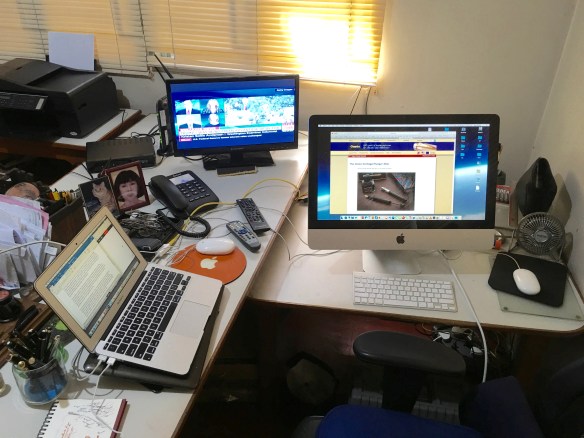
For me, that means several computers—I use a small MacBook Air as my main workhorse, portable but powerful, with a very fast processor and a large hard drive; for a backup, I have an older, larger MacBook Air, a bit slower, but good to have around just in case the main machine falters or is in repair; I also keep an iMac on another desk for when I need to see larger images, or to have fun surfing (or playing online poker) while I work. Yet another screen is almost always open at my desk: a tabletop TV, on which I keep up with the news.

All that hardware would be of little use without a fast and reliable Internet connection, and here I was lucky to be living in an area now covered by PLDTFibr, which ran a promo over the Christmas break offering a 100 Mbps service for six months (it’ll slide back down to 50 after six months, but you can’t sneeze at 50 Mbps either—and no, I’m not getting anything from the company for this plug, not even a coffee mug).

What does “100 Mbps” mean for the consumer? Webpages load in a snap, instead of crawling down the screen as some circular icon keeps spinning; you can download a 1-gigabyte software update in minutes rather than hours or overnight, as I used to be resigned to; and you can upload large files, say to DropBox or YouTube, without having to knit a doily while it loads. Is it expensive? It cost me only P500 more to level up from my old 5 Mbps service from another provider, which I had been a faithful client of for over ten years.

The best beneficiary of a fast Internet connection, however, is streaming, which is the way those who sell movies and music, like the iTunes Store and Netflix send you their material over the air—in one continuous flow, like you were watching a movie at the theater. But that’s more hopeful than achieved for most Pinoy consumers, because, as of a year ago, the Philippines had the third-slowest average Internet speed, at about 2.8 Mbps, in Asia, according to the folks at Akamai, who keep tabs on these things (No. 1 Korea averages 23.6 Mbps).

That means that your screen will very likely freeze just when things get really interesting in the movie, as your provider struggles to bring up the rest, like those guys who ran reels between theaters in the old days. (Lilia Ramos Shahani wrote a great piece on this for the Star, “Why Is Our Internet So Slow?” last August.)

And there’s nothing better to do with streaming than watch movies and TV shows from where they’re stored—the servers of US-based Netflix, for example, which we used to be able to access only through VPN. (Netflix didn’t want people in countries it didn’t serve—like the Philippines, until recently—to see Netflix shows. The Internet being what it is, some smart folks found a workaround, VPN, which tricks the Internet into thinking that you’re in Tampa, Florida instead of Tuguegarao, Cagayan.) There’s been a lot of argument over whether VPN-enabled Netflix is illegal, but it isn’t piracy—you still pay for Netflix, but are simply diverting its stream to your barong-barong. (I pay about $12 or less than P600 a month for a four-user license.)

That argument is now moot, as Netflix has officially added the Philippines to its serviced countries, albeit with a thinner menu; you’d still need to turn on your VPN to get the full US package (Netflix, however, has rethought its toleration of VPN, so that option might not last. I’m not too bothered, as I value VPN more for the PBS documentaries I like to watch on my iPhone in some traffic jam or over long, boring meetings. VPN is also good for your digital security, masking your real IP address from snoopers.)

The piece de resistance in this upgraded setup is the Apple TV, a small black box that uses wi-fi and your TV’s HDMI port to let you enjoy Netflix, YouTube, and other Internet video—even your own library of movies, music, and photos—on your big TV, instead of squinting at them on your phone or laptop. It isn’t cheap—the gadget costs a bit less than P9,000 for the basic fourth-generation model—but there are alternatives. Chromecast, a thumb-sized thingy made by Google and marketed by Globe for about P2,000, will hook you up to Google Play Movies, YouTube, Spotify, and other entertainment fare.

I’ll admit, it’s hard to think of work when you’re this wired for fun, but you can also say that this what makes all that work worth it—digital Disneyland at the click of a remote-control button.


Penman No. 184: Degrees and Diplomas

MI1107TAGAAXX_lg.jpg

Penman for Monday, January 25, 2015


IT WAS with much interest that my eye strayed last week to a story on the BBC website with the headline ‘Penguin scraps degree requirement.” The article went on to report that publishing giant Penguin Random House—presumably one of the world’s most literate employers—was no longer requiring applicants for any job in the company to show college diplomas.

“The firm wants to have a more varied intake of staff and suggests there is no clear link between holding a degree and performance in a job. This announcement follows a series of financial companies dropping academic requirements for applicants. Neil Morrison, human resources director, says they want talented staff ‘regardless of background’,” the article noted. The report went on to say that leading accounting firms such as Deloitte and Ernst & Young had also relaxed their educational requirements, with Deloitte changing its selection process so recruiters would not know what schools its applicants had attended.

It’s a novel idea that sounds fair and makes sense, but I’m sure it will take some time before Philippine businesses catch on, as obsessed as we Pinoys are with college diplomas, especially those that come from certain schools. Just scan the Sunday classifieds in any local newspaper—for jobs of any real economic and social worth, your typical non-equal-opportunity employer will demand a piece of parchment from a “Class A” university, which will count more than any previous experience you may have acquired.

Arguably, that wasn’t always the case. We baby boomers belong to a generation—probably the last one—for whom gutsiness and scrappiness was still the best way forward, rather than degrees and diplomas. Just ask any taipan how many of them have Wharton MBAs. One of them whom I happen to know, because I’ve written his family’s history—Filinvest founder Andrew Gotianun Sr.—didn’t go beyond two years of college at San Beda, and had to drop out because of his father’s unexpected demise. His wife Mercedes, Filinvest’s other dynamo (Andrew was the visionary, Mercedes the executor), graduated from UP with a BS in Pharmacy, magna cum laude—but what led to her success as a banker wasn’t college but streetsmarts. “I made friends with the owners of banks abroad and convinced them to lend me their operations manuals,” Mercedes told me, “which we then adapted to local conditions. That’s how Family Savings Bank began.”

Indeed it used to be that you could get places without a college degree, as long as you had talent and guts (you needed both—just one wouldn’t have done it). Among writers, in particular, a degree was a bonus, maybe even a demerit, in those pre-MFA (Master of Fine Arts, the writing degree of choice) days. The old conviction was that, to know how to write, you had to know how to read, and the serious would-be writer read a lot outside of school without having to be told. The real test of the writer was, well, in the writing—in the quality and the consistency of one’s craft, rather than in the number of English units one could present.

There was no finer example of this than the late National Artist NVM Gonzalez, who never finished college (he did go to National University), but who went on to a distinguished writing and academic career here and in the US. The late journalist I. P. Soliongco was another such titan in his field. My friends Pete Lacaba and Krip Yuson, both dropouts by choice, deserve honorary PhDs for all their work as far as I’m concerned—not that they would care—but more valuable is the fact that they’ve been asked to teach and to share their expertise with younger Filipinos.

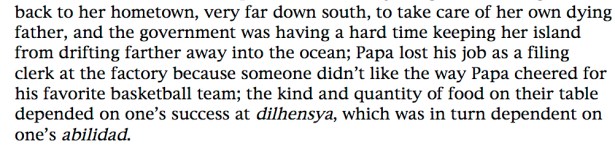
My own dad Jose Sr. also dropped out of college—he was the smartest kid of his time in our province of Romblon and could have gone on to become a de campanilla lawyer, but was too poor and also perhaps too confident in his abilidad to go the full distance, and soon fathered me and my four siblings. Seeing him write as well as he did—he was a keen reader of novels and magazines—I grew up believing that I didn’t need a college degree, either, to get where I wanted, so I dropped out of UP in my freshman year to get a job as a newspaper reporter. My younger brother Jess, also a talented writer, obviously had the same impression and did exactly the same thing, dropping out of UP before landing jobs with San Miguel’s PR department and later becoming editor-in-chief of the Mindanao Cross. I went on to work with the National Economic and Development Authority for ten years, even earning a graduate UP diploma in Development Economics as a special student and working on special detail with the United Nations Development Programme, doing project studies. I began writing plays, stories, and screenplays and winning Palancas, and felt that I could have gone on for life with little more than my 21 undergraduate units in English and 30 grad units in Economics.

But one day in 1981—after attending the Silliman Writers Workshop and falling under the spell of Robert Graves—I decided to go back to school as a returning sophomore, at the age of 27. I found school exhilarating, and later quit my job to study full-time, with my wife Beng taking up the slack. To be honest, it wasn’t the fiction that roped me in, but the poetry of Sidney, Wyatt, Shakespeare, Dylan Thomas, Philip Larkin, and James Dickey, among others. Having tasted such ambrosia, I craved more, and so I went on to Michigan for an MFA and to Wisconsin for a PhD, both on fellowships, making up for lost time (BA at age 30, MFA at 34, PhD at 37). I told myself that there was nothing more that I wanted to do for the rest of my life but write, teach, and spend time with family. There was, I must say, a great material and emotional cost to these degrees, which had I known it then I might not have been willing to pay. But with the deed done, I can’t regret the fact that these degrees have allowed me to move up the job ladder and gain the respect of people who haven’t the faintest idea what I do.

I finished college not so I could get a good job, which I already had, or so I could append little letters to my name, which I hardly use outside of work. (No self-respecting writer, as far as I know, has ever flaunted his or her PhD; you’d simply be laughed out of the place.) I did it for love—for the love of knowledge, especially the kind of knowledge for which there exists no practical utility and which is therefore the purest and sweetest, and for the love of my parents, who deserved some payback for all their hard work and sacrifice.

Make no mistake: I do agree with Penguin in broadening their search for good people to those without diplomas from Harvard or Oxbridge to show. You could miss out on a Steve Jobs, a Bill Gates, or a Mark Zuckerberg that way. But you could also always drop out of college, do your thing, and go back when you have the time to finish up—like Steven Spielberg, Oprah Winfrey, and Shaquille O’Neal did. Make that “Dr. O’Neal”—Shaq even went on to pick up a doctorate in Education in 2012.

And what about my brother Jess? He went back to school, too, earning a BA in Journalism at age 49, and a Bachelor of Laws at age 55. A published author, he now practices and teaches law, completing our father’s dream. Sometimes, those degrees and diplomas do count—for all the right reasons.


Penman No. 183: Why I Choose to Italicize

Abilidad.jpg

Penman for Monday, January 18, 2016


ONE OF the more interesting sidelights in our discussions at the NVM Gonzalez Centennial Workshop in Mindoro a couple of weeks ago had to do with the seemingly small issue of whether or not to italicize Filipino and other non-English words in an English text.

The conventional practice, of course, has been to italicize words like utang na loob, bagoong, kaibigan, and so on. That’s explicitly embodied in editorial stylebooks employed by such publications as The Economist, which hews to the policy that “FOREIGN WORDS AND PHRASES, such as cabinet (French type), dalits, de rigueur, jihad, glasnost, Hindutva, in camera, intifada, loya jirga, Mitbestimmung, pace, papabile, perestroika, sarariman, Schadenfreude, ujamaa, should be set in italics unless they are so familiar that they have become anglicised and so should be in roman. For example: ad hocapartheid
 a priori
 a propos
 avant-garde, etc.”

Not everyone, however, feels bound by this rule. Increasingly, over the past couple of decades, writers of color in both the US and the Commonwealth (and, yes, the Philippines) have chosen to resist and reject italicization, believing that doing so represents a form of acquiescence to the dominance of English, and of exoticizing one’s own language, making it appear quainter and therefore more artificially attractive than it should. It’s a political rather than a mere technical decision, a declaration of independence, as it were, from the strictures of style laid down by the old regime.

One of the most quoted sources for this position is the New York-based novelist Daniel Jose Older, who demonstrates in a YouTube video why italicizing Spanish words and phrases in an English text would sound silly in the real, spoken world.

This was brought up again at the recent NVM Gonzalez workshop, where half of the participants were Filipino-Americans who came over from the US. The workshop leader—the very capable fictionist Dr. Evelina Galang, who directs the creative writing program at the University of Miami—discussed the use of Filipino words in a mainly English text, and why glossaries (and, not incidentally, italics) are better dispensed with, leaving the writer with the responsibility of establishing or at least hinting at their meaning in context.

(Evelina has an essay devoted to this concern, and let me quote an eloquent passage from that piece: “As a girl who grew up hanging upside down on easy chairs with a book in her hand, I often read words—English and other words—that I did not understand. I rarely stopped to define them. Sometimes I wrote them down and looked them up later. (I was a geek, after all.) But more often than not, having stepped into a fiction John Gardner called ‘that vivid and continuous dream,’ and driven to know what happened next, I kept reading. Like Angel, I let the words wash right over me, I watched them working next to other words. I listened to them. I tasted them and felt the weight of them in my mouth. I imagined them surrounded by nothing at all. I followed them as they floated down the page, bumping into semicolons, swimming through parentheses, slapping up against em-dashes, evading italics, and falling right off the page. I read the words in context and, right or wrong, I gave the words their meaning.”

I agree perfectly with Evelina as far as contextualization goes. I’ve always taken it as a technical challenge to show what Filipino words like bucayo and manananggal mean without defining them in that direct but clumsy way that glossaries or footnotes provide. Importantly, Evelina went on to emphasize that these choices are, ultimately, for each author to make for his or her own good reasons, and that those choices deserve to be respected by other writers and readers.

As it happens, I’m one of the holdouts in the matter of italicization, and I premise my position on both technical and political grounds. First, in terms of readability, italics may seem intrusive—and if there’s too many of them in the text, that will certainly be true—but my pet theory is that it’s actually easier on the reader’s eye and mind to spot a non-English word coming up in the text and to prepare for it, rather than be surprised by something “foreign”, even if it’s one of our own. (Just imagine the confusion that words like “ate” (older sister), “pain” (bait), and “noon” (then) would make.) Personally, I don’t want my readers—especially in my fiction—stopping to wonder what specific words mean, which is why the older I get, the simpler my vocabulary becomes; I want the reader to grasp whole sentences, paragraphs, and scenes, and not to trip on individual words.

Politically, when I italicize Filipino words in an English text, I also mean to say that these words are special to me and to my culture, and I don’t want them to be diluted by a dominant foreign language, which is English. As far as I’m concerned, the whole book in English is already a translation of Filipino experience; most of the dialogue there was never spoken in English, in the first place.

I suppose it’s different when you’re writing in English as a minority in America, and you feel bound (as I would, in that situation) to claim and establish a parity between your mother tongue and English. And let’s face it—for many hyphenated minorities, especially second- and third-generation writers, English has become their mother tongue. When they write fiction about themselves, their characters will speak in English, and the odd Filipino word will be just that.

Indeed the issue goes beyond italicization; the question of when and how to use Filipino or other non-English words in an English text should be seriously pondered by every Filipino or Filipino-American (and Filipino-Canadian, etc.) writing in English, mindful that there are words and concepts in Filipino without exact translations in English, which might be better used as is. (And as Salman Rushdie once put it, “To unlock a language, look at its untranslatable words.”) However, one also needs to resist the urge to exoticize one’s writing by peppering it needlessly with native words and expressions just to add more “local color,” especially when ready translations are available.

I’ll go at greater length into matters of translation in another column-piece, but I’ll rest my case on this issue of italics for now, hoping that it adds a bit more asim to the global sinigang of language.